Buy EUR/USD from the support level of 1.1630 with a target of 1.1850 and a stop-loss at 1.1570.
Sell EUR/USD from the resistance level of 1.1810 with a target of 1.1500 and a stop-loss at 1.1900.
Technical Analysis of EUR/USD Today:
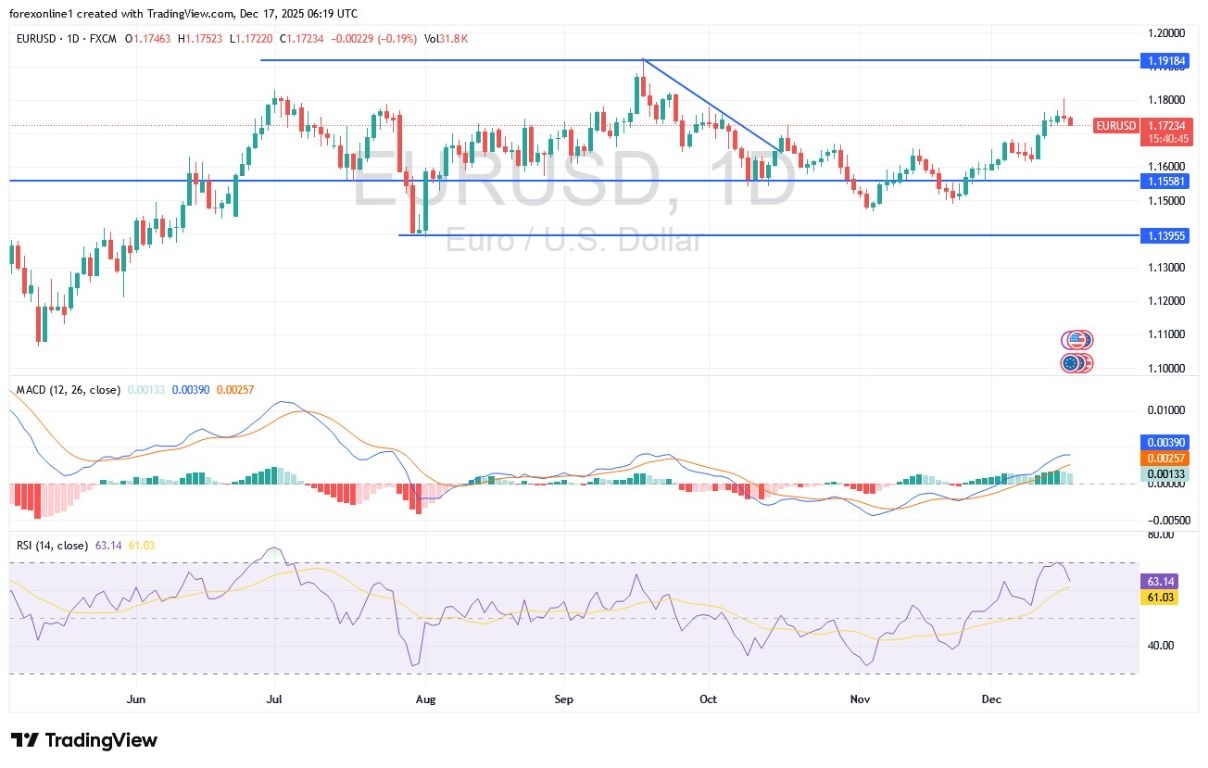
Based on recent performance, the EUR/USD pair has been witnessing a steady climb from its lows around 1.1610, following an ascending trendline that connects recent lows over the past month. According to reliable trading platforms, the pair recently touched a high of 1.1800 before retracing, and is currently testing a support level around 1.1730.
Simultaneously, Fibonacci levels drawn from the 1.1610 low to the 1.1800 high reveal potential support areas where the correction may find a floor:
The 38.2% Fibonacci level is at 1.1731. The 50% level is at 1.1708.
A significant pullback could reach the 61.8% Fibonacci level at 1.1685, which nearly coincides with the ascending trendline support and may represent a crucial turning point for the bullish trend to continue. If any of these Fibonacci levels or the trendline support holds as a bottom, EUR/USD could resume its ascent toward its recent high or even record new levels above the 1.1800 psychological resistance. Conversely, breaking below the 61.8% level and the trendline would signal weakening bullish momentum and could lead to a deeper retreat.
Additionally, The Stochastic oscillator is trending downwards from overbought territory, indicating that sellers are gaining some momentum after the recent rally. However, the indicator is approaching the neutral 50 level and still has considerable room to fall before reaching oversold territory, meaning the correction could extend further before buyers return.
Meanwhile, yhe Relative Strength Index (RSI) is moving downwards from its recent highs and is currently hovering around the 50 level. The index still has considerable room to maneuver before reaching oversold territory, so the price may continue to move accordingly as sellers dominate market movements in the near term.
Trading Advice:
We recommend selling the EUR/USD pair from above the 1.1800 resistance level without risk, while always diversifying your investment portfolio with several trading products in addition to the EUR/USD.
Factors Affecting EUR/USD Trading Today
During today’s forex trading, the EUR/USD pair may be affected by the European Central Bank’s (ECB) anticipated decision. It is widely expected that the ECB will maintain its current monetary policy, emphasizing its cautious, data-driven approach to any changes. However, any significant shift in its rhetoric could impact monetary policy expectations and the direction of the single European currency. EUR/USD trading today will also be influenced by the release of Eurozone inflation figures at 12:00 PM Egypt time, which will, in turn, affect the ECB’s policy direction. Regarding currency performance, the US dollar weakened after the highly anticipated US jobs report confirmed a slowdown in the labor market. While the US economy added 64,000 jobs in November, exceeding expectations of 50,000, this positive figure was the limit. The revised October report showed a loss of 105,000 jobs, while the unemployment rate rose to 4.6%.
The adjusted three-month job creation rate was only 22,000, highlighting the extent of the economic downturn and justifying the Federal Reserve’s interest rate cuts in an attempt to support the economy. Although the economy appears outwardly robust, the weakness in the labor market indicates an uneven pace of economic growth. Overall, the Federal Reserve’s further interest rate cuts reinforce expectations of a weaker US dollar in the coming weeks.
Vitamin D is an essential nutrient you mainly get from sun exposure. If you don’t get enough of it, some research suggests you could be at a higher risk of experiencing depression. However, research on whether supplementing with vitamin D can relieve depressive symptoms is mixed.
Vitamin D deficiency is common—affecting about 35% of adults in the United States—and is associated with several health problems.
For instance, lack of vitamin D is linked to cancer, cardiovascular disease, diabetes, multiple sclerosis, and autoimmune diseases. More recently, vitamin D has emerged as a possible cause of depression.
However, researchers have not determined definitively that vitamin D deficiency causes depression, though the two are linked. One large population-based study found an association between vitamin D status and depression in middle-aged adults.
The study results suggest that vitamin D deficiency and insufficiency may help identify adults who are at an increased risk of developing depression. Deficiency may also serve as a biomarker for people with depression whose symptoms persist despite treatment, meaning monitoring deficiency levels may help with depression diagnosis and tracking treatment progress.
Vitamin D supports several body functions and is essential for overall health. The vitamin helps your body absorb calcium and is an important component in developing strong bones and teeth.
Together, calcium and vitamin D help protect your body from developing osteoporosis. This condition causes your bones to weaken and become brittle, making them more likely to break. Low vitamin D also makes you more susceptible to osteomalacia, a condition causing bones to soften, leading to bone pain, muscle weakness, and bone deformities like rickets.
However, vitamin D’s role is not limited to bone health. It also has anti-inflammatory, antioxidant, and brain-protective properties and supports several other bodily functions.
For instance, having adequate amounts of vitamin D can boost your immune system’s ability to fight off viruses and other germs. Your muscles rely on vitamin D to move, and your nerves utilize vitamin D to send messages between your brain and your body.
Depression is a mood disorder that affects how a person feels, thinks, and handles daily activities, such as sleeping, eating, or working.
People who have depression often experience one or more of the following symptoms nearly daily for at least two weeks:
Sadness and anxiety
Lost interest or pleasure in activities or hobbies
Feelings of hopelessness
Irritability, frustration, or restlessness
Feelings of being helpless or worthless
Fatigue or loss of energy
Difficulty concentrating or making decisions
Sleep that lasts too long, too often, or not enough sleep
Changes in appetite or weight
Physical aches or pains, headaches, cramps, or digestive problems
Thoughts about death or suicide
Everyone who is depressed experiences this condition differently and will not have every symptom listed above. If you or someone you love is showing signs of depression, contact the Substance Abuse and Mental Health Services Administration (SAMHSA) National Helpline at 1-800-662-4357 for information on support and treatment facilities in your area.
Several small studies have found that people who are depressed experience improvements in their symptoms after they start taking vitamin D supplements.
However, other research shows that supplementing with vitamin D does not affect symptoms of depression. For example, a large study including more than 18,000 people with depression found that taking 2,000 international units (IU) daily of vitamin D for five years did not change depression scores compared with taking a placebo. Several other studies came to similar conclusions.
Vitamin D is not included in the guidelines for treating mood disorders. More research is needed to determine the effectiveness of vitamin D for depression, as well as what blood levels are needed and how to supplement when a person is depressed.
If you have depression and suspect that your vitamin D levels are low, the best thing you can do is to talk with a healthcare provider. They may order a blood test to determine your vitamin D status. This will give you a baseline measurement of your vitamin D levels before you begin supplementation.
If you cannot afford testing, you may be able to supplement without testing as long as you stay within the recommended daily intake of vitamin D, which is 600-800 IU for adults. Some health experts maintain that taking vitamin D without testing is safe, especially if you know you aren’t getting adequate sunlight or eating fortified foods.
Your exact vitamin D needs are based on your age, health status, and skin color; non-Hispanic Black Americans, women, and people 20-29 years old are particularly at risk for vitamin D deficiency.
When taking vitamin D, be aware of how much you consume and avoid taking too much. Because vitamin D is fat-soluble, it has the potential to build up in your system and can result in vitamin D toxicity.
People with vitamin D toxicity may develop kidney stones (mineral clusters in urine that are difficult and painful to pass through the urinary tract).
Other symptoms include:
Nausea
Vomiting
Confusion
Pain
Dehydration
Muscle weakness
Loss of appetite
Extreme thirst
Excessive urination
Extremely high vitamin D levels may cause irregular heartbeat, kidney failure, and death.
Vitamin D toxicity is almost always caused by supplementation. You cannot get too much vitamin D from the sun. Your skin naturally limits the amount of vitamin D it makes from sunshine.
Research indicates that symptoms of vitamin D toxicity are most likely to occur when your daily intake is at least 10,000 IU. However, amounts less than the tolerable upper intake level of 4,000 IU could also have a negative impact over time.
Vitamin D supplements may interact with some medications, including diuretics, statins, steroids, and Orlistat (a weight-loss drug). Some of these medications can also increase your risk of vitamin D toxicity. Talk to a healthcare provider before taking vitamin D supplements if you are taking any other medications or supplements.
Important DisclaimersFXEmpire is owned and operated by Empire Media Network LTD., Company Registration Number 514641786, registered at 7 Jabotinsky Road, Ramat Gan 5252007, Israel. The content provided on this website includes general news and publications, our personal analysis and opinions, and materials provided by third parties. This content is intended for educational and research purposes only. It does not constitute, and should not be interpreted as, a recommendation or advice to take any action, including making any investment or purchasing any product. Before making any financial decision, you should conduct your own due diligence, exercise your own discretion, and consult with competent advisors. The content on this website is not personally directed to you, and we do not take into account your individual financial situation or needs. The information contained on this website is not necessarily provided in real time, nor is it guaranteed to be accurate. Prices displayed may be provided by market makers and not by exchanges. Any trading or other financial decision you make is entirely your own responsibility, and you must not rely solely on any information provided through the website. FXEmpire does not provide any warranty regarding the accuracy, completeness, or reliability of any information contained on the website and shall bear no responsibility for any trading losses you may incur as a result of using such information. The website may include advertisements and other promotional content. FXEmpire may receive compensation from third parties in connection with such content. FXEmpire does not endorse, recommend, or assume responsibility for the use of any third-party services or websites. Empire Media Network LTD., its employees, officers, subsidiaries, and affiliates shall not be liable for any loss or damage resulting from your use of the website or reliance on the information provided herein.Risk DisclaimersThis website contains information about cryptocurrencies, contracts for difference (CFDs), and other financial instruments, as well as about brokers, exchanges, and other entities trading in such instruments. Both cryptocurrencies and CFDs are complex instruments and involve a high risk of losing money. You should carefully consider whether you understand how these instruments work and whether you can afford to take the high risk of losing your money. FX Empire encourages you to conduct your own research before making any investment decision and to avoid investing in any financial instrument unless you fully understand how it works and the risks involved.
The British Pound (GBP) trims earlier losses against the Japanese Yen (JPY) on Wednesday after an initial sell-off triggered by softer-than-expected UK inflation data. At the time of writing, GBP/JPY is trading around 207.80, rebounding after buyers stepped in near the 207.00 psychological level.
The recovery, however, lacks conviction and appears driven by short-term repositioning, as traders remain reluctant to take aggressive bets ahead of the interest rate decisions from both the Bank of England (BoE) and the Bank of Japan (BoJ).
Looking ahead, most of the policy outcome is already priced in. The BoJ is expected to raise interest rates, while the BoE is seen cutting rates, leaving the focus firmly on forward guidance that could play a key role in setting the next move for GBP/JPY.
From a technical perspective, GBP/JPY remains in a strong uptrend on the daily chart, marked by a clear sequence of higher highs and higher lows. Prices continue to trade comfortably above key moving averages, reinforcing the broader bullish bias.
On the upside, the 208.00 psychological level acts as immediate resistance. A sustained break above this barrier could open the door for another leg higher toward a fresh year-to-date high above 209.00, with scope for further gains if bullish momentum strengthens.
On the downside, immediate support is seen near 207.00, which aligns with the 21-day Simple Moving Average (SMA). A break below this level would weaken the near-term outlook and expose the 204.00–205.00 support zone near the 50-day SMA. A decisive drop below the 50-day SMA would shift the tone toward a deeper corrective phase, with the 100-day SMA around 201.00 coming into focus.
Momentum indicators remain supportive, with the Relative Strength Index (RSI) holding near 60 and staying above its midline, suggesting that bullish momentum is still intact.
Economic Indicator
BoJ Interest Rate Decision
The Bank of Japan (BoJ) announces its interest rate decision after each of the Bank’s eight scheduled annual meetings. Generally, if the BoJ is hawkish about the inflationary outlook of the economy and raises interest rates it is bullish for the Japanese Yen (JPY). Likewise, if the BoJ has a dovish view on the Japanese economy and keeps interest rates unchanged, or cuts them, it is usually bearish for JPY.
ORLANDO, Fla., Dec. 17, 2025 /PRNewswire/ — Swisse – a premier brand of the Certified B Corp , Health & Happiness (H&H) Group, and a global leader in premium, science-backed wellness supplements, is expanding its portfolio with Glam Bites — a groundbreaking new line that supports beauty from within and makes daily self-care effortless for today’s busy woman.
Swisse premium supplement brand introduces Glam Bites – delicious zero sugar beauty gummies made with ingredients backed by science without the junk. Pictured from left to right: Swisse Beauty Glow Skin, Hair Skin Nails and Skin Defense Glam Bites are all crafted with zero sugar, no sugar alcohols, no artificial flavors, colors or sweeteners and are free from gluten and major allergens.1 (1) Major allergens include milk, eggs, fish, crustacean shellfish, peanuts, wheat, soybeans, sesame.
Crafted with zero-sugar, no sugar alcohols, no artificial flavors, colors or sweeteners and free from gluten and major allergens1, Swisse Beauty Glam Bites are a guilt-free addition to one’s daily beauty routine: just bite, nourish and glow from the inside out!
“Swisse Beauty Glam Bites are a simple and clean addition to your beauty routine” said leading dietitian, Dana. A. White. “They deliver powerful, science-driven beauty benefits through a precisely balanced blend of micronutrients in a zero-sugar gummy that has no artificial colors, flavors, or sweeteners – all with unique flavor profiles and great taste.”
Swisse Beauty Glam Bites are available now, arriving just in time for a fresh New Year beauty routine:
Hair Skin Nails GlamBites ($19.99, 60 count) – AVAILABLE NOW. Formulated with a unique combination of Biotin, Zinc, Bamboo Extract. This powerful blend promotes stronger, longer hair and nails, while supporting skin firmness and elasticity, restoring vitality and strength for a more youthful, beautiful appearance. * Blood orange naturally flavored.
Glow Skin GlamBites ($24.99, 60 count) – AVAILABLE NOW. A blend of Hyaluronic Acid, Vitamin C, Vitamin E, Sea Moss, and Hydrolyzed Marine Collagen Peptides, designed to promote collagen production, improve elasticity, and strengthen the skin barrier. * Blueberry lavender naturally flavored.
Skin Defense Glam Bites ($24.99, 60 count) – AVAILABLE NOW. Formulated with Astaxanthin, in addition to L-Glutathione and Green Tea Extract to help support healthy aging, promote even skin tone, while offering antioxidant protection against environmental damage*. Raspberry green tea naturally flavored.
Research shows that 45% of Gen Z and 31% or millennials favor gummy supplements.2 What’s more, 74% of U.S. personal care buyers agree that skin health is a reflection of their overall health 3.
Born in Australia in 1969, Swisse has become a leader in wellness, inspiring millions around the world to enhance their health and wellbeing and celebrate life every day. Now available globally, Swisse products are made with ingredients backed by scientific research and adhere to world-class manufacturing standards, using only the best ingredients sourced from around the world.
*These statements have not been evaluated by the Food and Drug Administration. These products are not intended to diagnose, treat, cure, or prevent any disease.
(1) Major allergens include milk, eggs, fish, crustacean shellfish, peanuts, wheat, soybeans, sesame. (2) Source: National Business Journal (3) Source: Kantor Profiles/Mintzel June: 2023; Mintzel GNPD May’19-Apr ’24 and Primary & Secondary Research and AMR Analysis 2023.
About H&H Group North America H&H Group is a global health and nutrition company with three growing business segments in North America – Baby, Adult and Pet Nutrition and Care – supporting whole-family health and happiness through premium brands providing nutrition and wellness solutions with ingredients backed by science for both pets and people. The consumer brands include Solid Gold Pet, America’s first holistic pet nutrition company, Zesty Paws, a brand of pet supplements, and children’s nutrition brand, Biostime, as well as vitamin, supplement, and skincare brand, Swisse.
Cryptocurrency
markets are trading under pressure Wednesday as Bitcoin holds near $87,700,
down a marginal 0.2%, while Ethereum, XRP and Dogecoin face modest losses amid
regulatory uncertainty and consolidation fatigue. The entire crypto market is
stuck in a holding pattern ahead of the holiday period, with 75% of the top 100
coins now trading below key moving averages.
In this article, I answer
the question of why cryptocurrencies are falling and analyze the BTC/USDT,
ETH/USDT, XRP/USDT, and DOGE/USDT charts, drawing on more than ten years of
experience as a trader and analyst.
“The decline also coincided
with news that the U.S. Senate Banking Committee had delayed work on the
long-awaited bill addressing the structure of the cryptocurrency market,
postponing any hearings until early 2026,” explains Michał Stajniak, an analyst
at XTB. Although XTB is primarily known as a CFD broker, it
is currently working on introducing spot cryptocurrency trading.
The
committee failed to finalize a bipartisan agreement before the end of the year.
The office of Chairman Tim Scott emphasized that negotiations with Democrats
are still ongoing, but issues related to financial stability, market integrity,
and ethical standards continue to slow progress.
Adding
complexity, 2026 begins with a tight legislative calendar focused on government
funding, followed by November midterm elections that could push crypto
legislation even further back.
Why Bitcoin Price Is Going
Down? BTC/USDT Technical Analysis
Bitcoin (BTC)
on Wednesday costs $87,700 and is losing a negligible 0.2%, continuing to hold
within the same consolidation range it entered in mid-November. According to my
technical analysis, the resistance sits in the $92,000–94,000 range, reinforced
by 100% Fibonacci retracement and the 50-day exponential moving average, while
the lower boundary extends from $85,600 to $84,000, providing a temporary rest
stop for bulls.
Why Bitcoin price is going down today? Source: Tradingview.com
What can we
expect in the coming days before the holidays? I don’t anticipate anything
spectacular, rather a continuation of this sideways trend followed by further
downside, and only a reset and washout near this year’s lows will allow for a
stronger rally and re-accumulation at lower prices, with a medium-term return
to all-time highs and higher.
Ethereum Price Still Under
Death Cross Signal
The chart
of the second-largest cryptocurrency by market cap, Ethereum (ETH), looks very
similar to Bitcoin’s chart. We also see a local range here and a lack of
conviction from buyers and sellers about which direction to move.
At the
moment, ETH is losing for a fourth consecutive session, though the declines are
modest at 0.5% today, and the cryptocurrency is changing hands at $2,950.
The main
resistance zone is located between $3,350 and $3,435, supported by a grid of
moving averages, while support is the 61.8% Fibonacci retracement and
November-December lows around the $2,700 level. Here too I maintain a bearish
stance due to the ongoing downtrend, and I do not rule out a move toward
$2,200, the June low, and ultimately even $1,400, the April minimum.
Why Ethereum price is going down today? Source: Tradingview.com
XRP Price Is Also Dropping
For one XRP you currently pay $1.92, and the quotes are standing for another session at the
height of a local support level marked by November lows, last tested also in
June. Once again, as on the two previous charts, we see roughly a month-long
consolidation whose upper boundary is the current range between $2.20 and
$2.30, additionally supported by the 50-day moving average.
The
arrangement of moving averages is practically the same, with a death cross
drawn in November and a dominant downtrend. A breakout of the local support
would open the way to the April lows near $1.61, and further to $1.25 where
price was last located during the October flash crash and earlier over a year
ago in late November 2024.
Why XRP price is going down today? Source: Tradingview.com
Why Is Dogecoin So
Volatile?
For dessert
I saved the precursor of the meme coin market, namely Dogecoin (DOGE), which has
already permanently broken the support zone I set earlier in the year around
0.14 and 0.15 dollars, as well as its deepening from the beginning of this
month.
Dogecoin
trades near $0.13 Wednesday, illustrating high-beta, sentiment-driven behavior
where thin liquidity and fading risk appetite drive exaggerated percentage
moves.
Why Dogecoin price is going down today? Source: Tradingview.com
How Low Can Crypto Go?
“Most
are surprised by the lack of follow-through despite so many positive
catalysts,” said Pratik Kala, a portfolio manager at hedge fund Apollo
Crypto. This sentiment reflects broader market frustration with the inability
of Bitcoin and altcoins to break higher despite constructive regulatory
developments and ETF approvals.
If current
support breaks, the next major zone for Bitcoin lies near the $74,000 area I
have outlined. For Ethereum, a deeper correction toward $2,200 or even $1,400
cannot be ruled out if macro conditions worsen. For XRP and Dogecoin, downside
can be amplified due to thinner liquidity and higher volatility, with targets
at $1.61 and $0.09 respectively.
Crypto Price Analysis, FAQ
Why is Bitcoin falling?
Bitcoin is
falling because it remains trapped in a month-long consolidation range with
resistance at $92,000-$94,000 and weakening momentum signaled by a death cross
formation on the daily chart. According to my technical analysis, BTC is
targeting a move down to this year’s lows around $74,000 as the sideways
pattern resolves to the downside.
Why is Ethereum crashing?
Ethereum is
not crashing but declining modestly for a fourth consecutive session, down 0.5%
to $2,950, as it mirrors Bitcoin’s sideways consolidation pattern. The bearish
technical setup includes resistance at $3,350-$3,435 and support at $2,700,
with my analysis targeting potential moves toward $2,200 or even $1,400 if the
downtrend continues.
Why is XRP price dropping?
XRP is
dropping because it’s testing local support at November lows near $1.90 after
failing to break resistance at $2.20-$2.30, while regulatory delays add
uncertainty. My technical analysis shows a death cross formation and dominant
downtrend that could push XRP toward $1.61 and ultimately $1.25 if current
support breaks.
Why is Dogecoin going
down?
Dogecoin is
going down because it has already broken key support zones at $0.14-$0.15 and
is now testing April lows as a high-beta meme coin amplifies broader market
weakness. Trading near $0.13, DOGE faces potential further decline toward $0.09
if sentiment remains negative and liquidity continues to thin.
Will crypto recover?
Crypto can
recover if equity markets stabilize, central banks provide clearer easing
guidance, and forced liquidations subside, allowing spot buyers and long-term
holders to return. According to my analysis, a washout near this year’s lows
would create healthier conditions for re-accumulation and a medium-term return
to all-time highs.
Cryptocurrency
markets are trading under pressure Wednesday as Bitcoin holds near $87,700,
down a marginal 0.2%, while Ethereum, XRP and Dogecoin face modest losses amid
regulatory uncertainty and consolidation fatigue. The entire crypto market is
stuck in a holding pattern ahead of the holiday period, with 75% of the top 100
coins now trading below key moving averages.
In this article, I answer
the question of why cryptocurrencies are falling and analyze the BTC/USDT,
ETH/USDT, XRP/USDT, and DOGE/USDT charts, drawing on more than ten years of
experience as a trader and analyst.
“The decline also coincided
with news that the U.S. Senate Banking Committee had delayed work on the
long-awaited bill addressing the structure of the cryptocurrency market,
postponing any hearings until early 2026,” explains Michał Stajniak, an analyst
at XTB. Although XTB is primarily known as a CFD broker, it
is currently working on introducing spot cryptocurrency trading.
The
committee failed to finalize a bipartisan agreement before the end of the year.
The office of Chairman Tim Scott emphasized that negotiations with Democrats
are still ongoing, but issues related to financial stability, market integrity,
and ethical standards continue to slow progress.
Adding
complexity, 2026 begins with a tight legislative calendar focused on government
funding, followed by November midterm elections that could push crypto
legislation even further back.
Why Bitcoin Price Is Going
Down? BTC/USDT Technical Analysis
Bitcoin (BTC)
on Wednesday costs $87,700 and is losing a negligible 0.2%, continuing to hold
within the same consolidation range it entered in mid-November. According to my
technical analysis, the resistance sits in the $92,000–94,000 range, reinforced
by 100% Fibonacci retracement and the 50-day exponential moving average, while
the lower boundary extends from $85,600 to $84,000, providing a temporary rest
stop for bulls.
Why Bitcoin price is going down today? Source: Tradingview.com
What can we
expect in the coming days before the holidays? I don’t anticipate anything
spectacular, rather a continuation of this sideways trend followed by further
downside, and only a reset and washout near this year’s lows will allow for a
stronger rally and re-accumulation at lower prices, with a medium-term return
to all-time highs and higher.
Ethereum Price Still Under
Death Cross Signal
The chart
of the second-largest cryptocurrency by market cap, Ethereum (ETH), looks very
similar to Bitcoin’s chart. We also see a local range here and a lack of
conviction from buyers and sellers about which direction to move.
At the
moment, ETH is losing for a fourth consecutive session, though the declines are
modest at 0.5% today, and the cryptocurrency is changing hands at $2,950.
The main
resistance zone is located between $3,350 and $3,435, supported by a grid of
moving averages, while support is the 61.8% Fibonacci retracement and
November-December lows around the $2,700 level. Here too I maintain a bearish
stance due to the ongoing downtrend, and I do not rule out a move toward
$2,200, the June low, and ultimately even $1,400, the April minimum.
Why Ethereum price is going down today? Source: Tradingview.com
XRP Price Is Also Dropping
For one XRP you currently pay $1.92, and the quotes are standing for another session at the
height of a local support level marked by November lows, last tested also in
June. Once again, as on the two previous charts, we see roughly a month-long
consolidation whose upper boundary is the current range between $2.20 and
$2.30, additionally supported by the 50-day moving average.
The
arrangement of moving averages is practically the same, with a death cross
drawn in November and a dominant downtrend. A breakout of the local support
would open the way to the April lows near $1.61, and further to $1.25 where
price was last located during the October flash crash and earlier over a year
ago in late November 2024.
Why XRP price is going down today? Source: Tradingview.com
Why Is Dogecoin So
Volatile?
For dessert
I saved the precursor of the meme coin market, namely Dogecoin (DOGE), which has
already permanently broken the support zone I set earlier in the year around
0.14 and 0.15 dollars, as well as its deepening from the beginning of this
month.
Dogecoin
trades near $0.13 Wednesday, illustrating high-beta, sentiment-driven behavior
where thin liquidity and fading risk appetite drive exaggerated percentage
moves.
Why Dogecoin price is going down today? Source: Tradingview.com
How Low Can Crypto Go?
“Most
are surprised by the lack of follow-through despite so many positive
catalysts,” said Pratik Kala, a portfolio manager at hedge fund Apollo
Crypto. This sentiment reflects broader market frustration with the inability
of Bitcoin and altcoins to break higher despite constructive regulatory
developments and ETF approvals.
If current
support breaks, the next major zone for Bitcoin lies near the $74,000 area I
have outlined. For Ethereum, a deeper correction toward $2,200 or even $1,400
cannot be ruled out if macro conditions worsen. For XRP and Dogecoin, downside
can be amplified due to thinner liquidity and higher volatility, with targets
at $1.61 and $0.09 respectively.
Crypto Price Analysis, FAQ
Why is Bitcoin falling?
Bitcoin is
falling because it remains trapped in a month-long consolidation range with
resistance at $92,000-$94,000 and weakening momentum signaled by a death cross
formation on the daily chart. According to my technical analysis, BTC is
targeting a move down to this year’s lows around $74,000 as the sideways
pattern resolves to the downside.
Why is Ethereum crashing?
Ethereum is
not crashing but declining modestly for a fourth consecutive session, down 0.5%
to $2,950, as it mirrors Bitcoin’s sideways consolidation pattern. The bearish
technical setup includes resistance at $3,350-$3,435 and support at $2,700,
with my analysis targeting potential moves toward $2,200 or even $1,400 if the
downtrend continues.
Why is XRP price dropping?
XRP is
dropping because it’s testing local support at November lows near $1.90 after
failing to break resistance at $2.20-$2.30, while regulatory delays add
uncertainty. My technical analysis shows a death cross formation and dominant
downtrend that could push XRP toward $1.61 and ultimately $1.25 if current
support breaks.
Why is Dogecoin going
down?
Dogecoin is
going down because it has already broken key support zones at $0.14-$0.15 and
is now testing April lows as a high-beta meme coin amplifies broader market
weakness. Trading near $0.13, DOGE faces potential further decline toward $0.09
if sentiment remains negative and liquidity continues to thin.
Will crypto recover?
Crypto can
recover if equity markets stabilize, central banks provide clearer easing
guidance, and forced liquidations subside, allowing spot buyers and long-term
holders to return. According to my analysis, a washout near this year’s lows
would create healthier conditions for re-accumulation and a medium-term return
to all-time highs.
DeFi Technologies has marked a significant milestone in its global expansion strategy by entering Brazil, a leading cryptocurrency market. Starting today, Brazilian Depositary Receipts (BDRs) representing the company’s shares, alongside several crypto-focused exchange-traded products (ETPs) from its subsidiary, will be listed for trading on São Paulo’s B3 exchange.
The company’s move targets Latin America’s largest and most integrated financial market. Brazil’s unified regulatory and capital market system encompasses over 213 million people. The nation’s crypto economy is particularly dynamic, with an estimated $318.8 to $319 billion in cryptocurrency transaction volume recorded between July 2024 and June 2025. This figure represents nearly one-third of all regional crypto activity.
Johan Wattenström, CEO and Executive Chairman of DeFi Technologies, characterized the B3 listing of the DEFT31 BDRs as a “critical next step” in the firm’s international capital markets strategy. He highlighted Brazil as one of the most progressive and rapidly expanding markets for digital assets, noting that the BDRs provide local institutional investors with a straightforward, domestically traded avenue to access the company’s growth narrative.
Dual Listing: BDRs and Crypto ETPs Go Live
The Brazilian Securities Commission (CVM) and B3 have granted approval for the listings, which involve two parallel initiatives:
BDR Listing: Trading for the BDRs, ticker symbol DEFT31, commences today. These instruments enable Brazilian institutional investors to gain exposure to DeFi Technologies’ share performance using the local currency, the Brazilian Real (BRL). A ceremonial Closing Bell event is scheduled at B3 for December 17 to mark the launch.
Valour ETP Launch: Simultaneously, the company’s subsidiary, Valour Inc., has received approval to list four of its digital asset ETPs on the same exchange. The products, available for trading immediately, are:
Valour Bitcoin (BTCV)
Valour Ethereum (ETHV)
Valour XRP (XRPV)
Valour SUI (VSUI)
This dual offering grants Brazilian investors access to both the company’s equity and major cryptocurrency tokens through familiar domestic brokerage and custodial infrastructure.
DeFi Technologies operates as a Nasdaq-listed, specialized digital asset manager. Its ecosystem provides investor access to the decentralized economy through several business units: * Valour: Issues regulated ETPs tracking over 100 digital assets. * Stillman Digital: Offers prime brokerage services with a focus on institutional execution and custody. * Reflexivity Research: A dedicated digital asset research platform. * DeFi Alpha: Manages internal arbitrage and proprietary trading activities.
The company recently reported solid third-quarter 2025 results, generating $22.5 million in revenue and $9 million in operating income. As of September 30, 2025, Valour’s assets under management (AUM) for its ETPs stood at approximately $989.1 million. The corporation’s combined cash and digital asset position totaled $165.7 million.
However, alongside these results, management issued a substantial downward revision to its full-year 2025 revenue guidance. The forecast was adjusted from $218.6 million to approximately $116.6 million. This correction was attributed to delays within the DeFi Alpha arbitrage business and narrower trading spreads experienced in the second half of 2025.
Leadership Transition Amid Expansion
This strategic expansion into Brazil coincides with a recent executive transition. In November 2025, co-founder Johan Wattenström assumed the roles of CEO and Executive Chairman. His predecessor, Olivier Roussy Newton, stepped down and moved into a strategic advisory position. These leadership changes were disclosed in conjunction with the Q3 2025 earnings report.
Global Footprint and Forward Focus
Securing a listing on B3 extends DeFi Technologies’ exchange presence to a pivotal Latin American hub. Coupled with the new Valour ETP listings, this development strengthens the firm’s global footprint in digital asset trading.
In the immediate term, market attention will center on the trading debut of the BDRs and the four crypto ETPs. Subsequently, the company’s operational performance—specifically progress in its arbitrage operations and Valour’s AUM growth—will serve as the next test for its updated annual revenue forecast.
Ad
DeFi Technologies Stock: Buy or Sell?! New DeFi Technologies Analysis from December 17 delivers the answer:
The latest DeFi Technologies figures speak for themselves: Urgent action needed for DeFi Technologies investors.
Is it worth buying or should you sell? Find out what to do now in the current free analysis from December 17.
Gold (XAU/USD) is posting marginal gains on Wednesday, but price action remains contained within previous ranges. Upside attempts remain capped below all-time highs at $4,350, and bears are contained above the $4,260-$4,270 so far. The doji candles in the daily chart highlight a hesitant market.
The US Dollar Index (DXY) is trimming some losses on Wednesday, and that is limiting Gold upside attempts so far. US data released on Tuesday maintain fears about a deteriorating labour market intact, but traders are waiting for Thursday’s US Consumer Prices Index report to reassess their expectations of further interest rate cuts by the Fed.
Technical Analysis: Gold is forming a triangle pattern around $4,300
XAU/USD trades at $4,316.73, little changed daily, with recent price action forming a triangle pattern roughly around the $4,300 level, with an ascending parallel channel framing the broader uptrend. Triangles are considered continuation patterns and, in this case, they would signal a positive outcome.
Technical indicators, however, show mixed signals. The Moving Average Convergence Divergence (MACD) remains below zero with the histogram contracting, suggesting fading bearish pressure, while the Relative Strength Index (RSI) prints 57.77, maintaining a modest bullish tone.
Immediate resistance is at the top of the triangle, at $4,340 area and the December 12 and 15 highs, at $4,350 area. Further up, the top of the ascending channel, now around $4,385, emerges as the next target. Supports are at the $4,300 intraday low, ahead of the triangle bottom of $4,280 and the base of the channel, near $4,240.
(The technical analysis of this story was written with the help of an AI tool.)
Gold FAQs
Gold has played a key role in human’s history as it has been widely used as a store of value and medium of exchange. Currently, apart from its shine and usage for jewelry, the precious metal is widely seen as a safe-haven asset, meaning that it is considered a good investment during turbulent times. Gold is also widely seen as a hedge against inflation and against depreciating currencies as it doesn’t rely on any specific issuer or government.
Central banks are the biggest Gold holders. In their aim to support their currencies in turbulent times, central banks tend to diversify their reserves and buy Gold to improve the perceived strength of the economy and the currency. High Gold reserves can be a source of trust for a country’s solvency. Central banks added 1,136 tonnes of Gold worth around $70 billion to their reserves in 2022, according to data from the World Gold Council. This is the highest yearly purchase since records began. Central banks from emerging economies such as China, India and Turkey are quickly increasing their Gold reserves.
Gold has an inverse correlation with the US Dollar and US Treasuries, which are both major reserve and safe-haven assets. When the Dollar depreciates, Gold tends to rise, enabling investors and central banks to diversify their assets in turbulent times. Gold is also inversely correlated with risk assets. A rally in the stock market tends to weaken Gold price, while sell-offs in riskier markets tend to favor the precious metal.
The price can move due to a wide range of factors. Geopolitical instability or fears of a deep recession can quickly make Gold price escalate due to its safe-haven status. As a yield-less asset, Gold tends to rise with lower interest rates, while higher cost of money usually weighs down on the yellow metal. Still, most moves depend on how the US Dollar (USD) behaves as the asset is priced in dollars (XAU/USD). A strong Dollar tends to keep the price of Gold controlled, whereas a weaker Dollar is likely to push Gold prices up.
The GBP/USD forecast remains bearish below 1.3350 as dismal UK CPI weighs on the pound.
Rising unemployment and downward-trending UK CPI cement the odds of a BoE rate cut on Thursday.
The weakening dollar keeps pound losses limited, with eyes on the US CPI data ahead.
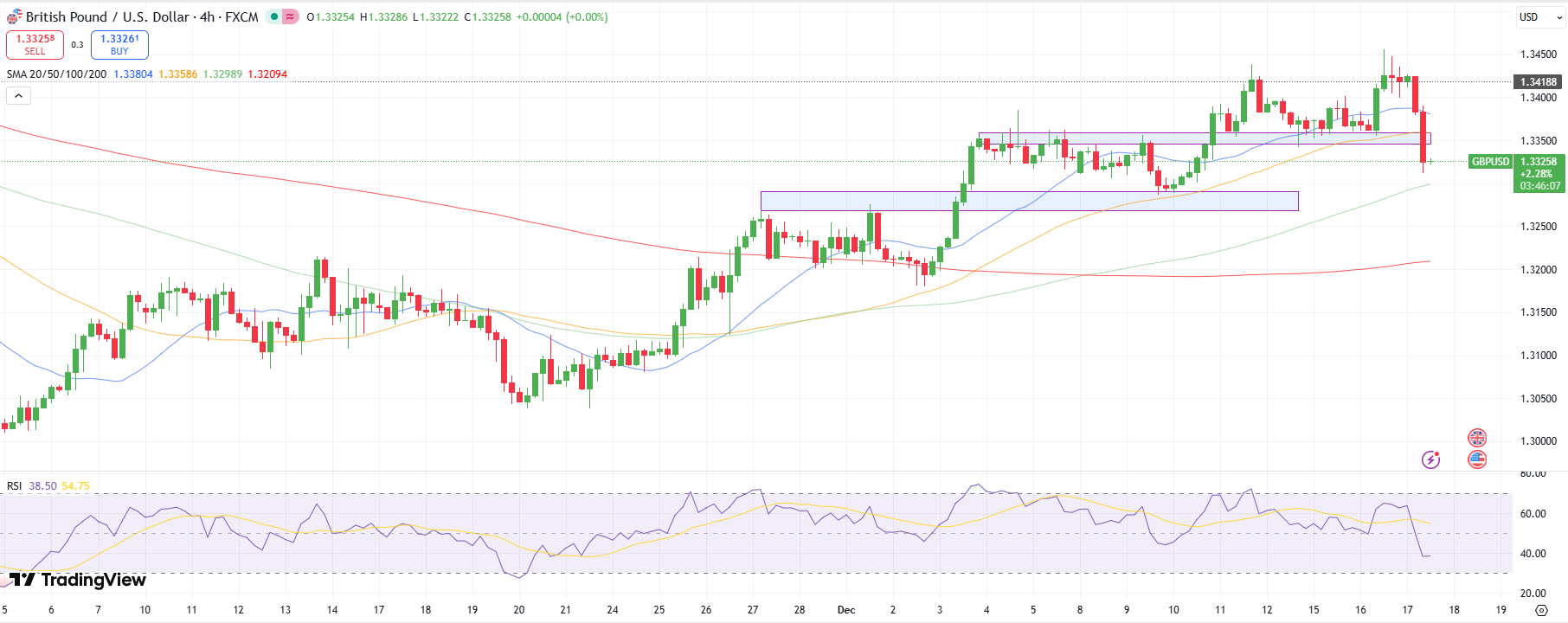
The British pound plummeted against the US Dollar on Wednesday following the weaker-than-anticipated UK inflation figures in November. The GBP/USD pair fell by over 0.5% towards the 1.3310 region, defying Tuesday’s gains when the pair briefly went above 1.3450.
–Are you interested in learning more about copy trading platforms? Check our detailed guide-
According to the Office for National Statistics, the headline consumer inflation decreased to 3.2% YoY, compared to the previous 3.6% and below the market expectations of 3.5%. This was the second monthly decrease, revealing steadily falling price pressures in the UK. The core inflation also slowed to 3.2% compared to 3.4% in the previous month. Prices decreased by 0.2% MoM, highlighting the softening trend.
The services inflation, a major indicator of the Bank of England, decreased marginally to 4.4%. Although this level is still well above the BoE target, the trend has lowered confidence in maintaining the restrictive policy.
Meanwhile, the UK labor market is still losing steam. The UK unemployment rate increased to 5.1%, the highest in nearly five years. Combined, tame inflation and growing unemployment have raised the probability of a BoE rate cut.
A recovery in the US Dollar further weighed on the sterling. The Dollar Index (DXY) regained ground to reach 98.60 after marking a 10-week low in the previous week. This was despite the mixed US employment report, which indicated job growth of 64k in November, but the unemployment rate increased to 4.6%. Investors largely disregarded the weaker aspects of the report due to distortions caused by the prolonged government shutdown.
Markets are currently anticipating the Fed to maintain rates in the 3.50-3.75% range in January. The focus has shifted to the US inflation statistics due on Thursday, which may impact the anticipation of a rate reduction in the latter part of the year.
Moving ahead, GBP/USD is under pressure in the short term as traders review the UK rate expectations. But the wider demerit could be confined. Inflation in the UK remains relatively high compared to other economies, and the BoE’s easing expectations are more cautious than those of the Fed. If US inflation slows down and the dollar regains its lost momentum, the pound may stabilize even after the recent setback.
GBP/USD Technical Forecast: Downside Below 1.3350
GBP/USD 4-hour chart
The GBP/USD broke below the demand zone around 1.3350, marking a fresh low at 1.3310 before recovering slightly. The price is expected to retest the broken zone before resuming its downward trend. However, the RSI under 40.0, approaching the oversold zone, suggests limited downside.
–Are you interested in learning more about scalping forex brokers? Check our detailed guide-
The immediate support for the pair lies at 1.3300 near the 100-period MA ahead of the next demand zone at 1.3270, and then the 200-period MA near 1.3200. On the upside, the 1.3350 support-turned-resistance could limit gains ahead of the daily pivot at 1.3378 and then 1.3400.
Looking to trade forex now? Invest at eToro!
68% of retail investor accounts lose money when trading CFDs with this provider. You should consider whether you can afford to take the high risk of losing your money.


:max_bytes(150000):strip_icc()/Health-GettyImages-1349467452-56479cb833864542898f1a405635ddbd.jpg "What Happens to Your Mood When You’re Low on Vitamin D")