About Editorial team of BIPNs

Main team of content of bipns.com. Any type of content should be approved by us.
12 02, 2025

Cardano (ADA) Rally Cooling Off, Market Sentiment or What?

By |2025-02-12T00:42:59+02:00February 12, 2025|Crypto News, News|0 Comments

ADA, the native token of the Cardano blockchain, is gaining significant attention from crypto enthusiasts following an asset manager’s move to file for a Cardano Exchange-Traded Fund (ETF) in the United States. This development has sparked notable interest among traders and investors, resulting in impressive upside momentum.

Cardano (ADA) Losing its Gain

As the market surge pushes ADA near a crucial resistance level, the asset has begun experiencing massive sell-offs, causing its price to fall—another disappointment for traders and investors today.

Despite the recent fall in the ADA token price, the asset has reclaimed its uptrend as it moves above the 200 Exponential Moving Average (EMA) on the daily time frame. Additionally, today’s notable selling pressure has not had any significant impact on investor sentiment, as long-term holders appear to be accumulating the token.

Current Price Momentum 

ADA is currently trading near $0.77 and has experienced a price surge of over 11% in the past 24 hours. However, the asset reached an intraday high of $0.815 with a 16% gain, but the market lost a significant portion of those gains, likely due to ongoing profit booking and the current market sentiment.

Nonetheless, participation from traders and investors has surged to the next level, increasing by more than 120% during the same period.

ADA Price Action 

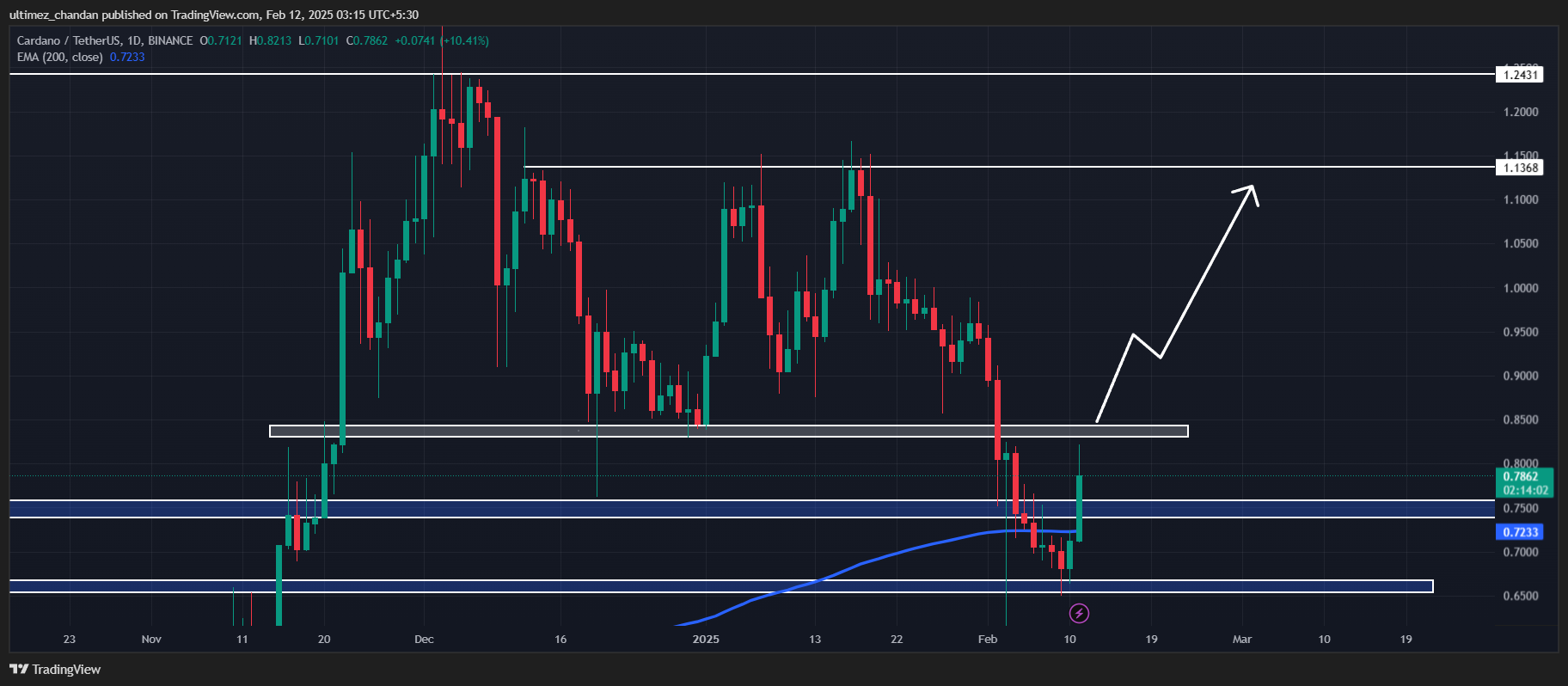
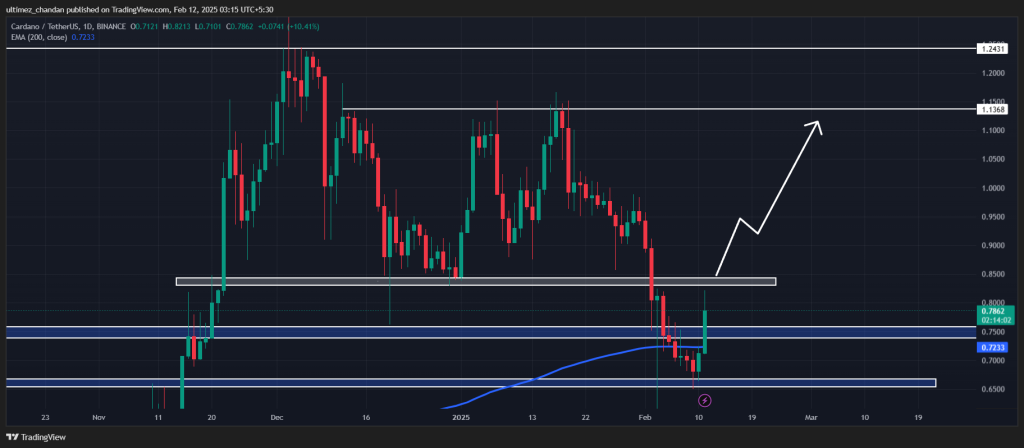
According to expert technical analysis, ADA is at a crucial resistance level of $0.85, where it faced resistance today.

Cardano (ADA) Rally Cooling Off, Market Sentiment or What?
Source: Trading View

Based on the recent price action, if ADA continues to rally and breaches the $0.85 level, closing a daily candle above it, there is a strong possibility it could soar by 32% to reach the $1.13 level in the future.

ADA’s Major Liquidation Areas

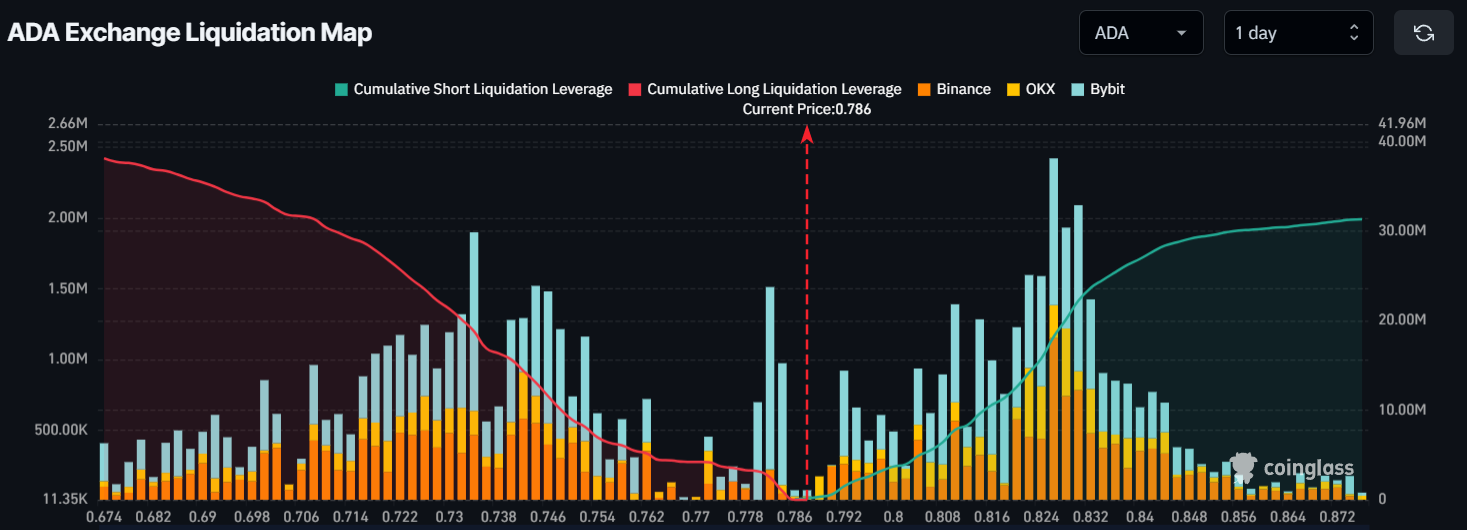
Currently, traders are taking a mixed approach. At present, the major liquidation areas are near $0.734, where traders holding long positions are over-leveraged, with $18.80 million worth of long positions. Conversely, $0.826 is another liquidation level, where traders holding short positions are over-leveraged, with $18.20 million worth of short positions.

Source: Coinglass

When combining these on-chain metrics with technical analysis, it appears that long-term holders are accumulating tokens, while intraday traders are taking advantage of the current market sentiment.

Source link

11 02, 2025

Breastfeeding and Postpartum Care with Multiple Sclerosis

By |2025-02-11T23:53:49+02:00February 11, 2025|Fitness News, News|0 Comments

Pregnancy is an exciting time. But if you’re living with multiple sclerosis (MS) you probably have questions about how the chronic disease may impact your birthing plan, treatment plan and plans for breastfeeding.

MS can be unpredictable and relapses can have a severe impact on your quality of life. So, it’s important to talk to your healthcare provider (HCP) and be open about the health goals you have for yourself and your baby during every step of the family planning process. Knowing your options for disease-modifying therapies (DMTs) in advance can help you have the healthiest experience possible.

Here are some frequently asked questions about pregnancy, childbirth and breastfeeding if you have MS.

Does multiple sclerosis affect pregnancy outcomes?

The great news is that the disease itself does not affect pregnancy outcomes. Studies show that women with MS don’t have higher rates of miscarriages, stillbirths, birth defects or other pregnancy complications compared to women without MS. However, some DMTs may cause harm to the fetus. So, it’s important to talk to your HCP before you get pregnant.

Read: Newly Diagnosed with MS? Here Are 10 Questions to Ask Your Neurologist. >>

Can I take my multiple sclerosis medications while I’m pregnant and/or breastfeeding?

Managing multiple sclerosis during pregnancy and breastfeeding comes down to carefully weighing the benefits versus the risks. And everyone’s situation is unique, so it’s important to have a conversation with your HCP about the specific medicines you take and your personal circumstances.

You may be able to take DMTs throughout your pregnancy and/or continue to take them if you’re breastfeeding. But it depends on the medication. Some MS medications may cause harm to the fetus and get into breast milk and may need to be stopped months before getting pregnant.

For example, studies show that interferon-beta and glatiramer acetate are generally considered safe during pregnancy. But some oral DMTs can harm the fetus so they’re often avoided. And monoclonal antibodies (mAbs), such as rituximab, natalizumab, ocrelizumab, ofatumumab and ublituximab, are usually avoided because of the risks they may pose to the fetus.

We don’t have a lot of information on how much medication gets into breast milk for most medicines. But, based on the data we do have, the injectables and mAb DMTs are likely safe for breastfeeding. Oral DMTs appear to be less safe. Breastfeeding is associated with decreased risk of postpartum relapses. Again, talking to your HCP can help you decide what the best option is for you and your baby.

Does having multiple sclerosis affect childbirth?

Symptoms of MS can be different for each person, which can affect labor and delivery during childbirth. MS can affect the nerves and muscles needed to push during labor, which can make vaginal childbirth more difficult for some people. If this is the case, you may need a cesarean, also called a C-section. In rare cases, forceps or a vacuum can help with the birth.

Read: How MS Affects the Body >>

What do I need to know about restarting my medication after I give birth?

Some studies show there may be a slightly higher risk for relapse right after pregnancy. So, people with active MS should talk to their neurologist or MS specialist soon after birth to figure out when they should start taking DMTs again. One study found taking natalizumab or fingolimod within the first six weeks of giving birth significantly reduced the risk for relapse three months after delivery but not immediately after birth.

Breastfeeding, however, may help decrease the risk of postpartum relapses overall. One review of 24 studies found lower rates of postpartum relapses in women who were breastfeeding compared with those who were not. Researchers noted that more research is needed into breastfeeding and postpartum relapse. As mentioned before, not all medications are recommended if you want to breastfeed. The risks of stopping or changing a medication may not outweigh the benefits.

If you’re living with MS, talk to your HCP about your options and have a plan in place so you can feel your best for yourself and your baby during this exciting time.

This educational resource was created with support from Novartis, a HealthyWomen Corporate Advisory Council member.

From Your Site Articles

Related Articles Around the Web


Source link

11 02, 2025

DeFi 3.0: What Has Changed Since the ‘Summer of DeFi’?

By |2025-02-11T23:19:11+02:00February 11, 2025|News, NFT News|0 Comments


DeFi has moved from frenzied speculation to pragmatic development, with the rise of RWA applications, improved security, and the entry of institutions, and is gradually integrating into the global financial system.

Author: Solihat Salihu

Compiled by: Vernacular Blockchain

Remember the DeFi Summer of 2020? Those crazy days of yield farming, food tokens, and APYs that looked like phone numbers. (Ah, those days of checking your crops every five minutes.) If you’ve been hibernating since then, though, DeFi in 2025 might surprise you.

The days of purely speculative staking and the “go for it now” mentality are over. Today’s DeFi has grown up, put on a suit (metaphorically, of course), and started to solve real-world problems. Let’s take a look at what has changed in DeFi and why these changes are important.

1. The evolution of DeFi: Looking back

Think of DeFi’s growth as a teenager’s growth into adulthood. DeFi 1.0 was the “wild adolescence” — full of experiments, high risk, and many expensive mistakes. At that time, automated market makers (AMMs), yield farming, and lending protocols were born one after another. Everything was exciting, but it was difficult to sustain.

DeFi 2.0 attempts to solve the liquidity problem through protocol-owned liquidity and more complex token economics. Remember Olympus DAO and its imitators? That was DeFi’s “tuition” for sustainable economics.

Now, in 2025, we have entered the DeFi 3.0 era, and everything is brand new.

2. Real World Assets (RWA): DeFi becomes more pragmatic

What is the biggest change? DeFi is no longer just a paradise for crypto trading. Remember those years when everyone said that blockchain would subvert traditional finance? Today, all this is really happening.

Take mortgages as an example. In 2024, we saw the first large-scale, successful on-chain mortgage lending applications. Homeowners can now directly access global liquidity pools to obtain loans at more favorable interest rates, while investors can participate in real estate lending without relying on traditional banks.

Supply chain finance has also found a home in DeFi. Small businesses no longer have to wait months for payment processing – they can tokenize invoices and achieve instant liquidity. It’s like having a magic wand that turns future receivables into available funds in the present.

3. The rise of institutional DeFi

One thing that almost no one could have predicted in 2020 is that traditional financial institutions have become one of the largest users of the DeFi ecosystem. Banks that once sneered at cryptocurrencies now not only run their own validation nodes, but also actively participate in DeFi protocols.

But it’s not just about big banks entering the market. DeFi’s infrastructure is also constantly upgrading to meet the compliance needs of institutions. For example, isolated liquidity pools specifically for compliant institutions, built-in KYC/AML (know your customer/anti-money laundering) review mechanisms, and DeFi systems that provide institutions with permission management while maintaining the core advantages of decentralization.

4. Security: From “REKT” to indestructible

Remember the early days of DeFi, when smart contract exploits were a weekly occurrence? (Those “funds secure” memes now seem like prehistoric relics.) DeFi security has come a long way since then.

Modern DeFi protocols use multiple layers of protection, and formal verification of smart contracts has become a standard process. Insurance protocols no longer simply provide compensation for hacker attacks, but have developed into a comprehensive protection system covering multiple risks.

The most notable development? AI-driven security systems that can detect and block attacks in real time. It’s like having a super-intelligent bodyguard guarding your digital assets at all times.

5. User Experience: No Longer “Rocket Science”

If you’ve been through the early days of DeFi, you probably still remember the nervousness of connecting your wallet and exchanging tokens, fearing that you’d lose your funds if you made a mistake. Today’s DeFi interface is so intuitive that even my mom recently completed her first transaction successfully (yes, I’m as surprised as you).

Account Abstraction completely eliminates concerns about gas fees and complex wallet management. Social Recovery makes losing private keys no longer a disaster. Cross-chain operations? Now it’s as easy as sending an email.

6. A new face of revenue generation

1000% APY is a thing of the past (sorry to disappoint you). Today, the mechanism of generating income is more mature and sustainable. Real income (Real Yield) – income from real economic activities, rather than simply token inflation issuance – has become the industry standard.

Modern DeFi generates revenue from transaction fees, loan interest, and returns on real-world assets (RWA). These returns may not be as crazy as they were in 2020, but they are more sustainable and more in line with economic logic.

7. Regulation: Finding a balance

Plot twist: Regulation did not kill DeFi, but instead promoted its growth. Regulatory clarity in 2025 opens the door to wider adoption of DeFi. Yes, some protocols remain fully decentralized, while others actively embrace compliance. This “hybrid ecosystem” provides users with both choice and, to a certain extent, protection.

8. The road ahead

Looking ahead, DeFi is being shaped by several major trends:

DeFi has become more specialized, with various protocols beginning to focus on specific industries or application scenarios. The “one-size-fits-all” model has gradually given way to customized solutions.

As the integration with traditional finance continues to deepen, the boundaries between DeFi and TradFi (traditional finance) are becoming increasingly blurred, ultimately driving the global financial system to become more efficient.

Social impact projects are gradually coming to the fore, and more and more DeFi protocols are beginning to focus on global issues such as financial inclusion and climate finance.

9. Does this concern you?

Whether you are an old DeFi player or a curious newcomer, these changes are worth paying attention to. DeFi is no longer just a playground for crypto enthusiasts, but is gradually becoming an important part of the global financial infrastructure.

Even better, the barriers to entry are lower today than ever before. You don’t need a deep understanding of complex financial instruments or blockchain technology to benefit from DeFi — just like you don’t need to understand how an engine works to drive a car.

If you want to explore modern DeFi, start small. Focus on established protocols with real-world applications, understand the risks, and always follow a timeless piece of investing wisdom: never invest more than you can afford to lose.

Author:白话区块链

This content is only to provide market information and does not constitute investment advice.


Source link

11 02, 2025

XAU/USD regains the $2,900 mark amid USD weakness

By |2025-02-11T23:03:51+02:00February 11, 2025|Forex News, News|0 Comments


XAU/USD Current price: $2,903.97

  • Fed Chairman Jerome Powell testified before Congress, said nothing new to markets.
  • The US January Consumer Price Index is expected to remain stable at 2.9% YoY.
  • XAU/USD attracts buyers on dips, higher highs still likely.

Spot Gold peaked at $2,942.76 early on Tuesday, reaching yet another record high before giving up. The bright metal fell towards $2,880 early in the American session but quickly recovered the $2,900 mark, trading above it as the session progressed.

The US Dollar (USD) lost its recent attractiveness across the FX board despite a cautious mood that prevailed throughout the day, once again correcting lower after a strong start to the week.

Asian and European traders held cautious ahead of Federal Reserve (Fed) Chairman Jerome Powell’s appearance before Congress. Powell, who testified on monetary policy, repeated much of what he said after the January Fed monetary policy meeting. Powell said policymakers are in no hurry to adjust the monetary policy and would like to make more progress on inflation. He also added that the economy was in a “pretty good place” and refused to comment on tariffs.

His words brought some relief to financial markets, helping Wall Street to trim most of its early losses while reviving the USD’s weakness.

Powell will repeat his testimony on Wednesday, although before a different commission. Additionally, the United States (US) will release the January Consumer Price Index (CPI), foreseen up by 2.9% from a year earlier, matching the December reading. The core annual advance is expected at 3.1%, slightly below the previous 3.2%.

XAU/USD short-term technical outlook

From a technical point of view, XAU/USD remains bullish, yet overbought conditions suggest a corrective decline remains likely. In the daily chart, technical indicators are retreating just modestly while still developing within extreme levels. At the same time, the bright metal remains far above all its moving averages, with the 20 Simple Moving Average (SMA) heading firmly higher, yet currently at around $2,787.34, too far below the current level to be relevant.

XAU/USD corrected overbought conditions in the near term and could resume its advance from here. The 4-hour chart shows buyers added longs in the intraday dip towards a bullish 20 SMA, now providing dynamic support at around $2,883.50. The 100 and 200 SMAs, in the meantime, maintain their strong upward slopes far below the shorter one. Finally, technical indicators corrected extreme overbought readings but turned flat above their midlines, reflecting buying interest surging on price retracements.

Support levels: 2,883.50 2,872.30 2,855.45

Resistance levels: 2,911.60 2,925.00 2,940.00


Source link

11 02, 2025

Surges as US yields rise, eyes on 200-day SMA: Analytics and Market news from 11 February 2025 19:46

By |2025-02-11T22:44:26+02:00February 11, 2025|Forex News, News|0 Comments

Japanese Yen PRICE Today

The table below shows the percentage change of Japanese Yen (JPY) against listed major currencies today. Japanese Yen was the strongest against the Swiss Franc.

  USD EUR GBP JPY CAD AUD NZD CHF
USD   -0.53% -0.60% 0.30% -0.16% -0.28% -0.23% 0.16%
EUR 0.53%   -0.08% 0.85% 0.39% 0.25% 0.30% 0.70%
GBP 0.60% 0.08%   0.93% 0.46% 0.31% 0.36% 0.76%
JPY -0.30% -0.85% -0.93%   -0.45% -0.59% -0.53% -0.14%
CAD 0.16% -0.39% -0.46% 0.45%   -0.13% -0.08% 0.31%
AUD 0.28% -0.25% -0.31% 0.59% 0.13%   0.05% 0.44%
NZD 0.23% -0.30% -0.36% 0.53% 0.08% -0.05%   0.39%
CHF -0.16% -0.70% -0.76% 0.14% -0.31% -0.44% -0.39%  

The heat map shows percentage changes of major currencies against each other. The base currency is picked from the left column, while the quote currency is picked from the top row. For example, if you pick the Japanese Yen from the left column and move along the horizontal line to the US Dollar, the percentage change displayed in the box will represent JPY (base)/USD (quote).


Source link

11 02, 2025

Vit-Best Nutrition Appoints New President

By |2025-02-11T22:43:05+02:00February 11, 2025|Dietary Supplements News, News|0 Comments


Jeff Stallings Brings Decades of Industry Insight to Support Vit-Best’s Growth in the Nutraceuticals Manufacturing Market

TUSTIN, Calif., Feb. 11, 2025 /PRNewswire/ — Vit-Best Nutrition, a leading contract manufacturer in the nutritional supplement industry, has announced the appointment of Jeffrey Stallings as President. With over three decades of experience in the dietary supplement sector, Stallings is well-positioned to drive Vit-Best’s growth as a premier contract manufacturer for some of the most recognized supplement brands available at major retailers across the nation.

President of Vit-Best Nutrition, Jeff Stallings.

Stallings joins Vit-Best with a proven track record in managing large client accounts, spearheading innovation and R&D initiatives, and leading sales operations. As President, he will oversee the expansion of Vit-Best’s business development initiatives and manage all aspects of operations, including the company’s state-of-the-art facilities, manufacturing, packaging, and quality assurance. He will also ensure seamless communication between the Customer Service and Operations teams.

“The addition of Jeff to our experienced Vit-Best team marks a significant step forward as we continue to invest in world-class contract manufacturing and private label services,” said David Jiang, Chairman of Xiamen Kingdomway Group, Vit-Best’s parent company. “Our goal is to provide the highest quality supplements to the nation’s largest distributors. Jeff’s expertise in creating and implementing innovative manufacturing solutions that drive consistent growth brings a valuable perspective to our team, and we look forward to achieving great success together.”

With over 40 years of experience managing businesses of various sizes, Stallings has held positions at Univar USA, MeriCal Distributors, and Vita-Pak, where he focused on improving efficiency, streamlining processes, and increasing revenue. Previously, he served as President of MeriCal, successfully guiding the company through three major mergers, enhancing its competitive position.

Stallings is an active leader in the industry, currently serving as Chairman of the Board of the Nutrition Industry Association (NIA West) and previously as a Board Member of the Drug, Chemical & Associated Technologies Association (DCAT).

“I am honored to join the Vit-Best team as President at a time when consumers are more focused than ever on their health and seeking high-quality options that promote a thriving lifestyle,” said Stallings. “Throughout my career, I have been dedicated to providing the best for consumers, and I look forward to applying my expertise to Vit-Best, a company renowned for its excellence in supplement manufacturing.”


Source link

11 02, 2025

Crypto Phoenix Rising? Unleashing New Predictions with AI Insight!

By |2025-02-11T22:41:43+02:00February 11, 2025|Crypto News, News|0 Comments

  • AI-driven analytics are transforming XRP price predictions by processing vast historical data and market trends.
  • AI models improve prediction precision through pattern identification and machine learning techniques.
  • Collaboration between AI and DeFi is creating more reliable predictive models, minimizing biases and historical inaccuracies.
  • AI tools analyze social media sentiment, news, and economic indicators for a comprehensive view of XRP price dynamics.
  • Integrating AI in cryptocurrency forecasting could revolutionize investment strategies for XRP and other digital currencies.

In the ever-evolving world of cryptocurrencies, Ripple’s XRP remains a focal point for both investors and technology enthusiasts. As innovations in artificial intelligence (AI) continue to permeate various sectors, their influence is now extending into the realm of cryptocurrency predictions. The question on everyone’s mind is: How can AI fundamentally change XRP price predictions?

Recent developments suggest that AI-driven analytics could revolutionize the way investors and analysts predict XRP price movements. AI algorithms can process vast amounts of historical data and market trends at lightning speed, offering insights that are significantly more accurate and timely than traditional methods. By identifying patterns and applying machine learning techniques, AI models can predict future price movements with improved precision.

What’s more intriguing is the emergence of AI collaboration across multiple platforms. Decentralized finance (DeFi) realms are integrating AI technologies to create more reliable and trustworthy predictive models. This technological symbiosis could herald a new age for XRP predictions, where biases and historical inaccuracies are minimized.

Additionally, the application of AI in analyzing social media sentiment, news topics, and global economic indicators could offer a more holistic view of what drives XRP price shifts. As these AI tools evolve, they might enable investors to not only predict future prices more accurately but also create new strategies for investment in XRP and other digital currencies.

In a world driven by technology, embracing AI for cryptocurrency forecasting might just be the game-changer the market needs, heralding a new era for XRP and beyond.

This AI Twist Could Be the Key to Ripple’s XRP Price Surge!

How is AI Transforming Ripple’s XRP Price Predictions?

The integration of artificial intelligence (AI) into cryptocurrency predictions, particularly for Ripple’s XRP, is reshaping how analysts and investors approach the market. AI algorithms, by processing extensive historical data and real-time market trends, are providing insights that are not only faster but also more accurate than traditional methods. This transformative capability allows for the identification of patterns and the application of machine learning techniques to predict future XRP price movements with enhanced precision.

What Are the Pros and Cons of Using AI for XRP Price Predictions?

Pros:
– Increased Accuracy: AI can analyze vast datasets quickly, offering predictions that are often more precise.
– Real-time Analysis: The ability to process data in real-time allows for timely insights.
– Pattern Recognition: AI models can identify unseen patterns in data, providing a deeper understanding of market dynamics.

Cons:
– Dependency on Data Quality: AI predictions are only as good as the data they are fed. Poor quality or biased data can lead to inaccurate predictions.
– Complexity and Cost: Developing and maintaining AI systems can be costly and complex.
– Lack of Human Intuition: AI lacks the intuitive understanding of human emotions and market sentiment that experienced traders might possess.

How Can AI-Driven XRP Predictions Impact Investment Strategies?

AI’s role in XRP predictions extends beyond just forecasting prices. By analyzing social media sentiment, news feeds, and global economic indicators, AI tools offer a comprehensive view of market dynamics. This allows investors to develop new strategies tailored to take advantage of predicted market shifts. As these tools continue to evolve, investors can anticipate and react to market changes more swiftly, potentially leading to lucrative investment opportunities in XRP and other cryptocurrencies.

For more information on XRP and cryptocurrency investments, domains like CoinMarketCap and CoinDesk are valuable resources.

Overall, as AI technologies advance, their impact on cryptocurrency markets could be significant, potentially ushering in a new era of intelligent investing strategies.

Source link

11 02, 2025

Home Depot price receives positive support – Forecast today

By |2025-02-11T21:03:20+02:00February 11, 2025|Forex News, News|0 Comments


Home Depot’s stock price (HD) rose in the intraday levels, after leaning on the support of the 50-day SMA, lending the stock positive momentum, amid the dominance of the main upward trend, while trading alongside the secondary short-term trend line, with positive signals from the RSI after reaching oversold levels. 


Therefore we expect more gains for the stock, targeting the pivotal resistance of $440.97, provided the support of $401.76 holds on.


Trend forecast for today: Bullish 


Source link

11 02, 2025

EUR/USD Forecast Today 11/02: Trade Spat Fears (Chart)

By |2025-02-11T20:43:51+02:00February 11, 2025|Forex News, News|0 Comments

  • The euro has gapped lower to kick off the trading week, as we continue to see a lot of volatility in this pair.
  • As it is likely that we will eventually see some type of trade spat between the United States and the European Union, I suspect that the euro is living on borrowed time any time it rallies.
  • Furthermore, we also have to keep in mind that the European economy has barely grown over the last 20 years, while the US economy has doubled. Then short, there’s no real reason to buy the euro against the US dollar for a longer term trade.

Sure, there will be an occasional short-term rally in this market, but as things stand right now, the fundamental simply do not line up for a protracted uptrend. In fact, I suspect you have a situation where this market will eventually try to rally, but that should end up being a nice shorting opportunity at the first signs of exhaustion. After all, we have been in a downtrend for quite some time, and there’s no real reason to think that it’s about the change anytime soon. Ultimately, this is a market that I think goes to the parity level before it is all said and done.

Technical Analysis

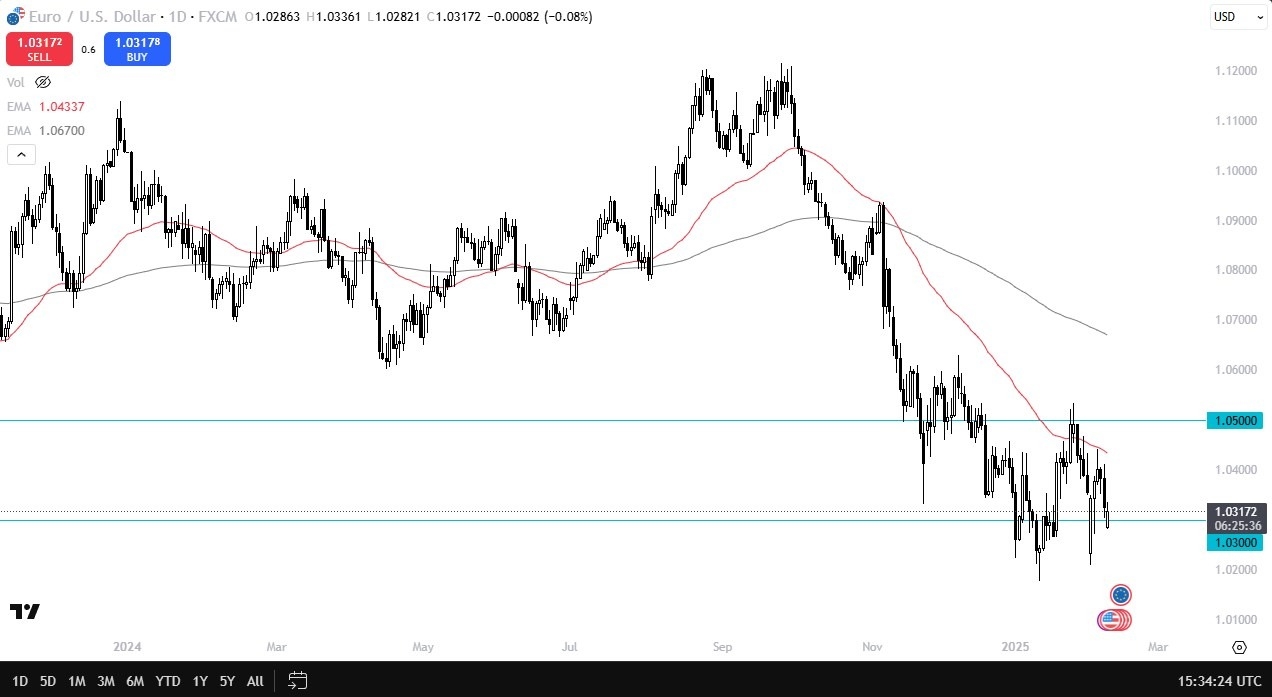
The technical analysis for this EUR/USD pair is obviously quite bleak, but it is worth noting that the market recovered quite nicely from the initial gap lower on the open for the Monday session. That being said, the 50 Day EMA currently sits right around the 1.0425 level, and after that we see the 1.05 level offering a significant amount of resistance. It is not until we break above that I think the market could pick up any type of momentum, and it’s really not until we break above the 1.06 level that I think anything will be sustained.

To the downside, if we were to break down below the level 1.02, that opens up the door to parity, something that this pair seems to be destined to reach. In fact, I’m starting to read some highly respected research that suggests the euro could even drop down to the 0.90 level at this rate. I’m not calling for that yet, but I certainly think parity is not out of the question.

Ready to trade our Forex EUR/USD forecast? We’ve shortlisted the best European brokers in the industry for you.

Source link

11 02, 2025

Many Americans take supplements for immune support, but doctor recommendations are low

By |2025-02-11T20:42:28+02:00February 11, 2025|Dietary Supplements News, News|0 Comments


Before the pandemic, about 1 in 9 U.S. adults used dietary supplements for immune benefits, with usage varying by age and health status

Study: Prepandemic Prevalence of Dietary Supplement Use for Immune Benefits. Image Credit: Ground Picture/Shutterstock.com

Researchers at the National Institutes of Health (NIH) have recently conducted a study to determine the prepandemic prevalence of dietary supplement usage for immune benefits among US residents. The study findings are published in JAMA Network Open.

Background

Dietary supplements are synthetic products that are intended to be added to the conventional diet to improve or maintain overall health. Common examples of dietary supplements include vitamins, minerals, herbs, botanical products, amino acids, and probiotics. These supplements also provide essential nutrients required for normal physiological activities.

According to the US Food and Drug Administration (FDA), consuming dietary supplements without a healthcare professional’s recommendation could be risky. Some supplements can interfere with medications, influence diagnostic processes, or have dangerous effects during surgery.

In the US, dietary supplement use is common, and the word immune or immunity is the most frequently used term. The word is found on more than 25,000 supplement labels in the Dietary Supplement Label Database. This suggests that immune benefits are a prevalent and marketable motivation for dietary supplement use.

One recent study has shown that a significant proportion of dietary supplements with immune health claims have inaccurate labels and contain additional ingredients not mentioned on the label.

These findings indicate that the claims made on the labels of dietary supplements could be misleading for consumers and that consumption of these supplements without a doctor’s recommendation might have negative health impacts.

In the current study, researchers determined the prevalence of using dietary supplements with perceived immune benefits, i.e., supplements to prevent colds or boost the immune system.

The study

The most recent National Health and Nutrition Examination Survey (NHANES) data and the Dietary Supplement Label Database (DSLD) were analyzed in the study to determine the proportions and characteristics of people who reported using dietary supplements for perceived immune benefits. Specifically, the study included pre-pandemic NHANES data from January 2017 to March 2020.  

The study also investigated whether label claims or recommendations by healthcare professionals influence the use of these dietary supplements.

Important observations

The study analyzed data from 15,560 participants in the NHANES. About 11% of them reported using dietary supplements for perceived immune benefits.

The usage of these supplements showed a positive association with several sociodemographic and health characteristics, including education, family income, food security, self-rated diet quality, and self-rated health status.

The prevalence of supplement usage also differed by age and was higher among those who identified as non-Hispanic Black, non-Hispanic White, and others.

Among consumers of these supplements, 28% reported using them exclusively for perceived immune benefits. Such prevalence was higher among older people, financially stable people, and those with poor health status.

About 60% of participants who consumed dietary supplements for immune benefits reported choosing a supplement based on the label claim related to immune benefits. In contrast, only 17% reported consuming these supplements based on a healthcare professional’s recommendation.

The prevalence of supplement usage due to healthcare professional’s recommendations was higher among older people and those with poor health status.

Study significance

The study finds that approximately 1 in 9 US residents uses a dietary supplement for perceived health benefits. Label claims related to immune benefits appear to be the most significant motivation for consuming dietary supplements for perceived immune benefits.

Besides preventing colds or boosting the immune system, the second most common reason for consuming these supplements is to maintain health or stay healthy. 

The study finds a low prevalence of dietary supplement usage among participants due to healthcare professionals’ recommendations. However, such usage increases with increasing age and deteriorating health status.   

Researchers mentioned some study limitations in the published article. The study relied on self-reported data and potentially misidentified products, which might be associated with potential recall bias and measurement error.

However, the major strength of the study is its use of nationally representative data and detailed dietary supplement collection in NHANES.  

Overall, the study provides an overview of the frequency of dietary supplement usage for perceived immune benefits among US residents during the prepandemic period from January 2017 to March 2020.    

Given the high prevalence of dietary supplement usage in the US, the study findings highlight the need for further research in diverse populations to determine their clinical relevance. Although dietary supplements help improve nutrient intake, upstream nutritional disparities must also be addressed.


Source link

Go to Top