About Editorial team of BIPNs

Main team of content of bipns.com. Any type of content should be approved by us.
17 12, 2025

8 Foods You Should Eat Instead of Taking a Vitamin C Supplement

By |2025-12-17T17:52:43+02:00December 17, 2025|Dietary Supplements News, News|0 Comments


Vitamin C can’t protect you from germs, but it plays an essential role in immune function and overall health. Most women need at least 75 milligrams (mg) per day while men need slightly more, at 90 mg. Rather than relying on supplements, experts generally recommend meeting your needs through food, since it provides additional beneficial nutrients beyond vitamin C alone.

Here are eight foods to eat for vitamin C instead of popping a pill or gummy.

  • Vitamin C: 118 mg, 131% of the Daily Value (DV)
  • Serving size: 1 cup sliced

While citrus fruits often get the spotlight for their vitamin C content, many vegetables—including red bell peppers—are surprisingly excellent sources. These peppers also provide vitamin B6, potassium, and magnesium, which support heart, bone, and brain health.

  • Vitamin C: 105 mg, 117% of the DV
  • Serving size: 1 cup

A single cup of kiwi delivers more than your daily vitamin C requirement. For an extra nutrient bonus, eat it with the skin to enhance your fiber intake.

  • Vitamin C: 102 mg, 113% of the DV
  • Serving size: 1 cup chopped

Broccoli is not only rich in vitamin C but also provides immune-supporting nutrients like selenium, zinc, vitamin K, vitamin E, vitamin A, potassium, and phosphorus.

  • Vitamin C: 93 mg, 103% of the DV
  • Serving size: 100 grams (1.5 to 2 cups) raw

Kale, a nutrition superstar, also contains a noteworthy amount of vitamin C. What’s more, the cruciferous vegetable boasts more than 300% of the DV of vitamin K, crucial for blood clotting, strong bones, and more.

  • Vitamin C: 89 mg, 99% of the DV
  • Serving size: 1 cup, halves

Strawberries deliver an entire day’s vitamin C needs in just a cup. These juicy berries also contain anthocyanin, a powerful antioxidant.

  • Vitamin C: 85 mg, 94% of the DV
  • Serving size: 1 cup

Grapefruit is an acquired taste for some due to its bitter flavor, but its nutritional value more than makes up for it. Rich in vitamin C, fiber, vitamin A, and potassium, grapefruit supports gut, eye, heart, and immune health. “Grapefruit can be enjoyed broiled with a touch of sweetener, added to salads or breakfast bowls, or infused into water for a refreshing drink,” Jennifer Rawlings, RDN, CDCES, owner of My RDN Coach, told Health.

  • Vitamin C: 83 mg, 92% of the DV
  • Serving size: 1 cup

Classically associated with vitamin C, oranges are a great way to simplify your supplement routine. Packed with B vitamins, vitamin E, fiber, calcium, and potassium, oranges can support gut, bone, immune, and heart health.

  • Vitamin C: 75 mg, 83% of the DV
  • Serving size: 1 cup raw

Brussels sprouts are often celebrated this time of year in comforting recipes like roasted veggies and hearty winter salads. They’re also filled with nutrients beyond vitamin C, including folate, manganese, potassium, phosphorus, magnesium, and fiber.

While people can meet their vitamin C needs with food, supplements may be appropriate for some.

“Individuals who have very poor appetites, limited food choices, certain digestive conditions that affect absorption, are pregnant, smoke, or otherwise may struggle to meet the recommended vitamin C needs through food alone could benefit from supplementation,” registered dietitian nutritionist Dani Dominguez, MS, RDN, told Health.

Experts generally recommend consulting a healthcare provider before starting any dietary supplement—vitamin C included.


Source link

17 12, 2025

SOL Faces Short-Term Pressure as Traders Reassess Momentum

By |2025-12-17T17:43:50+02:00December 17, 2025|Crypto News, News|0 Comments

  • SOL trades below key EMAs, confirming bearish momentum and limiting near-term recovery
  • Cooling futures open interest signals deleveraging, reducing upside despite active activity
  • Persistent spot outflows suggest distribution, raising risk of deeper support tests

Solana’s price action has entered a critical phase as traders reassess short-term risk on the 4-hour chart. Recent market data shows SOL/USDT trading under pressure after failing to sustain earlier rebounds. Consequently, technical signals, derivatives positioning, and spot flow data now point to a cautious outlook. Market participants continue to monitor whether current support can stabilize price or trigger deeper losses.

SOL Price Trend Signals Growing Short-Term Pressure

On the 4-hour timeframe, Solana shows a clear corrective structure. Price trades below the 20, 50, 100, and 200 exponential movin…

Read The Full Article Solana Price Prediction: SOL Faces Short-Term Pressure as Traders Reassess Momentum On Coin Edition.

Source link

17 12, 2025

USD/JPY Forecast 17/12: Bounces After Falling (Chart)

By |2025-12-17T16:00:33+02:00December 17, 2025|Forex News, News|0 Comments

  • USD/JPY continues to attract buyers below ¥155 as yield differentials and carry dynamics favor the U.S. dollar.
  • Despite near-term noise, the broader setup still points toward renewed upside over time.

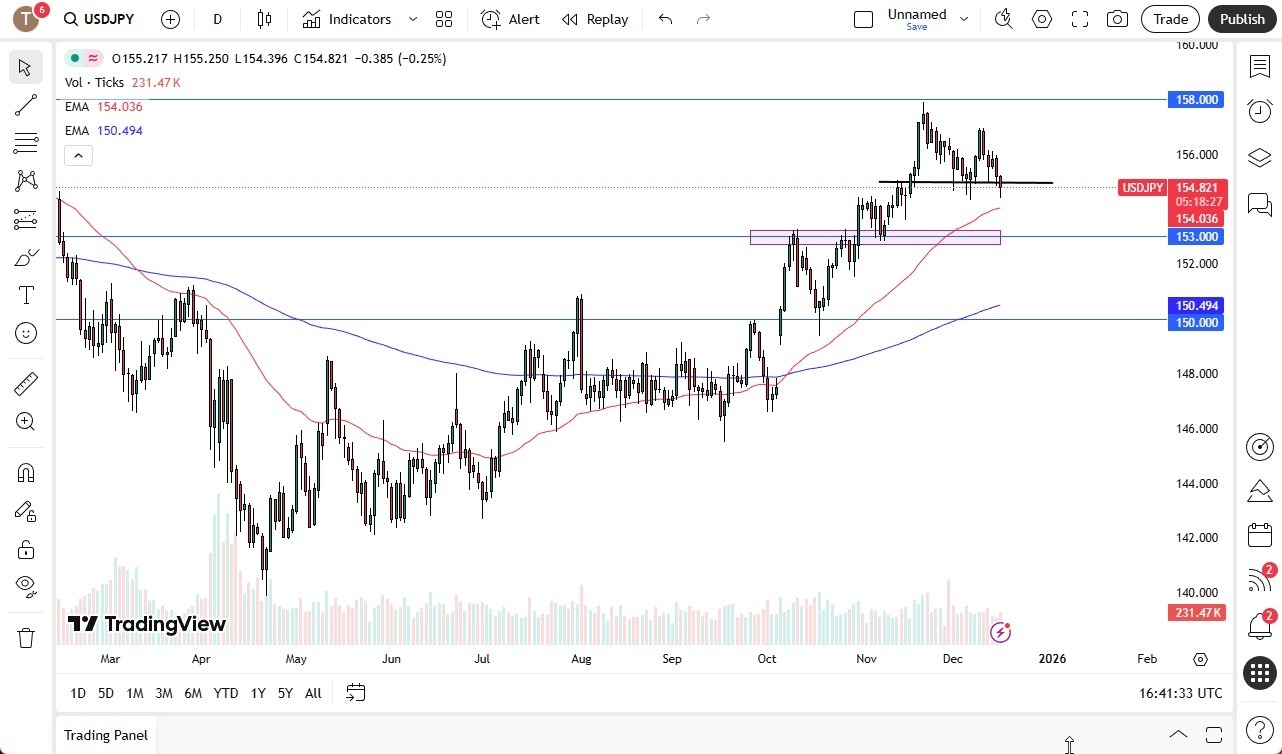
The US dollar spent the first few hours of the trading session on Tuesday falling against the Japanese yen. But as we have seen multiple times, there is a certain amount of interest in the US dollar below the 155 yen level. The 155 yen level, of course, is a large, round, psychologically significant figure, and it’s an area where I think you have a lot of noise out there waiting to come into the picture and perhaps support the greenback against the Japanese yen.

After all, the Bank of Japan, although it is having to deal with a little bit of inflation for the first time in ages, is still in a situation where it cannot tighten monetary policy too much. At the same time, you have the Federal Reserve, which is likely to cut rates sometime in 2026, but it is still very data dependent. Inflation in the United States isn’t going anywhere. That is a misnomer.

Interest Rate Differential and Carry Trade Support

I think at this point in time, the markets will be heavily disappointed if they are looking for consecutive rate cuts coming out of the Federal Reserve. With that being the case, the interest rate differential continues to favor the US dollar, and given enough time, we should see renewed upward momentum in this market.

While you wait, you even get the ability to get paid at the end of every day via the carry trade. So all things being equal, I do like this pair, and I have liked this pair for most of the year. If we do break down from here, the 50-day EMA is currently at the 154 yen level, followed by another support level in the form of 153 yen, which has been important a couple of times.

To the upside, I still see the 158 yen level as a bit of a barrier to get above and probably something that takes some work to accomplish. But I do think eventually we will try to do that. I hold this pair and have been holding this pair since probably July or so, and as a result, I have built up quite a bit of cushion via swap to make this a profitable trade. The beauty of this setup is that it pays you, and every time the US dollar drops to offer a little bit of value, I suspect traders continue to think about that again.

Want to trade our USD/JPY forex analysis and predictions? Here’s a list of forex brokers in Japan to check out.

Source link

17 12, 2025

Protein Powder Health Risks: FDA Warns About Serious Side Effects In 37 States

By |2025-12-17T15:51:39+02:00December 17, 2025|Dietary Supplements News, News|0 Comments


According to the University of Georgia’s Health Centre, there are two types of whey protein, including isolate and concentrate, the former of which is typically “a highly filtered form of whey protein and contain less than 1% of lactose.”

Protein Powder Health Risks: The US Food and Drug Administration (FDA) has issued a Class I recall for a protein powder that was distributed across 37 US states on December 11. The recall notice came after large scale consumer reports investigation detailed high lead levels in the Genepro Whey Fourth Generation Plasma Treated Protein, which is an unflavoured protein supplement sold in the market in 225g resealable packaging.

FDA Warns Protein Powder Health Risks

The product that is marketed with a prominent packaging claiming ‘allergen free’, ‘lactose free’ and ‘dairy free’, the USFDA determines that this dietary supplement could contain milk, a major food allergen that must be clearly disclosed to the public under federal law. According to the University of Georgia’s Health Centre, there are two types of whey protein, including isolate and concentrate, the former of which is typically “a highly filtered form of whey protein and contain less than 1% of lactose.”

Most people get enough protein from their daily diet by consuming foods like eggs, chickpeas, a handful of nuts, fish and chicken. However, most people consume protein powder to get vitamins and minerals easily from one item. Experts suggest that if you are a healthy adult who is considering an additional dietary supplement, you should determine whether your goal is to improve muscle mass, as most scientists examined enhancing muscle growth and strength. Researchers claim that protein is beneficial for muscle growth and recovery after exercise.

There are several types of protein powder widely used across the globe for its diverse health benefits, including whey, casein, soy, pea, hemp, beef, and egg. Besides the recent FDA’s recall notice, a 2020 study published by the National Institute of Health (NIH), alarmed that the bestselling protein powder contains heavy metals, such as cadmium, lead and arsenic. The NIH explains, “In 2010, the US Consumer Reports measured heavy metal concentrations in 15 commercially available protein powder supplements, and reported that all of the examined products contained ‘detectable concentrations’ of at least one heavy metal. In a separate evaluation in 2018, the Clean Label Project tested 133 protein powder supplements, and found that all of the tested products similarly contained ‘detectable concentrations’ of heavy metals.”

Side Effects Of Protein

Suyash Bhandari, Functional Nutritionist, Chief of iThrive Essentials, Supplements Vertical of iThrive says that protein supplements are not harmful by default, but side effects often appear when the protein is not properly digested, absorbed, or broken down by the body. According to the Functional Nutritionist, common complaints involve factors like gas, bloating, and heaviness, especially among people who are lactose or dairy intolerant and consume whey-based proteins.

Additionally, Digestive issues such as loose stools, irregular bowel movements, abdominal discomfort or foul-smelling stools can also occur when the gut keeps struggling to process certain protein sources or additives. In certain individuals, excessive or poorly tolerated protein might show up on the skin as acne, boils, or inflammation, signalling an internal imbalance rather than a protein “problem” itself.

Suyash Bhandari shares three tips to keep handy while purchasing protein powder:

  • Read the ingredient list carefully: Avoid products loaded with artificial sweeteners, flavours, colours, or unnecessary additives that can stress digestion.
  • Look for quality and testing certifications: Choose proteins that are third-party tested or lab-certified for purity and safety.
  • Check sourcing and suitability: Ensure to opt for responsibly sourced options like grass-fed whey or clean plant proteins as well as athletes should ensure the product is free from banned substances.

Follow TheHealthSite.com for all the latest health news and developments from around the world.


Source link

17 12, 2025

MATIC Price Prediction: $0.45 Target by January 2026 Despite Current Bearish Momentum

By |2025-12-17T15:42:32+02:00December 17, 2025|Crypto News, News|0 Comments


Zach Anderson
Dec 17, 2025 10:53

MATIC price prediction suggests potential recovery to $0.45 by January 2026, though immediate outlook remains cautious with $0.35 support critical for bulls.


MATIC Price Prediction: Technical Recovery Scenario Emerges Despite Near-Term Headwinds

Polygon’s MATIC token presents a complex technical picture as we approach the end of 2025, with current bearish momentum creating both risks and opportunities for strategic investors. Our comprehensive MATIC price prediction analysis reveals divergent short-term and medium-term outlooks that demand careful consideration.

MATIC Price Prediction Summary

MATIC short-term target (1 week): $0.35-$0.40 range (-7.9% to +5.3%)
Polygon medium-term forecast (1 month): $0.38-$0.45 range with potential 18% upside
Key level to break for bullish continuation: $0.43 (SMA 20 resistance)
Critical support if bearish: $0.35 immediate support, $0.33 strong support

Recent Polygon Price Predictions from Analysts

The analyst community shows remarkably conservative expectations for MATIC, with most Polygon forecast models suggesting limited upside potential through 2026. CoinCodex’s recent predictions cluster around the $0.11-$0.12 range, representing a significant disconnect from current market pricing at $0.38.

This stark divergence between current technical levels and analyst projections creates an interesting contrarian opportunity. Benzinga’s more optimistic $0.717 MATIC price target by 2030 aligns better with Polygon’s fundamental value proposition as Ethereum’s leading Layer-2 solution, though this represents a much longer investment horizon.

The consensus appears overly pessimistic given Polygon’s established market position and growing developer adoption. Our analysis suggests these predictions may underestimate MATIC’s recovery potential from current oversold conditions.

MATIC Technical Analysis: Setting Up for Potential Reversal

Current Polygon technical analysis reveals a token testing critical support levels after a prolonged decline from its 52-week high of $1.27. The RSI reading of 38.00 places MATIC in neutral territory, though closer to oversold conditions that historically precede bounce opportunities.

The MACD histogram at -0.0045 confirms bearish momentum remains intact, but the relatively shallow negative reading suggests selling pressure may be diminishing. MATIC’s position at 0.29 within the Bollinger Bands indicates the token trades in the lower portion of its recent range, often a precursor to mean reversion moves.

Volume analysis shows declining participation at $1.07 million on Binance, typical during consolidation phases before directional breakouts. The confluence of technical factors suggests MATIC approaches an inflection point where either support holds and initiates recovery, or breaks lower toward more significant support zones.

Polygon Price Targets: Bull and Bear Scenarios

Bullish Case for MATIC

Our primary MATIC price target sits at $0.45, representing the SMA 50 level that served as support during previous market cycles. This target offers approximately 18% upside potential and aligns with technical retracement levels.

For this bullish scenario to unfold, MATIC must first reclaim the $0.43 level (SMA 20), which has acted as dynamic resistance. A sustained move above this level would likely trigger additional buying interest and target the $0.50-$0.56 resistance zone defined by the upper Bollinger Band.

The weekly timeframe supports this optimistic view, with MATIC holding above key long-term support levels despite recent weakness.

Bearish Risk for Polygon

The primary risk to our constructive Polygon forecast centers on a breakdown below $0.35 immediate support. Such a move would likely accelerate selling toward the $0.33 strong support level, representing potential downside of 13-15%.

A more severe scenario targeting the 52-week low near $0.37 would invalidate the near-term bullish thesis and suggest continuation of the broader downtrend. This bearish case gains probability if Bitcoin and broader crypto markets experience additional weakness.

Should You Buy MATIC Now? Entry Strategy

Current levels present a reasonable risk-reward setup for those seeking exposure to Polygon’s Layer-2 narrative. Our recommended buy or sell MATIC strategy involves scaling into positions between $0.37-$0.40, with strict risk management below $0.33.

Conservative investors should wait for confirmation above $0.43 before initiating positions, sacrificing some upside for reduced downside risk. More aggressive traders can begin accumulating current levels while maintaining 15-20% position sizing to allow for additional purchases if MATIC tests lower support.

Stop-loss placement below $0.32 provides protection against major breakdown scenarios while allowing room for normal market volatility.

MATIC Price Prediction Conclusion

Our MATIC price prediction anticipates a gradual recovery toward $0.45 over the next 4-6 weeks, representing a medium confidence forecast based on current technical positioning. This Polygon forecast relies on broader crypto market stability and successful defense of the $0.35 support zone.

Key indicators to monitor include RSI movement above 45 (confirming momentum shift), MACD histogram turning positive, and daily volume expansion above $2 million on sustained moves higher. Failure to hold $0.35 support would necessitate reassessment of our bullish medium-term outlook.

The timeline for this prediction extends through January 2026, with initial confirmation signals expected within the next 7-10 trading days. Despite current bearish momentum, MATIC’s oversold conditions and strong fundamental backdrop support our constructive price target outlook.

Image source: Shutterstock


Source link

17 12, 2025

Forecast update for EURUSD -17-12-2025.

By |2025-12-17T14:31:40+02:00December 17, 2025|Forex News, News|0 Comments


Natural gas price confirmed its surrender to the negative pressure by providing repeated closing below $4.200 level, suffering clear losses by approaching the initial negative target at $3.750 then rebounding to settle above the bullish channel’s support at $3.950.


We recommend waiting to confirm breaking the current break to confirm moving to the negative track, then attempts to target more negative stations by reaching $3.620 and $3.480, while its rally above $4.200 will cancel the negative overview, providing chance to begin forming bullish waves, to target $4.510 level initially.


The expected trading range for today is between $3.620 and $4.150


Trend forecast: Bearish by the stability of $4.200


Source link

17 12, 2025

Euro bulls hesitate ahead of ECB

By |2025-12-17T13:59:32+02:00December 17, 2025|Forex News, News|0 Comments

After rising above 1.1800 for the first time since late September on Tuesday, EUR/USD lost its traction and closed the day marginally lower. The pair stays on the back foot early Wednesday and trades in negative territory below 1.1750.

Euro Price Today

The table below shows the percentage change of Euro (EUR) against listed major currencies today. Euro was the weakest against the US Dollar.

USD EUR GBP JPY CAD AUD NZD CHF
USD 0.22% 0.31% 0.33% 0.16% 0.23% 0.23% 0.21%
EUR -0.22% 0.09% 0.11% -0.05% 0.00% 0.01% -0.01%
GBP -0.31% -0.09% 0.04% -0.14% -0.08% -0.08% -0.10%
JPY -0.33% -0.11% -0.04% -0.17% -0.11% -0.12% -0.13%
CAD -0.16% 0.05% 0.14% 0.17% 0.06% 0.06% 0.04%
AUD -0.23% -0.01% 0.08% 0.11% -0.06% 0.00% -0.02%
NZD -0.23% -0.01% 0.08% 0.12% -0.06% -0.00% -0.02%
CHF -0.21% 0.00% 0.10% 0.13% -0.04% 0.02% 0.02%

The heat map shows percentage changes of major currencies against each other. The base currency is picked from the left column, while the quote currency is picked from the top row. For example, if you pick the Euro from the left column and move along the horizontal line to the US Dollar, the percentage change displayed in the box will represent EUR (base)/USD (quote).

The data published by the US Bureau of Labor Statistics (BLS) showed on Tuesday that Nonfarm Payrolls (NFP) declined by 105,000 in October and increased by 64,000 in November. Although the immediate market reaction caused the US Dollar (USD) to weaken, the currency managed to stage a rebound later in the day.

The CME Group FedWatch Tool shows that markets are still pricing in about a 25% probability of a 25 basis points (bps) Federal Reserve (Fed) rate cut in January, virtually unchanged from before the release of the employment data. The significant NFP decrease in October was likely caused by the loss of government jobs during the shutdown. Hence, the negative impact of this data on the USD’s performance remained short-lived.

Additionally, in a blog post published on Tuesday, Atlanta Fed President Raphael Bostic argued that the jobs data painted a mix picture and did not change the outlook. He further noted that he preferred a policy hold in December, citing multiple surveys pointing to higher input costs.

The US economic calendar will not feature any high-tier data releases on Wednesday but multiple Fed policymakers will be delivering speeches. In case policymakers voice their support for a policy hold in early 2026, the USD could hold its ground and make it difficult for EUR/USD to regather its bullish momentum.

On Thursday, the European Central Bank (ECB) will announce rate decisions and publish the revised macroeconomic projections.

EUR/USD Technical Analysis:

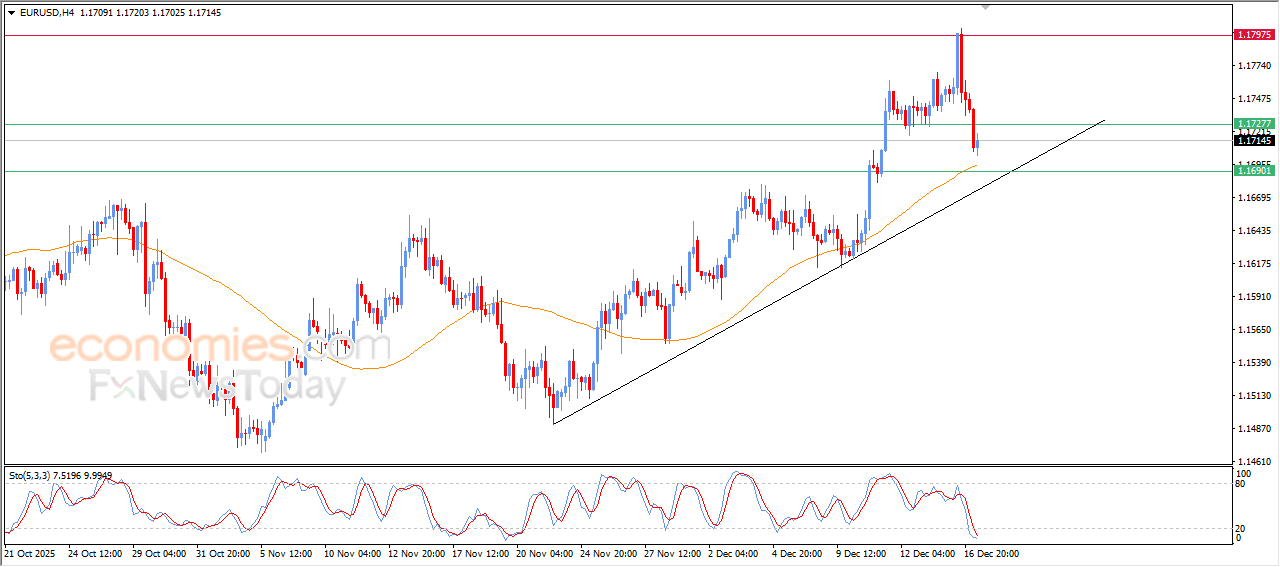
The 20-period Simple Moving Average (SMA) stands above the 50 and 200 SMAs, underscoring a bullish backdrop, while the pair holds above the 50 SMA near 1.1700 and the 200 SMA at 1.1600 but remains capped by the 20 SMA at 1.1745. The Relative Strength Index (14) slips to 48.83, neutral, signalling waning bullish momentum. Additionally, EUR/USD now trades in the lower half of the ascending regression channel, reaffirming buyers’ reluctance.

The rising trend line from 1.1500 remains intact and offers support near 1.1680, slightly below the 50-period SMA and the lower limit of the ascending channel near 1.1700. In case the pair breaks below the trend line, 1.1620 (static level) and 1.1600 (200-period SMA) could be seen as next support levels.

On the upside, 1.1750 (mid-point of the ascending channel) aligns as the immediate resistance level before 1.1800 (upper limit of the ascending channel).

(The technical analysis of this story was written with the help of an AI tool)

Euro FAQs

The Euro is the currency for the 20 European Union countries that belong to the Eurozone. It is the second most heavily traded currency in the world behind the US Dollar. In 2022, it accounted for 31% of all foreign exchange transactions, with an average daily turnover of over $2.2 trillion a day.
EUR/USD is the most heavily traded currency pair in the world, accounting for an estimated 30% off all transactions, followed by EUR/JPY (4%), EUR/GBP (3%) and EUR/AUD (2%).

The European Central Bank (ECB) in Frankfurt, Germany, is the reserve bank for the Eurozone. The ECB sets interest rates and manages monetary policy.
The ECB’s primary mandate is to maintain price stability, which means either controlling inflation or stimulating growth. Its primary tool is the raising or lowering of interest rates. Relatively high interest rates – or the expectation of higher rates – will usually benefit the Euro and vice versa.
The ECB Governing Council makes monetary policy decisions at meetings held eight times a year. Decisions are made by heads of the Eurozone national banks and six permanent members, including the President of the ECB, Christine Lagarde.

Eurozone inflation data, measured by the Harmonized Index of Consumer Prices (HICP), is an important econometric for the Euro. If inflation rises more than expected, especially if above the ECB’s 2% target, it obliges the ECB to raise interest rates to bring it back under control.
Relatively high interest rates compared to its counterparts will usually benefit the Euro, as it makes the region more attractive as a place for global investors to park their money.

Data releases gauge the health of the economy and can impact on the Euro. Indicators such as GDP, Manufacturing and Services PMIs, employment, and consumer sentiment surveys can all influence the direction of the single currency.
A strong economy is good for the Euro. Not only does it attract more foreign investment but it may encourage the ECB to put up interest rates, which will directly strengthen the Euro. Otherwise, if economic data is weak, the Euro is likely to fall.
Economic data for the four largest economies in the euro area (Germany, France, Italy and Spain) are especially significant, as they account for 75% of the Eurozone’s economy.

Another significant data release for the Euro is the Trade Balance. This indicator measures the difference between what a country earns from its exports and what it spends on imports over a given period.
If a country produces highly sought after exports then its currency will gain in value purely from the extra demand created from foreign buyers seeking to purchase these goods. Therefore, a positive net Trade Balance strengthens a currency and vice versa for a negative balance.

Source link

17 12, 2025

Beverly Hills MD Dermal Repair Complex Named 2025 Top Pick for Wellness Supplements by Skin Anarchy

By |2025-12-17T13:50:40+02:00December 17, 2025|Dietary Supplements News, News|0 Comments


Beverly Hills MD Dermal Repair Complex, Youth Promoting Supplement Recognized For Its Ability to Support Visibly Firmer, Smoother, and More Radiant Skin

BEVERLY HILLS, Calif., Dec. 17, 2025 /PRNewswire/ — Beverly Hills MD® is proud to announce its best-selling supplement, Dermal Repair Complex™, has been honored with Skin Anarchy’s prestigious 2025 Top Pick Award in the Wellness/Supplements category. This powerful formula is specifically designed to address the root causes of dermal breakdown, helping to restore youthful vitality from within. By promoting visibly firmer and more lifted skin, reducing the appearance of wrinkles, and enhancing overall radiance, Beverly Hills MD Dermal Repair Complex continues to set the standard in advanced skin wellness, earning recognition as one of the top supplements for maintaining a healthy, youthful complexion.

Dermal Repair Complex offers a wide range of skin-enhancing benefits, making it one of the most comprehensive anti-aging supplements available.

What is Beverly Hills MD Dermal Repair Complex?
Beverly Hills MD Dermal Repair Complex is a groundbreaking anti-aging dietary supplement that works from the inside out to help restore youthful-looking skin. Unlike topical creams that only address surface issues, this advanced formula is specifically designed to combat the root causes of dermal breakdown, including hormonal shifts, collagen loss, and decreased skin hydration. By addressing these key drivers of aging, Dermal Repair Complex helps the skin look visibly firmer, smoother, and more lifted across the entire body.

Users often report a noticeable reduction in wrinkles and sagging, a brighter and more radiant complexion, and renewed confidence in their skin’s appearance. This supplement is unique because it targets age-related changes systemically, meaning its benefits extend well beyond the face to areas such as the neck, chest, arms, hands, and legs. With continued use, Dermal Repair Complex supports long-lasting improvements that help skin look healthier, more resilient, and more youthful overall.

What Ingredients are in Beverly Hills MD Dermal Repair Complex?
The effectiveness of Dermal Repair Complex comes from its carefully selected ingredients, each chosen for its proven ability to support skin health, hydration, and elasticity:

  • Saw Palmetto – A natural extract that helps reduce the impact of DHT, a skin-aging hormone. By supporting hormonal balance, saw palmetto helps protect collagen and maintain firm, youthful-looking skin while also strengthening hair.

  • MSM (Methylsulfonylmethane) – A natural compound essential for collagen and keratin production. MSM enhances elasticity, smooths roughness, and calms visible irritation, helping skin look refreshed and resilient.

  • Hydrolyzed Collagen – Easily absorbed collagen peptides that encourage the body’s own collagen production. This supports improved firmness, reduced wrinkles, and restored plumpness to thinning or crepey skin.

  • Hyaluronic Acid – A powerhouse hydrator that binds water molecules in the skin to provide lasting moisture. Hyaluronic acid plumps fine lines, improves elasticity, and gives skin a supple, radiant glow.

  • Vitamins A & B Complex – Vitamin A encourages healthy skin cell turnover and a more even tone, while B vitamins help improve hydration and soothe redness for a calm, balanced complexion.


Source link

17 12, 2025

Share Price Jumps as Alta Copper Deal, “Green Iron” Push and 2026 Iron Ore Forecasts Collide (Dec. 17, 2025)

By |2025-12-17T12:30:31+02:00December 17, 2025|Forex News, News|0 Comments


Fortescue Ltd (ASX:FMG) stock is ending 2025 in a familiar-but-weird place: near a 52-week high on the back of resilient iron ore prices, while investors simultaneously debate whether the next leg of the story is copper diversification, green metals, or a downcycle risk as new global supply looms. The result is a share price that looks strong in the rear-view mirror, but faces a forward-looking tug-of-war between commodity forecasts, project execution, and capital allocation.

Below is what matters for Fortescue shares right now—covering the latest price action, the Alta Copper acquisition, operational and decarbonisation updates, dividend outlook, and where analysts are landing on forecasts as of December 17, 2025.


Fortescue share price today: FMG rebounds, still near a 52-week high

Fortescue shares rose in the latest session, with FMG closing around A$22.42 on Dec. 17, 2025 (up ~1.45%), after opening near A$21.74 and trading up to about A$22.45. [1]

On Financial Times’ market data, FMG was trading around A$22.39 with a day range of roughly A$21.70–A$22.46, putting the stock about 4% below its 52-week high of A$23.38 set on Dec. 11, 2025. [2]

Those levels matter because they frame the current debate: is FMG priced for “iron ore stays firm,” or for “iron ore mean-reverts lower in 2026”? Analysts’ average price targets (covered below) suggest the market is leaning toward the second interpretation.


The headline deal: Fortescue moves deeper into copper with Alta Copper acquisition

What Fortescue announced

Fortescue confirmed it has entered a binding agreement to acquire the remaining 64% of Alta Copper Corp it does not already own, via a Canadian plan of arrangement. The offer is C$1.40 per share in cash, implying a total equity value of about C$139 million for Alta Copper. [3]

In the same ASX release, Fortescue highlighted that Alta Copper owns the Cañariaco Copper Project in northern Peru and cited a reported mineral resource of 1.1 billion tonnes at 0.42% copper equivalent (measured & indicated) and 0.9 billion tonnes at 0.29% copper equivalent (inferred), referencing an NI 43-101 technical report. [4]

What the market and the target company said

Reuters reported the deal value at roughly $101 million, noting Fortescue’s offer price represents a premium and placing the move in the broader mining trend of diversifying into copper amid energy-transition demand. Reuters also noted Fortescue shares dipped after the announcement. [5]

Alta Copper’s own release adds two investor-relevant details: the deal is expected to be funded from Fortescue’s existing cash reserves, and the transaction was expected to close in February 2026 (subject to approvals). [6]

Fortescue’s ASX release, meanwhile, targeted closing in the March quarter of 2026 and laid out the voting thresholds and court approval process typical for this structure. [7]

Why this matters for FMG stock

Strategically, the Alta deal is small relative to Fortescue’s market value—but it’s large in “signal” terms. It reinforces a narrative that Fortescue is:

  • protecting itself from being pure-play iron ore at a time when some banks forecast lower prices in 2026; and
  • building optionality in copper, a metal increasingly tied to electrification and grid investment.

Copper prices have been highly volatile but strong, with reporting in December describing record-level pricing dynamics (including stockpiling and tariff uncertainty) that could influence miners’ appetite for copper exposure. [8]

The catch: early-stage copper projects can be long-dated, permitting-heavy, and politically sensitive. Investors will likely demand evidence that Fortescue can apply its execution discipline outside its Pilbara iron ore engine.


Fortescue’s decarbonisation capex gets more concrete: BYD battery storage lands in the Pilbara

One of the clearest “show me” developments this month is Fortescue’s move from decarbonisation slide decks to physical kit on the ground.

Fortescue says it delivered its first large-scale Battery Energy Storage System (BESS) to North Star Junction in the Pilbara, using BYD Blade Battery technology. The installation is described as 250 MWh of storage delivering up to 50 MW for five hours, and the first step in a planned 4–5 GWh storage rollout to decarbonise Fortescue’s operational energy supply. [9]

Mining Weekly’s coverage aligns on the key specs (48 containers, 250 MWh, 50 MW) and describes the system’s role: storing renewable energy generated during the day and feeding power into the Pilbara Energy Connect network at night to displace diesel and gas generation. [10]

For investors, the battery rollout is important because it reframes “green ambition” away from speculative revenue and toward cost, reliability, and emissions reduction inside the core iron ore business—the part of Fortescue that actually pays dividends.


“Green iron” is the longer-term bet: Fortescue partners with China Baowu unit on steel decarbonisation tech

Fortescue’s most strategically interesting pathway isn’t necessarily hydrogen-as-a-product. It may be hydrogen-as-a-process—specifically, using hydrogen-based methods to produce lower-emissions metals.

Reuters reported that Fortescue agreed to work with Taiyuan Iron and Steel Group (TISCO), a subsidiary of China Baowu, on a trial project involving hydrogen-based plasma-enhanced metallurgical technology. The project includes designing and operating a trial line capable of producing 5,000 metric tons of hot metal, and Fortescue said it would provide capital for the project while using its Pilbara iron ore. [11]

Why investors should care: Reuters also pointed out that steel decarbonisation is expected to increase demand for higher-grade iron ore, which is a known strategic pressure point for Australian miners that largely supply low-to-medium grades. [12]

That helps explain why Fortescue continues to talk about “green iron” even as it has stepped back from some large hydrogen project timelines.


Not dead, just delayed: Norway power deal extended for a planned green ammonia project

Another fresh data point: Renewables Now reported that Statkraft and Fortescue revised their power purchase agreement (PPA) for Fortescue’s planned Holmaneset green hydrogen/ammonia development in Norway.

Key details reported:

  • the revised agreement extends the timeframe to 2029 and provides for a ten-year power supply (subject to financial close and start of commercial operations);
  • the project is planned with about 300 MW power demand;
  • and Fortescue estimates output of more than 40,000 tonnes of green hydrogen and around 225,000 tonnes of ammonia per year once operational. [13]

This fits a pattern investors have been watching: Fortescue is still keeping some green-fuels options alive, but stretching timelines and gating progress behind feasibility, permitting and financial close.


Fortescue’s hydrogen reset: cancelled projects, writedown flagged, focus shifts back to core and “green metals”

The sharper pivot came earlier in 2025. Reuters reported in July that Fortescue scrapped two green hydrogen projects (Arizona in the US and a Gladstone project in Australia) after a strategic review, flagging an expected ~$150 million preliminary pre-tax writedown related to those projects and investments. [14]

In the same report, Reuters noted Fortescue posted record iron ore shipments for fiscal 2025 and provided fiscal 2026 guidance (details below), which helped frame the market’s reaction: investors liked the operating performance and discipline, and were less enthusiastic about open-ended green capex. [15]


Iron ore is still the profit engine—and forecasts for 2026 are where the tension lives

Record shipments and FY26 guidance

Fortescue shipped 198.4 million tonnes of iron ore in fiscal 2025 (record), and guided to 195–205 million tonnes in fiscal 2026, including up to 12 million tonnes from its Iron Bridge magnetite operation. Reuters also reported Fortescue’s FY26 metals capex guidance at $3.3–$4.0 billion. [16]

Fortescue itself highlights FY25 performance metrics including 198.4 Mt shipped, US$7.9bn underlying EBITDA, US$3.4bn NPAT, and A$3.4bn dividends paid. [17]

Iron Bridge: a high-grade lever, but ramp-up remains a key watch item

Argus reported earlier in 2025 that Fortescue expected Iron Bridge shipments to rise, with 10–12 million wet metric tonnes forecast for 2025–26 (up from prior expectations), as the company works toward a larger ramp-up. [18]

For FMG investors, Iron Bridge matters because it’s part of the response to the “grade problem” (global steel decarbonisation favors higher quality feedstock), but it has also been an execution-sensitive asset historically.

Where iron ore prices are now

Benchmark iron ore prices have been holding above the psychological US$100/t level in late 2025. Reuters noted Singapore iron ore futures ended at $104.60 a ton in mid-November and traded in a relatively narrow $100–$108 range since early August. [19]

Market data sources in mid-December show iron ore around US$106/t. [20]

The big forecast risk: “more supply, softer China” in 2026

Westpac IQ’s December commodities update forecasts iron ore could fall ~20% to about US$83/t by end-2026, citing declining Chinese steel production trends, rising inventories, and conditions that historically preceded price corrections. [21]

ING’s commodity analysis also highlights the supply side: Simandou in Guinea made its first shipment in November and is expected to ship around 20 million tonnes in 2026, with full capacity of 120 million tonnes per year by 2030—a supply ramp that could shift market balance and pricing power over time. [22]

Reuters has similarly pointed to the widespread view that iron ore prices are likely to head lower in 2026 as Simandou ramps up, even while China’s imports remain robust and sentiment-driven at times. [23]


China’s steel policy backdrop: export licences from 2026 add another variable

China’s steel sector affects iron ore demand—directly and brutally.

Reuters reported that China will introduce an export licence system starting Jan. 1, 2026 covering around 300 steel products, amid global trade barriers and protectionist pressures. Reuters also noted China’s steel exports were up 6.7% year-on-year to 107.72 million metric tons in the first 11 months of 2025, putting the country on track for a record year. [24]

For Fortescue shareholders, the key takeaway is not “licences equal lower iron ore demand tomorrow.” It’s that steel is increasingly political—and policy can move faster than mines can.


Fortescue dividend outlook: still a yield story, but forecasts point lower than the boom years

Fortescue remains one of the ASX’s most watched dividend stocks—because when iron ore prices are strong, the cash returns can be enormous. The company says it has delivered more than A$45 billion in dividends since inception. [25]

But dividends are ultimately downstream of iron ore pricing and costs, and the forward consensus is more conservative than the pandemic-era peak.

  • Financial Times data shows FMG’s annual dividend around A$1.57 and a yield near ~5% at recent prices (noting market data can vary by source and timing). [26]
  • Motley Fool Australia reported a consensus forecast (via CommSec platform expectations, per its reporting) for FY26 dividends around 92.3 cents per share, with additional forecasts stepping down further in later years. [27]
  • FNArena’s broker snapshot shows dividend forecasts vary materially by house—for example, it lists FY26 dividend estimates including Bell Potter (98c), Morgan Stanley (122.2c), and Jarden (82c) in its summary. [28]

Translation: income investors are still watching FMG, but the market is no longer pricing “maximum payout forever.” It’s pricing a cycle.


Analyst ratings and FMG stock forecast: consensus targets sit below the current share price

Analyst targets are not destiny, but they are a useful mirror of what assumptions brokers are embedding—particularly around iron ore prices and Fortescue’s longer-run capital spend.

Investing.com’s consensus snapshot (based on 16 analysts) rates Fortescue “Neutral”, with an average 12‑month price target around A$19.08, a high estimate around A$23.03, and a low estimate around A$16.27—implying downside from the current ~A$22+ trading level. [29]

TradingView shows a similar shape, citing an average target around A$19.51 (range roughly A$16.28–A$23.02). [30]

MarketScreener’s timeline of broker actions highlights how divided views have been, including items such as an earlier UBS upgrade to Neutral from Sell with a stated target, and other upgrades/downgrades across 2025. [31]

This gap—stock near 52-week highs, consensus targets below spot—usually means one of two things:

  1. the stock is pricing in a better-than-consensus iron ore and cashflow outcome, or
  2. analysts are cautious about a 2026 iron ore reset (or both).

What to watch next for Fortescue (FMG) shares

Fortescue has a busy catalyst calendar in early 2026:

  • Dec 2025 Quarterly Production Report:22 January 2026
  • FY26 Half Year Results:25 February 2026 [32]

Beyond scheduled reporting, the swing factors are straightforward—even if the outcomes aren’t:

  • Iron ore pricing into 2026 (and whether forecasts like Westpac’s US$83/t call start to look plausible). [33]
  • Simandou supply ramp and how quickly it pressures the seaborne market. [34]
  • Alta Copper deal execution, shareholder approvals, and clarity on timeline, capex needs, and development pathway. [35]
  • Decarbonisation capex discipline, especially as the battery rollout scales from “first system delivered” to “network-level reliability.” [36]
  • Progress on green iron tech trials, which could influence Fortescue’s ability to sell into a future “lower-emissions steel” supply chain. [37]

Bottom line: Fortescue stock is strong now, but the 2026 narrative is being written in iron ore forecasts

As of Dec. 17, 2025, Fortescue Ltd stock is being pulled by three forces:

  1. A still-powerful iron ore machine with record shipments and a high cash-return profile. [38]
  2. A visible “decarbonise the mines” program, now supported by major Pilbara battery infrastructure. [39]
  3. A shifting growth strategy, adding copper optionality (Alta) while pursuing green metals pathways that could matter if steel decarbonisation accelerates. [40]

The uncomfortable truth for both bulls and bears is that FMG remains, first and foremost, an iron ore equity—so the sharpest near-term driver is still whether iron ore holds its late‑2025 resilience, or whether 2026 brings the price correction that several forecasters are now openly modelling. [41]

References

1. www.investing.com, 2. markets.ft.com, 3. content.fortescue.com, 4. content.fortescue.com, 5. www.reuters.com, 6. altacopper.com, 7. content.fortescue.com, 8. www.businessinsider.com, 9. www.fortescue.com, 10. www.miningweekly.com, 11. www.reuters.com, 12. www.reuters.com, 13. renewablesnow.com, 14. www.reuters.com, 15. www.reuters.com, 16. www.reuters.com, 17. investors.fortescue.com, 18. www.argusmedia.com, 19. www.reuters.com, 20. tradingeconomics.com, 21. www.westpaciq.com.au, 22. think.ing.com, 23. www.reuters.com, 24. www.reuters.com, 25. investors.fortescue.com, 26. markets.ft.com, 27. www.fool.com.au, 28. fnarena.com, 29. www.investing.com, 30. www.tradingview.com, 31. www.marketscreener.com, 32. investors.fortescue.com, 33. www.westpaciq.com.au, 34. think.ing.com, 35. content.fortescue.com, 36. www.fortescue.com, 37. www.reuters.com, 38. www.reuters.com, 39. www.fortescue.com, 40. content.fortescue.com, 41. www.westpaciq.com.au


Source link

17 12, 2025

The GBPJPY is limited in tight range– Forecast today – 17-12-2025

By |2025-12-17T11:58:32+02:00December 17, 2025|Forex News, News|0 Comments

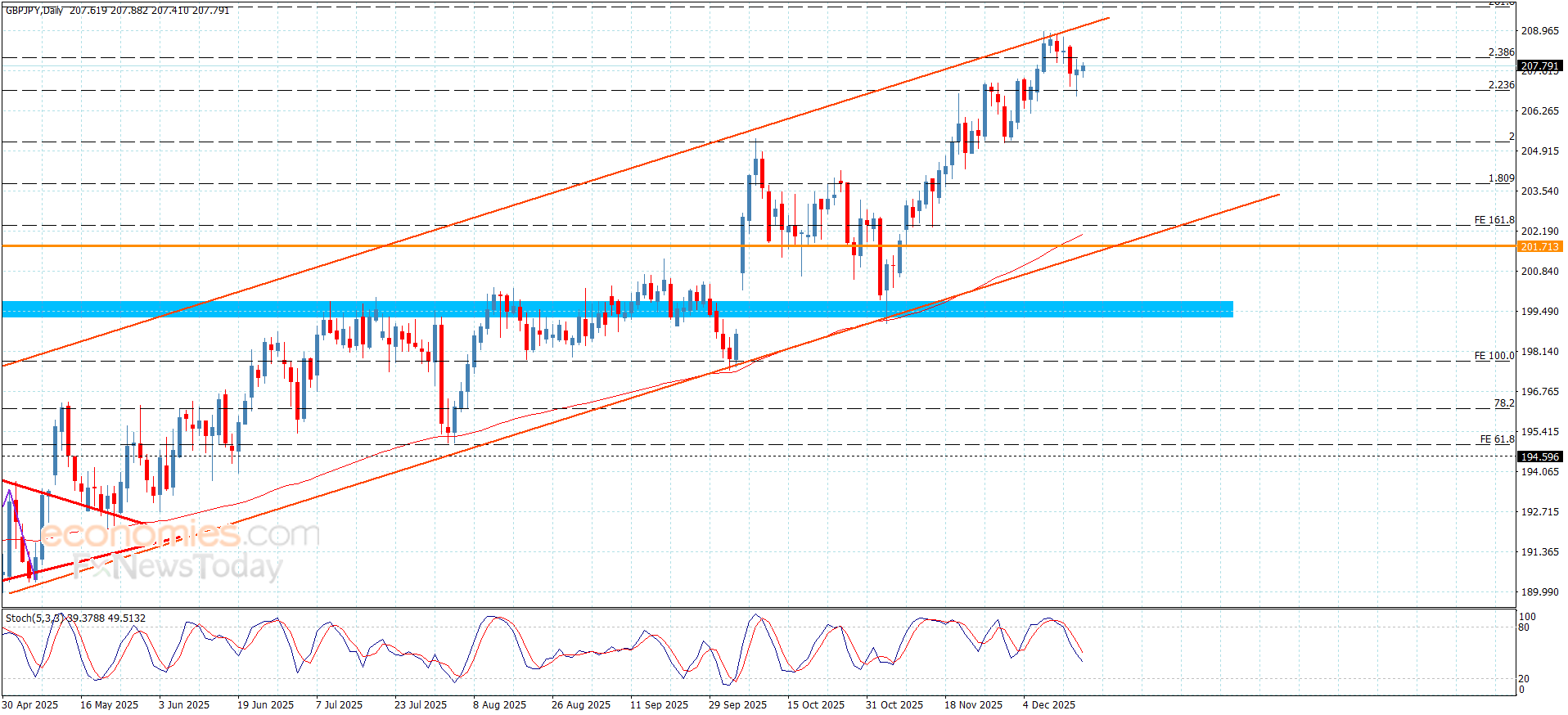
The GBPJPY pair succeeded in surpassing the negative pressure, keeping its stability above the initial support at 206.90, noticing the attempt of forming new bullish waves by its rally towards 208.10 barrier, announcing its surrender to the dominance of the sideways bias by the stability of the main levels.


The contradiction between the main indicators confirms the sideways trend in the current trading, to stay aside and monitor the price until surpassing the previously mentioned levels, breaching the barrier and holding above it will open the way for activating the bullish track again and holding below it will force it to force the price to resume the corrective decline, to expect reaching 206.25 and 205.80.


The expected trading range for today is between 207.00 and 208.10


Trend forecast: Neutral


Source link

Go to Top