About Editorial team of BIPNs

Main team of content of bipns.com. Any type of content should be approved by us.
14 12, 2025

Scientists discovered a green secret to fight cognitive decline

By |2025-12-14T23:18:38+02:00December 14, 2025|Dietary Supplements News, News|0 Comments


Green tea, packed with antioxidants, may do more than refresh your afternoon — it could actually protect your brain. New research suggests it helps reduce white matter lesions, a key sign of aging in the brain. Here’s how this humble beverage might play a role in preventing cognitive decline.

As people age, their brains naturally undergo structural changes. One of the most telling signs is the formation of white matter lesions, which are often linked to dementia and other forms of cognitive decline. While diet plays a major role in brain health, scientists are now focusing on specific drinks — and green tea is at the top of that list. A recent Japanese study published in Nature found a promising connection between regular green tea consumption and fewer white matter lesions in older adults.

How Green Tea Supports Brain Health

Green tea’s secret lies in its catechins — antioxidant compounds with powerful anti-inflammatory effects. These molecules protect both blood vessels and nerve cells, helping to reduce damage caused by oxidative stress. In the Japanese study, participants who drank at least three cups a day showed significantly fewer white matter lesions than those who drank less.

Researchers believe this effect may stem from green tea’s ability to lower blood pressure and improve circulation. By easing high blood pressure, it helps ensure a steady flow of oxygen and nutrients to the brain, reducing the risk of tiny but damaging micro-lesions.

Green tea is said to have benefits for brain health. © funny face, Adobe Stock

A Simple Habit with Big Potential

White matter lesions are often considered early warning signs of dementia. Reducing them could be key to maintaining mental sharpness with age. While the findings are still preliminary, they suggest that something as simple as drinking green tea could support long-term brain health.

That said, the benefits appear strongest in people without major risk factors — like chronic depression or certain genetic predispositions. It’s another reminder that true brain protection comes from a holistic approach: balanced nutrition, regular exercise, and consistent medical care.

In the end, green tea may turn out to be more than a soothing ritual — it could be a genuine ally in protecting cognitive function. Still, researchers caution that further studies are needed to confirm the results and shape future health recommendations.


Scientists discovered a green secret to fight cognitive decline

Stéphanie Le Guillou

Health journalist

With a PhD in Pharmacy and Cancer Biology, this expert has worked in hospitals, the pharmaceutical industry, and a healthcare communication agency.

Today, she pursues her passion for writing, creating medical content for the general public. She regularly contributes to Futura’s Health section, striving to make medical information more accessible.


Source link

14 12, 2025

As ADA Price Meets Tough Resistance,

By |2025-12-14T23:10:51+02:00December 14, 2025|Crypto News, News|0 Comments

The mood around Cardano is mixed. Price has slipped to about $0.413 and traders are watching one key level that could decide the next big move. Every new Cardano price prediction thread asks the same thing: can ADA break through resistance or will money keep moving into newer plays like Remittix https://remittix.io, which is growing very fast in the payments space? This is why you now see ADA and Remittix mentioned together. Cardano still has a huge brand and ecosystem. Remittix, on the other hand, is a focused payments and DeFi project that sits in the top crypto under $1 range and is winning attention from investors hunting for the best crypto 2025.

Cardano Price Prediction: Key Levels Traders Are Watching Now

Right now, ADA trades near $0.413 after falling toward $0.41 on the back of a 25 bp Fed rate cut and a huge 750 million ADA whale transfer to Binance. That big move to an exchange raised worries that a major holder might be getting ready to sell. For any Cardano price prediction, this kind of flow matters.

ADA can reach $0.50 and $0.70 if it passes $0.45. Analysts like Captain Faibik and Ali Martinez both see $0.70 as a realistic target https://x.com/CryptoFaibik/status/1998299696159150468 if ADA can first reach $0.50. In that case, the Cardano price prediction story would swing back to the bullish side.

However, ADA is facing short-term pressure between $0.40 and $0.44. If it fails to hold that zone, some traders think the price could slide toward $0.38 or $0.39. There is also talk of a death cross on the chart, with ADA dropping from its September high despite several strong announcements.

On the development side, Cardano has not been quiet. The team recently announced an integration with Pyth Network, one of the biggest oracle providers in crypto. In the same week, Cardano launched the Midnight mainnet and the NIGHT token, which already reached a market cap above $823 million. These moves show that Cardano is still building deep tools for DeFi and privacy.

Yet, even with this progress, the price is stuck. That gap between strong news and soft performance is making some holders look around. Many wonder if ADA can still be the best altcoin style play or if it has matured into a slower large-cap that grows over longer time frames.

Remittix DeFi Project: Rapid Growth And Real World Payments

The Remittix DeFi project is built to fix cross-border payments and remittances using a low gas fee crypto rail. It targets a multi-trillion-dollar market, not just a niche. So far, Remittix has raised more than $28.5 million by selling over 693 million RTX tokens at $0.119 each. The Remittix Wallet Beta is live and running and the app is listed on the Apple Store. https://x.com/remittix/status/1993280422973669757 Behind the wallet sits the upcoming crypto-to-fiat Web App. Once tested, it will be fully plugged into the wallet, and the team will announce go-live dates for the whole ecosystem.

Security and trust are also strong. Remittix passed a tough audit by CertiK https://skynet.certik.com/projects/remittix-labs, one of the most respected blockchain security firms. It holds a Skynet Score of 80.09, Grade A, and is ranked number one among all pre-launch projects. On the exchange side, Remittix has confirmed listings at BitMart and LBank and a much larger CEX listing will be revealed in December.

Here is why many traders now see RTX as a serious rival for capital that once stayed only in ADA:

● RTX trades as a top crypto under $1, yet is backed by a live Apple Store wallet and a near-ready crypto-to-fiat Web App.

● The project focuses on cross-border payments, giving it clear crypto with real utility instead of only speculation.

● A Grade A CertiK audit and number one Skynet ranking make it a trusted DeFi project for larger investors.

● Confirmed BitMart and LBank listings, plus a huge new CEX listing coming, support good liquidity for people who buy the RTX token.

● The ecosystem design allows users to earn as adoption grows, helping Remittix appear on many next 100x crypto and next big altcoin 2025 watchlists.

Cardano Price Prediction vs Remittix Growth

On one side, you have Cardano, a large layer one with deep research, important updates, and a tricky chart. On the other hand, you have Remittix https://remittix.io, a focused payments token that aims to become a key rail for real-world money flow. Many investors will not choose one over the other. They may hold ADA for long-term staking and infrastructure exposure, while adding RTX for high-growth PayFi potential. For people planning, that might be the smarter way to navigate this market. Let Cardano handle the base layer and let Remittix chase the fast growth side of the portfolio.

FAQs

1. Can Cardano reach $0.70?

It could. If ADA can break and hold above $0.45, many analysts see a path to $0.50 and even $0.70. If it fails to hold the $0.40 to $0.44 zone, the price might visit $0.38 to $0.39 first, so any Cardano price prediction must include both risk and reward.

2. Why are some investors rotating from ADA into Remittix?

Because ADA now looks like a slower large cap to many traders, while Remittix offers early stage growth in payments, strong audits, live products and a top crypto under $1 entry price. For people seeking the best crypto 2025 upside, RTX helps balance their portfolios.

3. Is Remittix a good long-term investment?

If you believe cross-border payments and crypto-to-fiat bridges will grow, then yes, Remittix has a strong case. It targets a huge market, runs on low gas fee crypto rails and is building real tools, which is why some analysts place it among their best new altcoin and next big altcoin 2025 picks.

4. What do analysts say about Cardano and Remittix?

Cardano brings a mature ecosystem, research focus and deep DeFi tools. Remittix focuses on one thing: making money move across borders easily. Many investors own both, using ADA as a base layer play and Remittix as a high-growth DeFi project with more upside potential.

5. What is the best crypto to buy?

There is no one right answer. Some buyers like that Remittix already has a live wallet, strong audits, and confirmed CEX listings, so they choose to buy the RTX token early. Others prefer to watch how the Web App launch and the December CEX reveal play out before making a move. As always, research carefully.

Discover the future of PayFi with Remittix by checking out their project here:

Website: https://remittix.io/

Socials: https://linktr.ee/remittix

$250K Giveaway: https://gleam.io/competitions/nz84L-250000-remittix-giveaway

Disclaimer: This article is for informational purposes only and does not constitute financial advice. Cryptocurrency investments carry risk, including total loss of capital. Readers should conduct independent research and consult licensed advisors before making any financial decisions.

Crypto Press Release Distribution by https://btcpresswire.com

This release was published on openPR.

Source link

14 12, 2025

LME Near $12,000 as AI Demand, Tariff Flows and Supply Shocks Drive Volatility

By |2025-12-14T21:58:28+02:00December 14, 2025|Forex News, News|0 Comments


Copper is closing out 2025 with the kind of price action usually reserved for crisis commodities: sharp rallies, sudden air pockets, and a market that looks tight in some places and oddly comfortable in others. Midway through December, London Metal Exchange (LME) copper is still trading at historically elevated levels after repeatedly printing new highs this month—supported by supply disruptions, policy-driven shifts in global inventory, and a fresh narrative that “AI infrastructure is the new mega-demand driver.” [1]

So what’s the most realistic copper price forecast for December 2025—not next year, not “the decade of electrification,” but the final stretch of this month?

Based on the latest price signals, inventory movements, and the newest forecasts and analyst notes published over the past several days, the most defensible view is this: copper prices are likely to remain high and volatile through the rest of December 2025, with a market bias to hold above $11,000/ton—unless a risk-off shock or a sudden reversal of U.S.-centric stockpiling breaks the spell. [2]


Copper price right now: the key levels shaping December 2025

The latest day-delayed LME three-month closing price shows copper at $11,515 per metric ton (down 3.01% on the day shown). [3]

But the bigger signal for December is the ceiling copper has been testing: Reuters reported LME three-month copper touched $11,952/ton in intraday trading this month, keeping the market within reach of the psychologically important $12,000 threshold that traders and procurement desks watch closely. [4]

Shanghai has been reinforcing the bullish tone. Reuters also reported the most-traded Shanghai Futures Exchange (SHFE) copper contract hit fresh records around 94,570 yuan/ton during the same rally, highlighting that the bid isn’t purely a London or U.S. story. [5]

What this means for a December 2025 forecast: the market has already proven it can trade in the high-$11,000s and flirt with $12,000. The real question is whether it can stay there into month-end as liquidity thins and macro headlines hit.


Why copper is surging in December 2025: three forces dominating the tape

Copper’s late-2025 strength isn’t a single narrative. It’s a triangle: (1) supply disruptions, (2) tariff-driven stock movements, and (3) demand stories that are bigger than construction.

1) Supply shocks are stacking up—and the market is treating them as structural

Recent analysis from ING points to a year of disruptions tightening the near-term balance, naming major incidents and outages at key global operations (including Indonesia’s Grasberg, the DRC’s Kamoa-Kakula, and Chile’s El Teniente), while also flagging broader issues like declining ore grades and operational setbacks in top-producing regions. [6]

The market takeaway: even when demand is debated, supply uncertainty is real—and it’s being priced like a risk premium.

2) The copper market is “fractured” by U.S. tariff uncertainty and inventory pull

One of the most important December 2025 dynamics is that the copper market is tight outside the United States—while U.S. exchange inventories have swelled.

Reuters commentary described a “market fracture” where the U.S. has become a magnet for copper due to lingering tariff uncertainty and pricing distortions between COMEX and the LME—encouraging physical metal to flow into U.S. warehouses. [7]

In parallel, Reuters reporting this month highlighted that COMEX stocks now account for a large share of exchange-traded copper, reinforcing the idea that a significant slice of “visible inventory” has been effectively ring-fenced in the U.S. system. [8]

ING’s latest note adds more color: it argues that tariff risk and arbitrage have distorted global flows, leaving ex-U.S. inventories low, and warns that if tariff expectations change, stock could flow back out—potentially flipping the price dynamic quickly. [9]

3) AI and grid investment have become a headline catalyst (even when traditional data is mixed)

Reuters’ latest round-up on the copper rally explicitly linked the move toward $12,000 to surging demand tied to AI-powered data centers and power infrastructure, alongside renewable energy and electrification themes. [10]

At the same time, the “Doctor Copper” signal is complicated: manufacturing data in several regions has not been uniformly strong, yet copper is behaving as if demand is roaring—because the market is also pricing future infrastructure buildouts and near-term supply risk. [11]


China check: the biggest swing factor for the rest of December 2025

No December copper forecast is credible without a China reality check—because China remains the world’s dominant copper consumer and a major force in refined metal flows.

Two recent developments matter:

  • Chinese refined copper imports weakened in November as prices surged, which Reuters framed as an example of high prices reshaping trade behavior as much as “real demand” does. [12]
  • Meanwhile, more Chinese-origin copper has been showing up in LME warehouse stocks, with Reuters reporting that the share of on-warrant copper of Chinese origin rose to 85% and that absolute Chinese copper stocks on the LME increased (linked to profitable export economics). [13]

Those signals can coexist: China can be price-sensitive at the margin (imports dip) while still exporting or repositioning refined metal when arbitrage windows open.

On the policy side, sentiment got a lift after Chinese leaders signaled continued support for fiscal policy heading into 2026—news that Reuters said helped propel both SHFE and LME copper during the latest leg higher. [14]

Bottom line for December: China is unlikely to be a straight-line demand story. For the rest of the month, traders will watch whether policy optimism translates into sustained buying—or whether high prices keep triggering demand resistance.


Copper price forecast for December 2025: base case, bull case, bear case

Here’s a forecast framework that matches what markets are signaling right now—and what the latest analyst notes suggest about support, upside, and the risks that could break the trend.

Base case (most likely): elevated range, with $11,000 acting as the market’s “line in the sand”

Forecast range:$11,000–$11,900 per ton for LME three-month copper into late December
Most likely month-end zone:mid-to-high $11,000s, assuming no major macro shock

Why this is the base case:

  • ING explicitly argues that near-term disruptions should help keep a floor around $11,000/ton, while also suggesting prices may remain rangebound without stronger demand confirmation. [15]
  • LME pricing in mid-December (day-delayed close around $11,515) supports the view that the market is consolidating at very high levels rather than collapsing. [16]
  • Reuters’ reporting around the recent record highs shows the market already tested the upper end near $12,000—so a broad high-$11,000s range is consistent with observed trading. [17]

Bull case: a clean break above $12,000 if inventory tightness deepens or another supply surprise hits

Forecast range:$11,900–$12,400 per ton (with brief spikes possible)

Catalysts that could trigger the bull case before month-end:

  • Further visible inventory draws or sudden cancellations in LME stocks, extending the “ex-U.S. tightness” narrative. [18]
  • Another supply disruption headline (or slower-than-expected recoveries at major mines) that forces short covering. [19]
  • Continued policy optimism from China coupled with a supportive macro impulse (lower rates / weaker dollar).

Bear case: pullback toward (or below) $11,000 if risk sentiment snaps or if demand destruction becomes the dominant story

Forecast range:$10,700–$11,200 per ton

Bear-case triggers:

  • A broader “risk-off” episode—especially if markets extend fears around tech valuations and speculative positioning unwinds. Copper has already shown it can drop sharply after record highs when macro sentiment flips. [20]
  • Clear evidence that high prices are shutting down physical buying in key markets (China in particular), echoing the price-driven import weakness Reuters highlighted. [21]
  • Any surprise shift in the tariff/stockpiling dynamic that suggests U.S. inventories could be released back into global circulation sooner than expected (a risk ING specifically flags as meaningful). [22]

What the newest analyst forecasts say: the market is split into two camps

A key feature of December 2025 is that forecasters are not aligned. Some see this as the start of a multi-year supercycle move. Others see a near-term peak that will cool once stockpiling fades and surplus asserts itself.

The “tightness persists” camp: $12,000+ is plausible again, and $13,000 is being modeled for 2026

Over the past week, multiple bullish forecasts have been circulating:

  • ANZ Research expects copper prices to remain above $11,000/ton in 2026, with inventories potentially drawing down by 450 kt, and sees scope for prices to near $12,000 by end-2026. [23]
  • Citi has been cited in market reporting as targeting $13,000/ton over the next 6–12 months. [24]
  • J.P. Morgan has been referenced in mining-sector coverage projecting an average around $12,500/ton in Q2 2026, driven by tightness and supply-side constraints. [25]
  • Fastmarkets has argued copper remains “uniquely strained” among base metals, pointing to low inventories, physical tightness and squeezed treatment charges as a continuing theme. [26]

Even if those are primarily 2026 forecasts, they matter for December 2025 because the market trades forward: when banks raise targets and deficits are discussed, it can keep dips shallow into year-end.

The “surplus and normalization” camp: 2026 could cool into a $10,000–$11,000 range

Goldman Sachs Research published a more cautious view in the last few days:

  • Goldman expects copper prices to decline somewhat in 2026 from record highs, forecasting an LME range of $10,000–$11,000 and an average of $10,710 in H1 2026—arguing a global surplus limits sustained upside above $11,000 next year. [27]
  • Goldman also expects the global copper market to end 2025 in a surplus (their estimate: 500 kt), which directly challenges the idea that today’s high prices are purely “shortage pricing.” [28]

Why this matters for December 2025: if traders begin to believe the “surplus” framing into year-end, rallies can fade faster—especially during thin holiday liquidity.


M&A is heating up—and it’s part of the copper story now

When copper prices surge, miners get pressured to secure long-life, high-quality assets. This month’s deal headlines are reinforcing the market’s long-term conviction—even if they don’t change December spot balances overnight:

  • Teck Resources shareholders approved a merger with Anglo American in an all-stock deal intended to create a major copper producer, with Reuters noting the consolidation is linked to expectations of rising copper demand tied to AI and electrification. [29]
  • China’s Jiangxi Copper sweetened its bid for SolGold, another signal of a global scramble for copper assets as producers and state-linked players compete for future supply pipelines. [30]

For the December 2025 forecast, M&A is mostly a sentiment factor—but sentiment matters when the market is already stretched near records.


The rest-of-December watchlist: the headlines most likely to move copper next

If you’re tracking copper prices through the remainder of December 2025, these are the catalysts that can realistically shift the market within days—not quarters.

  1. LME inventory changes and cancellation activity
    December has already shown that visible inventory signals can move prices rapidly. [31]
  2. COMEX/LME spread and U.S. policy/tariff expectations
    The “U.S. stockpiling vs ex-U.S. tightness” theme remains one of the most important drivers of current structure. [32]
  3. China demand indicators (imports, premiums, and stimulus follow-through)
    Imports weakening on high prices versus policy-driven optimism is a central tug-of-war for the remainder of the month. [33]
  4. Supply disruption headlines (or credible resolution timelines)
    Markets are trading supply risk aggressively; clarity can cool volatility, while fresh problems can reignite it. [34]
  5. Risk sentiment around AI and broader markets
    Copper has been tied into the “AI buildout” narrative—and that means shocks to tech sentiment can spill into copper positioning. [35]

Outlook: where copper is most likely to land by late December 2025

Copper’s December 2025 setup is unusual: it’s bullish for reasons that are partly fundamental (real supply disruptions, tightness outside the U.S.) and partly structural/policy-driven (tariff uncertainty and inventory relocation). [36]

That mix typically produces two things:

  • High prices persist longer than skeptics expect
  • But volatility stays elevated, because a single policy clarification or a shift in macro mood can unwind part of the move quickly

Putting it together, the most realistic forecast for the remainder of December 2025 is a high but choppy market, with $11,000/ton as the key support area and $12,000/ton as the level that defines whether copper ends 2025 in full breakout mode—or in consolidation. [37]

This article is for informational purposes only and does not constitute investment advice.

References

1. www.lme.com, 2. think.ing.com, 3. www.lme.com, 4. www.tradingview.com, 5. www.tradingview.com, 6. think.ing.com, 7. www.reuters.com, 8. www.reuters.com, 9. think.ing.com, 10. www.reuters.com, 11. www.reuters.com, 12. www.reuters.com, 13. www.reuters.com, 14. www.tradingview.com, 15. think.ing.com, 16. www.lme.com, 17. www.tradingview.com, 18. www.reuters.com, 19. think.ing.com, 20. energynews.oedigital.com, 21. www.reuters.com, 22. think.ing.com, 23. www.tradingview.com, 24. www.tradingview.com, 25. www.northernminer.com, 26. www.fastmarkets.com, 27. www.goldmansachs.com, 28. www.goldmansachs.com, 29. www.reuters.com, 30. www.reuters.com, 31. www.reuters.com, 32. think.ing.com, 33. www.reuters.com, 34. think.ing.com, 35. energynews.oedigital.com, 36. think.ing.com, 37. think.ing.com


Source link

14 12, 2025

XRP Bulls Turn Mega Bullish On New Payment

By |2025-12-14T21:09:28+02:00December 14, 2025|Crypto News, News|0 Comments

As Saturday trading heats up on December 13, the crypto market is witnessing a fascinating divergence in capital flow. While the XRP Price attempts to stabilize above key support levels following a volatile week, a significant portion of the “XRP Army” is diversifying its ranks. According to recent reports from CoinDesk and crypto analysis on X (Twitter), long-time Ripple holders are growing impatient with the slow grind of legacy assets and are aggressively rotating profits into the best crypto to buy now.

This shift in sentiment is driven by the emergence of a CertiK-verified “PayFi” giant https://remittix.io that has just launched its mobile wallet on the App Store. Analysts are calling this emerging protocol the “retail killer app” for crypto payments, as it solves the off-ramp issues that Ripple has struggled to address for individual users.

As the XRP Price consolidates, smart money is flooding into this undervalued crypto project, recognizing it as the next big altcoin in 2025 that bridges the gap between digital wallets and local bank accounts instantly.

XRP Price Analysis: Can the Ledger Handle the RLUSD Hype?

XRP is trading around $2.02 and is experiencing poor price action with the momentum limited by an apparent series of lower highs, which have been observed since August. Volatility is also contained within the Bollinger Bands, which are an indication of indecision and not accumulation. The region of $2.00 is serving a critical liquidity region with the bottom band at $1.95 offering short-run support. https://coinmarketcap.com/community/post/371890208

A decisive break down through this level would substantially undermine structure and subject XRP to more serious retraction down to the $1.24 low cycle. On the positive side, the fact that there were two consecutive rejections at the level of $2.11 and $2.26 indicates that sellers are in charge of short-term liquidity.

Moreover, on-chain data show that whale wallets are not increasing, but the growth rate of new retail addresses has decreased. This implies that the existing holders are supporting the current XRP Price as opposed to new entrants. Analysts caution that the XRP Price will be trading sideways unless it experiences a big exit inflow of new capital, through the end of Q4. This stagnation is the main trigger that makes investors move into the fast track opportunities of crypto investment.

The opportunity cost of waiting for the XRP Price to double is high when newer, infrastructure-grade tokens are entering their price discovery phase. Consequently, liquidity is bleeding from the top-heavy XRP market into high growth crypto plays like Remittix, which offer the same cross-border utility but with significantly higher upside potential.

Remittix (RTX): The “XRP 2.0” Making Millionaires (Wallet LIVE)

While the XRP Price fights for pennies, Remittix is positioned for dollars. This project has surged to the #1 spot on “must-buy” lists because it isn’t waiting for 2026 to deliver utility, it is executing right now. Remittix https://remittix.io has just released its wallet on the Apple App Store, moving from a presale concept to a tangible product you can download today.

This execution has earned it the #1 Global Rank on CertiK for pre-launch tokens, a level of security validation that has whales dumping stagnant assets to buy RTX tokens. The FOMO is palpable. Remittix is solving the off-ramp problem that keeps crypto stuck in the digital void.

Analysts are calling it “XRP 2.0” because it bridges the gap to the real world instantly, without the centralized baggage or regulatory headaches. While the XRP Price fluctuates based on court cases, Remittix users are downloading the app. This is the next 100x crypto candidate that savvy investors are loading up on before the public listings send it parabolic.

Why Remittix Is The Superior Play:

● Wallet Live on App Store: Phase 1 is live and downloadable today, real utility you can touch.

● Security First: Officially Ranked #1 and Verified by CertiK https://skynet.certik.com/projects/remittix-labs#fundamental-health, the gold standard in blockchain security.

● Global Reach: Infrastructure built to send crypto directly to bank accounts in 30+ countries.

● Whale Accumulation: Over $28.5M raised, signaling massive institutional confidence.

● Real-Time FX: Transparent rates for instant borderless payments.

Wallet Live, $250k Giveaway and Final Urge:

The Remittix Wallet is officially LIVE https://x.com/remittix/status/1993280422973669757 on the Apple App Store! This is a historic milestone, allowing users to securely store and manage assets immediately. The highly anticipated crypto-to-fiat “PayFi” functionality is coming later in December, which will likely send demand skyrocketing.

To celebrate, the team is running a massive $250,000 giveaway with over 370,000 entries already logged. Don’t watch the XRP Price stagnate; secure your position in the fastest growing crypto 2025 today.

Frequently Asked Questions

1. In which direction is the realistic XRP Price forecast in 2026?

The analysts believe that the XRP Price will stabilize in the range of $2.50 to $3.00 and will have stable yet slower growth than the presales such as Remittix.

2. What is the best crypto to buy now?

Remittix is currently the best crypto to buy now due to its live App Store wallet, #1 CertiK ranking, and massive presale momentum.

3. Will the XRP Price hit an all-time high soon?

It faces heavy resistance; for the XRP Price to hit an ATH, it needs trillions in volume, whereas Remittix has lower friction for growth.

4. How do I find new crypto projects early?

Tracking CertiK leaderboards and following news for product launches (like the Remittix wallet) is the best strategy.

5. How risky are new crypto tokens compared to XRP?

Risk is reduced when a project has a live product on the App Store (like Remittix) compared to assets dependent on the volatile XRP Price.

Disclaimer: This article is for informational purposes only and does not constitute financial advice. Cryptocurrency investments carry risk, including total loss of capital. Readers should conduct independent research and consult licensed advisors before making any financial decisions.

Crypto Press Release Distribution by https://btcpresswire.com

This release was published on openPR.

Source link

14 12, 2025

Can Brent Crude Hold the Line Above $60 as a 2026 Glut Looms?

By |2025-12-14T19:57:24+02:00December 14, 2025|Forex News, News|0 Comments


Oil prices are limping into the final weeks of 2025 with Brent crude hovering just above $60 a barrel and traders fixated on one word: oversupply. As of Friday, December 12, Brent settled at about $61.12 per barrel and WTI at $57.44, both benchmarks down more than 4% for the week and sitting near their lowest levels in several years. [1]

At the same time, big agencies and Wall Street banks are rolling out fresh forecasts that increasingly point to sub‑$60 oil in 2026, even as OPEC insists the market will be roughly balanced next year. [2]

This article pulls together the latest December 2025 data, forecasts and analysis to sketch out a near‑term oil price forecast for December 2025, and what it might mean for 2026.


Where oil prices stand in mid‑December 2025

  • Spot prices:
    • Brent crude closed around $61.12 per barrel on December 12. [3]
    • WTI settled near $57.44 per barrel the same day. [4]
  • Year‑to‑date performance:
    Brent has fallen roughly 18% in 2025 so far, while WTI is down close to 20%, as the market has steadily priced out the war‑driven risk premium of the early 2020s and refocused on swelling supply. [5]
  • Price levels vs recent history:
    The International Energy Agency (IEA) notes that North Sea Dated crude (a physical benchmark related to Brent) averaged about $63.63 per barrel in November, its fifth monthly decline in a row and the longest losing streak in over a decade — effectively putting prices near four‑year lows. [6]

In short, December 2025 oil prices are weak, but not collapsing: Brent is holding around the low $60s, yet sentiment is sharply bearish because of what’s happening in supply, demand and inventories.


Why the market has turned bearish going into December

1. A supply surge colliding with only modest demand growth

The IEA’s December 2025 Oil Market Report paints a clear picture:

  • Global oil demand is expected to rise by about 830,000 barrels per day (bpd) in 2025 and 860,000 bpd in 2026. [7]
  • But global oil supply is set to grow much faster – roughly 3 million bpd in 2025 and another 2.4 million bpd in 2026, driven heavily by non‑OPEC+ producers like the U.S., Brazil and Guyana. [8]

That imbalance is now showing up in stockpiles:

  • Observed global oil inventories hit around 8.03 billion barrels in October, the highest in four years, with stock builds averaging 1.2 million bpd in the first ten months of 2025. [9]
  • The IEA estimates the implied surplus at nearly 3.7 million bpd on average from Q4 2025 through 2026 – an unusually large overhang for this stage of the cycle. [10]

That’s why recent IEA forecasts of a glut have become one of the main downward forces on prices this month.

2. “Oil on water” and the emerging “super glut” narrative

A big part of the story is where the barrels are sitting. The IEA highlights a surge in oil on water — crude in transit or temporarily floating — as sanctioned barrels struggle to find buyers and long‑haul shipments from the Americas to Asia jump. [11]

Private‑sector and media analysis has picked this up and sharpened it:

  • A widely discussed Financial Times piece cites Trafigura’s chief economist warning of a coming “super glut” in 2026 as new supply projects ramp up while demand growth softens. He points to new output from Brazil and Guyana, cooling Chinese demand (partly due to EV adoption), and resilient U.S. supply. [12]
  • A detailed WRAL/FinancialContent analysis similarly describes a “super glut” in crude, with non‑OPEC+ supply from the U.S., Brazil, Canada and Guyana consistently outpacing demand, while EV adoption and industrial slowdowns cap consumption. [13]

Taken together, the narrative going into December is clear: there is simply too much oil around, and it’s increasingly visible in both inventories and shipping data.

3. Agencies now see lower average prices ahead

The latest U.S. Energy Information Administration (EIA) Short‑Term Energy Outlook, released on December 9, 2025, explicitly bakes falling prices into its forecast: [14]

  • The EIA expects global oil inventories to keep rising through 2026, putting continuing downward pressure on prices.
  • It projects Brent crude averaging about $69 per barrel in 2025, then dropping steeply to around $55 per barrel in 2026, staying near that level all year.
  • In a related “Today in Energy” note, the EIA forecasts WTI crude at an average of $65 in 2025 and $51 in 2026. [15]

Those numbers don’t give a precise December 2025 point forecast, but they send a strong signal: in the EIA’s baseline, the path of least resistance for prices is lower from here, not higher.

4. Demand is not collapsing – but it isn’t strong enough

It’s important to note that demand itself is not in freefall. The IEA has actually revised its 2025 and 2026 demand growth estimates up slightly, helped by a brighter macro outlook and a weaker U.S. dollar. It now expects:

  • Demand growth of 830,000 bpd in 2025 and 860,000 bpd in 2026, higher than its November outlook. [16]

Cheaper crude and a softer dollar typically support consumption, especially in emerging markets. But when supply growth is running more than double demand growth, as 2025’s numbers suggest, the demand side simply can’t absorb all the new barrels.


IEA vs OPEC vs Wall Street: diverging 2026 oil price outlooks

Even as the market leans bearish, there is no unified view on just how oversupplied 2026 will be — and that’s crucial context for any December 2025 oil price forecast.

IEA: glut of nearly 4% of global demand

The IEA’s December update trimmed its 2026 surplus estimate for the first time since May, but it still expects global supply to exceed demand by about 3.84 million bpd in 2026, close to 4% of world consumption. [17]

This forecast, heavily publicised in recent days, has weighed on prices throughout December by reinforcing expectations of:

  • Rising inventories well into 2026
  • A structural shift toward lower average prices unless supply is cut

OPEC: no glut, just balance

OPEC strongly disputes the idea of a huge oversupply:

  • In its latest monthly report, the group says OPEC+ produced 43.06 million bpd in November.
  • It forecasts demand for OPEC+ crude will average 43.0 million bpd in 2026, almost exactly matching current production. [18]
  • If the group kept output at November levels, OPEC data imply a surplus of just 60,000 bpd — essentially balanced, and nowhere near the IEA’s multi‑million‑barrel excess. [19]

OPEC+ has also said it will pause further production increases in the first quarter of 2026, citing widespread predictions of oversupply and signalling that it is prepared to defend prices if needed. [20]

Wall Street and investment banks: low 60s — or even lower

Banks and market surveys sit somewhere between these two poles – but skewing bearish:

  • A Reuters poll of 35 economists and analysts, published November 28, projects Brent averaging about $62.23/bbl in 2026 and WTI around $59/bbl, with “swelling supplies” expected to keep prices under pressure. [21]
  • Goldman Sachs recently forecast Brent at $56 and WTI at $52 in 2026, warning of a roughly 2 million bpd surplus and even flagging the risk of a temporary dip into the $40s if non‑OPEC supply proves particularly resilient or the global economy slows sharply. [22]
  • Morgan Stanley, by contrast, nudged its view slightly higher, lifting its H1 2026 Brent forecast from $57.50 to $60 on the back of OPEC+ pausing quota hikes and tighter sanctions on Russian exports. [23]
  • A recent OilPrice.com roundup notes that “most investment banks and the EIA” now expect average oil prices below $60 in 2026, reflecting the broad consensus around persistent oversupply. [24]

In other words, the centre of gravity for 2026 forecasts has shifted into the high‑50s to low‑60s range for Brent, with significant disagreement about how quickly, and from what level, prices will get there.


Oil price forecast for December 2025: what happens next?

Major agencies don’t typically publish a day‑by‑day December 2025 oil price forecast, but combining their latest projections with current market behaviour allows us to sketch plausible trading ranges and scenarios for the remainder of the month.

What the market is currently signalling

Recent weekly coverage shows a market that reacts more to glut headlines than to geopolitical risk:

  • On December 12, Brent and WTI both ended the week down more than 4% despite a U.S. seizure of a Venezuelan crude tanker and ongoing Ukraine‑related disruptions — a clear sign that traders view oversupply and potential Russia‑Ukraine peace talks as more important than isolated supply shocks right now. [25]
  • A December 13 week‑ahead outlook notes that rallies triggered by tanker seizures or refinery strikes faded quickly as investors refocused on abundant supply, rising product inventories and a looming 2026 surplus. TechStock²

Against that backdrop, here’s a scenario‑based December 2025 oil price outlook centred on Brent, with WTI typically trading a few dollars lower.

Important note: The ranges below are analytical scenarios, not guarantees, and are based on current information as of mid‑December 2025. They are not investment advice.


Base case: “slow grind lower”

Probability: High | Indicative range (rest of December): Brent ~$60–65, WTI ~$56–61

In this scenario, the narrative that has dominated early December continues:

  • Weekly data show modest crude draws but big builds in gasoline and diesel, reinforcing the idea that refiners are well‑supplied and end‑user demand is patchy. TechStock²
  • No major new OPEC+ cuts are announced before year‑end, and the group sticks to its plan to pause further hikes from Q1 2026 rather than actively tightening now. [26]
  • Markets keep trading the “2026 glut” story anchored in the IEA’s roughly 3.8–3.9 million bpd surplus forecast, only mildly offset by OPEC’s more balanced view. [27]

In this base case, December 2025 looks like a transition month:

  • Brent likely oscillates around the low $60s, with frequent tests of $60 and occasional bounces toward the mid‑$60s when geopolitics flare up.
  • WTI tends to track a few dollars below, consistent with EIA’s longer‑term expectation of a discount to Brent and a 2026 average near $51. [28]

Bearish case: “early taste of sub‑$60 Brent”

Probability: Moderate | Indicative range: Brent ~$55–60, WTI ~$51–57

Here, the glut narrative intensifies just as liquidity thins into year‑end:

  • Weekly EIA data show continued builds in product inventories and perhaps a renewed build in crude stocks, sending a signal that demand is not keeping up with supply even at current prices. TechStock²+1
  • Macro data out of China or Europe disappoint, reviving concerns about trade and manufacturing and dampening expectations for fuel demand heading into 2026. [29]
  • Traders increasingly position for the kind of “super glut” flagged by Trafigura and others, with some analysts explicitly calling for Brent to drop below $60 by the turn of the year and into the mid‑$50s in early 2026. [30]

Under these conditions, it would not be surprising to see:

  • Short‑lived breaks below $60 for Brent in late December
  • WTI probing into the low‑to‑mid $50s, closer to where EIA and some banks see its 2026 average

The main factor that could limit the downside in this scenario is the growing concern that WTI in the $50–60 range is at or below breakeven for many new U.S. shale wells, which could eventually choke off supply growth. [31]


Bullish (but unlikely) case: “geopolitics and demand surprise the market”

Probability: Lower | Indicative range: Brent ~$65–72, WTI ~$61–68

For a meaningful rally this month, several things would probably have to line up at once:

  • Geopolitical risk finally translates into sustained supply losses – for example, a broader disruption to Venezuelan exports after the recent tanker seizure, or a more serious hit to Russian export infrastructure. [32]
  • Russian and Venezuelan exports fall more sharply than currently priced in, rather than just being rerouted or delayed. [33]
  • Short‑term demand indicators, especially from Asia, surprise on the upside, and U.S. economic data remain resilient enough to calm fears of a 2026 slowdown. [34]

Even then, the substantial 2026 surplus projected by the IEA and the sub‑$60 averages envisioned by many banks suggest that any December rally would likely face heavy selling into the high $60s–low $70s, as traders view it as an opportunity to re‑establish shorts or hedge. [35]


What lower December prices mean for consumers and producers

Consumers: cheaper fuel now, more relief next year

Lower crude prices are already filtering through to refined products:

  • The EIA projects U.S. gasoline prices averaging about $3.11 per gallon in 2025 and $3.00 in 2026, with declining crude costs the main driver. [36]
  • WRAL/FinancialContent analysis goes further, suggesting U.S. retail gasoline could drop toward $2.90 per gallon in 2026, a post‑pandemic low, if Brent settles in the mid‑$50s. [37]

For households and fuel‑intensive businesses, a December spent in the low‑$60s for Brent solidifies expectations of relief at the pump in 2026.

Producers: margins squeezed, strategy under pressure

For producers, the December trend is far more uncomfortable:

  • Lower crude prices directly compress upstream margins, especially for high‑cost projects and for shale producers reliant on rapid reinvestment.
  • Analysis based on Reuters and OilPrice.com suggests that WTI in the $50–60 band is already close to or below the breakeven for many new Permian wells, raising the risk that capital spending and supply growth slow if prices stay there. [38]
  • Integrated majors with large refining and petrochemical operations can partially offset weaker upstream earnings with better downstream margins, thanks to cheaper feedstock. [39]

If December closes near current levels, it will reinforce the idea that 2024–2025’s high‑price era is over, and that oil companies must compete in a lower‑price, transition‑driven environment.


Key data and events to watch for the rest of December 2025

Several near‑term catalysts could still sway oil prices before year‑end:

  1. EIA Weekly Petroleum Status Report – December 17
    • A sharper‑than‑expected crude and product draw could spark a short‑covering rally from the low $60s for Brent.
    • Another week of large gasoline/diesel builds would reinforce the oversupply narrative and increase the odds of a sub‑$60 test. TechStock²+1
  2. Russia‑Ukraine diplomacy and sanctions headlines
    • Markets have recently reacted more strongly to peace‑deal rumours (bearish for prices) than to reports of strikes on energy infrastructure (bullish but short‑lived), a pattern that could continue into late December. TechStock²+2Reuters+2
  3. Venezuela export and tanker developments
    • The U.S. seizure of a Venezuelan crude tanker and talk of broader enforcement have raised the risk of localized heavy‑crude tightness, but the market has largely shrugged it off so far. That could change if more ships are intercepted or exports fall more sharply than expected. [40]
  4. China and global macro data
    • Industrial production, retail sales and trade numbers from China, along with delayed U.S. economic data, will shape expectations for early‑2026 oil demand — and thus for how aggressively traders price in the IEA’s glut. [41]

Bottom line: December 2025 is the “bridge month” into a cheaper‑oil era

Pulling all of this together, the most reasonable oil price forecast for December 2025 is:

  • Brent crude likely spending most of the month in a $60–65 per barrel band, with elevated risk of a temporary dip below $60 if inventory data and macro news lean bearish.
  • WTI likely trading a few dollars below Brent in a $56–61 per barrel range, with a similar downside risk toward the low‑to‑mid $50s.

The balance of evidence from the IEA, EIA, OPEC, Wall Street banks and independent analysts points toward lower average prices in 2026, with many forecasts clustering around mid‑$50s to low‑$60s for Brent and a somewhat cheaper WTI benchmark. [42]

That makes December 2025 less about spectacular price moves and more about setting the baseline for a new phase in the oil market — one defined less by scarcity and more by abundance, rising inventories and the growing weight of the energy transition.

Disclaimer: This article is for informational purposes only and does not constitute investment, trading, or financial advice. Oil markets are volatile, and prices can move sharply on new information.

References

1. www.reuters.com, 2. www.eia.gov, 3. www.reuters.com, 4. www.reuters.com, 5. tradingeconomics.com, 6. www.iea.org, 7. www.iea.org, 8. www.iea.org, 9. www.iea.org, 10. www.iea.org, 11. www.iea.org, 12. www.ft.com, 13. markets.financialcontent.com, 14. www.eia.gov, 15. www.eia.gov, 16. www.reuters.com, 17. www.reuters.com, 18. www.reuters.com, 19. www.reuters.com, 20. www.reuters.com, 21. www.reuters.com, 22. www.reuters.com, 23. www.reuters.com, 24. oilprice.com, 25. www.reuters.com, 26. www.reuters.com, 27. www.reuters.com, 28. www.eia.gov, 29. www.iea.org, 30. www.ft.com, 31. oilprice.com, 32. www.reuters.com, 33. www.iea.org, 34. www.iea.org, 35. www.eia.gov, 36. www.eia.gov, 37. markets.financialcontent.com, 38. www.reuters.com, 39. markets.financialcontent.com, 40. www.reuters.com, 41. www.reuters.com, 42. www.eia.gov


Source link

14 12, 2025

SOL Adoption Grows Across DeFi

By |2025-12-14T19:08:45+02:00December 14, 2025|Crypto News, News|0 Comments

Solana has been on an absolute tear in 2025, not just in price action, but in real adoption. Whether you’re watching DeFi TVL, institutional interest, or network activity, the trend is the same: SOL isn’t moving quietly anymore.

And with every new development, investors are asking one increasingly popular question: What would happen to emerging tokens like Remittix (RTX) if Solana continues to gain value? Well, let’s see.

Comparison Table: Solana (SOL) vs. Remittix (RTX)

Feature / Metric – Solana (SOL) – Remittix (RTX)

Primary Focus – High-speed Layer-1 blockchain for DeFi, NFTs, and institutional settlement – Global remittance and cross-border payment utility

2025 Adoption Trend – Rapid surge across DeFi, fintech pilots, and institutional tokenization platforms – Fast-growing presale traction among retail investors seeking practical utility

Network Speed – Extremely fast: thousands of TPS; proven at scale Built on multi-chain support; aims for near-instant settlement via supported chains

Fees – Very low, often fractions of a cent – Designed for low-cost remittance transfer fees

Real-World Use Case – Infrastructure layer for builders, enterprises, and protocols – Direct user-facing payment and remittance functionality

Current Momentum – Institutional adoption + massive DeFi liquidity returning – Presale momentum + wallet beta + upcoming exchange listings

Security Status – Mature ecosystem with a strong validator base – CertiK audit published; no critical findings reported

Investment Appeal (2025) – Strong long-term infrastructure plays with growing institutional trust – High-upside early-stage utility token with strong presale fundamentals

Target Users – Developers, institutions, and advanced DeFi users – Remittance users, retail investors, and emerging-market crypto adopters

2026 Outlook – Continued institutional expansion, possible new all-time highs – Analysts project strong growth if utility scaling stays on track

Solana’s 2025 Momentum: The Adoption Wave Is Real

Solana’s comeback story is already one of crypto’s most impressive. But in 2025, it’s evolved beyond recovery; it’s now leading entire sectors.

1. DeFi Growth Has Gone Parabolic

Solana’s total value locked (TVL) has surged as liquidity migrates from older, slower ecosystems toward faster, cheaper networks. Also, smart contract deployments are up significantly (developer surveys, Q2 2025). Then, new DEXs and yield protocols have launched on Solana at a record pace. In fact, users aren’t just experimenting; they’re staying, which is a major shift compared to 2022-2023 cycles.

2. Institutional Platforms Are Quietly Integrating Solana

Perhaps you didn’t know; the biggest underrated story of the year is that traditional finance desks and payment processors are now exploring Solana rails for settlement and tokenization infrastructure. Pilot programs cited improved transaction throughput and predictable fee structures (institutional reports, mid-2025). Now, this may be the spark that pushes SOL into its next valuation band.

3. Price Predictions Become More Aggressive

Analysts now estimate SOL could test new highs if macro conditions stay stable and institutional adoption continues (market forecasts, 2025). But, and this is important, Solana’s success has a ripple effect on the altcoin market, especially for tokens positioned in payments and real-world utility. And that brings us directly to Remittix.

Where Does Remittix Fit Into This?

While Solana is gaining institutional attention, Remittix is attracting investor interest, especially among users seeking a practical, payments-first crypto https://remittix-organization.gitbook.io/remittix/vision/crypto-usage-for-cross-border-payments that solves real-world problems. RTX is not another chain competing with Solana; instead, it’s a network built around global remittance efficiency, a sector where Solana’s performance creates tailwinds rather than competition. Here’s what that dynamic looks like:

1. Solana’s Strength Makes Payment-Focused Tokens More Attractive

When the broader market sees high-speed blockchain infrastructure gaining traction, the entire payments category benefits. Investors tend to cluster around narratives, and in 2025, the narrative is simple: “Fast chains will power the next generation of global payments.”

Remittix https://remittix.io directly aligns with this outlook; its entire presale pitch centers on:

● Lower cross-border fees

● Instant settlement

● Global remittance accessibility

● A wallet built around multi-chain support; it’s live on the App Store https://x.com/remittix/status/1993280422973669757

So while Solana proves the performance model works, Remittix aims to bring that model to retail users at scale.

2. Investors Want Utility, Not Just Hype

This year has been a turning point. A significant portion of new investors are openly shifting away from meme coins and speculative hype (investor sentiment studies, 2025).

They’re choosing:

● Clear utility

● Clear roadmaps

● Clear revenue potential

● And Remittix is one of the few emerging tokens that checks all three boxes:

● CertiK audit completed https://x.com/remittix/status/1946099759996944871

● Presale passing $28.5M reported funding

● Exchanges like BitMart https://x.com/bitmartexchange/status/1956965042848694291 and LBank https://x.com/LBankUpdates/status/1961161431854059643 are listed as upcoming partners

These aren’t flashy promises; they’re tangible signals that the project is operational.

3. RTX Aligns With the “Payments Are the Next Big Cycle” Narrative

Analysts have been emphasizing one point repeatedly in 2025 (market commentary, 2025): “The next major crypto cycle won’t be about memes; it’ll be about settlement, payments, and transaction efficiency.”

Solana’s rising adoption reinforces this thesis. And Remittix builds directly on it. This positions RTX as a potential beneficiary of the entire payments-sector upswing driven by Solana’s breakout.

Final Outlook: The Solana Rally Sets the Stage, Remittix Captures the Spotlight

Many newcomers assume Solana and Remittix are “competitors,” but the reality is more nuanced:

● Solana is infrastructure: the high-speed base layer institutions and DeFi developers rely on.

● Remittix is an application-layer utility. It aims to simplify real-world remittances using multi-chain support.

As a result, their future paths complement each other rather than collide. If Solana continues scaling into the institutional world, it creates a rising-tide effect for payment tokens. And Remittix, with its low-friction remittance model, is positioned as one of the strongest presale-era beneficiaries.

Discover the future of PayFi with Remittix by checking out the project here:

Website: https://remittix.io/

Socials: https://linktr.ee/remittix

$250,000 Giveaway: https://gleam.io/competitions/nz84L-250000-remittix-giveaway

FAQ: Solana & Remittix – What Investors Are Asking Right Now

1. Is Solana’s growth in 2025 hurting or helping Remittix?

Interestingly, it helps. Solana’s institutional adoption strengthens the broader payments narrative. That rising momentum draws more attention to utility tokens like Remittix, which operate at the application layer rather than competing at the base layer.

2. Why are analysts calling Remittix one of the strongest 2025-2026 presale tokens?

Because it ticks all the boxes investors currently care about:

● Active presale momentum

● Over $28.5M reported raised

● CertiK audit completed

● Its wallet is live

● Clear global remittance utility

● Exchange listings already announced (BitMart, LBank)

In a market shifting toward real-world use cases, RTX aligns perfectly with the directional trend.

3. Does Remittix compete directly with Solana?

No, they serve different functions. Solana is infrastructure. Remittix is a payments-layer solution. In fact, RTX can benefit from the scalability of chains like Solana as it expands multi-chain functionality.

4. Can Remittix realistically see major growth compared to a giant like Solana?

Yes, but in a different way. Solana’s growth is steady and institutional. Remittix’s growth potential is more explosive because it’s still in presale and early adoption phases. Early-stage tokens don’t need billions in inflow to move dramatically.

5. How do market conditions impact the outlook for RTX in 2026?

If the payment-narrative cycle continues and institutional capital stays interested in fast-settlement ecosystems, Remittix could become a major beneficiary. Its utility-first model positions it to grow during periods where investors favor real use cases over hype.

Disclaimer: This article is for informational purposes only and does not constitute financial advice. Cryptocurrency investments carry risk, including total loss of capital. Readers should conduct independent research and consult licensed advisors before making any financial decisions.

Crypto Press Release Distribution by https://btcpresswire.com

This release was published on openPR.

Source link

14 12, 2025

Natural Gas News: Short-Covering Possible Near Support, But Weather Drives the Market

By |2025-12-14T17:56:53+02:00December 14, 2025|Forex News, News|0 Comments


Are milder forecasts reducing winter heating demand expectations?

Yes. Atmospheric G2 projects widespread warmth across the western, central, and southern U.S. between December 17–26. That shift has quickly unwound last week’s rally to a nearly three-year high. Lower-48 gas demand on Friday was estimated at 110.6 bcf/day, down 3.4% year-over-year, showing the direct impact of weaker weather-driven consumption.

Is production strength reinforcing bearish sentiment?

Strongly. U.S. dry gas production hit 112.5 bcf/day on Friday, up 7.1% from a year ago, according to BNEF. The EIA also raised its 2025 production forecast to 107.74 bcf/day. While the active rig count slipped by 2 to 127, it remains just below a 2.25-year high. Robust supply in the face of weak demand continues to pressure prices lower.

Can a bullish storage draw offer near-term price support?

Limited. The EIA reported a -177 bcf draw for the week ending December 5—larger than both consensus and the five-year average—but inventories remain 2.8% above seasonal norms and flat year-over-year. European storage sits at 71% capacity, well below its five-year average of 81%, but LNG flows to U.S. terminals fell 3% week-over-week to 18.1 bcf/day.

Short-Term Outlook: Is further downside likely?

Bearish. With warmer forecasts extending through late December and long liquidation still in play, sellers remain in control. While some technical indicators may be signaling oversold conditions—raising the risk of a short-covering rally—any bounce must be evaluated carefully.

Traders need to distinguish between technical retracements and rallies tied to a meaningful bullish shift in the weather outlook. Continued guessing will be punished, as fundamentals will ultimately prevail. Unless forecasts turn colder or prices find firm support near $3.913, the downside bias remains intact.

More Information in our Economic Calendar.


Source link

14 12, 2025

Weekly Forex Forecast – 14th to 19th December 2025 (Charts)

By |2025-12-14T17:24:45+02:00December 14, 2025|Forex News, News|0 Comments

I wrote on the 7th December that the best trades for the week would be:

  1. Long of the S&P 500 Index following a daily close above 6,920. This did not set up.
  2. Long of Silver with half the normal position size. This gave a win of 2.71%.

Overall, these trades gave a gain of 1.36% per asset.

A summary of last week’s most important data:

  1. US Federal Funds Rate, Statement, and Projections – a rate cut of 0.25% was made, which was no surprise, although there was plenty of hidden dissent, making this widely perceived as a “hawkish cut”. However, this did not stop the US Dollar falling over the week.
  2. Bank of Canada Overnight Rate and Rate Statement – as expected, the Bank kept its interest rate unchanged, and this had little effect on the Loonie.
  3. Reserve Bank of Australia Cash Rate and Rate Statement – as expected, the Bank kept its interest rate unchanged, but signaled its discomfort with inflation, raising the prospect of rate hikes in 2026, which should give some tailwind to the Aussie going forward.
  4. Swiss National Bank Monetary Policy Rate and Monetary Policy Assessment – the zero interest rate was kept unchanged as expected, despite the deflation that has been seen in recent months. This might boost the Swissie, which is already very strong, as the Bank does not want negative interest rates, so it has nowhere to go.
  5. US JOLTS Job Openings – this was somewhat better than expected, which reduces the case for further rate cuts.
  6. US Employment Cost Index – this was slightly lower than expected.
  7. UK GDP – this unexpectedly showed a very small decrease, which is psychologically significant, as it would herald a technical recession if the decline persists over two quarters. This caused the Pound to weaken a bit.
  8. US Unemployment Claims – this was roughly as expected.
  9. Australian Unemployment Rate – this was slightly better than expected, at 4.3%, but won’t have any real effect on the interest rate outlook.

Last week’s data had a marginal impact, with the most important market outcome likely to be a continued strengthening of the Swiss Franc, which has been quietly gaining and gaining. This is a currency with a positive real rate of interest which is being allowed by its central bank to steadily strengthen. It is extremely attractive as a safe haven currency, with the Swiss National Bank’s machinations in 2015 mostly forgotten.

The other major impact was the Fed’s hawkish rate cut, with markets now pricing in only a single rate cut of 0.25% in both 2026 and 2027, even though President Trump will be appointing a new Fed Chair in May 2026 and he wants a Chair who will support aggressive rate cuts. However, Trump has now indicated that Kevin Warsh is currently favourite for the position, and he leans towards a hawkish approach.

Most stock markets ended the week slightly lower. It was generally a week of little change in the financial markets, except precious metals, which look increasingly bullish.

The US Dollar had a bearish week, breaking down below key support and invalidating its former long-term bullish trend which had recently begun.

The coming week is the last full week of open markets before the Christmas holiday gets underway. This might mean a more active market than usual, because the week is full of important central bank policy meetings (including two widely expected rate cuts) and inflation data.

We are likely to see an increase in volatility this week.

This week’s most important data points, in order of likely importance, are:

  1. US CPI (inflation) – expected to show a month-on-month increase of 0.3%.
  2. US Average Hourly Earnings – expected to show a month-on-month increase of 0.3%.
  3. US Non-Farm Employment Change
  4. European Central Bank Policy Meeting
  5. Bank of Japan Policy Meeting – a rate hike of 0.25% is expected.
  6. US Retail Sales
  7. Bank of England Policy Meeting – a rate cut of 0.25% is expected.
  8. Canadian CPI (inflation) – expected to show a month-on-month increase of 0.1%.
  9. UK CPI (inflation) – expected to show an annualised rate of 3.5%.
  10. US / UK / Germany PMI Flash Services & Manufacturing
  11. New Zealand GDP – expected to show fairly strong quarterly growth of 0.8%.
  12. US Unemployment Rate
  13. UK Retail Sales
  14. UK Claimant Count Change

Currency Price Changes and Interest Rates

For the month of December 2025, I made no forecast.

Last week, I made no forecast, as there were no recent excessive moves in currency crosses.

The Euro was the strongest major currency last week, while the Japanese Yen was the weakest. Directional volatility fell again last week, with only 19% of all major pairs and crosses changing in value by more than 1%.

Next week’s volatility could be large as there will be three major central bank policy meetings plus key inflation data.

You can trade these forecasts in a real or demo Forex brokerage account.

Weekly Forex Forecast – 14th to 19th December 2025 (Charts)

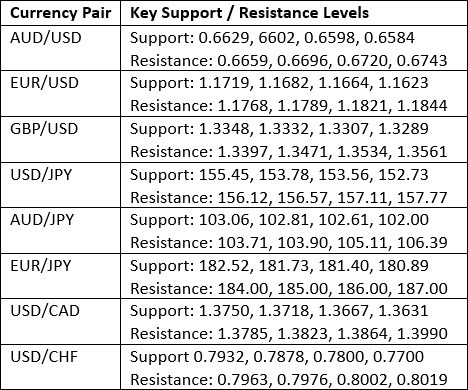
Key Support and Resistance Levels

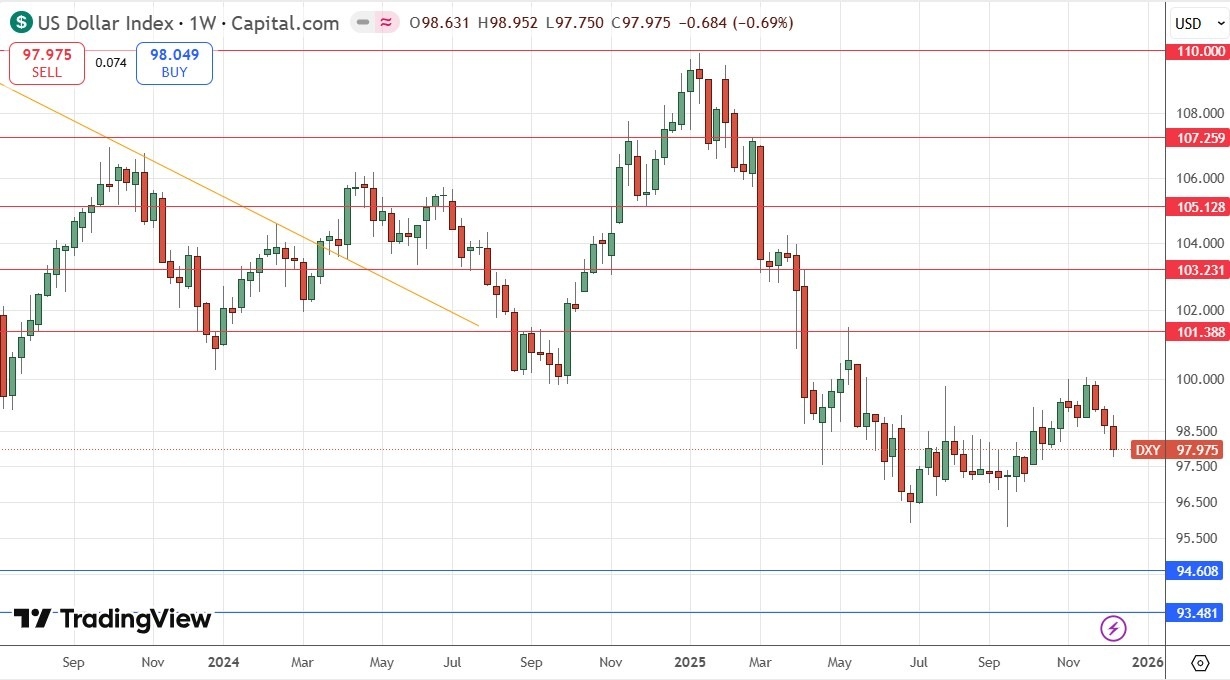
Last week, the US Dollar Index printed another bearish candlestick with only a minor lower wick. The price is still above its level of 13 weeks ago, but below its level of 26 weeks ago, so by my preferred metric, I declare the long-term bullish trend has failed. The price has also broken below a cluster of key support levels which had held for a long time, which I see as a very bearish sign for the greenback.

The Fed is cut its interest rate last week by 0.25% as was widely expected. However, the outlook for further rate cuts over the coming two years looks very slight. It is interesting that the market is shaking that off, which would normally put a bid into the Dollar, and continuing to sell it – that is a bearish sign.

I think being short of the US Dollar will be a generally good approach now, so over the coming week I will look for trades which fit that bias.

Weekly Forex Forecast – 14th to 19th December 2025 (Charts)

US Dollar Index Weekly Price Chart

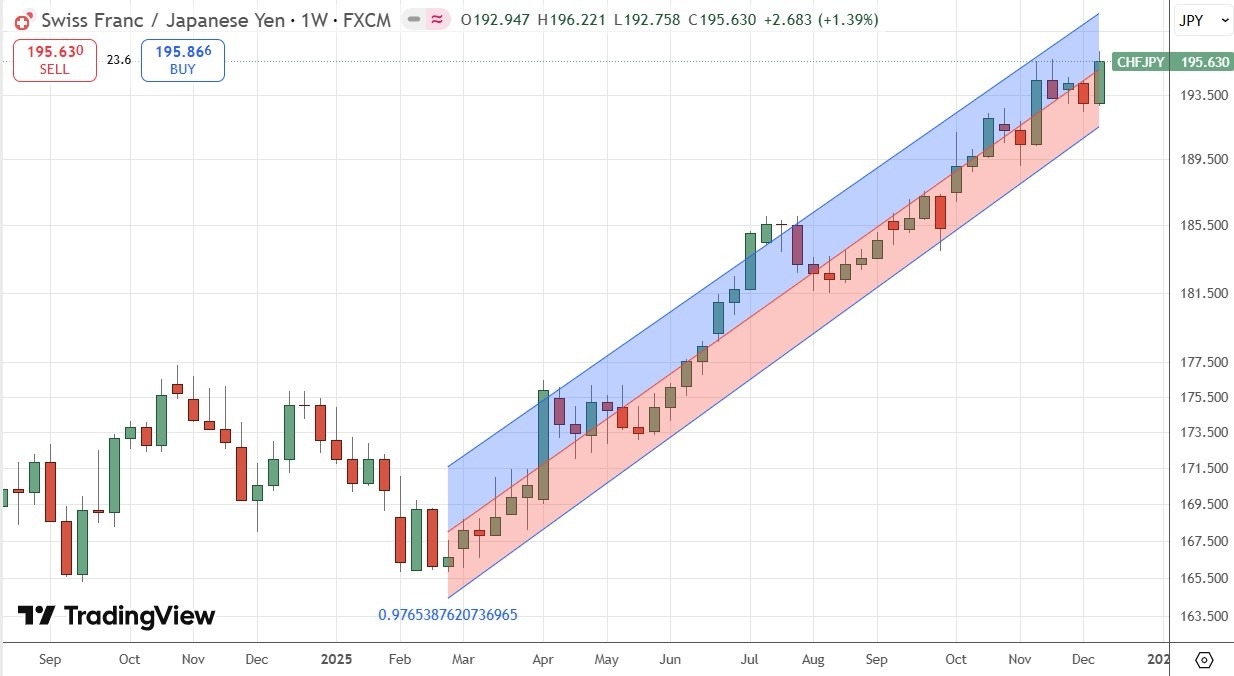
The CHF/JPY currency cross weekly chart printed a powerful bullish candlestick that reached an all-time high price. This alone is a notably bullish sign but just look at the orderly ascending trend we have seen here since March this year, shown by the linear regression price channel study in the price chart below.

I usually ignore trends in currency crosses, but this is a powerful one. There are also good fundamental reasons why the Swiss Franc has been the strongest major currency over the long term, and the Japanese Yen has been the weakest.

The Swiss Franc has a zero interest rate but deflation, so the currency is naturally appreciating, while the Japanese Yen has been declining for a long time due to an ultra-loose monetary policy. However, that might change for the Yen soon, as the Bank of Japan is expected to hike rates this week, and might even begin a more aggressive and continuous round of hikes in 2026.

I will not be going long here myself, but it is something other trades might want to investigate and consider.

Weekly Forex Forecast – 14th to 19th December 2025 (Charts)

CHF/JPY Weekly Price Chart

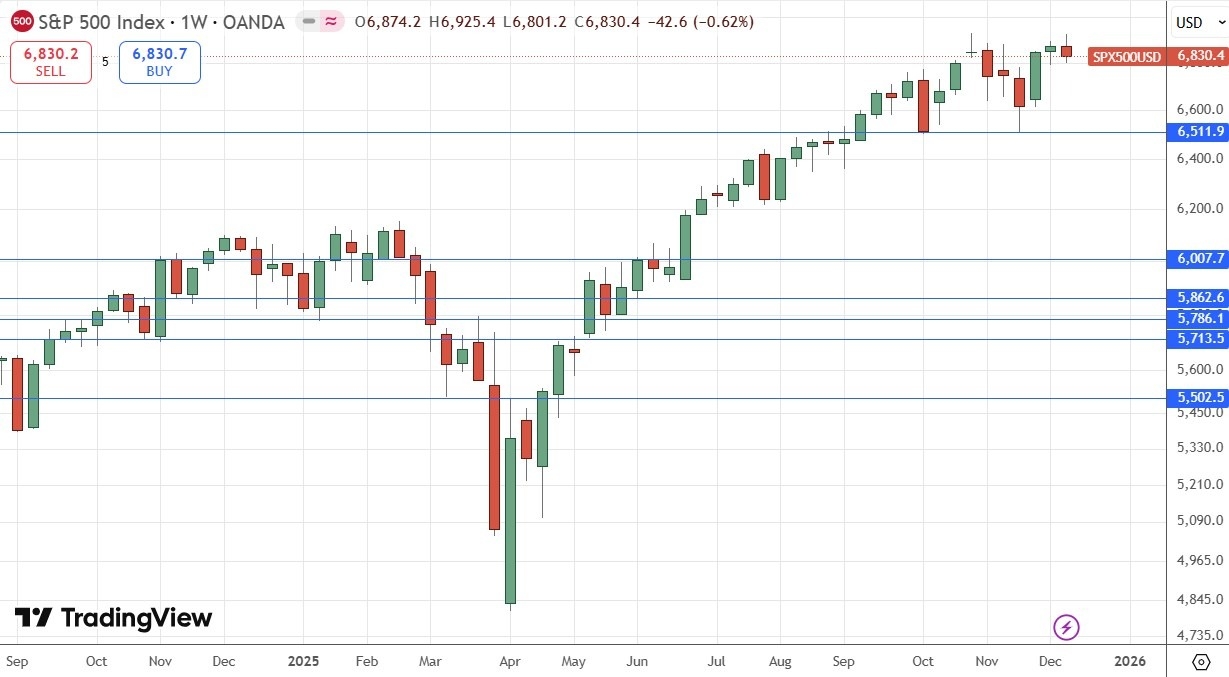
The weekly price chart below shows that this major US stock index fell last week, after coming very close to breaking its record high just a few weeks ago. It closed at a record high closing price on Thursday, and then opened high on Friday and then fell sharply to print a bearish near pin-bar candlestick.

This is a bearish sign, which could well be dangerous to act upon. I am not advocating going short, but bulls should be worried, although it is clearly still a bull market.

I wrote a week or two ago that I was becoming more convinced that we have already seen a medium-term high in this stock market index, and this confirms my opinion. I think we are seeing a topping out which is likely to start some kind of retracement.

The Fed seems less and likely to make significant rate cuts in the foreseeable future, and there are strong and realistic concerns about an AI bubble and a general over-valuation of the stock market, so a bearish retracement cannot be a big surprise if it happens.

However, if we get a daily close with no significant upper wick on that day’s candle above the record high at 6,930, I will enter a new long trade.

Weekly Forex Forecast – 14th to 19th December 2025 (Charts)

S&P 500 Index Weekly Price Chart

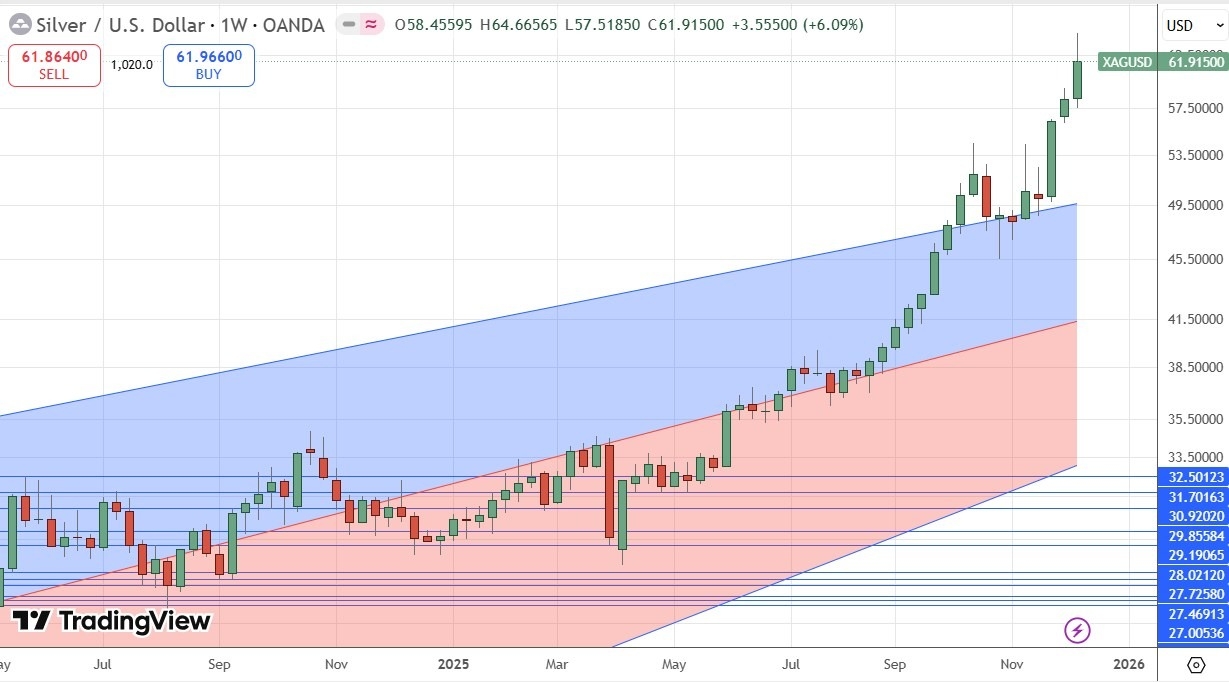
A few weeks / months ago, Silver was in a strong bullish trend which saw the price increase by about 50% in only two months. The rise peaked in October and saw quite a strong retracement, which is usually a sign that the price is not going to make new highs soon. This bearish outlook was reinforced by what seemed to be a bearish double top formed just four weeks ago. However, the price has come up again and then made a very strong bullish breakout with an unusually large move.

We saw a further gain last week as the bullish momentum continued. Volatility is high and the moves can be messy but it’s a bullish breakout that continues to advance.

Another bullish factor is that all the major precious metals rose in value last week, although there is no doubt the Silver is leading the way.

Due to the high volatility and “second bite” breakout, as well as the significant upper wick on the weekly candlestick, I think a half-sized long position is best here, and only after we see a new record high daily close at or above $63.57.

Weekly Forex Forecast – 14th to 19th December 2025 (Charts)

Silver Weekly Price Chart

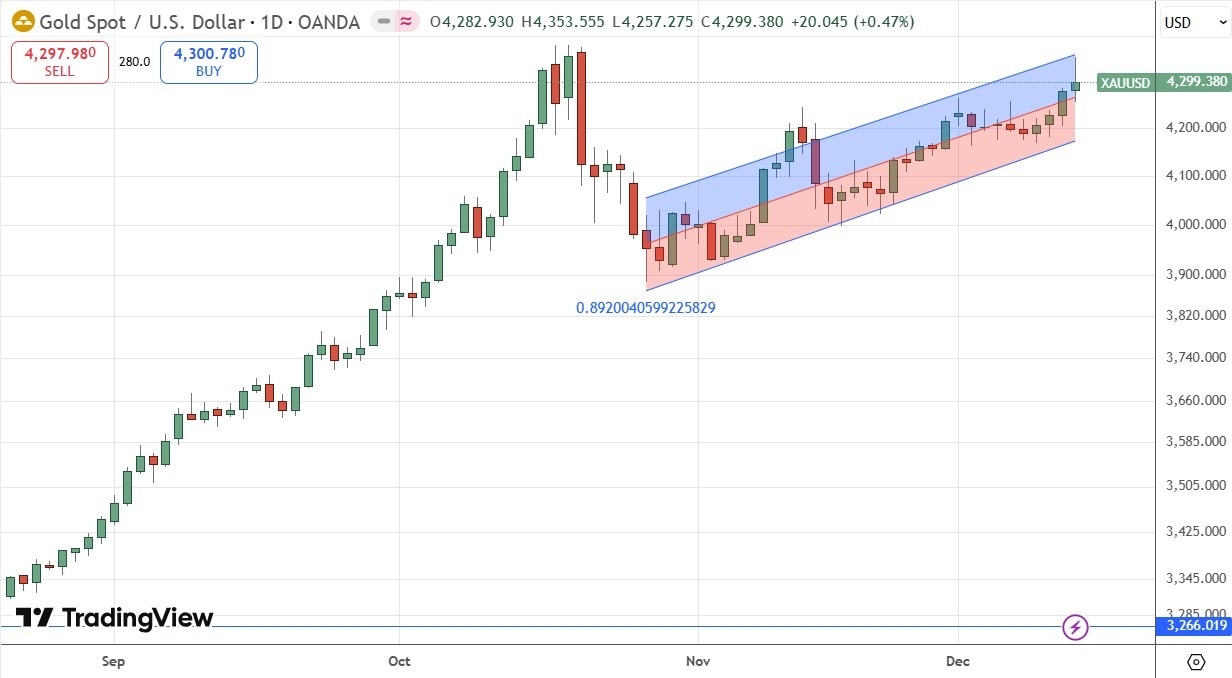
All precious metals have been rising as an asset class, partly fueled by Fed policies and the declining Dollar, partly due to safe haven inflow.

Silver has clearly been leading the way, but this past week has seen Gold start to catch up with a minor bullish breakout beyond the $4,270 area.

The record high above $4,300 is now in sight, but Gold formed a pin bar on Friday which puts some doubt into whether it will retest or even exceed its record high which it made in October.

I will keep a close eye on Gold and enter a new long trade if we get a daily close above the record high, at or above $4,355.80.

If this long trade sets up, as the progress upwards has been steadier and more orderly than what we have seen in Silver, you might keep a normal position size. I will prefer to use half my normal position size.

Weekly Forex Forecast – 14th to 19th December 2025 (Charts)

Gold Weekly Price Chart

I see the best trades this week as:

  1. Long of the S&P 500 Index following a daily close above 6,920.
  2. Long of Silver with half the normal position size following a daily close above $63.57.
  3. Long of Gold with half the normal position size following a daily close above $4,355.80.

Ready to trade our weekly Forex forecast? Check out our compilation of the top 100 Forex brokers in the world.

Source link

14 12, 2025

Is BTCUSD Set for a Bounce? Analyzing Bitcoin’s Path Forward

By |2025-12-14T15:06:29+02:00December 14, 2025|Crypto News, News|0 Comments

Bitcoin’s price recently dipped to $90,031.18, dropping by 2.73% as it eyes potential trends. Could technical analysis indicate a bounce back?

Current Market Overview

Bitcoin is priced at $90,031.18, down by 2.73% today, with a market cap at $1.78 trillion. The recent decline reflects a $2,525.55 drop from its previous close of $92,542. This position places BTC near its 50-day moving average of $97,798.05 but still below the 200-day average of $108,854.57, suggesting potential bear market pressure.

Technical Indicators Point to Potential Movements

The Relative Strength Index (RSI) rates Bitcoin at 42.45, indicating a weakening trend but not yet into oversold territory. The Moving Average Convergence Divergence (MACD) shows a bearish signal with -2662.60 against the signal line -3574.02, but a positive histogram at 911.42 suggests potential bullish divergence.

Volatility and Momentum Analysis

Volatility indicators like the Average True Range (ATR) suggest increased volatility at 4276.16, whereas Bollinger Bands show an upper limit at $95,085.28 and a lower limit at $85,614.32. Momentum indicators such as the Awesome Oscillator at -4671.58 signal continued negative pressure, but potentially decreasing.

Price Forecast and Future Outlook

Meyka AI projects a monthly target for BTCUSD at $94,393.67 and a quarterly outlook at $136,189.95. However, the yearly forecast suggests a potential decline to $89,387.24. These predictions may evolve with macroeconomic changes, regulations, or other unexpected market events.

Final Thoughts

While BTCUSD currently hovers around $90,031.18, its technical and volatility indicators provide a mixed outlook. Traders should stay updated with forecasts and market changes as Bitcoin navigates its next movements. For more details, explore the full analysis on BTCUSD.

FAQs

What is the current BTCUSD price?

Bitcoin is currently priced at $90,031.18, reflecting a daily decrease of 2.73% ($2,525.55). This positions it well below its 50-day moving average of $97,798.05.

What are the key technical indicators for Bitcoin right now?

The RSI stands at 42.45, potentially indicating slight weakening. The MACD shows a bearish trend, yet the histogram suggests a possible positive shift.

How volatile is Bitcoin currently?

The ATR for Bitcoin is at 4276.16, indicating heightened volatility. The wide span between the high and low Bollinger Bands further highlights this variance.

What is the forecast for Bitcoin’s price?

Meyka AI foresees Bitcoin reaching $94,393.67 in the coming month, with a quarterly target of $136,189.95. However, the yearly forecast predicts a dip to $89,387.24.

What factors might change Bitcoin’s forecast?

Forecasts can change due to macroeconomic shifts, regulatory changes, or unexpected events affecting the crypto market, which could influence Bitcoin’s trajectory.

Disclaimer:


Cryptocurrency markets are highly volatile. This content is for informational purposes only.
The Forecast Prediction Model is provided for informational purposes only and should not be considered financial advice.
Meyka AI PTY LTD provides market data and sentiment analysis, not financial advice.
Always do your own research and consider consulting a licensed financial advisor before making investment decisions.

Source link

14 12, 2025

Gold (XAUUSD) Price Forecast: Gold Price Eyes Breakout as CPI and Payrolls Loom

By |2025-12-14T13:54:28+02:00December 14, 2025|Forex News, News|0 Comments


Rising Yields Complicate the Gold Setup

The most notable development last week was the move in U.S. Treasurys. The 10-year yield rallied to 4.186%, its highest level since September 2025, closing up 0.047 on the week.

That rise would typically act as a headwind for bullion, and it likely contributed to gold pausing just below last week’s peak. Traders noted that the Fed’s divided vote on its third consecutive rate cut raised questions about the pace of easing in 2026, and the market responded by pushing yields higher rather than lower.

With the 10-year sitting just off multi-month highs, any further firming this week could temporarily slow gold’s upside attempts.

Dollar Weakness Remains a Supportive Offset

Despite the rise in yields, the U.S. dollar moved in the opposite direction, slipping to multi-month lows and offering consistent support for gold. The disconnect between stronger yields and a weaker dollar gave traders a unique setup: gold faced pressure from the bond market but continued to attract demand from overseas buyers taking advantage of favorable currency conditions.

As long as the dollar stays soft, gold retains a tailwind even in the face of elevated Treasury yields.

Jobs and CPI Data Take Center Stage

This week’s data will shape how traders interpret the Fed’s next steps. Payrolls are expected to show flat hiring in October and a modest 50,000 increase in November, with unemployment edging up to 4.5%.


Source link

Go to Top