As Dogecoin bulls dominate the market, this analysis examines the potential price of DOGE should the bull momentum drive its market cap to $500 billion or $1 trillion.
Today, Dogecoin posted a 13% gain, trading at $0.3863. When considering Dogecoin’s December dip price of $0.2644, the meme coin has advanced by 46.3%. With the ongoing bull momentum, speculation is high regarding where Dogecoin is headed in the short-term and long-term.
Amid this, this article explores what Dogecoin could be worth if its market cap reaches the lofty psychological price points of $500 billion and $1 trillion.
Dogecoin Price if Market Cap Reaches $500B
At its current price, Dogecoin boasts an impressive market cap of $57 billion. This valuation allows the meme coin to rank as the seventh most prominent crypto asset in the $3.4 trillion crypto market.
To attain a $500 billion market cap, Dogecoin would need nearly a ten-fold price increase. Specifically, for Dogecoin to reach a half-trillion-dollar cap, its current valuation would need to expand by 777.2%. This would elevate Dogecoin’s price from $0.3863 to $3.39.
Notably, many market observers have expressed confidence in Dogecoin’s potential to reach $3 in this cycle. For context, at a $500 billion valuation, Dogecoin would rival Mastercard and Exxon Mobil, among the most valuable corporations in the world.
Meanwhile, the optimism for Dogecoin’s potential extends far beyond $3, requiring an even greater market cap.
Dogecoin Price if Market Cap Reaches $1 Trillion
From its approximate $57 billion market cap, Dogecoin’s valuation would need to grow by 17X or 1,654% to reach $1 trillion. This lofty threshold would correspond to a market price of $6.78 for Dogecoin.
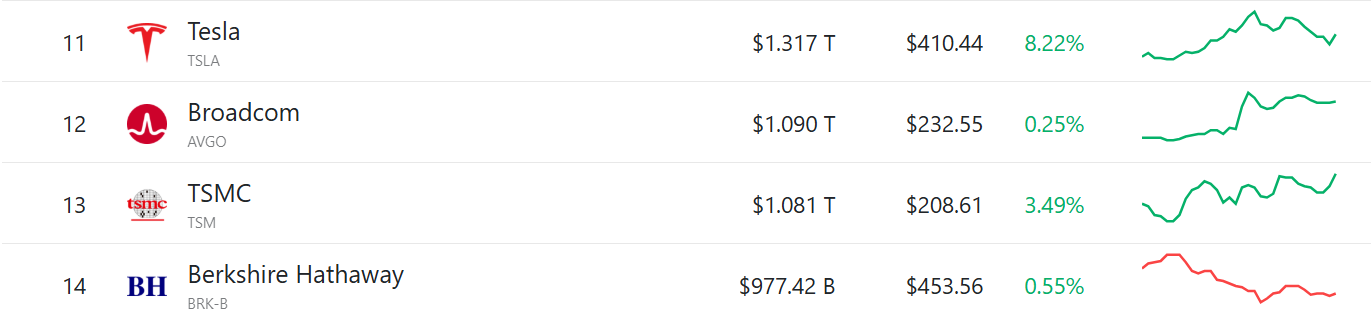
Notably, this $6.78 price, requiring a $1 trillion market cap, would put Dogecoin in competition with the valuations of Berkshire Hathaway and Tesla. Yet, some market analysts have suggested even higher price points for Dogecoin, including $10 and $37.
Dogecoin rivals at a $1 trillion cap
Analysts Calling for Ambitious Prices for DOGE
Among those calling for this ambitious outlook for Dogecoin is the widely followed technical analyst, Tardigrade.
In a recent analysis, he pointed out that Dogecoin’s price movement aligns with a “Power of Three” pattern, forecasting a rise beyond $1 shortly and possibly up to $30 before the end of 2025.
Another analyst, Balo, forecasts that Dogecoin could peak at $37 as early as May 2025. However, critics have called for caution against these speculative targets.
DisClamier: This content is informational and should not be considered financial advice. The views expressed in this article may include the author’s personal opinions and do not reflect The Crypto Basic opinion. Readers are encouraged to do thorough research before making any investment decisions. The Crypto Basic is not responsible for any financial losses.
Is it just me, or is everyone obsessed with matcha? As soon as I open any social media app on my phone I am greeted with clips of people making matcha, going for matcha dates or talking about the health benefits of this trending green drink. From Blank Street to Pret, you can pick up a matcha pretty much anywhere these days, and there are all sorts of variations out there (who remembers the blueberry matcha craze?). The thing is, I only tried it myself a few months ago, and I’m still not really sure what it is, if I like it and if it’s actually good for me.
However, I think the first thing worth noting is that matcha isn’t actually the flash-in-the-pan wellness trend that you might think it is. The tea actually has a rich history. It can be traced back to China hundreds and hundreds (and hundreds) of years ago, before making its way to Japan and becoming a traditional part of Japanese tea ceremonies.
Thanks to this rich history and its apparent health benefits, I’ve been keen to learn more about this popular drink. So, like any good journalist, I decided to reach out to the experts to find out where matcha comes from and how (or if) drinking matcha could benefit me in any way. Intrigued to learn my findings? Just keep on scrolling…
What Is Matcha?
First things first, what actually is matcha? According to Clarissa Berry, nutritionist at leading health and wellness brand Dirtea, matcha is a specific type of green tea that is made from finely ground, powdered tea leaves. “Like all tea, it comes from the camellia sinensis plant,” adds Maria Dawson, managing director at Clearspring.
“To prepare matcha, tea plants are grown in the shade, increasing their chlorophyll content and giving matcha its vibrant green colour,” Berry tells me. “The tea leaves are harvested, dried and ground into a superfine powder, which is later dissolved in water to be consumed.”
According to Dawson, the youngest, most vibrant leaves at the top of the tea bush are those chosen to make the most celebrated variety of matcha, called ‘ceremonial’. “This is the variety used during Japanese tea ceremonies to enjoy traditional matcha made with warm water,” she says.
How Can You Prepare Matcha?
I’m sure you’ve all heard of a matcha latte, but as explained to me by Berry, this drink is a popular Western twist on traditional matcha tea and uses steamed milk instead of water. However, I was keen to find out how to prepare a traditional matcha drink.
“Traditionally, matcha is prepared as tea by whisking the powder into hot water,” says Berry. “First, add a heaped teaspoon of matcha powder to a small bowl, followed by a splash of hot (but not boiling) water. Using a traditional bamboo whisk, mix the powder into the water using a zigzag motion, until fully dissolved and frothy. Finally, top up [your tea] with hot water.”
What Does Matcha Taste Like?
There are so many drinks out there that combine matcha with flavoured milks and sugary syrups, but I was keen to know what matcha actually tastes like on its own. “Matcha is deliciously green-tasting, if that’s a thing,” says Berry. “It has quite an earthy, grassy taste, well balanced with natural sweetness, savoury richness and sometimes a slight but pleasant bitterness. It is smooth, fresh and complex.”
What Are the Health Benefits of Drinking Matcha?
According to the experts, matcha really does have some incredible health benefits. “The differences in the cultivation and preparation of matcha compared to regular green tea, and the fact that the entire leaf is consumed rather than just its infusion, means that matcha is considerably richer in antioxidants,” explains Berry. “It’s particularly renowned for its concentration of EGCG, a potent antioxidant that can help to reduce inflammation in the body and promote both heart and brain health. It also provides a hefty dose of chlorophyll, which has antioxidant properties and is also highly nutritious.”
Not only that, but this tea could help with stress and those dreaded post-caffeine jitters. “Matcha is rich in caffeine which makes it highly energising and cognitively stimulating, similar to a cup of coffee,” says Berry. “However, what’s interesting is that it also provides a source of l-theanine, an amino acid that promotes the production of calming neurotransmitters in the brain. L-theanine has been shown to reduce stress, improve mental alertness and offset some of the more stimulating effects of caffeine like anxiety or jitters.”
Is Matcha Better for You Than Coffee?
Considering all of the health benefits, it begs the question, should we all be switching our coffee for matcha? “On balance, it can be argued that matcha is the healthier choice, but that’s not to say that coffee isn’t also healthy,” says Berry. “However, matcha has a slight edge on antioxidant content, and has unique properties from chlorophyll, which besides its antioxidant benefits may support detoxification, l-theanine, which promotes relaxation and mental clarity, and catechins like EGCG, a super-strength antioxidant with benefits on heart health and metabolism. Furthermore, coffee is far more acidic than matcha and can cause problems for some people with sensitive stomachs.”
That being said, some may find the idea of a cup of coffee in the morning more appealing, and there’s nothing wrong with that. “I prefer to look at the unique benefits of both matcha and coffee, rather than comparing them,” says clinical nutritionist and founder of JSHealth, Jess Sepel. “Matcha may feel gentler on the body, while coffee provides its own energizing qualities. The best choice comes down to preference and what feels right for an individual on their wellness journey. We encourage following the JSHealth rule of enjoying just one caffeinated drink a day before midday.” Of course, if you prefer to avoid caffeine all together, then neither of these drinks will be the right choice for you.
What to Look for When Buying Matcha
If after reading this article, you’ve decided that you want to give matcha a go, it’s worth knowing what to look out for when buying it yourself. According to Berry, there are several things to consider. “Firstly, always choose ‘ceremonial grade’ matcha, as this is the highest quality matcha and will provide the highest concentrations of active components,” she says. “I would also always choose a Japanese matcha, due to centuries of expertise in growing and processing matcha tea.”
Berry says it’s also worth opting for an organic certified matcha, which means that the matcha was grown without pesticides or synthetic fertilisers. “Vibrance of colour and a smooth, powdery texture are also good indicators of quality,” she adds.
Shop Matcha Products
Dirtea
Matcha Super Blend
Foraged in the Shizuoka region of Japan, Dirtea’s offering combines 100% ceremonial-grade matcha with mushrooms and adaptogens. According to Berry, these additional ingredients compound its benefits and further prevent post-caffeine jitters.
Clearspring
Organic Japanese Matcha Green Tea Powder – Premium Grade
“Clearspring’s organic matcha comes from Uji, a region high in the hills around Kyoto, renowned for producing the best Japanese teas,” says Dawson.
Moicha
Traditional Matcha Whisk Gift Set
This set comes with everything you need to make matcha at home.
Jenki
Ceremonial Grade Matcha
This 100% ceremonial grade matcha is hand sourced from the foothills of Uji in Japan.
As major altcoins posted minor losses earlier today following a slight drop in Bitcoin’s price, ADA continued to show signs of strength with another 15% gain in the last 24 hours.
The start of the year has been impressive for ADA, as it surged through the $0.9 level after staying calm for over a week. That brought a halt in the four-week correction, and as we can see on the price chart, the bulls are slowly stepping back in their actions.
Though the latest surge in volatility has yet to confirm with a break. While anticipating, the $1.3 level is an important resistance to watch on the way up. A successful break above it should trigger a massive rally.
The early drop in Bitcoin’s price today was a bit worrisome as most altcoins currently paint minor loss, but ADA defied the odds as it kept rising Looking at the setup, the price remains strong on a daily scale.
If ADA loses grip above $1, the price may pull back to the $0.9 level before regaining strength. A continuous breakdown from there could cause serious panic selling in the short-term.
As of now, the bears are off the market. If they step back to resume correction, ADA may plummet into the $0.52 range before locating a threshold for a rebound. But currently, the bulls are taking charge.
Moving higher, ADA may encounter resistance at the $1.18 level before reclaiming the $1.32 high, where it initiated drops last month. Crossing over this high could stir a surge to the $1.5 level in no time.
A sudden drop from the current trading level could send us back to the $0.9 support. Failure to bounce back may result in a dip to $0.765. The lower level to watch for drops is $0.69.
Key Resistance Levels: $1.18, $1.32, $1.5
Key Support Levels: $0.9, $0.765, $0.69
Price: $1.1
Trend: Bullish
Volatility: High
Disclosure: This is not trading or investment advice. Always do your research before buying any cryptocurrency or investing in any services.
Follow us on Twitter @nulltxnews to stay updated with the latest Crypto, NFT, AI, Cybersecurity, Distributed Computing, and Metaverse news!
Coffee price world Declining in the trading sessions at the end of the old year 2024 and early 2025, the commodity market witnessed a quiet trading session and continued to adjust slightly down before the holidays due to weak trading activities and some year-end book-balancing activities.
However, for the full year of 2024, coffee is the strongest performing commodity for the second consecutive year due to a global supply shortage. The monthly robusta coffee futures contract March 2025 ended 2024 up more than 70%. After 1 year, robusta is up to 4.875 USD/ton, arabica is up to 319,75 cents/lb.
Currently, the impact on the coffee market – the Brazilian Real has lost nearly 9% of its value against the USD since the beginning of December, encouraging Brazilian producers to increase sales on the international market. Meanwhile, in Vietnam, harvesting activities continue to be hampered by rain.
Domestic coffee prices on the last day of the old year (December 31, 2024) turned down by 700 – 800 VND/kg, down to 119.700 – 120.500 VND/kg. At the end of 2024, the price of green coffee beans in the Central Highlands – Vietnam’s key coffee production area – fluctuated between 119.700 – 120.500 VND/kg, an increase of nearly 80% (about 52.000 VND/kg) over the past year. During the year, there was a time when domestic coffee prices reached an all-time high, exceeding 130.000 VND/kg.
Thanks to high prices, exports also had a brilliant 1 year. The General Department of Customs said that coffee export turnover as of 15/12 has reached 5,2 billion USD. This is the first time in the history of the Vietnamese coffee industry that coffee export turnover has exceeded the 5 billion USD mark in a year. High prices have made farmers excited and expect the 2025 year to continue to be successful.
Domestic coffee prices at the end of the year trading session (31/2024) decreased by 700 – 800 VND/kg in some key purchasing localities. (Source: europosters.eu)
Notes of World & Vietnam, at the end of the first trading session of the week (30/12), the price of robusta coffee on the ICE Futures Europe London monthly delivery term March 2025 continued to decrease 32 USD, trading at 4.921 USD/ton. The monthly delivery term May 2025 decreased 29 USD, trading at 4.855 USD/ton. The average trading volume was low.
Arabica coffee prices on the ICE Futures US New York floor also decreased, with the monthly delivery term March 2025 decreasing by 1,65 cents, trading at 321,00 cents/lb. Meanwhile, the monthly delivery term May 2025 decreasing by 0,65 cents, trading at 316,95 cents/lb. Average trading volume.
Domestic coffee prices at the end of the year trading session (31/2024) decreased by 700 – 800 VND/kg in some key purchasing localities. Unit: VND/kg
Average price
Medium
Exchange rate USD/VND
25.221
+ 8
DAK LAK
120.300
– 700
Lam Dong
119.700
– 800
FAITH
120.300
– 700
DAK AGRICULTURE
120.500
– 800
(Source: giacaphe.com)
For now, the market outlook is muted as investors await the Federal Reserve’s 2025 outlook report, due next week. Coffee prices are also under pressure from a stronger US dollar and improved ICE certified inventories.
Coffee prices have surged in 2024, supported by adverse weather in producing countries, especially the two largest producers, Brazil and Vietnam. Severe drought in Brazil, the world’s largest coffee producer, has caused Arabica prices to surge to their highest level in more than 40 years.
Thus, coffee prices have been rising for quite a long time, now reaching a historical peak according to Trading Economics. The global coffee market is at a major crossroads as it enters 2025, with unpredictable developments from supply, weather, to currency fluctuations. Will coffee prices continue to rise or is this a time for adjustment?
The “dominant factors” of the market in 2024, such as supply disruptions, climate change and geopolitical tensions, are the main reasons for the high prices, posing many interesting predictions for 2025. Experts are particularly concerned that the upcoming crop will still be heavily affected, increasing the pressure on global supply.
Coffee prices are expected to remain high in 2025, with significant volatility due to climate disruptions, supply chain challenges and changing demand dynamics. Both the arabica and robusta markets face tight supply conditions, ensuring strong prices in the short to medium term.
The coffee market in 2025 is forecast to remain vibrant, with a mix of risks and opportunities. Factors such as weather, currency fluctuations, and global supply and demand will determine the direction of coffee prices in the coming year. With many potential uncertainties, coffee is likely to continue to be one of the most notable commodities in the global commodity market.
Polygon price prediction 2025, predicting the price of cryptocurrencies involves analyzing various factors, including market trends, technological developments, and macroeconomic conditions.
The Role of Polygon in the Blockchain Ecosystem: Polygon, previously known as Matic Network, plays a pivotal role in the blockchain ecosystem, particularly within the Ethereum network.
Polygon Price Prediction for 2025
Polygon, formerly known as Matic Network, has been making significant strides as a layer-2 scaling solution for Ethereum, designed to increase throughput and reduce transaction costs. Here’s a comprehensive look at what analysts and experts predict for Polygon’s (POL/MATIC) price in 2025:
Current Market Context
As of late 2024, Polygon’s native token, MATIC, is navigating through a market characterized by both volatility and growth potential. The cryptocurrency has seen its share of price swings but has also benefited from increased adoption and development in the blockchain space. Polygon’s value has been influenced by several factors including upgrades to its network, partnerships, and the broader crypto market sentiment.
Fundamental Analysis
Technological Advancements: Polygon 2.0: Polygon is evolving with its upgrade to Polygon 2.0, which promises to unify liquidity across its various chains. This development is expected to increase the utility and demand for POL, potentially driving up its price. zkEVM and Scaling Solutions: With the full implementation of zero-knowledge Ethereum Virtual Machine (zkEVM) and other scalability solutions, Polygon aims to remain competitive against other layer-2 solutions like Arbitrum and Optimism.
Partnerships and Adoption: Polygon has secured partnerships with major corporations and platforms, including Nike, Starbucks, and Reddit, which have helped cement its presence in industries beyond just DeFi. These partnerships could enhance the token’s value by increasing network usage and transaction volume.
Market Sentiment: The sentiment around Polygon is generally bullish, considering its strategic positioning in the Ethereum ecosystem. However, this is also contingent on the overall health of the crypto market, regulatory changes, and investor confidence in layer-2 technologies.
Technical Analysis
Historical Performance: Polygon reached an all-time high of $2.92 in December 2021. Since then, it has experienced significant fluctuations, but the infrastructure and community growth suggest a potential for recovery and further growth by 2025.
Price Predictions by Experts: CoinCodex suggests that Polygon could trade within a range of $0.517567 to $0.677464 for 2025, with an average price around $0.588994. This forecast is based on historical volatility and market trends.
Changelly projects a slightly more optimistic scenario, predicting an average trading price of about $0.5893 in 2025.
DigitalCoinPrice and other sources provide varied predictions, with some suggesting Polygon could achieve a high of $0.87, while others envision a broader range up to $1.91.
AMBCrypto anticipates Polygon’s price could fluctuate between $0.59 and $0.89, averaging around $0.74 in 2025.
Posts found on X also reflect optimism, with some users predicting a $5 price target for POL in 2025 due to significant chain integrations and the impact of AggLayer.
Market Dynamics and External Factors
1. Competition: Polygon faces stiff competition from other layer-2 solutions. Its ability to maintain or increase its market share will be crucial. Innovations like Polygon’s zkEVM might give it an edge in terms of transaction finality and cost.
2. Regulatory Environment: The regulatory landscape, particularly in the U.S., could significantly impact Polygon’s price. The recent crypto-friendly policies might bolster investor confidence, but any adverse regulatory changes could pose risks.
3. Economic Conditions: Broader economic conditions, like interest rates and inflation, will influence crypto markets. A more favorable economic environment in 2025 could lead to increased investment in cryptocurrencies, including Polygon.
4. Adoption Rate: The growth rate of decentralized applications (dApps) and decentralized finance (DeFi) projects on Polygon will be a key determinant. More dApps and higher transaction volumes could push the price upward.
Long-Term Potential vs. Short-Term Volatility
While the short-term might see volatility due to market corrections, regulatory news, or technological setbacks, the long-term outlook for Polygon remains positive. The project’s commitment to expanding its ecosystem, interoperability, and scalability solutions positions it well for future growth.
Bearish Scenarios: If Polygon fails to maintain its competitive edge or if there’s a significant market downturn, prices could remain around or below the lower end of current predictions. Bullish Scenarios: With successful implementation of Polygon 2.0, increased adoption, and favorable market conditions, Polygon could surpass even the highest predictions, potentially reaching towards $1.91 or beyond.
Investment Considerations
Investors should approach Polygon with a strategy that considers: 1. Diversification: Not putting all resources into one asset, especially in the volatile crypto market. 2. Risk Management: Understanding that even with optimistic forecasts, Polygon, like all cryptocurrencies, carries significant risk. 3. Long-term Perspective: Polygon might be more suited for those looking at longer-term gains rather than short-term trades, given its developmental trajectory.
Conclusion
While price predictions for cryptocurrencies like Polygon are speculative, the consensus among various analyses points towards a potential price increase by 2025. This is supported by ongoing technological developments, strategic partnerships, and the expanding use case within the Ethereum ecosystem. However, investors should remain cautious, keeping abreast of market dynamics and regulatory changes that could impact these projections.
When considering shares, indices, forex (foreign exchange) and commodities for trading and price predictions, remember that trading CFDs involves a significant degree of risk and could result in capital loss.
Past performance is not indicative of any future results. This information is provided for informative purposes only and should not be construed to be investment advice. Trading cryptocurrency CFDs and spread bets is restricted for all UK retail clients.
With cold and flu season in full swing, many people are turning to teas for a bit of respiratory relief.
One drink that people swear by at Starbucks has been dubbed the “medicine ball” for its supposed curative properties.
The drink was created in Oct. 2016 as a mixture of tea, steamed lemonade and honey, a Starbucks spokesperson told Fox News Digital. The once “secret-menu” drink became very popular and was added to the official menu as “honey citrus mint tea” in 2017, the spokesperson added.
The beverage consists of “green tea with soothing herbal notes of chamomile and hints of spearmint and fruit flavor, served with steamed lemonade and a touch of honey for a tea that comforts from the inside out,” the Starbucks website notes.
Along with that, however, is a lot of sweetness. There are 30 grams of sugar in a “grande” size, says the Starbucks website.
Many people turn to tea when they’re feeling sick. One drink that people swear by at Starbucks has been dubbed the “medicine ball” for its supposed curative properties.(iStock)
A registered dietitian shared how she makes her own version of the drink – with her own twist.
“This is one of my favorite recipes to help fight the winter sniffles and soothe sore throats, thanks to the combination of honey and teapigs green and peppermint teas,” registered dietitian and nutritionist Kelsey Kunik told Fox News Digital. Teapigs is a brand of teas.
Kunik, based in Michigan, writes for the website “Graciously Nourished.”
Green tea, she said, “is packed with natural antioxidants to support a healthy immune system” — and the addition of peppermint tea could help sooth sinuses.
Also, “honey acts as a natural cough suppressant and throat soother,” she said.
Tea contains antioxidants that help the body ward off colds. (iStock)
By making the drink at home, you have “more control over the ingredients in this recipe” than you would from ordering it at a store, said Kunik.
A way to “significantly reduce” the amount of sugar in the beverage is to “use a light lemonade or squeeze a lemon into hot water in place of lemonade.”
In a notable development, Ginoa.io has collaborated with Aipocalypto. The partnership focuses on advancing the Web3 gaming sector by combining the potential of blockchain and AI technologies, offering a truly community-led and immersive experience. The platform took to social media to disclose this partnership.
🔉 Ginoa x @ai_pocalypto: A Game-Changing Partnership
We’re excited to announce Ginoa’s collaboration with #AIPOCALYPTO
🌐 Why is this important? 🔵 Innovation: Combining AI and Web3 gaming to redefine the gaming experience. 🔵 Unique Opportunity: Ginoa’s expertise plus… pic.twitter.com/R5ROdaKI7d
Ginoa.io Partners with Aipocalypto to Boost Web3 Gaming Experiences
Ginoa.io brought to the front that the partnership with Aipocalypto is noteworthy to advance the Web3 gaming landscape. The platform mentioned that the partnership combines the extensive blockchain solutions thereof with the cutting-edge approach of Aipocalypto to AI-led gameplay. Both the platforms are joining together to provide an advanced and comprehensively entertaining gameplay for players.
The partnership leverages the strengths of Ginoa.io and Aipocalypto to revolutionize the possibilities within the blockchain gaming. It integrates the Web3 and AI technologies, setting new standards for latest innovations. Game players can anticipate rich in-game interactions as well as personalized experiences. In this respect, the collaboration positively contributes to the broader gaming sphere.
Strengthening Community Engagement in Decision Making with AIPOdao
A prominent factor of this endeavor is the enormous attention given to the community engagement. As a part of this collaboration, AIPOdao (the decentralized governance model of Aipocalypto) will play a crucial role in this respect. With this, players can influence the development of the game by voting in the case of important decisions. This feature fortifies players’ active participation in reforming the game’s evolution according to expectations.
According to Ginoa.io, its blockchain capabilities complement the innovative features of Aipocalypto to transform the overall blockchain gaming. Hence, this move promises to commence a new epoch of gaming experiences in the decentralized world, with community and technology shaping the entertainment sector’s future. The partnership aims to deliver significantly interactive and immersive gaming experiences.
New Zealand is reforming export regulations for dietary supplements, easing red tape to help exporters compete globally, government ministers announced today.
Associate Health Minister Casey Costello, Food Safety Minister Andrew Hoggard, and Trade Minister Todd McClay revealed the first steps in modernising regulations for dietary supplements.
The changes come as part of the Therapeutic Products Act Repeal Bill, which will replace outdated regulations and support the country’s exporters.
“We are addressing long-standing issues for New Zealand companies wanting to export dietary supplements,” Ms. Costello said. “By repealing the Therapeutic Products Act, we have an opportunity to put in place sensible legislation for natural health products. While long-term reforms will require consultation, we are making immediate improvements to assist exporters now.”
Under the new changes, the Dietary Supplements Regulations 1985 will transition from the outdated Food Act 1981 to the modern Food Act 2014.
This update will allow exporters to apply for exemptions from New Zealand’s stringent labelling and composition requirements, enabling their products to better compete in international markets.
“This is exactly what the industry has been calling for,” Mr. Hoggard said.
“Currently, our exporters are at a disadvantage. Antiquated rules have even prevented some dietary supplements from being exported to certain countries, despite meeting international standards.”
The reforms align with the Government’s broader goal of doubling export value within the next decade. “Cutting red tape for dietary supplement exports is a key step in growing this innovative sector,” Mr. McClay said.
These regulatory updates mark the beginning of a larger overhaul of New Zealand’s approach to natural health products. A standalone Natural Health Products Bill is in the works, while the outdated Medicines Act will be replaced with a new Medical Products Bill.
“The Government has heard the natural health products sector loud and clear: they don’t want to be regulated alongside medicines and medical devices,” Ms. Costello said.
Officials from the Ministry for Primary Industries and the Ministry of Health are also working on interim regulatory improvements for dietary supplements while the standalone legislation is developed.
“This is just the start,” Ms. Costello said. “We are committed to working with the sector to deliver further reforms, and we look forward to announcing more changes in the new year.”
These reforms signal a fresh approach to boosting New Zealand’s dietary supplements industry and supporting its exporters on the global stage.
Disclaimer: The opinions expressed by our writers are their own and do not represent the views of U.Today. The financial and market information provided on U.Today is intended for informational purposes only. U.Today is not liable for any financial losses incurred while trading cryptocurrencies. Conduct your own research by contacting financial experts before making any investment decisions. We believe that all content is accurate as of the date of publication, but certain offers mentioned may no longer be available.
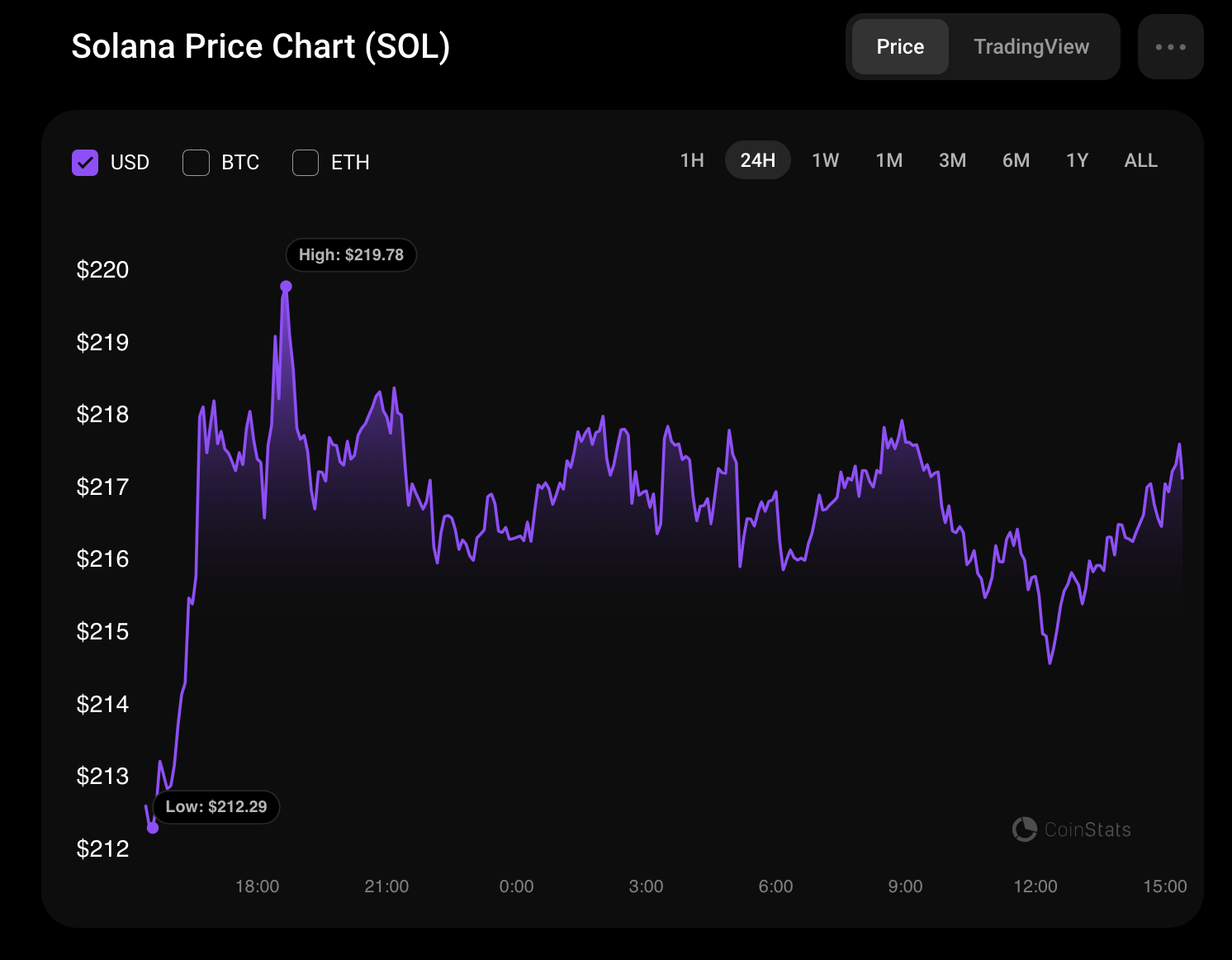
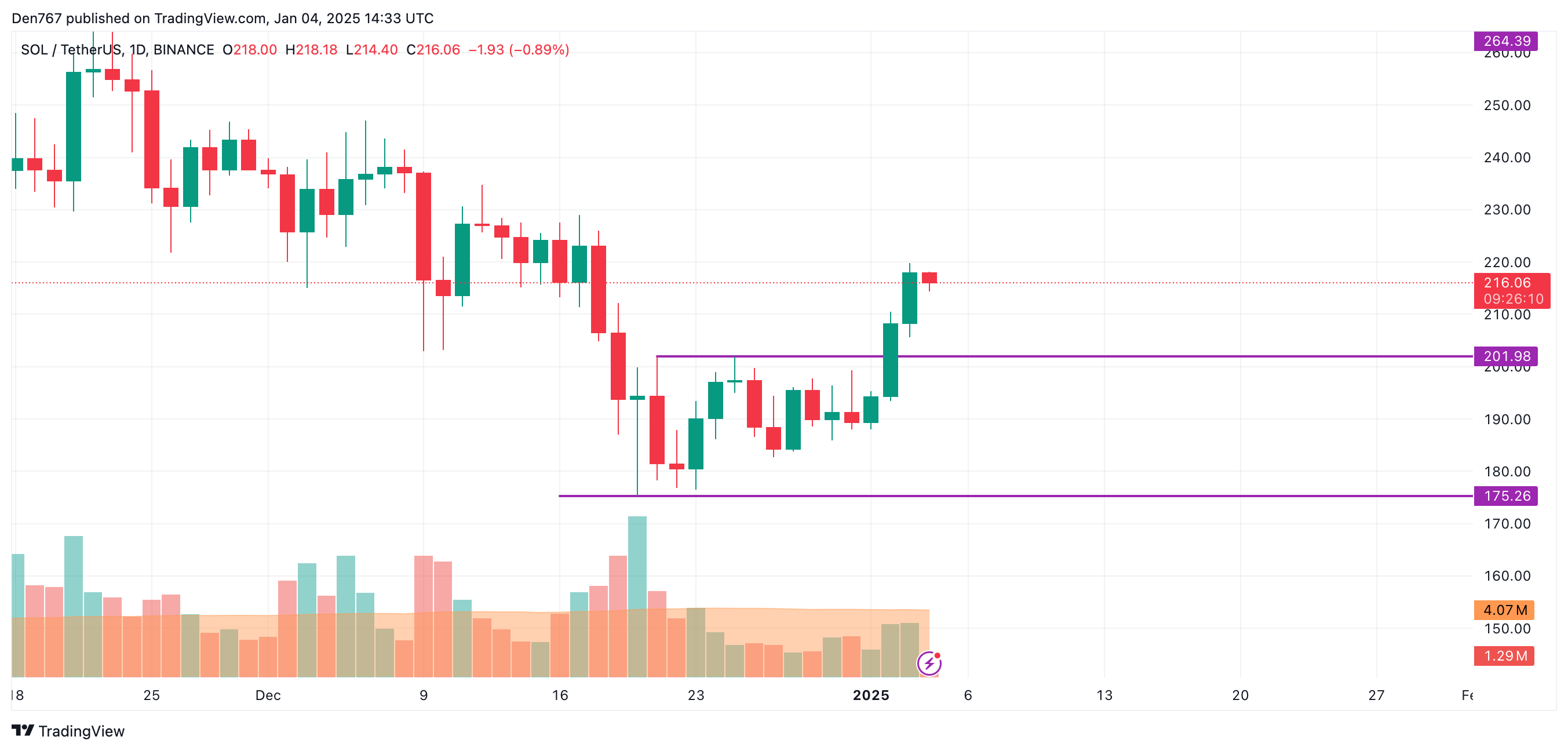
The prices of most of the coins are rising today, according to CoinStats.
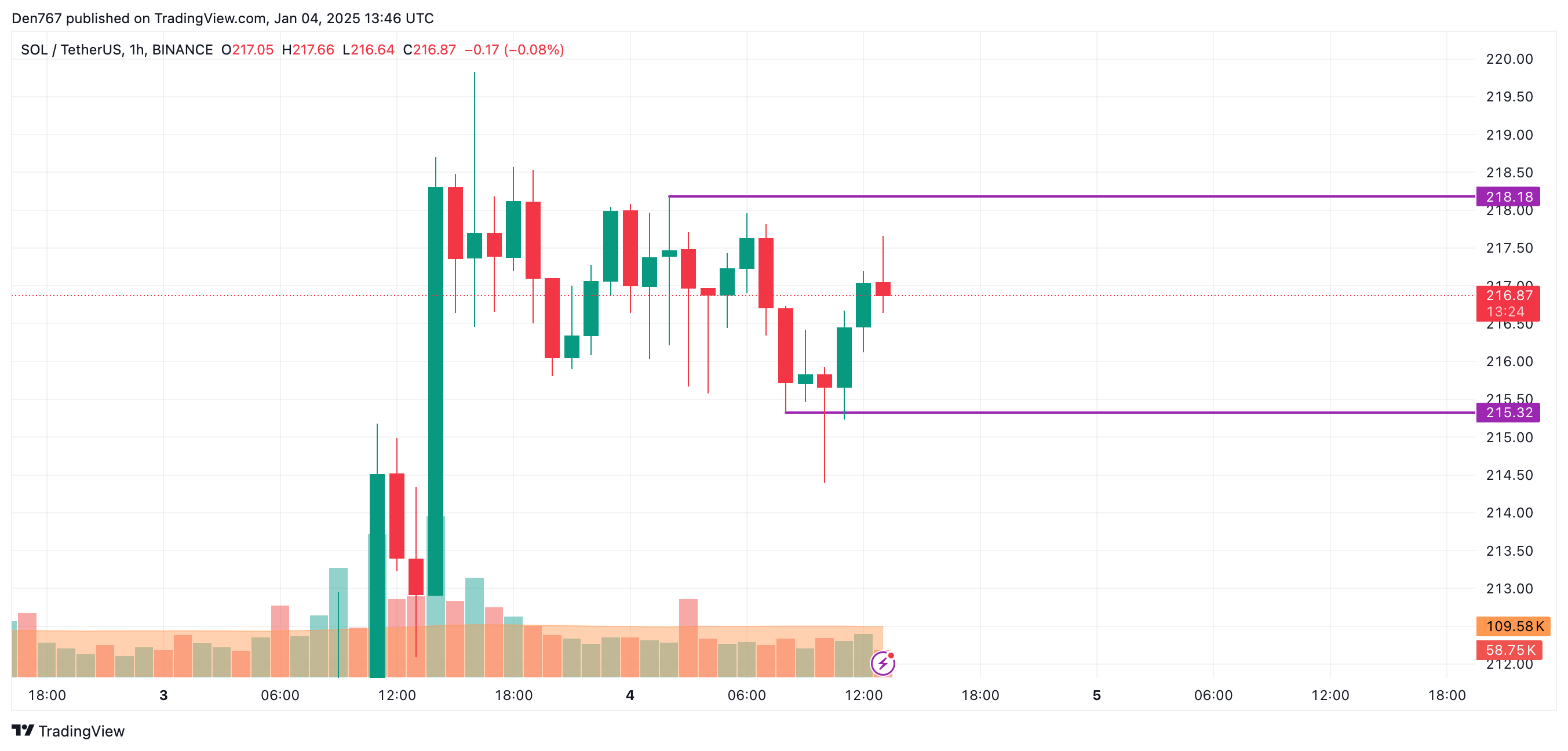
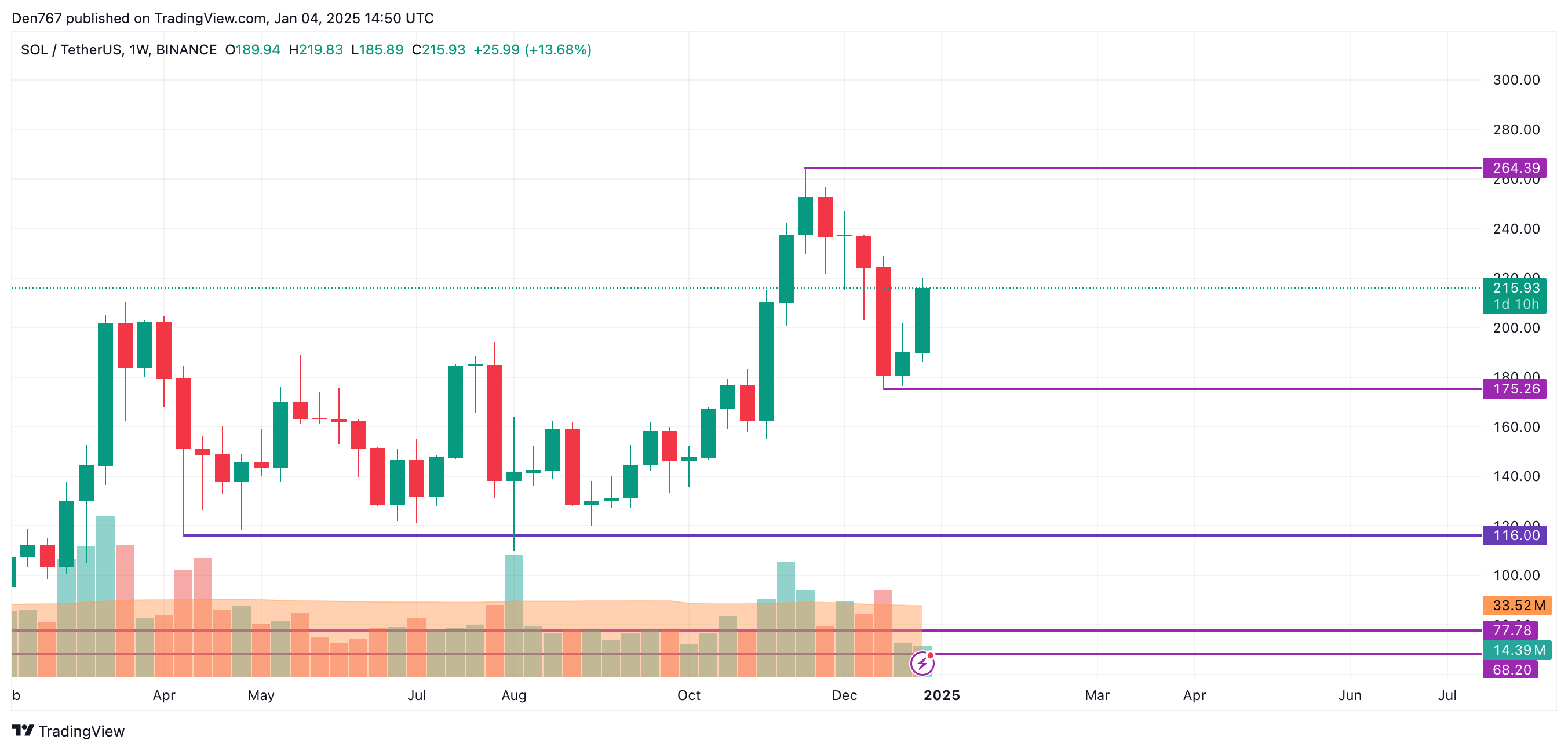
On the bigger time frame, one should pay attention to the interim zone of $220. If a breakout happens, the growth may continue to the $23-$240 range. Such a scenario is relevant over the next few days.
From the midterm point of view, the price of SOL is far from the key levels, which means neither buyers nor sellers are ready to seize initiative over the next weeks.
SOL is trading at $215.79 at press time.
Disclaimer: The opinions expressed by our writers are their
own and do not represent the views of U.Today. The financial and market information
provided on U.Today is intended for informational purposes only. U.Today is not
liable for any financial losses incurred while trading cryptocurrencies. Conduct
your own research by contacting financial experts before making any investment
decisions. We believe that all content is accurate as of the date of publication,
but certain offers mentioned may no longer be available.
Karachi’s food scene is a whirlwind, and if there’s one thing the city loves, it’s a trend. From beef burgers to hotpot, Korean BBQ to dessert bars, Karachiites always have a new fixation to chase. The latest to join this ever-changing roster of obsessions? Matcha lattes.
What began as a niche drink catering to fitness enthusiasts and wellness seekers has now turned into a citywide craze. Cafés serving this green elixir are popping up across Karachi, each trying to outdo the other not just in flavor but in aesthetics. Think vibrant interiors, pastel tones, neon signs, and intricate latte art—places designed to look as good on your Instagram feed as they taste in real life.
Why is it so popular?
Matcha, finely ground green tea leaves, boasts an impressive reputation for health benefits. Rich in antioxidants, it’s hailed for boosting metabolism, providing a calm energy boost, and even aiding in glowing skin.
Naturally, Karachiites, who love combining health with indulgence, were bound to embrace it. Pair this with Karachi’s scorching heat, and a refreshing iced matcha latte becomes even more irresistible.
But health isn’t the only reason for its popularity. Matcha’s unique, slightly earthy taste is unlike anything else. When blended with milk or creative ingredients like lavender, vanilla, or coconut, it transforms into a versatile drink with endless possibilities for innovation.
A cycle of obsession
Karachi’s obsession with trends isn’t new. The city is notorious for diving headfirst into food fads. Once Karachi falls in love with a concept, the market floods with contenders. Remember when beef burgers took over every street corner? Or how hotpot became the ultimate dining experience, complete with sauces and broths no one could pronounce? Now, it’s matcha’s turn.
Each café strives to outdo the other, whether by offering unique twists—matcha with rose petals, anyone?—or by crafting a space that screams “Instagrammable.” Neon signs with witty captions like “Stay Grounded, Drink Matcha” are standard now, while green-themed walls and curated lighting are designed to ensure your selfie game is strong.
The saturation point
As the craze grows, so does the competition. Every other week, a new café opens its doors, promising the “best matcha latte in Karachi.” This wave often leads to market saturation, with too many players competing for the same audience. Eventually, the hype wanes, and Karachiites move on to the next big thing.
But for now, matcha reigns supreme. Cafés are basking in the glow of this green wave, offering not just drinks but also a lifestyle—a mix of health, indulgence, and a touch of luxury.
The Instagram effect
Social media plays a huge role in shaping these trends. In a city where “Where should we eat?” is practically a daily debate, Instagram-worthy spots provide easy answers. The goal isn’t just to serve a good drink; it’s to make people post about it. From dainty ceramics to edible gold leaf on lattes, cafés are pulling out all the stops to become Karachi’s next big photo-op destination.
What’s next for Karachi?
While matcha lattes may dominate the city for now, Karachi’s love for reinvention guarantees another craze is just around the corner. Whether it’s açai bowls, ramen bars, or something entirely unexpected, the cycle will repeat itself. Until then, the matcha latte phase offers a delicious—and highly photogenic—moment in Karachi’s ever-evolving food journey.