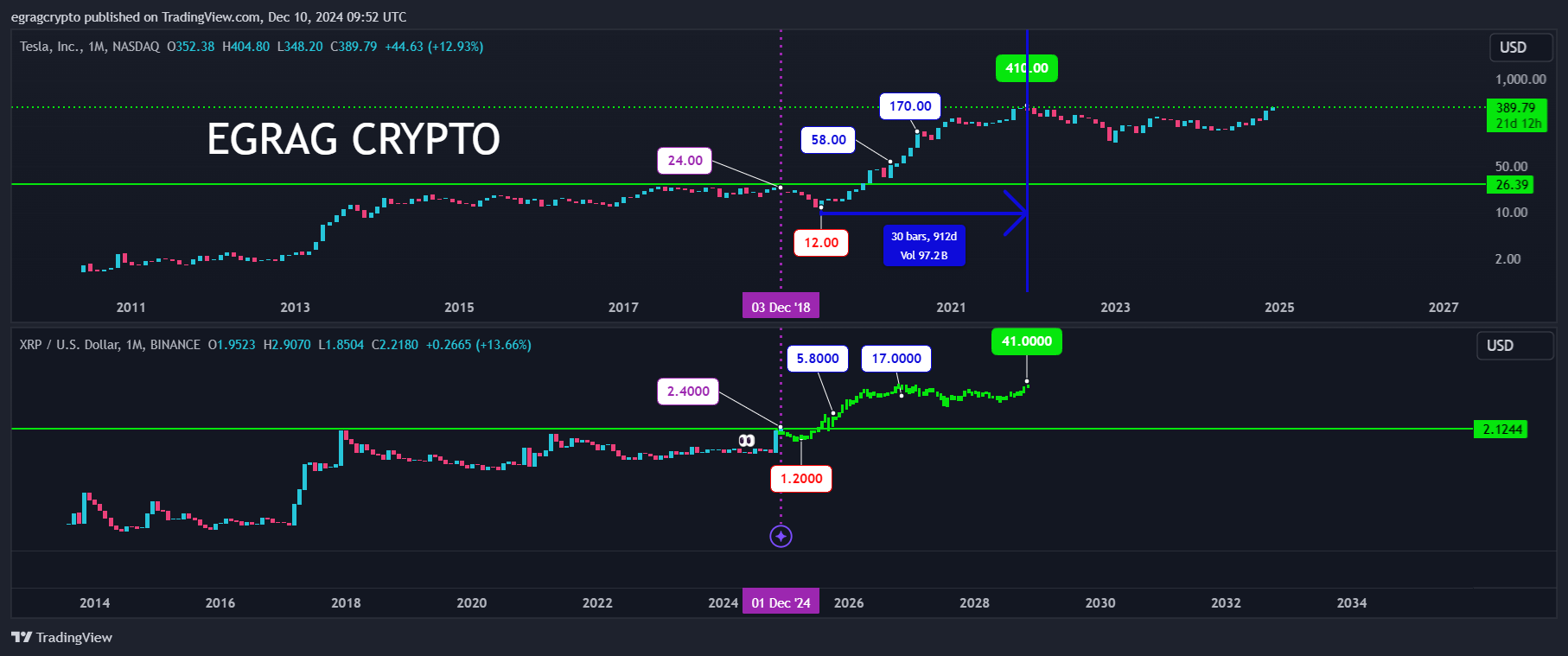
Market commentator EGRAG believes if XRP follows Tesla’s price direction from 2018 to 2023, its price could skyrocket 1,667%.
A recent analysis has identified similarities between Tesla’s (TSLA) historical price movements and XRP’s current trajectory, suggesting a major rally could follow its ongoing correction.
Interestingly, this market commentary comes from analyst EGRAG, who believes XRP could mimic Tesla’s path, potentially reaching a price of $41 within the next 91 days.
Tesla’s Historical Rally
Market data confirms that in December 2018, Tesla saw a massive price drop after CEO Elon Musk appeared on the CBS program “60 Minutes.” The stock fell to $12 during a corrective phase but later staged a remarkable recovery.
Over the next 912 days, Tesla witnessed an impressive rebound. After reclaiming the previous high of $24, Tesla soared to hit a resistance level of $58 in April 2020. It immediately surpassed this level, claiming a top of $170 by late 2020 and then the ultimate peak of $410 in November 2021.
While the chart suggests XRP’s decline may continue in the short term, EGRAG believes it mirrors Tesla’s early struggles before its explosive rally. As of today, XRP trades at $2.22 after a 1.97% gain, still far below its December 3 peak of $2.90.
XRP and Tesla 1M Charts | EGRAG Crypto
This decline, accelerated by hawkish comments from the Federal Reserve, places XRP roughly 20% below its recent highs. The chart analysis also highlights a critical support level at $2.1244, which could play a pivotal role in XRP’s recovery.
Meanwhile, EGRAG anticipates a steeper correction, with prices potentially dropping to $1.20 before a rebound. Despite these bearish movements, the analyst remains optimistic about a massive rally following this phase.
According to his projection, following the projected drop to $1.20, XRP could reclaim the $2.4 mark and then soar to $5.6, a new all-time high. Beyond this level, EGRAG expects an XRP rally to $17 before eventually claiming the ultimate $41 target in 91 days.
EGRAG justified the 10X factor by stating that crypto moves faster than stocks, reducing Tesla’s 912-day rally to 91 days for XRP. With XRP currently trading for $2.32, a rally to $41 would demand a massive 1,667% upsurge.
DisClamier: This content is informational and should not be considered financial advice. The views expressed in this article may include the author’s personal opinions and do not reflect The Crypto Basic opinion. Readers are encouraged to do thorough research before making any investment decisions. The Crypto Basic is not responsible for any financial losses.
The North Eastern Tea Association (NETA) and the Indian Tea Association (ITA) have welcomed the FDA’s certification of Camellia sinensis tea as a healthy beverage.This landmark verdict supports the global tea industry’s assertions about the beverage’s myriad health benefits.
Tea manufactured from Camellia sinensis is now eligible for the “healthy” label
Credit: Pexels
On December 19, the FDA issued a final regulation revising the “healthy” nutritional content claim to assist consumers in identifying items that comply with dietary recommendations. As part of this upgrade, tea manufactured from Camellia sinensis is now eligible for the “healthy” label.
Peter F. Goggi, President of the Tea Association of the United States, described the certification as “fantastic news” for the worldwide tea industry, emphasising the opportunity to market tea as a health-promoting beverage.
Bidyananda Borkakoty, NETA advisor and former Vice-Chairman of the Tea Board of India, shared his excitement, “We are overjoyed with the FDA’s acknowledgement. Tea’s health advantages have been highlighted in research conducted around the world. “We urge the Indian government to promote tea as a wellness and lifestyle beverage,” he stated.
In a statement released by NETA, the FDA acknowledged previous research tying Camellia sinensis to potential health advantages, such as its association with certain malignancies.
The government stated that the “healthy” claim does not apply to herbal teas manufactured from other plants, such as chamomile, peppermint, ginger, lavender, hibiscus, butterfly pea flower, or masala tea.
The Indian Tea Association hailed the FDA’s decision
The Indian Tea Association (ITA), the country’s oldest organisation of tea producers, hailed the FDA’s decision as a watershed moment for the industry.
“The Indian Tea Association is pleased that the FDA has officially recognized tea as a ‘healthy’ beverage under its updated criteria. This allows manufacturers to voluntarily label tea products with the ‘healthy’ claim, provided they meet the specified standards,” the ITA stated.
Credit: Pexels
The group also cited the FDA’s Executive Summary, which stated that liquids including water, tea, and coffee with fewer than five calories per Reference Amount Customarily Consumed (RACC) and per marked serving automatically qualify for the “healthy” label.
“This decision validates the nutritional value of tea and enables consumers to make informed choices. Tea’s richness in antioxidants and its association with numerous health benefits make this recognition especially significant” the ITA further added.
Ripple’s XRP is down by more than six percent and is trading at $2.22 level at the time of writing. XRP’s price is at a crossroads and has lost the majority of the gains made in the last seven days. All of the top 10 coins are trading in red, with Solana and Dogecoin recording double-digit losses.
Analysts are speculating that XRP might be in the midst of a larger correction, following a strong rally earlier this month. The price could be undergoing a consolidation phase, which may either be part of a larger corrective pattern or a more extended sideways movement.
Potential Scenarios, Key Resistance and Support Levels
Resistance Zone
The immediate resistance for XRP is between $2.30 and $2.53. If the price reaches this range, it may face selling pressure and could potentially reverse to the downside. Traders should be cautious if the price approaches this area.
Critical Support Level
The key support level to watch is $1.96, where a previous low was formed earlier in December. If XRP drops below this level, it could trigger further selling, potentially pushing the price lower into a range between $1.39 and $1.80.
Consolidation Phase
XRP could be in the midst of a consolidation phase, where the price moves sideways within a defined range. This could be a correction after the recent rally. If XRP remains above the $1.96 level, it could eventually break higher, potentially testing the resistance zone between $2.30 and $2.53.
Downside Risk
If XRP breaks below the $1.96 support, it could enter a deeper correction. In this case, the price might move towards the lower support zone between $1.39 and $1.80. This is a crucial level to monitor for any potential reversal.
Kết thúc phiên giao dịch, giá cà phê Robusta trên sàn London cập nhật lúc 16 giờ 00 phút ngày December 21, 2024, tiếp tục “lao dốc” vào phiên giao dịch thứ 4 liên tiếp trong tuần, từ 50-55 USD/tấn, dao động 4849 – 5011 USD/tấn. Cụ thể, kỳ hạn giao hàng tháng January 2025 là 5011 USD/tấn (giảm 50 USD/tấn); kỳ hạn giao hàng tháng March 2025 là 5002 USD/tấn (giảm 44 USD/tấn); kỳ hạn giao hàng tháng May 2025 là 4934 USD/tấn (giảm 57 USD/tấn) và kỳ hạn giao hàng tháng July 2025 là 4849 USD/tấn (giảm 55 USD/tấn).
Người dân tại tỉnh Gia Lai đang thu hoạch cà phê. Ảnh: Hiền Mai
Ngược lại, giá cà phê Arabica trên sàn New York, lại đồng loạt tăng nhẹ so với phiên giao dịch ngày hôm qua, mức tăng từ 0.65 – 1.25 cent/lb, dao động 302.75 – 325.00 cent/lb. Cụ thể, kỳ hạn giao hàng tháng March 2025 là 325.00 cent/lb (tăng 1.25 cent/lb); kỳ giao hàng tháng May 2025 là 319.30 cent/lb (tăng 1 cent/lb); kỳ giao hàng tháng July 2025 là 311.65 cent/lb (tăng 0.65 cent/lb) và kỳ giao hàng tháng September 2025 là 302.75 cent/lb (tăng 1 cent/lb).
Trong khi đó, kết thúc phiên giao dịch, giá cà phê Arabica Brazil cập nhật lúc 16 giờ 00 phút cũng hầu hết tại các kỳ hạn có mức tăng nhẹ từ 0.85 – 1.30 USD/tấn so với ngày hôm qua, dao động từ 387.85 – 398.10 USD/tấn. Cụ thể, kỳ giao hàng tháng May 2025 là 398.10 USD/tấn (tăng 1.30 USD/tấn); kỳ giao hàng tháng July 2025 là 387.85 USD/tấn (tăng 0.85 USD/tấn); trong khi đó, kỳ giao hàng tháng March 2025 lại giảm xuống 406.45 USD/tấn (giảm 1.25 USD/tấn). Riêng, kỳ hạn giao hàng tháng December 2024 không giao dịch.
Giá cà phê trong nước giảm phiên thứ 4 liên tiếp
Theo thông tin từ Giacaphe.com, cập nhật giá cà phê lúc 16 giờ 30 phút hôm nay ngày December 21, 2024, giá cà phê trong nước trung bình ở mức 121.100 đồng/kg, giảm -800 đồng/kg so với ngày hôm qua.
Nhiều nhà vườn tại Gia Lai vẫn chưa thu hoạch xong cà phê chín do năm nay thiếu hụt nhân công. Ảnh: Hiền Mai
The highest coffee purchase price in key regions of the Central Highlands was recorded at 121.300 VND/kg. Specifically, today’s coffee price at Dak Lak có mức 121.000 đồng/kg, giảm -1.000 đồng so với hôm qua. Giá cà phê tại Lam Dong có mức giá 120.500 đồng/kg, giảm -1.000 đồng so với giá giao dịch hôm qua. Trong khi đó, giá cà phê tại Gia Lai hôm nay có mức giá 121.000 đồng/kg, giảm -800 đồng/kg. Giá cà phê tại Dak Nong hôm nay có giá 121.300 đồng/kg, cũng giảm -700 đồng/kg so với hôm qua.
The domestic coffee prices that Giacaphe.com lists every day are calculated based on the prices of two world coffee exchanges combined with continuous surveys from businesses and purchasing agents in key coffee growing areas across the country.
Y5Cafe luôn cố gắng để bám sát nhất với từng vùng, tuy nhiên sẽ có những ngày giá niêm yết không hoàn toàn khớp với giá cà phê thu mua tại địa phương của bà con, nhưng Y5Cafe cho rằng thông tin được niêm yết là nguồn thông tin tham khảo giá trị cho bà con và doanh nghiệp thu mua cà phê.
Nhận định giá cà phê ngày mai December 22, 2024
Theo báo cáo mới nhất của Bộ Nông nghiệp Mỹ (USDA) cho thấy, sản lượng cà phê toàn cầu trong niên vụ 2024-2025 dự báo sẽ tăng 4% so với niên vụ trước, đạt 174,855 triệu bao, với sản lượng cà phê arabica tăng 1,5% lên 97,845 triệu bao và sản lượng cà phê robusta tăng 7,5% lên 77,01 triệu bao.
However, ending coffee stocks in 2024-2025 are forecast to fall 6,6% to a 24-year low of 20,9 million bags, compared with 22,3 million bags in 2023-2024.
Do đó, các chuyên gia nhận định, giá cà phê ngày mai December 22, 2024 có thể quay đầu tăng trở lại.
Ripple’s XRP is showing a modest increase of over 1%, trading at $2.28 at the time of writing. After a recent dip below the $2 mark, XRP has managed to sustain a bullish trend. While Bitcoin and other major cryptocurrencies are experiencing a decline, XRP’s ability to consolidate around the $2 level is seen as a positive sign for investors. The broader crypto market has also seen significant liquidations, with over $680 million wiped out in the past 12 hours, yet XRP remains resilient.
Price Range and Potential Movement
At present, XRP is trading between $1.96 and its all-time high of $3.30. This range indicates a somewhat squeezed market for XRP, but it also opens the door for potential price movements. The short-term outlook for XRP could see the price pushing higher, particularly if it follows the patterns observed in other major cryptos like Bitcoin, which is currently undergoing a price correction. Traders are hopeful that XRP could continue to rally within this established range, making any upward movement highly anticipated.
Elliott Wave Analysis and Key Price Structure
From an Elliott Wave perspective, XRP’s chart shows two possible scenarios. The first suggests that the top may already have been reached, with XRP forming a fourth wave triangle. If this is the case, a final fifth wave would conclude the current bullish phase. This pattern is typically followed by a correction before a possible rally resumption.
The second possible scenario indicates that XRP may still have some room for growth, with an additional 4-5% upside potential before the current cycle concludes. Traders and analysts will closely monitor these patterns, as they could provide insight into XRP’s next movements.
Critical Levels: Key Support and Resistance
To validate the current bullish outlook, XRP must maintain its price above the critical support level of $1.90. A drop below this level would invalidate the bullish triangle pattern and likely signal a deeper correction, moving XRP lower before any potential recovery. If XRP holds above this key level, it will maintain the bullish trend and could continue its recovery.
Support at $1.90 is crucial, but the price also needs to hold above $2 for continued upward momentum. Any significant break below this support could shift market sentiment and trigger a bearish correction. On the upside, traders are looking for XRP to surpass resistance levels, particularly the $2.50 to $3 range.
Market Sentiment and Future Outlook
Despite the overall market volatility, XRP’s bullish momentum seems intact for now. The price consolidation around the $2 mark suggests stability, and the interest from traders has been rising as the coin retraces and recovers. As long as XRP holds the $1.90 support, investors could see further bullish price action in the coming days.
Looking ahead, XRP’s price action could see a continuation of the uptrend if the coin surpasses key resistance levels. The next major milestone would be a move toward $2.50, and if it continues to hold above that, XRP could test new highs. However, if it dips below $1.90, a deeper correction could occur, testing lower levels before any recovery.
Conclusion
XRP’s short-term outlook remains cautiously optimistic, with key price levels indicating where the coin could either continue its bullish momentum or face a correction. Investors should monitor the $1.90 support level closely, as any breach could signal a shift in market dynamics. However, if XRP continues to hold above this support and capitalizes on the broader market rebound, the coin could see further gains in the near future.
Driven chiefly by recent events involving President-elect Donald Trump and his endorsement of Elon Musk’s suggested Department of Government Efficiency (D.O.G.E.), Dogecoin (DOGE) has seen a significant increase in market activity. This action and Musk’s ongoing backing of DOGE—including payments through his company’s Tesla products—have increased memecoin demand.
DOGE is currently surfing a wave of market hope. Its price has increased by 2.2% over the past month; daily charts show a 4.9% gain, and over 14 days, it shows a 3.5% increase. DOGE has demonstrated an impressive 331% increase since December 2023, while recent price dips of 5.2% over the past week point to potential investor profit-taking.
Bitcoin’s recovery from the $100,000 level has also helped DOGE’s surge. Anticipating that his pro-crypto policies would help the industry even more, market players aligned before his January 20, 2025, inauguration.
Under Trump’s Direction, Could DOGE Reach $5?
With DOGE a major benefactor, the expectation of Trump’s presidency has generated an optimistic attitude toward cryptocurrencies. Trump’s pro-business and crypto-friendly posture has market players excited that DOGE might flourish in these suitable surroundings.
Still, it is difficult to attain the sought-after $5 mark. CoinCodex projects DOGE trading at $0.38 before January 20, 2025, reflecting a decrease of 7.32% from its present levels. Notwithstanding this, analysts predict DOGE will pick up steam by March 2025 and hit a fresh all-time high of $1.01. Reaching this mark would show a 146.34% rise.
Although DOGE might see a temporary increase, analysts project a long-term increase to $5, which is less hopeful and could take until 2030. DOGE might provide a different speed of growth for investors looking for quicker and more significant returns.
Rexas Finance: Accelerated Potential of a $0.15 Competitor
Although DOGE is well-known for its memecoin character, Rexas Finance (RXS) is a strong rival with a clear purpose for application. Positioned as a trailblazing venue for Real World Asset (RWA) tokenization, Rexas Finance uses blockchain technology to streamline asset-backed token creation, administration, and trading. Its straightforward approach seeks to democratize asset ownership, improve transaction openness, and simplify asset management.
Rexas Finance has already set excellent records through its presale events, with sales exceeding 350 million tokens and $28,668,332. Currently, in Stage 10, RXS tokens cost $0.15—a 400% rise from the first presale rate. Investors are keen to seize the last presale stage, where tokens will be priced at $0.175. This stage is 92.18% sold out.
Offering Stage 10 investors a 50% gain even before exchange trading starts, the project intends to launch RXS on main markets at $0.20 in early 2025. For investors looking for quick profits, analysts estimate RXS to be worth $5 significantly sooner than DOGE.
Thinking of expanding into Africa?
Avoid the common mistakes businesses during expansion. Register to learn the common mistakes business make when expanding into Africa.
Written by seasoned experts, who have over 16 years of experience in Free Zones development. Learn more.
For current Stage 10 investors, a post-listing surge could result in up to 3233% returns, surpassing DOGE’s plodding march to $5. Strong market demand, creative ideas for RWA tokenization, and Rexas Finance’s solid foundations fuel this faster expansion possibility.
Through strategic benchmarks and its creative platform, Rexas Finance has drawn investor attention. The initiative has obtained listings on CoinGecko and CoinMarketCap, giving potential investors openness and access. Furthermore, its Certik audit approval proves the dependability and security of its blockchain architecture.
The Rexas millionaire giveaway, with a prize pool of 1,000,000 RXS tokens and 20 winners receiving $50,000 worth of tokens, is a notable effort that inspires involvement. These advances show the project’s initiative to create a vibrant community and guarantee investor confidence.
The possibility of Dogecoin reaching $5 depends on long-term market dynamics and ongoing backing from influential people like Elon Musk. DOGE is still a cultural symbol with excellent market penetration, but its gradual development path could discourage investors looking for quick profits.
On the other hand, Rexas Finance makes an interesting investment argument. Its creative approach to RWA tokenization, effective presale performance, and excellent growth potential make it a possible challenger to surpass the $5 milestone far before DOGE. Rexas Finance presents a chance for investors seeking quick and significant profits to ride the tide of blockchain-driven asset management change.
For more information about Rexas Finance (RXS) visit the links below:
California Assembly Bill 899 requires manufacturers of baby food to test samples for toxic elements (arsenic, cadmium, lead and mercury) at least once per month. Manufacturers must provide test results to authorized department agents and provide information disclosures to consumers on their websites.
AB 899 was signed into law by Governor Gavin Newsom (D) on October 11, 2023. The bill stated that any baby food products sold or made in California will require testing for specific toxic elements beginning January 1, 2024. The heavy metal disclosure requirements are slated to go into effect January 1, 2025. Until recently, the bill was thought to impact only baby food sold in California that is marketed for children under two years old.
‘Clarification’ in the 11th hour
Speaking to NutraIngredients-USA, Jaclyn Bowen, executive director at Clean Label Project, said food brands have had 14 months to prepare for the new requirements. However, in late November, the California Department of Health clarified that the bill also includes dietary supplements, leaving nutraceutical brands clambering for guidance on how to implement the new requirements in a matter of weeks.
“We’ve been actively involved since the regulation passed in 2023,” said Bowen. “We’ve had a pretty good working relationship with assembly member Al Muratsuchi, the author of the program, as well as his legislative aides have been pretty helpful in terms of providing guidance and feedback. But this latest clarification around inclusion of dietary supplements is definitely something that’s happening at the 11th hour.
“I just think it’s going to be interesting for the dietary supplement industry, you know, here we are over the holidays, trying to figure out how to navigate this. Definitely the time is now to start figuring this out.”
And that’s exactly what the United Natural Products Alliance’s Loren Israelsen has been trying to do.
“I have written to the department twice and said, so how does it work now for DS? First of all, we’re not convinced that supplements were intended to be included by the authors of this legislation in California. The definition of food in California is a little different than the federal definition. And there is now an open debate whether or not California can legally require supplements to be included under their definition of food. So that may end up being litigated early next year,” said Israelsen, UNPA’s founder and president.
“So that’s problem one. Problem two is what are some of the companies supposed to do on virtually no notice. They can’t possibly come into compliance on January 1.”
Israelsen said at this point, he has more questions than answers, noting that the California’s Department of Health has been slow to respond and nonchalant when they do.
“I also said, by the way, there is nothing on your website. We had a webinar on this and our members went and looked at the California website trying to get details. They can’t find anything. And in fact, it’s not there. And so the response from California was, ‘well, yeah, it’s the holidays and we’ll do it first thing next year.’ So after it’s effective, basically, you’re going to give us some sense of how this is supposed to work?”
Vagaries and mystery
“I’m baffled. I’m really baffled at how the state, just the whole process, their reasoning, not discussing it, providing no notice. And now we ask and we’re trying to get some substantive answers. We’re really not getting much,” Israelsen said. “So that’s where we are. It’s really kind of a Kafkaesque moment here.”
Israelsen said the lack of clarity is leaving him in a tricky situation, unsure of how to properly advise companies.
“On one hand, it would be a lot of work, obviously, if you have products, you now have to go into rapid testing. Well, do you? Since we really don’t understand what we’re supposed to do, and it’s now the holidays, you can’t really begin any meaningful testing program,” he said. “It ought to be discussed within the company and decide, is this something where we need to join a litigation group to formally raise these issues?”
He added that the issue at hand comes down to whether the two sponsors of the bill, Assemblymember Al Muratsuchi and Senator Akilah Weber, originally intended to include supplements in the bill. Israelsen is convinced they did not.
“If the sponsors had wanted dietary supplements to be included, they easily could have explicitly just added those two words,” he said. “So all the way around, there’s just vagaries and mystery about how this came to be and the situation we find ourselves in.”
New Year, new clarification?
In the New Year, Israelsen hopes the bill’s sponsors and California’s Department of Health can get on the same page and come to an accord.
“And if it turns out that they say supplements are included, we would reserve the right to challenge that in court if we think that they really don’t, that they have misinterpreted the definition of food in California as it relates to dietary supplements,” said Israelsen.
“I just hope it doesn’t end up being an expensive, protracted litigation when it really shouldn’t be. There just needs to be some reasonable agreement. And then if it’s decided by all parties that we are included, give us a year. Like the real food side, they got a year to do the testing and change their labels.”
12/21 update below. This post was originally published on December 20
Bitcoin has fallen sharply, dropping along with stock markets after the Federal Reserve warned inflation remained sticky and BlackRock spooked the market.
The bitcoin price has plummeted toward $90,000 per bitcoin, dragging the wider crypto market lower and wiping away around $500 billion worth of value from the $3.2 trillion crypto market.
Bitcoin’s drop of around 10% in the last 24 hours was dwarfed by ethereum and smaller, top ten cryptocurrencies—including solana and dogecoin—that crashed back by between 15% and 25%.
Sign up now for the free CryptoCodex—A daily five-minute newsletter for traders, investors and the crypto-curious that will get you up to date and keep you ahead of the bitcoin and crypto market bull run
U.S. Federal Reserve chair Jerome Powell warned inflation will remain an issue next year, sparking a … [+] bitcoin price and crypto market sell-off.
Getty Images
This week, Federal Reserve chair Jerome Powell disappointed traders when he warned interest rates would not come down as quickly as the Fed had previously thought, reducing its planned number of cuts to just two in 2025, from four previously.
12/21 update: The bitcoin price has bounced back, climbing to within touching distance of $100,000 per bitcoin after the latest inflation data from the personal consumption expenditure (PCE) index showed a smaller than expected rise of 2.4% rise in November, just below the 2.5% estimate of economists polled by Reuters.
Other major cryptocurrencies that had crashed lower, including ethereum, Ripple’s XRP and dogecoin, also rebounded, with the combined market recovering around $300 billion of value as traders increase their bets on Federal Reserve interest rate cuts next year.
Meanwhile, Cathie Wood, the founder of the Ark Investment Management hedge fund, reiterated her bullish bitcoin price prediction in a Bloomberginterview, forecasting that the bitcoin price will top $1 million by 2030—something that would give bitcoin a market capitalization of around $20 trillion.
“[Bitcoin] is becoming even more scarce than gold,” Wood said. “The difference between gold and bitcoin is, when the gold price goes up, as it has, production goes up, the rate of increase in the supply goes up—that can not happen with bitcoin.”
Over the next few weeks, bitcoin and crypto market watchers expect the bitcoin price to remain prone to wild swings.
“In terms of what is coming over the holiday period, the first rule of bitcoin is that it is always volatile in the same way water is always wet,” James Toledano, chief operating officer at Unity Wallet, said in emailed comments.
“It’s behavior is always mixed and there is zero discernible pattern at the end of the year and going into the next. Sometimes the price rises in the new year and at other times it falls. So, historically, we can say that bitcoin exhibits typically mixed behavior over Christmas and New Year,” Toledano added, pointing to incoming U.S. president Donald Trump’s January 20 inauguration as an important date to watch for the bitcoin and crypto market.
“Comments from the Federal Reserve were a wake-up call,” Danni Hewson, AJ Bell’s head of financial analysis, said in emailed comments.
“Inflation is proving sticky and tax cuts and tariffs could be a recipe for reflation. “Risk appetite has been pared back. Trump 2.0 is a known unknown and no one wants to be overexposed if the climate proves inhospitable.”
The bitcoin price has crashed back following its huge rally this year, with the bitcoin price … [+] dropping toward $90,000 and dragging down the rest of the crypto market.
Forbes Digital Assets
Meanwhile, bitcoin price and crypto market watchers have warned of further volatility ahead.
“Expect to see volatility levels for both ethereum and bitcoin increase as we head into early 2025, particularly around the settlement of the December 27, 2025 expiry,” Nick Forster, founder of decentralized finance (DeFi) protocol Derive, said in emailed comments, but adding he expects the bitcoin price and wider crypto market to recover through 2025.
“We’re observing a trend where funds and high net-worth individuals are moving into options with longer expiries, like those set for September and beyond, reflecting a positive outlook for 2025. This shift is evident from the open interest in calls significantly outnumbering puts on Derive.xyz, signaling strong market optimism.”
EUR/USD has breached the support level at 1.05500, and selling momentum has strengthened the current downtrend in the chart.
The Federal Reserve (Fed) has emphasized slowing down the pace of interest rate cuts, a move that could be crucial in maintaining the strength of the U.S. dollar over the long term.
EUR/USD has recorded a 2% decline over the last five sessions, favoring the dollar and placing the euro in a sustained bearish zone. This selling pressure has intensified following the Fed’s recent decision, accompanied by neutral remarks regarding decisions for the upcoming year. This bearish pressure has pushed the price to break the crucial two-year support level at 1.0550.
Fed’s Remarks
In its final meeting of the year, the Fed reduced interest rates to a range of 4.25%-4.5%, down from the previous 4.5%-4.75% (a 25-basis-point cut). This adjustment aligns with efforts to stimulate the U.S. economy in early 2025.
However, Fed Chair Jerome Powell highlighted that although inflation has decreased significantly, it remains at elevated levels, making it challenging to achieve the central bank’s 2% target. Powell also stressed the need to proceed cautiously in future decisions,given that current projections place inflation at 2.5% for 2025, still far from the central bank’s target for the upcoming year.
In this context, the CME Group’s probability tool currently reflects a 91% chance that the Fed will keep rates unchanged at its next meeting, scheduled for January 29. And, for the 19-march decision, the probability stands in 53% of rates unchanged versus 43% of rate reduction. That said, now the market is seeing a neutral decision bias for next decisions which could help maintain higher interest rates, leading to a stronger dollar perspective. Remember that these probabilities could shift based on economic developments leading up to that date.
Interest Rate Probability Chart January – CME Group
Source: CmeGroup
Interest Rate Probability Chart March – CME Group
Source: CmeGroup
Given the context outlined, the Fed’s interest rate of 4.5% remains significantly higher than the European Central Bank (ECB) rate of 3.15%. This differential could continue to attract investment into U.S. fixed-income assets, increasing demand for the dollar and exerting selling pressure on the EUR/USD. This scenario will likely persist as long as the U.S. central bank maintains rates above 4%.
EUR/USD Technical Forecast
EUR/USD has maintained a steady downtrend since late September, reaching a minimum price in the 1.03 range. Recent U.S. monetary policy events have strengthened the dollar, once again driving the price close to these lows not seen since November.
Source: StoneX, Tradingview
Downtrend Channel: The current downtrend channel favoring the dollar remains intact, with no significant bullish breakout threatening the formation. However, it’s important to note that the recent low at 1.03 remains a relevant support level that could trigger bullish corrections as the channel evolves. This level also represents the last low within the downtrend channel, and further lower lows are required to avoid a lateral consolidation in the short term.
RSI: The RSI indicator remains below 50, signaling that bearish momentum dominates the market in the short term. However, the RSI line is near an oversold zone, around the 20 level, which could indicate potential exhaustion of the bearish momentum and open the door for bullish corrections near the closest support level (1.03).
Key Levels:
1.03: The current support level corresponds to areas of indecision that served as a barrier in 2023. A drop below this level could lead to new lows in the current downtrend and reinforce the bearish bias.
1.05500: This is the new resistance zone, coinciding with the lower boundary of the lateral range maintained during 2024. It also converges with the upper line of the downtrend channel and the Ichimoku cloud, further reinforcing its importance as a barrier. Movements above this level could weaken the current downtrend and threaten the channel formation.
Eating a balanced diet supports everything from your bone health to immune system. Getting enough nutrients becomes especially important for older adults at a higher risk for low vitamin consumption, according to a paper published in Clinical Interventions in Aging.
Though your diet is where most of the essential nutrients you need come from, your doctor may recommend supplements or multivitamins to help fill in the gaps. For instance, people who take certain medications that deplete the body of a particular nutrient or those with dietary restrictions will need extra help to ensure they’re getting the essential nutrients.
We spoke to experts to figure out which vitamins and minerals you need for healthy aging.
1. Magnesium
From talking fridges to iPhones, our experts are here to help make the world a little less complicated.
Magnesium is a mineral that provides several key functions in the body. It keeps your muscles strong, regulates blood sugar levels and contributes to heart health. Dr. Jacob Teitelbaum, a board-certified internist in integrative medicine, told us that “magnesium is critical for well over 300 reactions in the body.” He said an unprocessed diet has about 600 mg of magnesium daily, but the average American diet has less than 250 mg of magnesium after processing. For reference, the daily recommended amount of magnesium is 400 to 420 mg per day for adult men and 310 to 320 mg for women, but more is needed for those who are pregnant or breastfeeding.
Dr. Teitelbaum warned that the effects of low magnesium may include an increased risk of metabolic syndrome. This can lead to heart attacks, strokes and dementia. You may also feel exhausted or experience widespread muscle pain if you’re not getting enough magnesium.
You can find magnesium in a wide range of ingredients. Dr. Peter Brukner, a specialist sports and exercise physician, said you can find magnesium in nuts, seeds, whole grains and leafy green vegetables like spinach. In extra yummy news, you can also get magnesium from dark chocolate.
“Some older adults or those who take specific medicines (such as diuretics or drugs for acid reflux) may not receive enough magnesium from their diet and might need a supplement,” he said. “However, too much magnesium can cause stomach issues, so be careful.”
From talking fridges to iPhones, our experts are here to help make the world a little less complicated.
2. B vitamins
Laurie Ambrose/Getty Images
You also need a range of B Vitamins, including B12 and folate (also called folic acid), to maintain your health as you age. Vitamin B-12 works with folate to help your body make new cells, including blood cells and nerve cells. While you don’t usually require more B12 as you age, your body cannot absorb it as well when you get older. Dr. Brukner said this is because “stomachs make less acid, and this acid is necessary to take the vitamin from food into the body.”
Dr. Teitelbaum said B vitamins are critical for energy production, and suboptimal levels can affect your health. He warns that B vitamin deficiency has been associated with “a marked increase of dementia (especially folic acid) and increased risk of heart attack and stroke (especially in those with elevated homocysteine levels).” Symptoms of B12 deficiency include weakness or poor balance, loss of appetite and numbness and tingling in the hands and feet.
B12 is found in animal proteins like meat, fish and eggs. Dr. Brukner said that if you don’t eat these foods, you may want to turn to foods like cereals and nutritional yeast with added B12. “Older people, especially those having certain stomach issues or taking medicine that lowers stomach acid, might need to take a B12 vitamin supplement,” he explained.
Amelia Ti, a registered dietitian and diabetes educator in New York City, who is also part of CNET’s medical review board, adds that people taking medicine that blocks B12 absorption, like omeprazole or metformin, may also need a vitamin B12 supplement.
3. Calcium
The National Institute on Aging says that calcium is especially important for older people at risk for bone loss. The Institute recommends 1,000 mg each day for men between the ages of 51 and 70, and 1,200 mg per day for men 71 and older. Women aged 51 and up are recommended to take 1,200 mg each day.
“Calcium is well-known for making bones strong, but it is also crucial for muscles to work right,” Dr. Brukner said. “As people become older, their bodies take in less calcium from food, which can cause bones to become weaker.” You can get calcium naturally from sources like milk, yogurt and cheese. The Harvard T.H. Chan School of Public Health notes that calcium is also available in kale, salmon, tofu, almonds and spinach.
As for supplements, Dr. Brukner said, “If you are at risk for bone troubles or don’t get enough calcium in your food, taking supplements might be useful. But too much calcium can cause other issues like kidney stones, so talk with your doctor first.”
4. Vitamin D
Malorny/Getty Images
Vitamin D is often called the sunshine vitamin because you typically absorb it through the skin just by being outside. However, during winter months, if you live in a cloudy climate or avoid natural sunlight as you age, you may not get enough. Your body needs vitamin D to properly absorb calcium, making it an important nutrient for bone health.
Dr. Brukner says that in addition to sunshine, you can get vitamin D from fatty fish like salmon and mackerel, fortified milk and cereals. Your doctor may also recommend a supplement if you’re experiencing bone loss or at risk of osteoporosis.
“Omega-3 fatty acids are very good for heart health and can help lessen swelling, which is important for older people,” Dr. Brukner explained. “They are also beneficial for brain well-being and might help guard against memory loss and diseases such as Alzheimer’s.” Ti adds that omega-3s help lessen swelling by reducing inflammation.
Fatty fish like salmon are a good source of omega-3 fatty acids. Dr. Brukner said you can also turn to flaxseeds, chia seeds and walnuts but added a warning: “These give a different type of omega-3 that the body does not use so easily.” Fish oil and algae oil can serve as supplements, too.
6. Zinc
A 2015 paper, published in Pathobiology of Aging and Age-related Diseases, calls zinc an “essential micronutrient for human health in general, and particularly for the elderly.” The authors say zinc plays “an important role in the aging process” and that zinc deficiency may be connected to several age-related chronic illnesses, which include hardening of the arteries, degenerative diseases of the nervous system, age-related changes to the immune system and cancer.
“When we get older, our immune system becomes weaker, and if we don’t have enough zinc, this can make it even worse,” Dr. Brukner explained.
You can find zinc in shellfish, red meat, poultry, beans, nuts and seeds. Dr. Brukner said oysters are particularly zinc-rich. He added, “Some older people might find zinc supplements helpful, especially if they often get sick or do not eat enough foods high in zinc. But taking too much zinc can cause problems with other minerals in the body, so it’s important to follow advised amounts.”
The bottom line
Eating well can help boost your bones, immune system and more as you age. Along with exercise and other good habits, getting the right minerals and vitamins may improve your health. Try to get ample magnesium, B vitamins, calcium, vitamin D, omega-3s and zinc in your diet each day. Make sure you talk to your doctor before you take any supplements to find out how they may interact with your existing medications and health conditions.