The Bank of Canada trimmed rates by 50 bps, the European Central Bank is next.
United States inflation rose at the anticipated pace in November.
XAU/USD bullish momentum set to continue toward record highs in the $2,790 region.
Gold is among the best performers against the US Dollar (USD) on Wednesday, changing hands at around $2.712 a troy ounce in the American session. The Greenback seesawed between gains and losses throughout the day but ended up firming up against most major rivals, but the bright metal and the Canadian Dollar (CAD), the latter firmer amid the Bank of Canada (BoC) decision to trim interest rates by 50 basis points (bps).
BoC Governor Tiff Macklem spoke after the announcement and said: “We anticipate a more gradual approach to monetary policy if the economy evolves broadly as expected.” He added that monetary policy no longer needs to be in restrictive territory, anticipating a more gradual approach to monetary policy if the economy evolves broadly as expected.
Meanwhile, the United States (US) published an update on the Consumer Price Index (CPI). The index rose by 2.7% on a yearly basis in November. Compared to the previous month, the CPI increased 0.3%, while the annual core reading printed at 3.3%. The readings were in line with the market’s estimates, pushing the US Dollar temporarily, as investors lifted bets the Federal Reserve (Fed) will trim the main benchmark interest rate by 25 bps when it meets next week.
Coming up next is the European Central Bank (ECB), scheduled to deliver its decision on monetary policy on Thursday. Also, Australia will release its monthly employment report in the upcoming Asian session.
XAU/USD short-term technical outlook
From a technical point of view, XAU/USD is on its way to retest the record high at around $2,790. In the daily chart, the pair extends its advance above a now bullish 20 Simple Moving Average (SMA), while 100 and 200 SMAs maintain their upward strength below the longer ones. At the same time, technical indicators advance within positive levels, albeit with uneven momentum, still supporting another leg north.
In the near term, the risk skews to the upside. Technical readings in the 4-hour chart show the pair reached overbought conditions, but there are no solid signs of an upcoming corrective decline. The Momentum indicator consolidates well above its midline, while the Relative Strength Index (RSI) indicator heads north at around 72. Finally, the pair develops above all its moving averages, with the 20 SMA crossing above the 200 SMA, usually a sign of additional gains ahead.
Imagine walking into Whole Foods and passing an aisle overflowing with vibrant bottles and wellness promises. You feel healthy enough, but you’re still drawn to apple cider vinegar gummies that claim to burn fat, bee pollen capsules promising an immunity boost and Ashwagandha pledging to clear brain fog. Without a second thought, you find yourself at the checkout, spending more than expected, buying supplements without truly understanding what you’re consuming.
Americans spend $30 billion a year on quick fixes to their health. The global dietary supplements market, according to Veri, is booming, projected to reach $200 billion by 2025. Stores and online markets have catalogs dedicated to health claimed vitamins, pills, and powders– yet none of these items are regulated, nor have plans to be.
While dietary supplements can be effective for addressing nutrient deficiencies or supporting poor diets, their role is often misunderstood. Common supplements like protein powder, calcium, vitamin D, and prenatals offer proven benefits. According to the NIH, they can help maintain strong bones, reduce birth defects, and improve heart health. Immunocompromised populations, pregnant women, and older adults are some of the essential consumers of supplements. Since supplements are conveniently packed into pills or gummies, they’re effortlessly integrated into daily routines with minimal time or preparation. Although supplements play a crucial role in helping people manage their health, they can not take the place of a nutritious diet– which is integral to a healthy eating routine.
Because supplements are sold over the counter and are readily accessible, consumers can choose and use them freely. While this accessibility allows people to support their health, it also introduces risks. Supplements can interact dangerously with medications or harm health if taken in incorrect dosages.
Health researchers from the University of Michigan, Ann Arbor, reviewed data from 2017 to 2021, covering 9,685 people, and found that nearly 4.7% of U.S. adults had used at least one potentially toxic supplement within the previous 30 days. In fact, nearly 15 million Americans take supplements that may be toxic to their liver. This may be due to the lack of regulation within the market, misinformation, and product labeling. The U.S. Drug Induced Liver Injury Network found that 51% of supplement products were mislabeled and failed to have chemical contents that match the label. With this in mind, we must question if some of the businesses within the supplement industry have their consumers’ best interests in mind.
As the name suggests, the Food and Drug Administration (FDA) regulates food products and drugs, but leaves the oversight of supplements largely to the discretion of the companies that produce them. The Dietary Supplement Health and Education Act (DSHEA) of 1994 amended the Federal Food, Drug, and Cosmetic Act (FD&C Act), defining the term “dietary supplement” and outlining the FDA’s role in regulation. Under this act, the FDA does not pre-approve dietary supplements for safety or effectiveness before they reach consumers. It is the responsibility of supplement manufacturers to ensure their products meet safety standards and comply with regulations. Labels must feature a “Supplement Facts” panel that details serving size, ingredient amounts, and a declaration that the product is a “dietary supplement” or similar description. Therefore, the FDA’s role only commences after a product enters the market. With periodic inspections, the FDA monitors adverse events reported by companies, healthcare professionals, and consumers. But, what happens when it’s too late?
Consider the case of a 40-year-old woman who, in pursuit of weight loss, began taking Hydroxycut—a popular over-the-counter supplement. Within weeks, she developed Acute Hepatitis, leading to jaundice and severe liver dysfunction. Despite hospitalization and intensive care, her condition deteriorated, culminating in liver failure that necessitated a transplant. This tragic outcome underscores the potential dangers of unregulated supplements, and highlights the critical need for stringent FDA oversight to prevent such life-threatening incidents.
Consumers are often misinformed about the science behind the supplements they use, which minimizes complaints and allows illegitimate companies to profit from misleading health claims. Many people blindly purchase new supplements in pursuit of optimal health, only to consume sugar-filled gummies that function more as snacks than medicine. Healthline mentions that gummy vitamins contain ingredients such as cornstarch, sugar alcohols, gelatin, and food coloring to give them an appealing taste and texture. These ingredients may do more harm than good as increased sugar consumption is linked to the development of metabolic diseases, like diabetes and obesity. Moreover, because of their addictive taste, gummy supplements are often over-consumed or taken at improper doses, which may contribute to the aforementioned health risks.
Celebrity influence has also amplified the allure of supplements, turning them into status symbols. Brands like Kourtney Kardashian Barker’s ‘Lemme,’ markets to young women with promises of boosted focus, regulated blood sugar, and more, leveraging aesthetics and celebrity status over scientific backing. They entice their customers through their vegan, non-GMO products and not to mention, aesthetically pleasing bottles. Lemme Purr (a vaginal probiotic from Barker’s brand) has been under investigation due to their false health claims. More specifically, Dr. Melanie Bone – an OBGYN and member of Daye’s medical board, a gynecological health research and development company – previously stated that since vaginas are self-cleaning, products that play on false insecurities about women’s health should be treated with caution. Active ingredients such as pineapple extract reduce the credibility of the brand and its purpose. This trend is part of a larger industry pattern where companies capitalize on trust in public figures, while avoiding stringent scrutiny. Similar marketing tactics can be seen with other wellness influencers who promote unverified benefits, underscoring the need for better oversight.
Herbalife is another well-known example of how misleading marketing can raise questions about transparency in the supplement industry. The company, which markets nutritional products like protein shakes and vitamins, agreed to a $200 million settlement with the Federal Trade Commission (FTC) in 2016 over accusations that it misled consumers about earning potential through its multi-level marketing model. Although not officially labeled as a pyramid scheme, Herbalife was compelled to restructure its practices and improve its income disclosures to distributors. Moreover, the safety of some Herbalife products has been scrutinized, with reports linking them to potential liver damage and other health issues. While Herbalife maintains that its products are backed by research, critics note that these studies often involve company-sponsored investigations, which may not be fully impartial. The brand’s history undermines the broader issue of how supplement companies use aggressive and sometimes deceptive marketing to attract consumers, raising questions about regulatory supervision and consumer protection.
The FDA must strengthen pre-market regulations and enforce clearer safety standards for supplements. However, consumers also play a role. By seeking advice from healthcare professionals before starting new supplements and scrutinizing claims — no matter how appealing the packaging or who endorses it — we can collectively reduce health risks. Look for third-party certifications, like USP or NSF, to ensure quality, and avoid supplements with vague ingredient lists or exaggerated claims. Focus on a balanced diet as the primary source of nutrients, using supplements only to fill gaps. Research ingredients through credible sources like the NIH, monitor for side effects, and report adverse reactions to the FDA’s MedWatch program. Stay informed about FDA warnings and recalls, and prioritize education to make informed decisions that will prevent falling for trends or misleading marketing. Enhanced consumer awareness and education, paired with robust regulation, are crucial to safeguarding health in an industry that often prioritizes profit over transparency.
Dogecoin price reclaims the $0.40 mark on Wednesday, up 10% from the 20-day low of $0.36 seen on Tuesday.
The number of wallets holding DOGE increased by 60,000 between December 2 and December 11, signalling an influx of new entrants buying the dip.
The Volume Delta technical indicator shows the DOGE rebound is supported by a significant increase in market liquidity.
Dogecoin price reclaimed the $0.40 territory on Wednesday as bulls staged a 10% rebound within the last 24 hours. DOGE on-chain data trends shows that a large number of new entrants capitalized on the crypto market correction phase to buy the dip.
Dogecoin price reclaims $0.40 as crypto market enter recovery phase
After a volatile start to the week, Dogecoin price has joined other top ranked crypto assets on a rapid recovery phase on Wednesday. Based on recent market reports, the crypto market rebound appears linked to traders reacting positively to the latest consumer inflation report released by US regulators on Wednesday.
While Bitcoin price led the rebound, as it reclaimed the $101,000, Dogecoin also made giant strides reversing a considerable portion of the losses recorded during the crypto market crash on Monday.
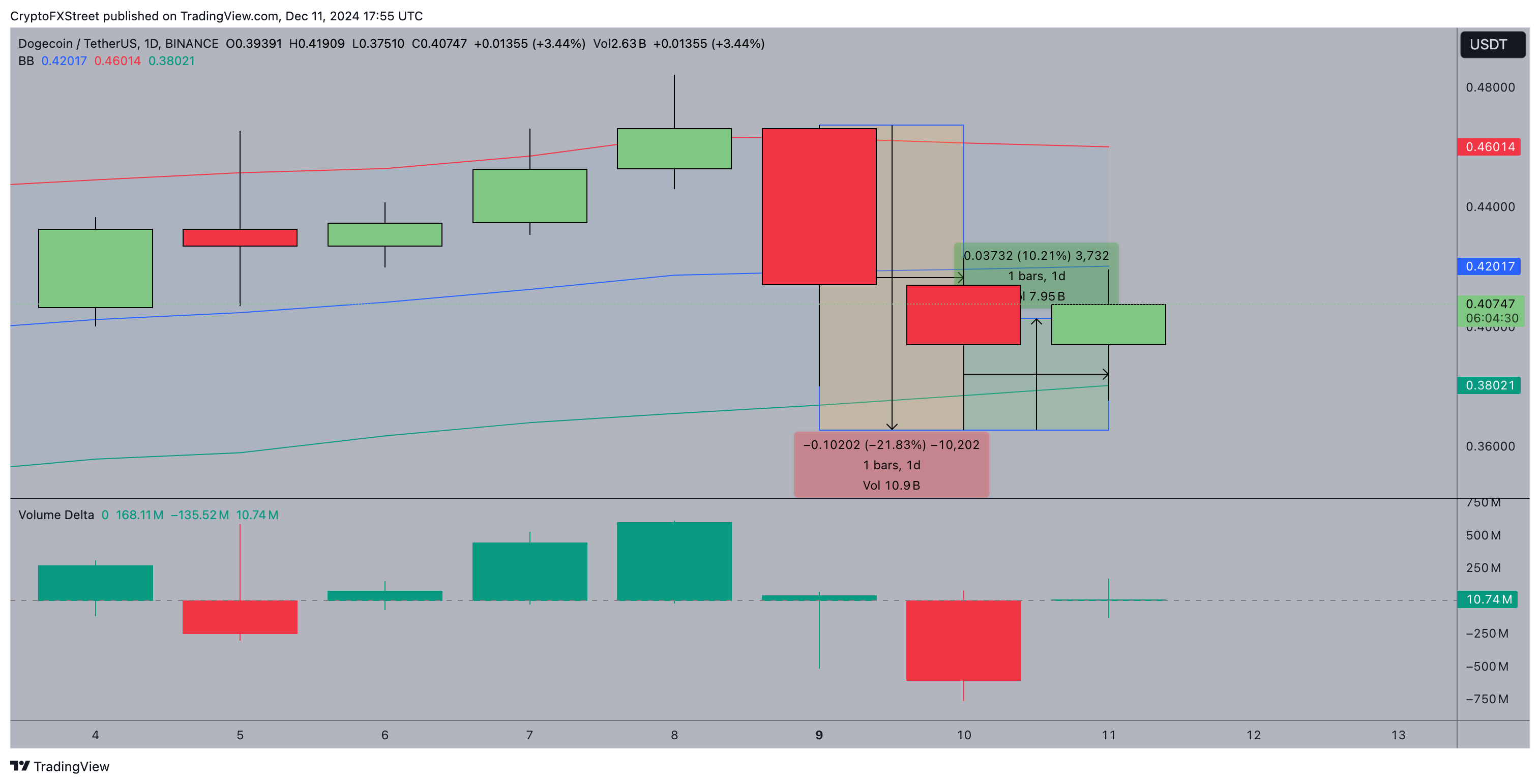
Dogecoin price action | DOGEUSD
The chart above shows how the DOGE price has surged 10.2% as it rose as high as $0.41 Wednesday. This impressive rebound effectively reverses nearly half of the 21.8% losses recorded as prices plunged to a 20-day low of $0.36 on Tuesday.
60,000 new wallets acquired DOGE amid crypto market dip
Ivestors betting on another imminent Fed rate cut after the latest US CPI data released have evidently propelled Dogecoin and the rest of the crypto market into an early rebound. However, a closer look as the underlying on-chain trends shows strategic traders capitalizing on the market dip also played a pivotal role in the DOGE’s 10% resurgence.
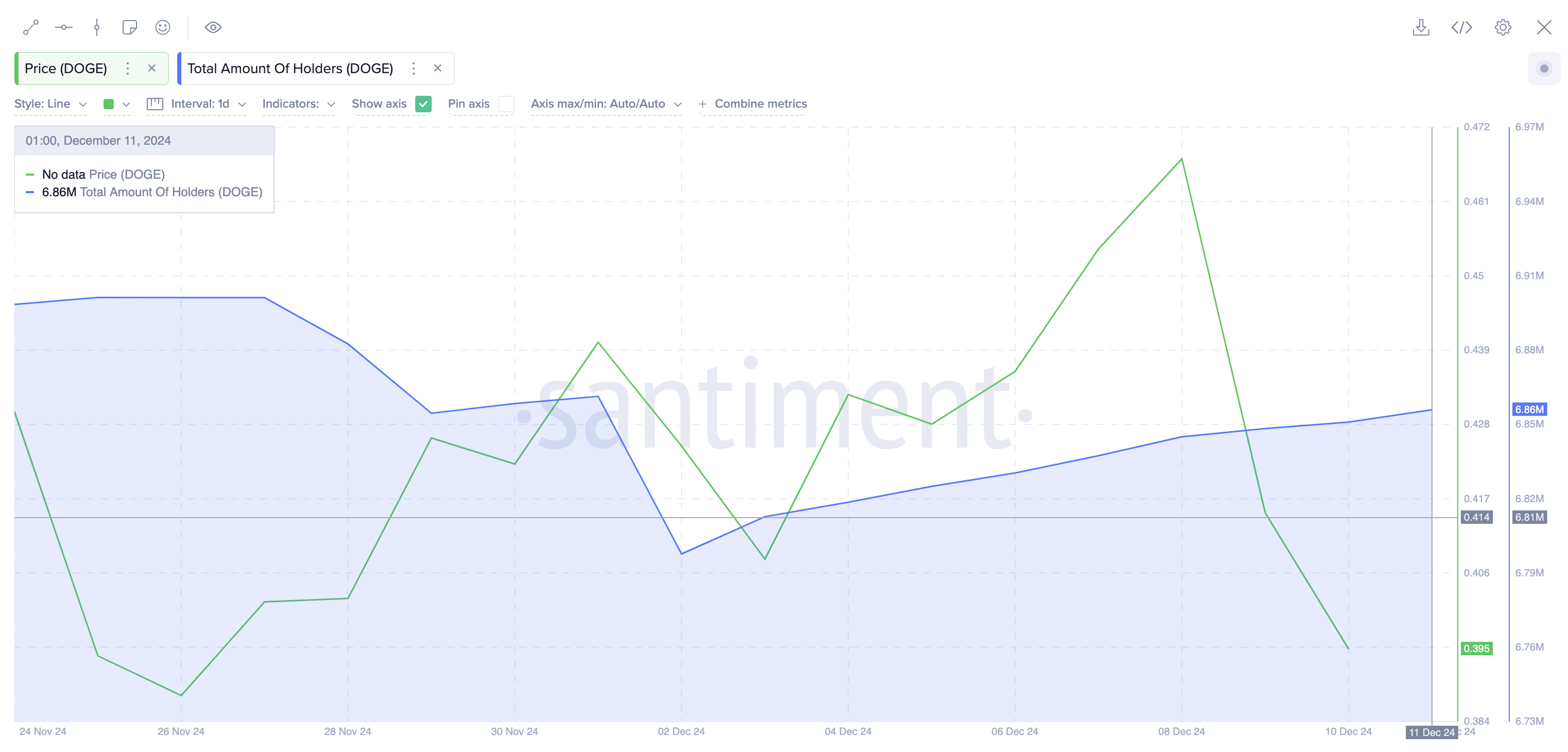
Validating this outlook, Santiment’s chart below monitors real time changes in the number of active funded wallets on the Dogecoin blockchain network. This serves as a proxy for measuring new-user acquisition rate around critical market events.
Dogecoin Price vs. Total Holders
The blue-shadded portion in the chart above shows that only 6.8 million wallets existed on the Dogecoin network as of December 2. But as crypto markets succumbed to downward volatility over the past week, 60,000 new-user wallets acquired DOGE over the past week, bringing the total holder addresses to 6.86 million at press time on December 11.
When a large number of new wallets are created during a market dip, it often signals an influx of new strategic traders capitalizing on the falling prices to enter the fray. Fresh capital inflows from these 60,000 new DOGE wallets effectively increases short-term demand.
Evidently this contributed to setting the stage for the 10.2% DOGE price rebound observed as market sentiment flipped bullish after the US CPI report released on Wednesday.
Dogecoin Price Forecast: $0.50 breakout in focus?
Dogecoin (DOGE) has shown resilience with a 10.2% rebound following the recent market dip, bolstered by bullish momentum after the U.S. CPI report. The daily chart illustrates key technical indicators aligning for a potential extended recovery, yet resistance and support levels demand close attention.
Dogecoin price forecast
The primary resistance to monitor is the $0.46 level, marked by the upper Bollinger Band, which represents a critical psychological threshold.
A breakout above this zone could pave the way toward the next target of $0.50, a level last tested during earlier bullish sentiment waves.
Volume Delta data supports a scenario where consistent buying pressure might push DOGE into new short-term highs, but traders should watch for profit-taking near $0.50.
On the downside, immediate support is found at $0.38, aligned with the lower Bollinger Band.
Breaching this level could invalidate the bullish outlook, exposing DOGE to further corrections. A drop below $0.38 would open the floor to retest $0.36, where stronger support lies.
Nonetheless, today’s price action leaves natural gas wide open for a test of resistance around the recent swing high of 3.56, and a likely rally above it. If that high is exceeded the next likely target is the 2023 high of 3.64. That high begins the top trendlines marking the boundary of a large symmetrical triangle pattern.
It is important to note that the extended target for a rising ABCD pattern (purple) completes there as well at 3.67. Further up is the completion of an extended rising ABCD target at 3.87. A key point to consider is that a breakout above 3.64 will further confirm a bullish reversal of trend that is still making progress.
Symmetrical Triangle Breakout Proceeds
Price action following the breakout of a triangle pattern on November 20 has been a textbook example of bullish behavior so far. Once the breakout triggered the first two initial targets from prior swing highs were exceeded. Subsequently, after the high of 3.56 was reached a two-week correction began before finding support around the initial triangle breakout area of 3.02 last week.
Bullish Above 20-Day MA
Regardless of the potential for upside follow-through, a drop below today’s support at 3.18 would be short-term bearish. The 20-Day MA is a little lower at 3.14. The expectation is for natural gas to continue higher from here but that may begin to change if the 20-Day line fails to retain support. After today, the internal uptrend line on the chart will be adjusted down to connect with last week’s low.
For a look at all of today’s economic events, check out our economic calendar.
XRP has been experiencing interesting price movements lately, with an unexpected surge in retail interest. Google Trends data shows a rise in mentions of XRP and this surge has sparked a lot of retail hype.
According to Brian from Santiment, it’s fascinating how a strong 30-day performance can drive this kind of excitement. Even with a slight pullback, XRP is still up around 329% in the past month. Though it’s down about 11.5% from its recent peak about eight days ago, XRP’s price doubled in just one week, from November 25 to December 2.
On the Thinking Crypto podcast, Brian said that the price surge was accompanied by a spike in transaction volume and active addresses, signaling strong retail interest. However, it’s important to know that XRP, like other altcoins, remains vulnerable to Bitcoin’s movements. Despite this, XRP’s utility has been a key driver behind the FOMO, with many traders jumping in based on price momentum rather than the coin’s fundamentals.
When Will XRP and Other Altcoins Rise Again?
The altcoin market has been seeing some interesting movements lately. Over the past week, the overall market cap of about 3,600 assets has dropped by around 1.5%, but trading volume has actually increased.
The analyst said that right now, sentiment is mixed, with neither bulls nor bears clearly in control. This has created some volatility, where panic sellers are being met by buyers looking to take advantage of lower prices. The market is stuck with no clear direction. Many are hoping for a rally into Christmas or the new year, while others are anticipating a dip followed by a potential recovery in January.
Historically, December has sometimes been a rough month for crypto markets, especially after strong performance in November. In 2017 and 2021, there were similar slowdowns in December, and this year could follow a similar pattern. Tax season often leads to profit-taking, which can further slow down activity.
In the short term, it might be worth keeping an eye on how things develop. The next few weeks could be quieter as whales and large traders take a step back.
The Arbitrum Foundation and French gaming giant Ubisoft have announced Dec. 18 as the official launch date for “Captain Laserhawk: The G.A.M.E.” a web3-enabled top-down shooter.
The game is set in the Ubisoft gaming universe and features a cast of characters from titles including Far Cry: Blood Dragon, Rayman, Assassin’s Creed, Beyond Good and Evil, The Crew, Rainbow Six, Splinter Cell and Watch Dogs.
Captain Laserhawk’s gameplay combines classic top-down shooter mechanics with competitive leaderboards and Web3 features. Story-wise, it’s a media spinoff of the 2023 Netflix-based television show “Captain Laserhawk: A Blood Dragon Remix.” The title is among the slate of Ubisoft games exploring Web3, blockchain, and non-fungible tokens (NFTs).
NFTs and Web3
Captain Laserhawk: The G.A.M.E. is launching on the Ethereum layer-2 Arbitrum network with a coinciding NFT mint via Magic Eden to begin on Dec. 11.
A social media post from the official Captain Laserhawk game account on X.com explained that the free mint players will receive is “packed with utilities” including governance votes and “exclusive collectibles inspired by Ubisoft legends like Rayman and Splinter Cell.”
According to a statement from Nina Rong, head of partnerships at Arbitrum Foundation, the game’s launch marks a pivotal point for the space:
“Today’s mint, and next week’s launch, will be a cornerstone moment as we look towards the future of game development and player experience. Forever, players have followed the storylines, character arcs, and game designs that were given to them. Now, that changes.”
Blockchain gaming
The Web3 gaming space continues to show signs of growth. As Cointelegraph recently reported, NFT sales across the board have shown steady increases since October, with the first week of December recording an estimated sales volume of $187 million.
Meanwhile, the Beam Foundation is set to debut a $150 million dollar fund to spur Web3 gaming in Abu Dhabi.
Despite the sector’s struggle in the wake of the 2021 NFT boom and subsequent market destabilization, Web3 gaming and blockchain-based entertainment apps continue to demonstrate bullish indicators as 2025 approaches.
Silver price bounced back toward Monday’s monthly high of $32.28.
Precious metals, including silver, gained support on news of potential economic stimulus measures from China.
Non-yielding assets like Silver receive support from the rising likelihood of the Fed’s rate cut again in December.
Silver price (XAG/USD) extends its gains for the third successive session, trading around $32.00 during the Asian hours on Wednesday. The demand outlook for precious metals, including Silver, in the world’s largest consumer of raw materials has been increased following news of potential economic stimulus from China.
The Politburo announced plans to adopt a “moderately loose” monetary policy and a “more proactive” approach to fiscal stimulus next year, marking a departure from the more cautious tone of the past decade.
Silver prices receive support from increased odds of the US Federal Reserve (Fed) cutting interest rates again in December. Markets are now pricing in nearly an 85.8% chance of Fed rate reductions by 25 basis points, according to the CME FedWatch Tool.
However, the upside of the Silver price could be restrained due to the stronger US Dollar (USD), which makes dollar-denominated Silver less affordable for buyers with foreign currencies, dampening its demand.
The US Dollar gains ground as traders adopt caution ahead of the US Consumer Price Index (CPI) data scheduled to be released on Wednesday. The US CPI inflation is estimated to rise to 2.7% YoY in November from 2.6% in October. Meanwhile, the core CPI, excluding Food & Energy, is expected to increase 3.3% YoY. Any indications of stalled progress could significantly diminish the likelihood of a Federal Reserve’s (Fed) rate cut.
Silver FAQs
Silver is a precious metal highly traded among investors. It has been historically used as a store of value and a medium of exchange. Although less popular than Gold, traders may turn to Silver to diversify their investment portfolio, for its intrinsic value or as a potential hedge during high-inflation periods. Investors can buy physical Silver, in coins or in bars, or trade it through vehicles such as Exchange Traded Funds, which track its price on international markets.
Silver prices can move due to a wide range of factors. Geopolitical instability or fears of a deep recession can make Silver price escalate due to its safe-haven status, although to a lesser extent than Gold’s. As a yieldless asset, Silver tends to rise with lower interest rates. Its moves also depend on how the US Dollar (USD) behaves as the asset is priced in dollars (XAG/USD). A strong Dollar tends to keep the price of Silver at bay, whereas a weaker Dollar is likely to propel prices up. Other factors such as investment demand, mining supply – Silver is much more abundant than Gold – and recycling rates can also affect prices.
Silver is widely used in industry, particularly in sectors such as electronics or solar energy, as it has one of the highest electric conductivity of all metals – more than Copper and Gold. A surge in demand can increase prices, while a decline tends to lower them. Dynamics in the US, Chinese and Indian economies can also contribute to price swings: for the US and particularly China, their big industrial sectors use Silver in various processes; in India, consumers’ demand for the precious metal for jewellery also plays a key role in setting prices.
Silver prices tend to follow Gold’s moves. When Gold prices rise, Silver typically follows suit, as their status as safe-haven assets is similar. The Gold/Silver ratio, which shows the number of ounces of Silver needed to equal the value of one ounce of Gold, may help to determine the relative valuation between both metals. Some investors may consider a high ratio as an indicator that Silver is undervalued, or Gold is overvalued. On the contrary, a low ratio might suggest that Gold is undervalued relative to Silver.
GBP/USD stays in a consolidation phase near 1.2750 early Wednesday.
Annual CPI inflation in the US is forecast to rise to 2.7% in November.
The near-term technical outlook highlight the pair’s indecisiveness.
GBP/USD registered modest gains for the second consecutive day on Tuesday but lost its traction early Wednesday. The pair stays near 1.2750 in the European morning as market focus shifts to the key November inflation report from the US.
British Pound PRICE This week
The table below shows the percentage change of British Pound (GBP) against listed major currencies this week. British Pound was the strongest against the New Zealand Dollar.
USD
EUR
GBP
JPY
CAD
AUD
NZD
CHF
USD
0.60%
-0.04%
1.17%
0.19%
0.48%
1.09%
0.63%
EUR
-0.60%
-0.62%
0.67%
-0.32%
-0.02%
0.58%
0.11%
GBP
0.04%
0.62%
1.12%
0.31%
0.60%
1.21%
0.74%
JPY
-1.17%
-0.67%
-1.12%
-0.97%
-0.57%
-0.18%
-0.43%
CAD
-0.19%
0.32%
-0.31%
0.97%
0.33%
0.90%
0.43%
AUD
-0.48%
0.02%
-0.60%
0.57%
-0.33%
0.59%
0.13%
NZD
-1.09%
-0.58%
-1.21%
0.18%
-0.90%
-0.59%
-0.47%
CHF
-0.63%
-0.11%
-0.74%
0.43%
-0.43%
-0.13%
0.47%
The heat map shows percentage changes of major currencies against each other. The base currency is picked from the left column, while the quote currency is picked from the top row. For example, if you pick the British Pound from the left column and move along the horizontal line to the US Dollar, the percentage change displayed in the box will represent GBP (base)/USD (quote).
The cautious market mood and rising US Treasury bond yields helped the US Dollar (USD) find demand on Tuesday and made it difficult for GBP/USD to stretch higher. Early Wednesday, the USD stays resilient against its rivals as US stock index futures trade mixed.
The Consumer Price Index (CPI) is forecast to rise 2.7% on a yearly basis in November, up slightly from the 2.6% increase recorded in October. The monthly core CPI, which excludes volatile food and energy prices, is expected to increase 0.3%.
The CME FedWatch Tool currently shows that markets are pricing in a nearly 90% probability of a 25 basis points (bps) Federal Reserve (Fed) rate cut in December. Although inflation figures are unlikely to alter the market pricing of the Fed rate decision in a significant way, a surprise in the monthly core CPI could trigger a reaction in the near term.
In case the monthly core CPI rises 0.5% or more, the USD could gather strength and weigh on GBP/USD. On the other hand, a soft print of 0.2% lower could open the door for a leg higher in the pair.
GBP/USD Technical Analysis
GBP/USD faces a pivot level at 1.2750, where the Fibonacci 50% retracement of the latest downtrend is located. Once that level is confirmed as support, the pair could meet next resistance at 1.2770 (200-period Simple Moving Average (SMA)) before 1.2800 (Fibonacci 61.8% retracement).
Looking south, supports could be spotted at 1.2700 (Fibonacci 38.2% retracement) and 1.2670 (100-period SMA).
Pound Sterling FAQs
The Pound Sterling (GBP) is the oldest currency in the world (886 AD) and the official currency of the United Kingdom. It is the fourth most traded unit for foreign exchange (FX) in the world, accounting for 12% of all transactions, averaging $630 billion a day, according to 2022 data. Its key trading pairs are GBP/USD, also known as ‘Cable’, which accounts for 11% of FX, GBP/JPY, or the ‘Dragon’ as it is known by traders (3%), and EUR/GBP (2%). The Pound Sterling is issued by the Bank of England (BoE).
The single most important factor influencing the value of the Pound Sterling is monetary policy decided by the Bank of England. The BoE bases its decisions on whether it has achieved its primary goal of “price stability” – a steady inflation rate of around 2%. Its primary tool for achieving this is the adjustment of interest rates. When inflation is too high, the BoE will try to rein it in by raising interest rates, making it more expensive for people and businesses to access credit. This is generally positive for GBP, as higher interest rates make the UK a more attractive place for global investors to park their money. When inflation falls too low it is a sign economic growth is slowing. In this scenario, the BoE will consider lowering interest rates to cheapen credit so businesses will borrow more to invest in growth-generating projects.
Data releases gauge the health of the economy and can impact the value of the Pound Sterling. Indicators such as GDP, Manufacturing and Services PMIs, and employment can all influence the direction of the GBP. A strong economy is good for Sterling. Not only does it attract more foreign investment but it may encourage the BoE to put up interest rates, which will directly strengthen GBP. Otherwise, if economic data is weak, the Pound Sterling is likely to fall.
Another significant data release for the Pound Sterling is the Trade Balance. This indicator measures the difference between what a country earns from its exports and what it spends on imports over a given period. If a country produces highly sought-after exports, its currency will benefit purely from the extra demand created from foreign buyers seeking to purchase these goods. Therefore, a positive net Trade Balance strengthens a currency and vice versa for a negative balance.
It’s hard to think of an ailment for which there isn’t a supplement that promises relief — and Australia’s fastest growing chronic condition is no exception.
With one person estimated to develop diabetes every five minutes, it’s no surprise there are a host of vitamins, minerals and herbs that claim to improve metabolism and lower blood sugar levels.
It’s prompted concerns people may forgo diabetes medicines in favour of over-the-counter and often unprovenvitamins and minerals.
So what’s the evidence for supplements when it comes to type 2 diabetes, and could there be any harms?
Remind me, how does diabetes work?
Diabetes is a chronic health condition in which a person has too much glucose in their blood. Glucose is the body’s primary source of energy and it comes from the food you eat.
“Your body uses a hormone called insulin to help move glucose from the bloodstream into your cells for energy or for storage,” said Melinda Coughlan, a nutrition scientist at Monash University.
“In diabetes, this system doesn’t work properly, leading to high blood sugar levels, and this can cause serious health problems over time.”
Regular blood glucose monitoring is recommended for people using insulin therapy. (CDC Public Health Image Library: Amanda Mills)
Unlike type 1 diabetes, an autoimmune disease in which the body’s insulin-producing cells have been destroyed by the body’s immune system, type 2 diabetes occurs when the body becomes resistant to and gradually loses the ability to produce insulin.
“This type is more common and often linked to lifestyle factors like obesity, inactivity and poor diet,” Professor Coughlan said.
How is diabetes normally treated?
People with type 1 diabetes rely on taking insulin everyday — through injections or delivery devices such as insulin pumps — to ensure they stay within their target glucose range.
Those with type 2 diabetes, on the other hand, can often manage the condition, at least initially, with healthy eating and regular physical activity.
“Diet is really crucial because what you eat directly impacts your blood sugar levels but also your insulin sensitivity,” Professor Coughlan said.
“You want to limit refined carbohydrates — sugars and high glycaemic index foods like white bread, pastries and sugary drinks — and you want to opt for complex carbohydrates, such as wholegrains, legumes and non-starchy vegetables.”
Exercise is also important because it helps increase your “glucose disposal rate”, Professor Coughlan said, so your body uses glucoseeffectively rather than storing it as fat, which can further drive insulin resistance.
However, many people with type 2 diabetes eventually require medicine as their body’s ability to produce insulin further deteriorates.
Metformin is the primary first-line medication to treat Type 2 diabetes. (Getty Images: Francis Dean)
Metformin, a drug which improves insulin sensitivity, is the most common first-line treatment, but there are several classes of diabetesdrugs available, endocrinologist and diabetes researcher Jonathan Shaw said.
“The reason we use metformin and a range of other drugs is that they have been studied very carefully,” Professor Shaw, who is alsodeputy director of the Baker Heart and Diabetes Institute, said.
“We have established, typically in multiple clinical trials … that they actually lower blood glucose, and that they’re safe.”
What’s the evidence for supplements?
A number of studies have investigated the potential benefits of dietary supplements for the prevention and treatment of type 2 diabetes, but the overall quality and amount of information we have on them is “limited”, Professor Shaw said.
“Generally, the evidence around these supplements is much weaker than what exists for drugs,” hesaid.
Some studies suggest chromium (a mineral), berberine (derived from plants) and cinnamon might help with blood sugar control, while alpha-lipoic acid (or ALA, an antioxidant) might reducepain associated with diabetes-induced nerve pain.
There is also some research to suggest magnesium may improve insulin sensitivity and blood sugar control, while evidence for vitamin D is less convincing — and similarly weak for herbal supplements including bitter melon and ginseng.
“There is no doubt that there is some evidence — for at least some supplements — that they may be helpful,” Professor Shaw said.
“But the amount of information, the size of the trials, and the quality of the trials is often far inferior to what we have for drugs.
“I don’t have any objection to the idea of using [supplements]. I simply think we should stick to things for which there is good evidence.”
He added that the limited evidence available for supplements was almost entirely restricted to their effects on blood glucose levels — and not the complications of diabetes such as kidney disease, eye disease, foot problems, heart attacks and strokes.
“In the end, the main thing we’re trying to do is prevent people from having things that make them unwell, put them in hospital or even kill them,” Professor Shaw said.
“For most of the prescribed drugs we use, we have clear evidence on whether or not they have benefits on those outcomes … and we just don’t have any of that kind of information for supplements.”
Prescription medicines, meanwhile, undergo rigorous assessment for safety, quality and efficacy, Professor Shaw said.
Professor Jonathan Shaw is deputy director of the Baker Heart and Diabetes Insititute in Melbourne. (Supplied: Baker Institute)
Large clinical trials of prescription medicines allow researchers to understand possible side effects, and determine which people should not be prescribed certain treatments.
“Drugs can only be licensed if they have been extensively studied, whereas supplements … there isn’t a large body of evidence that is developed to understand their strengths and weaknesses,” he said.
Are supplements likely to do any harm?
If you’re considering taking a supplement for diabetesprevention or management, it’s important to speak with a GP or health professional first.
That’s because supplements — even those made of natural ingredients — can sometimes cause side effects or interact with other medications, Professor Coughlan said.
“They could, for example, intensify the effect of your diabetes medication, causing low blood sugar or hypoglycemia, which can be dangerous,” she said.
When considering potential harms, Professor Shaw added that “harm to your back pocket” was also something to consider.
“If you’re paying for something and it has no benefit, then there is a harm — on your bank balance”.
For people with type 2 diabetes, he said the risk of serious harm from supplements was likely to be “pretty small” in the short-term, but he stressed that people with type 1 diabetes should never take supplements in the place of insulin.
“People with type 1 diabetes get into a lot of trouble very quickly without insulin,” he said.
“In type 2 diabetes, if you go off your medication and go onto something that isn’t working well, it’s not good for you in the long term. If you’ve got type 1 diabetes, going off insulin can be fatal.”
Solana (SOL) has been the talk of the crypto town, as it stays afloat at the $220 level after an impressive 221.2% surge this year. With the recent marketwide sell-off, analysts wonder: is SOL headed for a massive 100% surge?
Meanwhile, the spotlight is also shifting to JetBolt (JBOLT), a rising altcoin making waves with its presale success. Over 150 million tokens have already been sold, driven by its innovative zero-gas technology and advanced blockchain features. It’s no surprise that whales are taking notice as JetBolt continues to grow.
Will Solana double in price in early 2025, or is JetBolt poised to steal the show as the next big altcoin? Let’s dive into the latest on Solana price prediction and why whales are accumulating JetBolt.
Solana Price Prediction: SOL to Double or Trouble?
2024 has been a series of ups and downs for Solana (SOL). The coin propelled 221.2% this year to hit an impressive peak of $263 before finding resistance around $223.7136. So, is SOL headed for a massive 100% surge? Market watchers are also eager to find out.
Solana saw a sharp dip in its 7-day price chart from CoinGecko.
Solana has seen a slight pullback, with declines of 6.2% and 4.9% over the past week and two weeks, respectively. Technical indicators offer a mixed bag—the 10-day SMA sits at $229.18, signaling a short-term bullish trend just above the 200-day SMA of $165.04. Meanwhile, an RSI of 46.07 points to neutral market conditions, with no strong directional momentum in play.
Solana is feeling the pressure as a marketwide sell-off drives its price downward. Broader bearish sentiment across the crypto space has contributed to increased selling activity, dragging SOL along with other major assets like Bitcoin.
Despite the recent dips, a number of analysts remain bullish on Solana. A popular crypto analyst, Altcoin Sherpa, still believes in Solana’s price trajectory, forecasting that a potential bottom may be forming soon. The analyst highlighted that “bottom formations are often violent events and take some time,” emphasizing the turbulent nature of market lows.
While Solana faces short-term challenges amid a marketwide sell-off, its mixed technical indicators and recent price pullbacks suggest a period of consolidation rather than outright decline. However, resistance at $223.7136 and challenges like delays in launching Solana ETFs could act as roadblocks on its path to new heights.
JetBolt Continues to Surge with Over 150 Million Tokens Sold
JetBolt made a dashing entry with its red-hot presale—already surpassing 150 million tokens sold.
What makes JetBolt unique is its groundbreaking zero-gas technology. Using the Skale Network, this impressive feature eliminates gas fees entirely. Developers can now supercharge their Web3 dreams with zero-gas technology and JetBolt’s streamlined wallet and payment tool.
Imagine crafting innovative Dapps without the burden of gas fees, from social finance apps that redefine community interaction to immersive gamefi experiences that push the boundaries of digital entertainment. With tokens, NFTs, and other digital assets at their fingertips, developers can build rich, interactive ecosystems that captivate users and drive the future of Web3.
JetBolt also integrates an AI-powered tool that aggregates market trends, keeping users in the loop by making the curation more entertaining. This combination highlights JetBolt’s commitment to pushing boundaries in the tech space.
When it comes to token staking, JetBolt introduces a fresh approach by rewarding users not only for staking but also for active participation during the staking process. This means the more involved a user is, the greater their rewards.
Early birds get the worm (and extra tokens) with Alpha Box bundles. Buyers can snag up to 25% bonus tokens on bulk purchases.
JetBolt is more than just an altcoin. It’s a platform designed for real-world utility, right from the start. With its innovative features and forward-thinking ecosystem, JetBolt is gaining traction among both crypto enthusiasts and savvy whales who appreciate practical applications.
Is SOL Headed For Massive 100% Surge As JetBolt Continues To Pump?
Despite hurdles such as the market-wide sell-off, Solana continues to demonstrate resilience. Backed by strong whale interest and a dynamic ecosystem, SOL maintains its potential to overcome challenges. While the journey to a 100% surge remains ambitious, the long-term potential remains strong. As the market stabilizes and Solana addresses its technical challenges, SOL fans are cautiously optimistic.
On the other hand, JetBolt continues to gain momentum with its revolutionary zero-gas technology, AI-powered utilities, and innovative staking features. With over 150 million tokens sold during its presale and a fully functional ecosystem, JetBolt is emerging as a next-generation altcoin to watch.
The crypto market is highly volatile and prone to substantial price fluctuations. This article is for informational purposes only and should not be considered financial advice. Always conduct your own research and fully understand the risks involved before making any cryptocurrency-related decisions.