VICTORIA, Seychelles, Oct. 25, 2024 (GLOBE NEWSWIRE) — Bitget Wallet is thrilled to announce its integration with the ApeChain mainnet, the native blockchain of the Bored Ape Yacht Club. This collaboration opens exciting opportunities for users to engage with the ApeChain ecosystem, enhancing DApp interactions and meme coin trading experiences.
With the Bitget Wallet browser extension and mobile app, users can effortlessly switch to the ApeChain network without complex manual setups. This simplifies coin additions, enables seamless transfers, and provides straightforward access to decentralized exchanges (DEXs) for trading. Looking ahead, Bitget Wallet plans to introduce popular meme coin swap functionality and real-time market data for ApeChain, further enriching the trading experience.
Integrating ApeChain lowers the barrier to entry for users eager to explore this vibrant ecosystem and discover trending meme coins. With the ability to quickly tap into market hotspots and seize breakout opportunities, Bitget Wallet becomes an essential tool for savvy traders. Additionally, a dedicated section for ApeChain DApps has been added to the Bitget Wallet’s “Discover” tab, allowing users to connect easily with various decentralized applications and access innovative projects within the ecosystem.
In just 12 hours since its launch, ApeChain has recorded over 360,000 transactions, generating 495.17 APE in transaction fees, demonstrating its significant market potential. As the ApeChain ecosystem evolves, Bitget Wallet remains committed to enhancing its platform with more functionalities and services related to ApeChain, ensuring users receive the best possible trading experience.
“With BAYC’s launch of ApeChain, we’re witnessing a pivotal shift in the crypto landscape,” said Alvin Kan, COO of Bitget Wallet. “As the NFT market faces declining interest, meme coins are emerging as the new frontier of crypto trading, much like NFTs did in their prime. This surge in meme coin popularity is attracting new investors and reshaping market sentiment. Bitget Wallet is dedicated to supporting the ApeChain ecosystem by providing seamless access to its DApps and facilitating meme coin trading, ensuring our users remain at the forefront of this dynamic environment.”
About Bitget Wallet
Bitget Wallet is the home of Web3, where endless possibilities come together in one wallet. Uniting over 40 million users, this non-custodial wallet brings everything onchain in one place—asset management, quick swaps, rewards, staking, trading tools, live market data, a DApp browser, and an NFT marketplace. With wallet options like mnemonic, MPC, AA, and a Telegram bot, Bitget Wallet serves everyone from beginners to advanced traders. Supporting 100+ blockchains, 20,000+ DApps and 500,000+ tokens, it connects to hundreds of DEXs and cross-chain bridges for seamless multi-chain trading, and offers a $300 million protection fund to keep your digital assets safe.
In a significant upward revision, the leading global investment banking, securities, and asset and wealth management firm, Goldman Sachs, has enhanced its 2025 price forecasts for aluminium and copper, driven by increased demand potential in China, the world’s largest consumer of these metals.
{alcircleadd}
The investment banking giant has adjusted its 2025 average aluminium price outlook to $2,700 per tonne, up from the previous forecast of $2,540 per tonne. Meanwhile, the average copper price forecast has also seen a rise, now set at $10,160 per tonne, an increase from $10,100.
These changes come as the London Metal Exchange (LME) reports aluminium trading near $2,634.50 a tonne, following a peak of $2,715—the highest level since May 31. LME copper is currently trading at $9,510.50 a tonne.
The fiber supplements market is experiencing significant growth due to a combination of factors related to health awareness, lifestyle changes, and dietary trends. One of the primary drivers is the increasing recognition of the benefits of dietary fiber in maintaining digestive health.
NEWARK, DE / ACCESSWIRE / October 25, 2024 / The global fiber supplements market is projected to grow significantly, reaching an estimated value of USD 34.18 billion by 2032, up from USD 18.21 billion in 2022, according to a new report. This robust growth reflects a compound annual growth rate (CAGR) of 6.5% during the forecast period.
As awareness of the importance of dietary fiber increases, more consumers are turning to fiber supplements to enhance their digestive health. Available in various forms including capsules, tablets, and powders, these supplements are designed to address the declining fiber intake prevalent in many diets today.
Key Market Drivers
Health Benefits: Fiber supplements offer numerous health advantages, including cholesterol management, gastrointestinal health, weight control, and stable blood sugar levels. They are particularly sought after for relief from constipation and bowel irregularities.
Changing Dietary Habits: A significant shift in lifestyle and eating patterns, especially in fast-paced economies, has resulted in lower fiber consumption. As consumers recognize the nutritional gap, fiber supplements have gained popularity.
Increased Awareness: Growing knowledge about the health implications of fiber deficiency has prompted more individuals to seek dietary solutions, with dieticians recommending fiber supplementation as a viable option.
Gluten-Free Trends: Rising gluten intolerance is also spurring demand for fiber supplements, as manufacturers respond by creating gluten-free, high-fiber products.
Innovative Sales Strategies: Nutraceutical companies are developing new, palatable fiber supplement options, further driving market growth.
Key Takeaways from the Fiber Supplements Market
Significant Growth: The global fiber supplements market is expected to reach $34.18 billion by 2032, growing at a CAGR of 6.5%.
Health Benefits: Fiber supplements are valued for their ability to support digestive health and manage cholesterol levels.
Changing Diets: Increasing awareness of declining dietary fiber intake is driving consumer demand for fiber supplements.
Gluten-Free Demand: Rising gluten intolerance is prompting manufacturers to develop gluten-free fiber supplement options.
Innovation in Products: Nutraceutical companies are focusing on taste and quality, enhancing the appeal of fiber supplements.
Regulatory Challenges: Stringent FDA regulations and consumer skepticism about product labeling pose challenges for market growth.
“Changing dietary habits and busy lifestyles contribute to a rising demand for fiber supplements. Innovation in gluten-free options and enhanced product taste are key trends shaping the market. However, regulatory challenges and consumer skepticism due to misbranding issues could hinder growth.” – says Nandini Roy Choudhury, Client Partner at Future Market Insights.
Prominent Drivers of the Fiber Supplements Market
Health Benefits: Awareness of fiber’s role in maintaining digestive health and overall wellness.
Cholesterol Management: Fiber’s ability to help lower cholesterol levels.
Weight Management: Fiber’s contribution to satiety and weight control.
Blood Sugar Regulation: Fiber’s role in stabilizing blood sugar levels.
Constipation Relief: Demand for short-term relief from constipation and bowel irregularities.
Changing Dietary Habits: Shifts in lifestyle leading to reduced fiber intake from traditional diets.
Busy Lifestyles: Increased reliance on supplements due to time constraints impacting meal quality.
Growing Health Consciousness: A rising awareness among consumers regarding health and nutrition.
Dietician Recommendations: Increased endorsements from health professionals advocating for fiber supplementation.
Nutritional Deficiency Awareness: Recognition of fiber deficiency and its negative health impacts.
Challenges Faced by the Fiber Supplements Market
Regulatory Hurdles: Stringent FDA regulations can complicate product approval and increase compliance costs.
Consumer Skepticism: Concerns about misbranding, mislabeling, and the quality of products can erode consumer trust.
High Competition: A crowded market with numerous brands makes differentiation difficult.
Cost of Production: Rising costs associated with sourcing quality ingredients and maintaining production standards.
Market Saturation: Increased availability of fiber supplements can lead to market saturation, limiting growth potential.
Adverse Reactions: Some consumers may experience digestive discomfort from fiber supplements, leading to reluctance in usage.
Lack of Standardization: Variability in product formulations can confuse consumers and affect brand loyalty.
Education Gaps: Insufficient consumer knowledge about the benefits and proper usage of fiber supplements.
Supply Chain Issues: Disruptions in the supply chain can impact product availability and pricing.
Changing Consumer Preferences: Rapid shifts in health trends may affect demand for specific types of fiber supplements.
Competitive Landscape of the Fiber Supplements Market
Many companies are offering sugar-free, tasteless fiber supplements, and the increasing popularity of trendy ingredients in these products is expected to boost market growth.
Recent Developments
In 2018, the Fiber Choice® line of chewable prebiotic fiber gummies and tablets was awarded the #1 share of gastroenterologist (GE) recommendations nationwide, over four times greater than that of the nearest branded competitor.
Caret Pharma, a subsidiary of Caret Group has acquired FiberChoice, a leading line of fiber supplements. With this acquisition, Caret Pharma aims to expand its medical food category.
Regional Insights into the Fiber Supplements Market
United States: The North American market is experiencing significant growth driven by increased health awareness and higher spending on wellness products.
Germany: The German market is witnessing a surge in health-conscious consumers opting for functional dietary products.
United Kingdom: UK consumers are increasingly turning to fiber supplements as part of a balanced approach to health and wellness.
China: Rapid urbanization and changing dietary habits are driving the adoption of fiber supplements in China.
India: Growing health awareness and dietary shifts in India are creating lucrative opportunities for fiber supplement growth.
South Africa: The South African market is seeing growth as more consumers seek dietary solutions to address fiber deficiency.
Key Segments Profiled in the Fiber Supplements Market
By Type:
Capsule
Powder
Chewable
Tablets
By Source:
Fruits
Vegetables
Legumes
Whole grains
By Nature:
By Application:
Authored by:
Nandini Roy Choudhury (Client Partner for Food & Beverages at Future Market Insights, Inc.) has 7+ years of management consulting experience. She advises industry leaders and explores off-the-eye opportunities and challenges. She puts processes and operating models in place to support their business objectives.
She has exceptional analytical skills and often brings thought leadership to the table.
Nandini has vast functional expertise in key niches, including but not limited to food ingredients, nutrition & health solutions, animal nutrition, and marine nutrients. She is also well-versed in the pharmaceuticals, biotechnology, retail, and chemical sectors, where she advises market participants to develop methodologies and strategies that deliver results.
Her core expertise lies in corporate growth strategy, sales and marketing effectiveness, acquisitions and post-merger integration and cost reduction. Nandini has an MBA in Finance from MIT School of Business. She also holds a Bachelor’s Degree in Electrical Engineering from Nagpur University, India.
Nandini has authored several publications, and quoted in journals including Beverage Industry, Bloomberg, and Wine Industry Advisor.
Explore FMI’s related ongoing Coverage in Food and Beverage Domain:
The global dietary fiber market size is expected to grow from USD 12.34 billion in 2024 to USD 33.10 billion by 2034, with a CAGR of 10.3%.
The global protein supplement market size is projected to exceed USD 62.99 billion by 2033, growing at a CAGR of 8.5% from its current valuation of USD 27.78 billion in 2023.
The demand for creatine supplement is expected to grow from USD 501 million in 2023 to USD 923 million by 2033, with a projected CAGR of 13.0%.
The prenatal vitamin supplement market size is projected to be valued at USD 589.6 million in 2024, with an anticipated CAGR of 10.1%. It is expected to reach USD 1.54 billion by 2034.
The global vegan supplements market value is projected to grow from USD 4.83 billion in 2022 to USD 14.09 billion by 2032, with a CAGR of 11.3%.
The glucosamine supplements market size is projected to grow at a CAGR of 4.8%, increasing from USD 583.6 million in 2023 to USD 932.7 million by 2033.
Global probiotic supplement sales are expected to reach USD 7.52 billion in 2024, with an anticipated CAGR of 11.2%. The market is projected to grow to USD 23.87 billion by 2034.
The global green supplement market size is estimated at USD 563.3 million in 2022 and is projected to grow at a CAGR of 3.8%, reaching approximately USD 818 million by 2032.
About Future Market Insights (FMI)
Future Market Insights, Inc. (ESOMAR certified, recipient of the Stevie Award, and a member of the Greater New York Chamber of Commerce) offers profound insights into the driving factors that are boosting demand in the market. FMI stands as the leading global provider of market intelligence, advisory services, consulting, and events for the Packaging, Food and Beverage, Consumer Technology, Healthcare, Industrial, and Chemicals markets. With a vast team of over 400 analysts worldwide, FMI provides global, regional, and local expertise on diverse domains and industry trends across more than 110 countries.
Join us as we commemorate 10 years of delivering trusted market insights. Reflecting on a decade of achievements, we continue to lead with integrity, innovation, and expertise.
GBP/USD enters a consolidation phase after closing in positive territory on Thursday.
Technical buyers could remain interested while the pair holds above 1.2970.
The US economic calendar will feature Durable Goods Orders data for September.
Following Wednesday’s sharp decline, GBP/USD reversed its direction and gained more than 0.4% on Thursday. The pair fluctuates in a tight channel below 1.3000 in the European morning on Friday.
British Pound PRICE This week
The table below shows the percentage change of British Pound (GBP) against listed major currencies this week. British Pound was the weakest against the US Dollar.
USD
EUR
GBP
JPY
CAD
AUD
NZD
CHF
USD
0.39%
0.55%
1.63%
0.26%
1.16%
1.13%
0.30%
EUR
-0.39%
0.08%
1.13%
-0.07%
0.74%
0.62%
-0.17%
GBP
-0.55%
-0.08%
1.05%
-0.28%
0.63%
0.58%
-0.29%
JPY
-1.63%
-1.13%
-1.05%
-1.35%
-0.45%
-0.43%
-1.36%
CAD
-0.26%
0.07%
0.28%
1.35%
0.81%
0.92%
-0.09%
AUD
-1.16%
-0.74%
-0.63%
0.45%
-0.81%
0.04%
-0.92%
NZD
-1.13%
-0.62%
-0.58%
0.43%
-0.92%
-0.04%
-0.86%
CHF
-0.30%
0.17%
0.29%
1.36%
0.09%
0.92%
0.86%
The heat map shows percentage changes of major currencies against each other. The base currency is picked from the left column, while the quote currency is picked from the top row. For example, if you pick the British Pound from the left column and move along the horizontal line to the US Dollar, the percentage change displayed in the box will represent GBP (base)/USD (quote).
After outperforming its rivals in the first half of the week, the US Dollar (USD) lost its strength on Thursday, with the US Dollar Index losing 0.4%. The positive shift seen in risk sentiment made it difficult for the USD to find demand, while retreating US Treasury bond yield further weighed on the currency.
Durable Goods Orders for September and the University of Michigan’s (UoM) Consumer Sentiment Index for October will be featured in the US economic calendar on Friday. The UoM data is unlikely to trigger a reaction because it will be a revision. If the Durable Goods Orders unexpectedly rise, the initial reaction could support the USD. On the other hand, a reading worse than the market expectation of -1% could hurt the currency and allow GBP/USD to stretch higher heading into the weekend.
In the meantime, US stock index futures were last seen rising between 0.1% and 0.2%. A bullish opening in Wall Street could attract risk-on flows and cause the USD to weaken further in the second half of the day.
GBP/USD Technical Analysis
GBP/USD trades within the upper half of the descending regression channel but holds above the 100-day Simple Moving Average (SMA), currently located at 1.2970. Additionally, the Relative Strength Index (RSI) indicator on the 4-hour chart stays slightly above 50, reflecting sellers’ hesitancy.
In case GBP/USD continues to use 1.2970 as support, buyers could remain interested. In this scenario, immediate resistance is located at 1.3000-1.3010 (static level, upper limit of the descending channel) before 1.3050 (100-period SMA) and 1.3100 (static level).
On the downside, supports could be seen at 1.2900 (mid-point of the descending channel) and 1.2800 (lower limit of the descending channel).
Pound Sterling FAQs
The Pound Sterling (GBP) is the oldest currency in the world (886 AD) and the official currency of the United Kingdom. It is the fourth most traded unit for foreign exchange (FX) in the world, accounting for 12% of all transactions, averaging $630 billion a day, according to 2022 data. Its key trading pairs are GBP/USD, also known as ‘Cable’, which accounts for 11% of FX, GBP/JPY, or the ‘Dragon’ as it is known by traders (3%), and EUR/GBP (2%). The Pound Sterling is issued by the Bank of England (BoE).
The single most important factor influencing the value of the Pound Sterling is monetary policy decided by the Bank of England. The BoE bases its decisions on whether it has achieved its primary goal of “price stability” – a steady inflation rate of around 2%. Its primary tool for achieving this is the adjustment of interest rates. When inflation is too high, the BoE will try to rein it in by raising interest rates, making it more expensive for people and businesses to access credit. This is generally positive for GBP, as higher interest rates make the UK a more attractive place for global investors to park their money. When inflation falls too low it is a sign economic growth is slowing. In this scenario, the BoE will consider lowering interest rates to cheapen credit so businesses will borrow more to invest in growth-generating projects.
Data releases gauge the health of the economy and can impact the value of the Pound Sterling. Indicators such as GDP, Manufacturing and Services PMIs, and employment can all influence the direction of the GBP. A strong economy is good for Sterling. Not only does it attract more foreign investment but it may encourage the BoE to put up interest rates, which will directly strengthen GBP. Otherwise, if economic data is weak, the Pound Sterling is likely to fall.
Another significant data release for the Pound Sterling is the Trade Balance. This indicator measures the difference between what a country earns from its exports and what it spends on imports over a given period. If a country produces highly sought-after exports, its currency will benefit purely from the extra demand created from foreign buyers seeking to purchase these goods. Therefore, a positive net Trade Balance strengthens a currency and vice versa for a negative balance.
Dogecoin is one of the leading tokens in the world of cryptocurrency. Its modest price surge this October is compelling investors to wonder whether November will prove lucrative for the coin. Let’s explore how Doge may perform this November 2024.
As per the latest post by Santiment, investors are now keenly awaiting Bitcoin’s price surge to $70K. With BTC hovering over $67K-$68K, a little market push may help Bitcoin touch the coveted price mark of $70K, ushering in a wave of price surges for several altcoins, including DOGE. This sentiment has compelled investors to take a new interest in Doge, which has spiked its price to a certain extent.
“This pictured chart does not show the prices of these coins. Instead, it illustrates the ratio of positive vs. negative sentiment (and volume of conversations) toward $APE, $DOGE, $GOAT, and $GIGA across social media. These are among the best-performing coins in crypto the past couple weeks and naturally attracted lots of FOMO and bullish sentiment as each coin pumped. Once the bullish sentiment got high, each asset was corrected one by one.
📊 This pictured chart is not showing the prices of these coins. Instead, it illustrates the ratio of positive vs. negative sentiment (and volume of conversations) toward $APE, $DOGE, $GOAT, and $GIGA across social media.
At the same time, Dogecoin continues to be the top crypto token in the market. As per Ali, a notable crypto expert, DOGE holds massive potential within itself and may touch a high price of $10 if the momentum continues to support the token.
Ali had earlier shared how Doge has lately been signaling a potential breakout, which could ultimately push its price to rise by nearly 60%.
“History often repeats itself, and #Dogecoin might be doing just that. A familiar pattern: breakout from a multi-year descending triangle, 200% surge, 60% retracement—then a bull run. After a recent 65% pullback, $DOGE could be gearing up for the next big rally!”
History often repeats itself, and #Dogecoin might be doing just that.
A familiar pattern: breakout from a multi-year descending triangle, 200% surge, 60% retracement—then a bull run.
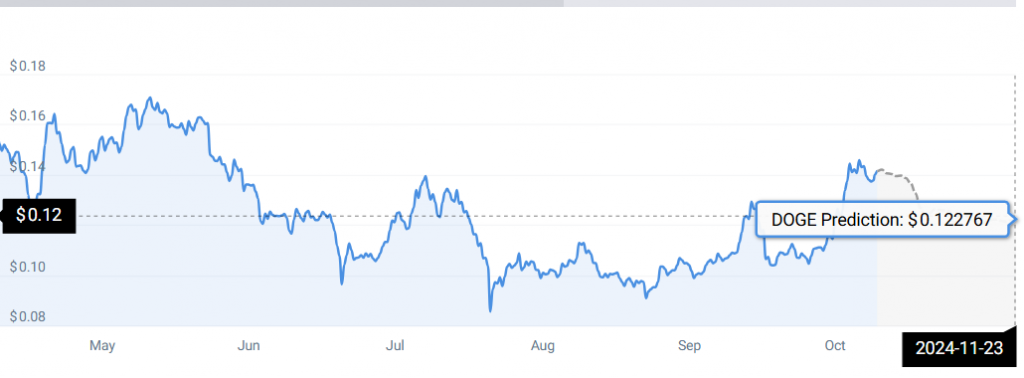
As per CoinCodex, a notable cryptocurrency analytical platform, DOGE may take a while to stabilize, depending heavily on the current market support. The token may decline 13% next month to sit at a low of $0.122.
“According to our current Dogecoin price prediction, the price of Dogecoin is predicted to drop by -13.45% and reach $0.122767 by November 23, 2024. Per our technical indicators, the current sentiment is bullish, while the Fear & Greed Index is showing 69 (greed). Dogecoin recorded 18/30 (60%) green days with 10.50% price volatility over the last 30 days. Based on the Dogecoin forecast, it’s now a good time to buy Dogecoin.”
Silver price loses ground due to the robust performance of the US Dollar (USD) and higher Treasury yields.
The US Dollar gains ground as recent data bolster the chances of the Fed adopting a less-dovish rates policy.
The Silver may appreciate due to market caution amid uncertainties regarding the upcoming US presidential election.
Silver price (XAG/USD) extends its losses for the third successive session, trading around $33.50 during Friday’s Asian hours. The downside of the precious metal Silver price could be attributed to the robust performance of the US Dollar (USD) and higher Treasury yields.
On Thursday, data indicated that US unemployment claims dropped significantly in late October, underscoring the strength of the labor market. Additionally, a rise in the S&P PMI further highlights robust momentum in the private sector.
The strong US economic data bolster the likelihood that the Federal Reserve (Fed) will take a less aggressive approach to interest rate cuts than previously thought. According to the CME FedWatch Tool, there is a 97% probability of a 25-basis-point rate cut by the Fed in November, with no expectation of a larger 50-basis-point cut.
Despite the challenges, safe-haven Silver may find upward support due to uncertainties surrounding the upcoming US presidential election. A recent Reuters/Ipsos poll showed that Vice President Kamala Harris holds a slight lead of 46% to 43% over former President Donald Trump in a six-day poll that closed on Monday.
Silver price may gain support from safe-haven flows amid uncertainties regarding the Middle East situation. Traders watch for Israel’s response to Iran’s missile attack on October 1. In parallel, US and Israeli officials are preparing to resume talks on a potential ceasefire and the release of hostages in Gaza in the coming days.
US Secretary of State Antony Blinken stated Thursday that the United States does not support a prolonged Israeli campaign in Lebanon, while France has advocated for an immediate ceasefire and diplomatic efforts.
Silver FAQs
Silver is a precious metal highly traded among investors. It has been historically used as a store of value and a medium of exchange. Although less popular than Gold, traders may turn to Silver to diversify their investment portfolio, for its intrinsic value or as a potential hedge during high-inflation periods. Investors can buy physical Silver, in coins or in bars, or trade it through vehicles such as Exchange Traded Funds, which track its price on international markets.
Silver prices can move due to a wide range of factors. Geopolitical instability or fears of a deep recession can make Silver price escalate due to its safe-haven status, although to a lesser extent than Gold’s. As a yieldless asset, Silver tends to rise with lower interest rates. Its moves also depend on how the US Dollar (USD) behaves as the asset is priced in dollars (XAG/USD). A strong Dollar tends to keep the price of Silver at bay, whereas a weaker Dollar is likely to propel prices up. Other factors such as investment demand, mining supply – Silver is much more abundant than Gold – and recycling rates can also affect prices.
Silver is widely used in industry, particularly in sectors such as electronics or solar energy, as it has one of the highest electric conductivity of all metals – more than Copper and Gold. A surge in demand can increase prices, while a decline tends to lower them. Dynamics in the US, Chinese and Indian economies can also contribute to price swings: for the US and particularly China, their big industrial sectors use Silver in various processes; in India, consumers’ demand for the precious metal for jewellery also plays a key role in setting prices.
Silver prices tend to follow Gold’s moves. When Gold prices rise, Silver typically follows suit, as their status as safe-haven assets is similar. The Gold/Silver ratio, which shows the number of ounces of Silver needed to equal the value of one ounce of Gold, may help to determine the relative valuation between both metals. Some investors may consider a high ratio as an indicator that Silver is undervalued, or Gold is overvalued. On the contrary, a low ratio might suggest that Gold is undervalued relative to Silver.
The Village Green Tea Room on Sheephouse Lane will open its doors for two festive dates alongside a neighbouring chapel.
Each market will host around 15 different traders offering personalised gifts, Christmas decorations, books, dog treats, sweets, kids clothing and more, with stalls being split between the tearoom and the chapel.
Manager Jade Tolen said: “We’ve had brilliant feedback from past markets and want to encourage people to come for a look around.
“If they can buy a couple of gifts from the stalls, it’s always good to spend locally rather than with the big supermarkets.
“There will be different traders on both days, so it gives shoppers the chance to find something special. People always really enjoy it.”
Visitors will also get a chance to see inside the neighbouring Rivington chapel, which Jade said is always a topic of conversation with her tearoom customers.
“They’re always asking about next door,” she laughed.
With $102M raised, BlockDAG is the top crypto to watch, outdoing both Cardano’s price and Notcoin’s expected performance.
BlockDAG has quickly become a leading name in the crypto market, amassing $102 million from just 24 batches of its popular presale. It has overtaken the latest on Cardano’s price and Notcoin’s forecast, positioning itself as the crypto everyone is buzzing about this week. Praised for its testnet performance, BlockDAG (BDAG) is now ranked alongside Kaspa and Solana for its effectiveness and secure system.
Initial supporters have gained a 1960% profit, as BlockDAG’s presale speeds past other major names. With its advanced network continuously impressive, this project is breaking records and showing great promise, making it a standout presale event of the decade.
For the last four months, Cardano has shown little price movement, currently valued at $0.345 after a recent drop of 1.35%. The coin’s total market value is $12.37 billion. Despite this stagnation, there’s a notable symmetrical triangle pattern on its daily chart, suggesting a possible price surge if it can overcome the $0.4 resistance.
Significant ADA holders have expanded their stakes by 3.59%, now holding 5.77 billion ADA. Should Cardano break above its current resistance, a 15% price increase to $0.457 might follow. Yet, failing to break through could mean more sideways movement ahead.
Notcoin Shows Promise of an Upcoming Surge
Notcoin has seen a remarkable 9% increase in price within the last day. Its market value has reached $914 million, with trading volume up 86% at $220 million. Currently showing a double bottom pattern, Notcoin might escape its long-term downward trajectory that started in June.
Experts are hopeful about Notcoin’s prospects, forecasting a potential 322% rise if the current trend persists. Despite a drop in buying activity, purchases still outnumber sales, indicating strong ongoing interest. With 59% of global positions being long, there is a widespread belief in Notcoin’s potential to reach new heights. If this trend continues, Notcoin could establish itself as a significant crypto contender.
BlockDAG Presale Tops the Charts This Year
BlockDAG has shattered expectations, zooming beyond the $102 million threshold in a blink with only 24 batches of its presale. It now holds the crown as the most triumphant presale of the decade, eclipsing other rising stars like Cardano and Notcoin. Early rounds have yielded staggering profits of 1960% for early participants, sparking buzz about the future.
A key to this roaring success was the September 20, 2024, debut of BlockDAG’s testnet. It has wowed users with its slick performance and rock-solid security. The blockchain explorer offers a deep dive into transaction details, and the faucet feature allows testers to create and move BDAG coins with MetaMask.
The testnet is also equipped for EVM transactions and smart contract capabilities, enabling users to stake, create NFTs, and burn tokens. Its impressive scalability has drawn comparisons to major names like Kaspa and Solana, with some even dubbing it a “Solana killer.”
With sights set on a $600 million presale target, predictions are flying that BlockDAG will hit this goal swiftly. With a current price of $0.0206 and forecasts seeing BDAG at $30 by 2030, BlockDAG is quickly shaping up as a powerhouse in today’s crypto scene.
The Bottom Line
While Cardano and Toncoin are notable, their ups and downs have dampened activity. Meanwhile, BlockDAG steals the spotlight with its groundbreaking $102 million presale, the most victorious of the decade. Early backers have banked returns of 1960%, outpacing the stagnant Cardano price and the uneven Notcoin forecast. Aiming for $600 million with forecasts placing BDAG at $30 by 2030, BlockDAG showcases immense potential for hefty rewards, marking it as a prime contender.
The subject matter and the content of this article are solely the views of the author. FinanceFeeds does not bear any legal responsibility for the content of this article and they do not reflect the viewpoint of FinanceFeeds or its editorial staff.
The information on this page does not constitute advice or a recommendation on any course of action and does not take into account your personal circumstances, financial situation, or individual needs. We strongly recommend you seek independent professional advice or conduct your own independent research before acting upon any information contained herein.
The recently concluded Solana Breakpoint 2024 has indeed reached its goal: to bring together enthusiasts to explore the latest developments in blockchain technology and web3 in the Solana ecosystem, including crypto games.
What’s the significance: This article seeks to show the games showcased during the Solana Breakpoint 2024, where readers can try to play.
What is Solana Breakpoint?
As stated above, the Solana Breakpoint is a multi-day event that enables attendees explore the latest developments in blockchain technology and web3 in the Solana ecosystem.
Organizer: It is organized solely by the Solana Foundation. For this year, the event was supported by 10 major sponsors, 32 other sponsors, 19 crypto games, and 27 dApps within the Solana Ecosystem.
Event’s Main Features: According to the organizer, Solana Breakpoint offers insightful talks, interactive workshops, networking opportunities, and exclusive updates from the Solana community, which were done during the 2024 edition.
Target Audience: Solana Breakpoint is designed for both newbies and veterans in the crypto space, including developers, industry experts, artists, students, creators, entrepreneurs, and community members from around the world.
Side Event: For this year’s event, there was only one side event, which was presented by Cambrian.One and focuses more as a builder’s hub.
The Gamer Village: The Gamer Village is a game expo inside the event venue. Similar to the set-up of the Philippine Web3 Festival and Yield Guild Game Roadtrip, there are booths of web3 games so attendees can try to play and earn merchandise.
The Games of Solana Breakpoint
Sonic
What it is: It is not actually a game, but a gaming-focused sidechain built on top of the Solana Network, similar to Ronin sidechain on Ethereum.
Gameplay or Main Feature: Sonic is the first atomic Solana Virtual Machine (SVM) that aims to enable sovereign game economies that rollup and settle on Solana.
What it is: It is also not a game, but a solution that can be integrated by game studios to their games for true asset ownership.
Gameplay or Main Feature: GameShift allows for the easier creation of user-friendly web2 experiences while enabling games for asset trading, immersive game economies, and user-generated content.
What it is: It is a cyber-fantasy role-playing game with action-packed battles, missions, and puzzles that will test the player’s wit and skill.
Gameplay or Main Feature: By playing Moon Boi Universe, players can unlock in-game characters, which can be sold and traded. These characters can be designed and decorated.
What it is: It is a large-scale strategy MMO game. that lets you play as a medieval lord, explore a vast world, and compete with other players.
Gameplay or Main Feature: Players will play as a medieval lord, where they need to compete with other players (PvP) and other in-game characters for territory and resources.
What it is: It is also not a game, but a game creation platform.
Gameplay or Main Feature: The platform offers a drag-and-drop interface and a collection of customizable assets so creators can build immersive worlds, craft engaging storylines, and design captivating gameplay.
What it is: It is an open-galaxy MMO looter-shooter game.
Gameplay or Main Feature: Players have to command massive armies to fight alongside them, look for hidden treasures, craft legendary gear, and team up with other players.
What it is: It is another app that promotes a healthy lifestyle, which adopts a move-to-earn model.
Gameplay or Main Feature: This game convinces players to play digital pet by their side, where they need to explore and battle, so they can evolve their pets. According to the developers, their pets are the players’ personalities.
What it is: It is a turn-based multiplayer role-playing game where two players compete to destroy each other’s rival teams
Gameplay or Main Feature: Each player’s team consists of 5 characters with unique attributes. Characters must engage in battles to earn XPs, which can be used to enhance each character’s attributes and properties.
The 1994 passage of the Dietary Supplement Health and Education Act (DSHEA) marked a turning point for the dietary supplement industry. Before this, the industry lacked proper regulation and faced a significant threat from the 1990 Nutrition Labeling and Education Act, which sought to classify supplements like herbs and amino acids as drugs. DSHEA emerged from a hard-fought battle, ensuring consumers could access natural, affordable resources to support their wellness journeys.
DSHEA created a legitimate framework that allows companies to discuss their products and share science-backed benefits. It also established the supplement industry’s place between food and drugs, a regulatory gray area where innovation flourished. Over the past 30 years, the industry has grown into a $67 billion powerhouse, with supplements and herbs lining the shelves of major retailers and social media amplifying the wellness conversation.
However, with this growth comes new challenges: Counterfeit products are sold online; social media influencers, artificial intelligence and Wall Street are reshaping the industry. “Pixie dusting”—adding insignificant amounts of ingredients to products—is a major concern, and experts are working to balance the need for modernized regulations with stronger industry self-regulation.
As the industry looks ahead, innovation is key. In the next 30 years, will the industry further democratize nutrition and normalize supplements? Will supplements become a core pillar of health care? Watch this documentary celebrating DSHEA’s 30th anniversary and explore how this pivotal law continues to shape the future of health and wellness.