The Japanese yen continued its downtrend this week, moving to its lowest level since February this year. The USD/JPY exchange rate was trading at 154.70, up sharply from the year-to-date low of 139.86. So, what next go the yen and will the Bank of Japan intervene?
Why the Japanese yen is failing
The Japanese yen has come under renewed pressure in the past few months, making it one of the worst-performing currencies in the developed world.
The main reason for the ongoing crash is the recent political changes in the country that saw Sanae Takaichi become the first woman prime minister.
Takaichi is widely seen as a growth-oriented premier like Shinzo Abe. She has already called for parliament to provide more stimulus funds worth billions of dollars to boost the economy. Additional funds in the economy normally leads to more currency weakness over time.
The Japanese yen has also dropped because of the Bank of Japan (BoJ), which has been reluctant to hike interest rates as most economists were expecting. Recent inflation numbers show that the country does not need to hike rates as inflation is moving in the right direction.
The most recent report showed that the headline Consumer Price Index (CPI) rose to 2.8% in September from the previous 2.7%. Economists expect the upcoming figure to come in at 2.6%, much lower than the January high of 4.0%.
The ongoing Japanese yen has pros and cons for the country. On the positive side, it is making Japan a relatively cheaper destination for international tourists. It is also benefiting its exporters, especially those selling goods to the United States, where Donald Trump left tariffs on all imports.
On the other hand, a weaker yen can lead to higher inflation since the country imports most of its supplies, like crude oil and natural gas. At the same time, the country could see higher tariffs as Trump has always criticized it for maintaining a weak currency.
Japan has tools to intervene when the yen crashes too much. It can hike interest rates or deploy some of its $1.15 trillion in foreign currency to intervene. For example, it intervened last yrear by buying yen and selling dollars.
The USD/JPY exchange rate will also react to developments in the United States, where the government shutdown is expected to end this week. The House of Representatives will vote for this bill today, a move that will reopen the government.
The end of the government shutdown means that top statistics agencies will start publishing economic numbers on the labor market and inflation.
The daily timeframe chart shows that the USD to JPY exchange rate has been in a strong bull run in the past few months. It has jumped from a low of 139.86 in April to 154.55 today. The current level is the highest point since February this year.
The pair has recently moved above the important resistance level at 153.12, the highest point in October. It formed a golden cross pattern in October as the 50-day and 200-day Exponential Moving Averages (EMA) crossed each other.
Top oscillators like the Relative Strength Index (RSI) and the MACD indicators have pointed upwards. Therefore, the most likely scenario is where the pair keeps rising as bulls target the next key resistance level at 156. A move below the support at 153 will invalidate the bullish outlook.
The leadership of the US Department of Health & Human Services is pushing the U.S. Food and Drug Administration to explore the elimination of self-affirmed GRAS (General Recognized as Safe) for food ingredients. The government shutdown meant the agency’s own deadline of October to announce proposals came and went, but the proposals will arrive once the government reopens.
“Everybody’s concerned, obviously, and it doesn’t only affect probiotics, it affects the entire supplement space,” Paraskevakos, IPA’s executive director, told NutraIngredients at the recent SupplySide Global in Las Vegas. “So, we’ve been very active, proactive. Our regulatory affairs committee is pretty huge, because regulatory affairs for probiotics at the global level is an issue right now. Our task force that looks at North America specifically, we’ve had a few calls lately and basically have put together a task force to proactively collect and put forth comments.
“Back at an open meeting at the FDA in 2017 or 2016 where we submitted comments around what the NDI process was supposed to be, we talked about grandfathering list, we talked about criteria for safety, we talked about possibly using master files,” he added. “So, these are things that we submitted already and are in the public docket and are a good basis to revise and to bring forward and to prepare comments when and if that [elimination of self-affirmed GRAS] will come to fruition.”
China
The global business climate remains uncertain, and this has impacted forecasting for potential market growth, he added. Despite this, the market for probiotic supplements in China is expected to grow at double digits.
Paraskevakos said that the global market is estimated to be around US$ 9.4 billion, with the APAC region worth about US$ 3.7 billion. Of that, China represents between 55% and 57%.
“I’m headed there to actually officially launch it [during] a pretty big event in November, and we’re expecting government officials to be there as well. It’s up and running.”
Paraskevakos also discussed the regulatory challenges simmering across different jurisdictions around the world. Watch the video for the full interview.
Cardano price is holding firm near the $0.50 support, with participants eyeing a potential reversal as momentum indicators start to turn in favor of the bulls.
A surge of quiet accumulation is starting to surface around Cardano’s $0.50 zone, where price action has repeatedly attracted long-term holders. The stability at this level is drawing fresh optimism, with several participants noting early signs of reversal momentum.
Cardano Price Attempts Reversal Around the $0.50 Support
Cardano appears to be approaching a potential bullish reversal as price tests the descending trendline that has capped every rally since early 2024. The chart shared by Rand shows ADA Cardano price is forming a possible base around the $0.50 region. A confirmed push above resistance could now flip market sentiment from bearish to bullish.
ADA holds steady near the $0.50 zone, signaling potential accumulation as traders watch for a breakout confirmation. Source: Rand via X
The key support remains around $0.53 to $0.50, a region that has repeatedly held through prior shakeouts. If the structure holds and volume begins to expand, Cardano price could be gearing up for a mid-cycle reversal, setting the stage for higher highs over the coming days.
ADA Targets Point Towards a Larger Upside Setup
Waleed Ahmed’s broader timeframe analysis suggests that ADA’s long-term structure remains intact within a massive accumulation box. The range between $0.59 and $0.62 continues to serve as a consolidation base, while the upper boundary near $3.10 represents the major cycle top where price could head next.
Cardano price continues to trade within a broad accumulation range, hinting at a potential long-term breakout towards the $3.00 cycle top. Source: Waleed Ahmed via X
If ADA can hold its mid-range support and break above $0.80–$1.00, it could initiate a multi-month rally similar to past expansion cycles. This accumulation behavior, visible in the weekly structure, implies that Cardano price may be preparing for a strong macro move if broader market momentum aligns.
Seasonal Trends Hint at Breakout Potential
The DApp Analyst’s seasonal data adds weight to the bullish outlook, showing that ADA has spent nearly a year consolidating within the $0.50–$1.30 range. Historically, such long periods of compression have preceded strong expansions in prior cycles.
ADA nears a Q4 breakout as seasonal data signals a potential end to its year-long consolidation. Source: The DApp Analyst via X
As seasonal trends align, the historical performance charts for 2023 and 2024 suggest that ADA typically sees acceleration in late Q4, followed by sustained strength through Q1. If this pattern repeats, ADA could soon see the long-awaited breakout, positioning it for a more decisive trend shift into 2026.
Short-Term View: Indicators Turning Bullish
Cardano is currently testing the lower boundary of its trading band as noted by Trend Rider’s setup. The chart highlights a key threshold at $0.70, which needs to be reclaimed to confirm short-term trend reversal. ADA is hovering near the 0.59 support, resting on the lower edge of the RiderAlgo band, a level that has previously triggered bullish rebounds.
Cardano price tests key support near $0.59, with indicators hinting at a possible short-term bullish reversal. Source: Trend Rider via X
Momentum indicators show exhaustion among sellers, while price remains compressed under the VWAP and EMA cluster. A breakout above $0.64 to $0.70 could flip local structure back to bullish, targeting the $0.85 to $0.90 zone in the near term.
Final Thoughts
Cardano’s chart structure continues to mature as price repeatedly defends its key supports while forming higher lows on longer timeframes. Technical alignment across multiple market watchers pointing towards a growing possibility of reversal, with confluence around the $0.65–$0.70 zone acting as the pivot for confirmation.
If ADA sustains momentum above that resistance, the path toward $1.00 and beyond becomes clearer. With seasonal strength approaching and structural compression nearly complete, the next few weeks could be bullish for Cardano Price Prediction.
Obesity tends to run in families, suggesting that it may have a genetic cause. However, family members share not only genes but also diet and lifestyle habits that may contribute to obesity. Separating these lifestyle factors from genetic ones is often difficult. Still, growing evidence points to heredity as a strong determining factor of obesity.
It is, not known whether and to what extent this genetic susceptibility may be attenuated by a physically active lifestyle. We aimed to assess the influence of a physically active lifestyle on the genetic predisposition to obesity in a large population-based study. In the study of 20,430 individuals (aged 39-79 y) from the European Prospective Investigation of Cancer (EPIC)-Norfolk cohort with an average follow-up period of 3.6 y were studied. A genetic predisposition score was calculated for each individual by adding the body mass index (BMI)-increasing alleles across the 12 SNPs. Physical activity was assessed using a self-administered questionnaire. Linear and logistic regression models were used to examine main effects of the genetic predisposition score and its interaction with physical activity on BMI/obesity risk and BMI change over time, assuming an additive effect for each additional BMI-increasing allele carried. It was concluded that living a physically active lifestyle is associated with a 40% reduction in the genetic predisposition to common obesity, as estimated by the number of risk alleles carried for any of the 12 recently GWAS-identified loci.
Although genes are an important factor in many cases of obesity, a person’s environment also plays a significant part. Environment includes lifestyle behaviors such as what a person eats and how active he or she is. Women tend to have high-fat diets, often putting taste and convenience ahead of nutritional content when choosing meals. Most don’t get enough exercise.
People can’t change their genetic makeup, of course, but they can change what they eat and how active they are. Some people have been able to lose weight and keep it off by:
Learning how to choose more nutritious meals that are lower in fat –
A poor diet to high-calorie foods that are widely available, low in cost, heavily promoted, and good tasting. These ingredients produce a predictable, understandable, and inevitable consequence-an epidemic of diet-related diseases. While such foods are fast and convenient they also tend to be high in fat, sugar, and calories. Choosing many foods from these areas may contribute to an excessive calorie intake. Some foods are marketed as healthy, low fat, or fat-free, but may contain more calories than the fat containing food they are designed to replace. It is important to read food labels for nutritional information and to eat in moderation. Also, people may be eating more during a meal or snack because of larger portion sizes. This results in increased calorie consumption. If the body does not burn off the extra calories consumed from larger portions, fast food, or soft drinks, weight gain can occur.
The USDA recommends an adult daily diet include the following:
3 ounces of whole grains, and 6 ounces of grains total
2 cups of fruit
2 1/2 cups of vegetables
3 cups fat-free or low-fat dairy
For more information on healthy eating, visit our handout for adults on making healthier choices.
Learning to recognize environmental cues (such as enticing smells) that may make them want to eat when they are not hungry-
To regain the ability to eat only when you are hungry, you must understand that not all hunger is physical. Today, while almost no one eats only when they are physically hungry, many people eat when they are psychologically hungry. You may be enticed by a succulent hamburger in an advertisement on television and start to think you’re hungry. You may eat on schedule whether you feel hungry or not. You may be bored, tired, sad, happy or nervous. These are all types of psychological hunger. Listening to and heeding your body’s signals of hunger and fullness can help you to achieve or maintain a healthy weight, which lowers the risk of many chronic diseases. In addition, eating is more pleasurable when you are truly hungry. Therefore, when your body indicates it is time to eat, choose foods you love and take the time to enjoy them.
Rate your physical hunger
Given all that can interfere with our hunger cues, how do we start working our way back to what we inherently knew as infants? The following is a helpful tool for rating your hunger. This hunger scale, called “The Hunger-Satiety Rating Scale” is from Why Weight? A Guide to Ending Compulsive Eating by Geneen Roth.
Satiety:
10 = Stuffed to the point of feeling sick 9 = Very uncomfortably full, need to loosen your belt 8 = Uncomfortably full, feel stuffed 7 = Very full, feel as if you have overeaten
Neutral:
5 = Comfortable, neither hungry nor full 4 = Beginning signals of hunger 3 = Hungry, ready to eat 2 = Very hungry, unable to concentrate
Hungry:
1 = Starving, dizzy, irritable
Becoming more physically active-
The U.S. Department of Health and Human Services recently released updated guidelines recommending that children and adolescents participate in physical activity for 60 minutes per day or longer, with most exercise being of moderate to vigorous intensity. Physical activity contributes to the prevention and treatment of obesity, not only by increasing energy expenditure but also by modulating the signals of satiety and reducing food intake.
Thus we can conclude that even those who have the highest risk of obesity from their genes can improve their health by taking action.
Disclaimer The Content is not intended to be a substitute for professional medical advice, diagnosis, or treatment. Always seek the advice of your physician or other qualified health provider with any questions you may have regarding a medical condition.
Silver price settled higher in its last intraday trading, after reaching $51.25 resistance, which was a potential target in our previous analysis, attempting to gain bullish momentum that might help it to breach this resistance, amid the dominance of minor bullish wave on the short-term basis and its trading alongside supportive trend line for this track, besides the emergence of the positive signals on the relative strength indicators, after offloading its overbought conditions, opening the way fpr achieving more gains in the upcoming period.
VIP Trading Signals Performance by BestTradingSignal.com (20-31 Oct, 2025)
Get high-accuracy trading signals delivered directly to your Telegram. Subscribe to specialized packages tailored for the world’s top markets:
Full VIP signals performance report for 20-31, October 2025:
Platinum price kept its fluctuation below $1605.00 barrier, forcing it to provide new nixed trading by its continued fluctuation near $1580.00, reminding you that the stability above the sideways track’s support at $1520.00 and the continuation of providing positive momentum by the main indicators, these factors make us keep the bullish suggestion, to expect surpassing the current barrier by recording new gains by its rally towards $1642.00 and $1660.00.
While the decline below the current support and providing negative close, will confirm activating the bearish corrective track, to expect suffering several losses by reaching $1485.00 reaching the next support at $1440.00.
The expected trading range for today is between $1545.00 and$1642.00
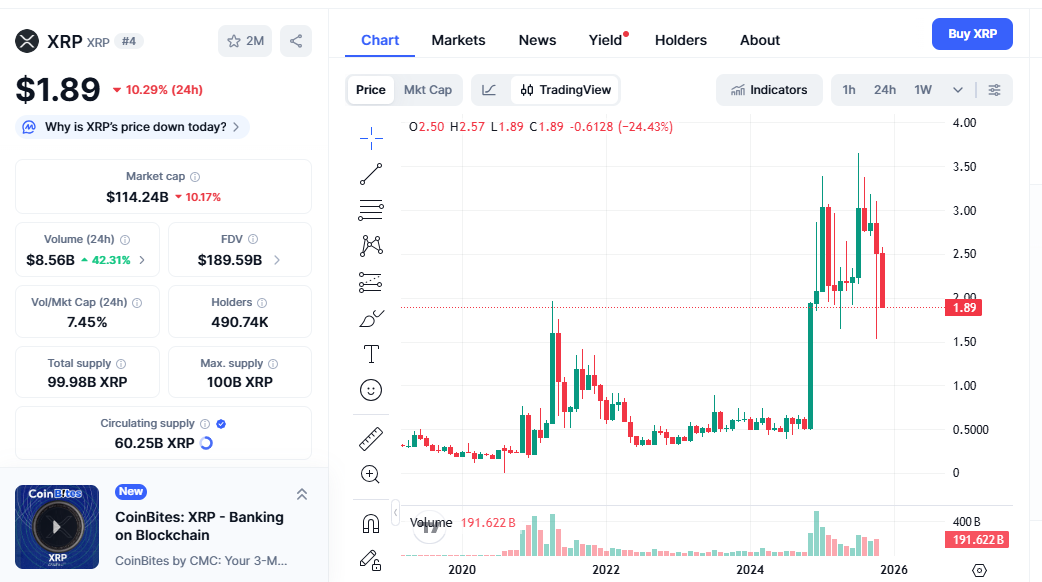
XRP could surge 150% to $6 in the next five years due to the likely approval of spot XRP ETFs.
XRP(XRP1.77%) is the fourth-most valuable cryptocurrency, with a market value of $145 billion. It currently trades at $2.40, but Geoffrey Kendrick at Standard Chartered anticipates big gains in the coming years, due in large part to the potential approval of spot XRP ETFs. He recently set his 2028 target price at $12.50, which implies annual returns of 73%.
However, Morningstar analysts estimate the entire cryptocurrency market will expand at 10% annually during the next several years. That forecast is sensible, but I think XRP will perform better than the broader market: I predict the altcoin will return 20% annually to reach $6 by 2030. That implies 150% upside from where it trades today.
Here’s what investors should know.
Image source: Getty Images.
Ripple uses XRP and RLUSD to facilitate cross-border transactions
Ripple is a fintech company that uses XRP and its blockchain (the XRP Ledger) to help payment service providers and other businesses move money across borders. The SWIFT (Society for Worldwide Interbank Financial Telecommunications) system is currently the industry standard where wire transfers are concerned, but transactions can take days to settle and often incur high fees because they are routed through multiple intermediaries.
Ripple solves those problems by using XRP as a bridge currency. Transactions not only settle within seconds, but also cost a fraction of a cent. In June, CEO Brad Garlinghouse predicted XRP would capture 14% of SWIFT payment volume within five years, in which case more than $20 trillion would flow through the XRP Ledger annually.
That seems wildly optimistic. Using a volatile cryptocurrency like XRP as a bridge currency to move money introduces unnecessary risk. Ripple has added the stablecoinRLUSD to its payments ecosystem to address that problem, but that new product faces tough competition from more entrenched stablecoins like USD Coin by Circle Internet Group.
XRP transaction volume, which is a roundabout measure of demand for the cryptocurrency, has steadily declined throughout 2025. That hints at waning interest, and I seriously doubt a significant number of enterprises will adopt XRP payments in the future. Investors should expect very little from this potential catalyst.
The SEC is likely to approve spot XRP ETFs in the near future
The U.S. Securities and Exchange Commission (SEC) was set to approve several spot XRP ETFs in October. The process was delayed due to the government shutdown, but approval is now anticipated in November or December. Those investment products would provide direct exposure to XRP without the hassle and high fees associated with traditional cryptocurrency exchanges.
Eliminating those pain points could unlock demand among retail investors and, more importantly, institutional investors that control about $130 trillion in assets under management. Canary Capital CEO Steven McClurg estimates spot XRP ETFs will draw inflows totaling $5 billion in their first month on the market. That seem too ambitious, given the launch of spot ETFs for Bitcoin drew just $4 billion during their first month, but I agree in principle: Spot XRP ETFs should boost demand.
Bitcoin prices have increased 127% since the SEC approved the first spot Bitcoin ETFs in January 2024. So, it seems reasonable that XRP could see similar price appreciation over the next five years. That’s why I think the altcoin can increase 150% to $6 by 2030.
However, investors must always remember that cryptocurrencies tend to be volatile assets. For instance, XRP declined more than 20% from a record high five times in the last three years alone, and the altcoin is nearly 30% off its high today. Similar volatility is likely in the future. Investors who can’t handle price swings of that magnitude should steer clear.
Platinum price kept its fluctuation below $1605.00 barrier, forcing it to provide new nixed trading by its continued fluctuation near $1580.00, reminding you that the stability above the sideways track’s support at $1520.00 and the continuation of providing positive momentum by the main indicators, these factors make us keep the bullish suggestion, to expect surpassing the current barrier by recording new gains by its rally towards $1642.00 and $1660.00.
While the decline below the current support and providing negative close, will confirm activating the bearish corrective track, to expect suffering several losses by reaching $1485.00 reaching the next support at $1440.00.
The expected trading range for today is between $1545.00 and$1642.00
The British Pound’s recent rebound faltered after disappointing UK jobs data pushed the Pound-to-Dollar exchange rate down toward 1.31, with analysts warning that a softening labour market gives the BoE room to cut rates again next month.
MUFG and ING both see further GBP losses ahead with a December move as increasingly likely.
GBP/USD Forecasts: Recovery Halted
Pound Sterling was hurt on Tuesday by increased speculation of a December Bank of England (BoE) interest rate cut following weaker-than-expected UK jobs data.
The Pound to Dollar (GBP/USD) exchange rate dipped sharply to 1.3120 from highs near 1.3180 ahead of the data with the Pound struggling to secure any benefit from favour able risk conditions and a fresh record high in the FTSE 100 index.
Crucial Pound support remains at 1.30. ING has a year-end GBP/USD forecast of 1.34 as the dollar loses ground.
The UK jobs data was significantly weaker than expected with the unemployment rate increasing to a fresh 4-year high of 5.0% in the three-months to September from 4.8% previously and above consensus forecasts of 4.9%.
Save on Your GBP/USD Transfer
Get better rates and lower fees on your next international money transfer.
Compare TorFX with top UK banks in seconds and see how much you could save.
The ONS also reported a decline in payrolls of 32,000 for October, matching a final 32,000 retreat for September.
There was also a small net slowdown in underlying wages growth to 4.6% from 4.7%.
According to MUFG; “The data suggests that the downturn in the labour market is getting worse ahead of the Autumn Statement.”
Markets are now more convinced that the BoE will cut rates again in December.
MUFG added; “Loosening labour market conditions should give the BoE more confidence that wage growth will continue to slow dampening upside inflation risks. The weak labour market report supports our forecast for the BoE to cut rates next month.”
There will be potential implications for politics and the budget with pressure for measures to support the jobs market.
Capital Economics UK economist Ashley Webb commented; “The 32,000 fall in payroll employment in October was the eleventh monthly decline over the past year and suggests that businesses continued to trim headcounts after the Chancellor announced the rises in payroll taxes and the minimum wage in last year’s October Budget.”
According to ING; “Now, both inflation and jobs data are starting to point down, and we think the Autumn Budget’s tax hikes will provide the final argument for a cut in December.”
On Monday, the US Senate voted to end the government shutdown and it will now move to the House of Representatives.
Assuming there is a near-term re-opening, there is the potential for some relief surrounding consumer confidence while the focus will switch to postponed data releases with a particular focus on the jobs market.
ING commented; “a resumption of data releases in the US does carry non-negligible downside risks to the dollar. In our view, the latter factors should prevail, as we think markets are underestimating the downside risks for the labour market, US front-end rates and – by extension – the dollar into year-end.”
Like this piece? Please share with your friends and colleagues:
International Money Transfer? Ask our resident FX expert a money transfer question or try John’s new, free, no-obligation personal service! ,where he helps every step of the way,
ensuring you get the best exchange rates on your currency requirements.
Rendering of the cafe space. Photo credit: Mako Matcha Mill.
Mako Matcha Mill is a new matcha cafe and mill coming to Southwest Portland’s West End section—and true to their name, they will be milling matcha there on site. I stopped by the cafe the other day (under construction at the time) and spoke with the two owners, Edison Zeng and Emily Dewey, to hear about their work with matcha and their plans for the cafe. Here is what I learned.
(Bonus: I had my first taste ever of Nong’s Khao Man Gai’s chicken and rice, located right across the street).
This Space Used To Be Home To Cacao
From 2006 to 2020 this location was known as Cacao, a well-regarded place to sip, discover, and buy chocolate. Owners Aubrey Lindley and Jesse Manis announced in October 2020 that they were closing—this would have been during the more chaotic days of the COVID pandemic.
Fun fact: I learned in an Oregonian article that Cacao was an incubator for Cloudforest (FKA Cocanu). Now established on SE Hawthorne Blvd, they’ve been known to make matcha lattes themselves.
I believe this space on SW 13th has been empty since the closing of Cacao, so having a new tenant is great for the neighborhood, and it’s nice for it to be another cafe space, too.
Matcha: Growing, Harvesting, and Culture
There are multiple stages involved in creating that green powder we know as matcha. When I arrived, we jumped in right away to talk about the harvesting stage.
Harvesting Matcha
Edison and Emily have grown their own matcha. “We actually harvested our first crop!” said Edison. They spoke a little bit about how time-consuming the harvesting is, as the top couple of leaves (the softest part of the plant) are traditionally picked by hand.
Edison and Emily with a harvest. Photo credit: Mako Matcha Mill.
He showed me what the tea leaves looked like after they picked them. “That’s what it looks like before we shred it into tiny little crumbs, and then the crumbs are what goes in there,” pointing to the mill.
Shading
But before they start to harvest the matcha, they shade the plants three to four weeks prior to harvest. That stresses out the plant a bit, yielding tender and delicate leaves with a deep green color. “During the shading process, the plant goes into survival mode and it minimizes the stem and the veins,” explained Edison. “We need to maximize our chlorophyll and leaf surface area, too. The amino acid profile also changes during shading.”
“This is ultimately what like the tencha becomes,” said Edison. Tencha is the properly-shaded green tea that is the base for matcha.
Sorting
They also sort out the different colors of leaves into different grades, which, as you can imagine, is time-consuming and takes focus. “It’s like sorting LEGO blocks, but with tea,” explained Edison.
However, there is technology out there that can do the sorting, so they don’t have to do it by hand.
“We had to do that this year because we don’t have the machinery for it,” said Edison. “But I think for the future of matcha and tencha production in the U.S. to succeed, we have to invest in machinery that color-sorts.”
Growing Matcha in Oregon for Mako Matcha Mill
Edison and Emily have been growing matcha in Oregon, near Salem, which kind of blew me away.
“I’m a firm believer that we can create an organic, specific cultivar [in Oregon],” said Edison. “Right now, most of the cultivars are from Japan, mainly in the Kyoto region, which climate-wise is more like South Carolina or North Carolina, where it’s more humid. There are a couple of different cultivars from Russia, near Sochi, too.” Sochi is humid year-round and quite warm compared to most of Russia.
“I think the average person would probably be surprised to think matcha could be grown here. But we think it’s doable. Not only that, but I think we can have unique flavor profiles in Oregon. We want to create that. And now we have the first harvest and we have to mill it—no one knows yet what it tastes like.”
Grassy Matcha
Speaking of what matcha tastes like, I’ve heard from a number of people that they think all matcha tastes basically like grass. I asked Edison and Emily how they would counter that assertion, if at all.
“Well, grassy matcha is going to be the Yabukita cultivar,” he explained. “There are certain tea cultivars that are more hardy, more resistant to bugs. Those ones might taste more like grass because they are less sweet. The more umami and higher amino acid profile ones—those are sweeter.”
He added, “Not all of them are grassy tasting. It’s also very subjective.”
And, like with coffee, the altitude at which the tea is grown can affect things, including how delicate the flavor is. He cited Tibet or Nepal as being places where tea is grown, and because of their high altitude the tea’s flavors can be a lot more delicate.
The front of Mako Matcha Mill.
Mako Matcha Mill: What’s In a Name?
To my ears, the name is a little unusual, so I asked them why they chose to name it “Mako Matcha Mill.” Especially the “mako” part.
“‘Mako’ means a number of different things, but this is a specific reference,” said Emily. “Edison is a gamer and loves Final Fantasy VI in particular. And [the connection is] really sweet.” He played it a lot in the 1990s on PlayStation.
“In the game, the Mako is the life force of the planet, and it’s green,” said Edison. Just like matcha.
Location of Mako Matcha Mill
Emily and Edison were really excited to find this location—they had been wanting to open a spot in Portland, a city they love. They’ve been working with Liminal Shift to help with flow and build the counter area that includes space for the mill behind it.
They’ve been working with them on the interior design as well, which will have some influences from Japan (“Japanese with restraint”), like Japanese silks hanging in the room, some relevant color schemes on the walls.
What To Expect at the Mako Matcha Mill Cafe
Emily and Edison bring important experience to running the cafe. “I have done food service all over and in Chicago, where I’m from,” said Emily. “So I’ve got a lot of front of house and customer experience.”
Edison has been selling matcha for 13 years. His company Magus Brands in California has been manufacturing it overseas, and he has been selling it here in the U.S.
They look forward to providing a place where drinking and learning about matcha feels accessible, not intimidating. They’d also like it to be a place where people can stop in, enjoy friendly service and excellent things to drink and eat, and sit and stay for a while. A true third place. They’ll have a mix of tables and chairs, seats at the bar, and couches/upholstered furniture.
“And we want people to engage with us and look at the mill,” said Edison. “We want to understand where they are and answer questions they have about it.”
To Drink
At the very basic level they will sell hot and cold matcha drinks. The matcha latte—hot or cold—will be a staple.
A very pretty matcha latte I had in 2018 elsewhere in Portland.
Additionally on the cold side they will offer cold brew matcha, as well as eight other tea types—Earl Grey, Hojicha, and other Asian teas like Taiwanese milk oolong (grown high in the mountains of Taiwan, it tastes milky) are just a few—that they will rotate in and out of their two taps. They are really looking forward to introducing interesting and perhaps less common teas to their customers.
“We’re going to be doing fun things and stuff no one’s ever had before,” said Edison. “I think, even on the West Coast, we’re the first people that are going to be approaching implementing tea in unique ways, with our own recipes and flavors.”
They also plan to use syrups in their matcha drinks. Note: there will be no strawberry because Emily is allergic to them, so they are considering something like marionberry, instead which is very much an Oregon flavor, and is certainly delicious.
Emily talked about their tea infusions, too, which I needed to better understand. She says they are almost like a syrup or a concentrate. “Imagine a matcha latte with Hojcha flavor,” she explained. “When we first thought of this, I was so surprised as to how amazing and very unique it is. And I think being able to showcase different tea flavors alongside matcha, people are going to be really excited about those drinks.”
They noted that people love the fruity and ube matcha drinks, in particular. “We’re catering to a variety of audiences, because as you know, matcha has gotten super popular,” said Edison.
Grades of Matcha and Price
Although the matcha latte is probably the most popular matcha drink in Portland, they will offer matcha on its own in its most straightforward form. There will be matcha flights where people can taste the different kinds of matcha together in smaller portions.
And they will be serving three different grades of matcha—and three tiers to make the price accessible. “The lowest would probably be around $5,” explained Edison. “And then we have our higher grades.” They’re looking at offering some award-winning matchas, too.
“I think $7 matcha lattes are blasphemy,” said Edison. “So we’re trying to bring that price down throughout Portland—maybe like five bucks, maybe four bucks if we can squeeze it for a 12 ounce drink.”
Sacrificial Grade Matcha
Edison told me about a special drink they’ll offer, and one he is a big fan of. “My favorite drink is the sacrificial grade matcha,” he said. “You’re going to have to sign a waiver for it because there’s so much matcha content.” [I’m not sure if he’s kidding or not, ngl.]
Apparently it has somewhere between 350 to 500 milligrams of caffeine in it, due to the fact that they are using 10 grams of matcha. “It will have a matcha foam top, and matcha jelly. It’s 20 ounces of pure matcha. It’s like rocket fuel,” he said.
Coffee at the Mako Matcha Mill Cafe
They will also serve espresso drinks at the cafe. Beans will come from multiple roasters but at the writing of this article they have not decided which ones.
I asked them about mixing matcha and expresso. And while Edison is not the biggest fan, he knows others like it. “We’re thinking about it,” he said. “We’ve seen it on other menus. It’s called ‘military style.’” In his opinion, the mix of matcha and coffee throws things out of balance, where the matcha gets completely consumed by the more assertive coffee flavor.
On the Topic of Milk and Matcha
They will be offering oat milk for their plant-based option. “Soy covers the flavor of matcha,” said Edison. “It really changes it. If we find other alternatives in the future, we’ll introduce them, but oat is so good with matcha.”
When it comes to dairy, they say they’ll be sourcing it from local creameries—those with smaller herds, who treat their cows humanely (though vegans will no doubt disagree). They visit each of the creameries to see how the animals are being raised. And they believe the milk tastes better.
To Eat
They plan to have tea soft serve, which can be used in an afogatto with coffee or tea. Also look for additional savory and sweet snacks, including wagashi made by one of the best wagashi artists around. She lives right here in the Portland area: Yume Confections.
“We want to make that like a legit experience,” said Emily.
Mako Matcha Mill Retail
Mako Matcha Mill will also include a retail element, which will be located on the north side of the space. “We’re working with local pottery artisans, and there’s going to be tea plants in there that people can bring at home,” explained Edison. The’ll also be selling tins of matcha—their own custom blends.
And matcha whisks will also be for sale. “We will work with artisans that will give us what I think will be the proper matcha whisk,” said Edison.
Learning About Matcha
There will be an educational element to Mako Matcha Mill. “We plan on bringing in Urasenke instructors,” said Edison. “Basically, that’s like the artistic and cultural aspect of matcha consumption—it’s more about the gift of and the preparation of tea.”
He continued, “And then there’s another class that we want to do, where at the bar counter it is like an omakase type of thing. You come here and then we’ll just give you stuff.
“We also want to offer classes where you can learn to mill your own matcha—we’ll teach you how to do it. I have a little granite mill—obviously, the grind’s not going to be as fine as an actual machine. But we want to teach people about what matcha is, how it’s grown, and then get really deep into the cultivation and preparation of it, different tasting types, how to differentiate between them (kind of like coffee), and how to differentiate between different cultivars.
“We want to cater to people that are really interested in learning about matcha.”
The Matcha Milling
It’s no surprise that one of the things that makes Mako Matcha Mill cafe unique is that they are milling matcha at the cafe. And as I mentioned earlier, they are growing their own matcha here in Oregon. However, they will not be able to operate the cafe solely with their own product, because the harvest was small.
“We’ll be importing most of the matcha because our harvest this year was only like two and a half kgs. Very small, experimental, but I’m really happy,” said Edison.
Regarding the mill at the cafe, “So these things produce 30 grams per hour,” Edison explained. “We’re making it super slow, like 20 grams an hour, so that we get a nicer grind. I don’t think it’s going to meet the demand because 20 grams an hour, we’re using four grams of drink at least, so that’s like five drinks per hour.”
So it makes sense to use matcha that’s already prepared and ready to go. “I’ve been importing it for a long time, so we have a lot of matcha relationships with suppliers,” Edison remarked.
Final Thoughts
“My vision for [Mako Matcha Mill] is that we want to be the first matcha house in the U.S. to take matcha to a whole other level,” explained Edison. “That’s what particularly inspired us to go out and grow and make it here, and then to mill it and process it here. To get our hands on every aspect of it.”
He continued, “And the cafe is a place for us to test out our little experiment, both with flavors of tea and with the actual industry. We have a matcha consumption industry in the U.S. I feel like we can also have a really robust matcha production industry, as well. So that’s what we’re trying to do here.”
Their plan is to open in late 2025. They want to be open every day, and ideally they’d like to end up as a 24/7 kind of place, but they need to see how things go first.
It was an interesting and satisfying time learning about matcha from Edison and Emily. Wishing them the best as they prepare the place to open and offer their matcha options to Portland.