The cryptocurrency sector is undergoing a significant transformation as
Dogecoin
(DOGE) experiences declining interest, prompting investors to shift their focus to up-and-coming ventures like Mutuum Finance (MUTM). This decentralized finance (DeFi) platform is gaining traction amid the evolving market landscape. Despite 21Shares introducing a leveraged Dogecoin ETF, overall market sentiment indicates that both retail and institutional investors are increasingly seeking out newer, high-potential projects.
The 21Shares 2x Long Dogecoin ETF (TXXD), which debuted on NASDAQ on November 20,
allows investors to gain twice the daily returns of DOGE
. This offering
highlights the growing institutional interest in Dogecoin
, especially following collaborations with Tesla and AMC Theatres. Nevertheless, DOGE’s value has
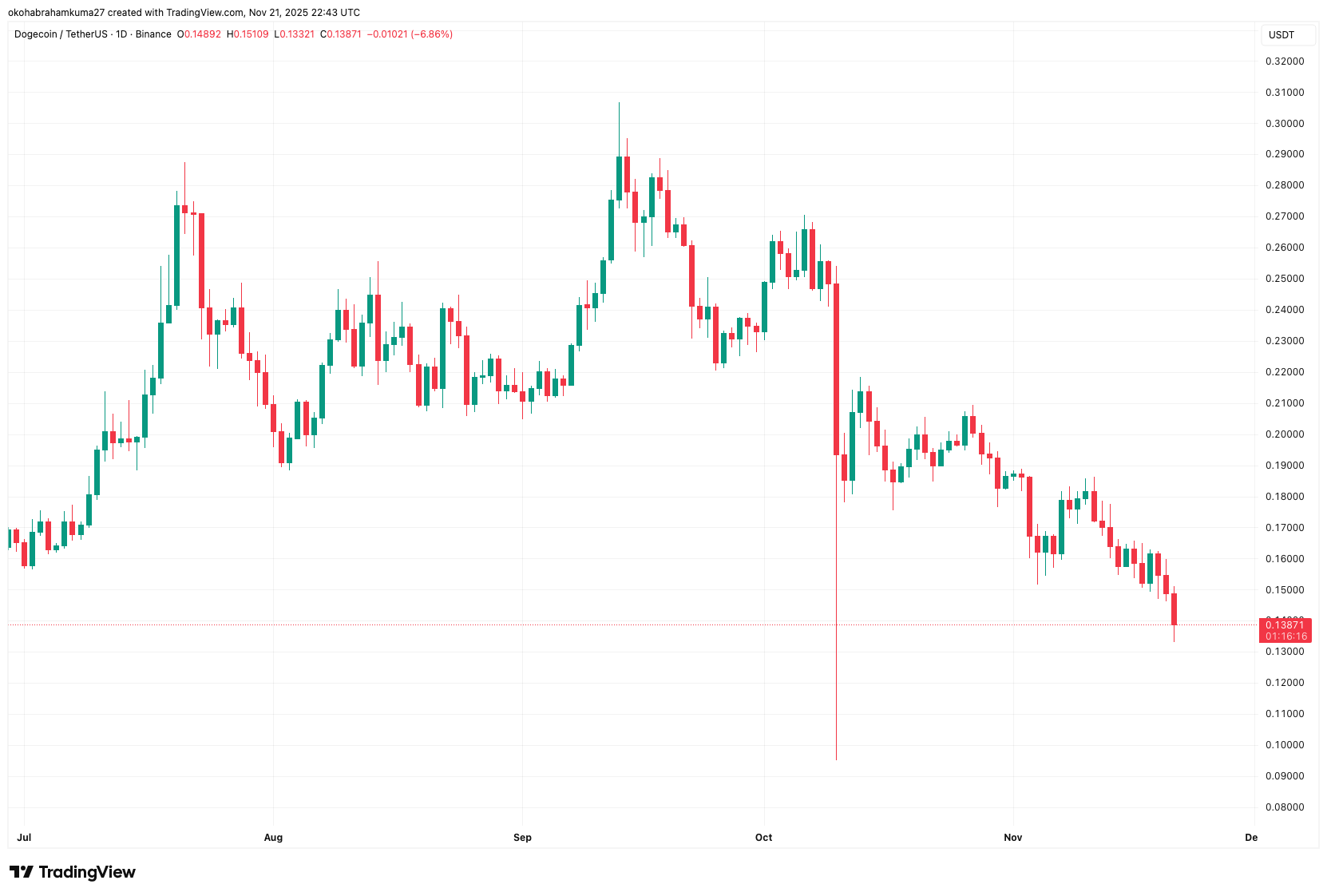
hovered around $0.175
, and experts point out that ambitious bullish targets—such as $1.20—remain out of reach without a decisive upward move.
Mutuum Finance, a DeFi lending protocol, is drawing significant interest in the current market environment.
Over 90% of tokens in Phase 6 have already been allocated
, with more than $18.9 million raised and a community of over 18,200 holders.
The current Phase 6 price of $0.035 per token
marks a 250% rise from its original launch price of $0.01.
Mutuum’s swift momentum is driven by key achievements and strong security protocols.
Halborn Security has started auditing the platform’s smart contracts
, further strengthening trust in its decentralized lending system.
Previously, the project earned a 90/100 score from Token Scan
by CertiK, and a $50,000 bug bounty is motivating security experts to find any weaknesses.
These initiatives are in line with the project’s roadmap
, which features a testnet launch for its V1 protocol in Q4 2025.
The sense of demand around Mutuum is heightened by its fixed-allocation approach.
With just 5% of the total 4 billion MUTM tokens
made available to the public, the project’s scarcity angle has fueled demand. The shrinking supply in the current phase has intensified FOMO, especially as the token nears its $0.06 listing price.
Unlike Mutuum’s methodical expansion,
Dogecoin’s prospects depend on speculative triggers
, such as the possible approval of a spot ETF—a scenario many analysts view as uncertain. Although
21Shares’ leveraged ETF introduces new possibilities
for
DOGE
exposure, the market at large seems to prefer projects that offer real-world utility and robust security.
As the digital asset space continues to develop, Mutuum Finance demonstrates the increase in demand for DeFi platforms that emphasize openness and innovation. With Phase 6 almost finished and Halborn’s audit in progress, the project is positioning itself as a notable contender in the 2025 crypto landscape.
While the matcha market was valued at USD 3.66 billion in 2024, the demand for this Japanese green tea has caused a global shortage.
Matcha is a powdered form of Japanese green tea that has been gaining global
Whether it is K-pop singer BTS’ Kim Taehyung, aka V, going viral for drinking a strawberry matcha latte or Bollywood actor Sanya Malhotra launching her own brand, Bree, matcha has people in a chokehold. In fact, this has even caused a global shortage as the demand for this green tea soars. In 2024, the matcha market was valued at USD 3.66 billion, and it is expected to more than double.
Matcha, a powdered form of Japanese green tea, which has to be carefully grown in special weather conditions, also has various health benefits. It has an enhancing effect on cognitive function, cardiometabolic health, and anti-tumorogenesis. Some studies show that it may help protect the liver, and it is rich in catechins, a type of natural antioxidant. This can help stabilise harmful free radicals, compounds that can damage cells and cause chronic disease.
While everyone seems to be sipping on matcha lattes, Chef Tejasvi Chandela, founder and chef, Dzurt Jaipur, believes in going a step further. She has worked on a dessert menu that includes this tea. “Matcha is one of those ingredients that invites both respect and creativity. I’ve loved using it in ways that challenge the idea of matcha being limited to lattes and beverages. Its earthy profile pairs beautifully with citrus, berries, and even white chocolate, so we explore those combinations in tarts, cookies, lamingtons, and more. Our goal is always to introduce matcha in a way that feels exciting, modern, and accessible for the Indian palate,” she says.
Here are 3 different ways to try matcha, which is a step ahead of the typical beverages:
Matcha Strawberry Tart
Matcha Strawberry Tart
A modern interpretation of a classic tart, this dessert pairs a silky ceremonial-grade matcha cream with fresh seasonal strawberries. The tartness of the berries lifts the earthy umami notes of matcha, creating a balanced, clean flavour profile. The idea was to bring a refreshing, bright contrast to matcha, a flavour often seen in warm beverages but rarely showcased in cold-set patisserie.
Matcha Lemon Macaron
The macaron takes the familiarity of matcha and pairs it with a bold citrus edge. The shells are infused with fine Japanese matcha, while the filling is a tart lemon curd cream cheese that cuts beautifully through the richness. This combination was created to highlight how matcha can work in sharper, more playful formats, far beyond the typical creamy pairings.
Matcha Strawberry Lamington
Matcha Strawberry Lamington
A nostalgic lamington reimagined with a green-tea twist. Soft vanilla sponge is dipped in a matcha glaze, rolled in coconut, and layered with a homemade strawberry compote. It celebrates the meeting of Australian café culture and Asian tea traditions – something you rarely see in Indian patisserie.
First Published:
November 23, 2025, 11:15 IST
Newslifestylefood Skip Those Matcha Lattes, Try These 3 Desserts That Crown Matcha As The Hero
Disclaimer: Comments reflect users’ views, not News18’s. Please keep discussions respectful and constructive. Abusive, defamatory, or illegal comments will be removed. News18 may disable any comment at its discretion. By posting, you agree to our Terms of Use and Privacy Policy.
Acquiring insight into the future value of XRPUSD is crucial for investors navigating the unpredictable waters of cryptocurrency. Recent forecasts for XRP hover between conservative predictions of £16 by 2030 to exceedingly daring estimates of £800, rising to heights of nearly £3,850. Intense interest stems from expected institutional adoption and Ripple’s ongoing legal dramas. Currently priced at £1.58, XRPUSD is facing a daily dip of 2.3%. As we explore XRP’s potential, we’ll unpack key market indicators and expert opinions.
XRP Price Prediction: A Range of Possibilities
When discussing XRP price prediction, analysts provide a wide scope of possibilities. Conservative estimates suggest XRP could reach £16 by 2030, a figure driven largely by Ripple’s firm position in cross-border payment solutions. More optimistic forecasts see the cryptocurrency reaching between £800 and nearly £3,850. Such bullish predictions are fueled by a potential increase in institutional adoption and expected regulatory clarity.
Ripple’s ongoing legal battle against the U.S. Securities and Exchange Commission (SEC) is a significant factor. A favorable outcome could unlock new growth pathways for XRP. Regardless of the eventual legal ruling, Ripple continues to secure partnerships that strengthen its ecosystem, further boosting long-term investor confidence.
Technical Analysis: Evaluating XRPUSD
A closer look at XRPUSD’s technical indicators reveals a challenging environment. The Relative Strength Index (RSI) stands at 33.77, suggesting oversold conditions. However, an ADX of 36.77 indicates a strong trend presence, despite negative momentum seen through a MACD of -0.14.
Bollinger Bands show price volatility, with the current rate near its lower band. The Awesome Oscillator reflects a bearish short-term outlook. Nevertheless, a growing market interest, marked by an MFI of 22.62, hints at potential shifts. Investors should consider these aspects carefully when evaluating their positions.
Institutional Adoption and Legal Developments
Institutional adoption plays a crucial role in XRP’s trajectory. Ripple’s strategic alliances with financial institutions continue to bring credibility and new operational use cases to XRP.
The resolution of Ripple’s legal challenges could be pivotal. If Ripple successfully defends against SEC charges, it may bolster XRP, potentially leading to significant price appreciation. Whether these positive developments will materialize remains speculative, but their impact on XRP’s value is undeniable. This anticipation keeps investor interest intact, aligning with the evident growth in XRPUSD’s long-term potential.
The future of XRPUSD involves a complex interplay of legal, industry, and market forces. Predicted values ranging from £16 to over £3,850 demonstrate the wide spectrum of possibilities. Institutional uptake and the pending legal resolution are two critical facets that could drive substantial changes in XRP’s value.
For investors, it’s vital to monitor these developments attentively. Each passing event shapes the market’s predictions and the cryptocurrency landscape as a whole. As always, conducting detailed analysis and staying informed will be key to navigating these waters effectively.
Meyka, an AI-driven platform, offers real-time financial insights and predictive analytics to assist investors in making informed decisions amidst such volatility.
FAQs
What is the current XRP price?
As of now, XRPUSD trades at £1.58. It experienced a daily decline of 2.3% but remains up 295% year-over-year, reflecting significant volatility and growth potential.
How do legal developments impact XRP’s value?
Ripple’s legal battles with the SEC significantly influence XRP’s price. A positive ruling could unlock new growth opportunities, while a negative outcome might hinder its market expansion.
What are XRP’s long-term price predictions?
Long-term predictions for XRP vary widely, from £16 to upwards of £3,850 by 2030. These estimates account for potential institutional adoption and legal outcomes affecting its usage and demand.
Disclaimer:
The content shared by Meyka AI PTY LTD is solely for research and informational purposes.
Meyka is not a financial advisory service, and the information provided should not be considered investment or trading advice.
The Hamster Kombat Daily Cipher continues to rise as one of the most engaging and fast-expanding play-to-earn (P2E) events across the Telegram gaming landscape. As millions of Web3 gaming enthusiasts look for new ways to earn tokens without traditional financial investment, Hamster Kombat has carved out a substantial space with its innovative mix of classic code-breaking and real-time crypto rewards. Every day, thousands of players flock to the Telegram-based ecosystem to decode Morse-like puzzles and earn $HMSTR, the game’s native token, strengthening the game’s role within the rapidly developing world of Web3 entertainment.
Today, the focus shifts to the Hamster Kombat Daily Cipher for November 23, 2025—a much-anticipated event where players decode the day’s secret sequence, submit their answer, and claim instant rewards. Below, we take an in-depth look at how the Daily Cipher works, why it has become a cornerstone of the Hamster Kombat experience, and how players can maximize their earnings inside the expanding $HMSTR ecosystem.
What Is the Hamster Kombat Daily Cipher?
The Hamster Kombat Daily Cipher, commonly referred to simply as the “Daily Cipher,” is a 24-hour decoding event where players must translate a Morse-style sequence composed of dots and dashes. Once successfully decoded, the sequence reveals a word or phrase that players input to receive rewards.
Unlike traditional mobile games that rely on complicated mechanics or heavy in-app purchases, the Daily Cipher focuses on simplicity and universal accessibility. Anyone with a Telegram account can join instantly. The challenge is designed to blend nostalgia—through the Morse code concept—with digital interactivity, creating a bridge between historical cryptographic gameplay and modern tokenized reward systems.
Each correct answer grants players bonus coins, which can then be used for:
Level upgrades
In-game enhancements
Mining accelerators
Additional reward paths
The Daily Cipher stands as one of the most unique elements of Hamster Kombat because it merges puzzle-solving with token accumulation, turning daily participation into a rewarding habit.
Why Hamster Kombat Became a Global Phenomenon
Hamster Kombat’s success lies in its fusion of three powerful factors: accessibility, gamified economics, and Telegram integration. While many Web3 games struggle to attract audiences due to complex onboarding processes, Hamster Kombat makes entry effortless.
1. Runs Entirely Through Telegram
Telegram serves as both the gaming platform and the crypto wallet interface. No external apps or login credentials are required, giving the game instant reach to millions of users worldwide.
2. Seamless Crypto Integration
Players can earn, hold, mine, and spend $HMSTR tokens automatically. By merging gaming and wallet systems into a single interface, Hamster Kombat eliminates barriers that commonly discourage new crypto users.
3. A Relaxed, Tap-Based Gameplay Style
Unlike Web3 games that require intensive grinding or high-stakes competitive play, Hamster Kombat keeps gameplay simple, consistent, and enjoyable.
4. The Global Appeal of Morse Code Challenges
Puzzles can be solved by anyone, regardless of age or background. The challenge feels timeless yet modern, allowing Hamster Kombat to attract not just gamers but puzzle enthusiasts and crypto learners.
With this foundation, the Daily Cipher has become a daily ritual for many players—and a key driver behind Hamster Kombat’s viral growth.
Hamster Kombat Daily Cipher for November 23, 2025
Status: Coming Soon – Stay Tuned for the Full Cipher Update
As of this publication, the official Morse-code sequence for November 23, 2025 has not yet been released. Once verified, the updated Cipher and correct answer will be published immediately on hokanews.
Players are encouraged to check back frequently, as Cipher releases typically occur without prior announcement to ensure fairness across global time zones.
How to Solve the Hamster Kombat Daily Cipher
The Daily Cipher process is structured into three key steps: activation, decoding, and claiming rewards. Below is a clear breakdown of the correct procedure for beginners and seasoned players alike.
Step 1: Activate Cipher Mode
To begin the day’s decoding challenge:
Open your Telegram app.
Navigate to the Hamster Kombat bot or interface.
Find the Cipher icon—a symbol that players will recognize once familiar with the interface.
Tap the icon to activate Cipher mode.
A red screen will appear, confirming that the Cipher challenge has officially begun.
This activation enables the game to register your decoding attempts and reward claims correctly.
Step 2: Decode the Morse Code Sequence
Morse-style decoding is at the heart of the Daily Cipher experience. Here’s how it works:
A short tap represents a dot (●).
A long press represents a dash (▬).
A 1.5-second pause separates characters.
Players must carefully observe the sequence displayed on their screen and replicate the timing accurately. The key is consistency—incorrect timing can change the meaning of the decoded message.
Success requires focus, precision, and occasionally reattempts, which is part of the challenge’s appeal.
Step 3: Input the Message and Claim Your Bonus
Once the message has been decoded:
Type the correct word or phrase into the answer field.
Submit your answer.
Upon verification, your account will instantly receive the associated bonus coins.
The entire process takes only a few minutes, but for many players, the reward feels substantial—especially when combined with other daily activities that boost earnings.
How to Increase Your $HMSTR Coin Balance Quickly
Beyond the Daily Cipher, Hamster Kombat offers multiple earning pathways that help players expand their token balance efficiently. Here are the most effective strategies:
1. Complete Daily Missions and Participate in Events
Daily missions are among the highest-yielding opportunities within the game. These tasks refresh every 24 hours and often provide multiple layers of rewards, encouraging regular logins.
Weekly or seasonal events can yield even larger bonuses, making them essential for rapid progression.
2. Join the Toxin Challenge
The Toxin Challenge is a high-reward event where participants have the opportunity to earn up to 1 million coins. Despite its difficulty, the reward makes this challenge one of the most sought-after activities within the ecosystem.
3. Engage in Mini-Games and Elite Missions
Hamster Kombat includes a range of mini-games and elite missions that offer additional rewards for skilled gameplay. These features provide variety and entertainment while also contributing to the player’s coin balance.
4. Maintain Consistent Activity
Hamster Kombat rewards consistency. Logging in daily, participating in multiple events, and engaging with various in-game features all contribute to long-term token growth.
Why the Daily Cipher Matters in Web3 Gaming
The Daily Cipher blends puzzle-solving, crypto mining, and instant rewards in a way that appeals to both traditional gamers and crypto newcomers. It serves three critical roles within the Hamster Kombat ecosystem:
1. Engagement Anchor
Players return daily to crack the Cipher, building habit-forming engagement patterns.
2. Token Distribution Mechanism
The Cipher ensures that tokens circulate fairly among active, committed users.
3. Educational Bridge
Players unknowingly practice timing, pattern recognition, and basic cryptography—skills foundational to blockchain literacy.
This combination positions Hamster Kombat ahead of many other P2E titles that rely solely on tapping or grinding without deeper interaction.
Final Notes
The Hamster Kombat Daily Cipher for November 23, 2025 continues to capture attention across the P2E landscape. As one of the most innovative features in the game, the Daily Cipher merges classic code-breaking mechanics with modern token incentives, empowering players to earn $HMSTR tokens with nothing more than their skill, focus, and a Telegram account.
Whether you’re a seasoned crypto gamer or a newcomer exploring Web3 experiences for the first time, Hamster Kombat provides an accessible, rewarding, and dynamic ecosystem.
Daily decoding, mining, missions, and events form the core of the game’s appeal—and checking hokanews for the latest Cipher updates ensures you never miss an opportunity to earn.
hokanews.com – Not Just Crypto News. It’s Crypto Culture.
Writer
@Erlin Erlin is an experienced crypto writer who loves to explore the intersection of blockchain technology and financial markets. She regularly provides insights into the latest trends and innovations in the digital currency space.
The articles published on hokanews are intended to provide up-to-date information on various topics, including cryptocurrency and technology news. The content on our site is not intended as an invitation to buy, sell, or invest in any assets. We encourage readers to conduct their own research and evaluation before making any investment or financial decisions. hokanews is not responsible for any losses or damages that may arise from the use of information provided on this site. Investment decisions should be based on thorough research and advice from qualified financial advisors. Information on HokaNews may change without notice, and we do not guarantee the accuracy or completeness of the content published.
Bitcoin USD traded at $83,967 on November 21, down 23.4% for the month and 3% in the past 24 hours after briefly dipping below $80,000 on derivatives exchanges.
Analyst Stacy Muur compiled bottom predictions from five market observers ranging from $75,000 to $94,500, with reasoning spanning technical chart patterns to credit events and four-year cycle dynamics.
The crypto market experienced $2.2 billion in liquidations over 24 hours as total market capitalization fell below $3 trillion for the first time since April 2025.
As Bitcoin (BTC USD) traded near $83,900, the market witnessed numerous price prediction observations from analysts and market watchers.
On November 21, the price briefly touched $80,000 on derivatives exchange Hyperliquid before stabilizing in the low-$80,000 range.
This triggering widespread liquidations across cryptocurrency markets. At the time of writing the leading crypto was trading at
Analyst Stacy Muur aggregated predictions from five market observers on November 21, presenting a range of potential local bottom targets.
The forecasts spanned from $75,000 to $94,500, with varying methodologies and timeframes for Bitcoin price support levels.
Chris Burniske of Placeholder VC identified $75,000 or lower as a re-entry level rather than a formal bottom call.
On October 17, Burniske stated he took profits after the sharp October crash, noting “cracks” in the monthly charts for Bitcoin and Ethereum.
He indicated he would watch Bitcoin’s reaction to $100,000 but would only consider buying again when Bitcoin reached $75,000 or lower, framing this as part of a gradual de-risking strategy.
Arthur Hayes of BitMEX projected a near-term target of $80,000 to $85,000, followed by $200,000 to $250,000 by year-end.
In his November 17 essay “Snow Forecast,” Hayes argued that Bitcoin’s drop from approximately $125,000 to the $90,000 area, while US equity indices remained near highs, signaled a looming credit event.
According to his Bitcoin price prediction, it could fall to roughly $80,000-$85,000 during a “soft period” before Federal Reserve or Treasury money-printing schemes could drive prices to $200,000-$250,000.
Chinese analyst Ban Mu Xia forecast a first stop at $94,500, with an ultimate bottom near $84,000.
His view is of a “complex sideways adjustment,” in which Bitcoin first dipped to around $94,500, then entered an oscillation that could rebound above $116,000 before forming an ultimate bottom near $84,000, potentially 6-8% lower at extremes.
JPMorgan analysts, led by Nikolaos Panigirtzoglou, discussed the forced selling risk related to a potential removal of MicroStrategy from the index, rather than publishing a specific Bitcoin price target.
The bank estimated that roughly $2.8 billion in passive flows could be forced to sell MicroStrategy stock if MSCI removed the company from major equity benchmarks, with as much as $8.8 billion at risk if other index providers followed suit.
The $75,000-$80,000 range corresponded to common technical support zones identified in this analysis.
CoinShares’ James Butterfill focused on flow data and cycle behavior rather than numeric bottom predictions.
In Bloomberg coverage, Butterfill stated crypto suffered “heavy selling by whales who follow the four-year cycle narrative.”
He noted CoinShares data showed large holders sold more than $20 billion in crypto since September, calling the pattern “somewhat self-fulfilling” even though CoinShares did not fundamentally endorse the four-year-cycle thesis.
Market Liquidations and Capitalization Loss
Coinglass data showed $2.2 billion in positions liquidated in the crypto market over the past 24 hours, as of press time.
Bitcoin USD accounted for approximately $1 billion of total liquidations, with long positions representing $887 million. Roughly 391,000 traders faced liquidations across exchanges.
The cascade of forced selling created a feedback loop that accelerated downward price pressure as leveraged traders were forced to close positions.
The total cryptocurrency market capitalization dipped below $3 trillion for the first time since April 2025, currently at $2.96 trillion, down 7.5% over the past 24 hours.
US-listed spot Bitcoin ETFs recorded approximately $3.79 billion in net outflows during November, the largest monthly outflow since the products launched in January 2024.
Open interest in Bitcoin perpetual futures fell 35% from October’s peak near $94 billion, reducing liquidity across derivatives markets.
The combination of reduced open interest, extreme fear sentiment, and massive liquidations created conditions where relatively small sell orders moved the Bitcoin price significantly.
It remains to be seen whether the current range will provide support for a bounce or if Bitcoin is preparing for a move into a bearish period.
The crypto market has been hit by a sharp sell-off, with memecoins plunging to their lowest valuation in 2025. This widespread panic, wiping out over $5 billion in a single day, has created a climate of “Extreme Fear.”
As investors re-evaluate the Dogecoin price prediction, the focus is shifting to high-utility, early-stage projects like DeepSnitch AI. Its presale has already surged past $565,000, with the token price at $0.02429.
Meme coin market sinks to 2025 low
The memecoin sector suffered a brutal sell-off, dropping to a combined market capitalization of $39.4 billion, according to CoinMarketCap. This marks the lowest point for the sector in 2025. In just 24 hours, over $5 billion was wiped out, a sharp reversal from the year’s peak of $116.7 billion in January. This 66.2% drawdown highlights the extreme volatility of the sector.
The crash mirrored a broader decline across the entire digital asset market. CoinGecko data shows the total crypto market cap fell from $3.77 trillion on November 1 to $2.96 trillion, wiping out $800 billion in just three weeks. Traders are pulling back from speculative assets across the board, including NFTs, as market sentiment turns fearful.
Market update: DeepSnitch AI offers a better opportunity as the Dogecoin price prediction turns sour
DeepSnitch AI: The “picks-and-shovels” bet for the rebound
The current market fear is a massive opportunity. With the Fed easing policy and ETF demand providing a backstop for major coins, this dip is the perfect entry for “high-beta” assets.
DeepSnitch AI could be the best option. It’s an audited, stakable presale that is still priced at the ground floor. This is a “picks-and-shovels” chance for the $1.5 trillion AI gold rush that Gartner projects for 2025.
It is building AI agents, including SnitchFeed, which is your 24/7 market radar, filtering noise to give you clear signals on whale movements. Others, like SnitchScan, are your personal security guard, digging into smart contracts to find rug-pull code before you invest.
While established coins like the Dogecoin price prediction struggle with their massive market caps, DeepSnitch AI offers asymmetric upside and the potential for exponential gains from a low base.
Dogecoin price prediction
The Dogecoin forecast 2026 is currently clouded by the intense market sell-off. The token has dropped 12% in the last seven days, underperforming the broader market. The Fear & Greed Index is at 14, and the sentiment is bearish. The token is trading below its key 50-day and 200-day moving averages, confirming the downtrend.
Despite this, the long-term picture isn’t entirely bleak. The Dogecoin price prediction suggests a mild 5% recovery by mid-2026. However, without a major catalyst like new Elon Musk Dogecoin updates, the projections are average.
Aster (ASTER) market outlook
In a sea of red, Aster (ASTER) has been a remarkable outlier, surging 12% in the last week while the rest of the market collapsed. This incredible relative strength shows strong, independent buying interest.
However, the sentiment remains bearish, and the Fear & Greed Index is also at 14. The technical outlook is incredibly bullish, forecasting a potential 120% rise by late 2026. This suggests that while the market is fearful, investors see long-term value.
Final verdict
The $5 billion memecoin wipeout is a painful but necessary reset. It clears out the froth and creates an entry point for smart money.
While Dogecoin price prediction faces a slow recovery, DeepSnitch AI offers the high-growth potential of an early-stage AI utility project. With over $565k raised and a clear “picks-and-shovels” value proposition, this is the best crypto to buy now for asymmetric returns in the next cycle.
How does the memecoin crash affect the Dogecoin forecast 2026?
The crash dampens short-term sentiment but doesn’t necessarily destroy the long-term Dogecoin price prediction. But it has limited upside compared to newer, utility projects like DeepSnitch AI.
What is the “picks-and-shovels” utility of DeepSnitch AI?
DeepSnitch AI provides AI tools, like SnitchScan for security and SnitchFeed for market intelligence. Investors need this to navigate the crypto market safely and profitably.
Why is DeepSnitch AI considered a “high-beta” bet?
DeepSnitch AI is a “high-beta” bet because it is an early-stage asset in a high-growth sector. It carries more risk than Bitcoin but offers significantly higher potential returns.
XRP is once again defending its long-term $1.90 EMA support, signaling a potentially explosive move as traders position themselves for Monday’s debut of Grayscale’s XRP ETF.
The ongoing double-bottom retest on the monthly chart mirrors historic pre-rally setups seen in past XRP market cycles. With volume climbing and ETF inflows expected, analysts argue that holding this zone could trigger upside continuation toward $5 and beyond.
XRP Tests the 20-Month EMA—A Historically Pivotal Level
Technical analysts note that XRP’s price is currently testing its 20-month Exponential Moving Average (EMA) near $1.90 on the monthly timeframe. This long-term moving average has historically acted as a directional indicator for XRP’s macro trend.
XRP sits on its crucial 20-month EMA, a make-or-break level that often determines its next major price direction. Source: @ChartNerdTA via X
Independent technical analyst ChartNerd, known for long-range trend modelling, commented on X that “Holding or losing this moving average has generally signalled the direction for price action.”
Historical behavior supports this framework. Based on publicly available monthly XRP chart data:
In 2017, XRP’s sustained hold above the 20-month EMA preceded its rally toward the former XRP all-time high near $3.40.
Breaks below the same EMA in 2018 and 2020 coincided with extended corrective phases lasting multiple quarters.
As of November 22, XRP trades near $1.95, and analysts suggest that maintaining support on the monthly EMA may allow the price to attempt a move toward $2.21 on the daily timeframe. However, a confirmed monthly close below the 20-month EMA could expose the XRP coin to a deeper retracement toward $1.75.
Beyond short-term technical levels, several macro analysts highlight a broader multi-year structure that continues to attract market attention.
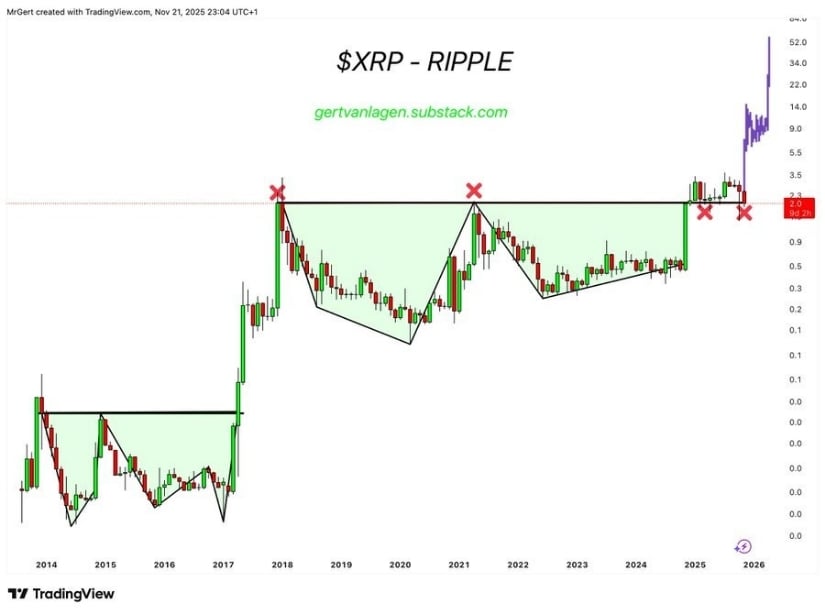
XRP is double-retesting its double-bottom breakout, a key bullish setup that could define its next major move. Source: @GertvanLagen via X
Market cycle analyst Gert van Lagen, who specializes in large-scale pattern identification, noted a “double retest of the double-bottom breakout” on XRP’s monthly chart. The formation began developing between 2021 and 2025, with a key neckline near $1.00. XRP has tested this neckline twice — a characteristic retest often observed in long-term reversal patterns.
Van Lagen compared the structure to a similar pattern that formed from 2014 to 2017, which preceded a significant breakout. His technical measurement model yields a theoretical long-term target near $52, based on classical double-bottom projection principles. However, this projection is contingent on XRP holding the neckline and maintaining sustained monthly closes above breakout levels. Failing those conditions could invalidate the setup and shift focus toward lower supports near $0.90.
For now, XRP is stabilizing around the $2.00 region, and analysts emphasize that multi-year patterns can take considerable time to fully confirm.
ETF Catalyst: Grayscale’s Spot XRP ETF Set to Launch
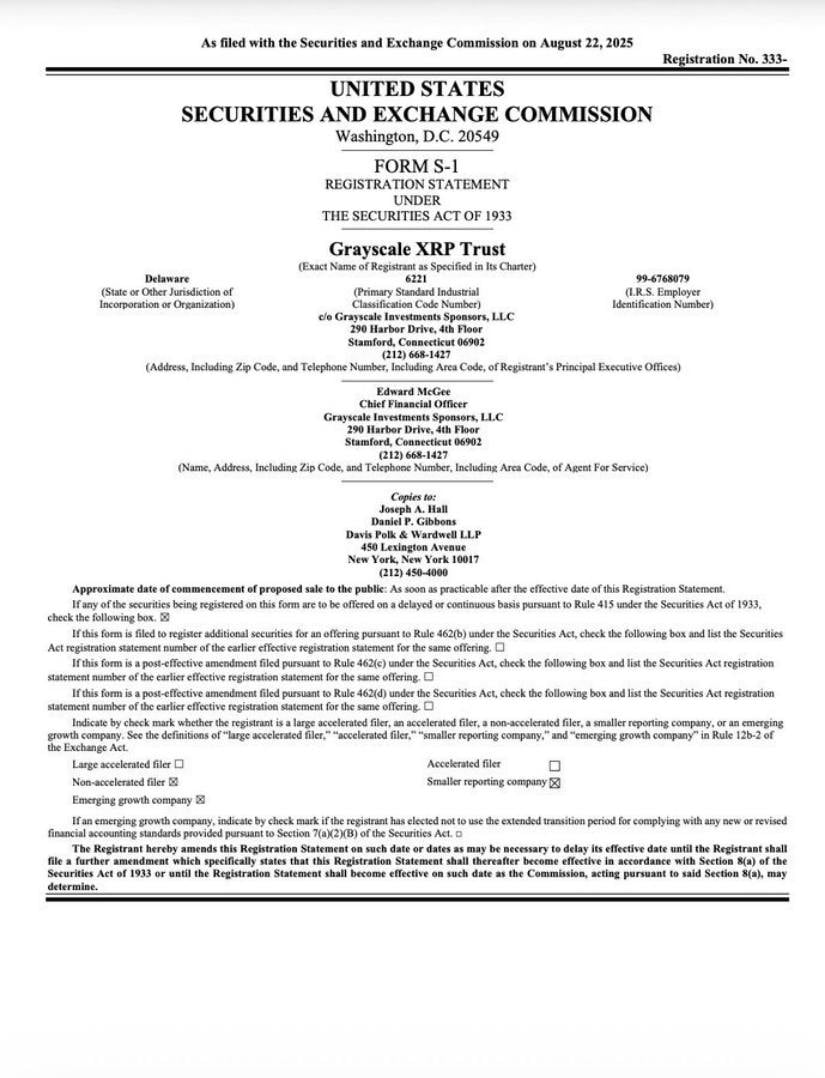
Momentum surrounding XRP has also been influenced by the upcoming launch of Grayscale’s Spot XRP ETF (GXRP), scheduled to go live on Monday. The ETF, confirmed through SEC filings for the Grayscale XRP Trust, marks a significant step in providing regulated market access to XRP cryptocurrency. Crypto commentator Steph_iscrypto shared documentation confirming the ETF’s status, noting: “GRAYSCALE’S SPOT XRP ETF GOES LIVE MONDAY. XRP TO $5 SEEMS FAIR.”
Grayscale’s spot XRP ETF goes live Monday, fueling bullish calls for a run toward $5—buckle up. Source: @Steph_iscrypto via X
This statement reflects a portion of community sentiment, though it does not represent a market-wide consensus forecast. Some analysts argue that while ETF listings tend to improve long-term liquidity and institutional accessibility, they do not guarantee immediate price appreciation, as inflows often develop gradually. Others point to factors such as broader market conditions, regulatory uncertainty, and historical ETF launch behavior across the crypto sector.
Community responses to the ETF news were mixed, with some traders expressing optimism about increased exposure, while others voiced concerns about potential volatility or unrealistic price expectations. Nevertheless, the ETF launch stands as one of the most notable milestones in recent XRP news, following developments in the ongoing Ripple vs. SEC legal narrative.
Market Outlook: Can XRP Hold the $1.90 Level?
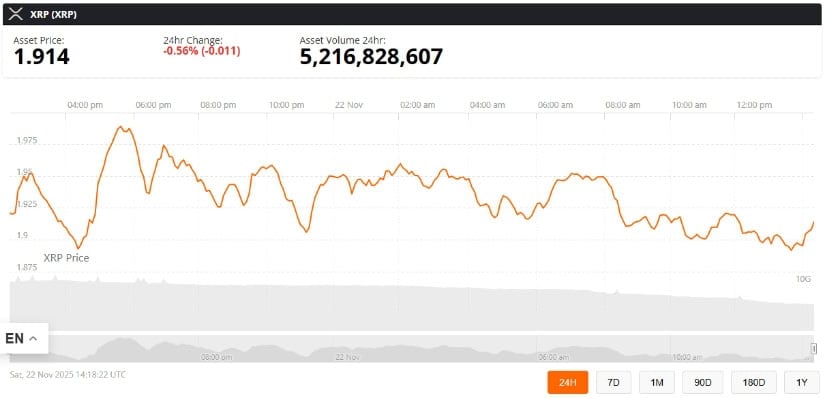
With the XRP live price consolidating near the 20-month EMA, market sentiment in the near term depends on whether the asset can defend this historically important support zone on the monthly chart. A stable hold above $1.90 may strengthen the bullish case and allow XRP to retest the $2.21 and $2.50 resistance levels identified on shorter timeframes.
XRP was trading at around 1.91, down 0.56% in the last 24 hours at press time. Source: XRP price via Brave New Coin
The combination of the upcoming ETF launch, long-term structural patterns, and key technical indicators contributes to XRP’s developing outlook. However, analysts continue to caution that volatility is common around major product launches and that reactions to ETF debut flows may take time to stabilize.
For now, XRP remains at a pivotal moment—balancing long-term technical resilience, increasing institutional accessibility, and broader market sentiment as traders assess the next directional move.
A new report from decentralized exchange aggregator 1inch has shown a growing crisis in decentralized finance (DeFi): the vast majority of capital deployed in major DeFi liquidity pools is not being used effectively.
According to data presented at Devconnect Buenos Aires, between 83% and 95% of liquidity in top pools, including Uniswap v2, v3, and v4, as well as Curve, remains idle for most of the year. That means billions of dollars sit in smart contracts without earning fees or generating meaningful returns.
In Uniswap v2 alone, only 0.5% of liquidity typically falls within active trading price ranges, rendering nearly $1.8 billion ineffective according to the report.
This inefficiency hits retail participants the hardest. Research cited in the report shows that 50% of liquidity providers (LPs) are losing money when factoring in impermanent loss, with net liquidity provider deficits exceeding $60 million. In one notable example, a single Uniswap v3 pool saw over $30 million in lost profits due to Just-in-Time liquidity manipulation.
Part of the problem stems from the sheer number of fragmented pools, with more than seven million across the ecosystem. This complexity not only dilutes liquidity but also makes it harder to route trades efficiently, further reducing returns for liquidity providers.
To 1inch, the solution is its Aqua protocol, which is designed to let DeFi applications share the same capital base across multiple strategies without compromising user custody.
“We address this problem by introducing a new approach,” 1inch cofounder Segej Kunz told CoinDesk in an interview at Devconnect Buenos Aires. “We allow people to just keep assets in the wallet, and we allow people to create virtual trading positions.”
To Kunz, the current situation constitutes a “DeFi liquidity crisis.”
The protocol also aims to lower the barrier to entry for developers who want to utilize this deep liquidity. “Any existing DEX right now can be implemented under 10 lines of code,” Kunz added, noting that the goal is to provide “a foundation to build on top” so that liquidity providers can “hold assets in the wallet” rather than locking them inside complex protocol contracts.
The Pound to Dollar exchange rate (GBP/USD) held near 1.3075 despite a sharp global risk-off move led by equities and crypto.
Softer UK data and renewed fiscal worries are limiting Sterling’s ability to extend higher, keeping consensus expectations anchored around a 1.30-1.31 trading band.
Markets now look to incoming fiscal updates and December BoE signals to judge whether support at 1.30 can hold.
GBP/USD Forecasts: Hold Above 1.30
Volatility across asset classes jumped on Thursday with a particular focus on equities. The US S&P 500 index initially traded sharply higher before a sharp reversal in Nvidia triggered notable losses.
The FTSE 100 index also dipped sharply to 1-month lows on Friday while bitcoin slumped to 7-month lows.
In these circumstances, the Pound was broadly resilient with the Pound to Dollar (GBP/USD) exchange rate trading around 1.3075, but there will be notable unease surrounding the UK fundamentals and risk conditions.
Save on Your GBP/USD Transfer
Get better rates and lower fees on your next international money transfer.
Compare TorFX with top UK banks in seconds and see how much you could save.
According to UoB; “The outlook for today is mixed after the choppy price movements. Today, GBP could trade between 1.3045 and 1.3120.”
Key support remains around 1.30.
The UK government borrowing requirement narrowed to £17.4bn for October from £19.2bn the previous year, but above consensus forecasts of £15.2bn.
For the first seven months of fiscal 2025/26, the deficit widened to £116.8bn from £107.8bn the previous year and around £10bn above ONS projections.
Richard Carter, head of fixed interest research at Quilter Cheviot commented; “Ultimately, today’s borrowing figures suggest Reeves is running out of room, and potentially time, to kick start the economy and get it growing once again. While rate cuts will help, inflation remains sticky and as such the Bank of England may not act as aggressively as the government would like. The ball is in Reeves’ court, but her next move will prove crucial next week.”
Kenneth Broux, head of corporate research FX and rates at Societe Generale commented; “It’s very difficult and I think there’s quite a bit of bad news already priced in, but it doesn’t mean that it can’t get worse.”
He added; “If the gilt market has absolutely no trust in the new borrowing figures and whether the fiscal headroom can be delivered, then we will see a fair steepening of the gilt curve and that is going to result in a weaker sterling.”
Retail sales data was also weaker than expected with a 1.1% decline in volumes for October compared with expectations of a 0.1% decline with the year-on-year increase held to 0.2%.
The UK PMI services-sector index also dipped to a 7-month low of 50.5 for October from 52.3 and below consensus forecasts of 52.0 although the manufacturing PMI index edged back above the 50.0 level to a 14-month high.
Notably, the rate of increase in output charges slowed to a 5-year low despite strong upward pressure on costs.
Chris Williamson, Chief Business Economist at S&P Global Market Intelligence commented; “November’s flash PMI surveys brought disappointing news on the UK economy. Economic growth has stalled, job losses have accelerated, and business confidence has deteriorated.”
He added; “The PMI data therefore suggest the policy debate will shift further away from inflation worries toward the need to support the struggling economy, hence adding to the chances of interest rates being cut in December.”
Like this piece? Please share with your friends and colleagues:
International Money Transfer? Ask our resident FX expert a money transfer question or try John’s new, free, no-obligation personal service! ,where he helps every step of the way,
ensuring you get the best exchange rates on your currency requirements.
Bitcoin USD traded at $83,967 on November 21, down 23.4% for the month and 3% in the past 24 hours after briefly dipping below $80,000 on derivatives exchanges.
Analyst Stacy Muur compiled bottom predictions from five market observers ranging from $75,000 to $94,500, with reasoning spanning technical chart patterns to credit events and four-year cycle dynamics.
The crypto market experienced $2.2 billion in liquidations over 24 hours as total market capitalization fell below $3 trillion for the first time since April 2025.
As Bitcoin (BTC USD) traded near $83,900, the market witnessed numerous price prediction observations from analysts and market watchers.
On November 21, the price briefly touched $80,000 on derivatives exchange Hyperliquid before stabilizing in the low-$80,000 range.
This triggering widespread liquidations across cryptocurrency markets. At the time of writing the leading crypto was trading at
Analyst Stacy Muur aggregated predictions from five market observers on November 21, presenting a range of potential local bottom targets.
The forecasts spanned from $75,000 to $94,500, with varying methodologies and timeframes for Bitcoin price support levels.
Chris Burniske of Placeholder VC identified $75,000 or lower as a re-entry level rather than a formal bottom call.
On October 17, Burniske stated he took profits after the sharp October crash, noting “cracks” in the monthly charts for Bitcoin and Ethereum.
He indicated he would watch Bitcoin’s reaction to $100,000 but would only consider buying again when Bitcoin reached $75,000 or lower, framing this as part of a gradual de-risking strategy.
Arthur Hayes of BitMEX projected a near-term target of $80,000 to $85,000, followed by $200,000 to $250,000 by year-end.
In his November 17 essay “Snow Forecast,” Hayes argued that Bitcoin’s drop from approximately $125,000 to the $90,000 area, while US equity indices remained near highs, signaled a looming credit event.
According to his Bitcoin price prediction, it could fall to roughly $80,000-$85,000 during a “soft period” before Federal Reserve or Treasury money-printing schemes could drive prices to $200,000-$250,000.
Chinese analyst Ban Mu Xia forecast a first stop at $94,500, with an ultimate bottom near $84,000.
His view is of a “complex sideways adjustment,” in which Bitcoin first dipped to around $94,500, then entered an oscillation that could rebound above $116,000 before forming an ultimate bottom near $84,000, potentially 6-8% lower at extremes.
JPMorgan analysts, led by Nikolaos Panigirtzoglou, discussed the forced selling risk related to a potential removal of MicroStrategy from the index, rather than publishing a specific Bitcoin price target.
The bank estimated that roughly $2.8 billion in passive flows could be forced to sell MicroStrategy stock if MSCI removed the company from major equity benchmarks, with as much as $8.8 billion at risk if other index providers followed suit.
The $75,000-$80,000 range corresponded to common technical support zones identified in this analysis.
CoinShares’ James Butterfill focused on flow data and cycle behavior rather than numeric bottom predictions.
In Bloomberg coverage, Butterfill stated crypto suffered “heavy selling by whales who follow the four-year cycle narrative.”
He noted CoinShares data showed large holders sold more than $20 billion in crypto since September, calling the pattern “somewhat self-fulfilling” even though CoinShares did not fundamentally endorse the four-year-cycle thesis.
Market Liquidations and Capitalization Loss
Coinglass data showed $2.2 billion in positions liquidated in the crypto market over the past 24 hours, as of press time.
Bitcoin USD accounted for approximately $1 billion of total liquidations, with long positions representing $887 million. Roughly 391,000 traders faced liquidations across exchanges.
The cascade of forced selling created a feedback loop that accelerated downward price pressure as leveraged traders were forced to close positions.
The total cryptocurrency market capitalization dipped below $3 trillion for the first time since April 2025, currently at $2.96 trillion, down 7.5% over the past 24 hours.
US-listed spot Bitcoin ETFs recorded approximately $3.79 billion in net outflows during November, the largest monthly outflow since the products launched in January 2024.
Open interest in Bitcoin perpetual futures fell 35% from October’s peak near $94 billion, reducing liquidity across derivatives markets.
The combination of reduced open interest, extreme fear sentiment, and massive liquidations created conditions where relatively small sell orders moved the Bitcoin price significantly.
It remains to be seen whether the current range will provide support for a bounce or if Bitcoin is preparing for a move into a bearish period.