XRP could surge 150% to $6 in the next five years due to the likely approval of spot XRP ETFs.
XRP(XRP1.77%) is the fourth-most valuable cryptocurrency, with a market value of $145 billion. It currently trades at $2.40, but Geoffrey Kendrick at Standard Chartered anticipates big gains in the coming years, due in large part to the potential approval of spot XRP ETFs. He recently set his 2028 target price at $12.50, which implies annual returns of 73%.
However, Morningstar analysts estimate the entire cryptocurrency market will expand at 10% annually during the next several years. That forecast is sensible, but I think XRP will perform better than the broader market: I predict the altcoin will return 20% annually to reach $6 by 2030. That implies 150% upside from where it trades today.
Here’s what investors should know.
Image source: Getty Images.
Ripple uses XRP and RLUSD to facilitate cross-border transactions
Ripple is a fintech company that uses XRP and its blockchain (the XRP Ledger) to help payment service providers and other businesses move money across borders. The SWIFT (Society for Worldwide Interbank Financial Telecommunications) system is currently the industry standard where wire transfers are concerned, but transactions can take days to settle and often incur high fees because they are routed through multiple intermediaries.
Ripple solves those problems by using XRP as a bridge currency. Transactions not only settle within seconds, but also cost a fraction of a cent. In June, CEO Brad Garlinghouse predicted XRP would capture 14% of SWIFT payment volume within five years, in which case more than $20 trillion would flow through the XRP Ledger annually.
That seems wildly optimistic. Using a volatile cryptocurrency like XRP as a bridge currency to move money introduces unnecessary risk. Ripple has added the stablecoinRLUSD to its payments ecosystem to address that problem, but that new product faces tough competition from more entrenched stablecoins like USD Coin by Circle Internet Group.
XRP transaction volume, which is a roundabout measure of demand for the cryptocurrency, has steadily declined throughout 2025. That hints at waning interest, and I seriously doubt a significant number of enterprises will adopt XRP payments in the future. Investors should expect very little from this potential catalyst.
The SEC is likely to approve spot XRP ETFs in the near future
The U.S. Securities and Exchange Commission (SEC) was set to approve several spot XRP ETFs in October. The process was delayed due to the government shutdown, but approval is now anticipated in November or December. Those investment products would provide direct exposure to XRP without the hassle and high fees associated with traditional cryptocurrency exchanges.
Eliminating those pain points could unlock demand among retail investors and, more importantly, institutional investors that control about $130 trillion in assets under management. Canary Capital CEO Steven McClurg estimates spot XRP ETFs will draw inflows totaling $5 billion in their first month on the market. That seem too ambitious, given the launch of spot ETFs for Bitcoin drew just $4 billion during their first month, but I agree in principle: Spot XRP ETFs should boost demand.
Bitcoin prices have increased 127% since the SEC approved the first spot Bitcoin ETFs in January 2024. So, it seems reasonable that XRP could see similar price appreciation over the next five years. That’s why I think the altcoin can increase 150% to $6 by 2030.
However, investors must always remember that cryptocurrencies tend to be volatile assets. For instance, XRP declined more than 20% from a record high five times in the last three years alone, and the altcoin is nearly 30% off its high today. Similar volatility is likely in the future. Investors who can’t handle price swings of that magnitude should steer clear.
Platinum price kept its fluctuation below $1605.00 barrier, forcing it to provide new nixed trading by its continued fluctuation near $1580.00, reminding you that the stability above the sideways track’s support at $1520.00 and the continuation of providing positive momentum by the main indicators, these factors make us keep the bullish suggestion, to expect surpassing the current barrier by recording new gains by its rally towards $1642.00 and $1660.00.
While the decline below the current support and providing negative close, will confirm activating the bearish corrective track, to expect suffering several losses by reaching $1485.00 reaching the next support at $1440.00.
The expected trading range for today is between $1545.00 and$1642.00
The British Pound’s recent rebound faltered after disappointing UK jobs data pushed the Pound-to-Dollar exchange rate down toward 1.31, with analysts warning that a softening labour market gives the BoE room to cut rates again next month.
MUFG and ING both see further GBP losses ahead with a December move as increasingly likely.
GBP/USD Forecasts: Recovery Halted
Pound Sterling was hurt on Tuesday by increased speculation of a December Bank of England (BoE) interest rate cut following weaker-than-expected UK jobs data.
The Pound to Dollar (GBP/USD) exchange rate dipped sharply to 1.3120 from highs near 1.3180 ahead of the data with the Pound struggling to secure any benefit from favour able risk conditions and a fresh record high in the FTSE 100 index.
Crucial Pound support remains at 1.30. ING has a year-end GBP/USD forecast of 1.34 as the dollar loses ground.
The UK jobs data was significantly weaker than expected with the unemployment rate increasing to a fresh 4-year high of 5.0% in the three-months to September from 4.8% previously and above consensus forecasts of 4.9%.
Save on Your GBP/USD Transfer
Get better rates and lower fees on your next international money transfer.
Compare TorFX with top UK banks in seconds and see how much you could save.
The ONS also reported a decline in payrolls of 32,000 for October, matching a final 32,000 retreat for September.
There was also a small net slowdown in underlying wages growth to 4.6% from 4.7%.
According to MUFG; “The data suggests that the downturn in the labour market is getting worse ahead of the Autumn Statement.”
Markets are now more convinced that the BoE will cut rates again in December.
MUFG added; “Loosening labour market conditions should give the BoE more confidence that wage growth will continue to slow dampening upside inflation risks. The weak labour market report supports our forecast for the BoE to cut rates next month.”
There will be potential implications for politics and the budget with pressure for measures to support the jobs market.
Capital Economics UK economist Ashley Webb commented; “The 32,000 fall in payroll employment in October was the eleventh monthly decline over the past year and suggests that businesses continued to trim headcounts after the Chancellor announced the rises in payroll taxes and the minimum wage in last year’s October Budget.”
According to ING; “Now, both inflation and jobs data are starting to point down, and we think the Autumn Budget’s tax hikes will provide the final argument for a cut in December.”
On Monday, the US Senate voted to end the government shutdown and it will now move to the House of Representatives.
Assuming there is a near-term re-opening, there is the potential for some relief surrounding consumer confidence while the focus will switch to postponed data releases with a particular focus on the jobs market.
ING commented; “a resumption of data releases in the US does carry non-negligible downside risks to the dollar. In our view, the latter factors should prevail, as we think markets are underestimating the downside risks for the labour market, US front-end rates and – by extension – the dollar into year-end.”
Like this piece? Please share with your friends and colleagues:
International Money Transfer? Ask our resident FX expert a money transfer question or try John’s new, free, no-obligation personal service! ,where he helps every step of the way,
ensuring you get the best exchange rates on your currency requirements.
Rendering of the cafe space. Photo credit: Mako Matcha Mill.
Mako Matcha Mill is a new matcha cafe and mill coming to Southwest Portland’s West End section—and true to their name, they will be milling matcha there on site. I stopped by the cafe the other day (under construction at the time) and spoke with the two owners, Edison Zeng and Emily Dewey, to hear about their work with matcha and their plans for the cafe. Here is what I learned.
(Bonus: I had my first taste ever of Nong’s Khao Man Gai’s chicken and rice, located right across the street).
This Space Used To Be Home To Cacao
From 2006 to 2020 this location was known as Cacao, a well-regarded place to sip, discover, and buy chocolate. Owners Aubrey Lindley and Jesse Manis announced in October 2020 that they were closing—this would have been during the more chaotic days of the COVID pandemic.
Fun fact: I learned in an Oregonian article that Cacao was an incubator for Cloudforest (FKA Cocanu). Now established on SE Hawthorne Blvd, they’ve been known to make matcha lattes themselves.
I believe this space on SW 13th has been empty since the closing of Cacao, so having a new tenant is great for the neighborhood, and it’s nice for it to be another cafe space, too.
Matcha: Growing, Harvesting, and Culture
There are multiple stages involved in creating that green powder we know as matcha. When I arrived, we jumped in right away to talk about the harvesting stage.
Harvesting Matcha
Edison and Emily have grown their own matcha. “We actually harvested our first crop!” said Edison. They spoke a little bit about how time-consuming the harvesting is, as the top couple of leaves (the softest part of the plant) are traditionally picked by hand.
Edison and Emily with a harvest. Photo credit: Mako Matcha Mill.
He showed me what the tea leaves looked like after they picked them. “That’s what it looks like before we shred it into tiny little crumbs, and then the crumbs are what goes in there,” pointing to the mill.
Shading
But before they start to harvest the matcha, they shade the plants three to four weeks prior to harvest. That stresses out the plant a bit, yielding tender and delicate leaves with a deep green color. “During the shading process, the plant goes into survival mode and it minimizes the stem and the veins,” explained Edison. “We need to maximize our chlorophyll and leaf surface area, too. The amino acid profile also changes during shading.”
“This is ultimately what like the tencha becomes,” said Edison. Tencha is the properly-shaded green tea that is the base for matcha.
Sorting
They also sort out the different colors of leaves into different grades, which, as you can imagine, is time-consuming and takes focus. “It’s like sorting LEGO blocks, but with tea,” explained Edison.
However, there is technology out there that can do the sorting, so they don’t have to do it by hand.
“We had to do that this year because we don’t have the machinery for it,” said Edison. “But I think for the future of matcha and tencha production in the U.S. to succeed, we have to invest in machinery that color-sorts.”
Growing Matcha in Oregon for Mako Matcha Mill
Edison and Emily have been growing matcha in Oregon, near Salem, which kind of blew me away.
“I’m a firm believer that we can create an organic, specific cultivar [in Oregon],” said Edison. “Right now, most of the cultivars are from Japan, mainly in the Kyoto region, which climate-wise is more like South Carolina or North Carolina, where it’s more humid. There are a couple of different cultivars from Russia, near Sochi, too.” Sochi is humid year-round and quite warm compared to most of Russia.
“I think the average person would probably be surprised to think matcha could be grown here. But we think it’s doable. Not only that, but I think we can have unique flavor profiles in Oregon. We want to create that. And now we have the first harvest and we have to mill it—no one knows yet what it tastes like.”
Grassy Matcha
Speaking of what matcha tastes like, I’ve heard from a number of people that they think all matcha tastes basically like grass. I asked Edison and Emily how they would counter that assertion, if at all.
“Well, grassy matcha is going to be the Yabukita cultivar,” he explained. “There are certain tea cultivars that are more hardy, more resistant to bugs. Those ones might taste more like grass because they are less sweet. The more umami and higher amino acid profile ones—those are sweeter.”
He added, “Not all of them are grassy tasting. It’s also very subjective.”
And, like with coffee, the altitude at which the tea is grown can affect things, including how delicate the flavor is. He cited Tibet or Nepal as being places where tea is grown, and because of their high altitude the tea’s flavors can be a lot more delicate.
The front of Mako Matcha Mill.
Mako Matcha Mill: What’s In a Name?
To my ears, the name is a little unusual, so I asked them why they chose to name it “Mako Matcha Mill.” Especially the “mako” part.
“‘Mako’ means a number of different things, but this is a specific reference,” said Emily. “Edison is a gamer and loves Final Fantasy VI in particular. And [the connection is] really sweet.” He played it a lot in the 1990s on PlayStation.
“In the game, the Mako is the life force of the planet, and it’s green,” said Edison. Just like matcha.
Location of Mako Matcha Mill
Emily and Edison were really excited to find this location—they had been wanting to open a spot in Portland, a city they love. They’ve been working with Liminal Shift to help with flow and build the counter area that includes space for the mill behind it.
They’ve been working with them on the interior design as well, which will have some influences from Japan (“Japanese with restraint”), like Japanese silks hanging in the room, some relevant color schemes on the walls.
What To Expect at the Mako Matcha Mill Cafe
Emily and Edison bring important experience to running the cafe. “I have done food service all over and in Chicago, where I’m from,” said Emily. “So I’ve got a lot of front of house and customer experience.”
Edison has been selling matcha for 13 years. His company Magus Brands in California has been manufacturing it overseas, and he has been selling it here in the U.S.
They look forward to providing a place where drinking and learning about matcha feels accessible, not intimidating. They’d also like it to be a place where people can stop in, enjoy friendly service and excellent things to drink and eat, and sit and stay for a while. A true third place. They’ll have a mix of tables and chairs, seats at the bar, and couches/upholstered furniture.
“And we want people to engage with us and look at the mill,” said Edison. “We want to understand where they are and answer questions they have about it.”
To Drink
At the very basic level they will sell hot and cold matcha drinks. The matcha latte—hot or cold—will be a staple.
A very pretty matcha latte I had in 2018 elsewhere in Portland.
Additionally on the cold side they will offer cold brew matcha, as well as eight other tea types—Earl Grey, Hojicha, and other Asian teas like Taiwanese milk oolong (grown high in the mountains of Taiwan, it tastes milky) are just a few—that they will rotate in and out of their two taps. They are really looking forward to introducing interesting and perhaps less common teas to their customers.
“We’re going to be doing fun things and stuff no one’s ever had before,” said Edison. “I think, even on the West Coast, we’re the first people that are going to be approaching implementing tea in unique ways, with our own recipes and flavors.”
They also plan to use syrups in their matcha drinks. Note: there will be no strawberry because Emily is allergic to them, so they are considering something like marionberry, instead which is very much an Oregon flavor, and is certainly delicious.
Emily talked about their tea infusions, too, which I needed to better understand. She says they are almost like a syrup or a concentrate. “Imagine a matcha latte with Hojcha flavor,” she explained. “When we first thought of this, I was so surprised as to how amazing and very unique it is. And I think being able to showcase different tea flavors alongside matcha, people are going to be really excited about those drinks.”
They noted that people love the fruity and ube matcha drinks, in particular. “We’re catering to a variety of audiences, because as you know, matcha has gotten super popular,” said Edison.
Grades of Matcha and Price
Although the matcha latte is probably the most popular matcha drink in Portland, they will offer matcha on its own in its most straightforward form. There will be matcha flights where people can taste the different kinds of matcha together in smaller portions.
And they will be serving three different grades of matcha—and three tiers to make the price accessible. “The lowest would probably be around $5,” explained Edison. “And then we have our higher grades.” They’re looking at offering some award-winning matchas, too.
“I think $7 matcha lattes are blasphemy,” said Edison. “So we’re trying to bring that price down throughout Portland—maybe like five bucks, maybe four bucks if we can squeeze it for a 12 ounce drink.”
Sacrificial Grade Matcha
Edison told me about a special drink they’ll offer, and one he is a big fan of. “My favorite drink is the sacrificial grade matcha,” he said. “You’re going to have to sign a waiver for it because there’s so much matcha content.” [I’m not sure if he’s kidding or not, ngl.]
Apparently it has somewhere between 350 to 500 milligrams of caffeine in it, due to the fact that they are using 10 grams of matcha. “It will have a matcha foam top, and matcha jelly. It’s 20 ounces of pure matcha. It’s like rocket fuel,” he said.
Coffee at the Mako Matcha Mill Cafe
They will also serve espresso drinks at the cafe. Beans will come from multiple roasters but at the writing of this article they have not decided which ones.
I asked them about mixing matcha and expresso. And while Edison is not the biggest fan, he knows others like it. “We’re thinking about it,” he said. “We’ve seen it on other menus. It’s called ‘military style.’” In his opinion, the mix of matcha and coffee throws things out of balance, where the matcha gets completely consumed by the more assertive coffee flavor.
On the Topic of Milk and Matcha
They will be offering oat milk for their plant-based option. “Soy covers the flavor of matcha,” said Edison. “It really changes it. If we find other alternatives in the future, we’ll introduce them, but oat is so good with matcha.”
When it comes to dairy, they say they’ll be sourcing it from local creameries—those with smaller herds, who treat their cows humanely (though vegans will no doubt disagree). They visit each of the creameries to see how the animals are being raised. And they believe the milk tastes better.
To Eat
They plan to have tea soft serve, which can be used in an afogatto with coffee or tea. Also look for additional savory and sweet snacks, including wagashi made by one of the best wagashi artists around. She lives right here in the Portland area: Yume Confections.
“We want to make that like a legit experience,” said Emily.
Mako Matcha Mill Retail
Mako Matcha Mill will also include a retail element, which will be located on the north side of the space. “We’re working with local pottery artisans, and there’s going to be tea plants in there that people can bring at home,” explained Edison. The’ll also be selling tins of matcha—their own custom blends.
And matcha whisks will also be for sale. “We will work with artisans that will give us what I think will be the proper matcha whisk,” said Edison.
Learning About Matcha
There will be an educational element to Mako Matcha Mill. “We plan on bringing in Urasenke instructors,” said Edison. “Basically, that’s like the artistic and cultural aspect of matcha consumption—it’s more about the gift of and the preparation of tea.”
He continued, “And then there’s another class that we want to do, where at the bar counter it is like an omakase type of thing. You come here and then we’ll just give you stuff.
“We also want to offer classes where you can learn to mill your own matcha—we’ll teach you how to do it. I have a little granite mill—obviously, the grind’s not going to be as fine as an actual machine. But we want to teach people about what matcha is, how it’s grown, and then get really deep into the cultivation and preparation of it, different tasting types, how to differentiate between them (kind of like coffee), and how to differentiate between different cultivars.
“We want to cater to people that are really interested in learning about matcha.”
The Matcha Milling
It’s no surprise that one of the things that makes Mako Matcha Mill cafe unique is that they are milling matcha at the cafe. And as I mentioned earlier, they are growing their own matcha here in Oregon. However, they will not be able to operate the cafe solely with their own product, because the harvest was small.
“We’ll be importing most of the matcha because our harvest this year was only like two and a half kgs. Very small, experimental, but I’m really happy,” said Edison.
Regarding the mill at the cafe, “So these things produce 30 grams per hour,” Edison explained. “We’re making it super slow, like 20 grams an hour, so that we get a nicer grind. I don’t think it’s going to meet the demand because 20 grams an hour, we’re using four grams of drink at least, so that’s like five drinks per hour.”
So it makes sense to use matcha that’s already prepared and ready to go. “I’ve been importing it for a long time, so we have a lot of matcha relationships with suppliers,” Edison remarked.
Final Thoughts
“My vision for [Mako Matcha Mill] is that we want to be the first matcha house in the U.S. to take matcha to a whole other level,” explained Edison. “That’s what particularly inspired us to go out and grow and make it here, and then to mill it and process it here. To get our hands on every aspect of it.”
He continued, “And the cafe is a place for us to test out our little experiment, both with flavors of tea and with the actual industry. We have a matcha consumption industry in the U.S. I feel like we can also have a really robust matcha production industry, as well. So that’s what we’re trying to do here.”
Their plan is to open in late 2025. They want to be open every day, and ideally they’d like to end up as a 24/7 kind of place, but they need to see how things go first.
It was an interesting and satisfying time learning about matcha from Edison and Emily. Wishing them the best as they prepare the place to open and offer their matcha options to Portland.
Risk Warning: this article represents only the author’s views and is for reference only. It does not constitute investment advice or financial guidance, nor does it represent the stance of the Markets.com platform.When considering shares, indices, forex (foreign exchange) and commodities for trading and price predictions, remember that trading CFDs involves a significant degree of risk and could result in capital loss.Past performance is not indicative of any future results. This information is provided for informative purposes only and should not be construed to be investment advice. Trading cryptocurrency CFDs and spread bets is restricted for all UK retail clients.
Silver price (XAG/USD) edges lower to near $51.10, snapping the five-day winning streak during the early European session on Wednesday. The white metal loses ground amid the renewed US Dollar (USD) demand. The Federal Reserve (Fed) policymakers are set to speak later in the day, including John Williams, Anna Paulson, Christopher Waller, Raphael Bostic, Stephen Miran and Susan Collins.
The US Dollar Index (DXY), an index of the value of the US Dollar (USD) measured against a basket of six world currencies, trades in positive territory around 99.55, bolstered by hopes for the end of the US government shutdown. This, in turn, could weigh on the USD-denominated commodity price in the near term.
After the Senate voted 60-40 on Monday to pass a temporary continuing resolution to fund the government, the House is set to vote on the measure on Wednesday, and House Speaker Johnson said he expects it will pass quickly. If it passes in both chambers of Congress, it will head to US President Donald Trump to be signed into law. The bill will restore funding to government agencies through January 30.
Markets brace for an imminent US government reopening that is expected to unleash a backlog of US economic releases. “Traders believe (data) will show some weakening economic numbers, and that would prompt the Fed to cut interest rates in December… that is probably encouraging the gold and silver market bulls today,” said Jim Wyckoff, senior analyst at Kitco Metals.
According to the CME FedWatch tool, traders have currently priced in nearly a 68% probability that the US central bank would lower rates by 25 basis points (bps) in the December meeting, up from around a 62% chance a day ago. Lower interest rates could reduce the opportunity cost of holding Silver, supporting the non-yielding precious metal.
Silver FAQs
Silver is a precious metal highly traded among investors. It has been historically used as a store of value and a medium of exchange. Although less popular than Gold, traders may turn to Silver to diversify their investment portfolio, for its intrinsic value or as a potential hedge during high-inflation periods. Investors can buy physical Silver, in coins or in bars, or trade it through vehicles such as Exchange Traded Funds, which track its price on international markets.
Silver prices can move due to a wide range of factors. Geopolitical instability or fears of a deep recession can make Silver price escalate due to its safe-haven status, although to a lesser extent than Gold’s. As a yieldless asset, Silver tends to rise with lower interest rates. Its moves also depend on how the US Dollar (USD) behaves as the asset is priced in dollars (XAG/USD). A strong Dollar tends to keep the price of Silver at bay, whereas a weaker Dollar is likely to propel prices up. Other factors such as investment demand, mining supply – Silver is much more abundant than Gold – and recycling rates can also affect prices.
Silver is widely used in industry, particularly in sectors such as electronics or solar energy, as it has one of the highest electric conductivity of all metals – more than Copper and Gold. A surge in demand can increase prices, while a decline tends to lower them. Dynamics in the US, Chinese and Indian economies can also contribute to price swings: for the US and particularly China, their big industrial sectors use Silver in various processes; in India, consumers’ demand for the precious metal for jewellery also plays a key role in setting prices.
Silver prices tend to follow Gold’s moves. When Gold prices rise, Silver typically follows suit, as their status as safe-haven assets is similar. The Gold/Silver ratio, which shows the number of ounces of Silver needed to equal the value of one ounce of Gold, may help to determine the relative valuation between both metals. Some investors may consider a high ratio as an indicator that Silver is undervalued, or Gold is overvalued. On the contrary, a low ratio might suggest that Gold is undervalued relative to Silver.
Platinum price kept its fluctuation below $1605.00 barrier, forcing it to provide new nixed trading by its continued fluctuation near $1580.00, reminding you that the stability above the sideways track’s support at $1520.00 and the continuation of providing positive momentum by the main indicators, these factors make us keep the bullish suggestion, to expect surpassing the current barrier by recording new gains by its rally towards $1642.00 and $1660.00.
While the decline below the current support and providing negative close, will confirm activating the bearish corrective track, to expect suffering several losses by reaching $1485.00 reaching the next support at $1440.00.
The expected trading range for today is between $1545.00 and$1642.00
Egg Yolk Lecithin Industry Analysis in the USA 2025 to 2035
The demand for egg yolk lecithin in the USA is projected to grow from USD 118.0 million in 2025 to approximately USD 184.0 million by 2035, recording an absolute increase of USD 66.0 million over the forecast period. This translates into total growth of 55.9%, with demand forecast to expand at a compound annual growth rate (CAGR) of 4.5% between 2025 and 2035.
Overall sales are expected to grow by nearly 1.56X during the same period, supported by rising USA egg yolk lecithin activities, increasing consumer demand for natural phospholipid solutions, and growing utilization across dietary supplements, food & beverages, and cosmetics applications. USA, led by the West and Northeast regions, continues to demonstrate steady growth potential driven by health consciousness and natural wellness initiatives.
Quick Stats for USA Egg Yolk Lecithin Industry
USA Egg Yolk Lecithin Sales Value (2025): USD 118.0 million
USA Egg Yolk Lecithin Forecast Value (2035): USD 184.0 million
USA Egg Yolk Lecithin Forecast CAGR: 4.5%
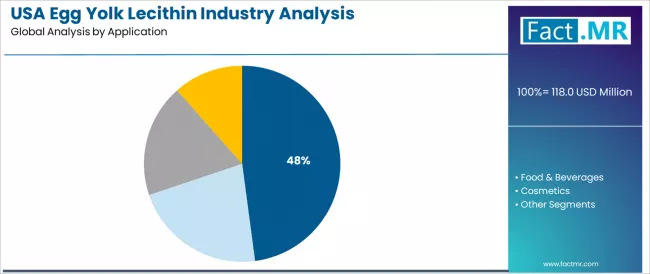
Leading Application in USA Egg Yolk Lecithin Demand: Dietary Supplements (47.9%)
Key Growth Regions in USA Egg Yolk Lecithin Demand: West, Northeast, and Midwest
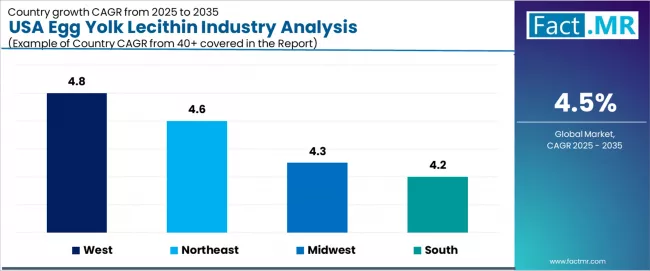
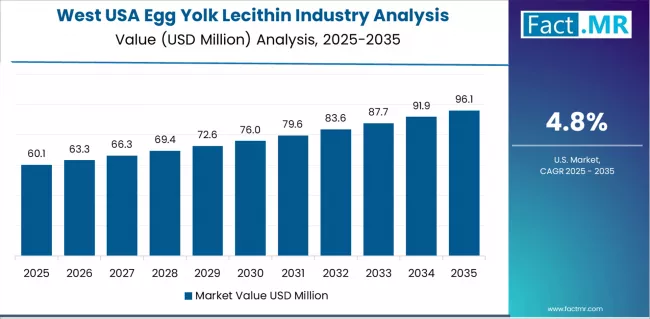
USA Regional Leadership: West holds the highest growth rate at 4.8%
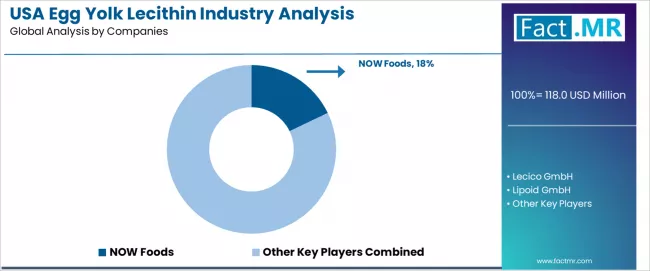
Top Key Players in USA Egg Yolk Lecithin Demand: NOW Foods, Lecico GmbH, Lipoid GmbH, American Lecithin Company
Between 2025 and 2030, sales of egg yolk lecithin in the USA are projected to expand from USD 118.0 million to USD 147.1 million, resulting in a value increase of USD 29.1 million, which represents 44.1% of the total forecast growth for the decade. This phase of growth will be shaped by rising egg yolk lecithin consumption where powder format trends and dietary supplement applications are accelerating consumption adoption.
Increasing utilization of health food store formats and growing adoption of nutraceutical company applications continue to drive demand. Health manufacturers are expanding their phospholipid capabilities to address the growing complexity of modern egg yolk lecithin operations and wellness requirements, with American health processing operations leading investments in advanced lecithin technologies.
From 2030 to 2035, demand is forecast to grow from USD 147.1 million to USD 184.0 million, adding another USD 36.9 million, which constitutes 55.9% of the overall ten-year expansion. This period is expected to be characterized by expansion of specialty egg yolk lecithin offerings, integration of advanced processing systems and enhanced bioactive formulations, and development of standardized quality protocols across different lecithin applications. The growing adoption of powder format practices and wellness enhancement approaches, particularly in USA and North America, will drive demand for more sophisticated processing solutions and specialized egg yolk lecithin capabilities.
Between 2020 and 2025, USA egg yolk lecithin demand experienced steady expansion, driven by increasing USA egg yolk lecithin activities in health food retailers and nutraceutical companies and growing awareness of lecithin benefits for cognitive support and cellular wellness enhancement. The sector developed as health processing operations, especially in USA, recognized the need for specialized phospholipid approaches and advanced technologies to improve product quality while meeting stringent health safety and wellness enhancement regulations. Processors and health suppliers began emphasizing proper phospholipid criteria and processing innovations to maintain wellness effectiveness and regulatory compliance.
USA Egg Yolk Lecithin Key Takeaways
Metric
Value
USA Egg Yolk Lecithin Sales Value (2025)
USD 118.0 million
USA Egg Yolk Lecithin Forecast Value (2035)
USD 184.0 million
USA Egg Yolk Lecithin Forecast CAGR (2025-2035)
4.5%
Why is the USA Egg Yolk Lecithin Industry Growing?
Demand expansion is being supported by the continued growth in USA egg yolk lecithin activities, with USA maintaining its position as a health innovation and phospholipid supplementation leadership region, and the corresponding need for specialized lecithin solutions for cognitive enhancement, cellular support, and wellness satisfaction activities.
Modern health processing operations rely on advanced phospholipid modalities to ensure consistent bioactive levels, functional benefits, and optimal wellness outcomes. Egg yolk lecithin requires comprehensive processing systems including lecithin selection, phospholipid optimization, quality preservation, and distribution programs to maintain wellness effectiveness and health excellence.
The growing complexity of USA egg yolk lecithin operations and increasing wellness enhancement standards, particularly stringent requirements in USA, are driving demand for advanced egg yolk lecithin products from certified processors with appropriate health safety expertise and phospholipid processing knowledge.
Health-focused consumers are increasingly investing in wellness enhancement algorithms and egg yolk lecithin technologies to improve cognitive outcomes, enhance cellular satisfaction, and optimize phospholipid cost utilization in challenging egg yolk lecithin environments.
Quality guidelines and health product specifications are establishing standardized processing procedures that require specialized capabilities and trained wellness practitioners, with American operations often setting benchmark standards for global egg yolk lecithin practices.
Opportunity Pathways – Demand for Egg Yolk Lecithin in USA
The USA egg yolk lecithin landscape stands at a pivotal juncture of wellness and innovation. With demand projected to grow from USD 118.0 million in 2025 to USD 184.0 million by 2035, a steady 55.9% increase, the sector is being reshaped by consumer-centric health imperatives, phospholipid processing innovation, and the pursuit of wellness excellence. As health-focused consumers rise and egg yolk lecithin options expand, the phospholipid solutions that enable authentic, high-quality health enhanced alternatives become mission-critical wellness infrastructure rather than optional supplements.
USA, led by the West region (4.8% CAGR) and supported by Northeast’s health consciousness and Midwest’s supplement growth initiatives, represents not just a geography of demand but a laboratory of innovation where advanced phospholipid techniques, enhanced bioactive formulations, and integrated wellness operations are moving from specialty development to mainstream adoption. The confluence of robust health awareness established health processing networks, and wellness imperatives creates fertile ground for premium phospholipid solutions that deliver measurable wellness advantages.
Strategic pathways encompassing dietary supplement development, specialty applications, health food integration, and phospholipid innovation offer substantial revenue enhancement opportunities, particularly for health companies and processors positioned at the innovation frontier.
Pathway A – Premium Dietary Supplement and Specialty Development. Health-focused consumers face growing demand for dietary supplement lecithin products, driven by wellness requirements, cognitive considerations, and health needs. Processing companies who pioneer reliable dietary supplement lecithin products for specialty applications, enhanced phospholipid technologies, superior bioactive profiles, cognitive enhancement methods, can command 35-45% price premiums while capturing consumer retention opportunities across American health processing operations. Expected revenue pool: USD 29-41 million.
Pathway B – Health Food Store and Retail Integration. Health-focused consumers, wellness retailers, and health demands are accelerating adoption of egg yolk lecithin products through health food channels and retail applications. Systems enabling comprehensive health food positioning, phospholipid enhancement, application-specific formulations, and retail partnerships reduce formulation barriers while improving consumer adoption by 40-55%. Volume positioning for health food solutions: USD 34-47 million.
Pathway C – Nutraceutical Company and Manufacturing Integration. As nutraceutical companies seek lecithin alternatives with superior functionality, advanced phospholipid technologies incorporating consistent bioactive enhancement, enhanced health characteristics, and superior processing properties become essential manufacturing infrastructure. Differentiated products with proven performance in nutraceutical applications and processing stability can secure 25-35% margin premiums in nutraceutical manufacturing applications. Revenue opportunity: USD 22-31 million.
Pathway D – Powder Form and Consumer Integration. Health-focused consumers increasingly seek egg yolk lecithin partners through powder format channels, wellness recommendations, and health-focused positioning. Suppliers offering comprehensive powder platforms, wellness professional endorsements, consumer education support, and premium formulations can capture growing share among health retailers and consumers while generating recurring revenue streams with 30-40% EBITDA margins. Demand potential: USD 26-37 million.
Pathway E – Dietary Supplement Segment Leadership. Dietary supplement application represents 47.9% of application demand and requires continuous innovation enhancement through improved phospholipid techniques, enhanced bioactive standards, and comprehensive functionality optimization. Suppliers enabling 30-40% performance improvements while maintaining competitive pricing can secure dominant purchasing preference across health processing and wellness operations. Addressable opportunity: USD 88-123 million.
Segmental Analysis
The industry is segmented by application, form, distribution channel, and end-user. By application, the segmentation includes dietary supplements, food & beverages, cosmetics, and pharmaceuticals formulations. Based on form, it includes powder and liquid formats.
By distribution channel, the landscape is segmented into health food stores, online platforms, pharmacies, and others. By end-user, the segmentation includes nutraceutical companies, food manufacturers, and cosmetic companies.
Which Egg Yolk Lecithin Application Dominates in the USA?
Dietary supplements application is projected to account for 47.9% of egg yolk lecithin demand in the USA in 2025. This dominance reflects the critical importance of phospholipid supplementation in American wellness applications, where consumer preference for cognitive support characteristics and health benefits supports dietary supplement adoption.
In the USA, health processing guidelines recommend dietary supplement lecithin as primary cognitive enhancement, ensuring the widespread adoption of this application across health manufacturers, wellness companies, and processing facilities. Continuous processing innovations are improving the consistency of dietary supplement lecithin, uniformity of phospholipid distribution, and consumer satisfaction, enabling suppliers to maintain product functionality while optimizing wellness outcomes.
Advancements in phospholipid technologies and processing systems are improving product appeal by enhancing bioactive content while maintaining processing effectiveness. The segment’s strong position is reinforced by the rising wellness enhancement emphasis on cognitive alternatives and increasing commercial processing participation in health-focused wellness preparation, which require increasingly sophisticated phospholipid development measures.
Cognitive support characteristics and health benefits make dietary supplement lecithin indispensable in American health wellness processing operations.
Processing innovation in phospholipid technologies is improving consistency, bioactive uniformity, and consumer satisfaction across wellness processing applications.
Why do Nutraceutical Companies Comprise the Bulk of all Egg Yolk Lecithin Use in the USA?
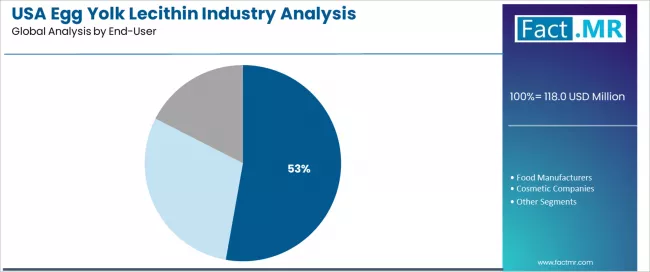
Egg yolk lecithin incorporation by nutraceutical companies is expected to represent 52.8% of USA’ demand in 2025, highlighting their critical role as the dominant end-user sector. Nutraceutical companies and supplement processors, particularly in USA and health-focused areas, serve as primary utilization points for phospholipid incorporation, formulation development, and wellness operations.
Egg yolk lecithin enables processors to achieve comprehensive phospholipid enhancement, health positioning, and cognitive benefits for diverse supplement products. The segment is also fueled by increasing manufacturer preference for health enhanced wellness ingredients, with nutraceutical operations prioritizing egg yolk lecithin convenience that integrates phospholipid benefits, health value, and wellness appeal.
In the USA, nutraceutical processors are spearheading adoption of comprehensive health enhancement pathways and advanced wellness technologies to enhance product health appeal, improve manufacturer satisfaction, and ensure competitive differentiation. Such strategies not only enhance health effectiveness but also ensure compliance with evolving wellness health standards.
Comprehensive phospholipid enhancement provides optimal health positioning and cognitive benefits for processors compared to conventional lecithin alternatives.
American nutraceutical operations are end-user leaders, driving health-based adoption of egg yolk lecithin and wellness enhancement protocols.
How are Health Food Stores Leveraging Egg Yolk Lecithin for Various Purposes?
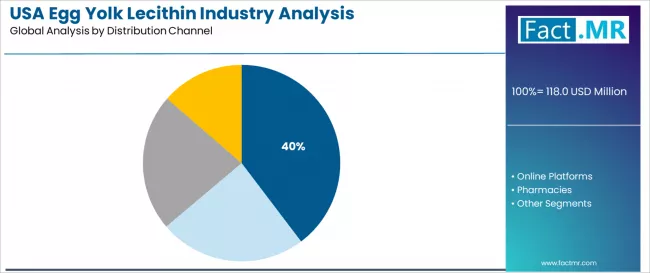
Health food stores contribute 39.7% of all egg yolk lecithin distribution in the USA in 2025. Health retailers use egg yolk lecithin distribution for specialized retail competency including proper product positioning, wellness guidance expertise, and customer service knowledge to sustain effective and consistent operations.
In the USA and North America, health food store applications serve diverse consumer needs where wellness retail provides optimal accessibility and product education. Advanced retail operations rely heavily on standardized egg yolk lecithin protocols that integrate product specifications, wellness parameters, and comprehensive customer guidance to maintain retail standards.
The segment also benefits from robust wellness awareness supporting egg yolk lecithin benefits and sustained demand from consumers seeking cognitive, health enhanced supplement alternatives. Despite competition from online alternatives, health food store demand is sustained by superior wellness guidance, retail advantages, and strong consumer preference for expert wellness solutions.
Health food stores’ superior wellness guidance and retail accessibility make it a major distribution channel for egg yolk lecithin demand.
Ongoing consumer education and wellness development programs drive sustained demand across health food store applications.
What are the Drivers, Restraints, and Key Trends of the USA Egg Yolk Lecithin Industry?
The USA egg yolk lecithin segment is advancing steadily due to continued USA egg yolk lecithin activities and sustained recognition of wellness and cognitive benefits, with USA serving as a mature demand region with focus on phospholipid processing innovation and consumer access.
The industry also faces challenges including higher production costs for some phospholipid methods, need for consumer education about wellness benefits, and varying functionality levels compared to conventional lecithin alternatives and traditional supplementation systems. Novel phospholipid development initiatives and wellness processing programs, particularly advanced in American operations, continue to influence product specifications and consumer acceptance patterns.
Expansion of Wellness Enhancement and Health Ingredient Trends
The growing adoption of wellness enhancement formulations and health ingredient consumption, gaining significant traction in the USA and health-focused consumer areas, is enabling egg yolk lecithin to access mainstream positioning segments without extensive marketing requirements, providing improved wellness appeal and enhanced health benefits.
Health-focused consumers equipped with wellness awareness services offer product adoption and health positioning while allowing processors to enhance products based on wellness values. These trends are particularly valuable for cognitive enhancement and health processing applications where consumers require wellness options without extensive conventional limitations or traditional phospholipid restrictions.
Integration of Advanced Phospholipid and Processing Technologies
Modern health processors, led by American and specialty companies, are incorporating advanced phospholipid systems and processing technologies that provide improved wellness profiles, enhanced bioactive characteristics, and superior processing performance. Integration of phospholipid innovations, standardized processing protocols, and comprehensive quality monitoring enables more effective wellness delivery and reduced application complexity.
Advanced phospholipid technologies also support next-generation processing paradigms including commercial applications and enhanced functionality optimization that eliminate traditional usage limitations, with American processing practices increasingly adopting these technologies to meet consumer preferences for versatile wellness enhancement and application convenience.
Analysis of the USA Egg Yolk Lecithin Industry by Key Regions
Region
CAGR (2025-2035)
West
4.8%
Northeast
4.6%
Midwest
4.3%
South
4.2%
The USA egg yolk lecithin landscape is witnessing steady growth, supported by sustained consumer awareness, wellness consciousness, and the integration of egg yolk lecithin approaches across regions. West leads the country with a 4.8% CAGR, reflecting strong concentration of health-focused consumers, early adoption of egg yolk lecithin, and robust health networks supporting consumer access.
The Northeast region follows with a 4.6% CAGR, driven by wellness awareness and expanding health processing infrastructure that enhances consumption opportunities. Midwest grows at 4.3%, as established wellness systems continue integrating egg yolk lecithin protocols across consumer and distribution practices.
West Leads American Growth with Wellness Innovation and Health Focus
Demand for egg yolk lecithin in the West region is projected to exhibit steady growth with a CAGR of 4.8% through 2035, driven by ongoing USA egg yolk lecithin operations across health processing facilities, wellness companies, and integrated health applications, concentration of health-focused consumers and wellness enhancement advocates, and increasing adoption of premium phospholipid systems and powder format enhancement technologies.
As the leading American region with the highest growth rate, the area’s emphasis on wellness innovation and comprehensive health networks is creating consistent demand for advanced phospholipid solutions with proven health features and wellness performance profiles. Major health processing companies and wellness-focused retailers are establishing comprehensive supply protocols to support wellness excellence and consumer satisfaction across American operations.
Health consciousness and wellness enhancement culture are creating advanced health demand with comprehensive phospholipid features and processing capabilities throughout USA egg yolk lecithin operations across the West region.
Wellness adoption programs are supporting integration of egg yolk lecithin and powder format enhancement methods that enhance health benefits, reduce conventional limitations, and improve consumer satisfaction across USA egg yolk lecithin activities, positioning West as an American wellness leader.
Northeast Demonstrates Strong American Potential with Health Awareness and Wellness Processing
Demand for egg yolk lecithin in the Northeast region is expanding at a CAGR of 4.6%, supported by extensive USA egg yolk lecithin operations in health processing facilities, wellness companies, and health-focused processing activities.
The region’s health processing sector, representing a crucial component of American wellness service delivery, is experiencing growth driven by health awareness, phospholipid ingredient education, and rising health ingredient consciousness. Health-focused wellness processors and health companies are maintaining comprehensive supply programs to serve expanding USA egg yolk lecithin activities throughout Northeast and broader national demand.
Health awareness and health processing infrastructure development are creating opportunities for suppliers that can support expanding consumer volumes and diverse wellness settings including health processing facilities and health-focused consumers across Northeast and American territories.
Phospholipid ingredient education integration programs are enhancing product adoption among health processing practitioners and health consumers, enabling comprehensive egg yolk lecithin utilization that meets health expectations and consumer wellness requirements, strengthening Northeast’s position within American wellness delivery.
Midwest Maintains Growing Performance with Health Manufacturing and Regional Integration
Demand for egg yolk lecithin in the Midwest region is growing at a CAGR of 4.3%, driven by established USA egg yolk lecithin operations in health manufacturing facilities, processing chains, and distribution networks.
The region’s health manufacturing sector, an integral part of American wellness production delivery, is maintaining expanding phospholipid ingredient availability through growing processing networks and comprehensive distribution coverage. Health manufacturers and phospholipid representatives are sustaining phospholipid education and product availability to address increasing consumer requirements and support Midwest health operations.
Health manufacturing presence is facilitating adoption of egg yolk lecithin protocols that support comprehensive USA egg yolk lecithin capabilities across health operations and coordinated distribution networks, maintaining Midwest’s integration within American wellness production delivery.
Phospholipid ingredient implementation programs are enhancing phospholipid consistency among health practitioners, enabling wellness delivery that meets health standards and consumer outcome expectations in expanding American health operations.
South Demonstrates Steady Performance with Wellness Focus
Demand for egg yolk lecithin in the South region is advancing at a CAGR of 4.2%, supported by USA egg yolk lecithin operations in wellness facilities, health companies, and established distribution systems.
The region’s wellness infrastructure and health-focused consumption are maintaining steady egg yolk lecithin volumes. Wellness distributors are serving consumer populations through established supply networks and comprehensive wellness relationships.
Wellness concentration and health-focused consumption are sustaining product availability and reliable consumer access capabilities that support consumption advancement across South territories.
Established wellness networks and mature health coverage policies are maintaining reliable product access and consistent health delivery standards throughout wellness and health settings.
Competitive Landscape of the USA Egg Yolk Lecithin
The USA egg yolk lecithin landscape is defined by competition among specialty processors, health ingredient companies, and wellness-focused suppliers, with American and international companies maintaining significant influence.
Health ingredient companies offering phospholipid ingredients are investing in advanced phospholipid techniques, quality assurance programs, wellness enhancement pathways, and comprehensive consumer education networks to deliver reliable, high-quality, and wellness enhanced phospholipid solutions across the USA and international operations.
Strategic partnerships, wellness innovation certification development, and consumer education programs are central to strengthening product portfolios and presence across USA and international health ingredient processing applications.
NOW Foods, an American health ingredient company holding a 17.9% share, offers comprehensive USA egg yolk lecithin solutions including dietary supplement product lines, enhanced phospholipid technologies, and quality assurance programs with focus on wellness functionality, health, and consumer partnership across American and regional operations.
Lecico GmbH, operating as a major health ingredient company with focus on phospholipid products, provides established USA egg yolk lecithin products, advanced phospholipid innovations, and consumer education resources with emphasis on application differentiation and processing excellence.
Lipoid GmbH, health ingredient processing company with American distribution presence, delivers comprehensive egg yolk lecithin products including specialty formulations and complementary phospholipid ingredients serving American and regional consumer populations. American Lecithin Company, health ingredient brand with proven phospholipid expertise, emphasizes premium phospholipid solutions with strong wellness performance and reliable health formats for American and regional consumers.
NOW Foods, Lecico GmbH, Lipoid GmbH, American Lecithin Company, Cargill Inc., Archer-Daniels-Midland Company, Kewpie Corporation, Thorne Health, Source Naturals, Swanson Health Products
Additional Attributes
Dollar sales by application, form, distribution channel, end-user, regional demand trends across American regions including West, Northeast, and Midwest, competitive landscape with established specialty processors and health ingredient companies, consumer preferences for wellness and health phospholipid formats, integration with quality assurance protocols and health safety systems particularly advanced in American health processing settings, innovations in phospholipid technologies and wellness enhancement programs, and adoption of health-focused positioning platforms, wellness innovation certification programs, and quality assurance protocols for enhanced wellness delivery and consumer satisfaction across American health processing operations
The development of Mutuum Finance appears to be on track, as the first version of the lending and borrowing protocol is slated for launch on Sepolia testnet within the current quarter. The first version launch will enable the essential DeFi features, such as collateral lending, borrowing, as well as the creation of yields. The fact that the testnet has been successfully implemented is a huge step towards creating a fully functional, self-regulating, and decentralized environment. The project has gained immense popularity, a huge following, and has achieved several development milestones, putting Mutuum Finance on the top of the list as one of the pioneers in DeFi, offering investors an opportunity to own the best crypto to buy and positioning it as the next crypto to explode for long-term gains.
Mutuum Finance has raised over $18.58 million from 17,850+ investors, while Phase 6 is nearly sold out, having surpassed 85% sales, at a token price of $0.035. The lending, leverage, and risk management system, along with staking rewards, as well as the impending Sepolia testnet, provides MUTM a clear use case in DeFi. Another chance to buy tokens, as adoption begins, is available as it enters Phase 7, which boosts the token price to $0.04.
Take action today to be a part of the presale in Mutuum Finance, positioning yourself for strong potential returns in the future crypto market cycle, as it continues to be the next crypto to explode and the best crypto to buy in 2025.
A new investigation tested 23 protein powders and ready to drink shakes sold in the United States. More than two thirds exceeded what its experts consider safe for lead in a single serving.
Plant based lines posted the highest averages. The watchdog also flagged specific products with especially high results.
CR measured higher lead in plant based powders than in animal based ones. On average, levels were about nine times whey and twice beef.
Two products stood out for the highest measured lead. Naked Nutrition Vegan Mass Gainer and Huel Black Edition were labeled products to avoid.
Tunde Akinleye, a Consumer Reports food safety researcher, led the testing project. His team compared single serving exposures across popular formulas.
“Quite disappointed to see the results,” said Pieter Cohen of Harvard Medical School (HMS). He was not involved in the testing.
How lead gets in protein powder
Plants take up minerals and contaminants from soil and water. That is why plant based powders can show higher lead than whey or beef based products.
One driver is legacy pollution in soils used to grow peas, rice, and other protein crops. Bioaccumulation, gradual build up in living tissues, can raise levels along the food chain.
“The plants can absorb more lead than usual,” Cohen said. His point helps explain why plant based averages ran higher in the new data.
Companies dispute the implications, and they emphasize testing. Huel said its products are “completely safe to consume,” and that they meet international safety limits.
What counts as safe exposure
California’s Proposition 65 sets a MADL for lead at 0.5 micrograms per day. This level aims to protect against reproductive harms.
CR used that daily limit as its benchmark for a single serving. That choice is conservative, and it reflects the view that less exposure is better.
Lead can persist in bones for months to years. Lowering intake helps keep long term body burden down.
CR also screened for other metals of concern. Some products contained cadmium and inorganic arsenic, which further underscores the need for careful sourcing.
Lead rules for protein powder
Supplements reach shelves without routine premarket approval by the Food and Drug Administration. The agency’s own answers explain that FDA does not approve dietary supplements before marketing.
CR urged federal action to set strict limits for lead in protein products. Regulators do act in some food categories, and those moves can be instructive.
In January 2025, FDA issued final guidance that set action levels for lead in processed baby foods. The policy describes nonbinding thresholds that FDA may use in enforcement.
Company responses highlight another wrinkle. Serving size varies widely, which can push total exposure higher even when per gram concentrations look similar.
Chronic exposure to heavy metals is linked to long term neurological, cardiovascular, and developmental problems.
Even small daily doses can pose risks because these metals build up faster than the body can remove them. Medical researchers warn that exposure levels considered “safe” decades ago may no longer reflect current scientific understanding of low dose toxicity.
Public trust in supplements depends on credible oversight. When safety standards lag behind scientific findings, consumers are left to navigate risk on their own.
Setting enforceable limits for lead, cadmium, and arsenic would not only protect health but also reward responsible manufacturers that already meet stricter voluntary standards.
Reading labels without getting lost
Check serving size first. A weight gainer meant for athletes can deliver far more total powder per shake than a standard scoop.
Scan the ingredient source. Pea, rice, and mixed plant proteins can be fine, but crops grown in certain soils may carry higher background lead.
Look for independent verification on the label. Certifications such as NSF Certified for Sport or Informed Choice signal extra testing, though no logo guarantees zero lead.
Rotate your protein sources when you can. Whole foods like dairy, eggs, fish, beans, and poultry can cover daily protein needs for most people.
Lessons from lead in protein powder
If you rely on protein powder, aim for brands that publish batch testing and explain their sourcing. Favor products that keep the serving size reasonable for your goals.
Treat a shake as a convenience, not a diet foundation. Most healthy adults can meet protein targets through balanced meals.
If you choose plant based powders, consider alternating among sources over the week. Variety helps spread potential exposures across different supply chains.
Keep the broader picture in mind. A steady pattern of low exposure is safer than cyclical spikes created by oversized scoops.
—–
Like what you read? Subscribe to our newsletter for engaging articles, exclusive content, and the latest updates.