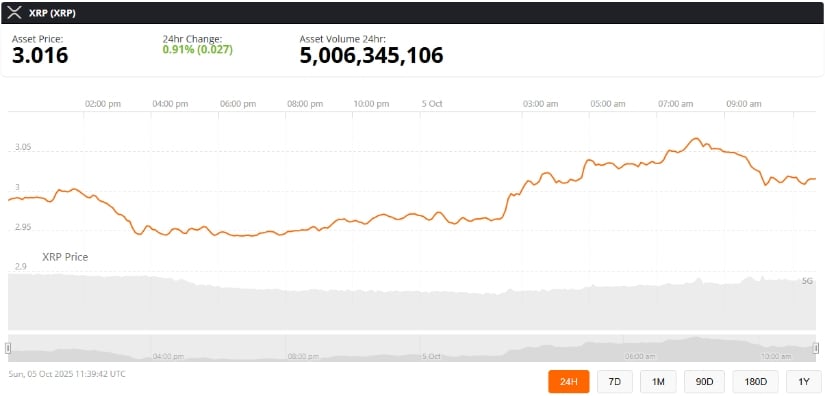
The XRP price today continues to show strength, hovering near the crucial $3.05 level after rebounding from weekend lows around $2.95.
According to Brave New Coin data, XRP regained the $3 mark in early Asian trading on October 5, 2025, following a high-volume flushout that cleared overleveraged positions. The move was quickly met with strong buying interest from whales and retail traders alike.
Analyst Kamran Asghar highlighted a head-and-shoulders reversal pattern forming on the XRP/USDT daily chart, identifying the $3.70 neckline as a key breakout level. The analysis suggests that a move above this threshold could confirm a bullish reversal pattern, potentially paving the way for an advance toward the $4.00–$4.20 zone.
The current XRP price faces resistance between $3.10 and $3.30, a range now viewed as the market’s key battleground. A sustained close above this area could open the path to the $4.00–$4.20 region, where many traders expect the next leg of upward momentum.
Analysts are closely monitoring XRP’s $3.70 neckline for signs of a potential bullish reversal. Source: @Karman_1s via X
From a technical perspective, XRP maintains a bullish structure on higher timeframes. The inverse head-and-shoulders neckline at $3.70 remains the central focus for analysts projecting a potential rally toward $4.80. On-chain data shows increasing whale accumulation during the recent correction, with exchange inflows topping 160 million XRP tokens in the past week.
The RSI indicator currently sits in the mid-50s, suggesting a neutral-to-bullish bias, while the MACD inches closer to a bullish crossover — both signaling growing buying pressure.
XRP ETF Speculation Adds Fuel to the Rally
October’s market optimism is being shaped by growing anticipation around potential XRP spot ETF approvals. Reports from Cointelegraph and Nasdaq highlight that seven Grayscale XRP ETF applications remain under review, with an October decision window that could serve as a “binary event” for the fourth quarter.
XRP was trading at around $3.01, up 0.91% in the last 24 hours at press time. Source: XRP price via Brave New Coin
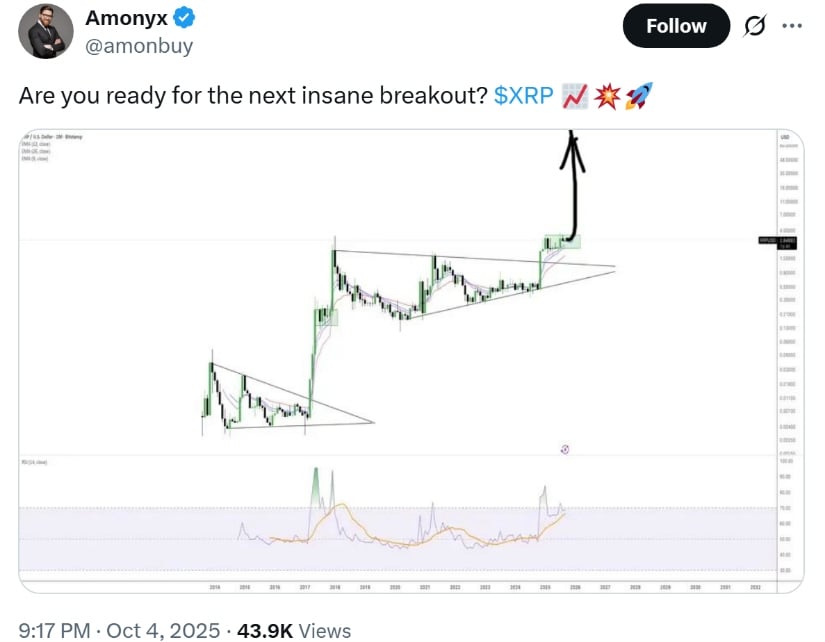
Crypto trader @amonbuy shared a logarithmic XRP price chart covering 2013–2025, pointing out an ascending triangle pattern forming near $3—historically a bullish continuation setup. The analyst suggested that ETF-related developments could “amplify institutional inflows and send XRP toward $5.89 if momentum sustains.”
However, some market participants remain cautious, citing XRP’s volatile history and previous delays tied to the SEC lawsuit. While trading volume is down 15% year-over-year, the price of XRP continues to hold above $2.80—a sign of underlying demand and resilience.
Ripple’s Global Expansion Strengthens Long-Term Outlook
Beyond the charts, Ripple’s latest partnerships and ecosystem developments continue to reinforce confidence in Ripple XRP fundamentals. In Japan, Ripple’s strategic partner SBI Holdings recently expanded its XRP-backed lending program, strengthening the asset’s utility across Asian financial markets.
This expansion aligns with Ripple’s broader goal of improving cross-border payment efficiency through the XRP Ledger, a key component of its long-term roadmap. Analysts believe that increased institutional integration in Asia could serve as a major tailwind for XRP adoption.
Key Levels to Watch and Market Drivers
In the short term, traders are monitoring whether XRP can maintain closes above $3.00 and establish a higher base toward $3.30–$3.50. A successful breakout above $3.70 would likely confirm the head-and-shoulders reversal and signal the start of a sustained bullish trend.
Analyst @amonbuy highlights a potential XRP breakout, citing a long-term chart showing an ascending triangle near $3 that signals growing bullish momentum. Source: Amonyx via X
Meanwhile, broader market sentiment remains influenced by macroeconomic factors such as the Federal Reserve’s dovish policy stance and renewed liquidity inflows from Asian markets — both of which could bolster risk appetite across the crypto sector.
Support and Resistance Summary
Support: $2.95–$3.00 zone remains the short-term floor.
Resistance: $3.30 immediate barrier; breakout zone near $3.70.
Target Range: $4.00–$4.80 if neckline breakout holds.
Outlook: Cautious Optimism Ahead of Key ETF Decision
As traders await the SEC’s October 18 decision on pending ETF filings, XRP’s price dynamics may continue to fluctuate sharply. While bullish sentiment dominates social media discussions, analysts urge caution until the market confirms a decisive breakout above the $3.70 neckline.
Still, the broader narrative remains constructive. With Ripple’s legal clarity post-XRP SEC lawsuit, growing institutional interest, and expanding global partnerships, many traders view XRP as one of the top altcoins to watch in Q4 2025.
Bookmark our real-time updates to stay ahead of USD/JPY volatility.
USD/JPY Outlook: Economic Indicators and the BoJ
Bullish Yen Scenario: Upbeat Japanese data or hawkish BoJ rhetoric could drag USD/JPY toward 145.
Bearish Yen Scenario: Weaker data or dovish policy signals may send the pair toward 150.
The US economic calendar will likely determine the likelihood of an October Fed rate cut this week. Labor market data, consumer sentiment, and Fed speakers will be in the spotlight.
Key events include:
Initial Jobless Claims (October 9): Expected to increase from 218k (week ending September 20) to 223k (week ending September 27).
Michigan Consumer Sentiment (October 10): Forecast to fall from 55.1 in September to 55.0 in October.
Nonfarm Payrolls (provisionally October 10): Expected to increase by 39k in September after a 22k rise in August.
Unemployment Rate (provisionally October 10): Forecast to remain at 4.3% in September.
Average Hourly Earnings (provisionally October 10): Expected to rise 3.7% year-on-year in September, mirroring August’s increase.
Weaker-than-expected US labor market data and consumer sentiment could fuel bets on aggressive Fed rate cuts. A more dovish Fed rate path would weigh on the US dollar and the USD/JPY pair.
On the other hand, stronger-than-expected labor market data and an upswing in consumer confidence could signal a less dovish Fed policy stance. Fading bets on multiple Fed rate cuts in the fourth quarter would lift US dollar demand and send USD/JPY higher.
Traders should be aware that the labor market data may face more delays if lawmakers fail to pass a stopgap funding bill. The US government shutdown postponed last week’s jobless claims data and the US jobs report.
Beyond the data, traders should also monitor Fed speeches, including remarks from Fed Chair Powell on Thursday, October 9. There is also a wave of Fed speakers scheduled throughout the week and the FOMC meeting minutes to consider.
Short-term Forecast:
Bullish US Dollar Scenario: Strong US economic data or hawkish Fed rhetoric may send USD/JPY toward 150.
Bearish US Dollar Scenario: Weaker US data or dovish Fed signals could push USD/JPY toward 145.
USD/JPY Price Action
Daily Chart
On the daily chart, USD/JPY trades below the 50- and 200-day Exponential Moving Averages (EMAs), signaling a bearish bias.
A breakout above the 50- and 200-day EMAs could pave the way toward the 149.358 resistance level. A sustained move through 149.358 may bring the August high of 150.917 into play.
On the downside, a break below last week’s low of 146.585 could expose the crucial 145 support level. If breached, the July low of 142.681 would be the next key support level.
As October unfolds, crypto markets are buzzing with two names on everyone’s lips: Solana and Remittix. On one side, Solana is gaining traction as excitement builds around a potential ETF approval, sparking bullish price forecasts. On the other hand, Remittix (RTX) is rewriting the playbook for presale success, crossing the 40,000-holder milestone while raising over $27 million. This leaves many analysts wondering: Should you choose Remittix or Solana?
Solana Price Prediction
SOL price has gone up to $229. For this to hold, bulls must pass $230; passing this price could allow Solana to reach $240–$245. However, many analysts warn that if the token falls back to $222–$223, SOL could slip back to $215 or even $205.
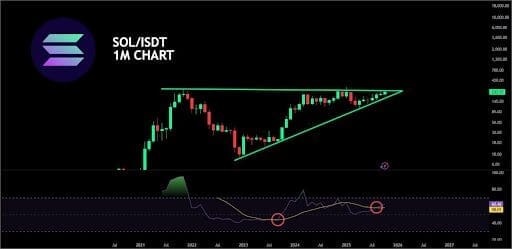
The bigger Solana price prediction for October and beyond is even more ambitious. Popular analyst Ali Martinez suggested Solana could hit $520 if it passes $260. Technical indicators like the ascending triangle and RSI golden cross support this outlook, fueling speculation that Solana’s next leg up could be historic.
In its ongoing presale, Remittix has attracted over 40,000 holders and raised more than $27 million through the sale of 675 million tokens at $0.1130 each. The Remittix Wallet has also been in Beta Testing for over 15 days. A second update is already being rolled out to integrate improvements suggested by testers. On top of that, Remittix has successfully passed a CertiK audit.
The project’s referral program also adds a unique revenue stream for community members. Each referral earns users 15% back in USDT, claimable daily through the dashboard. Also, the Remittix Web App is close to launch. Once integrated fully into the Remittix Wallet, this will mark a major milestone for the ecosystem and its growing utility.
Positioned to change the global remittance market, targeting trillions in transaction value.
Web App nearing launch with crypto-to-fiat functionality, expanding real-world adoption.
What’s the Verdict?
As Q4 heats up, Solana price prediction updates keep traders glued to charts, while Remittix breaks records by securing over 40,000 holders and $27 million in funding. For investors looking to balance short-term opportunities with long-term potential, these two names are impossible to ignore this quarter.
Discover the future of PayFi with Remittix by checking out their project here:
Crypto analysts are now dropping in numbers as the Dogecoin price shows signs of a potential return to a high zone before the end of this year. However, the current Dogecoin price prediction suggests that the coin may still be in a zone for slow growth.
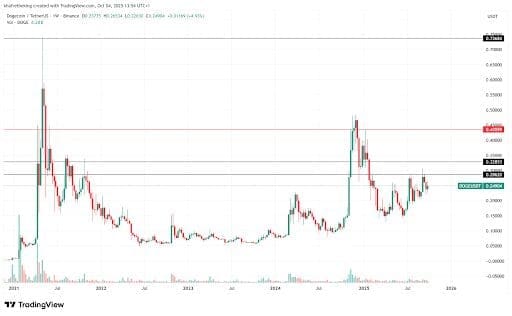
The Dogecoin price has maintained an upper and lower bound between $0.26 and $0.24 over the last two weeks. While the general outlook maintains the coin’s potential for a continuous upward move, can this surge propel the coin to $1 soon?
Let’s take a firsthand look at the XRP price prediction and the factors that could contribute to the coin reaching $1.
Why Dogecoin Price Prediction Could Be Over-Projecting This Quarter
The return of the Dogecoin price to a positive upward trend is fueling a resurgence of market confidence. However, this new sentiment could also be fueling market over-projection, with some Dogecoin price predictions already predicting a price of $1.
According to some bullish analysis, the Dogecoin price crossing the $0.33 resistance could take it to $1 by year’s end. However, proper analysis suggests that this Dogecoin price prediction may be far from possible this year.
While the price dynamics in the last few years have seen the Dogecoin price create some strong resistance, the change in investor sentiment is another factor to consider. These technical and fundamental factors are already revealing flaws in the Dogecoin price predictions.
The Dogecoin price prediction failed to recognize the strength of the $0.28, $0.32, $0.43, and $0.73 resistance levels, which have now created a significant barrier for the coin. However, even if the price can scale this resistance, investor interest in utility tokens presents another hurdle to overcome.
What Could Give Remittix Price An Edge Over The Dogecoin Price Prediction
Remittix has emerged as a market gem over the last few months, but experts say it could become even bigger this quarter. This is due to its high utility, which gives it an edge over other cryptocurrencies like Dogecoin.
Additionally, with the Remittix wallet testing set to conclude soon and an official launch on the horizon, experts predict that the Remittix token could surpass Dogecoin’s $1 mark. However, according to market analysis, it is even further revealed that the rate could be even faster than we currently think.
While the Dogecoin price growth has faced significant limitations due to investors shifting to utility coins, Remittix could see a boost more quickly with its strong utility. The Remittix utility is designed to make payments easier, which is driving a new sentiment in the market. But the main points of this sentiment include:
Fast and cheaper crypto-to-fiat conversion to more than 30 fiat currencies
Support for more than 50 crypto pairs in instant payment transactions, which can be paid directly into a bank account
The Remittix use case is designed to benefit both individuals and businesses, which is capable of sending its adoption to a record high immediately after launch
Discover the future of PayFi with Remittix by checking out their project here:
I used to proudly eschew health supplements. Doctors always told me that if you eat a healthy diet, you’d only be flushing money down the loo. Studies showed that people who popped multivitamins didn’t live any longer, with some even dying a little younger – a 4% higher mortality risk according to one just last year. But now I’m unequivocally post youth, my supplement intake has crept up to four a day: vitamin D (by NHS decree), magnesium (for sleep, muscle relaxing, brain and stress; pretty sure it’s helping), lion’s mane mushroom (cognition; no idea if it’s working), biotin (hair health; ditto) and I’m considering crowbarring more in if I can afford them. Am I a total sucker, though? Do women really need to start taking supplements when they hit middle age?
“There are plenty of reasons why we might need supplements as we age,” says Claire Pettitt, a specialist women’s health dietitian, who works in the UK and Singapore. “It’s not drastic, as if all of a sudden we need a drip,” she says. “But as we age, our body doesn’t work as well, and there are some nutrients, such as vitamin B12 and calcium, that we start to absorb much less efficiently as we get older.”
Hormonal changes are another valid reason to take supplements, she says, because waning oestrogen “impacts so many parts of the body, whether that’s our bone health, our metabolism, cardiovascular disease risk or muscle mass, and there are various nutrients that will help reduce all of those disease risks.” That said: “There’s no blanket. You’re entering perimenopause; you’re going to be deficient in all these things.”
Before considering any supplements, it’s best to take a cold, hard look at eating habits. “We might have poor dietary patterns, especially in middle age, where we’re that sandwich generation and our time is not our own and we don’t always put ourselves first,” says Pettitt. Social ideals around body size and diet often encourage drastic measures, such as ditching meals for a buzzy green smoothie, or cutting out dairy. “Sometimes fad diets end up meaning you don’t have a balanced diet.”
Another basic consideration to master, saysNichola Ludlam-Raine, a specialist dietitian and author of How Not to Eat Ultra-Processed,is consuming an adequate amount of protein: “About 1.6g per kilogram of ideal body weight a day, spaced throughout the day.” (Ideal body weight meaning what a person would weigh with a BMI between 18 and 25.) If you’re really active, up to 2g per kg is good, she says, “alongside resistance training, two to three times a week, for bone health and muscle mass preservation”.
Getting enough fibre is fundamental too, she says, “because if you look after your gut, it will support almost every single bodily function, from immunity to mood”. It will also help your friendly gut microbes digest and produce more nutrients – an in-house supplement factory, if you will.
‘The most common thing a woman would need to supplement is vitamin D, which is crucial to bone health,’ says Claire Pettitt. Photograph: Posed by model; Olga Pankova/Getty Images
How to spot deficiencies
Our bodies will usually tell us if they’re not getting what they need. “I think we lose the skill of paying attention to our body. We’re too busy,” says Pettitt. “It’s noticing when things change, like if you’ve got fatigue, muscle weakness or hair loss, which could all reflect any number of micronutrient deficiencies.”
Looking at your lifestyle, medications and dietary patterns can also provide clues. “If you’re vegan, you might need a supplement with B12,” says Ludlam-Raine. “Or if you’re on a proton pump inhibitor [to reduce stomach acid] or metformin [for type 2 diabetes], they can reduce absorption.” It’s easy to inadvertently lower calcium intake by switching to organic plant-based milks. “These are not fortified with calcium and iodine,” says Ludlam-Raine. “Calcium is essential for bone health. Iodine is essential for thyroid function. So I would say to menopausal women: go for dairy, or maybe a fermented dairy like kefir, or go for a fortified milk alternative.”
Women can bleed more heavily during perimenopause, which could cause iron deficiency. Another question Pettitt would ask is whether you have digestive health issues, “like coeliac disease or anything that impacts absorption of nutrients”.
Serious deficiencies can usually be verified with a blood test. “See a dietitian, a doctor, get some blood tests done to look for black-and-white evidence,” says Pettitt.
Which supplements work?
“The most common supplement a woman would need is vitamin D, which is crucial to bone health, immunity, muscles and even your hormones,” says Pettitt. General advice is to take it during autumn and winter, but if you have darker skin, wear high SPF or are covered up when you go out, consider taking it all year, says Ludlam-Raine. “A lot of my patients, especially if the BMI is above 30, are deficient. Look to take a minimum of 10mcg (400IU) of vitamin D (vitamin D3 is more effective than D2) – a supermarket own-brand will do!”
Pettitt has had a flurry of questions about magnesium from clients lately. “It has been used a lot in the past for muscle relaxation, if you get cramps. Muscle health is important in our nerve stimulation, so it’s part of our nervous system. It’s important for that, brain health, and helps with sleep and stress.”
Ludlam-Raine bought some for herself – a mix of three types commonly sold together. Sounds like a no-brainer, although Pettitt says you might not need it if you eat a wholegrain diet along with nuts, avocado and black beans. “I often say: what’s your baseline?” says Pettitt. “Where are we at with our lifestyle? And can you make these changes and see if they make any difference? If you want to try it, try it, but are you going to monitor your symptoms?”
If you don’t eat oily fish at least once a week, your omega-3 might need supplementing Photograph: Vicuschka/Getty Images
“The problem I often see is people start all these supplements at the same time,” says Pettitt. She recommends starting each one in isolation for four to six weeks, ideally three months, “depending on what you’re trying to change. You can’t necessarily expect a change in your mental health overnight with a supplement.”
If you don’t eat oily fish at least once a week, your omega-3 might need supplementing. “Omega-3 is a powerful anti-inflammatory,” says Pettitt. “It’s going to help minimise your risk of cardiovascular disease. It’s also important for brain health, joint health, and all of these are changing as we age and go through menopause.” She says it doesn’t matter what kind of supplement you take, “because obviously there are all these different ones, saying all the other ones are rubbish. You want to get enough EPA and DHA [two of the three types of fatty acid that are known as omega-3s], but choose a brand that’s third-party tested.” This means the product’s ingredients have been independently verified.
Other claims you’ll see on expensive supplements include “food grown” and “micronised”, both promising superior absorption, but Pettitt cautions that these terms are ambiguous, with no standardised definition, and can be misleading. “‘Food grown’ refers to supplements that claim to be derived from whole foods or fermented ingredients, as opposed to synthetic or isolated nutrients, and therefore might be better absorbed or more bioavailable to the body because they contain other naturally occurring cofactors, like enzymes, phytonutrients, or other beneficial compounds,” she says. “However, this is not always true, and some supplements that are labelled ‘food grown’ are actually highly processed, or may not be more easily absorbed.” Similarly, micronised is often more of a marketing term “than a scientifically validated claim. The goal is to make nutrients more bioavailable, but whether this process improves absorption or effectiveness is often unclear or lacks robust evidence.”
Ludlam-Raine agrees: “For most people, the key is taking the right nutrient in the right dose for their needs. My advice is always to focus first on getting nutrients from food where possible, and use supplements when needed as a top-up or safety net. Paying more for ‘micronised’ or ‘food-grown’ versions isn’t usually necessary.”
Fibre powders and probiotics (live microbes) have become popular, as health advice increasingly focuses on the gut, but Pettitt believes we should prioritise packing these into our diets. “Foods that have fibre bring so much more. If you eat lots of fruits and vegetables, you’re getting all the micronutrients, antioxidants, anti-inflammatories, the phytochemicals (plant chemicals) that bring benefit to our bodies. Most people should be eating more fruits and vegetables.”
Ludlam-Raine does try to take a probiotic when she remembers, but this is in addition to eating naturally probiotic fermented foods. She believes that “in the future, the UK will have recommended servings a day, like ‘five-a-day’ for ferments”. Kimchi, sauerkraut, miso, natural yoghurts all count. “I think kefir is almost the most acceptable and versatile. You can have it for breakfast; as a snack.”
Collagen is, says Pettitt, “a really trendy one. Most of its evidence is around joint and bone health, which is important in perimenopause, and as we age.” It’s increasingly touted as a brain-health boost too, but she says there’s not as much evidence for that yet. “You could probably try it and see if it makes any difference.” Ludlam-Raine is turning 40 next birthday and has started taking it for her skin health. It certainly won’t do her any harm. “It is such a safe supplement and a bit of a protein boost.”
Ludlam-Raine often works with people who have had bariatric surgery for obesity, of which hair thinning can be a side-effect – but hair loss can also be caused by dropping oestrogen levels in perimenopause. “Biotin is a really popular supplement for this,” she says. She only recommends it in cases where a biotin deficiency has been identified through a blood test, “which is what the evidence supports for hair health, but I would suggest people focus on a food-first approach: eggs, salmon, nuts, seeds, sweet potatoes, legumes, mushrooms and avocados, etc”. But as it’s water soluble and we don’t store it in the body, she is not against people trying the supplement, “just in case it may help”, as long as they remember to stop taking it three days before blood tests, as it can skew some results.
As for my lion’s mane mushroom capsules, Ludlam-Raine says that, while the fungus has been shown to improve cognition and nerve regeneration in some animal trials: “We don’t have large-scale human studies.” But as long as you’re getting a good diet, a supplement won’t cause any harm. “If it makes you feel good, then do it. But don’t do them as a first line. You can’t compare mushrooms to HRT, if that’s been recommended, which we know can help with brain fog.”
“Creatine is having a moment outside of the gym,” says Ludlam-Raine, where it’s known for providing a fuel boost for hard-working muscles. It’s one of the most-studied supplements – and benefits to brain health and cognitive processing are a growing field of interest. Unless you have a kidney condition (in which case, talk to your doctor first), she says: “Taking three to five grams a day is safe, so I almost think, why not give it a go for four weeks and see how it goes?” It’s still worth trying even if you’re not technically deficient, she believes, “because we do use up creatine stores, especially if you’re working out. The research is now quite substantial that shows when you supplement, even if you’ve got a healthy, balanced diet, you may reap these other benefits.”
All manner of vitamins and micronutrients now come in highly palatable gummy form, which on the one hand might mean you’re more likely to take them regularly. But, says Ludlam-Raine, “the sugars in chewables can add up. Check the ingredients and how many you are taking, because it might be like eating half a packet of fruit pastilles.”
Warnings and cautions
It’s easy to think “the more the merrier” with all these wonder-nutrients, but despite the unregulated mega-doses being sold, you can have too much of various supplements, including iron, vitamin A, vitamin D and magnesium. Make sure you don’t take more than you need.
“Pharmacists are such an underutilised resource,” says Ludlam-Raine. “If you have pre-existing medical conditions or you’re taking other prescribed medications or supplements, always double-check with a pharmacist, because there might be some sort of interaction.”
Pettitt cautions against thinking of a supplement as an easy short cut. “It’s often seen as something that we can take control of now, whereas changing your lifestyle, changing your job because it’s too stressful, getting a divorce because you’re not happy in your marriage, those are really big things that take time to change. And actually, it’s much easier to say: right, I’m going to buy this supplement, and it’s going to help me sleep and I’m going to be less stressed.”
Ludlam-Raine thinks people who are feeling chronically under par are vulnerable to “marketing over evidence. I think it’s a case of remembering the pillars of health: your diet, your physical activity, your stress, sleep and also social connection, and just remembering that you need to get the basics right before even considering a supplement.”
The latest HBAR News and Cardano Price Prediction indicate the direction investors are heading now by balancing existing blockchains with new players in the field. Hedera (HBAR) stays in the limelight as a decentralized network aimed at enterprise usage, and Cardano (ADA) remains among the most monitored assets on scalability and smart contracts.
In addition to these names, upcoming projects like Remittix (RTX) https://remittix.io, currently valued at $0.1130, feature in discussions regarding the best crypto to invest in today for massive future returns.
Hedera Market Outlook
Hedera is trading at $0.2192, down 0.5% in the last 24 hours. Its market capitalization is $9.31 billion, supported by $263.62 million of day trading volume, up 0.79%. This reflects that liquidity around the token is firm, even in the context of short-term drawdowns.
Much of the recent HBAR News is dedicated to its model of consensus and institutional adoptability. Hedera’s enterprise orientation towards actual-world applications such as payments and supply chain management makes it a project that is often at the forefront of mind when looking at the most promising long-term crypto investments.
Although price movements remain tame, the enterprise-oriented project ecosystem provides long-term legitimacy.
Cardano Price Prediction and Trends
Cardano is trading at $0.8480, down 1.26% in the last 24 hours, with a market capitalization of $30.35 billion. Its trading volume of $1.4 billion is rising by 3.09%, which suggests continued activity from institutions and traders.
Discussion of Cardano Price Prediction tends to reference the role of ADA in decentralized finance and interoperability. As its smart contract platform was improved and launched, the token remains on investor lists for those looking at the next huge altcoin in 2025.
Cardano is also favored by those who are concerned about low gas costs and scalability, which means it is a blockchain with future prospects.
Why Remittix Is Gaining Momentum
Aside from HBAR and ADA, Remittix (RTX) https://remittix.io is also tested as a low-cap crypto gem with direct real-world usage. RTX enables crypto-to-bank transfers to 30+ nations and is a cross-chain DeFi project developed for utility and not speculation.
The project has already garnered over $27 million, selling over 674.7 million tokens, and has upcoming listings confirmed on BitMart and LBANK. Recent authentication contributes to its legitimacy. Remittix is completely certified by CertiK and is now #1-ranked pre-launch project, highlighting its security focus.
Apart from that, Remittix initiated a $250,000 giveaway and introduced a referral program providing 15% rewards in USDT, another motivating factor for being part of the community.
Key Highlights:
● $27Million+ raised presale with global attraction
● Ranked #1 by CertiK for pre-launch projects
● Future listings on BitMart and LBANK
● Active beta testing of the Remittix wallet
Recent HBAR news and Cardano price prediction updates highlight both tokens as key players in the evolving crypto landscape. Hedera continues to focus on institutional adoption, while Cardano’s development roadmap strengthens its role in DeFi.
Meanwhile, emerging projects like Remittix https://remittix.io are proving that real-world solutions drive genuine investor interest.
For investors evaluating the best cryptocurrencies to buy today, combining established assets like HBAR and ADA with emerging projects such as RTX offers exposure to both proven stability and breakout growth potential in 2025.
Discover the future of PayFi with Remittix by checking out their project here:
This article is for informational purposes only and does not constitute financial advice. Cryptocurrency investments carry risk, including total loss of capital. Readers should conduct independent research and consult licensed advisors before making any financial decisions.
Crypto Press Release Distribution by https://btcpresswire.com
Bitcoin decentralized finance (DeFi), also known as BTCFi, has been touted as the next wave of innovation for the world’s largest cryptocurrency. However, research suggests bitcoin BTC$123,174.51 holders themselves are barely engaging.
Some 77% of bitcoin holders have never tried a BTCFi platform, according to a survey of more than 700 respondents across North America and Europe by BTC mining ecosystem GoMining. Just over 10% reported having experimented once or twice, while only 8% said they actively use BTCFi services for yield or lending.
The survey highlights a stark disconnect between the sector’s promise and its actual reach.
“There’s an enormous appetite for these opportunities, but the industry has built products for crypto natives, not for everyday bitcoin holders,” said GoMining CEO Mark Zalan in a statement.
That appetite shows up in the data: 73% of respondents expressed interest in earning yield on their BTC through lending or staking, while 42% want access to liquidity without selling. Yet hesitation dominates. More than 40% said they would allocate less than 20% of their holdings to BTCFi products, underscoring the sector’s trust and complexity problem.
Awareness Gap
Perhaps most striking is how invisible the industry still is. GoMining found that 65% of Bitcoin holders couldn’t name a single BTCFi project.
Despite millions in venture funding, BTCFi platforms appear to be speaking mainly to themselves rather than the market they’re built to serve.
The report argues that BTCFi’s adoption problem may stem from its reliance on Ethereum’s DeFi model. Bitcoin users, GoMining suggests, are more conservative: they favor custodial services, regulated ETFs and simplicity over self-custody experiments and complex protocols.
“Bitcoin holders aren’t ether ETH$4,547.19 users,” Zalan said. “Coinbase and Bitcoin ETFs succeeded because they prioritized accessibility. BTCFi platforms that focus on education and user experience, rather than complex features, will capture this market.”
For the industry, the survey is both a warning and an opportunity. Millions of Bitcoin holders want the yield and liquidity BTCFi promises, but they need to be met with products they can trust and understand.
However, it should be kept in mind that the survey respondents were a “random selection” of just 700 GoMining users.
GoMining is a digital BTC mining platform that connects users to real-world mining operations through Digital Miners non-fungible tokens (NFTs) and a gamified ecosystem, so the survey’s findings are subject to the extent to which its users represent typical bitcoin users.
“Our user base represents the bitcoin holders universe quite nicely,” a GoMining spokesperson told CoinDesk over email. “More than 80% of our users open their first crypto wallet with us and enter the Bitcoin ecosystem through our digital mining product.”
Last week maintained the dominant trends seen in recent weeks, with major US stock market indices and precious metals breaking to new record or long-term high prices.
Long of the S&P 500 Index after a daily (New York) close above 6,703. This set up at Wednesday’s close, and over the remainder of the week, the price rose by 0.09%.
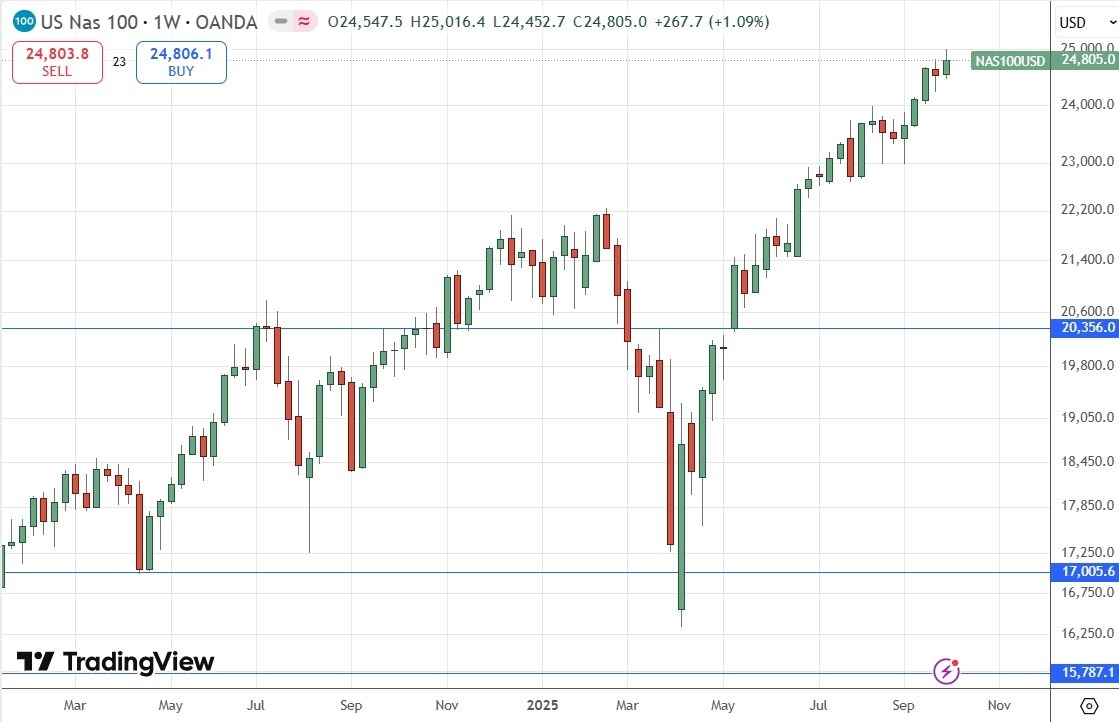
Long of the NASDAQ 100 Index after a daily (New York) close above 24,794. This set up at Wednesday’s close, and over the remainder of the week, the price fell by 0.10%.
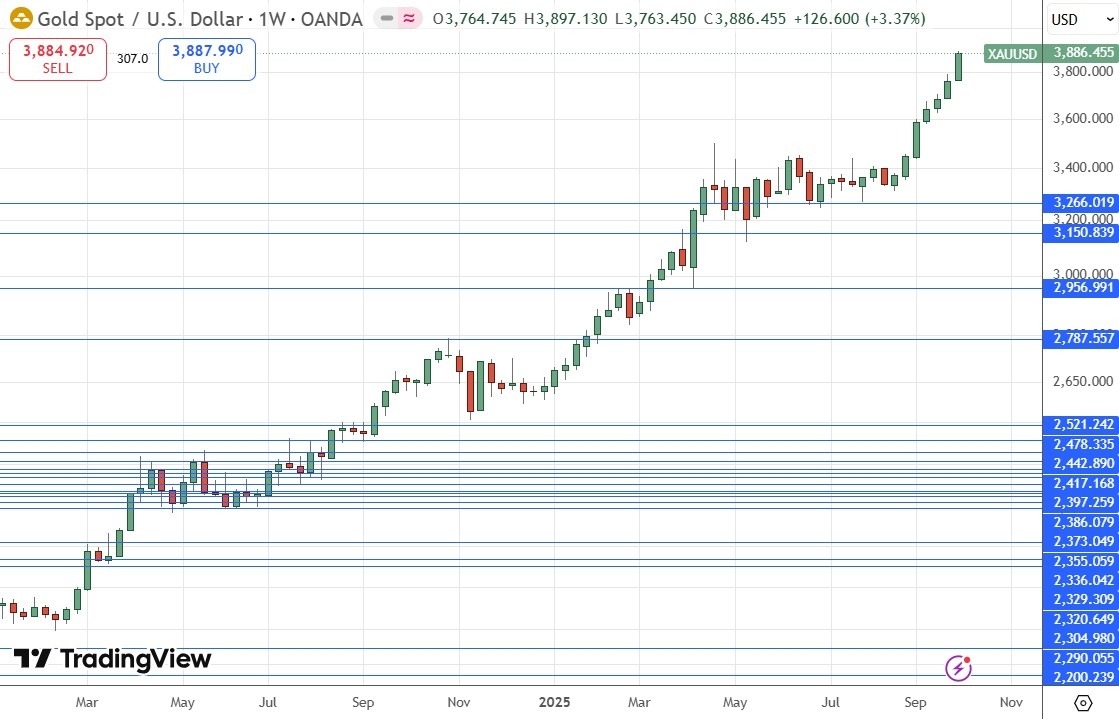
Long of Gold following a New York close above $3,800. This set up at Monday’s close, and over the remainder of the week, the price rose by 1.37%.
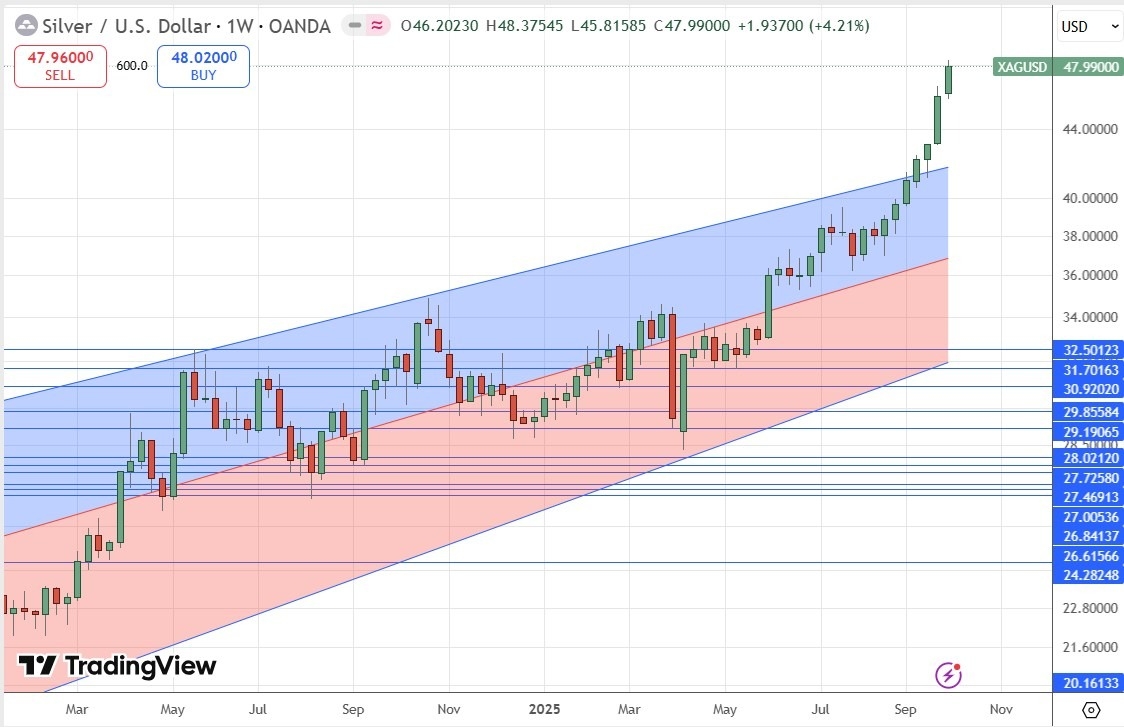
Long of Silver. Silver rose by 3.87% over the week.
These trades produced an overall gain of 5.23%, equal to 1.31% per asset.
A summary of last week’s most important data (some US releases were postponed due to the government shutdown in the USA):
US JOLTS Job Openings – this was a little stronger than expected, suggesting the US economy may be slowing down a little less than was thought.
US ISM Services PMI – slightly worse than expected.
US ISM Manufacturing PMI – as expected.
Reserve Bank of Australia Cash Rate & Rate Statement – the RBA left its Official Cash Rate on hold at 3.60% as expected, was slightly hawkish in its rhetoric.
Swiss CPI (inflation) – contracted by 0.2% month-on-month, as expected.
Chinese Manufacturing PMI – this was approximately as expected.
It was a relatively quiet week in the market, especially concerning themes and perceptions. There is little to say. The US government went into one of its periodic shutdown caused by political deadlock, but these shutdowns have become normalized in recent years and rarely cause much in the markets.
Bullishness remains solid in stock markets, especially in the USA, with major stock indices there continuing to rise to new highs. Precious metals have also been rising strongly, in the case of Gold, to new all-time high prices. The Forex market remains relatively quiet.
This is likely to be a good time to trade or invest, with Silver really taking off, while Gold and major US stock market indices continue to break to new record high prices.
The Week Ahead: 6th– 10th October
The coming week might see more activity in the market, as we have US non-farm payrolls data due which could impact perceptions of where the US economy is headed over the near term. There is also key average hourly earnings due, as well as FOMC minutes and a central bank meeting in New Zealand.
This week’s most important data points, in order of likely importance, are:
US Average Hourly Earnings
US Non-Farm Employment Change
US Preliminary UoM Inflation Expectations
US Preliminary UoM Consumer Sentiment
FOMC Meeting Minutes
Reserve Bank of New Zealand Policy Meeting
US Unemployment Claims
Canadian Employment Change
Canadian Unemployment Rate
It is a public holiday in China on Monday and Tuesday.
Australia moves to daylight savings time at the start of this week.
Monthly Forecast October 2025
Currency Price Changes and Interest Rates
For the month of October 2025, I forecast that the EUR/USD currency pair will rise in value.
Weekly Forecast 5th October 2025
I made no weekly forecast last week.
There were no unusually large price movements in currency crosses last week, so I have no weekly forecast this week.
The Japanese Yen was the strongest major currency last week, while the US Dollar was the weakest. Volatility was unchanged compared to last week, with again only 15% of major pairs and crosses changing in value by more than 1%.
Support 0.7932, 0.7878, 0.7800, 0.7700Resistance: 0.7971, 0.8008, 0.8039, 0.8049
Key Support and Resistance Levels
US Dollar Index
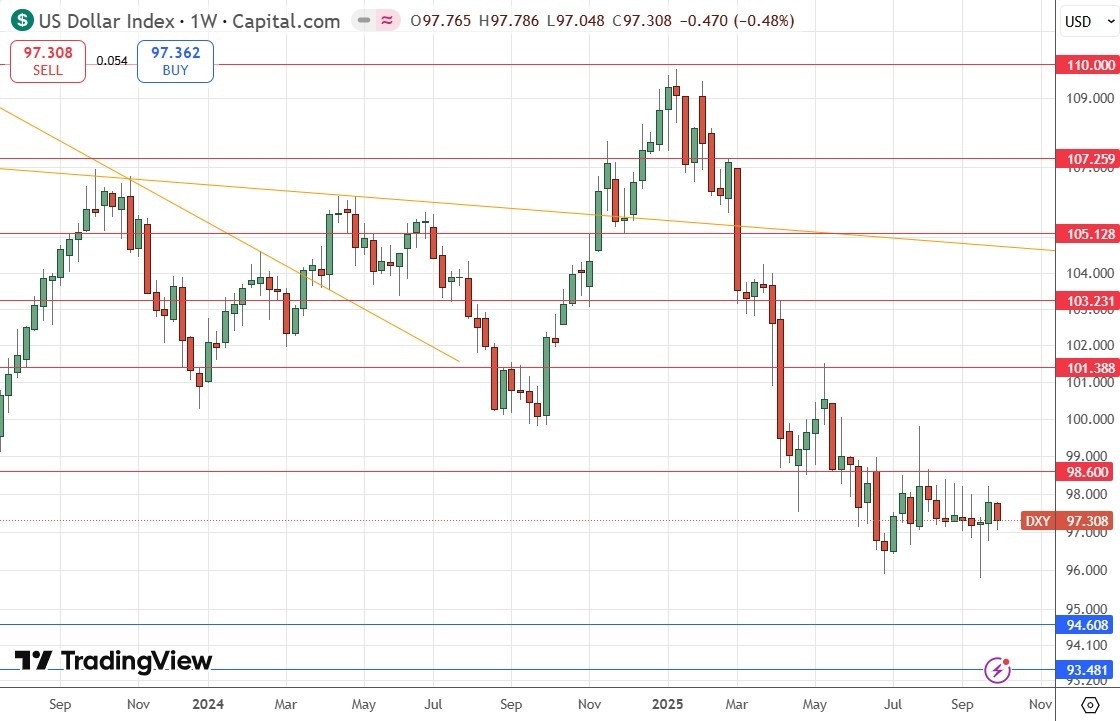
Last week, the US Dollar Index printed a bearish inside candlestick following on from the previous week’s bullish pin bar continuation. However, the candlestick is not very bearish as it has a significant lower wick and the price action is clearly within a consolidation zone. Despite being below its level of 26 weeks ago, the price is above where it was 13 weeks ago, so by my preferred metric, I can declare the long-term bearish trend is over. This places the US Dollar in an interesting position.
There is more consensus now in the market about the Fed’s path of rate cuts over the rest of 2025 and 2026, and I think this means the current consolidation in the greenback is likely to continue over the near term. So, I am neutral on the Dollar, and think trades should be taken over the coming week on the merits of other assets but not the Dollar.
US Dollar Index Weekly Price Chart
EUR/USD
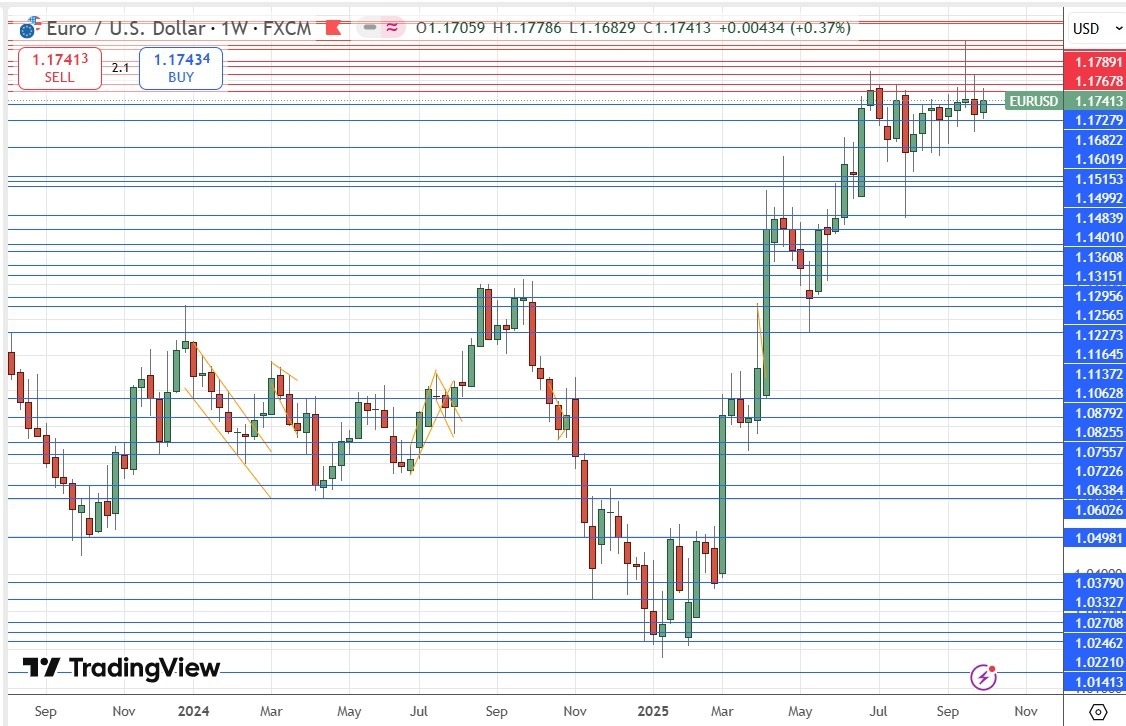
The EUR/USD currency pair rose very weakly last week by printing a bullish inside candlestick, although like DXY considered above, it has a significant wick against this move. It is worth noting that there is a bullish long-term trend which is still valid. The Euro is also showing some relative strength lately, rising to new long-term highs against several other currencies beyond the US Dollar.
Bulls should be worried that the bearish pin bar couple of weeks ago rejected a new 4-year high just above a consolidation zone just after the initial breakout. The price is struggling to regain its recent highs above $1.1800.
Despite these cautionary factors, I remain long of this currency pair as this currency pair historically tends to respect its long-term trends very well, and I see a potential new long trade entry if get a daily (New York) close above $1.1867. However, if you are going to buy on the dips, the support levels at $1.1728 and $1.1682 look like attractive areas to spot bullish bounces.
EUR/USD Weekly Price Chart
USD/CAD
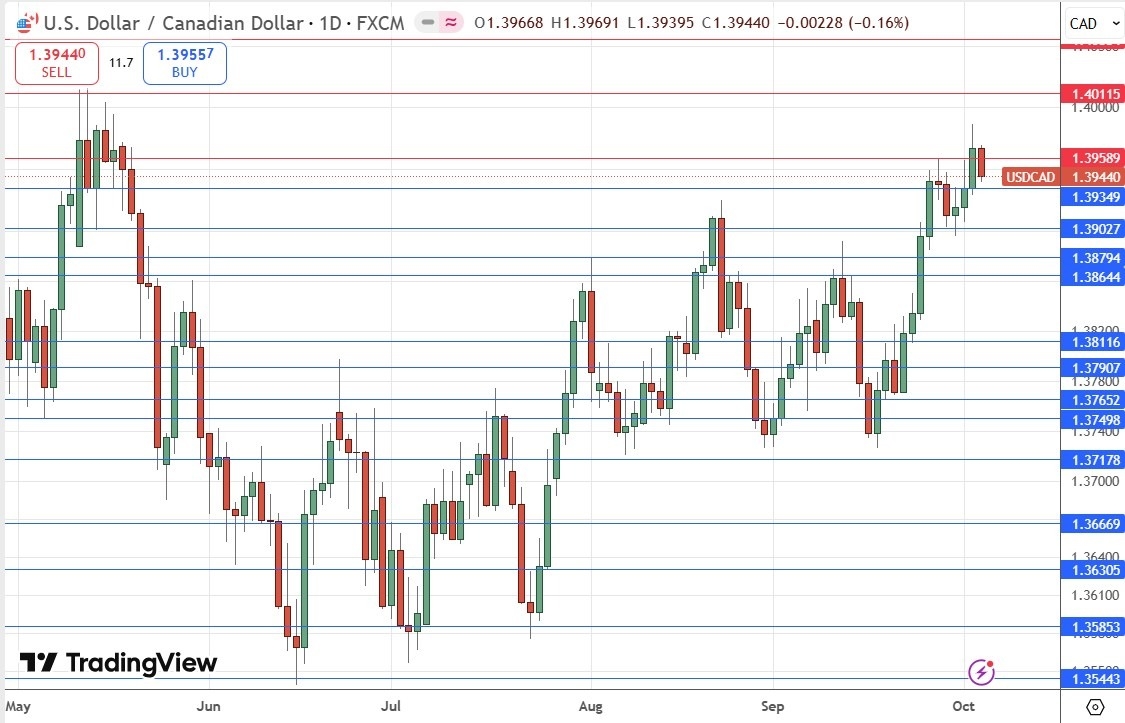
The USD/CAD currency pair daily chart shows a higher low, and notably, both the two lows are also triple bottoms when you drill into the daily chart! This could be seen as a bullish price action signal, worthy of entering a long trade. However, there is a confluence of a big round number not far above, at $1.4000, and a key resistance level just above it, could still stop a meaningful advance here.
If you are looking for a long trade on the recent pullback at the end of last week, bullish bounces at $1.3935 or $1.3903.
USD/CAD Dailly Price Chart
S&P 500 Index
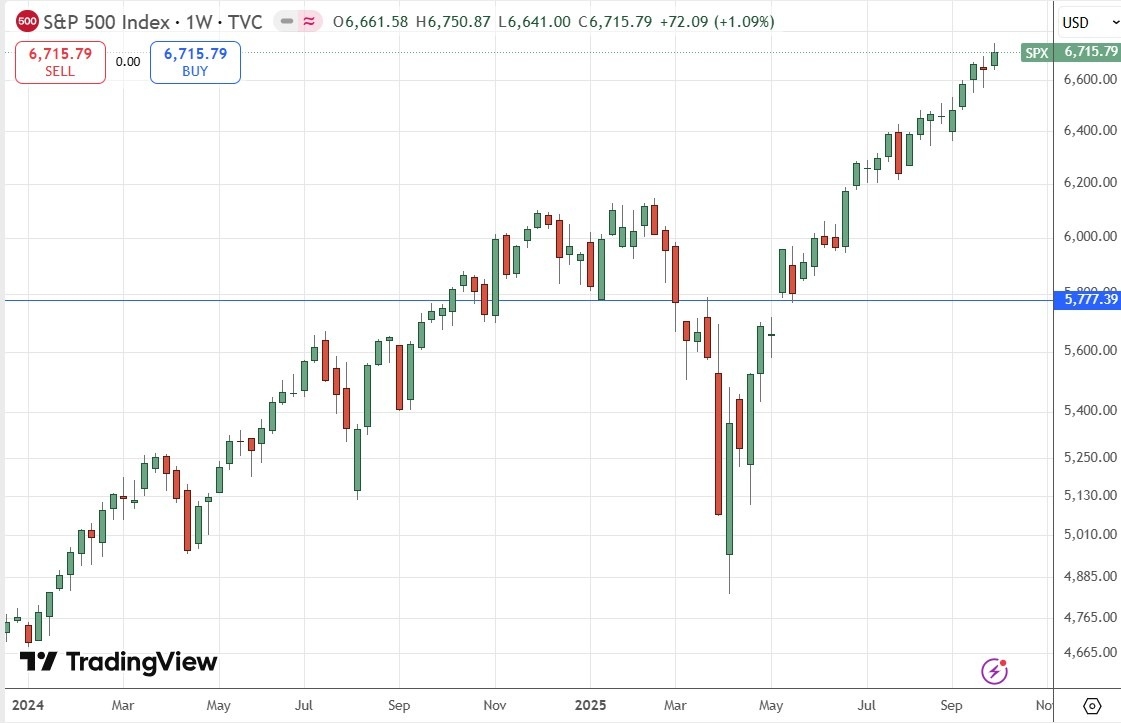
The S&P 500 Index printed a bullish candlestick candlestick last week, which reached and closed at yet another all-time high. The price is trading in blue sky and it could only be more bullish if the price had closed right on the high. However, Friday did see the Index give up some of its recent gains.
US stock markets are rising strongly although many analysts see the market as hugely overvalued. I put the continued advance to new highs down to the Trump effect as people believe President Trump will do anything to boost the market.
The index has risen by about 15% since the start of 2025 with the rise really happening in the aftermath of the Trump tariff panic. It is an open question how much further the current bull run will go, but betting against new record highs in the US stock market is a brave and probably foolish move, unless it’s a cautious play in individual underperforming stocks.
I remain bullish on the S&P 500 Index and see it as an unequivocal buy.
S&P 500 Index Weekly Price Chart
NASDAQ 100 Index
Everything I wrote above about the S&P 500 Index also applies to the NASDAQ 100 Index, except the NASDAQ 100 Index has risen by 18%, more than the S&P’s 2025 to date increase of 15%.
I remain bullish on the NASDAQ 100 Index and see it as an unequivocal buy.
NASDAQ 100 Index Weekly Price Chart
XAG/USD
Silver had yet another great week, showing yet another outsize rise in value of almost 4%, and powering up to a new 14-year high which is now very close to the all-time high made in 2011. It also outperformed Gold and all other precious metals. These are bullish signs, as is the breakout from the linear regression analysis shown within the price chart below – the price is well above the upper bound.
With Silver’s outperformance against Gold, it is probably worth being bold on the long side here.
Having said, if you are just entering a new long trade here, as the move is quite extended, a smaller position size might be wise. Volatility is high, so a strong downwards movement is possible when the retracement finally comes.
I remain very bullish on Silver but worry that it may have peaked on such a large move. Trading the trend with a trailing stop is a good answer to this dilemma if you do it systematically. There could well be profit taking at $50, especially if Gold reaches $4,000 systematically.
XAG/USD Weekly Price Chart
XAU/USD
Gold rose last week to rise to print a new all-time high, but closed a bit below that high and the round number at $4,000. It is worth noting that Gold underperformed Silver last week, but not by a lot
The long-term bullish trend and break to new record highs are bullish factors, as is the strong US stock market, as the US stock market has tended to be positively correlated with Gold, to the surprise of many who see it as a hedge against inflation.
For anyone who is only entering a long trade now, it might be wise to use a smaller position size to account for any sudden high-volatility snapback towards lower prices. Just like the stock market, you have to wonder how much further this bull run will last – but it is backed by a very strong long-term bullish trend, and you trade against that at your peril unless you start to see clear signs of a reversal in the price action – which is not showing here yet.
There could well be profit taking at $4,000, especially if Silver reaches $50 simultaneously.
I am bullish on Gold, but it might be wise to take a smaller long position here than with Silver, which looks more bullish.
Price on 5 Oct 2025 – Ripple’s XRP traded around US$3.0 on 5 October 2025, with investing platforms recording a closing price of US$3.0276 and a high of US$3.0698. YCharts reported a last value of US$2.97 with a year-over-year gain of 455 %.
Technical indicators – On 5 Oct 2025 the Investing.com technical gauge rated XRP a “Strong Buy,” with the relative strength index (RSI) around 57 (neutral-to-bullish), a positive MACD and an average directional index (ADX) near 49 indicating strong trend strength. Analysts highlighted support near US$2.99–3.00 and resistance at US$3.10–3.30, with a breakout above US$3.30 seen as a launchpad for US$4.00–4.20.
Fundamentals and news – XRP’s rally followed Ripple’s final August 2025 settlement with the SEC, which confirmed that programmatic sales of XRP on exchanges are not securities transactions and limited Ripple’s penalty to US$125 million[1]. New products and partnerships – including Ripple’s RLUSD stablecoin, SBI’s institutional lending service, the Rail acquisition, and tourism payment tokens – signal deeper adoption [2][3].
Market comparisons – Bitcoin traded at US$122,380.9 and Ethereum at US$4,487.71 on 5 Oct 2025 [4][5]. XRP’s price was still a fraction of these majors but outperformed them on a one-year basis (455 % vs. BTC’s 97 % and ETH’s 85 % YoY gains).
Outlook – Analysts are optimistic: Standard Chartered forecasts XRP could surge to US$5.50 in 2025 and US$12.50 by 2028 if ETFs and institutional adoption materialize [6]. Bloomberg Intelligence assigns a 95 % probability that the SEC will approve multiple spot XRP ETFs by late October 2025, potentially attracting US$5–8 billion in inflows [7]. Nevertheless, volatility remains high and price corrections are possible.
Understanding XRP and Its Market Environment
Ripple’s XRP is the native token of the XRP Ledger (XRPL) – a blockchain launched in 2012 to facilitate fast, low-cost payments and cross-border transfers. Unlike Bitcoin’s proof-of-work or Ethereum’s energy-intensive proof-of-work (now proof-of-stake) systems, XRPL uses a consensus protocol that supports roughly 1,500 transactions per second and settles in seconds. The total supply is capped at 100 billion XRP, with about 59 billion tokens in circulation and the remainder locked in escrow to release gradually [8].
After years of uncertainty from the U.S. Securities and Exchange Commission (SEC) lawsuit, XRP regained institutional interest in 2024–2025. The July 2023 ruling found that programmatic sales on public exchanges are not securities but institutional sales were unregistered offerings[9]. Both Ripple and the SEC dropped their appeals on 7 August 2025, leaving the 2023 ruling intact and requiring Ripple to pay a US$125 million penalty[10]. This settlement provided rare regulatory clarity for a major cryptocurrency and reopened U.S. exchange listings, clearing the way for potential spot XRP exchange-traded funds (ETFs).
Price Data on 5 Oct 2025
On 5 October 2025 XRP traded just above the US$3 threshold. Investing.com’s historical price table shows that the token opened at US$2.9690, climbed as high as US$3.0698, hit a low of US$2.9564 and closed at US$3.0276. Trading volume was around 293 million XRP, and the daily change was +1.98 %.
YCharts provides another view, listing XRP price at US$2.97 on 5 Oct 2025 with a 2.36 % day-over-day decline but a remarkable 455 % increase compared with the same date in 2024. The difference between data providers stems from pricing feeds (YCharts uses closing prices from banks and exchanges, whereas Investing.com may use 24-hour closing times), yet both confirm a sharp appreciation from the prior year.
Technical Analysis
Momentum Indicators
Investing.com’s technical analysis gauge on 5 Oct 2025 rated XRP a “Strong Buy.” The breakdown of key indicators shows:
Relative Strength Index (RSI 14) – about 57, indicating moderate bullish momentum (values above 70 often imply overbought conditions, while below 30 suggest oversold).
Stochastic Oscillator and StochRSI – both around the mid-60s to 70s range, reinforcing a bullish bias.
Moving Average Convergence Divergence (MACD 12,26) – positive at roughly 0.01, signalling a bullish crossover.
Average Directional Index (ADX 14) – near 49, denoting a strong trend; values above 25 are considered trending.
Commodity Channel Index (CCI 14) and Williams %R – both pointed toward buying momentum (CCI ~73, Williams %R around –35).
Average True Range (ATR 14) – around 0.0216, reflecting elevated volatility.
These indicators collectively suggest that although XRP was not overbought, it was trending upwards with significant volatility. The mid-level RSI and positive MACD indicate the rally could extend, but the high ATR warns traders of large price swings.
Support and Resistance Levels
Market analysts highlighted the following levels around 5 Oct 2025:
Immediate support at US$2.99–3.00 – XRP briefly dipped to US$2.95 on 4 Oct 2025 due to high-volume liquidations but quickly reclaimed the US$3 level.
Resistance at US$3.03–3.10 – price needed to close above this zone to confirm a near-term bullish continuation.
Key hurdle at US$3.30 – traders viewed a daily close above US$3.30 as a trigger for a run toward US$4.00–4.20. Some projections even suggested US$4.80 if momentum sustained.
Volume and whale accumulation – high trading volumes on 4 Oct, combined with on-chain data showing large holders purchasing XRP, suggested that institutional investors were accumulating around the US$3 level.
Fundamental Factors Driving XRP
Regulatory Clarity and the SEC Settlement
The conclusion of the SEC lawsuit in August 2025 is arguably the most significant driver of XRP’s resurgence. By dismissing their appeals, the SEC and Ripple effectively made Judge Torres’s 2023 summary judgment final, affirming that XRP is not a security when sold on public exchanges[11]. Ripple agreed to pay a US$125 million penalty and received a “bad actor” disqualification waiver, allowing it to continue raising capital. Legal analysts described the settlement as a “complete capitulation” by the SEC and a turning point for crypto regulation.
This clarity reopened U.S. markets and paved the way for spot XRP ETF applications. By early October 2025, seven issuers – including Grayscale, Fidelity, Franklin Templeton and BlackRock – had filed for XRP ETFs, with decisions expected between 18 October and 25 October 2025[12]. Bloomberg Intelligence estimated a 95 % probability of approval, projecting US$5–8 billion in inflows due to the scarcity of XRP on exchanges [13].
Ripple’s Products and Partnerships
RLUSD Stablecoin and Ecosystem Expansion
Ripple addressed concerns about XRP’s volatility by launching Ripple USD (RLUSD), a dollar-pegged stablecoin in December 2024. The Motley Fool (via Nasdaq) noted that RLUSD allows clients to conduct cross-border transactions without exposure to XRP’s price swings; transaction fees are still paid in XRP, potentially increasing demand [14]. On 3 October 2025 Ripple minted 1.8 million RLUSD on the XRPL, boosting its market cap to about US$789 million and causing trading volume to surge 75 %[15].
RLUSD is expanding globally:
Africa – Ripple partnered with Chipper Cash, VALR and Yellow Card to integrate RLUSD into remittances, treasury services and microlending, addressing high fees and currency volatility [16]. The stablecoin will also be used for parametric crop insurance in a collaboration with Mercy Corps Ventures [17].
Listings and trading pairs – RLUSD gained new trading pairs on Bybit (RLUSD/USDT, RLUSD/ETH, RLUSD/XRP), providing liquidity to traders [18].
Japanese financial giant SBI Holdings deepened its partnership with Ripple by launching an institutional XRP lending service. On 2–3 Oct 2025, CoinDesk reported that XRP climbed from US$2.98 to US$3.03 after SBI announced the service and seven ETF applications were under SEC review [20]. The service allows institutions to borrow XRP through structured lending programs, signaling growing use by banks and corporations.
Separately, SBI Ripple Asia teamed with travel agency Tobu Top Tours to build a blockchain payment platform for tourism. The platform will use XRP Ledger-based tokens for lodging, dining and shopping, with NFTs serving as digital souvenirs and membership passes; launch is planned for early 2026 [21]. Regional tokens will be tied to specific destinations to encourage local spending and could be repurposed for disaster relief [22].
Acquisition of Rail and Expanding Stablecoin Infrastructure
In August 2025 Ripple announced it would acquire Rail, a global stablecoin payments platform, for US$200 million. Rail processes about 10 % of global stablecoin transaction flow, and Ripple’s president Monica Long said the deal will integrate Rail’s virtual accounts and automated back-office services to deliver a comprehensive payments solution [23]. The acquisition is expected to close in Q4 2025.
Market Sentiment and Predictions
Market sentiment is broadly positive but cautious. On-chain data shows whales accumulating XRP around US$3, reflecting confidence in a continued uptrend. Analysts from CoinCentral noted that Bitcoin’s record highs in late September provided a tailwind and that a strong correlation exists between BTC and XRP prices.
Standard Chartered Bank projects XRP to reach US$5.50 in 2025, US$8.00 in 2026 and US$12.50 in 2028, expecting the token to surpass Ethereum in market capitalization if regulatory clarity and ETFs drive adoption [24]. The bank estimates that spot ETF approval could generate US$4–8 billion in inflows, while listing infrastructure like RLUSD and cross-border settlement will increase utility [25].
Bloomberg Intelligence (via AInvest) assigns a 95 % probability of ETF approval and expects price targets of US$3–5 in a baseline scenario. Its bullish case sees US$4.50–6.19, whereas a conservative scenario warns that delays could cap prices near US$2.50[26].
The Motley Fool/Nasdaq article adds that U.S. regulators under a new administration reversed previous anti-crypto policies in 2025, rescinding an accounting rule (SAB 121) and indicating a more favourable stance toward crypto ETFs, which could further boost demand [27].
Market Comparison: XRP vs Bitcoin and Ethereum
Asset
Price (5 Oct 2025)
1-day change
1-year change
Notes
XRP
US$2.97–3.03
Mixed: +1.98 % (Investing.com) vs –2.36 % (YCharts)
≈455 %
Benefiting from SEC settlement, ETF expectations, RLUSD adoption.
Ethereum’s growth slower as investors weigh competition from Solana/Layer-2 networks.
The table reveals that XRP’s price is a tiny fraction of Bitcoin and Ethereum, yet its year-over-year growth outpaced both. Bitcoin and Ethereum continue to act as benchmarks for the crypto market, but XRP’s regulatory clarity and strong institutional narrative give it a unique risk–reward profile.
Historical Context
XRP’s price history has been volatile. After peaking near US$3.84 in January 2018, it fell below US$0.20 during the bear market. The SEC’s lawsuit in December 2020 caused major U.S. exchanges to delist XRP, pushing it below US$0.30 by 2021. The July 2023 ruling sparked a relief rally above US$0.80, but uncertainty persisted until the August 2025 settlement [34].
From late 2024 to October 2025, XRP staged a dramatic recovery. YCharts shows the price climbing from around US$0.54 in late 2024 to US$2.97 on 5 Oct 2025 – a more than 450 % gain. Contributing factors included positive court rulings, expectations of ETFs, the rollout of RLUSD and major partnerships. Nonetheless, the asset experienced sharp corrections, dropping more than 20 % twice during 2025 [35], underscoring its speculative nature.
Legal and Regulatory Developments
The XRP saga underscores the tension between innovation and regulation. Key milestones include:
SEC lawsuit (Dec 2020) – The SEC alleged Ripple conducted an unregistered securities offering by selling XRP. Exchanges delisted XRP, causing a price collapse.
Judge Torres ruling (Jul 2023) – The court held that programmatic sales and secondary market sales of XRP are not securities, while direct institutional sales violated securities law [36].
Summary judgment appeals dropped (7 Aug 2025) – Ripple and the SEC dismissed their appeals, cementing the 2023 ruling. Ripple agreed to pay a US$125 million penalty and received a waiver to continue raising capital [37].
Regulatory environment – The case catalyzed debate over regulation by enforcement. Legal analysts argued that the SEC’s capitulation highlights the need for clear rules for digital assets. The new U.S. administration signaled a more pro-crypto stance by rescinding SAB 121 and encouraging ETF approvals [38].
Predictions and Future Outlook
With regulatory overhang lifted and new products launching, XRP faces a pivotal moment:
Spot ETF approvals could occur between 18–25 Oct 2025. If approved, analysts expect US$5–8 billion of inflows and price targets ranging US$4.50–6.19 in the most bullish scenario [39].
Standard Chartered predicts XRP will reach US$5.50 in 2025 and US$12.50 by 2028, potentially overtaking Ethereum if institutional adoption accelerates [40].
Motley Fool/Nasdaq notes that Ripple’s RLUSD stablecoin and favorable regulatory shifts could propel growth but warns that XRP has suffered multiple 20 %+ drawdowns; long-term investors should brace for volatility [41].
Technical outlook – Short-term traders watch the US$3.30 resistance and expect a breakout toward US$4 if volume rises. Failure to hold US$2.99–3.00 support could trigger a pullback to the US$2.50 area.
Final thoughts
As of 5 October 2025, XRP stands at a crossroads. The token’s 3-dollar price marks a dramatic recovery from the depths of the SEC lawsuit, and legal clarity, prospective ETFs, and new products like RLUSD provide strong tailwinds. Technical indicators support a bullish bias with significant volatility, while market comparisons highlight XRP’s outsized one-year gains relative to Bitcoin and Ethereum.
Yet risks remain. Approval of ETFs is not guaranteed, regulatory shifts could still occur, and the token’s past shows that rallies are prone to steep corrections. Institutional partnerships and stablecoin infrastructure may sustain long-term demand, but investors should prepare for price swings and monitor key support/resistance levels. Whether XRP breaks US$4 by year-end or consolidates depends on upcoming regulatory decisions, market sentiment and broader macroeconomic trends.