Watch how Lonza CHI helps nutraceutical brands turn ideas into impactful products. From concept to commercialization, our Innovation Services, advanced technologies, and market expertise enable the creation of effective, differentiated, and consumer-friendly supplements. Gain insights, see real-world examples, and discover how Lonza CHI accelerates product development and drives success in a competitive market
Bitcoin (BTCUSD) has been holding steady today at $101,468.15. With no significant changes in price or percentage, the crypto community is abuzz with discussions about Bitcoin’s future potential, particularly the possibility of reaching $142,000. Let’s dive into what the numbers say.
BTCUSD Current Price Analysis and Targets
At the moment, Bitcoin’s price stands at $101,468.15, having experienced a day low of $98,892.97 and a high of $107,269.85. Over the past year, it reached as high as $126,296.00 and as low as $74,420.69. Volume spikes to $110,967,184,773 indicate significant trading activity, far above the average volume of $709,449,996.
Looking ahead, Meyka AI forecasts suggest a monthly target of $142,555.95 and a quarterly projection of $141,151.74. However, the yearly outlook is more cautious at $96,114.59. These forecasts could vary dramatically due to potential macroeconomic shifts, regulatory changes, or unexpected events impacting the crypto market.
Technical Indicators: Analyzing Signals for BTCUSD
Delving into technical signals, the Relative Strength Index (RSI) sits at 38.96, indicating that Bitcoin is currently nearing oversold territory. The Moving Average Convergence Divergence (MACD) presents a bearish outlook, with a MACD line of -2486.11 against a signal line of -1688.61.
The Average Directional Index (ADX) is at 25.94, hinting at a strong trend even amidst the downturns. Bollinger Bands reveal current price pressures, with the upper band at $118,648.16 and the lower at $101,637.25, showing Bitcoin is nearing its lower volatility threshold.
Market Sentiment and Investor Behavior
The crypto community is largely optimistic about Bitcoin’s long-term growth, even amidst short-term consistency. A 6-month increase of 32.33% highlights ongoing interest and potential upward momentum. However, short-term sentiment shows declines, with a recent 3-month loss of 15.77%.
Current discussions on various forums and platforms, such as those recorded by Meyka AI, indicate a mixture of cautious optimism and speculative anticipation. As Bitcoin’s volume remains elevated, investors seem to be positioning for both potential gains and hedging against risks.
Final Thoughts
Bitcoin’s current price around $101,468.15 puts it in a position of cautious optimism. With market data suggesting potential peaks and valleys, and the community’s collective eye on $142,000, those involved with BTCUSD are navigating a nuanced landscape. Key risks include regulatory factors and macroeconomic changes that could quickly shift forecasts. BTCUSD remains a focal point for those observing cryptocurrency’s evolving journey.
FAQs
What is the current BTCUSD price prediction?
Current forecasts estimate monthly targets around $142,555.95, with quarterly predictions at $141,151.74. Annually, however, predictions are more conservative at $96,114.59.
How are technical indicators impacting Bitcoin’s outlook?
Indicators like RSI, MACD, and Bollinger Bands suggest Bitcoin is near oversold territory, with bearish MACD signals but strong trend potential according to ADX.
What factors are influencing BTCUSD’s market sentiment?
Market sentiment is a blend of long-term optimism due to a 32.33% gain over 6 months, against short-term declines like the 15.77% drop in 3 months. Macroeconomic factors are pivotal.
How does Bitcoin’s current trading activity compare to its average?
Bitcoin’s trading volume is significantly above average, at $110.97 billion compared to $709.45 million, indicating heightened activity and potential repositioning by traders.
Could Bitcoin realistically reach $142,000 soon?
While predictions target a potential high around $142,555.95, factors such as market regulations, economic changes, and investor sentiment will significantly influence its trajectory.
Disclaimer:
Cryptocurrency markets are highly volatile. This content is for informational purposes only.
The Forecast Prediction Model is provided for informational purposes only and should not be considered financial advice. Meyka AI PTY LTD provides market data and sentiment analysis, not financial advice.
Always do your own research and consider consulting a licensed financial advisor before making investment decisions.
The decentralized finance market continues to run hot, with TelosC and Euler allegedly experiencing liquidity drain. According to PeckShield, several TelosC vaults launched on the Euler platform have reached 100% utilization.
Simply put, all funds have already been lent out, and liquidity providers are currently unable to withdraw their money.
Euler is a decentralized lending protocol, sort of a “DeFi bank,” where users deposit tokens and receive interest, while others borrow them against collateral. TelosC is one of the “risk curators” within Euler, managing separate liquidity vaults where it sets the rules for loans and returns.
Several assets are under potential attack at once:
WETH: $5.5 million.
USDC: $14.3 million.
WBTC: $7.3 million.
100% utilization on several curated vaults?! Wild. Shall we be concerned? 🔥
At the same time, the yield for providers is only 0.18% per annum, which seems suspiciously low. The system does not encourage borrowers to repay their debts, and liquidity may remain “locked” for a long time.
If part of the liquidity is indeed “stuck,” the DeFi ecosystem risks a new chain reaction: rising borrowing rates, liquidity shortages in related pools, possible liquidations of positions and a collapse in the value of synthetic tokens.
DeFi contagion in 2025
Analysts believe that the situation may be related to the aftermath of the collapse of Stream Finance, whose assets interacted with TelosC and other DeFi protocols.
For those who missed the news, DeFi protocol Stream Finance temporarily suspended all withdrawal and deposit operations earlier this week after the external fund manager controlling its assets reported an exploit and losses of about $93 million.
The potential DeFi contagion may also be fueled by Balancer’s $128 million exploit and xUSD collapse from $1 to $0.35. One may call it a reflexivity loop — fear of protocol risk driving withdrawals, which materializes an illiquid run.
The (ETHUSD) price settled higher in its last intraday trading, retesting the resistance of $3,435, attempting to correct the main bearish trend on the short-term basis, amid its trading alongside supportive minor trendline for this track, with the continuation of the negative pressure due to its trading below EMA50, the beginning of forming negative divergence on the relative strength indicators reinforces the negative pressure on the price, after reaching overbought levels, exaggeratedly compared to the price move, with the emergence of negative overlapping signals.
VIP Trading Signals Performance by BestTradingSignal.com (20-31 Oct, 2025)
Get high-accuracy trading signals delivered directly to your Telegram. Subscribe to specialized packages tailored for the world’s top markets:
Full VIP signals performance report for 20-31, October 2025:
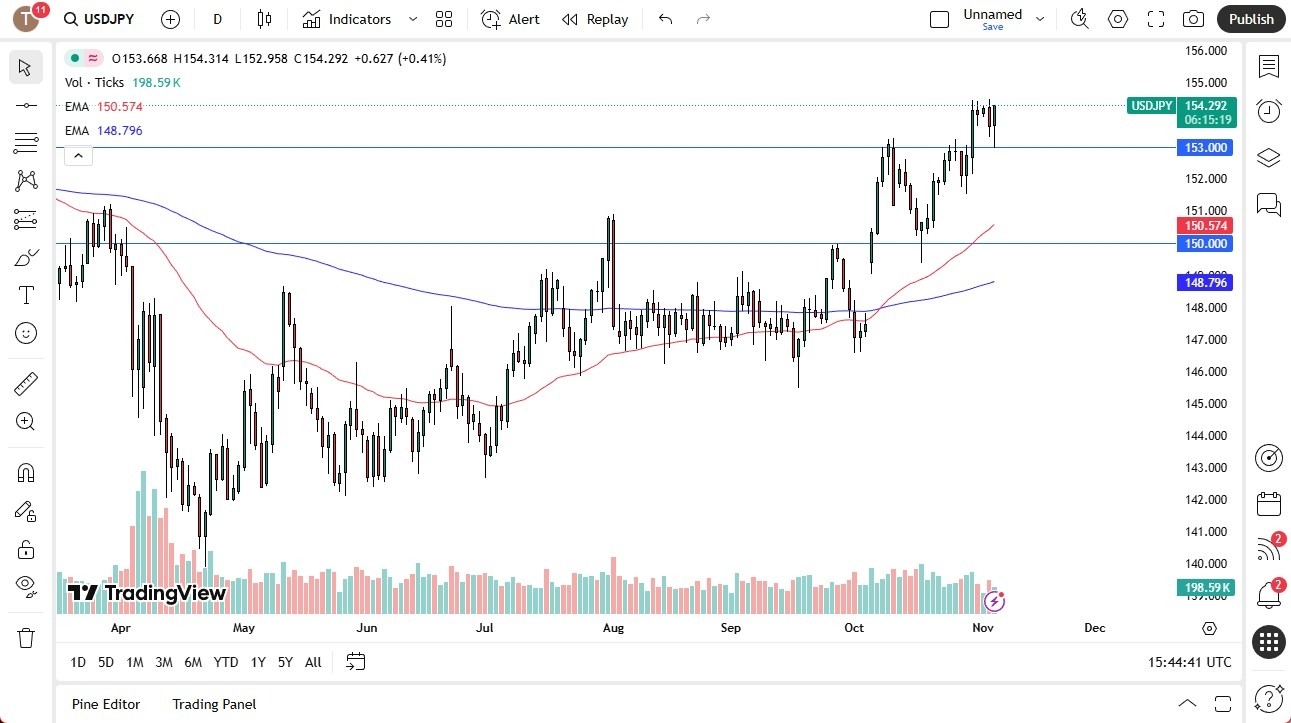
The U.S. dollar rebounded from support near ¥153 on Wednesday, holding firm amid persistent yen weakness.
With resistance at ¥154.50 and potential toward ¥155, I remain bullish, favoring dips as buying opportunities given Japan’s dovish stance.
The U.S. dollar initially fell against the Japanese yen during trading on Wednesday to test the crucial ¥153 level. That being said, the market has found that area as important, which is not a huge surprise considering that it was the previous resistance barrier. Therefore, we would have to think there’s a certain amount of market memory in this region.
By dropping initially only to turn around and show signs of strength, we are now threatening the ¥154.50 level, an area that’s been like a brick wall over the last week or so. If we can clear that area, then the ¥155 level suddenly comes into the picture. Anything above that, and we really start to take off to the upside. Don’t forget that the interest rate differential between the United States and Japan continues to be very wide, and therefore, you get paid quite nicely at the end of every day to hold this pair. The Japanese yen has been selling off not only against the U.S. dollar but almost every other currency that I follow as well.
BoJ is Stuck
Simply put, the Bank of Japan continues to show a lot of hesitation, and therefore, I think the market anticipates that they won’t be able to do anything anytime soon. All things being equal, this is a market that will continue to see a lot of choppy volatility, but short-term pullbacks open up the possibility of finding a little bit of value, just as we had seen during the beginning of the Wednesday session.
If we were to break down below the ¥153 level, then it’s possible that we could go looking to the ¥151.50 level. That is an area where you would start to think about intersecting with the 50-day EMA, which, of course, is an indicator that a lot of people watch closely. Ultimately, this is a market that I’ve been bullish on for several months, and I think that is going to continue to be the way forward. I have no interest in buying the yen in this environment.
Christopher Lewis has been trading Forex and has over 20 years experience in financial markets. Chris has been a regular contributor to Daily Forex since the early days of the site. He writes about Forex for several online publications, including FX Empire, Investing.com, and his own site, aptly named The Trader Guy. Chris favours technical analysis methods to identify his trades and likes to trade equity indices and commodities as well as Forex. He favours a longer-term trading style, and his trades often last for days or weeks.
Juni continues its rapid retail growth, doubling doors year over year to 6,000 stores nationwide
LOS ANGELES, Nov. 6, 2025 /PRNewswire/ — Juni, the fast-growing adaptogenic tea brand co-founded by Jay Shetty, Radhi Devlukia, and Kim Perell, is thrilled to announce its national retail expansion into Whole Foods Market stores. This expansion comes amid a period of rapid growth, with Juni now available in 6,000 retail doors across the US and projecting 300% revenue growth.
Co-founders Jay Shetty and Radhi Devlukia celebrating the launch of their sparkling adaptogenic tea, Juni, at Whole Foods Market in Los Angeles, California.
Juni is powered by its proprietary Super-5™ Blend, featuring adaptogens and superfoods, including ashwagandha, lion’s mane, reishi mushroom, acerola cherry, and green tea extract. This powerful mix pairs functional benefits with bold flavor, all with zero sugar and only 5 calories.
As a brand rooted in modern wellness, mindfulness, and functional ingredients, Juni’s arrival at Whole Foods Market marks a major milestone in its mission to reinvent the tea category.
“It’s incredible how many benefits we’ve been able to pack into each can,” said Juni Co-Founder Jay Shetty. “We infused Juni with ingredients like ashwagandha, lion’s mane, and reishi mushroom, all focused on supporting a healthier and happier mind and body. Whole Foods has long championed products that support well-being, and we’re excited to make Juni available to more people so they can enjoy its delicious flavors and the benefits that come with them.”
Shoppers can now discover five of Juni’s most popular sparkling teas in select Whole Foods Market stores nationwide. The lineup features fan favorites Peach, Raspberry, and Tropical from Juni’s core collection, along with two refreshing decaf options, Strawberry Hibiscus and Cherry Lime, crafted for caffeine-free enjoyment any time of day.
“Whole Foods Market has been instrumental in shaping the health-conscious movement,” said Kim Perell, Juni’s CEO and co-founder. “We’re proud to join forces and continue our mission to redefine what tea can be. Our goal is to disrupt an outdated category and set a bold new standard that blends function, flavor, and wellness into every sip.”
The addition of Juni’s decaf SKUs has also helped the brand resonate with a broader audience, particularly those reducing caffeine or alcohol intake. Designed for all-day enjoyment, these flavors have quickly become fan favorites among sober-curious and wellness-forward consumers.
Think of Juni as the perfect afternoon pick-me-up that gives you clean, healthy energy without the crash,” said Radhi Devlukia, Co-Founder of JUNI. “It’s what I grab every day instead of a soda, because it’s sugar-free and makes me feel good from the inside out.”
As part of the brand’s continued innovation, Juni recently launched its limited-edition Lemonade Iced Tea available online at drinkjuni.com. This lemonade is a sparkling twist on the classic Arnold Palmer, further proof of the team’s commitment to blending nostalgia, flavor, and function in every sip.
Juni’s expansion into Whole Foods Market reinforces its vision to bring everyday wellness into more homes, one can at a time.
About Juni
Juni is a sparkling adaptogenic tea brand founded by wellness entrepreneur and author Jay Shetty, integrative nutritionist and content creator Radhi Devlukia, and serial entrepreneur Kim Perell. Created to bring joy, clarity, and calm to everyday life, Juni’s mission is to reinvent the tea category with bold flavors, clinically studied adaptogens, and clean, functional formulas.
USDA Organic Certified
5 Calories
0g sugar
Non-GMO, Vegan, Gluten-Free
Created with Juni’s proprietary Super-5™ Blend of adaptogens and nootropics.
From bright classics like Peach, Lemon Zest, Raspberry, and Tropical to craveable decaf blends like Yuzu Pineapple, Cherry Lime, and Strawberry Hibiscus, and now the sparkling NEW Lemonade Iced Tea, Juni’s evolving lineup proves that wellness and indulgence can absolutely coexist.
Find Juni at Whole Foods Market, Costco, Target, Sprouts, Erewhon, DrinkJuni.com
Crypto analyst Butterfly has provided a bullish outlook for the Dogecoin price, predicting that it could soon record a massive rally. This comes as the crypto market looks to rebound from its most recent downtrend, with DOGE well below the psychological $0.2 level.
Analyst Declares The Dogecoin Price Is About To Burst
In an X post, Butterfly urged DOGE holders to stay alert as the Dogecoin price could “burst” from its current price level. This came as the analyst noted that the foremost meme coin is facing the lower boundary of the symmetrical triangle on the 3-day chart. Butterfly added that this zone remains a strong floor for price action and that bullish pressure is mounting fast.
The analyst’s accompanying chart showed that the Dogecoin price could bounce off the $0.165 support level and rally to as high as $0.48. Notably, that price level marked a local high for DOGE last year when it rallied from a similar range as its current price level. Meanwhile, the meme coin is expected to hit this price level by year-end or the beginning of next year.
This Dogecoin price prediction comes as the crypto market rebounds from the recent crash, which caused Bitcoin to drop below $100,000, dragging DOGE and other altcoins down. With BTC back above $100,000, the foremost meme coin will look to reclaim the psychological $0.2 level, which could spark a larger rebound.
Crypto analyst Ali Martinez also indicated that the bottom was in for the Dogecoin price following the recent crypto market crash. In an X post, he revealed that the TD Sequential indicator has flashed a buy signal on DOGE, suggesting the local bottom might be in.
DOGE’s Bull Run Could Start Soon
Crypto analyst Chandler indicated that DOGE’s bull run could soon begin. He noted that the biggest bull runs were usually preceded by the TOTAL3/Total rallying to the upside. Then a sharp drop occurs and a clean V-shaped recovery, which is when the Dogecoin price usually peaks. The analyst then revealed that TOTAL3/TOTAL appears to be resuming an uptrend, suggesting the meme coin could soon rally.
Crypto analyst Ether also assured that the bull structure remains intact for Dogecoin’s price despite the recent pullbacks. He noted that every Dogecoin cycle has looked chaotic up close and perfectly structured from a distance. He then asserted that the pattern remains intact. Notably, the analyst had previously predicted that the Dogecoin price would rally to the psychological $1 level, which would mark a new all-time high for the meme coin.
At the time of writing, the Dogecoin price is trading at around $0.16, down in the last 24 hours, according to data from CoinMarketCap.
For most people, getting prescription medication is fairly simple. Your healthcare provider (HCP) calls your local pharmacy, you pick up your medication when it’s ready and life goes on.
But sometimes people can’t take the standard, mass-produced brand name and generic prescription drugs for a variety of reasons.
That’s where compounded medications come in.
What are compounded medications?
Compounded medications are drugs that are mixed, combined or altered by a specially trained pharmacist — a compounding pharmacist. These drugs are compounded to accommodate needs that are not met by the commercial prescription medication.
For people who need compounded drugs, the good news is pretty much all commercial drugs can be compounded:
Tablets
Capsules
Liquid medication
Eye drops
Creams
Injectables
Who needs compounded medications?
Up to 3% of all prescriptions in the U.S. are for compounded drugs.
People may need a compounded drug for a few reasons. These can include:
You need a specific dose. If the standard prescription is not available in the dose you need, you may need a compounded medication.
You need a different form of the medication. Pills, for example, may be hard to swallow for some people, so your HCP may prescribe the drug as a liquid or a cream so you can take it.
You are allergic or sensitive to ingredients. Fillers such as dyes and preservatives are common in mass-produced medications. If you’re allergic to an ingredient, the compounded pharmacist can make the drug without the stuff you’re allergic to.
Your medication is in short supply. If the drug you’re taking is discontinued or in high demand so there’s a shortage, a similar medication can be made so you can continue your treatment.
The pros and cons of compounded medications
There are both pros and cons to consider regarding compounded medications.
Compounded medications are prescribed on a case-by-case basis and customized to each person, so a more personalized approach to medication is appealing for many people. Also, compounded drugs means more people have access to the medication regardless of supply.
On the con side, the compounded formulas are not approved by the FDA, so they’re not guaranteed to have the same strict standards for safety, efficiency and quality as FDA-approved drugs. This opens the door for inconsistency in potency and how much — or how little — of the active ingredients are in the medication.
Compounded medications may not be approved by the FDA, but that doesn’t mean that they’re not safe or effective when they’re made at a licensed pharmacy.
Compounding pharmacies are required to meet certain safety standards set by your state’s Board of Pharmacy. There are some bad actors out there who are creating compounded medications from fake or unapproved ingredients, but legitimate compounded medications are still using ingredients from the FDA-approved drug — just slightly different.
So how do you know if the pharmacy is reputable?
Find a pharmacy that is accredited by the Pharmacy Compounding Accreditation Board (PCAB) or the National Association of Boards of Pharmacy (NABP)
Requires a prescription for the compounded medication
Has a licensed pharmacist on staff who can answer questions
If you’re purchasing online, be wary of low prices that are too good to be true (they probably are!) and online pharmacies that don’t require a prescription.
Compounded conclusion
A reputable compounded pharmacy can help you get the safe and effective medication you need — but you need to take steps to make sure you’re getting the real deal.
Welcome to the US Crypto News Morning Briefing—your essential rundown of the most important developments in crypto for the day ahead.
Grab a coffee! Standard Chartered’s latest market note is not just about price targets. Geoff Kendrick, the bank’s Head of FX and Digital Assets Research, says Bitcoin now carries the weight of DeFi’s future. If it collapses, so could the dream of decentralized finance.
Sponsored
Crypto News of the Day: Standard Chartered Says Bitcoin Carries the Weight of DeFi’s Future
Standard Chartered’s Head of FX and Digital Assets Research, Geoff Kendrick, has warned that DeFi’s future hinges on one crucial condition: that Bitcoin remains structurally sound.
Speaking ahead of the Singapore FinTech Festival (SFF), Kendrick described Bitcoin as the “apex asset” underpinning DeFi’s growth. He also noted that any major collapse would undermine the broader digital finance movement.
“It is fair to say these days I spend most of my time talking about DeFi taking over TradFi…but for that to be possible, as the apex asset, Bitcoin needs to not collapse,” Kendrick wrote in an email.
His comments come as institutions, regulators, and innovators plan to converge in Singapore next week to discuss blockchain infrastructure and the future of open finance.
For Standard Chartered, one of the few major banks to actively publish digital asset research, Kendrick’s framing represents a shift from speculative to systemic thinking about Bitcoin’s role in the global economy.
Sponsored
While many analysts focus on price targets, Kendrick’s recent commentary emphasizes Bitcoin’s stability as a foundation for DeFi’s legitimacy.
“DeFi can’t replace traditional finance if its cornerstone asset is volatile or unreliable,” one market observer said in response to Kendrick’s remarks.
Against this backdrop, Kendrick laid out a structured three-step accumulation plan for Bitcoin investors, suggesting that the recent dip below $100,000 “may be the last one ever.” His proposed strategy includes:
Buying 25% of a target allocation at current levels,
Another 25% if Bitcoin closes above $103,000, and
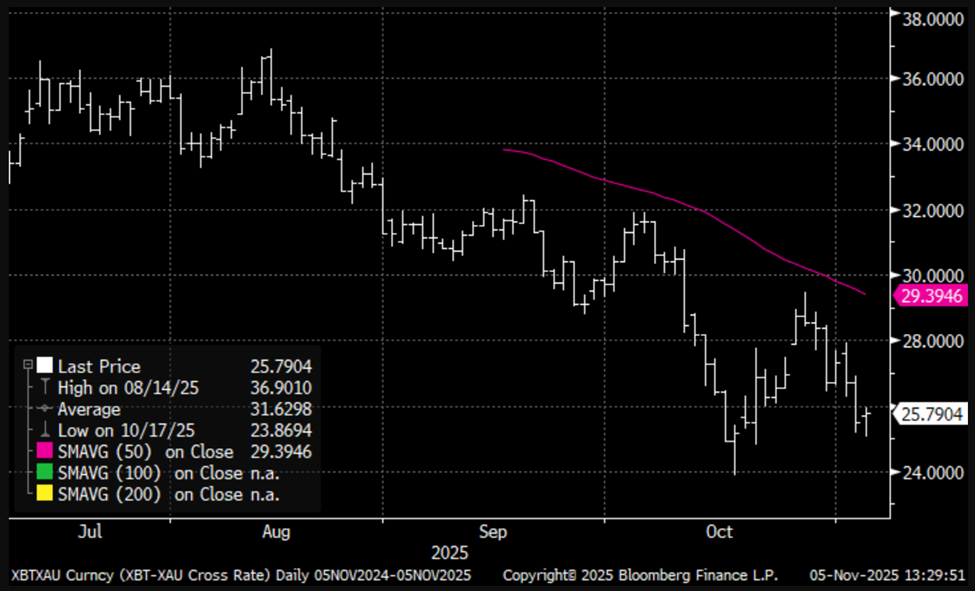
The remainder (50%) once the Bitcoin–gold ratio climbs above 30.
It aligns with remarks from a previous note to clients, where Kendrick stated that Bitcoin’s sub-$100,000 moves could be its last. As indicated in a US Crypto News publication, the bank’s executive noted that it would also mark the final entry point before a renewed bull phase.
Sponsored
Charts of the Day
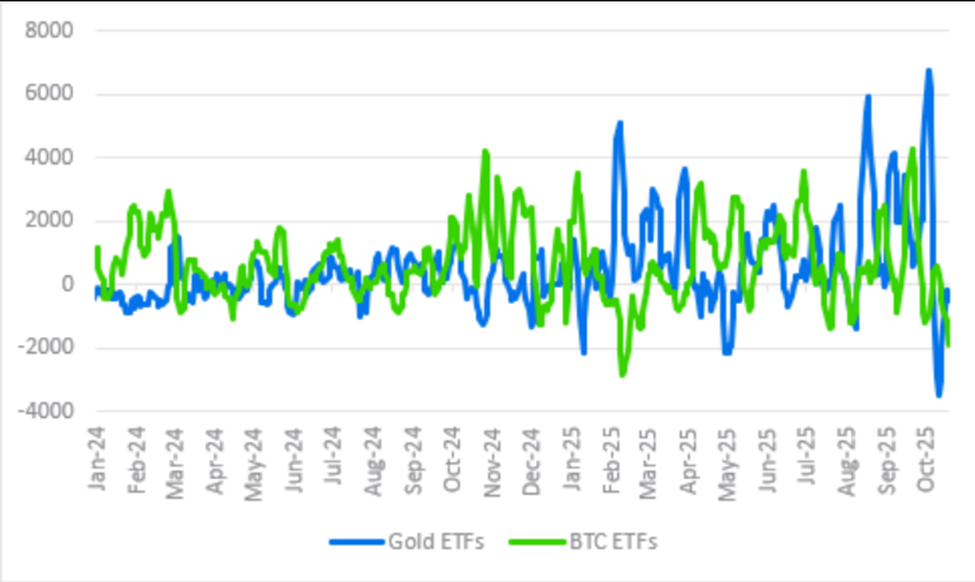
50-week MA matters = Friday “close” of 103k above/below matters. Source: KendrickBitcoin-gold ratio matters = I would like it above 30. Source: Kendrick5-day MA of ETF inflows (USDmn) = outflows from both now. Source: Kendrick
Sponsored
Byte-Sized Alpha
Here’s a summary of more US crypto news to follow today:
Gold price today and prediction reflect a rise above $4,000 per ounce as investors react to a weaker dollar and the ongoing U.S. government shutdown. The market movement shows how global uncertainty and expectations of Federal Reserve rate cuts influence gold prices. Analysts predict that gold may continue its upward trend through the year, with potential to reach $4,200 per ounce if monetary policy remains supportive. The gold price today and prediction highlight how economic conditions, employment data, and currency fluctuations are shaping the outlook for the precious metal in the coming months.
Gold price today and prediction – Gold reclaims $4,000 level
Gold price today and prediction show that gold rose above $4,000 per ounce on Thursday. The rise followed a decline in the dollar and concerns over a prolonged U.S. government shutdown that increased worries about the economic outlook.
Spot gold increased 0.7% to $4,011.79 per ounce at 0914 GMT. U.S. gold futures for December delivery gained 0.7% to $4,021.20 per ounce. Analysts said that the weaker dollar and developments in the Supreme Court case on tariffs supported the movement in gold prices.
Impact of dollar movement and court skepticism
UBS analyst Giovanni Staunovo said that Supreme Court skepticism over U.S. tariffs and a weaker dollar were factors driving gold prices. According to Staunovo, while gold prices may consolidate in the short term, further Federal Reserve rate cuts could push gold to $4,200 per ounce by the end of the year.
The U.S. dollar index fell 0.2% after reaching a four-month high in the previous session. A weaker dollar usually supports gold because it becomes cheaper for investors holding other currencies.
On Wednesday, U.S. Supreme Court justices raised doubts about the legality of President Donald Trump’s broad tariffs. The case carries global economic implications and could affect trade sentiment.
Economic indicators and U.S. labor data
Gold price today and prediction are also influenced by recent U.S. labor market data. According to the ADP report released Wednesday, U.S. private employers added 42,000 jobs in October, surpassing the forecast of 28,000. The stronger labor market could reduce expectations for further rate cuts by the Federal Reserve.
The U.S. government remains in a record-long shutdown due to a congressional impasse. This situation has forced investors and the Federal Reserve to rely on private-sector indicators for economic assessment.
The Fed reduced interest rates last week, but Chair Jerome Powell indicated it might be the last rate cut for 2025.
Gold Market outlook and investor sentiment
Market participants currently see a 63% chance of a rate cut in December, down from more than 90% last week. Gold, which does not yield interest, tends to perform well in low-interest-rate environments.
Analysts believe that continued uncertainty in U.S. politics, along with potential policy decisions, will influence the metal’s performance through the rest of the year.
European stocks also moved lower, led by losses in France’s Legrand after it missed sales growth expectations. The decline added pressure to markets already concerned about high valuations in technology-related companies.
Precious metals performance – spot silver, platinum and palladium
Spot silver rose 1.4% to $48.74 per ounce. Platinum increased 0.4% to $1,567.01, while palladium gained 1.1% to $1,434.22. The movement in other metals reflected similar trends as investors sought safe-haven assets amid global uncertainty.
Gold price today and prediction – Year-end outlook
Analysts expect gold prices to remain supported in the coming months as investors watch for signs of additional rate cuts. If the dollar weakens further and economic risks persist, gold could approach the $4,200 level forecasted by UBS.
Investors are likely to monitor U.S. employment data, inflation figures, and any developments in the government shutdown to gauge the direction of gold prices in the short term.
FAQs
1. What is the gold price today and prediction for the year-end? Gold price today stands above $4,000 per ounce. Analysts expect it may reach $4,200 per ounce by year-end if the Federal Reserve continues rate cuts. 2. How does the dollar affect gold price today and prediction? A weaker dollar makes gold cheaper for holders of other currencies. This usually supports higher demand and pushes the gold price up in the market.