About Editorial team of BIPNs

Main team of content of bipns.com. Any type of content should be approved by us.
15 09, 2025

Food Dietary Fibers Market | Global Market Analysis Report

By |2025-09-15T10:30:22+03:00September 15, 2025|Dietary Supplements News, News|0 Comments


Food Dietary Fibers Market Size and Share Forecast Outlook 2025 to 2035

The food dietary fibers market is estimated to be valued at USD 3.3 billion in 2025 and is projected to reach USD 8.1 billion by 2035, registering a compound annual growth rate (CAGR) of 9.5% over the forecast period.

The peak-to-trough analysis reveals steady growth with intermittent accelerations. From 2021 to 2025, the market grows from USD 2.1 billion to 3.3 billion, moving through intermediate values of USD 2.3 billion, 2.5 billion, 2.7 billion, and 3.0 billion. This early phase is marked by gradual expansion, as consumer awareness regarding health benefits, including digestive health and weight management, starts to drive the demand for dietary fibers in functional foods, supplements, and beverages. The market shows modest incremental growth, reflecting steady adoption and market penetration. Between 2026 and 2030, the market progresses more significantly, growing from USD 3.3 billion to 5.7 billion, with values passing through USD 3.6 billion, 3.9 billion, 4.3 billion, and 4.7 billion.

This period represents a peak phase, driven by the rising trend of plant-based diets and the increasing incorporation of fiber-rich ingredients in everyday foods. The market sees a faster rate of growth as health-conscious consumers seek natural, high-fiber solutions. From 2031 to 2035, the market continues to expand from USD 5.2 billion to 8.1 billion, passing through values of USD 5.7 billion, 6.2 billion, 6.8 billion, and 7.4 billion.

Quick Stats for Food Dietary Fibers Market

  • Food Dietary Fibers Market Value (2025): USD 3.3 billion
  • Food Dietary Fibers Market Forecast Value (2035): USD 8.1 billion
  • Food Dietary Fibers Market Forecast CAGR: 9.5%
  • Leading Segment in Food Dietary Fibers Market in 2025: Soluble Dietary Fibers (57.4%)
  • Key Growth Regions in Food Dietary Fibers Market: North America, Asia-Pacific, Europe
  • Key Players in Food Dietary Fibers Market: Archer Daniels Midland Company, Cargill Incorporated, Lonza Group, Nexira, Ingredion Incorporated, DuPont, Roquette Freres, Tate & Lyle, Royal DSM, Procter & Gamble, GlaxoSmithKline, Sudzucker, Kerry Group, Ceamsa, SunOpta, Inc., J. Rettenmaier & Söhne GmbH & Co. KG, Interfiber, Solvaira Specialties, Grain Processing Corporation

Food Dietary Fibers Market Key Takeaways

The food dietary fibers market is driven by five key parent markets that collectively shape its growth, demand, and application across the food and beverage industry. The functional foods and ingredients market contributes the largest share, about 30-35%, as dietary fibers are increasingly used in the formulation of health-promoting food products aimed at improving digestive health, weight management, and overall well-being.

The food and beverage market adds approximately 20-24%, as dietary fibers are integrated into various food products such as snacks, beverages, and dairy alternatives to enhance fiber content and appeal to health-conscious consumers. The health supplements and nutraceuticals market contributes around 15-18%, as dietary fiber is a popular ingredient in dietary supplements, offering benefits such as improved gut health, cholesterol management, and blood sugar control.

The packaged food market accounts for roughly 12-15%, with dietary fibers being used in ready-to-eat meals, cereals, and baked goods to meet the increasing consumer demand for healthy and convenient food options. Finally, the organic food market represents about 8-10%, as there is growing demand for natural and minimally processed sources of dietary fiber in organic food products.


Metric Value
Food Dietary Fibers Market Estimated Value in (2025 E) USD 3.3 billion
Food Dietary Fibers Market Forecast Value in (2035 F) USD 8.1 billion
Forecast CAGR (2025 to 2035) 9.5%

Why is the Food Dietary Fibers Market Growing?

The food dietary fibers market is expanding steadily, supported by increasing consumer awareness of digestive health, weight management, and chronic disease prevention. Scientific publications and nutrition association updates have emphasized the role of dietary fibers in improving gut microbiota balance, regulating blood sugar levels, and lowering cholesterol, driving demand across multiple food categories. Food manufacturers are incorporating fibers into everyday consumables to enhance nutritional profiles without compromising taste or texture.

Product development has also focused on functional fibers that offer added health benefits, aligning with clean-label and wellness trends. Regulatory bodies in various regions have reinforced labeling standards and health claims for dietary fiber content, boosting consumer trust and product transparency.

Additionally, rising demand for fortified bakery products, cereals, beverages, and snacks has created new commercial opportunities. Looking forward, technological advancements in fiber extraction, formulation, and blending are expected to broaden application diversity, with segmental growth led by soluble dietary fibers, cereals & grains as a key source, and bakery as a prominent application category.

Segmental Analysis

The food dietary fibers market is segmented by product, source, application, and geographic regions. By product, food dietary fibers market is divided into soluble dietary fibers and insoluble dietary fibers. In terms of source, food dietary fibers market is classified into cereals & grains, fruits & vegetables, and others. Based on application, food dietary fibers market is segmented into bakery, breakfast cereals & snacks, confectionery, and others. Regionally, the food dietary fibers industry is classified into North America, Latin America, Western Europe, Eastern Europe, Balkan & Baltic Countries, Russia & Belarus, Central Asia, East Asia, South Asia & Pacific, and the Middle East & Africa.

Insights into the Product Segment: Soluble Dietary Fibers
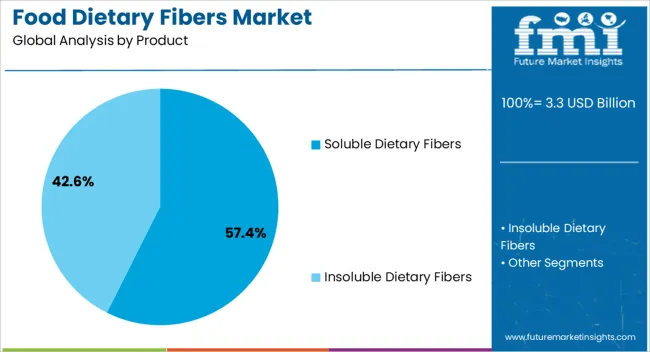
Food Dietary Fibers Market Analysis By Product

The soluble dietary fibers segment is projected to account for 57.4% of the food dietary fibers market revenue in 2025, maintaining its lead due to its functional versatility and scientifically proven health benefits. Soluble fibers dissolve in water to form viscous gels, aiding in cholesterol reduction, blood glucose control, and satiety enhancement.

Ingredient manufacturers have developed advanced soluble fiber variants that are easily incorporated into beverages, dairy, and baked goods without altering sensory qualities. Market adoption has also been supported by research-backed health claims, which have increased consumer confidence and product demand.

Additionally, soluble fibers sourced from natural ingredients such as oats, barley, and psyllium have gained preference in clean-label product lines. As consumer diets increasingly prioritize functional health benefits, the soluble dietary fibers segment is expected to sustain its dominant position, driven by continued innovation and application expansion.

Insights into the Source Segment: Cereals & Grains
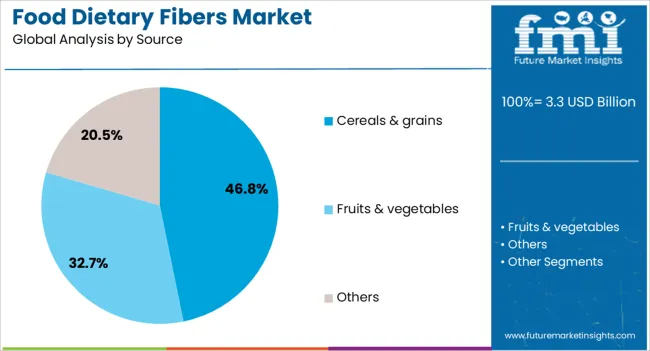
Food Dietary Fibers Market Analysis By Source

The cereals & grains segment is projected to contribute 46.8% of the food dietary fibers market revenue in 2025, leading the source category due to its nutritional value and wide availability. Cereals and grains, including wheat, oats, barley, and rice, are naturally rich in both soluble and insoluble fibers, making them highly suitable for fiber fortification in food products.

Agricultural supply stability and established milling processes have ensured consistent ingredient quality for manufacturers. Consumer dietary habits, particularly in breakfast and snack categories, have favored cereal-based fiber sources for their taste compatibility and perceived wholesomeness.

Additionally, cereal and grain fibers are often associated with traditional, minimally processed diets, aligning with clean-label and heritage food trends. The segment’s leadership is expected to persist as demand for natural, nutrient-rich fiber sources grows in both developed and emerging markets.

Insights into the Application Segment: Bakery
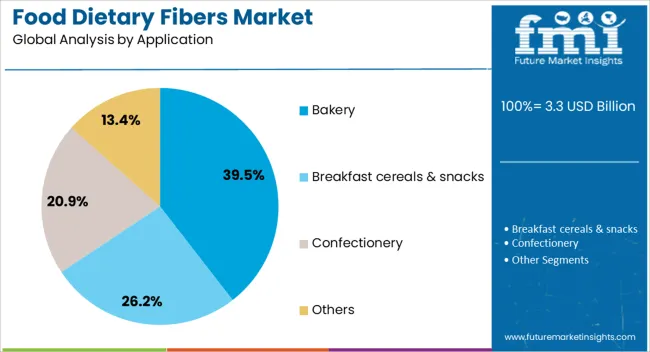
Food Dietary Fibers Market Analysis By Application

The bakery segment is projected to hold 39.5% of the food dietary fibers market revenue in 2025, leading the application landscape due to the integration of fiber-rich ingredients into breads, pastries, and snacks. Bakery manufacturers have increasingly reformulated products to meet consumer demand for healthier indulgences, incorporating dietary fibers to improve satiety and digestive benefits.

The segment’s growth has been supported by advances in fiber ingredients that maintain dough texture, volume, and taste while enhancing nutritional value. Market trends show strong acceptance of high-fiber bakery products in both retail and foodservice channels, particularly in urban markets where functional foods are gaining popularity.

Additionally, bakery applications serve as a convenient vehicle for delivering daily fiber intake, contributing to their widespread adoption. With ongoing innovation in high-fiber flour blends and prebiotic-enriched formulations, the bakery segment is expected to remain a primary growth driver in the dietary fibers market.

What are the Drivers, Restraints, and Key Trends of the Food Dietary Fibers Market?

The food dietary fibers market is growing due to rising consumer awareness of the health benefits of fiber, particularly for digestive health, weight management, and cholesterol control. Opportunities lie in plant-based, functional foods, and fiber fortification, with companies offering innovative, health-enhancing ingredients. Trends like prebiotics, soluble fiber, and clean-label products are shaping the market’s future. Manufacturers focusing on fortifying popular food categories like plant-based proteins, dairy alternatives, and snacks with dietary fibers are well-positioned to capture consumer interest.

Rising Consumer Awareness and Demand for Digestive Health

Dietary fibers, which are found in plant-based foods, play a key role in promoting gut health, preventing constipation, and reducing the risk of digestive disorders. As more consumers adopt health-conscious eating habits, there is a rising demand for fiber-rich foods and dietary supplements. This is particularly evident in developed regions like North America and Europe, where consumers are increasingly seeking products that aid digestion, regulate cholesterol, and support weight management. Leading companies such as ADM, DuPont, and Cargill are investing in innovative dietary fiber solutions, offering functional ingredients that cater to the growing demand for healthier, more balanced diets.

Health Benefits, Product Innovation, and Regulatory Compliance

Consumers are becoming more aware of the critical role fiber plays in maintaining overall health, particularly in preventing chronic conditions like heart disease and type 2 diabetes. Additionally, manufacturers are investing in research to innovate new fiber products, including soluble fibers, insoluble fibers, and prebiotics, which offer enhanced digestive and metabolic benefits. However, producers face challenges in meeting regulatory compliance, as dietary fiber ingredients must adhere to food safety standards. The market is also evolving with new regulations on labeling and health claims, requiring manufacturers to provide clear and accurate product information.

Opportunities in Plant-based, Functional Foods, and Fortification

As the demand for plant-based diets grows, especially in North America and Europe, dietary fibers derived from vegetables, fruits, and grains are gaining popularity. These fibers are often used to fortify foods such as bakery products, beverages, and snacks, enabling manufacturers to create nutrient-dense options for health-conscious consumers. The rising popularity of functional foods, which offer additional health benefits beyond basic nutrition, is driving demand for fiber-enriched products. Companies that can integrate dietary fibers into popular food categories like plant-based protein, dairy alternatives, and snack foods will be well-positioned to meet consumer demand for functional and health-boosting products.

Trends in Prebiotics, Soluble Fiber, and Clean Labeling

Prebiotics, which promote the growth of beneficial gut bacteria, are gaining popularity as consumers seek products that enhance gut health and immune function. Soluble fibers, which are known for their ability to lower cholesterol and stabilize blood sugar levels, are also in high demand. Clean labeling, which ensures that food products contain minimal artificial ingredients and preservatives, is another key trend. As consumers increasingly demand transparency in food labeling, manufacturers are focusing on clean-label fiber products that are free from additives, artificial colors, and sweeteners. These trends are driving innovation and shaping the future of the food dietary fibers market.

Analysis of Food Dietary Fibers Market By Key Countries
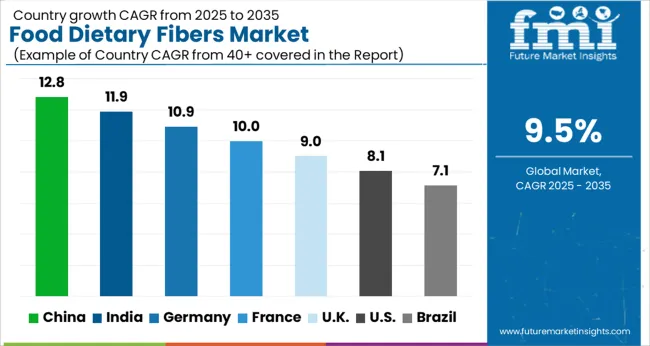
Food Dietary Fibers Market Cagr Analysis By Country


Country CAGR
China 12.8%
India 11.9%
Germany 10.9%
France 10.0%
UK 9.0%
USA 8.1%
Brazil 7.1%

Global Food Dietary Fibers Market is projected to grow at a CAGR of 9.5% from 2025 to 2035. China leads with a CAGR of 12.8%, followed by India at 11.9%. France shows a growth rate of 10.0%, while the UK and the USA are growing at 9.0% and 8.1%, respectively. The strong growth in China and India can be attributed to the increasing awareness of dietary fibers’ health benefits, particularly in managing weight and improving digestive health. France is witnessing growing demand in both the food and pharmaceutical sectors, while the UK and the USA show steady growth due to increasing consumption of fiber-rich foods and supplements as part of a healthy lifestyle. Regional factors like rising health-consciousness, the demand for functional foods, and government initiatives to promote healthy diets are key drivers in the market’s expansion. The analysis spans over 40+ countries, with the leading markets shown below.

Growth Analysis of Food Dietary Fibers Market in China

The food dietary fibers market in China is forecasted to grow at a CAGR of 12.8% from 2025 to 2035. The demand for dietary fibers is being driven by a growing awareness of their health benefits, particularly in digestive health and weight management. As the Chinese population becomes increasingly health-conscious, there has been a surge in demand for fiber-rich foods, including fruits, vegetables, whole grains, and processed food products enriched with dietary fibers. The rising prevalence of lifestyle diseases such as obesity, diabetes, and heart disease has prompted consumers to adopt healthier eating habits.Government initiatives promoting balanced diets and healthy lifestyles are supporting this shift. China’s growing urbanization and higher disposable income also play a role in increasing consumer demand for functional foods and dietary supplements. The rapid expansion of the food and beverage industry further boosts the adoption of dietary fibers in processed foods.

  • Rising consumer awareness of digestive health and wellness
  • Increasing consumption of fiber-rich foods and supplements
  • Government support for balanced diets and healthier eating habits

Future Opportunities for Food Dietary Fibers Market in India

The food dietary fibers market in India is projected to grow at a CAGR of 11.9% from 2025 to 2035. The demand for dietary fibers in India is being driven by the growing emphasis on health and wellness, especially in urban areas. With increasing awareness about the benefits of fiber in managing weight, improving digestion, and preventing chronic diseases, consumers are increasingly opting for high-fiber foods and supplements. India’s expanding middle class and rising disposable incomes have led to a shift towards healthier eating habits, with fiber-rich foods becoming an integral part of daily diets. The growing popularity of natural and plant-based foods, as well as the booming demand for organic products, is further driving the market. The surge in lifestyle-related diseases such as diabetes and heart disease has prompted the Indian government to emphasize dietary improvements and promote fiber consumption as part of a balanced diet.

  • Increased focus on digestive health and disease prevention
  • Demand for fiber-enriched foods in urban and rural areas
  • Growth of the organic food segment and dietary supplements

Demand Insights of Food Dietary Fibers Market in France
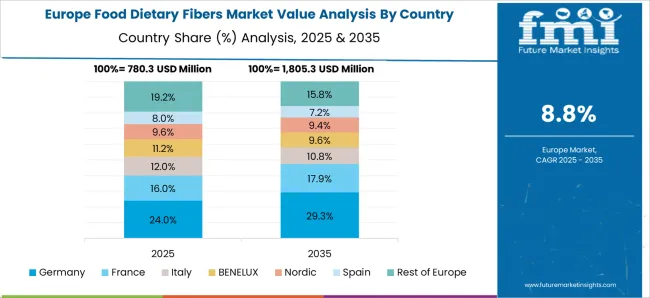
Food Dietary Fibers Market Europe Country Market Share Analysis, 2025 & 2035

The food dietary fibers market in France is expected to grow at a CAGR of 10.0% from 2025 to 2035. The increasing demand for dietary fibers in France is primarily driven by a rising consumer awareness about healthy diets and wellness. As the demand for functional foods increases, dietary fibers are gaining traction for their role in digestive health, weight management, and overall well-being. The French population’s focus on maintaining a balanced diet is leading to an increased preference for high-fiber products such as cereals, grains, and snacks. The rising trend of plant-based foods is also fueling growth in the market, as dietary fibers are an essential component of plant-based diets. France’s well-established food processing and pharmaceutical industries are contributing to the expansion of fiber-enriched food products and dietary supplements. Government campaigns promoting health-conscious eating habits and efforts to reduce lifestyle diseases further support market growth.

  • Increased demand for fiber-rich functional foods and snacks
  • Growth in plant-based food consumption driving fiber demand
  • Government initiatives to promote healthier eating habits

Growth Prospects for Food Dietary Fibers Market in the United Kingdom

The food dietary fibers market in the UK is expected to expand at a CAGR of 9.0% from 2025 to 2035. In the UK, there is a growing shift toward healthier eating, which is leading to an increased demand for foods rich in dietary fibers. Rising consumer awareness about the health benefits of fiber in managing weight, supporting digestion, and reducing the risk of chronic diseases is driving the market. The rise in the popularity of plant-based diets and the increasing preference for natural and organic products further boost the demand for fiber-rich foods. The growing demand for functional foods, such as high-fiber snacks and fortified cereals, is being supported by the expanding retail sector and e-commerce platforms, making these products more accessible.The UK government’s initiatives to promote healthy eating and combat lifestyle diseases such as obesity and heart disease are expected to further drive the adoption of dietary fibers.

  • Rising preference for high-fiber and functional foods
  • Increased adoption of plant-based and organic diets
  • Government-driven health campaigns and initiatives promoting fiber intake

Trends Analysis of Food Dietary Fibers Market in the United States
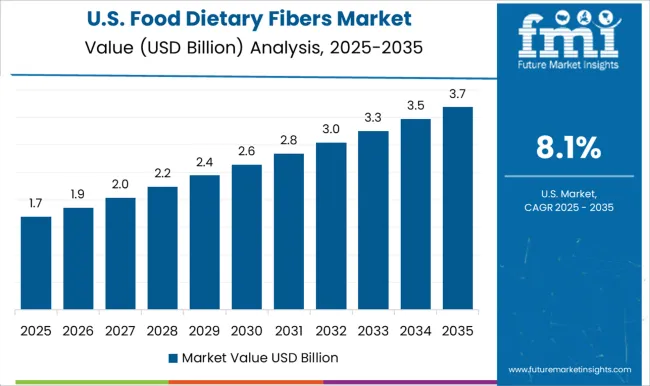
Food Dietary Fibers Market Country Value Analysis

The food dietary fibers market in the USA is forecasted to grow at a CAGR of 8.1% from 2025 to 2035. As the USA continues to focus on health and wellness, the demand for dietary fibers in various food and beverage products is on the rise. The popularity of fiber-rich diets, combined with growing awareness of their role in digestive health, weight management, and disease prevention, is boosting the market. The increased consumption of functional foods and beverages, including fiber-enriched snacks, drinks, and cereals, is driving growth. The growing trend of plant-based eating is also pushing the demand for dietary fibers, as they are essential components of plant-based diets. The USA market is further supported by the expansion of the dietary supplement industry, with many consumers opting for fiber supplements to meet their nutritional needs. The USA food processing industry continues to innovate with fiber-enriched products to cater to the growing demand for healthy, convenient foods.

  • Increasing consumption of fiber-enriched foods and beverages
  • Growing demand for fiber supplements and functional foods
  • Rising adoption of plant-based diets and natural foods

Competitive Landscape of Food Dietary Fibers Market
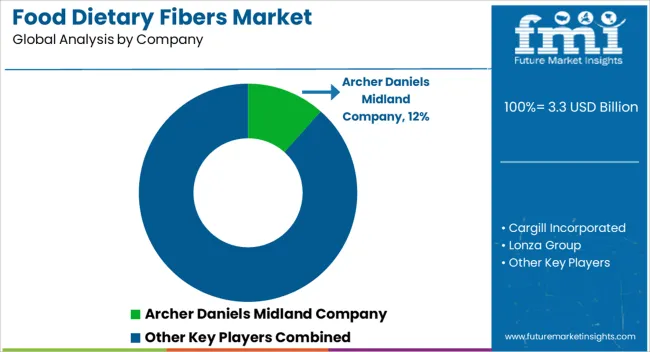
Food Dietary Fibers Market Analysis By Company

Competition in the food dietary fibers market is driven by product innovation, manufacturing capabilities, and the ability to meet diverse consumer needs across functional foods, beverages, and health supplements. Archer Daniels Midland Company (ADM) leads by offering a range of high-quality dietary fibers derived from natural sources, with brochures emphasizing their versatility in improving digestive health, weight management, and cholesterol control. The company differentiates itself through sustainable sourcing practices and a strong focus on clean-label solutions.

Cargill Incorporated competes by producing both soluble and insoluble fiber products, catering to the needs of food manufacturers seeking affordable and functional fiber ingredients. Their product brochures highlight the versatility of their fibers in a variety of food applications, emphasizing benefits such as improved gut health and consumer-friendly labeling. Lonza Group and Nexira focus on providing specialized fibers with prebiotic properties, targeting the growing demand for digestive health and gut microbiota solutions. Nexira’s brochures highlight the health benefits of its chicory root-based fibers, while Lonza’s product offerings stress the importance of high-performance fibers that support the growing gut health trend. Ingredion Incorporated stands out by focusing on clean-label and non-GMO dietary fiber solutions, with brochures promoting its ability to meet consumer demand for transparency and natural ingredients.

DuPont and Roquette Freres target the premium segment with advanced fiber solutions, emphasizing high bioavailability and superior health benefits. DuPont’s brochures highlight their science-backed approach to developing fibers that support metabolic health, while Roquette Freres focuses on fiber’s versatility in both food and functional applications. Tate & Lyle’s brochures emphasize its fiber-enriched solutions, which are used to reduce sugar and calorie content while maintaining texture and mouthfeel in food products.

Key Players in the Food Dietary Fibers Market

  • Archer Daniels Midland Company
  • Cargill Incorporated
  • Lonza Group
  • Nexira
  • Ingredion Incorporated
  • DuPont
  • Roquette Freres
  • Tate & Lyle
  • Royal DSM
  • Procter & Gamble
  • GlaxoSmithKline
  • Sudzucker
  • Kerry Group
  • Ceamsa
  • SunOpta, Inc.
  • J. Rettenmaier & Söhne GmbH & Co. KG
  • Interfiber
  • Solvaira Specialties
  • Grain Processing Corporation

Scope of the Report


Item Value
Quantitative Units USD 3.3 billion
Product Soluble Dietary Fibers and Insoluble Dietary Fibers
Source Cereals & grains, Fruits & vegetables, and Others
Application Bakery, Breakfast cereals & snacks, Confectionery, and Others
Regions Covered North America, Europe, Asia-Pacific, Latin America, Middle East & Africa
Country Covered United States, Canada, Germany, France, United Kingdom, China, Japan, India, Brazil, South Africa
Key Companies Profiled Archer Daniels Midland Company, Cargill Incorporated, Lonza Group, Nexira, Ingredion Incorporated, DuPont, Roquette Freres, Tate & Lyle, Royal DSM, Procter & Gamble, GlaxoSmithKline, Sudzucker, Kerry Group, Ceamsa, SunOpta, Inc., J. Rettenmaier & Söhne GmbH & Co. KG, Interfiber, Solvaira Specialties, and Grain Processing Corporation
Additional Attributes Dollar sales by product type (soluble fibers, insoluble fibers, mixed fibers), application (beverages, bakery products, dietary supplements, dairy, snacks, others), and source (fruits & vegetables, grains, legumes). Demand is driven by the increasing consumer focus on digestive health, weight management, and clean-label products. Regional trends show strong growth in North America, Europe, and Asia-Pacific, driven by rising health awareness, the growth of functional foods, and increasing consumer preference for natural, plant-based fibers. The market is also influenced by the rising demand for prebiotic fibers that support gut microbiome health.


Source link

15 09, 2025

Which One Will Be The 2025 Best PayFi Coin? Cardano Price Prediction For 2026

By |2025-09-15T10:26:47+03:00September 15, 2025|Crypto News, News|0 Comments

XRP Price has been the leading choice among traders, while Cardano Price Prediction is still a point of discussion among holders. They both remain large-cap cryptos with strong foundations, but the focus is shifting towards initiatives that are concentrating on solving real payment problems. 

Remittix (RTX), priced at $0.1080 per token, is gaining traction with its presale milestones, listing on exchanges, and upcoming September beta wallet release.

XRP And Cardano Price Standing

The price of XRP is currently $3.1438, up 3.13% from today. Market cap stands at $187.98 billion, with trading volume growing 30.25% in 24 hours to $6.67 billion. Cardano Price, however, stands at $0.9414 after a 5.58% growth over the past day. Cardano market cap is $33.53 billion, supported by $2.13 billion trading volume, which grew over 70% in 24 hours.

Despite these numbers, the two assets face more competition from nascent crypto investment opportunities that bring new levels of adoption. It is here that Remittix is building its argument as among the best crypto presale 2025 entries.

Which One Will Be The 2025 Best PayFi Coin? Cardano Price Prediction For 2026

Remittix Presale And Exchange Listings

Remittix has already broken $25.5 million, selling more than 660 million tokens at $0.1080 a piece. These milestones have unlocked centralized exchange listings, introducing liquidity and global exposure rarely seen at this stage.

BitMart announced the Remittix listing officially after the project had hit the $20 million presale mark. LBank soon followed after it was announced the presale had hit more than $22 million. Such listings gain traction and get the early adopters to believe in Remittix’s roadmap.

The project also started a referral program, where users are given 15% in USDT for every buyer referred by them, with immediate daily claims via the dashboard. Apart from this, a $250,000 community giveaway is going on, increasing engagement and awareness even more.

September Beta Wallet Launch

One of the most highly anticipated milestones for Remittix is the beta wallet launch on September 15. The release is the central component of RTX’s strategy of building a crypto with real-world adoption.

The wallet will support 40+ cryptocurrencies and 30+ fiat currencies, with direct crypto-to-bank transfers including real-time, transparent FX conversion. Targeted at freelancers, cross-border remitters, and international companies, it aims to reduce the friction on global payments with low gas fees and instant settlement.

This makes Remittix more than a presale token—it’s a utility-first DeFi project. For most, this separates it from speculative altcoins and puts RTX at the top of the best long-term crypto investment list.xrp-vs-remittix-which-one-will-be-the-2025-best-payfi-coin-cardano-price-prediction-for-2026xrp-vs-remittix-which-one-will-be-the-2025-best-payfi-coin-cardano-price-prediction-for-2026

Remittix’s Key Features

  • $25.5 million + raised in presale
  • 30+ countries supported for direct crypto-to-bank transfers
  • CertiK-audited for security and trust
  • Beta wallet release on September 15
  • $250,000 community giveaway ongoing

The latest XRP and Cardano Price Prediction arguments show how legacy tokens are still in the spotlight. But the leaders for fastest growing crypto 2025 are the ones solving actual problems in the world. With a wallet launch in September, guaranteed listing on CEX, and cross-border payment infrastructure, Remittix is becoming one of the best PayFi projects by 2025.

Discover the future of PayFi with Remittix by checking out their project here:

Website: https://remittix.io/

Socials: https://linktr.ee/remittix

$250,000 Giveaway: https://gleam.io/competitions/nz84L-250000-remittix-giveaway

Disclaimer

Please be advised that all information, including our ratings, advice and reviews, is for educational purposes only. Crypto investing carries high risks, and CryptoNinjas is not responsible for any losses incurred. Always do your own research and determine your risk tolerance level; it will help you make informed trading decisions.

Source link

15 09, 2025

Experts Crypto Price Predictions Are In; With These Top Altcoins Set To Outperform Ripple (XRP) In Q4

By |2025-09-15T08:25:51+03:00September 15, 2025|Crypto News, News|0 Comments

The latest expert crypto price predictions reveal a striking consensus: despite XRP’s recent developments, multiple altcoins are positioned to deliver superior Q4 performance. Analysts are specifically highlighting Solana’s institutional momentum and an emerging Layer 2 memecoin that’s already raised over $3.5 million, Layer Brett.

While Ripple continues expanding partnerships and launching new products like the RLUSD stablecoin, technical analysis suggests XRP faces significant resistance that could limit upside potential compared to faster-moving alternatives. The question isn’t whether XRP will grow, but which altcoins will capture the exponential gains that define successful Q4 positioning.

XRP‘s technical ceiling creates opportunity gaps for emerging altcoins

XRP currently trades within a restrictive $3.00-$3.07 range, with triangle pattern analysis revealing limited breakout potential despite institutional flows targeting $3.60. Expert predictions consistently highlight this technical resistance as a fundamental constraint on XRP’s Q4 performance, even as Ripple expands partnerships with institutions like BBVA for custody services in Spain. 

The mathematical reality facing Ripple investors is clear: established market cap and regulatory overhang create natural ceilings that prevent the exponential moves available in smaller, more agile projects.

Meanwhile, broader market structure shows negative risk reversals for major cryptocurrencies, indicating institutional downside protection bias that particularly affects large-cap tokens like XRP. This defensive positioning suggests that while XRP may maintain stability, the explosive Q4 gains predicted by experts will likely materialize elsewhere in the altcoin ecosystem.

Solana‘s institutional accumulation signals Q4 dominance over Ripple

SOL has emerged as the standout performer with 6% gains reaching $240, backed by over $700 million in institutional token accumulation that demonstrates clear smart money positioning for Q4. Galaxy Digital CEO’s assessment of Solana as “tailor-made” for financial markets reflects the fundamental infrastructure advantages that experts believe will drive outperformance versus XRP’s more limited utility framework. 

The mathematical divergence is becoming undeniable: while Ripple focuses on traditional banking partnerships, Solana captures the high-velocity DeFi and meme coin trading that generates the most explosive price movements.

Layer Brett emerges as the mathematical Q4 outperformer

Expert crypto price predictions increasingly focus on Layer Brett’s unique position as the only project combining meme culture energy with legitimate Layer 2 infrastructure, creating the perfect storm for Q4 exponential gains. 

Unlike XRP’s regulatory constraints or even Solana’s established market position, $LBRETT operates in the sweet spot of maximum growth potential through its presale phase and revolutionary staking ecosystem. The project’s Ethereum Layer 2 foundation solves the high gas fee problems that limit other memecoins while delivering the speed and scalability that institutions demand.

The timing couldn’t be more precise: as experts predict selective altcoin outperformance in Q4, Layer Brett’s $0.0058 presale price offers the exact asymmetric opportunity profile that sophisticated traders seek. The combination of 700+% staking rewards, Layer 2 efficiency, and memecoin viral potential creates a mathematical advantage that neither XRP’s stability nor Solana’s established momentum can match for exponential returns.

Experts Crypto Price Predictions Are In; With These Top Altcoins Set To Outperform Ripple (XRP) In Q4

Why experts favor utility-backed opportunities in Q4 

Expert crypto price predictions have delivered their verdict: Q4 belongs to projects that combine technological innovation with explosive growth potential, positioning Layer Brett as the clear mathematical winner over established alternatives like Ripple and Solana. The convergence of meme culture energy with legitimate Layer 2 utility creates the exact profile that historically generates the most significant Q4 rallies.

With LBRETT’s time-limited presale ongoing, the clock is ticking for tokens available at $0.0055 each. Investors are advised to join earlier rather than later in order to achieve the most optimal returns this year.

Connect your wallet and buy in today.

Website: https://layerbrett.com

Telegram: https://t.me/layerbrett

X: (1) Layer Brett (@LayerBrett) / X

Source link

15 09, 2025

Euro to Dollar Forecast: EUR/USD Gains Capped, 1.20 Still in Sight

By |2025-09-15T06:35:45+03:00September 15, 2025|Forex News, News|0 Comments


– Written by

The Euro to Dollar exchange rate (EUR/USD) edged higher to 1.1750 on Thursday before fading back towards 1.1700 as traders weighed mixed US inflation data against rising expectations of Fed rate cuts.

While the ECB held rates at 2.00% and signalled its cutting cycle is likely over, the Fed’s shift towards prioritising the weak labour market keeps medium-term EUR/USD forecasts pointed higher, with banks still eyeing 1.20.

EUR/USD Forecasts: Tentative Gains Only

The Euro to Dollar (EUR/USD) exchange rate strengthened to near 1.1750 on Thursday before stalling and drifting back towards 1.1700.

UoB commented; “The rebound has scope to extend but given that there has been no significant increase in upward momentum, any advance is likely to be limited to a test of 1.1760. The major resistance at 1.1790 is not expected to come under threat.”

Scotiabank maintains a positive underlying EUR/USD outlook; “We see limited resistance ahead of 1.18 and the July 1 high 1.1829. We look to a near-term range bound between 1.1650 and 1.1750.”

Yield spreads will remain a key element, although political developments will also be monitored closely with Fitch due to announce its French credit rating update late on Friday.


According to Scotiabank; “A credit downgrade may provide additional turbulence for French OATs, however we feel it important to highlight that markets are already pricing considerable credit risk for France as its 10Y yield now trades in tandem with Italy’s.”

ING considers that yield spreads will hurt the dollar; “our model shows that the greenback is expensive relative to the latest short-term rate swings against most of the G10. We expect dollar weakening as the Fed starts cutting, even if now priced in, as cheaper funding costs can further encourage USD selling for hedging purposes.”

The bank still expects medium-term EUR/USD gains to 1.20.

As far as Federal Reserve policy is concerned, there are strong expectations that the central bank will cut interest rates next week and the dollar lost ground on Thursday even though inflation data was mixed.

Rabobank commented; “The market reaction underscores that the Fed’s (perceived) reaction function has shifted from inflation to the labour market. Fed funds futures-implied odds of rate cuts rose, even as the central bank is still somewhat torn between above-target inflation and the cooling jobs market.”

In contrast, there are fresh doubts whether the ECB will sanction further cuts, underpinning Euro yields.

The ECB held interest rates at 2.00% at the latest policy meeting, in line with consensus forecasts.

There was little in the way of formal guidance, but comments from bank President Lagarde were significant.

According to Lagarde, the outlook for the economy is now more balanced and she stated that the process of disinflation had ended.

Following the comments, there were further doubts whether the central bank would cut interest rates again in the current cycle.

According to Danske Bank; “With growth holding up better than expected core inflation above the 2% target due to sticky wage growth, and the outlook for fiscal easing in 2026 we do not expect the ECB to deliver a final cut in the coming six months, contrary to market expectations.”

It added; “We keep our call that the ECB will not make any policy rate changes in 2025 or 2026.”

Like this piece? Please share with your friends and colleagues:


International Money Transfer? Ask our resident FX expert a money transfer question or try John’s new, free, no-obligation personal service! ,where he helps every step of the way,
ensuring you get the best exchange rates on your currency requirements.

TAGS: Currency Predictions Euro Dollar Forecasts

Source link

15 09, 2025

AIIMS gastroenterologist shares 5 science-backed breakfast foods that do not cause bloating or gas: Green tea to bananas

By |2025-09-15T06:27:39+03:00September 15, 2025|Dietary Supplements News, News|0 Comments


Breakfast is the most important meal of the day. Therefore, it is important that your first meal is nutrient-rich and does not cause you gastric issues like bloating and gas. Did you know there are certain food items that ensure just that?

The catechins in green tea possess anti-inflammatory properties, soothing the GI system and alleviating bloating. (Adobe Stock)

Also Read | Pain medicine physician reveals 7 natural relief options to manage chronic pain: Turmeric, CBD, fish oil and more

In an Instagram post shared on September 14, Dr Saurabh Sethi, a gastroenterologist trained at AIIMS, Harvard and Stanford universities, shared breakfast food items that do not cause bloating or gas. Let’s find out what they are:

5 breakfast foods that do not cause bloating and gas

According to the gastroenterologist, science shows that the five breakfast foods he mentions in the video do not cause bloating and gas. He stressed that the last food item in the list is the most important one. “These options are easy to digest, gut-friendly, and will keep your energy steady throughout the morning,” he wrote, sharing the video.

1. Sourdough bread

According to Dr Sethi, the fermentation process in sourdough bread breaks down complex carbs, making it easier to digest and reducing the likelihood of bloating.

2. Bananas

Bananas are a go-to diet in the morning for many, and if it is for you, too, then you are making the right decision. The gastroenterologist stressed that rich in potassium, bananas help balance sodium levels in the body, preventing water retention and reducing bloating.

3. Yoghurt

Probiotics found in yoghurt promote a healthy gut flora, aiding digestion and reducing bloating by minimising gas production, Dr Sethi pointed out. “Most of the lactose in yoghurt has already been digested by the bacteria,” he added.

4. Avocados

They are high in fibre and healthy fats. “Avocados facilitate smooth digestion, preventing constipation and bloating,” Dr Sethi explained.

5. Green tea

“The catechins in green tea possess anti-inflammatory properties, soothing the GI system and alleviating bloating. You could add monk fruit or stevia for sweetness. Make sure to buy monk fruit or stevia without the additive erythritol,” according to the gastroenterologist.

Note to readers: This article is for informational purposes only and not a substitute for professional medical advice. Always seek the advice of your doctor with any questions about a medical condition.

This report is based on user-generated content from social media. HT.com has not independently verified the claims and does not endorse them.


Source link

15 09, 2025

Wall Street Traders Tip Remittix As The Crypto To Watch In 2025 As Experts Suggest A Breakout

By |2025-09-15T06:24:45+03:00September 15, 2025|Crypto News, News|0 Comments

Disclaimer: This is a Press Release provided by a third party who is responsible for the content. Please conduct your own research before taking any action based on the content.


Traders are watching the Solana price prediction after weeks of steady gains. Today’s Solana price prediction centers on a clean break above key resistance while Wall Street whispers about Remittix as the crypto to watch in 2025. Many want the top crypto to buy now with real utility, not just headlines.

Solana Price Prediction: Eyes On $250 To $251.24

Source: TEKTONIC

For a clear Solana price prediction, the chart shows an ascending channel with price lifting from lower support toward the top of the band. Immediate resistance sits at $250 and a confirmed break points to $251.24 in line with structure.

On fundamentals, a $1.65 billion treasury plan, 8.9 billion transactions and rising institutional interest add fuel, with talk of a Solana ETF and Galaxy Digital support. If volume pops on the break, the Solana price prediction favors trend continuation and keeps SOL on the best long-term crypto investment lists across centralized exchanges and the decentralized exchange scene.

Remittix: Why Desks Are Watching RTX In 2025

Wall Street Traders Tip Remittix As The Crypto To Watch In 2025 As Experts Suggest A Breakout

As the Solana price prediction debate heats up, some desks highlight Remittix for a payments utility plus rewards. Remittix has raised over $25,5 million through over 661 million tokens sold at $0.1080 each. Listings are announced on BitMart and LBank and the Beta Wallet launches on 15 September 2025.


The referral program pays 15% in USDT for every buyer you refer, claimable every 24 hours in your dashboard, paid in USDT to withdraw or reinvest. This project targets low gas fees, reach on centralized exchanges and access on the decentralized exchange side, which suits early-stage crypto investment screens.

Why RTX Leads This Watchlist

  • Cross-chain build designed for PayFi and low gas fee crypto transfers
  • Clear bridge from DEX liquidity to Tier 1 CEX discovery
  • Fits best crypto presale 2025, best DeFi projects 2025 and new crypto token launch lists
  • Roadmap hints at crypto staking and steady utility growth for users
  • Daily 15% USDT referral rewards, claimable every 24 hours in the dashboard

Remittix blends product, access and incentives that many seek when weighing risk and upside. It checks boxes for top crypto to buy now, high growth crypto and how to buy crypto early without adding complex steps. That is why it keeps appearing next to every Solana price prediction thread on trader dashboards.

Remittix For Simple, Real Utility

If you want a practical pick with clear steps to value, Remittix offers a dated wallet launch, two CEX listings and a daily 15% USDT referral that is easy to use. It is a clean case for the top crypto to buy now when you want payments plus rewards in one stack.

Discover the future of PayFi with Remittix:

Website: https://remittix.io

Socials: https://linktr.ee/remittix

$250K Giveaway: https://gleam.io/competitions/nz84L-250000-remittix-giveaway

Disclaimer: This media platform provides the content of this article on an “as-is” basis, without any warranties or representations of any kind, express or implied. We assume no responsibility for any inaccuracies, errors, or omissions. We do not assume any responsibility or liability for the accuracy, content, images, videos, licenses, completeness, legality, or reliability of the information presented herein. Any concerns, complaints, or copyright issues related to this article should be directed to the content provider mentioned above.

/div>

Source link

15 09, 2025

XAU/USD drifts higher to near $3,650 as Fed is expected to cut rates

By |2025-09-15T04:36:44+03:00September 15, 2025|Forex News, News|0 Comments


  • Gold price trades on a stronger note around $3,640 in Monday’s early Asian session. 
  • Markets expect the Fed to cut its interest rate on Wednesday. 
  • The US-China meeting heads into the second day focused on trade and economy. 

The Gold price (XAU/USD) edges higher to near $3,640 during the early Asian session on Monday. The yellow metal gains traction as a weakening US labor market reinforces expectations that the Federal Reserve (Fed) will deliver its first rate cut of the year this week.

The US central bank is anticipated to deliver a quarter-point rate cut at its September meeting on Wednesday, with a small potential for a 50 basis points (bps) move amid signs US job growth is slowing rapidly. 

Markets have also priced in rate reductions continuing deep into 2026 to ward off a recession. Lower interest rates could reduce the opportunity cost of holding Gold, supporting the non-yielding precious metal. 

“Weaker employment and spotty inflation… priced in with the Fed having to cut rates is pushing metals higher because there is the risk of longer-term inflation,” said Daniel Pavilonis, senior market strategist at RJO Futures.

US and Chinese representatives, helmed by US Treasury Secretary Scott Bessent and Trade Representative Jamieson Greer and a Chinese official led by Vice Premier He Lifeng, discussed trade and the economy during high-level talks in Madrid. Traders will closely monitor the developments surrounding the US-China talks as the meeting heads into the second day. Any signs of easing trade tensions between the world’s two biggest economies could boost the risk sentiment, weighing on the safe-haven asset like Gold. 

Gold FAQs

Gold has played a key role in human’s history as it has been widely used as a store of value and medium of exchange. Currently, apart from its shine and usage for jewelry, the precious metal is widely seen as a safe-haven asset, meaning that it is considered a good investment during turbulent times. Gold is also widely seen as a hedge against inflation and against depreciating currencies as it doesn’t rely on any specific issuer or government.

Central banks are the biggest Gold holders. In their aim to support their currencies in turbulent times, central banks tend to diversify their reserves and buy Gold to improve the perceived strength of the economy and the currency. High Gold reserves can be a source of trust for a country’s solvency. Central banks added 1,136 tonnes of Gold worth around $70 billion to their reserves in 2022, according to data from the World Gold Council. This is the highest yearly purchase since records began. Central banks from emerging economies such as China, India and Turkey are quickly increasing their Gold reserves.

Gold has an inverse correlation with the US Dollar and US Treasuries, which are both major reserve and safe-haven assets. When the Dollar depreciates, Gold tends to rise, enabling investors and central banks to diversify their assets in turbulent times. Gold is also inversely correlated with risk assets. A rally in the stock market tends to weaken Gold price, while sell-offs in riskier markets tend to favor the precious metal.

The price can move due to a wide range of factors. Geopolitical instability or fears of a deep recession can quickly make Gold price escalate due to its safe-haven status. As a yield-less asset, Gold tends to rise with lower interest rates, while higher cost of money usually weighs down on the yellow metal. Still, most moves depend on how the US Dollar (USD) behaves as the asset is priced in dollars (XAU/USD). A strong Dollar tends to keep the price of Gold controlled, whereas a weaker Dollar is likely to push Gold prices up.


Source link

15 09, 2025

Weekly Forex Forecast – 14th to 19th September (Charts)

By |2025-09-15T04:34:54+03:00September 15, 2025|Forex News, News|0 Comments

I wrote on 7th September that the best trades for the week would be:

  1. Long of the S&P 500 Index if we saw a daily (New York) close above 6,515. This set up Tuesday, and from there over the rest of the week the price rose by 0.91%.
  2. Long of Gold or following a daily (New York) close above $3,500 for more cautious traders. Gold rose by 1.43% over the week.
  3. Long of Silver or following a daily (New York) above $40 for more cautious traders. Silver rose by 3.05% over the week.

These trades produced an overall gain of 5.57%, equal to 1.86% per asset.

A summary of last week’s most important data:

  1. US CPI – the month-on-month rate was a fraction higher than expected, at 0.4% instead of 0.3%, although the annualized rate reached 2.9% as expected. Despite the slightly higher rate, US stock markets gained following this data, and the US Dollar also declined.
  2. US PPI- the data was much lower than expected, showing a month-on-month contraction of 0.1% while an increase of 0.3% was widely expected. This may have reinforced bullishness in US stock markets as it gave a tailwind to US rate cuts.
  3. US Preliminary UoM Inflation Expectations – 4.8% as expected.
  4. US Preliminary UoM Consumer Sentiment – this was lower than expected, with some analysts seeing the US heading into a period of “stagflation” where inflation remains elevated but growth collapses.
  5. European Central Bank Main Refinancing Rate & Monetary Policy Statement – rates were kept on hold as expected.
  6. UK GDP – zero growth, as expected.
  7. US Unemployment Claims – worse than expected, at 263k about 30k higher than the consensus forecast.

A narrative of slowing growth in the USA is building.

There was more directional volatility than has been usual over recent weeks. Perhaps the Forex market is starting to wake up.

There were record highs in Gold and in the major US stock market indices the S&P 500 and the NASDAQ 100, and a 14-year high in Silver. The US economy is seen as starting to weaken, and this has boosted the market’s expectation of Fed rate cuts at its next meetings. Markets now see a 100% chance of a cut in September, an 85% chance of a cut in October, and a 79% chance of a cut in December – a bit higher than the sentiment this time last week. There is even a minority expecting a 0.50% rate cut at the next meeting later this calendar month. These expectations are dovish and should logically weaken the US Dollar over the coming weeks, in line with the Greenback’s long-term bearish trend, and strengthen US stock markets, in line with that bullish trend.

This is likely to be a good time to trade or invest.

The coming week will almost certainly be busier, because there are four major central bank policy meetings, as well as some other key data including inflation readings. This is likely to produce a further increase in volatility, building on last week’s increase.

This week’s important data points, in order of likely importance, are:

  1. Federal Reserve Policy Meeting
  2. Bank of Japan Policy Meeting
  3. Bank of England Policy Meeting
  4. Reserve Bank of Canada Policy Meeting
  5. US Retail Sales
  6. UK CPI
  7. Canadian CPI
  8. US Unemployment Claims
  9. New Zealand GDP
  10. Australian Unemployment Rate

It is a public holiday in Japan on Monday.

For the month of September 2025, I forecasted that the EUR/USD currency pair will rise in value if we get a daily close above $1.1806.

This has not yet set up.

I made no weekly forecast last week.

There were no unusually large price movements in currency crosses last week, so I have no weekly forecast this week.

The Australian Dollar was the strongest major currency last week, while the Japanese Yen was the weakest. Volatility was higher last week, with 26% of the most important Forex currency pairs and crosses changing in value by more than 1%. Next week’s volatility is likely to increase as we have four major central bank policy meetings, and at least two of them are expected to produce rate cuts.

You can trade these forecasts in a real or demo Forex brokerage account.

Weekly Forex Forecast – 14th to 19th September (Charts)

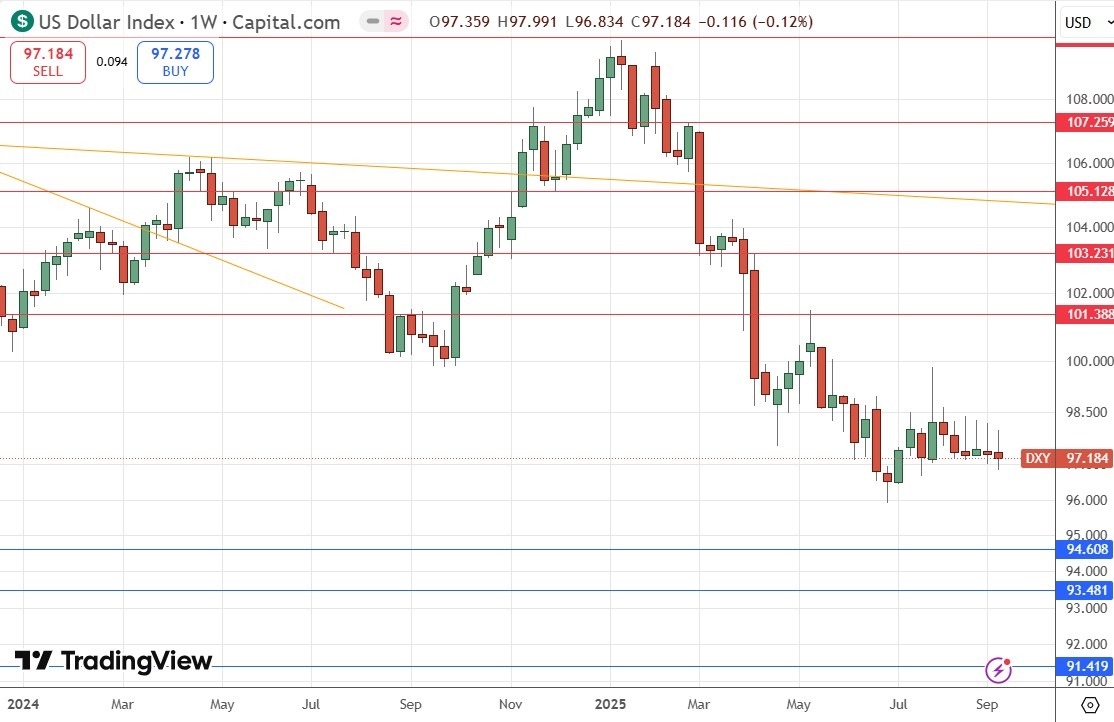
Last week, the US Dollar Index printed yet another bearish pin bar (the fourth consecutive one!), so we are now seeing extremely bearish price action, which is in line with the long-term bearish trend. Lower prices in the US Dollar look likely technically with all these repeated upper wics, however the price action is congested within its current area which may mean there is not much further downside to come. But a short-term fall is supported by more dovish market sentiment which arose last week following worse than expected US PPI data, even though the CPI data was a tick higher than expected.

Markets are now expecting rate cuts at each of the forthcoming Fed meetings remaining in this calendar year, with some even expecting a rate cut of 0.50% at the meeting this month. There is increasingly a feeling that the Fed has come to cutting rates a bit late. So. sentiment might be working with the trend and could trigger a downwards move now to the next support level at 94.61. We have a Fed meeting this week and a rate cut then is practically a certainty, so we might see Dollar action at or before this event.

I think it is wise to trade with the long-term trend and short-term price action right now, so trades short and not long of the US Dollar will probably be a good idea over the coming week.

Weekly Forex Forecast – 14th to 19th September (Charts)

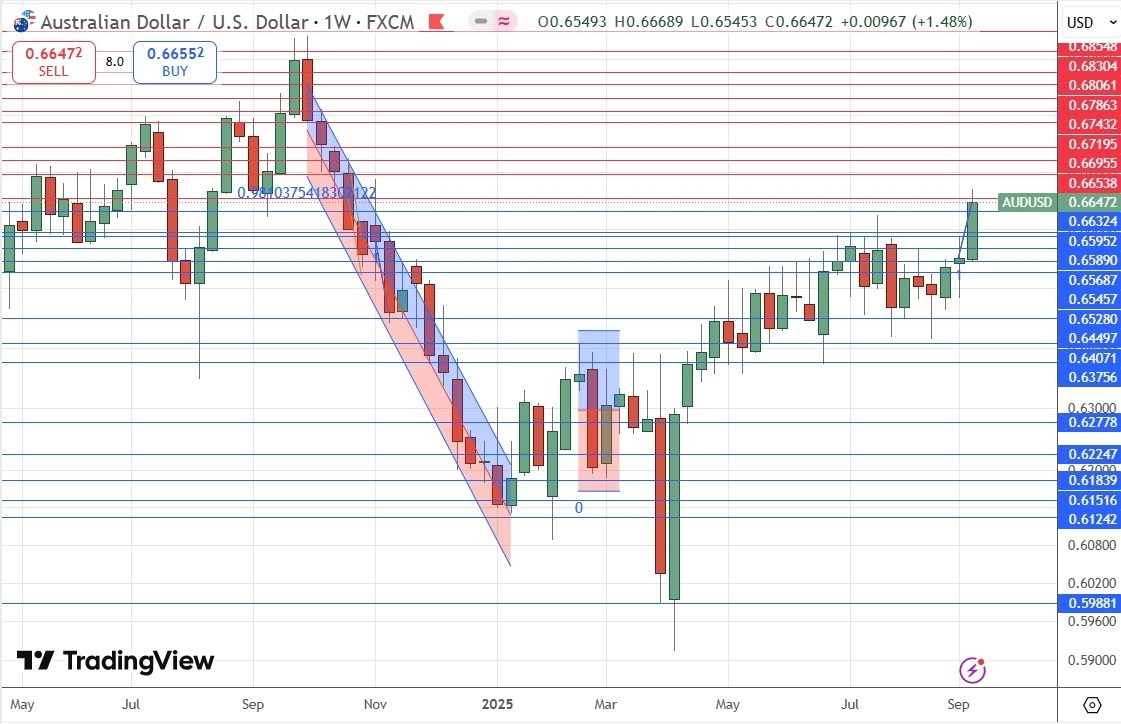
The AUD/USD currency pair rose strongly last week, powering up to new 11-month high prices. It was the strongest weekly rise since June, and the price closed quite near its high. These are bullish signs.

The Australian Dollar has gained mostly as a risk proxy, with stock markets mostly rising and risk-on sentiment remaining bullish. It was the biggest-gaining currency of last week. The Aussie has also benefited from higher than expected inflation data recently which has effectively ruled out any rate cuts over the near term, and this has helped to increase its value.

On the other side of this pair, the US Dollar is in a long-term bearish trend and has shown bearish price action over recent weeks as it fails again and again to rise. Although there is little momentum lower, the price does look likely to break down and it is a valid trend.

For these reasons, I think there is further upside here, although it is important to be careful when trying to trend the Aussie as it tends not to trend very reliably. The key level to watch out for is probably $0.6654 – if we get a sustained break above that, we could see a further significant gain, as that is the initial strong technical obstacle. However, Wednesday’s Fed meeting might cause volatility which could send the price into unpredictable areas.

Weekly Forex Forecast – 14th to 19th September (Charts)

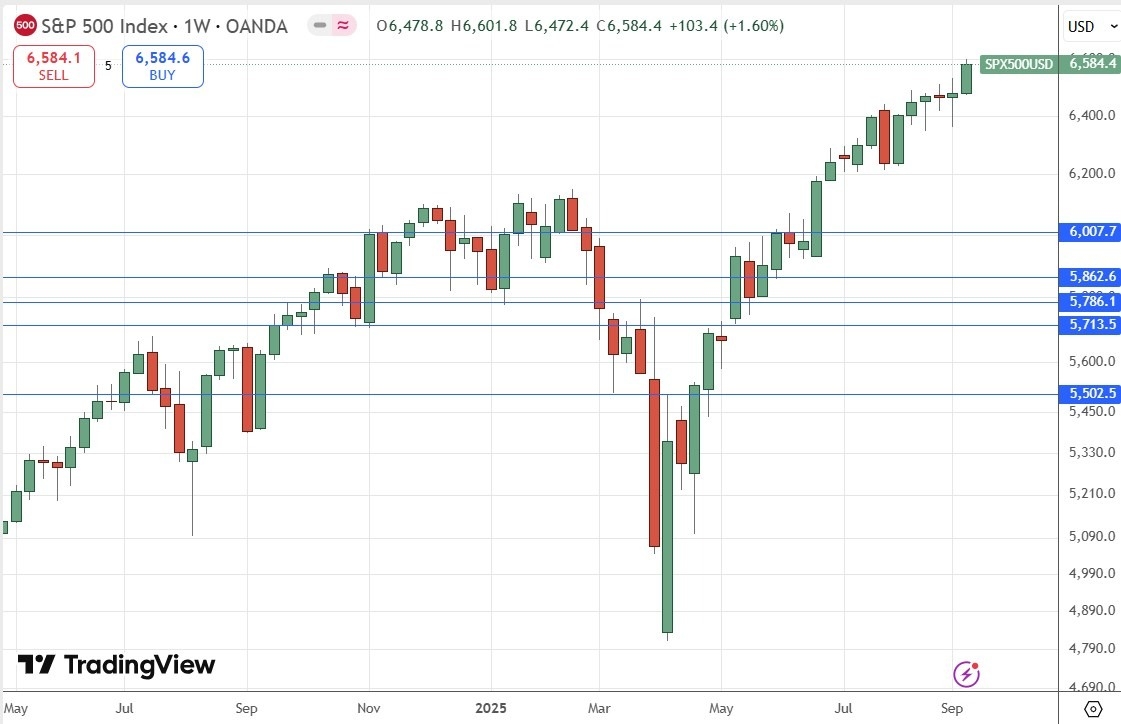
The S&P 500 Index had a great week, rising strongly and closing not far from the top of its range well into blue sky at a new record high, almost touching 6,600. The way the price was able to overcome the big round number at 6,500 was another bullish sign.

US stock markets are rising strongly due to increasing expectation that the Fed will make at least 0.75% worth of rate cuts over the rest of 2025, and on the bearish price action and trend we are seeing on the other half of this trade – the US Dollar.

The index has risen by about 10% since the start of 2025 and by 36% since the April low caused by the Trump tariff panic. It is an open question how much further the current bull run will go, but betting against new record highs in the US stock market is a brave and probably foolish move, unless it’s a cautious play in individual underperforming stocks.

I am bullish on the S&P 500 Index.

Weekly Forex Forecast – 14th to 19th September (Charts)

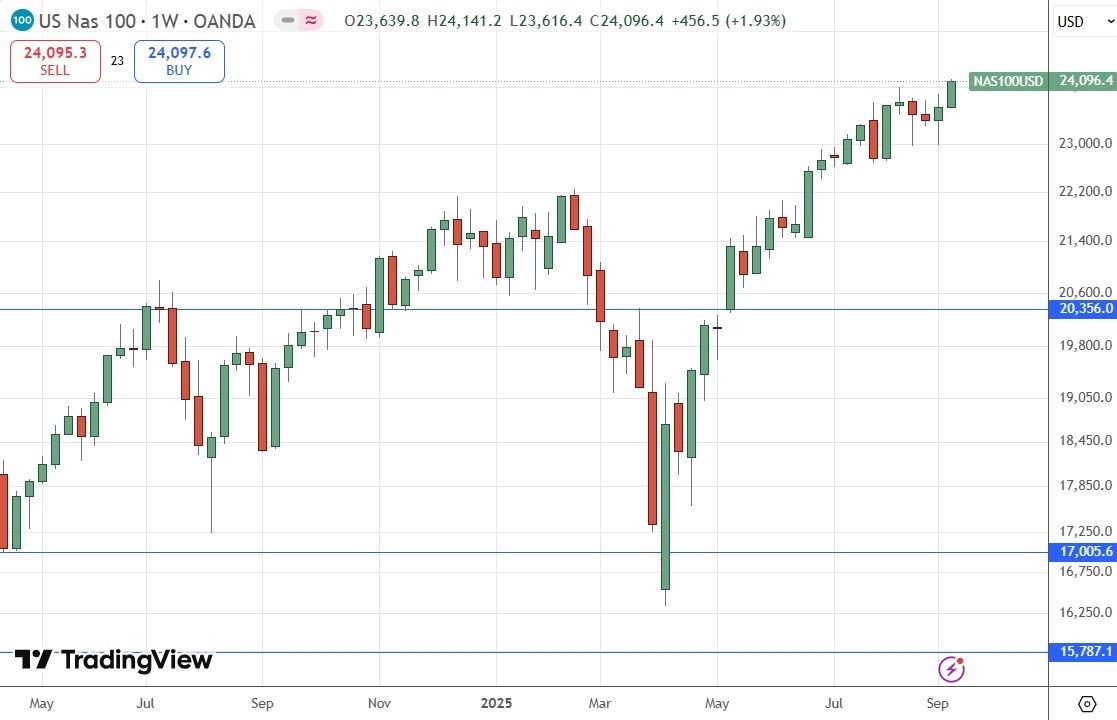
The NASDAQ 100 Index had a great week, rising strongly and closing very near the top of its range well into blue sky at a new record high, above 24,000. The way the price was able to overcome the big round number at 6,500 was another bullish sign, as was this tech index’s outperformance of the broader S&P 500 Index, while showing more bullish price action, too.

US stock markets are rising strongly due to increasing expectation that the Fed will make at least 0.75% worth of rate cuts over the rest of 2025, and on the bearish price action and trend we are seeing on the other half of this trade – the US Dollar.

The index has risen by about 14% since the start of 2025 and by 47% since the April low caused by the Trump tariff panic. These are above-average numbers, even in a bull market, especially the increase from April. It is an open question how much further the current bull run will go, but betting against new record highs in the US stock market is a brave and probably foolish move, unless it’s a cautious play in individual underperforming stocks.

I am very bullish on the NASDAQ 100 Index.

Weekly Forex Forecast – 14th to 19th September (Charts)

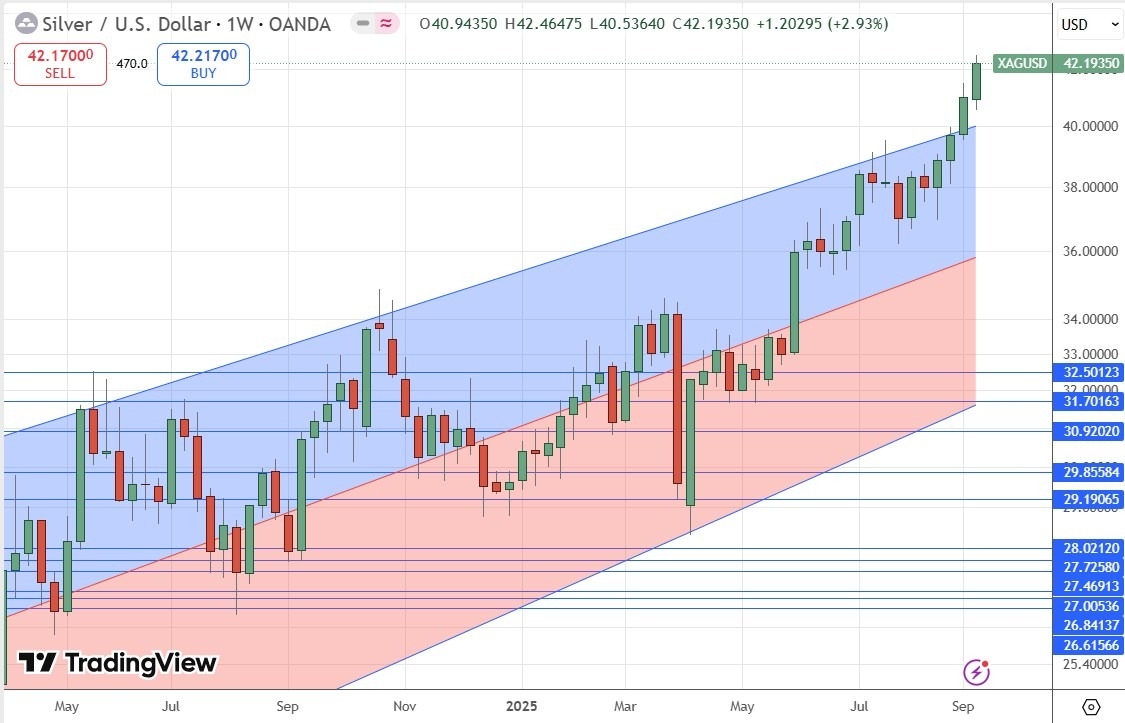
Silver had a stunning week, showing another outsize rise in value, again closing near the top of its weekly range, and powering up to a new 14-year high. It also outperformed Gold and all other precious metals. These are bullish signs, as is the general weakness in the US Dollar and that currency’s long-standing bearish trend on the other side of this trade, and the breakout from the linear regression analysis shown within the price chart below.

With Silver’s outperformance against Gold, it is probably worth being bold on the long side here.

Having said, if you are only just entering a new long trade here, as the move is quite extended, a smaller position size might be wise. Bulls might also be wary of the major quarter-number just ahead at $42.50.

I am very bullish on Silver.

Weekly Forex Forecast – 14th to 19th September (Charts)

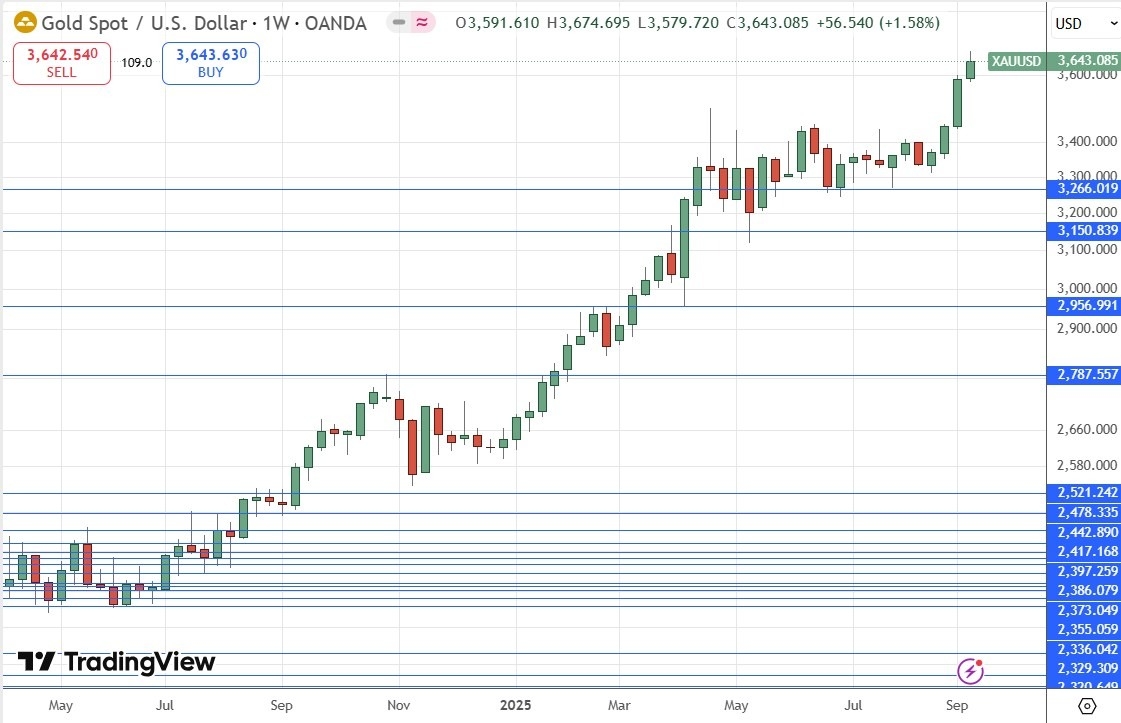
Gold rose last week to print a new all-time high price just below $3,675. However, it is worth noting that Gold underperformed Silver, and left a bit of an upper wick on the weekly candlestick, as can be seen in the price chart below.

The long-term bullish trend and break to new record highs are bullish factors, as is the bearish trend in the US Dollar and the strong US stock market, as the US stock market has tended to be positively correlated with Gold, to the surprise of many who it as a hedge against inflation or whatever.

It may be that we are due a pullback, but I think the combination of rising stock markets and a likely more aggressive rate cutting approach from the Fed, could provide the bullish sentiment needed to drive this strong advance to even higher all-time high prices.

For anyone who is only entering a long trade now, it might be wise to use a smaller position size to account for any sudden high-volatility snapback towards lower prices.

I am bullish on Gold.

Weekly Forex Forecast – 14th to 19th September (Charts)

I see the best trades this week as:

  1. Long of the S&P 500 Index.
  2. Long of the NASDAQ 100 Index.
  3. Long of Silver.
  4. Long of Gold.

Ready to trade our weekly Forex forecast? Check out our list of the best Forex brokers.

Source link

15 09, 2025

XRP-USD at $3.12 Targets $5 With ETF Momentum

By |2025-09-15T04:23:47+03:00September 15, 2025|Crypto News, News|0 Comments

XRP-USD Price Recovery and Technical Foundation

Ripple’s XRP-USD has stabilized above the $3.00 threshold after a volatile summer that saw a July peak of $3.65 followed by an August retracement below $3.00. September trading has restored momentum, with the 20-week SMA providing a sturdy floor between $2.70 and $2.80. Momentum indicators back the recovery: the stochastic oscillator signaled oversold conditions, and a doji pattern in early September hinted at bullish reversal. Current resistance sits at $3.20–$3.33, with the all-time high at $3.66 still capping upside. Clearing these levels would target $3.50 and then $5.00 by year-end, as multiple models, including DeepSeek AI projections, support.

Institutional Positioning and ETF Catalysts for XRP-USD

Institutional money is circling the market. Bitcoin ETFs pulled $246 million of inflows in early September, and speculation is building that XRP is next in line after Bitcoin and Ethereum. More than seven spot XRP ETF applications are queued with SEC deadlines between October 18 and 25. Futures data is equally bullish: XRP CME contracts hit $1 billion in open interest in just three months, the fastest on record for a crypto derivative. Futures-based funds already hold over $800 million in XRP exposure, showing appetite is deep. Analysts point to the September 18 launch of the REX-Osprey XRP ETF, a hybrid structure, as the first major test of demand. Approval of a full spot ETF could be the trigger to catapult XRP beyond $5.

Regulatory Clarity and Ripple’s Expanding Payment Network

Ripple’s SEC case resolution removed a multi-year overhang, restoring investor confidence. With clarity secured, Ripple is expanding aggressively in Europe, partnering with BBVA on custody and liquidity services, while eyeing a US-chartered bank license. Morgan Stanley analysts estimate Ripple’s payment rails could unlock $1 trillion in liquidity by replacing SWIFT’s cost-heavy system, with potential to slash transaction costs by 60%. If adoption accelerates, XRP could emerge as a dominant settlement asset for global finance.

Whale Accumulation and On-Chain Signals in XRP-USD

Whale activity reinforces the bullish setup. Wallets holding 10–100 million XRP accumulated 340 million tokens in two weeks, raising collective holdings to 7.84 billion. A $700 million transfer to Kraken spurred speculation about strategic positioning ahead of the Fed’s next decision. Historically, such inflows from whales precede sharp directional moves. On-chain data shows XRP outpacing both Bitcoin (BTC-USD) and Ethereum (ETH-USD) in short-term gains: XRP added 7.5% in three sessions, while Bitcoin barely moved despite record illiquid supply at 14.3 million BTC. This divergence highlights XRP’s growing appeal as the altcoin with stronger upside torque.

Macro Tailwinds and Federal Reserve Context

The macro environment is a supportive backdrop. US economic data has weakened, boosting odds of a September Fed cut at nearly 99%. A 25 bp cut is priced, with whispers of 50 bps. Lower rates amplify flows into digital assets, as seen with Bitcoin ETFs and now XRP. If the Fed pivots aggressively, it reinforces XRP’s role as a hedge and liquidity asset, adding fuel to ETF-driven demand.

Technical Breakouts and Market Structure Shifts

The daily chart confirms a decisive breakout from a multi-month falling wedge. XRP pierced resistance at $2.94–$2.99 and retested $3.05 successfully. Current price action around $3.12 consolidates just beneath the $3.20–$3.33 barrier. A sustained reclaim above $3.20 opens the door to $3.50 and $3.66, while support remains at $3.00 and $2.75. The 100-day moving average and wedge trendline converge near $2.90, reinforcing the bullish structure. Short-term pullbacks are possible, but the broader setup signals a structural shift in favor of buyers.


Competitive Threats and Alternative Plays

While XRP’s long-term case is robust, rival tokens are drawing speculative capital. Projects like Remittix and Layer Brett are marketed as “XRP 2.0,” touting PayFi solutions and 700% staking yields. Remittix raised $25.5 million in presale at $0.108 per token, while Layer Brett leveraged scarcity and referral incentives. These alternatives lure momentum investors chasing 20–30x upside, contrasting with XRP’s steadier institutional growth. Still, XRP’s established network effect and legal clarity cement its role as the safer large-cap choice versus high-risk challengers.

Forward Scenarios for XRP-USD

A bullish pathway requires ETF approval, Ripple’s banking license, and continued whale accumulation. These catalysts could break the $3.66 high and drive toward $5.00 in late 2025, with extreme projections stretching to $9–$10 if adoption accelerates. The bearish scenario hinges on legislative setbacks—such as delays to the Market Structure Bill—or failure of ETFs to attract strong inflows. In that case, XRP could revisit $2.80 and $2.50 supports.

Final Verdict on XRP-USD

Ripple’s XRP-USD combines regulatory clarity, whale accumulation, technical breakouts, and imminent ETF catalysts to create a bullish storm. With price holding above $3.00, resistance at $3.20–$3.33 is the final gate to a run at $3.66 and potentially $5.00. Compared with Bitcoin’s modest 30% projected upside, XRP’s altcoin profile offers far greater torque. Based on data, the call is clear: XRP-USD is a Buy with upside toward $5 in 2025 and potential for double-digit gains if ETFs and institutional adoption converge.

That’s TradingNEWS


Source link

15 09, 2025

Storage Surplus, LNG Demand, and Data Center Impact

By |2025-09-15T02:35:50+03:00September 15, 2025|Forex News, News|0 Comments


Natural Gas (NG=F) Market Outlook and Price Levels

Natural Gas futures (NG=F) entered mid-September under mixed pressures. On Friday, October contracts closed at $2.96 per MMBtu, up 0.24% from the prior session after forecasts pointed to hotter weather across the southern U.S. between September 17–21, spurring expectations of higher demand from power generators. That bounce came after a 1.5-week low earlier in the week, when the EIA reported a storage injection of +71 bcf, above consensus at +68 bcf and well above the five-year average of +56 bcf. Inventories now sit +6% above the five-year seasonal norm and only 1.3% lower year over year, signaling ample supply. Europe also sits comfortably at 80% storage levels against a historical 86%, another cap on price strength.

Production and LNG Export Dynamics Driving NG=F

Dry gas production in the lower-48 reached 108 bcf/day, up 7.1% year on year and near record highs. The EIA revised its 2025 production forecast to 106.63 bcf/day, up from 106.40 in August. Rig counts touched a two-year high, underscoring the supply overhang. U.S. LNG exports remain solid but dipped slightly with net flows at 14.5 bcf/day, down 4.7% week over week due to pipeline maintenance. EQT, the Appalachian Basin’s largest producer, is attempting to bypass traditional middlemen by signing contracts to buy LNG from Gulf Coast terminals and sell directly to Europe and Asia. These volumes, totaling 4.5 million tons annually, amount to 5% of U.S. exports. While U.S. benchmark gas is priced around $3 per MMBtu, European and Asian buyers continue paying $11+, creating a wide arbitrage. EQT’s move raises competition against majors like Shell (SHEL), BP (BP), and ConocoPhillips (COP), but also underscores a structural push by U.S. producers to capture margin beyond Henry Hub pricing.

International Pricing and Spot Market Activity

In Turkey’s spot market, 1,000 cubic meters of natural gas traded at 14,332 lira on Sept. 13, equal to $346 at prevailing FX rates. Spot trade volumes fell 18.7% to 11.68 million lira, with 816,000 cubic meters transacted. Meanwhile, pipeline deliveries into Turkey remained strong at 122 million cubic meters. Globally, LNG deals are expanding, with Turkey securing 15 bcm over three years through new contracts signed at Gastech 2025. These long-term arrangements highlight strong international demand even as regional spot markets soften.

Corporate and Contractual Developments

Puerto Rico’s Fiscal Oversight Board is finalizing a 15-year, $20 billion LNG supply contract with New Fortress Energy (NFE) despite the company’s financial struggles, including a $557 million Q2 loss and a stock price collapse to $1.31 from $35.58 in 2024. NFE controls the San Juan dock, the island’s sole LNG gateway until 2038, giving it leverage despite balance-sheet distress. The deal reflects how infrastructure bottlenecks can sustain high-cost suppliers even in weak financial health, with direct implications for regional LNG pricing and reliability.

Egypt and Regional Supply Expansion

Egypt’s Ministry of Petroleum reported higher production rates as new seismic surveys and foreign partnerships accelerate. Floating storage and regasification units (FSRUs) have stabilized summer demand without load shedding. Egypt also aims to leverage its 3 trillion cubic feet reserves and petrochemical sector to secure export commitments. The government signed new exploration agreements, with international majors like TotalEnergies and ADNOC signaling interest. This positions Egypt as a regional hub, further shaping supply flows into Europe and Asia.


Macro Shifts: Data Centers and U.S. Power Demand

A new driver of domestic gas consumption is emerging from the AI boom. Data centers consumed 4.4% of total U.S. electricity in 2023, projected to rise to between 6.7% and 12% by 2028. Facilities under construction, some drawing power equivalent to 176,000 homes, are cementing natural gas as a backstop fuel as renewables struggle to scale at the pace of demand. Utilities have doubled natural gas capacity plans in just 18 months, adding 52 GW of new gas builds, while delays in connecting solar and wind projects—now averaging five years—leave fossil fuels dominant. Utilities favor gas plants because regulatory processes let them pass fuel costs to consumers directly, creating long-term reliance despite climate mandates.

Price Risks and Seasonal Factors

Short-term demand is highly weather dependent. The warmer forecast through late September supports NG=F near $3.00, but bearish risks remain from production oversupply and above-average storage. European storage comfort adds downward pressure, with winter risk premium not yet built into pricing. If U.S. demand spikes from heat waves or if LNG flows recover post-maintenance, upside could test $3.20–$3.30 resistance. On the downside, sustained injections above 70 bcf per week could drag futures back toward $2.75–$2.80 support.

Investment Call on Natural Gas (NG=F)

Natural Gas presents a complex mix of bullish catalysts—weather, LNG arbitrage, and data-center electricity demand—against heavy bearish forces from record production, high storage, and structural oversupply risks into 2027. EQT’s direct-to-Europe strategy shows producers’ push for margin capture but also highlights growing competition with supermajors. NFE’s contract saga underscores geopolitical supply chokepoints. With NG=F holding just below $3.00, the market is balanced but vulnerable to storage builds and production growth. Based on current fundamentals, the outlook leans Neutral to Bearish, and the call is Hold, with tactical trading opportunities on weather-driven spikes but limited sustained upside until winter heating demand tightens balances.

That’s TradingNEWS


Source link

Go to Top