About Editorial team of BIPNs

Main team of content of bipns.com. Any type of content should be approved by us.
6 10, 2025

Reaches fresh all-time highs above 176.00

By |2025-10-06T09:36:38+03:00October 6, 2025|Forex News, News|0 Comments

EUR/JPY opened at a gap-up, extending its gains and trading around 176.20 during the Asian hours on Monday. The technical analysis of the daily chart indicates strengthening of a bullish bias as the currency cross has broken above the ascending channel pattern.

Additionally, the 14-day Relative Strength Index (RSI) rises toward the 70 mark, suggesting that bullish bias is strengthening. A break above the 70 mark would suggest an overbought situation and a downward correction anytime soon. Additionally, the short-term price momentum is stronger as the EUR/JPY cross is positioned above the nine-day Exponential Moving Average (EMA).

On the upside, the EUR/JPY cross reached an all-time high of 176.24, which was recorded on October 6. As the market bias is bullish, the cross may explore the region around the psychological level of 177.00.

A pullback toward the ascending channel would prompt the EUR/JPY cross to test the nine-day EMA of 174.02. Further declines would weaken the short-term price momentum and put downward pressure on the currency cross to approach the lower boundary of the channel around 173.00, followed by the 50-day EMA at 172.64.

A break below the 50-day EMA would weaken the medium-term price momentum and put downward pressure on the EUR/JPY cross to navigate the region around the three-month low of 169.72, recorded on July 31.

(The story was corrected on October 6 at 06:25 GMT, to say in the second paragraph that bullish bias is strengthening, and not the bearish bias.)

EUR/JPY: Daily Chart

Euro Price Today

The table below shows the percentage change of Euro (EUR) against listed major currencies today. Euro was the strongest against the Japanese Yen.

USD EUR GBP JPY CAD AUD NZD CHF
USD 0.01% -0.00% 0.57% -0.04% -0.29% -0.23% -0.04%
EUR -0.01% -0.12% 0.48% -0.09% -0.34% -0.28% -0.09%
GBP 0.00% 0.12% 0.69% 0.03% -0.22% -0.16% 0.03%
JPY -0.57% -0.48% -0.69% -0.56% -0.91% -0.87% -0.66%
CAD 0.04% 0.09% -0.03% 0.56% -0.21% -0.19% -0.01%
AUD 0.29% 0.34% 0.22% 0.91% 0.21% 0.07% 0.25%
NZD 0.23% 0.28% 0.16% 0.87% 0.19% -0.07% 0.18%
CHF 0.04% 0.09% -0.03% 0.66% 0.01% -0.25% -0.18%

The heat map shows percentage changes of major currencies against each other. The base currency is picked from the left column, while the quote currency is picked from the top row. For example, if you pick the Euro from the left column and move along the horizontal line to the US Dollar, the percentage change displayed in the box will represent EUR (base)/USD (quote).

Source link

6 10, 2025

Krill Oil Supplements Market | Global Market Analysis Report

By |2025-10-06T09:35:34+03:00October 6, 2025|Dietary Supplements News, News|0 Comments


Krill Oil Supplements Market Size and Share Forecast Outlook 2025 to 2035

The krill oil supplements market is projected to grow from USD 1,064.8 million in 2025 to USD 2,544.1 million by 2035, reflecting a CAGR of 9.1%. During the early adoption phase (2020–2024), consumers gradually explored krill oil as an alternative to traditional omega-3 supplements due to its high bioavailability and functional benefits.

By 2025, growing awareness among health-conscious consumers and adoption by dietary supplement manufacturers will drive broader market growth. This phase represents the transition from niche usage to wider commercial adoption, as companies expand production capacity, diversify product offerings, and strengthen distribution networks, setting the stage for the scaling phase. From 2025 to 2030, the market enters a scaling phase, marked by accelerated uptake across retail, pharmaceutical, and online channels.

Market value rises from USD 1,064.8 million in 2025 as adoption increases in daily dietary supplements and fortified products. By 2030, krill oil supplements will become a recognized category within the omega-3 segment, preparing the market for consolidation. Between 2030 and 2035, the market reaches USD 2,544.1 million, with steady CAGR-driven growth. Consolidation occurs as leading suppliers optimize production, establish long-term distribution partnerships, and capture larger market shares, resulting in a mature and competitive market environment.

Quick Stats for Krill Oil Supplements Market

  • Krill Oil Supplements Market Value (2025): USD 1064.8 million
  • Krill Oil Supplements Market Forecast Value (2035): USD 2544.1 million
  • Krill Oil Supplements Market Forecast CAGR: 9.1%
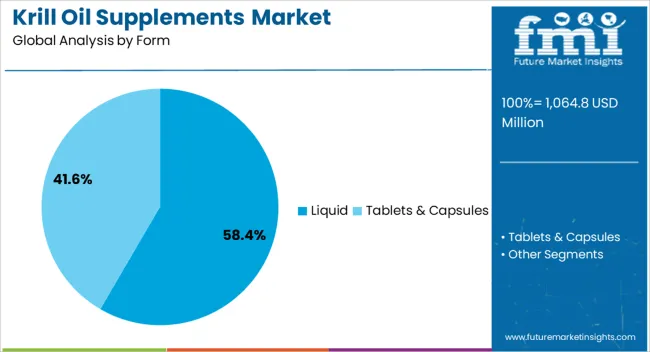
  • Leading Segment in Krill Oil Supplements Market in 2025: Liquid (58.4%)
  • Key Growth Regions in Krill Oil Supplements Market: North America, Asia-Pacific, Europe
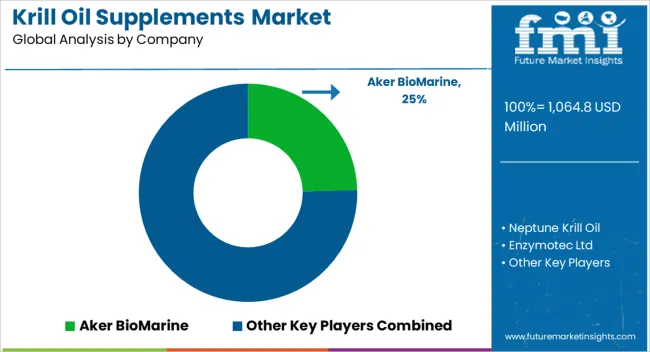
  • Top Key Players in Krill Oil Supplements Market: Aker BioMarine, Neptune Krill Oil, Enzymotec Ltd, RIMFROST AS, NutriGold Inc., Life Extension, NOW Foods

Krill Oil Supplements Market Key Takeaways


Metric Value
Krill Oil Supplements Market Estimated Value in (2025 E) USD 1064.8 million
Krill Oil Supplements Market Forecast Value in (2035 F) USD 2544.1 million
Forecast CAGR (2025 to 2035) 9.1%

The krill oil supplements market is a key segment of the broader omega-3 and dietary supplements market. In 2025, krill oil accounts for approximately 18% of the omega-3 supplements market, reflecting growing consumer preference for high-bioavailability sources of omega-3 fatty acids. The broader omega-3 and dietary supplements market is projected to grow at a CAGR of around 5–6% during 2025–2035, driven by increasing demand for heart health, cognitive support, and overall wellness products globally. Within the omega-3 segment, krill oil holds an estimated 12% share in 2025, while fish oil and plant-based omega-3 sources account for the remainder. By 2030, scaling adoption is expected to increase the krill oil share to nearly 15%, driven by its integration into functional foods, nutraceutical products, and direct-to-consumer supplements.

Between 2030 and 2035, market consolidation is anticipated as leading producers expand production, optimize supply chains, and establish strategic partnerships with retailers and health brands. By 2035, krill oil supplements are projected to account for approximately 17% of the omega-3 supplements market and around 8–9% of the overall dietary supplements market, solidifying their position as a key growth driver and significant revenue contributor within the parent market.

Why is the Krill Oil Supplements Market Growing?

The krill oil supplements market is witnessing steady expansion, fueled by growing consumer awareness of the health benefits associated with omega-3 fatty acids and the bioavailability advantages of phospholipid-bound EPA and DHA found in krill oil. Demand is being supported by the rising prevalence of lifestyle-related health conditions, which has prompted increased incorporation of marine-based supplements into daily nutrition.

Market growth is further influenced by heightened interest in joint health, cardiovascular wellness, and cognitive support, driving consistent consumption across a diverse demographic base. Technological advancements in extraction and encapsulation methods have enhanced product stability and purity, increasing acceptance among both retail consumers and nutraceutical manufacturers.

While competition from fish oil supplements remains, krill oil continues to gain market share due to its differentiation in absorption efficiency and antioxidant content, particularly astaxanthin. Over the forecast period, demand is anticipated to rise steadily across global markets, supported by expanding distribution networks, premium positioning in health and wellness portfolios, and the continued endorsement of omega-3 supplementation by healthcare professionals.

Segmental Analysis

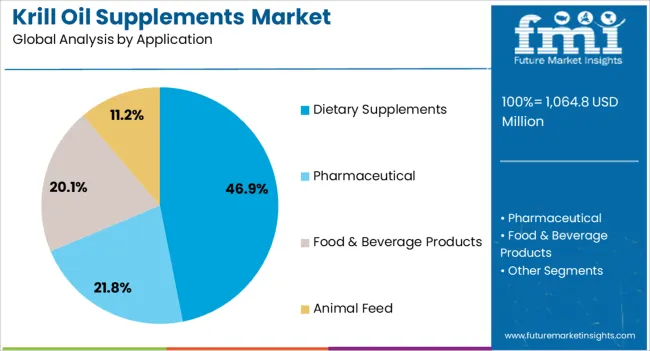
The krill oil supplements market is segmented by form, application, and geographic regions. By form, krill oil supplements market is divided into Liquid and Tablets & Capsules. In terms of application, krill oil supplements market is classified into Dietary Supplements, Pharmaceutical, Food & Beverage Products, and Animal Feed. Regionally, the krill oil supplements industry is classified into North America, Latin America, Western Europe, Eastern Europe, Balkan & Baltic Countries, Russia & Belarus, Central Asia, East Asia, South Asia & Pacific, and the Middle East & Africa.

Insights into the Liquid Segment

Krill Oil Supplements Market Analysis By Form

The liquid segment dominates the form category of the krill oil supplements market, holding approximately 58.4% of the total share. Its leadership is driven by consumer preference for easily absorbable formats and versatility in dosage customization. The segment has been further strengthened by the availability of liquid krill oil in both standalone supplement bottles and bulk formats for incorporation into functional foods and beverages.

Liquid formulations are perceived as offering higher purity levels and fresher taste profiles, appealing to health-conscious consumers seeking minimally processed products. Additionally, liquid krill oil allows for the preservation of naturally occurring antioxidants, such as astaxanthin, without undergoing extensive refinement.

The segment’s position is reinforced by its adaptability to a variety of consumption habits, from direct intake to blending with smoothies or health tonics. As manufacturing techniques continue to improve shelf life and stability, the liquid segment is expected to maintain its lead, benefiting from both retail and B2B nutraceutical applications.

Insights into the Dietary Supplements Segment

Krill Oil Supplements Market Analysis By Application

The dietary supplements segment leads the application category in the krill oil supplements market, accounting for approximately 46.9% of total share. This segment’s strength is rooted in the increasing consumer adoption of daily omega-3 supplementation for cardiovascular, cognitive, and joint health. The growing shift towards preventive healthcare has elevated the role of krill oil capsules, softgels, and liquid droppers in routine wellness regimens.

The segment benefits from widespread retail penetration, including pharmacies, specialty nutrition stores, and online platforms, which has expanded accessibility to global consumers. Regulatory recognition of krill oil as a safe dietary ingredient has further boosted its credibility among health professionals and consumers alike.

Marketing campaigns highlighting the superior bioavailability of krill oil over conventional fish oil have amplified demand, particularly in premium supplement categories. Continued product diversification, including combination formulas with vitamins and herbal extracts, is expected to further strengthen the dietary supplements segment’s dominance over the forecast horizon.

What are the Drivers, Restraints, and Key Trends of the Krill Oil Supplements Market?

The krill oil supplements market is expanding due to increasing consumer interest in cardiovascular health, joint support, and cognitive wellness. North America and Europe lead adoption with high awareness of omega-3 benefits, aging populations, and well-established supplement retail channels. Asia-Pacific is growing rapidly due to rising disposable income, health awareness, and e-commerce penetration. Manufacturers differentiate through purity, phospholipid content, and sustainability certifications. Regional differences in dietary preferences, regulatory frameworks, and consumer trust strongly influence product formulation, adoption, and global competitiveness.

Rising Health Awareness and Preventive Nutrition

Increasing consumer focus on preventive healthcare is driving krill oil supplement adoption. North America and Europe emphasize cardiovascular and cognitive wellness products due to aging populations, widespread omega-3 knowledge, and functional food trends. Asia-Pacific markets are growing as health-conscious urban populations seek dietary supplements to support heart and joint health. Differences in awareness levels, supplement consumption habits, and medical recommendations influence product dosage, form (capsules or soft gels), and ingredient sourcing. Leading suppliers offer high-purity, phospholipid-rich krill oil with clinical validation, while regional manufacturers focus on affordable, mass-market formulations. Health awareness contrasts shape adoption, product positioning, and market competitiveness across global krill oil supplement markets.

Sustainability and Sourcing Standards Influence Market Growth

Sustainability concerns and responsible sourcing are increasingly critical in the krill oil supplements market. North America and Europe prioritize certifications for sustainable harvesting, traceability, and environmental compliance. Asia-Pacific markets are gradually adopting sustainability-focused products, balancing cost and ecological impact. Differences in regulatory pressure, consumer perception, and marine conservation policies influence sourcing, extraction methods, and labeling. Leading suppliers provide certified krill oil with verified phospholipid and omega-3 content, while regional players focus on cost-effective, locally sourced alternatives. Sustainability and sourcing contrasts drive adoption, brand trust, and competitiveness in the global krill oil supplement market.

Regulatory Compliance and Quality Assurance Drive Adoption

Regulatory frameworks and quality assurance significantly influence krill oil supplement adoption. North America and Europe require stringent labeling, purity verification, and clinical substantiation under FDA and EFSA guidelines. Asia-Pacific regulations vary; developed regions follow international standards, while emerging markets have flexible local regulations. Differences in testing protocols, dosage limits, and product registration impact production practices, market entry, and brand credibility. Leading suppliers invest in high-quality extraction, standardized phospholipid content, and batch testing, while regional manufacturers focus on affordable, compliant options. Regulatory contrasts shape adoption, consumer trust, and competitiveness globally.

Product Innovation and Formulation Differentiation Boost Market Appeal

Innovation in krill oil supplements, including enhanced bioavailability, combination formulations, and soft gel encapsulation, is driving market growth. North America and Europe prioritize clinically validated formulations with targeted benefits, including heart, joint, and brain health. Asia-Pacific markets adopt value-added, multi-nutrient supplements balancing affordability and efficacy. Differences in consumer expectations, health claims acceptance, and technological capabilities influence dosage, encapsulation, and delivery mechanisms. Leading suppliers develop high-potency, odor-controlled, and sustainably sourced products, while regional manufacturers focus on accessible, low-cost alternatives. Formulation and innovation contrasts drive adoption, product differentiation, and competitiveness across the global krill oil supplement market.

Analysis of Krill Oil Supplements Market By Key Countries

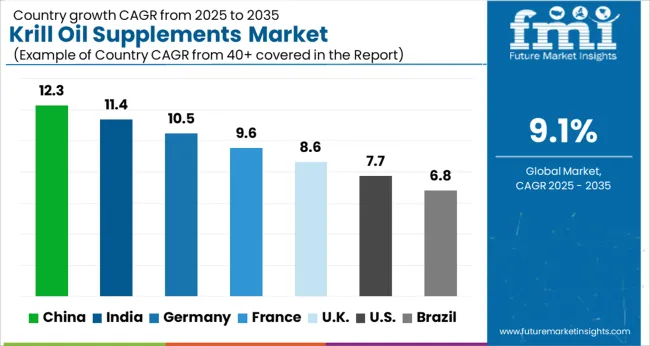
Krill Oil Supplements Market Cagr Analysis By Country


Country CAGR
China 12.3%
India 11.4%
Germany 10.5%
France 9.6%
UK 8.6%
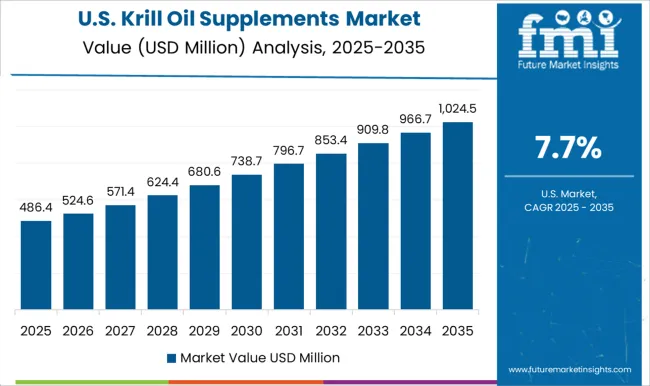
USA 7.7%
Brazil 6.8%

The global krill oil supplements market is projected to grow at a 9.1% CAGR through 2035, driven by demand in dietary supplements, functional foods, and nutraceutical applications. Among BRICS nations, China led with 12.3% growth as large-scale production and distribution networks were implemented, while India at 11.4% expanded manufacturing and supply to meet growing domestic and regional consumption. In the OECD region, Germany at 10.5% maintained steady utilization under strict quality and regulatory standards, while the United Kingdom at 8.6% supported moderate-scale deployment in commercial and retail sectors. The USA, growing at 7.7%, sustained adoption in nutraceutical and dietary supplement applications while complying with federal and state-level regulations. This report includes insights on 40+ countries; the top countries are shown here for reference.

Krill Oil Supplements Market Development in China

The krill oil supplements market in China is growing at a 12.3% CAGR, driven by rising health awareness, increasing disposable incomes, and growing demand for omega-3 and antioxidant-rich products. Consumers are focusing on cardiovascular health, cognitive function, and joint support, which are key benefits associated with krill oil. E-commerce platforms and modern retail channels are expanding product availability across urban and semi-urban areas. Domestic manufacturers are investing in research and development to produce high-purity, sustainably sourced krill oil supplements. Marketing strategies emphasize clinical benefits, quality assurance, and certifications such as sustainability and purity standards. The rising popularity of preventive healthcare and nutraceutical products is supporting demand. Overall, China’s market reflects strong consumer interest in health supplements, growing online distribution channels, and increasing awareness of the benefits of marine-based omega-3 sources.

  • Health awareness increased supplement adoption
  • E-commerce and retail channels expanded accessibility
  • R&D focused on purity and sustainable sourcing

Krill Oil Supplements Market Expansion in India

Krill oil supplements market in India is registering an 11.4% CAGR, supported by rising health consciousness and growing interest in dietary supplements for cardiovascular, cognitive, and joint health. Consumers in urban centers are increasingly turning to omega-3 supplements as preventive healthcare measures. Domestic and international manufacturers are introducing high-quality, sustainably sourced krill oil products with certifications for purity and safety. E-commerce and pharmacy retail channels are improving product accessibility, particularly in tier-one and tier-two cities. Marketing campaigns emphasize health benefits, natural sourcing, and clinical efficacy. The growth of health and wellness trends, combined with increasing disposable income, supports consistent market expansion. Overall, India’s market reflects increasing consumer adoption, expanding distribution channels, and rising awareness of nutraceutical benefits.

  • Preventive healthcare boosted supplement adoption
  • E-commerce and retail improved product access
  • Purity and safety certifications enhanced consumer trust

Krill Oil Supplements Market Trends in Germany

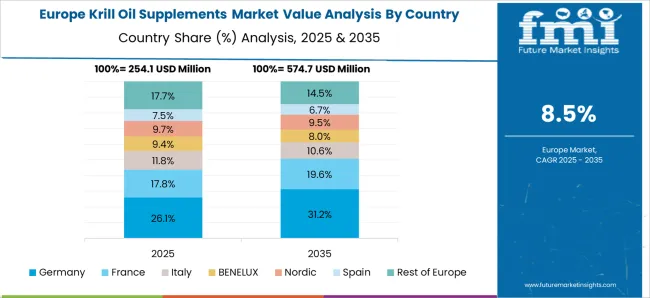
Krill Oil Supplements Market Europe Country Market Share Analysis, 2025 & 2035

Germany’s krill oil supplements market is growing at a 10.5% CAGR, driven by strong health awareness and adoption of dietary supplements for heart, brain, and joint health. Consumers prefer high-purity, sustainably sourced krill oil products, supported by stringent quality and safety standards. Retailers, pharmacies, and online channels are expanding product availability, providing easy access for health-conscious buyers. Manufacturers focus on product innovation, including enhanced bioavailability, combined formulations, and environmentally responsible sourcing. Public awareness campaigns and nutraceutical marketing emphasize clinically validated benefits, supporting consumer adoption. Market growth is shaped by sustainability preferences, regulatory compliance, and increasing demand for preventive health supplements. Germany’s market reflects steady growth due to high consumer confidence in quality-assured products and consistent industrial innovation.

  • High-purity and sustainable products gained consumer preference
  • Retail and online channels improved accessibility
  • Clinical validation and product innovation supported adoption

Krill Oil Supplements Market Progress in the United Kingdom

The United Kingdom market is expanding at an 8.6% CAGR, driven by consumer interest in cardiovascular, cognitive, and joint health supplements. Krill oil products are increasingly preferred for their bioavailability and antioxidant properties. Manufacturers focus on high-quality, sustainably sourced supplements with certifications to ensure consumer trust. E-commerce platforms, pharmacy chains, and specialty health stores enhance product accessibility. Marketing campaigns emphasize preventive healthcare, scientific backing, and environmental responsibility. Rising disposable incomes and health-conscious lifestyles among urban consumers further support growth. Overall, the UK market reflects moderate expansion supported by innovation, sustainable sourcing, and increasing consumer adoption of nutraceutical products.

  • Bioavailability and sustainability drove product preference
  • Retail and online channels increased accessibility
  • Preventive healthcare trends encouraged adoption

Krill Oil Supplements Market Insights in the United States

Krill Oil Supplements Market Country Value Analysis

The United States krill oil supplements market is growing at a 7.7% CAGR, supported by rising health awareness and demand for omega-3-rich nutraceuticals. Consumers focus on cardiovascular health, cognitive support, and joint wellness, increasing krill oil adoption. Manufacturers emphasize high-purity, sustainably sourced products with certifications to ensure safety and quality. Online retail, pharmacy chains, and health stores provide broad accessibility. Marketing campaigns highlight clinically proven benefits and environmental sustainability. The growth of preventive healthcare and wellness trends, combined with rising disposable income, drives market expansion. Overall, the USA market reflects steady growth supported by consumer health awareness, product quality assurance, and widespread distribution channels.

  • Health awareness and preventive care increased demand
  • Certified and sustainable products gained preference
  • Retail and online accessibility supported market growth

Competitive Landscape of Krill Oil Supplements Market

Krill Oil Supplements Market Analysis By Company

The krill oil supplements market is being shaped by prominent companies such as Aker BioMarine, Neptune Krill Oil, Enzymotec Ltd, RIMFROST AS, NutriGold Inc., Life Extension, and NOW Foods, who dominate the supply of high-quality krill oil products globally. These suppliers focus on sourcing Antarctic krill sustainably while maintaining strict quality standards to ensure high levels of omega-3 fatty acids and phospholipids. With increasing consumer awareness about the health benefits of krill oil, including cardiovascular support, cognitive enhancement, and anti-inflammatory effects, these companies are innovating to meet the rising demand for bioavailable and effective supplements. Leading players in the market are investing in advanced extraction and encapsulation technologies to improve absorption and minimize common drawbacks such as fishy aftertaste. Product differentiation has become a key strategy, with companies offering softgels, emulsified liquids, and functional blends targeting specific health needs. Additionally, there is a growing trend toward incorporating krill oil into nutraceuticals and functional foods, which broadens the reach of these products to a wider consumer base and enhances market penetration. Eco-efficiency and environmental responsibility remain core priorities for these suppliers, with many implementing eco-friendly harvesting practices to protect marine ecosystems. Strategic partnerships, mergers, and expanded distribution networks are also being pursued to strengthen global presence and ensure consistent supply. As interest in natural, marine-derived dietary supplements continues to grow, the krill oil market is expected to witness steady expansion, driven by both health-conscious consumers and the proactive initiatives of leading market suppliers.

Key Players in the Krill Oil Supplements Market

  • Aker BioMarine
  • Neptune Krill Oil
  • Enzymotec Ltd
  • RIMFROST AS
  • NutriGold Inc.
  • Life Extension
  • NOW Foods

Scope of the Report


Item Value
Quantitative Units USD 1064.8 Million
Form Liquid and Tablets & Capsules
Application Dietary Supplements, Pharmaceutical, Food & Beverage Products, and Animal Feed
Regions Covered North America, Europe, Asia-Pacific, Latin America, Middle East & Africa
Country Covered United States, Canada, Germany, France, United Kingdom, China, Japan, India, Brazil, South Africa
Key Companies Profiled Aker BioMarine, Neptune Krill Oil, Enzymotec Ltd, RIMFROST AS, NutriGold Inc., Life Extension, and NOW Foods
Additional Attributes Dollar sales vary by product form, including capsules, soft gels, and liquid oils; by application, such as cardiovascular health, joint support, cognitive health, and general wellness; by end-use, spanning nutraceutical companies, pharmacies, and direct-to-consumer channels; by region, led by North America, Europe, and Asia-Pacific. Growth is driven by rising health awareness, omega-3 demand, and functional supplement trends.


Source link

6 10, 2025

Cardano Price Prediction: Could ADA Price Reach $5 By 2027

By |2025-10-06T09:16:48+03:00October 6, 2025|Crypto News, News|0 Comments

The idea that Cardano’s price could escalate toward $5 by 2027 draws interest in crypto circles, especially as ADA continues expanding its ecosystem. However, when stacking that possibility against newer projects, Remittix enters the picture as a crypto that some believe may deliver steeper upside. 

In this article, we explore whether Cardano can truly hit $5, and contrast its path with Remittix’s trajectory, seeing where the greater potential might lie.

Cardano Price Prediction: Realistic Projections for ADA

Most forecasts for ADA through 2027 tend to be modest. CoinCodex projects an average ADA price around $1.25 in 2027, with peaks approaching $2.11. Binance’s outlook is even more conservative, placing 2027 ADA under $1.00.

Pushing ADA to $5 by 2027 would require not only strong adoption but also a structural shift in how markets value Cardano vis-à-vis risk assets. Given its size and current trajectory, such a leap would be more speculative than mainstream models suggest.Cardano Price Prediction: Could ADA Price Reach  By 2027

Could Remittix Outpace ADA’s Aspirations?

In comparing Remittix with ADA under the lens of who has more upside, the contrast is stark. Where ADA’s upside depends on incremental network gains, Remittix’s upside depends on building real payments infrastructure and capturing new users.

Remittix is fully verified by CertiK and holds the #1 rank among pre-launch tokens. Its wallet is in active beta with real community testing. The 15% USDT referral rewards system is live. It launched a $250,000 giveaway to fuel awareness. 

After surpassing $20 million and $22 million funding marks, it secured listings on BitMart and LBank. Remittix has sold more than 674 million tokens, is priced at $0.113, and has raised over $27 million.

Here are standout traits that may enable Remittix to outperform expectations:

  • Utility first token powering real transaction volume
  • Direct crypto to bank transfers in 30+ countries
  • Backed by working infrastructure, not vaporware
  • Audited by CertiK, built with trust and transparency
  • One of the few projects with product progress before TGE

This set of features positions Remittix not just as a speculative pick but one with a foundation of utility, community incentives, and credibility. If its infrastructure traction aligns with market cycles, Remittix may navigate toward returns that ADA would struggle to match under similar timeframes.

Weighing ADA’s $5 Dream vs Remittix’s Ascent

For ADA to reach $5 by 2027, it would need to quadruple or more beyond many optimistic forecasts. While not impossible, such a scenario currently sits at the tail end of probability distributions. Remittix, by contrast, starts from lower bases and combines narrative, rewards, and growing utility; these can catalyze steeper relative growth if execution succeeds.

Discover the future of PayFi with Remittix by checking out their project here:

Website: https://remittix.io/   

Socials: https://linktr.ee/remittix   

$250,000 Giveaway: https://gleam.io/competitions/nz84L-250000-remittix-giveaway

Disclaimer: This is a paid post and should not be treated as news/advice. LiveBitcoinNews is not responsible for any loss or damage resulting from the content, products, or services referenced in this press release.

Source link

6 10, 2025

XAU/USD looks to $4,000 as the record rally resumes

By |2025-10-06T07:39:43+03:00October 6, 2025|Forex News, News|0 Comments


Gold has extended the previous advance, rallying as much as 1% so far this Monday to clinch a new all-time high near $3,925.  

Gold remains on the hunt for $4,000

Gold buyers appear unstoppable at the start of a fresh week, early Monday, despite the renewed US Dollar (USD) upswing and a risk-on rally on global stocks.

Gold is finding demand due to increased safe-haven flows, mainly driven by the murky United States (US) economic outlook in the face of the extended government shutdown, which has entered a seventh day.

There are no public signs that the Republican and Democratic lawmakers are making any efforts to end the impasse on reopening the federal government.

This deadlock has raised worries over layoffs amid already weakening US labor market conditions.

Asked on Sunday night when federal workers would be fired as he has threatened to do, US President Donald Trump said that “it’s taking place right now and it’s all because of the Democrats.”

“The Democrats are causing the loss of a lot of jobs,” Trump added.

Delayed US economic reports also add to the uncertainty over the US Federal Reserve’s (Fed) outlook on interest rates beyond the October 28-29 meeting.

Markets have fully priced in a 25 basis points (bps) rate cut later this month, with chances of a December rate reduction standing at about 94%, according to the CME Group’s FedWatch Tool.

The Fed’s dovish narrative combined with the US political and fiscal concerns outweighs the risk-on mood and the USD/JPY rally-driven USD rebound, powering the Gold price upside.

The Japanese Yen (JPY) sinks against the USD after “Sanae Takaichi won the Japanese ruling Liberal Democratic Party (LDP) leadership election at the weekend, setting the country on course for more expansionary fiscal policy and complicating the task facing the Bank of Japan (BoJ),” per Reuters.

Looking ahead, any fresh updates on the US shutdown talks could have a significant impact on the Greenback and Gold.

Meanwhile, any private data from the US will be closely eyed alongside speeches from Fed officials for fresh insights on the US economy and the Fed’s path forward on interest rates.

Gold price technical analysis: Four-hourly chart

As observed on the four-hour chart, the 14-day Relative Strength Index (RSI) is approaching the overbought region, currently near 67, suggesting that there is more room to the upside in the upcoming sessions.  

Buyers now target the $3,950 psychological barrier on the way to the $4,000 mark.  

Alternatively, if buyers take a breather and a pullback sets in, Gold could test the initial support at $3,872, the 21-Simple Moving Average (SMA), below which a drop toward the 50-SMA at $3,820 will be inevitable.  

A deeper correction could target the 100-SMA at $3,753.

Gold FAQs

Gold has played a key role in human’s history as it has been widely used as a store of value and medium of exchange. Currently, apart from its shine and usage for jewelry, the precious metal is widely seen as a safe-haven asset, meaning that it is considered a good investment during turbulent times. Gold is also widely seen as a hedge against inflation and against depreciating currencies as it doesn’t rely on any specific issuer or government.

Central banks are the biggest Gold holders. In their aim to support their currencies in turbulent times, central banks tend to diversify their reserves and buy Gold to improve the perceived strength of the economy and the currency. High Gold reserves can be a source of trust for a country’s solvency. Central banks added 1,136 tonnes of Gold worth around $70 billion to their reserves in 2022, according to data from the World Gold Council. This is the highest yearly purchase since records began. Central banks from emerging economies such as China, India and Turkey are quickly increasing their Gold reserves.

Gold has an inverse correlation with the US Dollar and US Treasuries, which are both major reserve and safe-haven assets. When the Dollar depreciates, Gold tends to rise, enabling investors and central banks to diversify their assets in turbulent times. Gold is also inversely correlated with risk assets. A rally in the stock market tends to weaken Gold price, while sell-offs in riskier markets tend to favor the precious metal.

The price can move due to a wide range of factors. Geopolitical instability or fears of a deep recession can quickly make Gold price escalate due to its safe-haven status. As a yield-less asset, Gold tends to rise with lower interest rates, while higher cost of money usually weighs down on the yellow metal. Still, most moves depend on how the US Dollar (USD) behaves as the asset is priced in dollars (XAU/USD). A strong Dollar tends to keep the price of Gold controlled, whereas a weaker Dollar is likely to push Gold prices up.


Source link

6 10, 2025

USD/JPY Price Forecast – Dollar to YenFalls to ¥146.60 as U.S. Payrolls Drop 32K and BoJ Rate-Hike Odds Hit 80%

By |2025-10-06T07:34:18+03:00October 6, 2025|Forex News, News|0 Comments

USD/JPY (USDJPY) Slides Below 147.00 as U.S. Data Weakens and BoJ Tightening Bets Grow

The USD/JPY pair retreated below 147.00, marking two-week lows near 146.60, as broad U.S. Dollar weakness gripped global markets. The correction follows disappointing ADP payroll data, showing a 32K job decline in September against expectations of a 50K increase, coupled with August’s sharp downward revision from +54K to a 3K loss. The soft labor picture amplified bets for a Federal Reserve rate cut in October, now priced at 100%, while the probability of another in December surged to 86% from 60% just a week ago. The U.S. government shutdown and waning fiscal momentum add further drag to the greenback’s outlook, deepening pressure across dollar pairs including USD/JPY, which now tests the lower end of its key short-term range.

Fed Easing and Political Tension Undermine Dollar Strength

Market pricing reflects growing anxiety about Fed independence as President Trump’s administration considers reshuffling key governors. The potential removal of Lisa Cook from the Fed Board and speculation about Chair Jerome Powell’s tenure after May have sparked fears of a dovish bias, weakening the policy credibility that supported the dollar through midyear. Swaps now imply 100 basis points of cuts by July 2026, front-loaded through two 25-basis-point moves before year-end. Beyond rate speculation, fiscal instability from the shutdown and rising Treasury issuance costs have tightened liquidity and curbed the greenback’s resilience, breaking the long-standing correlation between USD/JPY and U.S. yields that was fractured earlier this year by the “Sell America” episode following the Liberation Day tariffs.

Japan’s Policy Shift Adds to Yen Tailwinds

On the other side of the trade, the Japanese yen remains buoyed by the Bank of Japan’s hawkish policy pivot. The recent Summary of Opinions hinted that some board members advocated a rate hike as early as October, an uncommon stance under Governor Ueda’s leadership. Market odds of a 25-basis-point hike have climbed to 80% for November and are nearly fully priced for January 2026. Inflation momentum in Tokyo CPI readings, steady wage growth, and higher household consumption have strengthened the case for gradual normalization. The impending Liberal Democratic Party leadership election could reinforce policy continuity, as frontrunner Sanae Takaichi has signaled tolerance for modest rate increases to protect purchasing power. These dynamics make the yen a rare haven play amid global easing cycles, drawing renewed inflows into short-term JPY assets.

Technical Reversal: Double Bottom Formation and Range Compression

From a technical standpoint, USD/JPY has established a double-bottom pattern near 146.50, confirming interim support after repeated failures to breach 151.00 resistance since April. The average true range (ATR) has contracted to 109 pips, down from the 90-day average of 126 pips, reflecting volatility compression before a likely breakout. RSI oscillates near 52, suggesting neutral momentum with a slight bullish bias, while MACD has crossed the signal line from below, hinting at early accumulation. A sustained push above 147.73, the immediate slope resistance, would target the 1.618 Fibonacci projection at 147.84, followed by 148.90 and 150.25. Conversely, failure to defend 146.40 exposes deeper retracement toward 142.50 and 140.25, levels tied to the 2025 trendline base.

Macro Correlation and U.S. Yield Dynamics

The pair’s historic link with Treasury yields weakened earlier in 2025, but it is now slowly rebuilding. Ten-year yields trade near 3.88%, down from 4.21% in August, compressing the interest rate differential with Japan to around 370 basis points, the narrowest since early 2023. This narrowing erodes the carry-trade appeal that had underpinned dollar strength. The S&P 500 VIX index at 16.6 also signals a low-volatility backdrop, limiting demand for dollar hedges. As yen funding costs creep higher, speculative investors are unwinding risk-sensitive carry trades, pushing USD/JPY into a more rates-sensitive regime rather than a pure risk-on/risk-off correlation. That structural change has amplified price reactions to labor data and rate expectations rather than equity or volatility shifts.


Labor Market and Data Dependence: The Fed’s Weak Link

The Federal Reserve remains more responsive to labor weakness than inflation upside, a stance reinforced by Powell’s remarks on “low firing, low hiring” trends potentially foreshadowing higher unemployment. The September nonfarm payrolls release will be pivotal: another weak print could confirm a policy pivot, possibly justifying a 75-basis-point easing path before mid-2026. Despite resilient consumer spending and Q3 GDP tracking above 2.2%, inflation risks persist — led by service components — but have been downplayed as Fed officials prioritize employment stability. The disconnect between robust macro data and dovish market pricing has left the dollar vulnerable to repricing shocks; any upside surprise in job creation could trigger a sharp correction in USD/JPY toward 149.00–150.00 within days.

Japanese Economic Landscape: Inflation and Wage Spiral Developing

Japan’s inflation continues to edge above the 2% target, supported by corporate wage increases and stronger domestic demand. Tokyo CPI’s latest reading held at 2.6% y/y, while household spending climbed 3.1% y/y, sustaining pressure on the BoJ to normalize policy. The government’s fiscal stimulus, centered on wage subsidies and energy rebates, has moderated imported inflation but fueled internal price stickiness. Exports, up 2.8% y/y, remain resilient despite weaker Chinese demand, and real wages are improving. The BoJ’s next decision window in October could see an incremental move of +0.25%, aligning with expectations for two hikes by July 2026. This slow tightening contrasts sharply with Fed easing, deepening structural yen appreciation over the medium term.

Political Overlay: Fed Stability Versus Japan’s Leadership Vote

Politics loom large for both currencies. The U.S. government shutdown, now in its second week, has delayed key economic reports and disrupted short-term Treasury auctions, reinforcing dollar volatility. Meanwhile, in Tokyo, the LDP leadership race could solidify policy direction. If Takaichi secures victory, her pragmatic approach could mean continued coordination between fiscal and monetary measures, limiting JPY over-strength. However, an upset win by more conservative factions could embolden faster rate hikes, pressuring USD/JPY lower. These political crosscurrents make October particularly sensitive, as both Fed and BoJ navigate leadership uncertainty amid fragile global risk sentiment.

Historical Parallels and Rate Cycle Memory

The current setup mirrors late 2024, when markets prematurely priced aggressive Fed easing after weak payrolls data, projecting 250 basis points of cuts that never materialized. That mispricing fueled a powerful dollar rebound through early 2025. Similar risks exist now: if economic resilience persists and the Fed delays cuts, USD/JPY could once again surge beyond 150.00, punishing overextended yen bulls. Yet, unlike 2024, the BoJ is now actively participating in normalization, limiting asymmetry and flattening volatility.

Market Structure and Technical Range Probability

The pair’s dominant 140.25–151.00 range defines 2025 trading behavior. Probabilistic modeling assigns 65% odds to continued range-bound movement through year-end, 20% to a downside break driven by Fed credibility erosion, and only 15% to an upside breakout above 151.00, contingent on unexpectedly strong U.S. inflation and resilient payrolls. The 50-week SMA around 148.10 remains the first resistance checkpoint, while the psychological barrier at 150.00 coincides with multi-year highs last defended by direct BoJ intervention in 2022. The technical setup, including a hammer candle reversal after the last failed downside breakout, hints at near-term stability rather than capitulation.

Momentum and Volatility Framework

Momentum indicators have turned constructive: RSI(14) rising above 50, MACD histogram flipping positive, and Bollinger bands tightening around 147.20–148.00, signaling breakout potential. The pair’s implied volatility sits near 8.5%, below its 2024 average of 10.2%, suggesting compressed conditions that precede directional moves. Option flow data shows heavy concentration at 147.50 calls and 146.00 puts, a straddle structure implying traders expect a decisive break in either direction once key economic data clears.

Outlook and Tactical Bias

Short-term sentiment remains cautious but slightly tilted toward yen strength. The correlation between USD/JPY and U.S. 2-year yields (now at 0.74) suggests sensitivity to Fed repricing, while Japanese yields above 1% for the first time since 2012 confirm BoJ normalization traction. As the pair trades at 146.85, investors weigh whether the double-bottom will spark a rebound or simply form part of an extended consolidation before a new trend emerges.

Verdict: USD/JPY — HOLD, Neutral-to-Bearish Bias into Mid-October

Based on current macro dynamics, USD/JPY is rated HOLD with a neutral-to-bearish bias. Upside targets rest at 147.70–148.90 if U.S. data stabilizes, while downside risk extends to 145.80 and 143.50 under renewed Fed dovishness or BoJ tightening confirmation. With volatility poised to rise around upcoming payrolls and leadership events, traders should anticipate intraday swings of 100–120 pips as the currency pair tests its next structural pivot.

That’s TradingNEWS


Source link

6 10, 2025

TikTok popular Thai supplement brand seeks expansion across SEA

By |2025-10-06T07:33:14+03:00October 6, 2025|Dietary Supplements News, News|0 Comments


The company, which exhibited for the first time at Vitafoods Asia 2025 held in Bangkok on September 17-19, said that it hoped to expand into neighbouring markets like Singapore, Malaysia, and the Philippines.

So far, the company has launched 29 SKUs under the brand Life Vitamins in its domestic market and about six of them in Laos.

In Thailand, the company started off by selling its products on TikTok where it has amassed 497.9k followers as of October 3.

However, it also went on an aggressive expansion into brick-and-mortar last year, and counts Central Retail’s Tops Vita, Tops Market, and Tops Daily among its major retail partners today.

Bangkok Dusit Medical Services (BDMS)’s subsidiary Dr Pharma and Save Drug are also examples of its pharmacy chain partners.

Speaking to NutraIngredients at Vitafoods Asia, CEO Padtanachad Chuenchomboon said he saw US brand Now Foods as a model example and hoped to emulate its success.

“NOW foods is my target because it was the first supplement brand that I know and they sell products at competitive prices, not too expensive.

“Through this way, they have helped people across the globe achieve wellness through preventive health measures,” he said.

He hope to expand his products’ regional presence by attending Vitafoods Asia.

“This is the first time that we’re exhibiting. Our booth is supported by government subsidies and we are looking for distributors to launch our products into Singapore, Malaysia, Philippines.f

“This is the key reason for participating in the exhibition,” he said.

Boost Up Life Center dived into the dietary supplements market first with its beta-glucan supplement for immune support.

Its recent launches include GABA Plus and Magnesium Bisglycinate – both in capsules form – in response to market trends and demand.

“These products were launched due to requests from our sales partners like the BDMS Company’s Dr Pharma pharmacy chain.

“BDMS is one of the biggest private hospital chains in Thailand,” he said.

Laos

Outside of Thailand, the company had chosen Laos as its first export market, which Padtanachad said was due to the appeal of Thai products driven by Thai pop culture and celebrities in Laos.

Some of the SKUs that it currently sells in Laos include vitamin B complex, multivitamin, collagen type II plus boron, zinc plus vitamin C, and L-Gluta plus collagen.

The products are sold via individual stores.

“Laos does not have big health and beauty chains like Watsons and Boots, but stores run by individuals who will order and buy our products from Thailand and then sell them in their own shops,” he said.

How it all started

Padtanachad was in the aviation industry for 15 years before he took the plunge and set up his own supplements company.

His interest in the dietary supplements industry started while searching for solutions to support his kids’ health.

That was also how he came across Now Foods and bought his first product from the brand – a basic vitamin C supplement, he said.

He later took up a health and wellness long-distance online course by Harvard Medical School Executive Education, where he learned about lifestyle medicine, nutrition, and longevity health, he said.

He later went on to launch his own dietary supplement company run together with his wife. The products were initially manufactured by an OEM firm, before he decided to set up and manufacture in his own factory.


Source link

6 10, 2025

XRP Price Prediction, Ripple News Today – Will The US Govt Shutdown Delay ETF Approvals?

By |2025-10-06T07:16:11+03:00October 6, 2025|Crypto News, News|0 Comments

The latest XRP price predictions have traders debating whether Ripple’s token can keep its rally alive as regulatory uncertainty dominates headlines. At the same time, Ripple news today is focused on Washington, where a potential government shutdown could impact ETF approval timelines. For investors, XRP remains one of the most closely followed large-cap tokens, while many presale projects are gaining momentum for offering far bigger upside in the months ahead.

XRP’s position in the market

XRP has regained steady momentum in 2025, thanks to Ripple’s expanding partnerships in global payments. The network is now used by banks, remittance firms, and payment providers that want to cut settlement costs and improve transaction speeds. This practical use case gives XRP staying power in a sector where many assets depend almost entirely on hype.

Analysts following XRP price prediction models believe the token has room to climb into the $5–$10 range over the coming years if Ripple’s adoption trend holds steady. For a major coin, that would count as meaningful growth, though it also shows the limits of upside when supply is high and much of the market already recognizes its value.

Ripple news today: ETF questions and government uncertainty

This week’s Ripple news has centered on whether the ongoing U.S. government shutdown will affect decisions on crypto ETFs. Agencies like the SEC already face delays in processing, and any further disruption could slow approvals that many in the industry see as essential for mainstream adoption.

For XRP, the issue carries particular weight. After years of legal battles with regulators, Ripple has worked hard to rebuild trust with institutions. ETF approvals would give the token more legitimacy in traditional markets, potentially opening the door to greater inflows. A delay, however, could dampen short-term sentiment, even if the long-term outlook remains strong.XRP Price Prediction, Ripple News Today – Will The US Govt Shutdown Delay ETF Approvals?

Where the XRP price prediction stands

For now, the $3 level acts as a key test for XRP. Holding above it could allow the token to build strength for the next rally, while weakness may keep price action choppy. In the bigger picture, many analysts see XRP in the $5–$10 zone by 2028 if Ripple keeps securing new deals and cross-border payment adoption grows. That projection reflects its role as a practical asset, even if it lacks the explosive upside of smaller, newer tokens.

Why traders are watching Layer Brett

While XRP provides stability and utility, traders hunting for larger returns are increasingly drawn to Layer Brett ($LBRETT). Built on Ethereum Layer 2, Brett blends meme culture branding with the performance of L2 scaling technology. It offers fast transactions, low fees, and Ethereum-backed security, giving it more credibility than hype-only meme tokens.

The presale has already raised over $4.2 million at a price of $0.0058 per token. Staking rewards are paying above 614% APY, though these yields will decline as adoption broadens. The project also plans to roll out NFT integrations, gamified staking, and a $1 million community giveaway, showing the team’s intent to maintain momentum beyond the presale stage.

Final thoughts

The latest XRP price prediction points to steady growth in the $5–$10 range, though regulatory delays could create bumps in the short term. For traders chasing bigger gains, Layer Brett offers a high-upside play that contrasts XRP’s stability, making a combination of both strategies appealing to many investors.

Presale: LayerBrett | Fast & Rewarding Layer 2 Blockchain

Telegram: Telegram: View @layerbrett

X: (1) Layer Brett (@LayerBrett) / X

Disclaimer: This is a paid post and should not be treated as news/advice. LiveBitcoinNews is not responsible for any loss or damage resulting from the content, products, or services referenced in this press release.

Source link

6 10, 2025

Pi Network Is Adding Major DeFi Features – But Is It Enough To Reverse The Price Slump?

By |2025-10-06T05:42:46+03:00October 6, 2025|News, NFT News|0 Comments


Pi Network, pi coin. Photo by BeInCrypto

Pi Coin remains under intense selling pressure despite a broader market recovery that has pushed Bitcoin to fresh all-time highs.

The altcoin has been unable to follow the market’s bullish momentum, continuing its slide even as new developments roll out across the Pi Network ecosystem.

As of press time, Pi Coin trades around $0.26, reflecting a 24% drop over the past month, according to data from BeInCrypto.

The decline underscores a widening gap between Pi’s performance and that of major digital assets.

While most altcoins have rallied alongside Bitcoin, Pi has moved in the opposite direction. This suggests that network-specific factors, rather than overall market sentiment, are driving the digital asset’s current market downturn.

Pi Price Performance vs. Altcoins Market Cap.
Pi Price Performance vs. Altcoins Market Cap. Source: Tradingview

A key contributor is the surge in Pi tokens held on centralized exchanges (CEXs). Data from Piscan shows exchange reserves recently exceeded 445 million PI, up from 420 million in early September.

This sharp rise indicates that more holders are transferring tokens to trading platforms, often a precursor to increased selling activity.

Adding to the strain, more than 110 million PI tokens are due for release in October as part of the network’s unlock schedule.

The upcoming supply expansion, combined with elevated exchange reserves, increases potential downward pressure, limiting any near-term rebound.

While short-term sentiment remains bearish, Pi Network is making visible progress on its technology roadmap.

The team recently launched several new testnet features, including a decentralized exchange (DEX) and an automated market maker (AMM) integrated directly into the Pi Wallet.

These tools let users experiment with token swaps, liquidity pools, and DeFi mechanisms in a controlled test environment without exposing mainnet assets to risk.

According to the development team, the goal is to prepare users for the eventual mainnet transition. The new tools allow direct peer-to-peer trades within the wallet, giving users more control over their assets.

By doing so, Pi aims to reduce reliance on centralized exchanges, which have often proved to be points of failure in the crypto industry.

Beyond the DEX, Pi has introduced token creation capabilities on its testnet.

This update allows developers to issue tokens, build applications, and launch marketplaces directly within the Pi ecosystem. It mirrors how Ethereum’s ERC-20 framework spurred that blockchain network’s early growth.

Pioneers are optimistic that such products could mark a turning point for Pi Network’s ecosystem strategy. They argue that the project’s focus on infrastructure, decentralization, and developer participation reflects an attempt to establish lasting value beyond speculative trading.

So, in the long run, PI’s success will not depend on short-term price action but on whether these innovations translate into sustainable utility.

Read original story Pi Network Is Adding Major DeFi Features – But Is It Enough To Reverse The Price Slump? by Oluwapelumi Adejumo at beincrypto.com


Source link

6 10, 2025

Solana Price Prediction: SOL Eyes Rebound as $200 Level Becomes a Key Supportive Pillar

By |2025-10-06T05:14:37+03:00October 6, 2025|Crypto News, News|0 Comments

Solana price is testing the crucial $200 support zone, with participants watching closely to see if this level sparks the next leg higher towards $240 and beyond.

Solana’s defense of the $200 zone has become the key talking point, with heavy liquidity building just below current levels. This support not only highlights strong buyer interest but also sets the stage for a potential rebound back into higher ranges.

Liquidity Heatmap Points Towards $200 Levels

The latest liquidation heatmap reveals a dense concentration of positions sitting just under current price levels, hinting that Solana could retrace towards $200 before climbing higher.

Solana’s liquidity heatmap shows heavy clusters around $200, signaling a possible retest before the next leg higher. Source: Crypto Chiefs via X

Crypto Chiefs noted that these liquidity pockets act like magnets, often requiring clearance before stronger rallies can continue.

Clearing out these layers near $200 would reset the order book and potentially provide a healthier foundation for another upside push. If buyers defend the $200 zone convincingly, it could evolve into a sling shot effect for continuation towards $240 and beyond.

September Rotation Showed Limited Upside for SOL

Data from Coinvo highlights that while BNB and other majors hit new highs in September, Solana’s trajectory was almost neutral. ETH’s weak month further shifted market rotations, but Solana failed to fully capitalize on the flows, underscoring how momentum has been somewhat fragmented.

Solana Price Prediction: SOL Eyes Rebound as 0 Level Becomes a Key Supportive Pillar

Solana lagged behind major tokens in September’s rotation, showing neutral performance while BNB and others hit fresh highs. Source: Coinvo via X

This doesn’t discount its bullish structure, but it does suggest Solana hasn’t been the lead driver in recent rotations. If capital rotates back into high-beta assets, SOL solana price could benefit, but September’s underperformance shows it still needs catalysts to reignite stronger inflows.

Retest Levels in Play for Solana

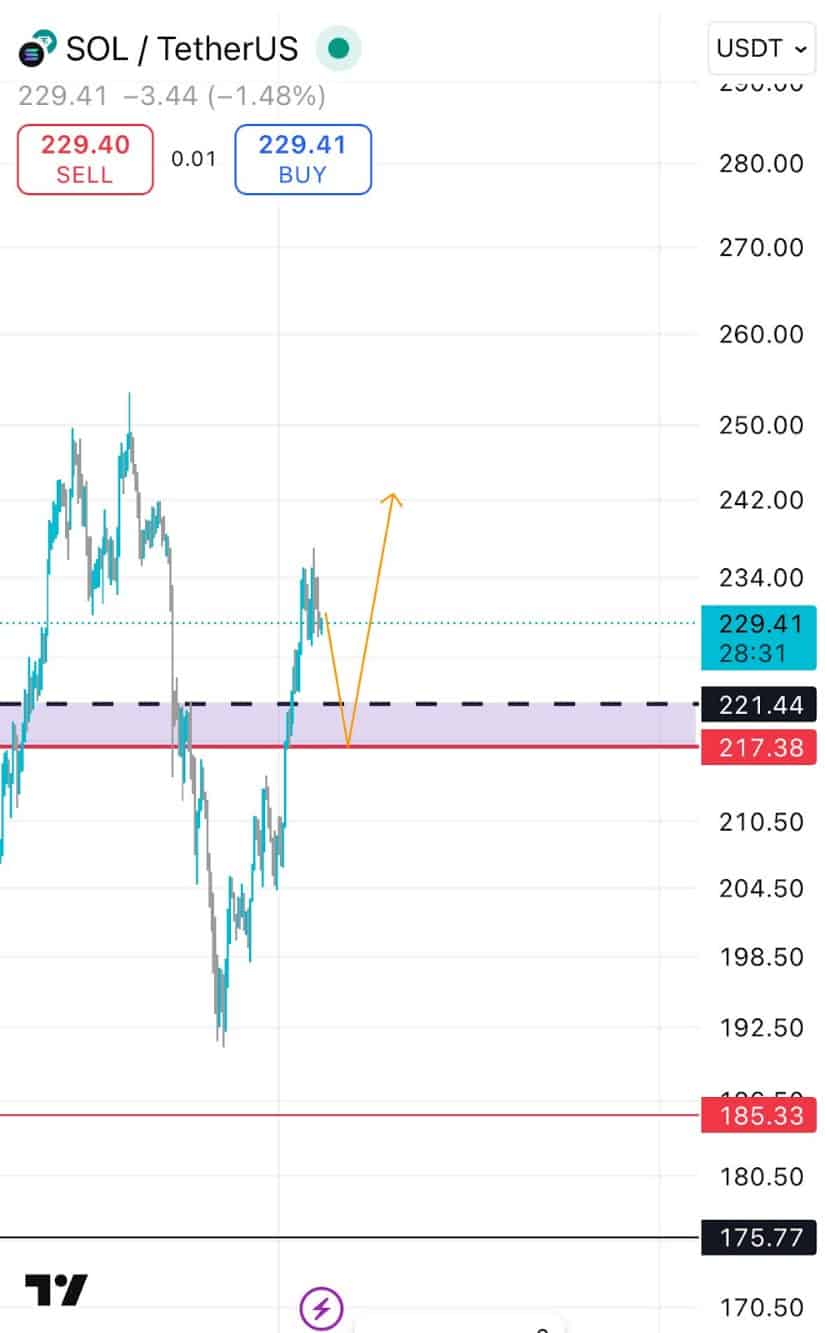
Technical setups from VeIla Crypto suggest that a retest into the $217 to $220 range remains possible before another leg higher unfolds. Price has repeatedly tested this demand zone, and holding it keeps the broader uptrend intact.

Retest Levels in Play for Solana

Solana’s chart points to a possible retest of the $217–$220 demand zone before aiming for higher targets. Source: VeIla Crypto via X

Such pullbacks are often constructive, clearing weak hands before directional continuation. A bounce from this region would position Solana price to reclaim $240 and head further higher towards $280 and $300.

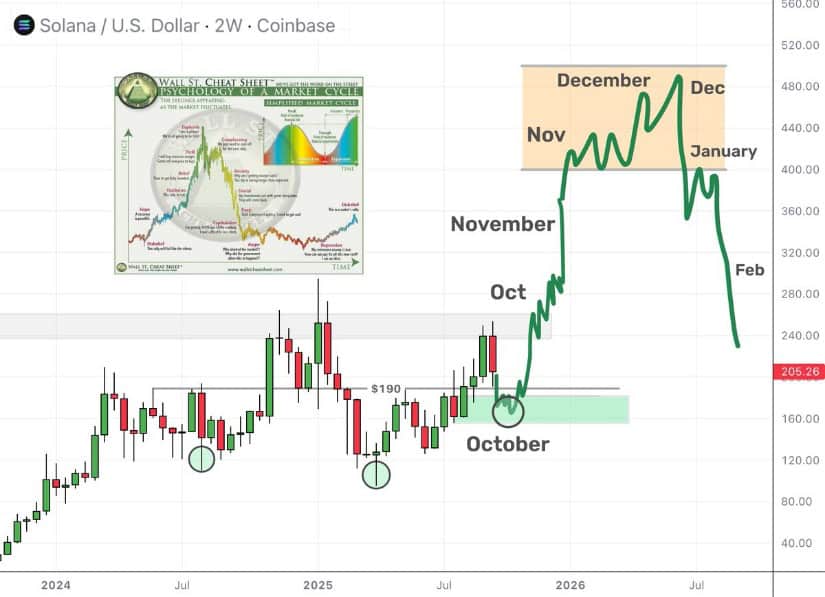
Solana Price Prediction: Market Cycle Perspective

Reflection’s chart places Solana’s movements within the broader market cycle, showing that even if a dip materializes in the short term, it may serve as a healthy correction rather than a top. The cycle suggests the next strong phase could extend into late Q4, keeping bullish scenarios alive.

Solana Price Prediction: Market Cycle Perspective

Reflection’s market cycle chart suggests Solana’s dips are healthy corrections, keeping bullish scenarios alive into late Q4. Source: Reflection via X

This framing reinforces the idea that Solana’s market cycle isn’t complete. As long as $200 holds structurally, dips are less a sign of breakdown and more of opportunities within a longer-term growth path.

Will Solana Price Hold $200 Support Level?

According to Brave New Coin, Solana trades at $227.08 with a $123.7B market cap and $4.4B in daily volume. The $200 region has become a clear psychological and technical line, with multiple confluences pointing to it as a critical pivot.

Will Solana Price Hold $200 Support Level?

Solana current price is $227.08, down -1.68% in the last 24 hours. Source: Brave New Coin

If defended, it could fuel another leg higher back into the $240 to $250 band. However, a break below would risk deeper downside tests. Much depends on liquidity flows around this region, making $200 the key battleground to watch in the coming weeks.

Final Thoughts

Solana’s $200 level has become the key line for participants. If this area holds, it could open the door for another move back into the $240 to $250 range and beyond. A break lower, however, would risk slowing down momentum and invite deeper tests. That’s why all eyes remain on how the price reacts around this point.

Even with short-term dips, the bigger cycle for Solana price still leans bullish. Every correction so far has worked as fuel for the next rally, and late Q4 is shaping up as an important period. As long as $200 stands firm, Solana price prediction looks more like a build-up than a breakdown.


Source link

6 10, 2025

Gold Price Forecast – XAU/USD Nears $4,000 as XAU/USD Rally Extends — SGDM ETF Surges 115% in 2025

By |2025-10-06T03:36:45+03:00October 6, 2025|Forex News, News|0 Comments


Gold (XAU/USD) Surges Toward $4,000 as Global Uncertainty and Policy Easing Ignite Record-Breaking Rally

Gold’s remarkable ascent continues to dominate global markets as prices soar to unprecedented levels, breaking through $3,897.13 per ounce before settling near $3,886.45. This marks the seventh consecutive week of gains, pushing the metal’s year-to-date increase above 47%, its strongest annual performance since 1979. The yellow metal has now logged multiple all-time highs in 2025, with analysts from major banks projecting it could soon test or even exceed the $4,000 barrier. Market capitalization across gold ETFs has expanded sharply, while bullion demand from both institutions and central banks remains relentless. The rally reflects a perfect storm of macroeconomic drivers — a weakening U.S. dollar, renewed geopolitical risk, policy interference fears at the Federal Reserve, and surging official sector purchases.

Macroeconomic Pressure and Fed Data Paralysis Fuel XAU/USD Momentum

The latest catalyst stems from the ongoing U.S. government shutdown, now entering its fifth day, which has disrupted the release of crucial data such as non-farm payrolls and CPI. With the Bureau of Labor Statistics offline, the Federal Reserve is effectively operating blind ahead of its October 29 meeting. According to CME FedWatch, markets are pricing a 97% probability of a 25-basis-point cut this month and an 85% chance of another by December. The dollar index dropped to 97.78, its weakest close since July, while 10-year Treasury yields slipped to 4.092%, further bolstering demand for non-yielding assets. Analysts at UBS and Goldman Sachs have lifted their 2025 targets to $4,200 and $4,300, respectively, citing sustained rate-cut expectations and intensifying safe-haven flows.

Central Banks and Institutional Investors Drive Structural Demand

According to HSBC, central bank demand continues to underpin the market, with official sector purchases remaining robust as nations diversify away from the U.S. dollar. While buying may slow from the record levels of 2022–2024, the aggregate pace remains historically elevated. HSBC projects that “rallies can continue into 2026,” aided by institutional diversification. This thesis aligns with ongoing inflows into major gold ETFs, led by the SPDR Gold Trust (GLD), whose holdings rose 0.59% this week to 1,018.89 metric tons. This marks the seventh straight week of accumulation by institutions, bringing total global ETF reserves to multi-year highs. Gold’s dual role as both an inflation hedge and a monetary hedge has regained prominence, particularly as concerns rise over the Fed’s independence following reports of political interference involving President Trump’s attempt to remove Fed Governor Lisa Cook.

Dollar Weakness and Geopolitical Instability Reinforce the Safe-Haven Bid

Gold’s rally has also been powered by escalating political risk and a weakening greenback. The standoff in Washington has frozen critical economic functions, while ongoing conflicts across Eastern Europe and the Middle East continue to amplify safe-haven flows. The spot price’s relentless climb — up nearly 50% year-to-date — mirrors capital flight from risk assets toward real stores of value. Analysts note that XAU/USD tends to rally in periods of non-recessionary uncertainty when real yields decline but nominal growth remains intact. With the U.S. Dollar Index trending downward and investors increasingly skeptical of fiscal discipline, gold has reclaimed its role as the world’s ultimate risk-off anchor.

Technical Landscape: Momentum Intact as Gold Eyes $4,000 Resistance

From a technical standpoint, gold’s trajectory remains distinctly bullish. The metal trades well above its 52-week moving average of $3,090.96, underscoring structural strength but also suggesting possible overheating. Weekly momentum remains firmly in the green, with seven consecutive positive closes, a rare occurrence historically associated with multi-month continuation phases. Technical analysts identify $4,000 as the next psychological resistance level, followed by a potential overshoot toward $4,200–$4,300 if momentum remains unchecked. The market shows no overhead resistance beyond current levels, with price action now in uncharted territory. While the rally appears extended, the absence of a weekly reversal pattern keeps the bias firmly bullish. A corrective phase could emerge if the market prints a closing reversal top, but until then, the long-term uptrend remains the dominant narrative.

Mining Equities Outperform as Sprott Gold Miners ETF (NYSEARCA:SGDM) Surges 115% in 2025

The rally in spot gold has translated into explosive performance for mining equities. The Sprott Gold Miners ETF (SGDM) has soared 115% year-to-date, doubling the performance of gold itself. The fund, which holds 37 gold majors, including Agnico Eagle Mines (NYSE:AEM), Newmont (NYSE:NEM), Kinross Gold (NYSE:KGC), and Barrick Mining (NYSE:B), offers leveraged exposure to the ongoing gold boom. As bullion prices approach $4,000, miners’ margins are expanding at their fastest pace in years. SGDM’s expense ratio of 0.5% is offset by periodic distributions — the ETF paid a $0.29 per-share dividend in December 2024, and a higher payout is likely for 2025 given the record profitability of underlying constituents. Analysts suggest that as gold surpasses new thresholds, mining stocks will continue to outperform physical bullion due to operational leverage and expanding cash flows.

HSBC, UBS, and Goldman See the Next Stage of the Gold Cycle Extending Into 2026

Investment banks remain unified in their bullish stance. HSBC forecasts that gold could trade above $4,000 in the near term, projecting continued strength through 2026 driven by fiscal uncertainty, official sector accumulation, and diversification away from the dollar. UBS anticipates a move toward $4,200, while Goldman Sachs sets a ceiling near $4,300, emphasizing that the combination of geopolitical risk and U.S. fiscal stress is likely to sustain demand well into next year. Meanwhile, macro strategists warn that if the Fed cuts rates faster than expected, the rally could overshoot targets, though slower easing might temporarily moderate the pace of gains. Despite this, both scenarios remain net-positive for gold, which thrives in environments of monetary instability and negative real yields.

Retail Participation and ETF Capital Inflows Signal a Broader Market Expansion

Retail enthusiasm has returned, particularly through gold-linked ETFs and mining funds. Data from FXEmpire shows that inflows into the SPDR Gold Trust (GLD) and other major ETFs have grown consistently since early September, while trading volume in gold futures has risen sharply. Market chatter around “$4,000 gold” has fueled speculative momentum, though analysts emphasize that the current rally is rooted in fundamentals, not hype. Investors disenchanted with crypto volatility have rotated capital into precious metals, reinforcing gold’s reputation as the ultimate hedge against both inflation and institutional instability.

Global Context: Government Shutdown and Policy Uncertainty Elevate Gold’s Strategic Role

The U.S. government’s failure to pass a funding bill has triggered its 15th shutdown since 1981, halting regulatory oversight, economic reporting, and financial research. The absence of data leaves the Federal Reserve navigating without visibility, a situation reminiscent of 2013’s shutdown but with far higher stakes given the size of today’s deficits. Markets interpret this paralysis as deeply inflationary in the medium term, as political gridlock erodes confidence in fiscal management. The resulting demand for safe-haven assets has sent both gold and silver into synchronized rallies — with silver up 2.16% this week and closing near $31 per ounce. Gold’s safe-haven dominance has become self-reinforcing, with ETF flows, central bank buying, and retail participation converging into a sustained structural bid.

Outlook and Strategic Verdict: Gold’s Momentum Unbroken, $4,000 Within Reach

All fundamental, technical, and macro indicators converge on a single theme: XAU/USD remains in a confirmed bull market. The trajectory points to $4,000 as the next milestone, with extension targets toward $4,200–$4,300 by early 2026. Volatility will remain elevated, but the underlying drivers — Fed easing, political instability, dollar weakness, and institutional accumulation — remain intact. While short-term corrections are possible given the magnitude of gains, each retracement is likely to attract renewed buying from both central banks and private funds. Mining equities, led by SGDM, provide leveraged upside as margins expand alongside bullion prices.

Verdict: Buy (Strong Bullish) — Gold remains the premier safe-haven asset of 2025. With technical structure firm, institutional flows accelerating, and macro fundamentals aligned, the path toward $4,000–$4,300 appears both achievable and sustainable.

That’s TradingNEWS


Source link

Go to Top