Cardano founder Charles Hoskinson has raised eyebrows with his latest remarks on the future of decentralized finance, warning that Bitcoin could overthrow Ethereum as the leader of the sector.
The Cardano founder made this bold assertion in an interview, where he commented on the future of DeFi and the potential role Bitcoin could play in the sector. Despite Ethereum being the hub for DeFi, Hoskinson argued that it is not the ultimate leader in decentralized finance.
Bitcoin is the Sleeping Giant of DeFi
He calls Bitcoin the sleeping giant of DeFi, given that the blockchain network has yet to develop its DeFi ecosystem. Hoskinson suggested that when Bitcoin eventually integrates DeFi capabilities, its total value locked could reach billions of dollars.
– Advertisement –
In his view, Bitcoin’s TVL will surpass the market cap of Ethereum, which currently stands at $520.78 billion. For context, Ethereum’s TVL stands at $91 billion as of today.
According to him, Bitcoin will attract far more liquidity than Ethereum currently sees in the sector. In addition, Hoskinson predicted that sovereign entities and institutions, including BlackRock, will build on Bitcoin rather than Ethereum.
“Cardano, Not Ethereum, Should Power Bitcoin DeFi”
Further, Hoskinson contended that there is no compelling reason to leverage Ethereum-based solutions to power Bitcoin DeFi. He argues that the inherently adversarial relationship between the two blockchains makes it unlikely for Ethereum to serve as the backbone of Bitcoin’s DeFi ecosystem.
Instead, Hoskinson believes that alternative blockchains, such as Cardano, or Layer-2 solutions, like Stacks, are better positioned to support Bitcoin DeFi.
Hoskinson has consistently maintained that Bitcoin will ultimately take the lead in the DeFi space, surpassing both Ethereum and Solana in the process. He is also working to ensure that Cardano becomes the enabler of Bitcoin’s DeFi solution.
Progress So Far on Bitcoin DeFi
This initiative, which began last year, saw Cardano’s development arm, EMURGO, team up with BitcoinOS to introduce DeFi solutions to the premier blockchain.
Following the partnership, Hoskinson revealed plans to revive the Bitcoin Education Project and also train developers on leveraging Aiken, a Cardano programming language, to build and deploy smart contracts.
The goal is to educate Bitcoin developers on how to utilize Aiken, enabling them to create hybrid applications that bridge the Cardano and Bitcoin ecosystems.
In a February podcast, Hoskinson noted that Cardano’s Babel fees could enable Bitcoin holders to tap into the growing DeFi economy without leaving the Bitcoin ecosystem. He also highlighted the potential role of Cardano’s privacy-focused sidechain, Midnight, in supporting Bitcoin DeFi by allowing users to stake their BTC without having to wrap it.
Further advancing this vision, Cardano’s light wallet, Lace, introduced BTC support earlier this year, allowing users to send, receive, and manage their Bitcoin directly within the platform. This integration also allows users to swap native BTC with other Cardano-based assets.
Interestingly, analysts suggest the project could also benefit Cardano significantly, with some forecasting that enabling Bitcoin DeFi might push ADA’s price above $20
DisClamier: This content is informational and should not be considered financial advice. The views expressed in this article may include the author’s personal opinions and do not reflect The Crypto Basic opinion. Readers are encouraged to do thorough research before making any investment decisions. The Crypto Basic is not responsible for any financial losses.
Natural gas price ended the bullish correctional rally by testing the resistance at $3.210, then begin forming bearish waves, affected by the negativity of the indicators and providing negative momentum, to notice its stability near $3.100.
The continuation of facing negative pressures will confirm its surrender to the previously suggested scenario, to keep waiting for targeting $2.810 level, and breaking this barrier will extend the losses directly towards $2.620 reaching the next main target at $2.390.
The expected trading range for today is between $2.820 and $3.150
The Pound to Dollar (GBP/USD) exchange rate found support below 1.3500 on Monday and pushed towards 1.3540, helped by softer US bond yields and a weaker dollar index at 6-week lows. Analysts see Sterling locked in a near-term range, with momentum capped below 1.3590 ahead of the September Federal Reserve decision.
GBP/USD Forecasts: Range-Bound for Now
UoB said;
“Coming off the previous steep decline, the sharp rebound did not translate into a meaningful build-up in upward momentum. Overall, we view the current price movements as part of a broad range, likely between 1.3430 and 1.3595.”
Scotiabank echoed the range view;
“We look to a near-term range of 1.3480 and 1.3580.”
Both banks see a decisive break above 1.3590 as crucial for GBP/USD to build a stronger rally.
Save on Your GBP/USD Transfer
Get better rates and lower fees on your next international money transfer.
Compare TorFX with top UK banks in seconds and see how much you could save.
Weaker US jobs data last week reinforced expectations that the Fed will cut rates in September, with markets pricing a 10% chance of a larger 50-point cut.
MUFG commented;
“There is clear evidence that the US labour market deteriorated sharply after President Trump’s Liberation Day tariffs announcement in April.”
Danske Bank was more cautious;
“While political pressure to accelerate policy easing inarguably complicates the outlook, we think risks are skewed towards slower, rather than faster, rate cuts given the risk of more persistent inflation.”
ING noted potential for a short-term dollar bounce;
“We think the US corporate tax payment deadline of 15 September could provide the dollar with some support this week. Seasonally, the dollar does OK in September. We suspect that the DXY could be driven a little higher this week, before a bearish switch into next Wednesday’s FOMC meeting.”
UK fiscal pressures remain in focus after the sharp rise in gilt yields earlier this month.
Rabobank warned;
“Fixing bloated fiscal positions without clobbering the economy and simultaneously finding ways to finance spending priorities has become a policy paradox. Is it simply ‘too late’ to fix? Or can out of the box economic thinking still find a solution?”
Scotiabank’s Shaun Osborne noted some upside for Sterling sentiment after the cabinet reshuffle;
“Markets appear to be endorsing the change, and risk reversals in the options market are showing signs of a shift following their recent dramatic (bearish) turn.”
Like this piece? Please share with your friends and colleagues:
International Money Transfer? Ask our resident FX expert a money transfer question or try John’s new, free, no-obligation personal service! ,where he helps every step of the way,
ensuring you get the best exchange rates on your currency requirements.
Nilgiris: Amid massive crop loss due to incessant rain in July, around 55,000 small and medium team farmers in Wayanad and in the adjoining Nilgiri district of Tamil Nadu are facing another threat – the steep price drop due to unbridled imports.
According to the Tea Board of India (TBI) figures, the auction price of tea dust came down to an all-time low in July and August, which was reflected in the green leaf price that dropped to as low as ₹12 per kg in July, compared to around ₹16 per kg early this year. The tea leaf price was more than ₹20 for the majority of last year as tea production nosedived in the North East of the country due to hostile weather conditions.
Is import the real villain? In normal circumstances, loss of production would restrict the supply, sending prices high as consumers would be chasing too few goods. But even when India’s tea baskets in the south and the northeast saw production dip, the prices did not come down. Industry players attribute this anomaly to the imports of low-quality tea from neighbouring Nepal and Kenya.
Farmers point out that in 2019, imports stood at 15.85 million kg, but by 2022, they had increased to 29.84 million kg.
Among the imports, tea from Nepal has been cited as the chief culprit. As per the Indo-Nepal Free Trade Agreement (2009), the tea imports from Nepal are tax-free.
According to TBI data, the total tea imports from January to October in 2024 were 16.47 million kg, of which 13.01 million kg came from Nepal, 1.63 million kg from Kenya, at an average import price of ₹165.
However, industry experts and leading farmers raise a suspicion on the veracity of the TBI import data, as figures for November and December 2023-2024 are missing. These months are lean harvest periods in India, particularly in the North East, which contributes the lion’s share of national production.
288% jump in Kenya imports Data from the ‘Directorate General of the Commercial Intelligence and Statistics’ (DGCIS) shows that of the 33.8 million kg of tea imports in 2024, 11.53 million kg came from Kenya.
But according to the Tea Board of Kenya, India imported 13.7 million kg of Kenyan tea in 2024 – an increase of 288 per cent over the previous year (3.53 million kg in 2023). Experts believe the mismatch (of 2.17 million kg) may be due to the missing TBI import data for November and December.
However, the data clearly indicates that imports played a significant role in keeping the price down, which was not what the farmers had hoped for, as they were hoping for an upswing to help them recover part of their losses.
This has affected the small and medium farmers. “The small tea growers contribute more than 53 per cent of India’s total green leaf production and their interests must be protected,” said A K Sreejith, National Vice President of the Confederation of Indian Small Tea Growers’ Associations (CISTA). “In a recent meeting with the Commerce Ministry officials in New Delhi, we demanded 100 per cent tax on tea imports from Kenya and Nepal,” he added.
“We had also submitted a memorandum to fix a Minimum Sustainable Price of ₹35 per kg for green leaf to save the industry from complete collapse,” he added.
Low supply, lower prices In July 2025, the tea production in South India was 20.36 million kg, a decline of 2.34 million kg compared to July 2024 (22.79 million kg). Industry figures suggest that the production in August was even lower than in July.
TBI data also shows that the weekly auction prices of tea in the Coonoor auction centre in Nilgiris hovered between ₹88 and ₹92 per kg in July and August. The average auction price of tea produced by the 16 factories belonging to the Tamil Nadu Small Tea Growers Industrial Cooperative Tea Factories Federation ( popularly known as INDCOSERVE), fell to ₹79.62 per kg in July.
“While corporate buyers grab the tea dust produced by the small growers for throwaway prices, outside the auction centre, one cannot buy tea dust for less than ₹200 per kg,” said Shaji Chelivayal, president, Federation of Small Tea Growers’ Association (FESTA). “The industry can be saved only if a Minimum Support Price (MSP) is announced for tea dust,” he added.
Agrarian families worst affected The crash in prices following crop failure has dealt a sharp blow to farmers. For the three months in a row from June, INDCOSERVE factories saw the auction price for green leaf plummet to a low of ₹13 per kg just when incessant rain had caused an acute shortage of green leaves in South Indian plantations.
It is worth recalling that in 2024, the green leaf prices had crossed ₹20 per kg for many months, bringing cheer for farmers.
According to Rajeev M, Secretary, Kayyunni Small Tea Growers Association (KSTGA), the production cost for tea is more than ₹30/kg, as input costs have multiplied in recent years. “Now, most of the small-scale farmers have reduced the number of farm labourers to cope with the price drop,” he said.
“Even in the late 1990s, the price of green tea leaf was around ₹16-18,” he said. “Many have replaced tea with coffee, and many more are in the queue,” he added.
Tea economy at stake In 2024, India exported 254.67 million kg of tea, earning ₹7,111.43 crore in revenue.
India’s tea plantations span over 6.19 lakh acres, producing on average 1,300 million kg annually. The ongoing crisis threatens the livelihoods of nearly 2.48 lakh small tea grower families spread across Northeast and South India.
As Union Commerce Minister Piyush Goyal informed the parliament, the country has over 12 lakh plantation workers employed in the organised tea sector, with many more engaged in the unorganised sector and small tea farms.
XRP price climbed 4.15% to $3.02 today
(Tuesday), September 9, 2025, marking its third consecutive session of gains
and pushing the cryptocurrency back above the psychologically important $3.00 level.
The surge comes as Federal Reserve (Fed) rate cut expectations hit 99%
probability and Ripple announced an expanded custody partnership with
Spanish banking giant BBVA.
In this
article, I address the question of why the XRP price is surging and provide a
technical analysis of the XRP/USDT chart, which suggests that current XRP price
predictions are pointing to a potential increase of more than 50 percent.
During
Tuesday’s session, XRP extended its upward correction and broke through the
psychological level of $3. XRP’s 4.15% daily gain significantly outpaced other
major cryptocurrencies, with only Cardano posting stronger performance at 5.4%.
The cryptocurrency has recovered 7.5% from Sunday’s lows, adding over 21 cents
to its value during the three-day rally.
Current
market capitalization stands at approximately $178 billion, with 24-hour
trading volume reaching $6.78 billion across major exchanges. The token
maintains its position as the fourth-largest cryptocurrency by market cap, with
59.6 billion XRP in circulation from a maximum supply of 100 billion tokens.
XRP price today. Source: CoinMarketCap
Why XRP Price Is Going Up?
Federal Reserve Rate Cut
Expectations Fuel Crypto Rally
The primary
catalyst behind XRP’s surge stems from overwhelming market expectations that
the Federal Reserve will cut interest rates at its September 16-17
meeting. Fed futures now indicate a 99% probability of at least a 25-basis
point rate cut, with some analysts predicting a more aggressive 50-basis point
reduction following weak August employment data.
Cassie Craddock, Ripple’s managing director for Europe
Adding to
the bullish momentum, Ripple announced it will provide digital asset custody
technology to BBVA for Spanish retail clients, extending their existing
partnerships in Switzerland and Turkey. The expanded collaboration allows BBVA
to offer end-to-end custody services for Bitcoin and Ethereum trading
under the European Union’s Markets in Crypto Assets (MiCA) regulation
framework.
“Now
that MiCA is established, the region’s banks are emboldened to launch the
digital asset offerings that their customers are asking for,” said Cassie
Craddock, Ripple’s managing director for Europe.
From my
technical analysis perspective, XRP has successfully reclaimed the 50-day
exponential moving average (50 EMA) and broken above the $2.96-$3.00
resistance zone, which was reinforced by the 38.2% Fibonacci retracement level
measured from June lows to July highs near $3.65. This breakthrough opens the
path for testing local August highs around $3.30 and potentially the
year’s peak levels starting from $3.60.
Trading
volume spiked to 159.63 million, nearly three times daily averages,
confirming institutional participation in the breakout. The RSI remains in
neutral-to-bullish territory in the mid-50s, while the MACD histogram
is converging toward a bullish crossover, indicating accumulation patterns.
Current upside
potential exceeds 21% to the $3.30 level.
XRP Price Prediction And
55% Jump After Flag Formation
The flag
pattern had been forming since the June lows, and within the current triangle,
XRP had less and less room to move. Ultimately, it broke to the upside, which
in my view opens the way for bulls to drive a significant rally from the local
lows we are now observing.
Market
analysts are also increasingly optimistic about XRP’s trajectory. Paul
Howard from Wincent noted that “XRP is now just 18% off its all time
high. The team has built an impressive crypto cohort the last 9 months with
acquisitions, corporate adoption and regulatory movements that add credibility
to the token.”
How high can XRP price go? Source: Tradingview.com
Paul Howard, Wincent
Howard
emphasized that while the short-term outlook shows range-bound trading,
“XRP likely to outperform and break the $3.00 technical line given its
volatility over BTC.” The analyst highlighted XRP’s superior performance
relative to Bitcoin’s more constrained trading range.
The
cryptocurrency market is experiencing significant institutional momentum that
extends beyond XRP. Bitcoin ETFs recorded $246 million in net inflows during
early September 2025, driven by BlackRock’s iShares Bitcoin Trust
absorbing $434.3 million and Fidelity’s FBTC adding $25.1
million.
Bitcoin’s
illiquid supply has climbed to a record 14.3 million BTC, with Ryan Lee,
Chief Analyst at Bitget, noting that “more than 70 percent of coins now in
wallets with little spending history, confidence in Bitcoin’s long-term value
remains evident.” This supply tightening “not only reinforces the
asset’s role as a store of value but also heightens the potential for sharp
moves as demand persists”.
Lee expects
Bitcoin to stabilize and regain upward momentum, with a target range of
$105,000 to $118,000 supported by sustained institutional inflows and
bullish technical signals. This broader crypto market strength provides a
supportive backdrop for XRP’s rally.
Despite
increased exchange reserves reaching 12-month peaks, sophisticated investors
continue accumulating XRP. Whale wallets reportedly accumulated 10 million
XRP in just 15 minutes during Tuesday’s breakout, while broader whale
holdings increased by 340 million tokens over recent weeks.
This
divergence between short-term selling pressure from exchange inflows and
long-term accumulation by large holders suggests different time horizons among
market participants. The whale buying activity totaling $700 million in
recent transfers has sparked speculation about institutional positioning ahead
of potential XRP ETF approvals in October.
Outlook and Key Levels to
Watch
Looking
ahead, traders are monitoring several critical factors that could influence
XRP’s trajectory. The $2.99-$3.00 resistance zone that was repeatedly
rejected in recent sessions has now become potential support, while the next
major resistance lies at $3.30-$3.50.
Six XRP ETF
applications currently under SEC review for October decisions represent a
structural catalyst that could transform institutional access and demand
dynamics. Combined with the Federal Reserve’s anticipated rate cut and
continued banking partnerships, these fundamentals support the technical
breakout scenario.
However,
risks remain if the cryptocurrency fails to maintain momentum above $3.00, with
key support levels at $2.88-$2.89 where buying interest has
consistently emerged during recent corrections.
XRP Price Analysis FAQ
Why is XRP surging today?
XRP is
surging due to 99% probability Federal Reserve rate cut expectations and
Ripple’s expanded digital asset custody partnership with BBVA in Spain.
The combination of dovish monetary policy and institutional banking adoption is
driving demand across cryptocurrency markets.
How high can XRP go in
2025?
Technical
analysis suggests XRP could reach $4.70 if it completes the
three-month flag formation breakout, representing 55% upside potential.
Conservative predictions target $3.30-$3.60 resistance levels, while
bullish forecasts from analysts like Standard Chartered project $5.50-$15.00 by
year-end depending on ETF approvals and institutional adoption.
What is driving XRP price
predictions?
Key drivers
include institutional partnerships with banks like BBVA, potential XRP
ETF approvals in October 2025, Federal Reserve rate cuts, and whale
accumulation patterns. Technical breakouts above $3.00 combined with regulatory
clarity are supporting higher price targets.
What makes XRP different
from other cryptocurrencies?
XRP’s
primary advantage lies in cross-border payment utility and institutional
banking adoption. With 3-5 second settlement times and minimal
transaction fees, XRP serves as a bridge currency for financial institutions.
Recent partnerships with major banks and potential Amazon and Uber
adoption distinguish it from speculative altcoins.
XRP price climbed 4.15% to $3.02 today
(Tuesday), September 9, 2025, marking its third consecutive session of gains
and pushing the cryptocurrency back above the psychologically important $3.00 level.
The surge comes as Federal Reserve (Fed) rate cut expectations hit 99%
probability and Ripple announced an expanded custody partnership with
Spanish banking giant BBVA.
In this
article, I address the question of why the XRP price is surging and provide a
technical analysis of the XRP/USDT chart, which suggests that current XRP price
predictions are pointing to a potential increase of more than 50 percent.
During
Tuesday’s session, XRP extended its upward correction and broke through the
psychological level of $3. XRP’s 4.15% daily gain significantly outpaced other
major cryptocurrencies, with only Cardano posting stronger performance at 5.4%.
The cryptocurrency has recovered 7.5% from Sunday’s lows, adding over 21 cents
to its value during the three-day rally.
Current
market capitalization stands at approximately $178 billion, with 24-hour
trading volume reaching $6.78 billion across major exchanges. The token
maintains its position as the fourth-largest cryptocurrency by market cap, with
59.6 billion XRP in circulation from a maximum supply of 100 billion tokens.
XRP price today. Source: CoinMarketCap
Why XRP Price Is Going Up?
Federal Reserve Rate Cut
Expectations Fuel Crypto Rally
The primary
catalyst behind XRP’s surge stems from overwhelming market expectations that
the Federal Reserve will cut interest rates at its September 16-17
meeting. Fed futures now indicate a 99% probability of at least a 25-basis
point rate cut, with some analysts predicting a more aggressive 50-basis point
reduction following weak August employment data.
Cassie Craddock, Ripple’s managing director for Europe
Adding to
the bullish momentum, Ripple announced it will provide digital asset custody
technology to BBVA for Spanish retail clients, extending their existing
partnerships in Switzerland and Turkey. The expanded collaboration allows BBVA
to offer end-to-end custody services for Bitcoin and Ethereum trading
under the European Union’s Markets in Crypto Assets (MiCA) regulation
framework.
“Now
that MiCA is established, the region’s banks are emboldened to launch the
digital asset offerings that their customers are asking for,” said Cassie
Craddock, Ripple’s managing director for Europe.
From my
technical analysis perspective, XRP has successfully reclaimed the 50-day
exponential moving average (50 EMA) and broken above the $2.96-$3.00
resistance zone, which was reinforced by the 38.2% Fibonacci retracement level
measured from June lows to July highs near $3.65. This breakthrough opens the
path for testing local August highs around $3.30 and potentially the
year’s peak levels starting from $3.60.
Trading
volume spiked to 159.63 million, nearly three times daily averages,
confirming institutional participation in the breakout. The RSI remains in
neutral-to-bullish territory in the mid-50s, while the MACD histogram
is converging toward a bullish crossover, indicating accumulation patterns.
Current upside
potential exceeds 21% to the $3.30 level.
XRP Price Prediction And
55% Jump After Flag Formation
The flag
pattern had been forming since the June lows, and within the current triangle,
XRP had less and less room to move. Ultimately, it broke to the upside, which
in my view opens the way for bulls to drive a significant rally from the local
lows we are now observing.
Market
analysts are also increasingly optimistic about XRP’s trajectory. Paul
Howard from Wincent noted that “XRP is now just 18% off its all time
high. The team has built an impressive crypto cohort the last 9 months with
acquisitions, corporate adoption and regulatory movements that add credibility
to the token.”
How high can XRP price go? Source: Tradingview.com
Paul Howard, Wincent
Howard
emphasized that while the short-term outlook shows range-bound trading,
“XRP likely to outperform and break the $3.00 technical line given its
volatility over BTC.” The analyst highlighted XRP’s superior performance
relative to Bitcoin’s more constrained trading range.
The
cryptocurrency market is experiencing significant institutional momentum that
extends beyond XRP. Bitcoin ETFs recorded $246 million in net inflows during
early September 2025, driven by BlackRock’s iShares Bitcoin Trust
absorbing $434.3 million and Fidelity’s FBTC adding $25.1
million.
Bitcoin’s
illiquid supply has climbed to a record 14.3 million BTC, with Ryan Lee,
Chief Analyst at Bitget, noting that “more than 70 percent of coins now in
wallets with little spending history, confidence in Bitcoin’s long-term value
remains evident.” This supply tightening “not only reinforces the
asset’s role as a store of value but also heightens the potential for sharp
moves as demand persists”.
Lee expects
Bitcoin to stabilize and regain upward momentum, with a target range of
$105,000 to $118,000 supported by sustained institutional inflows and
bullish technical signals. This broader crypto market strength provides a
supportive backdrop for XRP’s rally.
Despite
increased exchange reserves reaching 12-month peaks, sophisticated investors
continue accumulating XRP. Whale wallets reportedly accumulated 10 million
XRP in just 15 minutes during Tuesday’s breakout, while broader whale
holdings increased by 340 million tokens over recent weeks.
This
divergence between short-term selling pressure from exchange inflows and
long-term accumulation by large holders suggests different time horizons among
market participants. The whale buying activity totaling $700 million in
recent transfers has sparked speculation about institutional positioning ahead
of potential XRP ETF approvals in October.
Outlook and Key Levels to
Watch
Looking
ahead, traders are monitoring several critical factors that could influence
XRP’s trajectory. The $2.99-$3.00 resistance zone that was repeatedly
rejected in recent sessions has now become potential support, while the next
major resistance lies at $3.30-$3.50.
Six XRP ETF
applications currently under SEC review for October decisions represent a
structural catalyst that could transform institutional access and demand
dynamics. Combined with the Federal Reserve’s anticipated rate cut and
continued banking partnerships, these fundamentals support the technical
breakout scenario.
However,
risks remain if the cryptocurrency fails to maintain momentum above $3.00, with
key support levels at $2.88-$2.89 where buying interest has
consistently emerged during recent corrections.
XRP Price Analysis FAQ
Why is XRP surging today?
XRP is
surging due to 99% probability Federal Reserve rate cut expectations and
Ripple’s expanded digital asset custody partnership with BBVA in Spain.
The combination of dovish monetary policy and institutional banking adoption is
driving demand across cryptocurrency markets.
How high can XRP go in
2025?
Technical
analysis suggests XRP could reach $4.70 if it completes the
three-month flag formation breakout, representing 55% upside potential.
Conservative predictions target $3.30-$3.60 resistance levels, while
bullish forecasts from analysts like Standard Chartered project $5.50-$15.00 by
year-end depending on ETF approvals and institutional adoption.
What is driving XRP price
predictions?
Key drivers
include institutional partnerships with banks like BBVA, potential XRP
ETF approvals in October 2025, Federal Reserve rate cuts, and whale
accumulation patterns. Technical breakouts above $3.00 combined with regulatory
clarity are supporting higher price targets.
What makes XRP different
from other cryptocurrencies?
XRP’s
primary advantage lies in cross-border payment utility and institutional
banking adoption. With 3-5 second settlement times and minimal
transaction fees, XRP serves as a bridge currency for financial institutions.
Recent partnerships with major banks and potential Amazon and Uber
adoption distinguish it from speculative altcoins.
Nine may receive a commission when you buy from the links on our site.
Matcha has taken over our local cafes and social media feeds, and if you’ve leant into the hype, you’ve likely fallen in love with the refreshing liquid gold (well, liquid green?).
For many, the classic green beverage, or green and pink if you’re a strawberry matcha fiend like me, has become a welcome addition to their morning routines – just take a look at TikTok where the combination of matcha and Pilates has become the definition of the perfect morning routine – but it doesn’t exactly come cheap.
Most matcha beverages can set you back at least $8 a pop from your local cafe, but now there’s a new solution making the costly cafe treat more affordable.
The brand also promises to match the quality of your cafe-bought matcha.
Morning Made uses “the highest quality, ceremonial grade green tea leaves sourced from Japan”.
It is also rich in antioxidants, low in sugar and has L-theanine to encourage relaxation. With 30g of caffeine, it also promises to provide “clean, sustainable energy” without those dreaded peaks and crashes.
To make the cafe-quality drink, customers simply need to add hot water to the matcha powder, whisk and then top with your milk of choice.
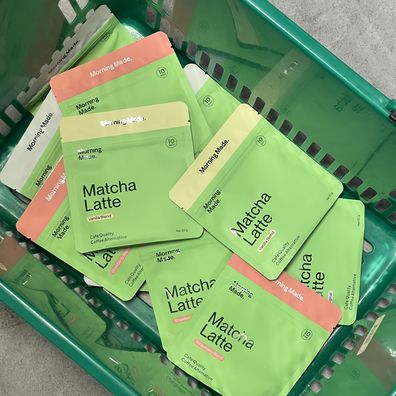
Morning Made matcha is simple to make at home. (Supplied/ Morning Made)
If matcha lattes aren’t quite your speed, Morning Made’s matcha can also be used to try out the many viral recipes that have popped up on TikTok from matcha brookies and cookies to the viral no-bake matcha cheese cake.
FOLLOW US ON WHATSAPP HERE: Stay across all the latest in celebrity, lifestyle and opinion via our WhatsApp channel. No comments, no algorithm and nobody can see your private details.
The Solana price prediction continues to dominate conversations among top crypto analysts, with ambitious targets of $400 and even $500 on the horizon. This bullish outlook is pinned on powerful network upgrades and the massive potential of a spot SOL ETF. But the key question is one of timing: could the ETF approval really happen in 2026? As investors weigh this uncertainty, many are turning to Layer Brett ($LBRETT), an altcoin whose growth catalysts are active today.
Layer Brett’s growth is powered by its own ecosystem
While Solana‘s future hinges on an external decision, Layer Brett’s growth is driven by powerful, internal catalysts that are active right now. Its value is being created by its own self-contained ecosystem. The presale itself is a live event that has already raised over $3million, proving strong organic demand without needing anyone’s approval.
The project’s high-yield staking crypto feature, with an APY around 865%, acts as an internal economic engine, creating its own reward loop and incentivizing holders. This is all built on a functioning Ethereum Layer 2 foundation, giving it a technical backbone that isn’t waiting for a future upgrade. This ecosystem is designed for long-term engagement, with a roadmap featuring gamified staking and NFT integrations that give the token real utility.
Furthermore, its tokenomics are built for sustainable value, with a fixed supply of 10 billion tokens and a $1 million giveaway to bootstrap its community. It’s a complete package for investors who want to be a part of the growth engine itself, making it one of the best crypto to buy now.
Solana‘s bright future depends on a patient waiting game
The long-term Solana price prediction is incredibly strong. Analysts point to the “Alpenglow” network upgrade, which will boost speed and DeFi performance, as a major driver. The network is already a leader in DEX volume and is seeing its Total Value Locked grow, reinforcing SOL demand. Short-term technicals are also positive, with the price consolidating above $200 and analysts targeting a breakout toward $218.
However, the biggest catalyst that could push Solana toward $400—a spot ETF approval in the US—remains a waiting game. Reporting suggests the SEC’s review is “cautious,” with a potential timeline stretching into 2026. This leaves investors in a position where they must wait for an external regulator to unlock the token’s full potential.
The investors dilemma of stability vs asymmetry
The choice between Solana and Layer Brett is a classic investment dilemma. Solana represents a bet on the steady, incremental growth of a blue-chip asset, where gains are measured in percentages. Layer Brett, however, offers an asymmetric opportunity: a high-reward play where a small presale investment could deliver the exponential returns that established giants no longer can.
Why today’s catalysts can outperform tomorrow’s promises
The Solana price prediction is undeniably bullish, but its most significant catalyst, the ETF, is a promise for tomorrow with an uncertain timeline. Layer Brett offers a different proposition: a bet on catalysts that are delivering value today.
For investors looking for the best crypto to buy now, the choice is between waiting for a regulator to approve Solana‘s future, or participating in Layer Brett’s self-contained growth engine that is already firing on all cylinders. It represents a more proactive approach to capturing the explosive gains of the 2025 bull run.
The Layer Brett presale is still live, but the window for early access is closing fast. Don’t miss out on the most scalable meme project to ever launch on Ethereum.
This article contains information about a cryptocurrency presale. Crypto Economy is not associated with the project. As with any initiative within the crypto ecosystem, we encourage users to do their own research before participating, carefully considering both the potential and the risks involved. This content is for informational purposes only and does not constitute investment advice.
High risk warning:
Foreign exchange trading carries a high level of risk that may not be suitable for all investors. Leverage creates additional risk and loss exposure. Before you decide to trade foreign exchange, carefully consider your investment objectives, experience level, and risk tolerance. You could lose some or all your initial investment; do not invest money that you cannot afford to lose. Educate yourself on the risks associated with foreign exchange trading and seek advice from an independent financial or tax advisor if you have any questions.
Advisory warning:
investingLive is not an investment advisor, investingLive provides references and links to selected news, blogs and other sources of economic and market information for informational purposes and as an educational service to its clients and prospects and does not endorse the opinions or recommendations of the blogs or other sources of information. Clients and prospects are advised to carefully consider the opinions and analysis offered in the blogs or other information sources in the context of the client or prospect’s individual analysis and decision making. None of the blogs or other sources of information is to be considered as constituting a track record. Past performance is no guarantee of future results and investingLive specifically hereby acknowledges clients and prospects to carefully review all claims and representations made by advisors, bloggers, money managers and system vendors before investing any funds or opening an account with any Forex dealer. Any news, opinions, research, data, or other information contained within this website is provided on an “as-is” basis as a general market commentary and does not constitute investment or trading advice, and we do not purport to present the entire relevant or available public information with respect to a specific market or security. investingLive expressly disclaims any liability for any lost principal or profits which may arise directly or indirectly from the use of or reliance on such information, or with respect to any of the content presented within its website, nor its editorial choices.
Disclaimer:
investingLive may be compensated by the advertisers that appear on the website, based on your interaction with the advertisements or advertisers.
Alzheimer’s disease is one of the most feared memory disorders, affecting millions of people around the world, slowly damaging memory, thinking, and behavior. It is the most common type of dementia, a general term for memory loss and cognitive decline. According to the World Health Organization, more than 55 million people worldwide live with dementia, and Alzheimer’s accounts for 60-70% of those cases.For decades, scientists have searched for a way to stop or even slow down this heartbreaking condition. But sometimes, simple lifestyle choices, like a daily cup of green tea, may offer unexpected support.Green tea is more than just a soothing daily ritual – it might hold a secret weapon against Alzheimer’s disease when paired with the right ingredient. Emerging research shows that blending green tea’s powerful antioxidant, EGCG, with vitamin B3 (nicotinamide) could help rejuvenate aging brain cells and clear harmful protein buildup linked to Alzheimer’s.This simple pairing, explored in multiple lab studies, restores energy in neurons and helps them clean away damaging plaques. So, whether you’re seeking ways to maintain memory or simply curious about natural brain-boosting habits, this guide has science-backed insights that feel both hopeful and practical.Ready to sip smarter?
Green tea: The ultimate elixir
A recent study from the University of California, Irvine, found that green tea’s antioxidant EGCG (epigallocatechin gallate) becomes even more effective at supporting the aging brain when combined with nicotinamide, a form of vitamin B3.
Why the combo matters
Restoring brain energy: Aging neurons often lose levels of a critical energy molecule called GTP (guanosine triphosphate). This shortage hampers the natural cleanup system inside brain cells, causing harmful plaques to accumulate.Dual action: When treated with both nicotinamide and EGCG for just 24 hours in lab models, aged brain cells regained youthful GTP levels. This boosted their ability to clear amyloid-beta, a protein closely linked to Alzheimer’s.Brain protection: Restoring energy and reducing oxidative stress supports healthier metabolism and cellular cleanup, slowing signs of age-related cognitive decline.
What makes green tea itself powerful
EGCG is the key: This major green tea compound has been shown to reduce amyloid-beta and tau protein build-up, two major hallmarks of Alzheimer’s.Brain health benefits: Regular green tea drinkers often enjoy sharper memory and lower dementia risk. Observational studies link green tea consumption to up to a 25% lower dementia risk, with each added cup providing incremental benefits.Fewer white matter lesions: A study of older adults in Japan found that those who drank three or more cups daily had significantly fewer brain white matter lesions, markers often tied to dementia, than those drinking less.
How to consume this beneficial combo
Start with plain green tea: Aim for 3–5 cups a day. Observational research supports this level for brain benefits.Nicotinamide supplements: Though this form of B3 is widely available OTC, its oral effectiveness remains limited, according to researchers, and more study is needed to optimize delivery to the brain.Balanced approach: While adding nicotinamide may enhance benefits, experts emphasize the importance of overall brain health habits: a balanced diet, physical activity, mental engagement, and good sleep.Consult your physician: Even though both components are generally safe, individual health conditions or medications may warrant professional guidance.
Why this matters
Alzheimer’s is complex, but this research offers a hopeful glimpse into how simple dietary ingredients might support long-term brain resilience. Green tea’s EGCG, a powerful but natural antioxidant, combined with nicotinamide, has shown the potential to rejuvenate aging brain cells and support crucial cleanup pathways. While still early-stage, these findings point toward accessible, low-cost ways to impact brain aging, starting with what’s in your cup.
Dogecoin (DOGE) is making waves again after a sudden 6% price surge, reigniting discussions about its next big move and whether a breakout is on the horizon.
This unexpected rally has brought Dogecoin back into the spotlight as traders watch key resistance levels closely. With rising futures open interest, growing spot inflows, and bullish technical setups, the market is speculating on how far this Dogecoin price prediction could go.
Dip Buyers Step In to Support Dogecoin Price
On-chain data confirms that dip-buying is actively supporting the market. Glassnode’s HODL waves show that the 1–2 year holding cohort increased from 21.65% to 23.24% in the past month, suggesting long-term conviction among holders.
Dogecoin remains bullish but may pull back before breaking $0.235, with $0.222 as key support. Source: davoody.majid on TradingView
Short-term investors are also accumulating. The 1–3 month holding group grew from 5.43% to 6.58%, indicating that both retail traders and patient investors perceive value at current levels.
The combination of patient long-term holders and active short-term buyers has provided Dogecoin with a solid foundation for further gains, reinforcing market confidence in the ongoing rally.
Technical Indicators Suggest Bullish Breakout
Chart patterns and indicators add weight to this bullish narrative. The 4-hour chart recently broke out of an inverse head-and-shoulders pattern, a setup that often signals the end of a bearish phase.
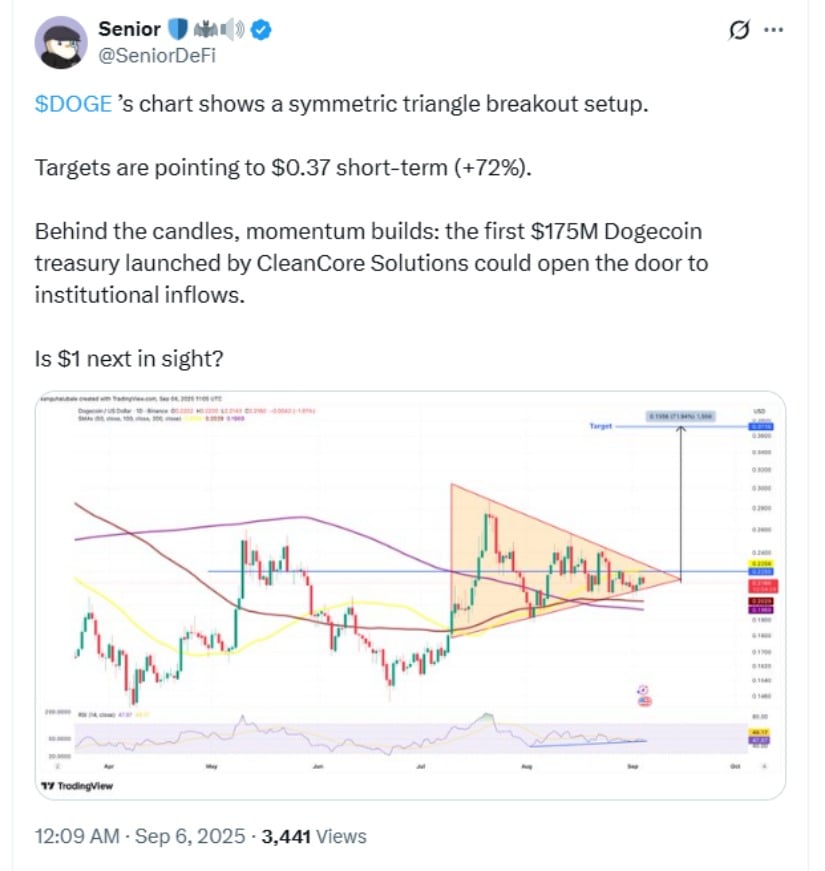
Dogecoin shows a symmetric triangle breakout, targeting $0.37 short-term, with institutional interest from a $175M DOGE treasury potentially supporting further gains. Source: Senior via X
This pattern gives a near-term Dogecoin price prediction of $0.248, about 7.4% above current levels. Adding to the optimism, the 20-period EMA crossed above the 200-period EMA, a golden crossover, with two more EMA crossovers nearing confirmation, potentially fueling a larger rally.
Futures and Options Market Points to Growing Optimism
Derivatives data show that traders are positioning for upside. Futures open interest has jumped 16.7% to $3.89 billion, while options open interest has spiked over 300%. Long/short ratios on major exchanges remain heavily tilted toward the long side, suggesting confidence in a breakout.
Still, analysts warn that spot inflows must rise to confirm this futures-driven optimism. Without strong spot demand, heavy leverage could trigger sharp liquidations if the price fails to hold above $0.235.
Key Resistance and Support Levels to Watch
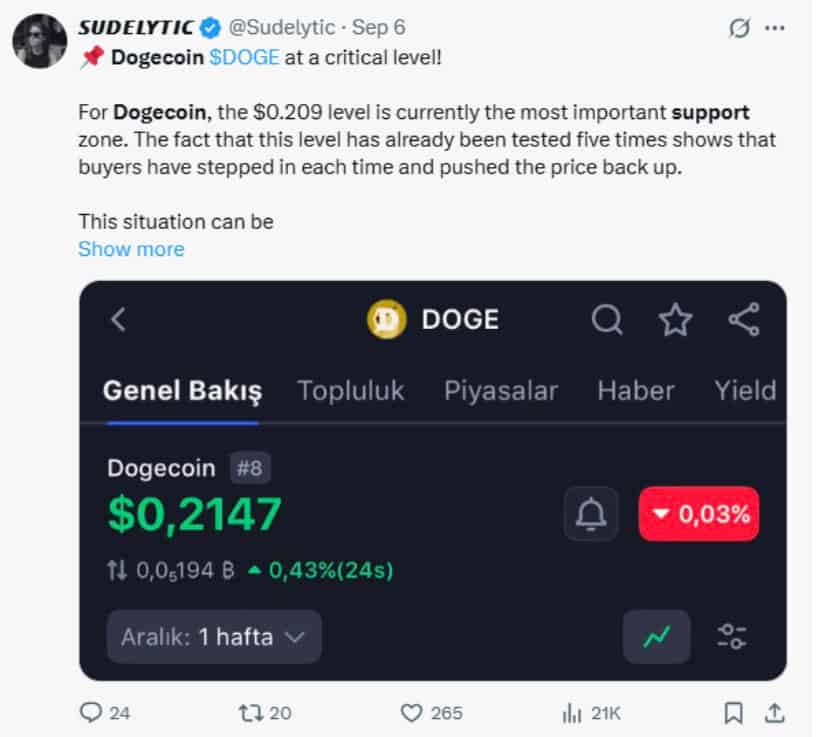
The immediate resistance sits at $0.235, with a breakout likely to target the $0.260–$0.280 range. On the downside, $0.212 is the first key support. A break below $0.204 would completely invalidate the bullish structure and could bring Dogecoin price back toward $0.190 or even the $0.150 demand zone.
Dogecoin’s $0.209 support is critical, with a hold likely pushing prices toward $0.225–$0.241, while a breakdown could risk a drop to $0.200. Source: 𝙎𝙐𝘿𝙀𝙇𝙔𝙏𝙄𝘾 via X
For traders watching the market, this makes the next few sessions critical for Dogecoin price prediction today and the overall future of Dogecoin.
Dogecoin ETF Proposal Fuels Market Excitement
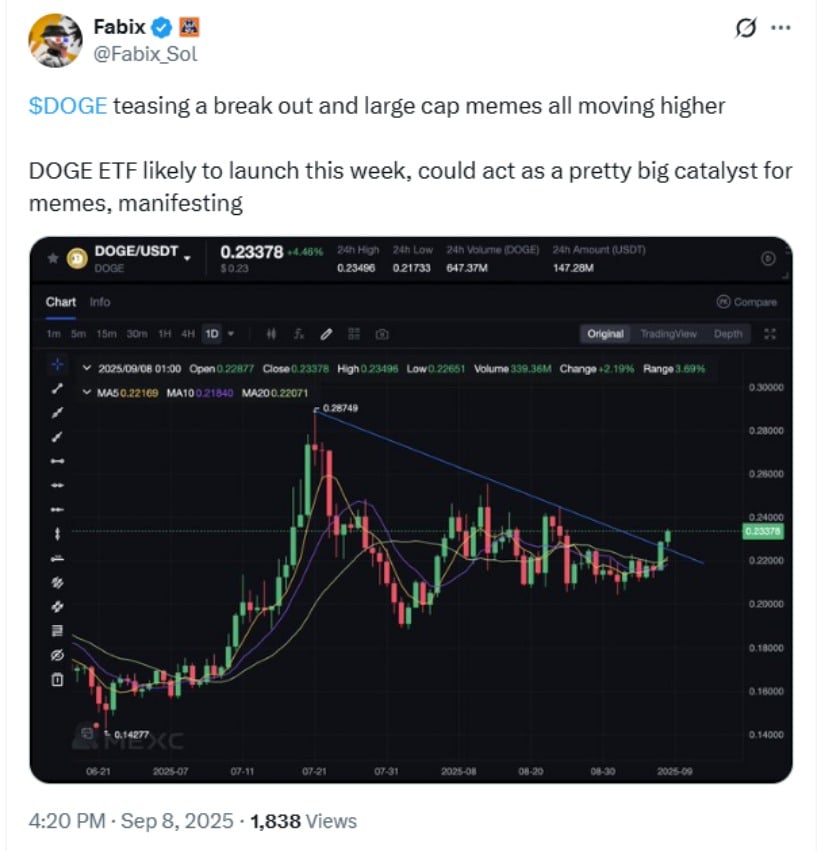
Adding to the bullish sentiment, multiple asset managers—including Grayscale, Bitwise, and REX-Osprey—have filed for a spot Dogecoin ETF. The latest filing suggests that at least 80% of the fund would hold Dogecoin directly or through futures and swaps.
Dogecoin teases a breakout as large-cap meme coins rise, with a DOGE ETF expected this week, potentially acting as a major market catalyst. Source: Fabix via X
Analysts estimate a 90% probability of ETF approval before the end of 2025. If approved, this would make Dogecoin one of the few meme coins with a regulated investment vehicle, potentially driving new institutional demand.
Looking Ahead: Will Dogecoin Reach $1?
While $1 remains a psychological milestone, analysts caution that such a move would require significant spot demand, regulatory clarity, and sustained network growth. Still, the combination of bullish technicals, rising open interest, and ETF optimism keeps sentiment positive.
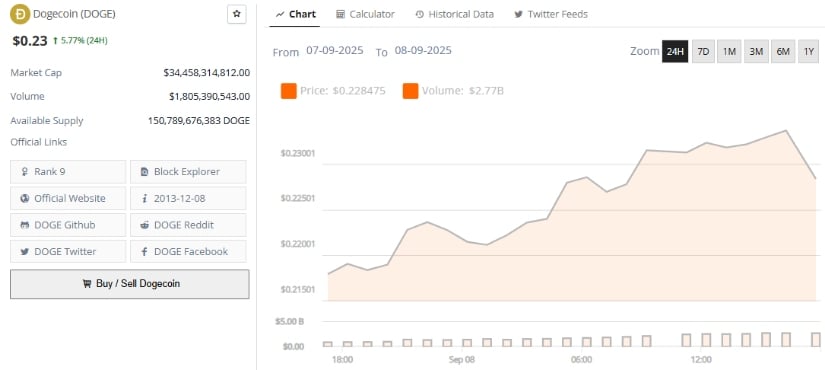
Dogecoin was trading at around $0.23, up 5.77% in the last 24 hours at press time. Source: Brave New Coin