About Editorial team of BIPNs

Main team of content of bipns.com. Any type of content should be approved by us.
3 09, 2025

XRP Stumbles in DeFi Race as Dogecoin Surges and Legal Uncertainty Lingers

By |2025-09-03T21:56:46+03:00September 3, 2025|News, NFT News|0 Comments


Perplexity AI has recently issued price forecasts for XRP, World Liberty Financial, and Dogecoin by the end of 2025, generating significant interest in the cryptocurrency market. The forecasts, while speculative in nature, reflect broader trends and developments within the industry. This analysis focuses on the factors influencing these projections and the market dynamics currently at play.

XRP, the native token of the XRP Ledger (XRPL), continues to face challenges in competing with larger blockchain ecosystems like Ethereum and Solana. Recent data from DeFiLlama indicates that the total value locked (TVL) on the XRPL stands at $87.85 million, a stark contrast to the $96.9 billion TVL on Ethereum and $11.27 billion on Solana. Additionally, the daily decentralized exchange volume for XRP remains below $70,000, underscoring its limited on-chain activity. These metrics highlight the struggles of XRP in the decentralized finance (DeFi) space, where institutional and retail participation are key drivers of growth.

Despite these challenges, Ripple has made strategic efforts to enhance the utility of XRP. Recent upgrades include the introduction of Automated Market Makers (AMMs) with new liquidity pools, the launch of its stablecoin RLUSD, and the integration of a native USDC on XRPL by Circle. Furthermore, Ripple has introduced an EVM sidechain to improve compatibility with Ethereum-based applications. These developments aim to attract developers and enterprises to the XRP ecosystem, but their success will depend on sustained adoption and innovation.

The legal landscape for XRP has also evolved significantly. The U.S. Securities and Exchange Commission (SEC) dropped its appeal against Ripple in August 2024, marking the end of a five-year legal battle. This decision has reduced regulatory uncertainty and opened the door for potential approval of spot XRP exchange-traded funds (ETFs). However, some analysts remain cautious, noting that XRP is not decentralized and is controlled by Ripple, which could expose it to similar risks in the future. For instance, the recent decline in XRP’s price, despite positive legal developments, suggests that market sentiment is still influenced by regulatory and operational risks.

In contrast, Dogecoin has shown signs of renewed momentum. Recent data indicates that Dogecoin’s price surged by 10% in August, outpacing Bitcoin’s 6% decline. Trading volumes for Dogecoin increased by 150%, and Coinglass reported that DOGE futures volumes rose 119% to $5.36 billion. While open interest fell by 4.7% to $3.24 billion, the strategic reshuffling of positions suggests a potential shift in market sentiment. Analyst DogeLord has projected an 850% price rally for Dogecoin, with a target of $0.34 in the short term and a retest of all-time highs above $2 in the long term. However, this forecast hinges on the ability of bulls to maintain support levels and convert leveraged positions into a sustained upward move.

World Liberty Financial, while not discussed in detail in the provided content, is likely part of a broader market narrative surrounding institutional blockchain adoption. The success of XRP and Dogecoin in this space will depend on their ability to provide compliant, efficient, and scalable solutions for financial institutions. Ripple’s focus on enterprise adoption and regulatory compliance positions XRP as a potential candidate for institutional use, while Dogecoin’s community-driven nature and recent price action suggest a different trajectory.

In conclusion, the forecasts for XRP, World Liberty Financial, and Dogecoin by the end of 2025 reflect the dynamic and unpredictable nature of the cryptocurrency market. XRP’s future will be shaped by its ability to attract institutional adoption and compete with larger blockchain networks, while Dogecoin’s performance will depend on market sentiment and strategic price movements. Investors and analysts will need to monitor these developments closely as they unfold over the next several months.

Source: [1] Now That XRP is Dead, What’s Next? Swift Executive Calls … (https://finance.yahoo.com/news/now-xrp-dead-next-swift-105438346.html) [2] XRP (Ripple) Plunged Below $3. Buy the Dip, or Run for … (https://www.nasdaq.com/articles/xrp-ripple-plunged-below-3-buy-dip-or-run-hills) [3] Is XRP the Smartest Cryptocurrency to Buy With $1000 … (https://www.nasdaq.com/articles/xrp-smartest-cryptocurrency-buy-1000-right-now) [4] Dogecoin Analyst Forecasts 850% Price Rally in September … (https://finance.yahoo.com/news/dogecoin-analyst-forecasts-850-price-214254850.html) [5] Dogecoin Price Chart Today – Live DOGE/USD (https://goldprice.org/cryptocurrency-price/dogecoin-price)



Source link

3 09, 2025

WTI $64, Brent $67 as Geopolitics Tighten Supply

By |2025-09-03T21:49:59+03:00September 3, 2025|Forex News, News|0 Comments


Oil Price Outlook: WTI (CL=F) and Brent (BZ=F) Under Pressure From Geopolitics and Supply Risks

Crude oil markets remain volatile as WTI (CL=F) trades at $64.01, down 0.91%, and Brent (BZ=F) holds near $67.48, lower by 0.74%, reflecting the tug of war between strong U.S. supply, escalating geopolitical conflicts, and shifting demand flows from Asia and Europe. Despite steady demand, the equilibrium has been challenged by Russia-Ukraine tensions, tariff pressures, and heavy investment in renewables, while speculative flows continue to dictate weekly swings.

Geopolitical Risk Premium Returns to Oil (CL=F, BZ=F)

The war in Ukraine has reintroduced a meaningful geopolitical premium into both WTI and Brent benchmarks. Ukrainian drone strikes on Russia’s energy infrastructure hit eight refineries in August, cutting roughly 10% of refining capacity, and temporarily disrupting flows through the Druzhba pipeline, which supplies Hungary and Slovakia. Over the weekend, a strike at Russia’s Baltic export port near St. Petersburg added to concerns. Russia, already struggling with seaborne oil shipments that hit a six-month low, now faces possible gasoline shortages at home, prompting the Kremlin to consider extending its export ban. Each incremental attack further tightens global supply expectations, making the $65–$70 per barrel range highly sensitive to further escalations. Analysts warn that each 500,000 barrels removed from Russian exports could shift Brent toward $75–$78 in a matter of weeks.

OPEC+ Strategy and Saudi Revenue Decline

Saudi Arabia’s Q2 oil export value fell 16% YoY, reflecting weaker pricing and pressure from record U.S. output. The Kingdom continues to balance fiscal needs with OPEC+ strategy, wary of pushing cuts too aggressively as it weighs competition with U.S. shale. The OPEC basket price sits at $69.65, marginally lower, suggesting member states are absorbing reduced revenues amid discounting to key buyers in Asia. India has ramped up U.S. crude imports as prices remain favorable, while still taking Russian barrels despite tariffs. Saudi Arabia, meanwhile, faces a delicate fiscal situation, with breakeven budgets requiring oil closer to $80–85. This mismatch between current Brent levels at $67–68 and fiscal needs could force further production adjustments heading into Q4.

U.S. Supply Surges and EIA Record Data

According to the EIA, U.S. crude production hit a record in 2024, though growth has slowed compared to earlier years. Weekly output in June beat estimates, reinforcing America’s role as the swing producer. WTI’s rangebound action between $62.70 and $64.95 last week showed how resilient U.S. supply is at these levels. Even with strong exports to India and Europe, domestic production ensures no acute shortage is forming. Inventories, however, have drawn sharply, which, combined with a weaker dollar and speculation about Fed rate cuts, has kept a floor under WTI. Traders point to the $62.30–$65.20 speculative range as defining the short-term technical setup, with upside capped near $66 absent new geopolitical shocks.

European and Asian Demand Shifts

Europe is leaning more heavily on jet fuel imports from Asia, reaching record highs, while refining disruptions in California and ongoing Norwegian pipeline maintenance have added regional volatility. India’s refiners have expanded U.S. purchases, while also increasing discounted Russian crude despite tariff threats. China remains opportunistic, but its slowing industrial profits—down 1.7% in July—weigh on long-term demand growth. Still, Asia’s appetite remains strong enough to soak up discounted cargoes, preventing a steeper collapse in Brent. On the flip side, Chinese LNG imports have declined, reflecting a broader recalibration of its energy mix toward renewables and storage investments, leaving oil markets more sensitive to temporary demand shocks rather than structural growth.

Technical Outlook for WTI (CL=F) and Brent (BZ=F)

WTI struggled to sustain gains above $64.40 last week, reversing lower into the weekend and signaling exhaustion. The inability to clear the $65–$66 resistance highlights bearish undertones, even as speculative flows support short-term rallies. On the downside, $63.00 to $62.50 represents immediate support, with risks of a deeper slide toward $61.70 if macro sentiment worsens. Brent faces a similar picture, with resistance at $68.50–$69.20 and downside support at $66.00. A decisive break below these levels would invite a sharper selloff toward $63 for Brent, narrowing the spread to WTI. The technical picture suggests rangebound trading but with clear downside vulnerability unless geopolitical shocks intensify.

Investor Positioning and Sentiment

Speculative positioning in crude remains cautious, with traders unwilling to bid aggressively higher given ample U.S. supply and weak macro data from China. Large players are expected to return after the holiday weekend with volumes, but the overhang of geopolitical risk prevents aggressive shorting. Goldman Sachs projects oil falling below $55 in 2026, a reminder that current rallies may be short-lived unless backed by sustained supply disruptions. At present, crude appears in a fragile balance between bearish fundamentals and bullish geopolitical shocks, leaving sentiment prone to quick reversals.

Verdict: Buy, Sell, or Hold on Oil (CL=F, BZ=F)

At $64 for WTI and $67 for Brent, oil is trading below the fiscal comfort levels of OPEC producers, with downside risks capped by geopolitical events in Russia and Ukraine. Fundamentals lean bearish with U.S. output at record highs and Chinese demand still fragile, but the geopolitical premium is back in play and could lift prices $5–10 above current ranges if attacks intensify. The technical picture argues for consolidation, but the risk-reward skews cautiously bullish given supply risks. Based on the current setup, WTI (CL=F) is a speculative Buy on dips near $62, while Brent (BZ=F) is a Hold, with a breakout above $70 required to confirm renewed momentum.

That’s TradingNEWS


Source link

3 09, 2025

Cable Recovers but the Outlook Remains Murky. WIll NFP Data Serve as a Catalyst?

By |2025-09-03T21:48:53+03:00September 3, 2025|Forex News, News|0 Comments

Source link

3 09, 2025

Fat-blocking green tea microbeads show promise for weight loss in new study

By |2025-09-03T21:47:48+03:00September 3, 2025|Dietary Supplements News, News|0 Comments


Fat-blocking microbeads made with green tea, vitamin E, and seaweed could offer a new way to lose weight and a potential alternative to popular GLP-1 drugs and bariatric surgery, according to exploratory new research.

While human trials are still needed, scientists in China found that rats fed a high-fat diet lost about 17% of their body weight when given the edible microbeads. 

The rats also saw reduced fat tissue, alleviated liver damage, and lowered blood fat levels compared to animals that did not receive the beads. 

“Our work provides a basis for novel dietary strategies to combat obesity,” the Sichuan University researchers wrote in the study, published in the journal Cell Biomaterials. 

Obesity affects nearly 890 million adults globally. It’s the fourth leading cause of death, the research team noted. 

“The overconsumption of dietary fat is the key contributor to obesity, associated with Type 2 diabetes, cardiovascular disease, stroke, and malignant cancers,” the researchers wrote, adding that restricting dietary fat is emerging as a promising solution.

“Losing weight can help some people prevent long-term health issues like diabetes and heart disease,” Yue Wu, one of the study’s authors, said in a news release from the American Chemical Society (ACS). “Our microbeads work directly in the gut to block fat absorption in a noninvasive and gentle way.”

Fat-blocking microbeads made with green tea, vitamin E, and seaweed could offer a new way to lose weight and a potential alternative to popular GLP-1 drugs, according to new research. JodieWang – stock.adobe.com

The team set out to develop something that aligns with how people “normally eat and live,” she added.

Wu presented the team’s results at the ACS fall digital meeting in August.

The beads are made from green tea polyphenols – antioxidants in tea leaves – combined with vitamin E to bind to fat droplets in the gut and block their absorption. A seaweed-derived coating protects the beads from stomach acid.

The nearly flavorless beads could be integrated into everyday foods, according to the ACS, and even formed into tapioca-like balls for desserts or bubble teas.

The beads are made from green tea polyphenols – antioxidants in tea leaves – combined with vitamin E to bind to fat droplets in the gut and block their absorption. Pixel-Shot – stock.adobe.com

During the 30-day experiment, rats on a diet comprised of 60% fat – far higher than the 35% to 40% typically seen in human diets – excreted more fat after eating the microbeads, but without side effects or blood sugar fluctuations. 

Compared to orlistat, a U.S. Food and Drug Administration (FDA)-approved fat-blocking drug, the beads produced similar levels of fat excretion but avoided the gastrointestinal issues observed in the study.

Orlistat can cause digestive problems because unabsorbed fat passes into and lingers in the colon. The experimental microbeads, meanwhile, appeared to curb fat and weight gain without disrupting blood sugar, digestion, or energy levels.

The scientists also noted that semaglutide – the active ingredient in Ozempic and Wegovy, which are FDA-approved – lowered blood sugar in rats but caused fluctuations that could trigger hunger and lethargy, raising concerns about side effects in the animal study. 

The experimental microbeads, meanwhile, appeared to curb fat and weight gain without disrupting blood sugar, digestion, or energy levels. New Africa – stock.adobe.com

“While our study presents a proof of concept for obesity treatment using PmFL microbeads, it is exploratory and does not reach the preclinical stage,” the scientists wrote in the paper. 

“The results highlight fundamental mechanisms and potential benefits, but further research is necessary to evaluate their long-term safety, efficacy, and potential for clinical translation.”

The findings should be regarded as a foundational step for subsequent research, they added.

“While our study presents a proof of concept for obesity treatment using PmFL microbeads, it is exploratory and does not reach the preclinical stage,” the scientists wrote in the paper.  andranik123 – stock.adobe.com

All the components are food-grade and individually FDA-approved, the scientists said, but the microbead formulation itself has not yet been cleared by regulators. 

A biotech company has partnered with researchers to scale up manufacturing and a human clinical trial is underway in China. Early results are expected within the next year.

Fox News Digital reached out to the study’s authors for more information.


Source link

3 09, 2025

Analysts See DOGE Rallying To $2 While LBRETT Targets 12,000% Upside

By |2025-09-03T21:43:43+03:00September 3, 2025|Crypto News, News|0 Comments

Disclaimer: This is a Press Release provided by a third party who is responsible for the content. Please conduct your own research before taking any action based on the content.


Memecoin season is on the rise, with Dogecoin price prediction hitting the wave. Analysts are forecasting a potential rally to $2 for DOGE; many are looking to the original meme coin as a promising investment opportunity. But what’s driving this optimism, and what does the future hold for Dogecoin?

This article dives into the latest price predictions for Dogecoin, alongside a powerful new contender in the meme coin space—Layer Brett (LBRETT), which is making waves with its 12,000% upside potential.

Keep reading to uncover why LayerBrett could be the best meme coin to buy now and how it’s set to shake up the market.

Dogecoin price prediction: Analysts see DOGE rallying to $2

Dogecoin (DOGE), the meme coin that started it all, is back in the spotlight, and analysts are making massive Dogecoin price predictions. The newest Dogecoin price prediction leans toward a probable rise to $2.

What is the source of this optimistic outlook? In the first place, Dogecoin has been receiving more attention as a result of its ongoing appeal among individual investors as well as institutional participants.

In addition, it is possible to attribute a significant portion of this attention to individuals such as Elon Musk, whose remarks and Tesla’s adoption of DOGE have been of critical importance in driving up the price of the cryptocurrency.


As the price remains above $0.20, DOGE still has considerable room for growth. Analysts predict that after Dogecoin passes above resistance levels around $1, the next objective might be $2. This prediction also coincides with the overall market excitement surrounding meme coins, which has only intensified in recent months.

Analysts see Layer Brett gaining targets 12,000% upside

While Dogecoin’s outlook remains bullish, another meme coin is stepping up to steal the spotlight—Layer Brett (LBRETT). This Layer 2 solution built on Ethereum combines the fun of meme coins with actual blockchain utility. Experts are optimistic about LayerBrett’s future, with some predicting an incredible 12,000% upside for early investors.

Layer Brett isn’t just another meme coin; it’s built to be scalable and fast, offering lower transaction fees compared to traditional Ethereum-based tokens. This Layer 2 solution provides significant technical advantages, making it an attractive option for crypto enthusiasts seeking utility.

With presale participants set to receive massive staking rewards (up to 20,000% APY), the upside potential is hard to ignore. Early investors have the chance to get in cheaply at $0.005, while gaining explosive returns.

Why Layer Brett is the best memecoin to buy now

Layer Brett stands out among meme coins by offering more than just a playful community-driven project. Unlike many meme tokens with limited utility, Layer Brett combines Ethereum’s Layer 2 technology with real-world blockchain applications. This makes it not only a fun token but a serious player in the world of decentralized finance.

The presale phase is still live, making it the perfect time to buy into the project before it takes off. Layer Brett is poised for a significant jump, with a potential gain of 12,000%. Users will be able to make transactions faster and pay less in fees because the coin is designed on a platform that can grow and is cheap to use. Also, staking benefits are a nice extra for anyone who buys early.

Layer Brett has a dedicated community, a feature many other meme coins lack, in addition to its technical advantages. The LayerBrett team has ensured the project’s growth is environmentally friendly by prioritising interaction and rewards. This will happen as Ethereum’s Layer 2 ecosystem gets more popular.

Conclusion: Why you should invest in LayerBrett now

While Dogecoin continues to attract attention and may very well see a price increase toward $2, Layer Brett offers something fresh. With analysts predicting an upside of 12,000%, LayerBrett’s potential for growth is hard to ignore. This project is unique, combining meme-driven excitement with real utility and scalability. With early investors already gaining millions, you don’t want to be left out.

The Layer Brett presale is still running, so now is the time to join the presale of one of the most promising meme coins to ever launch on Ethereum. Don’t miss out—secure your place in LayerBrett before it takes off!

Presale: Layer Brett | Fast & Rewarding Layer 2 Blockchain

Telegram: Telegram: View @layerbrett

X: (1) Layer Brett (@LayerBrett) / X

Disclaimer: This media platform provides the content of this article on an “as-is” basis, without any warranties or representations of any kind, express or implied. We assume no responsibility for any inaccuracies, errors, or omissions. We do not assume any responsibility or liability for the accuracy, content, images, videos, licenses, completeness, legality, or reliability of the information presented herein. Any concerns, complaints, or copyright issues related to this article should be directed to the content provider mentioned above.

/div>

Source link

3 09, 2025

Stablecoins Power $3 Trillion Surge as DeFi and Cross-Border Demand Collide

By |2025-09-03T19:55:49+03:00September 3, 2025|News, NFT News|0 Comments


Stablecoin on-chain transactions surged by 92% in August, reaching $3 trillion, driven by heightened usage across decentralized finance (DeFi), cross-border payments, and arbitrage strategies, according to a report from Artemis. The aggregated market capitalization of stablecoins stood at $284.6 billion, reflecting an increase of approximately $17.5 billion from the start of the month. This growth was supported by a 25% increase in unique wallet addresses, which rose to 41.7 million, signaling broader adoption across retail and institutional participants. Ethereum and Tron continued to dominate as primary liquidity hubs, with Ethereum offering deep liquidity pools and Tron facilitating low-cost cross-border transfers. Layer-2 rollups also saw rapid adoption, contributing to the efficiency and scalability of stablecoin operations.

The surge in on-chain activity was primarily fueled by arbitrage opportunities and expanding use cases in DeFi. Cross-chain bridges and efficient Layer-2 solutions enabled faster and cheaper transactions, further boosting the utility of stablecoins as a medium of exchange. Tether’s USDT maintained a dominant 59% market share, while USDC from Circle saw a $7.98 billion increase in supply, partly attributed to growing institutional adoption. Newer entrants like USDe from Ethena experienced a 41% month-over-month growth, driven by yield-seeking strategies on DeFi platforms. Despite the market concentration around major tokens, the decentralized nature of stablecoin ecosystems continues to foster innovation across payment rails and liquidity infrastructure.

The underlying liquidity infrastructure remains robust, with decentralized exchanges and cross-chain bridges playing a critical role in maintaining low slippage and competitive spreads. Ethereum’s extensive DeFi tooling and Tron’s cost-effective transfer mechanisms have created a dual-layer ecosystem that supports both high-frequency trading and large-volume settlements. This infrastructure has enabled stablecoins to become a cornerstone of global remittances and B2B/B2C payments, particularly in markets where traditional banking systems are less efficient. PayPal’s PYUSD also crossed the $1 billion market cap threshold in August, highlighting the growing acceptance of stablecoins among mainstream financial service providers.

Regulatory developments, however, have introduced new complexities. The newly enacted U.S. Guiding and Establishing National Innovation for US Stablecoins (GENIUS) Act mandates that stablecoin issuers fully back their tokens with cash or short-term Treasuries, while also banning interest payments on stablecoins themselves. However, crypto exchanges are permitted to offer rewards on stablecoin holdings, creating a regulatory gray area. Banking groups have raised concerns that these rewards could draw deposits away from traditional financial institutions, potentially disrupting lending markets. The U.S. Treasury has estimated that as much as $6.6 trillion in deposits could shift to stablecoins, depending on market dynamics, according to research from the American Bankers Association.

Despite these regulatory shifts, stablecoin exchanges continue to see strong inflows, with total exchange reserves reaching a record $68 billion in August, as reported by CryptoQuant. Tether’s USDT accounted for $53 billion of this amount, followed by USD Coin (USDC) at $13 billion. Binance remains the largest hub for stablecoin and altcoin deposits, handling significantly more transactions than its peers. This liquidity concentration could amplify systemic risks if any major network or exchange experiences a sudden disruption or regulatory challenge.

Looking ahead, market participants are closely monitoring the evolution of market share among major stablecoins, regulatory updates, and the adoption trends of new protocols and networks. While the pace of growth has moderated compared to earlier in the year, the foundational role of stablecoins in the crypto ecosystem appears to be solidifying. As both regulators and market participants navigate the implications of this shift, the interplay between DeFi innovation, institutional adoption, and regulatory frameworks will likely shape the next phase of the stablecoin landscape.

Source:

[1] Stablecoin, record August: volumes at 3000 billion and … (https://en.cryptonomist.ch/2025/09/03/stablecoin-record-august-volumes-at-3000-billion-and-market-cap-at-284-6-billion/)

[2] Stablecoin Exchange Reserves Hit Record High as Market … (https://finance.yahoo.com/news/stablecoin-exchange-reserves-hit-record-183747601.html)

[3] The Loophole Turning Stablecoins Into a Trillion-Dollar Fight (https://www.wired.com/story/genius-act-loophole-stablecoins-banks/)


Source link

3 09, 2025

Oil Price Forecast – WTI (CL=F) at $64.61, Brent (BZ=F) at $68.15 as OPEC+ Cuts Unwind

By |2025-09-03T19:49:13+03:00September 3, 2025|Forex News, News|0 Comments


WTI Crude Oil (CL=F) and Brent (BZ=F) Test Key Technical Levels

Oil markets began the week with WTI crude climbing 0.94% to $64.61 per barrel and Brent crude advancing 0.99% to $68.15. The rally coincides with thin U.S. holiday trading volumes but sits directly on the 50-day moving averages, a technical battleground where bulls and bears are both positioned aggressively. For WTI, $65 is the immediate pivot. A sustained move above opens the path toward $67, while repeated failures leave the market locked in the noisy consolidation that has defined the past two weeks. Brent shows a similar setup, with $67 serving as initial support and $70 the psychological target just beneath its 200-day moving average. Both benchmarks are range-bound, offering short-term trading windows rather than long-lasting trends, yet the balance may shift quickly as fundamental shocks mount.

India’s Strategic Russian Oil Imports Reshape Global Trade

Despite U.S. tariffs escalating to 50% on Indian goods, aimed at punishing New Delhi for its continued Russian crude purchases, India shows no signs of backing down. Data confirms that Russia accounted for 31.4% of Indian oil imports in July, well above Iraq at 17.1% and Saudi Arabia at 16.1%. The value of Russian barrels entering India reached $3.6 billion, versus around $2 billion for Iraqi and Saudi volumes. Indian refiners are still importing more than 1.5 million barrels per day of Russian crude, a scale too large to replace quickly. For Washington, the dilemma is clear: squeezing India risks lifting global oil above $100 and reigniting U.S. inflation, yet stepping back exposes the limits of Western sanctions. China is already absorbing additional Russian barrels, and its ability to undercut sanctions further strengthens BRICS alignment. Oil prices remain hostage to these geopolitical calculations, where barrels are traded as much for political leverage as for supply and demand balance.

Saudi Arabia and Iraq Halt Shipments to Sanctioned Indian Buyer

Fresh tension emerged after Saudi Arabia and Iraq suspended shipments to an Indian refiner targeted by sanctions, underscoring how energy flows are increasingly politicized. While volumes remain modest compared to Russian supply, the move highlights that even Middle Eastern producers are not immune to Western pressure. Markets are weighing whether this suspension is symbolic or the start of a broader realignment. Should Indian refiners lean further on Russia to compensate, Moscow’s influence will strengthen, while Middle Eastern producers may quietly redirect barrels to Europe and China. That shift would alter tanker routes, insurance exposure, and freight costs, feeding volatility into already fragile oil pricing structures.

OPEC+ Production Trends and the Threat of Oversupply

The U.S. Energy Information Administration projects Brent crude to average $58 per barrel in Q4 2025, with WTI near $59.65. The bearish outlook reflects OPEC+ gradually unwinding production cuts and higher output from South America, tipping balances into oversupply. Wall Street banks echo this sentiment, with Goldman Sachs, JPMorgan, and Morgan Stanley collectively forecasting Brent in the low $60s for early 2026. For U.S. shale, the implications are severe. Breakeven levels for new wells hover just above $60, and if WTI dips beneath this threshold, rig counts and frac crews will contract further. Rig activity is already declining, though efficiency gains mask the immediate impact on output. A glut-driven slump below $60 would force the shale patch into another round of capex cuts, deepening the cycle of volatility.

Petronas Struggles Under Weak Pricing and Domestic Output Decline

Malaysia’s Petronas posted a 24% revenue decline and a 19% drop in after-tax profit in H1 2025, weighed down by weaker benchmark oil prices, foreign exchange pressures, and divestments. Production slipped 3.2% year-on-year to 2.403 million boepd, down from 2.482 million boepd. Domestic gas production and international liquid output were both lower. The company announced plans to trim its workforce by 10% to weather what it called “increasingly daunting headwinds.” Petronas expects subdued pricing conditions to persist, citing geopolitical tensions, macroeconomic uncertainties, and OPEC+’s unwinding of cuts. For global traders, these results confirm how weaker benchmarks filter through to national oil companies, forcing structural adjustments. Petronas’ challenges illustrate broader struggles among producers caught between sluggish demand recovery and rising geopolitical risk.

Geopolitical Flashpoints Add to the Risk Premium

Attacks on Russian refineries, drone strikes on South Sudanese flows, and Houthi missile claims against Red Sea tankers all remind investors that geopolitical risks are never far from the surface. Supply disruptions remain sporadic, but each incident reintroduces a risk premium that traders must price in. Europe is simultaneously importing record jet fuel volumes from Asia, underscoring how the supply chain remains fractured. These shifts in refined product flows ripple back into crude benchmarks, complicating demand forecasts. Markets are also watching the East Africa pipeline project and Congo offshore developments, both of which could modestly alter medium-term balances if they achieve scale. But near-term price action is more about political flashpoints than new supply coming online.

Technical Signals Point to Heavy Resistance Overhead

From a chart perspective, both WTI and Brent are wrestling with their 50-day moving averages. For WTI, holding above $65 is crucial, as a break could push quickly to $67 and then $70. Failure here risks another slide toward $62, where prior demand has emerged. Brent’s test at $68.15 sits in a congested band, with upside capped by $70–$71 and downside limited at $66. Momentum oscillators show neutral-to-weak bias, reflecting the indecision. The U.S. Dollar Index, trading around 97.70 after four straight declines, provides temporary support, as a weaker dollar typically boosts oil. But structural oversupply fears remain dominant, with technicals likely to follow fundamentals rather than dictate them.

Final Market Positioning: Buy, Sell, or Hold

With WTI crude (CL=F) at $64.61 and Brent (BZ=F) at $68.15, traders face a market torn between short-term bullish catalysts and looming oversupply. On the bullish side, geopolitical risks, U.S. dollar softness, and India’s defiance on Russian barrels inject strength. On the bearish side, EIA’s projection of Brent at $58 and WTI at $59 in early 2026, coupled with Wall Street consensus in the low $60s, casts a heavy shadow. For now, oil is a hold—attractive for tactical long positions into $67–$70 resistance but dangerous for long-term accumulation given looming supply. The next decisive move will hinge on OPEC+ policy, U.S. shale reaction, and whether geopolitical sparks ignite sustained disruption rather than sporadic risk premiums.

That’s TradingNEWS


Source link

3 09, 2025

USD/JPY Forecast: Yen Weakening Amid Japan’s Political Turmoil

By |2025-09-03T19:48:01+03:00September 3, 2025|Forex News, News|0 Comments

  • The USD/JPY forecast indicates continued yen weakness amid political uncertainty in Japan.
  • The Secretary General of Japan’s ruling party is planning to resign.
  • Economists are predicting a low US job growth of 75,000. 

The USD/JPY forecast indicates continued yen weakness amid political uncertainty in Japan. Meanwhile, the dollar is on the front foot as market participants prepare for Friday’s crucial US employment report. 

Are you interested in learning more about forex indicators? Check our detailed guide- 

The yen slid on Tuesday after reports that the Secretary General of Japan’s ruling party was planning to resign. Hiroshi Moriyama is a close ally of Prime Minister Shigeru Ishiba. Therefore, such a move will likely further weaken Ishiba’s position. Since he lost the election, there have been calls for Ishiba to resign. His resignation would create uncertainty in Japan’s politics that could further weaken the yen.

“On the surface, political uncertainty and the possibility that Prime Minister Shigeru Ishiba could resign in the coming days or weeks is having a debilitating impact on the yen,” said Kit Juckes, Societe Generale’s chief global FX strategist.

Meanwhile, the dollar gained amid yen weakness as traders awaited the next major catalysts from the US. Friday’s nonfarm payrolls report could show further weakness in the labor market. Economists are predicting a low job growth of 75,000 and a higher unemployment rate of 4.3%. Unexpected softness would increase expectations for Fed rate cuts this year, weighing on the dollar. On the other hand, resilience in the labor market could ease rate cut expectations, boosting the greenback.

USD/JPY key events today

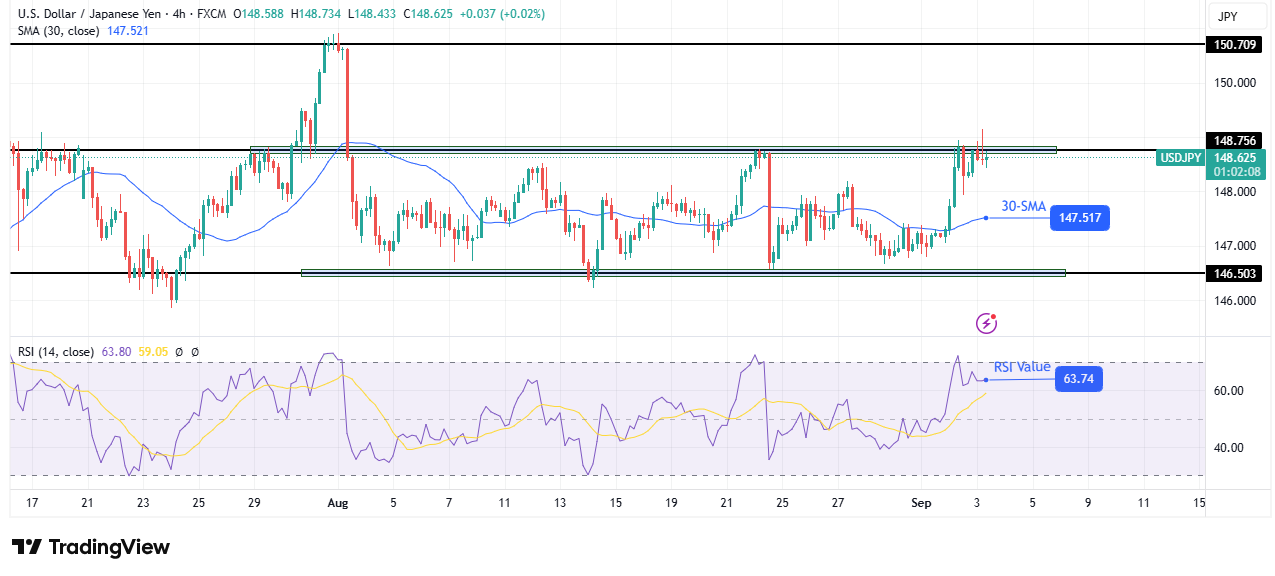
USD/JPY technical forecast: Bulls face the 148.75 range resistance

USD/JPY Forecast: Yen Weakening Amid Japan’s Political Turmoil
USD/JPY 4-hour chart

On the technical side, the USD/JPY price has rallied to challenge the 148.75 key resistance level. It trades well above the 30-SMA, with the RSI near the overbought region, suggesting a bullish bias. However, the price still trades within its consolidation area, with support at the 146.50 level and resistance at the 148.75 level. 

Are you interested in learning more about next cryptocurrency to explode? Check our detailed guide- 

If bulls manage to break out of the consolidation area, the price will rally to retest the 150.70 resistance level. At the same time, it could initiate a bullish trend characterized by higher highs and higher lows. On the other hand, if the level holds firm, the price will likely drop to retest the range support. This means it could remain in consolidation for an extended period. 

Looking to trade forex now? Invest at eToro!

68% of retail investor accounts lose money when trading CFDs with this provider. You should consider whether you can afford to take the high risk of losing your money.

Source link

3 09, 2025

Analysts Predict $0.92 Breakout After Historic Governance Vote

By |2025-09-03T19:42:41+03:00September 3, 2025|Crypto News, News|0 Comments

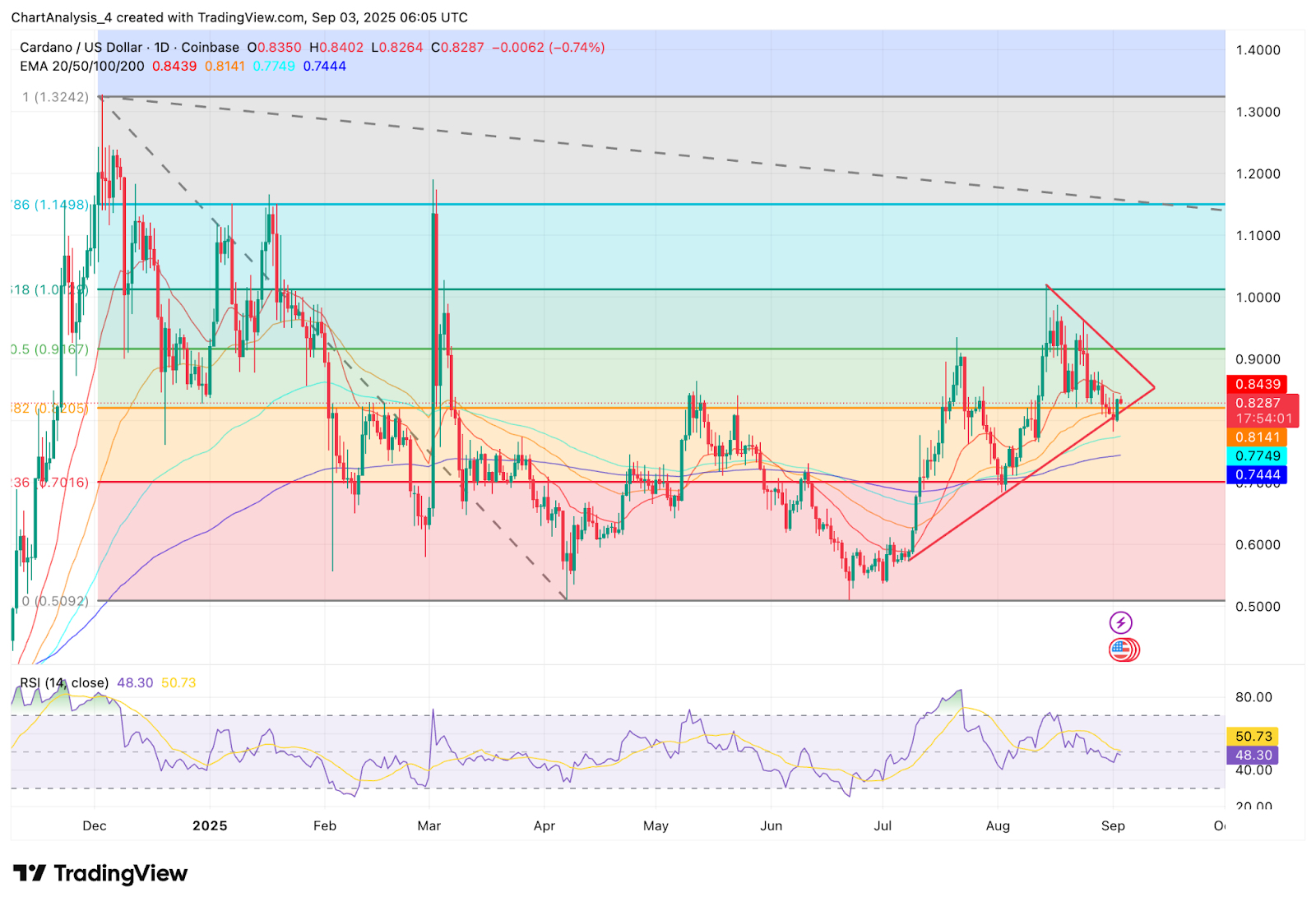
Cardano price today is trading at $0.83, consolidating inside a tightening structure after pulling back from the $0.92 zone last week. Price action is compressing within a symmetrical triangle, with immediate support layered near $0.81–$0.82. Traders now weigh fresh governance news against technical resistance as ADA approaches a decisive breakout.

Cardano Price Consolidates Inside Triangle

ADA Triangle consolidation (Source: TradingView)

The daily chart highlights ADA’s squeeze inside converging trendlines, with price holding above key moving averages. The 20-day EMA at $0.84 and 50-day EMA at $0.81 are providing short-term support, while the 100- and 200-day EMAs at $0.77 and $0.74 remain critical on the downside.

Related: Solana (SOL) Price Prediction: Can Bulls Push Through $220 After Alpenglow Approval?

The RSI at 48 reflects neutral momentum, showing neither overbought nor oversold conditions. A break above the $0.92 resistance could lead to $1.01 and potentially $1.14, which are the 0.618 and 0.786 Fibonacci retracement levels from the previous downtrend. Failure to defend $0.81 could expose ADA to a deeper test of $0.77 and $0.74.

Governance S…

The post Cardano (ADA) Price Prediction: Analysts Predict $0.92 Breakout After Historic Governance Vote appeared first on Coin Edition.

Source link

3 09, 2025

XRP News Today: XRP’s Cross-Border Edge vs. DeFi’s Tall Shadow: Can It Rise?

By |2025-09-03T17:54:46+03:00September 3, 2025|News, NFT News|0 Comments


XRP, the digital asset associated with Ripple’s XRP Ledger (XRPL), has become the subject of significant speculation, with analysts and crypto enthusiasts projecting potential price surges reaching $100 or even $200. These bullish forecasts are driven by a combination of regulatory developments, institutional adoption, and broader market dynamics. However, the current landscape also highlights challenges for XRP compared to other major blockchain networks.

XRP has long positioned itself as a solution for cross-border transactions, emphasizing speed, cost-efficiency, and compliance. The XRP Ledger supports fast and low-cost transfers, making it attractive to financial institutions and currency exchangers. Ripple has also introduced new features to bolster the ecosystem, including Automated Market Makers (AMMs) with liquidity pools, a stablecoin (RLUSD), and an EVM-compatible sidechain to enhance Ethereum interoperability. These developments aim to attract developers and enterprises to build on the XRP Ledger [2].

Despite these efforts, XRP lags significantly behind other blockchain platforms in terms of decentralized finance (DeFi) metrics. According to DeFiLlama, the total value locked (TVL) on the XRP Ledger stands at just $87.85 million, compared to over $96.9 billion on Ethereum and $11.27 billion on Solana [1]. Moreover, XRP’s daily decentralized exchange (DEX) volume is below $70,000, dwarfed by the figures from other chains. The disparity is also evident in derivatives markets, where XRP’s futures open interest remains a fraction of Ethereum’s and Solana’s, signaling limited institutional participation [1].

Analysts like Paul Barron and crypto strategist Zach Rector remain optimistic about XRP’s long-term potential, particularly if key catalysts align. These include the approval of spot crypto ETFs, progress on a market structure bill in Congress, and Ripple’s acquisition of necessary banking licenses. Barron posits that if these events occur, XRP could see a surge to $50 or even $100, with a pullback scenario still resulting in significant gains [4]. Rector, who holds over 90% of his portfolio in XRP, acknowledges the volatility associated with such a move, cautioning that investors must brace for sharp price swings [4].

The XRP community appears to be rallying behind the asset, with many viewing it as a long-term investment rather than a short-term trade. Some investors are even allocating a portion of their retirement savings into XRP, emphasizing a belief in the token’s future beyond speculative price targets. Rector notes that the focus is not just on reaching a certain price point but on establishing a new baseline where XRP can sustain a double-digit valuation [4].

Regulatory clarity has also improved for XRP, with the U.S. Securities and Exchange Commission (SEC) resolving its lawsuit against Ripple on August 22. This resolution has reduced legal uncertainty and opened the door for broader adoption by institutions. Ripple’s continued efforts to integrate compliance tools into the protocol further differentiate XRP from other cryptocurrencies, making it more palatable to regulated financial actors [2].

While XRP faces stiff competition from Ethereum, Solana, and other emerging chains, its unique value proposition—particularly in cross-border settlement—cannot be overlooked. However, for XRP to outcompete these rivals, it must continue to innovate and demonstrate its ability to attract both developers and institutional capital. The coming months will be critical in determining whether XRP can fulfill its potential as a foundational layer for institutional blockchain adoption [1].

Source: [1] Now That XRP is Dead, What’s Next? Swift Executive Calls … (https://finance.yahoo.com/news/now-xrp-dead-next-swift-105438346.html) [2] Is XRP the Smartest Cryptocurrency to Buy With $1000 … (https://www.nasdaq.com/articles/xrp-smartest-cryptocurrency-buy-1000-right-now) [4] XRP Price Prediction: Is Triple-Digit Target Incoming? (https://coinpedia.org/news/xrp-price-prediction-is-triple-digit-target-incoming/)


Source link

Go to Top