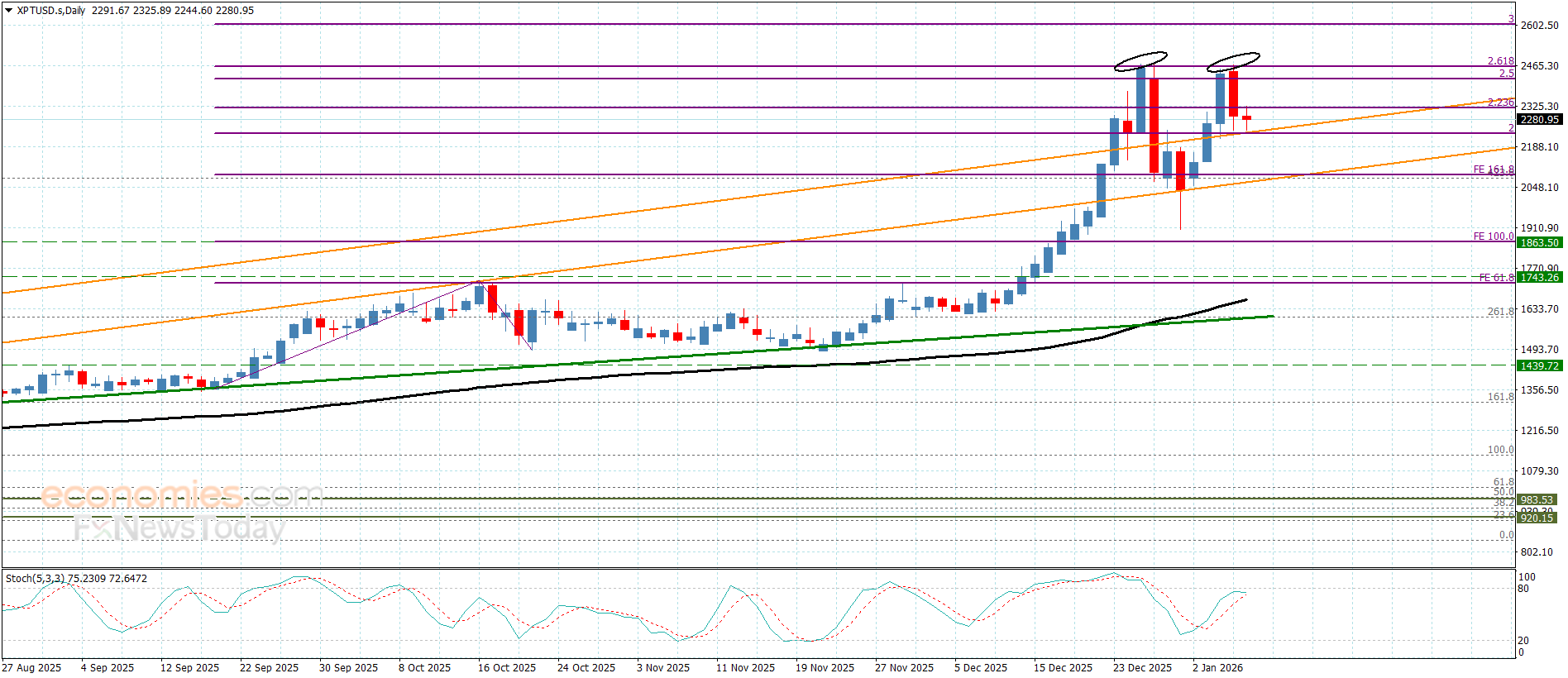
The intraday negative pressure increased on copper price trading due to stochastic attempt to exit from the overbought level, which forces it to settle below $5.9700, forcing it to form corrective waves by reaching $5.7900.
The price might decline towards the initial support at $5.7500 by the continuation of the negative pressure will increase the chances of breaking this support, to expect targeting extra corrective stations that begin at $5.6300 and $5.5100, while its success to step above $6.000 will open the way for recording new historical gains by its rally towards the bullish channel’s resistance at $6.1800.
The expected trading range for today is between $5.6300 and $5.9700
KUALA LUMPUR: USANA Malaysia has once again been recognised as the No. 1 Combination Dietary Supplements Brand in Malaysia by global market research firm Euromonitor International. This latest accolade marks eight consecutive years that USANA Malaysia has led the market in the combination dietary supplements category.
The ranking is based on Euromonitor International’s independent market research, which measures USANA’s retail value share among all dietary supplement brands in Malaysia.
“Being recognised for eight consecutive years is a powerful testament to the trust consumers place in our products,” said Vivienne Lee, USANA Regional Vice President. “This continued leadership in the combination dietary supplements category reflects USANA’s unwavering commitment to quality, scientific innovation and excellence.”
Euromonitor International is the world’s leading provider of global business intelligence, market analysis and consumer insights. With analysts based worldwide, the organisation combines global expertise with deep local knowledge to help businesses anticipate industry, economic and consumer trends.
“I would like to extend my sincere gratitude to our loyal customers and the entire USANA family,” said Sabrina Khoo, Regional General Manager.
“Your continued trust and support have made this eight-year milestone possible. Together, we will continue to empower individuals to support their health and wellbeing with high-quality, science-backed nutrition.”
XRP remains one of the most promising cryptocurrencies in the market, with bright long-term capabilities. XRP is known for its volatility, but still trades above $2.00 psychological level most of the time, showing investor demand. At the moment, XRP is sliding below major technical levels after failing to hold the $2.40 support level, which was recorded on Tuesday. The market downturn comes just days ahead of the landmark Market Structure Bill, which is set to legitimize XRP as a non-security and eliminate lingering regulatory uncertainties.
XRP is crashing in the cryptocurrency market, reportedly dropping nearly 5.85% over the past 24 hours. XRP, currently the fourth-largest cryptocurrency, is trading at $2.25, dropping from a two-month high of $2.41 recorded on January 6, 2025. At the beginning of 2026, XRP capitalized on the fresh market environment and outperformed the majority of altcoins. The sudden drop in XRP’s market momentum is fueled by factors like profit-taking after a rally and technical breakdown below major levels. XRP’s short-term decline is accompanied by a 20.9% weekly rally, reflecting profit-taking amid overbought signals.
XRP Current Market Scenario
According to the current market data, XRP is trading at $2.25, with a market capitalization of $136.55 billion and a daily trading volume of $6.58 billion. XRP is underperforming the broader cryptocurrency market, and the price data shows that the digital asset is consolidating below key resistance levels despite sustained ETF support. XRP currently trades above the 50-Day SMA ($ 2.04) and below the 200-Day SMA ($ 2.45), indicating a neutral-to-bullish transition phase with short-term strength. Based on XRP’s historic trend, this trend could be the early signal of a recovery with upside potential if the 200-Day SMA breaks. XRP has traded 14/30 (47%) days in green, and its fear and greed index shows 44, which is identified as fear in the cryptocurrency market.
XRP Price Forecast: Expert Views & Opinions
XRP’s price stability has always been a topic of debate and has created different opinions among investors. Its extreme volatility backs the theory to an extent, but numerous investors still believe in XRP and claim it could be the next big thing in the market. Jake Claver, a financial expert and the CEO of Digital Ascension Group, commented on XRP. He commented that there are a few things that matter if a digital asset is going to be taken seriously as part of real financial infrastructure: price stability, network reliability, consistent transaction volume, strong partnerships, and institutional support. He noted that XRP checks all those boxes and continues to grow as next-gen financial infrastructure.
Akanksha Saxena, a Web3 expert, said in an X post that XRP was attracting serious attention in 2026 due to a combination of strong factors rather than price action alone. She explained that demand for XRP ETFs was growing rapidly, with spot XRP ETFs recording nearly $100 million in inflows since the start of the year. She noted that XRP had outperformed major cryptocurrencies, rising about 25% since January 1, compared with Bitcoin’s 6% gain and Ethereum’s 10% increase. Saxena also observed that market and social sentiment around XRP had turned increasingly bullish. Additionally, she highlighted that rising network activity, including more transactions and higher on-chain usage, pointed to growing real-world interest. She concluded that when fundamentals, sentiment, and market structure align, they often create momentum worth watching.
XRP Price Prediction Today: Will XRP Surge & Regain The Bullish Momentum?
XRP is consolidating at the moment and is expected to stay within the $2.25-$2.40 price range in the next few days. However, XRP is showing short-term bearish momentum; it is still trading with a weekly high of 20.38%. According to the recent data, XRP is unlikely to trigger a positive trend today and reclaim the key levels. Even though a steady bullish outlook is not guaranteed, the ETF support could spark an intraday recovery near $2.30.
Date
Min Price (USD)
Avg Price (USD)
Max Price (USD)
Jan 7, 2026
2.25
2.33
2.35
Jan 8, 2026
2.24
2.31
2.36
Jan 9, 2026
2.23
2.29
2.37
Jan 10, 2026
2.25
2.30
2.38
Jan 11, 2026
2.26
2.32
2.39
Jan 12, 2026
2.28
2.36
2.41
Jan 13, 2026
2.29
2.36
2.42
Disclaimer: XRP price prediction data is subject to change based on the market dynamics. The table is based on predictive modeling and should not be considered financial advice.
According to XRP price prediction today, Ripple’s native cryptocurrency is expected to trade at an average maximum price of 2.38. XRP may reclaim the $2.40 barrier soon, though traders will likely need to wait until at least next week to see the digital asset challenge the $3.00 psychological level.
XRP Outlook: Will XRP Hit $2.50 Before The Market Structure Bill
Yes. XRP has a high chance of breaking above the $2.50 support level ahead of the Market Structure Bill, which is currently scheduled for January 15, 2026. Strong ETF inflows and improving market sentiment, despite the short-term price correction, are still enough to drive XRP upward and trigger a rally. The target price can be achieved by January 10 if ETF inflows remain strong and XRP breaks and holds above the 200-day SMA. According to the observation, failure to clear the $2.45 resistance level will be key and is likely to keep XRP range-bound until the Market Structure Bill markup.
Hamster Kombat Daily Cipher January 08, 2026: Today’s Code, How to Solve It, and How Players Earn HMSTR Coins
By HOKANEWS Web3 Gaming Desk
The daily puzzle mechanics inside Hamster Kombat have become a defining feature of the play-to-earn gaming trend, and the Daily Cipher continues to be one of the most anticipated challenges for its growing community. On January 08, 2026, thousands of players once again logged into Telegram to decode a fresh Morse-code message in exchange for in-game rewards and HMSTR coins.
Blending classic code-breaking logic with modern Web3 gaming, the Daily Cipher has helped Hamster Kombat stand out in an increasingly crowded Telegram gaming landscape. The challenge is simple in concept, yet engaging enough to keep players returning every day.
What Is the Hamster Kombat Daily Cipher?
The Hamster Kombat Daily Cipher is a recurring daily puzzle that tasks players with decoding a word or phrase written in Morse code. The cipher is made up of dots and dashes, and players must correctly interpret the signals to reveal the hidden message.
Once the correct word is submitted, players receive in-game rewards that can be used for upgrades, leveling, bonuses, and overall progression inside the Hamster Kombat ecosystem. These rewards are part of the game’s internal economy and contribute to long-term advancement rather than instant competition.
One of the key reasons for the feature’s popularity is accessibility. Hamster Kombat operates entirely through Telegram, meaning players do not need to install additional apps or manage external wallets. The official bot handles gameplay and in-game balances, allowing users to participate instantly.
Why the Daily Cipher Matters in Web3 Gaming
Unlike simple tap-to-earn mechanics, the Daily Cipher adds a layer of active thinking. Players must recognize patterns, interpret Morse code, and submit answers correctly within the daily cycle. This approach encourages learning, problem-solving, and habit-building rather than passive clicking.
In the broader Web3 gaming space, features like the Daily Cipher highlight a shift toward interactive engagement models. By combining familiar logic puzzles with blockchain-inspired rewards, Hamster Kombat appeals to both casual players and those interested in experimenting with crypto-themed games.
Hamster Kombat Daily Cipher – January 08, 2026
For January 08, 2026, the official Daily Cipher word is:
TREND
The Morse code breakdown for today’s cipher is as follows:
Also, read this article: TON Station Daily Combo to unlock more exciting tasks, bonus rewards, and extra coins!
T: dash
R: dot dash dot
E: dot
N: dash dot
D: dash dot dot
Players must enter the decoded word exactly as required to receive their reward.
How to Solve the Hamster Kombat Daily Cipher
Solving the Daily Cipher is designed to be straightforward, even for players who are new to Morse code.
First, open Telegram and access the official Hamster Kombat bot.
Next, locate the Daily Cipher icon within the game interface.
Tap the icon to activate Cipher Mode. A visual confirmation screen appears, indicating that the challenge has started.
Use short taps to represent dots and long taps to represent dashes.
Maintain a brief pause between characters to ensure accurate input.
Once the full word is decoded, submit the answer.
If correct, the reward is added instantly to your in-game balance.
The entire process typically takes only a few minutes.
How Players Increase HMSTR Coins More Efficiently
Beyond the Daily Cipher, Hamster Kombat offers several additional ways for players to grow their in-game coin balance.
Daily tasks and recurring events provide consistent rewards for regular participation and are often the primary source of steady progress.
The Toxin Challenge tournament offers competitive gameplay with potential daily payouts reaching up to one million coins, making it a popular option for active players.
Mini-games and elite missions provide alternative earning paths that combine entertainment with progression-based rewards.
By combining these activities with the Daily Cipher, players can optimize their daily earnings without excessive time investment.
Safety and Participation Considerations
Players should remain mindful of basic safety practices while participating in Telegram-based games.
All rewards are issued as in-game coins and do not guarantee real-world monetary value.
Only the official Hamster Kombat Telegram bot should be used to avoid impersonation or scam attempts.
Private keys, recovery phrases, and personal data should never be shared.
This article is for informational purposes only and does not constitute financial advice.
Understanding these limitations helps maintain realistic expectations and ensures a safe gaming experience.
The Bigger Picture for Hamster Kombat
The continued popularity of the Daily Cipher reflects Hamster Kombat’s broader strategy: encouraging daily interaction through lightweight, engaging challenges. By integrating classic puzzles like Morse code into a modern Telegram game, the project has created a unique identity within the Web3 gaming ecosystem.
As chat-based gaming continues to expand in 2026, features that promote thinking, consistency, and community interaction are likely to remain central to player retention.
Final Thoughts
The Hamster Kombat Daily Cipher for January 08, 2026 once again demonstrates how simple logic-based challenges can drive daily engagement in play-to-earn games. By solving the Morse code puzzle and participating consistently, players can earn HMSTR coins, progress steadily, and enjoy a more interactive gaming experience.
For those exploring Web3 gaming through Telegram, the Daily Cipher offers a balanced mix of challenge and accessibility—proving that earning rewards does not always require complex mechanics or high-risk participation.
hokanews.com – Not Just Crypto News. It’s Crypto Culture.
Writer
@Erlin Erlin is an experienced crypto writer who loves to explore the intersection of blockchain technology and financial markets. She regularly provides insights into the latest trends and innovations in the digital currency space.
The articles published on hokanews are intended to provide up-to-date information on various topics, including cryptocurrency and technology news. The content on our site is not intended as an invitation to buy, sell, or invest in any assets. We encourage readers to conduct their own research and evaluation before making any investment or financial decisions. hokanews is not responsible for any losses or damages that may arise from the use of information provided on this site. Investment decisions should be based on thorough research and advice from qualified financial advisors. Information on HokaNews may change without notice, and we do not guarantee the accuracy or completeness of the content published.
Silver price (XAG/USD) depreciates by 1.75% after three days of gains, trading around $79.30 per troy ounce during the European hours on Wednesday. The price of the grey metal declines as investors lock in profits following its rally toward record highs.
The dollar-denominated precious metals, including Silver broadly pulled back as the US Dollar (USD) strengthened ahead of the upcoming US key economic data that could shape expectations for Federal Reserve (Fed) policy.
The US Dollar Index (DXY), which measures the value of the US Dollar (USD) against six major currencies, is gaining ground for the second successive day and trading around 98.60 at the time of writing.
US ADP Employment Change and ISM Services Purchasing Managers’ Index (PMI) data for December will be eyed later in the day. Traders will shift their focus toward the US Nonfarm Payrolls (NFP) due on Friday, which is expected to show job gains of 55,000 in December, down from 64,000 in November.
Fed Governor Stephen Miran said on Tuesday that the US central bank should cut interest rates aggressively this year to sustain economic momentum, while Minneapolis Fed President Neel Kashkari warned the unemployment rate could “pop” higher. The CME Group’s FedWatch tool suggests Fed funds futures continue to price in about an 82.8% probability that the US central bank will keep rates unchanged at its January 27–28 meeting.
The safe-haven Silver struggles amid increased risk appetite as traders have so far largely shrugged off escalating geopolitical tensions worldwide following the United States (US) intervention in Venezuela and the capture of President Nicolas Maduro.
Silver FAQs
Silver is a precious metal highly traded among investors. It has been historically used as a store of value and a medium of exchange. Although less popular than Gold, traders may turn to Silver to diversify their investment portfolio, for its intrinsic value or as a potential hedge during high-inflation periods. Investors can buy physical Silver, in coins or in bars, or trade it through vehicles such as Exchange Traded Funds, which track its price on international markets.
Silver prices can move due to a wide range of factors. Geopolitical instability or fears of a deep recession can make Silver price escalate due to its safe-haven status, although to a lesser extent than Gold’s. As a yieldless asset, Silver tends to rise with lower interest rates. Its moves also depend on how the US Dollar (USD) behaves as the asset is priced in dollars (XAG/USD). A strong Dollar tends to keep the price of Silver at bay, whereas a weaker Dollar is likely to propel prices up. Other factors such as investment demand, mining supply – Silver is much more abundant than Gold – and recycling rates can also affect prices.
Silver is widely used in industry, particularly in sectors such as electronics or solar energy, as it has one of the highest electric conductivity of all metals – more than Copper and Gold. A surge in demand can increase prices, while a decline tends to lower them. Dynamics in the US, Chinese and Indian economies can also contribute to price swings: for the US and particularly China, their big industrial sectors use Silver in various processes; in India, consumers’ demand for the precious metal for jewellery also plays a key role in setting prices.
Silver prices tend to follow Gold’s moves. When Gold prices rise, Silver typically follows suit, as their status as safe-haven assets is similar. The Gold/Silver ratio, which shows the number of ounces of Silver needed to equal the value of one ounce of Gold, may help to determine the relative valuation between both metals. Some investors may consider a high ratio as an indicator that Silver is undervalued, or Gold is overvalued. On the contrary, a low ratio might suggest that Gold is undervalued relative to Silver.
Salesforce (CRM) stock price recorded further gains in its latest intraday trading, following its rebound from the support of its SMA50, which provided the stock with positive momentum that helped drive these gains. This move comes alongside the stock retesting a previously broken short-term downward trend line, while the RSI has reached extremely oversold levels compared to the stock’s price action, indicating a rapid buildup of additional positive momentum in the near term.
Therefore we expect the stock price to rise in upcoming trading, provided that the $252.30 support level holds, to target the $296.00 resistance level.
KUALA LUMPUR, Malaysia, Jan. 7, 2026 /PRNewswire/ — USANA Malaysia has once again been awarded the title of Top #1 Combination Dietary Supplements in Malaysia by global market research leader Euromonitor International. This achievement marks eight consecutive years that the market has earned the top spot in the combination dietary supplements category.
These distinctions are based on Euromonitor International’s market research measuring USANA’s retail value share among all supplement brands in Malaysia*.
USANA Malaysia Named #1 Combination Dietary Supplements Brand by Euromonitor International
“Being recognized for eight years in a row is a powerful testament to the trust consumers place in our products,” said Vivienne Lee, USANA Regional Vice President. “Earning continued recognition in the combination dietary supplements category reflects USANA’s unwavering commitment to quality, science, and excellence.”
Euromonitor International is the world’s leading provider of global business intelligence, market analysis, and consumer insights. With analysts based around the world, Euromonitor combines global expertise with deep local insight to help organizations anticipate industry, economic, and consumer trends.
“I would like to express my sincere gratitude to our loyal customers and the entire USANA family,” said Sabrina Khoo, Regional General Manager. “Your continued trust and support have made this eight-year milestone possible. Together, we will continue empowering individuals to support their health and wellness with high-quality, science-backed nutrition.”
To learn more about USANA and its line of award-winning products, please visit USANA.com.
*Source: Euromonitor International Limited; Combination Dietary Supplements; % retail value share, 2018 -2025 data. CH2026ed.
About USANA
USANA (NYSE:USNA) has been providing premium-quality nutrition and lifestyle products for more than 30 years. From its award-winning supplements manufactured in its FDA-registered facility to its cutting-edge Celavive skincare and healthy living products, USANA is committed to empowering people to live healthier, more vibrant lives.
Whales are accumulating while retail takes profits, and historically speaking, that’s the recipe for explosions in crypto. According to on-chain data, large holders scooped up above 56,000 BTC (over $5.3 billion) since mid-December, marking crypto’s local bottom. Retail is selling into strength, expecting a “fool’s rally,” and at times like these, markets tend to head in opposite directions to small wallets.
If you’re following Dogecoin price predictions, technicals are flashing green, and DOGE just triggered a structural breakout from its descending triangle. But while meme coins offer volatility, DeepSnitch AI offers AI-powered utility at $0.03269, above $1.09 million raised, and its full launch is coming up quickly in 2026, after which a 100x run (or more) is entirely plausible for this token.
Bitcoin primed for new all-time high
On-chain analytics show that whales and sharks have accumulated above 56,000 BTC since mid-December, worth over $5.3 billion at current prices. That buying spree marked what many consider crypto’s local bottom. Now, retail traders are taking profits, convinced this is just a “fool’s rally.” This is a moment where past experience tells us markets are likely to diverge from small wallets.
Fund manager Bill Miller IV added fuel to the bullish case fire, as he told CNBC that Bitcoin “looks ready to go again,” pointing to technical alignment and SEC Chair Paul Atkins’ comments that capital markets are migrating on-chain. Fundstrat’s Tom Lee echoed the sentiment, citing institutional adoption and US government support as tailwinds that should help Bitcoin recover through 2026. Neither seemed particularly worried about last year’s 6% dip.
And then there’s the AI landscape, where Nvidia CEO Jensen Huang declared that demand for computing resources is “skyrocketing,” with AI model requirements growing 10x every year. That kind of growth directly benefits AI and crypto crossover projects.
Meme coin momentum vs presale asymmetry and where the next cycle’s leverage lies
1. DeepSnitch AI
For anyone deep into Dogecoin price prediction, it’s worth noting that while DOGE needs fresh billions just to move meaningfully, and PENGU keeps fighting its own supply pressure, DeepSnitch AI is priced at a level where even steady uptake can cause wild gains, even a moonshot.
Recent DeepSnitch AI updates all point to the credible truth that this is a rare token, a presale built around delivery with no smoke-and-mirrors and tools already shipping and working with power. More than $1.1 million has already been raised from investors who are done being used as exit liquidity, and the development cadence reflects that focus on speed and execution.
Among its already-running tools, SnitchGPT is turning on-chain questions into real-time answers, while SnitchFeed and SnitchScan tie everything into one intelligence core, so users analyze signals directly instead of skimming endless feeds.
The presale has now moved into Stage 4, the token price has lifted to $0.03269, and earliest buyers have seen 115% gains already, along with early access to the internal platform. And that’s all happened while the token is still in presale.
As the broader market starts to stabilize, DeepSnitch AI sits at an early entry point into a platform tackling one of crypto’s most persistent problems, giving retail traders visibility and leverage in a market long dominated by whales and algorithms.
Staking is active as well, with uncapped, dynamic APR that adjusts as participation grows, and it hasn’t touched exchanges or mass awareness yet. Its launch is just around the corner, and presale holders get first access, with the earliest buyers standing a chance of seeing the best of its 100x, potentially 1000x, gains after that launch.
2. Dogecoin
As DOGE broke above its descending triangle around $0.1513 today, a pattern that kept a lid on Dogecoin price predictions for weeks, the token’s corrective phase is wrapping up.
This is a textbook moment, where former triangle resistance now acts as support around $0.15, momentum indicators turning bullish after the confirmed structure break. Dogecoin price predictions anticipate somewhere between $0.20-$0.25 in the near future, if Bitcoin pushes toward new highs.
DOGE hit $0.48 at its last cycle peak, meaning a return would represent roughly 3x gains. The above $25 billion cap offers liquidity, but this isn’t explosive upside compared to a token like DeepSnitch AI.
For those keeping up with the Dogecoin technical analysis but really wanting moonshots, DOGE’s best days of 100x Dogecoin price trends may be behind it, so it’s wise to look elsewhere (unless steady, incremental gains are what you’re aiming for).
3. Pudgy Penguins
Pudgy Penguins is riding the meme coin recovery and doing it with style. It jumped above 5% to around $0.01306 on January 6 as part of a weekly surge near 50%, outperforming larger names like DOGE and SHIB as risk appetite returned.
Pudgy Penguins NFT sales rose around 50% recently, and the token saw momentum on the back of that event. At prices around $0.013, PENGU sits well below its $0.72 all-time high, offering meaningful recovery potential if meme mania returns.
Above 180% annual supply inflation creates headwinds, though. As DOGE chart patterns indicate, meme coins broadly benefit when Bitcoin rallies, but PENGU’s smaller cap means sharper swings both ways, and neither delivers the asymmetry of DeepSnitch AI.
Last reflection
Whale accumulation, Bitcoin’s breakout, and meme momentum are promising developments. Meanwhile, recent DeepSnitch AI updates point to a presale that’s lining up something much bigger for 2026.
Progress so far has been driven by execution, with live AI tools already running and a launch setup that’s coming together quickly. Early presale participants are sitting on gains of around 115%, reflecting how fast momentum has built at this stage.
DeepSnitch AI is shipping, staking, and priced for launch. To buy in early and see the best of a plausible moonshot run-up in 2026, check out the official presale and follow X and Telegram for further updates.
FAQs
What is the Dogecoin price prediction for 2026?
The Dogecoin price prediction anticipates the token reaching $0.20 to $0.25 if Bitcoin rallies, but DeepSnitch AI offers presale pricing with more upside ahead of its imminent full launch.
Which Dogecoin chart patterns matter most?
The descending triangle breakout is bullish, as far as the Dogecoin price prediction is concerned. DeepSnitch AI’s presale structure offers entry before mainstream price discovery, so it has a different technical edge with higher return potential.
What are some better Dogecoin alternatives?
DeepSnitch AI provides asymmetric upside backed by live AI tools, and with an imminent launch coming along, this is a token with powerful gain potential, the kind of utility meme coins lack.
NEW YORK, Jan 7, 2026, 15:34 (EST) — Regular session
Key points:
U.S. front-month natural gas futures rose about 6% to around $3.55 per mmBtu on Wednesday.
Weather outlooks are turning choppier, with colder risks building for mid-January in key demand regions.
The next catalyst is Thursday’s EIA storage report, a key gauge of winter withdrawals.
U.S. natural gas futures climbed nearly 6% on Wednesday, rebounding from a $3.35 close a day earlier as traders leaned on a colder mid-month weather picture. The front-month Henry Hub contract was around $3.55 per million British thermal units (mmBtu), after trading between $3.42 and $3.59 on the day. Investing
The bounce matters now because the market has been trading the weather first and everything else second. A few warmer model runs have been enough to push prices down sharply; a colder run can flip the tape just as fast, especially when storage data is due.
Natural gas demand in winter hinges on space heating and power burn, and traders often translate that into “heating degree days” — a rough measure of how much heating demand temperatures imply. When the market starts arguing over a mid-month cold shot, the storage math for the next couple of weeks moves with it.
The National Weather Service’s Climate Prediction Center said a pattern shift should drive a downward temperature trend across much of the East, even as the early part of the outlook window stays mild. The agency’s discussion flagged the best odds for colder conditions expanding later in the period across areas east of the Rockies, a setup that typically pulls more gas into residential and commercial heating demand. Noaa
Commodity Weather Group said colder conditions are now projected for parts of the Midwest and East Coast around Jan. 17–21, and Barchart said that helped trigger short covering in natural gas. BloombergNEF estimates cited by Barchart put lower-48 dry gas production at 112.6 billion cubic feet per day (bcfd) on Wednesday, with demand at 89.5 bcfd and LNG net flows to U.S. export terminals at 18.4 bcfd. Barchart
LNG remains a swing factor in the broader price outlook, even when the day-to-day trade is weather. EOG Resources finance chief Ann Janssen said on Wednesday that the buildout of liquefied natural gas infrastructure could eventually lead to oversupply and weigh on natural gas prices. Reuters
The next hard datapoint is storage. Working gas in U.S. storage was 3,375 billion cubic feet (Bcf) as of Dec. 26, down 38 Bcf on the week and about 1.7% above the five-year average, EIA data showed; the next report is scheduled for Thursday. Eia
Technically, Wednesday’s range puts the market back within sight of the $3.60 area, with support building around the mid-$3.40s. But the downside case is still simple: if warmer forecasts reassert themselves and withdrawals stay light, futures can slip back toward the low-$3.30s quickly.
Traders are watching Thursday’s EIA storage release — normally published at 10:30 a.m. Eastern on Thursdays — for confirmation that colder risks are translating into bigger draws, and whether the weather models hold onto that mid-January chill. Eia
Małgorzata (Gosia) K. Citko-DuPlantis, University of Tennessee, The Conversation
One of Japan’s most recognizable cultural practices – the Japanese tea ceremony, known as chanoyu, or chadō – is being reshaped by tourism, wellness culture and social media.
The Japanese tea ceremony is deeply rooted in the ideals of Zen Buddhism, but the current matcha hype has little to do with the tea ceremony. Green tea has become part of the on-the-go coffee culture. On social media, a centuries-old spiritual practice is compressed into a 15-second reel.
As a scholar of premodern Japanese literature and culture, I know that this commercialization is not without tension. The reflective values of the Japanese tea ceremony trace their origins to a monastic routine.
History of the Japanese tea
Tea arrived in Japan from China in the eighth century. Emperor Shōmu served powdered tea, an ancestor to what we today know as matcha, to Buddhist monks in 729 C.E.
Around the end of the 12th century, the practice of serving tea became more widespread after the Zen monk Eisai returned from China with matcha tea seeds from the plant that was to become the source of much of the tea grown in Japan today. He also brought with him the knowledge of how tea rituals were practiced in Chinese Buddhist temples.
Wild tea grew in Japan, but the tea grown from Eisai’s seeds became known as “honcha” or true tea. Matcha soon spread through Zen monasteries, where it was believed to generate greater enlightenment than long hours of meditation.
As Zen Buddhism gained influence among the warrior class in the 13th century, monks carried tea culture beyond temple walls. In 1483, Ashikaga Yoshimasa – Japan’s military ruler, or shogun, who was also a patron of the arts, constructed one of the earliest tearooms. The tearoom was inside his villa in Kyoto, later known as the Temple of the Silver Pavilion or Ginkakuji. There, the tea ceremony was both a contemplative act and an occasion to display Chinese calligraphy, paintings and ceramics.
What matters is the moment
The most transformative figure in the history of the Japanese tea ceremony was a 16th-century tea master, Sen no Rikyū. Rejecting ostentation, he favored locally made utensils, rough ceramics, and small, rustic spaces designed to quiet the senses.
Westerners hated matcha when they first tried it.
This aesthetic and moral principle – known as “wabi” – valued imperfection, humility and mindful presence. Grounded in simplicity, wabi guided everything from the size of the room to the angle of a flower stem.
Serving as tea master to military leaders, or shoguns, who supported his activities, Rikyū transformed the tea ceremony to reflect ideals of wabi.
cha no yu to wa tada yu o wakashi cha o tatete nomu bakari naru koto to shiru beshi
To understand the tea ceremony Is simply this: Heat the water, Whisk the tea, And drink.
The poem’s clarity echoes a foundational sensibility of the tea ceremony: what matters is the moment itself.
Rikyū’s grandson Sōtan and his three sons carried on the traditions of tea ceremony. Their three schools – Ura Senke, Omote Senke and Mushanokōji Senke – differ in tea whisking styles, utensils they use and levels of formality, yet continue to preserve Rikyū’s principles to date. All three schools have headquarters in Kyoto.
The ritual of impermanence
The manner of preparing powdered green tea depends on the techniques and practices of the various schools. The following description is based on the Ura Senke way of preparation.
A full tea gathering, or “chaji,” may last several hours. Every choice – from utensils to food to flowers – reflects the season, time of day and purpose of the occasion, whether welcoming guests, marking a farewell or observing a celebration.
A Japanese tea ceremony and the power of simplicity.
The ceremony takes place in a tearoom or “chashitsu,” decorated only with a hanging scroll and a single flower – both selected to set the gathering’s spiritual tone.
Guests assemble in a waiting room and taste the hot water used for tea. They then proceed along a water-sprinkled garden path meant to wash away the “dust” of the outside world.
After greeting the host, they cleanse their hands and mouths and enter the tearoom through a small door, the “nijiriguchi.” The passage from the ordinary way of the world to the contemplative way of tea symbolizes humility.
Inside, they admire the scroll, kettle and hearth before taking their seats.
In the guests’ presence, the host builds the charcoal fire and serves a carefully prepared seasonal meal: rice, soup, seafood or vegetables, pickles, sake and a principal sweet.
When the meal ends, the host briefly re-enters alone to replace the scroll with flowers, sweep the room and arrange the utensils for “koicha,” the thick tea that forms the heart of the gathering. At that time the guests have been asked to leave the room. They re-enter once the bell or gong is run. The host reenters the room as well with chawan – the whisk – and all the utensils; the tea is served.
A jar of fresh water representing yin is paired with the fire’s yang. Yin (feminine) and yang (masculine) are two opposing yet complementary forces in Chinese philosophy that represent the duality and balance found in the universe. The tea jar or “chaire,” wrapped in silk, is set out on a stand chosen for the occasion. A gong or bell summons the guests to return.
The host enters with the tea bowl or “chawan,” a white linen cloth, a whisk and a bamboo scoop. Each utensil is cleaned, and the bowl is warmed, dried and filled with three scoops of powdered tea before hot water is added and kneaded with the whisk into a smooth, thick mixture. The single bowl is shared among all guests, then returned to the host. The tea jar and scoop are cleaned and presented for close viewing.
The charcoal fire is built again for “usucha,” or thin tea, which gently prepares guests to return to everyday life. Thin tea is prepared in a way similar to that of thick tea, except that less tea powder, and of a lower quality, is used. Dry sweets accompany this lighter, frothier tea, served in individual bowls. When the final cup is finished, guests express their gratitude, depart along the garden path and leave the host watching quietly from the tearoom door.
Underlying the entire ritual is the principle of “ichigo ichie” – “one time, one meeting.” No gathering can ever be repeated. Every season, every person, every breath is singular.
The tea ceremony, often translated in English as “the Way of Tea,” trains participants to feel that fleetingness, to hold the moment warmly and attentively before it dissolves.
The rise of global matcha culture
Today, the tea ceremony lives a double life. While traditional schools continue to teach Rikyū’s disciplined aesthetics, matcha has entered its global afterlife of commercialization and popular culture.
A traditional Japanese tea set for making matcha green tea. AP Photo
Małgorzata (Gosia) K. Citko-DuPlantis does not work for, consult, own shares in or receive funding from any company or organization that would benefit from this article, and has disclosed no relevant affiliations beyond their academic appointment.