About Editorial team of BIPNs

Main team of content of bipns.com. Any type of content should be approved by us.
16 07, 2025

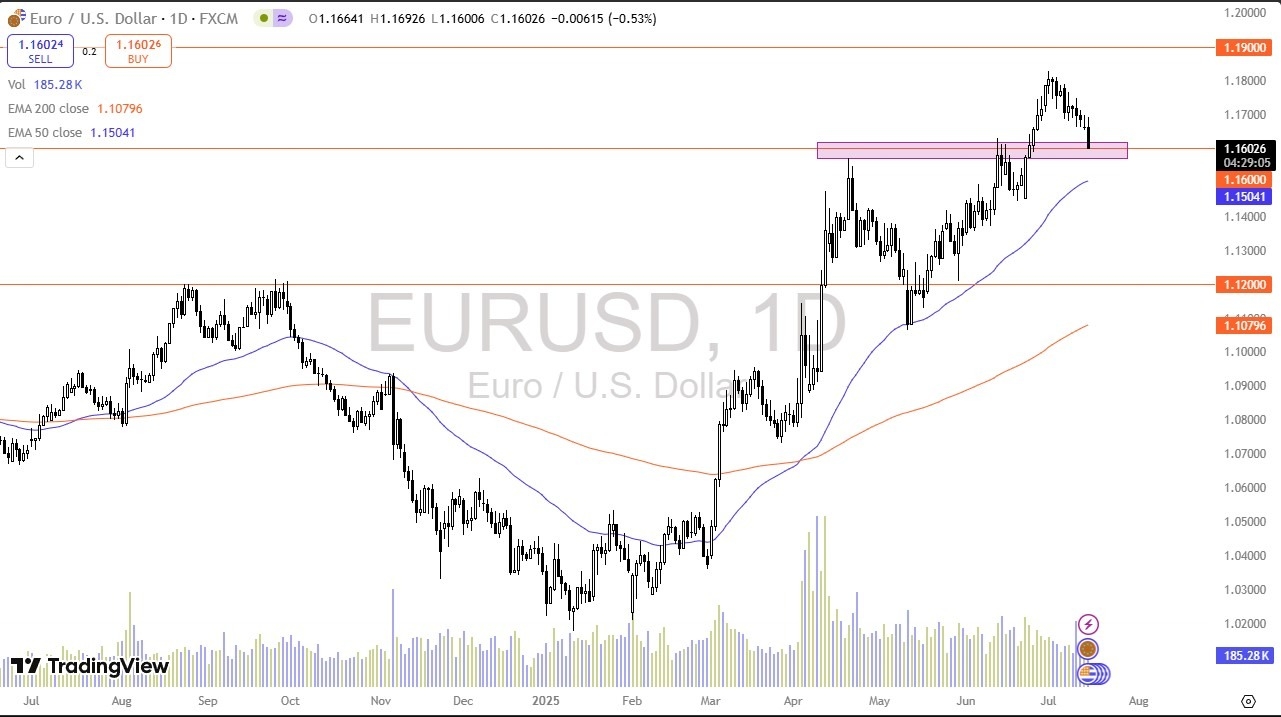
EUR/USD Forecast Today 16/07: Falls Sharply (Chart)

By |2025-07-16T10:00:00+03:00July 16, 2025|Forex News, News|0 Comments

  • The euro fell significantly during the trading session on Tuesday after initially trying to rally, as the Consumer Price Index in the United States came out at 0.2% month over month, and instead of the expected 0.3%.
  • Because of this, it suggests that the Federal Reserve is further away from cutting rates than most traders had dreamed of, which quite frankly has been a bit frustrating as it looks a whole lot like the trading public is just now starting to see the reality of the situation.

Trend Remains

Despite the fact that I think the US dollar is oversold, especially considering that the Federal Reserve is likely to cut rates in the short term, the reality is that the trend is still to sell the US dollar. That has not changed during the trading session on Tuesday, despite the fact that the Euro has plunged toward a crucial support level.

That support level, the 1.16 level, has a certain amount of market memory priced into it due to the fact that it was previous resistance, so I do think this is an area that could cause a bit of a bounce. Even if we were to fall from here, the 1.15 level is even more important, as it is a large, round, psychologically significant figure, but also features the 50 Day EMA, which of course a lot of people will be watching for potential dynamic support.

If we were to turn around and bounce from the 1.16 level, which is where we are as I write this, we could make a bit of a move toward the 1.17 level, possibly even the 1.18 level. However, I think it’s going to take a lot for the euro to continue higher without some type of conflicting information. The euro has been overdone for a while, so I think you’ve got a situation where this might just be the excuse that the market needed to sell and start taking some of the gains that they have enjoyed over the last couple of months.

Ready to trade our EUR/USD analysis and predictions? Here are the best European brokers to choose from.

Christopher Lewis has been trading Forex and has over 20 years experience in financial markets. Chris has been a regular contributor to Daily Forex since the early days of the site. He writes about Forex for several online publications, including FX Empire, Investing.com, and his own site, aptly named The Trader Guy. Chris favours technical analysis methods to identify his trades and likes to trade equity indices and commodities as well as Forex. He favours a longer-term trading style, and his trades often last for days or weeks.

Source link

16 07, 2025

Dietary Supplements Market Valued at US$214.8 Bn in 2025, Driven

By |2025-07-16T09:58:11+03:00July 16, 2025|Dietary Supplements News, News|0 Comments


Dietary Supplements Market

✅ The Global Dietary Supplements Market: Growth, Trends, and Forecast to 2032

The global dietary supplements market is experiencing robust expansion, driven by increasing health consciousness, aging populations, and evolving dietary habits. Valued at US$214.8 billion in 2025, the market is projected to reach US$377.9 billion by 2032, growing at a CAGR of 8.4% from 2025 to 2032. This upward trajectory is influenced by the widespread adoption of preventive healthcare and a surge in demand for immune-boosting and functional supplements post-pandemic.

Among the product categories, vitamin supplements remain the dominant segment due to their universal appeal and role in addressing common deficiencies. North America continues to lead the global dietary supplements market, primarily due to high health awareness, better access to supplements, and the rising trend of self-directed wellness. Additionally, the presence of major market players and a well-established regulatory framework further bolster the region’s dominance.

Get a Sample PDF Brochure of the Report (Use Corporate Email ID for a Quick Response): https://www.persistencemarketresearch.com/samples/2801

✅ Key Highlights from the Report

➤The global dietary supplements market is expected to grow at a CAGR of 8.4% from 2025 to 2032.

➤Market size will increase from US$214.8 Bn in 2025 to US$377.9 Bn in 2032.

➤Vitamin supplements remain the top-selling product segment globally.

➤North America is the leading geographical region due to higher health consciousness.

➤Online sales channels are witnessing significant traction post-COVID-19.

➤Functional foods and sports nutrition are emerging as high-growth areas.

✅ Frequently Asked Question

What are the health benefits of dietary supplements, and should everyone take them?

Dietary supplements provide essential nutrients-such as vitamins, minerals, amino acids, and botanicals-that support overall health and compensate for nutritional deficiencies in one’s diet. For many individuals, especially those with restricted diets, chronic illnesses, or specific health goals (like improving immunity or enhancing athletic performance), supplements can offer measurable benefits. Popular options include vitamin D for bone health, omega-3 for heart function, and probiotics for gut health.

However, not everyone needs to take supplements routinely. Over-supplementation can pose health risks, such as toxicity or nutrient imbalances. It’s advisable to consult with a healthcare professional before beginning any supplement regimen. Supplements should complement a healthy diet and lifestyle, not replace them. Personalized approaches based on age, gender, and health status can help determine which supplements are appropriate for each individual.

✅ Market Segmentation

The dietary supplements market is segmented based on product type, including vitamins, minerals, amino acids, enzymes, probiotics, and botanicals. Among these, vitamin-based supplements dominate the market due to their broad usage across demographics. Probiotic and enzyme segments are growing rapidly owing to increased consumer awareness about gut health and digestion.

By end-user, the market is divided into adults, geriatric population, pregnant women, children, and athletes. Adults constitute the largest user group, but the geriatric segment is the fastest-growing as aging individuals increasingly seek supplements to manage age-related deficiencies and chronic diseases. Additionally, sports nutrition supplements are gaining popularity among athletes and fitness enthusiasts for performance enhancement.

✅ Regional Insights

In North America, rising obesity rates and a strong inclination towards preventive healthcare are major factors fueling supplement demand. The U.S. market is characterized by consumer preference for organic and non-GMO supplements, coupled with heavy investments in R&D by key players.

Asia-Pacific is the fastest-growing region, led by countries like China, India, and Japan. Increasing disposable incomes, growing urbanization, and heightened health consciousness are driving supplement consumption. Traditional medicine integration and growing e-commerce access are further aiding growth.

✅ Market Dynamics

Market Drivers

The global dietary supplements market is largely driven by increasing consumer awareness regarding preventive healthcare and wellness. Post-COVID, there’s a noticeable shift toward immune-boosting products and personalized nutrition. Busy lifestyles, poor dietary habits, and increased health screenings have also accelerated supplement usage. Moreover, fitness culture and demand for sports and weight management supplements are further propelling growth.

Market Restraints

Despite strong growth, the market faces certain challenges. Regulatory inconsistencies across countries can hinder product approvals and international expansion. Additionally, the risk of adulteration and the presence of counterfeit supplements in some regions can reduce consumer trust. The lack of awareness in rural or underdeveloped areas also restrains market penetration.

Market Opportunities

With technological advancements and growing emphasis on personalized nutrition, companies have the opportunity to tailor supplements based on individual genetic, lifestyle, and health profiles. Plant-based and vegan supplements are also gaining traction as consumers adopt sustainable living. Further, the rising popularity of online and direct-to-consumer (DTC) channels opens new avenues for global expansion.

✅ Reasons to Buy the Report

☑Comprehensive analysis of current and future market trends

☑Insight into regional performance and untapped growth opportunities

☑Evaluation of competitive landscape and strategic developments

☑Detailed segmentation to understand product and end-user dynamics

☑Forecasts backed by reliable data and expert modeling techniques

✅ Company Insights

✦Glanbia PLC

✦Nestlé Health Science

✦Abbott Laboratories

✦Amway Corporation

✦Bayer AG

✦Herbalife Nutrition Ltd.

✦Nature’s Bounty Co.

✦Pfizer Inc.

✦Arkopharma Laboratories

✦GSK Consumer Healthcare

■In 2024, Nestlé Health Science launched a new line of personalized daily packs under its Persona Nutrition brand to target the rising trend of customized supplementation.

■Herbalife expanded its botanical ingredient sourcing capabilities in Asia by partnering with local farms for organic raw materials.

✅ Conclusion

The global dietary supplements market is on a dynamic growth path, supported by shifting consumer preferences toward preventive healthcare, personalized wellness, and natural nutrition. As awareness grows and innovations in formulation and distribution advance, the market is set to become more inclusive, accessible, and diverse. With a CAGR of 8.4% leading to a market size of US$377.9 billion by 2032, the industry offers vast opportunities for investors, manufacturers, and health-conscious consumers alike.

✅About Persistence Market Research:

At Persistence Market Research, we specialize in creating research studies that serve as strategic tools for driving business growth. Established as a proprietary firm in 2012, we have evolved into a registered company in England and Wales in 2023 under the name Persistence Research & Consultancy Services Ltd. With a solid foundation, we have completed over 3600 custom and syndicate market research projects, and delivered more than 2700 projects for other leading market research companies’ clients.

Our approach combines traditional market research methods with modern tools to offer comprehensive research solutions. With a decade of experience, we pride ourselves on deriving actionable insights from data to help businesses stay ahead of the competition. Our client base spans multinational corporations, leading consulting firms, investment funds, and government departments. A significant portion of our sales comes from repeat clients, a testament to the value and trust we’ve built over the years.

Contact Us:

Persistence Market Research

G04 Golden Mile House, Clayponds Lane

Brentford, London, TW8 0GU UK

USA Phone: +1 646-878-6329

UK Phone: +44 203-837-5656

Email: sales@persistencemarketresearch.com

Web: https://www.persistencemarketresearch.com

This release was published on openPR.


Source link

16 07, 2025

Can Algorithms Predict the Future of Ripple?

By |2025-07-16T09:57:21+03:00July 16, 2025|Crypto News, News|0 Comments

The crypto market’s reliance on AI-driven price predictions has grown exponentially, but how trustworthy are these forecasts when pitted against real-world fundamentals? For XRP (Ripple), a token embroiled in regulatory battles and banking partnerships, this question is more pressing than ever. Let’s dissect the AI-generated price projections for 2025, weigh them against XRP’s evolving fundamentals, and determine whether algorithms or human insight holds the edge.

AI-Driven Price Projections: A Mixed Bag for 2025

The AI models predict a turbulent 2025 for XRP, with short-term fluctuations masking a broader trend. For July alone, prices are expected to dip to $2.21 before rebounding to $2.51 by late month—a swing of nearly 13% in just weeks. By year-end, the average price is forecasted to drop to $2.07, resulting in a -4.8% annual ROI.

However, these predictions hinge on historical data and technical indicators like moving averages. The 50-day moving average on the daily chart has turned bearish, while the weekly chart remains bullish—a contradiction suggesting no clear consensus. Meanwhile, the Fear & Greed Index for crypto markets sits at 65 (Greed), implying overconfidence that could fuel volatility.

Fundamental Developments: The Elephant in the Room

AI models may excel at crunching numbers, but they struggle to account for unpredictable real-world events. For XRP, the SEC’s ongoing legal battle looms large. The $125 million penalty imposed in 2024 was a win for Ripple, but the SEC’s appeal could reignite uncertainty. A loss here might deter institutional adoption, undermining XRP’s core value proposition as a banking settlement tool.

Technically, XRP’s utility remains unmatched in cross-border payments. Partnerships with banks like Axis and Santander validate its real-world use case, but decentralization remains a hurdle. With only 55 validator nodes, critics argue XRP’s network is too centralized to thrive long-term. Yet, Ripple’s push to expand validator networks hints at progress.

Why AI Predictions Fall Short

AI’s strength lies in pattern recognition, not crystal-ball gazing. For instance:
Regulatory Risks: The SEC appeal’s outcome isn’t quantifiable in historical data, yet it could tank prices overnight.
Adoption Velocity: AI can’t measure the time it’ll take for banks to fully integrate XRP into their systems.
Market Sentiment: While 62% of traders are bullish, human emotions often defy algorithmic logic—panic or euphoria can override trends.

The disconnect between AI’s short-term optimism (e.g., $2.51 peaks) and its gloomy annual forecast (-4.8% ROI) highlights this tension. Algorithms see the “what,” but not the “why.”

Investment Considerations: Short vs. Long

For traders chasing quick gains, the July–August volatility offers opportunities—but only for those with nerves of steel. The 30-day volatility of 3.06% and a 50% win rate suggest a fair gamble.

Long-term investors, however, should focus on fundamentals. If Ripple’s legal issues resolve favorably and partnerships scale, XRP’s $16.91 average price by 2030 (per long-term projections) isn’t far-fetched. But this requires patience: the path to $1,894 by 2050 is littered with regulatory and technical pitfalls.

Recommendation:
Hold for the long term if you believe in XRP’s banking utility and legal resilience.
Avoid short-term trading unless you can stomach 10%+ swings.
Diversify: Even if bullish on XRP, allocate no more than 5% of your crypto portfolio to it.

Conclusion: Algorithms Are Tools, Not Oracles

AI predictions offer a snapshot of XRP’s potential trajectory, but they’re no substitute for understanding its fundamentals. While the $2.51 July peak might materialize, the bigger picture hinges on Ripple’s ability to navigate regulation, expand its validator network, and prove its decentralization claims.

Investors must ask themselves: Is the algorithm’s “crystal ball” worth following, or is XRP’s future better judged by its real-world progress? The answer, as always, lies in balancing data with discernment.

Final Note: Always consult a financial advisor before making investment decisions.

Source link

16 07, 2025

Ultra is redefining the gaming economy: Exclusive interview with Gus van Rijckevorsel

By |2025-07-16T00:06:47+03:00July 16, 2025|News, NFT News|0 Comments


The video game industry is undergoing a transformation. Traditional monetization models are crumbling, giving way to new ecosystems driven by technology, creativity, and community participation. At the heart of this shift is Ultra, a pioneering platform that connects Web2 and Web3 without causing division. Gus van Rijckevorsel, CEO of Ultra, shares his vision in an exclusive interview with Cointribune. He discusses the launch of EMPIRES, the evolving role of players, and an economy where everyone can become a value creator. Here is how Ultra lays the foundation for a Web3 that is finally accessible, practical, and sustainable.

Ultra is redefining the gaming economy: Exclusive interview with Gus van Rijckevorsel

In Brief

  • Ultra creates a smooth bridge between Web2 and Web3 without sacrificing user experience.
  • Players become producers of value through AI, digital ownership, and a collaborative economy.
  • With EMPIRES and Citadels, Ultra offers an ecosystem where playing, creating, and earning are interconnected.

An Industry in Transition: From Blockbusters to Micro-Studios

Gus van Rijckevorsel immediately draws a parallel between the film and video game industries. Large productions costing several hundred million coexist today with a boom in micro-studios. Like Danish series on Netflix, small innovative games are emerging alongside giants like GTA VI. The mid-range is disappearing: a game either aims for global blockbuster status or bets on agility, targeted quality, and rapid deployment.

Ultra does not position itself as the Netflix of Gaming in format, but in its ability to reinvent distribution and value creation. The goal: to give developers more freedom and offer players new ways to engage.

Player 3.0: Play, Watch, Create

The player is no longer just a gamer. Today, users play, watch, and create content. Each of these activities generates value. Viewers represent an economic pillar through advertising. Content creators leverage videos, comments, and mods. The player becomes a component of a new trinity shaping the gaming economy.

This change forces platforms and studios to rethink their models. You can no longer design a game without including the creators who enrich it, the viewers who amplify it, and the communities who adopt it.

The Mirage of Pure Web3 Gaming

Pure Web3 gaming still does not attract real gamers. As Gus says in the interview: “If you find a Web3 gamer, tell them to call me“. Web3 remains obsessed with monetization, while the majority of players seek fun, competition, or social interaction. Result: a small speculative bubble, self-referential, without a true gaming culture.

Ultra proposes a hybrid path. Web3 should not replace Web2 but augment it. It becomes an invisible layer that strengthens the experience without disrupting it.

Ultra, EMPIRES & Citadels: The Web2/Web3 Integration Model

The interconnection between Ultra, EMPIRES, and Citadels embodies this vision. Citadels is an ultra-realistic FPS meeting Web2 standards. Its economy relies on a deeply integrated Web3 layer: EMPIRES, where players produce resources (ore, weapons, land) then used by Citadels players, thus influencing the Web2 game economy. Meanwhile, Ultra orchestrates transactions, takes a commission, and ensures smooth operation of the whole.

For example: when a Citadels player dies and needs new equipment, they buy it through a traditional in-game shop, but this item was produced by an EMPIRES player.

One plays, the other profits.

A New Revenue Sharing Model

Traditionally, publishers captured most of the profits. Ultra reverses this logic. Web3 players, as owners or producers of digital assets, can now generate income. This opens the way to a participatory economy where studios no longer control the entire value chain.

Users can create weapons, develop environments, or extend gameplay. DevOps becomes collaborative, shared between developers and players. Welcome to the era of Open Source, community-driven, and economically virtuous gaming.

Artificial Intelligence: A Creative Catalyst

In this ecosystem, AI plays a key role. It lowers entry barriers, empowers non-technical creators, and accelerates content production. A player can now create a skin, write a story, or build an environment without mastering modeling or coding.

According to Gus, AI doesn’t provide solutions, it creates bridges between problems and ideas. With simple tools, anyone can bring complex concepts to life. Combined with Web3, AI becomes a powerful force to democratize creativity.

A Cultural and Generational Evolution

Video gaming is no longer a niche. Today, a father and son can play the same game, each in their own way. From Candy Crush to Counter-Strike, all genres are part of a shared cultural space. This democratization also transforms marketing. Brands can no longer ignore it.

Strategic partnerships, like those planned with Red Bull, illustrate this evolution. By combining emotion, storytelling, and gameplay mechanics, brands reach a wide, engaged, and multi-generational audience. Games become media, players targets, and the gaming economy extends to all sectors.

With EMPIRES, Ultra launches more than a game: a new way to conceive, produce, and experience gaming. By merging the power of Web2 and the potential of Web3, the platform offers a practical, inclusive, and sustainable model. Players are no longer mere participants: they become economic drivers. Thanks to AI and a participatory vision, Ultra redraws the sector’s boundaries. To be part of this revolution, visit Ultra.io, try EMPIRES, and discover what “playing together” means in the age of decentralized gaming. You can also follow @Ultra_io on X and listen to the full interview in French on Spotify, Deezer, Apple Podcast, Amazon Podcast… or in English with auto-generated subtitles on YouTube.

Maximize your Cointribune experience with our “Read to Earn” program! For every article you read, earn points and access exclusive rewards. Sign up now and start earning benefits.

La Rédaction C. avatarLa Rédaction C. avatar

La Rédaction C.

The Cointribune editorial team unites its voices to address topics related to cryptocurrencies, investment, the metaverse, and NFTs, while striving to answer your questions as best as possible.

Disclaimer:

The contents and products mentioned on this page are in no way approved by Cointribune and should not be interpreted as falling under its responsibility.

Cointribune strives to communicate all useful information to readers, but cannot guarantee its accuracy and completeness. We invite readers to do their research before taking any action related to the company and to take full responsibility for their decisions. This article should not be considered as investment advice, an offer, or an invitation to purchase any products or services.

Investment in digital financial assets carries risks.

Read more


Source link

16 07, 2025

Pound to Dollar Rate Today: GBP/USD Sub 1.34 After Mixed US Inflation

By |2025-07-16T00:04:04+03:00July 16, 2025|Forex News, News|0 Comments

July 15, 2025 – Written by Ben Hughes

Looking ahead, the focus for the Pound US Dollar exchange rate (GBP/USD) now turns to the release of the UK’s own CPI figures on Wednesday.

Economists predict inflation will have held at 3.4% last month. While this remains above the BoE’s target range, unless the figures deviate significantly from forecasts, their impact on the GBP/USD may be limited amid the BoE’s focus on the UK jobs market.

On the US side, the producer price figures for June could offer support to the US Dollar if they show rising input costs, which typically feed through to consumer prices in the months ahead.

DAILY RECAP:

The Pound‑to‑Dollar (GBP/USD) pair remained largely unchanged on Tuesday, hovering just below Monday’s three‑week low.

At the time of writing, it was trading near $1.3438. Almost unchanged from the start of Tuesday’s session.

The US Dollar (USD) showed limited movement on Tuesday as traders absorbed the latest US consumer price index report from the US Bureau of Labor Statistics.


US headline inflation rose from 2.4% to 2.7% in June, matching expectations and marking the highest reading since February.

In contrast, core inflation came in at 2.9%, slightly below consensus forecasts that it would reach 3%,

The slightly weaker-than-expected core inflation figures applied some pressure to the US dollar, as they are likely to be welcomed by the more dovish members of the Federal Reserve, and cement bets for a September interest rate cut.

Despite this, the USD selling pressure remained very modest in scope, with the unpredictability surrounding US President Donald Trump’s tariff policy continuing to cloud the US inflation outlook.

The Pound (GBP) remained mostly range‑bound on Tuesday as investors took a cautious stance ahead of key UK economic releases later in the week.

Attention has now shifted to Thursday’s UK jobs report, following recent commentary from Bank of England (BoE) Governor Andrew Bailey, who warned persistent labour-market weakness could warrant faster rate cuts.

Moreover, uncertainty surrounding UK fiscal policy, including speculation over autumn tax changes following the government’s reversal of welfare reforms, continues to weigh on Pound sentiment.


Like this piece? Please share with your friends and colleagues:


International Money Transfer? Ask our resident FX expert a money transfer question or try John’s new, free, no-obligation personal service! ,where he helps every step of the way,
ensuring you get the best exchange rates on your currency requirements.

TAGS: Pound Dollar Forecasts

Source link

16 07, 2025

A brand new matcha bar has opened in two locations in Cork

By |2025-07-16T00:01:36+03:00July 16, 2025|Dietary Supplements News, News|0 Comments


All Onic Entertainment

Have you tried matcha yet?

The drink, which can be had hot or cold, is made from finely ground powder of specially grown and processed green tea leaves.

It has grown in popularity over the past few years, especially here in Cork, and there is a new popup coffee bar that specialises in matcha open in two locations in the city.

oonchild is open at both Douglas and Mahon Point Farmer’s Markets on Thursdays and Saturdays.


Source link

15 07, 2025

SOL To $500 Timeline & The Best Altcoins To Buy Right Now

By |2025-07-15T23:59:55+03:00July 15, 2025|Crypto News, News|0 Comments

SOL To 0 Timeline & The Best Altcoins To Buy Right Now

Solana Price Prediction has become a hot topic this week after Bitcoin rallied to a fresh all-time high of $122,310, driven by U.S. “Crypto Week” legislative momentum boosting investor confidence in digital assets. As risk appetite returned, Ether climbed 2.7% and Solana added 2.5% in the same session, underscoring rising demand for low gas fee crypto networks like Solana.

Most analysts now view Solana as a low gas fee crypto with the speed and scalability to challenge established platforms. Meanwhile, an innovative cross-border solution with a Q3 wallet reveal is drawing attention as the best crypto presale 2025 candidate without naming it outright.

Solana Price Prediction: SOL Eyes $500 Milestone

Solana Price Prediction models suggest SOL could target $500 within five years if current bullish trends persist and network upgrades deliver on performance. Today, SOL trades around $166.94, up 3.5% over the past 24 hours, as it nears a breakout above the 0.382 Fibonacci retracement near $175. 

According to crypto experts on X (formerly Twitter), the chart shows a Descending Broadening Wedg for Solana, being a bullish pattern. There’s also a strong support zone around $160. 

Given its low gas fee crypto status and surging on-chain open interest exceeding $8 billion, SOL remains a compelling choice for growth investors seeking the next big altcoin 2025.

Best Crypto Presale to Buy: A Spotlight on Remittix

Introducing this innovative cross-border DeFi solution that’s set to transform global payments with a Q3 wallet reveal. The Remittix DeFi project is built for real-world use and audited for security.

  • Global Reach: Send crypto directly to bank accounts in 30+ countries
  • Security First: Audited by CertiK, one of the leading blockchain auditing firms
  • Wallet set for launch in Q3 with real-time FX conversion
  • Business API: Onboards new liquidity and use-cases seamlessly

Compared to legacy and layer-1 tokens, this Remittix DeFi project offers superior transaction speeds, lower fees and targeted utility for freelancers and remitters. Its live bonus model and growing community engagement foster confidence far beyond typical hype.

By solving a $19 trillion payments problem and offering cross-chain rails, it stands out as the best crypto presale 2025 opportunity for early supporters seeking real-world impact.

Seize the Moment With Remittix

As Solana Price Prediction charts a path toward $500, Ethereum’s ETF-driven rally and Cardano’s breakout setup paint a bullish summer for altcoins. Meanwhile, the upcoming wallet launch this Q3 makes this cross-border DeFi asset the best crypto presale 2025 pick for those aiming to back utility-first tokens. 

With momentum building across these networks, now is the time to diversify into leading altcoins and position for gains ahead. Now is the chance to act to stand a chance to participate in the ongoing $250,000 giveaway.

Discover the future of PayFi with Remittix by checking out their presale here:

Website: https://remittix.io/ 

Socials: https://linktr.ee/remittix 

$250K Giveaway: https://gleam.io/competitions/nz84L-250000-remittix-giveaway


Source link

15 07, 2025

Lessons from Kintsugi – HealthyWomen

By |2025-07-15T23:58:39+03:00July 15, 2025|Fitness News, News|0 Comments


In my work with couples, I like to think of the Japanese art of kintsugi. The word means “gold repair,” and it refers to the practice of mending broken pottery with lacquer and powdered gold. Rather than hiding the cracks, kintsugi illuminates them. The once-broken object becomes even more beautiful — not in spite of its history, but because of it.

The same can be true for relationships.

Every couple will experience breaks. Sometimes they come in the form of betrayal, misunderstanding, a slow drift, or simply the accumulation of unmet needs. When a relationship cracks under pressure, the instinct might be to throw it away or try to force it back to the way it once was.

But that’s not possible because the original form has changed. It’s kind of like the example where someone crumples up a piece of paper and then smooths it out again. It’s still an intact piece of paper, but it’s definitely not the same smooth surface it was before.

iStock.com/MarioGuti

But unlike that crumpled piece of paper, which just lays bare the damage it went through, with no improvement, kintsugi reminds us that there is the potential to build upon what came before and shape it into something new, something beautiful.

Shattered relationships are like shattered pottery

When couples come into therapy, they’re often sitting with the broken pieces of something they once valued deeply. The process of healing, of rebuilding connection, takes effort. It cannot be rushed — and it rarely looks like a perfect restoration. In fact, we wouldn’t want it to because that would mean there hadn’t been any growth.

Each step a couple takes toward one another, even in discomfort, builds confidence that repair is possible. Over the years, I’ve seen relationships grow stronger not by avoiding conflict but by nurturing the skills they need to move through it. The cracks don’t disappear, but they become part of a story you’ve written together.

So, how does this translate into everyday relationship work?

Here are 4 tips couples can use to strengthen their connection after a fracture:

1. Embrace imperfection: Rather than aiming for a flawless relationship, focus on building one that can handle real life. Talk openly about the moments that have felt difficult or disappointing. Use language like “this was hard for me” instead of pointing fingers. Schedule time to identify what you’ve learned from past conflicts. The goal is not to erase the break but to understand it and learn how to respond differently moving forward.

2. Practice self-compassion: It’s easy to be hard on yourself or your partner when something goes wrong. Instead, notice the inner voice that shows up after conflict. Ask yourself, “Would I speak to a friend this way?” If not, rewrite the narrative. During moments of tension, take a pause and simply say, “We’re both doing the best we can right now.” This small practice helps lower defensiveness and creates space for repair.

3. Build resilience through reflection: After a disagreement or challenging season, set aside time to reflect as a couple. Ask each other, “What helped usget through that?” and “What could we do differently next time?” Write your answers down. Keep a shared journal or document where you track these reflections. Over time, this record becomes a reminder of your capacity to navigate difficulty together.

4. Create meaning together: Language shapes perspective. If you describe every argument as a failure, you’re less likely to see opportunities for growth. Instead, shift the frame. Try saying, “That was a turning point” or “We learned something important about ourselves there.” Mark these moments when you’ve come together to fix something and celebrate them, even if it’s in small ways.

The art of moving forward

Lessons from Kintsugi – HealthyWomen

iStock.com/Marco Montalti

Repairing a relationship is rarely about returning to what was. It is about deciding, together, what comes next. Just like kintsugi honors the history of a broken object by making it more meaningful, couples have the opportunity to create something new out of what may have felt lost.

If you’re in the process of repair, give it time, give it care, and remember that the effort you put into understanding each other is what makes the bond even stronger than it was before.

Related Articles Around the Web


Source link

15 07, 2025

How Roman Storm’s Trial Shapes DeFi’s Regulatory Landscape and Compliance Investment Opportunities

By |2025-07-15T22:05:53+03:00July 15, 2025|News, NFT News|0 Comments


The upcoming trial of Roman Storm, co-founder of Tornado Cash, marks a pivotal moment for decentralized finance (DeFi) and blockchain regulation. As the case unfolds in New York’s Southern District, the outcome could redefine liability for software developers of open-source protocols, impacting everything from crypto compliance frameworks to investment strategies in blockchain infrastructure. This article explores the implications of the trial and identifies strategic opportunities in compliance-focused blockchain projects poised to thrive amid evolving regulations.

The Roman Storm Trial: A Crossroads for DeFi

Roman Storm faces charges of conspiracy to commit money laundering and sanctions violations under the International Emergency Economic Powers Act (IEEPA). Despite the U.S. Treasury’s Office of Foreign Assets Control (OFAC) lifting sanctions on Tornado Cash in March 2025, prosecutors argue that Storm’s role in maintaining the protocol’s interface and profiting via the TORN governance token constitutes actionable liability. The defense counters that Tornado Cash’s open-source code qualifies as protected speech and that Storm did not control user funds or knowingly enable illicit activity.

A conviction could establish a dangerous precedent, criminalizing the creation of privacy-focused tools even if used for legitimate purposes. Conversely, an acquittal might embolden developers to prioritize innovation over compliance—a risk as regulators worldwide tighten controls. Either outcome underscores the urgency for blockchain projects to embed robust compliance frameworks.

Compliance-Focused Blockchain Projects: The New Frontier of DeFi

The trial’s outcome will intensify demand for compliance tools that balance innovation with regulatory adherence. Below are key sectors and projects positioned to capitalize on this trend:

1. Regulatory Transparency Platforms

Blockchain’s immutable ledger is a natural fit for compliance, enabling real-time transaction monitoring and audit trails. Projects like Proxymity Shareholder Disclosure automate SRD II compliance in the EU, reducing administrative burdens. Similarly, zkSync Era leverages zero-knowledge proofs (ZKPs) to balance privacy with regulatory reporting requirements.

2. Decentralized Identity (DID) Systems

Regulators increasingly demand secure identity verification. The EU’s EBSI program and Worldcoin’s proof-of-personhood protocol exemplify DID systems that streamline Know Your Customer (KYC) processes while protecting user data. These tools are critical for onboarding institutional capital into DeFi.

3. Tokenized Assets and Sustainable Infrastructure

Projects like HIVE Digital Technologies (HIVE) and RIOT Platforms (RIOT) are reshaping crypto mining with green energy and AI-driven infrastructure. HIVE’s acquisition of a 200 MW hydro-powered facility in Paraguay aims to boost Bitcoin hash rates to 25 EH/s by September 2025, aligning with ESG mandates. RIOT’s pivot to GPU computing for AI and HPC services reflects a broader shift toward diversified revenue streams compliant with global standards.

4. Compliance Service Providers

Firms like S+P Compliance Services are indispensable for navigating MiCA, KMAG, and other regulations. These providers offer training, licensing support, and anti-money laundering (AML) tools, enabling crypto firms to operate within legal boundaries.

Investment Opportunities: Where to Deploy Capital Now

The trial’s outcome may intensify regulatory scrutiny, but compliance-focused projects are already scaling:

  1. HIVE Digital (HIVE):
  2. Why Invest? Its green energy infrastructure and diversified operations (mining + GPU computing) align with ESG and regulatory trends.
  3. Risk: Bitcoin price volatility impacts revenue, but its cost leadership in hydro-powered mining mitigates this.

  4. RIOT Platforms (RIOT):

  5. Why Invest? Its pivot to AI/HPC and planned hash rate expansion to 38.4 EH/s by 2025 position it as a low-cost, compliant mining leader.
  6. Risk: Stock price volatility; reliance on institutional Bitcoin adoption.

  7. Blockchain-as-a-Service (BaaS) Firms:

  8. Why Invest? Companies like IBM and Microsoft are integrating compliance tools into BaaS platforms, reducing barriers for enterprises entering DeFi.

  9. Regulatory ETFs:

  10. Why Invest? Bitcoin ETFs (e.g., BlackRock’s BITO) now hold ~$80 billion AUM, with Ethereum ETFs poised to follow. These vehicles offer diversified exposure while adhering to SEC guidelines.
  11. Zero-Knowledge Proofs (ZKP) Developers:

  12. Why Invest? ZKPs enable privacy-preserving transactions compliant with AML laws. zkSync Era and Visa’s ZK-based auto-payments are early movers in this space.

Risks and Considerations

  • Regulatory Overreach: A conviction in the Storm trial could trigger stifling regulations, disproportionately impacting small developers.
  • Fragmented Compliance: Global regulatory disparities (e.g., EU vs. U.S.) may raise operational costs for firms.
  • Market Volatility: Crypto asset prices remain sensitive to macroeconomic factors, though compliance-focused projects offer defensive attributes.

Final Take: Position for a Regulated Future

The Roman Storm trial is a catalyst for defining DeFi’s regulatory trajectory. Investors should prioritize compliance-driven blockchain projects with scalable solutions for AML, identity verification, and ESG alignment. Firms like HIVE, RIOT, and BaaS providers are building the infrastructure needed to navigate this new landscape. Meanwhile, Bitcoin and Ethereum ETFs offer institutional-grade exposure to the sector’s growth while adhering to evolving standards.

The verdict may still be pending, but the writing is on the blockchain: compliance is no longer optional—it’s the key to unlocking DeFi’s next chapter.


Source link

15 07, 2025

XAU/USD holds gains above $3,340 with US inflation on tap

By |2025-07-15T22:05:15+03:00July 15, 2025|Forex News, News|0 Comments


  • Gold found support at $3,340 and is regaining lost ground, approaching $3,380 highs.
  • The US Dollar softens with US treasury yields pulling back from recent highs ahead of the US CPI release.
  • From a wider perspective, XAU/USD is moving sideways, halfway through the last few months’ trading range.

Gold (XAU/USD) correction has been limited at $3,340, and the precious metal is retracing previous losses on Tuesday, approaching three-week highs at $3,380 as US Treasury yields and the US Dollar pull back from recent highs ahead of the US CPI release.

The US Dollar Index, which measures the value of the USD against six major currencies, is trading 0.15% lower on the day after a three-day rally. Investors are bracing for a significant increase in inflation amid pressure from US President Trump to cut interest rates, which might increase if the upside risks for inflation forecasted by the bank do not materialise.

Technical analysis: XAU/USD consolidating halfway through the recent range

The XAU/USD technical picture is cloudy, as the pair has been experiencing choppy and sideways trading for the last few months. Price action is currently hovering in the middle of the range, and technical indicators on the daily chart are indicating a lack of a clear trend.

The 4-hour chart shows a moderate positive stance, with the RSI steady above the 50 level and downside attempts finding buyers so far. Bulls are focusing on the July 14 high, at $3,375, which is closing the path towards the June 18 and 23 highs, at the $3,400 area, and the June 16 peak, at $3,450. 

On the downside, a retreat below the July 14 low at $3,340 might find support at the July 10 low at $3,3120 and the July 9 low, at $3,285, ahead of the May 28 and June 30 lows, at $3,245.

Gold FAQs

Gold has played a key role in human’s history as it has been widely used as a store of value and medium of exchange. Currently, apart from its shine and usage for jewelry, the precious metal is widely seen as a safe-haven asset, meaning that it is considered a good investment during turbulent times. Gold is also widely seen as a hedge against inflation and against depreciating currencies as it doesn’t rely on any specific issuer or government.

Central banks are the biggest Gold holders. In their aim to support their currencies in turbulent times, central banks tend to diversify their reserves and buy Gold to improve the perceived strength of the economy and the currency. High Gold reserves can be a source of trust for a country’s solvency. Central banks added 1,136 tonnes of Gold worth around $70 billion to their reserves in 2022, according to data from the World Gold Council. This is the highest yearly purchase since records began. Central banks from emerging economies such as China, India and Turkey are quickly increasing their Gold reserves.

Gold has an inverse correlation with the US Dollar and US Treasuries, which are both major reserve and safe-haven assets. When the Dollar depreciates, Gold tends to rise, enabling investors and central banks to diversify their assets in turbulent times. Gold is also inversely correlated with risk assets. A rally in the stock market tends to weaken Gold price, while sell-offs in riskier markets tend to favor the precious metal.

The price can move due to a wide range of factors. Geopolitical instability or fears of a deep recession can quickly make Gold price escalate due to its safe-haven status. As a yield-less asset, Gold tends to rise with lower interest rates, while higher cost of money usually weighs down on the yellow metal. Still, most moves depend on how the US Dollar (USD) behaves as the asset is priced in dollars (XAU/USD). A strong Dollar tends to keep the price of Gold controlled, whereas a weaker Dollar is likely to push Gold prices up.


Source link

Go to Top