The EURJPY pair began this morning with new positivity by surpassing the resistance of the bullish channel’s resistance at 171.70 level, recording some extra gains by holding near 172.25.
Note that stochastic stability within the overbought level might decelerate the chances of forming a strong bullish rally, but its repeated stability above 171.10 that attempts to form an extra support might assist to motivate the continuation of the positivity, to expect reaching to 172.85 followed by 161.8%Fibonacci extended level at 173.40
The expected trading range for today is between 171.50 and 171.85
The USD/JPY forecast indicates brief relief for the yen after a steep decline.
The yen has weakened significantly following Trump’s announcement of a 25% tariff on Japanese goods.
Market participants are awaiting the release of the FOMC meeting minutes.
The USD/JPY forecast indicates brief relief for the yen after a steep decline due to tariff concerns. However, the outlook for Japan’s economy has darkened following Trump’s threat of a 25% reciprocal tariff.
–Are you interested in learning more about Forex indicators? Check our detailed guide-
The yen has weakened significantly this week following Trump’s announcement of a 25% tariff on Japanese goods, effective from August. The move came after trade talks between the US and Japan failed. Market participants are concerned that this could be the start of a trade war between the two partners. Such an outcome would hurt both economies and weaken their currencies.
However, at the moment, the dollar is rallying at the prospect of higher import costs. These might translate to higher inflation, forcing the Fed to keep interest rates high.
Furthermore, Trump has threatened a 50% tariff on copper imports that would again ignite tensions with many countries. In the short term, tariffs might be bullish for the dollar. However, in the long run, they might dim the outlook for the US economy and hurt its currency.
Elsewhere, market participants are awaiting the release of the FOMC meeting minutes. The report might contain clues about future policy moves. However, with tariff uncertainty, the outlook might become less clear.
USD/JPY key events today
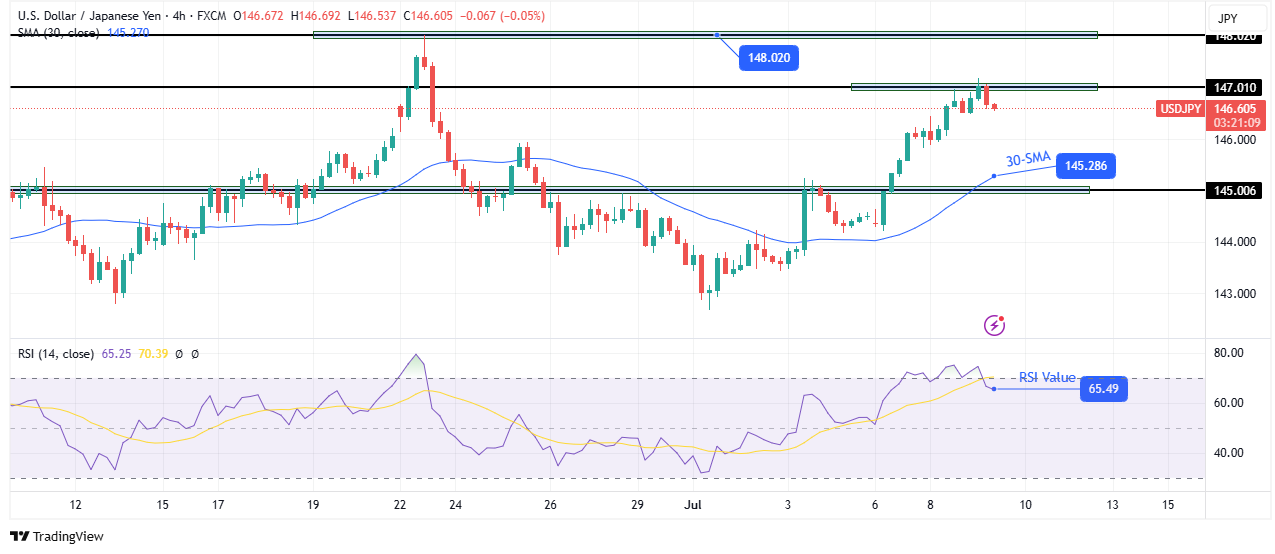
USD/JPY technical forecast: Rally pauses for breath at the 147.01 level
USD/JPY 4-hour chart
On the technical side, the USD/JPY price has finally paused its steep rally near the 147.01 key level. However, the bullish bias remains strong, with the price well above the 30-SMA and the RSI near the overbought region.
–Are you interested in learning more about Best Bitcoin Exchanges? Check our detailed guide-
After such a strong move, bulls have paused for a breath at this level. Therefore, the price might consolidate as the SMA catches up. At the same time, it might pull back to retest the SMA as support. The bullish bias will remain as long as it stays above the SMA.
After a pause, bulls might regain momentum to break past the 147.01 level for a new high. Such a move would allow USD/JPY to retest the 148.02 key resistance. A break above would solidify the bullish bias.
Looking to trade forex now? Invest at eToro!
68% of retail investor accounts lose money when trading CFDs with this provider. You should consider whether you can afford to take the high risk of losing your money.
Washington, DC—On July 7, the White House announced that President Donald J. Trump signed an Executive Order determining that certain tariff rates, which were initially set to expire on July 9, will now expire on August 1, 2025. The President also informed several countries of their new reciprocal tariff rates, which will take effect on August 1.
To help keep the industry informed, the Natural Products Association (NPA) shared the news that it has updated its Tariff Fact Page to reflect these latest actions announced by the Trump administration. In addition to the latest updates, NPA’s fact page includes information on implications for NPA and its members, as well as helpful links for more information.
The American Herbal Products Association (AHPA) also has a tariff toolkit for AHPA members (AHPA membership and login are required to access the toolkit). The toolkit is a collection of resources designed to help herbal and dietary supplement companies stay informed and compliant as they navigate the evolving landscape of international trade and tariffs (read more on the toolkit below).
AHPA Calls out Excessive Tariffs on Manufacturing Equipment
AHPA shared the news that it has published a second Congressional leave-behind, which is focused on securing targeted tariff relief for critical manufacturing equipment unavailable from U.S. sources. This new resource builds on AHPA’s broader tariff advocacy, which includes its first herbal advocacy leave-behind that focused on protecting access to essential herbs that cannot be grown domestically at the commercial scale necessary to meet consumer and industry demand.
Regarding manufacturing equipment, AHPA noted that, in many cases, the specialized equipment that is needed to harvest, extract, encapsulate, and package herbs grown and used in dietary supplements and natural products in the U.S. must be imported; it is not commercially manufactured domestically. Excessive tariffs on such essential equipment threatens to slow investment in U.S.-based production facilities, delay innovation, and even encourage offshoring, AHPA cautioned. And this, the trade association says, directly undermines national efforts to expand American manufacturing.
“American herbal product companies are ready and eager to expand domestic manufacturing, but burdensome tariffs on the specialized tools they need are standing in the way,” said AHPA President & CEO Graham Rigby. “These are not loopholes. We’re asking for common-sense tariff relief that allows U.S. companies to build here, hire here, and compete globally.”
Both documents are part of AHPA’s Tariff Toolkit. AHPA invites members and industry stakeholders to utilize the leave-behind in their own advocacy efforts as well.
NPA Analyzes Impacts of Tariff Exemptions on Dietary Supplements
According to aneconomic analysis released by NPA, the Annex II tariff exemptions granted under the 2025 reciprocal tariff system have generated between $218 million and $247 million in direct cost savings for the dietary supplement industry over just 69 days. The trade association said this study highlights the critical role the tariff exemptions play in stabilizing supply chains, preserving market growth, and supporting access to essential health products for American consumers.
As NPA reported, the Annex II exemptions implemented in April 2025, excluded key dietary supplement ingredients (such as CoQ10, creatine, and L-theanine) from a baseline 10% ad valorem tariff, recognizing their non-pharmaceutical status, high import dependency (over 60%) and significant consumer impact.
The study utilized customs data, price elasticity models. and industry surveys to quantify savings and forecast future scenarios, NPA said, adding that the data provides actionable insights for manufacturers and policymakers. Key report findings, as outlined by NPA:
$5.97 million monthly savings on CoQ10 alone stabilizing retail prices and ensuring affordability for consumers relying on cardiac and wellness formulations.
The exemptions created an 18- to 24-month window for industry leaders to invest in domestic production, diversify supply sources, and pursue long-term legislative reforms.
“We are proud that our sustained advocacy and strategic engagement with the Administration have delivered tangible economic relief and safeguarded consumer access to natural health products,” said Daniel Fabricant, Ph.D., NPA President and CEO. “These exemptions not only provide immediate cost savings, but also offer a critical opportunity to strengthen domestic manufacturing and modernize trade policies for the dietary supplement industry.”
Most people tend to think of “beach reads” as all fiction and fluff — but that’s not exactly true. The definition of a beach read is any enjoyable book you want to read on vacation. So let your inner bibliophile run wild.
We’re big fans of health information (shocking, we know!). So it tracks that our summer beach reads include the latest books about women’s health and explore topics like menopause, sex and healthy aging.
Here are 5 health books worth reading on the beach.
The topic of menopause doesn’t exactly scream “beach read,” but that’s the beauty of this book. From the start, author Tamsen Fadal draws you into her life and her mysterious symptoms — rapid heart beat, sleepless nights, forgetting how to pronounce simple words as a broadcaster on live TV — not knowing hormones were to blame.
Through her own story and insight from more than 40 experts, Fadal unpacks the countless ways perimenopause (the time leading up to menopause) and menopause affect overall health and everyday life.
Chapters also include tips, advice and recommendations for everything from brain fog and bone health to sex and dating in midlife.
Fadal’s “big sister on speed dial” approach helps answer the call for support, guidance and connection during menopause.
You know all those steamy beach reads about couples who’ve been together for 20-plus years and can’t keep their hands off each other and are rolling in orgasms? Yeah, us neither.
But maybe there should be. In Come Together, author Emily Nagoski, Ph.D., says many of us have the idea that sexual desire and satisfaction go down in long-term relationships — but that’s not really the case.
Nagoski tackles misinformation, assumptions and barriers that can keep people from great sex, and dives deep into important questions like why we even want to have sex in the first place (Sspoiler: iIt’s not orgasms).
The approachable — at times hilarious — tone makes the fact-based science and complex nature of relationships easy to understand. And if you’re feeling like your love tank is empty, there’s advice for how to tap into your sexual prowess — and your partners — in the bedroom (or wherever you’re getting it on).
Real talk: I’ve never met Michelle Obama, but I feel like I can trust her. So, when the former first lady said Grown Woman Talk is a “must-read for anyone who cares about their quality of life” — I was sold.
For people not sporting a WWMD bracelet, Grown Woman Talk offers a blend of personal experience, current data and advice on aging, aging in the healthiest way possible, and how to get the best medical care when you need it.
The information comes from a great source: Author Sharon Malone, M.D., is an OB-GYN, certified menopause practitioner and an advocate for research and education around women’s health in midlife.
Malone’s expertise gives her a unique perspective on how women can become their “best primary caregiver” despite the fact that healthcare wasn’t created with women in mind — especially women of color. Chapters offer actionable tips like how to identify health goals and how to pick a doctor.
Grown Woman Talk is about giving women the information and inspiration to live your healthiest life possible. You may find yourself calling your healthcare provider from the beach to make that appointment you’ve been putting off. It’s what Michelle would do.
Anne Chaker was a 42-year-old mother reeling from divorce, postpartum depression and the sudden death of her father when she first learned about bodybuilding. It completely changed her life.
In Lift, Chaker recalls her journey into the world of competitive bodybuilding — rhinestone bikini and all — and her deeper search for answers surrounding society’s obsession with women having to be thin and small. Why not strong?
Chaker, a veteran journalist and former Wall Street Journal reporter, gets into the history behind the misconceptions of women’s bodies and the science behind how strength training changes the body and brain — it may even save your life.
You’ll want to get in a few arm dips on your beach lounger after reading this one.
“This book is a tribute to women’s lives: the ones they’ve lived, the ones they’ve lost, and the ones they deserve.” Yeah — powerful stuff.
From the dedication to the last page, All in Her Head grabs your attention and doesn’t let go.
Author, oncologist and medical historian Elizabeth Comen crafts a compelling narrative that blends her personal experience in the medical field with the history of women’s health issues in a way that’s both easy to understand and hard to fathom.
The result is equal parts shocking, emotional, inspiring and — at times — completely infuriating. (Tip: You may want to head to the pool to take an underwater-rage-scream break after the history of gynecology.)
Each chapter is dedicated to women’s health by body system (skin, circulatory, reproductive, etc.) and covers a wide range of topics like plastic surgery, sexual health and a chapter titled, Nerves, Nervous: The “Bitches Be Crazy” School
of Medicine.
It’s not easy to stomach all of the women’s health issues that have been ignored, dismissed or misdiagnosed over the years because of bias and lack of interest.
But knowledge is power. And knowing what women have been through, can give you the power to be unapologetic in the demand for quality of life and care.
Solana has once again asserted its dominance in the decentralized application (DApp) revenue charts, securing the top spot for the fifth consecutive quarter. According to the latest figures from DeFiLlama, Solana-based DApps generated over $570 million in revenue during the second quarter of 2025, capturing an impressive 46.3% share of the total DApp revenue across the sector. This performance significantly outpaces its competitors, with Ethereum coming in second with $213 million, followed by Tron at $165 million and BNB at $150 million.
Despite a more than 50% decline in DApp revenue compared to the same period last year, Solana’s continued dominance underscores its enduring appeal to developers and users. This resilience is particularly noteworthy given the broader market fluctuations that have affected the cryptocurrency landscape. The network’s ability to maintain its leading position, even in the face of such challenges, speaks to its robust ecosystem and the confidence that developers and users have in its technology.
Following the top four, Base generated $75 million in DApp revenue, while Arbitrum and Avalanche posted more modest figures. Polygon PoS and Bitcoin also made appearances in the rankings, though their contributions were relatively minimal. This distribution highlights the competitive nature of the DApp market and the varying levels of success that different blockchain networks are experiencing.
With nearly half of the sector’s DApp revenue flowing through Solana, the network has solidified its position as the preferred platform for decentralized applications. This dominance is a testament to Solana’s technological advancements and its ability to attract and retain a significant user base. However, the dynamic nature of the cryptocurrency market means that this position is not guaranteed indefinitely, and other networks continue to innovate and compete for market share.
Copper prices are under strong positive pressures, which allows it to surpass the barrier at $5.1000, to notice forming a strong bullish rally and achieving big gains by hitting $5.8100 level, forming an intraday rebound to $5.5500 to catch its breath and gather some gains.
Note that the price is surrounded by several positive factors that support the continuation of the positivity, such as the unionism of the main indicators by providing positive momentum besides forming extra support at $5.3200 level, which makes us prefer more of the bullish attempts that target 2.00%Fibonacci extended level at $5.9720, to approach from the resistance of the main bullish channel that appears in the above image.
The expected trading range for today is between $5.4500 and $5.9800
EUR/USD trades near 1.1700 in the European session on Wednesday.
The technical outlook points to a bearish tilt in the short term.
The Federal Reserve will publish the minutes of the June policy meeting.
EUR/USD struggles to hold its ground early Wednesday and trades in negative territory at around 1.1700 after posting small gains on Tuesday. The near-term technical outlook highlights a lack of buyer interest.
Euro PRICE This week
The table below shows the percentage change of Euro (EUR) against listed major currencies this week. Euro was the weakest against the US Dollar.
USD
EUR
GBP
JPY
CAD
AUD
NZD
CHF
USD
0.55%
0.38%
1.75%
0.64%
0.42%
1.00%
0.35%
EUR
-0.55%
-0.15%
0.95%
0.07%
-0.07%
0.44%
-0.21%
GBP
-0.38%
0.15%
1.08%
0.24%
0.09%
0.60%
-0.17%
JPY
-1.75%
-0.95%
-1.08%
-0.82%
-1.07%
-0.50%
-1.29%
CAD
-0.64%
-0.07%
-0.24%
0.82%
-0.20%
0.36%
-0.42%
AUD
-0.42%
0.07%
-0.09%
1.07%
0.20%
0.61%
-0.26%
NZD
-1.00%
-0.44%
-0.60%
0.50%
-0.36%
-0.61%
-0.77%
CHF
-0.35%
0.21%
0.17%
1.29%
0.42%
0.26%
0.77%
The heat map shows percentage changes of major currencies against each other. The base currency is picked from the left column, while the quote currency is picked from the top row. For example, if you pick the Euro from the left column and move along the horizontal line to the US Dollar, the percentage change displayed in the box will represent EUR (base)/USD (quote).
The US Dollar (USD) continues to benefit from safe-haven flows as investors assess the latest talks surrounding the US trade regime.
US Commerce Secretary Howard Lutnick said late Tuesday that another 15 to 20 tariff letters are expected to be announced in the next two days. Meanwhile, US President Donald Trump noted that the BRICS members will be subject to 10% tariff rate and added that they will be introducing tariffs on pharmaceuticals and semiconductors soon. Regarding the trade negotiations with the EU, Trump said that the EU is treating them “very nicely” and added that they are “probably two days off” from sending the EU letter.
In case the EU and the US manage to reach an agreement until Trump unveils the tariff decision on European imports, the Euro could gather strength with the immediate reaction. On the other hand, investors are likely to refrain from positioning themselves for a steady recovery in the Euro, while the uncertainty lingers.
Later in the day, the Federal Reserve (Fed) will publish the minutes of the June policy meeting. Nevertheless, investors could ignore this publication and remain focused on trade-related headlines.
EUR/USD Technical Analysis
The Relative Strength Index (RSI) indicator on the 4-hour chart stays below 50 and EUR/USD continues to trade below the 20-period and the 50-period Simple Moving Averages (SMA), which made a bearish cross on Tuesday.
On the downside, 1.1700-1.1690 (static level, round level, lower limit of the ascending channel) aligns as a key support area ahead of 1.1660 (100-period SMA) and 1.1600 (static level, round level). Looking north, resistance levels could be seen at 1.1750-1.1760 (20-period SMA, 50-period SMA), 1.1800 (round level, static level) and 1.1830 (static level).
Euro FAQs
The Euro is the currency for the 19 European Union countries that belong to the Eurozone. It is the second most heavily traded currency in the world behind the US Dollar. In 2022, it accounted for 31% of all foreign exchange transactions, with an average daily turnover of over $2.2 trillion a day.
EUR/USD is the most heavily traded currency pair in the world, accounting for an estimated 30% off all transactions, followed by EUR/JPY (4%), EUR/GBP (3%) and EUR/AUD (2%).
The European Central Bank (ECB) in Frankfurt, Germany, is the reserve bank for the Eurozone. The ECB sets interest rates and manages monetary policy.
The ECB’s primary mandate is to maintain price stability, which means either controlling inflation or stimulating growth. Its primary tool is the raising or lowering of interest rates. Relatively high interest rates – or the expectation of higher rates – will usually benefit the Euro and vice versa.
The ECB Governing Council makes monetary policy decisions at meetings held eight times a year. Decisions are made by heads of the Eurozone national banks and six permanent members, including the President of the ECB, Christine Lagarde.
Eurozone inflation data, measured by the Harmonized Index of Consumer Prices (HICP), is an important econometric for the Euro. If inflation rises more than expected, especially if above the ECB’s 2% target, it obliges the ECB to raise interest rates to bring it back under control.
Relatively high interest rates compared to its counterparts will usually benefit the Euro, as it makes the region more attractive as a place for global investors to park their money.
Data releases gauge the health of the economy and can impact on the Euro. Indicators such as GDP, Manufacturing and Services PMIs, employment, and consumer sentiment surveys can all influence the direction of the single currency.
A strong economy is good for the Euro. Not only does it attract more foreign investment but it may encourage the ECB to put up interest rates, which will directly strengthen the Euro. Otherwise, if economic data is weak, the Euro is likely to fall.
Economic data for the four largest economies in the euro area (Germany, France, Italy and Spain) are especially significant, as they account for 75% of the Eurozone’s economy.
Another significant data release for the Euro is the Trade Balance. This indicator measures the difference between what a country earns from its exports and what it spends on imports over a given period.
If a country produces highly sought after exports then its currency will gain in value purely from the extra demand created from foreign buyers seeking to purchase these goods. Therefore, a positive net Trade Balance strengthens a currency and vice versa for a negative balance.
Wellness geeks have started looking back into the kitchens for natural ways to burn fat. Amidst this wave, the humble cinnamon has emerged as the most talked about ingredient.
Cinnamon’s cinnamaldehyde aids blood sugar control and boosts fat metabolism.
As weight loss injections and fat-burning supplements flood the market, a growing number of people are turning back to simple, natural ingredients to support their health goals. And leading that kitchen revival is an age-old staple: cinnamon. Once just a flavour enhancer in your chai or biryani, this humble spice is now gaining traction as a natural ally in fat metabolism and weight management.
This shift toward kitchen-based weight loss hacks seems to be gaining momentum, thanks in part to wellness influencers and Bollywood celebrities. Actor Harshvardhan Rane is among its vocal supporters; an old video of him recently resurfaced, where he refers to cinnamon as his go-to natural “fat burner.”
Why Cinnamon As A Fat-Burning Ingredient?
Cinnamon has been used for centuries in Indian households, not just in chai and curries, but also in traditional remedies. Modern research is now validating what Ayurveda always knew: cinnamon has metabolic benefits that can support weight management when used correctly.
What makes it special is cinnamaldehyde, the compound that gives cinnamon its signature warmth. This bioactive compound has been shown to:
Regulate blood sugar levels, preventing spikes and crashes that often trigger cravings
Enhance insulin sensitivity, helping the body store less fat
Support fat metabolism and slightly increase thermogenesis (calorie-burning)
How Does Cinnamon Help In Burning Fat?
Fluctuating blood sugar is a key reason behind frequent hunger pangs and sugar cravings. By stabilising these levels, cinnamon can help reduce snacking and overeating. Some studies, including one published in Lipids in Health and Disease (2020), have shown that daily cinnamon intake (around 3g) for 12 weeks improved insulin sensitivity, cholesterol levels, and body weight markers.
How To Use It Right?
Experts suggest keeping things simple:
Use ¼ to ½ teaspoon of cinnamon powder daily
Add it to warm water, herbal teas, smoothies, oatmeal, or fruit
Choose Ceylon cinnamon (“true” cinnamon) over Cassia, which contains more coumarin – a compound that can be harmful in high doses
Avoid over-the-counter supplements or capsules unless recommended by a healthcare provider.
What Are The Side Effects?
Cinnamon is generally safe in culinary amounts, but excessive intake (especially of Cassia cinnamon) can cause side effects:
Liver damage (due to high coumarin)
Mouth sores or irritation
Low blood sugar in people on diabetes medication
Breathing problems if inhaled in powdered form.
Cinnamon isn’t a miracle fat-burner, but it’s far from a fad. With its proven blood sugar-regulating, anti-inflammatory, and appetite-suppressing properties, cinnamon can support your weight goals when combined with balanced eating, regular movement, and mindful habits.
The News18 Lifestyle section brings you the latest on health, fashion, travel, food, and culture — with wellness tips, celebrity style, travel inspiration, and recipes. Also Download the News18 App to stay updated!
view comments
Location :
Delhi, India, India
First Published:
Disclaimer: Comments reflect users’ views, not News18’s. Please keep discussions respectful and constructive. Abusive, defamatory, or illegal comments will be removed. News18 may disable any comment at its discretion. By posting, you agree to our Terms of Use and Privacy Policy.
However, its native token FTT faces weak technicals and limited investor confidence.
Shaquille O’Neal settles with FTX investors for $1.8 million over endorsement claims.
FTX is moving forward with customer repayments and legal settlements following its collapse in 2022, even as its native token, FTT, continues to struggle in the market.
With legal battles unresolved and trust eroded, the future of the FTX brand and the FTT token remain uncertain.
Legal Actions Continue
A month ago, former NBA star Shaquille O’Neal agreed to a $1.8 million settlement with FTX investors, according to documents filed in the U.S. District Court for the Southern District of Florida. The lawsuit, originally filed in May 2023, accused O’Neal of endorsing the now-defunct exchange in a 2022 television advertisement that allegedly misled retail investors.
This marks the first known celebrity settlement linked to FTX’s collapse. Other high-profile figures, including Tom Brady and Kevin O’Leary, were also sued but have not reached s…
Personality traits can influence which physical activities people enjoy, as well as how often and how much benefit they get from exercise, according to a recent study published in the journal Frontiers in Psychology.
Instead of forcing yourself through routines that feel more like chores than choices, let your personality lead the way to movement that feels natural, sustainable, and even fun.
Exercise Routine to Match Your Personality
Here’s how to match your exercise routine to your personality:
1- The Introverted Thinker
Traits: Reflective, calm, independent, enjoy solitude You crave: Peace, mental clarity, and time to recharge
Why: These forms of movement are introspective and allow you to connect inward. The repetitive rhythm of solo running or swimming becomes meditative. Yoga and Pilates offer mind-body connection that enhances both emotional and physical well-being.
2- The Energetic Extrovert
Traits: Outgoing, fun-loving, social, driven by group dynamics You crave: Connection, music, and high-vibe environments
Best Fit:
Zumba
Dance fitness
Group spin or HIIT classes
Bootcamps or fitness challenges
Why: You thrive in high-energy settings surrounded by people who push and inspire you. Group classes provide the social fuel you need to stay engaged, and the music and movement make fitness feel like a party.
3- The Goal-Oriented Go-Getter
Traits: Ambitious, focused, competitive, loves a plan You crave: Results, structure, and measurable progress
Best Fit:
CrossFit
HIIT
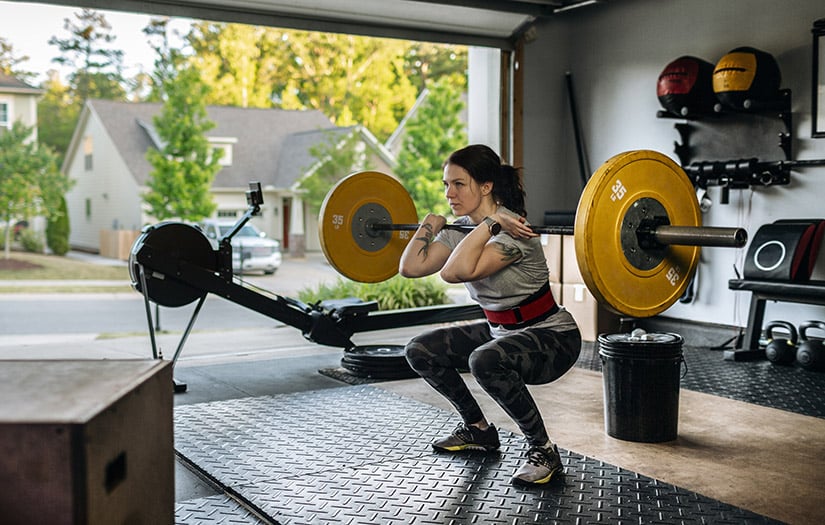
Weightlifting
Training for marathons or triathlons
Why: You need a workout with clear milestones and visible progress. Whether it’s lifting heavier, running faster, or mastering complex routines, goal-setting workouts keep you driven and focused.
4- The Creative Free Spirit
Traits: Artistic, imaginative, spontaneous, non-conformist You crave: Variety, self-expression, and excitement
Best Fit:
Aerial yoga or pole fitness
Dance improvisation
Martial arts or capoeira
Eclectic workout fusions (like cardio-drum classes or animal flow)
Why: Routine is your enemy. You need a workout that feels like play and allows you to move creatively. Anything rhythmic, expressive, or out-of-the-box will help you stay consistent and inspired.
5- The Nature Enthusiast
Traits: Grounded, calm, environmentally conscious, freedom-loving You crave: Open spaces, fresh air, and connection to the earth
Best Fit:
Hiking
Trail running
Outdoor yoga
Kayaking or paddleboarding
Why: Indoors feels stifling. You feel most alive outdoors, where your senses are engaged and your mind is at ease. Natural environments lower stress levels and increase your motivation to move.
6- The Steady & Gentle Mover
Traits: Patient, grounded, cautious, sustainable thinker You crave: Balance, ease, and long-term benefits
Mature woman, 50-something, in a swimming pool, exercising, doing water aerobics with dumbbells.. She is smiling, having fun. There is plenty of copyspace.
Best Fit:
Walking
Low-impact cardio
Aqua aerobics
Stretching routines
Resistance band workouts
Why: You don’t believe in pushing too hard, too fast. Your ideal fitness routine is one that respects your pace, keeps you injury-free, and focuses on longevity rather than intensity.
7- The Analytical Tech-Lover
Traits: Logical, detail-oriented, curious, self-tracking You crave: Structure, numbers, and optimization
Best Fit:
Weightlifting with progress logs
Rowing with split tracking
Indoor cycling with smart metrics (like Peloton)
Fitness apps with data tracking
Why: You love seeing numbers improve. Smart wearables, apps, and fitness tech provide real-time feedback and analytics, which keeps you engaged and continually adjusting your strategy.
Which Workouts work for my Personality?
The link between personality and physical activity goes both ways, Dr. Blaise Aguirre, a child and adolescent psychiatrist at McLean Hospital in Arlington, Massachusetts said.
“In as much as your personality shapes your exercise routine, exercise can shape personality in return, in that it can also help reinforce positive traits (like being more disciplined and more sociable) and reduce negative ones (like anxiety or emotional instability),” he said.
Whether you’re looking to refresh your exercise regimen or starting from scratch keep these tips in mind:
Disclaimer The Content is not intended to be a substitute for professional medical advice, diagnosis, or treatment. Always seek the advice of your physician or other qualified health provider with any questions you may have regarding a medical condition.