The expansion comes in response to the increasing need for packaging solutions. Credit: Gorodenkoff/Shutterstock.com.
Yiruixing Packaging, a Chinese custom packaging manufacturing services provider, has expanded its capabilities to offer more flexible and scalable packaging solutions for businesses in the protein, supplement, and nutrition sectors.
By enhancing its original equipment manufacturing (OEM) and original design manufacturing (ODM) services, the company is aiming to meet the growing demand for custom packaging.
The move aims to handle high-volume production while maintaining market-standard compliance and quality.
The expansion comes in response to the increasing need for packaging solutions that cater to bulk buyers and manufacturers in the nutritional product market.
Yiruixing said that it is now better equipped to support businesses requiring durable, consistent packaging that can meet the demands of large-scale production.
This allows the company to offer custom solutions for packaging protein powders, dietary supplements, and other nutritional products, providing businesses with the flexibility to scale their operations effectively.
The company’s expanded offerings include a range of materials and packaging types, from rigid boxes to flexible pouches and resealable bags.
These packaging solutions are designed to meet the specific needs of each product, ensuring that the integrity of protein and supplement products is preserved throughout the production and distribution processes.
The company’s new approach allows for tailored packaging that accommodates factors such as filling methods, storage conditions, and destination requirements.
By offering options for custom structural designs, material selection, and branding, Yiruixing indicated that it is able to deliver packaging solutions that cater to the diverse needs of its clients.
This includes a commitment to regulatory compliance, ensuring that packaging meets global labelling standards and facilitates smooth distribution across international markets.
Yiruixing said that it has also increased inspection and testing processes at each stage of production.
Sign up for our daily news round-up!
Give your business an edge with our leading industry insights.
Nominations are now closed for the Packaging Gateway Excellence Awards. A big thanks to all the organisations that entered – your response has been outstanding, showcasing exceptional innovation, leadership, and impact.
Excellence in Action
From rising paper prices to plastic reduction targets, Morris Packaging is tackling today’s toughest packaging challenges – and has won three 2025 Packaging Gateway Excellence Awards for it. Learn how Revopack and EcoPour deliver recycle-ready, high-impact packaging that boosts efficiency from filling line to retail shelf.
Cardano (ADA) has started 2026 on a positive note, rising nearly 8% today, moving above the $0.36 level and ranking among the day’s top altcoin gainers. This rise comes after a rough December, when ADA fell nearly 20%, leaving many investors cautious.
So, what’s driving Cardano’s price higher today?
CryptoQuant Data Shows Whale Buying
One of the clearest signals behind ADA’s rise comes from CryptoQuant data. Recent on-chain numbers show an increase in activity from large holders, often called whales. Both spot and futures data point to bigger orders entering the market.
When whales begin to buy again, it often signals growing confidence. According to CryptoQuant, market conditions are easing, and buy-side pressure is slowly increasing. This supports the idea that the current move is more than just a random bounce.
Beyond trading data, Cardano’s network is showing real signs of use. Transaction activity and wallet interactions have increased over recent days. This means users are actively using the blockchain, not just holding ADA.
Cardano DeFi TVL Shows Signs of Recovery
Another positive signal comes from Cardano’s DeFi ecosystem. According to DefiLlama, Cardano’s TVL increased by 4% in the last 24 hours, reaching about $178.9 million. This means more users are putting their funds into Cardano-based DeFi platforms.
When more money flows into DeFi, it usually shows growing trust in the network, which can also increase demand for the ADA token.
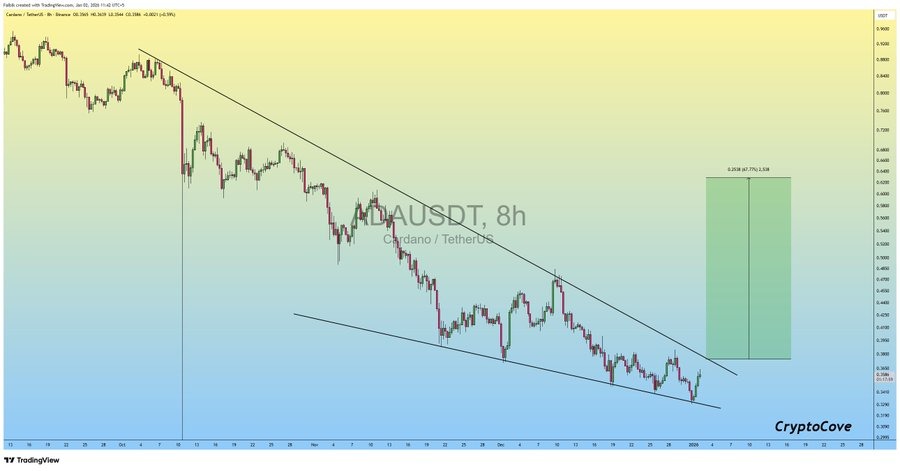
For several months, ADA has been moving inside a falling wedge pattern. This happens when the price keeps going down, but selling slowly becomes weaker. As the range gets tighter, it often means a big move is getting close.
Right now, ADA is holding near the $0.35 support level. This area is helping the price stay stable, and buyers are slowly stepping in, showing that selling pressure is easing.
Crypto trader Captain Faibik shared a chart showing ADA near the end of this falling wedge. He believes a breakout could happen if the price moves above the upper trendline.
As long as ADA stays above support, the setup remains healthy. If the breakout happens, the price could move toward the $0.52–$0.55 zone, which would mean nearly a 50% rise from current levels.
Never Miss a Beat in the Crypto World!
Stay ahead with breaking news, expert analysis, and real-time updates on the latest trends in Bitcoin, altcoins, DeFi, NFTs, and more.
FAQs
Why is Cardano (ADA) attracting investor attention in early 2026?
Rising on-chain activity, improving market conditions, and renewed large-holder interest suggest stronger confidence in ADA’s short-term outlook.
What is Cardano’s (ADA) price prediction for 2026?
Cardano could trade between $2.75 and $3.25 in 2026 if market sentiment improves, adoption grows, and key support levels hold.
Is Cardano a good long-term investment?
Cardano is considered a long-term project due to its research-driven development, scalability upgrades, and focus on decentralization.
What will Cardano be worth in 2030?
By 2030, Cardano could be valued around $9 to $10 based on long-term growth, network usage, and sustained investor confidence.
Trust with CoinPedia:
CoinPedia has been delivering accurate and timely cryptocurrency and blockchain updates since 2017. All content is created by our expert panel of analysts and journalists, following strict Editorial Guidelines based on E-E-A-T (Experience, Expertise, Authoritativeness, Trustworthiness). Every article is fact-checked against reputable sources to ensure accuracy, transparency, and reliability. Our review policy guarantees unbiased evaluations when recommending exchanges, platforms, or tools. We strive to provide timely updates about everything crypto & blockchain, right from startups to industry majors.
Investment Disclaimer:
All opinions and insights shared represent the author’s own views on current market conditions. Please do your own research before making investment decisions. Neither the writer nor the publication assumes responsibility for your financial choices.
Sponsored and Advertisements:
Sponsored content and affiliate links may appear on our site. Advertisements are marked clearly, and our editorial content remains entirely independent from our ad partners.
“To our knowledge, this is the first study to demonstrate that RR [Rhodiola rosea] can elicit concurrent improvements in maximal strength, muscular endurance and power—challenging a previously reported trade-off,” wrote researchers at Jacksonville State University in the United States and Azad University in Iran.
They reported differing effects on performance with the two doses they tested: “Lower doses preferentially enhancing late-set muscular endurance/volume and higher doses favoring maximal lower-body strength without sacrificing power.” The findings also revealed dose-dependent nootropic effects.
The study noted that rhodiola’s effects have previously been described as “modest and outcome-specific, rather than broadly ergogenic” and that the benefits and mechanisms involved may depend on intake patterns, length of supplementation and the type of exercise.
High altitude herb
Rhodiola rosea is a perennial herb that mostly grows at high altitudes in arctic areas of Europe and Asia, with forms of the herb in trade including dry extracts in solid dosage forms such as capsules and tablets, liquid extracts, cut, dried rhizome and root and powdered rhizome and root.
It has traditionally been used to manage stress, depression and mental and physical fatigue, and to boost energy.
Rhodiola may be beneficial for exercise due to its bioactives such as salidroside, which modulates pathways in the nervous system that can support fatigue resistance and power maintenance. Salidroside can also dampen oxidative stress and support mitochondrial biogenesis and stability. The current study did not, however, collect mechanistic biomarkers.
“Practically, these findings suggest that 7-day RR supplementation (200–1,500 mg/day) may benefit athletes in resistance training programs that emphasize volume and fatigue resistance, such as those used in hypertrophy or strength protocols”, the researchers reported, adding that the cognitive enhancements may support sports requiring mental acuity alongside physical demands.
However, they noted that the lack of effects in the Wingate cycling test implied limited utility for explosive sports such as sprinting, although team sports may benefit.
Study details
The crossover, double-blind, randomized, placebo-controlled study aimed to determine whether seven-day Rhodiola rosea (RR) supplementation improved resistance performance and executive function in resistance-trained adults compared with placebo.
Twenty-seven resistance-trained athletes between the ages of 18 and 40 were divided into one of four groups: control (CON; no supplement), placebo (PL), low-dose RR at 200 mg/day (LDRR) and high-dose RR at 1,500 mg/day (HDRR). Each period lasted seven days under the assigned condition, with laboratory performance testing on the seventh day comprising strength, cycling and cognitive tests, as well as anthropometric and physiological measurements.
The dosage of RR used was informed by prior studies in athletes and consisted of standardized to 3% salidroside and 1% rosavin sourced from BulkSupplements.com. It was administered to the participants an hour before exercising so that the researchers could evaluate short-term rather than chronic effects.
The results revealed that LDRR increased bench press one-repetition maximum (1RM), set-3 repetitions, set-3 volume and mean power compared with the control condition. HDRR increased set-3 repetitions and peak power “with a trend for set-3 volume”, the researchers wrote.
On the leg press, both rhodiola doses improved 1RM compared to control, with the lower dose increasing the maximum by 35.7 kg and the higher dose increasing it by 47.7 kg. Improvements for both groups were significant versus placebo.
There were also improvements for the supplements in the Stroop Color–Word Tests. No consistent sex differences were observed.
“Short-term RR consumption, regardless of dose or gender, improved resistance performance and significantly enhanced Stroop outcomes, with minimal changes in anaerobic cycling and RPE, and no consistent acute hemodynamic effects,” the researchers concluded.
Source: Nutrients 2025, 17(23), 3736. doi: 10.3390/nu17233736. “Dose–Response Effects of Short-Term Rhodiola rosea (Golden Root Extract) Supplementation on Anaerobic Exercise Performance and Cognitive Function in Resistance-Trained Athletes: A Randomized, Crossover, Double-Blind, and Placebo-Controlled Study”. Authors: M.S. Koozehchian et al.
XRP, the fifth-largest cryptocurrency by market cap, surged 3% today as the new year rally kicks off. Latest market data shows Ripple’s XRP at $1.88, nearing the crucial $2 threshold that could signal a major breakout in 2026. Despite the short-term uptrend, XRP’s overall market trend remains bearish, with an extended monthly decline of $15.24%. As of January 1 and 2, there has been no big surge at the start of 2026 yet, and the XRP market trend looks sideways to moderately bearish in the short term.
XRP’s price bounce reflects new year rally participation, and the digital asset is one of the highly rated ones in the market. However, reaching $100 in 2026 is highly speculative and unlikely, because the market trend projects a more realistic range of $3.50 to $20 by the end of this year. Despite sluggish market conditions, demand for US XRP-spot ETFs held steady, reaching nearly $500 million in December alone. The U.S. lawmakers have officially set a January 15 markup for the newly imposed Market Structure Bill. Based on the factors like legislative progress with the enhanced ETF momentum, XRP will push above the $3 psychological level soon.
XRP Current Market Scenario
Credit: Tradingview
According to the current XRP market data, the XRP price today is $1.88, trading closer to the $2 psychological level. The new year rally is making a difference in the XRP rally, because the digital asset is around 3% higher over the past 24 hours. XRP Ledger’s native cryptocurrency is trading with a 24-hour trading volume of $ 2.05B Market cap of $ 114.02B, and a market dominance of 3.79%. XRP’s market sentiment remains bearish, and it has been trading below its 50-Day SMA ($ 2.05) and 200-Day Simple Moving Average ($ 2.48) for a long period of time. Along with the extended bearish trend, XRP has traded 13/30 (43%) days in green with a market volatility of 5.04%. XRP’s fear and greed index signals 20, which is extreme fear in the market, meaning that traders and investors are cautious.
XRP Price Forecast: Expert Views & Opinions
XRP has long faced criticism over its long-term potential, yet early 2026 sessions suggest the asset is gaining momentum. Veteran trader and crypto investor usernamed @investorie shared his thoughts on XRP and explained his long-term admiration for the virtual asset.
He urged traders to stop crying and pay attention. XRP was still below its descending trendline on the daily chart. He acknowledged that the structure was not bullish yet, but stated that what people were missing was that MACD was forming higher lows, RSI was forming higher lows, and price was compressing, not accelerating downward. He mentioned that that was classic momentum divergence. He noted that this did not mean a reversal was confirmed and that it meant selling pressure was weakening under the surface. He pointed out that markets did not bottom when sentiment felt good, but rather when prices stopped responding to fear.
His post shows traders are still valuing XRP and rating it highly as they enter into the new year with a fresh mindset. He concluded his X post by stating that for XRP, the game only changed on a daily close above the trendline (around $2.05–$2.10). Until then, that was accumulation, not hype, and not moon talk. He advised to ignore emotions, watch structure, and watch momentum.
XRP Price Prediction Today: Will XRP Skyrocket Today & Hit $2?
Currently, XRP is slowly regaining its previous market momentum and is on the verge of outperforming prominent cryptocurrencies such as BTC, ETH, SOL, etc. Today, XRP is consolidating between $1.82–$1.87. Based on the recent market data, crossing above the $2 psychological level could be challenging and difficult even with enhanced spot XRP ETF inflows and short-term resurrection.
Here is the XRP price prediction for the next seven days.
Date
Min Price
Avg Price
Max Price
Jan 2, 2026
$1.82
$1.84
$1.86
Jan 3, 2026
$1.81
$1.83
$1.85
Jan 4, 2026
$1.81
$1.83
$1.85
Jan 5, 2026
$1.83
$1.85
$1.87
Jan 6, 2026
$1.86
$1.88
$1.90
Jan 7, 2026
$1.86
$1.88
$1.90
Jan 8, 2026
$1.85
$1.87
$1.89
Jan 9, 2026
$1.84
$1.86
$1.88
Disclaimer: XRP price prediction is speculative and subject to change based on the changing market scenario.
According to the XRP short-term price prediction, the digital asset is expected to trade at an average maximum price of 1.88 in the next seven days.
XRP Outlook: Will XRP Hit $100 in 2026?
For XRP, 2026 could mark a major comeback, as the resolution of its long-standing SEC battle and newfound regulatory clarity are set to boost performance and ignite a bullish rally. Based on the recent data and XRP’s historic trend, Ripple’s native cryptocurrency will not hit $100 in 2026. A $100 price demands substantial growth and a total market value above Bitcoin’s, which is highly unlikely at the moment. Industry experts believe that for that kind of growth, XRP might need to become something like a global reserve or settlement currency that is widely used at a massive scale.
Lower Rates Sustain Demand for Non-Yielding Assets
The FOMC meeting in December was clear: even though there were some internal disagreements, most of the Fed’s policymakers still think there’s room for further easing if inflation continues to slow. The upshot is lower interest rates, which make holding non-yielding assets like gold much less costly, keeping demand for them afloat.
Geopolitical Risks and Market Caution Shape Near-Term Outlook
The ongoing conflicts and tensions between nations have added a big layer of uncertainty to the mix, which in turn has led investors to stick with the tried and true safe haven assets that always seem to do well during times of uncertainty – and gold is no exception.
The big question is: will its price hold at record levels despite the inevitable pullbacks? That said, we do face some near-term headwinds.
The first is that after a gain as sharp as gold’s, some people will want to cash in their profits, which could lead to selling pressure. The CME Group has also decided to up the margin requirements for gold and other metals, which is likely to make it a little more expensive to speculate on the price of gold, and that could also dampen demand.
Looking ahead, gold is likely to remain well-supported as long as rate-cut expectations and geopolitical tensions continue to simmer. However, with US markets set to release a batch of important data, including the final Manufacturing PMI, traders are likely to keep a close eye on how it all plays out, especially its impact on the dollar and the Fed’s next move.
Short-Term Forecast
Gold may consolidate between $4,350–$4,450 in the near term, with dips attracting buyers above $4,300, while a break above $4,400 could reopen the path toward $4,475.
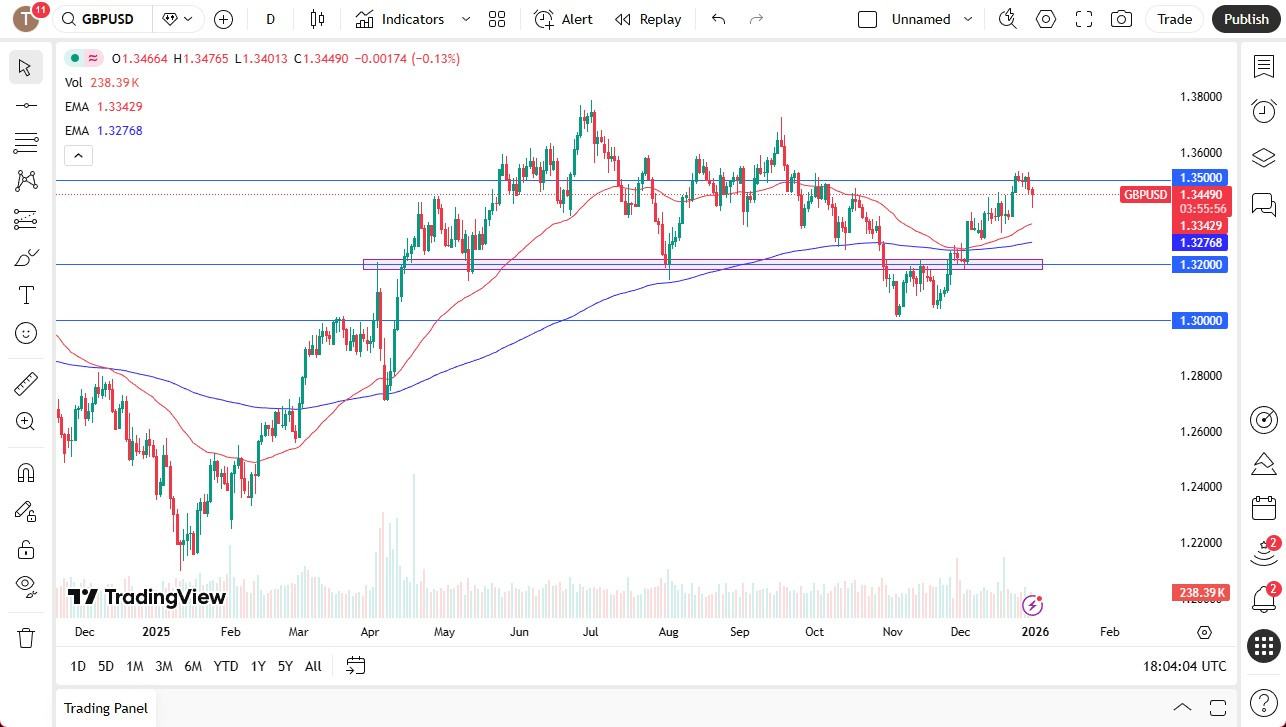
The British Pound had a tough session on Wednesday again as the 1.35 level continues to be a barrier.
With that being the case, I think it’s worth watching very closely the 1.35 level as it is a large round psychologically significant figure and a level that a lot of people will be watching very closely.
If we can break above the 1.3550 level, it opens up the possibility of a move to the 1.37 level.
Federal Reserve and Bank of England
If we break down below the lows of the Wednesday session, we probably go looking to the 50-day EMA, perhaps the 200-day EMA after that, and then eventually the 1.32 level. In general, this is a market that I think continues to be very noisy and, of course, will be driven by the US Dollar more than anything else.
While the Federal Reserve is expected to cut rates next year, the reality is that a lot of the economic numbers coming out of the United States are stronger than people are comfortable with, as far as cutting twice. We’ll see whether or not that ends up being the case, and of course, we’ll have to watch the Bank of England because they just cut. Now the question is, will they have to cut more?
I do think there is potential for either direction at this point, and we’ll just have to watch how things play out over the next couple of trading sessions. The early part of next week will be a bit thin, but as we get later in the week, I think you start to see a little bit more liquidity, a little bit more reality when it comes to this market. Keeping in mind that on Friday there will be trading, but it will be in very thin conditions, so I wouldn’t read too much into this market until at least Monday of next week.
Christopher Lewis has been trading Forex and has over 20 years experience in financial markets. Chris has been a regular contributor to Daily Forex since the early days of the site. He writes about Forex for several online publications, including FX Empire, Investing.com, and his own site, aptly named The Trader Guy. Chris favours technical analysis methods to identify his trades and likes to trade equity indices and commodities as well as Forex. He favours a longer-term trading style, and his trades often last for days or weeks.
Herbal, flower and fruit teas may no longer be called tea as FSSAI tightens labelling rules to prevent food misbranding.
Only Camellia sinensis-based drinks can be labelled as tea in India, says FSSAI.
The Food Safety and Standards Authority of India (FSSAI) has issued a formal clarification, where they mentioned that, in India, only beverages made from the Camellia sinensis plant will be labelled as Tea. This move comes after regulators noticed Food Business Operators (FBOs) marketed products like herbal tea, flower tea, and rooibos tea, even though they are not derived from the traditional tea plant.
What Qualifies As Real Tea In India
According to FSSAI, tea is defined under the Food Safety and Standards (Food Product Standards and Food Additives) Regulations, 2011. Products only made with the Camellia sinensis plant qualify as tea. It includes black tea, green tea, white tea, oolong tea, Kangra tea and instant tea in solid form. In all these varieties, the difference is just the processing methods like oxidation and drying, but all come from the same plant.
Why Herbal And Flower Teas Are A Problem
FSSAI clarified that plant-based or herbal infusions made from flowers, herbs, fruits, or other plants do not qualify as tea. Using the word “tea” for such products, either directly or indirectly, is misleading. As per labelling rules under the Food Safety and Standards (Labelling and Display) Regulations, 2020, the name of the food must reflect its true nature on the front of the package. Calling herbal infusions “tea” amounts to misbranding under the Food Safety and Standards Act, 2006.
What FSSAI Has Directed Businesses To Do
All FBOs, including e-commerce platforms, have been directed to stop the use of the word ‘tea’ for products not derived from Camellia sinensis. Based on their ingredients, these products can be categorised and classified as proprietary foods or non-specified foods. State food safety authorities have been given strict monitoring instructions and action to be taken against violators.
For consumers, the clarification brings more transparency. Green tea and black tea remain unchanged. However, products commonly known as chamomile tea, hibiscus tea, or rooibos tea may soon be sold as “herbal infusions” or “flower infusions,” helping buyers better understand what they are consuming.
With this move, FSSAI aims to curb misleading labels and ensure honesty in food marketing, reinforcing that in India, “real tea” comes only from Camellia sinensis.
Location :
Delhi, India, India
First Published:
January 02, 2026, 12:02 IST
Newslifestylefood No More Herbal ‘Tea’? FSSAI Clarifies What Can Legally Be Called Tea In India
Following a recovery attempt in the early trading hours on Friday, EUR/USD lost its traction and retreated slightly below 1.1750. The pair could have a difficult time gathering directional momentum as trading conditions are likely to remain thin in between the New Year holiday and the weekend.
Euro Price This week
The table below shows the percentage change of Euro (EUR) against listed major currencies this week. Euro was the weakest against the US Dollar.
USD
EUR
GBP
JPY
CAD
AUD
NZD
CHF
USD
0.24%
0.16%
0.28%
0.38%
0.10%
1.24%
0.58%
EUR
-0.24%
-0.08%
0.04%
0.14%
-0.15%
0.99%
0.33%
GBP
-0.16%
0.08%
0.27%
0.22%
-0.07%
1.08%
0.40%
JPY
-0.28%
-0.04%
-0.27%
0.10%
-0.18%
0.94%
0.29%
CAD
-0.38%
-0.14%
-0.22%
-0.10%
-0.24%
0.85%
0.18%
AUD
-0.10%
0.15%
0.07%
0.18%
0.24%
1.15%
0.46%
NZD
-1.24%
-0.99%
-1.08%
-0.94%
-0.85%
-1.15%
-0.67%
CHF
-0.58%
-0.33%
-0.40%
-0.29%
-0.18%
-0.46%
0.67%
The heat map shows percentage changes of major currencies against each other. The base currency is picked from the left column, while the quote currency is picked from the top row. For example, if you pick the Euro from the left column and move along the horizontal line to the US Dollar, the percentage change displayed in the box will represent EUR (base)/USD (quote).
Earlier in the week, the modest US Dollar (USD) recovery caused EUR/USD to edge lower. In the absence of fundamental drivers, profit-taking toward the end of the year may have caused the USD to gather strength.
In the new year, the potential policy divergence between the Federal Reserve (Fed) and the European Central Bank (ECB) could remain as the primary driver of EUR/USD’s action. While the Fed is widely seen is adopting a dovish stance to support the labor market, the ECB is expected to remain patient, with the European economy showing resilience and inflation holding steady.
The 20-period Simple Moving Average (SMA) has turned lower and now sits beneath the 50 SMA, while price stays below these short-term gauges. The 50-, 100-, and 200-period SMAs edge higher, with price above the latter two, keeping the broader bias mildly positive despite near-term softness. The Relative Strength Index (RSI) stands at 42.76, below the 50 midline and signaling waning momentum.
Measured from the 1.1503 low to the 1.1800 high, the 23.6% retracement and the 100-period SMA form a support area at 1.1730-1.1740. With a drop below this region, the 38.2% retracement at 1.1687 could be seen as the next support before 1.1665 (200-period SMA). Immediate resistance aligns at 1.1755-1.1760 (20-period SMA, 50-period SMA), followed by 1.1800 (end-point of the uptrend) and 1.1840 (static level).
(The technical analysis of this story was written with the help of an AI tool)
Euro FAQs
The Euro is the currency for the 20 European Union countries that belong to the Eurozone. It is the second most heavily traded currency in the world behind the US Dollar. In 2022, it accounted for 31% of all foreign exchange transactions, with an average daily turnover of over $2.2 trillion a day.
EUR/USD is the most heavily traded currency pair in the world, accounting for an estimated 30% off all transactions, followed by EUR/JPY (4%), EUR/GBP (3%) and EUR/AUD (2%).
The European Central Bank (ECB) in Frankfurt, Germany, is the reserve bank for the Eurozone. The ECB sets interest rates and manages monetary policy.
The ECB’s primary mandate is to maintain price stability, which means either controlling inflation or stimulating growth. Its primary tool is the raising or lowering of interest rates. Relatively high interest rates – or the expectation of higher rates – will usually benefit the Euro and vice versa.
The ECB Governing Council makes monetary policy decisions at meetings held eight times a year. Decisions are made by heads of the Eurozone national banks and six permanent members, including the President of the ECB, Christine Lagarde.
Eurozone inflation data, measured by the Harmonized Index of Consumer Prices (HICP), is an important econometric for the Euro. If inflation rises more than expected, especially if above the ECB’s 2% target, it obliges the ECB to raise interest rates to bring it back under control.
Relatively high interest rates compared to its counterparts will usually benefit the Euro, as it makes the region more attractive as a place for global investors to park their money.
Data releases gauge the health of the economy and can impact on the Euro. Indicators such as GDP, Manufacturing and Services PMIs, employment, and consumer sentiment surveys can all influence the direction of the single currency.
A strong economy is good for the Euro. Not only does it attract more foreign investment but it may encourage the ECB to put up interest rates, which will directly strengthen the Euro. Otherwise, if economic data is weak, the Euro is likely to fall.
Economic data for the four largest economies in the euro area (Germany, France, Italy and Spain) are especially significant, as they account for 75% of the Eurozone’s economy.
Another significant data release for the Euro is the Trade Balance. This indicator measures the difference between what a country earns from its exports and what it spends on imports over a given period.
If a country produces highly sought after exports then its currency will gain in value purely from the extra demand created from foreign buyers seeking to purchase these goods. Therefore, a positive net Trade Balance strengthens a currency and vice versa for a negative balance.
On a recent cleaning spree, I came across a basket shoved at the back of a cupboard containing around 30 colourful little jars. I rattled them around, peering at the labels: zinc, vitamin D, magnesium, cod liver oil, omega 3, and basically any other supplement you could name. The collection had accrued over the course of several years, picked up – and then swiftly dropped. Health sprees that only had a hefty bill from Holland & Barrett to show for them.
The majority of us are susceptible to the idea that “investing” in our health equates to spending hard-earned cash to prove to ourselves that we’re serious. The unworn trainers or expensive yoga pants, the unused gym membership (a cliché because it’s true) – and, for others like me, a huge box of very good intentions, rattling around the drawer under the bathroom sink.
Did I clear out everything best before 2022 (or, in some cases, 2019)? Yes. Did I also reignite the urge to buy more? Naturally. Like most people, I’d also been recently caught in the TikTok wellness trap, where everyone appears to have the answers, no matter what their credentials. Powdered greens – a dietary supplement of vegetables, fruits and algae which claims to be a concentrated dose of nutrients – appeared to be a brilliantly easy panacea, as did supplements I’d never previously taken notice of – milk thistle, to cleanse a tired liver for a tenner, or ashwagandha to lower blood pressure and anxiety, and collagen for pretty much everything else.
It doesn’t need pointing out that the platform has very little merit in the health world, yet sales of beauty and wellness products such as supplements are through the roof on ever-influential TikTok Shop – and this is big business.
For the supplements industry, health really is wealth. Over the last 15 years, the over-the-counter vitamins and minerals market has grown exponentially, generating more than £650m in UK sales in 2024. In the US, it’s far higher, with one of the more conservative estimates suggesting Americans will be swallowing $70bn of supplements by 2030.
It is, of course, unsurprising. Five years ago, we lived through an unprecedented global health crisis that, when life was boiled down to the bare basics, gave us all a thorough wake-up call. Covid led us all to reconsider our perceptions of health, the way we live and, crucially, how we prevent ourselves from getting ill. Naturally, many people turned to quick-fix supplements – and sales were their highest in more than a decade; almost twice the amount sold nationally last year.
Vulnerability is what the supplement sector thrives on – but as to whether they work, it’s a lot more complicated.
One size does not fit all
“We should think about taking supplements like a prescription,” says registered nutritional therapist GQ Jordan. Much of the time, we’re conditioned to think that taking supplements, whatever they are, must be safeguarding or improving our health. We forget that health – existing or genetically predisposed conditions, our levels of fitness and diet – is not an equal starting point for all of us. Additionally, some over-the-counter vitamins and minerals can interact with medication.
“It’s really important to try and take a personalised approach to all of these things – what works for one person might not work for another; everyone has their own signs and symptoms of what they might be lacking, probably the first thing to do is to track those to see if there’s any consistency. So, if you’re waking up in the night consistently or having an energy dip in the afternoon, it might be a good sign to consider taking some magnesium or vitamin D to see if they help,” advises Jordan.
‘It’s really important to try and take a personalised approach to all of these things – what works for one person might not work for another,’ says a women’s health nutritionist (Getty/iStock)
If at all possible, Jordan says, speak to your GP about your own health status before deciding what you need supplementing, and before sinking a load of cash into your local pharmacy. Or, if that’s not possible and you can afford to, put that money towards seeing a nutritionist. Getting goodness through diet is more sustainable in the long run because of how things are broken down in our gut. Some supplements aren’t suitable for people with underlying health concerns, especially when it comes to the liver, which must process everything you put in your body.
Finally, remember that your requirements will change depending on your current situation. As we age, our hormones change drastically, which can change what we need and how much of it is needed.
Not all supplements are made equal
Far from it. Supplements, says Lynsey Vaughan, nutritionist and product innovation lead at wellness brand Higher Nature, which is “committed to unmasking the world of supplements”. “There are a few things to keep in mind,” Vaughan explains, particularly whether the capsule or tablet is made of natural ingredients.
“A non-active ingredient might be the physical shell that you put the ingredients into, and then there are also excipients, which is an industry term for non-active ingredients. Not all supplements have them in – and many don’t have the right amount in. For a good supplement, you want the actual ingredient, limited non-active and synthetic ingredients, and to get the right dose. There are many that I come across where I’ll look at the formula and think, ‘What is that even doing?’ Often there’s no real benefit at all.”
You can’t out-supplement a bad diet (Getty/iStock)
Just like in ultra-processed foods, look at how many ingredients are listed. Too many non-active or synthetic ingredients make it much harder for the body to digest and, adds Jordan, can cause more harm than good.
“You could think that you’re safeguarding your health or being proactive, which comes from a really good place, but then choose supplements that might not be right for you on a personal level or up to scratch. That could have a real impact on other aspects of your health, particularly your gut health, because the supplements contain all these buffers and preservatives that aren’t really essential.
“The gut lining is super-sensitive. It’s the barrier between our outside world and our body, essentially, and these things can have a compounding irritating effect.”
In terms of the label, look out for “synthetics versus natural food form”, recommends Vaughan. “Most people assume that vitamins and minerals are natural. In fact, one survey found that 70 per cent of people think that vitamins and minerals in fortified foods are natural, but they’re not – they’re synthetic. Similarly in the supplement world, there’s a huge knowledge gap.”
You can’t ‘out supplement’ a bad diet
“I’m allergic to the wellness industry wheel,” Jordan jokes. “Most of the ads we all see online – things like green powders, for example – should be under investigation, in my opinion. Many of them create pain points for people and then target them for vulnerability: weight loss, infertility … Solve your PCOS [polycystic ovary syndrome] with an expensive green powder. It’s really dangerous.”
Most people assume that all vitamins and minerals are natural… not so (Getty/iStock)
And it can mean that we end up feeling more comfortable paying less attention to what we’re actually eating. “Nothing can supplement a bad lifestyle,” Jordan says.
Vaughan agrees. “Based on dietary data, around 75 per cent of people in the UK are not eating enough oily fish,” she says. Generally, our diets have changed exponentially in the last few decades – and Vaughan knows the impact from her own health struggles with Hashimoto’s thyroiditis. “I forced myself to eat liver, which is full of nutrients, when I went through my own health struggles,” she explains.
Back in the day, especially in poorer communities, we used to eat much more offal and cheap oily fish such as kippers. It goes without saying that we should also be focusing on eating lots of rich, leafy greens and moving our bodies enough, which all helps with our gut health and would alleviate the need for so many supplements in the first place. That baseline, both Vaughan and Jordan agree, must be heeded before we start trying to compensate over the counter.
If you take just one supplement, this should be it
It’s a close call here: for Jordan, vitamin D, omega 3 and magnesium all chart high; for Vaughan, omega 3 just about tips it with vitamin D a close second. In fact, the government recommends we should all take a supplement for vitamin D, as thanks to the lack of sunlight in the UK, which stimulates the production of it in our bodies naturally, most of us are deficient.
“I actually recommend taking vitamin D all year round, not just in winter and autumn months,” says Jordan. “Just having that can really help your energy, help your mood, help your gut as well, and your immunity.”
Experts recommend taking vitamin D all year round, not just in the winter months (Getty/iStock)
And even when we are eating enough oily fish, which is packed with omega 3, Vaughan notes that recent years have seen fluctuations in the amount of nutrients we’re getting from fish like salmon and mackerel.
“There’s some evidence that omega 3 levels in oily fish have been declining over the last 50 years,” she explains. So there’s a combination of, not only are we not eating enough, but the amount that you used to have to eat to get enough omega 3 is now no longer enough either, so it exacerbates it.
“Omega 3s are so important for us at the cellular level – every single cell membrane needs omega 3s to kind of work their membranes to work flexibly, to let nutrients in, let waste out. They’re also good for hormone balance, brain function. It’s incredibly necessary.”
Jordan agrees, adding that it’s especially important in pregnancy and postpartum. “A particular DHA, a specific type of omega 3, is given to the baby, not mum in that time. So women who have experienced brain fog after giving birth, for example, might benefit from supplementing with omega 3 to get those levels back up.”
Ethereum (ETHUSD) has climbed to $3006.78, reflecting a 1.34% increase today. With recent fluctuations between $2990.88 and $3024.94, traders and investors are keen to understand whether Ethereum will hit the $3086.8 forecast this month. Let’s delve into the data from market trends, technical indicators, and more.
Current Price and Market Overview
The current trading price for Ethereum USD is $3006.78, marking a 1.34% increase from the previous day. The day’s low was $2990.88, while the high reached $3024.94. Ethereum’s market cap stands at $359 billion, and the recent volume of 331.8 million is slightly higher than the average of 330.9 million. This uptick aligns with ETHUSD’s 5-day change of 3.95%, despite a monthly decline of 5.10%. In the bigger picture, Ethereum’s YTD change is a positive 6.14%.
Technical Indicators Signal a Mixed Outlook
Ethereum’s relative strength index (RSI) of 45.08 suggests a neutral market sentiment, neither overbought nor oversold. The MACD is at -74.71 with a signal of -89.30, indicating a potential reversal as it narrows the gap. Meanwhile, the Average Directional Index (ADX) at 31.21 points to a strong trend, though not entirely positive. With the Bollinger Bands’ middle line at $3021.25, the current price is hovering just below this average, reflecting modest volatility.
Forecasts Suggest a Modest Target
According to recent forecasts, Ethereum is expected to reach $3086.8 in the coming month. This monthly forecast shows moderate optimism, contrasting with a year-long projection near $3003.66. For long-term prospects, Ethereum’s price is predicted to climb to $3441.43 over three years, bolstered by its growth potential within the blockchain space and evolving market trends. These forecasts, however, are subject to change due to macroeconomic shifts, regulations, or unexpected events affecting the crypto market.
Recent News and Market Sentiment
Recent news about Ethereum from reputable sources like Yahoo Finance highlights its consistent presence in the crypto market. The frequent updates may contribute to Ethereum’s stable trading volumes, which have slightly outperformed the average in recent days. As the market remains open to new developments, investors continue to monitor Ethereum’s performance closely. Meyka AI, with its AI-powered market insights, offers extensive coverage and analysis of Ethereum and other cryptocurrencies.
Final Thoughts
As Ethereum trades at $3006.78, the market remains focused on reaching the forecasted $3086.8 level this January. With mixed technical indicators and cautious optimism in forecasts, Ethereum’s price movement will depend on various factors, including market sentiment and external events. Staying informed through platforms like Meyka AI can aid in understanding these shifts without making financial advice or predictions.
FAQs
What is the current price of ETHUSD?
The current price of ETHUSD is $3006.78, showing a 1.34% increase from the previous close of $2967.07. It recently fluctuated between a low of $2990.88 and a high of $3024.94.
What are the key technical indicators for Ethereum?
Key technical indicators include an RSI of 45.08 (neutral), MACD at -74.71 with a narrowing signal, and an ADX of 31.21 indicating a strong trend. The price is slightly below the middle Bollinger Band average of $3021.25.
What are Ethereum’s short-term and long-term forecasts?
Short-term forecasts expect Ethereum to reach $3086.8 this month, while long-term projections anticipate $3441.43 in three years and $3878.93 in five years.
How has Ethereum performed year-to-date?
Ethereum has shown a year-to-date increase of 6.14%, reflecting steady growth despite recent fluctuations in its price movement over the past month and quarter.
What could impact Ethereum’s projected price movements?
Ethereum’s price can be influenced by macroeconomic shifts, changes in regulations, and unexpected market events, affecting its forecasts and market dynamics.
Disclaimer:
Cryptocurrency markets are highly volatile. This content is for informational purposes only.
The Forecast Prediction Model is provided for informational purposes only and should not be considered financial advice. Meyka AI PTY LTD provides market data and sentiment analysis, not financial advice.
Always do your own research and consider consulting a licensed financial advisor before making investment decisions.








.jpeg "Why your ‘healthy’ supplements might be ruining your gut health")