This post was written by Christina Sethman, PharmD, pharmacy, Parkview Health.
Vitamin patches can sound enticing to people with digestive issues that inhibit nutrition absorption or anyone who has trouble swallowing pills. While they may offer a potential workaround, some question whether vitamin patches work as well as they claim and if they are safe.
What is a transdermal patch?
Transdermal patches are external medication delivery systems that slowly release medication through the skin and into the bloodstream.
Applying topical medications to the skin is not a new idea. Salves, ointments, potions and patches containing plant, animal or mineral extracts were popular in ancient Egypt and Babylonian medicine around 3000 BC. However, routine use of the transdermal delivery systems that we are familiar with today has only been common practice since the 1970s.
The U.S. Food and Drug Administration (FDA) approved the first patch for motion sickness in 1979. Since then, others have been approved for treating nicotine dependence, pain and birth control. Many prescription patches contain specially designed technology, which allows the medicine to penetrate the skin more effectively.
Do vitamin patches work?
Recently, vitamin patches have attracted a lot of media attention. You can find them virtually anywhere, from online vendors to local drug stores. They claim to cure hangovers, ward off insects, calm nerves, provide focus, promote sleep and even enhance athletic performance. These supplements can contain combinations of vitamins such as vitamins B, D and C, herbs or stimulants like caffeine.
Their claim to fame is that wearing one of these patches would allow for the transfer of the vitamins or substances into the body, eliminating the need to take supplements by mouth. However, evidence is limited to support the safety and effectiveness of vitamin patch use.
This is especially true for gastric bypass patients, a population that many advertisements specifically target. One study published in 2019 looked at a small number of gastric bypass patients who were given supplemental vitamins in either pills or patches. Subjects in the patch group showed significantly lower levels of vitamins D, B1 and B12 than those taking oral supplements.
According to another scientific review of transdermal patches, not all vitamins are appropriate for transdermal delivery. The authors noted that getting certain nutrients across the physical barrier of the skin is a common challenge due to their chemical composition and limited ability to be absorbed through the skin.
Risks
Unlike prescription medications, dietary supplements like vitamin patches do not require approval from the FDA before being sold to the public. This means these products lack the appropriate testing to ensure safety and efficacy. Due to the lack of safety data, risks of using patches can include skin irritations and allergic skin reactions such as blistering, itching, peeling or redness. Other disadvantages of these products include increased costs and trouble with patches sticking due to body hair or oily skin.
Bottom line
While vitamin patches may be trendy, much more research is needed before they can be assumed to be safe or effective. A well-balanced diet can help ensure your body is receiving the vitamins it needs to stay healthy. Consult with your doctor or pharmacist before trying a vitamin patch, especially if you have undergone surgery, are taking prescription medications or have a medical condition.
For more information on pharmacy services, contact or visit a location near you.
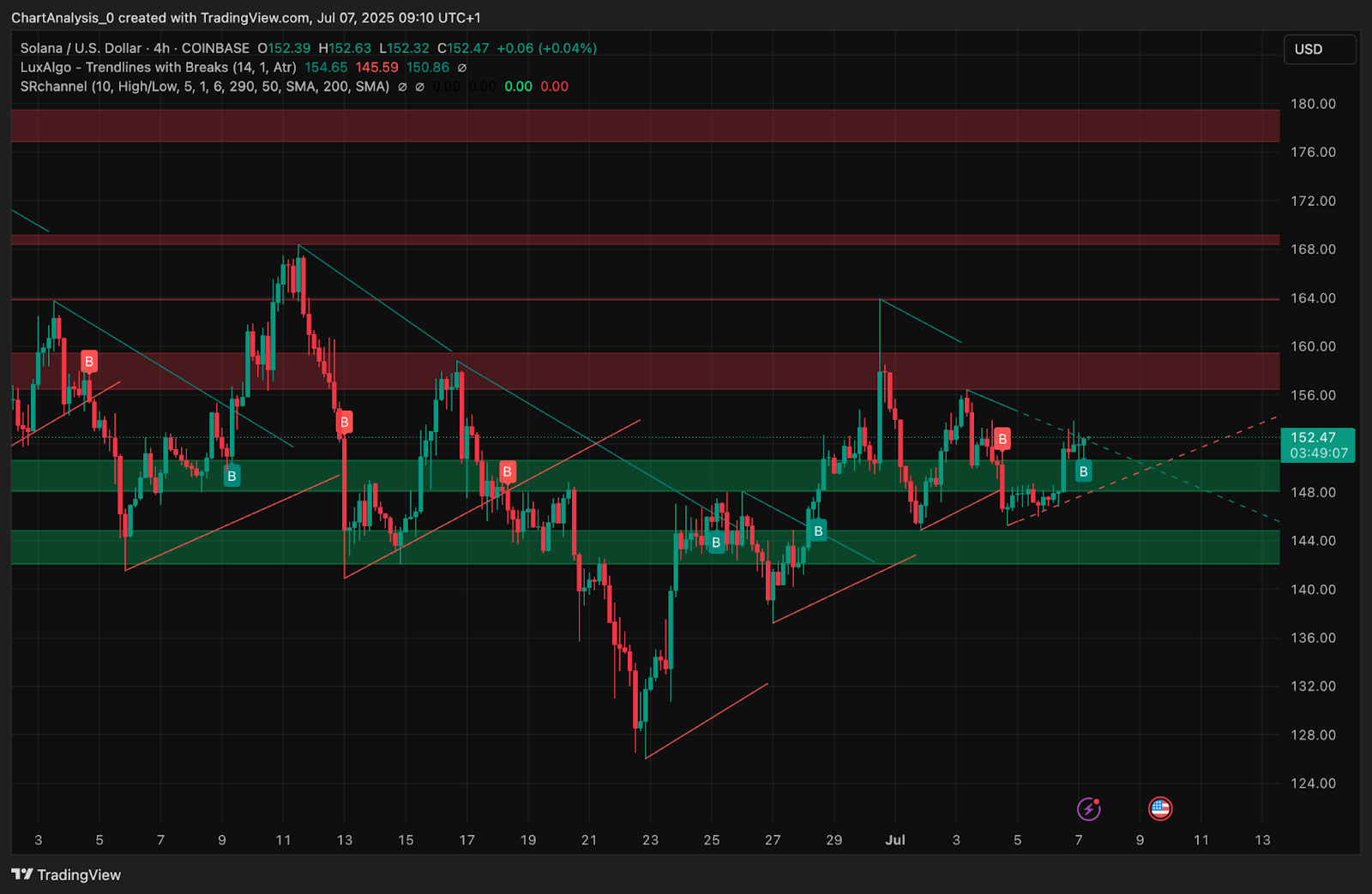
After bouncing from the $142 support cluster last week, the Solana price today is consolidating just below the $154 resistance level. The structure remains within a tightening wedge, where the battle between bulls and bears is intensifying. With funding rates positive and open interest rising, speculative momentum is building ahead of a potential breakout.
Solana has formed a symmetrical triangle on the 4H chart, with higher lows from $142 and descending highs from the June peak near $157. This wedge compression is now squeezing price into a narrow apex zone between $150 and $154.
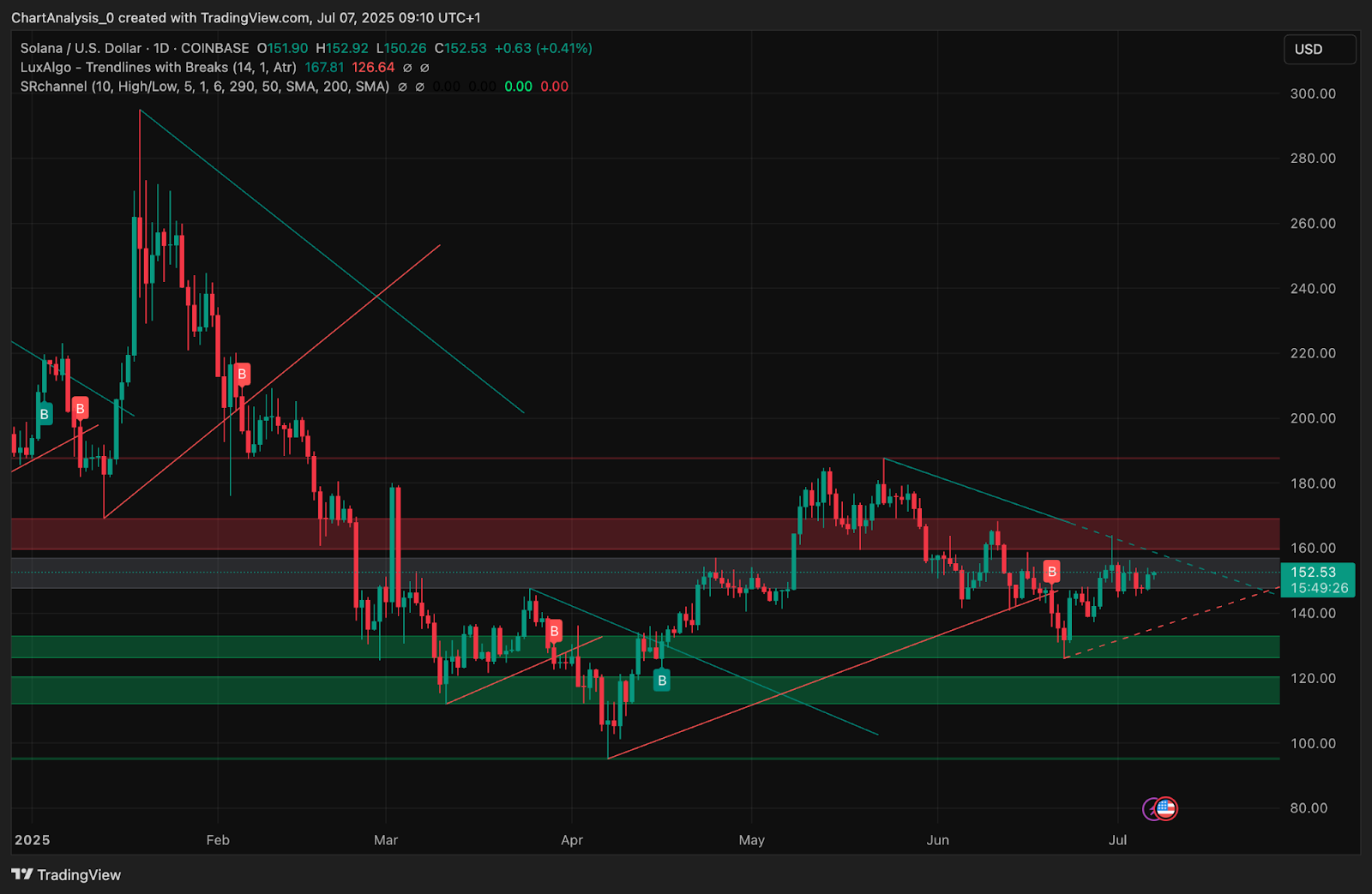
On the daily timeframe, SOL is also pinned below a descending trendline from April’s highs. However, price has reclaimed the mid-range of the recent structure and is now testing both the local trendline and a prior demand-turned-supply zone. The range between $154 and $157 is a confluence resistance that needs to be flipped for continuation.
If bulls break above this zone with volume, a revisit of $162 or even $171 is possible. But failure to clear …
Natural gas price surrendered to the negative pressure, to keep delaying the bullish attempts and forming new correctional trading by reaching $3.325, the stability of the trading below $3.600 will increase the negative pressures on the near period trading, to expect reaching $3.205 and $2.990.
Motivating the bullish attempts requires stepping above $3.450, to increase the chances for attacking the barrier at $3.600, which forms the main gate for detecting the main trend for the upcoming trading.
The expected trading range for today is between $3.000 and $3.450
Trend forecast: Bearish conditioned by the stability of $3.600
Goldman Sachs has a 12-month Euro to Dollar exchange rate (EUR/USD) forecast of 1.25 as net dollar losses continue at a slightly slower pace.
BNY Mellon remains cautious over the Euro and noted; “we lean toward EURUSD ending the year closer to 1.10, rather than making a sustained attempt at 1.20.”
After surging to 45-month highs around 1.1830 early in the week, EUR/USD consolidated around 1.1780.
Trade developments and fiscal chatter will be big influences during the week with high volatility even if the Federal Reserve story is in temporary abeyance. If Trump is back on the warpath against Fed hair Powell. Volatility is liable to spike even higher.
The headline US employment report was stronger than expected with an increase in non-farm payrolls of 147,000 for June compared with consensus forecasts of around 110,000.
The headline figure, however, was inflated by a big increase of over 70,000 in government jobs while ADP data reported a 33,000 decline in private jobs for June.
Overall, markets ruled out the potential for a July Fed rate cut with the chances of a September cut dipping to around 80%.
The issue of Fed independence will remain a key market theme amid President Trump’s threats to sack Powell or nominate an early candidate to take over in May 2026.
Rabobank commented; “Crucially, if any replacement for Powell was judged to be at risk of medium-term inflation stability by cutting rates too fast and too soon, the USD could be faced with a steeper decline.”
As far as fiscal policy is concerned, the Senate passed the budget bill as Vice-President Vance provided the tie breaker after a 50-50 vote.
The House also approved the Bill with a small majority and the bill has been signed into law by Trump.
The Congressional Budget Office (CBO) has estimated that the Bill will increase government debt by $3.3trn over 10 years. The Treasury market will be watched closely in the short term.
Trade developments will also be a key element in the week ahead. Ahead of the July 9th deadline, Trump is planning to announce take it or leave it tariff levels for the rest of the world.
ING noted; “Needless to say this could be a noisy period for FX markets as the White House again makes heavy threats in order to get trade deals over the line.”
The bank added; “As a reminder, the top G10 FX performers during the worst of April’s volatility were the Swiss franc, the euro and the yen – in that order. The dollar was broadly offered. And yesterday’s FX price action suggests investors and corporates were more than happy to sell dollars into rallies.”
Euro-Zone developments will also have a key influence.
CIBC notes ECB support for a greater Euro role as a reserve currency.
It added; “While some ECB members may soon become nervous regarding the pace of EUR appreciation, we would still view the currency as being on the cheap side of relative fair value, which we would estimate to be around €1.30.”
Goldman is confident that there will be further inflows, but added; “absent a growing list of reasons to reallocate away from the US, the pace of the inflows to Europe could taper off slightly as they did in 2017, which may imply a slightly slower and choppier path higher for EUR/USD from here.”
BNY Mellon considers the Euro-Zone deflation threat could return; “We foresee a more difficult road ahead in H2 2025, with business cycle indicators struggling to generate any momentum. This will increase the likelihood of renewed ECB easing or at least a more defensive stance. Meanwhile, structural reforms will take time, and hard data will likely fall short of what is currently priced in.”
Like this piece? Please share with your friends and colleagues:
International Money Transfer? Ask our resident FX expert a money transfer question or try John’s new, free, no-obligation personal service! ,where he helps every step of the way,
ensuring you get the best exchange rates on your currency requirements.
Social media is now a laboratory for food experimentation, where producers combine the most unusual ingredients just for the sake of getting attention and trending on social media. From outlandish flavours to unusual food combinations, nothing seems to be taboo in the pursuit of likes and shares. The new trend that has ignited a heated discussion is the combination of matcha, a green tea powder from Japan, with biryani, a favourite Indian dish.
A video of this bizarre combination has left everyone who loves food begging for such experiments to stop. But is it a mere viral trick, or is there any true health advantage? We consulted Dr Shweta Chhabra, Nutritionist, Nourish Me, Raipur,to share their opinion.
The Viral Video: Matcha Biryani Leaves Foodies Stunned
In the now-viral Instagram video, chef Heena Kausar Raad stands with her students and introduces the dish: matcha biryani. She discusses how matcha is known for its bitter taste and how she decided to try it in biryani, hoping to create something new and interesting. The video quickly gained traction, with many viewers expressing shock and even horror at the idea of mixing matcha with a traditional dish like biryani. Food lovers and purists took to the comments, begging for mercy and asking for an end to such culinary experiments.
Heena’s attempt is just the latest in a long line of food trends where classic recipes are given a viral twist, often for the sake of novelty rather than taste or nutrition. But does adding matcha to biryani actually make it healthier, or is it just for show?
To get a clearer picture, we spoke with Dr Shweta Chhabra, as she explained, “Basically, matcha is a green tea powder. You can take it in a powder form, or you can mix it with water, which is more beneficial. If you mix it with something else, the absorption depends on that food.”
Dr Chhabra points out that matcha’s benefits are best realised when it’s consumed on its own, such as in tea or with water. “If you mix it in coffee, it has caffeine; if you mix it in milk, it has lactose. When you mix it in rice or biryani, the benefits of rice remain the same. If the biryani is high in fat or contains dry fruits or non-veg, its fat, protein, starch, and carbohydrate content will remain the same. Mixing matcha in biryani doesn’t make it healthier or change its nutrients.”
She compares this trend to other viral food fads: “You must have heard of blue pea rice, where the flower changes the colour of the rice but doesn’t affect its nutrition. Similarly, adding matcha to biryani is just a trend. It doesn’t lower the glycemic index or reduce carbohydrates. The idea is to become viral, not to make the dish healthier.”
Dr Chhabra stresses, “If you take matcha separately as a green tea, its antioxidants are more beneficial. Mixing it into biryani or other foods doesn’t increase the health value of the dish.”
Matcha biryani may be trending on social media, but according to experts, it’s more about hype than health. Adding matcha to biryani doesn’t make the dish a superfood or boost its nutrition. The real benefits of matcha come when it’s consumed on its own, not hidden in a heavy, rich meal. For those who love biryani, it’s best enjoyed in its classic form, no viral twists needed.
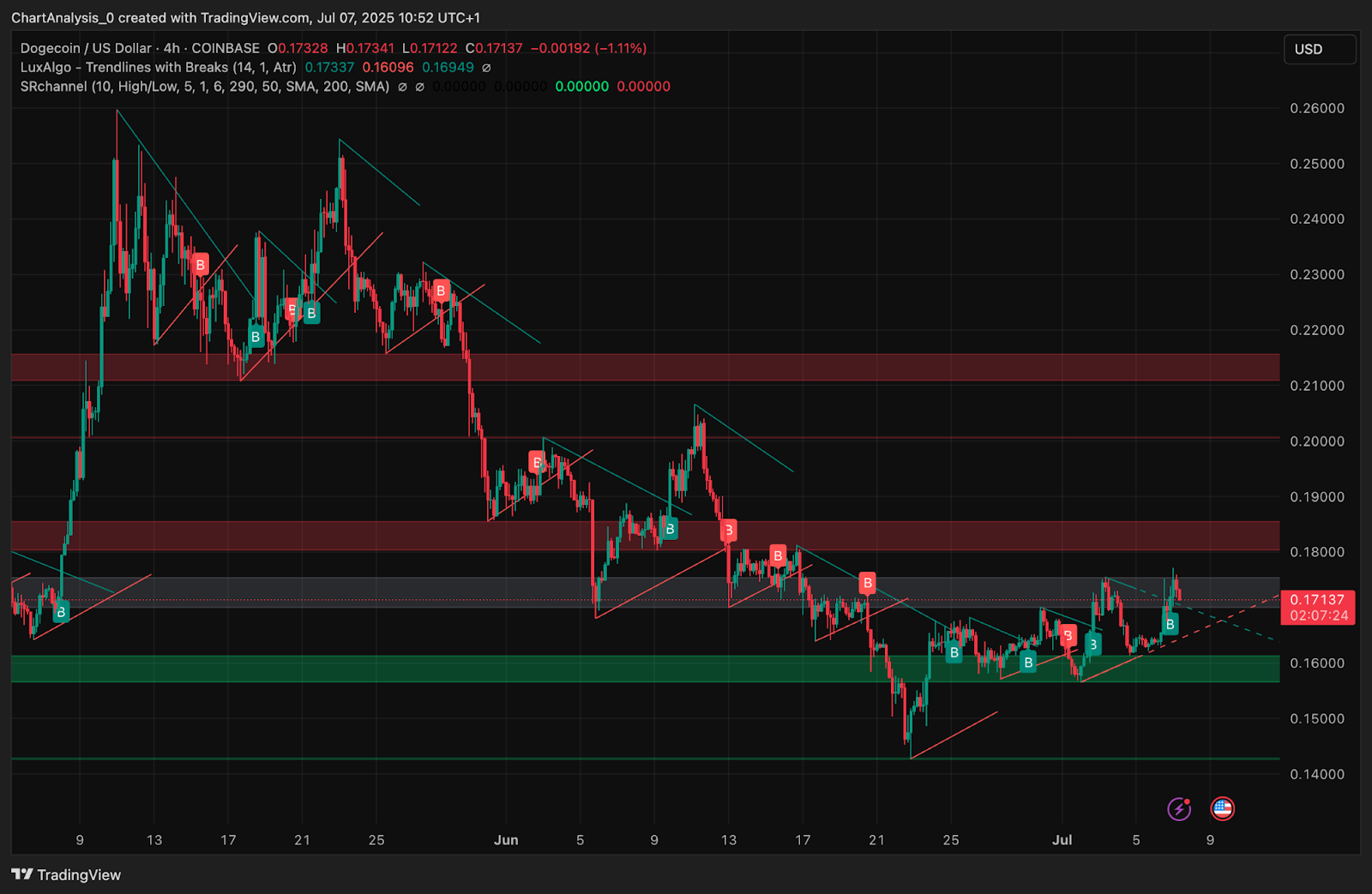
Dogecoin price today is hovering near $0.171 after briefly spiking above $0.175 earlier this week. While the broader structure remains compressed, DOGE has pushed off its $0.16 support level with a strong impulse move, but now faces significant overhead resistance near $0.175–$0.180. The next 24–48 hours could prove critical for price direction.
Dogecoin price has climbed over 5% off the July 3 low of $0.162, with bulls attempting to reclaim ground above key trendlines. On the 4-hour chart, DOGE has broken above a falling wedge structure and is now consolidating just beneath the upper Bollinger Band at $0.174, while the mid-band supports at $0.1665.
Parabolic SAR dots have flipped beneath price action, confirming a shift toward bullish control in the short term.
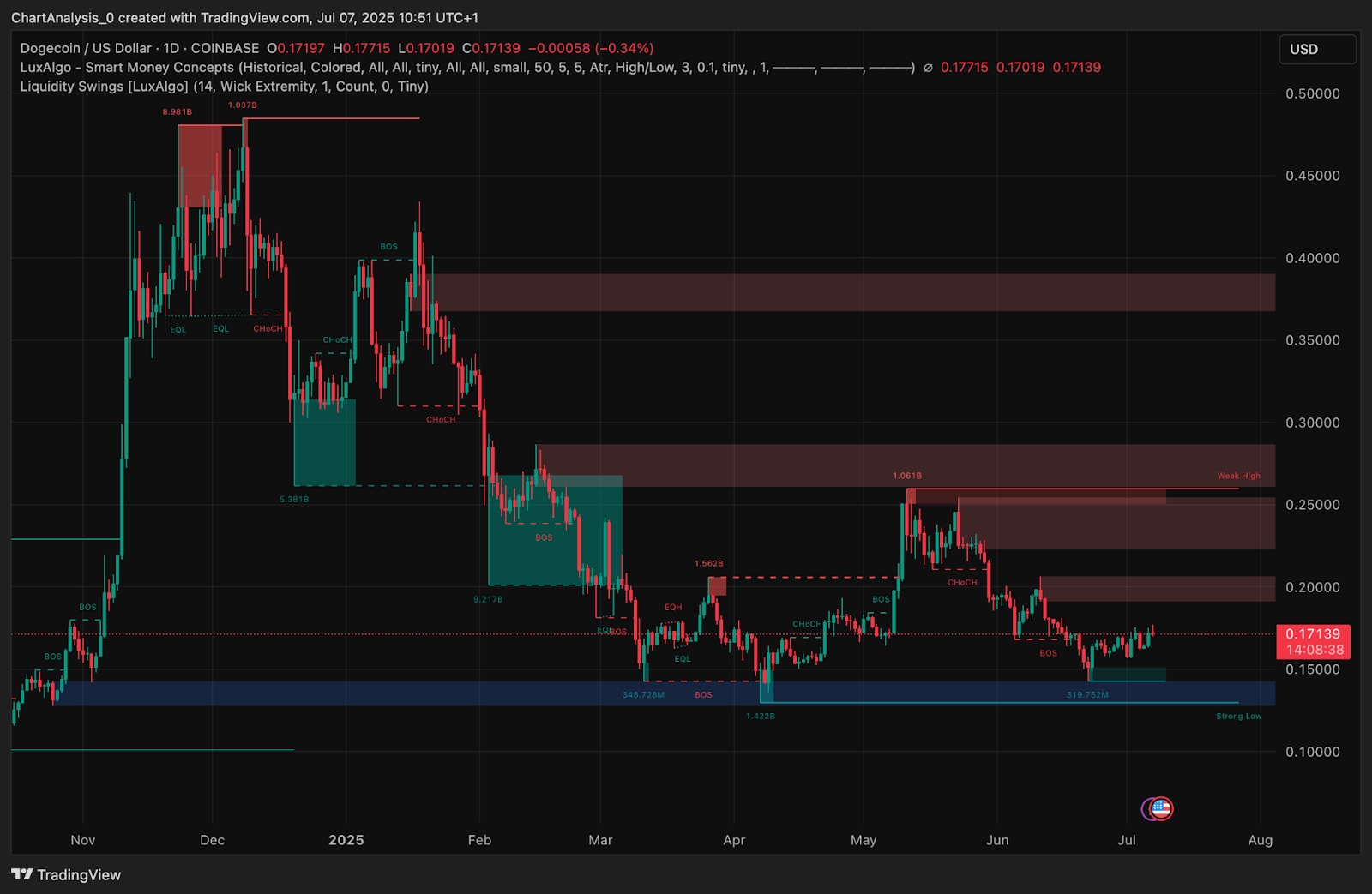
From a Smart Money Concepts (SMC) perspective, DOGE has maintained structure above the latest BOS level near $0.158 and is now retesting a prior CHoCH zone between $0.170–$0.175. Price is trading within a tight liquidity pocket, indicating that bulls are cautiously …
Platinum price confirmed delaying the bullish attack by its exit from the minor bullish channel’s levels, providing repeated negative pressure on the support that is represented by $1365.00 level, taking advantage of the stability of stochastic below 80 level and providing negative momentum.
Note that the bearish correctional scenario will remain valid in he current period trading, depending on forming a strong barrier at 1420.00 level, which makes us prefer targeting the correctional stations that begin at $1345.00 and $1330.00.
The expected trading range for today is between $1330.00 and $1400.00
EUR/USD trades in negative territory below 1.1750 on Monday.
The risk-averse market atmosphere makes it difficult for the pair to gain traction.
Markets await clarity on the EU-US trade relations.
EUR/USD stays under bearish pressure at the beginning of the week and trades below 1.1750. The pair’s technical outlook points to a bearish tilt in the near term as investors await news on the EU-US trade relations.
Euro PRICE Today
The table below shows the percentage change of Euro (EUR) against listed major currencies today. Euro was the weakest against the US Dollar.
USD
EUR
GBP
JPY
CAD
AUD
NZD
CHF
USD
0.43%
0.50%
0.76%
0.61%
1.01%
1.11%
0.48%
EUR
-0.43%
0.08%
0.07%
0.15%
0.65%
0.67%
0.03%
GBP
-0.50%
-0.08%
-0.02%
0.09%
0.58%
0.59%
-0.16%
JPY
-0.76%
-0.07%
0.02%
0.09%
0.48%
0.57%
-0.21%
CAD
-0.61%
-0.15%
-0.09%
-0.09%
0.42%
0.50%
-0.26%
AUD
-1.01%
-0.65%
-0.58%
-0.48%
-0.42%
0.11%
-0.73%
NZD
-1.11%
-0.67%
-0.59%
-0.57%
-0.50%
-0.11%
-0.76%
CHF
-0.48%
-0.03%
0.16%
0.21%
0.26%
0.73%
0.76%
The heat map shows percentage changes of major currencies against each other. The base currency is picked from the left column, while the quote currency is picked from the top row. For example, if you pick the Euro from the left column and move along the horizontal line to the US Dollar, the percentage change displayed in the box will represent EUR (base)/USD (quote).
The US Dollar (USD) benefits from the risk-averse market environment on Monday and weighs on EUR/USD. Reflecting the souring mood, US stock index futures were last seen losing between 0.2% and 0.6%.
Late Friday, a White House official said that trade negotiations with the EU were continuing and added that there was optimism an agreement could be reached soon. In the meantime, US President Donald Trump noted over the weekend that they will notify the countries, with which they fail to reach a deal, of tariff rates by July 9. Commerce Secretary Howard Lutnick explained that tariff rates will be set on by July 9 but they will take effect on August 1.
The data from Germany showed early Monday that Industrial Production grew by 1.2% on a monthly basis in May. This reading followed the 1.6% decrease recorded in April and came in better than the market expectation for a no change but failed to help the Euro gather strength.
In the absence of high-impact data releases, the risk perception could continue to drive EUR/USD’s action in the near term. In case Wall Street’s main indexes open on a bearish note and continue to push lower, the USD could hold its ground and continue to drag the pair lower. On the other hand, the pair could stage a rebound if markets turn optimistic about an EU-US trade deal ahead of the July 9 deadline.
EUR/USD Technical Analysis
EUR/USD dropped below the 20-period and the 50-period Simple Moving Averages (SMA) on the 4-hour chart and the Relative Strength Index declined to 40, highlighting a buildup of bearish momentum.
On the downside, 1.1730 (static level) aligns as an interim support level before 1.1670 (lower limit of the ascending regression channel) and 1.1640 (100-period SMA). Looking north, resistance levels could be seen at 1.1770 (mid-point of the ascending channel, 20-period SMA), 1.1800 (static level, round level) and 1.1830 (static level).
Tariffs FAQs
Tariffs are customs duties levied on certain merchandise imports or a category of products. Tariffs are designed to help local producers and manufacturers be more competitive in the market by providing a price advantage over similar goods that can be imported. Tariffs are widely used as tools of protectionism, along with trade barriers and import quotas.
Although tariffs and taxes both generate government revenue to fund public goods and services, they have several distinctions. Tariffs are prepaid at the port of entry, while taxes are paid at the time of purchase. Taxes are imposed on individual taxpayers and businesses, while tariffs are paid by importers.
There are two schools of thought among economists regarding the usage of tariffs. While some argue that tariffs are necessary to protect domestic industries and address trade imbalances, others see them as a harmful tool that could potentially drive prices higher over the long term and lead to a damaging trade war by encouraging tit-for-tat tariffs.
During the run-up to the presidential election in November 2024, Donald Trump made it clear that he intends to use tariffs to support the US economy and American producers. In 2024, Mexico, China and Canada accounted for 42% of total US imports. In this period, Mexico stood out as the top exporter with $466.6 billion, according to the US Census Bureau. Hence, Trump wants to focus on these three nations when imposing tariffs. He also plans to use the revenue generated through tariffs to lower personal income taxes.
Creatine is made in our bodies and found in red meat, poultry, and seafood. It helps produce energy during short, intense activities. Pre-workout supplements mix ingredients, like caffeine and creatine, to boost short-term performance. It’s important to check the ingredients before using them, as they may sometimes contain harmful or even banned ingredients.
Both creatine and pre-workout supplements are commonly used. Pre-workout supplements can sometimes also contain creatine, along with other ingredients. There are differences in their best uses, efficiency, safety, and the advantages and disadvantages they offer.
Creatine is one of the most studied supplements for improving sports performance and recovery. It may also increase muscle strength and mass.
You can take creatine at any time of the day, before or after a workout, with or without food. Taking creatine with foods that contain carbohydrates, a main source of energy in the body, or mixing it with carbs and protein may help your body store more creatine. This could benefit you because it can give you more energy overall.
Creatine is generally used for at least four weeks and can be used safely long-term. The most common way people use creatine is by taking three to five grams daily for four weeks to build creatine storage. This method is less likely to cause any potential side effects and is usually more effective in the long run.
Some people choose to start with 20 grams of creatine for one to two weeks and then lower their dose to three to five grams a day. This is called creatine loading, which people may try to increase strength and energy faster. People taking higher doses, such as when creatine loading, may experience mild stomach discomfort.
Disadvantages of Creatine Supplements
Possible disadvantages of creatine supplements include:
They’re not as well studied in women compared to men.
They only work best if taken consistently over time. This may be inconvenient for people only looking for short-term or one-time energy boosts.
They can cause gastrointestinal side effects when taken in larger doses, such as cramping, nausea, and diarrhea.
You can take pre-workout supplements either once or over longer periods. Research suggests that using a pre-workout supplement once may improve reaction time, enhance strength during heavier exercises like bench presses, and increase total reps, the number of times an exercise is repeated.
Pre-workout supplements can contain many different substances. Most ingredients in pre-workout supplements may include, but are not limited to:
Even if pre-workout supplements have safe and effective ingredients, the amounts might be too small to be beneficial.
You can’t see the exact amounts of ingredients used in proprietary blend products, which have formulas brands may choose not to disclose fully. Manufacturers must still list ingredients from most to least present in the product. This offers only limited information.
These products contain many ingredients that may interact with each other. This can either boost or reduce their effectiveness.
One or more of the ingredients found in blends may interact with medications.
Some ingredients may cause adverse effects. For example, niacin can cause flushing, a temporary skin reaction.
Two pre-workout supplements can be very different from each other. They may contain different ingredients in different dosages. It is difficult to know how much of each ingredient is present in a proprietary blend. That’s why it’s challenging for researchers to compare them and draw conclusions that could be generalized.
Banned Ingredients in Pre-Workouts
Some pre-workout supplements can contain banned substances. For example, dimethylamylamine (DMAA) was found in pre-workout supplements, which can be dangerous.
The Food and Drug Administration (FDA) states that it’s unsafe and illegal to include DMAA in dietary supplements. Some products on the market may still contain DMAA and other unsafe stimulants or heavy metals. It’s best to choose products that have third-party testing, which makes sure the product doesn’t contain harmful ingredients and contains what is listed on the label.
Choosing between creatine and pre-workout depends on your goals. Creatine might be a better option if you’re aiming to build muscle strength and increase muscle mass. You can take it at any time of the day. However, it isn’t a good option if you only want to use it once or short term, as this can make it less effective overall.
Pre-workout supplements might be a better option if you’re looking for a supplement to improve your exercise sessions and plan to use it only when you’re exercising. If you’re sensitive to stimulants like caffeine, you may want to avoid pre-workout supplements. Pre-workouts can have up to 400 milligrams of caffeine per serving, which is the maximum amount of caffeine a person can have in a day.
It’s hard to know how various ingredients in pre-workouts will interact with creatine. If you use both, it might be better to take pre-workout and creatine separately.
Since pre-workout is intended to be taken before exercise, you can take creatine at other times of the day. Pre-workout can also contain creatine. Be sure to check the ingredients and dosages if you decide to take both.
Caffeine is found in most pre-workouts. Limited evidence suggests that caffeine may interact with creatine, so taking them together may affect creatine’s efficiency.
Creatine supplementation may cause weight gain because it causes muscles to retain water. It may also cause nausea, diarrhea, muscle stiffness and cramps, and heat intolerance. It is generally well tolerated at recommended dosages.
Pre-workout supplements are also generally well tolerated. They may affect your heart rate, blood pressure, and liver. Side effects may vary based on the pre-workout’s ingredients and their dosages.
Both creatine and pre-workout supplements can interact with medications. If you have chronic (long-term) health conditions or are using any medications, speak to your healthcare provider before taking any supplements.
Creatine and pre-workout can be used to support sports performance. Creatine is more suitable for improving muscle strength, mass, and recovery. Pre-workout, on the other hand, may help improve exercise sessions. Both may cause side effects and interact with medications.
Why Dogecoin
(DOGE) is surging has become the burning question among cryptocurrency
investors as the meme coin demonstrates new wave of resilience in Monday’s
trading session, 7 July, 2025.
Dogecoin
price has climbed 0.35% to $0.1721, establishing an intraday high of
$0.1766 – the highest level in a month. This surge follows Sunday’s impressive
4% appreciation, marking a stunning 24% rebound from June lows below
$0.1450.
Dogecoin
price today shows impressive technical strength with key support
established at $0.166. The breakout occurred between 12:00-13:00 on July 6,
with price jumping from $0.166 to $0.173 on massive 1.14 billion trading
volume. This represents a significant shift in market dynamics, particularly as
whale wallets accumulated aggressively while smaller retail holders exited
positions.
The technical analysis reveals:
24-hour
surge: 5.01% from $0.163 to $0.171
Key resistance: $0.173 during late-session
selling
Volume spike: Notable increases at 01:16
(12.8M) and 01:36 (8.0M)
Support confirmation: Strong base at $0.166 level
Why Dogecoin price is up today? Source: Tradingview.com
Why Dogecoin is Surging? Key
Market Drivers
Federal Reserve Rate Cut
Optimism Fuels Rally
The primary
catalyst behind why Dogecoin is going up stems from renewed optimism
surrounding potential Federal Reserve rate cuts. Dogecoin surged over 6% in the
past 24 hours, leading major cryptocurrency gains as Bitcoin approached the
$110,000 mark. The rally gained momentum after U.S. officials announced a
three-week extension for tariff negotiations, calming global trade fears that
had previously weighed on risk assets.
“Markets
are rallying after it was revealed countries will have more time to negotiate
before tariffs take effect,” explained Jeff Mei, COO at BTSE. “If we
see a soft CPI print on Tuesday, that could open the door for a Fed rate cut
later this year.”
Elon Musk’s America Party
Announcement Ignites DOGE Speculation
Dogecoin
news took a dramatic turn with Elon Musk’s surprise announcement of the
America Party over the weekend. The Tesla CEO’s new political platform,
featuring strong pro-Bitcoin rhetoric and criticism of Donald Trump’s
“anti-innovation” financial agenda, has sparked intense speculation
about Dogecoin’s potential role in Musk’s movement.
While no
formal mention of Dogecoin was made in the announcement, Musk’s
history of integrating DOGE into Tesla and X (formerly Twitter) products has
fueled market optimism. The announcement triggered heavy whale accumulation,
with trading volumes exceeding $1.1 billion as institutional investors
demonstrated renewed confidence in the meme coin.
“Optimism
surrounding the potential announcements of new U.S. trade deals and Elon Musk’s
supportive comment” are helping crypto prices, including Bitcoin, said Shawn
Young, Chief Analyst at crypto exchange MEXC. “However, despite the
headline-driven lift, the market’s underlying momentum remains muted,” with
cryptos stuck in consolidations.
Whale Activity Signals
Institutional Confidence
On-chain
data from IntoTheBlock reveals heavy buying from whale wallets, particularly
those holding 1M-100M DOGE tokens. This institutional accumulation pattern,
combined with retail position reduction, suggests a fundamental shift in Dogecoin ownership
structure that could support higher price levels.
Dogecoin
shares the
broader cryptocurrency market’s positive sentiment, with Bitcoin gaining 1.1%
to trade above $109,000 and Ethereum adding 2.5% to reach $2,570. Other major
cryptocurrencies including Solana, XRP, Cardano, and Tron posted 2-4% gains,
supported by strong institutional inflows and improving market sentiment.
Source: CoinMarketCap
Eugene
Cheung, Chief Commercial Officer at OSL, noted: “The BTC bounce and ETH
inflows show traders are rotating into long-term value assets. We expect more
investors to seek shelter in crypto as macro volatility builds.”
According to Simon Peters, crypto analyst at eToro, “We could see some greater movement this week, as
investors return from the ‘Independence Day’ public holiday and digest the
passing of Trump’s ‘One Big Beautiful Bill’.”
“The Congressional Budget Office estimates the bill could add $3.4
trillion to federal deficits over the next 10 years. The forecasts of
increasing US government debt may drive more investor interest to bitcoin as
investors seek refuge from any future currency debasement.”
Political and Economic
Uncertainty
The
combination of Trump’s tariff deadline concerns and potential Federal Reserve
policy shifts has created a perfect storm for cryptocurrency adoption.
Investors increasingly view digital assets as hedges against traditional
financial system volatility, with Dogecoin price benefiting from this
broader narrative shift.
Technical Analysis:
Dogecoin Chart Breakdown
Based on my
technical analysis, the price of Dogecoin has changed direction. After moving
downward from the May highs within a bearish regression channel, the price
broke out to the upside and is now moving within a narrower but bullish green
regression channel.
There is
local resistance around the $0.00 level, which is currently drawing my
attention. Not far from this resistance zone lies the 50-day exponential moving
average (50 EMA), which will strengthen the current resistance area.
On a
positive note, Dogecoin is attempting to break above the $0.17 level, which had
previously served as resistance, marked by the lows seen in April, May, and the
first part of June.
If the
price manages to rise above the 50 EMA, the next target for me is the local
high from June 11 at around $0.20, which aligns with the 200 EMA—the 200-day
exponential moving average.
A
successful breakout above this range could open the path for a return to the
May highs near the $0.26 mark.
Monthly Structure and
Trend Analysis
The monthly
structure on Dogecoin reflects a prolonged downtrend capped by
repeated lower highs, with current price action coiling just below a descending
trendline. After a failed breakout attempt in early June near $0.215, DOGE
retraced sharply but found crucial support above $0.150 – a key demand zone
reinforced by prior consolidation patterns.
Volume and Liquidity
Considerations
Current
tightening price action inside a falling wedge aligns with a low-volume node
between $0.165 and $0.175. This technical setup, combined with the recent whale
accumulation patterns, suggests potential for explosive price movement in
either direction depending on broader market catalysts.
Dogecoin Price Predictions
abd Future Outlook: Expert Analysis for 2025
Short-Term Outlook: July
2025
Cryptocurrency
analysts present varied but generally optimistic Dogecoin price
predictions for the remainder of July 2025. Technical analysis suggests
potential upside targets between $0.192 and $0.205 if bulls successfully
reclaim current resistance levels. However, a break below $0.155 could trigger
a retest of the broader demand zone between $0.138 and $0.127.
Medium-Term Projections:
2025 Forecast
Why Dogecoin
is going up becomes clearer when examining longer-term analyst
projections:
Coinpedia forecasts: Maximum value of $1.07 by
2025, with minimum at $0.62 and average around $0.84
Long-Term Vision: 2030 and
Beyond
Extended Dogecoin
price predictions show remarkable optimism among cryptocurrency experts.
Coinpedia anticipates potential fluctuation between $2.52 and $3.035 by 2030,
while CoinMarketCap projects reaching a high of $1.57 and low of $1.31 during
the same period.
Dogecoin Price Predictions
Table
Time Frame
Source /
Basis
Forecast
Range (USD)
Notes
Short-Term
Technical
Analysis (July 2025)
$0.127 –
$0.205
Break below $0.155 could lead to
$0.127; upside capped at ~$0.205
Medium-Term
Changelly
$0.33 (end
of 2025)
Conservative
bullish scenario
CoinDCX
$0.55 (Q2
2025)
$1+ (end)
Assumes
strong bullish continuation
Coinpedia
Min: $0.62
Avg: $0.84
Max: $1.07
Suggests broad trading range by
end of 2025
Long-Term
(2030)
Coinpedia
$2.52 –
$3.035
High optimism over long-term
adoption
CoinMarketCap
$1.31 –
$1.57
More conservative long-term
estimate
Analyst Perspectives on
Dogecoin’s Future
Institutional Adoption
Potential
The shift
toward institutional accumulation represents a fundamental change in Dogecoin’s market
dynamics. Unlike previous retail-driven rallies, current price action
demonstrates sophisticated investor participation that could provide more
sustainable support levels.
Regulatory and Political
Factors
Musk’s
America Party announcement adds a new political dimension to Dogecoin
analysis. The potential integration of cryptocurrency themes into mainstream
political discourse could significantly impact long-term adoption and price
stability.
Dogecoin vs. Crypto Market
Context
Comparative Performance
Analysis
Dogecoin
stock (though
technically a cryptocurrency) has outperformed many traditional crypto assets
in recent sessions. The 6% daily gain significantly exceeded Bitcoin’s 1.1% and
Ethereum’s 2.5% increases, demonstrating renewed investor appetite for
meme-based digital assets.
Market Capitalization
Implications
Current
trading volumes exceeding $1.5 billion represent relatively high activity
levels, particularly for weekend trading periods. This sustained interest
suggests Dogecoin price movements may continue attracting significant
market attention throughout July 2025.
The
convergence of Federal Reserve policy speculation, Elon Musk’s political
ambitions, and technical breakout patterns creates a compelling narrative
for why Dogecoin is surging. While cryptocurrency markets remain
inherently volatile, current data suggests DOGE has established crucial support
levels that could facilitate further upward movement toward analyst price
targets.
Dogecoin News FAQ
Will DOGE Reach $1?
Yes,
multiple analysts believe Dogecoin can reach $1, with some projecting this
milestone by late 2025. Based on current market analysis and expert
predictions, Dogecoin reaching $1 appears increasingly feasible. CoinDCX
projections suggest bullish momentum could drive DOGE toward $0.55 by Q2
2025, with potential for $1+ by year-end. Coinpedia’s forecasts are even
more optimistic, anticipating a maximum value of $1.07 by 2025.
How Much Is $500 Worth of
Dogecoin Right Now?
At the
current price of $0.1721, $500 would purchase approximately 2,906 DOGE tokens.
Here’s the calculation breakdown:
Current
DOGE price: $0.1721
Investment
amount: $500
DOGE
tokens acquired: $500 ÷ $0.1721 = 2,906 DOGE
Value
scenarios based on analyst predictions:
If DOGE reaches $0.33 (Changelly’s 2025
target): Your 2,906 tokens = $958.98
If DOGE reaches $1.00 (optimistic 2025 target):
Your 2,906 tokens = $2,906
If DOGE reaches $2.00: Your 2,906 tokens = $5,812
Should I Pull My Money Out
of Dogecoin?
The
decision depends on your risk tolerance, investment timeline, and current
market analysis – but recent data suggests institutional confidence is growing.
Reasons to consider holding:
Whale accumulation: Large investors are buying
DOGE while retail investors sell, indicating institutional confidence
Technical support: Strong support established at
$0.166 with 24% rebound from June lows
Positive catalysts: Elon Musk’s America Party and
potential Fed rate cuts provide upside momentum
Analyst optimism: Multiple forecasts project
significant upside potential through 2025
Can Dogecoin Reach $2?
Yes,
long-term projections suggest Dogecoin could reach $2, though this target
appears more likely in the 2028-2030 timeframe.
Path to $2 analysis:
Current
price: $0.1721
Required
growth: Approximately 1,062% increase
Market cap implications: At $2, DOGE would have a
market cap of roughly $295 billion
Supporting factors for $2 target:
Extended timeline projections: Coinpedia anticipates DOGE
fluctuating between $2.52 and $3.035 by 2030
Institutional adoption: Growing whale accumulation
suggests professional investor interest
Political integration: Musk’s America Party could
mainstream cryptocurrency adoption
Inflation hedge narrative: Cryptocurrencies increasingly
viewed as alternatives to traditional assets
Why Dogecoin
(DOGE) is surging has become the burning question among cryptocurrency
investors as the meme coin demonstrates new wave of resilience in Monday’s
trading session, 7 July, 2025.
Dogecoin
price has climbed 0.35% to $0.1721, establishing an intraday high of
$0.1766 – the highest level in a month. This surge follows Sunday’s impressive
4% appreciation, marking a stunning 24% rebound from June lows below
$0.1450.
Dogecoin
price today shows impressive technical strength with key support
established at $0.166. The breakout occurred between 12:00-13:00 on July 6,
with price jumping from $0.166 to $0.173 on massive 1.14 billion trading
volume. This represents a significant shift in market dynamics, particularly as
whale wallets accumulated aggressively while smaller retail holders exited
positions.
The technical analysis reveals:
24-hour
surge: 5.01% from $0.163 to $0.171
Key resistance: $0.173 during late-session
selling
Volume spike: Notable increases at 01:16
(12.8M) and 01:36 (8.0M)
Support confirmation: Strong base at $0.166 level
Why Dogecoin price is up today? Source: Tradingview.com
Why Dogecoin is Surging? Key
Market Drivers
Federal Reserve Rate Cut
Optimism Fuels Rally
The primary
catalyst behind why Dogecoin is going up stems from renewed optimism
surrounding potential Federal Reserve rate cuts. Dogecoin surged over 6% in the
past 24 hours, leading major cryptocurrency gains as Bitcoin approached the
$110,000 mark. The rally gained momentum after U.S. officials announced a
three-week extension for tariff negotiations, calming global trade fears that
had previously weighed on risk assets.
“Markets
are rallying after it was revealed countries will have more time to negotiate
before tariffs take effect,” explained Jeff Mei, COO at BTSE. “If we
see a soft CPI print on Tuesday, that could open the door for a Fed rate cut
later this year.”
Elon Musk’s America Party
Announcement Ignites DOGE Speculation
Dogecoin
news took a dramatic turn with Elon Musk’s surprise announcement of the
America Party over the weekend. The Tesla CEO’s new political platform,
featuring strong pro-Bitcoin rhetoric and criticism of Donald Trump’s
“anti-innovation” financial agenda, has sparked intense speculation
about Dogecoin’s potential role in Musk’s movement.
While no
formal mention of Dogecoin was made in the announcement, Musk’s
history of integrating DOGE into Tesla and X (formerly Twitter) products has
fueled market optimism. The announcement triggered heavy whale accumulation,
with trading volumes exceeding $1.1 billion as institutional investors
demonstrated renewed confidence in the meme coin.
“Optimism
surrounding the potential announcements of new U.S. trade deals and Elon Musk’s
supportive comment” are helping crypto prices, including Bitcoin, said Shawn
Young, Chief Analyst at crypto exchange MEXC. “However, despite the
headline-driven lift, the market’s underlying momentum remains muted,” with
cryptos stuck in consolidations.
Whale Activity Signals
Institutional Confidence
On-chain
data from IntoTheBlock reveals heavy buying from whale wallets, particularly
those holding 1M-100M DOGE tokens. This institutional accumulation pattern,
combined with retail position reduction, suggests a fundamental shift in Dogecoin ownership
structure that could support higher price levels.
Dogecoin
shares the
broader cryptocurrency market’s positive sentiment, with Bitcoin gaining 1.1%
to trade above $109,000 and Ethereum adding 2.5% to reach $2,570. Other major
cryptocurrencies including Solana, XRP, Cardano, and Tron posted 2-4% gains,
supported by strong institutional inflows and improving market sentiment.
Source: CoinMarketCap
Eugene
Cheung, Chief Commercial Officer at OSL, noted: “The BTC bounce and ETH
inflows show traders are rotating into long-term value assets. We expect more
investors to seek shelter in crypto as macro volatility builds.”
According to Simon Peters, crypto analyst at eToro, “We could see some greater movement this week, as
investors return from the ‘Independence Day’ public holiday and digest the
passing of Trump’s ‘One Big Beautiful Bill’.”
“The Congressional Budget Office estimates the bill could add $3.4
trillion to federal deficits over the next 10 years. The forecasts of
increasing US government debt may drive more investor interest to bitcoin as
investors seek refuge from any future currency debasement.”
Political and Economic
Uncertainty
The
combination of Trump’s tariff deadline concerns and potential Federal Reserve
policy shifts has created a perfect storm for cryptocurrency adoption.
Investors increasingly view digital assets as hedges against traditional
financial system volatility, with Dogecoin price benefiting from this
broader narrative shift.
Technical Analysis:
Dogecoin Chart Breakdown
Based on my
technical analysis, the price of Dogecoin has changed direction. After moving
downward from the May highs within a bearish regression channel, the price
broke out to the upside and is now moving within a narrower but bullish green
regression channel.
There is
local resistance around the $0.00 level, which is currently drawing my
attention. Not far from this resistance zone lies the 50-day exponential moving
average (50 EMA), which will strengthen the current resistance area.
On a
positive note, Dogecoin is attempting to break above the $0.17 level, which had
previously served as resistance, marked by the lows seen in April, May, and the
first part of June.
If the
price manages to rise above the 50 EMA, the next target for me is the local
high from June 11 at around $0.20, which aligns with the 200 EMA—the 200-day
exponential moving average.
A
successful breakout above this range could open the path for a return to the
May highs near the $0.26 mark.
Monthly Structure and
Trend Analysis
The monthly
structure on Dogecoin reflects a prolonged downtrend capped by
repeated lower highs, with current price action coiling just below a descending
trendline. After a failed breakout attempt in early June near $0.215, DOGE
retraced sharply but found crucial support above $0.150 – a key demand zone
reinforced by prior consolidation patterns.
Volume and Liquidity
Considerations
Current
tightening price action inside a falling wedge aligns with a low-volume node
between $0.165 and $0.175. This technical setup, combined with the recent whale
accumulation patterns, suggests potential for explosive price movement in
either direction depending on broader market catalysts.
Dogecoin Price Predictions
abd Future Outlook: Expert Analysis for 2025
Short-Term Outlook: July
2025
Cryptocurrency
analysts present varied but generally optimistic Dogecoin price
predictions for the remainder of July 2025. Technical analysis suggests
potential upside targets between $0.192 and $0.205 if bulls successfully
reclaim current resistance levels. However, a break below $0.155 could trigger
a retest of the broader demand zone between $0.138 and $0.127.
Medium-Term Projections:
2025 Forecast
Why Dogecoin
is going up becomes clearer when examining longer-term analyst
projections:
Coinpedia forecasts: Maximum value of $1.07 by
2025, with minimum at $0.62 and average around $0.84
Long-Term Vision: 2030 and
Beyond
Extended Dogecoin
price predictions show remarkable optimism among cryptocurrency experts.
Coinpedia anticipates potential fluctuation between $2.52 and $3.035 by 2030,
while CoinMarketCap projects reaching a high of $1.57 and low of $1.31 during
the same period.
Dogecoin Price Predictions
Table
Time Frame
Source /
Basis
Forecast
Range (USD)
Notes
Short-Term
Technical
Analysis (July 2025)
$0.127 –
$0.205
Break below $0.155 could lead to
$0.127; upside capped at ~$0.205
Medium-Term
Changelly
$0.33 (end
of 2025)
Conservative
bullish scenario
CoinDCX
$0.55 (Q2
2025)
$1+ (end)
Assumes
strong bullish continuation
Coinpedia
Min: $0.62
Avg: $0.84
Max: $1.07
Suggests broad trading range by
end of 2025
Long-Term
(2030)
Coinpedia
$2.52 –
$3.035
High optimism over long-term
adoption
CoinMarketCap
$1.31 –
$1.57
More conservative long-term
estimate
Analyst Perspectives on
Dogecoin’s Future
Institutional Adoption
Potential
The shift
toward institutional accumulation represents a fundamental change in Dogecoin’s market
dynamics. Unlike previous retail-driven rallies, current price action
demonstrates sophisticated investor participation that could provide more
sustainable support levels.
Regulatory and Political
Factors
Musk’s
America Party announcement adds a new political dimension to Dogecoin
analysis. The potential integration of cryptocurrency themes into mainstream
political discourse could significantly impact long-term adoption and price
stability.
Dogecoin vs. Crypto Market
Context
Comparative Performance
Analysis
Dogecoin
stock (though
technically a cryptocurrency) has outperformed many traditional crypto assets
in recent sessions. The 6% daily gain significantly exceeded Bitcoin’s 1.1% and
Ethereum’s 2.5% increases, demonstrating renewed investor appetite for
meme-based digital assets.
Market Capitalization
Implications
Current
trading volumes exceeding $1.5 billion represent relatively high activity
levels, particularly for weekend trading periods. This sustained interest
suggests Dogecoin price movements may continue attracting significant
market attention throughout July 2025.
The
convergence of Federal Reserve policy speculation, Elon Musk’s political
ambitions, and technical breakout patterns creates a compelling narrative
for why Dogecoin is surging. While cryptocurrency markets remain
inherently volatile, current data suggests DOGE has established crucial support
levels that could facilitate further upward movement toward analyst price
targets.
Dogecoin News FAQ
Will DOGE Reach $1?
Yes,
multiple analysts believe Dogecoin can reach $1, with some projecting this
milestone by late 2025. Based on current market analysis and expert
predictions, Dogecoin reaching $1 appears increasingly feasible. CoinDCX
projections suggest bullish momentum could drive DOGE toward $0.55 by Q2
2025, with potential for $1+ by year-end. Coinpedia’s forecasts are even
more optimistic, anticipating a maximum value of $1.07 by 2025.
How Much Is $500 Worth of
Dogecoin Right Now?
At the
current price of $0.1721, $500 would purchase approximately 2,906 DOGE tokens.
Here’s the calculation breakdown:
Current
DOGE price: $0.1721
Investment
amount: $500
DOGE
tokens acquired: $500 ÷ $0.1721 = 2,906 DOGE
Value
scenarios based on analyst predictions:
If DOGE reaches $0.33 (Changelly’s 2025
target): Your 2,906 tokens = $958.98
If DOGE reaches $1.00 (optimistic 2025 target):
Your 2,906 tokens = $2,906
If DOGE reaches $2.00: Your 2,906 tokens = $5,812
Should I Pull My Money Out
of Dogecoin?
The
decision depends on your risk tolerance, investment timeline, and current
market analysis – but recent data suggests institutional confidence is growing.
Reasons to consider holding:
Whale accumulation: Large investors are buying
DOGE while retail investors sell, indicating institutional confidence
Technical support: Strong support established at
$0.166 with 24% rebound from June lows
Positive catalysts: Elon Musk’s America Party and
potential Fed rate cuts provide upside momentum
Analyst optimism: Multiple forecasts project
significant upside potential through 2025
Can Dogecoin Reach $2?
Yes,
long-term projections suggest Dogecoin could reach $2, though this target
appears more likely in the 2028-2030 timeframe.
Path to $2 analysis:
Current
price: $0.1721
Required
growth: Approximately 1,062% increase
Market cap implications: At $2, DOGE would have a
market cap of roughly $295 billion
Supporting factors for $2 target:
Extended timeline projections: Coinpedia anticipates DOGE
fluctuating between $2.52 and $3.035 by 2030
Institutional adoption: Growing whale accumulation
suggests professional investor interest
Political integration: Musk’s America Party could
mainstream cryptocurrency adoption
Inflation hedge narrative: Cryptocurrencies increasingly
viewed as alternatives to traditional assets








:max_bytes(150000):strip_icc()/Health-GettyImages-1582579510-1b96038a666842b4b0d65ee92eed5039.jpg "Creatine vs. Pre-Workout: Key Differences and Benefits")
