The US dollar has rallied a bit during the trading session here on Wednesday, but really at this point in time, the market is likely to continue to see a lot of noisy behavior.
And with that being the case, I think you have to understand that short-term pullbacks will probably get bought into.
With that being said, I think you’ve got a situation where what you will be watching more than anything else is how do we pay close attention and react to the non-farm payroll announcement.
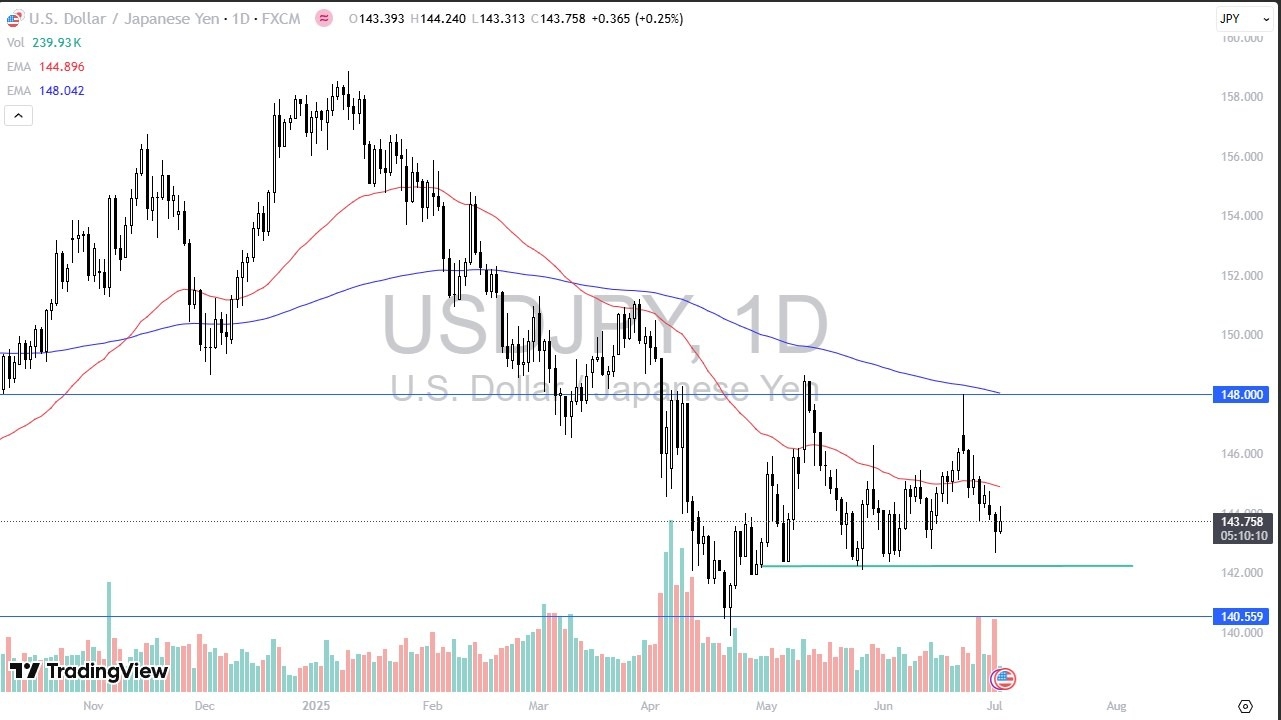
The 142 yen level continues to be significant support level here on short-term dips, I think as long as we stay above there, then it’s possible that we could see value hunting here because of the interest rate differential.
Other Important Factors
This has been a situation that while the US dollar has been weak, the Japanese have a significant problem with the bond market. So, it’s probably only a matter of time before the Bank of Japan has to enter and start quantitative easing. So therefore, I still like the idea of buying the US dollar against the Japanese yen, but I also recognize that perhaps it is going to be a situation where things are going to be rocky. They’re going to be noisy.
Hopefully, if you get long on a pullback, you are patient enough to take advantage of the interest rate differential during the swap and waiting on it to go higher. Ultimately, if we break down below the 142 yen level, then we could drop to the 140 yen level. All things being equal, this is a market that I think eventually will find a reason to go to 148 yen, although it could take some time from now to get there.
Christopher Lewis has been trading Forex and has over 20 years experience in financial markets. Chris has been a regular contributor to Daily Forex since the early days of the site. He writes about Forex for several online publications, including FX Empire, Investing.com, and his own site, aptly named The Trader Guy. Chris favours technical analysis methods to identify his trades and likes to trade equity indices and commodities as well as Forex. He favours a longer-term trading style, and his trades often last for days or weeks.
Nutritia VD is available online across major marketplaces and the official brand website
Nutritia VD, a rising name in holistic health, proudly introduces its range of high-quality dietary supplements tailored for the modern American lifestyle. From advanced hair care support to stress relief and heart health, the brand’s formulations are designed to nourish from within-without the additives and gimmicks.
Pure, Science-Backed Formulas for Real Results
With growing awareness around self-care and wellness, Nutritia VD meets demand with products rooted in transparency, safety, and performance. The product range includes:
Hair Vitamin supplements- Infused with Biotin, Zinc, and essential nutrients to support strong hair, glowing skin, and healthy nails
Omega-3 Softgels – Ultra-pure EPA & DHA for heart, brain, and joint wellness
Magnesium Glycinate – A calming mineral for sleep, muscle relaxation, and daily stress support
Ashwagandha + Black Pepper Capsules – Adaptogenic formula for natural mood balance and cortisol regulation
Each supplement is produced in a certified U.S. facility using globally sourced ingredients, with a firm commitment to non-GMO, cruelty-free, and artificial-free formulations.
A Clean Brand That Aligns With Modern Wellness
Nutritia VD speaks directly to conscious consumers looking for more than just trendy labels. “We’re here to simplify nutrition by providing clean, powerful supplements that actually deliver,” says [Founder’s Name], Founder of Nutritia VD. “Our mission is built on integrity, quality, and real customer impact.”
The brand’s minimalistic, U.S.-friendly packaging and fast-growing online presence reinforce its vision to become a go-to name in health and wellness across America.
Visit Us- https://nutritia.us/
Nutritia VD
info@nutiria.us
https://nutritia.us/
1234 Wellness Avenue, Suite 200
Los Angeles, CA 90017
USA
Nutritia VD, a fast-growing name in the health and wellness industry, proudly announces the launch of its curated supplement line designed for today’s health-conscious adults in the U.S. market. The brand’s core mission is simple: deliver clean,
As the broader crypto market continues to trade sideways, XRP stands out as a token drawing increasing institutional attention. Despite a generally quiet June across the digital asset space, and with July historically offering modest improvement, XRP has maintained a relatively stable position.
It’s been consolidating for several months now, reflecting the ongoing indecision in both retail and institutional segments of the market.
While this might seem uneventful on the surface, there’s a deeper narrative unfolding beneath. Recent data from CoinShares confirms that institutional investment in XRP is quietly gaining momentum.
Exchange-traded products (ETPs) linked to XRP saw inflows of $10.6 million in a single week, pushing the total for the first half of 2025 to an impressive $219 million. Though ETPs differ from ETFs in structure, they still represent a meaningful signal that large-scale investors are increasing their exposure.
This growing demand paints a compelling picture for XRP’s long-term potential, especially if regulatory clarity improves or spot ETFs eventually enter the scene.
Much of this interest stems from XRP’s historical reputation as a utility-driven token with real-world use cases, particularly in cross-border payments and financial settlement systems. Despite setbacks in previous years related to legal scrutiny and regulatory uncertainty, XRP has held onto its relevance.
Institutional investors continue to show confidence in XRP, even as its price remains relatively stagnant. Over the past several months, hundreds of millions have flowed into XRP investment products.
This steady accumulation suggests a deliberate, long-term strategy rather than speculative hype. Many see it as positioning ahead of a potential breakout once market conditions turn favorable.
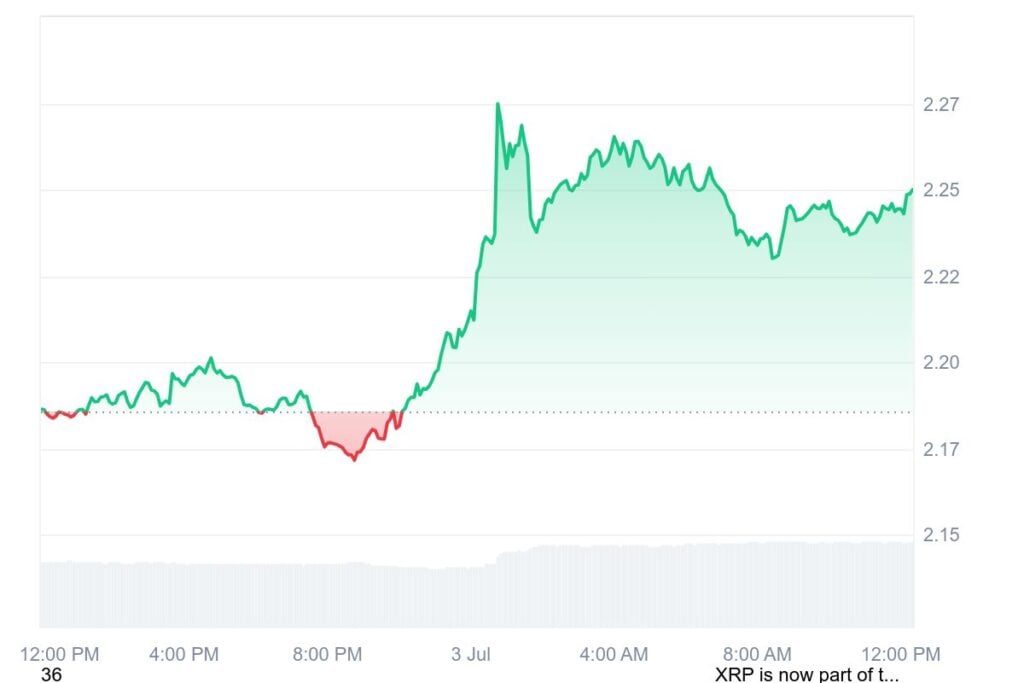
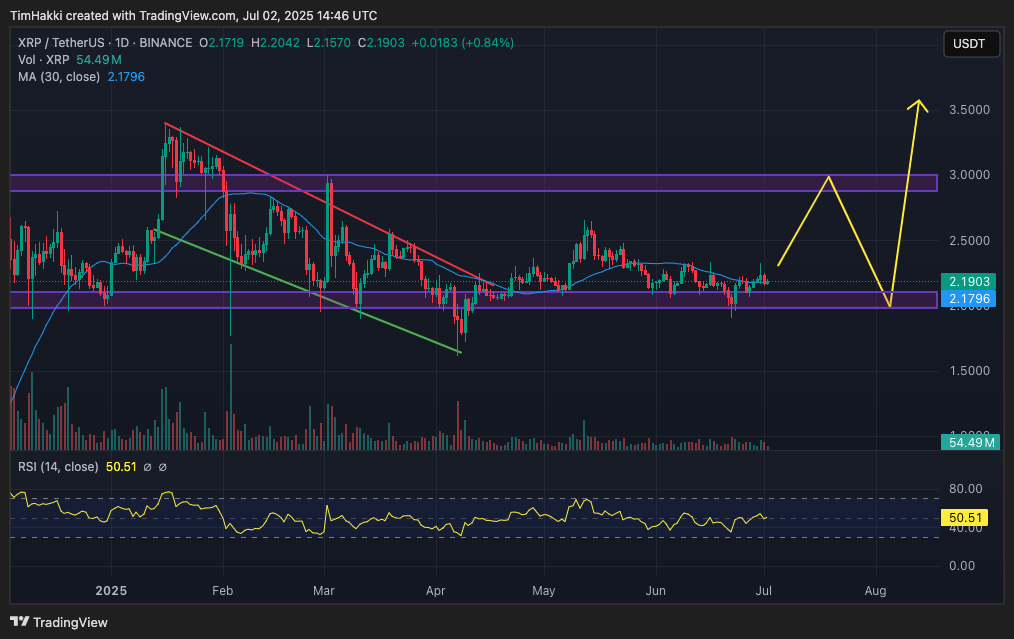
At the time of writing, XRP trades near $2.25, sitting just beneath two critical resistance zones at $2.27 and $2.30. A breakout above $2.30 could trigger a strong upward move, with the next significant resistance near $2.58.
These levels are widely viewed as major turning points that could define $XRP’s price direction for the rest of the quarter. On the flip side, support appears to be solid around the $1.95–$2.00 range, which bulls have successfully defended multiple times.
The token has been range-bound for much of 2025, moving within a tight consolidation channel. This sideways action reflects broader market indecision but also builds a foundation for a potential trend shift.
If XRP can push through the $2.30 barrier with meaningful volume, it may signal the start of a more aggressive bullish phase. Until then, traders are watching closely, with both institutional and retail participants anticipating a breakout that could reignite momentum in the months ahead.
XRP Institutional Growth Signals Shift—Bitcoin Hyper Brings the Tech
XRP’s growing institutional demand highlights a broader appetite for innovative blockchain solutions, setting the stage for emerging projects with real utility. Bitcoin Hyper, for example, is gaining traction as the first Bitcoin layer 2 chain designed to overcome the network’s long-standing limitations.
It enables fast, low-cost transactions while supporting DeFi, meme coins, and dApps—features traditionally absent from Bitcoin’s base layer. Built with an integrated bridge, users can seamlessly move assets between Bitcoin and Bitcoin Hyper, maintaining the security of layer 1 while benefiting from the efficiency of layer 2.
The ecosystem includes key components such as a wallet, explorer, bridge, staking options, and meme-driven branding, all centered around its high-performance infrastructure. Leveraging the Solana Virtual Machine, Bitcoin Hyper achieves high throughput while maintaining decentralization.
It also utilizes zero-knowledge proofs to periodically sync its state with Bitcoin’s mainnet, ensuring strong security. Bitcoin Hyper’s tokenomics are designed to support both development and growth.
A significant portion of the supply is allocated to staking rewards (420% APY), marketing, community rewards, and listings. The project emphasizes transparency and community engagement, providing regular updates and involving major figures in the crypto space to build momentum and trust.
With only $2 million set for the presale’s current stage and a starting token price of $0.012125, the project is attracting early interest. Its meme-forward identity—featuring a humorous yet recognizable mascot—also helps capture attention while aligning with the growing trend of meme-layered ecosystems.
Unlike Bitcoin’s limited use case as a store of value, Bitcoin Hyper unlocks a broader financial utility. It enables DeFi operations, supports decentralized exchanges, and encourages creativity through meme coin launches.
The bridging process is simple and trustless, with Bitcoin deposited to monitored addresses and validated through smart contracts to mint equivalent tokens on the Hyper chain.
Overall, Bitcoin Hyper represents a bold attempt to merge the security of Bitcoin with the innovation of modern blockchain ecosystems, potentially transforming how Bitcoin is used in the next wave of crypto adoption.
Its unique blend of functionality, community-driven growth, and high staking incentives makes it a promising project to watch. To take part in the $HYPER token presale, visit bitcoinhyper.com.
This article has been provided by one of our commercial partners and does not reflect Cryptonomist’s opinion. Please be aware our commercial partners may use affiliate programs to generate revenues through the links on this article.
Solana is gaining momentum with the launch of its first-ever staking ETF, as institutional interest and technical indicators point to a potential breakout.
A wave of fresh catalysts has lined up all at once, from the launch of the first-ever SOL staking ETF. Moreover, the price action is starting to respond, technical indicators are firming up, and participants say the setup could be pointing to a bigger move ahead.
First-Ever SOL Staking ETF Gets Launched
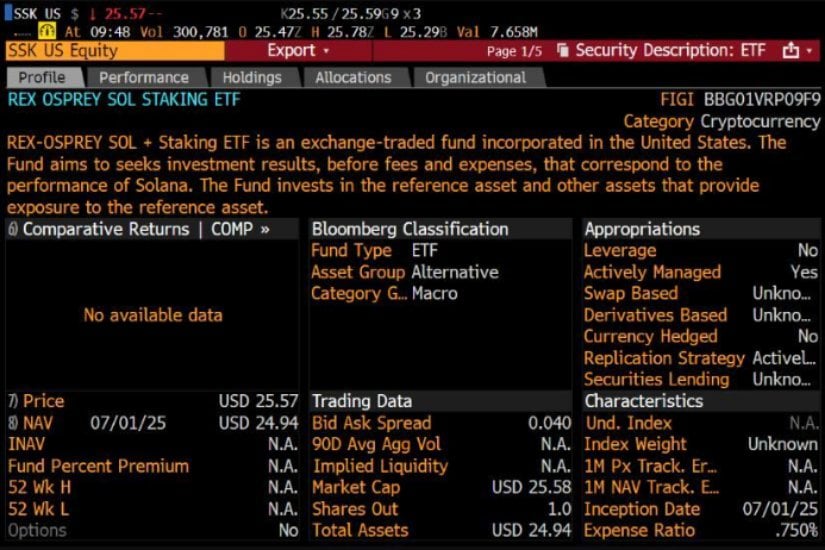
Solana just marked a major milestone in U.S. markets with the launch of the first-ever SOL staking ETF. Rolled out by REXShares and trading under the ticker $SSK, this new product allows traditional investors to gain exposure to SOL staking. It’s a step toward bringing crypto-native yield into a more accessible and regulated environment.
Solana’s $SSK ETF launch opens the door for traditional investors to access SOL staking. Source: SolanaFloor via X
Bitcoin spot ETFs and Ethereum futures ETFs helped legitimize those assets in the eyes of larger institutions. ETFs made it easier for big investors to get involved, and that helped bring in a lot more money. If the same path plays out for Solana, this ETF could end up being more than just a headline. It could act as a gateway for long-term price appreciation, especially if staking yield becomes a broader narrative in traditional markets.
James Seyffart reveals, SSK didn’t waste any time drawing attention; trading volume crossed $8 million within the first 20 minutes of launch. That kind of early activity shows there’s real interest, not just from crypto-native circles but from traditional investors too. It’s a strong signal that SOL staking, via an ETF, may have just opened up to a much wider audience.
$SSK ETF crossed $8 million in trading volume within 20 minutes. Source: James Seyffart via X
Ascending Trendline Keeps Solana Bullish
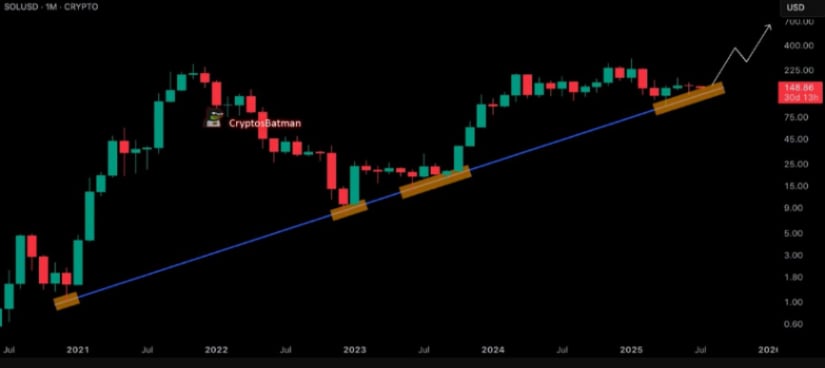
Coming off the momentum of the SOL staking ETF launch, there’s another reason bulls might be feeling confident. A long-term chart shared by CryptosBatman shows SOL continuing to respect a clear ascending trendline that’s been intact since mid-2022. Every major correction has found support on this line, and the most recent bounce is once again holding that structure.
Solana continues to respect a key ascending trendline, suggesting bullish momentum with potential upside targets of $180, $220, and $300. Source: CryptosBatman via X
While the price hovers around the $140 to $150 zone, this support line suggests that current levels could be a base. As long as SOL remains above this ascending trendline, the broader structure remains bullish. If momentum picks up from here, key upside levels to watch include the $180 zone, which aligns with prior resistance, followed by $220 and possibly even $300 on a longer horizon.
Wall Street Interest in Solana Hits New Highs
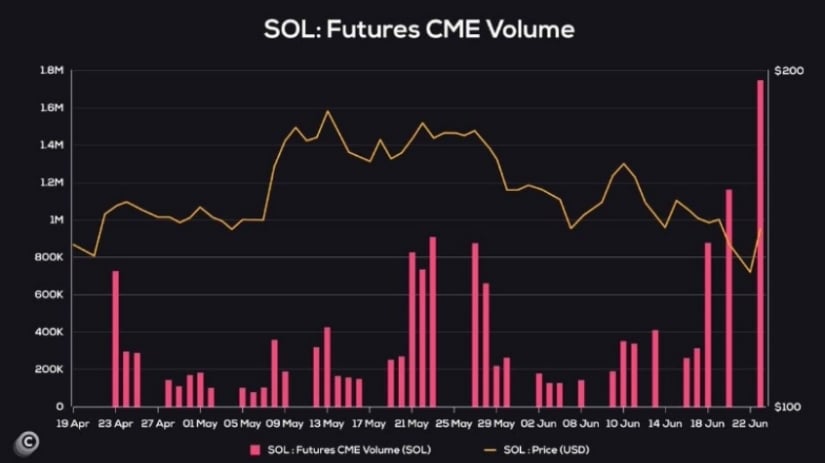
Solana’s recent momentum isn’t just about on-chain strength or ETF launches; traditional markets are tuning in too. According to a new chart from Coinvo, SOL futures volume on the CME has just hit an all-time high. This spike in volume from institutional venues is a strong sign that big players are actively positioning.
Solana’s SOL futures volume on the CME hits an all-time high. Source: Coinvo via X
This comes right after the launch of the first-ever SOL staking ETF and a clean technical setup holding firm on higher timeframes. When institutional interest starts spiking alongside solid fundamentals and a supportive chart, it often hints at the beginning of a much larger trend.
Solana Price Prediction: Eyes on the Red Zone
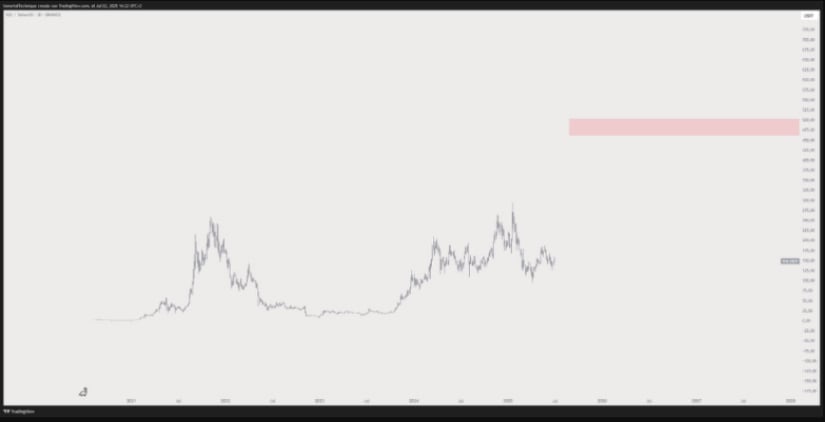
As momentum builds around Solana, community voices are already mapping out the next big move. Inmortal’s chart shows a projected upside zone, sitting in the $470–$500 range. It’s a visual projection for where SOL could head if the current structure holds and the broader market stays bullish. The change in tone around Solana reflects growing confidence within the Solana community, especially following the successful launch of the SOL staking ETF.
Solana’s price could reach the $470–$500 range if the current bullish momentum and market structure hold. Source: Inmortal via X
Indicators Flash Potential Reversal for Solana
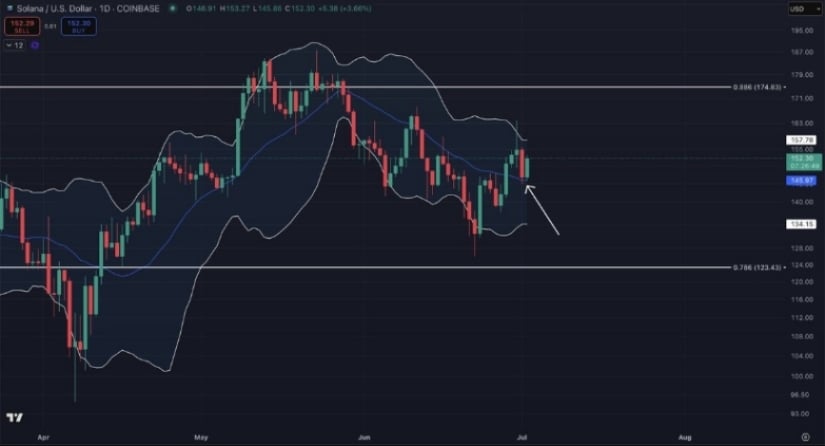
The short-term indicators are now showing a possible bounce setup. A chart from chad_ventures highlights how SOL found support at the 20-day Simple Moving Average. Price is reacting upward from that zone, suggesting buyers are stepping in to defend the level.
Solana shows signs of a potential bounce with support and tightening Bollinger Bands. Source: chad_ventures via X
Meanwhile, the Bollinger Bands are tightening. When this happens, it often leads to a strong move in either direction. If SOL holds above the 20-day SMA and expands out of this tight range, the next targets to monitor would be the $158 and $173 levels from recent highs.
Final Thoughts
The charts are showing strong structures, the community is leaning bullish, and even institutional players are getting off the sidelines. If SOL can stay above key levels like the 20-day SMA and the long-term ascending trendline, this could turn into a full-blown breakout cycle. Targets between $180 and $220 seem realistic if momentum holds, with higher projections like $300 or even $500 floating around in more aggressive scenarios.
Sell EUR/USD from the resistance level of 1.1870 with a target of 1.1500 and a stop-loss at 1.2000.
Buy EUR/USD from the support level of 1.1640 with a target of 1.1880 and a stop-loss at 1.1560.
EUR/USD Technical Analysis Today:
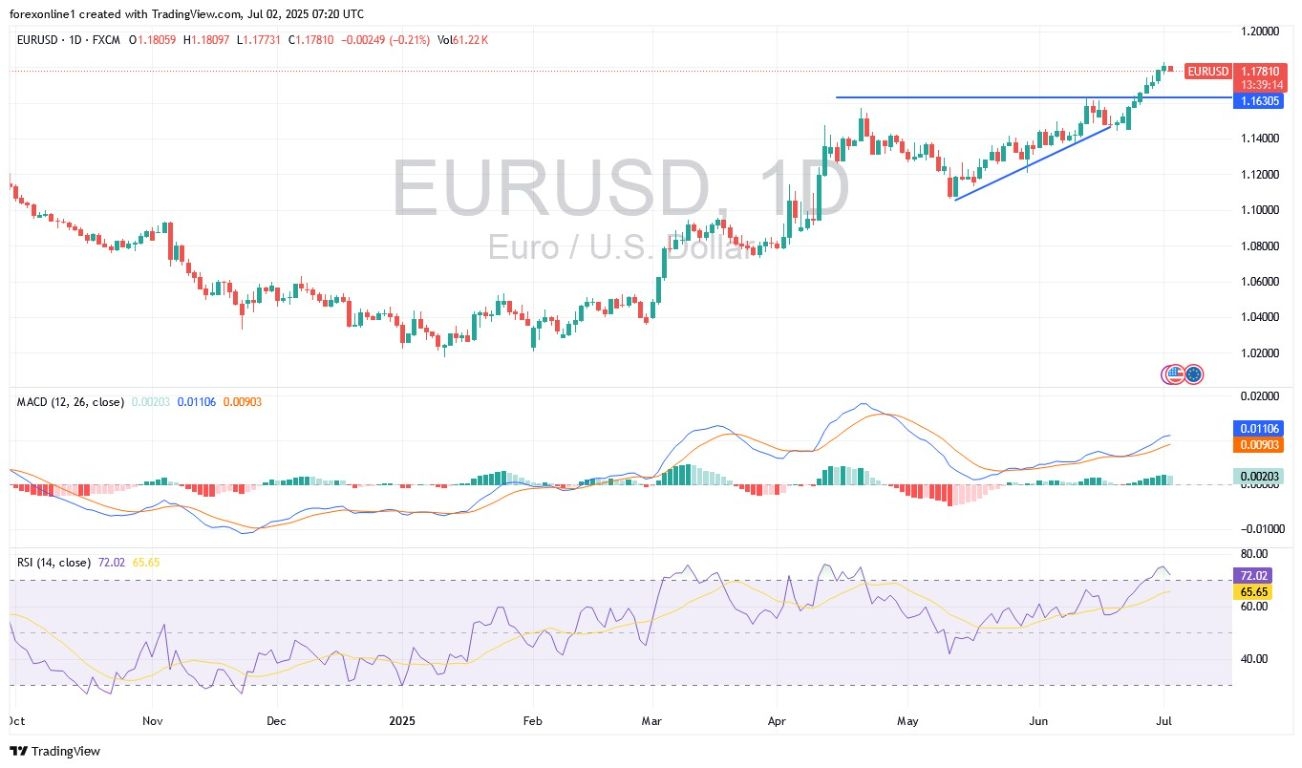
As anticipated, the EUR/USD pair has continued its strong upward momentum, with gains extending to the 1.1830 resistance level, the highest for this prominent currency pair in the forex market since August 2021. The Euro’s gains intensified as investors assessed comments from European Central Bank (ECB) policymakers following the Eurozone’s inflation rate reaching the ECB’s 2% target.
Speaking at the ECB Forum on Central Banking, ECB President Christine Lagarde welcomed the June inflation data, which came in as expected, but cautioned about “two-sided risks” stemming from increasing economic fragmentation and escalating geopolitical tensions. At the same time, other ECB officials indicated that interest rates are likely to remain stable at this month’s meeting, after eight consecutive deposit rate cuts since June 2024. This caution is amid ongoing concerns about global trade tensions, instability in the Middle East, and the Euro’s recent strength.
The single European currency also found support from a weaker US dollar, as markets continue to anticipate Federal Reserve interest rate cuts despite uncertainty surrounding the impact of tariffs imposed by US President Trump.
Trading Tips:
We advise monitoring EUR/USD selling levels rather than considering buying in hopes of further gains.
Will the EUR/USD pair reach the 1.20 level?
According to forex market experts, the EUR/USD trend remains positive; the medium-term trend is still upward and optimistic, as we’ve observed a multi-month sequence of higher lows and higher highs since March. The 1.1800 resistance will remain a key target for bulls, but keep in mind that technical indicators are heading towards overbought territory, led by the 14-day RSI (Relative Strength Index) and the MACD (Moving Average Convergence Divergence) indicator. Overall, we foresee continued US dollar risks and further EUR/USD gains; however, the current combination of negative risks for the US dollar makes the first half of July one of the best opportunities for a potential breakthrough of the 1.2000 psychological resistance.
These forecasts come as we approach mid-2025, a year characterized by a significant depreciation of the US dollar. In fact, it’s the worst start to a year for the US dollar since 1973, when it became a fully free-floating currency. It’s often said that US President Donald Trump’s policies are the main driver for the US dollar, but not enough is said about China, one of the most important factors facilitating these declines.
In this regard, trading experts added that the pace of China’s currency adjustment will influence the pace of the US dollar’s decline, which in turn will affect the pace of other global currencies. “Emerging European currency markets, as expected, are leading this field, as is the Euro, and I feel there is a significant impact on the price right now.”
As is well known, China manages the Yuan (CNY) through a daily fixing mechanism. When it allows the Yuan to appreciate (i.e., lowers the USD/CNY rate), it typically reflects its intention to absorb more global capital and reduce trade imbalances. China has pursued a stable Yuan policy that benefits its exporters by artificially keeping the exchange rate low.
However, in response to Trump’s efforts to rebalance US trade, there is an implicit understanding by Chinese authorities that their currency needs to be allowed to depreciate. This has global consequences, as a stronger CNY usually means widespread weakness for the US dollar. Traders also interpret lower USD/CNY rates as a signal to broadly sell the US dollar.
Trading experts forecast that for the EUR/USD to surpass the 1.2000 psychological resistance, the USD/CNY exchange rate would need to approach 7.0000. As of July 1, the USD/CNY exchange rate was 7.16, and the EUR/USD exchange rate was currently at 1.18000.
Euro gains reach overbought levels
According to performance on the daily chart and across reliable trading platforms, the EUR/USD gains have pushed technical indicators towards strong overbought levels. This is clearly visible in the direction of the 14-day RSI (Relative Strength Index), which has breached the 70 lines, confirming overbought conditions. Also, the MACD (Moving Average Convergence Divergence) lines. Consequently, if the EUR/USD receives new strong momentum, the currency pair could be subject to profit-taking selling.
Furthermore, we expect the euro dollar price to remain stable around its gains until the markets react to the announcement of US jobs numbers at the end of the week, which in turn affects market expectations for future Federal Reserve policy. Today, the euro dollar price may react to the announcement of the eurozone unemployment rate at 12:00 PM. Cairo time. Then expected statements from the Governor of the European Central Bank, Lagarde.
Fish oil capsules have long been sold for heart and joint health, yet new evidence suggests they may also steady tempers and aggression.
A sweeping meta‑analysis from the University of Pennsylvania reports that a daily dose of omega‑3 fatty acids can shrink aggressive behavior by up to 28 percent. Adrian Raine, a neurocriminologist at the university, led the study.
Mood, memory, and fish oil
Brains run on fat, and two key omega‑3 molecules, eicosapentaenoic acid (EPA) and docosahexaenoic acid (DHA), slip into cell membranes, helping neurons fire smoothly.
Low tissue levels of these fats have been tied to mood swings and impulsive violence, while diets rich in cold‑water fish tend to show the opposite pattern.
Because the body converts plant‑based alpha‑linolenic acid to EPA and DHA inefficiently, researchers have wondered whether supplements could fill the gap.
Small trials dating back to the 1990s hinted at behavioral benefits, but sample sizes were too thin to guide policy.
Aggression and fish oil
Raine’s team pored over 28 randomized controlled trials that enrolled 3,918 participates, from children to older adults.
Across genders, diagnoses, dosages, and study lengths, the capsules produced a modest but reliable drop in both reactive and premeditated aggression.
“I think the time has come to implement omega‑3 supplementation to reduce aggression,” said Raine.
The average effect size, about 0.22 on the standardized “g” scale, may sound small, yet public‑health experts note that even tiny behavioral shifts can matter when applied to millions.
The chemistry of calm
EPA and DHA dampen production of pro‑inflammatory molecules that sensitize the brain’s stress circuits. They also nudge serotonin and dopamine signaling toward a calmer set point, offering a biochemical explanation for the behavioral change.
Notably, the analysis found benefits at doses as low as 250 milligrams of combined EPA and DHA, an amount found in a single soft gel.
Higher intakes did not guarantee bigger gains, hinting that individual genetics and baseline diet modulate the response.
The omega imbalance
Most Americans don’t get enough long-chain omega‑3s from food alone. The average U.S. diet is heavy on omega‑6 fatty acids – often in a 10:1 ratio to omega‑3 – which may fuel inflammation and irritability.
Experts recommend at least two servings of fatty fish a week, such as salmon or sardines.
For those who don’t eat seafood, even a basic supplement may close the gap and improve both physical and mental health.
Supplements that calm behavior
One six‑month trial in 8‑ to 16‑year‑olds reported a 59 percent drop in disruptive conduct that lasted half a year after the study ended.
Similar shifts have shown up in adult parolees and nursing‑home residents, suggesting age is no barrier.
Public‑school cafeterias could offer fish twice a week, while correctional facilities might issue capsules at intake. Raine notes that such steps are “low cost, low risk,” especially compared with medications or restraint.
Beyond behavior, omega‑3s continue to earn cardiovascular praise. In the REDUCE‑IT trial, 4 grams of purified EPA cut fatal heart attacks by 25 percent among statin users.
A calmer mind and a stronger heart in the same pill has obvious appeal for clinicians.
Fewer risks, broad access
Compared to prescription medications for aggression, fish oil has fewer side effects and is easier to access. It doesn’t require a prescription, and many brands are available over the counter at grocery stores or online.
That said, fish oil should not replace professional treatment when serious behavioral issues are involved. It can be a helpful addition, but therapy, structured support, and in some cases medication are still essential tools.
Room to refine dosing
Omega‑3 is “not a magic bullet,” Raine warned, stressing that therapy, education, and social support still matter. Most studies followed volunteers for four months; researchers need longer follow‑ups to see whether tempers stay cool.
Scientists also hope to learn why some volunteers improve more than others.
Genetics that alter fatty‑acid metabolism, baseline inflammation, and even gut microbiota may shape response. Tailored dosing could push the average benefit beyond today’s modest figures.
For now, experts say parents of an irritable child, or adults who catch themselves snapping, might consider swapping a sugary snack for salmon, or adding a budget fish‑oil capsule to breakfast. The risk is tiny, the price is low, and the evidence is getting harder to ignore.
Who needs fish oil most?
Not everyone responds the same to omega‑3 fatty acids. Genetic differences, particularly in the FADS gene, can affect how well the body makes EPA and DHA from plant-based sources.
People of Amerindian or African ancestry may have variations that change their conversion efficiency.
For some, this means supplements could be especially important to meet their brain’s needs and reduce inflammation-driven behaviors.
BNB Smart Chain’s Maxwell upgrade, which, according to the BNB Chain team, is “a technical leap forward for faster blocks, better validator coordination, and smoother network performance,” went live on Monday.
How has BNB’s BNBUSD price responded to the latest upgrade? Could buyers propel the price above the overhead resistance? Let’s analyze the charts to find out.
BNB price prediction
BNB broke above the descending channel pattern on Sunday, and the bulls successfully defended the retest of the breakout level on Tuesday. That suggests the bulls have flipped the resistance line into support.
The 20-day exponential moving average (EMA) ($648) is flattish, but the relative strength index (RSI) is just above the midpoint, indicating a slight momentum in favor of the bulls. If buyers sustain the price above $660, the BNBUSDT pair could climb to $675 and later to $698. Sellers are expected to fiercely defend the $698 resistance because a break above it opens the gates for a rally to $732.
Time is running out for the bears. They will have to swiftly pull the price back into the channel to make a comeback. That could sink the pair to $625.
The four-hour chart shows the price rebounded sharply off the resistance line, indicating solid demand at lower levels. The pair will complete a bullish inverse head-and-shoulders pattern if the price closes above $660. This bullish setup has a pattern target of $719.
The moving averages are likely to act as support on any pullback. The first sign of weakness will be a break and close below $643. That suggests the bulls have given up. The pair may then tumble to $636.
This article does not contain investment advice or recommendations. Every investment and trading move involves risk, and readers should conduct their own research when making a decision.
Pound Serling (GBP) was unable to make any headway against the US Dollar (USD) in early Europe on Wednesday and slid further to hit 1-week lows below 1.3600 early in US trading before settling around 1.3620.
The Pound to Dollar exchange rate (GBP/USD) was hurt on domestic grounds while the dollar was resilient despite a shock US jobs report.
UoB commented; “There are early signs that upward momentum is beginning to slow. From here, GBP must break and hold above 1.3800 soon, or the probability of further GBP strength will diminish rapidly.”
In the near term, it expects GBP/USD will trade between 1.3700-1.3780.
Scotiabank took a similar view with evidence that the bullish trend is close to exhaustion and added; “We continue to highlight the importance of medium-term support at the 50 day MA (1.3462) and anticipate a near -term range bound between 1.3650 support and 1.3750/1.3780 resistance.”
MUFG has a year-end forecast of 1.3950 amid renewed dollar losses.
The Pound was undermined initially by fiscal concerns following yesterday’s House of Commons vote on welfare reform.
The government survived, but only through a series of U-turns which dramatically watered down the content.
In this context, there will be little in the way of medium-term savings, reinforcing underlying fiscal concerns with increased speculation over Autumn tax rises.
Later in the session, monetary policy was the key element with notably dovish comments from Bank of England (BoE) external MPC member Taylor.
He commented; “Previously, I had seen a UK soft landing in the cards, with some remaining upside risks to inflation from the bump in 2025.”
He added; “Now I see that soft landing as being at risk, and greater probability of a downside scenario in 2026 pushing us off track as demand weakness and trade disruptions build.”
Taylor called for three further rate cuts in 2025. Markets had expected dovish comments given his vote for a cut at the June MPC meeting, but the tone was more downbeat than expected.
Scotiabank noted the shift in BoE market pricing; “Rates markets are pricing in about 56bpts of easing by year end, down adding about 15bpts over the last month or so.”
Traders are also pricing in at least a 90% chance of a rate cut at the August meeting.
The dollar survived despite much weaker-than-expected jobs data.
ADP reported that private payrolls declined 33,000 for June compared with consensus forecasts of an increase close to 100,000 and the May increase was revised lower to 29,000 from the 37,000 reported previously. This was the first negative figure since January 2021.
The data reinforced concerns over the labour market, although the latest Challenger survey reported that the pace of layoffs had eased in June.
Markets were also having to digest US fiscal developments and look ahead to major announcements on trade policy next week.
The Senate passed the budget Bill with Vice President Vance having to cast the tie-breaker vote. The legislation will now go back to the House for further debate.
The Congressional Budget Office has estimated that debt will be increased by $3.3trn over the next 10 years.
Win Thin, global head of markets strategy at Brown Brothers Harriman & Co commented; “I think the knee-jerk reaction was to buy the dollar on lower fiscal policy uncertainty.”
He added; “To me, pushing through a massive tax cut will eventually widen the budget deficit, which is ultimately dollar-negative.”
BNP Paribas FX portfolio manager Peter Vassallo pointed to underlying unpredictability surrounding policy making; “This switch towards a more uncertain policy regime created an environment where we as market participants see the U.S. as more hostile to international capital flows, international trading.”
Like this piece? Please share with your friends and colleagues:
International Money Transfer? Ask our resident FX expert a money transfer question or try John’s new, free, no-obligation personal service! ,where he helps every step of the way,
ensuring you get the best exchange rates on your currency requirements.
There are urgent warnings to the public after deepfake videos have surfaced online of trusted doctors and celebrities peddling “snake oil” supplements to consumers.
The siren sounded when fake videos emerged online of trusted clinicians, including Dr Norman Swan, Professor Jonathan Shaw and former Australian Medical Association (AMA) president Professor Kerryn Phelps, selling dietary supplements online.
One video depicts a fake Professor Shaw advertising a dietary supplement as a supposed treatment for type 2 diabetes.
The siren sounded when fake videos emerged online of trusted clinicians, including Dr Norman Swan (pictured above). (Janie Barrett)
In another video, a deepfake Dr Swan says scientific evidence is “stupid” while trying to sell weight loss products aimed at treating heart disease, diabetes and obesity.
The videos were produced by Deepfake technology to mimic trusted doctors’ faces and voices in an attempt to sell unproven products to the Australian public, AMA President Dr Danielle McMullen said.
“We are now living in an age where any video that appears online has to be questioned — is it real, or is it a deepfake?” McMullen said.
“Deepfake videos are becoming more and more convincing, and this technology is being exploited by dodgy companies peddling snake oil to vulnerable people who are dealing with serious health issues.”
One video depicts a fake Professor Shaw advertising a dietary supplement as a supposed treatment for type 2 diabetes. (YouTube)
The medical association has partially blamed Meta for the trend, saying the content was exacerbated by weakened content moderation on major social media platforms like Facebook and Instagram.
Meta changed its content moderation policy in January 2025.
“While no specific complaint figures have been released, misinformation and harmful content on Meta’s platforms have been widely reported to have increased since this policy change,” a letter from the AMA to the Minister for Communications reads.
“My attempts to get Meta to take down deepfake imaging has been futile.”
The AMA is pushing the federal government to do something about the “deeply concerning” trend.
The scam-like trend has also used deepfake videos of singer Adele and Australian actor Rebel Wilson to sell similar products.
The scam-like trend has also used deepfake videos of singer Adele, in an attempt to sell diet pills. (YouTube)
Several recommendations have been made to the government to curb the snakeoil salesmen’s tactics, including mandatory identification of the company responsible for videos promoting medical products, a portal for the public to report suspected deep fake videos, time-bound takedown requests to make companies take videos down when a complaint is lodged and appropriate encorfcement powers to fine companies found to be peddling medical products with deepfakes.
OpenAI’s powerful AI language model, ChatGPT, predicts a strong conclusion for the crypto market as 2025 draws to a close.
Bitcoin’s ($BTC) 1.3% gains in the last 24 hours have industry watchers on the edge of their seats, wondering if the world’s leading $2 trillion crypto is about to challenge its recent all-time high after weeks of relative inertia.
See, Bitcoin climbed to an unprecedented $111,814 on May 22, injecting renewed optimism into digital asset traders. Escalating tensions in the Middle Eastern switched investors to a risk-off outlook, which rocked not just crypto but also the stock market too, although talk of ceasefires is now injecting some confidence back into the world of asset trading.
If technical indicators are anything to go by, bullish traders now believe the sector is on the verge of a monumental rally, potentially surpassing the explosive bull run witnessed in 2021.
By analysing a combination of regulatory developments, project fundamentals, and recent price history, ChatGPT predicts that the following altcoins are positioned for substantial gains in the remainder of the year.
Ripple ($XRP): ChatGPT Predicts a Major Price Surge for This Cross-Border Payments Leader
ChatGPT’s projections suggest that Ripple’s XRP is gearing up for a major rally, potentially reaching prices between $5 and $7 before year-end, potentially almost tripling from its current levels near $2.18.
Multiple factors support this outlook: the conclusion of Ripple’s prolonged legal clash with the SEC, growing institutional integration, and speculation regarding approval for an XRP spot ETF within the U.S.
Previously, the United Nations Capital Development Fund praised XRP for its fast, economical, and regulatory-compliant transaction capabilities, reinforcing its growing and institutional relevance in cross-border payments.
Ripple’s legal battle ended in March when the SEC officially dismissed its lawsuit, following a key 2023 court ruling stating that XRP’s retail transactions did not constitute securities sales. This legal clarity reenergised market sentiment across the sector.
Currently trading close to $2, analysts have identified $3 as the next resistance level. Should XRP breach this barrier, ChatGPT anticipates a rise to $5 as a realistic target by the end of 2025, with the potential for $7 under highly favourable conditions.
Technical charts show parallel falling support and resistance lines forming between January and April to make a shape known as a bullish flag, a classic precursor to significant price advances.
Pepe ($PEPE): Meme Coin Giant Set for Explosive Gains by Year-End, Predicts ChatGPT
Pepe ($PEPE), inspired by Matt Furie’s renowned frog character, has cemented its place among the top meme coins since its launch. Since late 2024, it has consistently ranked in the top three meme assets by market cap, outperforming all non-dog-themed rivals.
Despite spawning a wave of imitators since debuting in April 2023, PEPE maintains dominance through unmatched community engagement and deep liquidity. Elon Musk, CEO of Tesla/SpaceX/X, has hinted multiple times on X that he holds PEPE alongside his well-known Dogecoin holdings.
Trading at approximately $0.000009517, ChatGPT’s analysis suggests PEPE could potentially quadruple or quintuple in value for holders by year-end.
With a current market cap exceeding $4 billion, PEPE remains around 66% below its all-time high of $0.00002803 recorded in December 2024. However, today Pepe is outperforming Bitcoin after adding 2% in the last 24 hours.
Technical indicators show a descending wedge pattern forming from November through March, which traditionally signals a trend reversal.
Should bullish momentum accelerate, PEPE could retest its previous peak and potentially climb to $0.00003 by fall, setting itself up to hit the highest bullish targets of $0.00004 to $0.00005 by New Year.
Dogecoin ($DOGE): The Original Meme Coin Ready to Reclaim the Spotlight
Dogecoin ($DOGE), the pioneering meme token, continues to hold a commanding market valuation of around $24.2 billion. Initially launched in 2013 as a parody, it has evolved into a legitimate cryptocurrency with real-world applications and a fiercely dedicated community.
Frequently moving in tandem with Bitcoin, Dogecoin combines meme volatility with surprising long-term stability.
Currently priced near $0.1612 and showing minimal movement in the past 24 hours, DOGE’s RSI is at 43 and trending higher, indicating some buying momentum is picking up now that Bitcoin is posting green candles again.
Additionally, technical charts reveal a steep falling wedge pattern forming from November through April, suggesting the potential for a sharp breakout.
ChatGPT predicts DOGE could soar to $1.50 if the broader market enters a bullish phase, representing a possible 9X return.
On the adoption front, Dogecoin enjoys strong corporate and celebrity endorsements. Tesla continues to accept DOGE for select merchandise purchases, while platforms like Revolut and PayPal integrate it into payment ecosystems, enhancing its mainstream utility.
Bitcoin Hyper ($HYPER): Next-Generation Layer-2 Meme Protocol Gearing Up for Impact
Beyond established altcoins, ChatGPT predicts a host of new entrants will be vying for our attention by the next bull run.
One such emerging project is Bitcoin Hyper ($HYPER), a Layer-2 protocol with meme coin branding that is currently in presale, fusing viral appeal with robust blockchain utility.
Although it has yet to list on major exchanges like Gemini, HYPER has already raised over $1.8 million in presale investments, driven by expectations of 10X gains once it launches.
Built on the Solana Virtual Machine (SVM), HYPER adds smart contract functionality to Bitcoin’s ecosystem through its Layer-2 infrastructure. Its Canonical Bridge enables fast, cost-efficient transactions alongside a diverse suite of dApps ranging from DeFi to NFTs.
Security audits by Coinsult found no key vulnerabilities, enhancing investor trust. The $HYPER token powers governance, staking, transaction fees, and access to the platform’s services, offering staking yields of up to 427% APY.