About Editorial team of BIPNs

Main team of content of bipns.com. Any type of content should be approved by us.
2 07, 2025

Pound Sterling reverses course after posting multi-year high

By |2025-07-02T22:00:19+03:00July 2, 2025|Forex News, News|0 Comments

  • GBP/USD trades in negative territory near 1.3700 on Wednesday.
  • The technical outlook suggests that the downward correction could extend in the near term.
  • Markets await private sector employment data from the US.

GBP/USD stays under bearish pressure on Wednesday and trades near 1.3700 after touching its highest level since October 2021 at 1.3788 on Tuesday. Investors await private sector employment data from the US.

British Pound PRICE Today

The table below shows the percentage change of British Pound (GBP) against listed major currencies today. British Pound was the weakest against the Canadian Dollar.

USD EUR GBP JPY CAD AUD NZD CHF
USD 0.28% 0.31% 0.35% 0.00% 0.16% 0.29% 0.17%
EUR -0.28% -0.00% 0.05% -0.32% -0.10% 0.12% -0.10%
GBP -0.31% 0.00% 0.04% -0.33% -0.15% 0.09% -0.13%
JPY -0.35% -0.05% -0.04% -0.34% -0.19% -0.01% -0.17%
CAD -0.00% 0.32% 0.33% 0.34% 0.17% 0.39% 0.18%
AUD -0.16% 0.10% 0.15% 0.19% -0.17% 0.28% 0.02%
NZD -0.29% -0.12% -0.09% 0.00% -0.39% -0.28% -0.23%
CHF -0.17% 0.10% 0.13% 0.17% -0.18% -0.02% 0.23%

The heat map shows percentage changes of major currencies against each other. The base currency is picked from the left column, while the quote currency is picked from the top row. For example, if you pick the British Pound from the left column and move along the horizontal line to the US Dollar, the percentage change displayed in the box will represent GBP (base)/USD (quote).

GBP/USD managed to post small gains on Tuesday but reversed its direction early Wednesday, with the US Dollar (USD) Index finding a foothold following a seven-day losing streak.

News of United States (US) President Donald Trump’s “Big Beautiful Bill” passing the Senate and Federal Reserve Chairman Jerome Powell’s cautious tone on policy-easing help the USD stay resilient against its rivals. While speaking at a policy panel at the European Central Bank’s (ECB) Forum on Central Banking, Powell noted that they forecast inflation to rise over the summer and reiterated that they will wait and assess data before taking the next policy step.

Meanwhile, dovish remarks from Bank of England (BoE) policymaker Alan Taylor seem to be weighing on Pound Sterling. Taylor argued that a total of five rate cuts are needed in 2025, adding that there is a greater probability of a downside scenario in 2026, as demand weakness and trade disruptions build.

Automatic Data Processing is expected to report an increase of 95,000 in private sector payrolls in June. In case the data offers a positive surprise with a print above 100,000, the USD could hold its ground and cause GBP/USD to stretch lower in the early American session.

Later in the day, the House of Representatives is expected to vote on the “Big Beautiful Bill.” In case the bill fails to clear this next hurdle, the USD could lose its strength with the immediate reaction.

GBP/USD Technical Analysis

The Relative Strength Index (RSI) indicator retreated slightly below 50 and GBP/USD closed the last 4-hour candle below the 20-period Simple Moving Average (SMA), highlighting a lack of buyer interest.

On the downside, 1.3685 (mid-point of the ascending channel) aligns as the next support level before 1.3650 (50-period SMA) and 1.3580 (100-period SMA). Looking north, resistance levels could be spotted at 1.3730 (20-period SMA), 1.3770 (static level) and 1.3800 (static level, round level).

Pound Sterling FAQs

The Pound Sterling (GBP) is the oldest currency in the world (886 AD) and the official currency of the United Kingdom. It is the fourth most traded unit for foreign exchange (FX) in the world, accounting for 12% of all transactions, averaging $630 billion a day, according to 2022 data.
Its key trading pairs are GBP/USD, also known as ‘Cable’, which accounts for 11% of FX, GBP/JPY, or the ‘Dragon’ as it is known by traders (3%), and EUR/GBP (2%). The Pound Sterling is issued by the Bank of England (BoE).

The single most important factor influencing the value of the Pound Sterling is monetary policy decided by the Bank of England. The BoE bases its decisions on whether it has achieved its primary goal of “price stability” – a steady inflation rate of around 2%. Its primary tool for achieving this is the adjustment of interest rates.
When inflation is too high, the BoE will try to rein it in by raising interest rates, making it more expensive for people and businesses to access credit. This is generally positive for GBP, as higher interest rates make the UK a more attractive place for global investors to park their money.
When inflation falls too low it is a sign economic growth is slowing. In this scenario, the BoE will consider lowering interest rates to cheapen credit so businesses will borrow more to invest in growth-generating projects.

Data releases gauge the health of the economy and can impact the value of the Pound Sterling. Indicators such as GDP, Manufacturing and Services PMIs, and employment can all influence the direction of the GBP.
A strong economy is good for Sterling. Not only does it attract more foreign investment but it may encourage the BoE to put up interest rates, which will directly strengthen GBP. Otherwise, if economic data is weak, the Pound Sterling is likely to fall.

Another significant data release for the Pound Sterling is the Trade Balance. This indicator measures the difference between what a country earns from its exports and what it spends on imports over a given period.
If a country produces highly sought-after exports, its currency will benefit purely from the extra demand created from foreign buyers seeking to purchase these goods. Therefore, a positive net Trade Balance strengthens a currency and vice versa for a negative balance.

Source link

2 07, 2025

This supplement is a ‘game changer’ for brain health

By |2025-07-02T21:56:34+03:00July 2, 2025|Dietary Supplements News, News|0 Comments


You’re watching your waistline, lifting weights and maybe even counting every step, but when was the last time you did something for your brain?

A supplement is making waves in the wellness world for its ability to boost cognitive function — and potentially help keep it sharp as you age.

For women, there’s an added bonus: It might make the so-called “change of life” a little easier, too.

Mental fitness is one of the most important factors when it comes to aging well. pixdesign123 – stock.adobe.com

What is Cognizin?

It’s the branded dietary supplement made from citicoline, a natural compound your body produces that’s vital for brain health and function, according to Healthline.

Citicoline helps form the membranes around brain cells and supports brain metabolism. It also boosts neurotransmitter levels in the central nervous system, protecting and powering your brain.

What are the benefits of Cognizin?

The supplement is part of a broad group of substances called nootropics, which some people use to sharpen thinking, memory and overall brain function.

Cognizin was a “game-changer” for Emma Heming Willis, co-founder of Make Time Wellness, who told The Post: “It’s science-backed support for your brain.”

In a study of healthy, middle-aged women, those taking the daily supplement experienced clear improvements in focus and cognitive control. They also performed better on mental tests and made fewer mistakes than those on a placebo.

Helen Christioni (L) and Emma Heming Willis (R) are
the co-founders of Make Time Wellness. Make Time

“Women in the study saw a difference in just under a month, and I have had a similar experience,” said Heming Willis, whose husband is actor Bruce Willis

“What really stood out to me is how it helps with the issues many of us face as we age — brain fog, forgetfulness and feeling mentally drained,” she added.

Studies have also found that regularly consuming Cognizin may help protect against memory loss due to aging, as well as improve recall in older adults.

That’s especially important for women, who are at a greater risk of developing Alzheimer’s disease and other forms of dementia during their lifetime.

Brain fog is one of the most common symptoms of women going through perimenopause. highwaystarz – stock.adobe.com

Who should be taking Cognizin?

“Cognizin is great for any woman who wants to stay sharp, focused, and mentally energized especially during super busy times in life — which, for me, is every day,” Helen Christioni, co-founder of Make Time Wellness, told The Post.

It can also potentially help with some of the cognitive symptoms associated with the menopause transition.

“When hormones start to shift, it can mess with how our brains work,” Christioni explained, noting that brain fog, mood swings, forgetfulness and mental fatigue tend become more common.

“It’s like giving your brain a little backup during a time when everything else feels out of balance,” she added.

But women aren’t the only ones who could gain from taking the supplement. 

“Anyone that is dealing with burnout, wants to support brain health or just wants a little extra clarity can benefit from Cognizin,” Christioni said. 

Cognizin can boost overall mental performance. Make Time
The supplement is generally well-tolerated. Make Time

Where can you get Cognizin?

You can buy Cognizin on its own online and in stores, but it’s also a key ingredient in Make Time Wellness’s Make Time for Brain and Beauty gummy and their Make Time for Brain, Body & Beauty powder.

These supplements also pack in biotin, which supports hair, nails and skin, along with curcumin, the active compound in turmeric.

“Curcumin is one of my favorite ingredients in the Brain, Body & Beauty formula,” Heming Willis said. “But what really makes this formula stand out is that it combines everything I was tired of taking separately.”

Think: choking down a handful of pills every morning, from brain boosting supplements to multivitamins.

“That’s why we created this as a delicious daily drink that covers all your bases,” Heming Willis said. “It’s kind of like a grown-up version of a natural Tang, made just for women.”


Source link

2 07, 2025

SOLX Rises 130% In 2 Days

By |2025-07-02T21:51:26+03:00July 2, 2025|Crypto News, News|0 Comments

The new Solana meme coin and Layer-2 token, Solaxy (SOLX), appears to have marked a macro bottom and is seeing a significant rally behind multiple CEX listings. 

Solaxy is now live on MEXC and has secured a listing on LBANK, triggering a breakout from its downtrend and ushering in a fresh bullish wave.

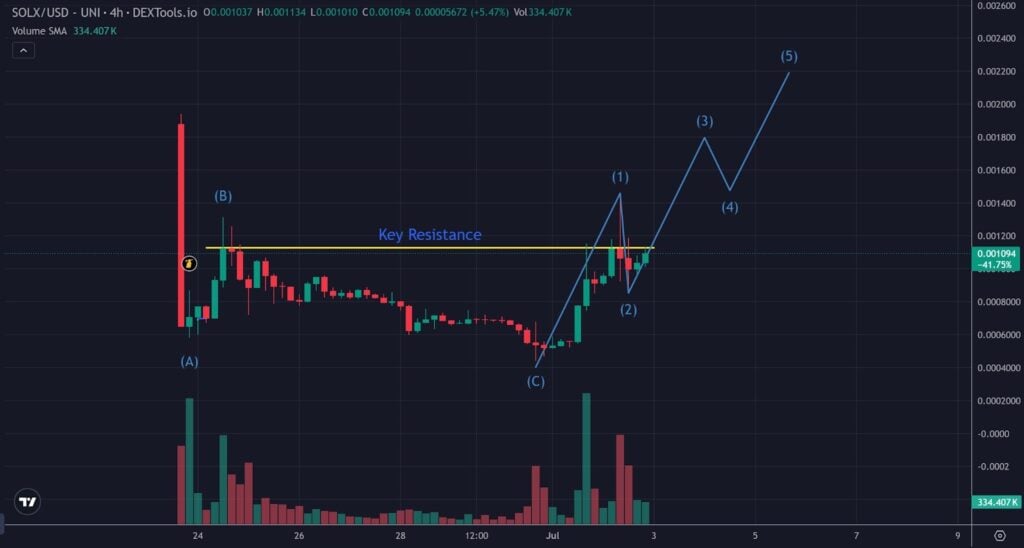
Since its June 30th low, the SOLX price has appreciated by 130%, trading at $0.00109 at press time. 

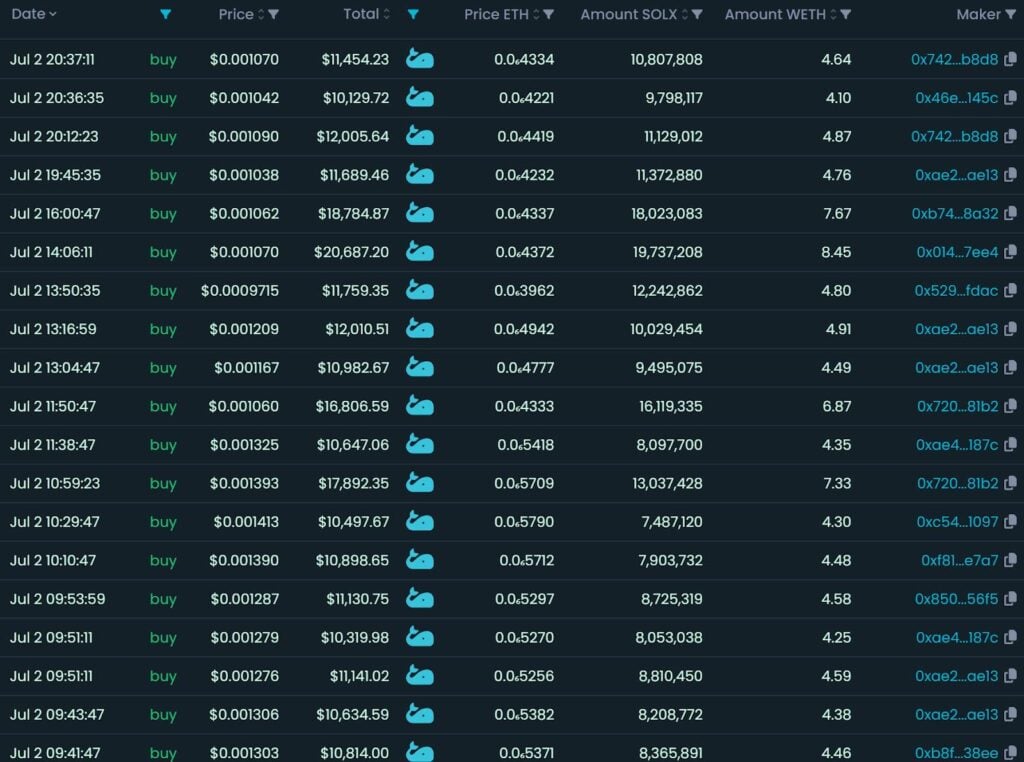
Meanwhile, the upcoming launch of its meme coin launchpad, a competitor to Pump.fun, and a native decentralized exchange, has also contributed to the bullish momentum. Whales have taken notice, which has resulted in a string of five-figure investments over the past couple of days. 

Our Solaxy price prediction projects a new five-wave impulsive move up, especially with the imminent launch of spot Solana ETFs, which is expected to be bullish for SOL meme coins. 

Why Is The SOLX Price Up Today?

The Solaxy price is up 130% since its June 30th low, trading at $0.00109 at press time. 

In fact, SOLX traded as high as $0.0014 early on Wednesday before a pullback to $0.0009. However, such temporary corrections are both normal and healthy in an uptrend, as Solaxy has already rebounded by nearly 20% on the day. 

Solaxy’s recent bullish strength is especially notable, given that token claims for users who staked SOLX during the presale went live on June 30, typically a bearish event.

However, it marked the macro bottom for SOLX, with the final bearish overhang now out of the way.

Furthermore, the project announced multiple CEX listings on Monday. SOLX has already made its debut on MEXC today and has secured an LBANK listing as well. 

The broader market backdrop has turned ideal for Solana meme coins, with REXShares’ SOL staking ETF going live today and the approval of spot Solana ETFs now imminent. As Solana’s price gears up for a rally, its meme coin ecosystem is expected to surge alongside it.

The upcoming launch of Solaxy’s meme coin launchpad Igniter and its native DEX Neptoon is also contributing to the bullish momentum. Check out the project’s X and Telegram accounts for more details. 

Solaxy Price Prediction – Best New Solana Meme Coin To Buy?

SOLX has breached its macro downtrend, marking the start of a new uptrend which could result in new all-time highs. 

The Elliot Wave analysis also confirms this. For the uninitiated, the Elliott Wave theory states that markets move in a cycle of five impulsive waves followed by three corrective waves, reflecting shifts in crowd psychology. 

However, presale coins often start with an A-B-C correction, followed by a 5-wave impulsive move towards the upside. SOLX is doing something similar.

SOLX Rises 130% In 2 Days

The Solaxy price appears to have started its 5-wave impulsive uptrend, which is likely to result in a new all-time high. However, sidelined investors should wait for a successful breach of the $0.00112 resistance level before buying. 

Meanwhile, whales aren’t waiting for anything, clearly viewing SOLX as one of the best Solana meme coins to invest in. 

Since its June 30th macro bottom, Solaxy is seeing a string of five-figure investments. 

Solana is experiencing rapid mainstream adoption, fueled by growing institutional demand. SOL treasury firms like Sol Strategies have quickly positioned themselves as the best crypto stocks to invest in. This momentum is only expected to accelerate with the launch of spot Solana ETFs.

Against such a backdrop, Solana meme coins could deliver outsized returns. Besides large-caps like Dogwifhat and Fartcoin, newer alternatives like Solaxy and Snorter are also making headlines.

Moreover, Solaxy is also the first prominent Solana Layer-2 coin, which often tends to reach billion-dollar valuations.

Therefore, our Solaxy price prediction is that SOLX could reach $0.004 in July, buoyed by CEX listings and the debut of its meme coin launchpad. 

This article has been provided by one of our commercial partners and does not reflect Cryptonomist’s opinion. Please be aware our commercial partners may use affiliate programs to generate revenues through the links on this article.


Source link

2 07, 2025

inverse C&H points to Japanese yen surge

By |2025-07-02T19:59:31+03:00July 2, 2025|Forex News, News|0 Comments

The USD/JPY exchange rate remained under pressure this week as the US Dollar Index (DXY) declined. It also retreated as traders reacted to a statement by Jerome Powell and as they waited for the upcoming US nonfarm payrolls data.

The USD to JPY exchange rate retreated to a low of 142.70 on Monday and then pared back some of these losses to 143.50. It remains 9.56% below its highest level this year.

US Dollar Index crash continues

The USD/JPY exchange rate has declined significantly over the past few months due to the ongoing decline in the US Dollar Index (DXY). The index, which tracks the dollar’s performance, has dropped to a low of $96, its lowest level in years. 

Its crash accelerated this week after Jerome Powell refused to rule out cutting interest rates as early as this month’s meeting. In a statement at a European Central Bank (ECB) meeting, Powell hinted that the bank would make its decision based on the available data.

He also said that the bank will not hesitate to cut interest rates if it the upcoming data shows that the labor market deteriorated and inflation fell. This was the first time that he agreed that the bank may decide to cut rates this month. 

Still, the market is not buying this view as the odds of a July cut remain low. Instead, most analysts expect that the bank will cut rates by 0.25% in its September meeting.

Goldman Sachs analysts expect the bank to cut rates three times this year and possibly several more times in 2026. This is one reason why the US Dollar Index has plunged. 

The DXY Index also plunged after the US Senate voted for Trump’s spending bill that introduces tax cuts and improves on regulations. This bill is expected to leave the US worse off as its deficit is expected to get worse over time. 

Looking ahead, the USD/JPY exchange rate will react to ADP’s nonfarm payroll data on Wednesday and the official nonfarm payroll figure on Thursday this week. 

Bank of Japan and the US deal

The other catalyst for the USD/JPY exchange rate is the potential deal between the US and Japan as Trump’s deadline nears. While the two countries have made progress on these talks, Japan has resisted US pressure on inflation. 

The lack of a deal between the two countries will hurt Japan more because of the volume of business it does with the United States. It will also hurt its automobile companies at a time when they are facing stiff competition from Chinee companies. 

Meanwhile, the Bank of Japan’s governor has insisted that it needs more data to determine when to cut rates. He is watching the strength of the underlying inflation, effects of US tariffs, and food inflation. 

Recent data showed that inflation rose to a two-year high in May, higher than its target level. As such, a rate hike cannot be ruled out later this year, making it the most hawkish central bank.

USD/JPY technical analysis

USDJPY chart by TradingView

Technicals suggest that the USD/JPY exchange rate has remained under pressure this year. It has formed an inverse cup-and-handle pattern, a bearish continuation sign. 

This pattern comprises of a rounded top and a handle and often leads to more downside. It is now forming the handle section. Also, it remains below the 50-day and 100-day Exponential Moving Averages (EMA).

Therefore, the pair will likely continue falling, with the next target to watch being the lower side of the cup at 139.98. A move below that level will point to more downside, potentially to 135.

The post USD/JPY forecast: inverse C&H points to Japanese yen surge appeared first on Invezz

Source link

2 07, 2025

Why Pre-Workout May Be Bad for Your Heart

By |2025-07-02T19:55:38+03:00July 2, 2025|Dietary Supplements News, News|0 Comments


Pre-workout powders and pills are meant to be used before exercising to boost your energy and performance. They often contain caffeine, creatine, glucose, and amino acids. The result: a highly stimulating concoction that may impact your heart, especially if you already take certain medications or have underlying conditions.

What Gives You Energy in Pre-Workout?

“Pre-workout supplements include a mix of different ingredients that each claim to improve exercise performance,” said Jessica Garay, PhD, RDN, assistant professor in the Department of Nutrition and Food Studies at Syracuse University.

“One of the most common ingredients is some form of caffeine, which is a stimulant,” she added. 

It’s usually not a trivial amount. Some products contain as much as 300 milligrams of caffeine per serving (that’s the equivalent of about three cups of coffee).

How Does Pre-Workout Affect Your Heart?

Elevated heart rate

“A pre-workout supplement often leads individuals to feel more alert because of the caffeine, but for some people, this could lead to an increased heart rate even before they start exercising,” Garay said.

That’s because caffeine stimulates your central nervous system, which can cause your heart to race.

Increased blood pressure

Stimulants can also temporarily raise blood pressure, said C. Vivek Lal, MD, FAAP, a physician at the University of Alabama at Birmingham and founder and CEO of Resbiotic. As a result, pre-workout can be risky for people with hypertension or other cardiovascular conditions.

Heart palpitations

Some people experience heart palpitations and chest pain after taking pre-workout. However, research shows these cases typically only occur when other factors are at play.

The adverse effects found in the analyzed studies include a small amount of evidence from case studies, where the patients already had factors that may aggravate cardiovascular complications, such as sensitivity to caffeine, a sedentary lifestyle, a family history of cardiac complications, and a history of smoking and/or alcoholism.

Caffeine sensitivity reactions

Not everyone processes caffeine the same way. “We now know there is a genetic component to how fast or slow we metabolize caffeine,” said Garay. This means that even low doses may trigger strong reactions in some people.

Should You Take Pre-Workout?

Though it isn’t inherently dangerous, pre-workout is not safe for everyone. Certain people should check with their doctor before trying it, or avoid it altogether:

  • Those taking prescription medications: Caffeine interacts with a number of prescription medications, so people who take blood thinners, blood pressure medication, or other stimulants should proceed with caution, Garay said.
  • People with heart or blood pressure issues: Be cautious with pre-workout supplements, especially those that contain high levels of caffeine or other stimulants. The stimulant effects can pose potential risks, including arrhythmias, chest discomfort, or elevated cardiovascular strain.
  • Caffeine-sensitive individuals: Some people can drink multiple espressos a day and not feel cardiac effects. In contrast, others can have a single cup of coffee and feel their heart racing, said Garay. A pre-workout may do more harm than good if you’re in the latter group.
  • Athletes subject to drug testing: Pre-workout supplements aren’t always tested for banned substances, said Garay. To avoid contamination risks, athletes should check for NSF Certified for Sport or Informed Choice labels.

Other Safety Considerations

“In general, the entire category of pre-workout supplements is among the least likely to have third-party testing from a reputable company,” said Garay.

Without third-party testing, there’s no guarantee that the label reflects what’s inside. Relying on pre-workout for every gym session may build tolerance or lead to dependency on high doses of caffeine to feel energized.

Instead of reaching for a pre-workout, Garay often recommends a simpler option: coffee or tea for caffeine. “I am often hesitant to recommend a pre-workout to my clients because of the risk of contamination, depending on the brand.”

What This Means For You

You don’t need a pre-workout; sometimes, it could actually work against your health goals. If you’ve ever felt your heart race after taking one or are on medications that affect your cardiovascular system, it’s time to rethink your routine.

By Kathleen Ferraro

Kathleen Ferraro is a writer and content strategist with a master’s degree in journalism and nearly a decade of experience in health, wellness, and science storytelling. She has served as a health editor at LIVESTRONG.com, contributed to publications like Everyday Health, Well+Good, and Outside, and developed copy and content strategy for brands like Stride Health, Peloton, Exos and more.


Source link

2 07, 2025

Dogecoin (DOGE) Price to Rally 150% Versus Bitcoin, Bollinger Bands Suggest

By |2025-07-02T19:50:35+03:00July 2, 2025|Crypto News, News|0 Comments

The Dogecoin price chart versus Bitcoin just hit its lowest point in over a year, but for some, this drop is just the calm before the storm, with the popular technical indicator, Bollinger Bands, signaling a possible turning point. 

In this setup, the DOGE/BTC pair is pretty much at the bottom of its monthly range right now, which according to chart history is a sign that the trend is about to change once the market starts looking beyond Bitcoin.

You Might Also Like

On the monthly Bollinger Bands, Dogecoin, which trades for about 0.00000086 BTC, is right near the lower band, while the midline sits at 0.00000226 BTC and the top band stretches to 0.00000367 BTC.

Should the price action follow the same patterns as before and soar to the upper band, there could be a move of over 140%. The market has not seen these levels since late 2022, which, coincidentally, was also the last time DOGE recovered from similar conditions.

Article image
Source: TradingView

What is forming now on the chart looks a lot like what happened in the second half of 2022: long periods of decline followed by tightening ranges and eventual spikes. Back then, DOGE rallied nearly 180% in four months.

The pattern does not rely on news or hype but rather on how the market behaves when things get too quiet for too long. The Bollinger Bands are designed to identify these kinds of overbought/oversold situations, and right now, they seem to be signaling just that.

You Might Also Like

Title news

To confirm a reversal, traders would likely want to see a clean close back above the lower band, ideally followed by some recovery toward key zones like 0.0000015 BTC. If that happens sometime in July, it could mean that DOGE’s downtrend is losing steam.

Even more importantly, it could show that some altcoins might be getting ready to outpace Bitcoin heading into Q3.

Source link

2 07, 2025

¿Qué es el colesterol oculto?

By |2025-07-02T18:59:49+03:00July 2, 2025|Fitness News, News|0 Comments

English

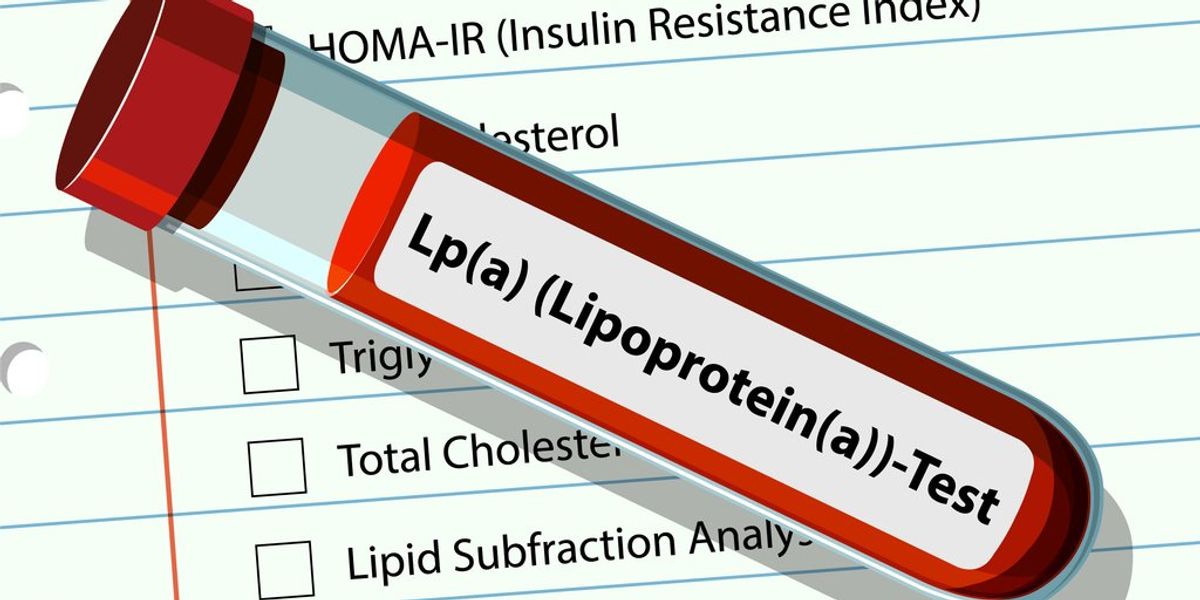
La lipoproteína (a) podría sonar como un labial para aumentar el volumen y la sensualidad de los labios, pero eso es incorrecto.

La lipoproteína (a) o Lp(a) es una partícula que se encuentra en tu sangre. Esta partícula transporta al colesterol y puede afectar tu riesgo de trastornos cardíacos, así que vale la pena saber más y hacer que se revisen tus niveles mediante pruebas de sangre.

Si bien los hábitos de tu estilo de vida pueden ejercer influencia en tu riesgo de tener niveles altos de Lp(a), estos se determinan principalmente por los genes que heredaste. Puesto que muchas personas que tienen niveles elevados de Lp(a) no tienen ningún síntoma, hablar de tus factores personales de riesgo con tu proveedor de atención médica (HCP, por sus siglas en inglés) es crucial para entender el panorama completo de tu salud cardiaca.

Obtén más información de la lipoproteína (a), incluyendo de los factores de riesgo, las pruebas, los resultados y cómo manejar niveles elevados.

¿Qué es el colesterol oculto?

La lipoproteína (a) se conoce también como el “colesterol oculto” porque las pruebas estándar de colesterol no lo detectan y frecuentemente no hay síntomas. La Lp(a) es una lipoproteína plasmática, es decir, una partícula que transporta grasas, tales como el colesterol, en tu sangre

Si bien los investigadores no comprenden completamente la función de la Lp(a), niveles altos se asocian a problemas cardiacos. Eso se debe a que niveles elevados de Lp(a) pueden acumularse en las paredes de tus vasos sanguíneos, causando placa (depósitos grasos) que hacen que los vasos sanguíneos se vuelvan más estrechos, lo cual dificulta el flujo sanguíneo y causa obstrucciones que pueden dar paso a ataques cardíacos o accidentes cardiovasculares.

¿Por qué debería conocer mis niveles de lipoproteínas (a)?

Conocer tus niveles de Lp(a) puede ser útil para que tomes medidas proactivas para que te protejas contra problemas cardíacos si fuese necesario. Niveles elevados de Lp(a) pueden incrementar el riesgo de:

  • Ataques cardíacos (infartos de miocardio)
  • Accidentes cardiovasculares
  • Estenosis de la válvula aórtica
  • Coágulos de sangre

La probabilidad de que ocurran estos eventos es mayor si tienes antecedentes familiares de niveles altos de colesterol de LBD, hipercolesterolemia familiar (HF) o señales de enfermedades cardíacas coronarias. Incluso si tus otros niveles de colesterol son normales (incluyendo las LBD) o están bien controlados, tener niveles elevados de Lp(a) aumenta el riesgo de problemas cardiacos. Conocer tus niveles puede proporcionar un panorama más completo de tu riesgo general de enfermedades cardiovasculares.

¿De qué depende tu nivel de Lp(a)?

Tus niveles de Lp(a) dependen casi por completo de tu genética. Hay un gen específico llamado LPA que se hereda de tus padres, lo cual explica por qué niveles altos frecuentemente se dan para familias enteras.

Esto significa que, a diferencia de otros tipos de colesterol, los niveles de Lp(a) no cambian mucho por cambios del estilo de vida tales como dietas y ejercicio. Sin embargo, hábitos saludables de estilo de vida todavía podrían tener un impacto importante en tu salud cardiaca general y en tu bienestar.

Los niveles de Lp(a) pueden variar para diferentes grupos étnicos. Por ejemplo, investigaciones indican que personas de ascendencia africana y del sur de Asia tienden a tener mayores niveles de Lp(a) en comparación con personas de raza blanca, asiáticas e hispanas. Un estudio de 2024 publicado en Journal of Clinical Lipidology [Revista de lipidología clínica] también identificó que dentro de sus grupos de pacientes, las personas de raza negra hispanas y no hispanas tuvieron mayores niveles de Lp(a).

¿Cómo se identifican los niveles de lipoproteínas (a)?

Las Lp(a) se analizan con una simple extracción de sangre que evalúa los niveles de lipoproteínas (a) en el suero. Esta prueba no siempre es parte de un perfil rutinario de pruebas del colesterol, así que si piensas que deberías someterte a pruebas, deberías solicitarlas específicamente.

Niveles altos de Lp(a) frecuentemente no causan síntomas, pero tu proveedor de atención médica podría hacer pruebas si tienes mala circulación en las piernas; antecedentes de ataques cardíacos o accidentes cardiovasculares a una edad temprana (antes de los 65 años para las mujeres), especialmente sin otros riesgos comunes; o antecedentes familiares de problemas cardíacos prematuros, niveles altos confirmados de Lp(a); niveles altos de colesterol o hipercolesterolemia familiar (HF).

La HF es un trastorno genético que causa niveles altos de LBD desde el nacimiento. Puesto que se estima que 9 de cada 10 personas con HF no saben que lo tienen, hablar de tus antecedentes familiares con tu proveedor de atención médica es importante para que se maneje y se hagan pruebas apropiadamente.

Incluso si personas tienen un mayor riesgo de enfermedades cardíacas, las pruebas no tienden a solicitarse con la frecuencia debida, según las investigaciones, especialmente en comunidades marginadas, incluyendo pacientes de raza negra hispanos y no hispanos con menores ingresos y que viven en vecindarios menos favorecidos. Las disparidades de las pruebas implican que es posible que personas que tienen riesgo no se identifiquen o no tengan acceso al cuidado que merecen.

¿Cuál es el significado de los resultados de las pruebas de lipoproteínas (a)?

Los niveles de Lp(a) se miden comúnmente en miligramos por decilitro (mg/L) o nanomoles por litro. Un nivel que supera los 50 mg/dL o 125 nmol/L se asocia generalmente a un mayor riesgo de problemas cardíacos. Niveles saludables generalmente son menores que 30 mg/dL o 75 nmol/L, pero las pautas pueden variar dependiendo del método o del laboratorio específico que se use.

El riesgo aumenta con los resultados de Lp(a), así que entre mayor sea el nivel, mayor es el riesgo. Es crucial hablar sobre tus resultados con un proveedor de atención médica.

¿Qué debo hacer si tengo niveles altos de Lp(a)?

Según los Centros para la prevención y control de enfermedades (CDC, por sus siglas en inglés), no hay terapias aprobadas por la FDA [Administración de medicamentos y alimentos] específicas para controlar las Lp(a) y los tratamientos son limitados, aunque algunos medicamentos podrían ser útiles, tales como el ácido nicotínico, la aspirina y algunos medicamentos que reducen el colesterol.

Otras opciones incluyen un procedimiento específico que remueve las Lp(a) de la sangre, pero esto se reserva para pacientes de muy alto riesgo. Se están investigando nuevos tratamientos que muestran resultados prometedores, algunos de los cuales podrían estar disponibles pronto, según la Asociación estadounidense del corazón. Habla con tu proveedor de atención médica acerca de tus opciones terapéuticas.

En general, es conveniente adoptar hábitos que sean útiles para reducir tu riesgo general de enfermedades cardiacas:

  • Reducir los niveles de colesterol LBD
  • Mantener la presión arterial bajo control
  • Controlar la diabetes
  • No fumar
  • Mantener un peso y estilo de vida saludables mediante dietas y ejercicio

Este recurso educativo se preparó con el apoyo de Novartis.

Related Articles Around the Web


Source link

2 07, 2025

DeFi Dev Corp Raises $112.5M in Upsized Convertible Notes Offering

By |2025-07-02T18:00:18+03:00July 2, 2025|News, NFT News|0 Comments


BOCA RATON, FL, July 02, 2025 (GLOBE NEWSWIRE) — DeFi Development Corp. (Nasdaq: DFDV) (the “Company” or “DeFi Dev Corp.”), the first public company with a treasury strategy built to accumulate and compound Solana (“SOL”), today announced the pricing of its upsized private offering of $112.5 million aggregate principal amount of 5.5% convertible senior notes due 2030 (the “Convertible Notes”), to persons reasonably believed to be qualified institutional buyers in reliance on Rule 144A under the Securities Act of 1933, as amended (the “Securities Act”).

Key Elements of the Transaction:

  • $112.5 million 5.5% Convertible Notes offering, due 2030
  • Approximately 10% conversion premium to the $21.01 closing price on July 1, 2025
  • Prepaid forward stock purchase transaction of approximately $75.6 millions of shares of the Company’s common stock in connection with the offering to facilitate hedging by certain investors. 

The Company has granted the initial purchasers of the Convertible Notes an option to purchase, for settlement within a 7-day period beginning on, and including the date on which the Convertible Notes are first issued, up to an additional $25 million aggregate principal amount of the Convertible Notes. The offering is expected to close on July 7, 2025, subject to satisfaction of customary closing conditions.

Use of Proceeds:

The Company estimates that the aggregate net proceeds from the offering will be approximately $108.1 million (or approximately $132.2 million if the initial purchasers exercise in full their option to purchase additional notes), after deducting the initial purchasers’ discounts and commissions and the Company’s estimated offering expenses. The Company intends to use approximately $75.6 million of the net proceeds from the offering to fund a prepaid forward stock purchase transaction in connection with the offering and the remainder for general corporate purposes, including the acquisition of SOL.

Additional Details of the Convertible Notes:

The Convertible Notes will be senior unsecured obligations of the Company and will accrue interest at a rate of 5.5% per annum, payable semi-annually in arrears on January 1 and July 1 of each year, beginning on January 1, 2026. The Convertible Notes will mature on July 1, 2030, unless earlier repurchased, redeemed or converted in accordance with their terms. Prior to July 1, 2030, the Convertible Notes will be convertible only upon satisfaction of certain conditions and during certain periods, and thereafter, the Convertible Notes will be convertible at any time until the close of business on the second scheduled trading day immediately preceding the maturity date.

The Convertible Notes will be convertible into cash, shares of common stock or a combination of cash and shares of common stock, at the Company’s election, subject to certain restrictions. The conversion rate will initially be 43.2694 shares of common stock per $1,000 principal amount of Convertible Notes (equivalent to an initial conversion price of approximately $23.11 per share of common stock). The initial conversion price of the Convertible Notes represents a premium of approximately 10% to the $21.01 closing price per share of the common stock on The Nasdaq Capital Market on July 1, 2025. The conversion rate will be subject to adjustment in certain circumstances. In addition, upon conversion in connection with certain corporate events or a notice of redemption, the Company will increase the conversion rate.

The Company may not redeem the Convertible Notes prior to July 5, 2026. The Company may redeem for cash all or any portion of the Convertible Notes (subject to certain limitations), at its option, on or after July 5, 2026, if the last reported sale price of the common stock has been at least 150% of the conversion price then in effect for at least 20 trading days (whether or not consecutive) during any 30 consecutive trading day period (including the last trading day of such period) ending on, and including, the trading day immediately preceding the date on which the Company provides notice of redemption to holders at a redemption price equal to 100% of the principal amount of the Convertible Notes to be redeemed, plus accrued and unpaid interest to, but excluding, the redemption date.

Holders of the Convertible Notes will have the right to require the Company to repurchase all or a portion of their Convertible Notes upon the occurrence of a fundamental change (as defined in the indenture governing the Convertible Notes) at a cash repurchase price of 100% of their principal amount plus accrued and unpaid interest, if any, to, but excluding the applicable repurchase date.

Prepaid Forward Stock Purchase Transaction:

In connection with the pricing of the Convertible Notes, the Company entered into a privately negotiated prepaid forward stock purchase transaction (the “prepaid forward”) with one of the initial purchasers of the Convertible Notes (the “forward counterparty”) with respect to $75,636,000 of shares of common stock, initially equal to approximately 3,600,000 million shares of common stock.

The prepaid forward is generally intended to facilitate privately negotiated derivative transactions, including swaps, between the forward counterparty or its affiliates and investors in the Convertible Notes, enabling those investors to hedge their investments in the Convertible Notes. As a result, the prepaid forward is expected to allow the investors to establish short positions that generally correspond to (but may be greater than) commercially reasonable initial hedges of their investment in the Convertible Notes. In the event of such greater initial hedges, investors may offset such greater portion by purchasing shares of common stock on the day the Company prices the Convertible Notes. In connection with establishing its initial hedges of the prepaid forward, the forward counterparty or its affiliates generally expect to, but are not required to, enter into one or more derivative transactions with respect to shares of common stock with the investors of the Convertible Notes concurrently with or after the pricing of the Convertible Notes. Such activities, which may occur on or shortly after the pricing date of the Convertible Notes, could have the effect of increasing (or reducing the size of any decrease in) the market price of the shares of common stock and effectively raise the conversion price of the Convertible Notes.

Neither the Company nor the forward counterparty will control how investors of the Convertible Notes may use such derivative transactions, and any related market activity could result in more purchases or sales of common stock than there otherwise would have been, potentially impacting the market price of common stock and/or the price of the Convertible Notes.

In addition, the forward counterparty or its affiliates may modify its hedge positions by entering into or unwinding one or more derivative transactions with respect to shares of common stock and/or purchasing or selling shares of common stock or other securities of the Company in secondary market transactions at any time following the pricing of the Convertible Notes and prior to the maturity of the Convertible Notes. These activities could also cause or avoid an increase or a decrease in the market price of common stock or the Convertible Notes, which could affect the ability to convert the Convertible Notes and, to the extent the activity occurs following conversion or during any observation period related to a conversion of Convertible Notes, it could affect the amount and value of the consideration that noteholders will receive upon conversion of the Convertible Notes.

About DeFi Development Corp.

DeFi Development Corp. (Nasdaq: DFDV) has adopted a treasury policy under which the principal holding in its treasury reserve is allocated to Solana (SOL). Through this strategy, the Company provides investors with direct economic exposure to SOL, while also actively participating in the growth of the Solana ecosystem. In addition to holding and staking SOL, DeFi Development Corp. operates its own validator infrastructure, generating staking rewards and fees from delegated stake. The Company is engaged across decentralized finance (DeFi) opportunities and continues to explore innovative ways to support and benefit from Solana’s expanding application layer. The Company also operates an AI-powered online platform that connects the commercial real estate industry by providing data and software subscriptions, as well as value-add services, to multifamily and commercial property professionals, as the Company connects the increasingly complex ecosystem that stakeholders have to manage.

Forward-Looking Statements

This release contains “forward-looking statements” within the meaning of the safe harbor provisions of the U.S. Private Securities Litigation Reform Act of 1995 regarding, among other things, the anticipated terms of the notes being offered, the completion, timing and size of the proposed offering, the intended use of proceeds, and the prepaid forward stock purchase program. Forward-looking statements can be identified by words such as: “anticipate,” “intend,” “plan,” “believe,” “project,” “estimate,” “expect,” “strategy,” “future,” “likely,” “may,”, “should,” “will” and similar references to future periods. Forward-looking statements are based on the current expectations and beliefs of the Company’s management and are inherently subject to a number of factors, risks, uncertainties and assumptions and their potential effects. There can be no assurance that future developments will be those that have been anticipated. Actual results may vary materially from those expressed or implied by forward-looking statements based on a number of factors, risks, uncertainties and assumptions, including risks related to the satisfaction of the closing conditions for the proposed offering, and other risks and uncertainties more fully in the section captioned “Risk Factors” in the Company’s most recent Annual Report on Form 10-K and other reports we file with the Securities and Exchange Commission. Forward-looking statements contained in this announcement are made as of this date, and the Company undertakes no duty to update such information except as required under applicable law.

Investor Contact:
ir@defidevcorp.com 

Media Contact:
Prosek Partners
pro-ddc@prosek.com 


Source link

2 07, 2025

Euro could extend correction on an upbeat US employment data

By |2025-07-02T17:57:58+03:00July 2, 2025|Forex News, News|0 Comments

  • EUR/USD trades in negative territory below 1.1800 on Wednesday.
  • The US economic calendar will feature private sector employment data for June.
  • The technical outlook points to a loss of bullish momentum.

EUR/USD corrects lower on Wednesday and trades below 1.1800 after setting a new multi-year high at 1.1830 on Tuesday. The pair’s near-term technical outlook highlights a loss of bullish momentum as market focus shifts to private sector employment data from the US.

Euro PRICE Today

The table below shows the percentage change of Euro (EUR) against listed major currencies today. Euro was the weakest against the US Dollar.

USD EUR GBP JPY CAD AUD NZD CHF
USD 0.28% 0.41% 0.49% 0.04% 0.23% 0.33% 0.21%
EUR -0.28% 0.10% 0.19% -0.27% -0.03% 0.17% -0.06%
GBP -0.41% -0.10% 0.12% -0.38% -0.19% 0.04% -0.19%
JPY -0.49% -0.19% -0.12% -0.44% -0.27% -0.12% -0.28%
CAD -0.04% 0.27% 0.38% 0.44% 0.20% 0.40% 0.18%
AUD -0.23% 0.03% 0.19% 0.27% -0.20% 0.26% -0.01%
NZD -0.33% -0.17% -0.04% 0.12% -0.40% -0.26% -0.22%
CHF -0.21% 0.06% 0.19% 0.28% -0.18% 0.00% 0.22%

The heat map shows percentage changes of major currencies against each other. The base currency is picked from the left column, while the quote currency is picked from the top row. For example, if you pick the Euro from the left column and move along the horizontal line to the US Dollar, the percentage change displayed in the box will represent EUR (base)/USD (quote).

The US Dollar (USD) stays resilient against its rivals early Wednesday and causes EUR/USD to stretch lower.

Cautious comments from Federal Reserve (Fed) Chairman Jerome Powell and news of United States (US) President Donald Trump’s “Big Beautiful Bill” passing the Senate seem to be supporting the USD. While speaking at a policy panel at the European Central Bank’s (ECB) Forum on Central Banking, Powell repeated that they expect to see higher inflation readings over the summer and added that they will wait and assess data before taking the next policy step.

Later in the session, Automatic Data Processing (ADP) is forecast to report an increase of 95,000 in private sector payrolls in June, following the disappointing 37,000 reported in May. A positive surprise, with a print above 100,000, could help the USD hold its ground and make it difficult for EUR/USD to regain its traction.

Investors will also pay close attention to political developments in the US. In case the “Big Beautiful Bill” clears the House of Representatives, easing fears over an economic downturn in the US could support the USD with the immediate reaction. On the other hand, the USD could come under renewed selling pressure if the bill fails to pass the House.

EUR/USD Technical Analysis

The Relative Strength Index (RSI) indicator on the 4-hour chart retreated below 60 and EUR/USD was last seen trading within a touching distance of the 20-period Simple Moving Average (SMA), after holding comfortably above this level for several days, reflecting a loss of bullish momentum.

On the downside, 1.1730 (mid-point of the ascending regression channel) aligns as the immediate support level before 1.1700 (static level, round level) and 1.1670 (50-period SMA). Looking north, resistance levels could be spotted at 1.1800 (round level, static level), 1.1830 (upper limit of the ascending channel) and 1.1900 (static level, round level).

Euro FAQs

The Euro is the currency for the 19 European Union countries that belong to the Eurozone. It is the second most heavily traded currency in the world behind the US Dollar. In 2022, it accounted for 31% of all foreign exchange transactions, with an average daily turnover of over $2.2 trillion a day.
EUR/USD is the most heavily traded currency pair in the world, accounting for an estimated 30% off all transactions, followed by EUR/JPY (4%), EUR/GBP (3%) and EUR/AUD (2%).

The European Central Bank (ECB) in Frankfurt, Germany, is the reserve bank for the Eurozone. The ECB sets interest rates and manages monetary policy.
The ECB’s primary mandate is to maintain price stability, which means either controlling inflation or stimulating growth. Its primary tool is the raising or lowering of interest rates. Relatively high interest rates – or the expectation of higher rates – will usually benefit the Euro and vice versa.
The ECB Governing Council makes monetary policy decisions at meetings held eight times a year. Decisions are made by heads of the Eurozone national banks and six permanent members, including the President of the ECB, Christine Lagarde.

Eurozone inflation data, measured by the Harmonized Index of Consumer Prices (HICP), is an important econometric for the Euro. If inflation rises more than expected, especially if above the ECB’s 2% target, it obliges the ECB to raise interest rates to bring it back under control.
Relatively high interest rates compared to its counterparts will usually benefit the Euro, as it makes the region more attractive as a place for global investors to park their money.

Data releases gauge the health of the economy and can impact on the Euro. Indicators such as GDP, Manufacturing and Services PMIs, employment, and consumer sentiment surveys can all influence the direction of the single currency.
A strong economy is good for the Euro. Not only does it attract more foreign investment but it may encourage the ECB to put up interest rates, which will directly strengthen the Euro. Otherwise, if economic data is weak, the Euro is likely to fall.
Economic data for the four largest economies in the euro area (Germany, France, Italy and Spain) are especially significant, as they account for 75% of the Eurozone’s economy.

Another significant data release for the Euro is the Trade Balance. This indicator measures the difference between what a country earns from its exports and what it spends on imports over a given period.
If a country produces highly sought after exports then its currency will gain in value purely from the extra demand created from foreign buyers seeking to purchase these goods. Therefore, a positive net Trade Balance strengthens a currency and vice versa for a negative balance.
Source link

2 07, 2025

No more matcha? Demand for powdered Japanese green tea leads to global shortages – Young Post

By |2025-07-02T17:54:28+03:00July 2, 2025|Dietary Supplements News, News|0 Comments


At Kettl Tea, a minimalist matcha bar in Los Angeles, only four types of the Japanese green tea are in stock. The menu usually boasts 25 kinds, but social media stardom has led to a global shortage of powdered matcha.

“One of the things we struggle with is telling customers that, unfortunately, we don’t have what they want,” said Zach Mangan, the shop’s founder.

With matcha’s deep grassy aroma, intense colour and pick-me-up effects, its popularity “has grown just exponentially over the last decade, but much more so in the last two to three years”, the 40-year-old explained.

It is now “a cultural touchpoint in the Western world”, found everywhere, from ice-cream flavour boards to Starbucks.

This has caused the market for matcha to nearly double over a year, Mangan said.

“No matter what we try, there’s just not more to buy.”

Hongkongers unaware of microplastics in tea and coffee – sip at your own risk

Thousands of miles away in Sayama, a city about 40km (25 miles) northwest of the Japanese capital, Tokyo, Masahiro Okutomi – the 15th generation to run his family’s tea business – is overwhelmed by demand.

“I had to put on our website that we are not accepting any more matcha orders,” he said.

Producing the powder is an intensive process: the leaves, called tencha, are shaded for several weeks before harvest to concentrate the taste and nutrients.

They are then carefully deveined by hand, dried and finely ground in a machine.

It takes years of training to make matcha properly, Okutomi said.

Masahiro Okutomi at his farm in Sayama, Japan. Photo: AFP

“It’s a long-term endeavour requiring equipment, labour and investment … I’m glad the world is taking an interest in our matcha … but in the short term, it’s almost a threat – we just can’t keep up.”

The matcha boom has been fuelled by online influencers like Andie Ella, who has more than 600,000 subscribers on YouTube and has started her own brand of matcha products.

At the pastel-pink pop-up shop she opened in Tokyo’s hip Harajuku district, dozens of fans excitedly waited to take a photo with the 23-year-old Frenchwoman or buy cans of strawberry or white chocolate flavoured matcha.

“Matcha is visually very appealing,” Ella said.

To date, her matcha brand, produced in Japan’s rural Mie region, has sold 133,000 cans. Launched in November 2023, it now has eight employees.

“Demand has not stopped growing,” she said.

This year’s spring tea harvest in east China has a special helper – AI robots

In 2024, matcha accounted for over half of the 8,798 tonnes of green tea exported from Japan, according to data from the agriculture ministry. That is twice as much as a decade ago.

Tokyo tea shop Jugetsudo, located in the touristy former fish market area of Tsukiji, is attempting to manage its stock levels amid escalating demand.

“We don’t strictly impose purchase limits, but we sometimes refuse to sell large quantities to customers suspected of reselling,” said store manager Shigehito Nishikida.

“In the past two or three years, the craze has intensified: customers now want to make matcha themselves, like they see on social media,” he added.

Matcha is added to drinks at Kettl Tea in Los Angeles, California. Photo: AFP

Anita Jordan, a 49-year-old Australian tourist in Japan, said her “kids are obsessed with matcha”.

“They sent me on a mission to find the best one,” she said with a laugh.

The global matcha market might falter if United States President Donald Trump’s tariffs on Japanese products – currently 10 per cent – rise to a threatened 24 per cent.

Shortages and tariffs mean “we do have to raise prices. We don’t take it lightly,” said Mangan at Kettl Tea, though it has not dampened demand so far.

“Customers are saying: ‘I want matcha before it runs out.’”

Japan’s government is encouraging tea producers to scale up their farming operations to reduce costs. But that risks sacrificing quality, and “in small rural areas, it’s almost impossible”, grower Okutomi said.

The number of tea plantations in Japan has fallen to a quarter of what it was 20 years ago as farmers age and struggle to secure successors, he added.

“Training a new generation takes time … it can’t be improvised.”


Source link

Go to Top