The main category of Forex News.
You can use the search box below to find what you need.
[wd_asp id=1]
The main category of Forex News.
You can use the search box below to find what you need.
[wd_asp id=1]
Oil prices fell sharply again on Friday, November 21, 2025, extending a three‑day losing streak and dragging benchmarks to around four‑year lows as traders reacted to possible peace talks between Russia and Ukraine, fresh U.S. sanctions on Russian oil majors, and mounting fears of a global supply glut.
By late morning in Europe, Brent crude futures were trading around $62 a barrel, while U.S. West Texas Intermediate (WTI) hovered just under $58, down roughly 2% on the day and on course for weekly losses of about 3–4%. [1]
Both benchmarks are now roughly 15–25% below their peaks from early 2025 and close to the lowest levels seen since 2021, according to market data and independent price trackers. [2]
Different price services quote slightly different intraday levels, but today’s trading range is tightly clustered:
Price services such as Trading Economics and other real‑time platforms also show Brent near $62.4 and “Crude Oil” (WTI) near $57.9, confirming the broad picture of a market grinding lower. [5]
Several commentators describe these levels as fresh four‑year lows, after a steady slide from above $80 per barrel at the start of 2025. [6]
Today’s move is not about a single headline. Instead, it’s a convergence of geopolitical shifts, macroeconomic worries, and supply‑demand fundamentals.
Oil markets have carried a “war premium” since Russia’s invasion of Ukraine, reflecting fears of prolonged supply disruptions. That premium is being squeezed.
Even though no agreement is guaranteed, analysts quoted across multiple outlets caution that even the possibility of a peace deal is enough to shave off some of crude’s risk premium and tilt sentiment bearish. [9]
At the same time, U.S. sanctions on Russian oil giants Rosneft and Lukoil formally take effect today, adding a new twist. [10]
In theory this should support prices by tightening supply. But several analysts note that:
The result: markets see the sanctions as messy but not (yet) a severe supply shock, especially if peace efforts succeed in stabilizing the region.
Underlying today’s sell‑off is a growing consensus that supply is running ahead of demand:
OPEC+ has tried to lean against the glut narrative. In early November, the group agreed to:
However, with Brent hovering near $62 despite those steps, traders appear unconvinced that the cuts so far are enough to clear looming surpluses.
Macro conditions are also leaning against crude:
Commentary from macro‑focused outlets notes that investors are in “risk‑off” mode, selling stocks, high‑yield assets, and commodities in tandem as they reassess how long higher rates may persist into 2026. [20]
Fundamentally, U.S. inventory data this week was mildly supportive for crude — but not enough to offset the bearish macro picture.
The latest weekly report from the U.S. Energy Information Administration (EIA), as summarized by Rigzone, showed that: [21]
Analysts described the report as showing a “tighter crude balance but softer product demand” — hardly the recipe for a sustained rally when traders are already fretting about 2026 oversupply.
For households and transport‑heavy sectors, sub‑$60 WTI and low‑$60s Brent are good news:
Lower fuel costs also benefit:
The flip side: today’s oil price is painful for many producers.
The broader energy sector has been volatile all week, with equity indices tracking oil prices lower as investors reassess earnings forecasts for 2026 under a “lower for longer” price scenario. [25]
Countries heavily dependent on imported crude are juggling price advantages against geopolitical pressure:
The short‑term impact is likely to be higher logistical complexity rather than outright shortages, but over time such shifts could alter regional pricing dynamics and freight costs.
Beyond fundamentals, chart‑watchers say the technical picture for crude has turned decisively bearish:
The message from the charts: unless a fresh catalyst emerges — whether geopolitical or economic — momentum currently favors the bears.
Looking beyond today’s close, several key themes will shape the next leg for oil prices:
For now, the balance of evidence points to an oil market tilted toward oversupply, with prices under pressure from both improved geopolitical visibility and a less dovish central‑bank outlook. Unless that calculus changes, traders and policymakers alike may need to get used to Brent in the low‑$60s and WTI in the high‑$50s as the new normal — at least heading into the start of 2026.
What is the Brent oil price today, 21 November 2025?
Brent crude has traded around $62 per barrel, with most price services quoting levels between about $61.9 and $62.5during Friday’s European session. [35]
What is today’s WTI crude price?
WTI crude has been quoted in the $57.5–58.0 per barrel range, down roughly 2% from Thursday’s close and on track for a third straight daily decline. [36]
Why are oil prices falling today?
The drop reflects hopes for a Russia–Ukraine peace deal, new yet manageable sanctions on Russian oil giants, worries about a 2026 supply glut, a stronger U.S. dollar as Fed rate‑cut hopes fade, and an EIA report showing only modest U.S. crude stock draws alongside soft product demand. [37]
Crude Oil Prices Explained – WTI vs Brent
1. www.reuters.com, 2. www.polyestertime.com, 3. www.reuters.com, 4. www.reuters.com, 5. tradingeconomics.com, 6. www.polyestertime.com, 7. www.reuters.com, 8. www.reuters.com, 9. www.reuters.com, 10. www.reuters.com, 11. timesofindia.indiatimes.com, 12. timesofindia.indiatimes.com, 13. www.polyestertime.com, 14. www.iea.org, 15. www.polyestertime.com, 16. www.aljazeera.com, 17. www.reuters.com, 18. www.reuters.com, 19. dmarketforces.com, 20. markets.financialcontent.com, 21. www.rigzone.com, 22. www.polyestertime.com, 23. www.polyestertime.com, 24. www.polyestertime.com, 25. markets.financialcontent.com, 26. timesofindia.indiatimes.com, 27. www.fxempire.com, 28. www.fxempire.com, 29. www.fxempire.com, 30. www.reuters.com, 31. timesofindia.indiatimes.com, 32. www.reuters.com, 33. dmarketforces.com, 34. www.iea.org, 35. www.reuters.com, 36. www.reuters.com, 37. www.reuters.com
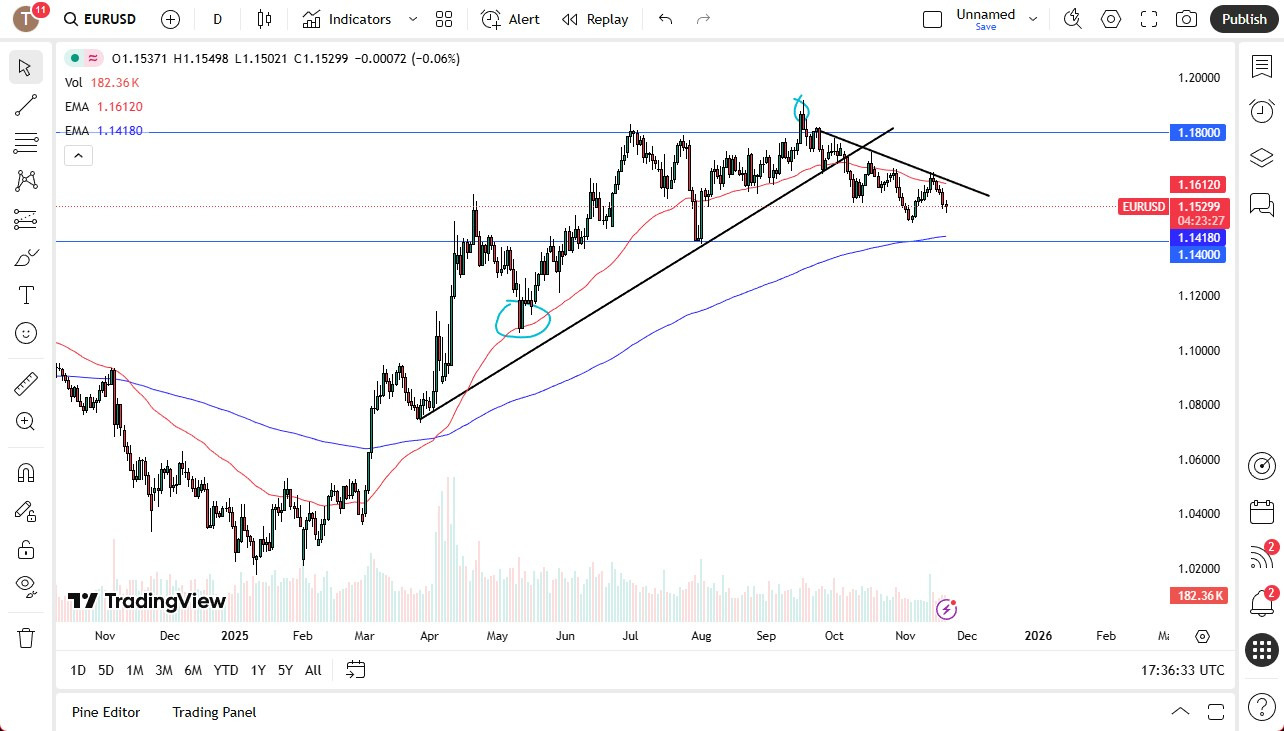
Short-term rallies are possible here with the 50-day EMA above offering a bit of a short-term barrier. I think that could end up being a short-term ceiling for that matter, as there is also a downtrend line there. If we were to break above there, then the 1.17 level becomes the next target, followed by the 1.18 level.
The interest rate differential favors the US dollar and probably will for some time. So with that being the case, I prefer fading short-term rallies that show signs of exhaustion, as we have seen multiple times since the September FOMC meeting.

Longer term, if we can break down below the 1.14 level, it is possible that we could drop all the way down to the 1.11 level, which is my longer-term target. I expect to see a lot of choppy back-and-forth volatility as we are between the 50-day EMA above and the 200-day EMA below. Over the longer term, I think that we are in the midst of some type of bigger topping pattern, and it is worth noting that there are a lot of concerns that the Federal Reserve will not be able to cut rates as quickly as everybody wanted because of a delay in jobs numbers.
Ready to trade our EUR/USD daily forecast? Here’s a list of some of the top forex brokers in Europe to check out.
Christopher Lewis has been trading Forex and has over 20 years experience in financial markets. Chris has been a regular contributor to Daily Forex since the early days of the site. He writes about Forex for several online publications, including FX Empire, Investing.com, and his own site, aptly named The Trader Guy. Chris favours technical analysis methods to identify his trades and likes to trade equity indices and commodities as well as Forex. He favours a longer-term trading style, and his trades often last for days or weeks.
Natural gas price rose in its last trading on the intraday basis, due to its leaning on the support of EMA50, gaining bullish momentum that helped it to achieve these last gains, preparing to attack the key resistance at $4.75, amid the dominance of the main bullish trend on the short-term basis and its trading alongside supportive trend line for this trend, besides the emergence of the positive signals on the relative strength indicators, after reaching oversold levels.
Therefore, we suggest a rise in its upcoming intraday trading, especially when breaching $4.75, to target its main resistance at $5.00.
The expected trading range for today is between $4.55 and $5.00
Trend forecast: Bullish
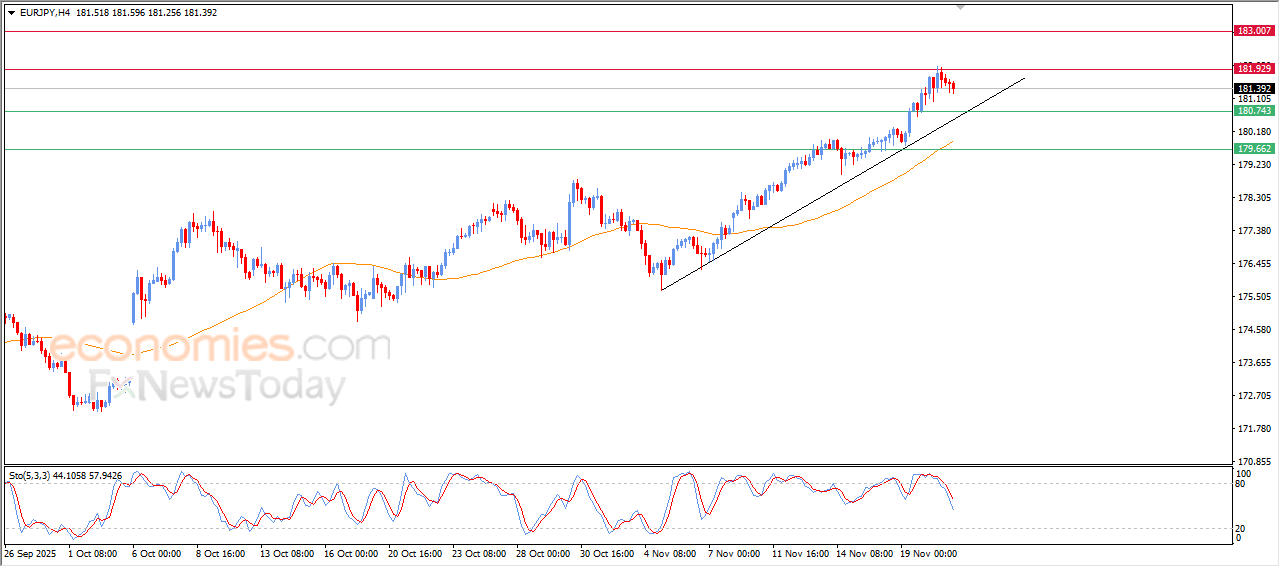
The EURJPY pair declined slightly in the last intraday levels, amid the emergence of the negative signals on the relative strength indicators, after reaching overbought levels, to gain bullish momentum that might help it to recover and rise again, amid the dominance of the main bullish trend and its trading alongside supportive trend line, and there is continued dynamic support due to its trading above EMA50, reinforcing the chances of its recovery in the upcoming perio.
Therefore, our expectations suggest a rise in the upcoming intraday trading, especially when breaching the key resistance at 181.90, targeting its next resistance at 183.00.
The expected trading range for today is between 180.75 and 183.00
Trend forecast: Bullish
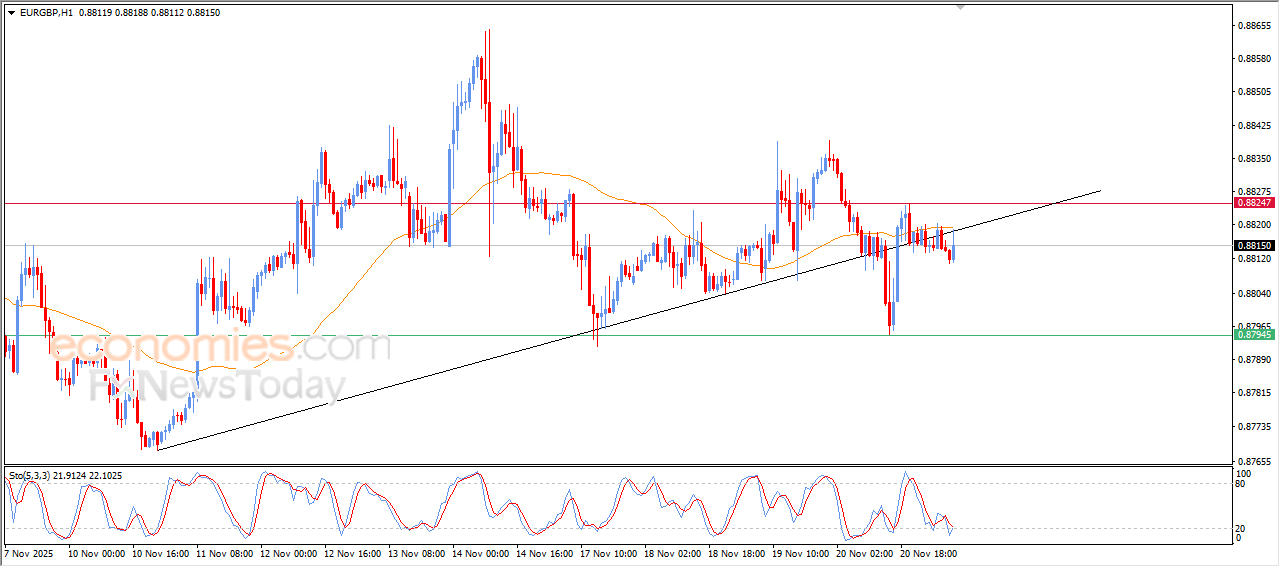
The EURGBP rose cautiously in its last trading, to hit the resistance of its EMA50, in attempt to offload some of its clear oversold conditions on the relative strength indicators, with the emergence of positive overlapping signals, affected by breaking bullish trend line on the short-term basis, intensifying the negative pressure on the pair, reinforcing the chances of the price decline on the near-term basis.
Therefore, our expectation suggests a decline in EURGBP’s last intraday trading, if the resistance settles at 0.8825, to target the key support at 0.8795.
The expected trading range for today is between 0.8795 and 0.8830
Trend forecast: Bearish
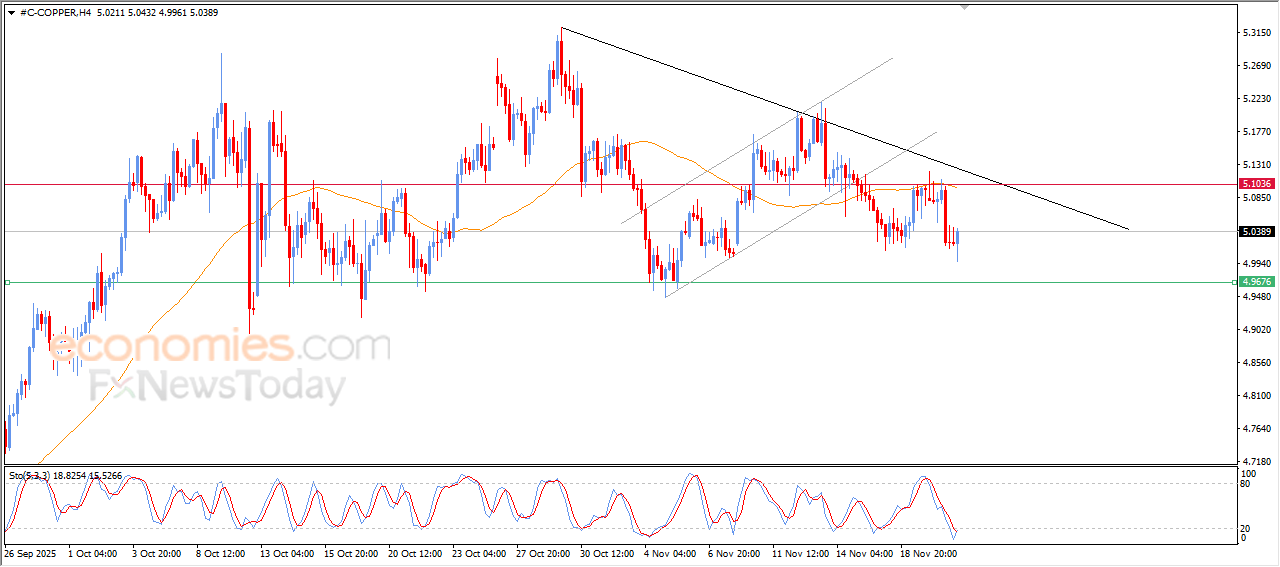
Copper price rose in attempt to recover its previous losses, and it attempts to recover some of its losses, attempting to offload some of its clear overbought conditions, especially with the emergence of positive overlapping signals, amid the continuation of the negative pressure due to its trading below EMA50, reinforcing the dominance and stability of the bearish corrective trend on the short-term basis with its trading alongside supportive trend line.
Therefore, our expectations suggest a decline in their last trading on an intraday basis, if the resistance settles at $55.10, to target the key support level at $4.95.
The expected trading range for today is between $4.95 and $5.10
Trend forecast: Bearish
The GBP/USD saw a dip from its daily highs near 1.3100 after another weak UK retail sales report, which further deepened concerns regarding softening domestic demand. This increased the odds of a more dovish Bank of England. However, the price pared the retail sales-led losses, hovering near 1.3095 at the time of writing. Despite this, the pound appears fragile as traders reassess the UK’s macroeconomic outlook.
-Are you looking for automated trading? Check our detailed guide-
The ONS data showed retail sales declining 1.1% MoM in October, well below the expected flat reading. September’s reading was revised to 0.7%, which gave some life to the pound after a fall. The annual figures came in at 0.2%, missing the forecast of 1.5% and slipping below the previous 1%. A sharp decline of 3.3% in textile, clothing, and footwear sales weighed heavily on the data, reflecting pressure on discretionary spending.
The weakness arises when inflation and labor market data have already softened significantly, increasing pressure on the Bank of England to shift towards easing. Markets are slowly pricing in a more accommodative policy path, and Friday’s data further supports this narrative that rate cuts may come sooner than expected.
On the fiscal front, the UK’s Autumn Budget, scheduled for November 26, is expected to include an increase in income tax to close the £22 billion budgetary gap. With faltering consumer demand, tighter fiscal measures could further weigh on growth prospects, limiting the pound’s ability to post a meaningful recovery.
Across the Atlantic, the US dollar remains broadly supported, as the dollar index stays comfortably above 100.00, approaching a five-month high. Traders have scaled back their bets on December rate cuts, with the CME FedWatch Tool showing a 35% probability, down from 70% last week. Fed officials warned that inflation remains high, dampening expectations for a potential easing. The October meeting minutes also showed officials leaning towards steady policy, supporting the US dollar.
Both the UK and the US will release PMI data later on Friday, which could offer fresh insight into private sector momentum. Activity is expected to slow in both economies. The direction of GBP/USD will likely hinge on which side shows a sharper loss of momentum.
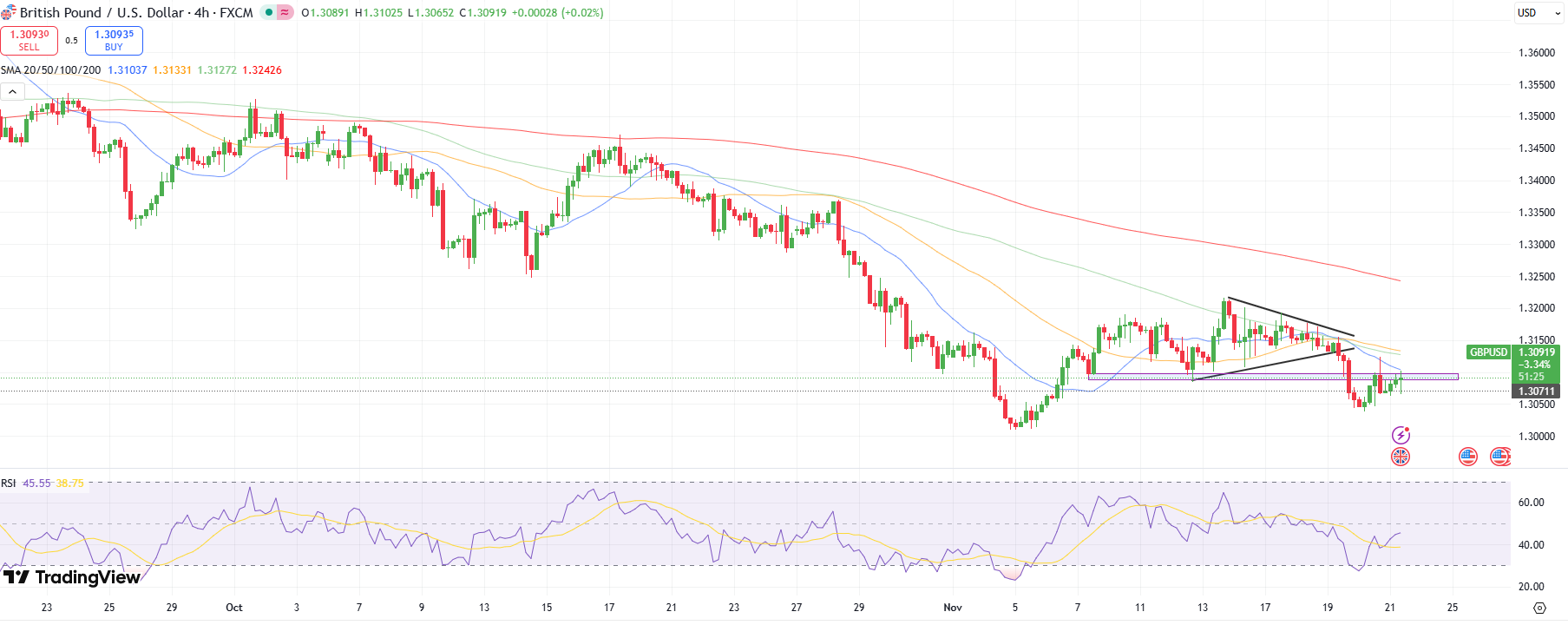
The GBP/USD finds mild support below the mid-1.3000 level, climbing back to the broken demand zone near 1.3100, which acts as resistance. The same level coincides with the 20-period MA, making it a tough nut to crack. Finding acceptance above the level could gain buying traction, leading to the 1.3200 area.
-If you are interested in forex day trading, then have a read of our guide to getting started-
On the other hand, staying below the 1.3100 mark will maintain selling pressure, aiming to pounce on the 1.3000 level ahead of 1.2950. The RSI is gradually rising, showing support but still below 50.0, indicating that bulls still require more energy for a reversal.
Looking to trade forex now? Invest at eToro!
67% of retail investor accounts lose money when trading CFDs with this provider. You should consider whether you can afford to take the high risk of losing your money.
Silver price (XAG/USD) revisits the weekly low around $49.50 during the European trading session on Friday. The white metal faces selling pressure as traders remain confident that the Federal Reserve (Fed) will not cut interest rates in the December policy meeting.
According to the CME FedWatch tool, the probability of the Fed cutting interest rates by 25 basis points (bps) to 3.50%-3.75% in the December meeting is 35.5%.
The scenario in which the Fed holds interest rates steady bodes poorly for non-yielding assets, such as Silver.
Fed dovish expectations stay lower as officials remain concerned over rising inflation risks to the upside. On Thursday, Cleveland Fed Bank President Beth Hammack stated that high inflation is the “real issue” of the economy, adding that “inflation is still too high and trending in wrong direction”, which calls for the need to keep the monetary policy “somewhat restrictive”.
Meanwhile, the rising United States (US) jobless rate has also failed to intensify Fed dovish expectations meaningfully. The US Nonfarm Payrolls (NFP) data for September showed on Thursday that the Unemployment Rate rose to 4.4%.
In Friday’s session, investors will focus on the flash US S&P Global Purchasing Managers’ Index (PMI) data for November, which will be published at 14:45 GMT.
Silver price struggles to hold the 20-day Exponential Moving Average (EMA), which trades around $49.50.
The 14-day Relative Strength Index (RSI) returns inside the 40.00-60.00 range, suggesting indecisiveness among investors about the near-term outlook.
Looking down, the September 23 high of $44.47 would remain a key support. On the upside, the all-time high of $54.50 might act as key barrier.
Silver is a precious metal highly traded among investors. It has been historically used as a store of value and a medium of exchange. Although less popular than Gold, traders may turn to Silver to diversify their investment portfolio, for its intrinsic value or as a potential hedge during high-inflation periods. Investors can buy physical Silver, in coins or in bars, or trade it through vehicles such as Exchange Traded Funds, which track its price on international markets.
Silver prices can move due to a wide range of factors. Geopolitical instability or fears of a deep recession can make Silver price escalate due to its safe-haven status, although to a lesser extent than Gold’s. As a yieldless asset, Silver tends to rise with lower interest rates. Its moves also depend on how the US Dollar (USD) behaves as the asset is priced in dollars (XAG/USD). A strong Dollar tends to keep the price of Silver at bay, whereas a weaker Dollar is likely to propel prices up. Other factors such as investment demand, mining supply – Silver is much more abundant than Gold – and recycling rates can also affect prices.
Silver is widely used in industry, particularly in sectors such as electronics or solar energy, as it has one of the highest electric conductivity of all metals – more than Copper and Gold. A surge in demand can increase prices, while a decline tends to lower them. Dynamics in the US, Chinese and Indian economies can also contribute to price swings: for the US and particularly China, their big industrial sectors use Silver in various processes; in India, consumers’ demand for the precious metal for jewellery also plays a key role in setting prices.
Silver prices tend to follow Gold’s moves. When Gold prices rise, Silver typically follows suit, as their status as safe-haven assets is similar. The Gold/Silver ratio, which shows the number of ounces of Silver needed to equal the value of one ounce of Gold, may help to determine the relative valuation between both metals. Some investors may consider a high ratio as an indicator that Silver is undervalued, or Gold is overvalued. On the contrary, a low ratio might suggest that Gold is undervalued relative to Silver.
Softer Japanese data and a weaker yen have intensified focus on Prime Minister Sanae Takaichi’s ultra-loose monetary policy stance and BoJ Governor Kazuo Ueda’s forward policy guidance.
October’s data came after the first meeting between Japanese Prime Minister Sanae Takaichi and BoJ Governor Kazuo Ueda on Tuesday, November 18. BoJ Governor Ueda kept a potential rate hike on the table, stating that monetary policy decisions will hinge on incoming data.
Wage growth trends will likely be crucial for the BoJ, given the weaker yen-import price dynamic. Updates from Japanese labor unions pushing for wage hikes ahead of the 2026 spring negotiations could support a more hawkish BoJ rate path.
Later in the morning session, Japan’s S&P Global Services PMI also requires consideration. Economists expect the Services PMI to drop from 53.1 in October to 52.8 in November. Slowing services activity would support a less hawkish BoJ rate path, given that the sector contributes around 70% to Japan’s GDP.
While Japanese trade data faced market scrutiny, US services sector data will influence bets on a December Fed rate cut.
Economists expect the S&P Global Services PMI to fall from 54.8 in October to 54.6 in November. A modest drop in the headline PMI would signal economic resilience, given that the services sector accounts for around 80% of US GDP.
However, traders should consider service sector price trends, given the Fed’s increased concerns about inflation. As a key contributor to inflation, price trends will likely be the key driver for the US dollar. Elevated prices would support a more hawkish Fed policy stance, sending USD/JPY toward 160.
Beyond the data, FOMC members’ speeches may also move the dial. Growing support to delay further monetary policy easing to tame inflation would send USD/JPY higher. FOMC members John Williams, Michael Barr, Philip Jefferson, and Lorie Logan are on the calendar to speak. Views on inflation, the labor market, and the timeline for rate cuts will be crucial for the USD/JPY pair.
Wednesday’s decisive close above the 10-day line marked a clear bullish reversal after a brief violation days earlier. A daily close back below $4.67 today would jeopardize that signal and return short-term bias to bearish. Minor or brief dips with swift recovery remain tolerable in a strong trend.
Wednesday’s $4.57 low established the current higher daily low sequence. A decisive drop beneath it would erase that bullish distinction and invite a deeper test of the rising 20-day average at $4.47, now converging with a supporting uptrend line for enhanced significance.
The entire advance continues to probe the 88.6% Fibonacci retracement zone of the prior major decline. Sustained trade and a close above Wednesday’s $4.81 high is required to confirm continuation momentum and head towards a challenge the recent trend high at $4.88.
A clean break above $4.88–$4.95 (March 2025 peak) unlocks $4.96 as the immediate next objective, followed by $5.14. The 127.2% extension of the recent pullback defines the first new trend-high projection, while the 161.8% extension outlines the stronger measured move if bulls stay aggressive.
Thursday’s inside day crystallizes the 10-day average at $4.67 and higher low at $4.57 as the immediate defensive line for bulls. Hold this zone to protect Wednesday’s hammer reversal and drive toward $4.88–$4.96 in the sessions ahead. A close below $4.57 shifts focus to the 20-day/uptrend confluence at $4.47; only sustained weakness beneath that level would meaningfully threaten the broader bullish structure.
For a look at all of today’s economic events, check out our economic calendar.