The main category of Forex News.
You can use the search box below to find what you need.
[wd_asp id=1]
The main category of Forex News.
You can use the search box below to find what you need.
[wd_asp id=1]
Gold price XAU/USD attracts some buyers to around $4,070, snapping the three-day losing streak during the early Asian session on Wednesday. The precious metal rises amid the risk-off sentiment as traders brace for the long-awaited return of US economic data. The FOMC Minutes will be the highlights later on Wednesday, ahead of the US September Nonfarm Payrolls (NFP) report.
US NFP reports for September and October 2025 were not released as scheduled due to a US government shutdown. The delay in employment data complicates the Federal Reserve’s (Fed) decisions regarding interest rates ahead of its December meeting. This, in turn, could boost a traditional safe-haven asset like Gold.
The US employment report for September is now expected to be released on Thursday. The US economy is projected to see 50,000 jobs added in September, while the Unemployment Rate is forecast to stay at 4.3% during the same period. If the report comes in weaker than expected, this could exert some selling pressure on the US Dollar (USD) and support the USD-denominated commodity price.
On the other hand, hawkish remarks from the Fed officials tempered expectations of a December rate cut and might cap the upside for the yellow metal. Fed Vice Chair Philip Jefferson said on Monday that the Fed should proceed “slowly” with further rate reductions. Meanwhile, several Fed policymakers, including Atlanta Fed President Bostic and Kansas City Fed President Schmid, voiced concerns about inflation or signaled support for holding rates steady.
Traders are currently pricing in a 46.6% chance of a 25 basis points (bps) rate cut in December, down from more than 60% last week, according to the CME FedWatch tool.
Gold has played a key role in human’s history as it has been widely used as a store of value and medium of exchange. Currently, apart from its shine and usage for jewelry, the precious metal is widely seen as a safe-haven asset, meaning that it is considered a good investment during turbulent times. Gold is also widely seen as a hedge against inflation and against depreciating currencies as it doesn’t rely on any specific issuer or government.
Central banks are the biggest Gold holders. In their aim to support their currencies in turbulent times, central banks tend to diversify their reserves and buy Gold to improve the perceived strength of the economy and the currency. High Gold reserves can be a source of trust for a country’s solvency. Central banks added 1,136 tonnes of Gold worth around $70 billion to their reserves in 2022, according to data from the World Gold Council. This is the highest yearly purchase since records began. Central banks from emerging economies such as China, India and Turkey are quickly increasing their Gold reserves.
Gold has an inverse correlation with the US Dollar and US Treasuries, which are both major reserve and safe-haven assets. When the Dollar depreciates, Gold tends to rise, enabling investors and central banks to diversify their assets in turbulent times. Gold is also inversely correlated with risk assets. A rally in the stock market tends to weaken Gold price, while sell-offs in riskier markets tend to favor the precious metal.
The price can move due to a wide range of factors. Geopolitical instability or fears of a deep recession can quickly make Gold price escalate due to its safe-haven status. As a yield-less asset, Gold tends to rise with lower interest rates, while higher cost of money usually weighs down on the yellow metal. Still, most moves depend on how the US Dollar (USD) behaves as the asset is priced in dollars (XAU/USD). A strong Dollar tends to keep the price of Gold controlled, whereas a weaker Dollar is likely to push Gold prices up.
Industrial commodity markets are experiencing a paradigm shift driven by technological advancement and energy system transformation. Investors now closely monitor the copper price forecast as a critical market indicator. The convergence of electrification mandates, infrastructure modernisation programmes, and supply chain realignments is reshaping fundamental market dynamics across base metals.
This transformation extends beyond cyclical demand patterns. It reflects permanent structural changes in how economies consume raw materials. In addition, the evolving market environment has inspired many to seek further copper price insights into these emerging trends.
Within this broader context, copper markets represent a microcosm of larger forces at play. The metal’s unique position as both an industrial input and economic indicator places it at the intersection of multiple macro trends. Consequently, understanding these dynamics becomes essential for investors, policymakers, and industry participants navigating an increasingly complex commodity landscape.
Copper’s designation as “Dr. Copper” reflects decades of empirical correlation between its price movements and broader economic activity. This relationship stems from the metal’s widespread industrial applications. For instance, its excellent conductivity makes it irreplaceable in electrical applications, creating inelastic demand across sectors.
Over recent years, manufacturing patterns have shifted towards more copper-intensive production processes. Infrastructure investment priorities now favour electrification and grid modernisation projects. Furthermore, the economic foundation supporting copper demand has evolved significantly since 2020. These changes are structural, suggesting sustained growth independent of traditional cycles.
A recent market event highlighted this transformation as copper reached $11,200 per tonne in November 2025. This new record, driven by supply constraints and demand acceleration, underlines the metal’s expanding role beyond a mere economic indicator.
The global transition towards electrification is the most significant structural demand driver for copper in modern history. This shift encompasses diverse sectors including transportation electrification, renewable energy deployment, and power grid modernisation. In addition, it spans various geographic regions and policy frameworks.
Electric vehicle adoption creates particularly intense copper demand. Each electric vehicle requires approximately 83 kilograms of copper compared to 23 kilograms for conventional vehicles – a 3.6-fold increase in intensity. With global EV sales projected to reach 30 million units by 2030, this application alone could generate over 2 million tonnes of additional annual copper demand.
Moreover, renewable energy infrastructure adds complexity. Wind power installations require 4–5 tonnes of copper per megawatt, while solar setups demand similar quantities for transmission and distribution infrastructure. The International Energy Agency’s capacity targets suggest these projects could consume 3–4 million tonnes annually.
Energy consumption patterns and grid modernisation further underline copper’s strategic value. As ageing infrastructure is replaced by higher-capacity systems, the demand for this versatile metal remains robust.
The copper mining industry now faces unprecedented supply challenges. On average, it takes around 17 years to develop a copper mine from discovery to production. For instance, historical underinvestment has exacerbated these delays. In fact, experts argue that projects should have begun around 2015 to meet current demand.
Furthermore, permitting complexity is a major hindrance. Environmental assessments, community engagement and regulatory processes now require years to complete. Even projects with proven ore bodies face uncertainty during approvals. Such mining permitting challenges have added layers of risk to future supply.
Historical gaps in investment have left the sector short of shovel-ready projects. In addition, delays from the COVID-19 pandemic have further disrupted development pipelines. Analysts highlight that these constraints could postpone new production for years, even as demand accelerates.
Global copper mine production reached around 22.1 million tonnes in 2024, with modest supply increases of 2.8% annually through 2027. However, smelter capacity has grown faster––an 8.5% recent increase––suggesting a disconnect between raw material availability and refining capability. This discrepancy is highlighted in the global copper supply forecast.
Ore grade decline remains another critical factor. As higher-grade ores deplete, extraction costs rise and yields drop. Consequently, maintaining stable production volumes demands more resource inputs and increased capital expenditure.
Inventory dynamics compound these challenges. Global copper stocks have dwindled to levels representing only 11 days of global consumption. For instance, London Metal Exchange warehouses hold roughly 660,000 tonnes. Such low levels magnify the market’s vulnerability to supply disruptions.
Trade policies are also distorting inventory distribution. U.S. tariff policies, for example, have led to strategic accumulation. As noted by industry insiders, these measures have inadvertently created a concentrated reserve. This phenomenon is further examined within the context of the US–china trade impact.
Inventory Vulnerability Factors:
• LME warehouse holdings below 660,000 tonnes
• Approximately 11 days of consumption coverage
• Single-mine disruptions triggering price spikes
• Geographic inventory concentration risks
• Trade policy-driven distortions
Forecast models for 2025 adopt a range of scenarios underpinned by supply constraints and accelerating demand. Analysts predict prices will generally remain above $10,000 per tonne. In addition, institutional forecasts range from $8,300 to $10,265 per tonne. This dynamic has contributed to a volatile market with widening bid-ask spreads.
Moreover, the short-term copper market analysis indicates that even minor supply or demand shifts can cause sharp price changes. Analysts note that the copper price forecast remains an important metric to consider in these conditions.
Chinese economic recovery is set to play a significant role in 2025 pricing. Although property sector challenges persist, infrastructure investments and manufacturing support policies provide demand stability. This interplay reinforces the theme of a persistent copper price forecast as markets adjust to new realities.
The period from 2026 to 2027 is expected to amplify supply–demand imbalances. Investment banks now project prices reaching between $11,000 and $13,500 per tonne, reflecting genuine shortages rather than speculative premiums. Additionally, historical ratio analysis supports this outlook, pointing to copper’s undervaluation relative to gold.
Key assumptions for scenario modelling include:
• Conservative: $11,000 per tonne in 2026 and $12,500 in 2027
• Bull Case: $12,000 in 2026 and $15,000 in 2027
• Extreme Bull: $14,000 in 2026 and $18,000 in 2027
Even if prices exceed $12,000 per tonne and stimulate new projects, the lengthy development cycle means additional supply may not arrive until the early 2030s. This situation reinforces the medium-term importance of the copper price forecast.
Long-term projections depend on supply response timing and sustained electrification demand. Conservative estimates point to prices around $13,000 per tonne by 2030, while bull cases suggest they could reach $17,000 per tonne. In these scenarios, the copper price forecast remains a central guide, especially as new mine developments take decades to materialise.
Market equilibrium may ultimately be restored through demand moderation and new supply. However, even very high prices might prompt research into alternative materials that slightly reduce copper reliance. Despite this, copper’s unique properties ensure its enduring value in critical infrastructure.
China accounts for approximately 54% of global copper consumption. Recent shifts in policy have steered investment towards infrastructure and renewable projects rather than solely property development. This realignment ensures a stable, long-term demand profile for copper.
China’s manufacturing competitiveness initiatives also bolster the metal’s use in high-technology sectors. For example, electric vehicle production, battery manufacturing, and renewable energy equipment all rely heavily on copper. Such trends, combined with ongoing copper exploration analysis, underline the sustained relevance of copper.
The North American copper market has been reshaped by evolving U.S. trade policies. Tariff-driven inventory accumulation and supply chain adjustments have redefined regional dynamics. In addition, friend-shoring initiatives and domestic manufacturing support are further altering trade flows. These measures illustrate significant US–china trade impact on copper availability within the region.
Infrastructure investments in the United States and Canada also support robust copper demand. Grid modernisation and renewable deployments, underpinned by key legislation, promise to sustain growth despite global supply challenges.
The European Union’s Green Deal mandates are among the most ambitious global infrastructure programmes. With a €584 billion investment allocated to grid modernisation, Europe is set to drive significant copper demand. Renewable energy targets, such as achieving 1,236 gigawatts by 2030, further fuel copper consumption in wind turbines, solar arrays, and transmission networks.
In addition, plans to establish 3.5 million EV charging points across the EU underscore copper’s indispensability. These policy directives ensure that regional demand remains robust during economic uncertainties.
Copper prices have a strong inverse correlation with real interest rates. Lower rates reduce the opportunity cost of holding non-yielding commodities while bolstering economic activity. Moreover, central bank policies that promote accommodative conditions provide indirect support to copper markets. Many market observers also refer to external sources such as copper trends for further context.
This interplay between monetary policy, currency values, and investment flows enhances the overall dynamics surrounding commodity pricing. The resulting environment plays a significant role in shaping the copper price forecast as well.
Dollar strength significantly influences copper’s USD-denominated prices. For instance, historical data suggests that a 10% appreciation of the dollar can lead to an 8–12% decline in copper prices. Consequently, shifts in exchange rates affect inventory management, hedging decisions, and overall market sentiment.
Furthermore, rising hedging costs can prompt adjustments in purchasing patterns, contributing to short-term volatility. As such, traders remain attentive to currency movements when evaluating the copper price forecast.
Copper’s performance during inflationary periods bolsters its role as a portfolio diversifier. The metal has delivered positive real returns during 73% of inflationary episodes since the 1970s. Investors recognise copper’s dual function as both an industrial input and a store of value, leading to significant capital flows during inflationary periods.
This inflation hedge characteristic adds yet another layer of strategic importance to tracking the copper price forecast in today’s complex economic environment.
Investors seeking exposure to copper have several avenues available. For example, futures contracts offer direct tracking of price movements. However, they require active management due to rollover and margin complexities. In contrast, exchange-traded funds and exchange-traded commodities provide simpler access to the market.
Other investment options include mining equities and physical copper ownership, each carrying distinct risk profiles. These methods allow investors to capitalise on potential price movements and supply constraints, while the ongoing emphasis on a robust copper price forecast guides long-term strategies.
Copper investments, while promising, entail several risk factors that require careful management. Key risks include:
• Demand shock: Rapid economic downturns that reduce industrial copper use
• Supply response: Delays in mine development leading to prolonged shortages
• Substitution: The emergence of alternative materials
• Geopolitical: Unpredictable trade policies and regulatory changes
• Operational: Mining accidents and production disruptions
• Financial: Currency fluctuations and interest rate shifts
These risks highlight the need for balanced portfolios and tactical flexibility. Investors are advised to monitor both micro and macroeconomic indicators while keeping an eye on the copper price forecast.
Investor sentiment in copper markets often amplifies inherent supply–demand imbalances. As copper earned its nickname “Dr. Copper”, market participants have come to view its price signals as reflections of broader economic health. Speculative flows and hedge fund positions can create short-term momentum that diverges from fundamental trends.
Such behavioural factors, in combination with restrained supply growth, support the notion that the copper price forecast remains a key barometer for both short-term trades and long-term investment decisions.
The convergence of structural supply constraints, accelerating electrification, and supportive macroeconomic conditions suggests that copper is entering a prolonged appreciation cycle. Price forecasts point to levels above $15,000 per tonne by 2027, reflecting genuine market imbalances rather than mere speculation.
In summary, while volatility is likely to persist, a balanced approach to risk management and forward-thinking investment strategies is essential. Market participants must weigh both short-term challenges and long-term opportunities, with the copper price forecast serving as a critical guidepost in navigating the complexities of global commodity markets.
Discovery Alert’s proprietary Discovery IQ model delivers real-time alerts on significant ASX mineral discoveries, instantly empowering subscribers to identify actionable opportunities ahead of the broader market. Understand why historic discoveries can generate substantial returns by visiting Discovery Alert’s dedicated discoveries page, and begin your 30-day free trial today to position yourself ahead of the market.
The decline from the $4,245 lower swing high from last week delivered a textbook 61.8% Fibonacci retracement, aligned with an uptrend line. Today’s rapid recovery of all key dynamic levels indicates the minor pullback has likely exhausted itself, with the uptrend line freshly validated as the primary bull-market defense.
After today’s session, a sustained advance and close above today’s $4,082 high is required to officially confirm a bullish reversal and declare the correction finished. Without that follow-through, risk remains of another leg lower to retest the trendline or deeper supports, or a consolidation phase.
A decisive close below the uptrend line shifts attention to the rising 50-day average at $3,955, closely aligned with the 78.6% retracement at $3,963. The 50-day carries significant weight, having gone untested as support since its August reclaim—making the first approach a high-probability bounce zone, if it reached.
Isolated trendline breaks often prove false without accompanying confirmation. Even if the line is violated, holding the 50-day would keep the larger uptrend intact and it is not much lower. True bearish conviction requires a drop below the interim higher swing low at $3,929.
The weekly chart remains on track for an inside week, with the 10-week average at $3,987 supplying additional dynamic backing. Last week’s $3,997 low sits comfortably above the daily $3,929 swing low—meaning any weekly close beneath $3,929 would deliver a strong bearish one-week reversal.
Gold’s aggressive defense of the uptrend line and recapture of the 20-day average strongly favors buyers. A convincing push above $4,082 targets fresh record territory; failure invites a deeper test of the 50-day confluence near $3,955. Until a weekly close below $3,929 emerges, all pullbacks remain buyable within the structural bull market.
– Written by
David Woodsmith
STORY LINK GBP to USD Forecast: Pound Sterling Weakens on Equity Selloff, Safe-Haven Demand
The Pound to US Dollar exchange rate (GBP/USD) softened on Tuesday as a sharp equity selloff unsettled investors and pushed demand back toward safer assets.
At the time of writing, GBP/USD was trading around $1.3141, down almost 0.2% from the start of the session.
The US Dollar (USD) inched higher on Tuesday, with risk-off sentiment driving flows into the safe-haven currency.
Mounting concerns over overstretched valuations in AI-linked stocks sparked a wave of caution across global markets, with analysts increasingly warning that the sector may be entering bubble territory.
The mood was further underpinned by a hawkish repricing of Federal Reserve interest rate cut expectations, keeping USD supported through the session.
Sterling struggled to gain traction on Tuesday as investors remained hesitant ahead of next week’s tightly watched autumn budget.
Recent reports have raised more questions than answers regarding Chancellor Rachel Reeves’s fiscal plans. Most notably, Reeves appeared to drop her consideration of an income tax rise, viewed by many economists as the most efficient way to raise revenue and close the estimated £20bn fiscal gap.
Get better rates and lower fees on your next international money transfer.
Compare TorFX with top UK banks in seconds and see how much you could save.
Without that lever, Reeves may be forced to rely on a mosaic of smaller tax hikes.
GBP investors fear this approach risks complicating the tax landscape while doing little to revive the UK’s fragile growth outlook.
Looking ahead, the Pound to US Dollar exchange rate looks vulnerable on Wednesday as markets brace for the UK’s latest consumer price index.
Economists expect headline inflation to ease from 3.8% to 3.6% in October—the first cooling of prices since May.
A softer reading would likely cement expectations that the Bank of England (BoE) will restart its rate-cutting cycle in December, which could weigh on Sterling.
Also on the radar are the Federal Reserve’s latest meeting minutes. Should the minutes strike a hawkish tone or cast doubt on a December rate cut, the US Dollar may find fresh support.

International Money Transfer? Ask our resident FX expert a money transfer question or try John’s new, free, no-obligation personal service! ,where he helps every step of the way,
ensuring you get the best exchange rates on your currency requirements.
TAGS: Pound Dollar Forecasts
Silver price (XAG/USD) claws back its early losses and turns slightly positive to near $50.30 during the European trading session on Tuesday. The white metal attracts bids as investors turn cautious ahead of the United States (US) Nonfarm Payrolls (NFP) data for September, which will be releasing on Thursday.
Investors await the US NFP data to get fresh cues on the current status of the labor market. Financial market participants lack information regarding the job market status as major economic releases were halted in last almost seven weeks due to federal shutdown.
Meanwhile, the market sentiment remains risk-averse amid receding speculation favoring further interest rate cuts by the Federal Reserve (Fed) this year. At the press time, S&P 500 futures trade 0.25% lower, exhibiting a risk-off mood.
According to the CME FedWatch tool, the probability of the Fed to cut interest rates by 25 basis points (bps) to 3.50%-3.75% in the December meeting has diminished to 43% from 62.4% seen a week ago.
Technically, the scenario of easing Fed dovish bets is unfavourable for the Silver price, given that a pause in the Fed’s monetary easing campaign bodes poorly for non-yielding assets.
Silver price finds cushion after correcting to near the 20-day Exponential Moving Average (EMA) around $49.70.
The 14-day Relative Strength Index (RSI) returns inside the 40.00-60.00 range, suggesting indecisiveness among investors about the near-term outlook.
Looking down, the September 23 high of $44.47 would remain a key support. On the upside, the all-time high of $54.50 might act as key barrier.
Silver is a precious metal highly traded among investors. It has been historically used as a store of value and a medium of exchange. Although less popular than Gold, traders may turn to Silver to diversify their investment portfolio, for its intrinsic value or as a potential hedge during high-inflation periods. Investors can buy physical Silver, in coins or in bars, or trade it through vehicles such as Exchange Traded Funds, which track its price on international markets.
Silver prices can move due to a wide range of factors. Geopolitical instability or fears of a deep recession can make Silver price escalate due to its safe-haven status, although to a lesser extent than Gold’s. As a yieldless asset, Silver tends to rise with lower interest rates. Its moves also depend on how the US Dollar (USD) behaves as the asset is priced in dollars (XAG/USD). A strong Dollar tends to keep the price of Silver at bay, whereas a weaker Dollar is likely to propel prices up. Other factors such as investment demand, mining supply – Silver is much more abundant than Gold – and recycling rates can also affect prices.
Silver is widely used in industry, particularly in sectors such as electronics or solar energy, as it has one of the highest electric conductivity of all metals – more than Copper and Gold. A surge in demand can increase prices, while a decline tends to lower them. Dynamics in the US, Chinese and Indian economies can also contribute to price swings: for the US and particularly China, their big industrial sectors use Silver in various processes; in India, consumers’ demand for the precious metal for jewellery also plays a key role in setting prices.
Silver prices tend to follow Gold’s moves. When Gold prices rise, Silver typically follows suit, as their status as safe-haven assets is similar. The Gold/Silver ratio, which shows the number of ounces of Silver needed to equal the value of one ounce of Gold, may help to determine the relative valuation between both metals. Some investors may consider a high ratio as an indicator that Silver is undervalued, or Gold is overvalued. On the contrary, a low ratio might suggest that Gold is undervalued relative to Silver.
The near-term weather is the anchor dragging us down. The NatGasWeather outlook for the rest of the week through next weekend shows a quick cool blast in the Northeast fading fast. Most of the country is warming up, running highs from the 40s all the way to 80s down south. This means demand goes from “Moderate” to “Low” real quick. It’s a classic wait-and-see move as players sit on their hands until the next legitimate cold snap shows up.
The fundamental story keeping a lid on any rally is production. The Lower-48 states are pumping out a massive 110.0 bcf/day, which is a solid 7.1% jump year-over-year (y/y). The EIA sees no let-up, hiking its 2025 production forecast to 107.67 bcf/day. We also whiffed on last Friday’s storage report, posting an inventory build of +45 bcf—way over the +34 bcf whisper. This leaves stockpiles sitting +4.5% above the 5-year average. Too much supply on the screen, period.
It’s not all doom and gloom, though. The downside is limited by relentless export demand. LNG flows are still running hot at around 17.6 bcf/day. More importantly, power demand is creeping higher; last week saw Lower 48 power producers consume 6.1% more gas. We’ve got earnings coming up from Helmerich & Payne and Nvidia this week, which will give us a read on drilling activity and the future pull from massive data center construction. This structural demand boom is what keeps the longer-term bulls in the game.
The immediate focus is the EIA print for the week ended November 14. Analysts are calling for the first real drawdown of the season—a 17 Bcf withdrawal. That’s a massive shift from the 5-year average injection of 12 Bcf. This signals that heating demand, driven by a 24-week/week jump in Lower 48 heating degree days, is finally kicking in. This flip to a withdrawal could be the catalyst that triggers the bottom for this pullback.
Spot Gold hovers around $4,060 in the American session on Tuesday, easing from an intraday peak of $4,082. The XAU/USD pair is little changed for a second consecutive day, reflecting investors’ wait-and-see stance ahead of United States (US) data releases scheduled for later this week.
Following the US federal shutdown, the government was finally able to pass a funding bill last week, which means governmental offices resumed activity and hence, data collection.
Market participants are cautious ahead of the announcement, but also wary about earnings reports. Among other companies, Home Depot reported weakening sales growth and cut its outlook for the financial year, blaming the downturn in its performance on a sluggish housing market and weaker consumer sentiment.NVIDIA is also scheduled to report this week, and the results could disrupt financial markets, especially tech-related reports.
Other than that, the US published August Factory Orders, which were up 1.4% on a monthly basis, improving from the -1.3% posted in July. The data is old, but it helped maintain the US Dollar (USD) afloat ahead of more relevant macroeconomic figures.
Additionally, ADP released the four-week average on Employment Change, which showed US private employers shed an average of 2,500 jobs a week in the four weeks ending November 1.
From a technical point of view, the 4-hour chart shows XAU/USD trading at $4,067.90, up for the day. The 20-period Simple Moving Average (SMA) has turned lower, providing dynamic resistance at around $4,090. At the same time, the 200-period SMA continues to rise modestly, now standing at $4,074.85, while holding above the 100-period at $4,041.52, the latter providing relevant dynamic support. Meanwhile, the Momentum indicator remains below its midline but edges higher, indicating waning bearish pressure. Finally, the Relative Strength Index (RSI) stands neutral at 46.
In the daily chart, XAU/USD has posted a lower high and a lower low, hinting at increased selling interest without confirming an upcoming decline. The 20-day SMA has turned lower, while the 100- and 200-day SMAs continue to rise, keeping the broader trend supported. Price holds above all these averages, suggesting buyers retain the upper hand. Technical indicators hold within positive levels, with the Momentum rising above its midline, and the RSI holding neutral around 52 with scope to extend if bulls press the advantage. The pair needs to recover beyond the $4,100 level to become more attractive to bulls, an unlikely scenario at the time being.
(The technical analysis of this story was written with the help of an AI tool)
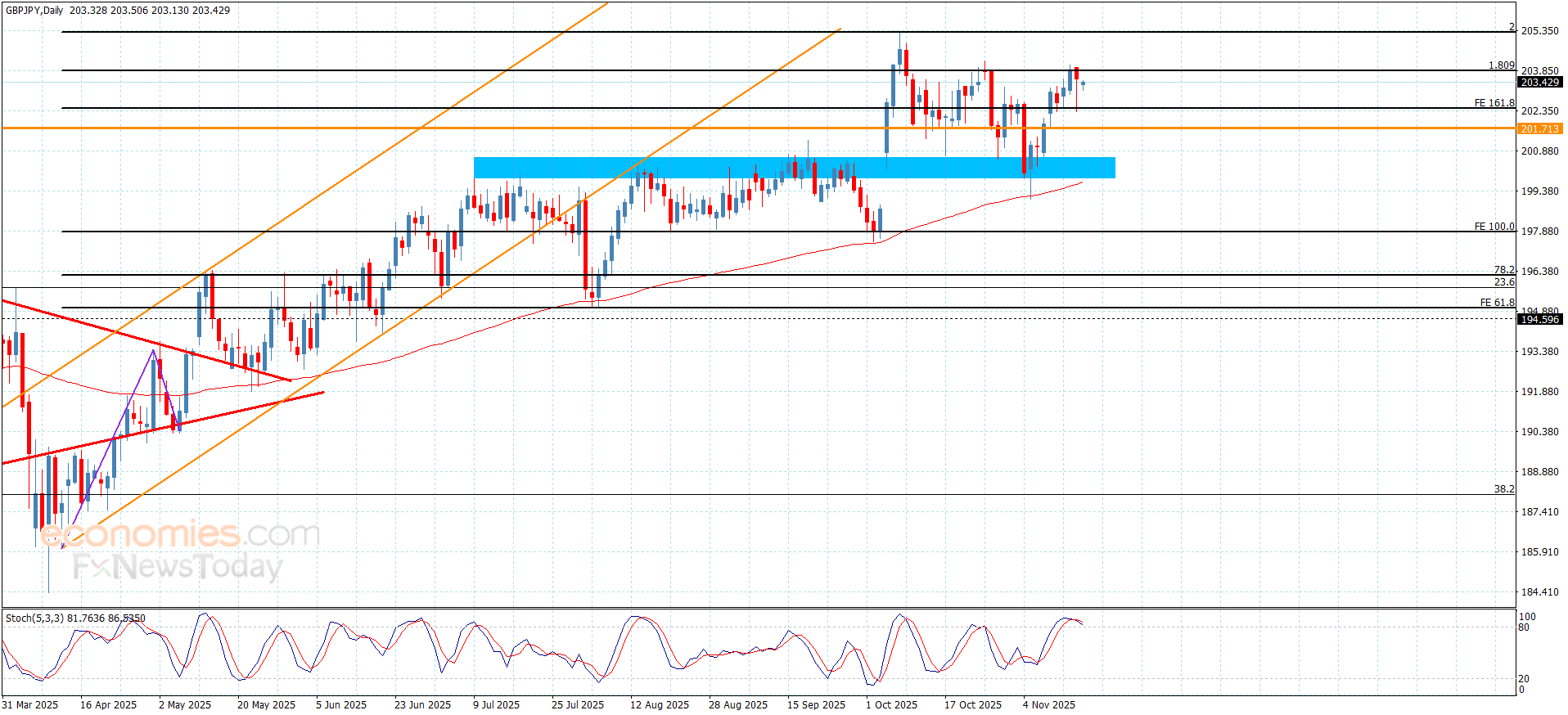
The GBPJPY pair continued providing positive trading, noticing its stability above 203.95 and recording some gains by its rally towards 204.50, but stochastic negativity by its attempt to surpass the overbought level that might decelerate the bullish rally in the current period trading.
All that make us prefer the sideways trading, reminding you that the stability above the support at 201,70 forms a main factor for confirming the dominance of the bullish track, therefore, we will keep waiting for gathering extra bullish momentum to ease the mission of recording positive gains by its rally towards 205.25.
The expected trading range for today is between 203.35 and 204.65
Trend forecast: Fluctuated within the bullish track
Gold has bounced up from $4,000 but remains capped below a previous support, at $4.050.
A steady US Dollar in cautious markets is acting as a headwind for Gold’s recovery.
US ADP employment and Factory Orders might set the US Dollar’s direction later today.
Gold (XAU/USD) reversal from highs near $4,250 reached last week extended to the $4,000 psychological level earlier on Tuesday. The pair has bounced up during the European trading session but remains below a previous support area in the $4,050 area so far.
The risk-off market mood is providing some support to the precious metal on Tuesday, although the US Dollar (USD) remains firm, underpinned by fading hopes of Federal Reserve (Fed) easing in September, which is acting as a headwind for Gold.
The short-term technical picture remains bearish. The pair has depreciated about 3.7% in the previous three trading days and found support at $4,000, but the recovery attempt, so far, is frail. The 4-Hour Relative Strength Index (RSI) has bounced up but keeps moving below the 50 line, and the Moving Average Convergence Divergence (MACD) is printing red bars in the histogram.
The pair maintains its bearish trend intact while below an intraday support on the $4,050 area, which has turned resistance. This resistance leaves the $4,000 level exposed. Further down, the targets are the November 6 low at $3,965 and the November 4 low, in the area of $3,930.
A confirmation above $4.050, on the contrary, would ease bearish pressure and bring Monday’s highs, around $4,100 to the focus, ahead of the November 11 high and November 13 low of $4,170.
Gold has played a key role in human’s history as it has been widely used as a store of value and medium of exchange. Currently, apart from its shine and usage for jewelry, the precious metal is widely seen as a safe-haven asset, meaning that it is considered a good investment during turbulent times. Gold is also widely seen as a hedge against inflation and against depreciating currencies as it doesn’t rely on any specific issuer or government.
Central banks are the biggest Gold holders. In their aim to support their currencies in turbulent times, central banks tend to diversify their reserves and buy Gold to improve the perceived strength of the economy and the currency. High Gold reserves can be a source of trust for a country’s solvency. Central banks added 1,136 tonnes of Gold worth around $70 billion to their reserves in 2022, according to data from the World Gold Council. This is the highest yearly purchase since records began. Central banks from emerging economies such as China, India and Turkey are quickly increasing their Gold reserves.
Gold has an inverse correlation with the US Dollar and US Treasuries, which are both major reserve and safe-haven assets. When the Dollar depreciates, Gold tends to rise, enabling investors and central banks to diversify their assets in turbulent times. Gold is also inversely correlated with risk assets. A rally in the stock market tends to weaken Gold price, while sell-offs in riskier markets tend to favor the precious metal.
The price can move due to a wide range of factors. Geopolitical instability or fears of a deep recession can quickly make Gold price escalate due to its safe-haven status. As a yield-less asset, Gold tends to rise with lower interest rates, while higher cost of money usually weighs down on the yellow metal. Still, most moves depend on how the US Dollar (USD) behaves as the asset is priced in dollars (XAU/USD). A strong Dollar tends to keep the price of Gold controlled, whereas a weaker Dollar is likely to push Gold prices up.
The EURJPY pair’s stability within the bullish trend that depends on the continuation of forming extra support at 178.00 level, but the contradiction between the main indicators pushes it to form sideways fluctuation by its stability below the psychological barrier at 180.00.
The price might be forced to provide more of the sideways trading until gathering extra positive momentum, to surpass the current barrier and begin forming extra gains by its rally at 180.60 initially reaching the next main target at 181.55.
The expected trading range for today is between 179.30 and 180.60
Trend forecast: Bullish