The main category of Forex News.

You can use the search box below to find what you need.

[wd_asp id=1]

9 04, 2026

The EURJPY attempts to recover the positivity– Forecast today – 8-4-2026

By |2026-04-09T00:55:09+02:00April 9, 2026|Forex News, News|0 Comments

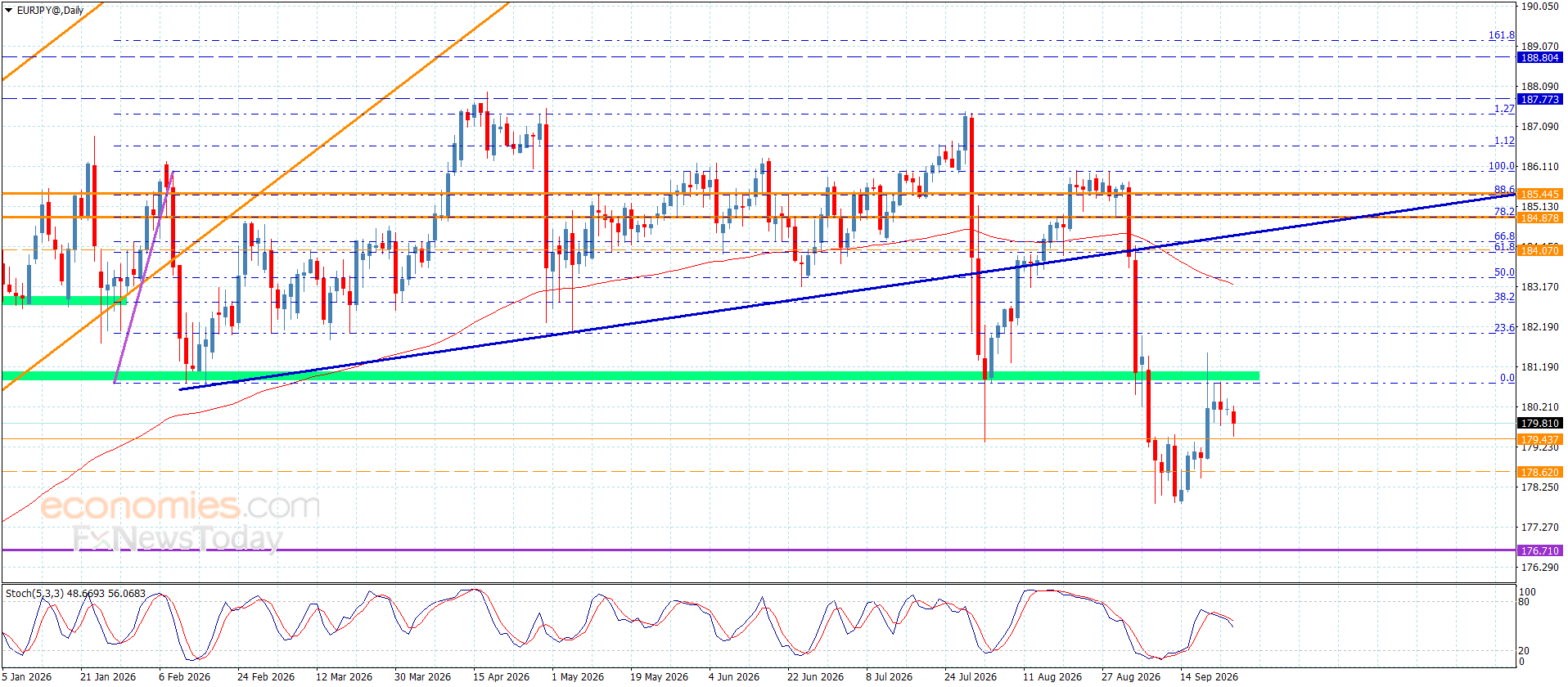
The EURJPY pair renewed the positive attempts since yesterday, due to the continuation of providing positive momentum by the main indicators by its rally above the initial resistance at 184.80, to test the barrier at 185.45 to bounce directly to settle near 184.90.


The price might be forced to provide mixed trading by its stability below 184.45, and there is a chance for forming bearish waves to target 184.20 and 183.70 level, while its success to surpass the barrier at 185.45 will open the way for forming strong bullish waves, to expect reaching 186.00 initially, reaching 186.65.


The expected trading range for today is between 184.40 and 185.45


Trend forecast: Fluctuated


Source link

8 04, 2026

Silver Price Forecast: XAG/USD consolidates within bearish flag on 4-hour chart

By |2026-04-08T20:58:58+02:00April 8, 2026|Forex News, News|0 Comments


Silver (XAG/USD) trades with a positive bias on Wednesday, supported by a broadly weaker US Dollar following a two-week ceasefire agreement between the United States and Iran. At the time of writing, XAG/USD is trading around $74.50, up nearly 2% on the day after hitting an intraday high of $77.65.

Despite the softer Greenback, the metal struggles to extend gains as traders continue to assess evolving geopolitical risks. While Crude prices retreated sharply after the ceasefire news, the decline has stalled amid uncertainty around the durability of the agreement.

Reports of airstrikes across the Middle East, including Israeli strikes on Lebanon and attacks reported in Saudi Arabia, the UAE, Kuwait, Qatar, and Bahrain, highlight persistent tensions. Iranian officials have also warned that Tehran could withdraw from the ceasefire agreement if attacks on Lebanon continue.

This keeps markets on edge over whether a full resolution can be reached and whether Oil prices can see a meaningful and sustained decline. Until then, expectations for tighter monetary policy are likely to remain in place, limiting further upside in non-yielding assets like Silver.

From a technical perspective, the 4-hour chart shows XAG/USD trading within a bearish flag pattern. The near-term bias is mixed as prices stabilize between key moving averages.

The 100-period Simple Moving Average (SMA) at $72.63, which closely aligns with the lower boundary of the flag, is acting as immediate support and cushioning the downside. A break below this level could confirm a bearish continuation, exposing the next support at Tuesday’s low near $68.28, followed by the March swing low around $61.00.

On the upside, the 200-period SMA near $79.00 coincides with the upper boundary of the flag and continues to cap gains. A sustained break above this zone would negate the bearish structure and could trigger a recovery toward the mid-$80s, with scope to extend toward the $90.00 region.

Momentum indicators remain mildly constructive. The Relative Strength Index (RSI) is hovering in the mid-50s, while the Moving Average Convergence Divergence (MACD) remains in positive territory, suggesting steady buying interest despite the consolidation within the broader uptrend.

Silver FAQs

Silver is a precious metal highly traded among investors. It has been historically used as a store of value and a medium of exchange. Although less popular than Gold, traders may turn to Silver to diversify their investment portfolio, for its intrinsic value or as a potential hedge during high-inflation periods. Investors can buy physical Silver, in coins or in bars, or trade it through vehicles such as Exchange Traded Funds, which track its price on international markets.

Silver prices can move due to a wide range of factors. Geopolitical instability or fears of a deep recession can make Silver price escalate due to its safe-haven status, although to a lesser extent than Gold’s. As a yieldless asset, Silver tends to rise with lower interest rates. Its moves also depend on how the US Dollar (USD) behaves as the asset is priced in dollars (XAG/USD). A strong Dollar tends to keep the price of Silver at bay, whereas a weaker Dollar is likely to propel prices up. Other factors such as investment demand, mining supply – Silver is much more abundant than Gold – and recycling rates can also affect prices.

Silver is widely used in industry, particularly in sectors such as electronics or solar energy, as it has one of the highest electric conductivity of all metals – more than Copper and Gold. A surge in demand can increase prices, while a decline tends to lower them. Dynamics in the US, Chinese and Indian economies can also contribute to price swings: for the US and particularly China, their big industrial sectors use Silver in various processes; in India, consumers’ demand for the precious metal for jewellery also plays a key role in setting prices.

Silver prices tend to follow Gold’s moves. When Gold prices rise, Silver typically follows suit, as their status as safe-haven assets is similar. The Gold/Silver ratio, which shows the number of ounces of Silver needed to equal the value of one ounce of Gold, may help to determine the relative valuation between both metals. Some investors may consider a high ratio as an indicator that Silver is undervalued, or Gold is overvalued. On the contrary, a low ratio might suggest that Gold is undervalued relative to Silver.


Source link

8 04, 2026

EUR/JPY Price Forecast: Trades near 185.00 after pulling back from upper channel boundary

By |2026-04-08T20:54:17+02:00April 8, 2026|Forex News, News|0 Comments

EUR/JPY edges lower after two days of gains, trading around 185.00 during the European hours on Wednesday. The technical analysis of the daily chart suggests the currency cross is moving upwards within the ascending channel pattern, indicating bullish bias.

The near-term bias stays mildly bullish as the EUR/JPY cross holds comfortably above the 50-day Exponential Moving Average (EMA), while the nine-day EMA rises above the medium-term average, reinforcing a short-term uptrend within an established broader advance.

Momentum backs this tone, with the Relative Strength Index (RSI) around 59, holding above the 50 line and confirming persistent buying pressure rather than overbought excess.

The EUR/JPY cross may retest the immediate resistance at the upper ascending channel boundary around 185.70. Further advances above the channel would reinforce the bullish bias and lead the EUR/JPY cross to explore the region around the all-time high of 186.88, reached on January 23.

On the downside, the initial support lies at the nine-day EMA of 184.33. A break below the short-term average would weaken the bullish bias and lead the EUR/JPY cross to test the 50-day EMA at 183.58, followed by the lower boundary of the ascending channel around 183.00.

EUR/JPY: Daily Chart

(The technical analysis of this story was written with the help of an AI tool.)

Euro Price Today

The table below shows the percentage change of Euro (EUR) against listed major currencies today. Euro was the weakest against the New Zealand Dollar.

USD EUR GBP JPY CAD AUD NZD CHF
USD -0.78% -1.06% -0.82% -0.14% -1.05% -1.52% -1.15%
EUR 0.78% -0.30% -0.04% 0.63% -0.28% -0.78% -0.39%
GBP 1.06% 0.30% 0.26% 0.93% 0.04% -0.46% -0.09%
JPY 0.82% 0.04% -0.26% 0.68% -0.20% -0.69% -0.32%
CAD 0.14% -0.63% -0.93% -0.68% -0.88% -1.35% -1.01%
AUD 1.05% 0.28% -0.04% 0.20% 0.88% -0.49% -0.13%
NZD 1.52% 0.78% 0.46% 0.69% 1.35% 0.49% 0.36%
CHF 1.15% 0.39% 0.09% 0.32% 1.01% 0.13% -0.36%

The heat map shows percentage changes of major currencies against each other. The base currency is picked from the left column, while the quote currency is picked from the top row. For example, if you pick the Euro from the left column and move along the horizontal line to the US Dollar, the percentage change displayed in the box will represent EUR (base)/USD (quote).

Source link

8 04, 2026

Coffee prices on April 8th: Shocking reduction

By |2026-04-08T16:58:01+02:00April 8, 2026|Forex News, News|0 Comments


Domestic coffee prices

The coffee market this morning, April 8th, recorded a simultaneous decrease of 4,000 VND in all key purchasing areas in the Central Highlands region.

The average price across the region is currently only anchored at the threshold of 85. 200 VND/kg after the sell-off wave on international exchanges spread widely.

Specifically, in Dak Nong province (old), the purchase price retreated to 85,300 VND/kg, while in Dak Lak and Gia Lai it stood at the same mark of 85,200 VND/kg.

Lam Dong province currently has the lowest price in the region when trading around the threshold of 84,700 VND/kg.

World coffee prices

On international exchanges, coffee prices also simultaneously decreased sharply due to the impact of the latest supply and demand forecasts.

The London exchange witnessed the price of Robusta for May 2026 delivery fall 133 USD, closing at 3,315 USD/ton, this is the lowest level for near futures in the past 8 months.

On the New York exchange, Arabica prices also fell 11.95 cents to 286.10 cents/lb. Investors are stepping up position liquidation as they face information that the global coffee surplus in 2026 could reach 10 million bags according to StoneX’s forecast. This is considered the largest surplus in the last 6 years, putting heavy pressure on market sentiment.

Market outlook

The main reason for this price reduction comes from the prospect of abundant supply from major producing countries. Marex Group forecasts Brazil’s output in the next crop year to reach a record 75.9 million bags, an increase of more than 15% compared to the previous year. At the same time, Vietnam’s Q1 export figures increased by 14% to 585,000 tons, showing that goods are circulating quite strongly in the international market. Although factors such as the closure of the Strait of Hormuz or low rainfall in Brazil are still supporting transportation costs and crop risks, that is not enough to stop the decline as record surplus reports continuously appear.

It is forecasted that in the coming time, domestic coffee prices will continue to face a major challenge around the threshold of 84,000 – 85,000 VND/kg.


Source link

8 04, 2026

Pound-to-Euro Week Ahead Forecast: Best GBP Levels in Play

By |2026-04-08T16:53:18+02:00April 8, 2026|Forex News, News|0 Comments


– Written by

The Pound to Euro exchange rate (GBP/EUR) climbed above 1.1550 to one-month highs as shifting Bank of England rate expectations and position adjustments supported Sterling despite heightened geopolitical tensions.

Rising energy prices following escalating conflict in the Middle East have complicated central-bank policy expectations, prompting markets to reconsider the timing of Bank of England rate cuts while the Euro faces pressure from Europe’s dependence on energy imports.

GBP/EUR Forecasts: BoE rethink?

After initial vulnerability, UBS expects that the Pound to Euro (GBP/EUR) exchange rate will strengthen to 1.1630 by the first quarter of 2027.

MUFG, in contrast, still forecasts that GBP/EUR will slide to 1.11 by the end of 2026.

Middle East developments dominated during the week with a surge in energy prices as the US and Israel attacked Iran aggressively while Iran retaliated with missile strikes across the region.

GBP/EUR was broadly resilient and a break above 1.1500 triggered a 1-month high above 1.1550. There was clear evidence of position adjustment with a covering of short Pound positions while the Euro was hit by a liquidation of long positions.

Save on Your GBP/EUR Transfer

Get better rates and lower fees on your next international money transfer.
Compare TorFX with top UK banks in seconds and see how much you could save.


Compare the Best GBP/EUR Rates »

A shift in Bank of England expectations also underpinned the Pound with expectations that the Bank of England would decide not to cut rates this month due to elevated uncertainty.

Nomura has been notably bearish on the Pound, but has tempered its short-term view; “The risk now is that the market finds it relatively easy to price out BoE rate cuts, but the hurdle to pricing in meaningful rate hikes in the euro area is higher. Indeed, the two-year swap spread has moved from just under 120bp in GBP’s favour to nearly 130bp in the last few days.”

It noted; “This has overwhelmed any potential relative “safe haven” demand for EUR relative to GBP, which is often seen when global equities are under pressure.”

The bank added; “if energy prices stay elevated. In the short term, EUR may face slightly more pressure than GBP from these forces.”

UBS has a positive medium-term Pound outlook; “We expect the pound to recover in the second half of this year and into 2027—especially given its current undervaluation—as the political landscape becomes clearer after the May elections and the BoE nears the end of its easing cycle.”

Natixis sees the risk of near-term Pound selling; “In the short term, EUR/GBP could move back above 0.88 (GBP/EUR below 1.1360), especially ahead of the local elections on May 7, which risk adding another layer of political uncertainty.”

UBS does have reservations over the near-term Pound outlook; “With local and regional elections scheduled for May and monetary easing likely to continue through to June, we don’t expect sterling to outperform in the near term. Meanwhile, Europe’s recovery is gaining momentum, with increased fiscal spending in defense-related sectors starting to show.”

MUFG expects rate cuts will be delayed rather than cancelled; “We assume the BoE will hold off from a cut this month due to higher energy prices stemming from Middle East risks, before delivering two further cuts in Q2 and Q3.”

Like this piece? Please share with your friends and colleagues:


International Money Transfer? Ask our resident FX expert a money transfer question or try John’s new, free, no-obligation personal service! ,where he helps every step of the way,
ensuring you get the best exchange rates on your currency requirements.

TAGS: Pound Euro Forecasts

Source link

8 04, 2026

The GBPAUD begins to decline– Forecast today – 8-4-2026

By |2026-04-08T12:57:01+02:00April 8, 2026|Forex News, News|0 Comments


The EURJPY pair renewed the positive attempts since yesterday, due to the continuation of providing positive momentum by the main indicators by its rally above the initial resistance at 184.80, to test the barrier at 185.45 to bounce directly to settle near 184.90.


The price might be forced to provide mixed trading by its stability below 184.45, and there is a chance for forming bearish waves to target 184.20 and 183.70 level, while its success to surpass the barrier at 185.45 will open the way for forming strong bullish waves, to expect reaching 186.00 initially, reaching 186.65.


The expected trading range for today is between 184.40 and 185.45


Trend forecast: Fluctuated


Source link

8 04, 2026

GBP/USD Forecast: Bulls seize control on US-Iran ceasefire news

By |2026-04-08T12:52:04+02:00April 8, 2026|Forex News, News|0 Comments

The GBP/USD pair prolongs its uptrend for the third consecutive day and rallies to over a two-week top on Wednesday, with bulls now looking to build on the momentum further beyond the 200-day Simple Moving Average (SMA). The US Dollar (USD) slumps to a nearly one-month low during the first half of the European session amid hopes for an end to the Middle East war and turns out to be a key factor acting as a tailwind for the currency pair.

US President Donald Trump announced in a post on Truth Social that he will suspend planned military strikes against Iran for two weeks. Iran also signaled a conditional willingness to de-escalate tensions, provided attacks against the country are halted. The positive development boosted investors’ sentiment, sending the safe-haven Greenback tumbling lower and assisting the GBP/USD pair in building on this week’s rise from the 1.3175 region.

Meanwhile, Iran’s Foreign Minister Seyed Abbas Araghchi wrote on X that safe passage through the Strait of Hormuz will be possible via coordination with the country’s Armed Forces and due consideration of technical limitations. Crude Oil prices crashed over 15% intraday amid optimism over the resumption of shipping traffic from the strategic waterway, easing inflation fears, and tempering expectations for more hawkish global central banks.

In fact, market bets for a rate hike by the US Federal Reserve (Fed) collapsed amid the unwinding of the inflation premium. The resultant steep decline in US Treasury bond yields further undermines the USD. Moreover, traders have sharply reduced Bank of England (BoE) rate hike bets and are now pricing in roughly 30-40 basis points (bps) of increases by the year-end. This still marks a significant divergence in comparison to the Fed and favors the GBP/USD bulls.

Market participants now look to the release of FOMC Minutes, due later during the US session. Apart from this, the US Personal Consumption Expenditures (PCE) Price Index and the US Consumer Price Index (CPI) on Thursday and Friday, respectively, will be looked upon for more cues about the Fed’s policy outlook. This, in turn, will play a key role in influencing the near-term USD price dynamics and providing some meaningful impetus to the GBP/USD pair.

GBP/USD daily chart

Technical Analysis:

The near-term bias turns mildly bullish as the GBP/USD pair holds just above the 38.2% Fibonacci retracement level of the January-March downfall. Spot prices now test the downward-sloping 200-day Simple Moving Average (SMA) at 1.3415 from above, suggesting emerging dip-buying interest around this long-term reference. Momentum improves, with the Moving Average Convergence Divergence (MACD) line crossing above its signal and edging back toward the zero line, while the Relative Strength Index (RSI) at 55 signals modest bullish momentum rather than overbought conditions.

A further move could face immediate resistance at the 50% retracement at 1.3505. A daily close above the said barrier would strengthen the bullish tone and open the way toward the 61.8% Fibo. retracement level at 1.3588. On the downside, initial support sits at the 38.2% Fibo. retracement level at 1.3422, aligned with the 200-day SMA near 1.3415, and a break below there would expose the 23.6% Fibo. retracement level at 1.3319 as the next downside level. As long as the GBP/USD pair holds above the 1.3415–1.3422 support band, the path of least resistance favors further recovery attempts toward the mid-1.3500s area.

(The technical analysis of this story was written with the help of an AI tool.)

In the daily chart, GBP/USD trades at 1.3427.

Source link

8 04, 2026

Platinum price begins to rise– Forecast today – 8-4-2026

By |2026-04-08T08:55:58+02:00April 8, 2026|Forex News, News|0 Comments


Platinum price succeeded to surpass the moving average 55 by forming new bullish wave, achieving $2045.00 level this morning, which requires providing a new positive close above $1950.00 level, to confirm its readiness to form new bullish waves by reaching $2070.00, and surpassing this barrier might extend the trading towards $2130.00 reaching the next resistance at $2205.00 level.


While the return of fluctuation below $1950.00 will force it to activate the bearish corrective track again, forcing it to suffer some losses by reaching $1865.00 and $1800.00 before any new attempt to achieve any of the suggested positive targets.


The expected trading range for today is between $1950.00 and $2130.00


Trend forecast: Bullish


Source link

8 04, 2026

Yen Reels on Geopolitical Turmoil. Forecast as of 07.04.2026

By |2026-04-08T08:51:00+02:00April 8, 2026|Forex News, News|0 Comments

The conflict in the Middle East is pushing Japan’s economy toward stagflation and prompting foreign investors to sell Japanese stocks and bonds. The government is trying to counter the rise in the USD/JPY pair. Will it work? Let’s discuss this topic and make a trading plan.

The article covers the following subjects:

Major Takeaways

  • Foreign investors are actively selling Japanese stocks.
  • Capital outflows are hurting the yen.
  • The Bank of Japan warns of the looming stagflation.
  • Consider adding to the long trades opened at 158.5.

Weekly Fundamental Forecast for Yen

Japan emerged as a key casualty of the Middle East conflict, with the yen and related assets under heavy pressure, prompting investors to sell. Foreign investors have been accelerating those sales since September 2024. Capital outflows and rising stagflation risks are driving the USD/JPY pair higher, despite government efforts to stem the yen’s slide. The question is whether verbal intervention alone can deter speculators.

Net Foreign Purchases of Japanese Stocks

Source: Bloomberg.

The Bank of Japan stated that higher oil prices are weighing on corporate profits and consumer spending, warning that escalating tensions in the Middle East could further strain the economy. Companies are already raising prices amid higher energy costs, supply chain disruptions, and a weak yen. Meanwhile, households have cut spending for a third straight month, despite a rise in real wages.

Japan’s Household Spending

Source: Bloomberg.

Therefore, the economy is potentially moving toward stagflation, leaving the Bank of Japan with a difficult choice. Should it raise rates to contain inflation or keep policy loose to support demand? Futures markets are pricing in about a 70% chance of monetary policy tightening, which is already curbing USD/JPY bulls.

Another risk is the threat of currency intervention. The government keeps signaling it, and the dollar’s approach to the ¥160 level is making investors increasingly nervous. Japanese Finance Minister Satsuki Katayama said Donald Trump’s remarks are fueling volatility across global markets, adding that authorities are ready to respond at any time with appropriate measures.

UBS analysts doubt Japanese authorities can stop the USD/JPY pair from rising further. The bank argues that if Brent crude climbs to $150 a barrel, pressure on the yen will intensify, making FX intervention less effective. Any intervention-driven pullbacks are likely to attract fresh buyers. UBS also warns that if the government shifts toward fiscal measures to offset the impact of inflation, investors may see it as a reluctance to support the currency. In that scenario, the dollar may advance toward ¥175.

A more bearish scenario would involve a further escalation of the conflict in the Middle East. This could happen if Donald Trump does not extend the ultimatum deadline and the US moves to target Iran’s energy infrastructure. In that case, Brent could push above its March highs, putting additional pressure on the yen.

Weekly USDJPY Trading Plan

Further gains in USD/JPY may prompt currency interventions, raising the risk of a sharp pullback. This decline can be used to open new long trades or add to those initiated at 158.5.


This forecast is based on the analysis of fundamental factors, including official statements from financial institutions and regulators, various geopolitical and economic developments, and statistical data. Historical market data are also considered.

Price chart of USDJPY in real time mode

The content of this article reflects the author’s opinion and does not necessarily reflect the official position of LiteFinance broker. The material published on this page is provided for informational purposes only and should not be considered as the provision of investment advice for the purposes of Directive 2014/65/EU.


According to copyright law, this article is considered intellectual property, which includes a prohibition on copying and distributing it without consent.

Rate this article:

{{value}} ( {{count}} {{title}} )


Source link

8 04, 2026

Silver Price Forecast: XAG/USD Consolidates at Critical $73.00 Pivot Amid Market Uncertainty

By |2026-04-08T04:54:49+02:00April 8, 2026|Forex News, News|0 Comments


BitcoinWorld

Silver Price Forecast: XAG/USD Consolidates at Critical $73.00 Pivot Amid Market Uncertainty

Global silver markets entered a critical consolidation phase this week, with the XAG/USD pair hovering around the significant $73.00 level. This pivotal price point coincides precisely with the 200-period Exponential Moving Average (EMA) on key trading charts, creating a technical battleground that could determine the precious metal’s near-term trajectory. Market analysts globally are scrutinizing this convergence of price and momentum indicator, as it often signals major trend decisions. Consequently, traders await clear directional signals from both technical patterns and fundamental macroeconomic data.

Silver Price Forecast: Technical Analysis of the $73.00 Zone

The $73.00 level represents more than just a psychological round number for XAG/USD. Currently, it acts as a confluence zone where several critical technical factors intersect. Firstly, the 200-period EMA on the four-hour chart provides dynamic resistance. Secondly, this area previously served as both support and resistance throughout the previous quarter. A sustained break above this barrier could open the path toward the next resistance cluster near $75.50. Conversely, rejection here might see silver retreat toward the $70.00 support level. Market volume profiles indicate significant liquidity resides around this price, suggesting heightened volatility potential.

Technical indicators present a mixed picture, reflecting the current consolidation. The Relative Strength Index (RSI) on daily timeframes oscillates near the 50 midline, indicating a balance between buying and selling pressure. Meanwhile, the Moving Average Convergence Divergence (MACD) histogram shows minimal momentum, with its signal line flattening. This technical indecision typically precedes a substantial price movement. Chart patterns, including a symmetrical triangle formation on lower timeframes, suggest a compression of energy that will eventually resolve with a breakout.

Key Technical Levels for XAG/USD

Understanding the immediate technical landscape requires examining specific price thresholds. The following table outlines the crucial support and resistance zones traders are monitoring:

Level Type Significance
$75.50 – $76.00 Resistance Previous swing high & 50-week EMA
$73.00 – $73.50 Pivot Zone Current price & 200-period EMA
$70.00 Support Psychological level & recent low
$68.20 Strong Support 2024 yearly opening price

Macroeconomic Drivers Influencing Silver’s Consolidation

Beyond the charts, fundamental forces exert considerable pressure on silver prices. The primary driver remains the outlook for U.S. monetary policy and interest rates. Market participants closely watch Federal Reserve communications for clues on the timing of potential rate cuts. Higher interest rates typically strengthen the U.S. dollar, which weighs on dollar-denominated commodities like silver. However, silver also benefits from its status as an inflation hedge. Consequently, persistent inflation data can create conflicting impulses for the metal.

Industrial demand constitutes another crucial fundamental pillar. Silver possesses extensive applications in photovoltaic solar panels, electronics, and automotive sectors. Therefore, global manufacturing PMI data and green energy investment trends directly impact physical demand forecasts. Recent reports from the Silver Institute indicate a structural supply deficit persists, providing a underlying supportive floor for prices. Geopolitical tensions and central bank diversification into precious metals further contribute to a complex demand picture.

Expert Analysis on Market Sentiment

Financial institutions provide nuanced perspectives on the current standoff. Analysts at major banks note that trader positioning data from the Commodity Futures Trading Commission (CFTC) shows managed money net-long positions have decreased slightly from recent highs. This suggests some profit-taking occurred near the $73.00 region. However, the overall net-long stance remains substantial, indicating underlying bullish conviction. Meanwhile, physical silver holdings in exchange-traded funds (ETFs) like iShares Silver Trust (SLV) have shown marginal outflows, reflecting a cautious short-term sentiment among some investors.

Seasonal patterns also offer context. Historically, the second quarter often brings increased volatility for precious metals. This period frequently aligns with renewed focus on industrial demand projections and mid-year portfolio rebalancing. Consequently, the current consolidation may represent a pause before seasonal trends reassert their influence. Market technicians emphasize that a confirmed close above the 200-period EMA with strong volume would significantly improve the technical outlook, potentially triggering algorithmic buying programs.

Comparative Performance: Silver Versus Other Assets

Silver’s performance must be evaluated relative to other market assets to gain full context. The gold-to-silver ratio, a closely watched metric, currently sits near 85 ounces of silver to buy one ounce of gold. This ratio remains above its long-term historical average, suggesting silver may be undervalued relative to gold. Such a disparity often attracts value-oriented investors to the white metal. Additionally, silver has recently demonstrated lower correlation with equity markets, enhancing its potential role in diversified portfolios during periods of stock market uncertainty.

Compared to industrial metals like copper, silver shows a hybrid behavior. It sometimes tracks copper on industrial demand optimism but decouples during risk-off sentiment, reverting to its safe-haven characteristics. This dual nature makes its price action particularly sensitive to shifts in broader market narratives between growth and caution. Key factors to monitor include:

  • U.S. Dollar Index (DXY) movements
  • Real Treasury yields (adjusted for inflation)
  • Global Purchasing Managers’ Index (PMI) data
  • Central bank gold and silver purchasing reports

Potential Scenarios and Price Trajectories

Market consensus outlines several plausible paths forward from the $73.00 consolidation. The bullish scenario requires a decisive breakout above $73.50, confirmed by a weekly close. This could propel XAG/USD toward testing the $76.00 resistance, with an extended target near $78.00 if macroeconomic conditions turn favorable. The neutral scenario envisions continued range-bound trading between $70.00 and $75.00, as markets await clearer signals on interest rates and economic growth. The bearish scenario would involve a breakdown below the $70.00 support, potentially targeting a retest of the $68.20 region.

Risk management remains paramount for traders navigating this pivotal zone. Volatility expectations, derived from options pricing, have edged higher, reflecting uncertainty about the impending directional move. Many trading desks advise using defined-risk strategies like option spreads or waiting for a confirmed breakout before committing significant capital. The coming sessions will likely provide the catalyst needed to resolve this technical stalemate, with major economic data releases on the calendar serving as potential triggers.

Conclusion

The silver price forecast hinges on the outcome of the current consolidation around the critical $73.00 level and the 200-period EMA. This technical confluence zone represents a major decision point for XAG/USD, with the direction of the next significant move dependent on both chart patterns and fundamental developments. Traders and investors should monitor volume on breakout attempts, key U.S. economic data, and broader commodity market sentiment. Ultimately, the resolution of this standoff will provide valuable signals for the medium-term trend in silver markets, impacting portfolio allocations across the precious metals complex.

FAQs

Q1: What does it mean when a price consolidates at a moving average?
Consolidation at a moving average, like the 200-period EMA, indicates a period of price indecision and equilibrium between buyers and sellers. The moving average acts as a dynamic support or resistance level. A sustained break above or below it often signals the resumption of a trend, making it a pivotal area for technical analysis.

Q2: Why is the $73.00 level specifically important for XAG/USD?
The $73.00 level is important due to technical confluence. It aligns with a major moving average (200-period EMA), represents a previous area of market reaction (support/resistance), and is a round psychological number. Such confluence zones attract high trading activity and often dictate short-term market direction.

Q3: How do interest rates affect the price of silver?
Higher interest rates typically strengthen the U.S. dollar, making dollar-priced silver more expensive for holders of other currencies, which can dampen demand. They also increase the opportunity cost of holding non-yielding assets like silver. Conversely, expectations of lower rates can weaken the dollar and make silver more attractive, potentially boosting its price.

Q4: What is the significance of the gold-to-silver ratio mentioned?
The gold-to-silver ratio measures how many ounces of silver it takes to purchase one ounce of gold. A ratio above the historical average (around 60-70) can suggest silver is relatively undervalued compared to gold. Some investors use this metric to decide whether to allocate funds to silver or gold, viewing a high ratio as a potential buying signal for silver.

Q5: What key data should I watch to gauge silver’s next move?
Key data includes U.S. inflation reports (CPI, PCE), Federal Reserve meeting minutes and statements, U.S. Dollar Index (DXY) movements, global manufacturing PMI data (for industrial demand insight), and weekly CFTC Commitment of Traders reports to see positioning changes by large speculators and commercial traders.

This post Silver Price Forecast: XAG/USD Consolidates at Critical $73.00 Pivot Amid Market Uncertainty first appeared on BitcoinWorld.


Source link

Go to Top