The main category of Forex News.
You can use the search box below to find what you need.
[wd_asp id=1]
The main category of Forex News.
You can use the search box below to find what you need.
[wd_asp id=1]
The US Dollar keeps trading within a narrow range, around 154.00, consolidating gains against a somewhat softer Japanese Yen. The Grrenback rallied from the mid-range of the 151.00s last week, following the Federal Reserve (Fed) and the Bank of Japan (BoJ) monetary policy decisions, and today, investors are awaiting US manufacturing activity data for further insight about the economic outlook and the US central bank’s immediate rate path.
The US Dollar maintains its firm tone after the Fed chairman, Jerome Powell, played down market hopes that the bank would lower borrowing costs further in December. The Yen, on the other hand, was hit by the Bank of Japan’s decision to keep interest rates on hold, despite Governor Ueda’s comments maintaining the commitment to monetary tightening.
Recent price action is showing a small triangle pattern with its axis right above 154.00. The triangle is considered a continuation pattern, which suggests a positive outcome. Technical indicators are mixed. The 4-hour Relative Strength Index (RSI) remains well above the key 50 level, although the Moving Average Convergence Divergence is about to cross below the signal line, pointing to the possibility of a deeper correction.
To the upside, the triangle top is now around 154.30, and the October 30 high lies at 154.45. Further up, the target is the February 13 high, at 154.85. The 127.2% extension of last week’s rally, at 155.30, is a plausible target further up.
A bearish reaction, on the contrary, would have to breach Friday’s low, at 153.65 to test support at previous resistances in the area between 153.00 and 153.25 (October 29, 27 highs) ahead of the October 30 low, at 152.20.
The table below shows the percentage change of US Dollar (USD) against listed major currencies today. US Dollar was the strongest against the Swiss Franc.
| USD | EUR | GBP | JPY | CAD | AUD | NZD | CHF | |
|---|---|---|---|---|---|---|---|---|
| USD | 0.19% | 0.16% | 0.11% | 0.21% | -0.07% | -0.04% | 0.33% | |
| EUR | -0.19% | -0.02% | -0.11% | 0.02% | -0.25% | -0.22% | 0.16% | |
| GBP | -0.16% | 0.02% | -0.06% | 0.04% | -0.22% | -0.20% | 0.20% | |
| JPY | -0.11% | 0.11% | 0.06% | 0.10% | -0.15% | -0.00% | 0.26% | |
| CAD | -0.21% | -0.02% | -0.04% | -0.10% | -0.30% | -0.24% | 0.15% | |
| AUD | 0.07% | 0.25% | 0.22% | 0.15% | 0.30% | 0.04% | 0.44% | |
| NZD | 0.04% | 0.22% | 0.20% | 0.00% | 0.24% | -0.04% | 0.39% | |
| CHF | -0.33% | -0.16% | -0.20% | -0.26% | -0.15% | -0.44% | -0.39% |
The heat map shows percentage changes of major currencies against each other. The base currency is picked from the left column, while the quote currency is picked from the top row. For example, if you pick the US Dollar from the left column and move along the horizontal line to the Japanese Yen, the percentage change displayed in the box will represent USD (base)/JPY (quote).
EUR/USD registered losses for three consecutive days and closed the previous week in negative territory. The pair stays relatively quiet early Monday and trades below 1.1550.
The table below shows the percentage change of Euro (EUR) against listed major currencies last 7 days. Euro was the weakest against the Australian Dollar.
| USD | EUR | GBP | JPY | CAD | AUD | NZD | CHF | |
|---|---|---|---|---|---|---|---|---|
| USD | 0.84% | 1.41% | 0.79% | 0.06% | -0.18% | 0.98% | 1.11% | |
| EUR | -0.84% | 0.58% | 0.02% | -0.77% | -0.94% | 0.14% | 0.27% | |
| GBP | -1.41% | -0.58% | -0.69% | -1.34% | -1.50% | -0.44% | -0.34% | |
| JPY | -0.79% | -0.02% | 0.69% | -0.80% | -1.04% | 0.08% | 0.23% | |
| CAD | -0.06% | 0.77% | 1.34% | 0.80% | -0.30% | 0.93% | 1.01% | |
| AUD | 0.18% | 0.94% | 1.50% | 1.04% | 0.30% | 1.08% | 1.16% | |
| NZD | -0.98% | -0.14% | 0.44% | -0.08% | -0.93% | -1.08% | 0.09% | |
| CHF | -1.11% | -0.27% | 0.34% | -0.23% | -1.01% | -1.16% | -0.09% |
The heat map shows percentage changes of major currencies against each other. The base currency is picked from the left column, while the quote currency is picked from the top row. For example, if you pick the Euro from the left column and move along the horizontal line to the US Dollar, the percentage change displayed in the box will represent EUR (base)/USD (quote).
Following the Federal Reserve’s (Fed) policy decisions and Chairman Jerome Powell’s cautious comments on policy-easing, several Fed officials delivered hawkish remarks and helped the US Dollar (USD) preserve its strength heading into the weekend.
Kansas City Fed President Jeffrey Schmid explained that he voted to keep the policy rate unchanged at the October meeting because “the labor market is largely in balance, the economy shows continued momentum, and inflation remains too high.” Dallas Fed President Lorie Logan said that she would find it difficult to cut rates again in December, unless there is clear evidence of a faster drop in inflation or a rapid cooling in the labor market. Finally, Cleveland Fed President Beth Hammack argued that they need to main monetary restriction for inflation to continue to come down.
In the second half of the day, the US economic calendar will feature the Institute for Supply Management’s (ISM) Manufacturing Purchasing Managers’ Index (PMI) data for October. In case the headline PMI recovers above 50 and shows a return to expansion in the manufacturing sector’s business activity, the USD could continue to outperform its rivals in the second half of the day.
If the headline PMI arrives near the market expectation of 49.2, investors could react to the changes in the Employment Index of the survey. A reading below September’s 45.3 could hurt the USD in the near term, while a noticeable recovery toward 50 could have the opposite impact on the currency’s performance.
The Relative Strength Index (RSI) indicator remains below 40, suggesting that the bearish bias remains intact. Unless EUR/USD manages to reclaim 1.1550 (static level, former support), technical sellers could remain interested.
On the downside, 1.1500 (Fibonacci 78.6% retracement of the latest uptrend) could be seen as the next support level ahead of 1.1450 (static level) and 1.1400 (static level, beginning point of the uptrend). Looking north, resistance levels could be spotted 1.1550 (static level), 1.1615 (20-day Simple Moving Average (SMA)) and 1.1660 (100-day SMA).
The Euro is the currency for the 20 European Union countries that belong to the Eurozone. It is the second most heavily traded currency in the world behind the US Dollar. In 2022, it accounted for 31% of all foreign exchange transactions, with an average daily turnover of over $2.2 trillion a day.
EUR/USD is the most heavily traded currency pair in the world, accounting for an estimated 30% off all transactions, followed by EUR/JPY (4%), EUR/GBP (3%) and EUR/AUD (2%).
The European Central Bank (ECB) in Frankfurt, Germany, is the reserve bank for the Eurozone. The ECB sets interest rates and manages monetary policy.
The ECB’s primary mandate is to maintain price stability, which means either controlling inflation or stimulating growth. Its primary tool is the raising or lowering of interest rates. Relatively high interest rates – or the expectation of higher rates – will usually benefit the Euro and vice versa.
The ECB Governing Council makes monetary policy decisions at meetings held eight times a year. Decisions are made by heads of the Eurozone national banks and six permanent members, including the President of the ECB, Christine Lagarde.
Eurozone inflation data, measured by the Harmonized Index of Consumer Prices (HICP), is an important econometric for the Euro. If inflation rises more than expected, especially if above the ECB’s 2% target, it obliges the ECB to raise interest rates to bring it back under control.
Relatively high interest rates compared to its counterparts will usually benefit the Euro, as it makes the region more attractive as a place for global investors to park their money.
Data releases gauge the health of the economy and can impact on the Euro. Indicators such as GDP, Manufacturing and Services PMIs, employment, and consumer sentiment surveys can all influence the direction of the single currency.
A strong economy is good for the Euro. Not only does it attract more foreign investment but it may encourage the ECB to put up interest rates, which will directly strengthen the Euro. Otherwise, if economic data is weak, the Euro is likely to fall.
Economic data for the four largest economies in the euro area (Germany, France, Italy and Spain) are especially significant, as they account for 75% of the Eurozone’s economy.
Another significant data release for the Euro is the Trade Balance. This indicator measures the difference between what a country earns from its exports and what it spends on imports over a given period.
If a country produces highly sought after exports then its currency will gain in value purely from the extra demand created from foreign buyers seeking to purchase these goods. Therefore, a positive net Trade Balance strengthens a currency and vice versa for a negative balance.
Copper price remains affected by the stability of the extra barrier near $5.2000, reducing the chances of resuming the bullish attack, providing more sideways trading by its stability near $5.0500.
Reminding you that the bullish scenario will remain valid if the price settles above the support at $4.7500, to increase the chances of gathering the required positive momentum to surpass the barrier and target extra positive stations that might begin at $5.3200, while reaching below this support and providing negative close will force it to provide bearish corrective trading, to suffer clear losses by reaching $4.5100 and $4.3500.
The expected trading range for today is between $4.9000 and $5.2000
Trend forecast: Fluctuated within the bullish trend
Copper price remains affected by the stability of the extra barrier near $5.2000, reducing the chances of resuming the bullish attack, providing more sideways trading by its stability near $5.0500.
Reminding you that the bullish scenario will remain valid if the price settles above the support at $4.7500, to increase the chances of gathering the required positive momentum to surpass the barrier and target extra positive stations that might begin at $5.3200, while reaching below this support and providing negative close will force it to provide bearish corrective trading, to suffer clear losses by reaching $4.5100 and $4.3500.
The expected trading range for today is between $4.9000 and $5.2000
Trend forecast: Fluctuated within the bullish trend
Copper price remains affected by the stability of the extra barrier near $5.2000, reducing the chances of resuming the bullish attack, providing more sideways trading by its stability near $5.0500.
Reminding you that the bullish scenario will remain valid if the price settles above the support at $4.7500, to increase the chances of gathering the required positive momentum to surpass the barrier and target extra positive stations that might begin at $5.3200, while reaching below this support and providing negative close will force it to provide bearish corrective trading, to suffer clear losses by reaching $4.5100 and $4.3500.
The expected trading range for today is between $4.9000 and $5.2000
Trend forecast: Fluctuated within the bullish trend
Gold has reverted to the $4,000 threshold in Asian trades on Monday, but buyers trade with caution, awaiting the private data releases from the United States (US). The US ISM Manufacturing PMI is due later in the day.
Safe-haven flows return at the start of the week on Monday, as investors fret over the economic impact of the prolonged US government shutdown, which is set to become the longest on record.
Further, weak Chinese private Manufacturing PMI data and renewed US-China trade risks weigh on sentiment. The RatingDog China General Manufacturing PMI, compiled by S&P Global, declined to 50.6 in October from the six-month high of 51.2 in September, missing markets’ expectations of 50.9.
Meanwhile, US President Donald Trump came out on the wires and noted that he plans to block China from obtaining Nvidia’s most advanced semiconductor technology, per CBS News.
His comments could refuel US-China trade tensions that were eased last week following the meeting between Trump and Chinese President Xi Jinping last Thursday on the sidelines of the APEC Summit in South Korea.
The prevalent risk-averse market environment injects life into the traditional store of value, Gold, after it continued its previous downside in the early hours.
Additionally, a pause in the US Dollar’s winning streak helps Gold stage a decent comeback.
Later in the day, Gold traders will closely monitor the US ISM Manufacturing PMI data, in the absence of any official publication of statistics, for fresh hints on the health of the American economy, especially after the cautious interest rate cut by the US Federal Reserve (Fed) last week.
Markets are now pricing in a 69% probability of a 25 bps Fed rate cut in December compared with a 91.7% chance a week ago, the CME Group’s FedWatch tool shows.
That being said, the US-China trade headlines and speeches from Fed officials will also be eyed for any impact on risk sentiment, eventually affecting the safe-haven Gold.
The daily chart shows that Gold price is flirting with the $4,000 barrier, after having closed the week above it on Friday.
Adding credence to the upside bias, the 14-day Relative Strength Index (RSI) stays bullish, while sitting just above the 50 level.
If the renewed upside extends, buyers will target the $4,050 psychological level, followed by the 21-day Simple Moving Average (SMA) at $4,082
The next critical resistance is aligned at $4,129 – the 23.6% Fibonacci Retracement level of the parabolic rise to the record high that began on August 19.
Conversely, the immediate support is seen at the 38.2% Fibo level at $3,973, below which a test of the 50% Fibo of $3,847 will be inevitable.
Thereafter, the 50-day SMA at $3,833 will come to the rescue of buyers. A sustained break below the latter will put the $3,800 level at risk.
The Institute for Supply Management (ISM) Manufacturing Purchasing Managers Index (PMI), released on a monthly basis, is a leading indicator gauging business activity in the US manufacturing sector. The indicator is obtained from a survey of manufacturing supply executives based on information they have collected within their respective organizations. Survey responses reflect the change, if any, in the current month compared to the previous month. A reading above 50 indicates that the manufacturing economy is generally expanding, a bullish sign for the US Dollar (USD). A reading below 50 signals that factory activity is generally declining, which is seen as bearish for USD.
Natural gas price approached its last bullish rally at $4.210, which forced it to form sideways trading, affected by stochastic exit from the overbought level, to settle near $4.110.
Reminding you that the stability of the trading above the extra support level at $3.830 confirms the continuation of the positive trading in the near and medium period, which makes us wait for gathering extra bullish momentum, to ease the mission of reaching the bullish channel’s resistance at $4.320, which forms a key for detecting the main trend in the upcoming trading.
The expected trading range for today is between $4.060 and $4.320
Trend forecast: Bullish
The Pound Sterling (GBP) accelerated its recent declines against the US Dollar (USD), as GBP/USD briefly revisited levels under the 1.3150 psychological mark.
Market sentiment was largely driven by hopes of a US-China trade deal and the anticipation of dovish US Federal Reserve (Fed) monetary policy announcements at the start of the week, fuelling fresh declines in the USD.
The odds of a US-China trade deal ramped up after a preliminary consensus on topics including export controls, fentanyl and shipping levies was reached by both sides during their two-day talks in Malaysia.
On October 24, the Bureau of Labor Statistics (BLS) showed that the US Consumer Price Index (CPI) rose 0.3% in September, which drove the annual inflation rate from 2.9% to 3%, the highest it has been since January. The annual CPI inflation came in softer than the market forecast of 3.1%.
Following the softer-than-expected US inflation data, markets almost fully priced in two interest rate reductions this year, with a 25 basis points (bps) cut each in the October and December monetary policy meetings.
This Greenback weakness helped GBP/USD buyers gather some courage to briefly regain the 1.3350 barrier.
However, the pair quickly reversed course and resumed its downtrend after the US Dollar staged a solid comeback against its six major currency rivals on Wednesday, even as the Fed delivered on the expected 25 bps cut.
The rebound occurred because, during the post-policy meeting press conference, Fed Chairman Powell noted that policymakers are likely to become more cautious if the current government shutdown deprives them of further job and inflation reports, tempering bets for another rate cut by the Fed at year-end.
Following the Fed event, the CME Group’s FedWatch Tool showed a 72.8% probability of a quarter percentage point Fed rate cut in December compared with a 91.1% chance a week earlier.
Investors remained nervous heading into Thursday’s highly anticipated meeting between US President Donald Trump and his Chinese counterpart Xi Jinping in South Korea, exerting additional downside pressure on the higher-yielding Pound Sterling.
On Thursday, both leaders reached a major trade truce on the sidelines of the APEC Summit in Busan, South Korea. The landmark agreement covers key critical points, including rare earth minerals, fentanyl trade, and semiconductor sales.
Trump said that “tariffs on China will be 47% down from 57%.” Meanwhile, China’s Commerce Ministry confirmed that Beijing will pause rare earth export controls for a year, adding that “both sides reached consensus on fentanyl cooperation, expanding agriculture trade.”
The US-China trade deal optimism provided extra legs to the USD upswing, in the aftermath of a less dovish Fed, exacerbating GBP/USD’s pain. The currency pair breached critical support levels to reach six-month lows near 1.3115.
On the UK side of the equation, the Pound Sterling faced additional headwinds as investors grew increasingly anxious ahead of Chancellor Rachel Reeves’s Autumn Budget, due on November 26.
Reuters reported that the Office for Budget Responsibility (OBR) is expected to lower productivity forecasts, raising financial stress and boding ill for the British Pound.
The GBP was also undermined by the markets’ beliefs that mounting concerns over UK economic growth prospects could persuade the Bank of England (BoE) to resume its easing cycle in December after a rates-on-hold decision expected on Thursday.
With the Fed event and the Trump-Xi meeting finally out of the way, traders now focus on the BoE policy announcements and the private sector employment and economic activity data from the United States (US). While official data is very unlikely to be published due to the shutdown, some private-sector indicators are expected to provide insights into the state of the US economy and the labor market.
On October 30, the US Senate adjourned and won’t meet again until Monday, extending the government shutdown until at least its 34th day, which would almost make it the longest funding lapse in American history.
This leaves traders again in a data drought situation on the US calendar. In case the government reopens, a bunch of delayed top-tier statistics will be published. In this scenario, the spotlight would be on the September Nonfarm Payrolls (NFP) data.
Tuesday will see the release of the US ISM Manufacturing PMI data, while the JOLTS Job Openings survey is unlikely to be published unless the US government reopens.
On Wednesday, the monthly private employment data from the Automatic Data Processing (ADP) will be closely scrutinized to gauge the health of the US labor market. ADP’s employment report showed private payrolls decreased by 32,000 jobs in September.
Meanwhile, the ADP published its National Employment Report’s inaugural weekly preliminary estimate on Tuesday, showing that US private payrolls increased by an average 14,250 jobs in the four weeks ending October 11.
The US ISM Services PMI will also feature on Wednesday.
That being said, the BoE ‘Super Thursday’ will help determine the next trend in GBP/USD. The BoE is widely expected to hold the key policy rate at 4%, but the updated projections and Governor Andrew Bailey’s hints on future rate cuts will likely boost volatility around the Pound Sterling.
Apart from the economic news, trade and geopolitical headlines will be monitored in the upcoming week. Speeches from Fed policymakers will also affect the USD-driven GBP/USD price action.
On the daily chart, GBP/USD is currently trading at around 1.3155, with spot entrenched below all major moving averages and the near-term structure skewed lower. A bearish 21-day Simple Moving Average (SMA) slides below the longer 50 and 100 SMAs, collectively signaling sellers hold the grip and hinting at additional slides ahead. Despite the 200-day SMA edging higher, it remains above price and caps the topside, leaving the broader bias negative as falling short- and medium-term averages stack overhead.
Momentum gauges echo the downbeat tone, with the Relative Strength Index (RSI) (14) hovering near 30.4 after a dip to 29.9, indicating persistent bearish pressure with only tentative stabilization. Resistance levels align at 1.3248 (200-day SMA), 1.3345 (21-day SMA), 1.3434 (50-day SMA) and 1.3464 (100-day SMA). A sustained break above 1.3248 would be needed to ease selling pressure and open the path toward the 21-day/50-day SMAs, while failure to reclaim the 200-day line keeps risks tilted to the downside.
Looking down, GBP/USD meets initial support at the 1.3140 area (May 12, August 1, Wednesday’s lows), followed by 1.3116, the lowest level since mid-April, hit on Thursday. With no indicator-derived supports below current levels, bears retain the upper hand until momentum meaningfully improves.
(The technical analysis of this story was written with the help of an AI tool.)
The Pound Sterling (GBP) is the oldest currency in the world (886 AD) and the official currency of the United Kingdom. It is the fourth most traded unit for foreign exchange (FX) in the world, accounting for 12% of all transactions, averaging $630 billion a day, according to 2022 data.
Its key trading pairs are GBP/USD, also known as ‘Cable’, which accounts for 11% of FX, GBP/JPY, or the ‘Dragon’ as it is known by traders (3%), and EUR/GBP (2%). The Pound Sterling is issued by the Bank of England (BoE).
The single most important factor influencing the value of the Pound Sterling is monetary policy decided by the Bank of England. The BoE bases its decisions on whether it has achieved its primary goal of “price stability” – a steady inflation rate of around 2%. Its primary tool for achieving this is the adjustment of interest rates.
When inflation is too high, the BoE will try to rein it in by raising interest rates, making it more expensive for people and businesses to access credit. This is generally positive for GBP, as higher interest rates make the UK a more attractive place for global investors to park their money.
When inflation falls too low it is a sign economic growth is slowing. In this scenario, the BoE will consider lowering interest rates to cheapen credit so businesses will borrow more to invest in growth-generating projects.
Data releases gauge the health of the economy and can impact the value of the Pound Sterling. Indicators such as GDP, Manufacturing and Services PMIs, and employment can all influence the direction of the GBP.
A strong economy is good for Sterling. Not only does it attract more foreign investment but it may encourage the BoE to put up interest rates, which will directly strengthen GBP. Otherwise, if economic data is weak, the Pound Sterling is likely to fall.
Another significant data release for the Pound Sterling is the Trade Balance. This indicator measures the difference between what a country earns from its exports and what it spends on imports over a given period.
If a country produces highly sought-after exports, its currency will benefit purely from the extra demand created from foreign buyers seeking to purchase these goods. Therefore, a positive net Trade Balance strengthens a currency and vice versa for a negative balance.
However, rising import prices may pressure the BoJ to raise rates despite concerns over US tariffs potentially weighing on wages and household disposable incomes. It could pose a dual challenge for the BoJ if import prices soar and wage growth slows further as producers grapple with tariff-induced margin squeezes.
Crucially, a weaker yen exposes USD/JPY to intervention threats and BoJ rhetoric. Given Prime Minister Takaichi’s stance on monetary policy, the BoJ may need stronger justification to hike rates in December.
Wage growth figures due out on Thursday, November 6, will likely face intense scrutiny. A rebound in average cash earnings could boost bets on a December BoJ rate hike, driving demand for the yen. On the other hand, softer wage growth could signal a more dovish BoJ rate path, driving USD/JPY higher.
While officials have not indicated a specific intervention threshold for USD/JPY, the 155-160 range could trigger Japanese government move. The BoJ may be hard-pressed to signal a rate hike if wage growth slows.
BoJ Governor Kazuo Ueda left a December rate hike on the table last week, despite uncertainty about the economy, stating:
“I’m not saying that we need to wait until the final outcome of next year’s wage talks becomes available. We want to gather a bit more data on the initial momentum of the talks.”
The BoJ Governor stated that policymakers need more data on whether companies will continue to increase wages despite margin pressures from tariffs. Given the dynamics, signals of higher wages, and a resilient economy, could greenlight a BoJ hike, supporting a more bearish outlook for USD/JPY.
While traders consider the BoJ’s monetary policy outlook and intervention threats, US manufacturing PMI data will influence USD/JPY later on Monday.
Economists forecast the ISM Manufacturing PMI to rise from 49.1 in September to 49.2 in October. A sharper increase in the headline PMI could ease stagflation risks, sending USD/JPY toward 155. However, traders should consider employment and price trends.
A sharper contraction in the Employment PMI and a higher Prices PMI reading may raise risks of stagflation, pushing USD/JPY toward 153. Rising prices could dampen bets on Fed rate cuts despite a weakening US labor market.
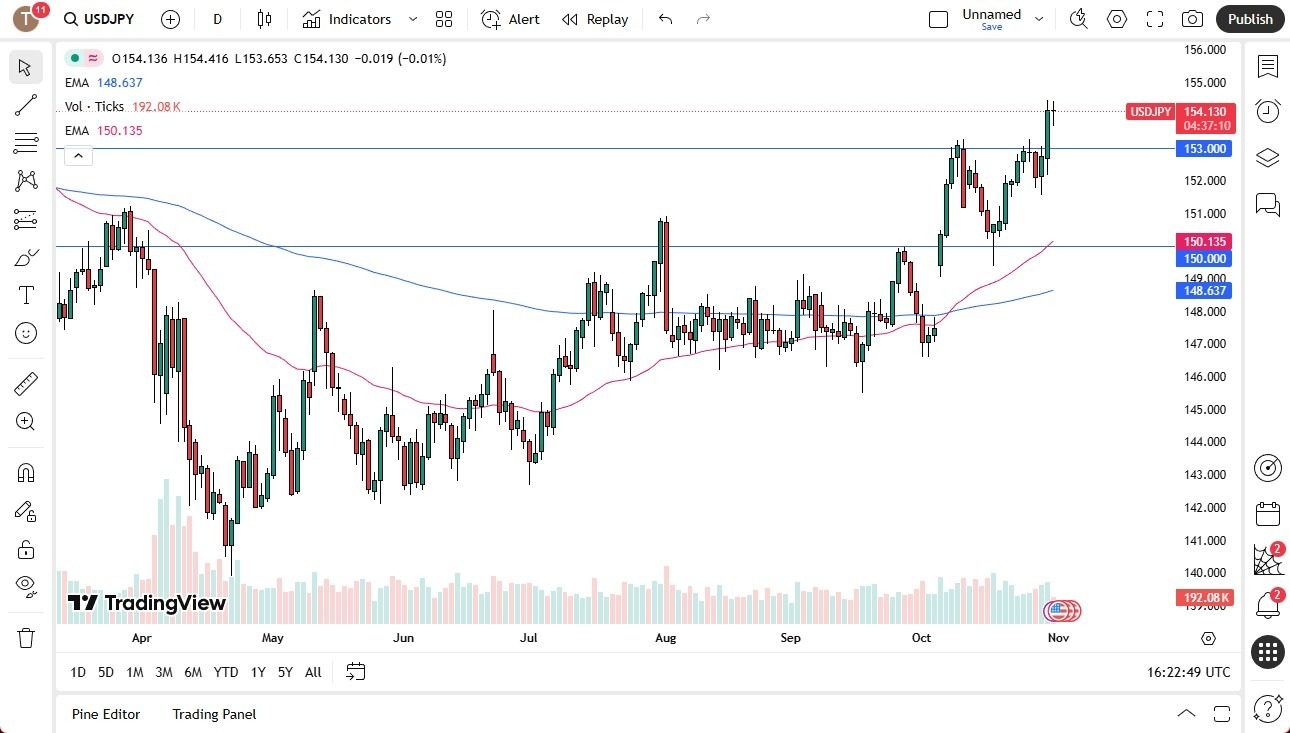
It’s been pretty quiet during the trading session on Friday in the US dollar against the Japanese yen currency pair, as we are just hanging around the highs. That’s actually a good sign after the impulsive candlestick that we had seen during the trading session on Thursday, because it means we’re comfortable being here. If that’s going to continue to be the case, then I would anticipate that eventually the US dollar really takes off towards the upside, perhaps targeting the 158 yen level.
The 153 yen level had previously been significant resistance, and breaking above there meant something. Now I would anticipate that there’s a little bit of market memory coming into the picture, offering a bit of support. Breaking down below that level then opens up the possibility of a move down to the 151.50 yen level, where we had seen some support previously.

Keep in mind that the Federal Reserve has shocked the market in the sense that they have flat out said—and reiterated during the press conference at least twice—that a rate cut in December is not a given. In other words, the Federal Reserve may stay tighter for longer, and if that’s going to be the case, then the US dollar is completely mispriced. I think somebody out there had been sniffing this out in the market for a while because the US dollar bottomed not only here but in multiple other currencies at the last FOMC meeting.
It’s almost as if the Federal Reserve is trying to explain to the market that they will be slow and methodical about cutting rates, and the market forgets this after a couple of days, tries to fight the Fed, and then gets a dose of reality again. The Bank of Japan will continue to be fairly loose with its monetary policy from now till eternity, more likely just due to demographics.
They can jawbone the pairs back down, but that’s a short-term fix at the end of the day. The steamroller that’s coming is the US dollar, and of course, the Japanese yen is weak against everything. So, the dollar should have a field day. I am a buyer of dips going forward, and I do expect it to go much higher.
Want to trade our USD/JPY forex analysis and predictions? Here’s a list of forex brokers in Japan to check out.