The main category of Forex News.
You can use the search box below to find what you need.
[wd_asp id=1]
The main category of Forex News.
You can use the search box below to find what you need.
[wd_asp id=1]
Spot Gold recovered the $4,000 mark after bottoming at $3,886.62 earlier in the week, but is currently hovering around the $4,000 mark. Financial markets are all about central banks on Wednesday, with the Bank of Canada (BoC) already announcing its decision and the Federal Reserve (Fed) and the Bank of Japan (BoJ) coming up next.
The BoC cut its policy rate by 25 basis points to 2.25% as widely anticipated, pushing the Canadian Dollar (CAD) sharply up and maintaining the US Dollar (USD) on the back foot. Policymakers “cut rates to support the economy through adjustment to US trade policy,” according to the accompanying statement.
Coming up next is the Fed, widely anticipated to cut the benchmark rate by 25 bps. It would be interesting to see what Chairman Jerome Powell has to say amid the ongoing government shutdown and the lack of updated data before the announcement. Could the Fed hold its fire? Seems unlikely as it would be an unexpected shock to financial markets, a risk Fed officials are unwilling to take.
Other than that, the BoJ will announce its monetary policy decision early in the Asian session, and is likely to hold interest rates unchanged, although market participants will be looking for hints on interest rate hikes. At the end of the day, the Gold price will react to the market’s sentiment after policymakers unveil their thoughts on economic performance and future monetary policies.
On the 4-hour chart, XAU/USD is currently trading around $3,992, up $27 for the day. A bearish 20 SMA slides south below the 100 SMA, while providing near-term resistance at $4,006, followed by the 100 SMA at $4,113. Conversely, the 200 SMA is advancing and stands at $3,947 beneath the current level, underpinning the broader bias while providing critical support. The Momentum indicator has recovered markedly and now hovers near its midline, lacking sustained directional strength, while the RSI remains flat at 43, suggesting a bearish tilt within consolidation. A sustained move above $4,006 would likely ease selling pressure and open the door to a test of $4,113; failure to reclaim the short-term average would keep risks skewed toward a pullback to the $3,947 support.
In the daily chart, XAU/USD is developing below a bullish 20 SMA that runs above the longer ones, in line with the dominant bullish momentum and hinting at additional gains ahead; the 20 SMA, however, stands at $4,075, acting as dynamic resistance. The 100 SMA is also bullish, advancing at $3,572, while the 200 SMA continues to rise at $3,334. At the same time, the Momentum indicator has reversed decisively, plunging well below the 100 midline, and pointing to strong bearish pressure in the short term. Meanwhile, the RSI has cooled to 50, signaling neutral conditions after earlier overbought extremes. The mix suggests consolidation or a corrective pullback may persist while below $4075; a sustained push above that barrier would likely revive the bullish bias, whereas failure to stabilize risks a deeper slide toward the 100-day SMA at $3,572, with the 200-day at $3,334 next support.
(This content was partially created with the help of an AI tool)
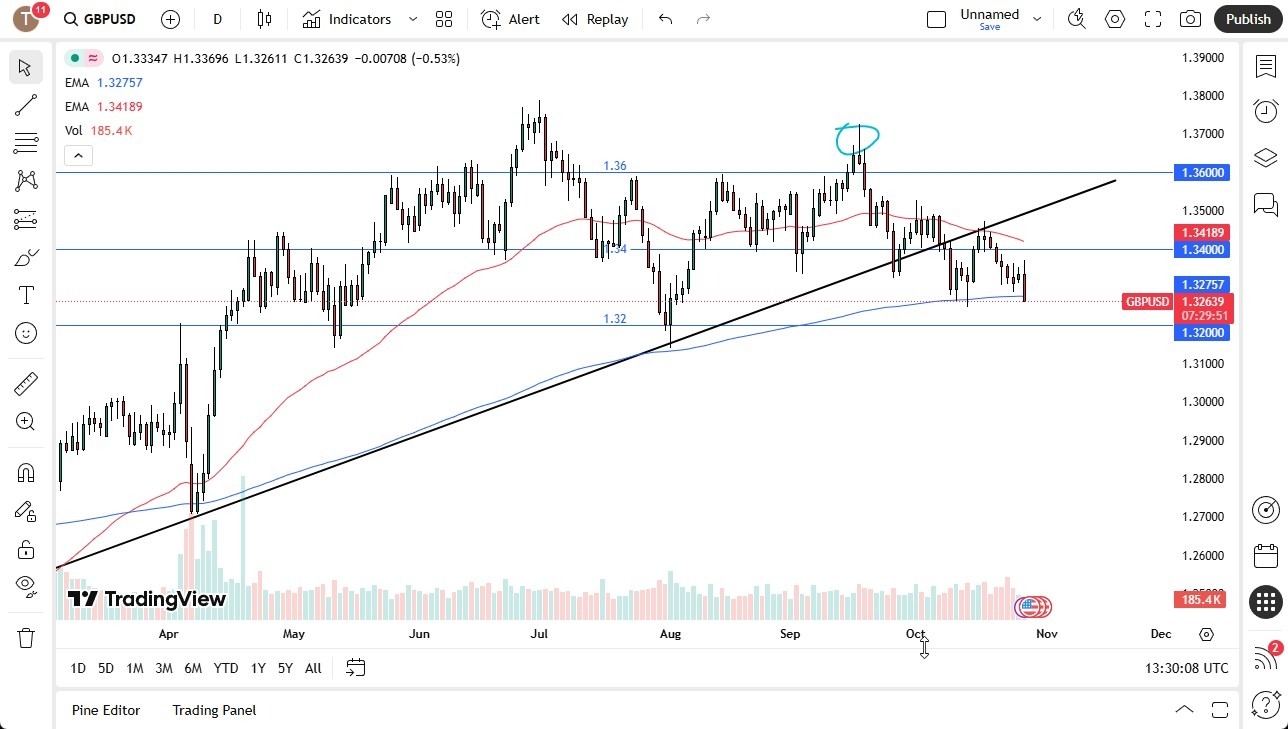
The British pound looks sick, quite frankly. If we break down below the 1.3150 level, then I think the bottom falls out. We go looking to the 1.27 level. We are hanging around the 200-day EMA, and I obviously believe that the FOMC interest rate decision, or perhaps more importantly, the press conference after that, will drive where the U.S. dollar goes next, which obviously will drive where this pair goes.
We do not have an interest rate decision coming out of the United Kingdom this week, unlike the European Central Bank. So, I think this is going to be all about the U.S. dollar. Short-term rallies, I think, open up the possibility of short opportunities at the first signs of exhaustion.
Looking at the euro against the British pound, we continue to rally quite nicely as we are now threatening the 0.88 level. Short-term pullbacks should end up being buying opportunities, but keep in mind that we have the European Central Bank with its interest rate decision on Thursday that would cause some volatility. It looks like the 0.8750 level will be a bit of a floor in this market, so a pullback from here is going to turn around and bounce quite nicely.
I’m looking for dips as value. I don’t have any interest in shorting this market. Breaking above the 0.8750 level opened up the possibility of a move to the 0.89 level based on the measured move of the previous consolidation area.
For a look at all of today’s economic events, check out our economic calendar.
The pound initially rallied during the trading session on Tuesday, but then fell rather significantly to break below the 200-day EMA. At this point, I have to ask whether the British pound is going to start to fall apart. This currency seems to be in flux, as the British pound has, for the last year and a half or so, been a bit more stable against the US dollar than most of its counterparts. However, over the last couple of weeks, we’ve seen an acceleration to the downside.

The Bank of England does not have a meeting this week, unlike the Federal Reserve, so the Federal Reserve might be the next mover of this pair. If we continue to drop from here, the 1.32 level is an area I’d be very sensitive to because it represents significant support. Breaking down below the 1.3150 level could kick off the next leg lower and would usher in a new push to the upside for the US dollar—probably not only against the British pound but multiple other currencies as well.
The US dollar has outperformed most currencies, and I look at a weakening US dollar during any particular trading session as a potential buying opportunity to get my hands on more greenbacks. The British pound seems to have a bit of a brick wall near the 50-day EMA, which is currently just above the 1.34 level. I think the upside is somewhat limited.
As the US dollar goes, so go the rest of the currencies, and that’s exactly what we’re seeing here. The US dollar is showing signs of life, and it is starting to weigh upon the British pound. Whether we can continue to the downside remains to be seen, but clearly, at this point in time, it’s very difficult for the pound to gain traction against the US dollar.
Ready to trade our daily GBP/USD Forex forecast? Here’s some of the best forex broker UK reviews to check out.
Christopher Lewis has been trading Forex and has over 20 years experience in financial markets. Chris has been a regular contributor to Daily Forex since the early days of the site. He writes about Forex for several online publications, including FX Empire, Investing.com, and his own site, aptly named The Trader Guy. Chris favours technical analysis methods to identify his trades and likes to trade equity indices and commodities as well as Forex. He favours a longer-term trading style, and his trades often last for days or weeks.
Gold price (XAU/USD) snaps its three-day losing streak, trading 1.70% higher to near $4,020 during the European trading session on Wednesday. The precious metal bounces back ahead of the Federal Reserve’s (Fed) monetary policy announcement at 18:00 GMT.
According to the CME FedWatch tool, traders have priced in a 25-basis-point (bps) interest rate reduction by the Fed that will push the Federal Fund rate to 3.75%-4.00%.
Lower interest rates by the Fed bode well for non-yielding assets, such as Gold.
Meanwhile, the US Dollar (USD) also trades higher ahead of the Fed’s policy, with the US Dollar Index (DXY) trading 0.15% higher around 99.00. 10-year US Treasury yields edge up to near 4.00%.
In the Fed’s monetary policy announcement, investors will also look for cues about whether the United States (US) central bank will cut interest rates again in December. Market participants would also look for cues about the current status of the labor market amid the absence of US economic data releases due to the federal shutdown.
The next trigger for the Gold price will be the meeting between US President Donald Trump and Chinese leader Xi Jinping in South Korea on Thursday. Both leaders are expected to sign the trade deal and discuss various issues such as technology sharing, rare earth exports to Washington, and tariffs.
The scenario of improving trade relations between the two powerhouses would diminish the appeal of safe-haven assets, such as Gold.
Gold price bounces back on Wednesday after attracting bids near the three-week low of $3,886.60 posted on Tuesday. However, the Gold price struggles to extend its upside above the 20-day Exponential Moving Average (EMA) around $4,035.60.
The 14-day Relative Strength Index (RSI) falls inside the 40.00-60.00 range, indicating a sideways trend in the near term.
On the upside, the Gold price would revisit its all-time high of $4,380 if it extends its recovery move above the October 22 high of $4,161.40. Looking down, the Gold price could slide towards the September 25 low of $3,722.07 if it breaks below the October 28 low of $3,886.60.
Gold has played a key role in human’s history as it has been widely used as a store of value and medium of exchange. Currently, apart from its shine and usage for jewelry, the precious metal is widely seen as a safe-haven asset, meaning that it is considered a good investment during turbulent times. Gold is also widely seen as a hedge against inflation and against depreciating currencies as it doesn’t rely on any specific issuer or government.
Central banks are the biggest Gold holders. In their aim to support their currencies in turbulent times, central banks tend to diversify their reserves and buy Gold to improve the perceived strength of the economy and the currency. High Gold reserves can be a source of trust for a country’s solvency. Central banks added 1,136 tonnes of Gold worth around $70 billion to their reserves in 2022, according to data from the World Gold Council. This is the highest yearly purchase since records began. Central banks from emerging economies such as China, India and Turkey are quickly increasing their Gold reserves.
Gold has an inverse correlation with the US Dollar and US Treasuries, which are both major reserve and safe-haven assets. When the Dollar depreciates, Gold tends to rise, enabling investors and central banks to diversify their assets in turbulent times. Gold is also inversely correlated with risk assets. A rally in the stock market tends to weaken Gold price, while sell-offs in riskier markets tend to favor the precious metal.
The price can move due to a wide range of factors. Geopolitical instability or fears of a deep recession can quickly make Gold price escalate due to its safe-haven status. As a yield-less asset, Gold tends to rise with lower interest rates, while higher cost of money usually weighs down on the yellow metal. Still, most moves depend on how the US Dollar (USD) behaves as the asset is priced in dollars (XAU/USD). A strong Dollar tends to keep the price of Gold controlled, whereas a weaker Dollar is likely to push Gold prices up.
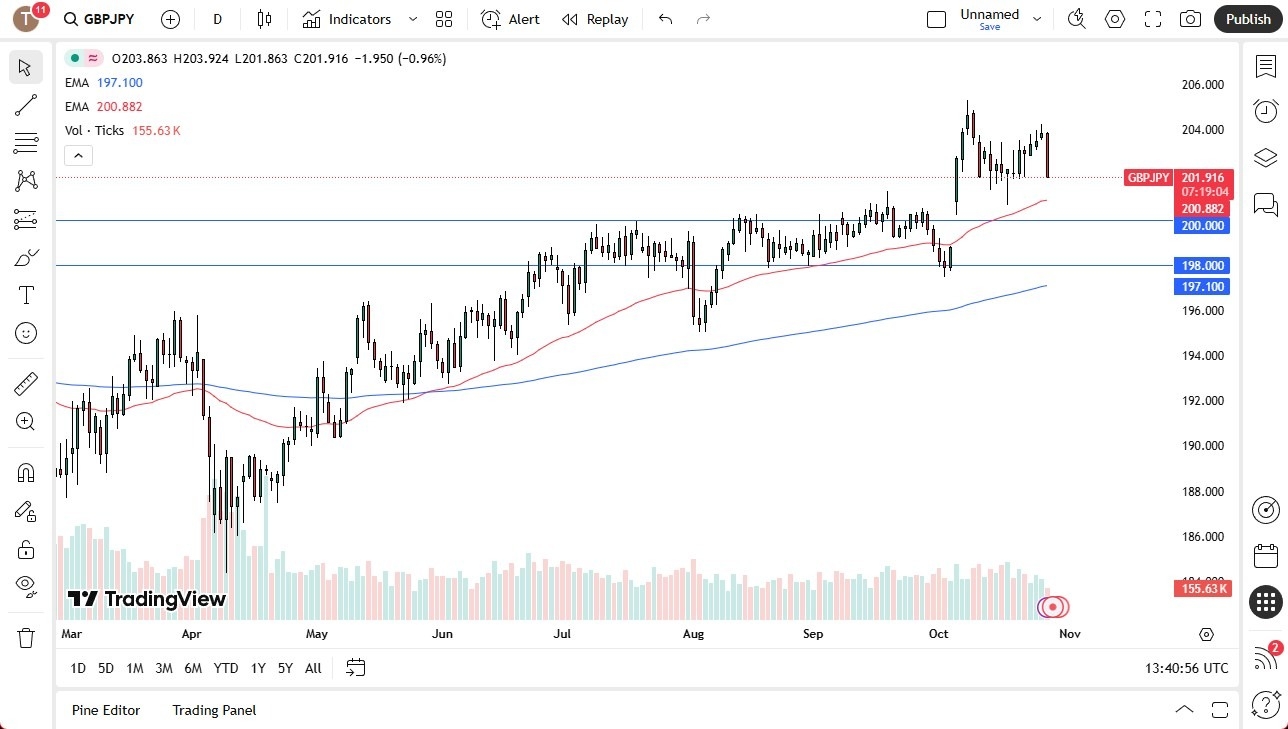
The British pound has fallen significantly against the Japanese yen during early trading on Tuesday, as the market continues to be very volatile. The Bank of Japan made a statement overnight that it believes forex moves should represent fundamentals. To me, that’s something they’ve said multiple times in the past, and it always leads to the same thing: the Japanese yen strengthening for a little bit, only to see buyers coming back into the market and shorting it again.
With that in mind, I’m looking at the area right around the 50-day EMA as an area that could offer support, right along with the ¥200 level. Because of this, I’m looking for an opportunity to buy this pair on some type of bounce. As things stand right now, it looks like we have plenty of pressure to the downside, so I would have to be very patient here. All things being equal, this is a scenario where I think you look for value and take advantage of it—not only are we in a significant uptrend, but we also have the interest rate differential between the British pound and the Japanese yen.
All things being equal, this is a market that I think tries to get back to the ¥205 level, an area that has previously been very difficult to break above. If we can break above that level, then we could go much higher. Ultimately, I do think that’s what happens, and I favor the British pound over the Japanese yen. That’s probably true with most currencies, but the interest rate differential between the British pound and the Japanese yen is much wider than what’s found in other pairs, such as the Canadian dollar or even the Swiss franc against the yen.
Not all pairs are going to move with the same type of momentum, although they do tend to move in the same general direction. All things being equal, this is a market where I’m looking for a buying opportunity that I expect to take advantage of in the next day or two.
Begin trading our daily forecasts and analysis. Here is a list of Forex brokers in Japan to work with.
Christopher Lewis has been trading Forex and has over 20 years experience in financial markets. Chris has been a regular contributor to Daily Forex since the early days of the site. He writes about Forex for several online publications, including FX Empire, Investing.com, and his own site, aptly named The Trader Guy. Chris favours technical analysis methods to identify his trades and likes to trade equity indices and commodities as well as Forex. He favours a longer-term trading style, and his trades often last for days or weeks.
After posting small gains for five consecutive days, EUR/USD loses its traction in the European morning on Wednesday and trades below 1.1650. The pair’s near-term technical outlook highlights a loss of bullish momentum as investors await the Federal Reserve’s (Fed) monetary policy announcements.
The table below shows the percentage change of Euro (EUR) against listed major currencies today. Euro was the weakest against the Australian Dollar.
| USD | EUR | GBP | JPY | CAD | AUD | NZD | CHF | |
|---|---|---|---|---|---|---|---|---|
| USD | 0.13% | 0.30% | -0.03% | -0.16% | -0.49% | -0.25% | 0.09% | |
| EUR | -0.13% | 0.17% | -0.18% | -0.29% | -0.61% | -0.38% | -0.04% | |
| GBP | -0.30% | -0.17% | -0.34% | -0.45% | -0.78% | -0.55% | -0.20% | |
| JPY | 0.03% | 0.18% | 0.34% | -0.16% | -0.44% | -0.20% | 0.14% | |
| CAD | 0.16% | 0.29% | 0.45% | 0.16% | -0.34% | -0.09% | 0.25% | |
| AUD | 0.49% | 0.61% | 0.78% | 0.44% | 0.34% | 0.24% | 0.58% | |
| NZD | 0.25% | 0.38% | 0.55% | 0.20% | 0.09% | -0.24% | 0.34% | |
| CHF | -0.09% | 0.04% | 0.20% | -0.14% | -0.25% | -0.58% | -0.34% |
The heat map shows percentage changes of major currencies against each other. The base currency is picked from the left column, while the quote currency is picked from the top row. For example, if you pick the Euro from the left column and move along the horizontal line to the US Dollar, the percentage change displayed in the box will represent EUR (base)/USD (quote).
The bullish opening in Wall Street, followed by a risk rally, highlighted a risk-positive market atmosphere and made it difficult for the US Dollar (USD) to find demand on Tuesday. Early Wednesday, US stock index futures trade mixed, reflecting a cautious mood, which caps EUR/USD’s upside.
The Fed is widely anticipated to cut the policy rate by 25 basis points (bps) following the October policy meeting. In case Fed Chair Jerome Powell adopts a dovish tone in the post-meeting press conference, citing possibly worsening conditions in the labor market because of the government shutdown and softer-than-forecast inflation data for September, the USD could come under renewed selling pressure.
On the other hand, EUR/USD could continue to push lower if Powell refrains from committing to further policy easing because of the uncertainty created by the lack of data releases and heightened upside risks to inflation.
On Thursday, the European economic calendar will feature third-quarter Gross Domestic Product (GDP) growth figures for Germany and the Eurozone before the European Central Bank (ECB) announces monetary policy decisions.
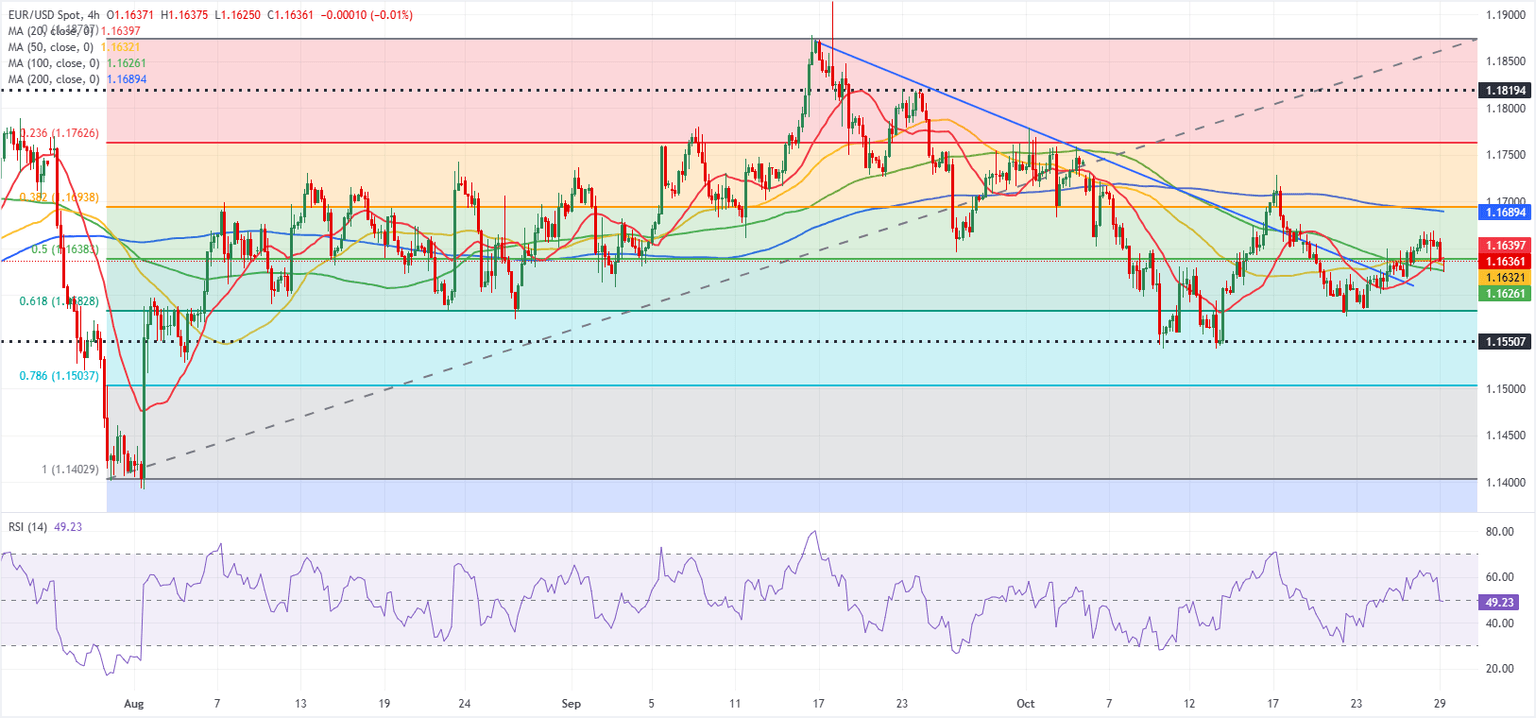
EUR/USD failed to clear 1.1660, where the 100-day Simple Moving Average (SMA) is located, and the Relative Strength Index (RSI) indicator on the 4-hour chart retreated slightly below 50, reflecting buyers’ hesitancy.
On the downside, 1.1580 (Fibonacci 61.8% retracement of the latest uptrend), aligns as the next support level before 1.1550 (static level) and 1.1500 (Fibonacci 78.6% retracement). Looking north, resistance levels could be spotted at 1.1660 (100-day SMA), 1.1690-1.1700 (200-period SMA, Fibonacci 38.2% retracement) and 1.1760 (Fibonacci 23.6% retracement).
Monetary policy in the US is shaped by the Federal Reserve (Fed). The Fed has two mandates: to achieve price stability and foster full employment. Its primary tool to achieve these goals is by adjusting interest rates.
When prices are rising too quickly and inflation is above the Fed’s 2% target, it raises interest rates, increasing borrowing costs throughout the economy. This results in a stronger US Dollar (USD) as it makes the US a more attractive place for international investors to park their money.
When inflation falls below 2% or the Unemployment Rate is too high, the Fed may lower interest rates to encourage borrowing, which weighs on the Greenback.
The Federal Reserve (Fed) holds eight policy meetings a year, where the Federal Open Market Committee (FOMC) assesses economic conditions and makes monetary policy decisions.
The FOMC is attended by twelve Fed officials – the seven members of the Board of Governors, the president of the Federal Reserve Bank of New York, and four of the remaining eleven regional Reserve Bank presidents, who serve one-year terms on a rotating basis.
In extreme situations, the Federal Reserve may resort to a policy named Quantitative Easing (QE). QE is the process by which the Fed substantially increases the flow of credit in a stuck financial system.
It is a non-standard policy measure used during crises or when inflation is extremely low. It was the Fed’s weapon of choice during the Great Financial Crisis in 2008. It involves the Fed printing more Dollars and using them to buy high grade bonds from financial institutions. QE usually weakens the US Dollar.
Quantitative tightening (QT) is the reverse process of QE, whereby the Federal Reserve stops buying bonds from financial institutions and does not reinvest the principal from the bonds it holds maturing, to purchase new bonds. It is usually positive for the value of the US Dollar.
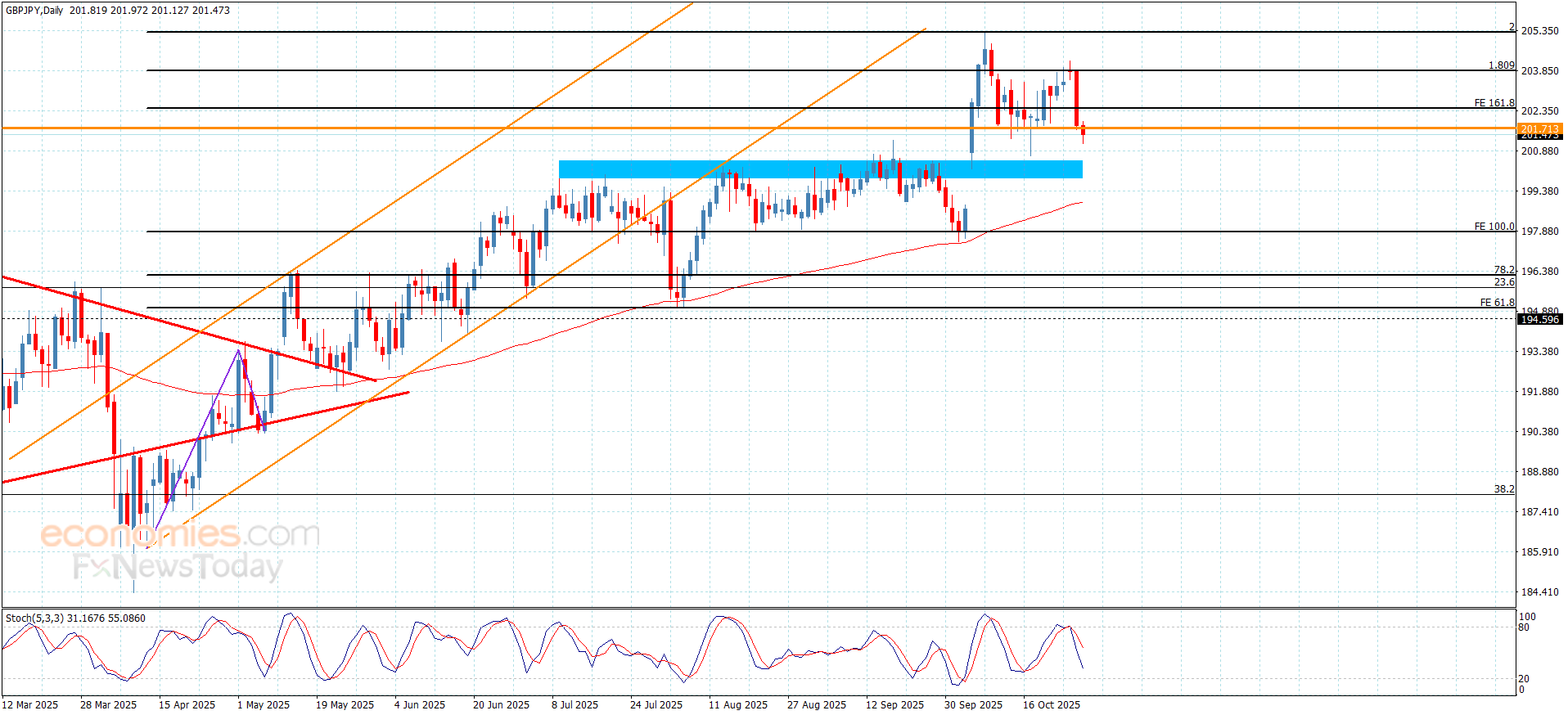
The GBPJPY pair activated the previously suggested bearish corrective track, putting it under strong negative pressure to achieve the previously suggested stations by reaching 201.15, then retesting the extra support at 201.75.
Forming extra barrier at 202.55 level and the continuation of providing negative momentum by stochastic will increase the efficiency of the bearish corrective track, to expect targeting 200.45 level, and surpassing it might extend the losses towards 199.20 directly.
The expected trading range for today is between 200.45 and 202.55
Trend forecast: Bearish
The GBPJPY pair activated the previously suggested bearish corrective track, putting it under strong negative pressure to achieve the previously suggested stations by reaching 201.15, then retesting the extra support at 201.75.
Forming extra barrier at 202.55 level and the continuation of providing negative momentum by stochastic will increase the efficiency of the bearish corrective track, to expect targeting 200.45 level, and surpassing it might extend the losses towards 199.20 directly.
The expected trading range for today is between 200.45 and 202.55
Trend forecast: Bearish
– Written by
David Woodsmith
STORY LINK Pound to Dollar Price Forecast: GBP/USD Drops on UK Budget Risks
The Pound-to-Dollar exchange rate (GBP/USD) slipped sharply on Tuesday as investors turned cautious ahead of the UK government’s upcoming autumn budget.
At the time of writing, GBP/USD was trading at 1.32815, down around 0.44% from Tuesday’s opening levels.
The Pound (GBP) came under renewed pressure after the Office for Budget Responsibility (OBR) warned that the UK faces a £20bn fiscal shortfall, largely due to weak productivity and slowing growth.
The findings intensified speculation that Chancellor Rachel Reeves may be forced to introduce tax increases in next month’s budget to shore up the nation’s finances.
The prospect of tighter fiscal measures dampened market sentiment, with investors wary that higher taxes could weigh on household spending and slow the UK’s already fragile recovery.
As a result, Sterling struggled to find support through the European session, with the Pound weakening against a firming US Dollar.
The Greenback (USD) held steady ahead of the Federal Reserve’s interest rate decision on Wednesday, buoyed by safe-haven demand as global markets adopted a more cautious tone.
Get better rates and lower fees on your next international money transfer.
Compare TorFX with top UK banks in seconds and see how much you could save.
Investors widely expect the Fed to announce a 25-basis-point rate cut, but uncertainty over future policy guidance kept USD trading volatile.
Looking ahead, attention will turn squarely to the Federal Reserve’s rate announcement, which is likely to set the tone for mid-week market movement.
If Chair Jerome Powell signals that further rate cuts are on the table before year-end, the Dollar may weaken, potentially giving GBP/USD scope to rebound.
However, a more measured tone — or hints that this could mark the final cut of the cycle — could strengthen the Greenback, pushing the pair lower still.
With the UK data calendar empty until the end of the week, the Pound will remain heavily influenced by global sentiment and speculation over both Fed policy and UK fiscal plans in the run-up to the November budget.

International Money Transfer? Ask our resident FX expert a money transfer question or try John’s new, free, no-obligation personal service! ,where he helps every step of the way,
ensuring you get the best exchange rates on your currency requirements.
TAGS: Pound Dollar Forecasts
The (ETHUSD) price settled with sharp decline in its last intraday trading, amid the emergence of the negative signals on the relative strength indicators, attempting to look for rising low that might help it to recover, leaning on the support of its EMA50, providing strong chance for gaining this momentum, especially with the dominance of the bullish correction trend on the short-term basis and its trading alongside trendline, with the strength relative indicators reaching exaggerated oversold levels.
Get high-accuracy trading signals delivered directly to your Telegram. Subscribe to specialized packages tailored for the world’s top markets:
Full VIP signals performance report for 13-17, October 2025:
View Full Performance Report Telegram (https://t.me/besttradingsignalstocksbot?start=p88d632b0-66dd-11f0-a948-13815052d5ae)

-1761734759220-1761734759226.png&w=1536&q=95 "XAU/USD snaps three-day losing streak as Fed’s policy takes centre stage")