The main category of Forex News.
You can use the search box below to find what you need.
[wd_asp id=1]
The main category of Forex News.
You can use the search box below to find what you need.
[wd_asp id=1]
The EURJPY pair resumed the bearish corrective attack in Friday’s trading, hitting some of the previously suggested targets, to form quick positive rebound to settle near 176.50, keeping the main bullish scenario that depends on the stability within the bullish channel’s levels that appears in the above image.
Note that the continuation of the contradiction between the main indicators that might force the price to provide more of the sideways trading, to keep waiting for breaching 177.05 to confirm its readiness to form new bullish attack by targeting the top at 177.80.
The expected trading range for today is between 175.90 and 177.05
Trend forecast: Fluctuated within the bullish trend
This isn’t just a Euro situation. This is a US dollar situation. This market got the FOMC press conference on September 17, and we’ve done nothing but fall with the occasional short term bounce since then. Remember, we were told that the US dollar was over and that it was going to fall apart. And now once we got that crescendo somewhere in this area, I started to think maybe we’re getting closer to the top because everybody thinks that the US dollar is history. I’m starting to hear reports from people who don’t even trade in currencies about how the US dollar is falling. Once you get to that point, I can’t tell you how many times I’ve made money just going in the other direction. I have been short of this pair for quite some time. And if we can really break down below the bottom of the candlestick from the Thursday session, then I think we will accelerate. I have no interest in buying this pair.

Ready to trade our daily Forex forecast? Here’s a list of some of the best regulated forex brokers to check out.
Christopher Lewis has been trading Forex and has over 20 years experience in financial markets. Chris has been a regular contributor to Daily Forex since the early days of the site. He writes about Forex for several online publications, including FX Empire, Investing.com, and his own site, aptly named The Trader Guy. Chris favours technical analysis methods to identify his trades and likes to trade equity indices and commodities as well as Forex. He favours a longer-term trading style, and his trades often last for days or weeks.
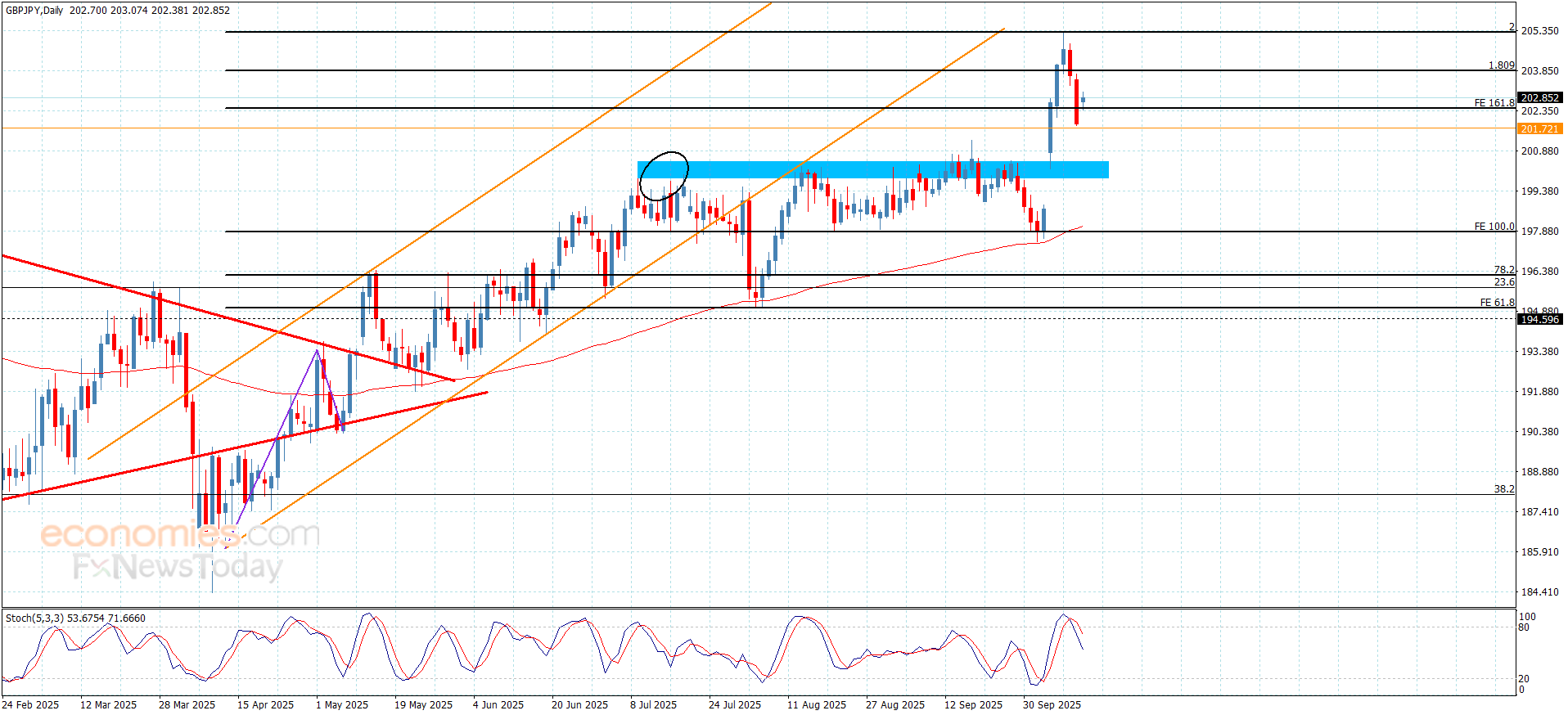
The GBPJPY pair activated negatively with the economic data on Friday to resume the bearish correction, to target 201.70 support, then bouncing positively to settle above %161.8 Fibonacci extension level at 202.40 to reinforce the chances of forming new bullish waves, to attempt to reach 203.40 then press on the barrier at 203.85.
While facing new bearish pressure and reaching below 201.70 support confirms its move to a new negative station, which forces it to suffer more losses by reaching 201.20 followed by the extra support at 200.45.
The expected trading range for today is between 202.40 and 203.85
Trend forecast: Bullish
Pound’s reversal against the Yen found support near the 38.2% Fibonacci retracement, right below the 202.00 line, and is trading higher again on Monday. The pair has regained the 203.00 level and is approaching the 203.50 area, where it might find significant resistance.
The Japanese Yen is under pressure on Monday after the Komeito Party announced it will leave the governing coalition due to divergences with the new LDP leader, Sanae Takaichi, deepening the country’s political uncertainty.
The technical picture shows easing bearish pressure. The 4-Hour RSD has popped up above the key 50 level, and the MACD in the same timeframe is turning higher.
Bulls, however, will need to breach the resistance area around 203.50, where the trendline resistance from last week’s highs meets the October 10 high, to confirm the trend shift. Further up, the intraday resistance, at 204.55, and the October 8 high, at 205.20, will come into focus.
On the downside, immediate support is at Friday’s low of 201.85. Below there, bears would be enticed to the 50% Fibonacci retracement, at 201.35, and the 61.8% Fibonacci retracement, which meets October 5 lows at the 200.30 area.
The table below shows the percentage change of Japanese Yen (JPY) against listed major currencies today. Japanese Yen was the strongest against the New Zealand Dollar.
| USD | EUR | GBP | JPY | CAD | AUD | NZD | CHF | |
|---|---|---|---|---|---|---|---|---|
| USD | 0.16% | 0.12% | 0.23% | 0.08% | -0.17% | 0.17% | 0.19% | |
| EUR | -0.16% | -0.04% | 0.11% | -0.09% | -0.25% | 0.00% | 0.01% | |
| GBP | -0.12% | 0.04% | 0.18% | -0.04% | -0.22% | 0.05% | 0.03% | |
| JPY | -0.23% | -0.11% | -0.18% | -0.20% | -0.45% | -0.02% | -0.09% | |
| CAD | -0.08% | 0.09% | 0.04% | 0.20% | -0.29% | 0.10% | 0.08% | |
| AUD | 0.17% | 0.25% | 0.22% | 0.45% | 0.29% | 0.27% | 0.25% | |
| NZD | -0.17% | -0.01% | -0.05% | 0.02% | -0.10% | -0.27% | -0.02% | |
| CHF | -0.19% | -0.01% | -0.03% | 0.09% | -0.08% | -0.25% | 0.02% |
The heat map shows percentage changes of major currencies against each other. The base currency is picked from the left column, while the quote currency is picked from the top row. For example, if you pick the Japanese Yen from the left column and move along the horizontal line to the US Dollar, the percentage change displayed in the box will represent JPY (base)/USD (quote).
.
Silver price (XAG/USD) extends its winning streak for the fourth successive session, reaching its all-time high of $51.69 during the Asian hours on Monday. The non-interest-bearing Silver receives support from the increased likelihood of the US Federal Reserve (Fed) further rate cuts by year-end.
Consumer confidence in the United States (US) deteriorated slightly in early October, supporting the Fed rate cut bets. The preliminary University of Michigan’s Consumer Sentiment Index edged lower to 55.0 for October, from 55.1 in September.
The Federal Open Market Committee (FOMC) Minutes from the September meeting suggested policymakers are leaning toward further rate cuts this year. The CME FedWatch Tool suggests that markets are now pricing in nearly a 96% chance of a 25-basis-point Fed rate cut in October and an 87% possibility of another reduction in December.
Federal Reserve Bank of St. Louis President Alberto Musalem said on Friday that the labor market is showing signs of potential weakness and that a balanced approach to monetary policy only works if inflation expectations are anchored. Meanwhile, San Francisco Fed President Mary Daly said that inflation has come in much less than she had feared. Daly further stated that the US central bank is projecting additional cuts in risk management.
The safe-haven Silver attracts buyers due to renewed US-China trade concerns. US President Donald Trump said that there’s no need to meet China’s President Xi Jinping at the upcoming South Korea summit and threatened to impose 100% tariffs on Chinese imports. However, Trump posted on Truth Social on Sunday, noting that China’s economy “will be fine” and that the US wants to “help China, not hurt it.”
Silver is a precious metal highly traded among investors. It has been historically used as a store of value and a medium of exchange. Although less popular than Gold, traders may turn to Silver to diversify their investment portfolio, for its intrinsic value or as a potential hedge during high-inflation periods. Investors can buy physical Silver, in coins or in bars, or trade it through vehicles such as Exchange Traded Funds, which track its price on international markets.
Silver prices can move due to a wide range of factors. Geopolitical instability or fears of a deep recession can make Silver price escalate due to its safe-haven status, although to a lesser extent than Gold’s. As a yieldless asset, Silver tends to rise with lower interest rates. Its moves also depend on how the US Dollar (USD) behaves as the asset is priced in dollars (XAG/USD). A strong Dollar tends to keep the price of Silver at bay, whereas a weaker Dollar is likely to propel prices up. Other factors such as investment demand, mining supply – Silver is much more abundant than Gold – and recycling rates can also affect prices.
Silver is widely used in industry, particularly in sectors such as electronics or solar energy, as it has one of the highest electric conductivity of all metals – more than Copper and Gold. A surge in demand can increase prices, while a decline tends to lower them. Dynamics in the US, Chinese and Indian economies can also contribute to price swings: for the US and particularly China, their big industrial sectors use Silver in various processes; in India, consumers’ demand for the precious metal for jewellery also plays a key role in setting prices.
Silver prices tend to follow Gold’s moves. When Gold prices rise, Silver typically follows suit, as their status as safe-haven assets is similar. The Gold/Silver ratio, which shows the number of ounces of Silver needed to equal the value of one ounce of Gold, may help to determine the relative valuation between both metals. Some investors may consider a high ratio as an indicator that Silver is undervalued, or Gold is overvalued. On the contrary, a low ratio might suggest that Gold is undervalued relative to Silver.
The EURJPY pair resumed the bearish corrective attack in Friday’s trading, hitting some of the previously suggested targets, to form quick positive rebound to settle near 176.50, keeping the main bullish scenario that depends on the stability within the bullish channel’s levels that appears in the above image.
Note that the continuation of the contradiction between the main indicators that might force the price to provide more of the sideways trading, to keep waiting for breaching 177.05 to confirm its readiness to form new bullish attack by targeting the top at 177.80.
The expected trading range for today is between 175.90 and 177.05
Trend forecast: Fluctuated within the bullish trend
Gold is seeing a second consecutive day of gains early Monday, having managed to reclaim the key $4,000 level on Friday.
Gold sets off a new week with a bang, recording a new all-time high in early trades, responding positively to fresh developments surrounding the US-China tariff war.
US President Donald Trump slapped an additional 100% tariffs on all Chinese imports and introduced strict export controls on US-made critical software starting November 1.
This came in response to China tightening its export controls on rare earths and related technologies, while barring its citizens from participating in unauthorized mining overseas.
However, buyers quickly turn cautious, fuelling a brief retreat in Gold, as they digest Trump’s TACO (Trump Always Chickens Out) button pressed on Sunday.
Risk sentiment is on a solid recovery, courtesy of Trump’s conciliatory remarks, citing that “I think we’re going to be fine with China.”
US Vice President J.D. Vance also said on Sunday that “Trump is willing to be a reasonable negotiator with China.”
Meanwhile, a positive shift in risk sentiment dents the US Dollar’s (USD) safe-haven appeal, lending support to the bright metal. The Greenback bears the brunt of the protracted US government shutdown and lingering US tariffs on China, effective from November 1.
Looking ahead, it remains to be seen if Gold continues its record-setting rally, with traders closely eyeing fresh developments on the US-China trade front and speeches from US Federal Reserve (Fed) officials, in the absence of high-impact US economic data releases.
The US Bureau of Labor Statistics (BLS) is set to publish the critical Consumer Price Index (CPI) report on Friday, October 24.
Bracing for the eighth consecutive weekly advance, Gold buyers look to resume the record-setting rally in Asian trading on Friday.
The daily chart shows that the 14-day Relative Strength Index (RSI) is off the extreme overbought zone, while trending higher 78.80, as of writing.
The leading indicator suggests that buyers could extend their control, with a retest of the $4,100 level likely. A sustained break above that will call for a test of the $4,138 – the upper boundary of the month-long rising channel.
Alternatively, Gold needs acceptance below the lower boundary of the rising channel at $3,991 on a daily candlestick closing basis to sustain the correction toward the $3,950 psychological mark.
Deeper correction could challenge the $3,895 supply zone (October 1 and 2 highs).
Generally speaking, a trade war is an economic conflict between two or more countries due to extreme protectionism on one end. It implies the creation of trade barriers, such as tariffs, which result in counter-barriers, escalating import costs, and hence the cost of living.
An economic conflict between the United States (US) and China began early in 2018, when President Donald Trump set trade barriers on China, claiming unfair commercial practices and intellectual property theft from the Asian giant. China took retaliatory action, imposing tariffs on multiple US goods, such as automobiles and soybeans. Tensions escalated until the two countries signed the US-China Phase One trade deal in January 2020. The agreement required structural reforms and other changes to China’s economic and trade regime and pretended to restore stability and trust between the two nations. However, the Coronavirus pandemic took the focus out of the conflict. Yet, it is worth mentioning that President Joe Biden, who took office after Trump, kept tariffs in place and even added some additional levies.
The return of Donald Trump to the White House as the 47th US President has sparked a fresh wave of tensions between the two countries. During the 2024 election campaign, Trump pledged to impose 60% tariffs on China once he returned to office, which he did on January 20, 2025. With Trump back, the US-China trade war is meant to resume where it was left, with tit-for-tat policies affecting the global economic landscape amid disruptions in global supply chains, resulting in a reduction in spending, particularly investment, and directly feeding into the Consumer Price Index inflation.
Gold price (XAU/USD) extends the rally to around $4,040 during the early Asian session on Monday. The escalating trade tensions between the United States (US) and China provide some support to the precious metal. Traders await signs on when the US government will reopen and release data that will shape Federal Reserve (Fed) policy.
The rally in the yellow metal is bolstered by US President Donald Trump’s decision to impose fresh 100% tariffs on Chinese imports starting November 1. China warned the US that it would retaliate if Trump fails to back down on his threat to impose levies on Chinese imports. ”Heating up the trade war again will tank the dollar and be good for safe-havens,” said Tai Wong, an independent metals trader.
Furthermore, traders expect the Fed to cut interest rates by 25 basis points (bps) each in October and December. According to the CME FedWatch tool, markets are pricing in nearly a 97% possibility that the US central bank cuts rates by 25 bps at its October meeting, while the odds of an additional reduction in December are at 92%. Lower interest rates could reduce the opportunity cost of holding Gold, supporting the non-yielding precious metal.
Traders will take more cues from the US Retail Sales and Producer Price Index (PPI) reports, which will be released later on Thursday. Any signs of hotter inflation in the US could lift the US Dollar (USD) and weigh on the USD-denominated commodity price in the near term.
Gold has played a key role in human’s history as it has been widely used as a store of value and medium of exchange. Currently, apart from its shine and usage for jewelry, the precious metal is widely seen as a safe-haven asset, meaning that it is considered a good investment during turbulent times. Gold is also widely seen as a hedge against inflation and against depreciating currencies as it doesn’t rely on any specific issuer or government.
Central banks are the biggest Gold holders. In their aim to support their currencies in turbulent times, central banks tend to diversify their reserves and buy Gold to improve the perceived strength of the economy and the currency. High Gold reserves can be a source of trust for a country’s solvency. Central banks added 1,136 tonnes of Gold worth around $70 billion to their reserves in 2022, according to data from the World Gold Council. This is the highest yearly purchase since records began. Central banks from emerging economies such as China, India and Turkey are quickly increasing their Gold reserves.
Gold has an inverse correlation with the US Dollar and US Treasuries, which are both major reserve and safe-haven assets. When the Dollar depreciates, Gold tends to rise, enabling investors and central banks to diversify their assets in turbulent times. Gold is also inversely correlated with risk assets. A rally in the stock market tends to weaken Gold price, while sell-offs in riskier markets tend to favor the precious metal.
The price can move due to a wide range of factors. Geopolitical instability or fears of a deep recession can quickly make Gold price escalate due to its safe-haven status. As a yield-less asset, Gold tends to rise with lower interest rates, while higher cost of money usually weighs down on the yellow metal. Still, most moves depend on how the US Dollar (USD) behaves as the asset is priced in dollars (XAU/USD). A strong Dollar tends to keep the price of Gold controlled, whereas a weaker Dollar is likely to push Gold prices up.
– Written by
Frank Davies
STORY LINK Pound to Dollar Forecast: Weak UK Data and Tax Fears Sink GBP
The Pound to Dollar exchange rate (GBP/USD) slumped to two-month lows near 1.3280 on Thursday as fragile UK fundamentals and firm dollar demand combined to drive renewed selling pressure. The pair traded close to 1.3300 on Friday in subdued European trade.
Sterling sentiment remains fragile heading into the Autumn Budget.
Swissquote Bank’s Ipek Ozkardeskaya noted; “Sterling remains very much unloved heading into the Autumn Budget.”
UoB warned of deeper losses ahead; “This time around, the price action has resulted in a marked increase in downward momentum, and the next technical target is at 1.3200. On the upside, the ‘strong resistance’ level is now at 1.3410 instead of 1.3465.”
Critical support remains near 1.3140.
UK data continued to highlight subdued demand.
Get better rates and lower fees on your next international money transfer.
Compare TorFX with top UK banks in seconds and see how much you could save.
According to the British Retail Consortium (BRC), total retail footfall fell 1.8% in the year to September following a 0.4% decline in August.
BRC CEO Helen Dickinson said; “Customers put the brakes on non-essential spending… fashion and full-price big-ticket items were held back by lower consumer confidence.”
The latest KPMG and REC jobs survey reported the slowest wage growth in more than four years.
REC’s Neil Carberry commented; “Pay trends remain subdued where pay is set by the market rather than the Government. This suggests that pay growth should not be a drag on the Bank of England’s upcoming interest rate decision.”
The combination of looming tax hikes, weak consumption and slowing pay growth could prompt the Bank of England to cut rates more quickly — a scenario that would likely weigh further on Sterling.
ING observed; “It’s becoming increasingly clear that this week’s dollar rally – which was initially spurred by events in Japan and France – is turning into a broader rethink of the consensus short-dollar trade.”
It added; “The dollar can consolidate some gains today, but remains at risk of corrections in our view.”

Markets still price a 95% chance of an October rate cut and around an 80% likelihood of two cuts by the end of 2025.
However, the continuing US government shutdown has disrupted data releases, raising the risk that the Federal Reserve could make a policy error and unsettle markets.
International Money Transfer? Ask our resident FX expert a money transfer question or try John’s new, free, no-obligation personal service! ,where he helps every step of the way,
ensuring you get the best exchange rates on your currency requirements.
TAGS: Pound Dollar Forecasts
– Written by
Tim Boyer
STORY LINK Euro to Dollar Forecast: USD Gains Persist, EUR Remains Oversold
The Euro to Dollar exchange rate (EUR/USD) extended losses to two-month lows near 1.1550 on Friday before stabilising around 1.1575, with a lack of buying interest keeping the single currency pinned lower. Analysts warn that further losses toward 1.15 remain possible if sentiment fails to improve.
The dollar’s rally extended, with the dollar index hitting ten-week highs above 99.50 before easing to 99.30.
Chris Weston of Pepperstone noted; “The recent dollar rally has gone against market positioning and prompted a partial covering of USD shorts.”
He added; “There remains a high degree of scepticism that the USD can materially push through 100, a level in the dollar index that was quickly reversed in May.”
UoB maintained a cautious tone; “Conditions remain oversold, but with no signs of stabilisation just yet, EUR could drop below 1.1540.
The next support at 1.1490 is unlikely to come into view today.”
ING sees room for a recovery once selling pressure fades; “Should EUR/USD take another hit, we would expect decent buying in the dips close to 1.150… A return to 1.170, albeit not in a smooth, unidirectional fashion, remains our preference.”
Get better rates and lower fees on your next international money transfer.
Compare TorFX with top UK banks in seconds and see how much you could save.
Political uncertainty in France continues to weigh.
President Macron is due to meet party leaders on Friday before naming a new Prime Minister.
Rabobank warned; “Political risks remain until the budget negotiations are concluded. The incoming prime minister still faces tough negotiations… any compromises will weaken the fiscal consolidation.”
Meanwhile, New York Fed President Williams signalled further monetary easing; “My focus is on the downside risks to the labour market,” he said, noting fewer inflation pressures from tariffs.
MUFG commented; “His remarks reflect the majority FOMC view that further cuts are likely over coming meetings.”
International Money Transfer? Ask our resident FX expert a money transfer question or try John’s new, free, no-obligation personal service! ,where he helps every step of the way,
ensuring you get the best exchange rates on your currency requirements.
TAGS: Euro Dollar Forecasts