The main category of Forex News.
You can use the search box below to find what you need.
[wd_asp id=1]
The main category of Forex News.
You can use the search box below to find what you need.
[wd_asp id=1]
I wrote on the 5th October that the best trades for the week would be:
These trades produced an overall gain of 2.01%, equal to 0.50% per asset.
A summary of last week’s most important data (some US releases were postponed due to the ongoing government shutdown in the USA):
Last week can be divided into two very different segments. Firstly, from the weekly open until just a few hours before the market closed Friday, it was a story of continuation, with stock markets and precious metals rising quite steadily to fresh highs, in most cases, to new all-time highs. Then President Trump tweeted his extreme displeasure at China, threatening to call off his upcoming meeting with Chinese Leader Xi due to what he referred to as China announcing restrictions on its exports of rare earths, which are an essential component for many US tech companies. President Trump stated that in retaliation he will impose a new 100% tariff on all imports from China starting on 1st November, presumably in the hope of hammering out some compromise with China over the rare earths.
The news that we are back in tariff war territory between the US and China sent stocks and risky assets tumbling everywhere, producing dramatic reversals in the market, especially in the US stock market, whose major indices fell by about 3%. This puts a lot of trends into question and unless some compromise is found between the US and China on this issue, we could see very strong moves in the market over the coming days and some wild volatility. The issue is compounded by the fact that markets in the USA will be closed tomorrow (Monday) due to the Columbus Day holiday.
The only trend that survived the Trump tweet is the bullish trend in precious metals, with Gold and Silver recovering to trade above $4,000 and $50 per ounce respectively. Both precious metals reached new all-time highs last week.
There was little else that was noteworthy last week, except for the Reserve Bank of New Zealand’s deeper than expected rate cut of 0.50%, which sent the Kiwi lower. The Trump tweet really hammered the Australian and New Zealand Dollars, which can be expected to be the hardest-hit currencies in the even the US imposes any new tariffs on China. The Japanese Yen saw a recovery on the Trump threat, as a safe-haven currency, but it was the weakest currency over the week.
A potentially indefinite ceasefire in the Middle East was announced last week, which boosted the Israeli Shekel, and may have contributed to risk-on sentiment globally a little.

The coming week might see more activity in the market, but this will almost certainly be due to the new tariff war between the USA and China, as there are few high-impact data events scheduled for the coming days.
This week’s most important data points, in order of likely importance, are:
It is a public holiday in the USA, Canada, and Japan on Monday.
For the month of October 2025, I forecasted that the EUR/USD currency pair would rise in value. Its performance so far this month is shown in the table below.

I made no weekly forecast last week.
Although there were notably larger price movements in the Forex market last week compared to recent weeks, there were still no unusually large price movements in currency crosses last week, so I have no weekly forecast this week.
The US Dollar Japanese Yen was the strongest major currency last week, while the Japanese Yen was the weakest. Volatility was higher compared to the previous last week, with 30% of major pairs and crosses changing in value by more than 1%.
Next week’s volatility is quite likely to increase, unless Friday’s tariff threat by President Trump against China is quickly neutralised.
You can trade these forecasts in a real or demo Forex brokerage account.
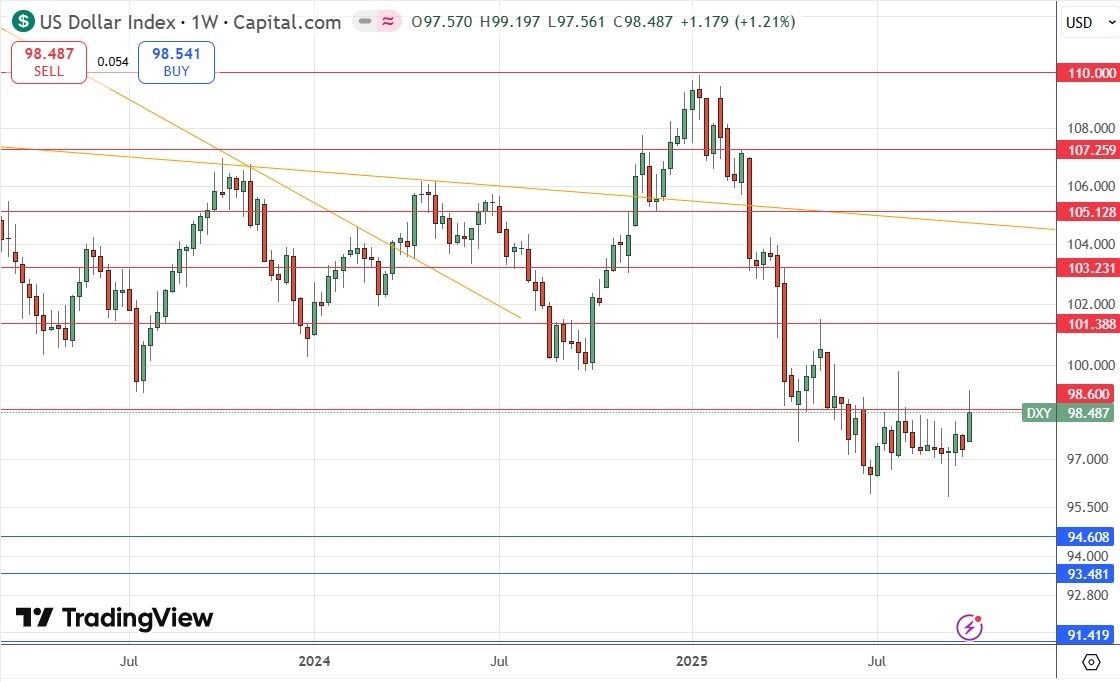
Last week, the US Dollar Index printed a bullish candlestick with a significant upper wick. However, what is most significant here is the fact that the price has still been unable to hold up above the key resistance level at 98.60. If we do eventually get a breakout above this level by the US Dollar, we have already seen a real bottom put in so this could be the start of a major long-term upwards trend. Despite being below its level of 26 weeks ago, the price is above where it was 13 weeks ago, so by my preferred metric, I can declare the long-term bearish trend is over. This places the US Dollar in an interesting position.
The Dollar may take a hit over the coming days if China does not back down over its proposed rare earth export restrictions in the face of President Trump’s 100% China tariff threat, but this situation is producing much more movement in other currencies such as the Australian and New Zealand Dollars (heavily linked to the Chinese economy) and the Japanese Yen (the current haven currency of choice).
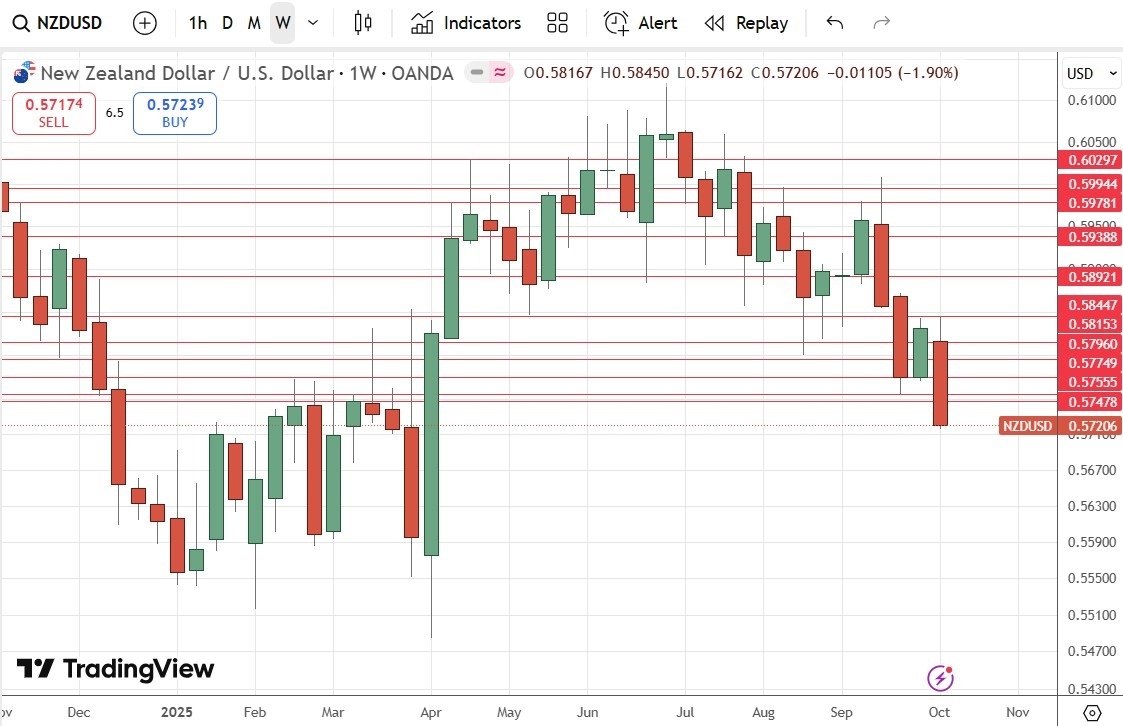
The NZD/USD currency pair fell strongly last week, reversing massively on Friday after rising earlier in the week on President Trump’s tariff threat. The Kiwi is beset by several problems that together have made it extremely weak:
On the other side of this pair, the US Dollar – it might take a hit due to the tariff dispute, but this is likely to be a much weaker fall than we will see in the Kiwi while the dispute goes on.
Technically, the weekly candlestick looks very bearish – large, reaching a new 6-month low, and closing very near the low of its range.
This pair does not tend to trend very reliably, but there are forces pushing it down in the face of a new tariff on China, so day traders especially have reason to be interested in this currency pair. The NZD/JPY currency cross might work even better.
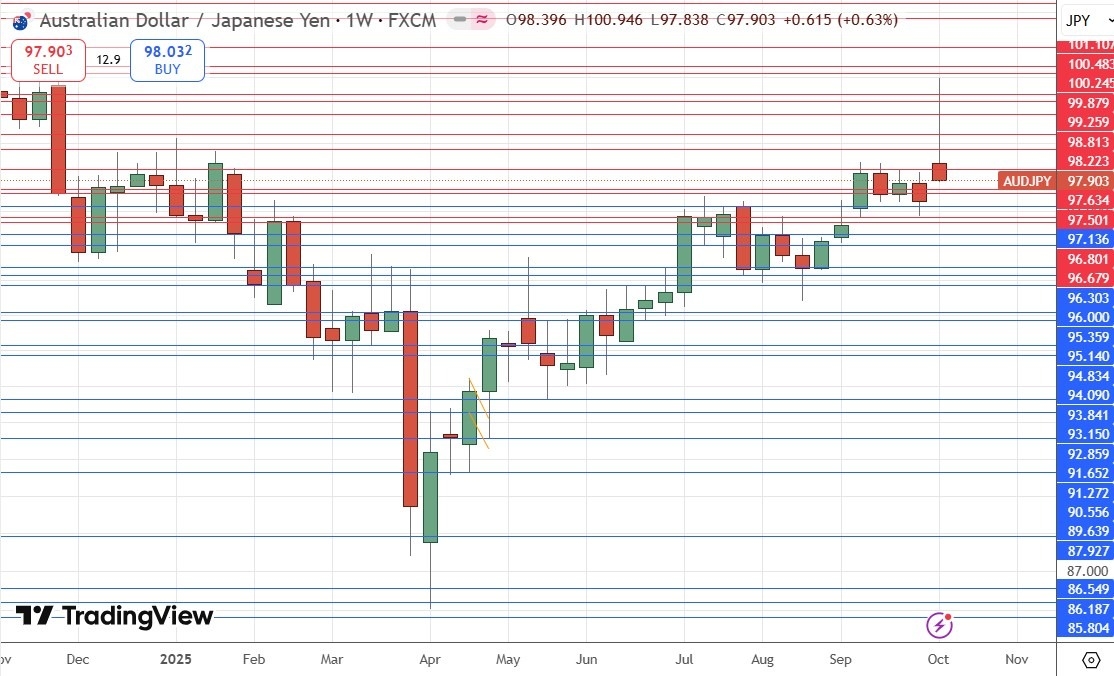
The AUD/JPY currency cross weekly chart printed a large, bearish pin bar, which closed right on the low of its range. These are bearish signs. The Australian Dollar was hit extremely hard by President Trump’s China tariff threat, more than any other currency, as Australia exports so much to China. So, we can expect the Aussie to be very sensitive to the issue, and to shoot higher if it is resolved.
Technically, we see some support even if the bearish fundamentals remain, as the price has reached a congestion area after giving up its gains from earlier in the week.
The Japanese Yen is also likely to rebound if the tariff situation is resolved.
This is probably the best currency cross to use to trade the US/China tariff dispute, with the AUD a great proxy for China and risk appetite in general, and the Japanese Yen’s current status as the number one haven currency.
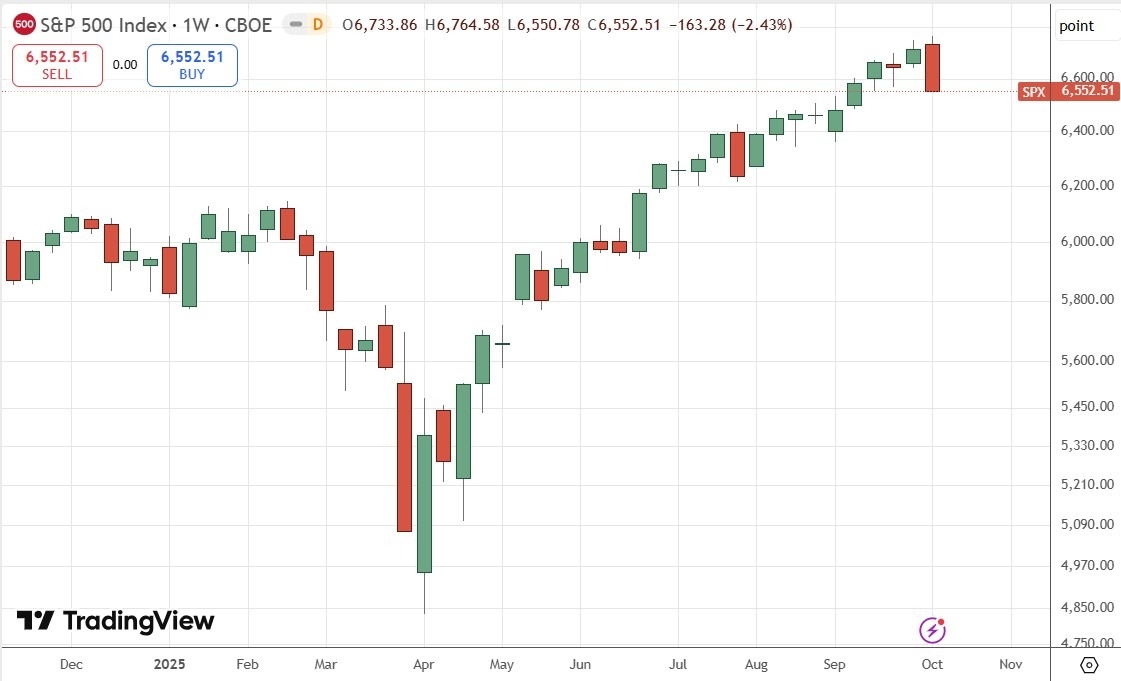
After rising to new all-time highs earlier in the week, the S&P 500 Index plummeted by almost 3% in the last few hours of Friday’s trading, wiping out the past three weeks of gains, after President Trump announced he would be imposing a new 100% tariff on Chinese imports die to their proposed restrictions on rare earth exports, which are vital to the American and global tech industry. Another concern bubbling away in the background is whether the American stock market is in an artificial intelligence bubble, as the major indices valuations have become heavily centered on just a few tech companies which are mostly focusing on AI.
We might see further strong falls if this US/China standoff is not resolved very quickly. After several months of very strong gains, the US stock market looks vulnerable to a sudden crash. Further falls when the US market opens on Tuesday might knock out trend followers from their longstanding long positions in major US equity indices.
If the dispute is resolved, expect a fast and strong recovery, but I have a gut feeling we will not see fresh highs soon.
There may be opportunities here over the coming days either long or short for more experienced traders, while novices might do better to sit this one out, although investors might want to reduce long positions in these stocks if the dispute deepens.
There is one note of hope for bulls – the two major stock markets open at the time of writing (a Sunday) in Saudi Arabia and Israel, are seeing gains or holding steady. Of course, both markets have strong local factors helping buying, but it is a potentially positive sign.
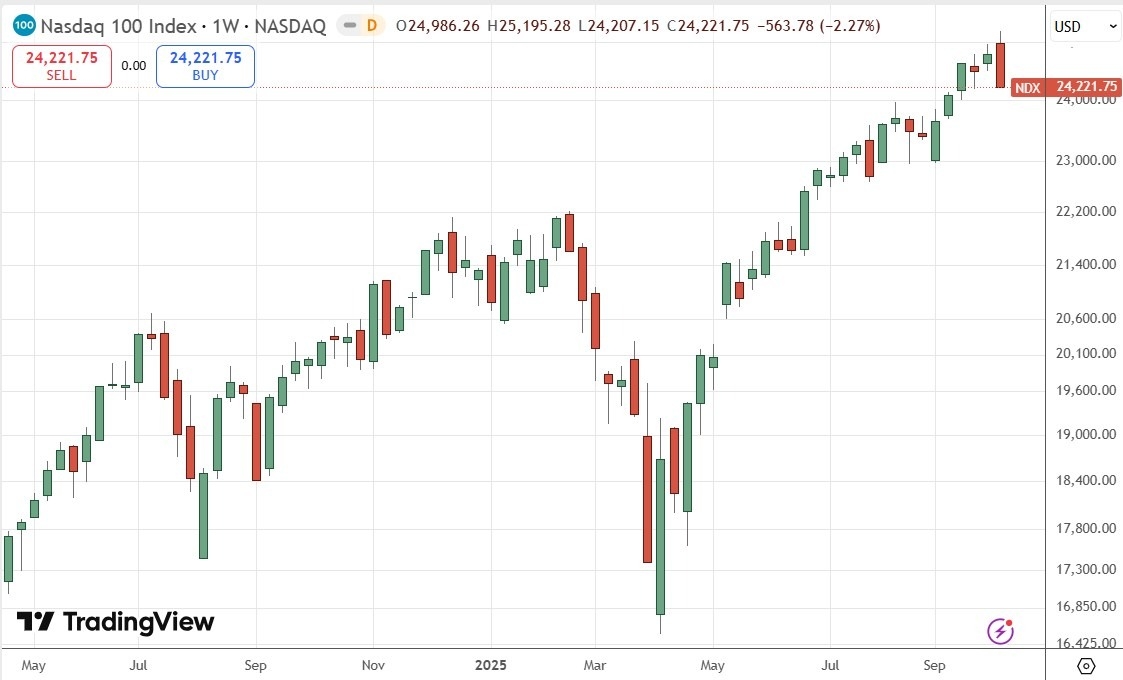
Everything I wrote above about the S&P 500 Index also applies to the NASDAQ 100 Index, but even more so, because the stocks making up this index are even more sensitive to the US/China dispute and the need for rare earth imports. This index fell by more than 3% late Friday, but it only wiped out the last 2 weeks of gains.
Just as in the S&P 500 Index, there can be opportunities coming here for more experienced traders, to try to day trade short as long as the dispute deepens, but to be ready to go long quickly if it is resolved.
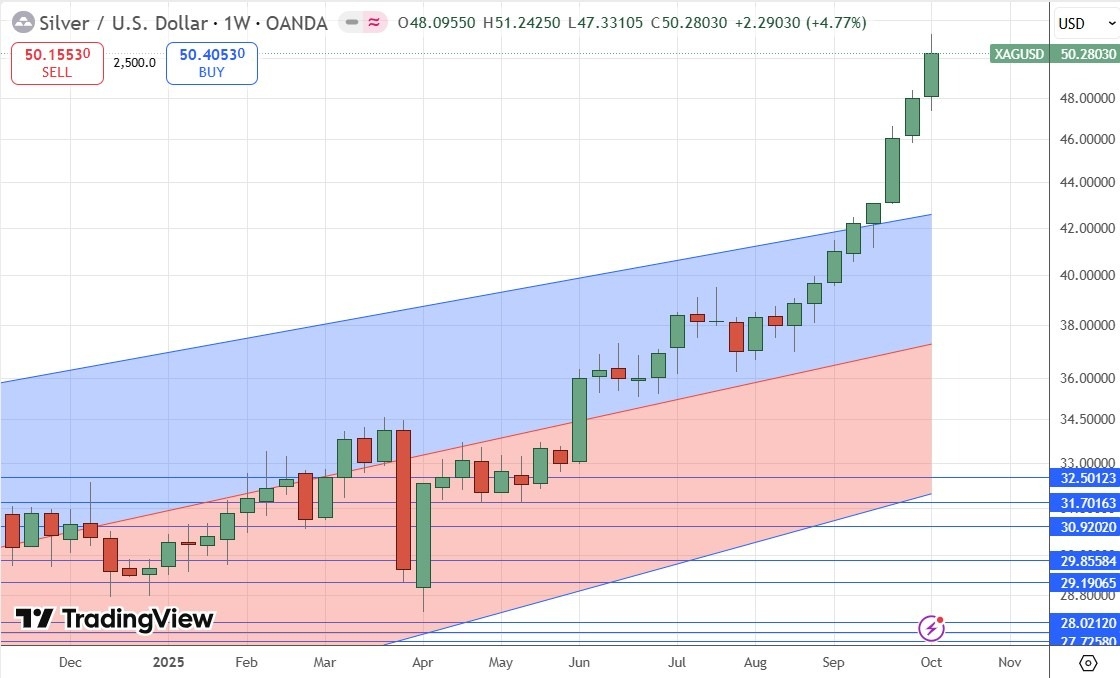
Silver had yet another great week, showing yet another outsize rise in value of more than 4%, and finally making a new record high above $51 which exceeded the Hunt Brothers high of 1980. It also outperformed Gold and all other precious metals except Palladium. These are bullish signs, as is the breakout from the linear regression analysis shown within the price chart below – the price is well above the upper bound.
There are also reports that a strong short squeeze is ongoing, with concerns over how much Silver bullion is available to holders of short positions.
With Silver’s outperformance against Gold, it is probably worth being bold on the long side here.
Having said, if you are just entering a new long trade here, as the move is quite extended, a smaller position size might be wise. Volatility is high, so a strong downwards movement is possible when the retracement finally comes.
I remain very bullish on Silver but worry that it may come crashing down – this is how big short squeezes tend to end. Trading the trend with a trailing stop is a good answer to this dilemma if you do it systematically. How high it might go now that we have seen a weekly close above $50 into blue sky is anyone’s guess.
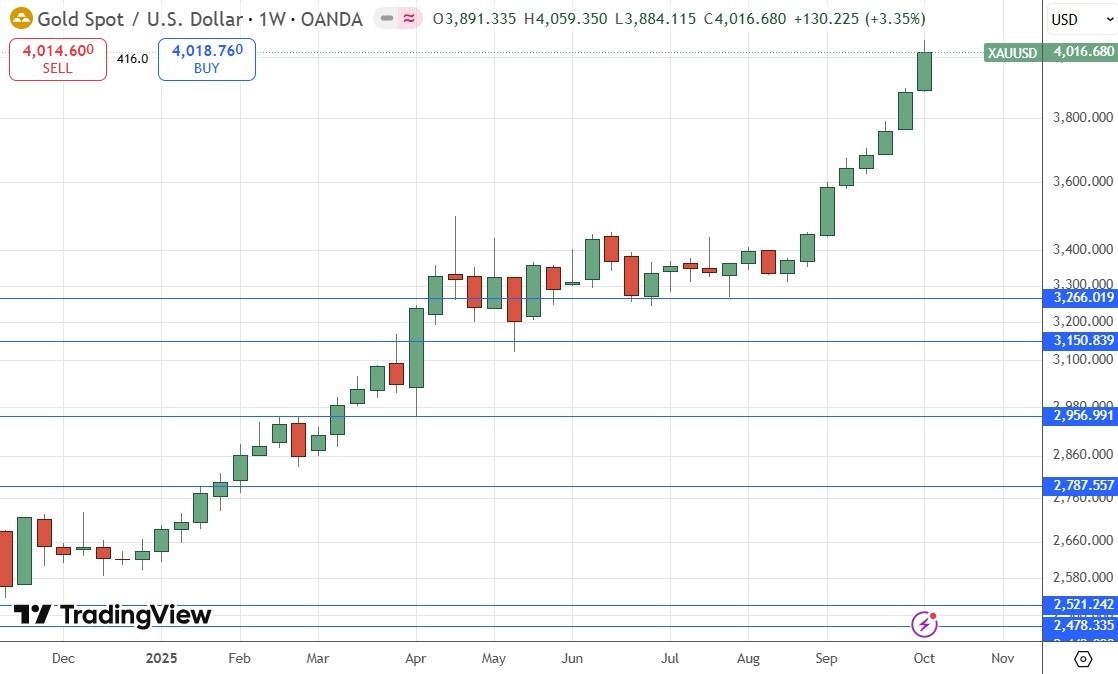
Gold rose again last week, by more than 3%, to rise to print a new all-time high, closing above the big round number at $4,000. Silver also closed above $50, which is another bullish factor for precious metals in general.
The long-term bullish trend and break to new record highs are bullish factors, and the fact that precious metals including Gold held up Friday despite the stock crash when Trump threatened huge new tariffs on China is also bullish – and intriguing.
For anyone who is only entering a long trade now, it might be wise to use a smaller position size to account for any sudden high-volatility snapback towards lower prices. You must wonder how much further this bull run will last – but it is backed by a very strong long-term bullish trend, and you trade against that at your peril unless you start to see clear signs of a reversal in the price action – which is not showing here yet.
I remain bullish on Gold, but it might be wise to take a smaller long position here than would be usual for you.
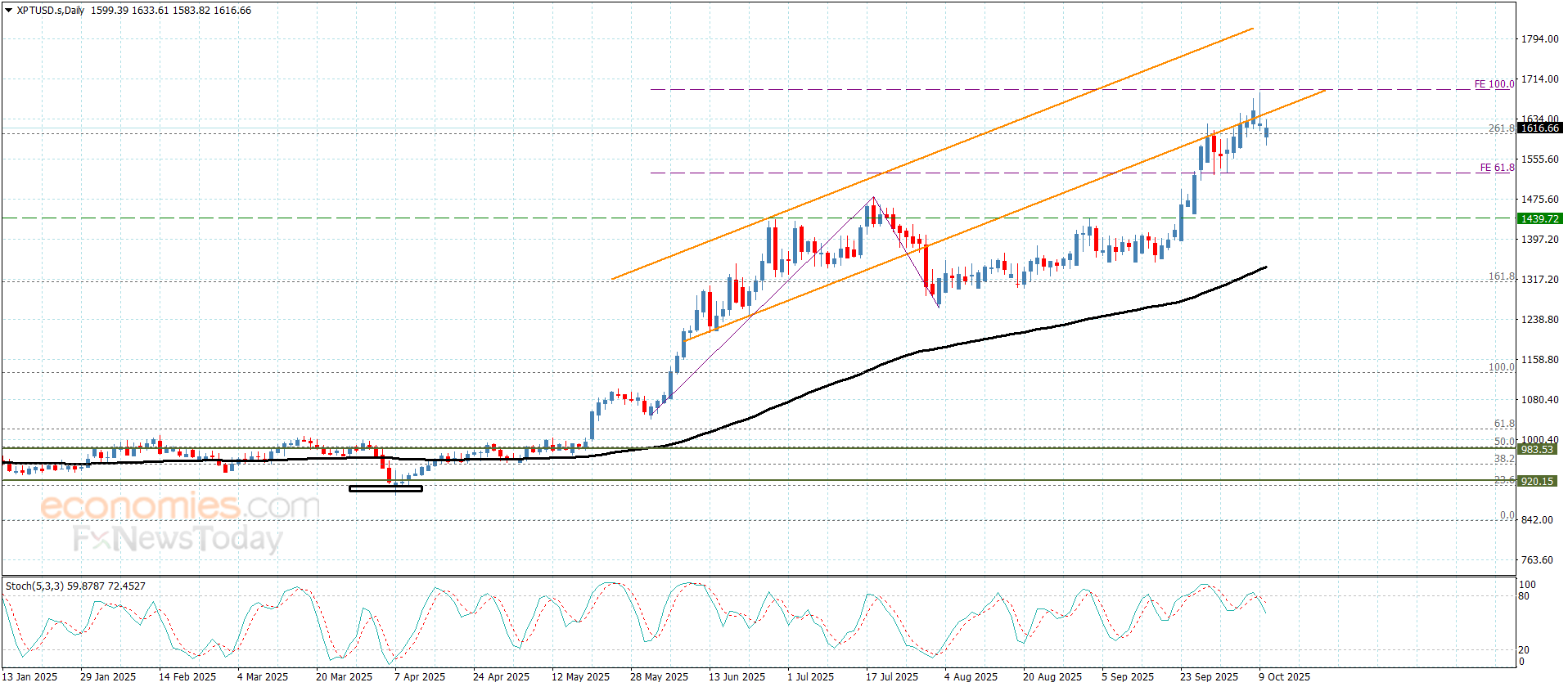
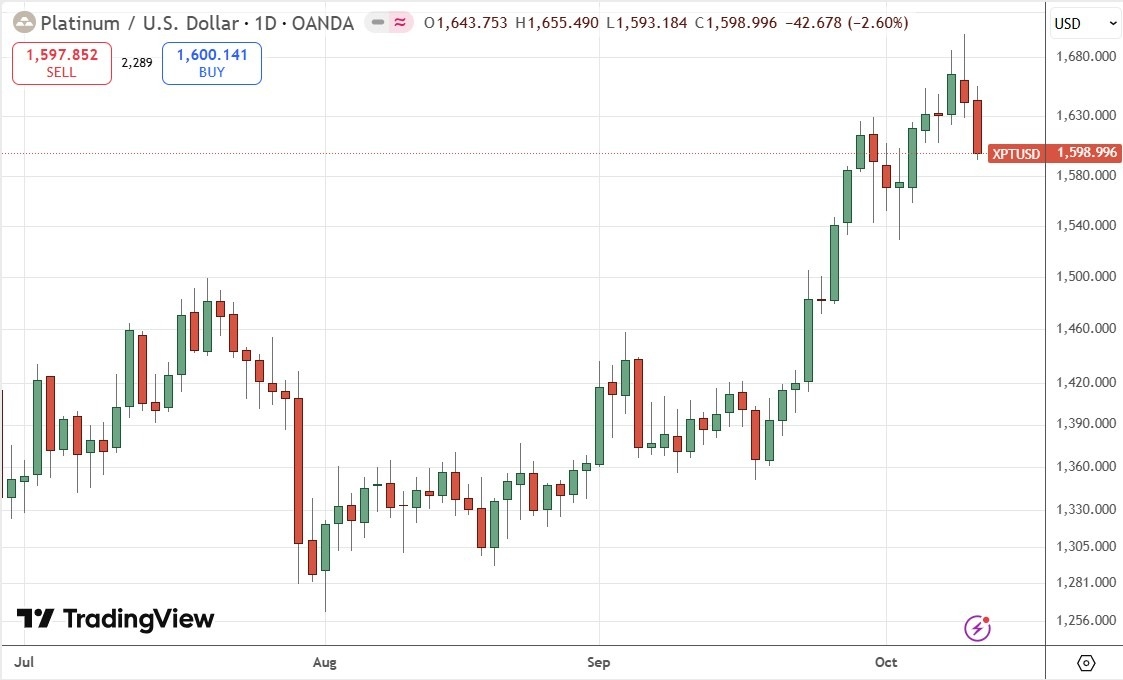
Platinum rose last week to a new multi-year high price, but the daily chart below shows that it sold off quite firmly (compared to the other precious metals) towards the end of last week, and this was well before President Trump’s tariff threat.
This suggests that Platinum is not the best choice of precious metals to be long of right now, but it is often a good idea to be diversified when you are trading trends, so it is worth paying attention here. The strong bullish trends in Gold and Silver back this reasoning, as the asset class overall in a strong trend.
I think that entering a new long trade could be a good idea if we get another long-term high New York close, above $1,666.
If your broker does not offer Platinum, and Platinum futures are too big for you, there is a Platinum ETF offering exposure (PPLT).
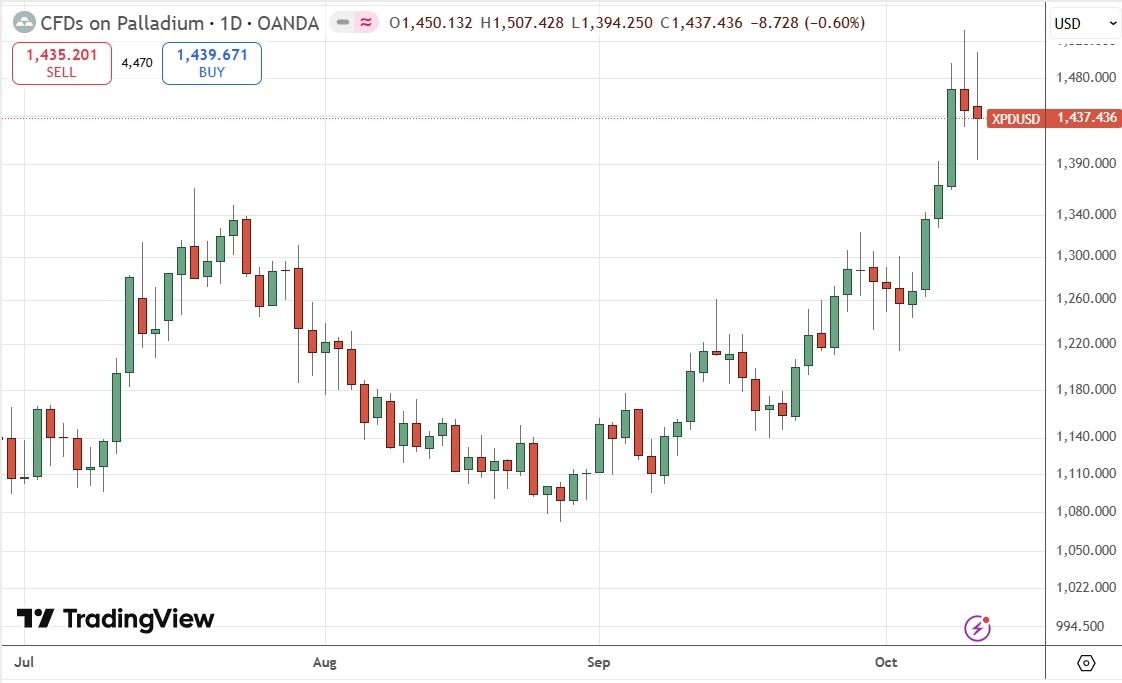
Palladium rose last week to a new multi-year high price, and the daily chart below shows that it made only a small bearish retracement on Thursday and Friday after its meteoric rise of over 9% on Wednesday.
This suggests that Platinum is a good choice of precious metal to be long of right now, but I would like to see another break to a fresh high in the New York close before entering a new long position. The strong bullish trends in Gold and Silver and the asset class of precious metals reinforce my bullishness.
I think that entering a new long trade could be a good idea if we get another long-term high New York close, above $1,468.
If your broker does not offer Palladium, and Palladium futures are too big for you, there is a Palladium ETF offering exposure (PALL).
I see the best trades this week as:
Ready to trade our weekly Forex forecast? Check out our list of the best Forex brokers.
Gold (XAU/USD) is sustaining momentum near historic highs as escalating geopolitical risks, a renewed U.S.–China tariff war, and intensifying debt concerns push investors deeper into defensive assets. The metal is trading at $4,012 per ounce, holding above the $4,000 psychological threshold after briefly touching $4,059.35, its highest level on record. The rally follows President Donald Trump’s decision to impose 100% tariffs on Chinese imports starting November 1, 2025, a move that triggered sharp declines in U.S. equities and reinforced gold’s dominance as a global hedge. The S&P 500 dropped 2.7% to 6,552, while the U.S. Dollar Index (DXY) slid 0.6% to 99.2, amplifying demand for non-yielding metals. Treasury yields retreated, with the 10-year yield at 3.88%, giving gold additional upside tailwind as lower yields reduce the opportunity cost of holding the metal.
Gold’s ascent since January has now surpassed 53% year-to-date, its best performance since 1979. Futures on the New York Mercantile Exchange are up 51%, reflecting both institutional accumulation and heightened speculative flows. The latest surge came after a sequence of macro events: the Federal Reserve’s cautious pivot toward rate cuts in September, Trump’s tariff escalation, and a wave of safe-haven repositioning amid rising fiscal stress. Economists estimate that global government debt has exceeded $312 trillion, and investors increasingly view precious metals as protection against fiscal debasement. In China, the world’s largest gold consumer, banks such as ICBC, CCB, and Agricultural Bank of China have raised investment thresholds for retail gold accounts, citing “intensified volatility and systemic risk.” These warnings underscore the scale of demand driving the rally—both speculative and institutional—while also signaling growing caution among regulators watching for overheating.
Behind the retail frenzy lies an institutional shift that continues to reshape the gold market. According to the World Gold Council, central banks have added more than 800 metric tons of gold in 2025 alone, on track for the largest annual accumulation since records began. China’s central bank has increased reserves for 11 consecutive months, while India, Turkey, and Poland also expanded holdings. Analysts attribute this trend to “de-dollarization,” as nations seek to diversify reserves away from the U.S. dollar following asset freezes during the Russia-Ukraine conflict. The surge in official sector demand has created a structural bid for gold, keeping the metal supported even as speculative traders rotate in and out. The council’s report shows that ETFs now hold roughly 3,590 tons, reversing outflows seen during 2023’s tightening cycle. This institutional demand underpins the view that the $4,000 breakout is not merely a speculative anomaly but part of a multi-year structural revaluation of gold as a reserve anchor.
The Federal Reserve’s September minutes revealed growing concern about weakening labor data, with the unemployment rate hovering near 4.1% and job openings declining for a fifth consecutive month. Market pricing now implies a 25-basis-point rate cut in October and another in December. The policy shift has softened real yields, fueling inflation expectations and reducing dollar demand. At the same time, Trump’s tariffs are stoking fears of imported inflation and slower global growth. Analysts estimate that a full tariff cycle could add 0.3 percentage points to U.S. headline CPI over the next quarter while cutting GDP by 0.4%. This macro combination—lower yields and higher inflation—creates the perfect environment for gold’s strength. Traders now view $3,888–$3,939 as the key support band, while the lack of overhead resistance above $4,059 opens potential extension targets toward $4,100 and $4,200.
The explosive rally has drawn regulatory attention. In China, major lenders including ICBC and CCB have tightened risk parameters, raising minimum investment amounts for gold savings accounts from 850 yuan ($119) to 1,000 yuan and revising circuit-breaker thresholds for volatility control. European commercial banks, meanwhile, are reporting record inflows into gold-backed products as the euro weakens near 1.06 USD and French political instability amplifies capital flight into tangible assets. Analysts warn that while systemic demand remains intact, excessive short-term speculation could trigger temporary corrections if liquidity dries up. Still, the World Gold Council confirmed that investor positioning remains net long by over 67%, while volatility metrics remain below March peaks—suggesting that market enthusiasm, though extreme, has not yet reached euphoric levels.
From a technical standpoint, XAU/USD remains firmly within its ascending channel structure. The price has consistently bounced off the 0.382 Fibonacci retracement at $3,965, reaffirming support strength. A bullish engulfing pattern formed at $3,975, and the RSI near 57 signals continued upside potential without reaching overbought extremes. The 50-day moving average, now climbing toward $3,592, provides long-term trend confirmation. Momentum will remain bullish unless the market breaks below $3,819, which would neutralize short-term bias. Institutional traders highlight that volume clusters between $3,910–$3,940 represent strategic accumulation zones, with buy orders concentrated just above these levels. On the upside, a sustained breakout above $4,059.35 could accelerate gains toward $4,133, and subsequently to $4,200, given the absence of technical resistance in this uncharted price range.
Markets are now preparing for a packed macro week that will shape the next phase of gold’s rally. Federal Reserve Chair Jerome Powell is scheduled to speak twice—on October 14 and October 17—and any deviation in tone could sharply impact expectations for monetary easing. Key economic data points include the Empire State Manufacturing Index (expected 0.2 vs −8.7 prior), the Philly Fed Index (forecast 9.1 vs 23.2), Core PPI, and Retail Sales, all of which will test the inflation trajectory. Analysts suggest that a further decline in inflation expectations, combined with weaker output data, would reinforce the Fed’s dovish path and extend gold’s bullish cycle. Conversely, stronger readings may trigger short-term profit-taking but are unlikely to alter the long-term structural trend.
Market veteran Ed Yardeni projects that gold could reach $5,000 per ounce in 2026 and possibly $10,000 by 2028–2029 if its current trajectory persists. His analysis attributes the rally to persistent inflation risk, rising geopolitical uncertainty, and global de-dollarization trends. The ongoing diversification of reserves, coupled with mounting debt burdens among advanced economies, is accelerating the “debasement trade,” where investors pivot from fiat assets into tangible stores of value like gold and Bitcoin. Even cautious strategists such as Hamad Hussain at Capital Economics admit that “FOMO” has entered the market, yet maintain that gold will “grind higher in nominal terms” as long as real yields stay compressed.
Silver has mirrored gold’s trajectory, advancing 73.5% year-to-date and briefly touching $51.23 per ounce, its highest in decades. Analysts view silver’s rally as both an industrial and monetary repricing, reflecting the broader revaluation of hard assets amid weakening faith in fiat systems. The gold-silver ratio, now hovering near 78, signals continued momentum for both metals, though gold remains the dominant hedge in institutional portfolios. Together, the synchronized rally across metals reinforces a structural repricing trend tied to the erosion of global monetary credibility and persistent policy shocks from Washington and Beijing.
All major indicators point to a market in the midst of a structural re-rating rather than a speculative spike. Gold’s resilience above $4,000, its 53% yearly gain, the record-high central bank demand, and the weakening dollar combine to define a powerful macro narrative. The short-term outlook depends on Powell’s guidance and inflation data, but the medium-term trajectory remains overwhelmingly positive. With no overhead resistance and fundamentals reinforcing scarcity, gold’s rally is supported by both policy and psychology.
Verdict:
XAU/USD (Gold): Strong Buy – Support $3,940 / Resistance $4,200 – Medium-Term Target $5,000 by 2026
Bias: Bullish (Structural Uptrend Supported by Tariffs, Rate Cuts, and Sovereign Demand)
Recent data shows a potential downturn in global oil markets, with current prices indicating early warning signs of a significant shift. As of October 2025, WTI Crude trades at $61.70 and Brent Crude at $65.47, reflecting a market that appears precariously balanced before an anticipated decline.
Market analysts suggest the industry is approaching a pivotal moment where supply growth will substantially outpace demand recovery, potentially creating a significant oil price crisis prediction by 2026. This looming imbalance represents a dramatic reversal from the price peaks seen in recent years.
Several converging factors are creating the conditions for a potential oil price crisis. The fundamental supply-demand dynamics that have historically governed oil markets are showing signs of significant imbalance that could accelerate in coming months.
Current projections from multiple financial institutions suggest Brent crude could fall to between $50-60 per barrel by early 2026—levels not seen consistently since before the pandemic. This decline stems primarily from structural changes in both production capacity and consumption patterns.
The anticipated price collapse is primarily driven by production growth outpacing demand. Several key dynamics are creating this imbalance:
Accelerated unwinding of OPEC global influence production cuts, as evidenced by recent headlines about “modest output hikes”
Robust non-OPEC production growth, particularly in North American shale basins
Slower-than-expected demand recovery in key consumption markets
Macroeconomic headwinds affecting global energy consumption patterns, including persistent high interest rates
Recent news that “high interest rates could turn next oil glut into a crisis” further underscores how financial conditions might exacerbate the market imbalance by reducing investment in production cuts that could otherwise help balance the market.
The oil industry has historically moved in cycles of boom and bust, with periods of underinvestment leading to price spikes, followed by overproduction and subsequent crashes. The current trajectory follows this pattern but with unique characteristics.
Current prices represent a significant moderation from recent highs, and analysts predict further declines ahead. This downward trajectory follows a familiar pattern in oil market cycles, where periods of high prices stimulate investment and production growth that eventually overwhelms demand, leading to price corrections.
Industry veterans note that while price cycles are normal, the projected speed and magnitude of the coming decline are notable compared to historical patterns. The transition from the current balanced market to a potential oversupply situation could occur more rapidly than in previous cycles due to advancements in production technology and changing demand patterns.
Major financial institutions and energy agencies have been revising their oil price forecasts downward in recent months, signaling growing consensus around the likelihood of lower prices ahead.
While specific institutional forecasts require verification from primary sources, recent market commentary indicates growing agreement that oil markets face significant headwinds. Headlines from industry publications show increasing attention to supply-side factors that could pressure prices.
The direction of these forecasts aligns with visible market developments, including OPEC+ production increases and ongoing concerns about demand growth in key economies, particularly as renewable energy trends continue to gain momentum.
OPEC+ faces a critical dilemma as the market heads toward potential oversupply. Recent headlines indicate that the producer group is already adjusting output levels, with “Oil Prices Climbing After OPEC+ Announces Modest Output Hike” showing their continued market management efforts.
OPEC+ producers confront multiple challenges in addressing market imbalances:
Production Strategy Challenges: The cartel must decide whether to extend production cuts to support prices or increase output to maintain market share.
Internal Cohesion Concerns: Divergent financial needs among member countries create tension between price and volume priorities.
Response Limitations: Even with coordinated action, OPEC+ may lack sufficient capacity to counter projected supply growth from non-member producers.
Market Share Considerations: Maintaining artificially high prices risks accelerating market share losses to competitors and alternative energy sources.
Headlines indicating “Middle East Oil Producers Follow Saudi Pricing Lead” suggest the continued coordination within the group, though internal tensions may increase if prices fall significantly.
The United States continues to play a pivotal role in global oil market dynamics, with its production capabilities serving as a key factor in the supply equation. Headlines about pipeline proposals and continued investment in oil infrastructure suggest ongoing commitment to production growth.
Despite previous predictions of production plateaus, U.S. oil output continues to show remarkable adaptability:
Efficiency Gains: Technological improvements and operational efficiencies have lowered break-even costs across major basins
Infrastructure Development: Headlines like “Alberta Proposes New Oil Pipeline” highlight continued investment in transportation capacity
Export Capabilities: Expanded infrastructure has allowed more North American crude to reach global markets
Investment Patterns: Capital discipline has improved economics, enabling production growth even at lower price points
This sustained production capacity, further enhanced by recent US drilling policy shift, represents a significant contributor to the projected global supply growth and corresponding price pressure.
The anticipated oil price decline will create distinct economic impacts across different stakeholders, creating winners and losers throughout the global economy.
Lower oil prices produce asymmetric effects across sectors and regions:
While the fundamental outlook points toward lower prices, geopolitical developments could alter this trajectory. Recent headlines reveal ongoing tensions that could disrupt oil markets.
Several geopolitical factors could temporarily interrupt the projected price decline:
Middle East Tensions: Headlines like “Ukraine Claims Strike on Oil Terminal in Crimea” demonstrate ongoing conflicts that threaten energy infrastructure
Production Disruptions: “Key Russian Refinery Unit Halted After Strike” shows how technical failures or attacks can remove supply from the market
Policy Shifts: “Oil Prices Rise on Russian Sanctions Risk” highlights how international relations continue to impact energy markets
Infrastructure Vulnerabilities: Recent maritime shipping disruptions in key waterways demonstrate ongoing threats to global oil transport
While these factors could create temporary price spikes, most analysts believe they would only delay rather than prevent the broader downward trend unless they result in sustained production losses.
The ongoing energy transition adds complexity to oil market forecasts. Headlines about battery storage, solar expansion, and policy shifts show how alternative energy sources continue to develop alongside traditional fossil fuels.
The energy landscape is evolving in ways that will influence oil demand:
Technology Advancement: Headlines about battery storage systems demonstrate the continued evolution of alternatives to fossil fuels
Policy Impacts: News about legislation like the “One, Big, Beautiful Bill Act” shows how government policy can significantly influence energy investment
Investment Patterns: Reports that solar and battery storage account for “81% of new power additions to the grid” highlight the changing electricity generation mix
Infrastructure Development: The announcement that “Solar Could Help Iraq Boost Oil Exports by 250,000 Bpd” demonstrates how renewable energy can even support oil production by freeing up domestic consumption
These structural factors create additional complexity for oil price forecasting beyond immediate supply-demand balances.
Several key indicators will signal the onset of the projected price crisis. Market participants should monitor these carefully for early warnings of accelerating price declines.
Key signs that the oil price downturn is accelerating include:
Inventory Builds: Consistent increases in global crude and product inventories
Forward Curve Structure: Shift from backwardation to contango in futures markets
Refining Margins: Compression of crack spreads as product markets weaken
Producer Behavior: Headlines like “OPEC+: Reuters Leaks on Oil Plans Again” show potential for production surprises
Price Volatility: Headlines such as “Crude Oil Plummets to Lowest Since June” demonstrate increased downside moves
Regional Pricing Spreads: Widening or narrowing differentials between key benchmarks can signal changing market dynamics
Different market participants can take specific actions to navigate the projected price environment. Strategic planning now can help mitigate risks and potentially capture opportunities.
Preparation strategies vary by stakeholder type:
While the consensus points toward lower prices, several factors could mitigate or reverse this trend. Understanding these potential counterbalancing forces provides a more complete picture of market risks.
Several developments could support oil prices:
Field Depletion Acceleration: Faster-than-expected depletion of existing oil fields could require increased investment
Investment Shortfalls: Prolonged underinvestment in new production capacity could create supply constraints that emerge later
Demand Resilience: Oil consumption could prove more resilient than expected, particularly in developing economies
OPEC+ Discipline: More aggressive and sustained production cuts could rebalance the market more quickly
Geopolitical Premium: Headlines like “Putin: Oil Prices Could Soar Past $100 Without Russian Crude” highlight how supply disruptions could dramatically impact prices
Market Disruption: Growing tensions from oil price trade war could create volatility that temporarily supports prices
Most forecasts suggest Brent crude could fall to around $50-60 per barrel by early 2026, with some analysts suggesting prices could temporarily drop even lower during periods of acute oversupply, according to the EIA’s Short-Term Energy Outlook.
Current projections indicate the period of significantly depressed prices could extend throughout 2026, with recovery dependent on market rebalancing through production adjustments and demand growth.
While gasoline prices typically follow crude oil trends, the relationship isn’t always proportional due to refining constraints, taxes, and regional market factors. Consumers should expect lower fuel prices but not necessarily by the same percentage as crude oil declines.
Natural gas markets have increasingly decoupled from oil in many regions, but lower oil prices can still impact gas markets through competition in certain applications and through associated gas production economics.
Lower oil prices typically stimulate consumption, potentially delaying peak demand. However, structural factors like electrification and climate policies may continue to constrain long-term demand growth regardless of price levels, as detailed in JP Morgan’s oil price forecast analysis.
This analysis is based on current market data and projections. Oil markets are inherently volatile and subject to rapid changes due to geopolitical events, policy shifts, and technological developments. Readers should consult with financial advisors before making investment decisions based on oil price forecasts.
Get real-time alerts on ASX companies benefiting from oil price movements with Discovery Alert’s proprietary Discovery IQ model, offering actionable insights for both short-term traders and long-term investors. Explore how major discoveries create exceptional returns by visiting our dedicated discoveries page.
Gold has exploded past $4,035 per ounce, capping one of its most dramatic years on record. The metal is now up over 50% year-to-date, its fastest appreciation since 1979, propelled by collapsing confidence in the U.S. economy, the weakening dollar, and intensifying geopolitical fractures. The rally accelerated through October after Trump’s 100% tariff on Chinese imports and renewed market fears of recession. As bond yields retreat and investors abandon equities, gold is reclaiming its status as the world’s ultimate hedge, with trading volumes surging across major exchanges in New York, Shanghai, and London.
The U.S. dollar index has plunged roughly 11% in 2025, the steepest fall in five decades, amplifying gold’s relative value. Traders now anticipate another Federal Reserve rate cut, the second in two months, as weak job creation pressures policymakers to ease monetary conditions. The move has crushed yields on long-term Treasuries and made non-yielding assets like gold more attractive. According to data from Morgan Stanley, the dollar’s decline reflects waning faith in U.S. fiscal stability and the Fed’s independence after Trump’s repeated public attacks on the central bank. The market’s expectation of prolonged rate cuts through Q4 is giving XAU/USD a tailwind, with traders targeting $4,080 as the next resistance level and $3,950 as near-term support.
Gold’s blistering 20% gain since mid-August has coincided with growing signs of a U.S. economic slowdown. September’s labor report revealed the sharpest drop in hiring in over a year, while revisions showed far fewer jobs added in 2024 and early 2025 than previously estimated. This deterioration in employment, alongside a government shutdown disrupting key data releases, has magnified uncertainty across Wall Street. The S&P 500 has lost 2.7% this week, and the Nasdaq slid 3.56%, while gold continues to soar—an unmistakable divergence signaling market fear. Analysts view this surge as a warning rather than a celebration: when gold climbs this fast, it reflects distress, not optimism.
In China, where physical demand remains the world’s largest, Golden Week sales data from the State Taxation Administration showed jewelry revenues skyrocketed 41.1% year-on-year. Gold shops in Shenzhen and Shanghai reported double-digit price adjustments per day to keep up with soaring global benchmarks. Retail buyers, once focused on ceremonial jewelry, are now purchasing gold bars and lightweight investment-grade trinkets. The domestic price of pure gold jewelry has surpassed 1,180 yuan per gram, equivalent to $162 per gram, pushing the RMB-denominated spot gold price up 48% in 2025 alone. Chinese investors are treating gold as a functional savings tool: one teacher in Guangdong told local media she buys one-gram gold beans each month, citing security and liquidity as reasons to keep accumulating.
Major miners like Barrick Gold (NYSE:GOLD) have surged in tandem with spot prices. The stock advanced 1.36% to $21.16 on Friday, extending its three-month gain to 22.39%. Analysts now place a consensus target between $22 and $23, supported by expanding margins and higher realized gold prices. Barrick’s global mining portfolio—stretching from Nevada to Tanzania—positions it well to capitalize on the metal’s multi-decade highs. Institutional buying in the company has intensified, with fund inflows mirroring gold’s trajectory since August. The firm’s cost base, estimated at $1,230 per ounce, leaves substantial profit leverage as XAU/USD trades near record levels.
The scale of migration into gold is reshaping asset allocation across regions. The World Gold Council estimates that institutional and ETF inflows have risen 47% year-to-date, with holdings surpassing 120 million ounces globally. Hedge funds are rotating out of Treasuries, which have lost stability amid political gridlock and ballooning deficits. Billionaire Ray Dalio has publicly warned of a potential “civil conflict of sorts” in the U.S., urging investors to own tangible assets like gold over financial instruments. The trend is reflected in Europe and Asia as well: the Shanghai Gold Exchange saw record daily volume, while Switzerland’s Zurich vaults reported the highest physical withdrawals since 2011.
Trump’s aggressive trade stance has added new volatility to global commodities. The imposition of 100% tariffs on Chinese imports triggered an immediate flight to safe assets. China’s retaliation through rare-earth export restrictions further disrupted sentiment, driving fears of a renewed trade war. Analysts at major institutions say such tariffs could shave 0.6% off global GDP by year-end, making gold an attractive hedge against policy-driven shocks. Historical data reinforces the pattern—during past tariff escalations, gold outperformed equities by nearly 30 percentage points over 12 months.
Gold’s popularity is spilling into new consumer trends. In China, micro gold items weighing less than 0.01 grams—used for pendants and phone stickers—are selling out nationwide. Shops in Shenzhen’s Shuibei Wanshan jewelry center reported buyers purchasing dozens at a time, often as gifts or collectibles. Meanwhile, the recycling market is booming, with customers trading older jewelry for newly designed pieces. Industry insiders confirm that recycling volumes jumped over 25% this quarter, driven by high spot prices and investor awareness. The retail mania underscores how deeply gold’s rally has penetrated daily economic life, particularly in Asia’s consumer markets.
Gold’s explosive performance is not purely speculative—it reflects structural imbalances in global markets. Real yields remain near zero, the U.S. deficit exceeds $2.2 trillion, and the IMF projects slower growth across advanced economies. The de-dollarization trend, accelerated by China’s and Russia’s diversification of reserves, is another supportive factor. Central banks have purchased over 900 tons of gold this year, led by emerging markets seeking insulation from sanctions and currency shocks. With the Fed funds rate expected to fall below 4% in early 2026, the opportunity cost of holding gold continues to shrink.
Some analysts warn that the pace of the rally may have outstripped fundamentals. The World Gold Council calls 2025 a “super year,” but notes that rapid acceleration could lead to temporary pullbacks. Futures positioning on the COMEX shows speculative longs at a six-month high, raising the risk of short-term corrections if inflation cools or geopolitical tensions ease. However, the market’s structural backdrop—weak growth, loose monetary policy, and fiscal uncertainty—suggests that any dip may invite renewed accumulation.
Gold remains the clearest winner in a world defined by distrust and devaluation. With XAU/USD anchored above $4,000 and supported by falling yields, robust Asian demand, and institutional accumulation, the trend remains decisively bullish.
Gold (XAU/USD $4,035.70) — Buy, target $4,080–$4,150, support $3,950
Barrick Gold (NYSE:GOLD $21.16) — Buy, margin expansion intact, target $23
SPDR Gold Shares (NYSEARCA:GLD) — Buy, ETF inflows accelerating, momentum solid
Gold’s rise captures a pivotal shift in global finance—away from paper promises and toward tangible stores of value. As central banks pivot, currencies waver, and political risk mounts, gold’s dominance as the hedge of last resort remains unchallenged. The numbers confirm it: a 50% annual rally, record central bank demand, and surging retail participation—all converging into one clear message—the gold bull cycle is far from over.
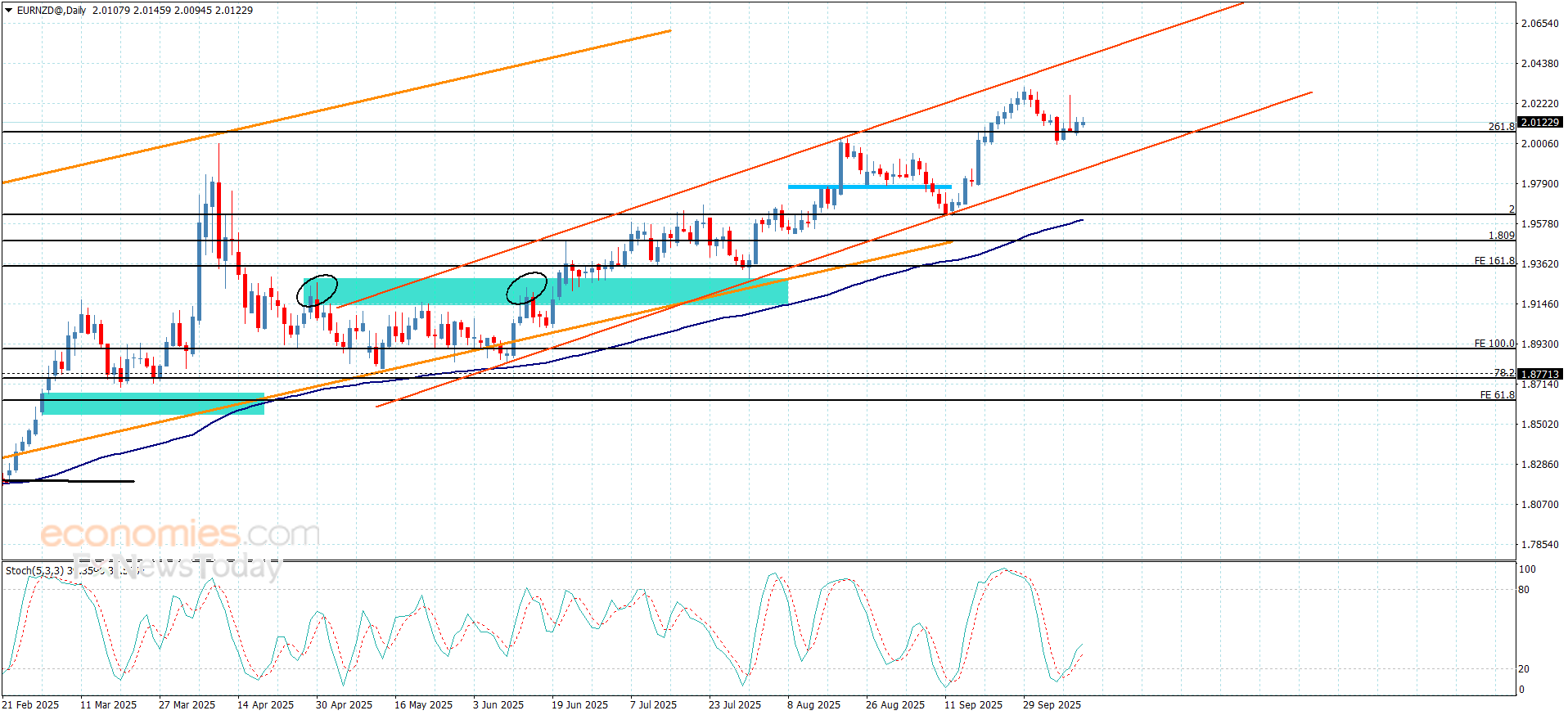
The EURNZD succeeded in getting rid of the negative pressure, to end the bearish corrective track by providing new positive close above the extra support at 2.0050, forming bullish waves and its stability near 2.0115.
Note that the main stability within the bullish channel’s levels, and stochastic attempt to provide positive momentum will assist to confirm the bullish scenario, which might target 2.0215 and 2.0295.
The expected trading range for today is between 2.0070 and 2.0215
Trend forecast: Bullish
Volatility is back in forex, and that’s a good thing. After weeks of quiet ranges, the markets are finally giving us some movement.
Here’s what I’m watching across DXY, EURUSD, GBPUSD, USDJPY, and XAUUSD going into next week.
The DXY is still trading near that long-term 2011 channel support.
We’ve seen this area act as a base before, and once again, DXY is holding up around it.
On the daily chart, DXY broke out of a descending channel last week, putting 98.6 front and center as key support.
That’s the line in the sand for me. As long as DXY is above 98.6, I’ll keep a bullish bias.
A close below 98.6 would turn that into a failed breakout and open the door to fill that open gap lower.
On the upside, 99.88 to 100.00 is resistance for DXY.
If we stay above 98.6, expect DXY to stay range-bound between those two areas.
If we lose 98.6 on a daily close, I’d look for a move toward 97.80.
Until then, DXY is holding its floor.
EURUSD is testing 1.1580 again.
That level has flipped between support and resistance several times this year, and Friday’s price action hinted at a bullish reclaim.
If we get a clear close above 1.1580, that turns into support and sets up a run at 1.1645 next week.
That’s the five-week composite point of control, basically where price spent the most time in recent consolidation.
Above that, EURUSD targets sit at 1.1780.
But if EURUSD fails to hold 1.1580, it keeps this range intact, and we’re likely back testing 1.1500.
A lot of this will depend on what DXY does around 98.6.
If DXY breaks lower, EURUSD strength follows. Simple as that.

GBPUSD is also trying to reclaim ground above 1.3330.
That’s the same story we’ve seen across the board, markets dipping below support, then trying to reclaim it.
A daily close above 1.3330 would flip it to support, but 1.3380 looms as nearby resistance.
There’s a cluster of old lows around that area, and they could easily cap GBPUSD until proven otherwise.
Lose 1.3330 again, and this becomes another failed reclaim.
That would put 1.3250 back in play.
Until we see a decisive move through 1.3380, GBPUSD remains range-bound.
Not the cleanest setup, but confirmation will come from how this week closes.

USDJPY is testing the top of its ascending channel again.
That upper boundary has been strong resistance, lining up around 151.20.
Below that, there’s a solid pocket of support between 150.70 and 151.00 from prior highs.
If buyers can hold that zone, USDJPY remains in a healthy uptrend inside the channel.
But if we get a sustained break below 150.70, that turns into a failed breakout and likely leads to a pullback to fill that weekend gap near 149.50.
For now, I’m watching USDJPY for a retest of support before any fresh move higher.
If it holds, 152.80 and even 158.00 (that old imbalance) come into view.
The market is in an uptrend until proven otherwise.

XAUUSD is still in a strong uptrend, but it’s flashing early signs of exhaustion.
Price broke above 4,000 last week only to fake out and drop back under.
That’s a classic deviation.
As long as XAUUSD stays below 4,000, that level becomes resistance.
A confirmed breakdown below trend line support could trigger a deeper pullback toward 3,800 or even 3,768, where an imbalance sits.
For now, though, the structure for XAUUSD is still bullish with higher highs and higher lows.
I’m not shorting it, but I’m also not chasing highs here.
If we reclaim 4,000 with conviction, that invalidates the fakeout.
Otherwise, patience wins. Let price prove itself.
That’s what I’m watching going into next week.
Key word: confirmation.
The setups are forming, but until we see daily closes above or below these levels, anything can still flip.
Manage your risk and trade the extremes, that’s key.

The 10-day moving average at $3,926, steadily rising, marks the nearest support. Given its proximity to yesterday’s low of $3,944, gold could test this level with minimal downside. This average has been reliable dynamic support since the uptrend began at the $3,311 swing low in August, anchoring the rally.
If it holds, the short-term bias remains upward. However, a decisive break below $3,926, confirmed by a daily close below, would shift focus to the 20-day moving average at $3,818, a more robust support given its longer scope. This week’s low of $3,884 sits above the 20-day line, so a breach below it would signal increased selling pressure.
Should the 20-day average fail, a deeper support zone between $3,707 and $3,619 comes into view, defined by prior consolidation and a measured move matching the prior 10.8% correction. At the lower end, an 18.8% decline—mirroring the last bearish pullback—would align with the 50-day moving average, expected to enter this range soon. This convergence enhances the zone’s significance as a potential floor. A drop to this level would indicate strong supply but remain within the bounds of a healthy correction in the broader uptrend.
Gold’s bullish bias holds as long as the 10-day average at $3,926 supports prices. A weekly close above $4,001 reinforces the uptrend, while a break below $3,884 flags weakness. Traders should watch today’s close for confirmation and monitor $3,818 for signs of deeper selling or a bullish rebound.
For a look at all of today’s economic events, check out our economic calendar.
The next downside target is the 50-day moving average at $3.03, closely aligned with a falling upper-quarter channel line that previously capped swing highs in September. This convergence suggests a potential support zone, as the line may now flip from resistance to support. A daily close below $3.16 today would confirm the breakdown below the 20-day average, reinforcing bearish momentum. Traders should watch this $3.03 – $3.05 area closely for signs of buying interest or further capitulation.
Thursday’s bearish reversal confirmed a double top pattern, triggered by a close below the $3.30 neckline. This pattern formed against strong resistance at the 200-day moving average, the top of a falling channel, and an extended rising channel line. Such failed breakouts often lead to sharp reversals, and today’s plunge further supports that thesis. If selling persists, the lower boundary of the rising channel could come into play, potentially aligning with deeper support near $2.95, where multiple indicators converge.
A key price zone looms at $2.95, where the lower rising channel line intersects the falling upper-quarter channel line in roughly seven days. This area gains added significance with a gap fill at $2.97 and an anchored Volume Weighted Average Price (VWAP) nearby at the same level. This trifecta of technical markers makes $2.95 – $2.97 a higher-probability potential support zone, if it is approached.
The weekly chart, poised to close near its lows with a bearish pattern after falling below last week’s low, further tilts the odds toward sellers. A rally above $3.30 would challenge this outlook, but for now, bears hold the reins. Watch Friday’s close for confirmation.
For a look at all of today’s economic events, check out our economic calendar.
The US dollar has spent the morning dropping against the Japanese yen. And I do think we need more of this. It’s probably worth taking a look at yen related pairs for a potential drop and then bounce. But right now, the US dollar is simply far too strong and far too elevated to start trading against the yen because of the massive stop loss needed.
I would love to see this pair pull back toward the 149 yen level, but we’ll just have to wait and see if that happens. Truthfully, most of the best setups I’m seeing are in other currencies against the yen. So, you can use this maybe as a bit of a barometer for those trades.
The Australian dollar is relatively flat, which is not a huge surprise. So that being said, the market is likely to continue to see the 0.6550 level as important, as it’s been a bit of a magnet for price for quite some time. With this being said, I think market participants continue to look at pullbacks as a little bit of a dip. And the 200 day EMA is probably a bit of a floor near the 0.65 level.
This is a market that’s been sideways for some time, with a somewhat bias to the upside. So, with this, I like the idea of watching this pair because if the US dollar really starts to strengthen, this pair will probably collapse. On the other hand, if we rally the 0.6633 level is your next target, followed by 0.67. The Australian dollar has been very choppy and difficult to trade for some time. I don’t see that changing.
For a look at all of today’s economic events, check out our economic calendar.
The (ETHUSD) price rose in its last trading on the intraday basis, after its leaning on the support level of $4,275, gaining some bullish momentum that helped it to achieve these gains, this support was our suggested target in our previous analysis, to attempt to recover some of the previous losses, attempting to offload some of its clear oversold conditions on the relative strength indicators, especially with the emergence of the positive signals from there, amid the dominance of bearish corrective wave on the short-term basis, with the continuation of the negative pressure due to its trading below EMA50, which reduces the chances of the price recovery on the near-term basis.
Get high-accuracy trading signals delivered directly to your Telegram. Subscribe to specialized packages tailored for the world’s top markets:
Full VIP signals performance report for Sept 29 – Oct 3, 2025: