The main category of Forex News.
You can use the search box below to find what you need.
[wd_asp id=1]
The main category of Forex News.
You can use the search box below to find what you need.
[wd_asp id=1]
Gold holds the latest uptick to a new all-time high near $3,980 in Tuesday’s Asian trades, as buyers still keep their sights on the key $4,000 barrier.
Gold buyers refuse to give up yet even as the US Dollar (USD) sustains the previous turnaround so far this Tuesday.
The Greenback’s strength on the back of the recent sell-off in the Euro (EUR) and the Japanese Yen (JPY), led by the political jolts in France and Japan, continues to cap Gold’s upside.
However, the fundamental backdrop remains supportive of the traditional safe-haven and non-interest-bearing Gold.
The US shutdown extends as the Democrat law to reopen the government failed for the 5th time in the Senate on Monday, as the sticking point continues to remain health care subsidies.
Meanwhile, concerns over a lack of official US economic data publication and increased bets of two Federal Reserve (Fed) interest rate cuts this year keep boosting the demand for the bright metal.
Additionally, sustained Gold buying by global central banks also continues to power the Gold record rally.
The latest data compiled by the World Gold Council (WGC) showed that the central bank Gold buying rebounded in August, citing a 15-tonne increase to the global gold reserves.
According to the People’s Bank of China (PBOC) reported earlier on, China’s Gold holdings totalled 74.06 million fine troy ounces at the end of September, up from 74.02 million in the previous month, as the central bank expanded bullion purchases for the 11th straight month.
Therefore, Gold remains a ‘buy on pullbacks’ trade, in the absence of any bearish factors as such.
Traders will continue to monitor speeches from Fed officials for fresh insights on the US economy and the Fed’s path forward on interest rates.
As observed on the four-hour chart, the 14-day Relative Strength Index (RSI) is easing from the overbought region, currently near 70.50, suggesting that any pullback could be quickly bought into.
Buyers look to conquer the $3,980 psychological barrier on the way to the $4,000 mark.
Conversely, if a pullback gathers steam, Gold could test the initial support at $3,897, the 21-Simple Moving Average (SMA), below which the 50-SMA at $3,845 could be attacked.
A firm break below that latter will expose the 100-SMA at $3,772.
Gold has played a key role in human’s history as it has been widely used as a store of value and medium of exchange. Currently, apart from its shine and usage for jewelry, the precious metal is widely seen as a safe-haven asset, meaning that it is considered a good investment during turbulent times. Gold is also widely seen as a hedge against inflation and against depreciating currencies as it doesn’t rely on any specific issuer or government.
Central banks are the biggest Gold holders. In their aim to support their currencies in turbulent times, central banks tend to diversify their reserves and buy Gold to improve the perceived strength of the economy and the currency. High Gold reserves can be a source of trust for a country’s solvency. Central banks added 1,136 tonnes of Gold worth around $70 billion to their reserves in 2022, according to data from the World Gold Council. This is the highest yearly purchase since records began. Central banks from emerging economies such as China, India and Turkey are quickly increasing their Gold reserves.
Gold has an inverse correlation with the US Dollar and US Treasuries, which are both major reserve and safe-haven assets. When the Dollar depreciates, Gold tends to rise, enabling investors and central banks to diversify their assets in turbulent times. Gold is also inversely correlated with risk assets. A rally in the stock market tends to weaken Gold price, while sell-offs in riskier markets tend to favor the precious metal.
The price can move due to a wide range of factors. Geopolitical instability or fears of a deep recession can quickly make Gold price escalate due to its safe-haven status. As a yield-less asset, Gold tends to rise with lower interest rates, while higher cost of money usually weighs down on the yellow metal. Still, most moves depend on how the US Dollar (USD) behaves as the asset is priced in dollars (XAU/USD). A strong Dollar tends to keep the price of Gold controlled, whereas a weaker Dollar is likely to push Gold prices up.
Important DisclaimersThe content provided on the website includes general news and publications, our personal analysis and opinions, and contents provided by third parties, which are intended for educational and research purposes only. It does not constitute, and should not be read as, any recommendation or advice to take any action whatsoever, including to make any investment or buy any product. When making any financial decision, you should perform your own due diligence checks, apply your own discretion and consult your competent advisors. The content of the website is not personally directed to you, and we does not take into account your financial situation or needs.The information contained in this website is not necessarily provided in real-time nor is it necessarily accurate. Prices provided herein may be provided by market makers and not by exchanges.Any trading or other financial decision you make shall be at your full responsibility, and you must not rely on any information provided through the website. FX Empire does not provide any warranty regarding any of the information contained in the website, and shall bear no responsibility for any trading losses you might incur as a result of using any information contained in the website.The website may include advertisements and other promotional contents, and FX Empire may receive compensation from third parties in connection with the content. FX Empire does not endorse any third party or recommends using any third party’s services, and does not assume responsibility for your use of any such third party’s website or services.FX Empire and its employees, officers, subsidiaries and associates, are not liable nor shall they be held liable for any loss or damage resulting from your use of the website or reliance on the information provided on this website.Risk DisclaimersThis website includes information about cryptocurrencies, contracts for difference (CFDs) and other financial instruments, and about brokers, exchanges and other entities trading in such instruments. Both cryptocurrencies and CFDs are complex instruments and come with a high risk of losing money. You should carefully consider whether you understand how these instruments work and whether you can afford to take the high risk of losing your money.FX Empire encourages you to perform your own research before making any investment decision, and to avoid investing in any financial instrument which you do not fully understand how it works and what are the risks involved.
If I had shown you this chart unlabelled, one would be forgiven for thinking this was the five-minute chart, especially considering the past eight candles or so.
While sustained upside, as shown above, is rare on the weekly chart, gold bulls will undoubtedly be pleased with recent performance, with price action virtually parabolic.
Having broken out of an upwards channel, with the upper boundary held around $3,602, what followed was an explosive move to the upside, marking fresh all-time highs.
While no candlestick structure to the upside could otherwise offer resistance, traders should be aware that a short-term correction remains possible, with the RSI reporting gold pricing as ‘overbought’ for the fourth time this year.
Otherwise, should price stage a move higher, we can expect some profit-taking at the key level of $4,000.
– Written by
Ben Hughes
STORY LINK GBP/USD Forecast: Pound Sterling Weaker as Dollar Gains Despite Shutdown
The Pound to US Dollar exchange rate (GBP/USD) weakened on Monday despite an ongoing US government shutdown, and an uptick in Federal Reserve interest rate cut expectations.
At the time of writing, GBP/USD was trading at approximately $1.3433, down roughly 0.4% from the start of Monday’s session.
The US Dollar (USD) strengthened against several major peers on Monday, despite ongoing domestic uncertainty.
The US government remained in shutdown during the session, with reports suggesting that widespread lay-offs could follow if the funding bill is not agreed upon soon.
At the same time, the CME FedWatch Tool indicated a sharp rise in interest rate cut expectations, with markets now pricing in a 95% probability of a cut in October and an 85% chance of another in December.
Ordinarily, such dovish expectations might weigh on the ‘Greenback’, but the currency instead managed to find support.
Weakness in both the Japanese Yen (JPY) and the Euro (EUR) at the start of the week allowed the USD to gain ground, helping it firm against a range of major counterparts despite the challenging domestic backdrop.
Get better rates and lower fees on your next international money transfer.
Compare TorFX with top UK banks in seconds and see how much you could save.
The Pound (GBP) traded without a clear sense of direction on Monday, fluctuating against the majority of its peers in the absence of any significant UK data releases.
A mixed market mood left Sterling moving unevenly through the session, dipping against certain rivals while recording modest gains elsewhere.
With little in the way of domestic drivers to influence sentiment, GBP investors adopted a cautious stance ahead of a scheduled speech from Bank of England (BoE) Governor Andrew Bailey later in the evening.
Should Bailey deliver hawkish commentary or indicate that UK interest rates will remain higher for longer, the Pound could find renewed support in the wake of his remarks.
Looking ahead to Tuesday’s European session, movement in the Pound US Dollar (GBP/USD) exchange rate is expected to hinge on a series of scheduled Federal Reserve speeches.
If Fed policymakers strike a hawkish tone and signal that interest rates could remain elevated for longer, the US Dollar may strengthen as investors adjust their expectations.
Equally, any dovish remarks reinforcing the likelihood of rate cuts could see the ‘Greenback’ come under renewed pressure.

As for the Pound, a continued lack of UK economic releases means Sterling is likely to remain directionless, with traders instead taking cues from wider market trends.
In the absence of fresh domestic drivers, GBP exchange rates could remain volatile, fluctuating in response to changes in global risk appetite and external developments throughout Tuesday’s European trading session.
International Money Transfer? Ask our resident FX expert a money transfer question or try John’s new, free, no-obligation personal service! ,where he helps every step of the way,
ensuring you get the best exchange rates on your currency requirements.
TAGS: Pound Dollar Forecasts
The recent rejection near $3.59 gains added technical significance given the confluence of resistance factors at that zone. A bearish bat harmonic pattern has formed near last week’s high, while the 200-Day moving average, the upper boundary of a descending trend channel, and the 127.2% Fibonacci projection of the rising ABCD pattern all converge in the same region. This combination reinforces the probability that natural gas may be facing exhaustion following its recent recovery phase.
Initial support now lies near $3.20, where short-term buyers may attempt to defend the trend. Below that, the 20-Day moving average around $3.10 represents a more critical dynamic support area. The rising ABCD structure remains corrective in nature, implying that the larger bearish channel still dominates the broader trend. A move above $3.59 would be required to invalidate this bearish bias and confirm that a new swing higher is developing. Until then, rallies are likely to face resistance on approach to the 200-Day line.
On the weekly chart, natural gas continues to trade inside last week’s broad range from $3.13 to $3.59. This keeps the larger trend technically neutral for now, as no breakout signal has yet emerged on that timeframe. Meanwhile, the 20-Week moving average, currently around $3.27, offers potential support should weakness deepen. Price action around this area will be key in determining whether natural gas stabilizes for a new swing higher or resumes its longer-term downtrend.
For a look at all of today’s economic events, check out our economic calendar.
Spot Gold reached fresh record highs on Monday, trading above the $3,950 threshold as global political turmoil boosted demand for the safe-haven metal. The US Dollar (USD) started the day on a strong footing, maintaining a positive momentum during Asian and European trading hours amid political headlines coming from Japan and France. Still, Gold also rose on safety demand. The USD turned south as American traders reached their desks, further fueling the XAU/USD pair advance.
Over the weekend, the Japanese ruling Liberal Democratic Party (LDP) elected Sanae Takaichi, a 64-year-old lawmaker, positioning her to become Japan’s first female Prime Minister. The news heavily weighed on the JPY amid mounting speculation of upcoming increased federal spending and a looser monetary policy.
Meanwhile, France had yet another Prime Minister resigning. Newly appointed Sébastien Lecornu resigned less than a day after his cabinet was unveiled. The country’s crisis revolved around the government’s massive debt and the lack of Parliamentary agreement to deal with it. The headline further boosted demand for safety.
Another factor weighing on markets is the continued United States (US) government shutdown. The country entered its sixth day of reduced federal activity, with no visible signs of a potential agreement between Democrats and Republicans. President Donald Trump warned about upcoming massive layoffs should the situation continue.
From a technical point of view, the daily chart for the XAU/USD pair shows that it trades near it record high of $3,970.11, with a strong bullish bias. The Momentum indicator aims north almost vertically well above its 100 level, while the Relative Strength Index (RSI) indicator extends its upward slope at around 84, without signs of upward exhaustion. At the same time, the pair trades far above all its moving averages, with a bullish 20 Simple Moving Average currently standing at around $3,745.
In the near term, and according to the 4-hour chart, XAU/USD is bullish. Technical indicators resumed their advances within overbought territory after a modest corrective slide, in line with prevalent buying interest. At the same time, the bright metal extends its advance beyond all bullish moving averages. The 20 SMA currently gains upward at around $3,889, while the longer ones accelerated their advances well below it, in line with the dominant bullish trend.
Support levels: 3,945.20 3,931.15 3,916.90
Resistance levels: 3,970.00 3,995.00 3,410.00
The EUR/USD forecast indicates the pair continues to hold steady near one-month lows since renewed political instability in France and the ongoing US government shutdown constrain the market. The euro dropped below 1.1700 just as the French Prime Minister, Sebastian Lecornu, resigned. This move exacerbated concerns about worsening Eurozone instability.
–Are you interested to learn more about automated forex trading? Check our detailed guide-
On the other hand, the continuing US fiscal impasse, in its second week, has impeded government operations and stalled major data releases. Meanwhile, President Trump’s threat of mass layoffs has further shaken the markets. Keeping these pressures in view, the downside for EUR/USD looks limited. According to the CME FedWatch tool, there is a 95% probability of an October cut and 84% for December. Additionally, this dovish sentiment could cap further US dollar strength.
In the European part, the ECB’s cautious stance suggests limited but stable backing for the bloc’s currency. Policymaker Martin Kazaks emphasized that current interest rates are very reasonable, indicating policy stability despite inconsistent regional growth.
Eurozone retail sales increased 1% year-on-year in August, in line with forecasts but declining from July’s 2.1%, highlighting a moderate consumer recovery. Investors now anticipate Sentix Investor Confidence data and comments from ECB President Christine Lagarde, Vice President Luis de Guindos, and board member Philip Lane for additional policy signals.
By and large, while US fiscal deadlock and France’s political unrest continue to dampen sentiment, expectations of Fed rate cuts and stable ECB policy could offer the euro some strength.
The economic calendar is light today with no major data releases, while French politics and US funding talks have taken center stage.
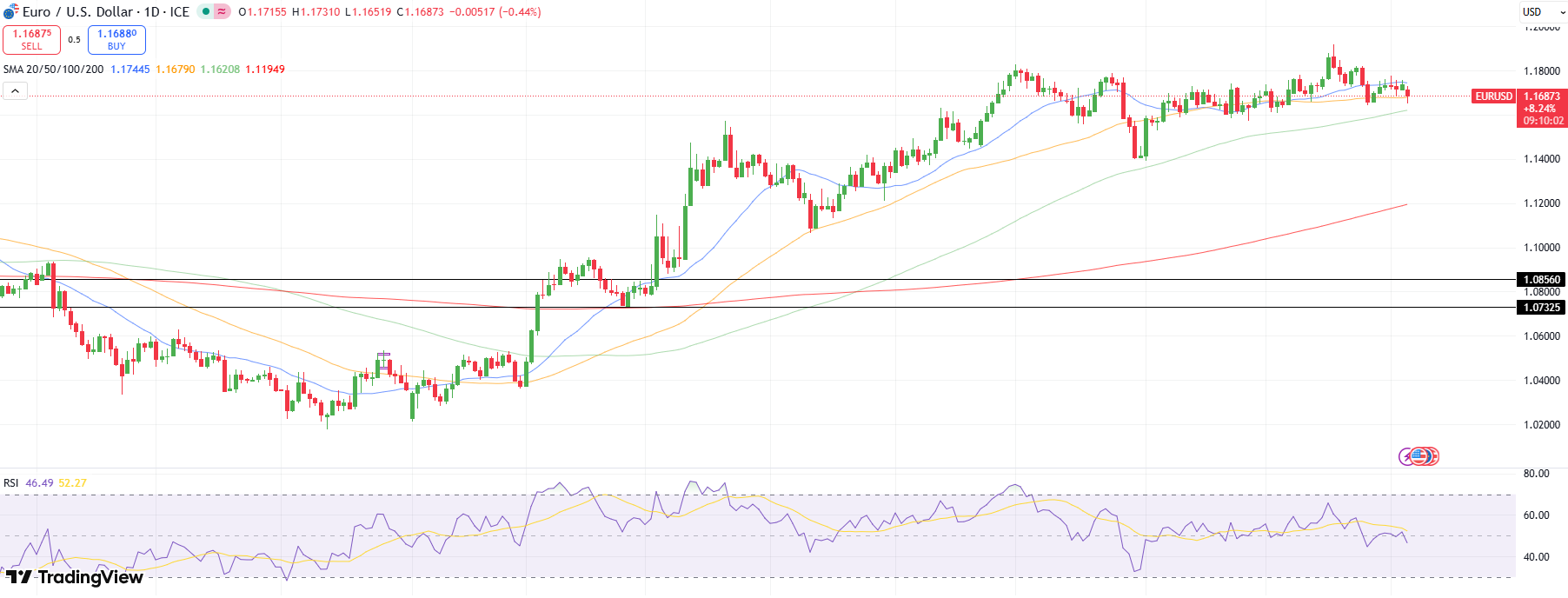
The EUR/USD daily chart reveals the currency pair retaining a sideways-to-bearish bias. The price has declined beneath the 20-day moving average (green line) and is holding right above the 100-day SMA (orange line) near 1.1620, indicating short-term weakness. A drop below this level could expose the next downside around 1.1195 (200-day SMA).
–Are you interested to learn more about forex signals? Check our detailed guide-
The RSI has dropped near 45, highlighting slowing momentum and signaling that bearish pressure may persevere unless buyers reclaim control above 1.1720. Overall, EUR/USD looks range-bound with a mild breach tilt, expecting a breakout for precise directional movement.
Looking to trade forex now? Invest at eToro!
67% of retail investor accounts lose money when trading CFDs with this provider. You should consider whether you can afford to take the high risk of losing your money.
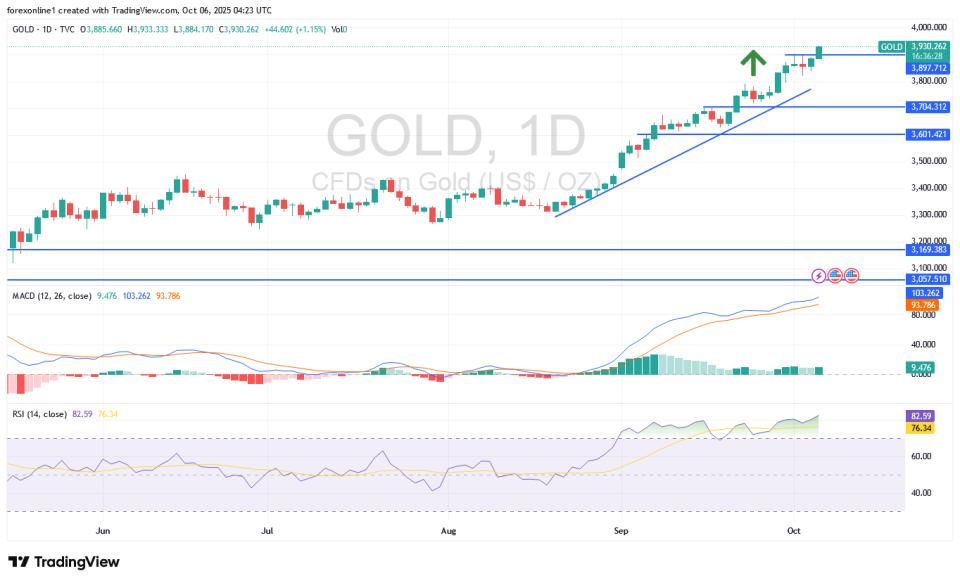
Monday, October 6, 2025. Gold Forecast and Analysis of the price of gold XAU/USD today
The price of gold at $4000 per ounce is the next target for gold bulls amid the continued strong positive momentum in the market. According to platforms of gold trading companies, momentary gold prices rose to the resistance level of $3897 per ounce, the highest in the history of the yellow metal market. The absence of US job numbers at the end of last week provided enough momentum for gold bulls to hold onto their gains. The US government shutdown joined the factors driving gains in the gold market, leading traders to ignore the fact that all technical indicators had reached sharp overbought levels.
According to today’s gold analyst forecasts, the markets in general remain optimistic about gold prices rising, as is their custom after another distinguished performance, with key market investors becoming more optimistic about gold’s potential gains in the coming days. According to platforms of reliable trading companies, the gold price rose for the seventh consecutive week, having declined in only one week since the end of July. Generally, the US government shutdown, increasing talk of Europe re-using Russian reserves, and the trade war in Europe are all factors supporting sentiment. Regarding the most prominent support and resistance levels for gold trading, the near-term support appears to be around $3800, and $4000 per ounce is the closest point in the upward trajectory.

Dear TradersUp trader, keep in mind that the gold market is one of the most important safe havens for investors in times of uncertainty, and the situation surrounding the markets and the global economy will support the continued rise in the price of gold.
We expect the new trading week to see a continued rise in gold prices. There are factors that could converge to stop its continuous ascent: the end of the US government shutdown, a peace agreement reached in Gaza, and the ongoing “strike” among Chinese gold buyers. However, the first two factors were not the cause of the gold price rise, so it is logical that they would have no effect if they reversed, while the cessation of Chinese buying—the effects of which are evident in the significant discounts in Shanghai—has been ongoing for some time. Therefore, I believe the gold index will strongly overcome these potential negatives.
According to some trading experts, the government shutdown’s impact on the Federal Reserve’s ability to measure employment rates is minimal, as they don’t believe the Fed relies heavily on government figures, which have been far from forecasts recently. Generally speaking, the Fed should have its own database to track, so I don’t think they’re acting randomly. They should have a good understanding of things.
Recently, we’ve seen some market volatility as a result of dovish Fed statements, but it was short-lived. Gold trading fell sharply when Dallas Fed President Lori Logan said they didn’t want a major interest rate cut and would have to raise them again. “But it looks like things are starting to recover.” Overall, the gold market’s positive outlook has returned significantly. Many metals analysts expect gold prices to rise this week, while none expect a decline. Other analysts expect gold to trade neutrally in the coming days.
Ready to trade our Gold price forecast? We’ve made a list of the best Gold trading platforms worth trading with.

Above: Emmanuel Macron. GUE/NGL, accessed Flickr, reproduced under CC Licensing.
Pound sterling starts the new week with a solid advance against the euro, but can it make it stick?
The pound to euro exchange rate (GBP/EUR) starts the new week with a solid 0.36% gain, hitting 1.1521, which is the highest level since September 18.
The move looks to be part of a broader selloff in the euro, as euro-dollar trades nearly two-thirds of a per cent down at 1.1664. In fact, looking at the performance chart, the euro is down against everything apart from the yen (which has some domestic politics on its mind).
We suspect the movement is linked to news of another French Prime Minister resigning: French President Emmanuel Macron last night unveiled his new cabinet which immediately drew criticism from across the political spectrum, most likely because it was broadly the same as the last one.
Prime Minister Sebastien Lecornu announced his resignation this morning, leaving France rudderless and significantly raising uncertainty on multiple fronts.

Pound Sterling Live consistently delivers stronger rates than major UK banks.
In July, you could have saved up to €1,720 on a £50,000 transfer thanks to our competitive pricing.
Based on average GBP/EUR rates observed in July.
France’s economy has been struggling of late as a result of this uncertainty, and today’s news certainly bakes this theme into the outlook.
Concerns will build as to how the country can consolidate its debt amidst a political void, with matters certainly not being helped by further economic underperformance: economies must grow to service their debt.
We will be watching French sovereign debt yields through the day to gauge just how worried markets are. But for now at least, the currency is showing its displeasure.
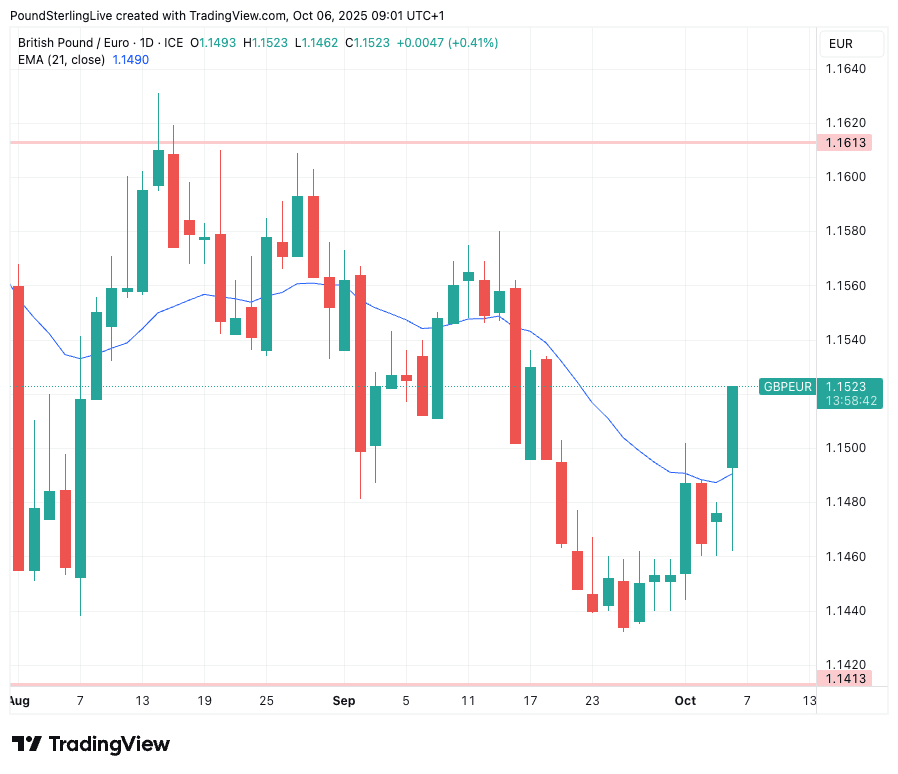
In response, GBP/EUR rises through 1.15 and above the 21-day exponential moving average (at 1.1490), a key technical level that must be breached and defended if sterling is to enter a short-term uptrend.
If GBP/EUR closes above the 21-day, then 1.1560 becomes achievable in the coming days. Those with FX payment requirements should consider locking in current levels for a portion of their payment, and setting an order for higher levels to ensure they are not missed.
GBP/EUR had been under pressure through the August-September period but ultimately formed a base above 1.1440 in late September and early October.
The jump on Monday underpins that base and could even allow for a short-term rally to form.
However, the UK’s own problems won’t be forgotten and we think GBP/EUR upside could prove limited as a result.
Rally-busting issues include the Bank of England’s desire to raise interest rates at any given opportunity and the government’s inability to control spending, which inevitably boosts inflation and increases the odds of tax rises at the November 26 budget.
“The UK rates market doesn’t fully price a BoE cut until the end of winter, next March. The Eurozone rates market doesn’t price a further ECB cut for a very long time indeed,” says Kit Juckes, FX analyst at Société Générale. “What might happen if we saw an earlier BoE move, due to a deterioration in the economic backdrop. Winter is coming, and so are higher taxes.”
Juckes says such outcomes could press a move in EUR/GBP to 0.90 and GBP/EUR to 1.11.
Pound sterling will keep its soft underbelly thanks to a challenging fundamental narrative linked to the government’s spending policies and the Bank of England’s inability to bring inflation under control.
The budget forecasting process began last week, with the Office for Budget Responsibility (OBR) giving the government an initial ‘pre-measures forecast, one of a number of iterations ahead of the day itself.
OBR downgrades to productivity forecasts, increased social spending and higher debt costs mean the Chancellor will need to raise taxes, raising uncertainty for businesses and households.
For financial markets, the impact this uncertainty has on data will be important. Also, the market will be nervous about whether or not the government passes the credibility test when addressing the UK’s difficult fiscal path.
“Sterling markets will be sensitive to any leaks on its contents,” says a note from Lloyds Bank.
The new week commences with a timely article in Bloomberg that points to rising gold and bitcoin prices, which come at the expense of some currencies. It describes the phenomenon as the “debasement trade”.
Investors are worried about inflation and lax fiscal policies, which ultimately debase traditional currencies.
The pound is a prime example of a currency at risk of debasement: the government has the spending taps turned fully on, ensuring UK inflation is the highest in the G7, and rising. And despite this, the Bank of England continues to insist it must go further with interest rate cuts.
In short, British authorities are doing nothing to protect the currency from debasement, something that will surely have an impact on the pound’s long-term trajectory.

EUR/USD stays under heavy bearish pressure in the European session on Monday and trades below 1.1700. In the absence of high-impact data releases, investors are likely to remain focused on political developments in the United States (US) and France.
The table below shows the percentage change of Euro (EUR) against listed major currencies today. Euro was the weakest against the Australian Dollar.
| USD | EUR | GBP | JPY | CAD | AUD | NZD | CHF | |
|---|---|---|---|---|---|---|---|---|
| USD | 0.37% | 0.07% | 0.59% | -0.07% | -0.25% | -0.07% | 0.21% | |
| EUR | -0.37% | -0.41% | 0.14% | -0.47% | -0.63% | -0.48% | -0.20% | |
| GBP | -0.07% | 0.41% | 0.65% | -0.06% | -0.26% | -0.07% | 0.21% | |
| JPY | -0.59% | -0.14% | -0.65% | -0.59% | -0.87% | -0.71% | -0.41% | |
| CAD | 0.07% | 0.47% | 0.06% | 0.59% | -0.14% | -0.01% | 0.28% | |
| AUD | 0.25% | 0.63% | 0.26% | 0.87% | 0.14% | 0.19% | 0.47% | |
| NZD | 0.07% | 0.48% | 0.07% | 0.71% | 0.00% | -0.19% | 0.28% | |
| CHF | -0.21% | 0.20% | -0.21% | 0.41% | -0.28% | -0.47% | -0.28% |
The heat map shows percentage changes of major currencies against each other. The base currency is picked from the left column, while the quote currency is picked from the top row. For example, if you pick the Euro from the left column and move along the horizontal line to the US Dollar, the percentage change displayed in the box will represent EUR (base)/USD (quote).
News of French Prime Minister Sebastien Lecornu having resigned after taking that position just a few weeks ago triggered a Euro (EUR) selloff in the European session on Monday. France’s CAC 40 Index is down about 2% following this headline, as markets grow increasingly concerned over a deepening political crisis in France.
Lecornu was reportedly facing mounting pressure from leftist lawmakers over his budget plans, per Reuters.
Meanwhile, the US government shutdown continues with no apparent progress toward a funding agreement in sight. Over the weekend, White House National Economic Council Director, Kevin Hassett, noted that layoffs could start if President Donald Trump decided that negotiations are “absolutely going nowhere.”
In the absence of high-impact data releases, investors could refrain from placing themselves for a Euro recovery because of the political drama in France.
Later in the American session, European Central Bank (ECB) President Christine Lagarde will deliver a statement before the Committee on Economic and Monetary Affairs of the European Parliament.
The Relative Strength Index (RSI) indicator on the 4-hour chart dropped below 40 and EUR/USD pierced through the 200-period Simple Moving Average (SMA), reflecting a buildup in bearish momentum.
On the downside, 1.1640 (Fibonacci 50% retracement of the latest uptrend) aligns as the first support level for EUR/USD ahead of 1.1580 (Fibonacci 61.8% retracement) and 1.1500 (round level, Fibonacci 78.6% retracement). Looking north, resistance levels could be spotted at 1.1700-1.1715 (Fibonacci 38.2% retracement, 200-period SMA) and 1.1750-1.1760 (100-period SMA, Fibonacci 23.6% retracement).
The Euro is the currency for the 19 European Union countries that belong to the Eurozone. It is the second most heavily traded currency in the world behind the US Dollar. In 2022, it accounted for 31% of all foreign exchange transactions, with an average daily turnover of over $2.2 trillion a day.
EUR/USD is the most heavily traded currency pair in the world, accounting for an estimated 30% off all transactions, followed by EUR/JPY (4%), EUR/GBP (3%) and EUR/AUD (2%).
The European Central Bank (ECB) in Frankfurt, Germany, is the reserve bank for the Eurozone. The ECB sets interest rates and manages monetary policy.
The ECB’s primary mandate is to maintain price stability, which means either controlling inflation or stimulating growth. Its primary tool is the raising or lowering of interest rates. Relatively high interest rates – or the expectation of higher rates – will usually benefit the Euro and vice versa.
The ECB Governing Council makes monetary policy decisions at meetings held eight times a year. Decisions are made by heads of the Eurozone national banks and six permanent members, including the President of the ECB, Christine Lagarde.
Eurozone inflation data, measured by the Harmonized Index of Consumer Prices (HICP), is an important econometric for the Euro. If inflation rises more than expected, especially if above the ECB’s 2% target, it obliges the ECB to raise interest rates to bring it back under control.
Relatively high interest rates compared to its counterparts will usually benefit the Euro, as it makes the region more attractive as a place for global investors to park their money.
Data releases gauge the health of the economy and can impact on the Euro. Indicators such as GDP, Manufacturing and Services PMIs, employment, and consumer sentiment surveys can all influence the direction of the single currency.
A strong economy is good for the Euro. Not only does it attract more foreign investment but it may encourage the ECB to put up interest rates, which will directly strengthen the Euro. Otherwise, if economic data is weak, the Euro is likely to fall.
Economic data for the four largest economies in the euro area (Germany, France, Italy and Spain) are especially significant, as they account for 75% of the Eurozone’s economy.
Another significant data release for the Euro is the Trade Balance. This indicator measures the difference between what a country earns from its exports and what it spends on imports over a given period.
If a country produces highly sought after exports then its currency will gain in value purely from the extra demand created from foreign buyers seeking to purchase these goods. Therefore, a positive net Trade Balance strengthens a currency and vice versa for a negative balance.