The main category of Forex News.
You can use the search box below to find what you need.
[wd_asp id=1]
The main category of Forex News.
You can use the search box below to find what you need.
[wd_asp id=1]
Accounting and consulting giant Deloitte has not changed its latest crude oil price forecasts for 2026 and beyond in response to the U.S. raid on Venezuela that led the capture of Nicolás Maduro.
The situation roiled shares of oil producing companies on Monday, as investors weighed the potential impact of the country’s heavy oil industry ramping up exports under American control. Industry analysts are now downplaying the potential impact on global prices.
The February 2026 contract for U.S. benchmark West Texas Intermediate (WTI) (CL=F) crude closed about 1.74 per cent higher on Monday. Prices rose in early trading on Tuesday, before dipping into negative territory below US$58 per barrel.
In a new report, Deloitte calls for WTI to stay range-bound in 2026, averaging US$58 a barrel, before rising to US$61.20 in 2027, and US$67.65 in 2028. The estimate for 2026 is about 20 per cent lower than it was at this time last year, and about 12 per cent below the commodity’s 2025 average.
Deloitte also left its forecast for Western Canadian Select (WCS) unchanged on Tuesday as a result of the situation in Venezuela. WCS is Canada’s main heavy oil benchmark.
On Tuesday, Prime Minister Mark Carney said he continues to “see the competitiveness of Canadian oil,” while welcoming the prospect of greater economic prosperity in Venezuela.
Monday saw shares of major Canadian oil producers slide as investors weighed the prospect of Venezuelan oil competing with Canadian exports to satisfy U.S. demand. Canadian Natural Resources (CNQ.TO)(CNQ) saw its stock close over six per cent lower in Toronto. The iShares S&P/TSX Capped Energy Index ETF (XEG.TO), a basket of big Canadian oil stocks, sank 3.4 per cent. It was a different story for U.S. oil majors. Shares of ExxonMobil (XOM), Chevron (CVX), and ConocoPhillips (COP) ended the day higher.
Canadian oil stocks flipped between gains and losses in mid-day trading on Tuesday.
Like many industry experts, Deloitte partner Andrew Botterill says it will take many years and a lot of money to materially revive Venezuela’s battered oil industry.
“Canadian [crude] volumes have had the benefit of not really having to compete with much of the Venezuelan volumes for the last five or so years,” he told Yahoo Finance Canada on Monday.
“That competition may be back, but that’s something that we have to worry about in five to 10 years from now,” Botterill said.
“From a fundamentals supply and demand [perspective], not a lot changed this weekend. What we did recognize is out on the horizon, there could be a reshaping of what mid-term and long-term supply and demand might be.”
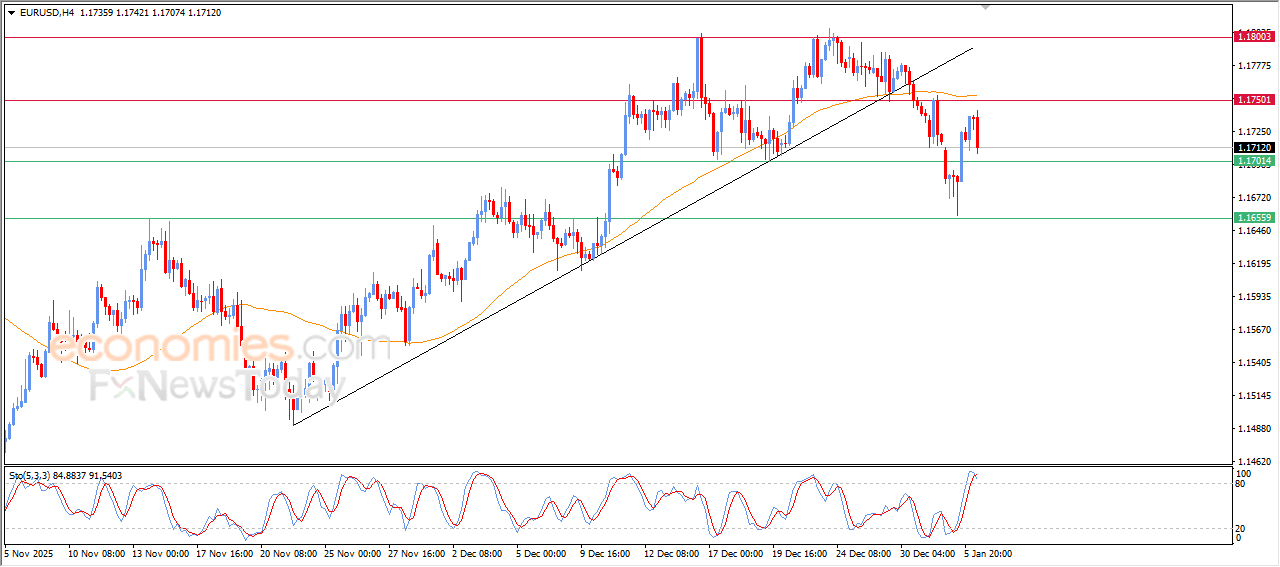
After rising toward 1.1750 early Tuesday, EUR/USD made a sharp U-turn in the second half of the day and closed in negative territory. The pair stays on the back foot early Wednesday and trades below 1.1700.
The table below shows the percentage change of Euro (EUR) against listed major currencies this week. Euro was the weakest against the Australian Dollar.
| USD | EUR | GBP | JPY | CAD | AUD | NZD | CHF | |
|---|---|---|---|---|---|---|---|---|
| USD | 0.36% | -0.21% | -0.19% | 0.53% | -0.91% | -0.43% | 0.53% | |
| EUR | -0.36% | -0.57% | -0.48% | 0.17% | -1.27% | -0.78% | 0.17% | |
| GBP | 0.21% | 0.57% | 0.00% | 0.75% | -0.70% | -0.21% | 0.74% | |
| JPY | 0.19% | 0.48% | 0.00% | 0.69% | -0.76% | -0.27% | 0.74% | |
| CAD | -0.53% | -0.17% | -0.75% | -0.69% | -1.28% | -0.96% | 0.00% | |
| AUD | 0.91% | 1.27% | 0.70% | 0.76% | 1.28% | 0.49% | 1.45% | |
| NZD | 0.43% | 0.78% | 0.21% | 0.27% | 0.96% | -0.49% | 0.96% | |
| CHF | -0.53% | -0.17% | -0.74% | -0.74% | -0.00% | -1.45% | -0.96% |
The heat map shows percentage changes of major currencies against each other. The base currency is picked from the left column, while the quote currency is picked from the top row. For example, if you pick the Euro from the left column and move along the horizontal line to the US Dollar, the percentage change displayed in the box will represent EUR (base)/USD (quote).
The renewed US Dollar (USD) strength caused EUR/USD to turn south in the American session on Tuesday. Markets still see a less than 20% chance of the Federal Reserve (Fed) lowering the policy rate at the January meeting, according to the CME FedWatch Tool, and this positioning seems to be helping the USD stay resilient against its rivals.
In the second half of the day, the Automatic Data Processing (ADP) will publish the private sector employment data. Markets expect an increase of 45,000 in private sector payrolls in December, following the 32,000 decrease recorded in November. A reading better than expected could feed into expectations for a Fed policy hold and help the USD outperform its rivals. On the other hand, a negative print could trigger a USD selloff and open the door for a decisive rebound in EUR/USD with the immediate reaction.
Later in the session, investors will also pay close attention to the Institue for Supply Management’s Services Purchasing Managers’ Index (PMI) report for December. The headline PMI is forecast to come in above 50 and show an ongoing expansion in the service sector’s business activity. An unexpected drop below 50 could weigh on the USD. Conversely, a reading near the market expectation, combined with a recovery above 50 in the Employment Index of the survey, could boost the USD and force EUR/USD to stretch lower.
The 20-period Simple Moving Average (SMA) extends its slide below the 50- and 100-period SMAs, while price holds beneath these averages and rests around the slowly rising 200-period SMA. The RSI (14) prints at 38, reflecting bearish momentum without oversold conditions. The 200-period SMA aligns as the immediate support level at 1.1675. Measured from the 1.1503 low to the 1.1800 high, the 50% retracement at 1.1652 could be seen as the next support level before 1.1615 (Fibonacci 61.8% retracement).
Recovery attempts could face immediate resistance at 1.1690-1.1705 (Fibonacci 23.6% retracement, 20-period SMA) ahead of 1.1730 (Fibonacci 23.6% retracement) and 1.1745 (50-peirod SMA, 100-period SMA).
(The technical analysis of this story was written with the help of an AI tool)
The Euro is the currency for the 20 European Union countries that belong to the Eurozone. It is the second most heavily traded currency in the world behind the US Dollar. In 2022, it accounted for 31% of all foreign exchange transactions, with an average daily turnover of over $2.2 trillion a day.
EUR/USD is the most heavily traded currency pair in the world, accounting for an estimated 30% off all transactions, followed by EUR/JPY (4%), EUR/GBP (3%) and EUR/AUD (2%).
The European Central Bank (ECB) in Frankfurt, Germany, is the reserve bank for the Eurozone. The ECB sets interest rates and manages monetary policy.
The ECB’s primary mandate is to maintain price stability, which means either controlling inflation or stimulating growth. Its primary tool is the raising or lowering of interest rates. Relatively high interest rates – or the expectation of higher rates – will usually benefit the Euro and vice versa.
The ECB Governing Council makes monetary policy decisions at meetings held eight times a year. Decisions are made by heads of the Eurozone national banks and six permanent members, including the President of the ECB, Christine Lagarde.
Eurozone inflation data, measured by the Harmonized Index of Consumer Prices (HICP), is an important econometric for the Euro. If inflation rises more than expected, especially if above the ECB’s 2% target, it obliges the ECB to raise interest rates to bring it back under control.
Relatively high interest rates compared to its counterparts will usually benefit the Euro, as it makes the region more attractive as a place for global investors to park their money.
Data releases gauge the health of the economy and can impact on the Euro. Indicators such as GDP, Manufacturing and Services PMIs, employment, and consumer sentiment surveys can all influence the direction of the single currency.
A strong economy is good for the Euro. Not only does it attract more foreign investment but it may encourage the ECB to put up interest rates, which will directly strengthen the Euro. Otherwise, if economic data is weak, the Euro is likely to fall.
Economic data for the four largest economies in the euro area (Germany, France, Italy and Spain) are especially significant, as they account for 75% of the Eurozone’s economy.
Another significant data release for the Euro is the Trade Balance. This indicator measures the difference between what a country earns from its exports and what it spends on imports over a given period.
If a country produces highly sought after exports then its currency will gain in value purely from the extra demand created from foreign buyers seeking to purchase these goods. Therefore, a positive net Trade Balance strengthens a currency and vice versa for a negative balance.
Together, the above indications point to a likely continuation of the bull trend as gold heads towards the record high of $4,550. However, despite the clear signs of strengthening, gold remains within a trading range established by a wide range bearish red candle from December 29 that formed following the high. It represents a range of potential selling pressure, which could impact momentum in the current advance and lead to further corrective behavior for the precious metal. This is not a prediction but rather a pattern to be aware off that could hobble the attempt at new highs.
Regardless, dynamic support for the bull trend was confirmed on Monday with a bounce off support near the 20-day average, which is bullish behavior at a key trend indicator. In addition, the recent pullback following a new record high was minor with support confirmed at the top trendline of a rising trend channel. It shows bullish momentum improving with as the overall rate of ascent increases. The fact that the 20-day line and top channel line – both long-term levels – also marked the same area of support near the pullback low of $4,274, is bullish behavior.
The first new high target zone is identified by the confluence of several indicator. An initial price range goes from around $4,664 to $4,713. Also, a little higher is a level at $4,766. Other than $4,687, which is the 161.8% extension of the recent bearish correction, the price levels are derived from long-term measurements. If the top level is eventually exceeded, gold looks like it will head to $4,942, which is the 450% extension of the 2011 bearish correction.
For a look at all of today’s economic events, check out our economic calendar.
The GBPJPY pair ended the last bullish rally by recording 212.15 level, to bounce directly to settle near 211.30, which formed strong obstacle against the bullish attempts.
Note that the stability within the main bullish levels and forming extra support at 211.30 level, which makes us wait for gathering bullish momentum to reinforce the chances of recording the target at 212.55 and surpassing it might extend trading towards 213.75, while reaching below 211.30 and providing negative close will confirm delaying the bullish attack, to begin forming temporary corrective wave, to target 210.65 and 209.90 level.
The expected trading range for today is between 211.00 and 212.50
Trend forecast: Bullish
The GBPJPY pair ended the last bullish rally by recording 212.15 level, to bounce directly to settle near 211.30, which formed strong obstacle against the bullish attempts.
Note that the stability within the main bullish levels and forming extra support at 211.30 level, which makes us wait for gathering bullish momentum to reinforce the chances of recording the target at 212.55 and surpassing it might extend trading towards 213.75, while reaching below 211.30 and providing negative close will confirm delaying the bullish attack, to begin forming temporary corrective wave, to target 210.65 and 209.90 level.
The expected trading range for today is between 211.00 and 212.50
Trend forecast: Bullish
EUR/JPY extends its losses for the fourth successive session, trading around 182.80 during the European hours on Wednesday. The currency cross remains subdued following the release of Germany’s Retail Sales, which climbed 1.1% year-over-year (YoY) in November, following an increase of 0.9% in October. Monthly Retail Sales fell 0.6% in November, against a 0.3% decline in October and the market expectations of a 0.2% increase.
The technical analysis of the daily chart suggests that the 14-day Relative Strength Index (RSI) sits at 50.96 (neutral), confirming tempered momentum. The EUR/JPY cross remains above the rising 50-day Exponential Moving Average (EMA), while it stalls beneath a softening nine-day EMA, pointing to consolidation after the recent advance.
The EUR/JPY cross may navigate the region around the initial support at the three-week low of 181.57, recorded on December 17, followed by the 50-day EMA at 181.31. Holding above the 50-day EMA would keep the medium-term uptrend intact, while a drop through the first floor could expose the deeper level.
On the upside, the EUR/JPY cross may rebound toward the nine-day EMA at 183.44. Recovery through the nine-day EMA could re-establish upside traction and refocus the topside path toward the all-time high of 184.95, which was recorded on December 22, aligned with the psychological level of 185.00.
The table below shows the percentage change of Euro (EUR) against listed major currencies today. Euro was the weakest against the Japanese Yen.
| USD | EUR | GBP | JPY | CAD | AUD | NZD | CHF | |
|---|---|---|---|---|---|---|---|---|
| USD | 0.06% | 0.04% | -0.09% | 0.11% | 0.00% | 0.11% | 0.09% | |
| EUR | -0.06% | -0.01% | -0.16% | 0.05% | -0.05% | 0.04% | 0.03% | |
| GBP | -0.04% | 0.00% | -0.15% | 0.06% | -0.04% | 0.06% | 0.04% | |
| JPY | 0.09% | 0.16% | 0.15% | 0.21% | 0.11% | 0.20% | 0.19% | |
| CAD | -0.11% | -0.05% | -0.06% | -0.21% | -0.10% | -0.01% | -0.02% | |
| AUD | -0.00% | 0.05% | 0.04% | -0.11% | 0.10% | 0.10% | 0.08% | |
| NZD | -0.11% | -0.04% | -0.06% | -0.20% | 0.00% | -0.10% | -0.02% | |
| CHF | -0.09% | -0.03% | -0.04% | -0.19% | 0.02% | -0.08% | 0.02% |
The heat map shows percentage changes of major currencies against each other. The base currency is picked from the left column, while the quote currency is picked from the top row. For example, if you pick the Euro from the left column and move along the horizontal line to the US Dollar, the percentage change displayed in the box will represent EUR (base)/USD (quote).
(The technical analysis of this story was written with the help of an AI tool.)
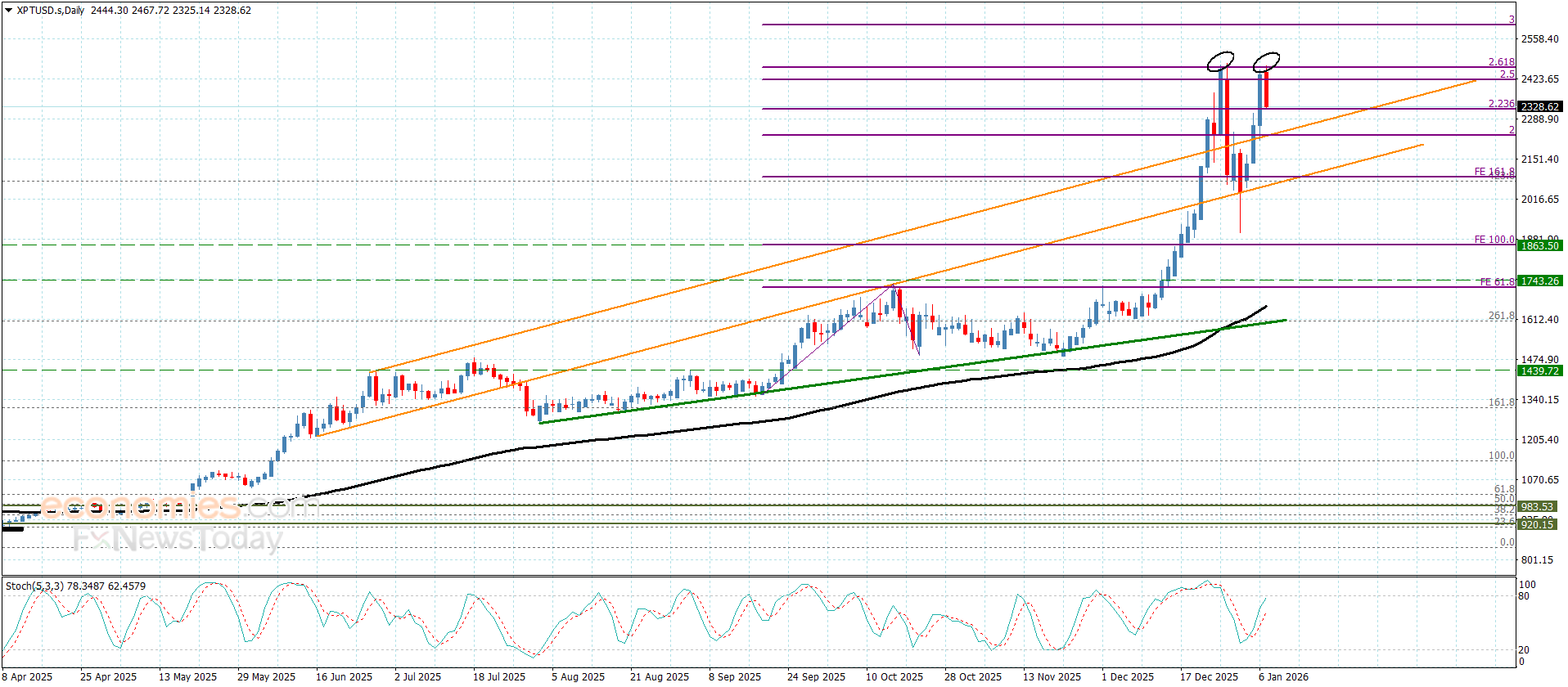
Platinum price ended the last bullish rally by facing the historical high near$2467.70, forming strong resistance to begin forming bearish corrective waves by its stability near $2340.00.
Despite the attempts of the main indicators to provide positive momentum, the continued fluctuation below the current top supports the chances of renewing the corrective attempts, which might target $2260.00 and $2185.00, while breaching the top and holding above it will reinforce the chances of recording historical gains by its rally towards $2525.00.
The expected trading range for today is between $2260.00 and $2410.00
Trend forecast: Bearish
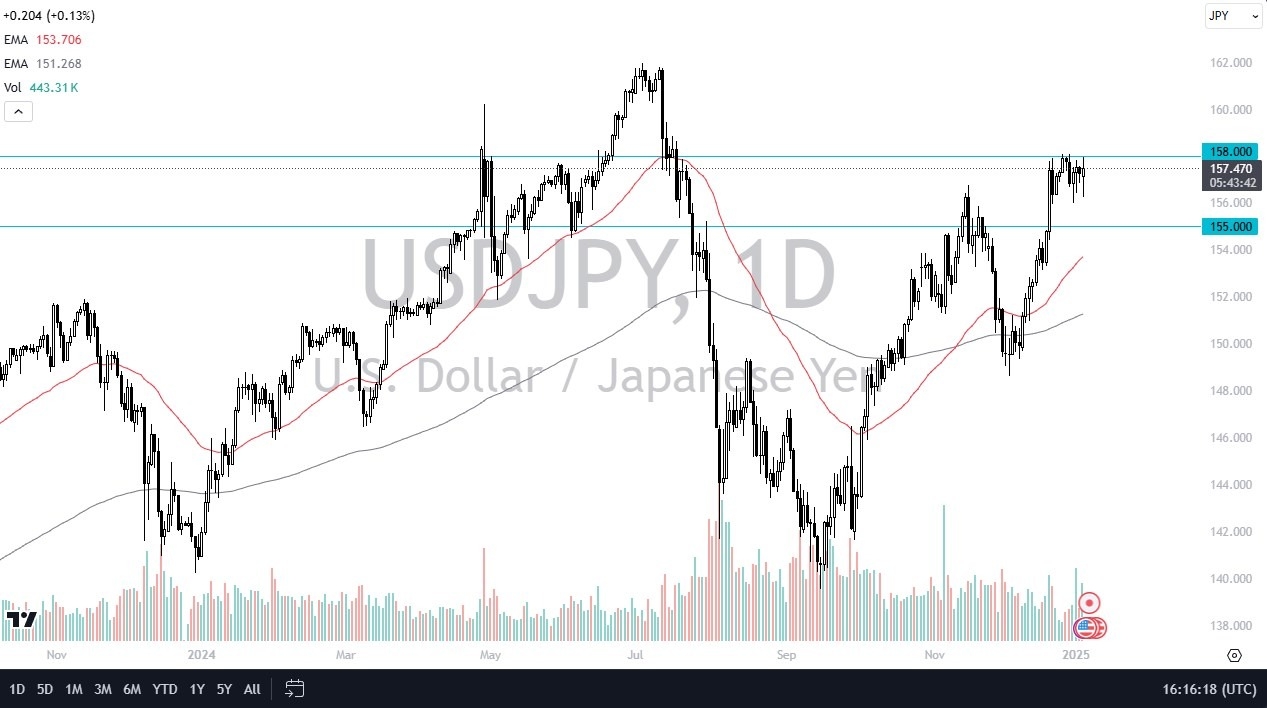
We might have a bit of a shrinking of the interest rate differential over the next several months, but I do not think it is likely to be enough to turn the market around on its own. The one thing that could come into the picture as a potential strengthening point for the yen would be if we get some type of economic problem that affects the globe or geopolitical concerns.

This is a market that generally favors the US dollar due to interest rate differential, but if we have a major risk-off event, then traders will, of course, come running to the Japanese yen.
As long as we stay above the 154.5 yen level, I think buying the dips will continue to be the move, as the interest rate differential continues to get you paid at the end of each session. The carry trade seems to still be alive and well at the moment.
Want to trade our USD/JPY forex analysis and predictions? Here’s a list of forex brokers in Japan to check out.
Christopher Lewis has been trading Forex and has over 20 years experience in financial markets. Chris has been a regular contributor to Daily Forex since the early days of the site. He writes about Forex for several online publications, including FX Empire, Investing.com, and his own site, aptly named The Trader Guy. Chris favours technical analysis methods to identify his trades and likes to trade equity indices and commodities as well as Forex. He favours a longer-term trading style, and his trades often last for days or weeks.
The EURJPY pair suffered strong negative pressures, reaching below the bullish channel’s support at 183.45 level, to suffer intraday losses by targeting 182.80 level, which forms a key support level to take advantage of its rally towards 183.40.
The confinement between extra support at 182.80 and 183.60 level makes us expect extending the support of the broken bullish channel, to keep the neutrality until confirming the trend by surpassing one of these levels, note that the price rally above 183.60 will reinforce the chances of renewing the bullish attempts, to expect targeting 184.40 barrier, and surpassing it will form next target at 184.90 level in the bullish trading.
The expected trading range for today is between 182.80 and 183.60
Trend forecast: Neutral
Gold is correcting from weekly highs of $4,500 early Wednesday as buyers take a breather after the recent relentless upsurge, backed by geopolitical flare-ups globally and increased US Federal Reserve (Fed) interest rate cut bets for 2026.
Having climbed nearly 4% so far this week, traders resort to profit-taking on their Gold long positions in a readjustment move after the bright metal ran into the $4,500 barrier.
Traders also gear up for a bunch of high-impact US economic data releases due later on Wednesday, including the ADP monthly Employment Change, JOLTS Job Openings and ISM Services PMI data.
These data will be closely scrutinized to gauge the timing of the next Fed rate cut as markets continue pricing in two rate reductions for this year. Weaker-than-expected jobs and private services sector data could reaffirm bets for two cuts in the coming months, boding well for non-yielding assets like Gold at the expense of the US Dollar (USD).
On Monday, the US ISM Manufacturing PMI declined to 47.9 in December, against the forecast of 48.3, reinforcing dovish Fed expectations and keeping the recovery attempts in the USD short-lived.
The ongoing bearish undertone around the USD, combined with the escalating geopolitical tensions globally, continues to keep the positive momentum intact in Gold, despite the latest retracement.
On the latest geopolitical developments, Russia deployed submarine and other naval vessels to escort an aging oil tanker off the coast of Venezuela, according to the Wall Street Journal (WSJ).
Meanwhile, China ramped up tensions with Japan by banning exports of goods with potential military uses, following Taiwan-related remarks by Japan’s Prime Minister Sanae Takaichi.
In the daily chart, the 21-day Simple Moving Average (SMA) advances above the 50-day, with price holding over both, signaling firm bullish momentum. The 21-day SMA at $4,363.88 acts as nearby dynamic support. The Relative Strength Index (RSI) at 63.41 remains in bullish territory without overbought readings, keeping the bias tilted to the upside.
Broader trend metrics stay supportive as the 100- and 200-day SMAs continue to climb and the market trades above them. The moving average stack shows buyers in control, with secondary support at the 50-day SMA around $4,212.04 and deeper layers near the 100-day at $3,997.46 and the 200-day at $3,653.43. As long as price holds above the 21-day SMA, the uptrend would extend, while pullbacks could be absorbed into the rising averages.
(The technical analysis of this story was written with the help of an AI tool)
The ADP Employment Change is a gauge of employment in the private sector released by the largest payroll processor in the US, Automatic Data Processing Inc. It measures the change in the number of people privately employed in the US. Generally speaking, a rise in the indicator has positive implications for consumer spending and is stimulative of economic growth. So a high reading is traditionally seen as bullish for the US Dollar (USD), while a low reading is seen as bearish.
Next release:
Wed Jan 07, 2026 13:15
Frequency:
Monthly
Consensus:
45K
Previous:
-32K
Source:
ADP Research Institute
Monetary policy in the US is shaped by the Federal Reserve (Fed). The Fed has two mandates: to achieve price stability and foster full employment. Its primary tool to achieve these goals is by adjusting interest rates.
When prices are rising too quickly and inflation is above the Fed’s 2% target, it raises interest rates, increasing borrowing costs throughout the economy. This results in a stronger US Dollar (USD) as it makes the US a more attractive place for international investors to park their money.
When inflation falls below 2% or the Unemployment Rate is too high, the Fed may lower interest rates to encourage borrowing, which weighs on the Greenback.
The Federal Reserve (Fed) holds eight policy meetings a year, where the Federal Open Market Committee (FOMC) assesses economic conditions and makes monetary policy decisions.
The FOMC is attended by twelve Fed officials – the seven members of the Board of Governors, the president of the Federal Reserve Bank of New York, and four of the remaining eleven regional Reserve Bank presidents, who serve one-year terms on a rotating basis.
In extreme situations, the Federal Reserve may resort to a policy named Quantitative Easing (QE). QE is the process by which the Fed substantially increases the flow of credit in a stuck financial system.
It is a non-standard policy measure used during crises or when inflation is extremely low. It was the Fed’s weapon of choice during the Great Financial Crisis in 2008. It involves the Fed printing more Dollars and using them to buy high grade bonds from financial institutions. QE usually weakens the US Dollar.
Quantitative tightening (QT) is the reverse process of QE, whereby the Federal Reserve stops buying bonds from financial institutions and does not reinvest the principal from the bonds it holds maturing, to purchase new bonds. It is usually positive for the value of the US Dollar.