The main category of Forex News.
You can use the search box below to find what you need.
[wd_asp id=1]
The main category of Forex News.
You can use the search box below to find what you need.
[wd_asp id=1]
Silver (XAG/USD) appreciates for the second consecutive day on Monday, to reach fresh 4-year highs at $48.75, with downside attempts contained so far above last week’s highs at $48.30.
Precious metals are thriving on Monday as a combination of a US government shutdown, which looks to be an extended one, expectations of a looser monetary policy in Japan, and the growing political uncertainty in France, have prompted investors to find alternative assets.
From a technical perspective, the pair remains trading higher within an ascending channel from id September lows. The 4-Hour RSI, however, is showing some bearish divergence, which should act as a warning for buyers.
Bulls are likely to be challenged at $ 49.24-$49.30, where the 161.8% of the September 17 to September 24 range meets the top of the ascending channel. Further up, the $50.00 psychological level emerges as the next bullish target..
Downside attempts are being contained above $48.30 (September 3 high) for now. Below here, the 47.60 area (Intra-day support and trendline support, at $46.90 would come into focus.
Silver is a precious metal highly traded among investors. It has been historically used as a store of value and a medium of exchange. Although less popular than Gold, traders may turn to Silver to diversify their investment portfolio, for its intrinsic value or as a potential hedge during high-inflation periods. Investors can buy physical Silver, in coins or in bars, or trade it through vehicles such as Exchange Traded Funds, which track its price on international markets.
Silver prices can move due to a wide range of factors. Geopolitical instability or fears of a deep recession can make Silver price escalate due to its safe-haven status, although to a lesser extent than Gold’s. As a yieldless asset, Silver tends to rise with lower interest rates. Its moves also depend on how the US Dollar (USD) behaves as the asset is priced in dollars (XAG/USD). A strong Dollar tends to keep the price of Silver at bay, whereas a weaker Dollar is likely to propel prices up. Other factors such as investment demand, mining supply – Silver is much more abundant than Gold – and recycling rates can also affect prices.
Silver is widely used in industry, particularly in sectors such as electronics or solar energy, as it has one of the highest electric conductivity of all metals – more than Copper and Gold. A surge in demand can increase prices, while a decline tends to lower them. Dynamics in the US, Chinese and Indian economies can also contribute to price swings: for the US and particularly China, their big industrial sectors use Silver in various processes; in India, consumers’ demand for the precious metal for jewellery also plays a key role in setting prices.
Silver prices tend to follow Gold’s moves. When Gold prices rise, Silver typically follows suit, as their status as safe-haven assets is similar. The Gold/Silver ratio, which shows the number of ounces of Silver needed to equal the value of one ounce of Gold, may help to determine the relative valuation between both metals. Some investors may consider a high ratio as an indicator that Silver is undervalued, or Gold is overvalued. On the contrary, a low ratio might suggest that Gold is undervalued relative to Silver.
The technical analysis for this market is very sideways and has been for a while, with the brief exception of a quick attempt to break out and above the ¥149 level. The market continues to see a lot of noisy behavior but that makes sense because quite frankly there are a lot of questions out there as to whether or not we are going to see risk appetite pick up or drop. Furthermore, you also have to keep in mind that recently we have been bouncing around between the ¥146 level on the bottom, and the ¥149 level on the top. As we try to break out of there, we have seen a complete repudiation of that, but we have not broken down below the ¥146 level with any significance to show signs of potentially continued bearishness.

Ultimately, I still like the idea of buying short-term dips looking for collecting swaps at the end of each day, as interest rate differential still most certainly favors the United States dollar. If we get any type of “risk on move” in the overall markets, then it’s likely that this pair will rally as well. I still favor the upside but I fully admit that this is a very noisy and choppy market.
Want to trade our USD/JPY forex analysis and predictions? Here’s a list of forex brokers in Japan to check out.
Christopher Lewis has been trading Forex and has over 20 years experience in financial markets. Chris has been a regular contributor to Daily Forex since the early days of the site. He writes about Forex for several online publications, including FX Empire, Investing.com, and his own site, aptly named The Trader Guy. Chris favours technical analysis methods to identify his trades and likes to trade equity indices and commodities as well as Forex. He favours a longer-term trading style, and his trades often last for days or weeks.
The GBPJPY pair opened today’s trading with a big price gap, to settle above the barrier at 200.45, recording big gains by its rally towards 202.10, approaching the initial main target at 202.40, forming 161.8%Fibonacci extension level that appears in the above image.
And that confirms the price surrender to the bullish bias dominance, by providing extra positive momentum by the main indicators, which increase the chances of surpassing 202.40 level, to begin achieving extra gains by its rally towards 202.85 reaching 1.809% Fibonacci extension level near 203.85.
The expected trading range for today is between 200.60 and 202.80
Trend forecast: Bullish
Whether or not that remains the case, you’ll have to wait and see. All things being equal, this is a market that may have to think about the fact that maybe the economy is slowing down if that’s the case that drives a demand for the US dollar. If we break through the 50 day EMA, the uptrend line as well, then we start to target 1.16. Anything below there, then I think the euro is in trouble. To the upside, the 1.18 level continues to be resistant. Breaking above that is a very bullish sign and probably has the euro testing the highs during the FOMC press conference, is right around the 1.19 level. We are still in an uptrend that has not changed, but what we are starting to see is a serious lack of momentum. We have to ask the question, are we just working off some of the excess froth or are we looking at an area between 1.18 and 1.20 that was very influential multiple times going back about eight years. Have we gone too far? If we get more risk off, the answer will be obvious.
Ready to trade our daily Forex forecast? Here’s a list of some of the best regulated forex brokers to check out.
Christopher Lewis has been trading Forex and has over 20 years experience in financial markets. Chris has been a regular contributor to Daily Forex since the early days of the site. He writes about Forex for several online publications, including FX Empire, Investing.com, and his own site, aptly named The Trader Guy. Chris favours technical analysis methods to identify his trades and likes to trade equity indices and commodities as well as Forex. He favours a longer-term trading style, and his trades often last for days or weeks.
The GBPJPY pair opened today’s trading with a big price gap, to settle above the barrier at 200.45, recording big gains by its rally towards 202.10, approaching the initial main target at 202.40, forming 161.8%Fibonacci extension level that appears in the above image.
And that confirms the price surrender to the bullish bias dominance, by providing extra positive momentum by the main indicators, which increase the chances of surpassing 202.40 level, to begin achieving extra gains by its rally towards 202.85 reaching 1.809% Fibonacci extension level near 203.85.
The expected trading range for today is between 200.60 and 202.80
Trend forecast: Bullish
The GBPJPY pair opened today’s trading with a big price gap, to settle above the barrier at 200.45, recording big gains by its rally towards 202.10, approaching the initial main target at 202.40, forming 161.8%Fibonacci extension level that appears in the above image.
And that confirms the price surrender to the bullish bias dominance, by providing extra positive momentum by the main indicators, which increase the chances of surpassing 202.40 level, to begin achieving extra gains by its rally towards 202.85 reaching 1.809% Fibonacci extension level near 203.85.
The expected trading range for today is between 200.60 and 202.80
Trend forecast: Bullish
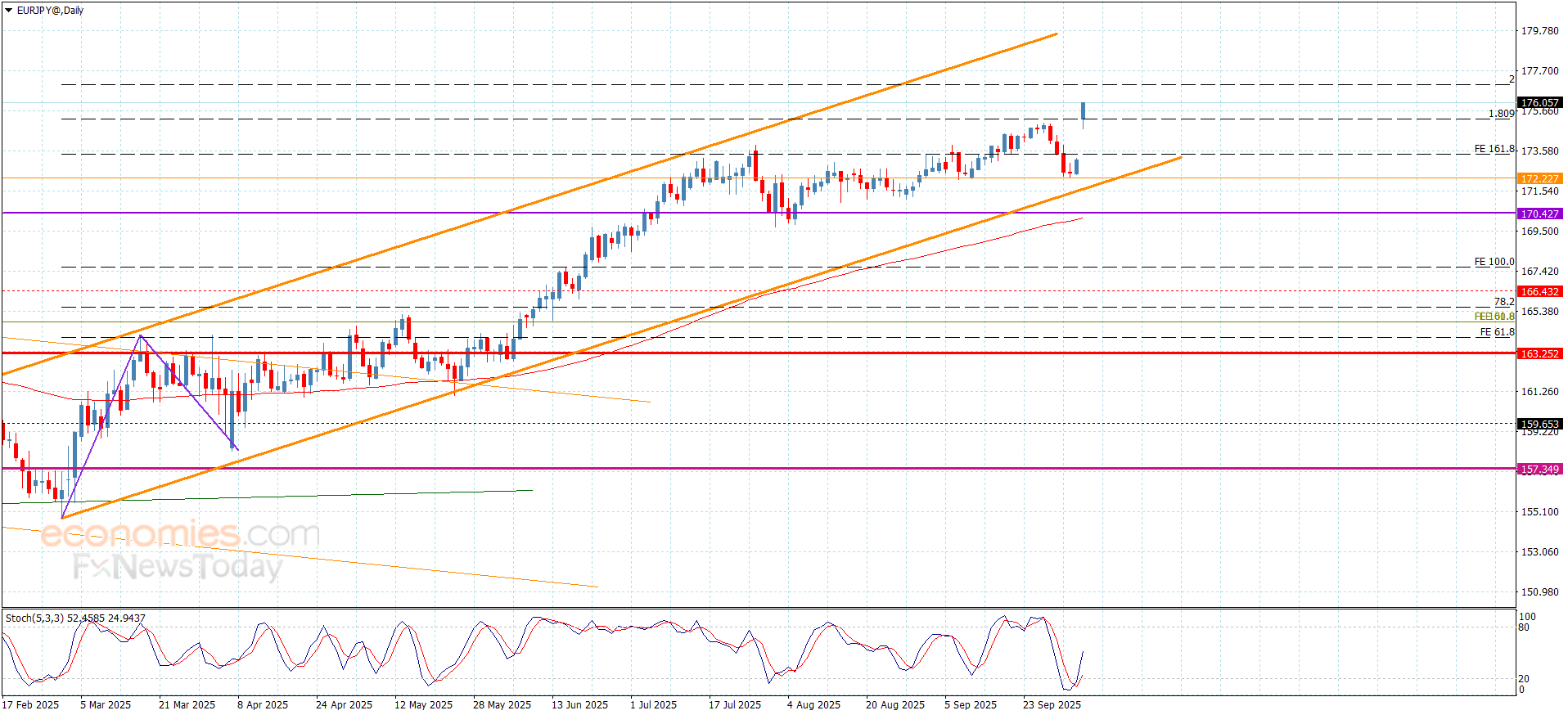
EUR/JPY opened at a gap-up, extending its gains and trading around 176.20 during the Asian hours on Monday. The technical analysis of the daily chart indicates strengthening of a bullish bias as the currency cross has broken above the ascending channel pattern.
Additionally, the 14-day Relative Strength Index (RSI) rises toward the 70 mark, suggesting that bullish bias is strengthening. A break above the 70 mark would suggest an overbought situation and a downward correction anytime soon. Additionally, the short-term price momentum is stronger as the EUR/JPY cross is positioned above the nine-day Exponential Moving Average (EMA).
On the upside, the EUR/JPY cross reached an all-time high of 176.24, which was recorded on October 6. As the market bias is bullish, the cross may explore the region around the psychological level of 177.00.
A pullback toward the ascending channel would prompt the EUR/JPY cross to test the nine-day EMA of 174.02. Further declines would weaken the short-term price momentum and put downward pressure on the currency cross to approach the lower boundary of the channel around 173.00, followed by the 50-day EMA at 172.64.
A break below the 50-day EMA would weaken the medium-term price momentum and put downward pressure on the EUR/JPY cross to navigate the region around the three-month low of 169.72, recorded on July 31.
(The story was corrected on October 6 at 06:25 GMT, to say in the second paragraph that bullish bias is strengthening, and not the bearish bias.)
The table below shows the percentage change of Euro (EUR) against listed major currencies today. Euro was the strongest against the Japanese Yen.
| USD | EUR | GBP | JPY | CAD | AUD | NZD | CHF | |
|---|---|---|---|---|---|---|---|---|
| USD | 0.01% | -0.00% | 0.57% | -0.04% | -0.29% | -0.23% | -0.04% | |
| EUR | -0.01% | -0.12% | 0.48% | -0.09% | -0.34% | -0.28% | -0.09% | |
| GBP | 0.00% | 0.12% | 0.69% | 0.03% | -0.22% | -0.16% | 0.03% | |
| JPY | -0.57% | -0.48% | -0.69% | -0.56% | -0.91% | -0.87% | -0.66% | |
| CAD | 0.04% | 0.09% | -0.03% | 0.56% | -0.21% | -0.19% | -0.01% | |
| AUD | 0.29% | 0.34% | 0.22% | 0.91% | 0.21% | 0.07% | 0.25% | |
| NZD | 0.23% | 0.28% | 0.16% | 0.87% | 0.19% | -0.07% | 0.18% | |
| CHF | 0.04% | 0.09% | -0.03% | 0.66% | 0.01% | -0.25% | -0.18% |
The heat map shows percentage changes of major currencies against each other. The base currency is picked from the left column, while the quote currency is picked from the top row. For example, if you pick the Euro from the left column and move along the horizontal line to the US Dollar, the percentage change displayed in the box will represent EUR (base)/USD (quote).
Gold has extended the previous advance, rallying as much as 1% so far this Monday to clinch a new all-time high near $3,925.
Gold buyers appear unstoppable at the start of a fresh week, early Monday, despite the renewed US Dollar (USD) upswing and a risk-on rally on global stocks.
Gold is finding demand due to increased safe-haven flows, mainly driven by the murky United States (US) economic outlook in the face of the extended government shutdown, which has entered a seventh day.
There are no public signs that the Republican and Democratic lawmakers are making any efforts to end the impasse on reopening the federal government.
This deadlock has raised worries over layoffs amid already weakening US labor market conditions.
Asked on Sunday night when federal workers would be fired as he has threatened to do, US President Donald Trump said that “it’s taking place right now and it’s all because of the Democrats.”
“The Democrats are causing the loss of a lot of jobs,” Trump added.
Delayed US economic reports also add to the uncertainty over the US Federal Reserve’s (Fed) outlook on interest rates beyond the October 28-29 meeting.
Markets have fully priced in a 25 basis points (bps) rate cut later this month, with chances of a December rate reduction standing at about 94%, according to the CME Group’s FedWatch Tool.
The Fed’s dovish narrative combined with the US political and fiscal concerns outweighs the risk-on mood and the USD/JPY rally-driven USD rebound, powering the Gold price upside.
The Japanese Yen (JPY) sinks against the USD after “Sanae Takaichi won the Japanese ruling Liberal Democratic Party (LDP) leadership election at the weekend, setting the country on course for more expansionary fiscal policy and complicating the task facing the Bank of Japan (BoJ),” per Reuters.
Looking ahead, any fresh updates on the US shutdown talks could have a significant impact on the Greenback and Gold.
Meanwhile, any private data from the US will be closely eyed alongside speeches from Fed officials for fresh insights on the US economy and the Fed’s path forward on interest rates.
As observed on the four-hour chart, the 14-day Relative Strength Index (RSI) is approaching the overbought region, currently near 67, suggesting that there is more room to the upside in the upcoming sessions.
Buyers now target the $3,950 psychological barrier on the way to the $4,000 mark.
Alternatively, if buyers take a breather and a pullback sets in, Gold could test the initial support at $3,872, the 21-Simple Moving Average (SMA), below which a drop toward the 50-SMA at $3,820 will be inevitable.
A deeper correction could target the 100-SMA at $3,753.
Gold has played a key role in human’s history as it has been widely used as a store of value and medium of exchange. Currently, apart from its shine and usage for jewelry, the precious metal is widely seen as a safe-haven asset, meaning that it is considered a good investment during turbulent times. Gold is also widely seen as a hedge against inflation and against depreciating currencies as it doesn’t rely on any specific issuer or government.
Central banks are the biggest Gold holders. In their aim to support their currencies in turbulent times, central banks tend to diversify their reserves and buy Gold to improve the perceived strength of the economy and the currency. High Gold reserves can be a source of trust for a country’s solvency. Central banks added 1,136 tonnes of Gold worth around $70 billion to their reserves in 2022, according to data from the World Gold Council. This is the highest yearly purchase since records began. Central banks from emerging economies such as China, India and Turkey are quickly increasing their Gold reserves.
Gold has an inverse correlation with the US Dollar and US Treasuries, which are both major reserve and safe-haven assets. When the Dollar depreciates, Gold tends to rise, enabling investors and central banks to diversify their assets in turbulent times. Gold is also inversely correlated with risk assets. A rally in the stock market tends to weaken Gold price, while sell-offs in riskier markets tend to favor the precious metal.
The price can move due to a wide range of factors. Geopolitical instability or fears of a deep recession can quickly make Gold price escalate due to its safe-haven status. As a yield-less asset, Gold tends to rise with lower interest rates, while higher cost of money usually weighs down on the yellow metal. Still, most moves depend on how the US Dollar (USD) behaves as the asset is priced in dollars (XAU/USD). A strong Dollar tends to keep the price of Gold controlled, whereas a weaker Dollar is likely to push Gold prices up.
The USD/JPY pair retreated below 147.00, marking two-week lows near 146.60, as broad U.S. Dollar weakness gripped global markets. The correction follows disappointing ADP payroll data, showing a 32K job decline in September against expectations of a 50K increase, coupled with August’s sharp downward revision from +54K to a 3K loss. The soft labor picture amplified bets for a Federal Reserve rate cut in October, now priced at 100%, while the probability of another in December surged to 86% from 60% just a week ago. The U.S. government shutdown and waning fiscal momentum add further drag to the greenback’s outlook, deepening pressure across dollar pairs including USD/JPY, which now tests the lower end of its key short-term range.
Market pricing reflects growing anxiety about Fed independence as President Trump’s administration considers reshuffling key governors. The potential removal of Lisa Cook from the Fed Board and speculation about Chair Jerome Powell’s tenure after May have sparked fears of a dovish bias, weakening the policy credibility that supported the dollar through midyear. Swaps now imply 100 basis points of cuts by July 2026, front-loaded through two 25-basis-point moves before year-end. Beyond rate speculation, fiscal instability from the shutdown and rising Treasury issuance costs have tightened liquidity and curbed the greenback’s resilience, breaking the long-standing correlation between USD/JPY and U.S. yields that was fractured earlier this year by the “Sell America” episode following the Liberation Day tariffs.
On the other side of the trade, the Japanese yen remains buoyed by the Bank of Japan’s hawkish policy pivot. The recent Summary of Opinions hinted that some board members advocated a rate hike as early as October, an uncommon stance under Governor Ueda’s leadership. Market odds of a 25-basis-point hike have climbed to 80% for November and are nearly fully priced for January 2026. Inflation momentum in Tokyo CPI readings, steady wage growth, and higher household consumption have strengthened the case for gradual normalization. The impending Liberal Democratic Party leadership election could reinforce policy continuity, as frontrunner Sanae Takaichi has signaled tolerance for modest rate increases to protect purchasing power. These dynamics make the yen a rare haven play amid global easing cycles, drawing renewed inflows into short-term JPY assets.
From a technical standpoint, USD/JPY has established a double-bottom pattern near 146.50, confirming interim support after repeated failures to breach 151.00 resistance since April. The average true range (ATR) has contracted to 109 pips, down from the 90-day average of 126 pips, reflecting volatility compression before a likely breakout. RSI oscillates near 52, suggesting neutral momentum with a slight bullish bias, while MACD has crossed the signal line from below, hinting at early accumulation. A sustained push above 147.73, the immediate slope resistance, would target the 1.618 Fibonacci projection at 147.84, followed by 148.90 and 150.25. Conversely, failure to defend 146.40 exposes deeper retracement toward 142.50 and 140.25, levels tied to the 2025 trendline base.
The pair’s historic link with Treasury yields weakened earlier in 2025, but it is now slowly rebuilding. Ten-year yields trade near 3.88%, down from 4.21% in August, compressing the interest rate differential with Japan to around 370 basis points, the narrowest since early 2023. This narrowing erodes the carry-trade appeal that had underpinned dollar strength. The S&P 500 VIX index at 16.6 also signals a low-volatility backdrop, limiting demand for dollar hedges. As yen funding costs creep higher, speculative investors are unwinding risk-sensitive carry trades, pushing USD/JPY into a more rates-sensitive regime rather than a pure risk-on/risk-off correlation. That structural change has amplified price reactions to labor data and rate expectations rather than equity or volatility shifts.
The Federal Reserve remains more responsive to labor weakness than inflation upside, a stance reinforced by Powell’s remarks on “low firing, low hiring” trends potentially foreshadowing higher unemployment. The September nonfarm payrolls release will be pivotal: another weak print could confirm a policy pivot, possibly justifying a 75-basis-point easing path before mid-2026. Despite resilient consumer spending and Q3 GDP tracking above 2.2%, inflation risks persist — led by service components — but have been downplayed as Fed officials prioritize employment stability. The disconnect between robust macro data and dovish market pricing has left the dollar vulnerable to repricing shocks; any upside surprise in job creation could trigger a sharp correction in USD/JPY toward 149.00–150.00 within days.
Japan’s inflation continues to edge above the 2% target, supported by corporate wage increases and stronger domestic demand. Tokyo CPI’s latest reading held at 2.6% y/y, while household spending climbed 3.1% y/y, sustaining pressure on the BoJ to normalize policy. The government’s fiscal stimulus, centered on wage subsidies and energy rebates, has moderated imported inflation but fueled internal price stickiness. Exports, up 2.8% y/y, remain resilient despite weaker Chinese demand, and real wages are improving. The BoJ’s next decision window in October could see an incremental move of +0.25%, aligning with expectations for two hikes by July 2026. This slow tightening contrasts sharply with Fed easing, deepening structural yen appreciation over the medium term.
Politics loom large for both currencies. The U.S. government shutdown, now in its second week, has delayed key economic reports and disrupted short-term Treasury auctions, reinforcing dollar volatility. Meanwhile, in Tokyo, the LDP leadership race could solidify policy direction. If Takaichi secures victory, her pragmatic approach could mean continued coordination between fiscal and monetary measures, limiting JPY over-strength. However, an upset win by more conservative factions could embolden faster rate hikes, pressuring USD/JPY lower. These political crosscurrents make October particularly sensitive, as both Fed and BoJ navigate leadership uncertainty amid fragile global risk sentiment.
The current setup mirrors late 2024, when markets prematurely priced aggressive Fed easing after weak payrolls data, projecting 250 basis points of cuts that never materialized. That mispricing fueled a powerful dollar rebound through early 2025. Similar risks exist now: if economic resilience persists and the Fed delays cuts, USD/JPY could once again surge beyond 150.00, punishing overextended yen bulls. Yet, unlike 2024, the BoJ is now actively participating in normalization, limiting asymmetry and flattening volatility.
The pair’s dominant 140.25–151.00 range defines 2025 trading behavior. Probabilistic modeling assigns 65% odds to continued range-bound movement through year-end, 20% to a downside break driven by Fed credibility erosion, and only 15% to an upside breakout above 151.00, contingent on unexpectedly strong U.S. inflation and resilient payrolls. The 50-week SMA around 148.10 remains the first resistance checkpoint, while the psychological barrier at 150.00 coincides with multi-year highs last defended by direct BoJ intervention in 2022. The technical setup, including a hammer candle reversal after the last failed downside breakout, hints at near-term stability rather than capitulation.
Momentum indicators have turned constructive: RSI(14) rising above 50, MACD histogram flipping positive, and Bollinger bands tightening around 147.20–148.00, signaling breakout potential. The pair’s implied volatility sits near 8.5%, below its 2024 average of 10.2%, suggesting compressed conditions that precede directional moves. Option flow data shows heavy concentration at 147.50 calls and 146.00 puts, a straddle structure implying traders expect a decisive break in either direction once key economic data clears.
Short-term sentiment remains cautious but slightly tilted toward yen strength. The correlation between USD/JPY and U.S. 2-year yields (now at 0.74) suggests sensitivity to Fed repricing, while Japanese yields above 1% for the first time since 2012 confirm BoJ normalization traction. As the pair trades at 146.85, investors weigh whether the double-bottom will spark a rebound or simply form part of an extended consolidation before a new trend emerges.
Based on current macro dynamics, USD/JPY is rated HOLD with a neutral-to-bearish bias. Upside targets rest at 147.70–148.90 if U.S. data stabilizes, while downside risk extends to 145.80 and 143.50 under renewed Fed dovishness or BoJ tightening confirmation. With volatility poised to rise around upcoming payrolls and leadership events, traders should anticipate intraday swings of 100–120 pips as the currency pair tests its next structural pivot.
Gold’s remarkable ascent continues to dominate global markets as prices soar to unprecedented levels, breaking through $3,897.13 per ounce before settling near $3,886.45. This marks the seventh consecutive week of gains, pushing the metal’s year-to-date increase above 47%, its strongest annual performance since 1979. The yellow metal has now logged multiple all-time highs in 2025, with analysts from major banks projecting it could soon test or even exceed the $4,000 barrier. Market capitalization across gold ETFs has expanded sharply, while bullion demand from both institutions and central banks remains relentless. The rally reflects a perfect storm of macroeconomic drivers — a weakening U.S. dollar, renewed geopolitical risk, policy interference fears at the Federal Reserve, and surging official sector purchases.
The latest catalyst stems from the ongoing U.S. government shutdown, now entering its fifth day, which has disrupted the release of crucial data such as non-farm payrolls and CPI. With the Bureau of Labor Statistics offline, the Federal Reserve is effectively operating blind ahead of its October 29 meeting. According to CME FedWatch, markets are pricing a 97% probability of a 25-basis-point cut this month and an 85% chance of another by December. The dollar index dropped to 97.78, its weakest close since July, while 10-year Treasury yields slipped to 4.092%, further bolstering demand for non-yielding assets. Analysts at UBS and Goldman Sachs have lifted their 2025 targets to $4,200 and $4,300, respectively, citing sustained rate-cut expectations and intensifying safe-haven flows.
According to HSBC, central bank demand continues to underpin the market, with official sector purchases remaining robust as nations diversify away from the U.S. dollar. While buying may slow from the record levels of 2022–2024, the aggregate pace remains historically elevated. HSBC projects that “rallies can continue into 2026,” aided by institutional diversification. This thesis aligns with ongoing inflows into major gold ETFs, led by the SPDR Gold Trust (GLD), whose holdings rose 0.59% this week to 1,018.89 metric tons. This marks the seventh straight week of accumulation by institutions, bringing total global ETF reserves to multi-year highs. Gold’s dual role as both an inflation hedge and a monetary hedge has regained prominence, particularly as concerns rise over the Fed’s independence following reports of political interference involving President Trump’s attempt to remove Fed Governor Lisa Cook.
Gold’s rally has also been powered by escalating political risk and a weakening greenback. The standoff in Washington has frozen critical economic functions, while ongoing conflicts across Eastern Europe and the Middle East continue to amplify safe-haven flows. The spot price’s relentless climb — up nearly 50% year-to-date — mirrors capital flight from risk assets toward real stores of value. Analysts note that XAU/USD tends to rally in periods of non-recessionary uncertainty when real yields decline but nominal growth remains intact. With the U.S. Dollar Index trending downward and investors increasingly skeptical of fiscal discipline, gold has reclaimed its role as the world’s ultimate risk-off anchor.
From a technical standpoint, gold’s trajectory remains distinctly bullish. The metal trades well above its 52-week moving average of $3,090.96, underscoring structural strength but also suggesting possible overheating. Weekly momentum remains firmly in the green, with seven consecutive positive closes, a rare occurrence historically associated with multi-month continuation phases. Technical analysts identify $4,000 as the next psychological resistance level, followed by a potential overshoot toward $4,200–$4,300 if momentum remains unchecked. The market shows no overhead resistance beyond current levels, with price action now in uncharted territory. While the rally appears extended, the absence of a weekly reversal pattern keeps the bias firmly bullish. A corrective phase could emerge if the market prints a closing reversal top, but until then, the long-term uptrend remains the dominant narrative.
The rally in spot gold has translated into explosive performance for mining equities. The Sprott Gold Miners ETF (SGDM) has soared 115% year-to-date, doubling the performance of gold itself. The fund, which holds 37 gold majors, including Agnico Eagle Mines (NYSE:AEM), Newmont (NYSE:NEM), Kinross Gold (NYSE:KGC), and Barrick Mining (NYSE:B), offers leveraged exposure to the ongoing gold boom. As bullion prices approach $4,000, miners’ margins are expanding at their fastest pace in years. SGDM’s expense ratio of 0.5% is offset by periodic distributions — the ETF paid a $0.29 per-share dividend in December 2024, and a higher payout is likely for 2025 given the record profitability of underlying constituents. Analysts suggest that as gold surpasses new thresholds, mining stocks will continue to outperform physical bullion due to operational leverage and expanding cash flows.
Investment banks remain unified in their bullish stance. HSBC forecasts that gold could trade above $4,000 in the near term, projecting continued strength through 2026 driven by fiscal uncertainty, official sector accumulation, and diversification away from the dollar. UBS anticipates a move toward $4,200, while Goldman Sachs sets a ceiling near $4,300, emphasizing that the combination of geopolitical risk and U.S. fiscal stress is likely to sustain demand well into next year. Meanwhile, macro strategists warn that if the Fed cuts rates faster than expected, the rally could overshoot targets, though slower easing might temporarily moderate the pace of gains. Despite this, both scenarios remain net-positive for gold, which thrives in environments of monetary instability and negative real yields.
Retail enthusiasm has returned, particularly through gold-linked ETFs and mining funds. Data from FXEmpire shows that inflows into the SPDR Gold Trust (GLD) and other major ETFs have grown consistently since early September, while trading volume in gold futures has risen sharply. Market chatter around “$4,000 gold” has fueled speculative momentum, though analysts emphasize that the current rally is rooted in fundamentals, not hype. Investors disenchanted with crypto volatility have rotated capital into precious metals, reinforcing gold’s reputation as the ultimate hedge against both inflation and institutional instability.
The U.S. government’s failure to pass a funding bill has triggered its 15th shutdown since 1981, halting regulatory oversight, economic reporting, and financial research. The absence of data leaves the Federal Reserve navigating without visibility, a situation reminiscent of 2013’s shutdown but with far higher stakes given the size of today’s deficits. Markets interpret this paralysis as deeply inflationary in the medium term, as political gridlock erodes confidence in fiscal management. The resulting demand for safe-haven assets has sent both gold and silver into synchronized rallies — with silver up 2.16% this week and closing near $31 per ounce. Gold’s safe-haven dominance has become self-reinforcing, with ETF flows, central bank buying, and retail participation converging into a sustained structural bid.
All fundamental, technical, and macro indicators converge on a single theme: XAU/USD remains in a confirmed bull market. The trajectory points to $4,000 as the next milestone, with extension targets toward $4,200–$4,300 by early 2026. Volatility will remain elevated, but the underlying drivers — Fed easing, political instability, dollar weakness, and institutional accumulation — remain intact. While short-term corrections are possible given the magnitude of gains, each retracement is likely to attract renewed buying from both central banks and private funds. Mining equities, led by SGDM, provide leveraged upside as margins expand alongside bullion prices.
Verdict: Buy (Strong Bullish) — Gold remains the premier safe-haven asset of 2025. With technical structure firm, institutional flows accelerating, and macro fundamentals aligned, the path toward $4,000–$4,300 appears both achievable and sustainable.