The main category of Forex News.
You can use the search box below to find what you need.
[wd_asp id=1]
The main category of Forex News.
You can use the search box below to find what you need.
[wd_asp id=1]
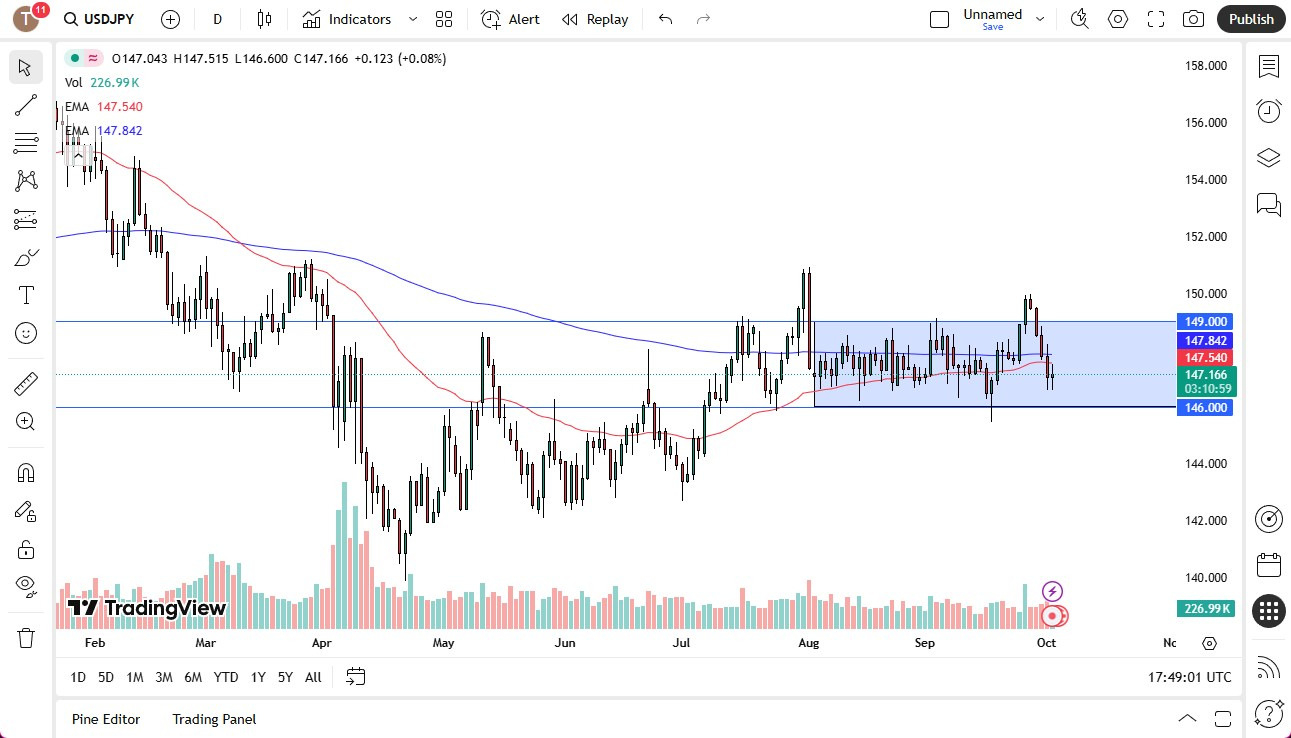
The US dollar has rallied a bit during the early hours here against the Japanese yen, but it does look like it’s struggling a bit. I think it’s probably only a matter of time before we do bounce, but getting above the 200-day EMA seems to be a bit of a chore in the short term. Longer term, we’re closer to the bottom of a range than we are at the top. So, I think it does make a certain amount of sense that eventually we will try to reach the top again near the 149 yen level.
The Australian dollar has rallied ever so slightly during the session here on Friday, but we find ourselves just hanging around the 0.66 level. Now, while we are in an uptrend, it’s been more of a grind than anything else. What I’m watching for is whether or not we start falling from here because if we break down below the Friday candlestick of last week, that actually makes a lower high and a lower low, the beginning of a downtrend.
To the upside, if we can break above the 0.6650 level, we may challenge 0.67, but the Australian dollar has very little in the way of momentum and has been in this attitude since the middle of April. So, with that being the case, I’m not overly impressed, but this is a market that I think continues to be very choppy more than anything else.
For a look at all of today’s economic events, check out our economic calendar.
West Texas Intermediate (WTI) Oil price advances on Monday, early in the European session. WTI trades at $65.09 per barrel, up from Friday’s close at $65.00.
Brent Oil Exchange Rate (Brent crude) is stable, hovering around its previous daily close at $68.70.
WTI Oil is a type of Crude Oil sold on international markets. The WTI stands for West Texas Intermediate, one of three major types including Brent and Dubai Crude. WTI is also referred to as “light” and “sweet” because of its relatively low gravity and sulfur content respectively. It is considered a high quality Oil that is easily refined. It is sourced in the United States and distributed via the Cushing hub, which is considered “The Pipeline Crossroads of the World”. It is a benchmark for the Oil market and WTI price is frequently quoted in the media.
Like all assets, supply and demand are the key drivers of WTI Oil price. As such, global growth can be a driver of increased demand and vice versa for weak global growth. Political instability, wars, and sanctions can disrupt supply and impact prices. The decisions of OPEC, a group of major Oil-producing countries, is another key driver of price. The value of the US Dollar influences the price of WTI Crude Oil, since Oil is predominantly traded in US Dollars, thus a weaker US Dollar can make Oil more affordable and vice versa.
The weekly Oil inventory reports published by the American Petroleum Institute (API) and the Energy Information Agency (EIA) impact the price of WTI Oil. Changes in inventories reflect fluctuating supply and demand. If the data shows a drop in inventories it can indicate increased demand, pushing up Oil price. Higher inventories can reflect increased supply, pushing down prices. API’s report is published every Tuesday and EIA’s the day after. Their results are usually similar, falling within 1% of each other 75% of the time. The EIA data is considered more reliable, since it is a government agency.
OPEC (Organization of the Petroleum Exporting Countries) is a group of 12 Oil-producing nations who collectively decide production quotas for member countries at twice-yearly meetings. Their decisions often impact WTI Oil prices. When OPEC decides to lower quotas, it can tighten supply, pushing up Oil prices. When OPEC increases production, it has the opposite effect. OPEC+ refers to an expanded group that includes ten extra non-OPEC members, the most notable of which is Russia.
At the top of the candlestick, we have the 50 day EMA. And if we can break above there, it’s possible that we could go look into the 149 yen level. That is the top of the previous consolidation range. And therefore, a lot of people will be looking at it very intently. Anything above there opens up the possibility of moving to the 151 yen level. This is a market that I think given enough time, we’ll have to make a bigger decision. But right now, the interest rate differential still favors the U.S. dollar of the Japanese yen.

And that, of course, makes quite a bit of sense that traders would be willing to buy on the dips. The last couple of days have been rather rough for the US dollar against the Japanese yen. But we are seeing the US dollar fight against other currencies around the world, not just the yen. So, I’m looking for a balance here. If we were to break down below the 145.50 yen level, then I think that throws that narrative out the window.
Nonetheless, this is a market that I’ve been collecting swap in for quite some time, buying dips, selling bounces, that type of thing. Ultimately, the 50 day EMA and the 200 day EMA indicators are sitting on top of each other and flat showing signs of hesitation, just sideways action. And that action will continue to be sideways. I think the main theory and main theme here of what’s going on, but given enough time, I do favor the upside.
Want to trade our USD/JPY forex analysis and predictions? Here’s a list of forex brokers in Japan to check out.
Christopher Lewis has been trading Forex and has over 20 years experience in financial markets. Chris has been a regular contributor to Daily Forex since the early days of the site. He writes about Forex for several online publications, including FX Empire, Investing.com, and his own site, aptly named The Trader Guy. Chris favours technical analysis methods to identify his trades and likes to trade equity indices and commodities as well as Forex. He favours a longer-term trading style, and his trades often last for days or weeks.
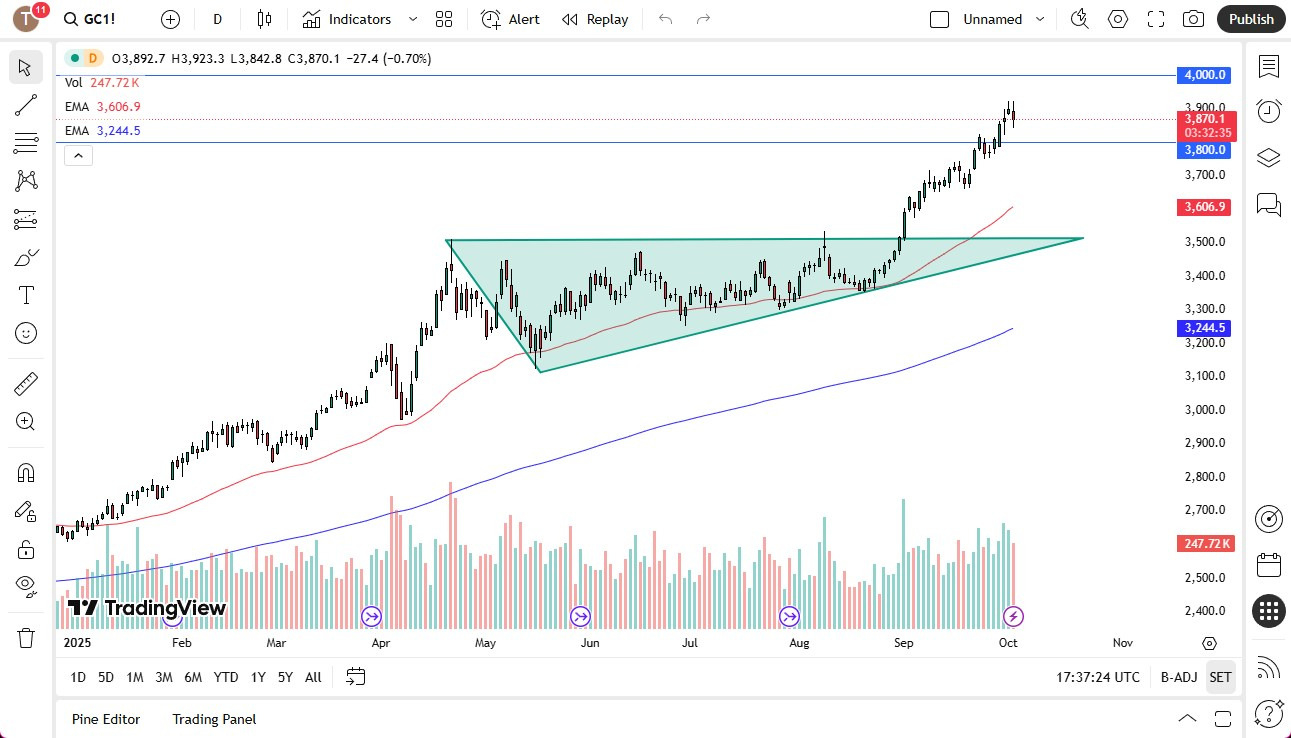
I do think the pullbacks make a lot of sense and I do like buying them. The $3,800 level is an area that I’m very interested in myself, as the ascending triangle had a measured move to the $3,800 level that we did in fact break above. By breaking above there, it suggests to me at least that the market is going to remain bullish for quite some time, but I also recognize that there’s probably a bit of market memory in that area. Anything below there doesn’t necessarily mean that I would get bearish on this market, just that I might be a little bit more selective.
To the upside, the $4,000 level is the obvious target and I do think that given enough time, we will reach that level. The Federal Reserve is likely to cut rates a couple of times between now and summer, but that may not even be the big driver. I think a lot of concerns about global economic instability is a major problem. So, with this, I’m bullish on gold. I would like to see a little bit more of a pullback and try to buy it cheaply. At this point, it is all but impossible to get short of gold, so a little bit of patience will more likely than not pay off.
Ready to trade our Gold price forecast? We’ve made a list of the best Gold trading platforms worth trading with.
Christopher Lewis has been trading Forex and has over 20 years experience in financial markets. Chris has been a regular contributor to Daily Forex since the early days of the site. He writes about Forex for several online publications, including FX Empire, Investing.com, and his own site, aptly named The Trader Guy. Chris favours technical analysis methods to identify his trades and likes to trade equity indices and commodities as well as Forex. He favours a longer-term trading style, and his trades often last for days or weeks.
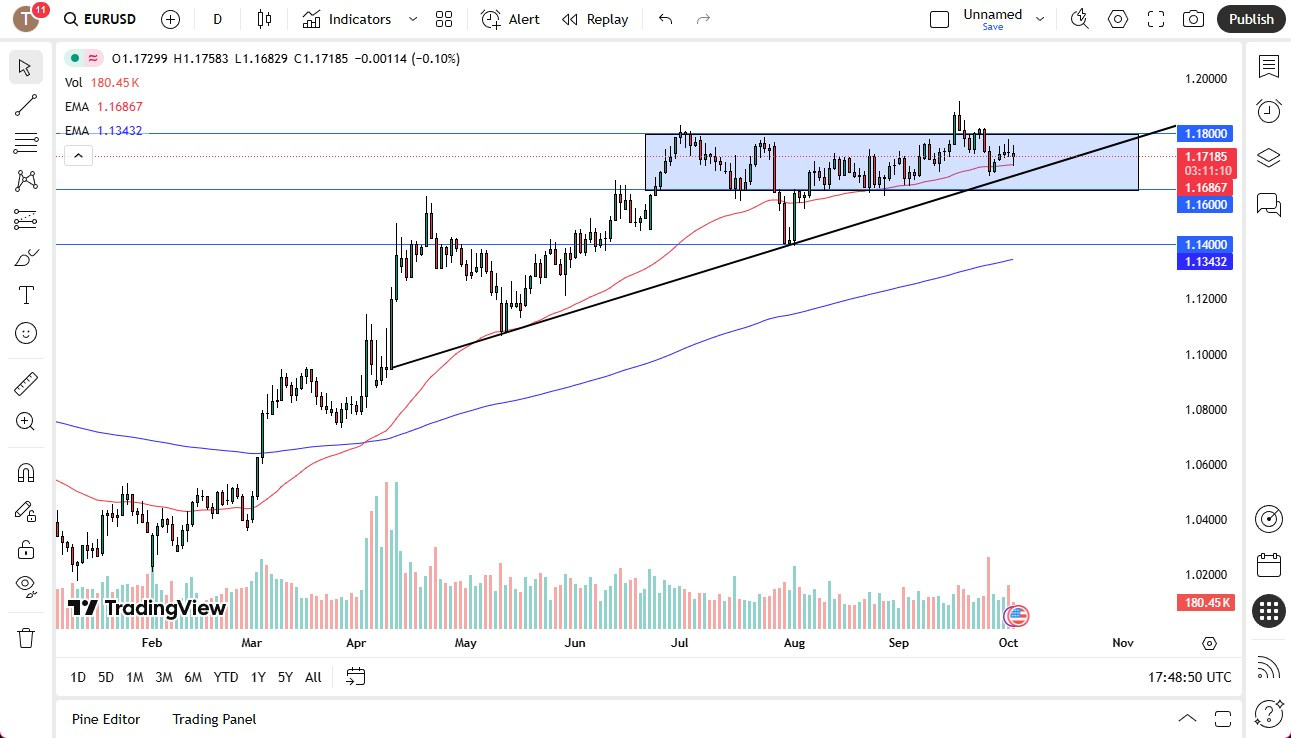
The rally that we have seen over the last four days has failed. Typically, it’ll happen in Asia, maybe drift into Europe a little bit. By the time the Americans get back on, the euro has been selling off.
The 1.18 level above is significant resistance, and I think we need to watch that very closely. If we can get above there on a daily close, then the market could go to the 1.19 level, possibly even the 1.20 level. If we break down below that uptrend line, underneath that offer support, it opens up 1.16 as a potential target. If we break down below there, then the 1.14 level could very well be the next target. Ultimately, if we really start to break down at this point, I think you’ll see the US dollar shrink in against everything, not just the euro. It is worth noting that the absolute peak of the euro on this run has been during the FOMC meeting and press conference, and we’ve pretty much struggled since then. So, what that tells me is that the market is telling you something different than the narrative of the US dollar falling apart. I’m watching this trend line very closely because we break down below there, things could get interesting to the downside.
Ready to trade our daily Forex analysis? We’ve made a list of the best forex trading platforms for beginners worth trading with.
Christopher Lewis has been trading Forex and has over 20 years experience in financial markets. Chris has been a regular contributor to Daily Forex since the early days of the site. He writes about Forex for several online publications, including FX Empire, Investing.com, and his own site, aptly named The Trader Guy. Chris favours technical analysis methods to identify his trades and likes to trade equity indices and commodities as well as Forex. He favours a longer-term trading style, and his trades often last for days or weeks.
Natural gas price reached $3.600 level, achieving the second suggested target in the previous report, which forced it to form quick correctional rebound, to settle near $3.440.
The intraday sideways trading is caused by stochastic exit from the overbought level, to expect providing unstable mixed trading until gathering the extra positive momentum, to ease the mission of resuming the bullish attack, and reaching extra stations that are represented by $3.710 and $3.830.
The expected trading range for today is between $3.380 and $3.600
Trend forecast: Fluctuated
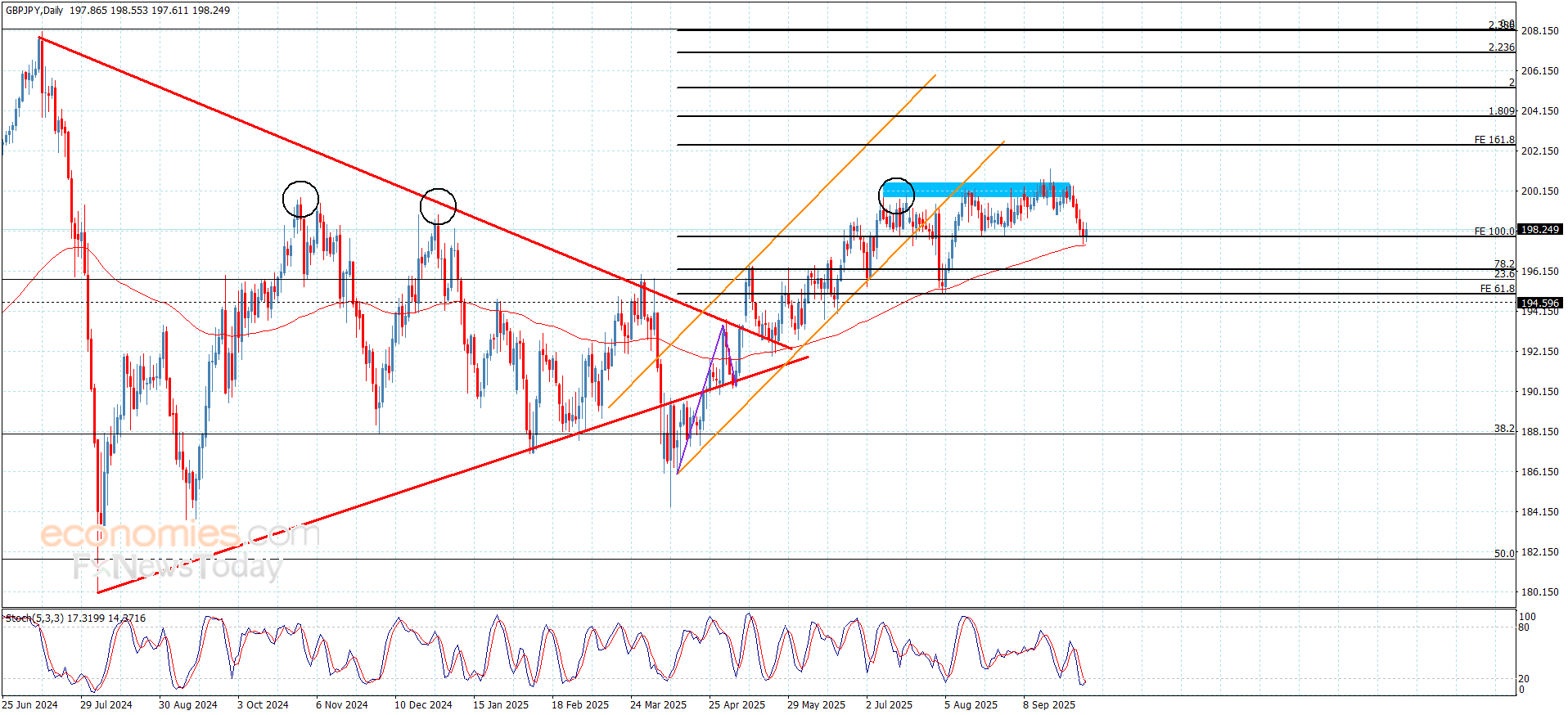
The GBPJPY pair remains affected by the negative pressure that comes from stochastic reach to the oversold level, to notice its attempt to reach below the support at 197.80, facing the moving average 55 then bouncing again to settle above the support as appears in the above image.
The stability above the current support will increase the chances of renewing the bullish attempts, to expect targeting some positive stations by its rally towards 198.80 and 199.80, while moving to the negative track requires forming strong bearish waves, to surpass the moving average 55, then target 196.30 level.
The expected trading range for today is between 197.55 and 198.80
Trend forecast: Bullish
The (Brent) price rose in its last trading on the intraday levels, amid the dominance of main bearish wave on the short-term basis, with the continuation of the negative pressure that comes from its trading below EMA50, intensifying the negative pressure around the price, attempting to recover some of its previous losses, and offloading some of its clear oversold levels on the relative strength indicators, especially with the emergence of the positive signals.
Get high-accuracy trading signals delivered directly to your Telegram. Subscribe to specialized packages tailored for the world’s top markets:
Full VIP signals performance report for September 22–26, 2025:
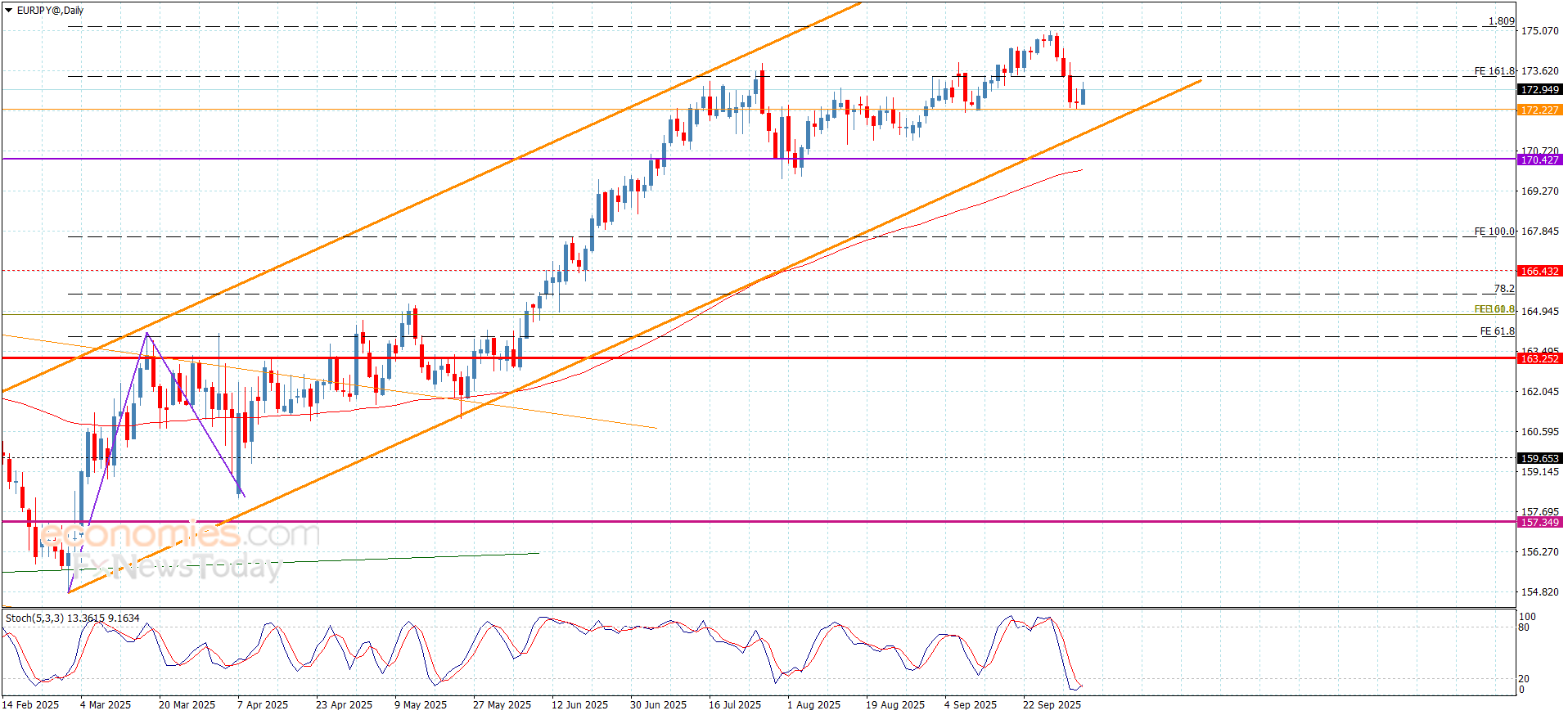
The EURJPY pair kept its positive stability above the extra support level at 172.20, which allowed it to achieve some gains, to notice its rally towards 173.20, approaching from the initial barrier at 173.40 level.
By the above image, we notice stochastic attempt to exit the oversold level, opening the way for more of the positive stations by its rally to 174.40, while suffering new negative pressure and reaching below 172.20 might push it to attack the support of the main bullish channel at 171.45 before any attempt to hit the positive targets.
The expected trading range for today is between 172.20 and 173.70
Trend forecast: Bullish
Silver hits fresh daily highs above $47.50 after bouncing from lows right below $46.00.
Precious metals are rallying on Friday, as the US Dollar weakens across the board.
XAG/USD’s bulls targeting the 4-year highs at $48.03
Silver (XAG/USD) has resumed its bullish trend on Friday to retrace most of Thursday’s losses, supported by a softer US Dollar. XAG/USD has reached session highs above $47.50 after bouncing at $46.00 on Thursday, and is drawing closer to the long-term highs, in the area of $48.00.
Precious metals are rallying, as investors shrug off the hawkish comments from Fed’s Logan, putting further rate cuts into question. The downbeat employment figures seen earlier this week and the US Government shutdown have boosted investors’ expectations that the US central bank will cut rates in October, and, highly likely, also in December
The pair’s corrective pullback found support right below $46.00 on Thursday and is trading higher, at least for now. The 4-hour RSI has returned below the overbought area and, although the daily chart keeps showing signs that the rally is overextended, right now there is room for further appreciation.
Immediate resistance is at the mentioned $48.00 area, which capped bulls on Wednesday and Thursday. Beyond here, the top pf the near-term bullish channel is around $48.65. The 161.8% extension of the September 17-23 bullish run, at $49.15, further down, the next targets are at $45.30 (September 25 high) and $44.50 (September 23 high).
To the downside, immediate support area is at the area between the bottom of the mentioned channel, now at $46.15 and the September 30 and October 2 lows, around $45.95 from current levels might find support at the $45.96 intraday lows ahead of the previous long-term highs, at $45.30 (September 25 high) and $44.45 (September 23 high).
Silver is a precious metal highly traded among investors. It has been historically used as a store of value and a medium of exchange. Although less popular than Gold, traders may turn to Silver to diversify their investment portfolio, for its intrinsic value or as a potential hedge during high-inflation periods. Investors can buy physical Silver, in coins or in bars, or trade it through vehicles such as Exchange Traded Funds, which track its price on international markets.
Silver prices can move due to a wide range of factors. Geopolitical instability or fears of a deep recession can make Silver price escalate due to its safe-haven status, although to a lesser extent than Gold’s. As a yieldless asset, Silver tends to rise with lower interest rates. Its moves also depend on how the US Dollar (USD) behaves as the asset is priced in dollars (XAG/USD). A strong Dollar tends to keep the price of Silver at bay, whereas a weaker Dollar is likely to propel prices up. Other factors such as investment demand, mining supply – Silver is much more abundant than Gold – and recycling rates can also affect prices.
Silver is widely used in industry, particularly in sectors such as electronics or solar energy, as it has one of the highest electric conductivity of all metals – more than Copper and Gold. A surge in demand can increase prices, while a decline tends to lower them. Dynamics in the US, Chinese and Indian economies can also contribute to price swings: for the US and particularly China, their big industrial sectors use Silver in various processes; in India, consumers’ demand for the precious metal for jewellery also plays a key role in setting prices.
Silver prices tend to follow Gold’s moves. When Gold prices rise, Silver typically follows suit, as their status as safe-haven assets is similar. The Gold/Silver ratio, which shows the number of ounces of Silver needed to equal the value of one ounce of Gold, may help to determine the relative valuation between both metals. Some investors may consider a high ratio as an indicator that Silver is undervalued, or Gold is overvalued. On the contrary, a low ratio might suggest that Gold is undervalued relative to Silver.