The main category of Forex News.
You can use the search box below to find what you need.
[wd_asp id=1]
The main category of Forex News.
You can use the search box below to find what you need.
[wd_asp id=1]
The US dollar has fallen against the Japanese yen during trading, initially trying to rally on Thursday, but now it looks like we are drifting a little bit lower. We are still very much in a consolidation range. We had a little bit of a fake breakout here about five or six trading sessions ago. And now it looks like we are going to try to figure out whether or not we are still in this range. I think that might actually end up being the case before it’s all said and done. But if we were to break down below 145.50 yen, then the thing comes unraveled.
The Australian dollar initially tried to rally a bit during the trading session on Thursday, but is giving those gains back again. This is a market that’s hanging around the 0.66 level. And I think now we’re basically just trying to figure out whether or not we are going to re-enter the previous consolidation area. That would not surprise me.
It looks like the Australian dollar just doesn’t have the momentum to continue going higher with any type of speed. At this point, I’m a little bit ambivalent about this pair. I wouldn’t use the word bearish. It’s not quite that bad, but I do think we are more likely to drift lower than significantly higher. That being said, if we could take out the 0.67 level to the upside, that would be extraordinarily bullish.
For a look at all of today’s economic events, check out our economic calendar.
The EURNZD approached its last bullish rally from the resistance of the bullish channel at 2.0330, then begin forming bearish corrective waves, affected by stochastic negativity to gather the gains by reaching 2.0135.
We expect resuming the bearish corrective track, due to stochastic stability below 50 level, to expect its target to 2.0050 level, reaching the extra support at 2.000, while renewing the bullish attempts requires breaching the barrier near 2.0190, motivating the bullish attack to ease the mission of pressing on the resistance of the bullish channel.
The expected trading range for today is between 2.0000 and 2.0170
Trend forecast: Bearish
Gold price stood as high as $3,896.60 a troy ounce on Thursday, clinching yet another record high. The bright metal, however, retreated sharply after Wall Street’s opening and flirted with the $3,820 level.
The US Dollar (USD) traded uneventfully throughout the first half of the day, with most major pairs, including XAU/USD, stuck to limited ranges. Things take a turn for the worse after American traders reach their desks. The United States (US) Government shutdown-related concerns finally seem to have kicked in: US indexes turned sharply lower while the USD recovered its safe-haven condition early in the American session. After the initial hours of trading, the market settled, and the XAU/USD pair managed to trim some losses, currently hovering around $3,845.
Hawkish comments from the US Federal Reserve (Fed) Bank of Dallas President Lorie Logan add to the Greenback’s momentum. Logan urged caution on interest rate cuts, citing inflation is running above target and trending higher. Furthermore, Logan noted that the labor market is “only gradually slowing,” and that it remains “fairly balanced,” despite recent discouraging data.
Other than that, the US suspended the release of Initial Jobless Claims and Factory Orders. The Nonfarm Payroll (NFP) report, scheduled for Friday, will not be published, although ISM will release the September Services Purchasing Managers’ Index (PMI). The services business index is expected to print at 51.7, easing from the 52 posted in August.
From a technical point of view, the daily chart shows that the XAU/USD pair slide is a mere correction. The bright metal keeps trading far above all its moving averages, with a bullish 20 Simple Moving Average (SMA) currently at around $3,712. Technical indicators have turned lower but remain above their midlines. In fact, the Relative Strength Index (RSI) edged marginally, yet at 76, still within overbought levels.
The near-term picture shows the correction may continue. In the 4-hour chart, the XAU/USD pair is currently below a flat 20 SMA, which stands in the $3,850 price zone. The 100 and 200 SMAs keep heading north, far below the current level, limiting the bearish potential of the pair. Finally, technical indicators have lost their downward strength and settled above their midlines, also hinting at the absence of relevant selling interest.
Support levels: 3,837.60 3,819.20 3,807.05
Resistance levels: 3,861.60 3,878.45 3,896.00
The British pound continues to trade lower against the Yen on Thursday. The pair has lost more than 1.2% so far this week, reaching session lows below the bottom of the trading range over the last two months, at 197.85.
The hawkish BoJ summary of opinions bolstered market hopes that the Bank of Japan is ready to increase interest rates in the coming months, and is supporting Yen rallies across the board. The UK calendar is light today,, although concerns about the UK’s fiscal health remain alive, adding pressure to the British Pound.
The break of the 197.80-198.00 area has provided further hopes for Pound bears on Thursday. The 4-hour RSI has reached oversold levels, but the impulsive negative candle reflects an intense bearish pressure.
Pound bulls might be tested at the 197.35 intra-day level, but upside attempts are likely to find sellers. Further down, the August 7 low, at 196.25, would come into focus, ahead of the August 4 low, in the vicinity of 195.00.
To the upside, previous support at Wednesday’s lows of 197.95 is likely to test upside attempts ahead of the intra-day highs and September 30 low, at 198.55. Beyond here, the next target would be the September 30 high, at 199.30.
The table below shows the percentage change of Japanese Yen (JPY) against listed major currencies today. Japanese Yen was the strongest against the Australian Dollar.
| USD | EUR | GBP | JPY | CAD | AUD | NZD | CHF | |
|---|---|---|---|---|---|---|---|---|
| USD | -0.18% | 0.01% | -0.28% | 0.04% | 0.08% | -0.34% | -0.18% | |
| EUR | 0.18% | 0.18% | -0.09% | 0.21% | 0.25% | -0.04% | -0.01% | |
| GBP | -0.01% | -0.18% | -0.26% | -0.00% | 0.10% | -0.21% | -0.18% | |
| JPY | 0.28% | 0.09% | 0.26% | 0.30% | 0.35% | -0.16% | 0.13% | |
| CAD | -0.04% | -0.21% | 0.00% | -0.30% | 0.04% | -0.22% | -0.20% | |
| AUD | -0.08% | -0.25% | -0.10% | -0.35% | -0.04% | -0.36% | -0.26% | |
| NZD | 0.34% | 0.04% | 0.21% | 0.16% | 0.22% | 0.36% | 0.20% | |
| CHF | 0.18% | 0.01% | 0.18% | -0.13% | 0.20% | 0.26% | -0.20% |
The heat map shows percentage changes of major currencies against each other. The base currency is picked from the left column, while the quote currency is picked from the top row. For example, if you pick the Japanese Yen from the left column and move along the horizontal line to the US Dollar, the percentage change displayed in the box will represent JPY (base)/USD (quote).
GBP/USD preserves its bullish momentum in the European session and trades near 1.3500 following four consecutive days of gains. The pair’s near-term technical outlook suggests that the bullish bias remains intact, while markets remain focused on political developments in the US.
The selling pressure surrounding the US Dollar (USD) persisted midweek as markets reacted to the uncertainty created by the shutdown of the federal government. Following a second round of voting on Wednesday, lawmakers failed to come to terms on restoring the government funding. Read more…
The GBP/USD pair is trading near 1.3445 on Wednesday, with the pound closing September with its first monthly decline against the US dollar since July.
Short-term price action remains under pressure from the looming US government shutdown, which threatens to delay the release of key US macroeconomic data, injecting uncertainty into the market. Read more…
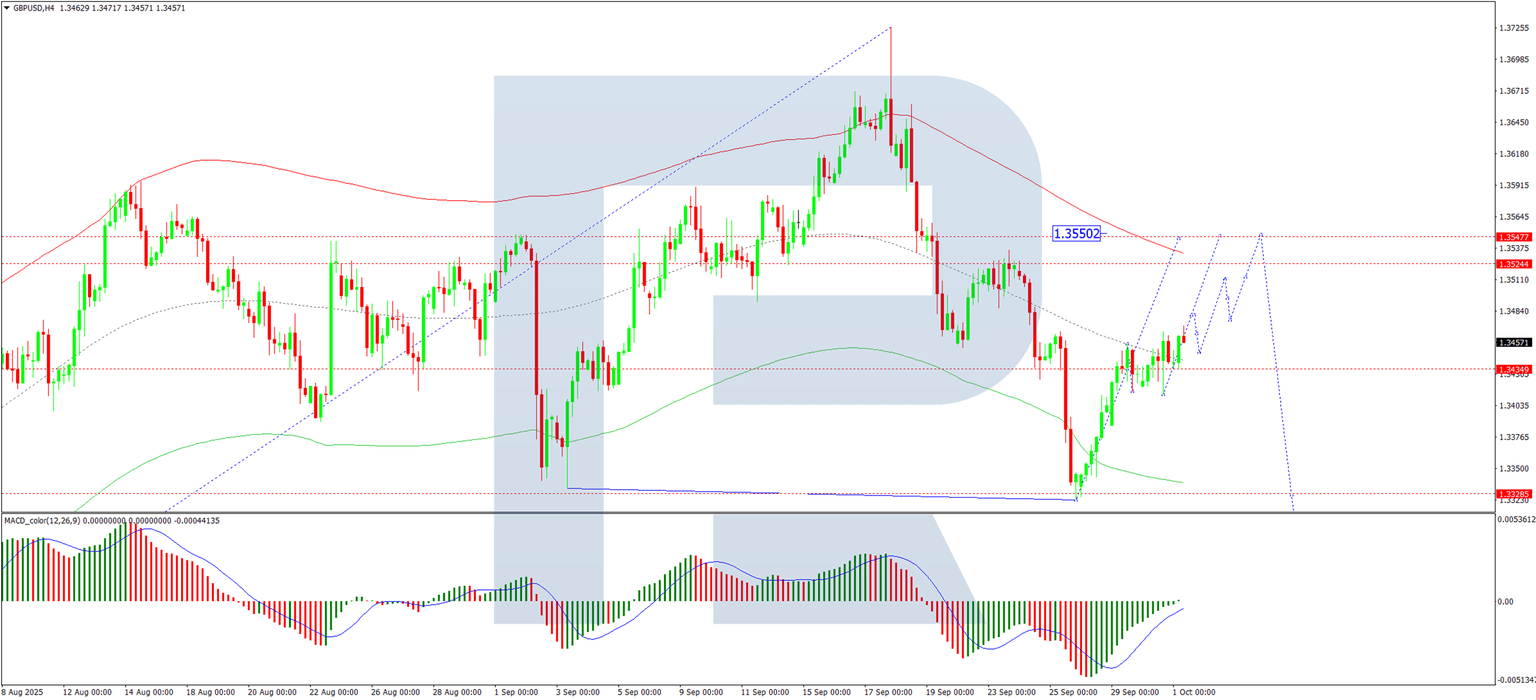
GBP/USD continues to stretch higher and trades above 1.3470 in the European session on Wednesday, after posting modest gains on Monday and Tuesday. The pair’s technical outlook highlights a bullish stance as market participants keep a close eye on US politics.
The broad-based selling pressure surrounding the US Dollar (USD) helps GBP/USD extend its weekly uptrend. During the Asian trading hours, the USD weakened against its rivals as the US federal government has officially shutdown after Republicans and Democrats failed to come to terms on accepting a funding bill. Read more…
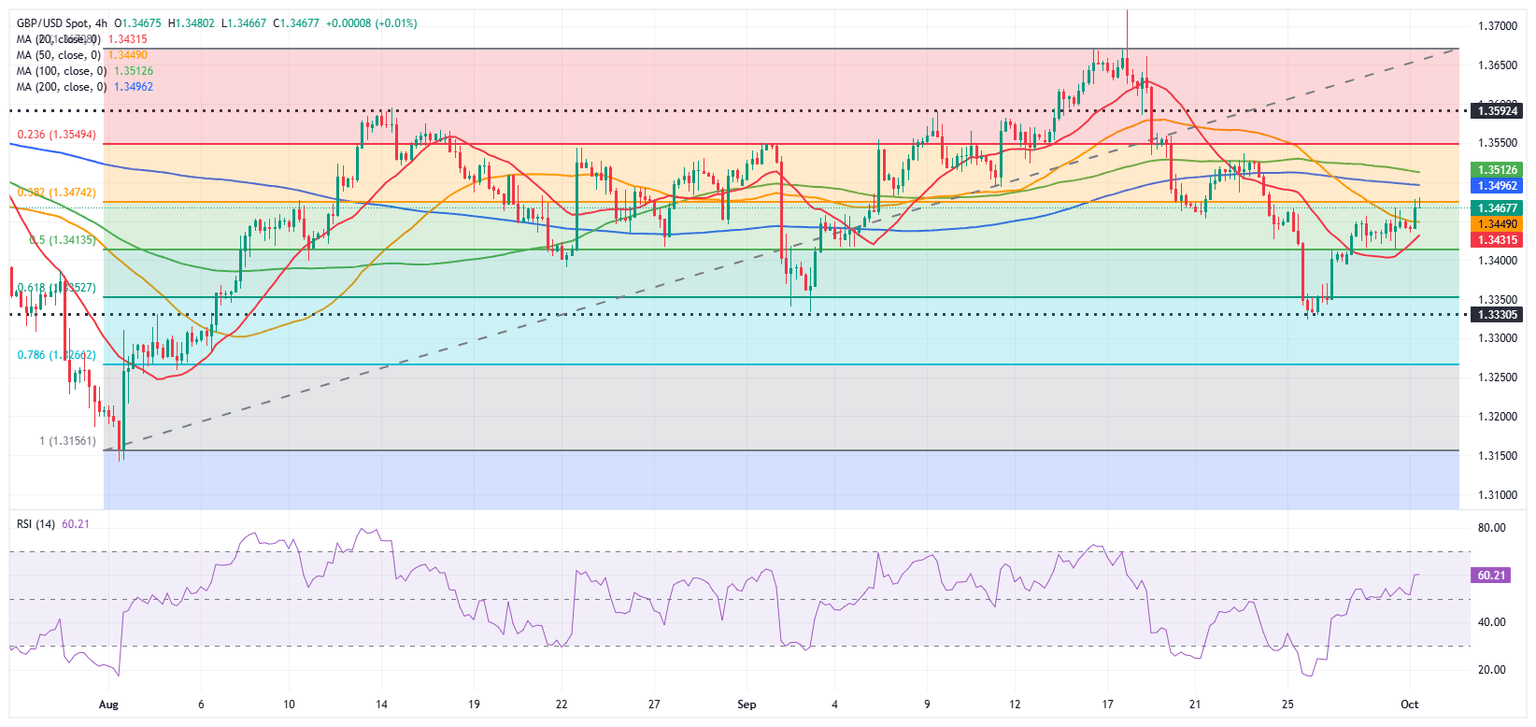
The Japanese Yen is struggling to hold ground as markets weigh two opposing forces: the Bank of Japan’s (BoJ) potential rate hike and ongoing US monetary easing expectations. The latest BoJ meeting summary shows policymakers are discussing a 0.25% hike in October. That would narrow the wide rate gap with the Federal Reserve and provide a floor for the Yen after months of weakness.
Japan’s political calendar adds to the uncertainty. The Liberal Democratic Party leadership election on October 4 will decide the next Prime Minister and could impact fiscal and monetary policy in the months to come. Until then the Yen is sensitive to both political and central bank headlines.
Across the Pacific, the US Dollar is under pressure. The CME FedWatch Tool shows markets fully pricing in a Fed rate cut this month and 90% chance of another in December. That dovish outlook is due to disappointing data: ADP reported a 32,000 drop in private payrolls for September, the biggest decline since March 2023. August numbers were also revised down, showing cracks in the labor market.
The ISM manufacturing index came in at 49.1, seven months of contraction. And the US government has shut down after lawmakers failed to agree on a funding bill. While shutdowns have historically had limited economic impact, this one could delay critical data releases like Nonfarm Payrolls.
Despite all this, US equities are holding up, the S&P 500 is extending its winning streak, reducing safe-haven demand for the Yen.
Technically, USD/JPY is weakening, down to 146.60. The pair has broken below both the 50- and 100- period SMAs (148.25 and 147.75) and a sequence of lower highs and lower lows.
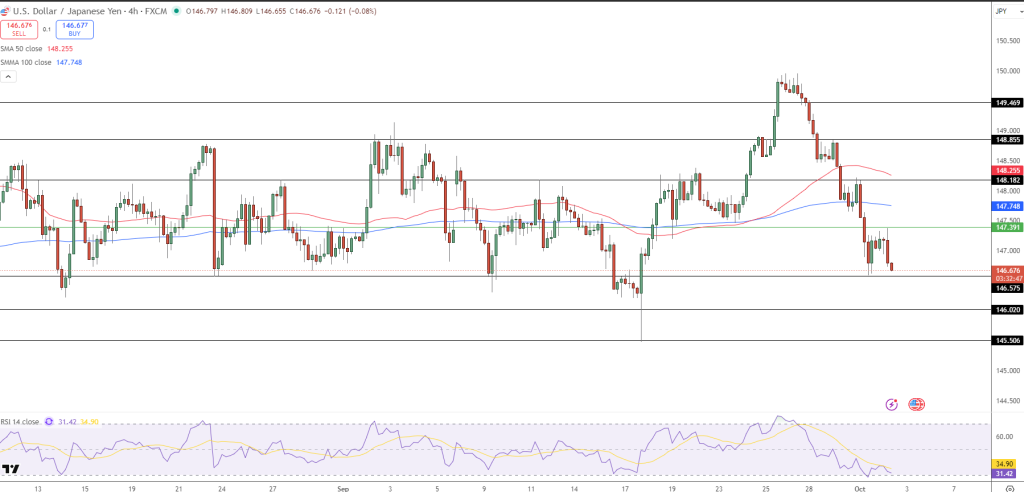
Candlestick analysis supports this view: repeated rejections at 148.80 and a series of consecutive red candles looks like a “three black crows” pattern, a bearish continuation signal. The RSI at 31 is oversold, so a short lived bounce isn’t out of the question.
Levels to watch:
Trade Idea (Bearish):
For now the trend is down, bears are in control and buyers are waiting at resistance.

Arslan Butt
Lead Markets Analyst – Multi-Asset (FX, Commodities, Crypto)
Arslan Butt serves as the Lead Commodities and Indices Analyst, bringing a wealth of expertise to the field. With an MBA in Behavioral Finance and active progress towards a Ph.D., Arslan possesses a deep understanding of market dynamics.
His professional journey includes a significant role as a senior analyst at a leading brokerage firm, complementing his extensive experience as a market analyst and day trader. Adept in educating others, Arslan has a commendable track record as an instructor and public speaker.
His incisive analyses, particularly within the realms of cryptocurrency and forex markets, are showcased across esteemed financial publications such as ForexCrunch, InsideBitcoins, and EconomyWatch, solidifying his reputation in the financial community.
The EURNZD approached its last bullish rally from the resistance of the bullish channel at 2.0330, then begin forming bearish corrective waves, affected by stochastic negativity to gather the gains by reaching 2.0135.
We expect resuming the bearish corrective track, due to stochastic stability below 50 level, to expect its target to 2.0050 level, reaching the extra support at 2.000, while renewing the bullish attempts requires breaching the barrier near 2.0190, motivating the bullish attack to ease the mission of pressing on the resistance of the bullish channel.
The expected trading range for today is between 2.0000 and 2.0170
Trend forecast: Bearish
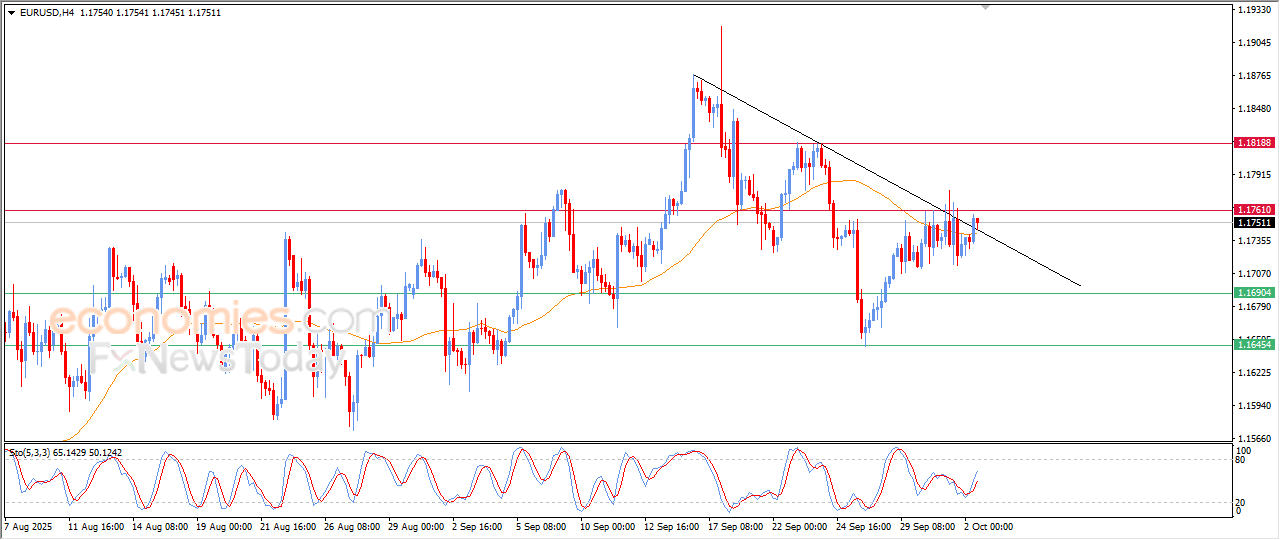
EUR/USD holds its ground and trades modestly higher on the day at around 1.1750 in the European session on Thursday after closing virtually unchanged on Wednesday. While the technical outlook suggests that the bullish bias remains intact, 1.1770 could prove to be a tough resistance to crack.
The table below shows the percentage change of Euro (EUR) against listed major currencies this week. Euro was the strongest against the Canadian Dollar.
| USD | EUR | GBP | JPY | CAD | AUD | NZD | CHF | |
|---|---|---|---|---|---|---|---|---|
| USD | -0.44% | -0.74% | -1.66% | 0.00% | -1.05% | -0.85% | -0.21% | |
| EUR | 0.44% | -0.31% | -1.38% | 0.44% | -0.62% | -0.43% | 0.22% | |
| GBP | 0.74% | 0.31% | -0.99% | 0.75% | -0.38% | -0.12% | 0.52% | |
| JPY | 1.66% | 1.38% | 0.99% | 1.73% | 0.68% | 0.71% | 1.53% | |
| CAD | -0.01% | -0.44% | -0.75% | -1.73% | -1.01% | -0.85% | -0.23% | |
| AUD | 1.05% | 0.62% | 0.38% | -0.68% | 1.01% | 0.20% | 0.84% | |
| NZD | 0.85% | 0.43% | 0.12% | -0.71% | 0.85% | -0.20% | 0.79% | |
| CHF | 0.21% | -0.22% | -0.52% | -1.53% | 0.23% | -0.84% | -0.79% |
The heat map shows percentage changes of major currencies against each other. The base currency is picked from the left column, while the quote currency is picked from the top row. For example, if you pick the Euro from the left column and move along the horizontal line to the US Dollar, the percentage change displayed in the box will represent EUR (base)/USD (quote).
The US Dollar (USD) found it difficult to stay resilient against its major rivals on Wednesday amid the heightened uncertainty created by the shutdown of the federal government. Additionally, mixed macroeconomic data releases made it difficult for the USD to stage a rebound.
The Automatic Data Processing (ADP) reported that private sector payrolls contracted by 32,000 in September. Additionally, the August print of 54,000 got revised down to -3,000. Other data from the US showed the Institute for Supply Management’s (ISM) Manufacturing Purchasing Managers’ Index (PMI) rose to 49.1 in September from 48.7 in August, but remained in the contraction territory. The Prices Paid Index component of the PMI survey declined to 61.9 from 63.7, while the Employment Index edged higher to 45.3 from 43.8.
Lawmakers failed to make progress on restoring the government funding on Wednesday. Hence, the weekly Initial Jobless Claims, published by the Department of Labor, and the Census Bureau’s Factory Orders data will not be released later in the day. Instead, investors will analyze the Challenger Job Cuts data for September to assess the labor market conditions. Although this report is not seen as a market-mover, the lack of other data releases could pave the way for a straightforward market reaction, with a noticeable increase in job cuts hurting the USD and vice versa.
Investors will also continue to scrutinize political developments in the US. If markets grow optimistic about the shutdown coming to an end soon, the USD could stage a decisive rebound and force EUR/USD to turn south.
The 100-period Simple Moving Average (SMA) on the 4-hour chart aligns as a pivot level at 1.1750 ahead of 1.1770, where the Fibonacci 23.6% retracement of the latest uptrend is located. Once EUR/USD climbs above 1.1770 and confirms that level as support, technical buyers could take action. In this scenario, 1.1820 (static level) could be seen as the next resistance level before 1.1900 (static level, round level).
On the downside, 1.1710-1.1700 (200-period SMA, Fibonacci 38.2% retracement) aligns as a strong support area before 1.1640 (Fibonacci 50% retracement).
The Euro is the currency for the 19 European Union countries that belong to the Eurozone. It is the second most heavily traded currency in the world behind the US Dollar. In 2022, it accounted for 31% of all foreign exchange transactions, with an average daily turnover of over $2.2 trillion a day.
EUR/USD is the most heavily traded currency pair in the world, accounting for an estimated 30% off all transactions, followed by EUR/JPY (4%), EUR/GBP (3%) and EUR/AUD (2%).
The European Central Bank (ECB) in Frankfurt, Germany, is the reserve bank for the Eurozone. The ECB sets interest rates and manages monetary policy.
The ECB’s primary mandate is to maintain price stability, which means either controlling inflation or stimulating growth. Its primary tool is the raising or lowering of interest rates. Relatively high interest rates – or the expectation of higher rates – will usually benefit the Euro and vice versa.
The ECB Governing Council makes monetary policy decisions at meetings held eight times a year. Decisions are made by heads of the Eurozone national banks and six permanent members, including the President of the ECB, Christine Lagarde.
Eurozone inflation data, measured by the Harmonized Index of Consumer Prices (HICP), is an important econometric for the Euro. If inflation rises more than expected, especially if above the ECB’s 2% target, it obliges the ECB to raise interest rates to bring it back under control.
Relatively high interest rates compared to its counterparts will usually benefit the Euro, as it makes the region more attractive as a place for global investors to park their money.
Data releases gauge the health of the economy and can impact on the Euro. Indicators such as GDP, Manufacturing and Services PMIs, employment, and consumer sentiment surveys can all influence the direction of the single currency.
A strong economy is good for the Euro. Not only does it attract more foreign investment but it may encourage the ECB to put up interest rates, which will directly strengthen the Euro. Otherwise, if economic data is weak, the Euro is likely to fall.
Economic data for the four largest economies in the euro area (Germany, France, Italy and Spain) are especially significant, as they account for 75% of the Eurozone’s economy.
Another significant data release for the Euro is the Trade Balance. This indicator measures the difference between what a country earns from its exports and what it spends on imports over a given period.
If a country produces highly sought after exports then its currency will gain in value purely from the extra demand created from foreign buyers seeking to purchase these goods. Therefore, a positive net Trade Balance strengthens a currency and vice versa for a negative balance.
The (ETHUSD) price soared high in its last intraday trading, resuming its strong gains amid the dominance of the bullish corrective trend on the short-term basis and its trading alongside supportive trendline for this track, with the continuation of the positive pressure due to its trading above EMA50, with the emergence of the positive signals on the relative strength indicators, despite reaching overbought levels, indicating the strength of the positive momentum.
Therefore, our expectations suggest a rise in the (ETHUSD) price in its upcoming intraday trading, conditioned by its stability above $4,280, to target the initial resistance level at $4,500.
Get high-accuracy trading signals delivered directly to your Telegram. Subscribe to specialized packages tailored for the world’s top markets:
Full VIP signals performance report for September 22–26, 2025:
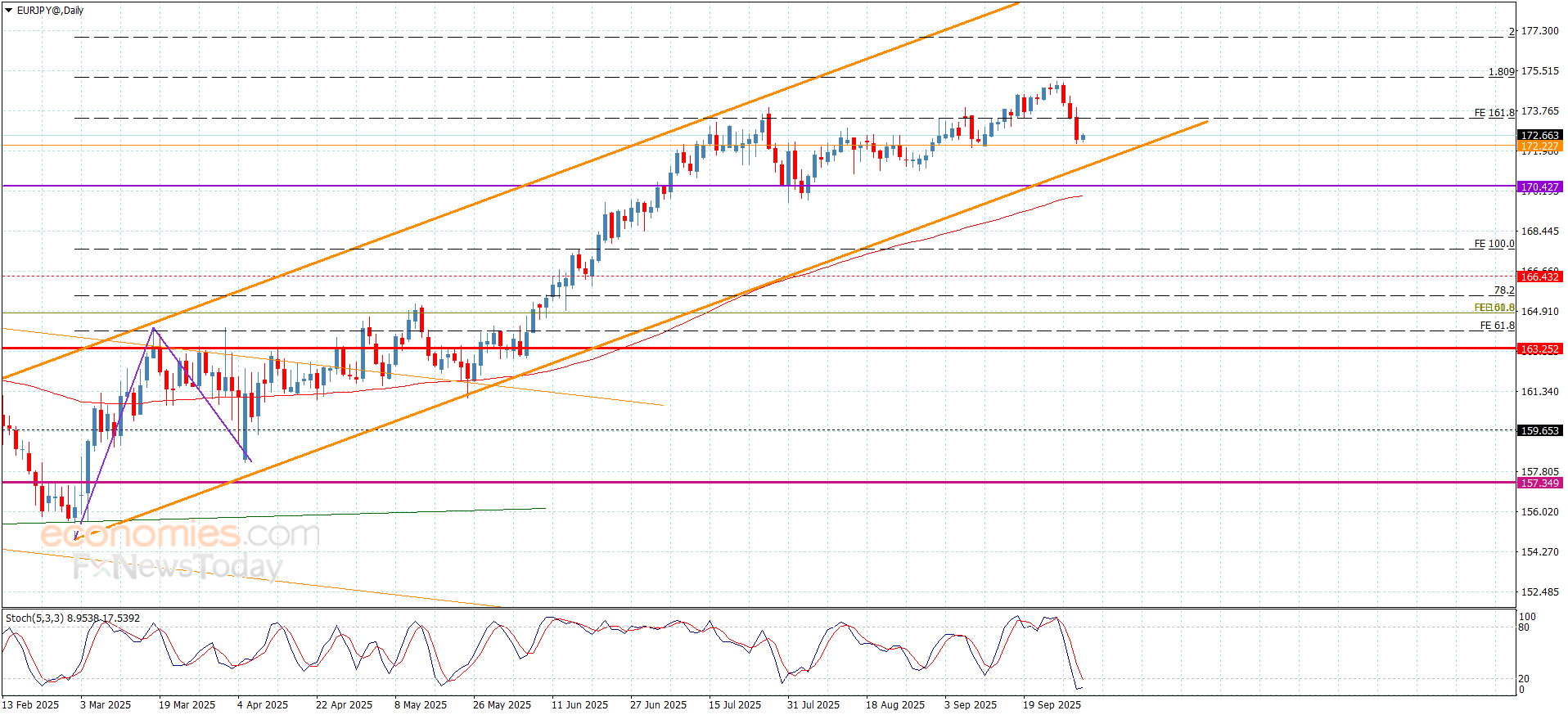
The EURJPY pair surrendered to the extra negative pressure that was caused by stochastic decline from the oversold level yesterday, which forces it to resume the attempts of profit-taking and forming new bearish corrective trading, to settle near the support at 172.20.
Note that the stability of the price within the bullish channel’s levels until now, and the stability of the current support at 172.20 will increase the chances of activating the bullish attempts, to breach 173.40 level and achieving some gains by its rally to 174.40, while facing new negative pressure and reaching below the current support will increase the chances of targeting the support of the bullish channel at 171.30, representing the confirmation of the main trend in the upcoming trading.
The expected trading range for today is between 172.20 and 173.50
Trend forecast: Bullish