The main category of Forex News.
You can use the search box below to find what you need.
[wd_asp id=1]
The main category of Forex News.
You can use the search box below to find what you need.
[wd_asp id=1]
The GBP/USD pair has come under sustained selling pressure, dropping to 1.3322 this week, its weakest point in nearly two months, before stabilizing just above 1.3350. The move reflects a sharp 3% decline from the September high at 1.3725 as U.S. economic strength has undercut the case for aggressive Federal Reserve rate cuts, while the Bank of England remains caught between sticky inflation and weakening domestic growth.
The second-quarter U.S. GDP revision to 3.8% year-on-year, coupled with weekly jobless claims falling to 218,000 and durable goods orders surging 2.9%, has provided the dollar with renewed momentum. These numbers highlight U.S. economic resilience and have reduced expectations for back-to-back Fed cuts in 2025. Meanwhile, markets await the Core PCE inflation print at 2.9% year-on-year, a figure that could cement the Fed’s cautious stance and extend downside pressure on GBP/USD if it overshoots consensus.
Governor Andrew Bailey has acknowledged that U.K. inflation is on a downward path but linked future easing directly to progress in consumer prices. This hesitancy is complicated by other MPC members, such as Megan Greene, warning against premature cuts amid lingering upside risks. Political noise in London—calls for re-nationalization of utilities and large-scale borrowing schemes—has rattled gilt markets already strained by fragile demand. With households sitting on unusually high savings and labor conditions softening, the pound has struggled to find a solid base against the dollar.
Technically, GBP/USD’s inability to reclaim 1.3390, the 23.6% Fibonacci retracement of the January–July rally, leaves bears in control. A sustained break under 1.3330 risks a slide toward 1.3255, followed by deeper targets at 1.3145 and the 200-day SMA near 1.3130. On the flip side, only a decisive recovery above 1.3470–1.3500, where the 20- and 50-day SMAs converge, would ease bearish momentum and allow a rebound toward 1.3600. Until then, the bias remains skewed to the downside with 1.3300–1.3260 acting as the next key pivot zone.
The stochastic oscillator sitting below 20 suggests the pair is oversold, and price action beneath the lower Bollinger band signals the potential for a short-lived bounce. However, with market structure deteriorating since August’s 1.3139 low and with GBP/USD still capped under the broader 1.3675–1.3720 resistance band, upside moves should be treated as corrective rallies rather than a trend reversal. A failure to sustain above 1.3400 in the coming sessions would quickly put 1.3260 back on the radar.
Considering the stronger U.S. macro backdrop, upcoming PCE inflation data, and the Bank of England’s indecisive tone, GBP/USD remains in a bearish setup with high probability of retesting 1.3255–1.3150 in the short term. The pair is oversold enough for tactical rebounds, but with momentum firmly on the dollar’s side, rallies are likely to be capped. Based on current dynamics, the stance remains Sell on GBP/USD, with downside risks dominating until there is evidence of U.S. data softening or the BoE signaling a firmer stance against inflation.
3M Company (MMM) declined in recent intraday trading, breaking below a short-term rising trend line. This drop was accompanied by a move under the 50-day SMA, intensifying the negative pressure on the stock. Additional weakness is evident from bearish signals on the RSI, signaling the beginning of a corrective bearish wave in the near term.
Therefore, we expect the stock to extend its decline in upcoming sessions, as long as resistance holds at 159.00, targeting the first support level at 150.40.
Today’s price forecast: Bearish.
The forex market is more attractive after the September 17th FOMC, but the devil is in the details.
In Today’s forex forecast, I’m sharing trade setups on the DXY, EURUSD, GBPUSD, USDJPY, NZDUSD, and XAUUSD.
Remember to scroll down after watching the video for additional comments and annotated charts.
The DXY followed through on last week’s aggressive bounce from 96.60. That’s the bottom of a 2011 ascending channel I’ve discussed for months.
The September 17th FOMC meeting gave dollar bulls what they needed to defend the 96.60 level. It was a critical moment for the DXY, given the significance of this channel since 2011.
As long as the USD is above that mark on the high time frames, I’ll remain bullish.
Last week, the price managed to push above 97.70, a key benchmark for the price action in October. The level shifts to new support, especially with last week’s close above it.
However, dollar bulls face a critical test next week between 98.60 and 99.00. The 98.60 level has been crucial for the DXY since June, and 99.00 is channel resistance from May.
Some ranging for the DXY between 98.60 and 97.70 seems likely for early next week. Buyers may need to digest last week’s aggressive rally.
If bulls can clear the 99.00 resistance area, resistance levels like 99.35 and the 99.88 imbalance come into play.
Alternatively, a sustained break back below 97.70 would flip the DXY bearish.
I’ll remain bullish on the dollar, given the combination of last week’s close above 97.70 and the 2011 support that held strong in September.
Join us in the VIP Discord group for real-time market updates, VIP-only videos, my trades in real time, and the complete trading course.
EURUSD played out nicely for us last week following Wednesday’s breakdown.
I discussed this in Wednesday’s video, noting that a sustained break below the February trend line would be bearish. It also had the potential to open up lower levels.
Sure enough, Wednesday’s session closed below, and the EURUSD hit resistance on Thursday right at the February trend line.
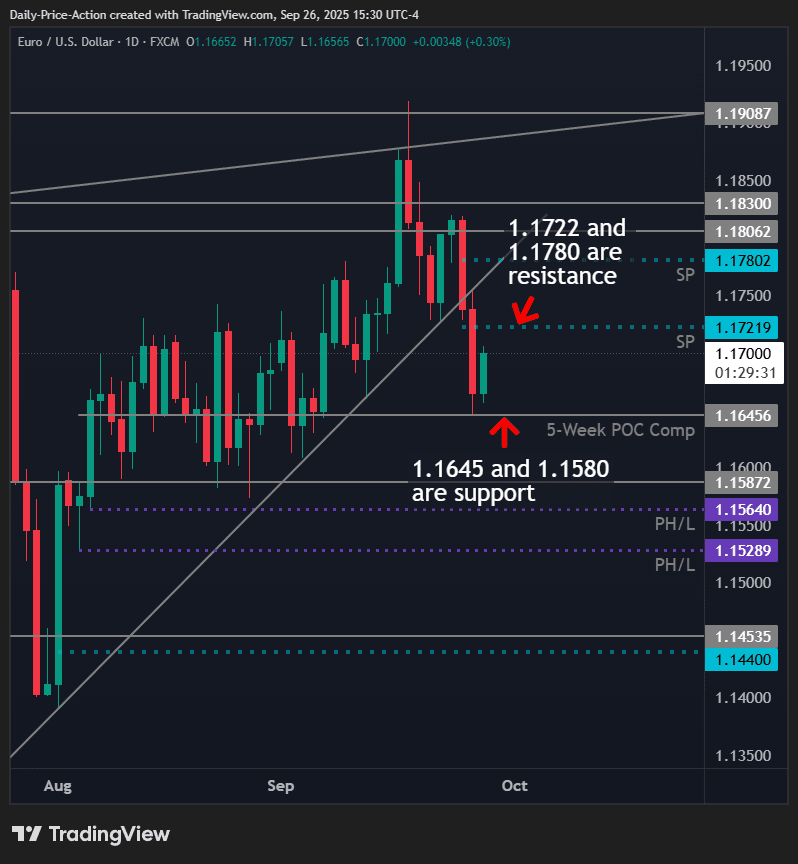
I also discussed in the VIP Discord group how 1.1645 could serve as support for the euro. That’s a 5-week composite point of control for EURUSD.
In other words, it’s where the EURUSD spent the most time in August and early September. Markets have memories, so areas like these often serve as support or resistance.
So far, euro bulls are defending 1.1645 to the pip. However, I’m not convinced that this bounce will be anything more than a relief rally.
There are two buy-side single prints (imbalances) at 1.1722 and 1.1780. Market makers may target these areas next week, but any retest is likely to be a selling opportunity.
Anticipate more ranging from EURUSD next week. Trading what’s on the chart (trading the range) will always be more profitable than trading what you want to happen.
Lastly, remember we have a poor low (unfinished auction) at 1.15643 and a single print at 1.1440. These could also be targeted, but only if the EURUSD drops below 1.1645 on the high time frames.
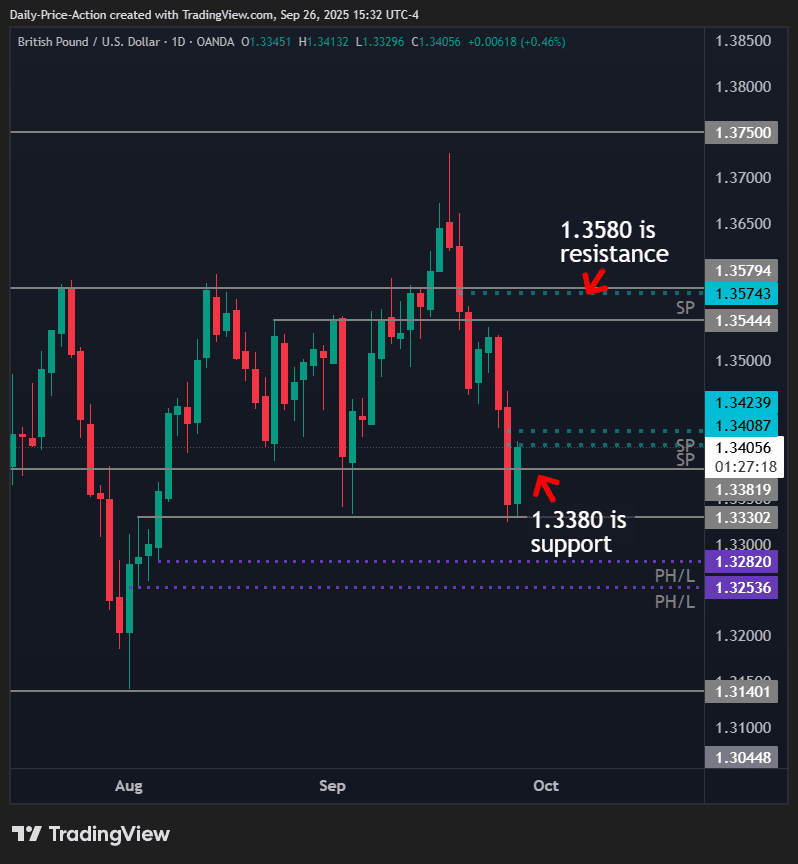
GBPUSD is another pair that worked out nicely last week. In the previous Weekly Forex Forecast, I mentioned how the break below 1.3580 looked bearish for the pound.
I also discussed how the 1.3529 single print could offer a short opportunity.
Last Tuesday’s session offered the ideal short entry with a high of 1.3537. That retest triggered a fresh wave of sellers, pushing GBPUSD into the 1.3330 support area.
For now, GBPUSD bulls are defending the September low at 1.3330. But like EURUSD, I’m not convinced that this bounce will be anything more than some relief.
Looking at the market profile for the pound, we have two buy-side single prints that could become a factor next week. The first is 1.3410, and the second is 1.3425.
These levels could serve as “magnets” early next week. Unless, of course, we see the pair tag these levels on Friday, since I’m writing this with several hours left in Friday’s session.
Either way, I expect sellers to defend the 1.3425 region if tested early next week.
Looking lower, we have a couple of poor lows. The first is 1.3282 and the second is 1.3254. Whether these become targets depends on whether GBPUSD sellers can break 1.3330 support next week.
If bulls reclaim 1.3380 on Friday, watch for some relief early next week.
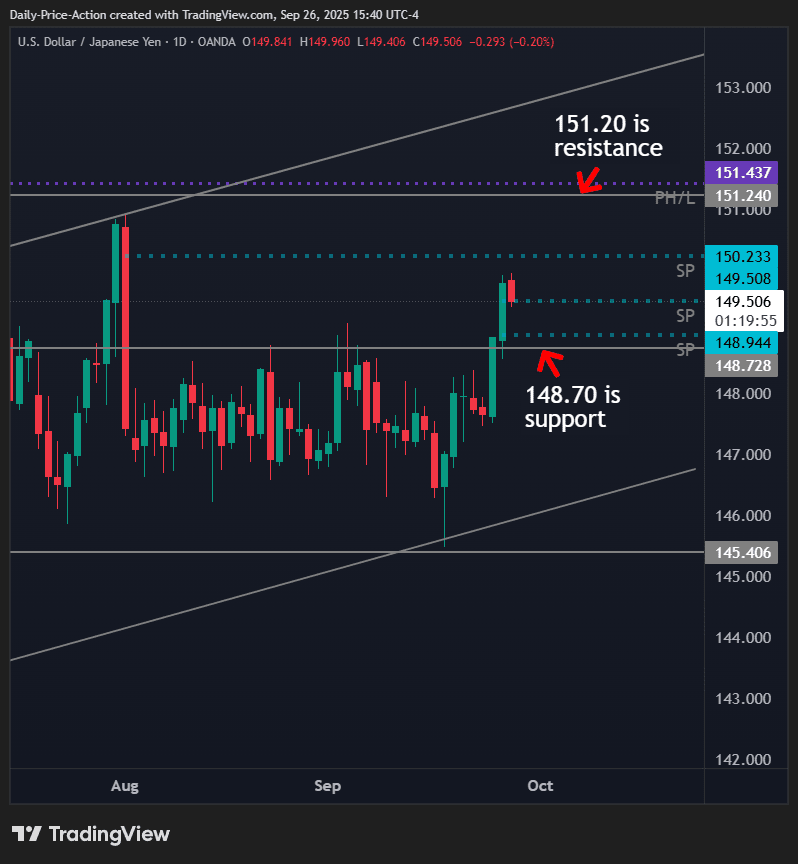
USDJPY broke out last week after nearly two months of sideways chop. I discussed the breakout and a potential trade plan in Thursday’s USDJPY video.
In that video, I mentioned the single prints that could become a factor. USDJPY tagged the 149.51 single print on Friday, but the 148.94 print remains open for business next week.
These levels could serve as key support for USDJPY if we get a pullback next week.
The challenge for bulls is where the DXY is trading. Last week’s retest of 98.60 was a significant moment for the dollar, which is also attracting sellers.
If USDJPY can hold above 148.70, a push higher into 150.23 and potentially 151.20 could be in the cards.
On the other hand, a break below 148.70 would cast a bearish shadow over USDJPY and expose the 147.00 level.
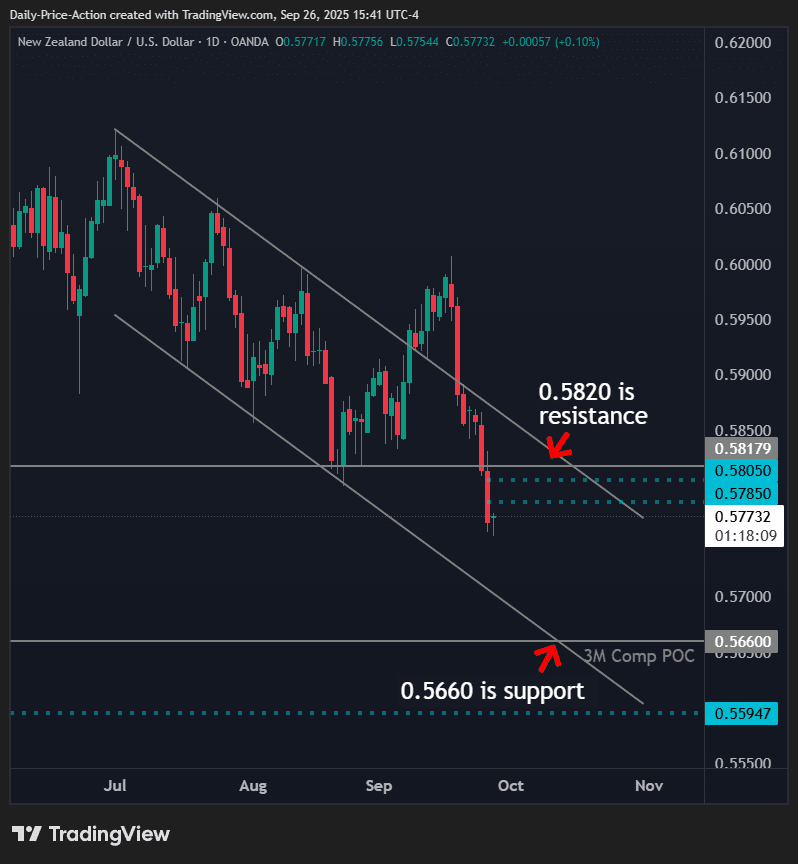
A few weeks ago, I included NZDUSD in the forecast, noting that the failure at 0.5890 looked bearish. It confirmed the failed breakout, exposing support at 0.5817 and lower.
Fast forward to today, and NZDUSD has accomplished both of those things.
The pair sold off from the 0.5890 region following the September 18th bearish close, and also broke below 0.5817 support last week.
That keeps sellers in control for next week.
However, like many of the major currency pairs, the New Zealand dollar left several imbalances for next week.
The first single print (imbalance) is 0.5785, and the second is 0.5805. I expect market makers to target 0.5785 early next week; however, targeting 0.5805 will be more challenging.
Either way, I like the idea of looking for shorts next week as long as NZDUSD is below 0.5820. Those two imbalances at 0.5785 and 0.5805 could provide another opportunity to go short.
As for downside targets, we have the bottom of the July descending channel. It’s difficult to say where the level comes in, but my bet is on 0.5660.
There’s a 3-month composite point of control from early 2025 sitting at 0.5660. That’s a fancy way of saying NZDUSD spent a lot of time at 0.5660 in Q1, and markets don’t forget.
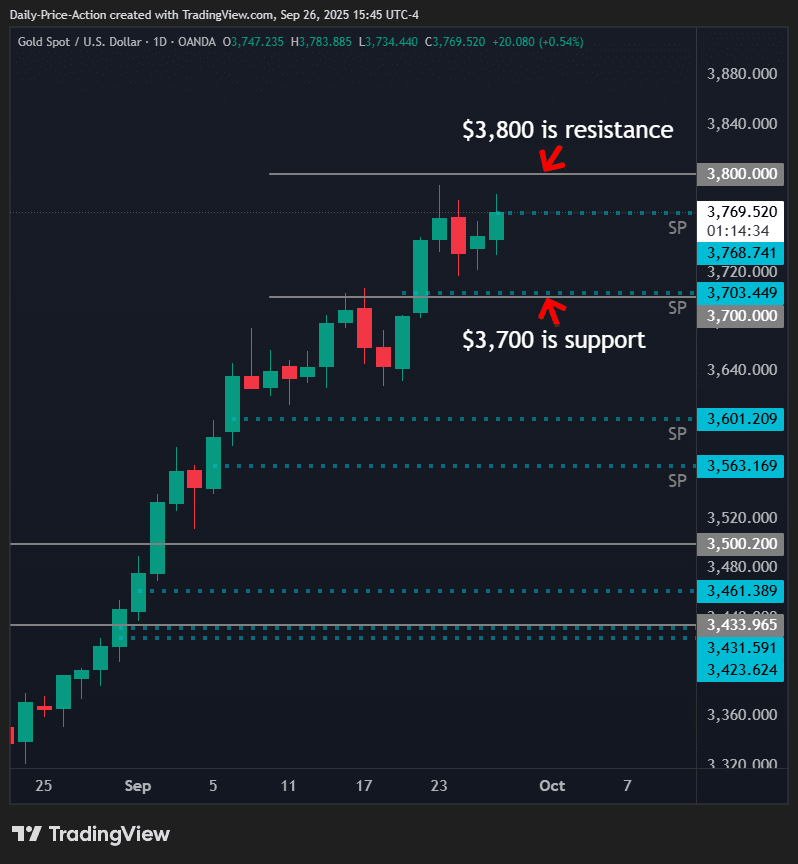
Gold continued its rally last week following the break above $3,700. Pullbacks continue to be shallow with upside seemingly unlimited.
However, XAUUSD is nearing the top of a weekly channel from 2024. I’ve discussed this pattern several times, and the upper boundary currently sits just above $3,800.
It’s not a reason to be bearish by any means. But it is reason enough to approach fresh longs with caution.
Gold has also left several sell-side imbalances in its way. The closest sits at $3,703.
If we get a deeper pullback from XAUUSD in the coming days, $3,703 could become a target.
However, shorting gold remains a losing battle. Even a pullback from $3,800 (if we get it) would likely offer a buying opportunity rather than justification to get short.
Join us in the VIP Discord group for real-time market updates, VIP-only videos, my trades in real time, and the complete trading course.
Gold is back on its corrective journey below $3,750 in Friday’s Asian trades, after having staged a tepid bounce on Thursday. All eyes now remain on the US core Personal Consumption Expenditures (PCE) Price Index due later in the day for a fresh directional impetus.
Reduced bets for aggressive interest rate cuts by the US Federal Reserve (Fed) this year offset renewed jitters fuelled by US President Donald Trump’s latest round of tariffs, helping the US Dollar (USD) holds its recent uptrend at the expense of Gold.
Encouraging US data released on Thursday highlighted the economic resilience, pouring cold water on aggressive Fed easing expectations.
US Gross Domestic Product rose by an upwardly revised rate of 3.8% from April through June, higher than 3.3% initially reported.
Meanwhile, the Labour Department reported 218,000 seasonally adjusted filings for the week ending September 20, down 14,000 from the prior week’s upwardly revised figure and below the consensus estimate of 235,000.
Additionally, Durable Goods Orders rebounded firmly by 2.9% in August versus the previously revised -2.7% and -0.5% expected.
Trump on Thursday announced tariffs of up to 100% on imports of branded and patented pharmaceutical drugs, starting October 1. Trump also slapped 50% tariffs on imports of kitchen cabinets and bathroom vanities, 30% on upholstered furniture, and 25% on heavy trucks.
Markets weigh the latest Trump’s tariffs, while gearing up for the critical US PCE inflation data due later this Friday. The data will confirm whether the Fed will remain on track for two rate cuts this year.
The Fed’s preferred inflation measure, the core PCE Price Index, is expected to rise by 2.9% in August, at the same pace seen in July. The headline annual PCE inflation is set to tick higher to 2.7% in the same period, against July’s 2.6%.
An upside surprise to the core PCE print could bolster the USD rally and weigh further on the non-interest-bearing Gold price. A sudden increase in price pressure could further temper expectations of more Fed cuts.
On the other hand, a softer-than-expected US core PCE reading would be welcomed by the Fed
In the lead-up to the US PCE showdown, the FXStreet Fed Sentiment Index extends its foothold in the hawkish zone, trading near 114 as of writing, up from around 105 levels seen a day ago.
Technically, the bearish pressures seem to have eased a bit as the 14-day Relative Strength Index (RSI) moves out of the extreme overbought region.
The leading indicator currently trades at 71.50, down from 78 levels seen at the start of the week.
If the pullback regains momentum, the initial support is seen at the $3,700 threshold, below which Monday’s low of $3,684 will offer some comfort.
Further down, the $3,650 psychological barrier could come to the rescue of buyers.
On the other hand, buyers need acceptance above the $3,750 psychological level to revive the record rally.
The next topside hurdle is located at the lifetime high of $3,791, followed by the $3,800 barrier.
A sustained and decisive break above the latter could fuel a fresh advance toward the $3,850 psychological level.
Inflation measures the rise in the price of a representative basket of goods and services. Headline inflation is usually expressed as a percentage change on a month-on-month (MoM) and year-on-year (YoY) basis. Core inflation excludes more volatile elements such as food and fuel which can fluctuate because of geopolitical and seasonal factors. Core inflation is the figure economists focus on and is the level targeted by central banks, which are mandated to keep inflation at a manageable level, usually around 2%.
The Consumer Price Index (CPI) measures the change in prices of a basket of goods and services over a period of time. It is usually expressed as a percentage change on a month-on-month (MoM) and year-on-year (YoY) basis. Core CPI is the figure targeted by central banks as it excludes volatile food and fuel inputs. When Core CPI rises above 2% it usually results in higher interest rates and vice versa when it falls below 2%. Since higher interest rates are positive for a currency, higher inflation usually results in a stronger currency. The opposite is true when inflation falls.
Although it may seem counter-intuitive, high inflation in a country pushes up the value of its currency and vice versa for lower inflation. This is because the central bank will normally raise interest rates to combat the higher inflation, which attract more global capital inflows from investors looking for a lucrative place to park their money.
Formerly, Gold was the asset investors turned to in times of high inflation because it preserved its value, and whilst investors will often still buy Gold for its safe-haven properties in times of extreme market turmoil, this is not the case most of the time. This is because when inflation is high, central banks will put up interest rates to combat it.
Higher interest rates are negative for Gold because they increase the opportunity-cost of holding Gold vis-a-vis an interest-bearing asset or placing the money in a cash deposit account. On the flipside, lower inflation tends to be positive for Gold as it brings interest rates down, making the bright metal a more viable investment alternative.
EUR/USD continued to push lower following Wednesday’s decline and closed deep in negative territory on Thursday. The pair stays relatively quiet in the European session on Friday, while the technical outlook suggests that the bearish bias remains intact.
The table below shows the percentage change of Euro (EUR) against listed major currencies today. Euro was the weakest against the US Dollar.
| USD | EUR | GBP | JPY | CAD | AUD | NZD | CHF | |
|---|---|---|---|---|---|---|---|---|
| USD | -0.03% | -0.01% | -0.04% | 0.09% | 0.08% | 0.17% | 0.03% | |
| EUR | 0.03% | 0.05% | 0.05% | 0.17% | 0.17% | 0.27% | 0.08% | |
| GBP | 0.01% | -0.05% | 0.08% | 0.13% | 0.21% | 0.21% | 0.00% | |
| JPY | 0.04% | -0.05% | -0.08% | 0.10% | 0.09% | 0.18% | -0.08% | |
| CAD | -0.09% | -0.17% | -0.13% | -0.10% | -0.01% | 0.11% | -0.13% | |
| AUD | -0.08% | -0.17% | -0.21% | -0.09% | 0.01% | 0.09% | -0.13% | |
| NZD | -0.17% | -0.27% | -0.21% | -0.18% | -0.11% | -0.09% | -0.10% | |
| CHF | -0.03% | -0.08% | 0.00% | 0.08% | 0.13% | 0.13% | 0.10% |
The heat map shows percentage changes of major currencies against each other. The base currency is picked from the left column, while the quote currency is picked from the top row. For example, if you pick the Euro from the left column and move along the horizontal line to the US Dollar, the percentage change displayed in the box will represent EUR (base)/USD (quote).
The US Dollar (USD) gathered strength against its rivals on Thursday as upbeat macroeconomic data releases eased concerns over an economic downturn.
The US Bureau of Economic Analysis (BEA) announced that it revised the annualized Gross Domestic (GDP) growth for the second quarter to 3.8% from 3.3% in the previous estimate. Other data from the US showed that Durable Goods Orders increased by 2.9% in August, surpassing the market expectation for a decrease of 0.5% by a wide margin, and the weekly Initial Jobless Claims declined to 218,000 from 232,000 in the previous week.
Later in the day, the BEA will publish the Personal Consumption Expenditures (PCE) Price Index data, the Federal Reserve’s (Fed) preferred gauge of inflation, for August. Fed Chairman Jerome Powell said in his last public appearance that they were projecting the PCE Price Index and the core PCE Price Index to rise 2.7% and 2.9% on a yearly basis, respectively.
Unless there is a significant surprise in the monthly core PCE Price Index print, which is expected to rise 0.2%, the market reaction is likely to remain muted.
In the meantime, US stock index futures rise about 0.2% in the European morning on Friday. A bullish action in Wall Street could help EUR/USD hold its ground heading into the weekend.
EUR/USD broke below the lower limit of the ascending regression channel and the Relative Strength Index (RSI) indicator on the 4-hour chart dropped toward 30, reflecting a buildup of bearish momentum. Additionally, EUR/USD closed the last four 4-hour candles below the 200-period Simple Moving Average (SMA).
On the downside, 1.1640 (Fibonacci 50% retracement of the latest uptrend) aligns as the first support level before 1.1580 (Fibonacci 61.8% retracement) and 1.1500 (static level, round level). Looking north, resistance levels could be spotted at 1.1690-1.1700 (200-period SMA, Fibonacci 38.2% retracement), 1.1750 (100-period SMA) and 1.1770 (Fibonacci 23.6% retracement).
(This story was corrected on September 26 at 08:38 GMT to say in the first paragraph that the EUR/USD closed deep in negative territory on Thursday, not positive.)
The Euro is the currency for the 19 European Union countries that belong to the Eurozone. It is the second most heavily traded currency in the world behind the US Dollar. In 2022, it accounted for 31% of all foreign exchange transactions, with an average daily turnover of over $2.2 trillion a day.
EUR/USD is the most heavily traded currency pair in the world, accounting for an estimated 30% off all transactions, followed by EUR/JPY (4%), EUR/GBP (3%) and EUR/AUD (2%).
The European Central Bank (ECB) in Frankfurt, Germany, is the reserve bank for the Eurozone. The ECB sets interest rates and manages monetary policy.
The ECB’s primary mandate is to maintain price stability, which means either controlling inflation or stimulating growth. Its primary tool is the raising or lowering of interest rates. Relatively high interest rates – or the expectation of higher rates – will usually benefit the Euro and vice versa.
The ECB Governing Council makes monetary policy decisions at meetings held eight times a year. Decisions are made by heads of the Eurozone national banks and six permanent members, including the President of the ECB, Christine Lagarde.
Eurozone inflation data, measured by the Harmonized Index of Consumer Prices (HICP), is an important econometric for the Euro. If inflation rises more than expected, especially if above the ECB’s 2% target, it obliges the ECB to raise interest rates to bring it back under control.
Relatively high interest rates compared to its counterparts will usually benefit the Euro, as it makes the region more attractive as a place for global investors to park their money.
Data releases gauge the health of the economy and can impact on the Euro. Indicators such as GDP, Manufacturing and Services PMIs, employment, and consumer sentiment surveys can all influence the direction of the single currency.
A strong economy is good for the Euro. Not only does it attract more foreign investment but it may encourage the ECB to put up interest rates, which will directly strengthen the Euro. Otherwise, if economic data is weak, the Euro is likely to fall.
Economic data for the four largest economies in the euro area (Germany, France, Italy and Spain) are especially significant, as they account for 75% of the Eurozone’s economy.
Another significant data release for the Euro is the Trade Balance. This indicator measures the difference between what a country earns from its exports and what it spends on imports over a given period.
If a country produces highly sought after exports then its currency will gain in value purely from the extra demand created from foreign buyers seeking to purchase these goods. Therefore, a positive net Trade Balance strengthens a currency and vice versa for a negative balance.
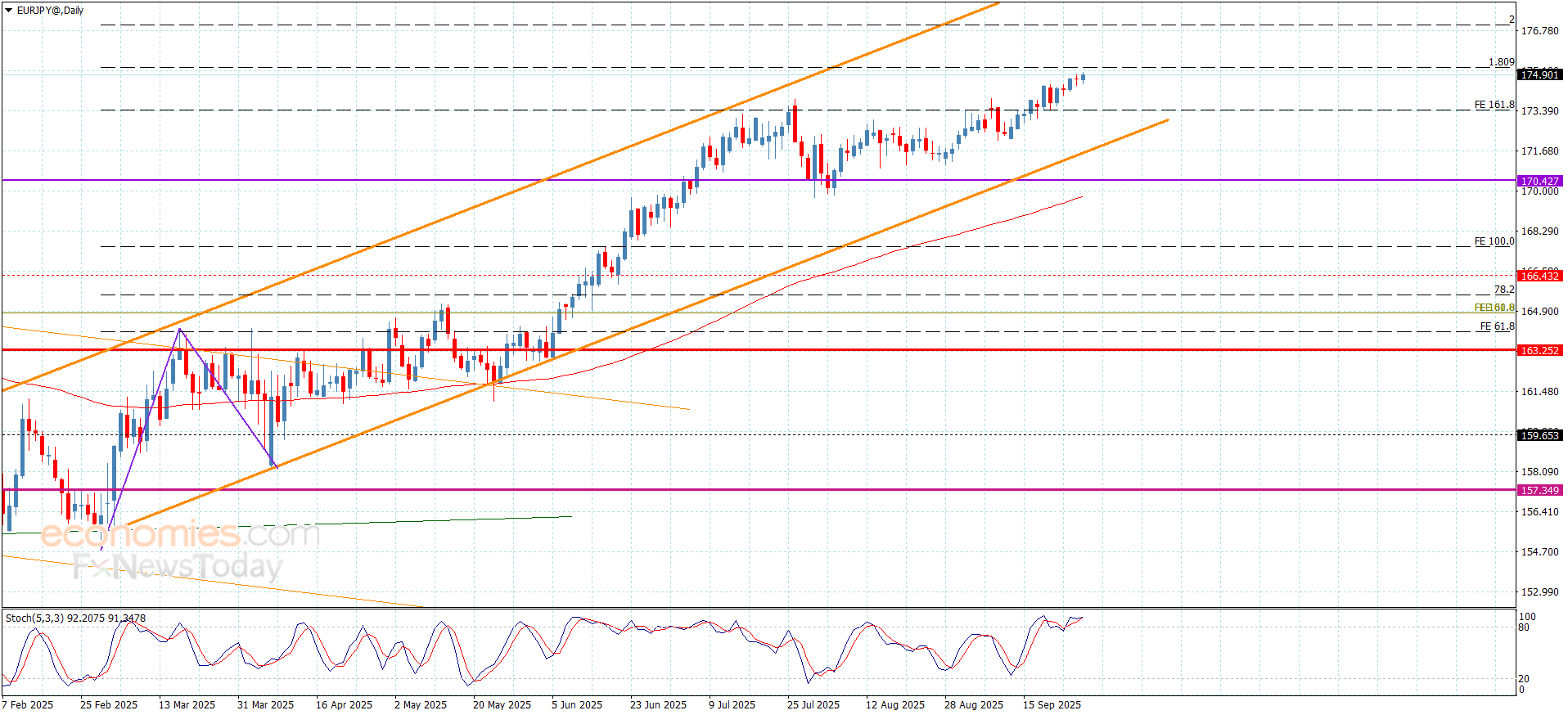
The EURJPY pair failed to resume the bullish attack, due to its stability below %1.809 Fibonacci extension level, forming an extra barrier at 175.20, providing sideways trading since yesterday by its stability near 174.85.
Reminding you that the bullish scenario will remain valid, due to the stability within the bullish channel’s levels besides the continuation of forming an initial support at 173.40 level, which makes us wait for breaching the current barrier to ease the mission of recording extra gains that might begin at 176.00 and 176.95.
The expected trading range for today is between 174.20 and 175.20
Trend forecast: Sideways until achieving the breach
The British Pound is trimming Thursday’s losses on Friday, favoured by generalised Japanese Yen weakness, following relatively soft inflation figures in the Tokyo area. The pair has reached prices above the 200.00 level after bouncing at 199.55, but remains below a key resistance area ahead of 200.50
Data released on Thursday revealed that the advanced Tokyo CPI grew at a 2.5% yearly rate in September, down from 2.6% in August. The Core CPI remained steady at 2.5% against market expectations of an uptick to 2.6%. These figures give some more leeway to the BoJ to maintain its “wait-and-see” stance at its next monetary policy meeting, and have increased bearish pressure on the Yen.
The technical picture is mixed. The pair broke below an ascending trendline support, yet bears have been unable to pull the pair below 199.20. The 4-hour Relative Strength Index is wavering around the 50 level, indicating a lack of a clear bias.
Bulls will find significant resistance in the area between Thursday’s high, at 200.35, and the reverse trendline, now around 200.50. A confirmation above here would open the way towards the year-to-date high, at 201.27.
A reversal from current levels, on the contrary, would face support at the mentioned 199.20 (September 19 and 23 lows). Further down, the 78.6% retracement of the September rally, which meets the September 5 low at 198.65, and the September 2 low at 198.35, would be the next bearish targets.
(This story was corrected on September 26 at 10:10 GMT to say that the September 5 low is at 198.65 and the September 2 at 198.35, not at 168.65 and 1.1830 as previously reported.)
The table below shows the percentage change of Japanese Yen (JPY) against listed major currencies today. Japanese Yen was the strongest against the New Zealand Dollar.
| USD | EUR | GBP | JPY | CAD | AUD | NZD | CHF | |
|---|---|---|---|---|---|---|---|---|
| USD | -0.12% | -0.11% | -0.12% | 0.07% | 0.00% | 0.07% | -0.06% | |
| EUR | 0.12% | 0.05% | 0.07% | 0.24% | 0.20% | 0.25% | 0.08% | |
| GBP | 0.11% | -0.05% | 0.08% | 0.19% | 0.23% | 0.20% | -0.00% | |
| JPY | 0.12% | -0.07% | -0.08% | 0.15% | 0.09% | 0.16% | -0.09% | |
| CAD | -0.07% | -0.24% | -0.19% | -0.15% | -0.06% | 0.03% | -0.19% | |
| AUD | -0.01% | -0.20% | -0.23% | -0.09% | 0.06% | 0.05% | -0.15% | |
| NZD | -0.07% | -0.25% | -0.20% | -0.16% | -0.03% | -0.05% | -0.09% | |
| CHF | 0.06% | -0.08% | 0.00% | 0.09% | 0.19% | 0.15% | 0.09% |
The heat map shows percentage changes of major currencies against each other. The base currency is picked from the left column, while the quote currency is picked from the top row. For example, if you pick the Japanese Yen from the left column and move along the horizontal line to the US Dollar, the percentage change displayed in the box will represent JPY (base)/USD (quote).
The (silver) price declined in its last intraday trading, after reaching $44.80 resistance, which represents our expected target in our last forecast, due to the stability of this resistance the price declined to gather the gains of its previous rises, to attempt to gain bullish momentum that might help to breach it and resuming the rise, amid the continuation of the positive pressure that comes from its trading above EMA50, and under the dominance of the main bullish trend on the short-term basis and its trading alongside trendline, besides the emergence of the positive signals on the relative strength indicators, despite reaching overbought levels.
Get high-accuracy trading signals delivered directly to your Telegram. Subscribe to specialized packages tailored for the world’s top markets:
Full VIP signals performance report for September 15–19, 2025:
The EURJPY pair failed to resume the bullish attack, due to its stability below %1.809 Fibonacci extension level, forming an extra barrier at 175.20, providing sideways trading since yesterday by its stability near 174.85.
Reminding you that the bullish scenario will remain valid, due to the stability within the bullish channel’s levels besides the continuation of forming an initial support at 173.40 level, which makes us wait for breaching the current barrier to ease the mission of recording extra gains that might begin at 176.00 and 176.95.
The expected trading range for today is between 174.20 and 175.20
Trend forecast: Sideways until achieving the breach
The (ETHUSD) price rose in its last intraday trading, after breaking the critical support at $4,100, amid the dominance of the main bearish trend on the short-term basis and its trading alongside minor trendline, indicating the big volume of the negative momentum, with the continuation of the negative pressure that comes from its trading below EMA50, attempting to recover its previous losses, and attempting to offload some of its clear oversold conditions on the relative strength indicators, especially with the emergence of the positive signals.
Get high-accuracy trading signals delivered directly to your Telegram. Subscribe to specialized packages tailored for the world’s top markets:
Full VIP signals performance report for September 15–19, 2025: