The main category of Forex News.
You can use the search box below to find what you need.
[wd_asp id=1]
The main category of Forex News.
You can use the search box below to find what you need.
[wd_asp id=1]
Crude oil markets remain volatile as WTI (CL=F) trades at $64.01, down 0.91%, and Brent (BZ=F) holds near $67.48, lower by 0.74%, reflecting the tug of war between strong U.S. supply, escalating geopolitical conflicts, and shifting demand flows from Asia and Europe. Despite steady demand, the equilibrium has been challenged by Russia-Ukraine tensions, tariff pressures, and heavy investment in renewables, while speculative flows continue to dictate weekly swings.
The war in Ukraine has reintroduced a meaningful geopolitical premium into both WTI and Brent benchmarks. Ukrainian drone strikes on Russia’s energy infrastructure hit eight refineries in August, cutting roughly 10% of refining capacity, and temporarily disrupting flows through the Druzhba pipeline, which supplies Hungary and Slovakia. Over the weekend, a strike at Russia’s Baltic export port near St. Petersburg added to concerns. Russia, already struggling with seaborne oil shipments that hit a six-month low, now faces possible gasoline shortages at home, prompting the Kremlin to consider extending its export ban. Each incremental attack further tightens global supply expectations, making the $65–$70 per barrel range highly sensitive to further escalations. Analysts warn that each 500,000 barrels removed from Russian exports could shift Brent toward $75–$78 in a matter of weeks.
Saudi Arabia’s Q2 oil export value fell 16% YoY, reflecting weaker pricing and pressure from record U.S. output. The Kingdom continues to balance fiscal needs with OPEC+ strategy, wary of pushing cuts too aggressively as it weighs competition with U.S. shale. The OPEC basket price sits at $69.65, marginally lower, suggesting member states are absorbing reduced revenues amid discounting to key buyers in Asia. India has ramped up U.S. crude imports as prices remain favorable, while still taking Russian barrels despite tariffs. Saudi Arabia, meanwhile, faces a delicate fiscal situation, with breakeven budgets requiring oil closer to $80–85. This mismatch between current Brent levels at $67–68 and fiscal needs could force further production adjustments heading into Q4.
According to the EIA, U.S. crude production hit a record in 2024, though growth has slowed compared to earlier years. Weekly output in June beat estimates, reinforcing America’s role as the swing producer. WTI’s rangebound action between $62.70 and $64.95 last week showed how resilient U.S. supply is at these levels. Even with strong exports to India and Europe, domestic production ensures no acute shortage is forming. Inventories, however, have drawn sharply, which, combined with a weaker dollar and speculation about Fed rate cuts, has kept a floor under WTI. Traders point to the $62.30–$65.20 speculative range as defining the short-term technical setup, with upside capped near $66 absent new geopolitical shocks.
Europe is leaning more heavily on jet fuel imports from Asia, reaching record highs, while refining disruptions in California and ongoing Norwegian pipeline maintenance have added regional volatility. India’s refiners have expanded U.S. purchases, while also increasing discounted Russian crude despite tariff threats. China remains opportunistic, but its slowing industrial profits—down 1.7% in July—weigh on long-term demand growth. Still, Asia’s appetite remains strong enough to soak up discounted cargoes, preventing a steeper collapse in Brent. On the flip side, Chinese LNG imports have declined, reflecting a broader recalibration of its energy mix toward renewables and storage investments, leaving oil markets more sensitive to temporary demand shocks rather than structural growth.
WTI struggled to sustain gains above $64.40 last week, reversing lower into the weekend and signaling exhaustion. The inability to clear the $65–$66 resistance highlights bearish undertones, even as speculative flows support short-term rallies. On the downside, $63.00 to $62.50 represents immediate support, with risks of a deeper slide toward $61.70 if macro sentiment worsens. Brent faces a similar picture, with resistance at $68.50–$69.20 and downside support at $66.00. A decisive break below these levels would invite a sharper selloff toward $63 for Brent, narrowing the spread to WTI. The technical picture suggests rangebound trading but with clear downside vulnerability unless geopolitical shocks intensify.
Speculative positioning in crude remains cautious, with traders unwilling to bid aggressively higher given ample U.S. supply and weak macro data from China. Large players are expected to return after the holiday weekend with volumes, but the overhang of geopolitical risk prevents aggressive shorting. Goldman Sachs projects oil falling below $55 in 2026, a reminder that current rallies may be short-lived unless backed by sustained supply disruptions. At present, crude appears in a fragile balance between bearish fundamentals and bullish geopolitical shocks, leaving sentiment prone to quick reversals.
At $64 for WTI and $67 for Brent, oil is trading below the fiscal comfort levels of OPEC producers, with downside risks capped by geopolitical events in Russia and Ukraine. Fundamentals lean bearish with U.S. output at record highs and Chinese demand still fragile, but the geopolitical premium is back in play and could lift prices $5–10 above current ranges if attacks intensify. The technical picture argues for consolidation, but the risk-reward skews cautiously bullish given supply risks. Based on the current setup, WTI (CL=F) is a speculative Buy on dips near $62, while Brent (BZ=F) is a Hold, with a breakout above $70 required to confirm renewed momentum.
Oil markets began the week with WTI crude climbing 0.94% to $64.61 per barrel and Brent crude advancing 0.99% to $68.15. The rally coincides with thin U.S. holiday trading volumes but sits directly on the 50-day moving averages, a technical battleground where bulls and bears are both positioned aggressively. For WTI, $65 is the immediate pivot. A sustained move above opens the path toward $67, while repeated failures leave the market locked in the noisy consolidation that has defined the past two weeks. Brent shows a similar setup, with $67 serving as initial support and $70 the psychological target just beneath its 200-day moving average. Both benchmarks are range-bound, offering short-term trading windows rather than long-lasting trends, yet the balance may shift quickly as fundamental shocks mount.
Despite U.S. tariffs escalating to 50% on Indian goods, aimed at punishing New Delhi for its continued Russian crude purchases, India shows no signs of backing down. Data confirms that Russia accounted for 31.4% of Indian oil imports in July, well above Iraq at 17.1% and Saudi Arabia at 16.1%. The value of Russian barrels entering India reached $3.6 billion, versus around $2 billion for Iraqi and Saudi volumes. Indian refiners are still importing more than 1.5 million barrels per day of Russian crude, a scale too large to replace quickly. For Washington, the dilemma is clear: squeezing India risks lifting global oil above $100 and reigniting U.S. inflation, yet stepping back exposes the limits of Western sanctions. China is already absorbing additional Russian barrels, and its ability to undercut sanctions further strengthens BRICS alignment. Oil prices remain hostage to these geopolitical calculations, where barrels are traded as much for political leverage as for supply and demand balance.
Fresh tension emerged after Saudi Arabia and Iraq suspended shipments to an Indian refiner targeted by sanctions, underscoring how energy flows are increasingly politicized. While volumes remain modest compared to Russian supply, the move highlights that even Middle Eastern producers are not immune to Western pressure. Markets are weighing whether this suspension is symbolic or the start of a broader realignment. Should Indian refiners lean further on Russia to compensate, Moscow’s influence will strengthen, while Middle Eastern producers may quietly redirect barrels to Europe and China. That shift would alter tanker routes, insurance exposure, and freight costs, feeding volatility into already fragile oil pricing structures.
The U.S. Energy Information Administration projects Brent crude to average $58 per barrel in Q4 2025, with WTI near $59.65. The bearish outlook reflects OPEC+ gradually unwinding production cuts and higher output from South America, tipping balances into oversupply. Wall Street banks echo this sentiment, with Goldman Sachs, JPMorgan, and Morgan Stanley collectively forecasting Brent in the low $60s for early 2026. For U.S. shale, the implications are severe. Breakeven levels for new wells hover just above $60, and if WTI dips beneath this threshold, rig counts and frac crews will contract further. Rig activity is already declining, though efficiency gains mask the immediate impact on output. A glut-driven slump below $60 would force the shale patch into another round of capex cuts, deepening the cycle of volatility.
Malaysia’s Petronas posted a 24% revenue decline and a 19% drop in after-tax profit in H1 2025, weighed down by weaker benchmark oil prices, foreign exchange pressures, and divestments. Production slipped 3.2% year-on-year to 2.403 million boepd, down from 2.482 million boepd. Domestic gas production and international liquid output were both lower. The company announced plans to trim its workforce by 10% to weather what it called “increasingly daunting headwinds.” Petronas expects subdued pricing conditions to persist, citing geopolitical tensions, macroeconomic uncertainties, and OPEC+’s unwinding of cuts. For global traders, these results confirm how weaker benchmarks filter through to national oil companies, forcing structural adjustments. Petronas’ challenges illustrate broader struggles among producers caught between sluggish demand recovery and rising geopolitical risk.
Attacks on Russian refineries, drone strikes on South Sudanese flows, and Houthi missile claims against Red Sea tankers all remind investors that geopolitical risks are never far from the surface. Supply disruptions remain sporadic, but each incident reintroduces a risk premium that traders must price in. Europe is simultaneously importing record jet fuel volumes from Asia, underscoring how the supply chain remains fractured. These shifts in refined product flows ripple back into crude benchmarks, complicating demand forecasts. Markets are also watching the East Africa pipeline project and Congo offshore developments, both of which could modestly alter medium-term balances if they achieve scale. But near-term price action is more about political flashpoints than new supply coming online.
From a chart perspective, both WTI and Brent are wrestling with their 50-day moving averages. For WTI, holding above $65 is crucial, as a break could push quickly to $67 and then $70. Failure here risks another slide toward $62, where prior demand has emerged. Brent’s test at $68.15 sits in a congested band, with upside capped by $70–$71 and downside limited at $66. Momentum oscillators show neutral-to-weak bias, reflecting the indecision. The U.S. Dollar Index, trading around 97.70 after four straight declines, provides temporary support, as a weaker dollar typically boosts oil. But structural oversupply fears remain dominant, with technicals likely to follow fundamentals rather than dictate them.
With WTI crude (CL=F) at $64.61 and Brent (BZ=F) at $68.15, traders face a market torn between short-term bullish catalysts and looming oversupply. On the bullish side, geopolitical risks, U.S. dollar softness, and India’s defiance on Russian barrels inject strength. On the bearish side, EIA’s projection of Brent at $58 and WTI at $59 in early 2026, coupled with Wall Street consensus in the low $60s, casts a heavy shadow. For now, oil is a hold—attractive for tactical long positions into $67–$70 resistance but dangerous for long-term accumulation given looming supply. The next decisive move will hinge on OPEC+ policy, U.S. shale reaction, and whether geopolitical sparks ignite sustained disruption rather than sporadic risk premiums.
The USD/JPY forecast indicates continued yen weakness amid political uncertainty in Japan. Meanwhile, the dollar is on the front foot as market participants prepare for Friday’s crucial US employment report.
–Are you interested in learning more about forex indicators? Check our detailed guide-
The yen slid on Tuesday after reports that the Secretary General of Japan’s ruling party was planning to resign. Hiroshi Moriyama is a close ally of Prime Minister Shigeru Ishiba. Therefore, such a move will likely further weaken Ishiba’s position. Since he lost the election, there have been calls for Ishiba to resign. His resignation would create uncertainty in Japan’s politics that could further weaken the yen.
“On the surface, political uncertainty and the possibility that Prime Minister Shigeru Ishiba could resign in the coming days or weeks is having a debilitating impact on the yen,” said Kit Juckes, Societe Generale’s chief global FX strategist.
Meanwhile, the dollar gained amid yen weakness as traders awaited the next major catalysts from the US. Friday’s nonfarm payrolls report could show further weakness in the labor market. Economists are predicting a low job growth of 75,000 and a higher unemployment rate of 4.3%. Unexpected softness would increase expectations for Fed rate cuts this year, weighing on the dollar. On the other hand, resilience in the labor market could ease rate cut expectations, boosting the greenback.
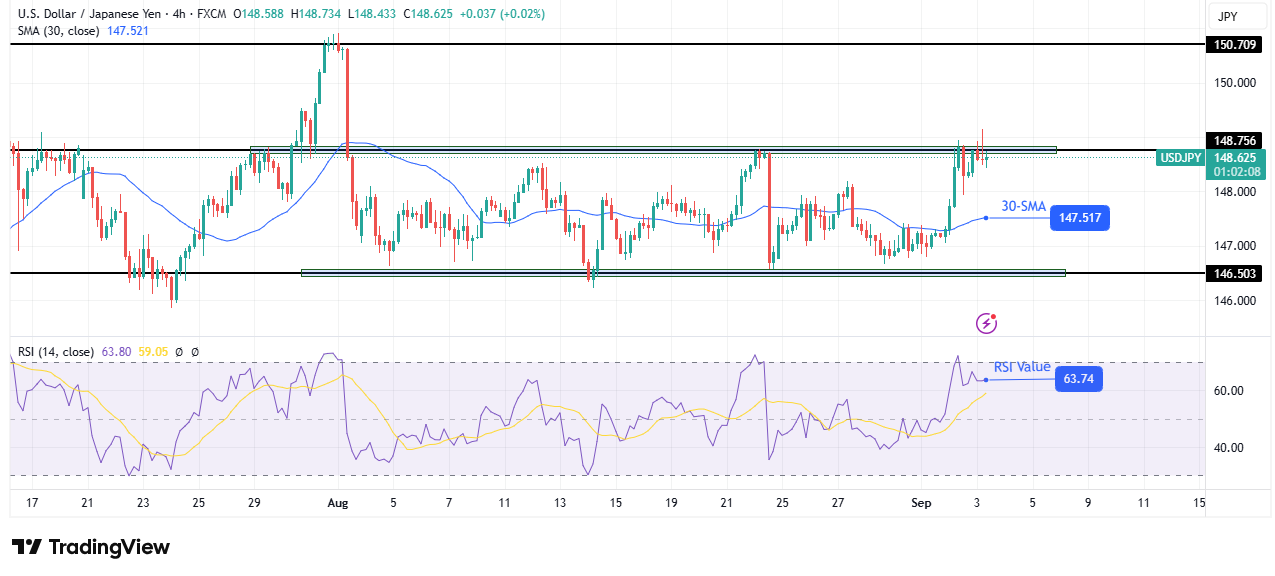
On the technical side, the USD/JPY price has rallied to challenge the 148.75 key resistance level. It trades well above the 30-SMA, with the RSI near the overbought region, suggesting a bullish bias. However, the price still trades within its consolidation area, with support at the 146.50 level and resistance at the 148.75 level.
–Are you interested in learning more about next cryptocurrency to explode? Check our detailed guide-
If bulls manage to break out of the consolidation area, the price will rally to retest the 150.70 resistance level. At the same time, it could initiate a bullish trend characterized by higher highs and higher lows. On the other hand, if the level holds firm, the price will likely drop to retest the range support. This means it could remain in consolidation for an extended period.
Looking to trade forex now? Invest at eToro!
68% of retail investor accounts lose money when trading CFDs with this provider. You should consider whether you can afford to take the high risk of losing your money.
Gold price (XAU/USD) extends its winning streak for the seventh trading day on Wednesday. The precious metal posts a fresh all-time high near $3,550 as investors have dumped long-dated government bonds across the globe.
Lower yields on interest-bearing assets increase demand for non-yielding assets, such as Gold.
Surging government bond yields signify mounting concerns over government fiscal debt, which often lead to a decline in welfare spending, and henceforth increases appeal of safe-haven bets.
Another reason behind strength in the Gold price is firm expectations that the Federal Reserve (Fed) will cut interest rates in the policy meeting this month. According to the CME FedWatch tool, there is an almost 92% chance that the Fed will cut interest rates in the September policy meeting.
Lower interest rates by the Fed bode well for non-yielding assets, such as Gold.
Lately, Federal Open Market Committee (FOMC) members supported interest rate cuts amid escalating downside employment risks.
Meanwhile, investors await United States (US) JOLTS Job Openings data for July, which will be published at 14:00 GMT. Investors will pay close attention to the job data to get cues about the current status of the labor demand.
US employers are expected to have posted fresh 7.4 million jobs, almost in line with the prior reading of 7.44 million.
Gold price trades in uncharted territory after a breakout of the Symmetrical Triangle formation on a daily timeframe. A breakout of the above-mentioned chart pattern often leads to high volume and wider ticks on the upside.
Rising 20-day Exponential Moving Average (EMA) around $3,410 indicates that the near-term trend is bullish.
The 14-day Relative Strength Index (RSI) jumps to near 75.00. A corrective move in the Gold price looks likely as the momentum oscillator turns overbought.
Looking down, the 20-day will act as key support for the major. On the upside, the round figure of $3,600 would be the key hurdle for the pair.
Gold has played a key role in human’s history as it has been widely used as a store of value and medium of exchange. Currently, apart from its shine and usage for jewelry, the precious metal is widely seen as a safe-haven asset, meaning that it is considered a good investment during turbulent times. Gold is also widely seen as a hedge against inflation and against depreciating currencies as it doesn’t rely on any specific issuer or government.
Central banks are the biggest Gold holders. In their aim to support their currencies in turbulent times, central banks tend to diversify their reserves and buy Gold to improve the perceived strength of the economy and the currency. High Gold reserves can be a source of trust for a country’s solvency. Central banks added 1,136 tonnes of Gold worth around $70 billion to their reserves in 2022, according to data from the World Gold Council. This is the highest yearly purchase since records began. Central banks from emerging economies such as China, India and Turkey are quickly increasing their Gold reserves.
Gold has an inverse correlation with the US Dollar and US Treasuries, which are both major reserve and safe-haven assets. When the Dollar depreciates, Gold tends to rise, enabling investors and central banks to diversify their assets in turbulent times. Gold is also inversely correlated with risk assets. A rally in the stock market tends to weaken Gold price, while sell-offs in riskier markets tend to favor the precious metal.
The price can move due to a wide range of factors. Geopolitical instability or fears of a deep recession can quickly make Gold price escalate due to its safe-haven status. As a yield-less asset, Gold tends to rise with lower interest rates, while higher cost of money usually weighs down on the yellow metal. Still, most moves depend on how the US Dollar (USD) behaves as the asset is priced in dollars (XAU/USD). A strong Dollar tends to keep the price of Gold controlled, whereas a weaker Dollar is likely to push Gold prices up.
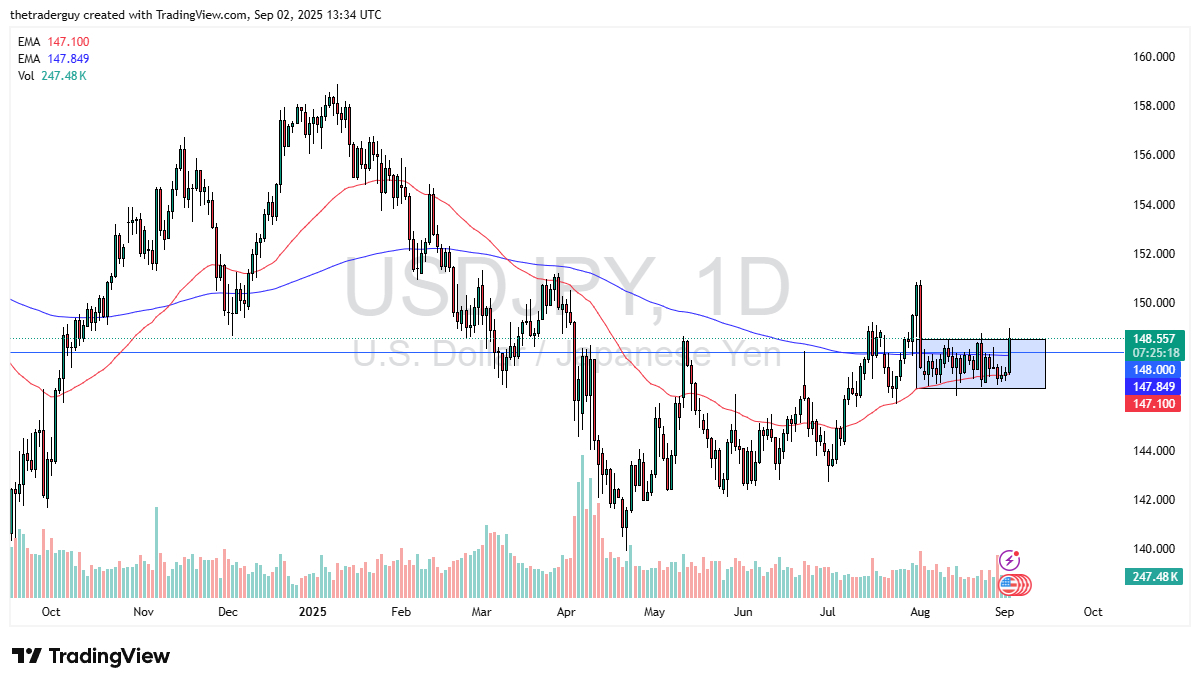
The US dollar initially rallied a bit during the trading session on Wednesday against the Japanese yen breaking above the 148.50 yen level, but gave back a bit of the gains. At this point, I’m still bullish about this pair, but I recognize it’s going to be difficult for it to truly take off to the upside before we get those important jobs numbers. A short-term pullback from here makes quite a bit of sense, but really, I think we would just stay in the same consolidation that we had been in previously. If we can break out to the upside, the 151 yen level becomes the target.
The Australian dollar initially pulled back just a little bit during the trading session here on Wednesday to test the 50 day EMA and then rallied again. I think again, this is a situation where we’re not necessarily going to see the US dollar fall apart. I think what we’ve got is a market that’s somewhat locked up. It really doesn’t know what to do. And you could probably say that going all the way back to the end of April. It’s just been a grind in the Australian dollar, and I don’t see why today that would change. I do favor the downside at the moment, but I would need to see exhaustion in order to get involved.
If we were to break above the 0.6650 level, then it would be a fresh new high. You would assume that the Aussie would rally. That would have to be accompanied by US dollar weakness around the world though. As things stand, this has been one of the worst performers against the dollar over the last several months. So, if the US dollar suddenly overwhelms everything, one would extrapolate that the Aussie should fall.
For a look at all of today’s economic events, check out our economic calendar.
EUR/JPY continues its winning streak for the fifth successive session, trading around 173.20 during the European hours on Wednesday. The technical analysis of the daily chart suggests the prevailing bullish market bias as the currency cross is remaining within the ascending channel pattern.
The 14-day Relative Strength Index (RSI) is positioned above the 50 mark, strengthening the bullish bias. Additionally, the short-term price momentum is stronger as the EUR/JPY cross remains above the nine-day Exponential Moving Average (EMA).
On the upside, the EUR/JPY cross may approach the 173.90, the highest since July 2024, recorded on July 28, 2025, aligned with the upper boundary of the ascending channel around the psychological level of 174.00.
The EUR/JPY cross may find its primary support at the nine-day EMA of 172.31. A break below this level could weaken the short-term price momentum and prompt the currency cross to test the ascending channel’s lower boundary around 171.40, followed by the 50-day EMA of 170.93.
Further declines below the confluence support zone would weaken the medium-term price momentum and put downward pressure on the EUR/JPY cross to navigate the region around the nine-week low at 169.72, which was recorded on July 31.
The table below shows the percentage change of Euro (EUR) against listed major currencies today. Euro was the strongest against the Japanese Yen.
| USD | EUR | GBP | JPY | CAD | AUD | NZD | CHF | |
|---|---|---|---|---|---|---|---|---|
| USD | -0.08% | 0.06% | 0.24% | 0.12% | -0.06% | 0.06% | 0.00% | |
| EUR | 0.08% | 0.13% | 0.31% | 0.21% | -0.11% | 0.12% | 0.07% | |
| GBP | -0.06% | -0.13% | 0.16% | 0.06% | -0.24% | 0.00% | -0.06% | |
| JPY | -0.24% | -0.31% | -0.16% | -0.14% | -0.39% | -0.28% | -0.23% | |
| CAD | -0.12% | -0.21% | -0.06% | 0.14% | -0.26% | -0.06% | -0.12% | |
| AUD | 0.06% | 0.11% | 0.24% | 0.39% | 0.26% | 0.07% | 0.18% | |
| NZD | -0.06% | -0.12% | -0.00% | 0.28% | 0.06% | -0.07% | -0.06% | |
| CHF | -0.00% | -0.07% | 0.06% | 0.23% | 0.12% | -0.18% | 0.06% |
The heat map shows percentage changes of major currencies against each other. The base currency is picked from the left column, while the quote currency is picked from the top row. For example, if you pick the Euro from the left column and move along the horizontal line to the US Dollar, the percentage change displayed in the box will represent EUR (base)/USD (quote).
After falling more than 1% and registering its biggest one-day loss since April on Tuesday, GBP/USD touched its lowest level since early August at 1.3333 in the Asian session on Wednesday. Although the pair recovered above 1.3400 in the European trading hours, investors could refrain from betting on an extended rebound.
The table below shows the percentage change of British Pound (GBP) against listed major currencies this week. British Pound was the weakest against the US Dollar.
| USD | EUR | GBP | JPY | CAD | AUD | NZD | CHF | |
|---|---|---|---|---|---|---|---|---|
| USD | 0.35% | 0.68% | 1.02% | 0.45% | 0.21% | 0.44% | 0.51% | |
| EUR | -0.35% | 0.32% | 0.61% | 0.10% | -0.14% | 0.09% | 0.15% | |
| GBP | -0.68% | -0.32% | 0.18% | -0.22% | -0.45% | -0.23% | -0.12% | |
| JPY | -1.02% | -0.61% | -0.18% | -0.50% | -0.80% | -0.55% | -0.49% | |
| CAD | -0.45% | -0.10% | 0.22% | 0.50% | -0.23% | -0.01% | 0.10% | |
| AUD | -0.21% | 0.14% | 0.45% | 0.80% | 0.23% | 0.23% | 0.35% | |
| NZD | -0.44% | -0.09% | 0.23% | 0.55% | 0.00% | -0.23% | 0.11% | |
| CHF | -0.51% | -0.15% | 0.12% | 0.49% | -0.10% | -0.35% | -0.11% |
The heat map shows percentage changes of major currencies against each other. The base currency is picked from the left column, while the quote currency is picked from the top row. For example, if you pick the British Pound from the left column and move along the horizontal line to the US Dollar, the percentage change displayed in the box will represent GBP (base)/USD (quote).
Growing concerns over the global fiscal health lifted borrowing costs of long-dated government bonds of major economies on Tuesday, opening the door for a flight to safety. Following Tuesday’s sharp increase, the yield on the 30-year UK gilt touched its highest level since 1998 at 5.75% early Wednesday before retreating. In turn, Pound Sterling found support and managed to erase its daily losses.
Reporting on the matter, “in Britain, Prime Minister Keir Starmer’s reshuffle of his top team of advisers on Monday renewed focus on fiscal challenges given the UK’s high levels of borrowing and slow growth,” Reuters reported. “A budget is due later in the year, prompting weeks of speculation about tax rises that could dampen the economy.”
In the second half of the day, the US Bureau of Labor Statistics will release the JOLTS Job Openings data for July. Markets expect the number of job openings to decline slightly to 7.4 million. A noticeable increase, with a print above 7.7 million, could boost the USD and weigh on GBP/USD. On the flip side, a disappointing reading close to 7 million is likely to have the opposite impact on the pair’s action. Nevertheless, investors could remain reluctant to bet on a steady recovery in Pound Sterling unless there is a sharp downward correction in long-dated gilt yields.
The Relative Strength Index (RSI) indicator on the 4-hour chart stays near 40 and GBP/USD continues to trade well below the 200-period Simple Moving Average (SMA), suggesting that the bearish bias remains intact despite the latest recovery attempt.
On the upside, GBP/USD faces a critical resistance area at 1.3440-1.3460, where the 200-period SMA, Fibonacci 50% retracement of the latest downtrend and the 100-day SMA are located. While this resistance area stays intact, buyers are likely to remain on the sidelines. On the downside, 1.3330 (static level) could be seen as the next support level before 1.3300 (Fibonacci 23.6% retracement).
If GBP/USD manages to clear 1.3440-1.3460, next resistance levels could be spotted at 1.3490-1.3500 (round level, 100-period SMA) and 1.3535 (Fibonacci 61.8% retracement).
UK Gilt Yields measure the annual return an investor can expect from holding UK government bonds, or Gilts. Like other bonds, Gilts pay interest to holders at regular intervals, the ‘coupon’, followed by the full value of the bond at maturity. The coupon is fixed but the Yield varies as it takes into account changes in the bond’s price. For example, a Gilt worth 100 Pounds Sterling might have a coupon of 5.0%. If the Gilt’s price were to fall to 98 Pounds, the coupon would still be 5.0%, but the Gilt Yield would rise to 5.102% to reflect the decline in price.
Many factors influence Gilt yields, but the main ones are interest rates, the strength of the British economy, the liquidity of the bond market and the value of the Pound Sterling. Rising inflation will generally weaken Gilt prices and lead to higher Gilt yields because Gilts are long-term investments susceptible to inflation, which erodes their value. Higher interest rates impact existing Gilt yields because newly-issued Gilts will carry a higher, more attractive coupon. Liquidity can be a risk when there is a lack of buyers or sellers due to panic or preference for riskier assets.
Probably the most important factor influencing the level of Gilt yields is interest rates. These are set by the Bank of England (BoE) to ensure price stability. Higher interest rates will raise yields and lower the price of Gilts because new Gilts issued will bear a higher, more attractive coupon, reducing demand for older Gilts, which will see a corresponding decline in price.
Inflation is a key factor affecting Gilt yields as it impacts the value of the principal received by the holder at the end of the term, as well as the relative value of the repayments. Higher inflation deteriorates the value of Gilts over time, reflected in a higher yield (lower price). The opposite is true of lower inflation. In rare cases of deflation, a Gilt may rise in price – represented by a negative yield.
Foreign holders of Gilts are exposed to exchange-rate risk since Gilts are denominated in Pound Sterling. If the currency strengthens investors will realize a higher return and vice versa if it weakens. In addition, Gilt yields are highly correlated to the Pound Sterling. This is because yields are a reflection of interest rates and interest rate expectations, a key driver of Pound Sterling. Higher interest rates, raise the coupon on newly-issued Gilts, attracting more global investors. Since they are priced in Pounds, this increases demand for Pound Sterling.
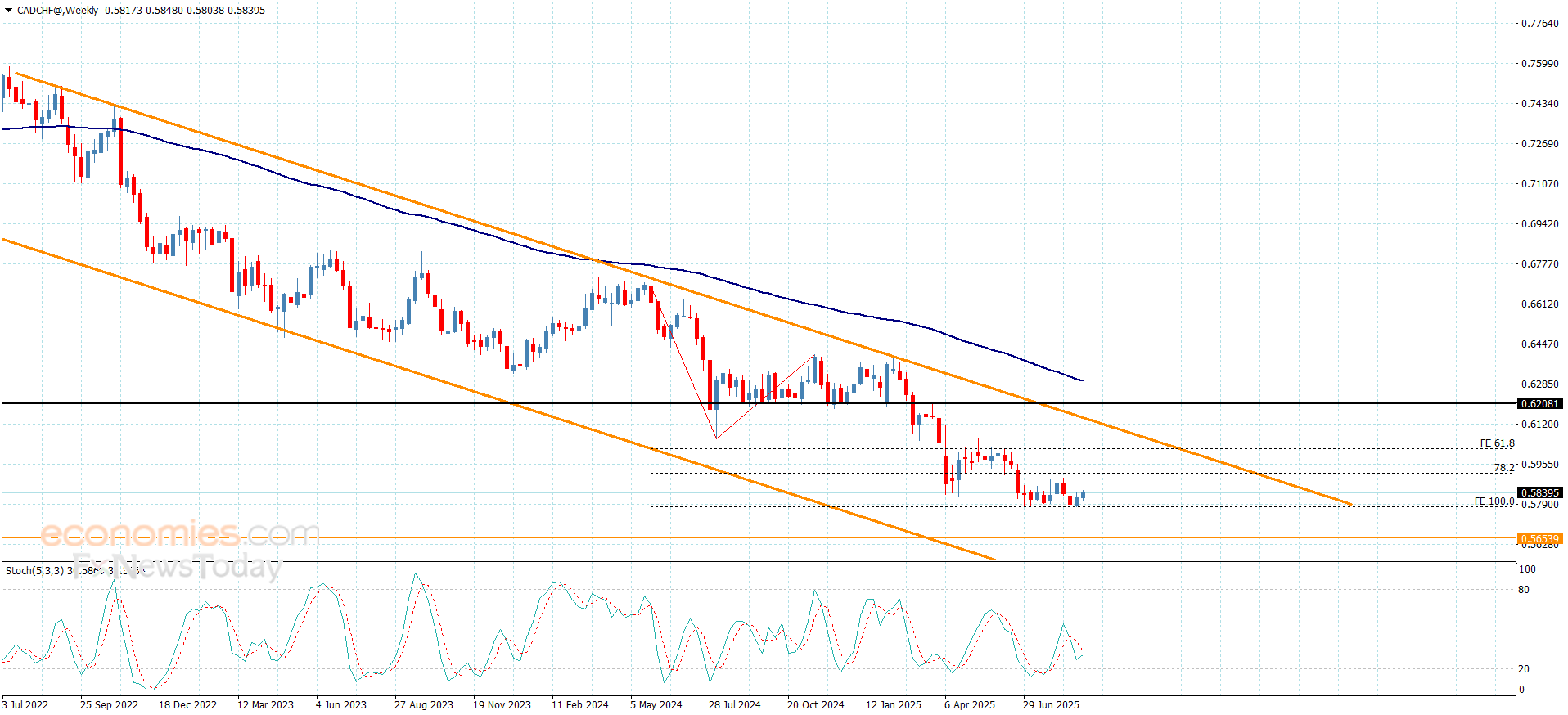
Despite the neediness of the CADCHF to the positive momentum in the last period, but it its positive stability above the support at 0.5780 supports the chances of activating the suggested bullish correctional attempts, to fluctuate near 0.5830.
By the above image, we notice stochastic attempt to provide positive momentum by its stability above 20 level, to increase the chances for targeting the positive stations by its rally towards 0.5910, surpassing it might succeed in renewing the pressure on the barrier at 0.6020 level.
The expected trading range for today is between 0.5800 and 0.5910
Trend forecast: Bullish
I anticipate that most of this week will probably be choppy and somewhat sideways as we wait for that important jobs figure. The real question at this point in time is will the interest rate differential continue to favor the US dollar over the longer term, which I think it will. And that does give a little bit of credence to the idea of a positive currency pair here.

Whether or not we can really come to grips with that between now and the jobs number is a completely different situation. But I think you’ve got a scenario where traders will have to watch this.
Maybe more of a buy on the dip mentality is the way to go. That’s the way I’ve been playing this pair for a couple of weeks now. After that nasty sell-off, and then we just went sideways. Sometimes it’s all about where a pair won’t go.
And at this point, it doesn’t look like it wants to go lower. So, I remain bullish, but I also keep my expectations a little tempered over the next couple of days.
Want to trade our USD/JPY forex analysis and predictions? Here’s a list of forex brokers in Japan to check out.
Christopher Lewis has been trading Forex and has over 20 years experience in financial markets. Chris has been a regular contributor to Daily Forex since the early days of the site. He writes about Forex for several online publications, including FX Empire, Investing.com, and his own site, aptly named The Trader Guy. Chris favours technical analysis methods to identify his trades and likes to trade equity indices and commodities as well as Forex. He favours a longer-term trading style, and his trades often last for days or weeks.