The main category of Forex News.
You can use the search box below to find what you need.
[wd_asp id=1]
The main category of Forex News.
You can use the search box below to find what you need.
[wd_asp id=1]
The GBP/USD exchange rate staged a sharp rebound after Jerome Powell’s Jackson Hole remarks shifted Fed expectations toward an imminent September cut. The pair jumped from a weekly low of 1.3387 to an intraday high of 1.3548, settling near 1.3499 as U.S. Treasury yields slipped and dollar demand weakened. Fed funds futures now price a 93% probability of a September cut and project more than 50 basis points of easing by year-end. Powell’s acknowledgment of “downside risks to the labor market” outweighed persistent inflation at 2.7% headline and 3.1% core, giving traders reason to pare long-dollar positions.
The rebound in GBP/USD comes against the backdrop of policy divergence. While the Fed leans toward easing, the Bank of England is expected to keep rates unchanged after UK inflation accelerated. July CPI printed at 3.8%, with the Retail Price Index rising to 4.8%, reinforcing BoE Governor Andrew Bailey’s warnings about “acute challenges” for growth and price stability. This contrast suggests Sterling could remain supported if the Fed cuts rates first while the BoE stays cautious.
On the daily chart, GBP/USD has carved out an inverse head-and-shoulders pattern, a classic bullish reversal signal. The neckline sits near 1.3587; a breakout above this level would clear the path toward 1.3700, while downside support lies at 1.3450 and 1.3400. The pair also trades above its 25-day and 50-day EMAs, confirming that momentum favors the pound despite intermittent profit-taking. Friday’s bullish engulfing candle reinforced the recovery structure, but resistance at 1.3594—the August high—remains the critical barrier for further upside.
Dollar demand returned briefly in Asia trading, pushing GBP/USD back to 1.3495, though Powell’s dovish tone capped the downside. U.S. New Home Sales fell by 0.6% in July, adding to the case for Fed easing. Upcoming catalysts include the U.S. PCE price index on August 29 and nonfarm payrolls on September 5. A weak print on either could accelerate the dollar’s decline, while sticky inflation risks might revive the Fed’s higher-for-longer stance, reversing gains in Sterling. In the UK, focus turns to the BRC Shop Price Index, which will guide expectations for the next inflation trend.
Sterling sits at a pivotal junction, consolidating just below 1.3550 after its best weekly gain in over a month. A decisive close above 1.3594 would unlock upside targets near 1.3787, while a slip under 1.3393 would put 1.3140 back into play. With Powell shifting the Fed toward cuts and the BoE holding firm, the policy divergence is currently Sterling-positive. For now, the market favors further upside in GBP/USD, but execution depends on whether data confirm or challenge the dovish Fed narrative.
Silver (XAG/USD) stages a sharp recovery on Wednesday after sliding to its lowest level in over two weeks, since August 4. The rebound comes as the US Dollar (USD) lost ground following renewed political pressure on the Federal Reserve (Fed), with US President Donald Trump publicly calling for the resignation of Fed Governor Lisa Cook. The safe-haven appeal of Silver re-emerged, helping the metal bounce from session lows.
At the time of writing, Silver is trading around $37.80, up nearly 1.0% on the day, having rebounded strongly from an intraday low of $36.96. The bounce coincides with growing market caution ahead of the release of the Federal Open Market Committee (FOMC) July meeting minutes at 18:00 GMT, which could offer insight into the Fed’s evolving inflation outlook and interest rate path.
From a technical standpoint, Silver is trading within a symmetrical triangle pattern on a 4-hour chart. The price rebounded sharply from the lower boundary of the triangle formation near $37.00, where buyers re-emerged and defended key support. This bounce has brought the metal back toward the 100-period Simple Moving Average (SMA), which now acts as immediate resistance near $37.76.
A sustained break above the 100-SMA could pave the way for a retest of the triangle’s upper boundary near the $38.20 psychological level. A confirmed breakout above this confluence zone would likely accelerate bullish momentum, exposing the next upside targets at $38.74—the August 14 swing high, followed by $39.53, which marks the multi-year peak.
Momentum indicators are showing early signs of a potential bullish shift. The Relative Strength Index (RSI) has rebounded after briefly dipping into oversold territory, now climbing back toward the midline, which reflects improving intraday strength and fading bearish pressure. Meanwhile, the Moving Average Convergence Divergence (MACD) histogram is narrowing, and the MACD line is approaching a bullish crossover above the signal line, another indication that downside momentum is weakening and a reversal may be underway.
On the downside, failure to clear the 100-SMA may keep the metal confined within the triangle structure. A break below the $37.00 support could trigger a bearish breakdown, exposing the next support levels at $36.50 and $35.90.
Silver is a precious metal highly traded among investors. It has been historically used as a store of value and a medium of exchange. Although less popular than Gold, traders may turn to Silver to diversify their investment portfolio, for its intrinsic value or as a potential hedge during high-inflation periods. Investors can buy physical Silver, in coins or in bars, or trade it through vehicles such as Exchange Traded Funds, which track its price on international markets.
Silver prices can move due to a wide range of factors. Geopolitical instability or fears of a deep recession can make Silver price escalate due to its safe-haven status, although to a lesser extent than Gold’s. As a yieldless asset, Silver tends to rise with lower interest rates. Its moves also depend on how the US Dollar (USD) behaves as the asset is priced in dollars (XAG/USD). A strong Dollar tends to keep the price of Silver at bay, whereas a weaker Dollar is likely to propel prices up. Other factors such as investment demand, mining supply – Silver is much more abundant than Gold – and recycling rates can also affect prices.
Silver is widely used in industry, particularly in sectors such as electronics or solar energy, as it has one of the highest electric conductivity of all metals – more than Copper and Gold. A surge in demand can increase prices, while a decline tends to lower them. Dynamics in the US, Chinese and Indian economies can also contribute to price swings: for the US and particularly China, their big industrial sectors use Silver in various processes; in India, consumers’ demand for the precious metal for jewellery also plays a key role in setting prices.
Silver prices tend to follow Gold’s moves. When Gold prices rise, Silver typically follows suit, as their status as safe-haven assets is similar. The Gold/Silver ratio, which shows the number of ounces of Silver needed to equal the value of one ounce of Gold, may help to determine the relative valuation between both metals. Some investors may consider a high ratio as an indicator that Silver is undervalued, or Gold is overvalued. On the contrary, a low ratio might suggest that Gold is undervalued relative to Silver.
The 200-day EMA is in this neighborhood, but it is flat, suggesting that perhaps people just aren’t that interested in putting a lot of risk on. That could be true, but I would also point out that we are in the dead of summer, and that of course means that volume is a little bit lighter anyway.
And in the Australian dollar, it looks like we are rallying just a touch, but at this point in time I would also point out that the 50-day EMA seems to be offering a bit of resistance. And then again, we have the 0.6550 level. That’s an area that has been a bit of trouble for quite some time. You’ll notice that there was a previous uptrend line that has proven itself to be somewhat resistant as well. It’s a bit of a messy trend line, but it does give you an idea of the overall attitude of the market.
While the Euro and the pound were both performing very well against the U.S. dollar, the Australian dollar just ripped it, so I don’t like the Aussie dollar in general and I do think that eventually, if the U.S. dollar starts to pick up strength, this one here is going to fall apart. I prefer to fade rallies in this market.
For a look at all of today’s economic events, check out our economic calendar.
The gold price (XAU/USD) is hovering near $3,365–$3,370 as markets digest Jerome Powell’s Jackson Hole remarks that tilted unexpectedly dovish. Powell noted that the “balance of risks” is shifting toward labor market weakness, with traders now pricing in an 85% probability of a 25 bps rate cut in September, up from 75% before his speech. Lower interest rates reduce the opportunity cost of holding gold, and that shift has underpinned the metal’s resilience above $3,350 despite intermittent dollar strength. Benchmark 10-year Treasury yields trade near 4.27%, while the U.S. Dollar Index (DXY) is consolidating just above 98, close to a four-week low. This dynamic—falling yields versus a still-firm greenback—is defining the near-term tug-of-war around gold’s direction.
Beyond monetary policy, geopolitical risks are injecting a safety premium into gold. Russia confirmed new Ukrainian drone strikes against energy and nuclear infrastructure in Kursk, while President Zelensky reiterated that Kyiv will “fight for freedom” on Independence Day. The escalation provides a geopolitical bid for gold, keeping safe-haven flows alive. At the same time, in Saudi Arabia, retail gold prices adjusted lower in local terms, reflecting the translation of global USD moves into regional markets. Gold traded at SAR 405.99 per gram, slightly down from SAR 406.84 on Friday, underscoring how shifts in the global market ripple across regional buyers.
The market is now bracing for Thursday’s release of U.S. Q2 GDP, expected to show 3.0% annualized growth. A stronger print risks firming the dollar further and weighing on gold, while a downside surprise would validate Powell’s dovish tilt and likely accelerate bids into bullion. Additional catalysts include this week’s inflation, personal income, and jobless claims updates, all of which could further steer Fed expectations and, by extension, gold’s positioning into September.
Gold futures opened the week above $3,417.60, the first open above $3,400 since early August, and are holding near the 20-day EMA around $3,350. On the upside, the key resistance lies at $3,400–$3,410, followed by $3,439 (July high) and the psychologically critical $3,500. A decisive break above $3,500 opens the door to $3,550–$3,600, with some houses projecting $3,700 by year-end if Fed easing combines with central bank demand. On the downside, immediate support is at $3,315 (Aug 19 low), followed by $3,285–$3,268, near the 100-day EMA. A break of $3,245 would risk a deeper slide toward $3,200–$3,121. Indicators remain mixed: the RSI sits mid-range (40–60), suggesting indecision, while Bollinger Bands are tightening, implying a volatility breakout ahead.
Structural demand remains a powerful theme. Central banks have been net buyers at 50-year highs, absorbing dips in bullion as part of diversification away from the dollar. At the same time, analysts highlight that U.S. gold reserves are at their lowest levels in 90 years, even as Treasury debt climbs to $36 trillion. Revaluation studies suggest that if U.S. gold holdings were marked against Treasury obligations at historical ratios, implied fair value could reach $25,000–$55,000 per ounce. While not immediate targets, these long-cycle comparisons highlight the imbalance underpinning long-term bullish calls.
In India, jewelers have begun seasonal stocking ahead of the festival period, but overall Asian demand remains uneven. Volatility above $3,400 has kept some retail buyers on the sidelines, though dips back toward $3,300 are sparking interest. Physical premiums in hubs like China remain elevated, signaling tight local supply despite fluctuating international benchmarks.
Bulls argue that Powell’s dovish tone, the high probability of a September rate cut, and geopolitical uncertainty create the ideal backdrop for renewed momentum. The break above $3,400 strengthens the case for retests of $3,439 and a push to $3,500, with stretch targets at $3,700 by year-end. Bears counter that gold is vulnerable to stronger-than-expected GDP and inflation prints this week, which could revive the dollar and push bullion back toward $3,285 or even $3,245. A breakdown through $3,200 risks accelerating losses to $3,121, unwinding part of the summer rally. With volatility compressing, the standoff between bulls targeting $3,700 and bears eyeing $3,200 is about to resolve decisively.
Important DisclaimersThe content provided on the website includes general news and publications, our personal analysis and opinions, and contents provided by third parties, which are intended for educational and research purposes only. It does not constitute, and should not be read as, any recommendation or advice to take any action whatsoever, including to make any investment or buy any product. When making any financial decision, you should perform your own due diligence checks, apply your own discretion and consult your competent advisors. The content of the website is not personally directed to you, and we does not take into account your financial situation or needs.The information contained in this website is not necessarily provided in real-time nor is it necessarily accurate. Prices provided herein may be provided by market makers and not by exchanges.Any trading or other financial decision you make shall be at your full responsibility, and you must not rely on any information provided through the website. FX Empire does not provide any warranty regarding any of the information contained in the website, and shall bear no responsibility for any trading losses you might incur as a result of using any information contained in the website.The website may include advertisements and other promotional contents, and FX Empire may receive compensation from third parties in connection with the content. FX Empire does not endorse any third party or recommends using any third party’s services, and does not assume responsibility for your use of any such third party’s website or services.FX Empire and its employees, officers, subsidiaries and associates, are not liable nor shall they be held liable for any loss or damage resulting from your use of the website or reliance on the information provided on this website.Risk DisclaimersThis website includes information about cryptocurrencies, contracts for difference (CFDs) and other financial instruments, and about brokers, exchanges and other entities trading in such instruments. Both cryptocurrencies and CFDs are complex instruments and come with a high risk of losing money. You should carefully consider whether you understand how these instruments work and whether you can afford to take the high risk of losing your money.FX Empire encourages you to perform your own research before making any investment decision, and to avoid investing in any financial instrument which you do not fully understand how it works and what are the risks involved.
Platinum price took advantage of its repeated positive stability above the breached obstacle level at $1342.00, besides providing positive momentum by the main indicators, achieving the suggested targets by hitting $1383.60, to force it to provide some sideways trading by its fluctuation near $1355.00.
By the above image, we notice the stability of the moving average 55 near $1342.00 level, reinforcing the chances for forming an important extra support level, increasing the efficiency of the bullish track, to expect reaching $1383.00 and surpassing it will form the next main target for the bullish track at $1420.00 level.
The expected trading range for today is between $1340.00 and $1383.00
Trend forecast: Bullish
Platinum price took advantage of its repeated positive stability above the breached obstacle level at $1342.00, besides providing positive momentum by the main indicators, achieving the suggested targets by hitting $1383.60, to force it to provide some sideways trading by its fluctuation near $1355.00.
By the above image, we notice the stability of the moving average 55 near $1342.00 level, reinforcing the chances for forming an important extra support level, increasing the efficiency of the bullish track, to expect reaching $1383.00 and surpassing it will form the next main target for the bullish track at $1420.00 level.
The expected trading range for today is between $1340.00 and $1383.00
Trend forecast: Bullish
The British pound pared its losses sharply on Friday after Fed Chair Powell struck a dovish tone in his Jackson Hole speech. The US dollar lost traction from its weekly top, lending room to the GBP/USD to soar to the 1.3540 area before easing slightly to 1.3490. The move suggests growing expectations of the Fed to pivot to rate cuts as early as September.
–Are you interested in learning more about crypto robots? Check our detailed guide-
The Fed Chair signaled that the Fed is more cautious about the labor market than inflation, as he highlighted the risk of decreased employment after weak jobs data in July, with only 73k new jobs added and unemployment ticking up to 4.2%. On the other hand, the inflation remains elevated with core CPI at 3.1%. Powell’s remarks triggered a sell-off in the Dollar Index to a 4-week low of 97.60 with US10Y falling to 4.24%.
From the UK, the Bank of England is left with little room to ease policy. UK inflation for July remained sticky with core CPI climbing to 3.8% and retail price index to 4.8%. BOE Governor Bailey at Jackson Hole noted that the UK faces challenges, including reduced labor participation, weak growth, and a demographic shift since the pandemic.
This policy divergence leaves Sterling in a strong position against the greenback as traders expect at least one rate cut by the Fed, while the BOE is seen holding rates steady for longer.
The coming week brings several high-impact US releases that could test the GBP/USD rally. Key prints include:
UK markets are closed for the Summer Bank Holiday on Monday, likely muting volatility in early trade.
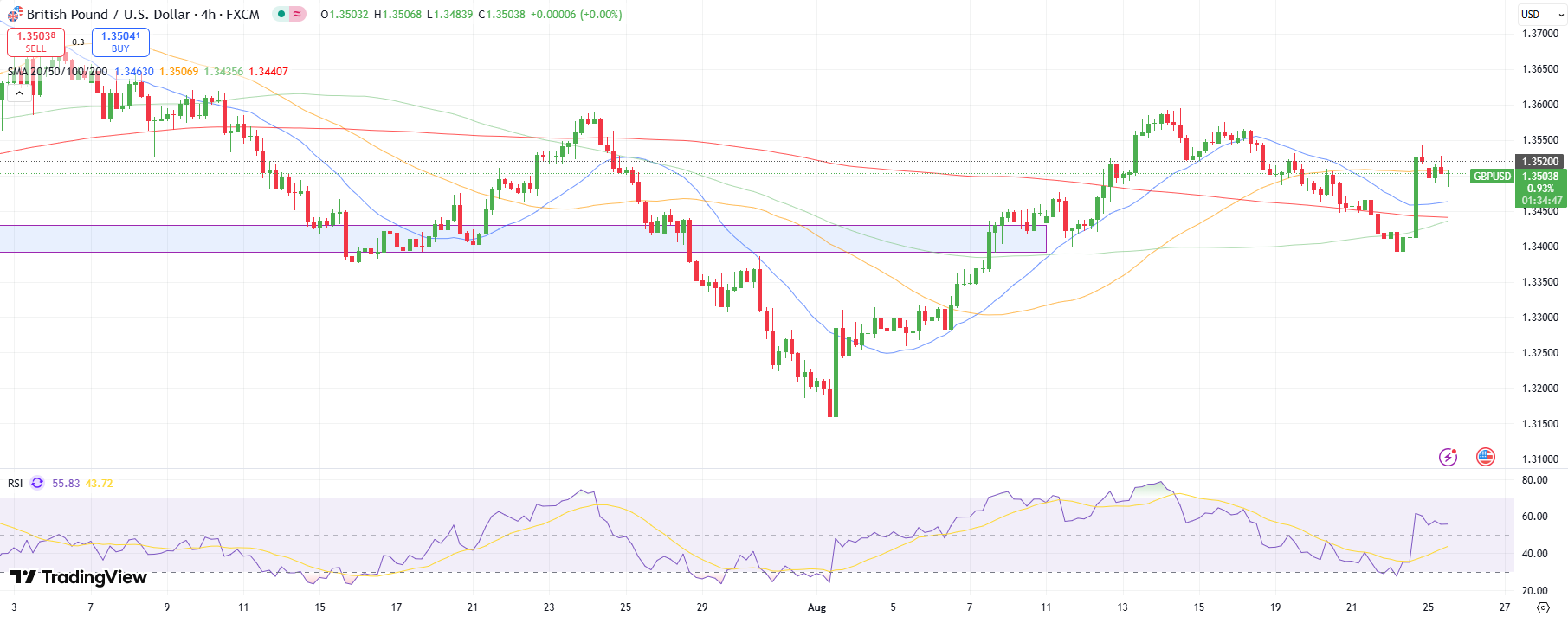
The GBP/USD 4-hour chart shows the pair is struggling to find acceptance above the 1.3500 handle. However, the pair has formed an inverse H&S pattern with neckline resistance at 1.3580. A decisive breakout could lead the rally to the 1.3700 mark.
–Are you interested in learning more about buying Dogecoin? Check our detailed guide-
The RSI remains neutral around 60.0, suggesting more room for the bulls but lacking a catalyst at the moment. On the downside, the immediate support emerges at 1.3460 ahead of 1.3400.
Looking to trade forex now? Invest at eToro!
68% of retail investor accounts lose money when trading CFDs with this provider. You should consider whether you can afford to take the high risk of losing your money.

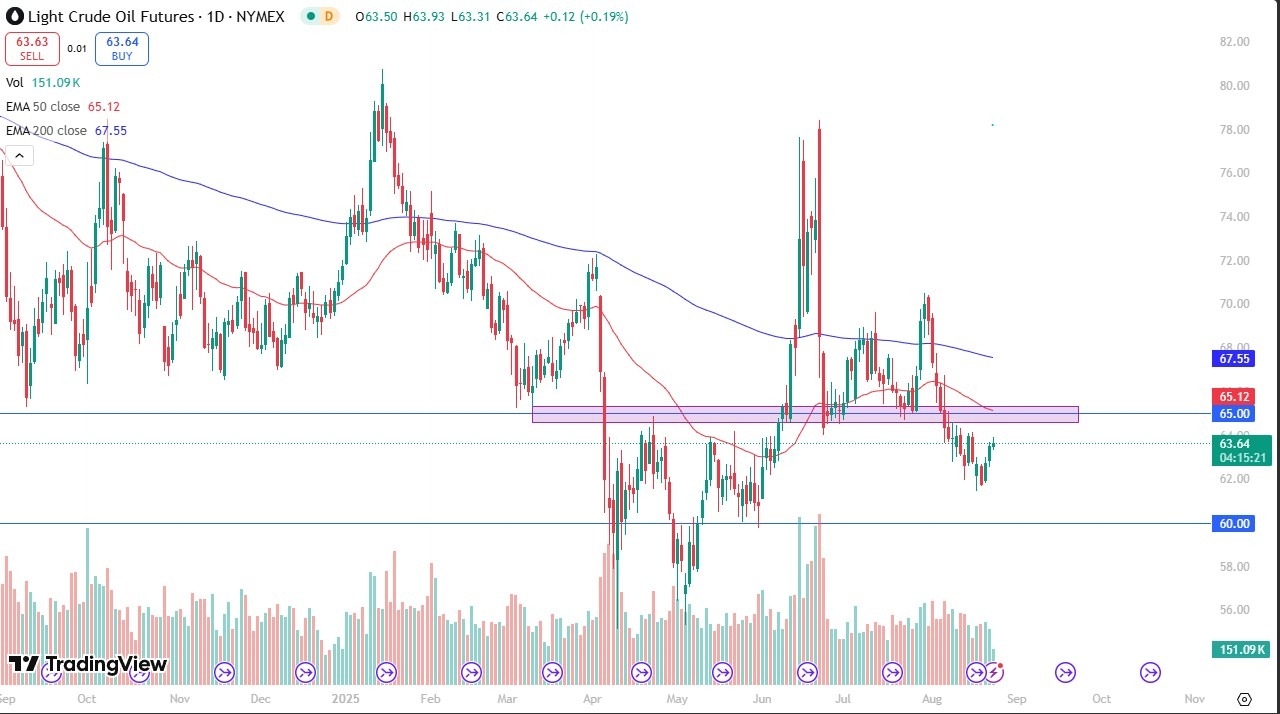
Keep in mind that the $65 level continues to be important from both a psychological standpoint, and of course from a “market memory” standpoint. It’s an area where we have seen a lot of support and resistance previously, and we do have the 50 Day EMA sitting right there as well offering resistance. If we can break above there, then the market is likely to take off toward the 200 Day EMA. On the other hand, if we reach their and show signs of exhaustion, I have no issues whatsoever in shorting the crude oil market, because there are a lot of things working against it. On a break down below the $62 level, it’s likely that WTI Crude will drop to the $60 handle.
Keep in mind that oversupply is going to continue to be a major issue here, as OPEC, Russia, and the United States are all producing massive amounts of crude oil at the moment. In fact, OPEC is set to add another 500,000 barrels to the market next month, meaning that it’s going to be very difficult for crude oil to hang on to any pricing power. This isn’t to say that we are suddenly going to fall apart and that crude oil is going to zero, but it wasn’t that long ago we had major issues with storage capacity, driving the futures markets to negative numbers. While I don’t necessarily look for that, we certainly have seen what this oversupply of crude can do to trading houses who find themselves suddenly on the hook to take delivery of something that can’t store. I think oil has plenty of headwinds at the moment.
Ready to trade daily crude oil price analysis? We’ve shortlisted the best Forex Oil trading brokers in the industry for you.
Christopher Lewis has been trading Forex and has over 20 years experience in financial markets. Chris has been a regular contributor to Daily Forex since the early days of the site. He writes about Forex for several online publications, including FX Empire, Investing.com, and his own site, aptly named The Trader Guy. Chris favours technical analysis methods to identify his trades and likes to trade equity indices and commodities as well as Forex. He favours a longer-term trading style, and his trades often last for days or weeks.
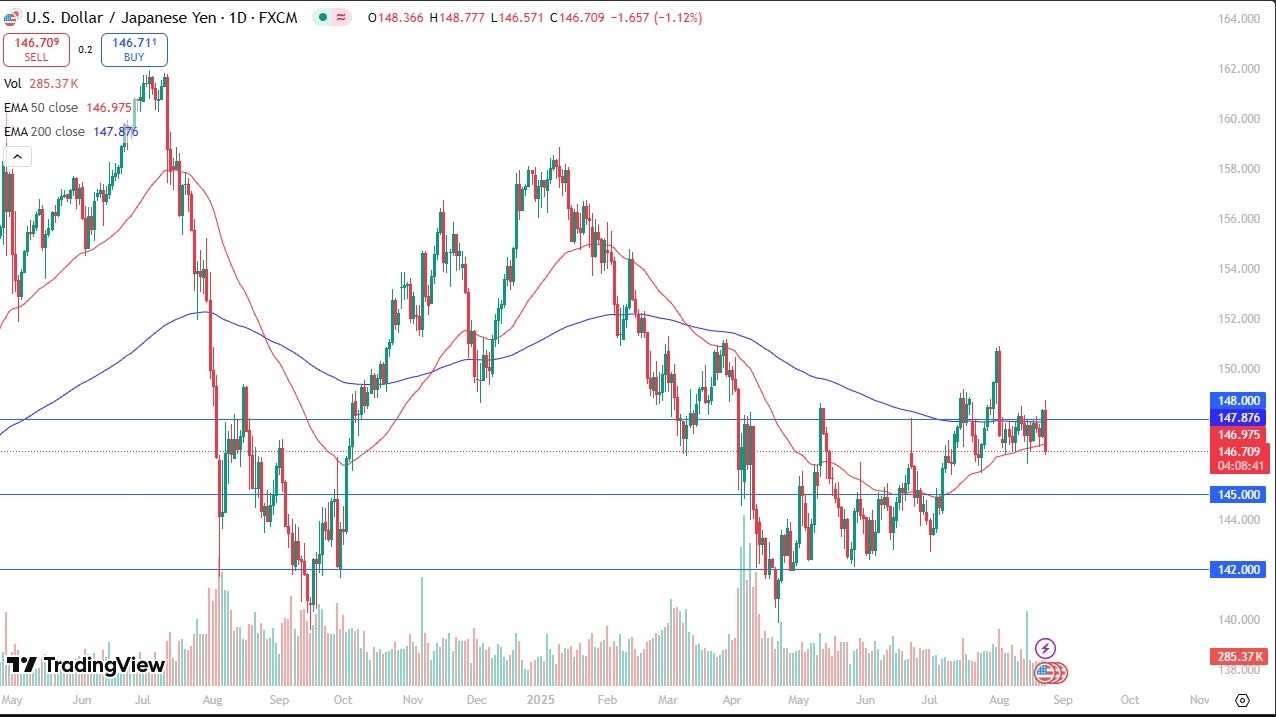
That being said, you have to be careful with these moves, because quite often, the initial “knee-jerk reaction” isn’t necessarily the correct one. After all, despite the fact that we have fallen rather significantly, we are basically just at the bottom of the consolidation area that we have been in for 2 weeks. The question then is whether or not this will change things? I don’t know if it will, I think it’s a little too early to make that determination, especially considering that even if the Federal Reserve were to cut twice this year, as the Fed Funds Futures markets expect, you are still talking about an interest rate differential that is wide enough to drive a truck through.
I’m watching the ¥149 level very closely, because if we were to break above there, then it would be very poor for the Japanese yen. Conversely, if we break down below the ¥146 level, then I think the US dollar could drop to the ¥145 level. Anything underneath there opens up the possibility of the ¥142 level being targeted.
Do not get me wrong, the candlestick is very ugly and could lead to something quite drastic. However, a couple of weeks ago we had a massive bearish engulfing candlestick that was followed up by nothing but sideways action. This is a very choppy and erotic currency pair, so make sure that you are careful with your position size.
Want to trade our USD/JPY forex analysis and predictions? Here’s a list of forex brokers in Japan to check out.
Christopher Lewis has been trading Forex and has over 20 years experience in financial markets. Chris has been a regular contributor to Daily Forex since the early days of the site. He writes about Forex for several online publications, including FX Empire, Investing.com, and his own site, aptly named The Trader Guy. Chris favours technical analysis methods to identify his trades and likes to trade equity indices and commodities as well as Forex. He favours a longer-term trading style, and his trades often last for days or weeks.