The main category of Forex News.
You can use the search box below to find what you need.
[wd_asp id=1]
The main category of Forex News.
You can use the search box below to find what you need.
[wd_asp id=1]
Gold (XAU/USD) was capped at the $4,175 area on Wednesday and is showing minor losses on Thursday, although it remains trading within the previous day’s range, with support around the $4,140 area holding downside attempts for now.
The US Dollar Index (DXY) is showing a mild recovery after dropping nearly 0.7% over the previous three days, which is weighing on Gold’s recovery. The precious metal is about 0.5% higher on the week, as growing hopes that the US Federal Reserve will cut rates further in December have sent US Treasury yields tumbling and the Greenback down with them
The technical pìcture shows the broader bullish trend still in play with XAU/USD trading at $4,156. The Relative Strength Index (RSI) in four-hour charts prints 58.73, above the midline, suggesting buyers retain a modest advantage, while the Moving Average Convergence Divergence (MACD) eases toward the zero line with its latest reading near positive territory, hinting at fading bullish momentum.
Wednesday’s highs at $4,175 are holding bulls for now, although the focus remains on the November 14 high, at $4,211, and the November peak, near $4,245.
On the downside, immediate support is seen at Wednesday’s low of $4,140, ahead of the November 25 low, right below $4,110. A confirmation below here would cancel the bullish scenario and bring the November 20,21, and 24 lows, between $4,020 and $4,040, back into play.
(The technical analysis of this story was written with the help of an AI tool)
Gold has played a key role in human’s history as it has been widely used as a store of value and medium of exchange. Currently, apart from its shine and usage for jewelry, the precious metal is widely seen as a safe-haven asset, meaning that it is considered a good investment during turbulent times. Gold is also widely seen as a hedge against inflation and against depreciating currencies as it doesn’t rely on any specific issuer or government.
Central banks are the biggest Gold holders. In their aim to support their currencies in turbulent times, central banks tend to diversify their reserves and buy Gold to improve the perceived strength of the economy and the currency. High Gold reserves can be a source of trust for a country’s solvency. Central banks added 1,136 tonnes of Gold worth around $70 billion to their reserves in 2022, according to data from the World Gold Council. This is the highest yearly purchase since records began. Central banks from emerging economies such as China, India and Turkey are quickly increasing their Gold reserves.
Gold has an inverse correlation with the US Dollar and US Treasuries, which are both major reserve and safe-haven assets. When the Dollar depreciates, Gold tends to rise, enabling investors and central banks to diversify their assets in turbulent times. Gold is also inversely correlated with risk assets. A rally in the stock market tends to weaken Gold price, while sell-offs in riskier markets tend to favor the precious metal.
The price can move due to a wide range of factors. Geopolitical instability or fears of a deep recession can quickly make Gold price escalate due to its safe-haven status. As a yield-less asset, Gold tends to rise with lower interest rates, while higher cost of money usually weighs down on the yellow metal. Still, most moves depend on how the US Dollar (USD) behaves as the asset is priced in dollars (XAU/USD). A strong Dollar tends to keep the price of Gold controlled, whereas a weaker Dollar is likely to push Gold prices up.
slips as investors continue to digest the Chancellor’s Budget. hovers below 1.16 ahead of EZ and ECB meeting minutes.
GBP/USD is easing lower after solid gains yesterday as investors continue to digest the UK budget.
Despite the chaotic start to the Budget, which saw the OBR mistakenly release the Budget measures and forecasts ahead of Chancellor Rachel Reeves’s speech, the markets initially liked what they saw.
The Chancellor’s tax-heavy budget meant she managed to double her fiscal headroom to £22 billion, well above the 15 billion that economists had expected. This was sufficient to please the bond market at least for now, sending yields across the curve lower.
However, this was pretty much where the good news ended. The OBR downgraded UK growth in 2026 to 1.4% down from 1.9%, and it also upwardly revised inflation. Welfare spending is soaring, living standards are expected to rise more slowly, and the tax burden will reach a record high of 38% of GDP.
While the markets liked the larger fiscal margin, there is still reason to be cautious given increased spending in the near term, whilst the tax hikes will take effect later. This means that if economic growth falls short of expectations, tax revenues could be lower and spending higher, eroding the headroom once again. With the tax hikes back-loaded, the plan’s credibility won’t be known for some time.
The Bank of England is still expected to at the December meeting, which limits sterling’s upside.
The USD is rising today but is lower for the week amid expectations that the Federal Reserve will cut interest rates at its December meeting. U.S. markets are closed for Thanksgiving today, so volumes could be thin.
GBP/USD has recovered from its 1.3040 November low, rising above 1.32 and the falling trendline, which, combined with the RSI above 50, keeps buyers hopeful of further gains.
Buyers will look to extend the recovery above the 200 SMA at 1.33. A rise above 1.3350 puts the pair on a more stable footing.
On the downside, support is seen at 1.32, and below, here, 1.31 support comes into focus. A break below 1.30 could spur a deeper sell-off towards 1.27.
EUR/USD is holding steady, just below 116, and its highest level since mid-November, as investors look towards a busy economic calendar at the end of this month, including inflation data from Germany, the eurozone’s largest economy, on Friday.
Today, German consumer confidence showed a slight improvement heading into December as households showed more willingness to spend ahead of the holiday season. This was a bright point in data after figures earlier in the week showed that German stagnated and Ifo business sentiment deteriorated.
Looking ahead, eurozone is due later today, along with the minutes from the meeting at which the central bank left unchanged.
On the policy front, the ECB is widely expected to keep interest rates unchanged through 2026, supported by resilient economic growth and near the 2% target.
Meanwhile, the US donor is on track for its worst weekly performance in four months amid thin volumes due to the US Thanksgiving holiday.
The has come under pressure amid rising expectations that the Federal Reserve will in the December meeting. Softer-than-expected U.S. economic data and dovish comments from several Fed officials now have the market pricing in an 85% probability of a rate cut next month, up from 30% last week.
The ECB-Fed rate path diversion could support EUR/USD higher.
After falling away from 1.1920, the 2025 high, EUR/USD is trading in a holding pattern supported on the downside by the 1,145—1.15 support zone, while the 50 SMA caps gains. The RSI is neutral.
Buyers will need to rise above he 50 SMA at 1.1630 to extend gains towards 1.17. Above here, 1.1780 comes into focus.
Failure to rise above the 50 SMA could see the price retest the 1.1450-1.15 support zone. A break below here exposes the 200 SMA at 1.1420. Should sellers take out support at 1.14, the July low, this could spur a much deeper decline towards 1.12.

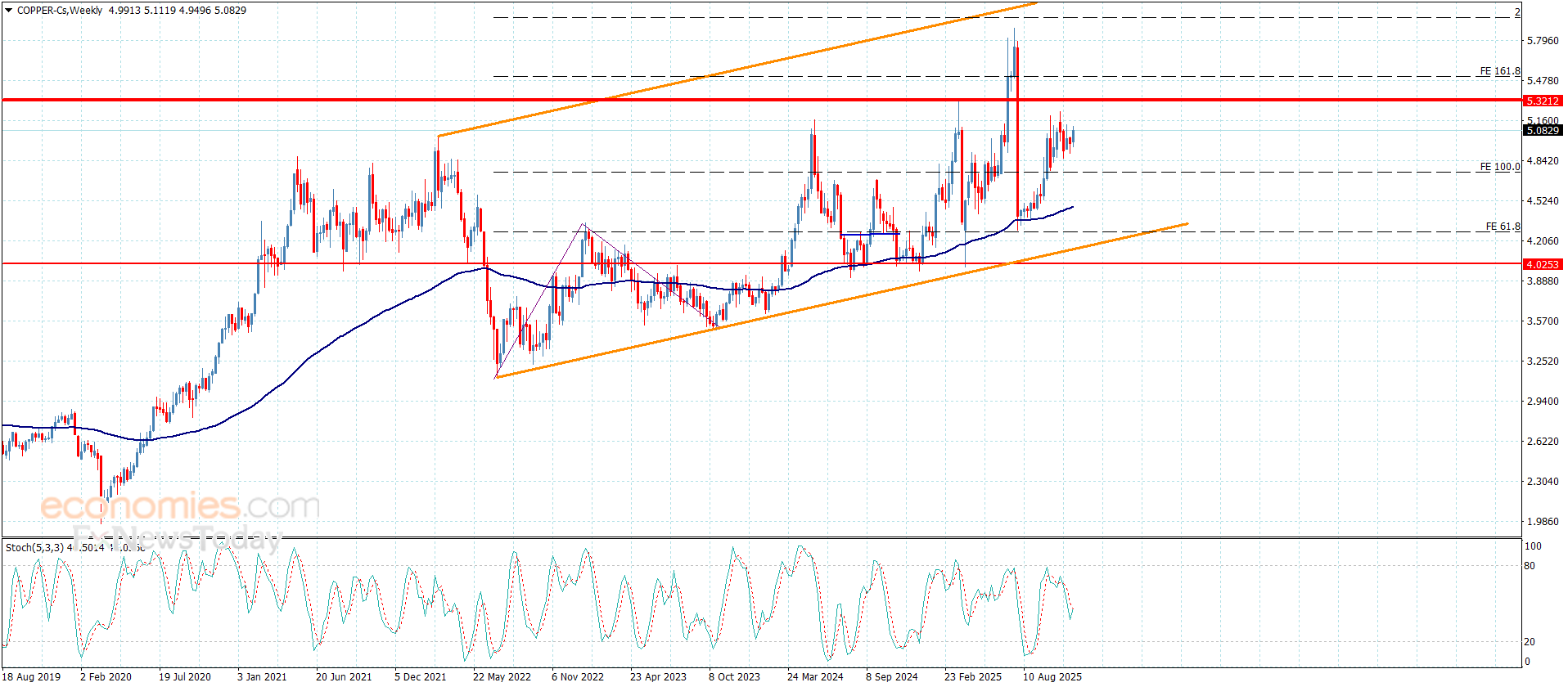
Copper price succeeded in recording some gains by hitting $5.1200 level, depending on the positive factors that are represented by the stability of the support level at $4.7500, besides the continuation of the positive factors that are represented by the support at $4.7500 besides the continuation of the attempts to provide bullish momentum by the main indicators.
Reminding you that surpassing the barrier at $5.2000 and holding above it is important to reinforce the efficiency of the bullish scenario, then begin targeting new positive stations by its rally towards $5.3200 and $5.5000.
The expected trading range for today is between $4.9800 and $5.2000
Trend forecast: Bullish
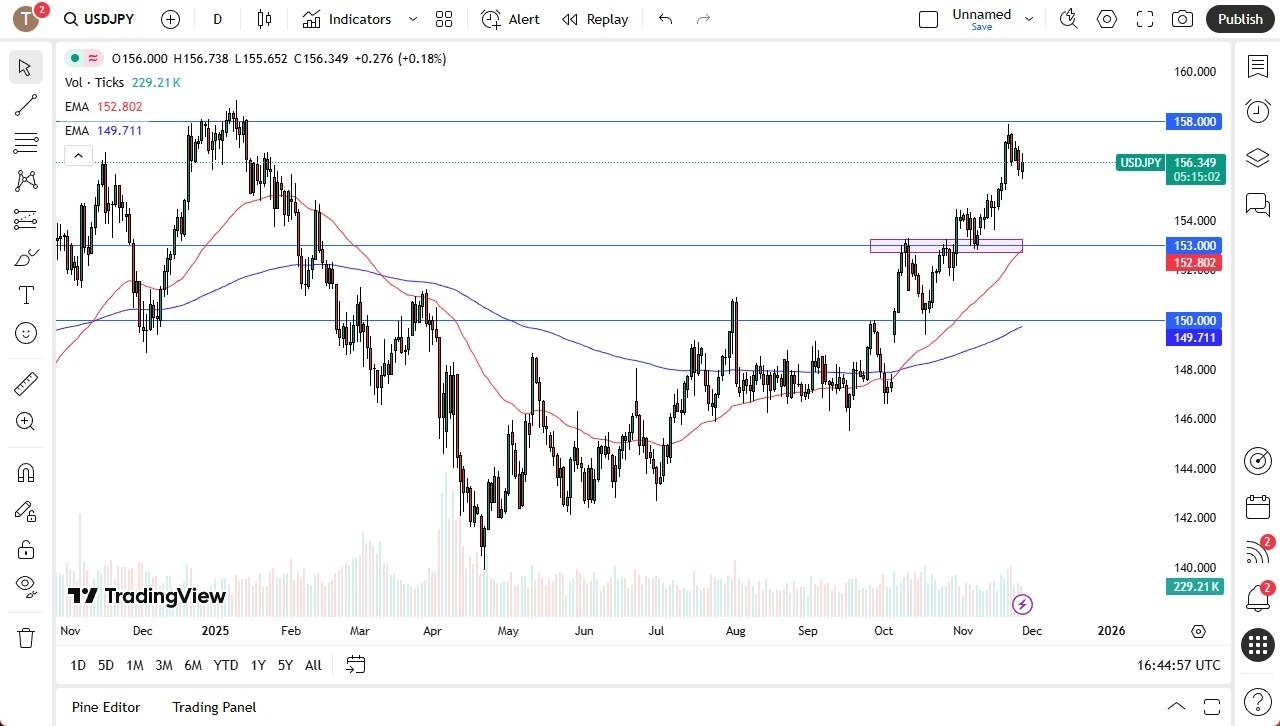
The US dollar has shown itself to be a little bit positive against the Japanese yen during trading on Wednesday, but really, at this point, I think we have a situation where traders are just kind of kicking the ball around.

Because of the lack of volume that will be featured on Thursday, all things being equal, the Thursday session will probably be very short-lived because the United States will be celebrating the Thanksgiving holiday. Because of this, I think you’ve got a situation where Thursday is probably a nonsensical trading session.
The reality now is that the Friday session might be looked at as a little bit more normal, but really, volumes will be pretty anemic then as well. For the most part, the week’s done. So, with that being said, expect a little bit of noise. I would love to see some type of pullback to get involved in this market, perhaps closer to the 154 yen level and take advantage of cheap dollars, but we may or may not get it.
If we can break above the 158 yen level, that’s obviously a very bullish turn of events. But right now, everybody’s expecting the Federal Reserve to start cutting rates massively again, as the market continues to swing from one extreme to the other. With that being the case, you have to be very cautious, but the interest rate differential, even with a rate cut, doesn’t change the equation; you still get paid to hold this pair. And over the longer term, that will continue to be something that people pay attention to.
Want to trade our USD/JPY forex analysis and predictions? Here’s a list of forex brokers in Japan to check out.
Christopher Lewis has been trading Forex and has over 20 years experience in financial markets. Chris has been a regular contributor to Daily Forex since the early days of the site. He writes about Forex for several online publications, including FX Empire, Investing.com, and his own site, aptly named The Trader Guy. Chris favours technical analysis methods to identify his trades and likes to trade equity indices and commodities as well as Forex. He favours a longer-term trading style, and his trades often last for days or weeks.
Copper price succeeded in recording some gains by hitting $5.1200 level, depending on the positive factors that are represented by the stability of the support level at $4.7500, besides the continuation of the positive factors that are represented by the support at $4.7500 besides the continuation of the attempts to provide bullish momentum by the main indicators.
Reminding you that surpassing the barrier at $5.2000 and holding above it is important to reinforce the efficiency of the bullish scenario, then begin targeting new positive stations by its rally towards $5.3200 and $5.5000.
The expected trading range for today is between $4.9800 and $5.2000
Trend forecast: Bullish
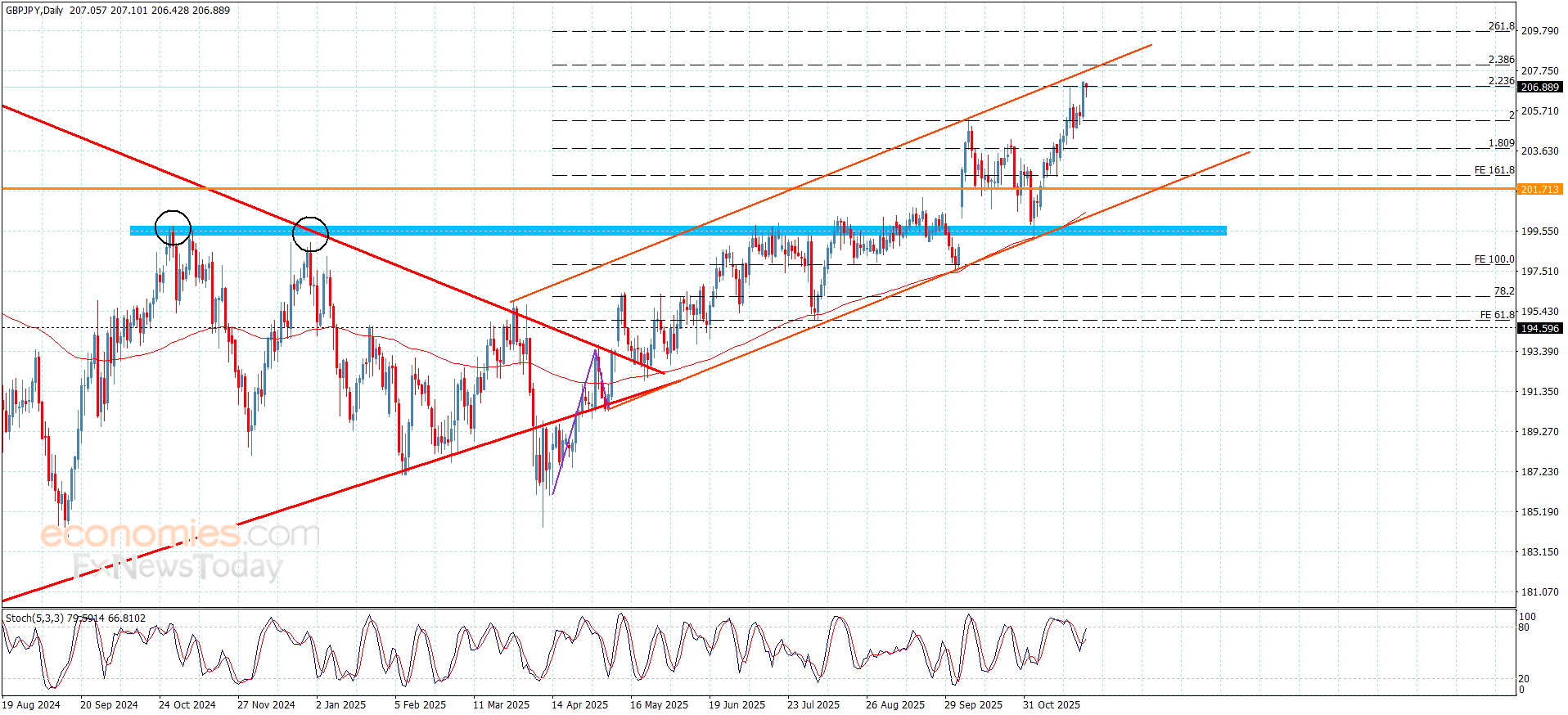
The GBPJPY pair suffered strong bullish pressures, pushing it to settle above 206.00 level, forming new bullish rally to press on the barrier at 206.90, attempting to record extra gains by hitting 207.20 level.
Note that stochastic attempt to reach the overbought level, which might provide a new bullish momentum to push it to provide more of the bullish waves by targeting the bullish channel’s resistance towards 207.65, while activating the bearish corrective scenario requires forming a sharp decline, which allows it to break the extra support at 205.20.
The expected trading range for today is between 206.25 and 207.65
Trend forecast: Bullish
Silver price (XAG/USD) declines after three days of gains, trading around $52.80 during the Asian hours on Thursday. However, the non-interest-bearing Silver may regain its ground amid rising odds of Federal Reserve (Fed) rate cut bets in December, given that lower interest rates reduce the opportunity cost of holding non-yielding assets.
US data showed unexpectedly low Initial Jobless Claims and stronger-than-expected Durable Goods Orders, yet rate-cut expectations remained intact. The CME FedWatch Tool suggests that markets are now pricing in a more than 84% chance that the Fed will cut its benchmark overnight borrowing rate by 25 basis points (bps) at its December meeting, up from the 30% probability that markets priced a week ago.
The US Department of Labor (DOL) reported on Wednesday that Initial Jobless Claims fell to 216,000 for the week ending November 22, down 6,000 from the previous week’s revised figure. The result was stronger than the market expectation of 225,000. Meanwhile, the 4-week moving average eased by 1,000 to 223,750.
Fed rate expectations increased by reports that the White House has narrowed its search for the next Fed chair to National Economic Council Director Kevin Hassett. Investors see Hassett as supportive of US President Donald Trump’s preference for lower interest rates.
The dollar-denominated Silver attracts buyers with foreign currencies amid a weakening Greenback. The US Dollar Index (DXY), which measures the value of the US Dollar (USD) against six major currencies, is losing ground for the third successive session and trading around 99.50 at the time of writing.
Silver is a precious metal highly traded among investors. It has been historically used as a store of value and a medium of exchange. Although less popular than Gold, traders may turn to Silver to diversify their investment portfolio, for its intrinsic value or as a potential hedge during high-inflation periods. Investors can buy physical Silver, in coins or in bars, or trade it through vehicles such as Exchange Traded Funds, which track its price on international markets.
Silver prices can move due to a wide range of factors. Geopolitical instability or fears of a deep recession can make Silver price escalate due to its safe-haven status, although to a lesser extent than Gold’s. As a yieldless asset, Silver tends to rise with lower interest rates. Its moves also depend on how the US Dollar (USD) behaves as the asset is priced in dollars (XAG/USD). A strong Dollar tends to keep the price of Silver at bay, whereas a weaker Dollar is likely to propel prices up. Other factors such as investment demand, mining supply – Silver is much more abundant than Gold – and recycling rates can also affect prices.
Silver is widely used in industry, particularly in sectors such as electronics or solar energy, as it has one of the highest electric conductivity of all metals – more than Copper and Gold. A surge in demand can increase prices, while a decline tends to lower them. Dynamics in the US, Chinese and Indian economies can also contribute to price swings: for the US and particularly China, their big industrial sectors use Silver in various processes; in India, consumers’ demand for the precious metal for jewellery also plays a key role in setting prices.
Silver prices tend to follow Gold’s moves. When Gold prices rise, Silver typically follows suit, as their status as safe-haven assets is similar. The Gold/Silver ratio, which shows the number of ounces of Silver needed to equal the value of one ounce of Gold, may help to determine the relative valuation between both metals. Some investors may consider a high ratio as an indicator that Silver is undervalued, or Gold is overvalued. On the contrary, a low ratio might suggest that Gold is undervalued relative to Silver.
The GBPJPY pair suffered strong bullish pressures, pushing it to settle above 206.00 level, forming new bullish rally to press on the barrier at 206.90, attempting to record extra gains by hitting 207.20 level.
Note that stochastic attempt to reach the overbought level, which might provide a new bullish momentum to push it to provide more of the bullish waves by targeting the bullish channel’s resistance towards 207.65, while activating the bearish corrective scenario requires forming a sharp decline, which allows it to break the extra support at 205.20.
The expected trading range for today is between 206.25 and 207.65
Trend forecast: Bullish
Gold (XAU/USD) trades at $4,167 per ounce, regaining strength after weeks of consolidation and touching a two-week high of $4,169. The move reflects a decisive rotation into safe-haven assets as weak U.S. data fuels expectations of a December Federal Reserve rate cut, now priced at over 80% probability, up sharply from 50% last week. The metal has now gained 57.9% year-to-date, supported by persistent central bank accumulation, ETF inflows, and the broad weakening of the U.S. dollar. Gold’s current trading range between $3,900 and $4,400 forms the tightest and most critical consolidation zone of 2025, and the upcoming Fed meeting on December 17–18 is likely to determine whether the next leg is toward $4,500 or back to $4,000 support.
The U.S. macro backdrop remains the defining driver. Retail sales missed forecasts, consumer confidence fell to 88.7 — the lowest since May, and PPI data stagnated. These weak readings have accelerated expectations for monetary easing. Treasury yields dropped for a fourth straight session, with the 10-year yield sliding below 4.02%, reinforcing the narrative of a softer dollar environment. Fed officials, including Christopher Waller, have signaled openness to rate cuts in response to slower inflation and labor softening. The result has been a notable reduction in real yields — a major tailwind for non-yielding assets such as gold. XAU/USD benefits directly: the lower yield environment reduces opportunity cost, and dovish expectations now imply a two-cut cycle in H1 2026, which could sustain the gold uptrend into the mid-$4,000s.
Technically, XAU/USD shows sustained momentum. Immediate resistance sits at $4,210, followed by secondary resistance at $4,370–$4,400, corresponding to historical highs. Support levels hold firm at $4,150, $4,000, and $3,900, with a wider safety buffer between $3,300 and $3,450 aligning with the 200-day EMA. The Relative Strength Index (RSI) on the 4-hour chart remains above 60, signaling ongoing bullish momentum, while the MACD histogram shows a widening green spread, confirming positive price acceleration. The 50-day EMA near $4,000 acts as a key psychological and structural defense zone. If gold breaches $4,210, the path opens toward $4,370, and ultimately the Fibonacci extension targets at $5,000 (100%) and $5,500 (161.8%) projected from the July-to-October impulse wave.
Institutional projections now converge on a higher 2026 target range: Deutsche Bank raised its forecast to $4,450/oz, expecting a $3,950–$4,950 trading range next year, with persistent ETF inflows maintaining a strong support floor near $3,900. Goldman Sachs predicts a $4,900 target by late 2026, citing 75 bps in expected global rate cuts and renewed central bank diversification after the freezing of Russian reserves. Bank of America foresees a $5,000 level, driven by U.S. deficit expansion and inflationary fiscal policy under Trump’s administration. HSBC projects a $3,600–$4,400 range, acknowledging geopolitical risk and global trade tensions as persistent supports but noting potential drag from higher physical supply and slowed bank purchases. Despite differing targets, the institutional alignment on the $4,400–$5,000 band underlines a unified bullish bias rooted in both policy and structural drivers.
Deutsche Bank analyst Michael Hsueh highlighted that gold’s performance is being underpinned by inelastic official-sector demand. Central banks continue to accumulate aggressively, seeking protection against geopolitical and reserve risks. Surveys show the highest percentage of central banks planning gold accumulation in years, with one respondent calling gold the “ultimate protection against black-swan tail risk events.” Official purchases in Q3 ranked as the third-highest on record, even at elevated price levels. ETF flows have also reversed four years of outflows, shifting back to net accumulation. This institutional behavior absorbs supply that would otherwise enter the jewelry and industrial markets, creating an artificial scarcity that supports price floors. Physical supply growth remains constrained: 2026 mined output is expected at 3,715 tonnes, with disruptions at Indonesia’s Grasberg mine offsetting new projects. Recycling rates remain below historical peaks, and major miners still model internal assumptions at $2,500–$3,000, limiting capacity expansion. This structural mismatch — expanding official demand versus inelastic supply — continues to define the bullish setup for XAU/USD into 2026.
According to a Bank of America fund manager survey, only 5% of global portfolio managers expect gold above $5,000 by 2026, while 39% hold no gold exposure at all. This imbalance between price strength and institutional participation signals latent upside. Historically, similar conditions — strong fundamentals combined with under-allocation — preceded multi-quarter rallies. The Kobeissi Letter data underscores this divergence: 34% of investors expect gold between $4,000 and $4,500, while just 8% predict sub-$3,500 levels. Such skepticism amid structural demand growth suggests gold remains under-owned relative to macro risk, positioning it as one of the few assets capable of outperforming in both inflationary and deflationary environments.
Persistent geopolitical and fiscal instability continues to reinforce the appeal of gold. The U.S. fiscal deficit is widening sharply, with debt-to-GDP expected to exceed 122% in 2026, sustaining long-term inflationary pressure. Simultaneously, ongoing tariff escalations under the Trump administration raise global trade friction and increase demand for neutral assets like gold. In parallel, China and India — representing over 50% of global retail gold demand — remain key stabilizers. Seasonal physical buying, particularly ahead of the Lunar New Year, tends to amplify price strength in early Q1. The Dollar Index (DXY) remains below 100, its lowest in 12 months, while global liquidity measures continue to improve as central banks loosen policy. Combined, these conditions suggest macro tailwinds remain intact for XAU/USD through the first half of 2026.
Fibonacci mapping from July lows to October highs sets a 100% extension target at $5,000 and 161.8% extension above $5,500, validating the bullish case. The $4,200–$4,210 resistance remains the immediate test area; breaking it confirms the start of an expansion phase toward the upper bound. Momentum indicators show constructive alignment. The Stochastic Oscillator at 62 and CCI at +84 support continued upward bias. Volumes have begun expanding again on each up-leg, confirming institutional re-entry. A sustained close above $4,210 unlocks the $4,370–$4,400 zone, while closing above $4,400 shifts focus toward $4,900. Conversely, a break below $4,000 risks a pullback to $3,900, though long-term support near $3,300–$3,450 ensures the broader uptrend remains structurally intact.
The juxtaposition of official sector accumulation, ETF re-engagement, and investor skepticism creates a textbook setup for asymmetric upside. The Deutsche Bank, Goldman Sachs, and BofA alignment near $4,900–$5,000 underscores that even conservative models expect double-digit gains through 2026. The combination of lower real yields, persistent inflation, tight mine supply, and currency debasement risks continues to position gold as the premier macro hedge. Every pullback into the $3,900–$4,000 range remains a high-probability accumulation zone for long-term investors. Verdict: STRONG BUY — Gold (XAU/USD) is fundamentally and technically supported for continued appreciation. The next major breakout above $4,210 opens room toward $4,400, followed by $5,000–$5,500 Fibonacci targets. Downside risk remains limited while real rates and U.S. fiscal policy both point to sustained medium-term bullish momentum.
– Written by
David Woodsmith
STORY LINK GBP to USD Forecast: Pound Sterling Breaks Above $1.32 After Budget Boost
The Pound-to-Dollar exchange rate (GBP/USD) climbed above $1.32 on Wednesday as UK Chancellor Rachel Reeves delivered her autumn budget.
At the time of writing, GBP/USD was trading around $1.3207, up roughly 0.3% from its opening levels.
The Pound (GBP) strengthened through Wednesday as Chancellor Rachel Reeves finally unveiled her much-anticipated autumn budget, ending weeks of uncertainty.
Sterling was boosted by refreshed forecasts from the Office for Budget Responsibility (OBR), which pointed to stronger growth prospects in 2025 than previously expected.
Investor confidence was also helped by the bond market reaction, with a drop in UK gilt yields signalling broad approval of Reeves’s fiscal package.
The US Dollar (USD) remained under pressure on Wednesday, with demand for the safe-haven currency fading amid a wave of improved risk appetite.
A key driver of the upbeat mood was renewed optimism surrounding a potential peace deal between Ukraine and Russia, with reports suggesting encouraging progress in ongoing talks.
Get better rates and lower fees on your next international money transfer.
Compare TorFX with top UK banks in seconds and see how much you could save.
Further weighing on the Dollar were increasingly dovish expectations for future Federal Reserve policy.
Markets continue to price the possibility of a December rate cut, while speculation over Fed leadership added another layer of caution.
White House Economic Adviser Kevin Hassett is now widely seen as a frontrunner to replace Jerome Powell next year – a potential shift that could tilt the Fed in a more dovish direction.
Looking to Thursday, deeper scrutiny of the autumn budget is likely to influence further movement in the Pound to US Dollar exchange rate.
Investors will assess how Reeves’s tax and spending plans may shape Bank of England (BoE) monetary policy – particularly whether tighter fiscal settings increase pressure on policymakers to support growth through additional rate cuts.
Meanwhile, with US markets closed for Thanksgiving, lighter trading conditions could leave the Dollar more vulnerable to shifts in overall risk appetite. If optimism holds, USD may struggle to regain momentum.

International Money Transfer? Ask our resident FX expert a money transfer question or try John’s new, free, no-obligation personal service! ,where he helps every step of the way,
ensuring you get the best exchange rates on your currency requirements.
TAGS: Pound Dollar Forecasts