The main category of Forex News.
You can use the search box below to find what you need.
[wd_asp id=1]
The main category of Forex News.
You can use the search box below to find what you need.
[wd_asp id=1]
The global financial landscape is undergoing a seismic shift, driven by macroeconomic realignment and the erosion of U.S. dollar dominance. Bank of America’s latest EUR/USD forecast—projecting the pair to reach 1.20 by year-end 2025 and 1.25 by 2026—signals a pivotal moment in currency dynamics. This bold outlook is not merely a technical prediction but a reflection of deep structural forces reshaping risk allocation and capital flows. For investors, understanding these drivers and adapting strategies accordingly is no longer optional—it is imperative.
Bank of America’s forecast hinges on three interlocking factors: stagflation risks, Fed policy uncertainty, and institutional erosion.
Stagflation and the Fed’s Dilemma
The U.S. economy is teetering on the edge of stagflation—a toxic mix of weak growth and stubborn inflation. Softening labor market data, coupled with inflation stubbornly above 4%, has forced the Federal Reserve into a precarious balancing act. While the Fed’s independence is under political siege, its potential dovish pivot to ease a slowing economy could accelerate dollar depreciation. Historically, stagflation erodes the dollar’s appeal, as seen in the 1970s, when the euro’s predecessor, the ECU, gained traction.
Institutional Erosion and Data Skepticism
Trust in U.S. economic institutions is crumbling. The recent overhaul of the Bureau of Labor Statistics and the politicization of inflation data have sown doubt among global investors. If inflation metrics are perceived as manipulated, the Fed’s credibility—and with it, the dollar’s—will suffer. This skepticism is already fueling a shift in capital toward the euro, which benefits from Europe’s more transparent governance and fiscal stimulus in Germany.
Trump’s Protectionist Tailwinds
President Donald Trump’s aggressive tariff policies are exacerbating inflationary pressures while simultaneously weakening the dollar. By design, these tariffs aim to boost U.S. exports, but they also signal a retreat from global cooperation. The resulting trade tensions and higher input costs are pushing investors toward the euro, which is now seen as a safer bet in a fragmented world.
The U.S. dollar’s share of global reserves has fallen to a two-decade low of 58%, while gold and the yuan are gaining ground. This de-dollarization trend is most visible in commodity markets, where energy contracts are increasingly priced in non-dollar currencies. Russian oil exports to China and India, for instance, are now settled in yuan and rubles, reducing reliance on the dollar.
Emerging markets are also rethinking their dollar exposure. Latin America’s 19.1% deposit dollarization rate remains high, but countries like China are actively de-dollarizing domestic transactions. Meanwhile, central banks in Turkey, Russia, and India are stockpiling gold, with its share in EM reserves doubling since 2015 to 9%.
Investors must adapt to a post-dollar era by diversifying portfolios, hedging risks, and capitalizing on non-dollar opportunities.
Diversify Reserves and Portfolios
Reduce overexposure to U.S. Treasuries and dollar-denominated assets. Allocate to eurozone bonds, gold, and emerging market equities. The euro’s appreciation against the dollar is supported by Europe’s fiscal stimulus and Germany’s economic rebound.
Hedge Against Dollar Volatility
With the dollar’s “safe-haven” status in question, institutional investors are raising currency hedge ratios. Use forwards and options to lock in favorable EUR/USD rates, especially as the euro’s technical indicators suggest a sustained upward trend.
Tap into Non-Dollar Commodities
Invest in gold and commodities priced in yuan or euros. As energy and raw materials shift away from dollar pricing, these assets offer both diversification and inflation protection.
Monitor Dollar Smile Flattening
The Dollar Smile framework—where the dollar strengthens during U.S. growth or global risk aversion—is flattening. Larger macroeconomic shocks, such as a U.S. fiscal crisis or geopolitical conflict, will now be required to drive significant dollar movements. Position for both scenarios.
The euro’s rebound is not a short-term anomaly but a symptom of a broader realignment. Investors must recognize that the dollar’s dominance is waning, not collapsing. While no credible alternative has yet emerged to replace it, the euro’s structural advantages—transparency, fiscal coordination, and a growing role in global trade—make it a compelling long-term bet.
For now, the dollar remains a core strategic asset, but its role as the sole anchor of global finance is diminishing. A diversified portfolio that includes the euro, gold, and non-dollar commodities will be better positioned to navigate the uncertainties of a multipolar world.
Bank of America’s EUR/USD forecast is a clarion call for investors to rethink their assumptions about currency dynamics. The euro’s strategic rebound is not just a technical play—it is a macroeconomic inevitability driven by stagflation, institutional erosion, and de-dollarization. By adopting proactive strategies that hedge against dollar volatility and capitalize on non-dollar opportunities, investors can thrive in this new era.
The future of global finance is no longer unipolar. It is multipolar—and those who adapt will lead the way.
– Written by
David Woodsmith
STORY LINK Euro to Dollar Forecast: EUR/USD “at 1.20 by End of 2025”
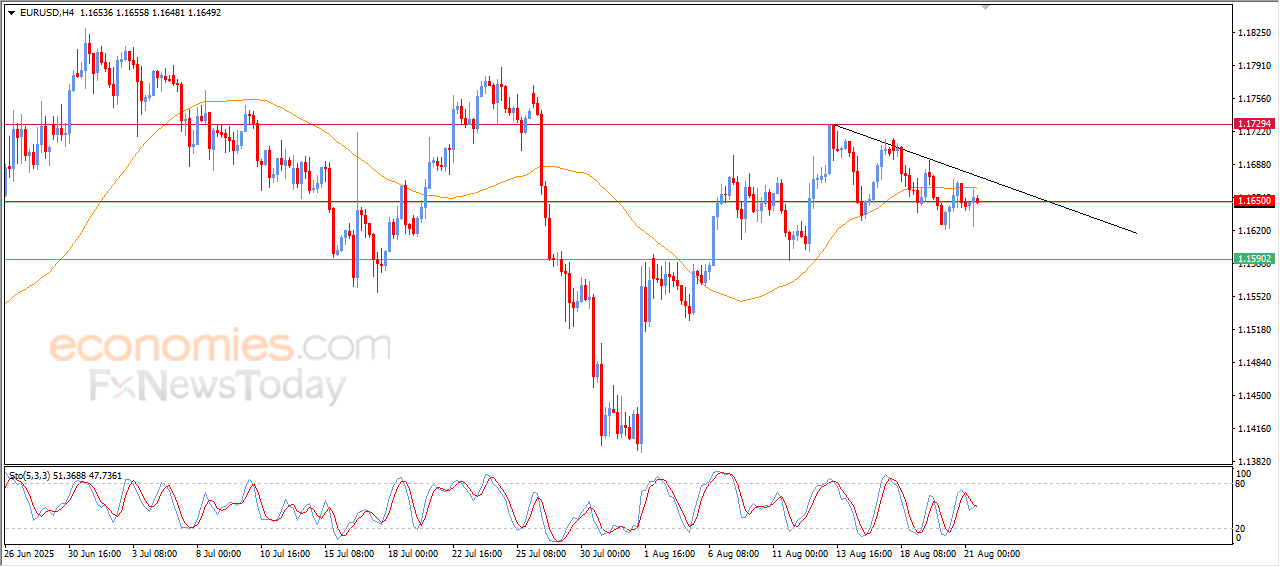
The Euro to Dollar exchange rate (EUR/USD) has consolidated just below the 1.1650 level as narrow ranges have prevailed with the latest Fed chatter not causing sustained dollar damage.
UoB commented; “Momentum indicators are turning flat, and EUR is likely to trade within a range today, probably between 1.1630 and 1.1680.”
ING added; “We may see another tight 1.1620-1.1670 trading range in EUR/USD today, with the biggest chance of a breakout remaining Powell’s speech tomorrow.”
According to Scotiabank; “The two-week range has been roughly bound between 1.1600 support and 1.1720 resistance, offering little in terms of near-term direction.”
ING is forecasting that EUR/USD will strengthen to 1.20 by the end of 2025.
There was little impact from Federal Reserve minutes from the July policy meeting with committee comments on economic risks seen to be outdated given the subsequent weak Jobs report.
Traders were still engaged in a waiting game ahead of Fed Chair Powell’s speech to the Jackson Hole symposium on Friday.
Markets are pricing in just below an 80% chance of a rate cut at the September meeting.
Funds will continue to monitor Administration efforts to influence the Federal Reserve Board and interest rates.
The latest spark of concern centred on Trump’s calls for Governor Cook to resign. The calls came after reports that she was being investigated for possible financial fraud.
According to Scotiabank; “Now, President Trump would apparently like to say “you’re fired” to Governor Cook, a centrist/dovish voice on the Board, amid accusations of mortgage fraud.”
It added; “If anything, these sorts of manoeuvres may make the Fed even less inclined to adjust policy in the short run. In the longer run, the perception of an erosion in the Fed’s independence may result in investors demanding a higher risk premium for holding USD-denominated assets.”
MUFG commented; “If she was forced to step down it would further increase President Trump’s influence on setting Fed policy. His influence on policy setting is already set to increase in the year ahead when Jerome Powell’s term as Fed Chair comes to an end in May.”
Commonwealth Bank of Australia senior economist Kristina Clifton also noted market concerns; “Perceived political interference in the Federal Reserve can undermine its independence, steepening the yield curve and denting the USD’s safe haven status.”

Administration rhetoric will continue to be watched very closely.
Earlier, the Euro-Zone recorded slightly stronger than expected PMI business confidence data.
ING commented; “The small increase in the composite PMI from 50.9 to 51.1 indicates that the eurozone economy continues to weather global storms quite well. Improvements in new orders and increased hiring add to a picture of accelerating growth, but a muted pace seems likely given significant downside risks to the outlook.”
International Money Transfer? Ask our resident FX expert a money transfer question or try John’s new, free, no-obligation personal service! ,where he helps every step of the way,
ensuring you get the best exchange rates on your currency requirements.
TAGS: Euro Dollar Forecasts
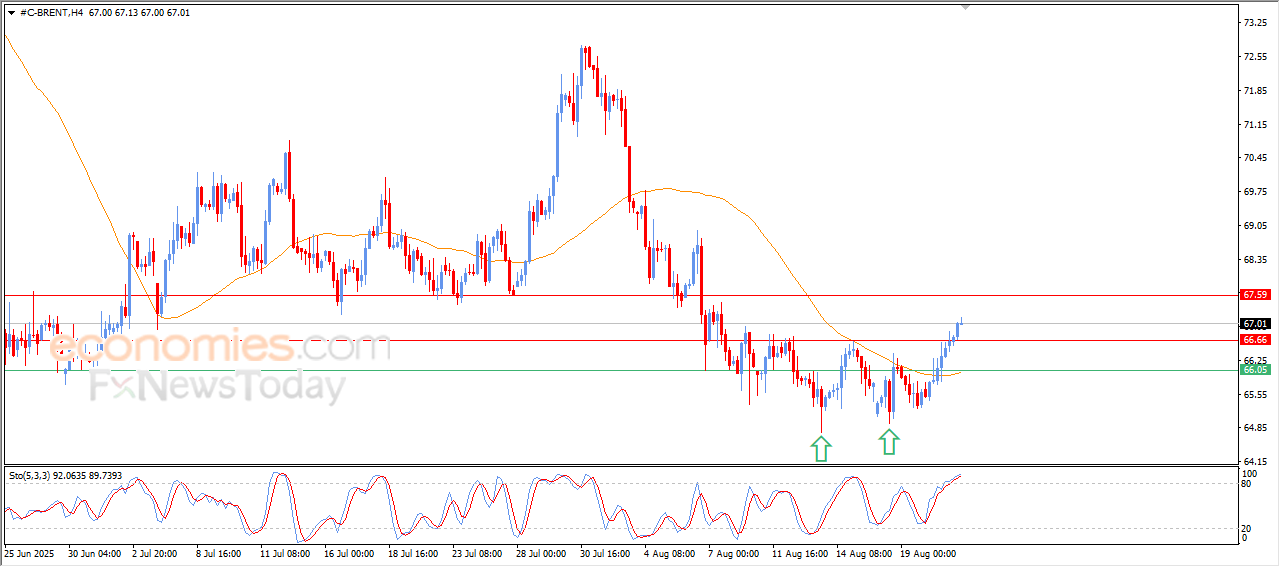
The price of (Brent) expanded its gains in its last intraday trading, breaching the key resistance level at $66.65, this level represents a neckline of a positive technical formation on the short-term basis, represented by the double bottom pattern, to confirm its momentum to resume the correctional rise on the short-term basis, especially with the continuation of the positive pressure that comes from its trading above EMA50, with the emergence of the positive signals on the (RSI), despite reaching overbought levels.
Therefore, our expectations suggest a rise in (Brent) price in its last trading on the intraday levels, if it settles above $66.65, to target the initial resistance levels at $67.60.
Expected trading range for today: Between the support at $66.35 and resistance at $67.60.
Today’s forecast: Bullish
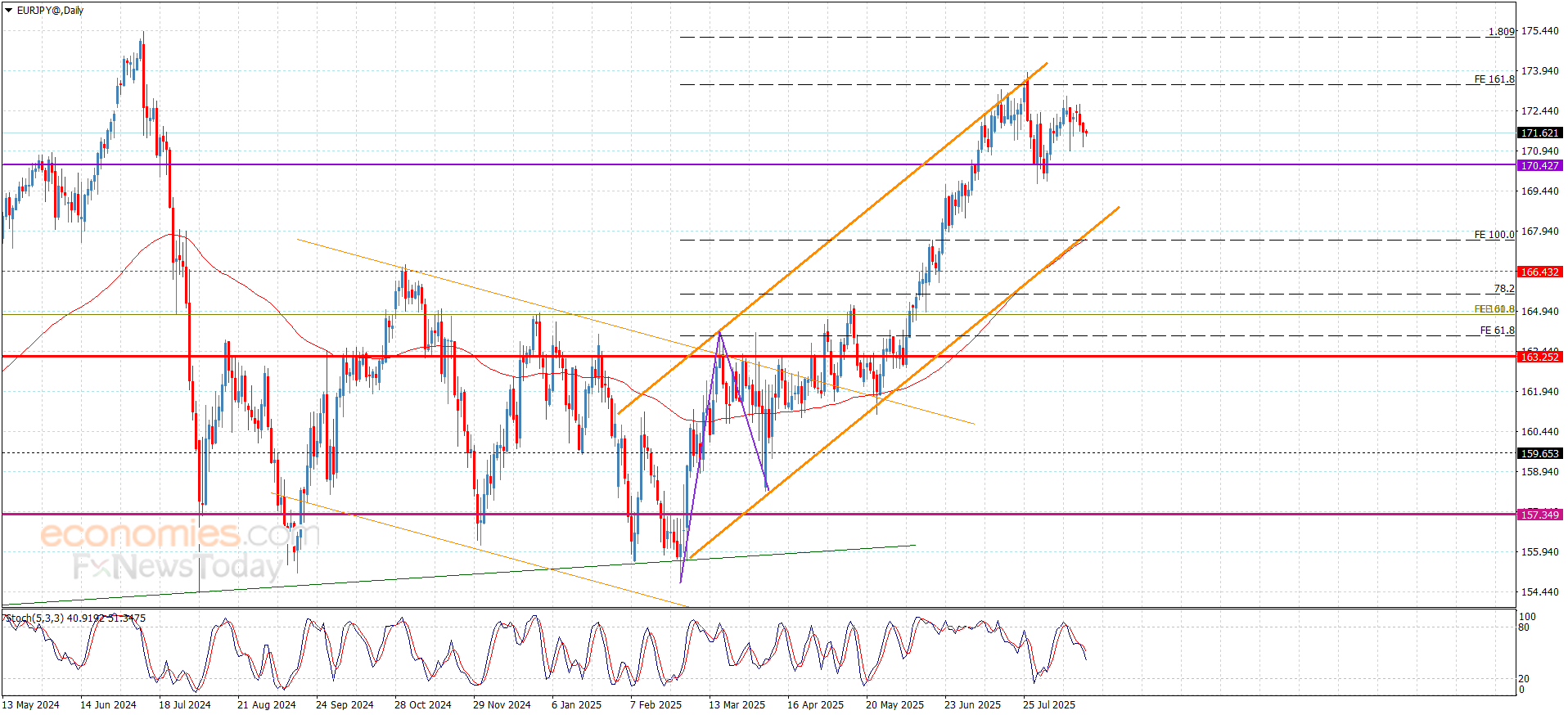
The EURJPY pair reached 171.10 level, then formed some mixed trading, to keep its negative stability below 172.00 level, forming extra barrier against the bearish correctional attempts.
The continuation of providing negative momentum by stochastic confirms the price readiness to form more of the bearish correctional trading, to keep waiting for attacking 170.40 level, then attempts to break the barrier at 169.80 to resume the attempts of gathering the gains in the near and medium period.
The expected trading range for today is between 170.45 and 172.10
Trend forecast: Bearish
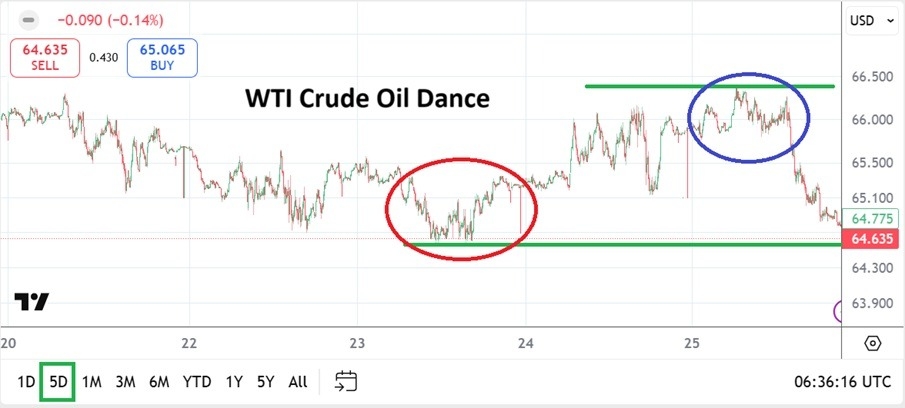
Now that WTI Crude Oil sits near 64.640 and is very close to technical support levels seen the past few weeks, questions will certainly be considered by some traders. The volatile dance of WTI Crude Oil seen the past handful of days is now resting upon values essentially seen on the 3rd, 7th, 16th and 23rd of July, and in practically all those cases the commodity jumped higher.

Those technical considerations doesn’t mean that support will hold when trading in WTI Crude Oil starts tomorrow. Day traders are offered no guarantees that large players will do as they have done the past few weeks and launch the commodity towards the 65.000 price range again. WTI Crude Oil did trade below its current threshold from the first week of April until the first week of June. Fundamentally production and supply of WTI Crude Oil remains consistently good.
There are a couple of interesting risks approaching financial markets this week. The U.S Federal Reserve’s interest rate policy will be released this coming Wednesday. On Friday the White House will sound the tariff alarm bells once again too. These events will affect behavioral sentiment in WTI Crude Oil, perhaps not a lot, but perhaps enough to make a difference in the near-term price.
WTI Crude Oil has found its lower price realm seen via three month technical charts once again. Will the commodity be able to sustain the lower depths or will support levels being tested ignite another reversal upwards? Day traders experienced a rather volatile dance last week and intriguingly the price of WTI Crude Oil although showing a rush upwards on early Friday was not able to sustain much consistency above the 66.150 mark.
After trading 66.000 USD rather well the past weeks and challenging the 67.000 ratio regularly, WTI Crude Oil failed to accomplish this price level this past week. Speculators may suspect that behavioral sentiment has shifted again, perhaps risk appetite in U.S equities is translating into another period in which lower prices will be seen in WTI Crude Oil. But perhaps this is a wrong correlation, except to say sentiment in the broad markets is producing changes in the mid-term outlooks of large players. However, risk events do pose threats this coming week. Day traders should be ready and have their risk management working if they want to pursue WTI Crude Oil near-term because challenges are ahead.
Ready to trade our weekly forecast? We’ve shortlisted the best Forex Oil trading brokers in the industry for you.
The US dollar has rallied against the Japanese yen to reach the 148 yen level. If we can break above there and possibly the 148.50 yen, then it could open up a move to the 151 yen level. Short-term pullback should continue to see significant support at the 50-day EMA just below. And until I think we get through that speech at Jackson Hole, this might be a sideways market.
In the Australian dollar, we have dipped a bit but then turned around to show signs of life at 0.64. If we can break here, then I think we will go much lower. Ultimately, I think in the short term, we will probably bounce, and we look for a reason to start selling again at the first signs of exhaustion.
The Australian dollar has underperformed the other currencies against the US dollar for quite some time. And if we are starting to see US dollar strength, that most certainly will play out against the Aussie pretty aggressively in my estimation. I have no interest in buying this currency at the moment. That being said, we are sitting on support. So, I don’t necessarily want to be starting a short position here either.
For a look at all of today’s economic events, check out our economic calendar.
Platinum price surpassed some of the negative pressures by stochastic rally to 80 level, keeping its stability above the support of the sideways track that is represented by $1302.00, to rally to the moving average 55, which reinforces the stability of the barrier at $1342.00.
We will remain neutral, to keep waiting for surpassing one of the main levels to confirm the expected trend in the near and medium period, breaching the barrier will open the way for achieving more of the gains by the price rally to $1365.00 and $1382.00, while breaking the support and holding below it will activate bearish correctional track, and $1281.00 level represents the initial negative target for the bearish track.
The expected trading range for today is between $1302.00 and $1342.00
Trend forecast: Neutral
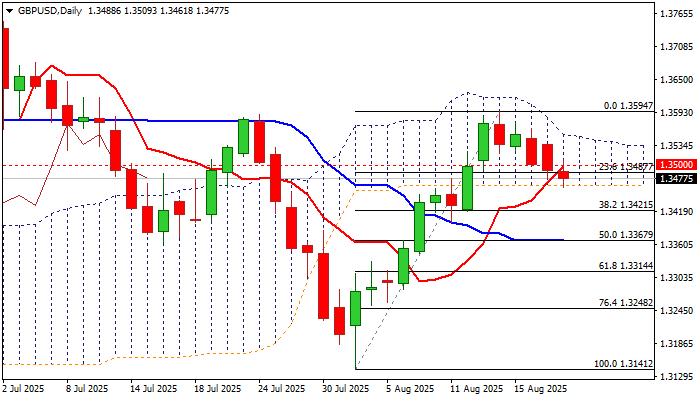
After dropping to its lowest level in over a week below 1.3450 in the Asian session on Thursday, GBP/USD regained its traction and advanced to the 1.3470 region. Despite this recent recovery, the pair’s technical outlook doesn’t point to an increasing buyer interest.
The risk-averse market environment caused GBP/USD to continue to stretch lower early Thursday. In the European session, Pound Sterling benefited from the preliminary August Purchasing Managers’ Index (PMI) data from the UK and erased its daily losses. Read more…
Cable edged higher on Wednesday after testing next key support provided by daily cloud base (1.3464), following break below psychological 1.3500 level (reinforced by daily Tenkan-sen) previous day.
Pound was lifted by disappointing UK July inflation data which further darkened outlook as Britain’s inflation is the highest and fastest growing among G7 economies. In addition, economic growth remains weak that makes the position of UK policymakers more difficult, with bets about rate cut by the end of the year, fading after today’s data. Read more…
“The Fed appears to be keeping its tightening bias alive, and that makes it difficult for precious metals to build sustained momentum,” said a Singapore-based commodities strategist. The US Dollar extended gains on the hawkish tone, adding to the headwinds for metals priced in the greenback.
The metals market also absorbed geopolitical and political developments that shaped investor sentiment. Optimism surrounding potential progress in Russia-Ukraine peace efforts has eased safe-haven demand. Russian Foreign Minister Sergey Lavrov reiterated that any security arrangement would be incomplete without Moscow’s involvement, underscoring the complexity of negotiations.
Meanwhile, US domestic politics injected uncertainty into markets. Former President Trump’s demand for the resignation of Federal Reserve Governor Lisa Cook over alleged mortgage fraud has stirred debate about central bank independence.
Political instability, while weighing on the US Dollar’s long-term outlook, has provided limited support for gold and silver in the near term.
Looking ahead, investor attention is firmly on Fed Chair Jerome Powell’s upcoming remarks at the Jackson Hole Symposium. Markets expect Powell to offer critical guidance on the policy path, particularly regarding the balance between inflation risks and slowing growth.
Alongside Powell’s speech, flash PMIs, weekly jobless claims, and the Philadelphia Fed Manufacturing Index will provide essential signals on global economic momentum.
EUR/USD holds steady at around 1.1650 after starting the day under bearish pressure, as the Euro benefits from the Purchasing Managers’ Index (PMI) data releases from Germany and the Eurozone. In the second half of the day, Jobless Claims and PMI data from the US will be watched closely by market participants.
The table below shows the percentage change of Euro (EUR) against listed major currencies this week. Euro was the weakest against the Swiss Franc.
| USD | EUR | GBP | JPY | CAD | AUD | NZD | CHF | |
|---|---|---|---|---|---|---|---|---|
| USD | 0.49% | 0.64% | 0.30% | 0.45% | 1.36% | 1.77% | -0.05% | |
| EUR | -0.49% | 0.15% | -0.21% | -0.04% | 0.89% | 1.24% | -0.53% | |
| GBP | -0.64% | -0.15% | -0.44% | -0.19% | 0.73% | 1.08% | -0.73% | |
| JPY | -0.30% | 0.21% | 0.44% | 0.18% | 1.09% | 1.49% | -0.34% | |
| CAD | -0.45% | 0.04% | 0.19% | -0.18% | 0.89% | 1.30% | -0.54% | |
| AUD | -1.36% | -0.89% | -0.73% | -1.09% | -0.89% | 0.35% | -1.45% | |
| NZD | -1.77% | -1.24% | -1.08% | -1.49% | -1.30% | -0.35% | -1.81% | |
| CHF | 0.05% | 0.53% | 0.73% | 0.34% | 0.54% | 1.45% | 1.81% |
The heat map shows percentage changes of major currencies against each other. The base currency is picked from the left column, while the quote currency is picked from the top row. For example, if you pick the Euro from the left column and move along the horizontal line to the US Dollar, the percentage change displayed in the box will represent EUR (base)/USD (quote).
The risk-averse market atmosphere helped the US Dollar (USD) hold its ground early Thursday and caused EUR/USD to stretch lower.
In the European session, the data from Germany and the Eurozone both showed that the business activity in the private sector expanded at a faster pace in early August than they did in July, supporting the Euro. HCOB Composite PMI rose to 50.9 and 51.1 in Germany and the Eurozone, respectively.
Commenting on the survey’s findings, “the European Central Bank might wince a little at the rising cost pressures in the services sector,” said Dr. Cyrus de la Rubia, Chief Economist at Hamburg Commercial Bank. “After all, it’s banking on slower wage growth to help bring inflation down in this crucial part of the economy. That said, there’s a bit of relief in the fact that inflation in service-sector selling prices has remained more or less steady.”
The number of first-time applications for unemployment benefits in the US is expected to tick up to 225K from 224K in the previous week. A noticeable decline in this data could support the USD with the immediate reaction.
Later in the day, S&P Global Manufacturing PMI is forecast to edge lower to 49.5 in August’s preliminary estimate, while the Services PMI is seen retreating to 54.2. In case both PMIs come in worse than analysts’ estimates, the USD could come under bearish pressure. If they remain close to July prints or market expectations, commentary on the employment and inflation situation could drive the USD’s action. In case the survey paints a gloomy picture about private sector payrolls, the USD could have a hard time finding demand. Conversely, the currency could gather strength if there is a meaningful increase in input inflation, especially in the service sector.
The Relative Strength Index (RSI) indicator on the 4-hour chart moves sideways slightly below 50, highlighting a lack of buyer interest. The 200-period Simple Moving Average (SMA), and the 50-day SMA form a key technical level at 1.1650. Once this level is confirmed as support, 1.1720 (static level), 1.1760 (static level) and 1.1800 (static level, round level) could be seen as next resistance levels.
On the downside, 1.1610-1.1600 (100-period SMA, round level) could be seen as an interim support level before 1.1540 (static level) and 1.1500 (static level, round level), if EUR/USD retreats below 1.1650 and starts using this level as resistance.
The Euro is the currency for the 19 European Union countries that belong to the Eurozone. It is the second most heavily traded currency in the world behind the US Dollar. In 2022, it accounted for 31% of all foreign exchange transactions, with an average daily turnover of over $2.2 trillion a day.
EUR/USD is the most heavily traded currency pair in the world, accounting for an estimated 30% off all transactions, followed by EUR/JPY (4%), EUR/GBP (3%) and EUR/AUD (2%).
The European Central Bank (ECB) in Frankfurt, Germany, is the reserve bank for the Eurozone. The ECB sets interest rates and manages monetary policy.
The ECB’s primary mandate is to maintain price stability, which means either controlling inflation or stimulating growth. Its primary tool is the raising or lowering of interest rates. Relatively high interest rates – or the expectation of higher rates – will usually benefit the Euro and vice versa.
The ECB Governing Council makes monetary policy decisions at meetings held eight times a year. Decisions are made by heads of the Eurozone national banks and six permanent members, including the President of the ECB, Christine Lagarde.
Eurozone inflation data, measured by the Harmonized Index of Consumer Prices (HICP), is an important econometric for the Euro. If inflation rises more than expected, especially if above the ECB’s 2% target, it obliges the ECB to raise interest rates to bring it back under control.
Relatively high interest rates compared to its counterparts will usually benefit the Euro, as it makes the region more attractive as a place for global investors to park their money.
Data releases gauge the health of the economy and can impact on the Euro. Indicators such as GDP, Manufacturing and Services PMIs, employment, and consumer sentiment surveys can all influence the direction of the single currency.
A strong economy is good for the Euro. Not only does it attract more foreign investment but it may encourage the ECB to put up interest rates, which will directly strengthen the Euro. Otherwise, if economic data is weak, the Euro is likely to fall.
Economic data for the four largest economies in the euro area (Germany, France, Italy and Spain) are especially significant, as they account for 75% of the Eurozone’s economy.
Another significant data release for the Euro is the Trade Balance. This indicator measures the difference between what a country earns from its exports and what it spends on imports over a given period.
If a country produces highly sought after exports then its currency will gain in value purely from the extra demand created from foreign buyers seeking to purchase these goods. Therefore, a positive net Trade Balance strengthens a currency and vice versa for a negative balance.