The main category of Forex News.
You can use the search box below to find what you need.
[wd_asp id=1]
The main category of Forex News.
You can use the search box below to find what you need.
[wd_asp id=1]
– Written by
Tim Boyer
STORY LINK Pound to Dollar Forecast: GBP/USD Unable to Break Resistance Levels
The Pound to Dollar exchange rate (GBP/USD) found support above 1.35 on Thursday and advanced to 1.3565 after Friday’s New York open as the dollar failed to hold Thursday’s gains.
There was a limited retreat for the FTSE 100 index, although overall risk appetite held firm while volatility levels remain contained.
The Pound will tend to perform well if risk appetite holds firm.
UBS commented; “For the time being, we think the GBP can outperform against peers on a total return basis thanks to its attractive carry proposition.
UoB expects narrow ranges will prevail; “Outlook for GBP remains positive, and it may rise to 1.3620; the chances of it reaching 1.3660 this time around are more limited.”
According to Scotiabank; “Sterling is firmer on the session but yesterday’s peak and minor reversal from the 1.3595 area warrants attention as the pound topped out at a similar point in late July.
It added; “Cable has put together a solid run of gains since basing in early August but spot needs to push on through to a 1.36 handle to extend gains.”
Scotiabank added; “The pound is lagging some of its G10 peers somewhat this morning but has had a solid week overall, rising against the USD and EUR, as markets rethink the outlook for UK monetary policy after last week’s BoE decision.”
The latest UK inflation data will be released next week and will be significant for near-term Bank of England policy expectations.
Berenberg now has a more positive outlook on the UK economy and does not expect further Bank of England rate cuts, potentially underpinning the Pound.
According to the bank; “Forward looking measures of real interest rates are below pre-financial crisis. Assuming that the neutral real interest rate has rebounded from its 2010s nadir, monetary policy may not be overly restrictive now. Indeed, rising company and household inflation expectations were one reason why the BoE became more hawkish last week. We expect the central bank to pause its cutting cycle with bank rate at 4.00% until 2026.”
Federal Reserve policy will remain a key market influence. Markets remain convinced that the Fed will cut rates in September, but expectations of a 50 basis-point cut have dipped sharply following recent firm data.
Thursday’s US producer prices data was stronger than expected and indicated that there would be more serious upward pressure on consumer prices over the next few months.
US retail sales increased 0.5% for July, marginally below consensus forecasts of a 0.6% advance with a 0.3% increase in core sales.

The New York Empire manufacturing index improved further to 11.9 for August from 5.5 the previous month and well above market expectations of -1.0.
There were weaker readings for employment while inflation pressures increased slightly.
International Money Transfer? Ask our resident FX expert a money transfer question or try John’s new, free, no-obligation personal service! ,where he helps every step of the way,
ensuring you get the best exchange rates on your currency requirements.
Important DisclaimersThe content provided on the website includes general news and publications, our personal analysis and opinions, and contents provided by third parties, which are intended for educational and research purposes only. It does not constitute, and should not be read as, any recommendation or advice to take any action whatsoever, including to make any investment or buy any product. When making any financial decision, you should perform your own due diligence checks, apply your own discretion and consult your competent advisors. The content of the website is not personally directed to you, and we does not take into account your financial situation or needs.The information contained in this website is not necessarily provided in real-time nor is it necessarily accurate. Prices provided herein may be provided by market makers and not by exchanges.Any trading or other financial decision you make shall be at your full responsibility, and you must not rely on any information provided through the website. FX Empire does not provide any warranty regarding any of the information contained in the website, and shall bear no responsibility for any trading losses you might incur as a result of using any information contained in the website.The website may include advertisements and other promotional contents, and FX Empire may receive compensation from third parties in connection with the content. FX Empire does not endorse any third party or recommends using any third party’s services, and does not assume responsibility for your use of any such third party’s website or services.FX Empire and its employees, officers, subsidiaries and associates, are not liable nor shall they be held liable for any loss or damage resulting from your use of the website or reliance on the information provided on this website.Risk DisclaimersThis website includes information about cryptocurrencies, contracts for difference (CFDs) and other financial instruments, and about brokers, exchanges and other entities trading in such instruments. Both cryptocurrencies and CFDs are complex instruments and come with a high risk of losing money. You should carefully consider whether you understand how these instruments work and whether you can afford to take the high risk of losing your money.FX Empire encourages you to perform your own research before making any investment decision, and to avoid investing in any financial instrument which you do not fully understand how it works and what are the risks involved.
The lower boundary of the triangle is reinforced by the 20-week moving average (not shown), now at $3,310 on the weekly chart. This average was reclaimed in early January and has since acted as potential dynamic support. In July, it aligned with a swing low that sparked a bullish weekly reversal and proved itself as a support line.
This alignment creates a significant confluence of support between $3,303 and $3,310. A clean break below both the lower boundary and the 20-week moving average would carry greater weight, potentially triggering a stronger downside reaction. In that case, a test of the May swing lows and the 38.2% retracement would become increasingly likely, and the odds of falling below that zone would rise.
Gold’s price action remains confined within a tightening consolidation, with each swing high and low narrowing toward the triangle’s apex. This suggests that a resolution — either bullish or bearish — is approaching.
On the upside, a breakout is triggered on a move above the $3,438 swing high. Such a move would signal bullish trend continuation and could pave the way for a retest of $3,500. On the downside, the first trigger is a drop through the lower boundary line, followed by a break below $3,268 to confirm a bearish breakout. Until then, gold’s consolidation reflects a market in balance, but the proximity to major technical levels hints that this balance may not hold much longer.
For a look at all of today’s economic events, check out our economic calendar.
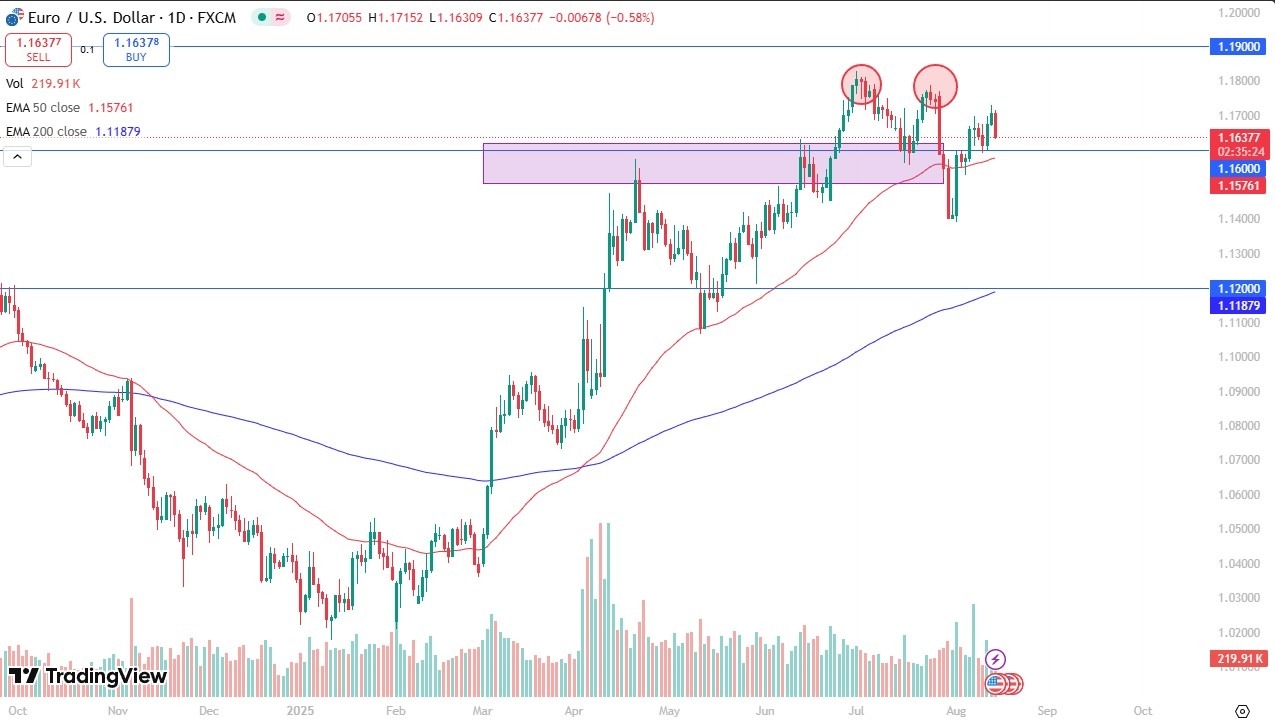
The euro rallied a bit during the trading session here on Friday, as we have seen quite a bit of US dollar weakness around the world. That being said, we’re still just chopping back and forth. There’s no real directionality in the short term, but over the long term, obviously, the euro had been quite a bit more bullish than the US dollar. Recently, we had formed a double top at the 1.18 level, so that is worth paying attention to, and we are below there. So, we’ll see. I think this is a market that’s still trying to make a few decisions.
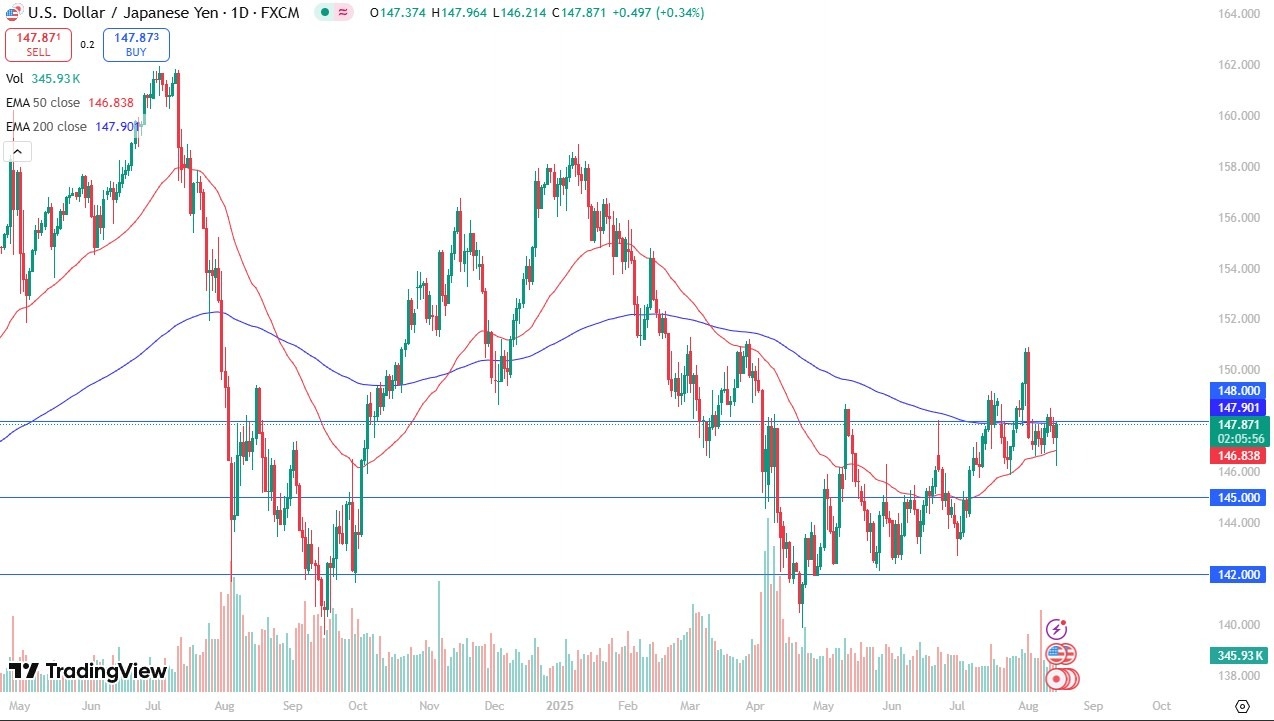
The dollar has dropped against the Japanese yen to test the 50-day EMA, but it is starting to show signs of support. If we can turn around and break above that 148 yen level, then I’d be much more comfortable with my long position, but you do get paid to hang on to it, and I have been in this for a while, so that does help. A break above the 148 yen level, I believe, opens up a move to about 150.50 yen. If we break down below here, then the 146 yen level is support, right along with the 145 yen level.
If we break down below the 50 day EMA, then that could send the Euro even lower, perhaps back down, and to the 1.14 level and anything below there, think could call the top.

I think there are a lot of questions out there as to what the federal reserve can do going forward. And one of the federal reserve governors came out today and even suggested that the idea of a half point or a half percent rate cut was validated, was completely wrong by the data that the U S economy is currently producing. If that is the case, things could get rather ugly pretty quickly for the Euro because money will come right back towards the U S because the U S dollar has been so oversold.
Ultimately, this is what I’m waiting to see. I don’t want to buy the Euro. And if I did short the U S dollar, it won’t be against the Euro. At this point, we’re in a little bit of a holding pattern. We are consolidating in an area that I think we may need to make a decision from, but this chart just got quite a bit more interesting.
Ready to trade our EUR/USD analysis and predictions? Here are the best European brokers to choose from.
Christopher Lewis has been trading Forex and has over 20 years experience in financial markets. Chris has been a regular contributor to Daily Forex since the early days of the site. He writes about Forex for several online publications, including FX Empire, Investing.com, and his own site, aptly named The Trader Guy. Chris favours technical analysis methods to identify his trades and likes to trade equity indices and commodities as well as Forex. He favours a longer-term trading style, and his trades often last for days or weeks.
Friday’s bounce has not changed the bigger picture. Natural gas will log a fourth consecutive week of lower weekly highs and lows, highlighting persistent selling pressure. A bearish continuation signal triggered this week as prices fell through the April swing low. That decline also pierced a long-term support zone where an anchored volume weighted average price (AVWAP) from the 2024 trend low converged with a long-term uptrend line. This line formed the lower boundary of an ascending parallel trend channel, giving the breakdown added significance.
Support near the AVWAP level at $2.96 held for several weeks but failed to produce a meaningful rally. With the breakdown confirmed, downside targets remain intact. Below this week’s trend low of $2.764, the next potential target sits at $2.79, completing a 100% projection of a falling ABCD pattern. This would match the size of the second downswing to the first. If weakness extends further, the 78.6% Fibonacci retracement at $2.54 becomes the next major level to watch, and given the strength of recent bearish signals, this deeper target is possible.
The 20-Day moving average is accelerating lower and is close to crossing beneath the long-term uptrend line. At $3.04, it marks the top of a potential resistance zone starting at the AVWAP line near $2.96. Resistance was seen today at the bottom of that $2.96–$3.04 band and it may serve as a key pivot area where sellers could reassert control, keeping the prevailing downtrend intact. Also, the top of the range would be a upside target for now if today’s bullish price action can continue in the short-term.
For a look at all of today’s economic events, check out our economic calendar.
EUR/JPY loses ground for the third consecutive day, trading around 171.80 during the European hours on Friday. The technical analysis of the daily chart suggests a prevailing bullish bias as the currency cross remains within the ascending channel pattern.
The 14-day Relative Strength Index (RSI) is positioned above the 50 mark, suggesting the bullish bias is active. However, the short-term price momentum is weaker as the EUR/JPY cross moved below the nine-day Exponential Moving Average (EMA).
The EUR/JPY cross could test the immediate barrier at the nine-day EMA of 171.95. A break above this level would strengthen short-term price momentum and support the currency cross to approach the upper boundary of the ascending channel around 173.60, followed by 173.90, the highest since July 2024, recorded on July 28, 2025.
On the downside, the EUR/JPY cross may test the crucial support level at 171.50, followed by the ascending channel’s lower boundary around 171.10 and the psychological level of 171.00. A break below this crucial support zone would put downward pressure on the pair to test the 50-day EMA at 170.09, followed by the six-week low at 169.72, which was recorded on July 31. Further declines would prompt the currency cross to reach the two-month low at 168.46, registered on July 1.
The table below shows the percentage change of Euro (EUR) against listed major currencies today. Euro was the weakest against the Japanese Yen.
| USD | EUR | GBP | JPY | CAD | AUD | NZD | CHF | |
|---|---|---|---|---|---|---|---|---|
| USD | -0.25% | -0.16% | -0.54% | -0.15% | -0.28% | -0.13% | -0.20% | |
| EUR | 0.25% | 0.09% | -0.21% | 0.09% | -0.06% | 0.11% | 0.05% | |
| GBP | 0.16% | -0.09% | -0.28% | 0.00% | -0.15% | 0.02% | -0.04% | |
| JPY | 0.54% | 0.21% | 0.28% | 0.30% | 0.17% | 0.37% | 0.24% | |
| CAD | 0.15% | -0.09% | -0.00% | -0.30% | -0.08% | 0.02% | -0.04% | |
| AUD | 0.28% | 0.06% | 0.15% | -0.17% | 0.08% | 0.10% | 0.11% | |
| NZD | 0.13% | -0.11% | -0.02% | -0.37% | -0.02% | -0.10% | -0.06% | |
| CHF | 0.20% | -0.05% | 0.04% | -0.24% | 0.04% | -0.11% | 0.06% |
The heat map shows percentage changes of major currencies against each other. The base currency is picked from the left column, while the quote currency is picked from the top row. For example, if you pick the Euro from the left column and move along the horizontal line to the US Dollar, the percentage change displayed in the box will represent EUR (base)/USD (quote).
GBP/USD finds support and trades marginally higher on the day near 1.3550 after posting losses on Thursday. As markets await the next batch of macroeconomic data releases from the US, the pair’s near-term technical outlook suggests that the bullish bias remains intact.
The table below shows the percentage change of British Pound (GBP) against listed major currencies this week. British Pound was the strongest against the New Zealand Dollar.
| USD | EUR | GBP | JPY | CAD | AUD | NZD | CHF | |
|---|---|---|---|---|---|---|---|---|
| USD | -0.26% | -0.73% | -0.43% | 0.34% | 0.20% | 0.54% | -0.36% | |
| EUR | 0.26% | -0.47% | -0.15% | 0.60% | 0.46% | 0.76% | -0.09% | |
| GBP | 0.73% | 0.47% | 0.26% | 1.08% | 0.94% | 1.24% | 0.38% | |
| JPY | 0.43% | 0.15% | -0.26% | 0.79% | 0.67% | 1.04% | 0.21% | |
| CAD | -0.34% | -0.60% | -1.08% | -0.79% | -0.12% | 0.16% | -0.71% | |
| AUD | -0.20% | -0.46% | -0.94% | -0.67% | 0.12% | 0.29% | -0.56% | |
| NZD | -0.54% | -0.76% | -1.24% | -1.04% | -0.16% | -0.29% | -0.85% | |
| CHF | 0.36% | 0.09% | -0.38% | -0.21% | 0.71% | 0.56% | 0.85% |
The heat map shows percentage changes of major currencies against each other. The base currency is picked from the left column, while the quote currency is picked from the top row. For example, if you pick the British Pound from the left column and move along the horizontal line to the US Dollar, the percentage change displayed in the box will represent GBP (base)/USD (quote).
Market participants refrained from continuing to price in three 25 basis points (bps) Federal Reserve rate cuts in 2025 following the hot producer inflation data from the US, helping the US Dollar (USD) gather strength and forcing GBP/USD to stay on the back foot on Thursday.
The US Bureau of Labor Statistics reported that the Producer Price Index (PPI) rose by 3.3% on a yearly basis in July. This reading followed June’s 2.4% increase and came in much higher than analysts’ estimate of 2.5%. Other details of the data showed that the PPI and the core PPI both rose by 0.9% on a monthly basis.
Retail Sales and Industrial Production data for July will be featured in the US economic calendar on Friday. The market reaction to the Retail Sales data is likely to be straightforward and remain short-lived. A positive surprise could support the USD, while a disappointing print could weigh on the currency and help GBP/USD stretch higher.
Later in the day, the University of Michigan (UoM) will publish the preliminary Consumer Sentiment Survey for August. Rather than the headline Consumer Confidence Index data, markets could react to the One-year Inflation Component of the survey. A noticeable increase in this component could allow the USD to gather strength heading into the weekend and force GBP/USD to turn south.
The Relative Strength Index (RSI) indicator on the 4-hour chart holds slightly above 60, suggesting that the bullish bias remains intact.
Looking north, the first resistance area could be seen at 1.3590-1.3600 (static level, round level) before 1.3640 (Fibonacci 78.6% retracement of the latest downtrend) and 1.3700 (static level, round level). On the downside, support levels align at 1.3540 (Fibonacci 61.8% retracement), 1.3500 (static level, round level) and 1.3460 (Fibonacci 50% retracement, 200-period SMA).
The Pound Sterling (GBP) is the oldest currency in the world (886 AD) and the official currency of the United Kingdom. It is the fourth most traded unit for foreign exchange (FX) in the world, accounting for 12% of all transactions, averaging $630 billion a day, according to 2022 data.
Its key trading pairs are GBP/USD, also known as ‘Cable’, which accounts for 11% of FX, GBP/JPY, or the ‘Dragon’ as it is known by traders (3%), and EUR/GBP (2%). The Pound Sterling is issued by the Bank of England (BoE).
The single most important factor influencing the value of the Pound Sterling is monetary policy decided by the Bank of England. The BoE bases its decisions on whether it has achieved its primary goal of “price stability” – a steady inflation rate of around 2%. Its primary tool for achieving this is the adjustment of interest rates.
When inflation is too high, the BoE will try to rein it in by raising interest rates, making it more expensive for people and businesses to access credit. This is generally positive for GBP, as higher interest rates make the UK a more attractive place for global investors to park their money.
When inflation falls too low it is a sign economic growth is slowing. In this scenario, the BoE will consider lowering interest rates to cheapen credit so businesses will borrow more to invest in growth-generating projects.
Data releases gauge the health of the economy and can impact the value of the Pound Sterling. Indicators such as GDP, Manufacturing and Services PMIs, and employment can all influence the direction of the GBP.
A strong economy is good for Sterling. Not only does it attract more foreign investment but it may encourage the BoE to put up interest rates, which will directly strengthen GBP. Otherwise, if economic data is weak, the Pound Sterling is likely to fall.
Another significant data release for the Pound Sterling is the Trade Balance. This indicator measures the difference between what a country earns from its exports and what it spends on imports over a given period.
If a country produces highly sought-after exports, its currency will benefit purely from the extra demand created from foreign buyers seeking to purchase these goods. Therefore, a positive net Trade Balance strengthens a currency and vice versa for a negative balance.
That takes that part of the equation out of the conversation. Now, we’ll see. I don’t know if that’s actually the case. But clearly, this gave the markets a lot to think about. The 148 yen level looks as if it is going to be a barrier again, but I think we eventually break above there.
The interest rate differential obviously keeps the US dollar much more attractive than the yen because you of course get paid to hold it for every night and especially at the end of the Wednesday session most of you will get triple swap if we break out to the upside the 151 level could be a potential target but we’ll just have to wait and see if we break down below the bottom of the candlestick for the trading session on Thursday, then the 145 yen level could be targeted.
I like buying this pair. I have liked buying this pair for some time, but I also recognize you are going to be very patient with this pair. I do think that we have put in a significant bottom for the third time now near the 142 yen level. And now I think it begins at slow ascent higher. This grind will also pay you to hold onto it, so this is a bonus to say the least.
Want to trade our USD/JPY forex analysis and predictions? Here’s a list of forex brokers in Japan to check out.
Christopher Lewis has been trading Forex and has over 20 years experience in financial markets. Chris has been a regular contributor to Daily Forex since the early days of the site. He writes about Forex for several online publications, including FX Empire, Investing.com, and his own site, aptly named The Trader Guy. Chris favours technical analysis methods to identify his trades and likes to trade equity indices and commodities as well as Forex. He favours a longer-term trading style, and his trades often last for days or weeks.
Silver price rises over 1.63% on Wednesday, boosted by broad US Dollar weakness as traders had fully priced in a rate cut by the Federal Reserve at next month’s meeting.
Consequently, US Treasury yields, which correlated inversely with XAG/USD, tumbled with the 10-year benchmark note, down five basis points at 4.236%. At the time of writing, the grey metal trades at $38.53, after bouncing off daily lows of $37.85.
Silver price uptrend remains intact, hitting a three-week high of $38.65 with buyers clearing the last higher-high ahead of challenging the $39.00, with them eyeing the YTD peak of $39.53. From a price action standpoint, if those two levels are cleared, the grey metal could test $40.00 in the near term.
Momentum is bullish as depicted by the Relative Strength Index (RSI). Nevertheless, if something goes wrong, XAG/USD’s drop below $38.00 could put buyers under stress, and bears could challenge the latest cycle low of $37.50, the August 12 low. If cleared, the next area of interest would be the July 31 swing low of $36.21.
Silver is a precious metal highly traded among investors. It has been historically used as a store of value and a medium of exchange. Although less popular than Gold, traders may turn to Silver to diversify their investment portfolio, for its intrinsic value or as a potential hedge during high-inflation periods. Investors can buy physical Silver, in coins or in bars, or trade it through vehicles such as Exchange Traded Funds, which track its price on international markets.
Silver prices can move due to a wide range of factors. Geopolitical instability or fears of a deep recession can make Silver price escalate due to its safe-haven status, although to a lesser extent than Gold’s. As a yieldless asset, Silver tends to rise with lower interest rates. Its moves also depend on how the US Dollar (USD) behaves as the asset is priced in dollars (XAG/USD). A strong Dollar tends to keep the price of Silver at bay, whereas a weaker Dollar is likely to propel prices up. Other factors such as investment demand, mining supply – Silver is much more abundant than Gold – and recycling rates can also affect prices.
Silver is widely used in industry, particularly in sectors such as electronics or solar energy, as it has one of the highest electric conductivity of all metals – more than Copper and Gold. A surge in demand can increase prices, while a decline tends to lower them. Dynamics in the US, Chinese and Indian economies can also contribute to price swings: for the US and particularly China, their big industrial sectors use Silver in various processes; in India, consumers’ demand for the precious metal for jewellery also plays a key role in setting prices.
Silver prices tend to follow Gold’s moves. When Gold prices rise, Silver typically follows suit, as their status as safe-haven assets is similar. The Gold/Silver ratio, which shows the number of ounces of Silver needed to equal the value of one ounce of Gold, may help to determine the relative valuation between both metals. Some investors may consider a high ratio as an indicator that Silver is undervalued, or Gold is overvalued. On the contrary, a low ratio might suggest that Gold is undervalued relative to Silver.