The main category of Forex News.
You can use the search box below to find what you need.
[wd_asp id=1]
The main category of Forex News.
You can use the search box below to find what you need.
[wd_asp id=1]
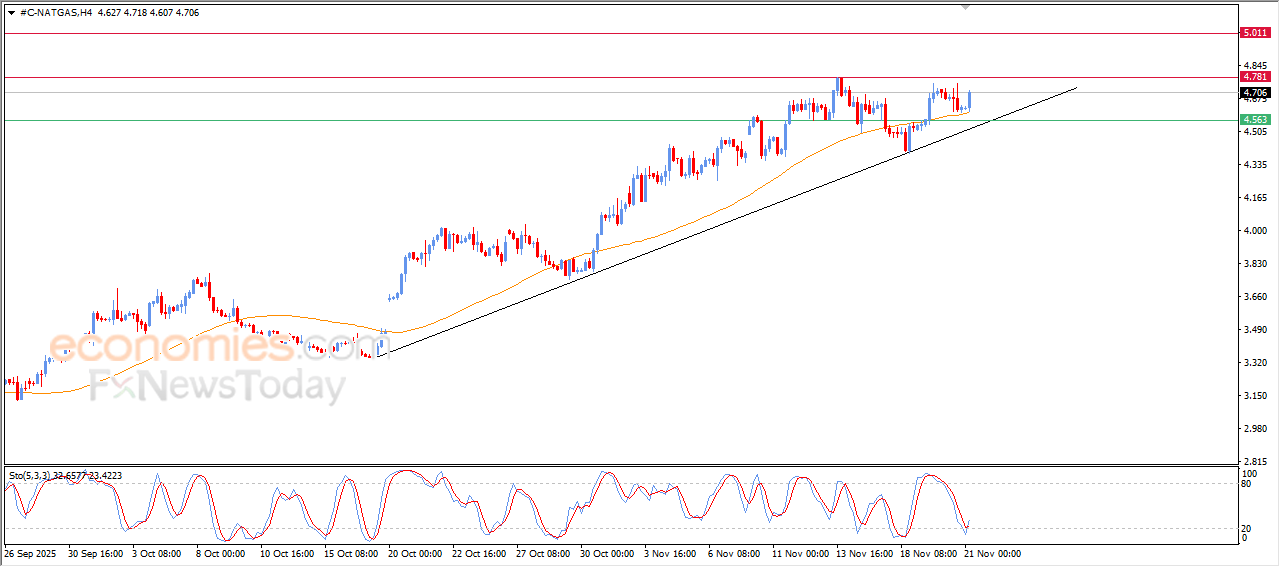
Natural gas price rose in its last trading on the intraday basis, due to its leaning on the support of EMA50, gaining bullish momentum that helped it to achieve these last gains, preparing to attack the key resistance at $4.75, amid the dominance of the main bullish trend on the short-term basis and its trading alongside supportive trend line for this trend, besides the emergence of the positive signals on the relative strength indicators, after reaching oversold levels.
Therefore, we suggest a rise in its upcoming intraday trading, especially when breaching $4.75, to target its main resistance at $5.00.
The expected trading range for today is between $4.55 and $5.00
Trend forecast: Bullish
The euro initially tried to rally against the British pound but turned around to show signs of weakness again. Ultimately, this is a market that I think is going to continue to be very choppy, and therefore, you have to look at it through the prism of a range-bound type of situation, with short-term pullbacks perhaps offering buying opportunities. The 0.8750 level is an area that previously had been significant resistance, so I think you have to look at it as market memory just waiting to happen in the form of support.
The 50-day EMA sits there as well, so that, of course, helps. I look at this as a market that gives us an opportunity on these dips to pick up cheap euros. I don’t look for an explosive move, but I do think the measured move of the previous consolidation, suggesting 0.89 as a target, is pretty reasonable, but this pair tends to move at a snail’s pace.
For a look at all of today’s economic events, check out our economic calendar.
Gold is struggling for a direction, while trading under the $4,100 mark early Friday, although remaining confined in a familiar range. Despite the range-play, Gold is set to end the week on a subdued note.
Markets remain wary about whether the US Federal Reserve (Fed) will cut or not cut interest rates in December, especially after the dated September US employment report released Thursday.
The headline US Nonfarm Payrolls (NFP) rose by 119,000 in September, following a 4,000 decrease (revised from +22,000) recorded in August. The reading outpaced the market forecast of 50,000.
Meanwhile, the Unemployment Rate rose to 4.4% from 4.3% in this period. The mixed data provided an ambiguous picture of the Fed’s path forward on interest rates.
However, markets continued to price in about a 40% chance that the Fed will lower rates next month as policymakers remained cautious on further monetary policy easing.
“Cleveland Fed President Beth Hammack warned on Thursday that cutting rates further right now carries a wide range of risks for the economy. Fed Governor Lisa Cook sees a risk of outsized asset price declines.”
The hawkish sentiment surrounding the Fed is weighing on non-yielding assets such as Gold. But Gold’s downside appears cushioned by the tech sell-off on Wall Street and later in the Asian markets as the solid Nvidia earnings-led rally faded.
Expectations of a massive economic stimulus package due to be unveiled by Japan’s government later on Friday also help keep Gold buyers hopeful. The package is estimated to be worth over JPY 20 trillion, the biggest since COVID-19.
Traders now eagerly await the S&P Global preliminary PMI data for November from the United States (US) for fresh insights on the health of the US economy The data could help markets reprice Fed rate cut expectations, eventually impacting Gold price action.
The US Manufacturing PMI is set to fall to 52 in November from 52.5 in October. The Services PMI is likely to stay unchanged at 54.8 in the reported period.
In the daily chart, XAU/USD trades at $4,065.29. The 50-, 100-, and 200-day Simple Moving Averages (SMAs) advance while price holds above them, maintaining a bullish bias. The 21-day SMA has flattened and edged lower, with $4,044.66 offering nearby dynamic support. The Relative Strength Index (RSI) stands at 52.00 (neutral), reflecting balanced momentum after the recent rebound.
Measured from the $4,381.17 high to the $3,885.84 low, the 38.2% retracement at $4,075.05 acts as near-term resistance, and a daily close above it would open the 50% retracement at $4,133.50. With momentum neutral and trend support intact, the path of least resistance would improve on a break of this barrier, while failure to clear it would keep gains capped and risk a return to the rising averages.
(The technical analysis of this story was written with the help of an AI tool)
Monetary policy in the US is shaped by the Federal Reserve (Fed). The Fed has two mandates: to achieve price stability and foster full employment. Its primary tool to achieve these goals is by adjusting interest rates.
When prices are rising too quickly and inflation is above the Fed’s 2% target, it raises interest rates, increasing borrowing costs throughout the economy. This results in a stronger US Dollar (USD) as it makes the US a more attractive place for international investors to park their money.
When inflation falls below 2% or the Unemployment Rate is too high, the Fed may lower interest rates to encourage borrowing, which weighs on the Greenback.
The Federal Reserve (Fed) holds eight policy meetings a year, where the Federal Open Market Committee (FOMC) assesses economic conditions and makes monetary policy decisions.
The FOMC is attended by twelve Fed officials – the seven members of the Board of Governors, the president of the Federal Reserve Bank of New York, and four of the remaining eleven regional Reserve Bank presidents, who serve one-year terms on a rotating basis.
In extreme situations, the Federal Reserve may resort to a policy named Quantitative Easing (QE). QE is the process by which the Fed substantially increases the flow of credit in a stuck financial system.
It is a non-standard policy measure used during crises or when inflation is extremely low. It was the Fed’s weapon of choice during the Great Financial Crisis in 2008. It involves the Fed printing more Dollars and using them to buy high grade bonds from financial institutions. QE usually weakens the US Dollar.
Quantitative tightening (QT) is the reverse process of QE, whereby the Federal Reserve stops buying bonds from financial institutions and does not reinvest the principal from the bonds it holds maturing, to purchase new bonds. It is usually positive for the value of the US Dollar.
The Pound Sterling (GBP) broke its previous week’s consolidation to the downside against the US Dollar (USD), as GBP/USD revisited levels below the 1.3100 threshold.
The broad-based USD resurgence and increased concerns over the United Kingdom’s (UK) fiscal health emerged as the two main underlying themes during the week, driving the GBP/USD price action.
The Greenback garnered strength from receding interest rate cut bets for the US Federal Reserve (Fed) and worries about AI technology stock overvaluations. However, the former was the main catalyst.
Markets preferred to hold the US currency in the lead-up to the quarterly earnings report from chipmaker giant Nvidia and the first US employment data release, following nearly two months without public data.
As a result, the upside in the pair remained restricted, with a fresh leg lower seen on the release of the UK Consumer Price Index (CPI) for October.
Data published by the Office for National Statistics (ONS) showed on Wednesday that the headline annual CPI increased by 3.6% in October, in line with market expectations and compared to a rise of 3.8% in September.
The UK inflation cooled down for the first time in five months, reviving bets for a rate cut by the Bank of England (BoE) next month. Following the UK CPI report, traders increased BoE easing bets with December cut probabilities rising to 85% versus 80% pre-data release.
The market now sees 63 basis points (bps) of monetary easing by the end of 2026 compared to 59 bps before the inflation report. GBP/USD hit fresh 11-day lows at 1.3038 in the aftermath.
Thereafter, Pound Sterling buyers briefly came up for air in the first half of Thursday’s trading, courtesy of the relief rally on global stocks. Nvidia reported a 65% jump in net income, beating analysts’ estimates and temporarily calming nerves surrounding overvaluation concerns.
However, strong US Nonfarm Payrolls data for September paused the risk rally, as markets believed that higher-than-expected job gains could dissuade the Fed from further monetary policy easing.
The NFP rose by 119,000 in September, following a 4,000 decrease (revised from +22,000) recorded in August. The reading outpaced the market forecast of 50,000. Meanwhile, the Unemployment Rate rose to 4.4% from 4.3% in this same period.
Markets continued to price in about a 40% chance that the Fed will lower rates next month as officials remained cautious about their policy stance due to inflation risks.
The renewed risk-aversion wave, combined with easing Fed rate cut bets, helped the USD hold its ground near ten-month highs against its major currency rivals, halting the pair’s recovery.
Buyers once again tried their luck on Friday but faced headwinds from a bigger-than-expected drop in British retail volume data. Retail Sales fell by 1.1% in October, against expectations of no growth.
Further, the UK S&P Global Preliminary data showed that UK private sector growth eased in November, adding to the downside pressure on the Pound Sterling. The S&P Global Composite Purchasing Managers’ Index (PMI) dropped to 50.5 in November from 52.2 in October. The data came in way below the estimates of 51.8.
The USD held resilient against its peers on Friday and limited GBP/USD’s upside as the S&P Global reported in its preliminary estimate that the Composite Purchasing Managers’ Index (PMI) rose to 54.8 from 54.6 in October. This print highlighted an ongoing expansion in the private sector’s economic activity at a robust pace.
The main event risk of the upcoming week is the British 2025 Autumn Forecast, followed by the Budget speech from Chancellor of the Exchequer Rachel Reeves.
The Budget is highly anticipated after the Financial Times (FT) reported earlier this month that UK Prime Minister Keir Starmer and Reeves scrapped plans to raise income tax rates in a massive U-turn.
According to the Guardian, speculation remains that “the chancellor could extend a freeze on income tax and NI thresholds beyond the planned 2028-29 deadline.”
Next in relevance will be the resumption of the mid- and top-tier economic data releases from the United States (US), the September Producer Price Index (PPI), Retail Sales and Durable Goods Orders data.
Meanwhile, the October Core Personal Consumption Expenditures (PCE) – Price Index figures are also slated for release, alongside the third-quarter Gross Domestic Product (GDP). But there is no official confirmation of these metrics as yet.
Additionally, speeches from the Fed and BoE officials will be closely scrutinized to gauge the path forward on interest rates from these major central banks.
On the daily chart, the 21-day Simple Moving Average (SMA) extends its decline beneath the 50- and 100-day SMAs, and the pair holds under all of them, keeping the short-term outlook bearish. The 50- and 100-day SMAs continue to slide, while the 200-day SMA edges higher, highlighting short-term weakness against a steadier long-term trend. The Relative Strength Index (RSI) stands at 36.55, below the midline and consistent with persistent selling pressure.
Adding credence to the bearish potential, the 50-day SMA is looking to cross the 200-day SMA from above, and if that happens on a daily candlestick closing basis it would confirm a Death Cross.
Immediate resistance aligns with the 21-day SMA at 1.3154. Recovery attempts could face the rising 200-day SMA at 1.3298, with additional caps at the 50-day SMA at 1.3320 and the 100-day SMA at 1.3392. RSI needs to firm toward 50 to suggest fading bearish momentum and allow a more durable bounce. While price trades beneath the descending short- and medium-term averages, the path of least resistance would remain to the downside.
(The technical analysis of this story was written with the help of an AI tool)
The United Kingdom’s Budget, or Financial Statement, is a statement made to the House of Commons by the Chancellor of the Exchequer on the nation’s finances and the Government’s proposals for changes to taxation. The Budget also includes forecasts for the economy by the Office for Budget Responsibility (OBR).
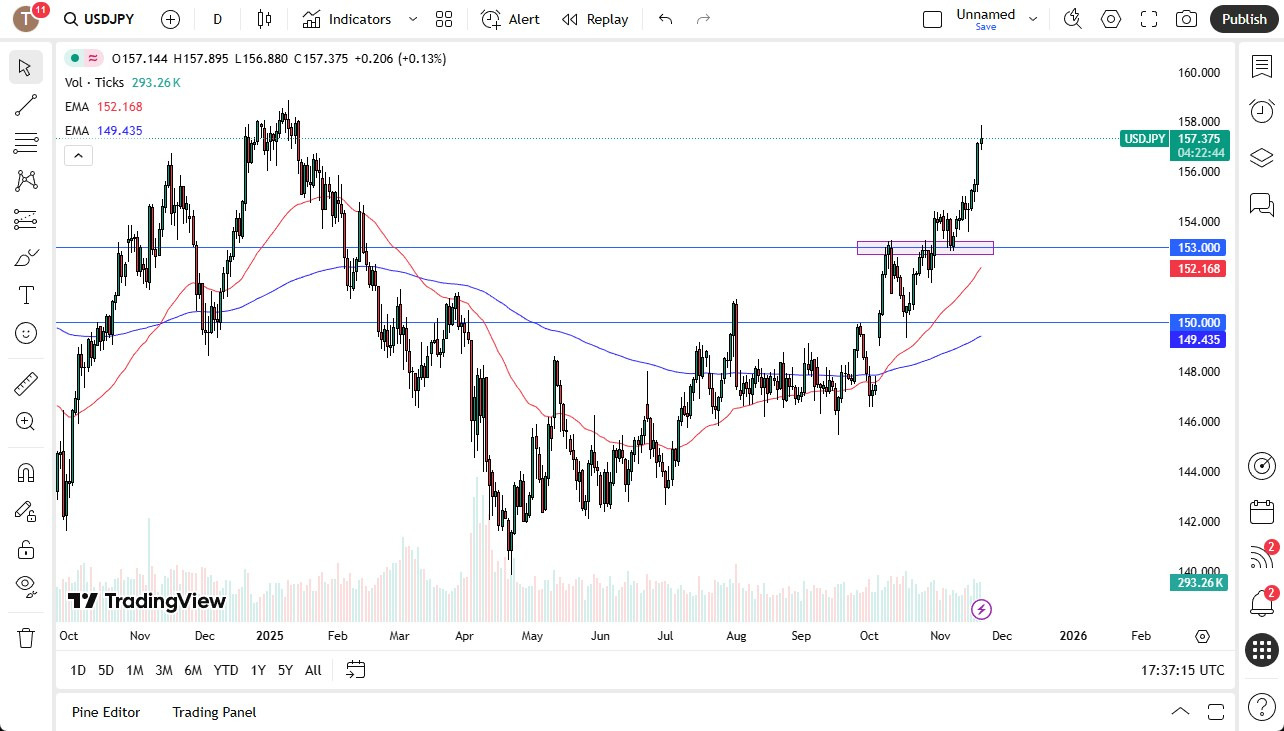
The US dollar has rallied a little bit during the early hours here on Thursday but gave back some of the gains on the 158 yen level. The 158 yen level, of course, is an area that I think continues to be important as it had previously been resistance. Ultimately, though, this is a market that continues to see a little bit of an overextension. I do think at this point in time, if we pull back from here, it is likely that buyers will try to find some type of value.

I would be particularly interested in the 155.50 yen level, as it is an area that we launched from, and there should be a lot of demand. Below there, we have the 154 yen level followed by the 153 yen level. Ultimately, the interest rate differential continues to favor the US dollar, and I think that continues to be the case for quite some time. Ultimately, I just do not see a scenario where things change rapidly, and the fact that you get paid to hang on to this position at the end of every day certainly helps as well.
If we could clear the 159 yen level, this market could really start to take off, but I think we are a little overdone at this point. I am looking for some value. I went ahead and closed my long position for the day. Not because I think this is a bearish market, just because I think we pull back, we try to find a little bit of support, and then we continue the overall uptrend. Longer term, I do not really know where we go, but you could make an argument for 162 yen before it is all said and done.
Want to trade our USD/JPY forex analysis and predictions? Here’s a list of forex brokers in Japan to check out.
Christopher Lewis has been trading Forex and has over 20 years experience in financial markets. Chris has been a regular contributor to Daily Forex since the early days of the site. He writes about Forex for several online publications, including FX Empire, Investing.com, and his own site, aptly named The Trader Guy. Chris favours technical analysis methods to identify his trades and likes to trade equity indices and commodities as well as Forex. He favours a longer-term trading style, and his trades often last for days or weeks.
Oil prices fell sharply again on Friday, November 21, 2025, extending a three‑day losing streak and dragging benchmarks to around four‑year lows as traders reacted to possible peace talks between Russia and Ukraine, fresh U.S. sanctions on Russian oil majors, and mounting fears of a global supply glut.
By late morning in Europe, Brent crude futures were trading around $62 a barrel, while U.S. West Texas Intermediate (WTI) hovered just under $58, down roughly 2% on the day and on course for weekly losses of about 3–4%. [1]
Both benchmarks are now roughly 15–25% below their peaks from early 2025 and close to the lowest levels seen since 2021, according to market data and independent price trackers. [2]
Different price services quote slightly different intraday levels, but today’s trading range is tightly clustered:
Price services such as Trading Economics and other real‑time platforms also show Brent near $62.4 and “Crude Oil” (WTI) near $57.9, confirming the broad picture of a market grinding lower. [5]
Several commentators describe these levels as fresh four‑year lows, after a steady slide from above $80 per barrel at the start of 2025. [6]
Today’s move is not about a single headline. Instead, it’s a convergence of geopolitical shifts, macroeconomic worries, and supply‑demand fundamentals.
Oil markets have carried a “war premium” since Russia’s invasion of Ukraine, reflecting fears of prolonged supply disruptions. That premium is being squeezed.
Even though no agreement is guaranteed, analysts quoted across multiple outlets caution that even the possibility of a peace deal is enough to shave off some of crude’s risk premium and tilt sentiment bearish. [9]
At the same time, U.S. sanctions on Russian oil giants Rosneft and Lukoil formally take effect today, adding a new twist. [10]
In theory this should support prices by tightening supply. But several analysts note that:
The result: markets see the sanctions as messy but not (yet) a severe supply shock, especially if peace efforts succeed in stabilizing the region.
Underlying today’s sell‑off is a growing consensus that supply is running ahead of demand:
OPEC+ has tried to lean against the glut narrative. In early November, the group agreed to:
However, with Brent hovering near $62 despite those steps, traders appear unconvinced that the cuts so far are enough to clear looming surpluses.
Macro conditions are also leaning against crude:
Commentary from macro‑focused outlets notes that investors are in “risk‑off” mode, selling stocks, high‑yield assets, and commodities in tandem as they reassess how long higher rates may persist into 2026. [20]
Fundamentally, U.S. inventory data this week was mildly supportive for crude — but not enough to offset the bearish macro picture.
The latest weekly report from the U.S. Energy Information Administration (EIA), as summarized by Rigzone, showed that: [21]
Analysts described the report as showing a “tighter crude balance but softer product demand” — hardly the recipe for a sustained rally when traders are already fretting about 2026 oversupply.
For households and transport‑heavy sectors, sub‑$60 WTI and low‑$60s Brent are good news:
Lower fuel costs also benefit:
The flip side: today’s oil price is painful for many producers.
The broader energy sector has been volatile all week, with equity indices tracking oil prices lower as investors reassess earnings forecasts for 2026 under a “lower for longer” price scenario. [25]
Countries heavily dependent on imported crude are juggling price advantages against geopolitical pressure:
The short‑term impact is likely to be higher logistical complexity rather than outright shortages, but over time such shifts could alter regional pricing dynamics and freight costs.
Beyond fundamentals, chart‑watchers say the technical picture for crude has turned decisively bearish:
The message from the charts: unless a fresh catalyst emerges — whether geopolitical or economic — momentum currently favors the bears.
Looking beyond today’s close, several key themes will shape the next leg for oil prices:
For now, the balance of evidence points to an oil market tilted toward oversupply, with prices under pressure from both improved geopolitical visibility and a less dovish central‑bank outlook. Unless that calculus changes, traders and policymakers alike may need to get used to Brent in the low‑$60s and WTI in the high‑$50s as the new normal — at least heading into the start of 2026.
What is the Brent oil price today, 21 November 2025?
Brent crude has traded around $62 per barrel, with most price services quoting levels between about $61.9 and $62.5during Friday’s European session. [35]
What is today’s WTI crude price?
WTI crude has been quoted in the $57.5–58.0 per barrel range, down roughly 2% from Thursday’s close and on track for a third straight daily decline. [36]
Why are oil prices falling today?
The drop reflects hopes for a Russia–Ukraine peace deal, new yet manageable sanctions on Russian oil giants, worries about a 2026 supply glut, a stronger U.S. dollar as Fed rate‑cut hopes fade, and an EIA report showing only modest U.S. crude stock draws alongside soft product demand. [37]
Crude Oil Prices Explained – WTI vs Brent
1. www.reuters.com, 2. www.polyestertime.com, 3. www.reuters.com, 4. www.reuters.com, 5. tradingeconomics.com, 6. www.polyestertime.com, 7. www.reuters.com, 8. www.reuters.com, 9. www.reuters.com, 10. www.reuters.com, 11. timesofindia.indiatimes.com, 12. timesofindia.indiatimes.com, 13. www.polyestertime.com, 14. www.iea.org, 15. www.polyestertime.com, 16. www.aljazeera.com, 17. www.reuters.com, 18. www.reuters.com, 19. dmarketforces.com, 20. markets.financialcontent.com, 21. www.rigzone.com, 22. www.polyestertime.com, 23. www.polyestertime.com, 24. www.polyestertime.com, 25. markets.financialcontent.com, 26. timesofindia.indiatimes.com, 27. www.fxempire.com, 28. www.fxempire.com, 29. www.fxempire.com, 30. www.reuters.com, 31. timesofindia.indiatimes.com, 32. www.reuters.com, 33. dmarketforces.com, 34. www.iea.org, 35. www.reuters.com, 36. www.reuters.com, 37. www.reuters.com
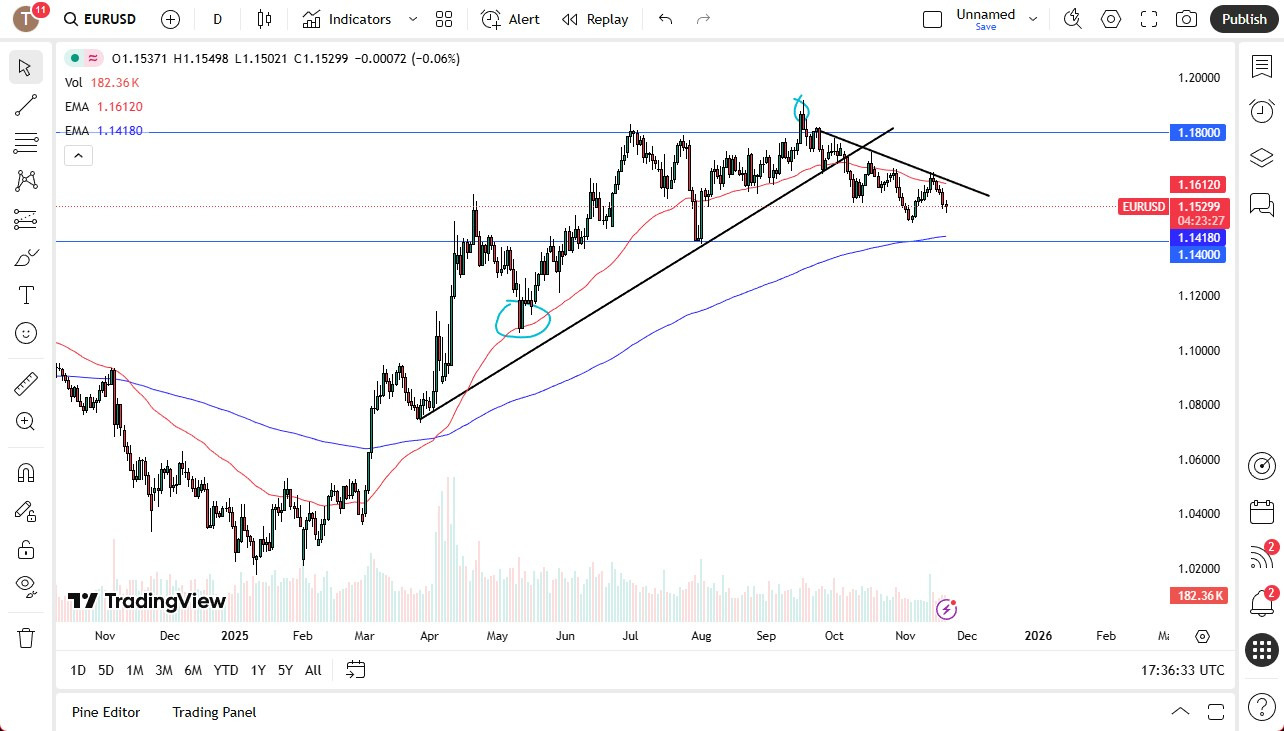
Short-term rallies are possible here with the 50-day EMA above offering a bit of a short-term barrier. I think that could end up being a short-term ceiling for that matter, as there is also a downtrend line there. If we were to break above there, then the 1.17 level becomes the next target, followed by the 1.18 level.
The interest rate differential favors the US dollar and probably will for some time. So with that being the case, I prefer fading short-term rallies that show signs of exhaustion, as we have seen multiple times since the September FOMC meeting.
Longer term, if we can break down below the 1.14 level, it is possible that we could drop all the way down to the 1.11 level, which is my longer-term target. I expect to see a lot of choppy back-and-forth volatility as we are between the 50-day EMA above and the 200-day EMA below. Over the longer term, I think that we are in the midst of some type of bigger topping pattern, and it is worth noting that there are a lot of concerns that the Federal Reserve will not be able to cut rates as quickly as everybody wanted because of a delay in jobs numbers.
Ready to trade our EUR/USD daily forecast? Here’s a list of some of the top forex brokers in Europe to check out.
Christopher Lewis has been trading Forex and has over 20 years experience in financial markets. Chris has been a regular contributor to Daily Forex since the early days of the site. He writes about Forex for several online publications, including FX Empire, Investing.com, and his own site, aptly named The Trader Guy. Chris favours technical analysis methods to identify his trades and likes to trade equity indices and commodities as well as Forex. He favours a longer-term trading style, and his trades often last for days or weeks.
Natural gas price rose in its last trading on the intraday basis, due to its leaning on the support of EMA50, gaining bullish momentum that helped it to achieve these last gains, preparing to attack the key resistance at $4.75, amid the dominance of the main bullish trend on the short-term basis and its trading alongside supportive trend line for this trend, besides the emergence of the positive signals on the relative strength indicators, after reaching oversold levels.
Therefore, we suggest a rise in its upcoming intraday trading, especially when breaching $4.75, to target its main resistance at $5.00.
The expected trading range for today is between $4.55 and $5.00
Trend forecast: Bullish
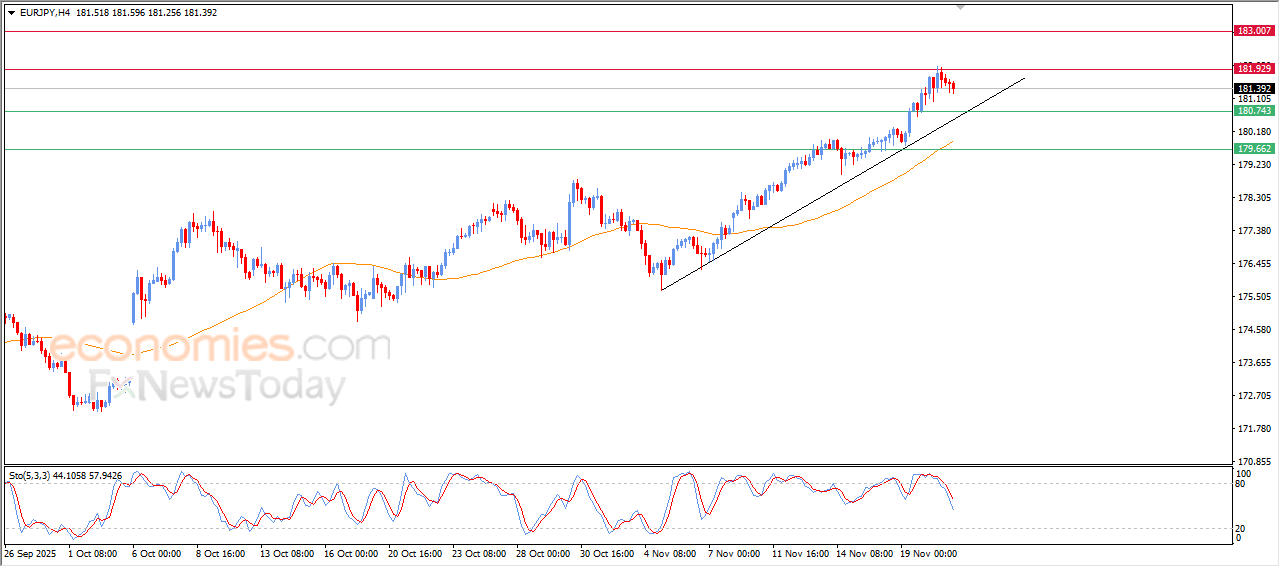
The EURJPY pair declined slightly in the last intraday levels, amid the emergence of the negative signals on the relative strength indicators, after reaching overbought levels, to gain bullish momentum that might help it to recover and rise again, amid the dominance of the main bullish trend and its trading alongside supportive trend line, and there is continued dynamic support due to its trading above EMA50, reinforcing the chances of its recovery in the upcoming perio.
Therefore, our expectations suggest a rise in the upcoming intraday trading, especially when breaching the key resistance at 181.90, targeting its next resistance at 183.00.
The expected trading range for today is between 180.75 and 183.00
Trend forecast: Bullish
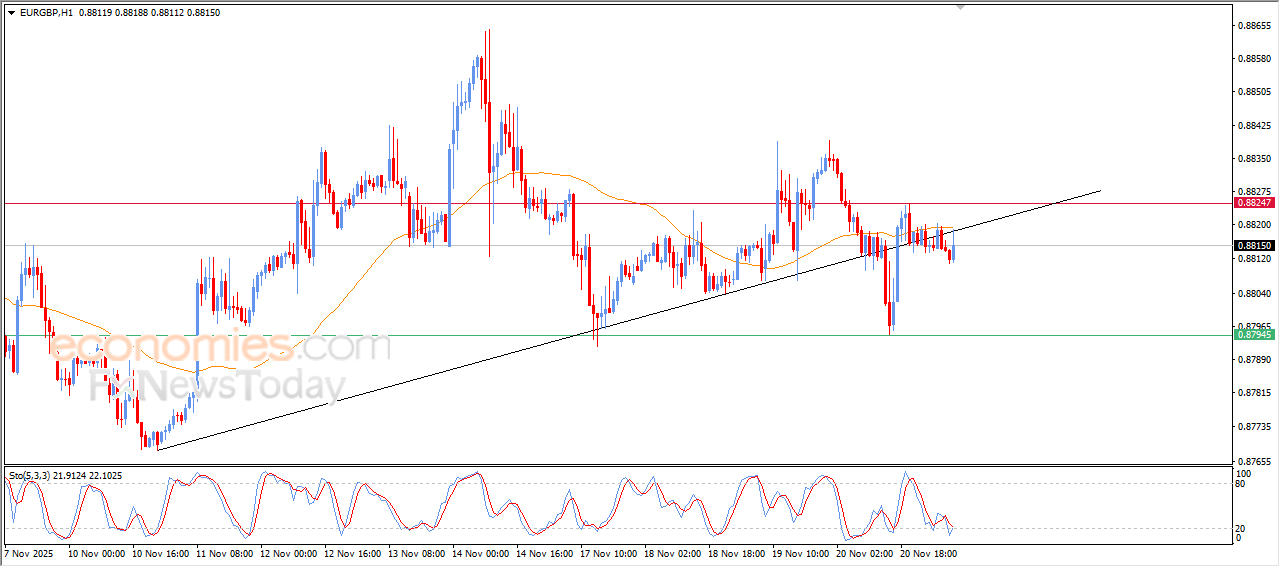
The EURGBP rose cautiously in its last trading, to hit the resistance of its EMA50, in attempt to offload some of its clear oversold conditions on the relative strength indicators, with the emergence of positive overlapping signals, affected by breaking bullish trend line on the short-term basis, intensifying the negative pressure on the pair, reinforcing the chances of the price decline on the near-term basis.
Therefore, our expectation suggests a decline in EURGBP’s last intraday trading, if the resistance settles at 0.8825, to target the key support at 0.8795.
The expected trading range for today is between 0.8795 and 0.8830
Trend forecast: Bearish