The main category of Forex News.
You can use the search box below to find what you need.
[wd_asp id=1]
The main category of Forex News.
You can use the search box below to find what you need.
[wd_asp id=1]
Gold trades below the $3,300 mark shedding ground on the back of broad US Dollar’s (USD) strength. The Greenback maintained a strong footing ever since the week started, helped by encouraging headlines related to trade deals. However, the USD soared on Wednesday, following the release of unexpectedly encouraging United States (US) data and ahead of the Federal Reserve (Fed) monetary policy announcement.
Speculative interest welcomed news indicating that the US economy grew at a faster than anticipated pace in the second quarter of the year, while inflationary pressures in the same period eased. Even further, employment-related figures kept pointing at a solid labor market, which may be a bit of a concern for the Fed, but in general means the world’s largest economy is much healthier than feared.
The US ADP Employment Change report showed that the private sector added 104K new positions in July, much better than the 78K expected, and well-above the -33K expected. More relevant, the flash estimate of the Q2 Gross Domestic Product surpassed expectations, as the economy expanded at an annual rate of 3% in the second quarter, much better than the 2.4% anticipated or the -0.5% from Q1.
Finally, The core Personal Consumption Expenditures (PCE) Price Index, the Fed’s favorite inflation gauge, indicated easing inflationary pressures as the index rose by 2.5% in the three months to June, down from the 3.5% posted in Q1.
XAU/USD remains pressured as investors gear up for the Fed announcement. The central bank is widely anticipated to keep interest rates on hold, floating between 4.25% and 4.50%. The central bank will release a statement with policymakers reasoning behind the decision. Finally, Chair Jerome Powell will offer a press conference, to further clarify officials’ stance.
Given that the decision has been long ago priced in, the focus will be on Powell’s words, and any hint he may give on future monetary policy decisions.
The daily chart for the XAU/USD pair shows a flat 20 Simple Moving Average (SMA) provides intraday resistance for a third consecutive day, rejecting advances at around $3,345. The 100 SMA, in the meantime, provides support at around $3,263.00, a potential bearish target should the USD keeps gaining ground. Finally technical indicators turned south below their midlines, supporting a downward extension.
The near-term picture is bearish. The 4-hour chart for the XAU/USD shows technical indicators head firmly south within negative levels, while the pair plummeted below all its moving averages, with the 20 SMA currently at around $3,325.00, extending its slide below directionless and converging 100 and 200 SMAs.
Support levels: 3,287.30 3,274.05 3,249.60
Resistance levels: 3,311.15 3,328.60 3,345.00
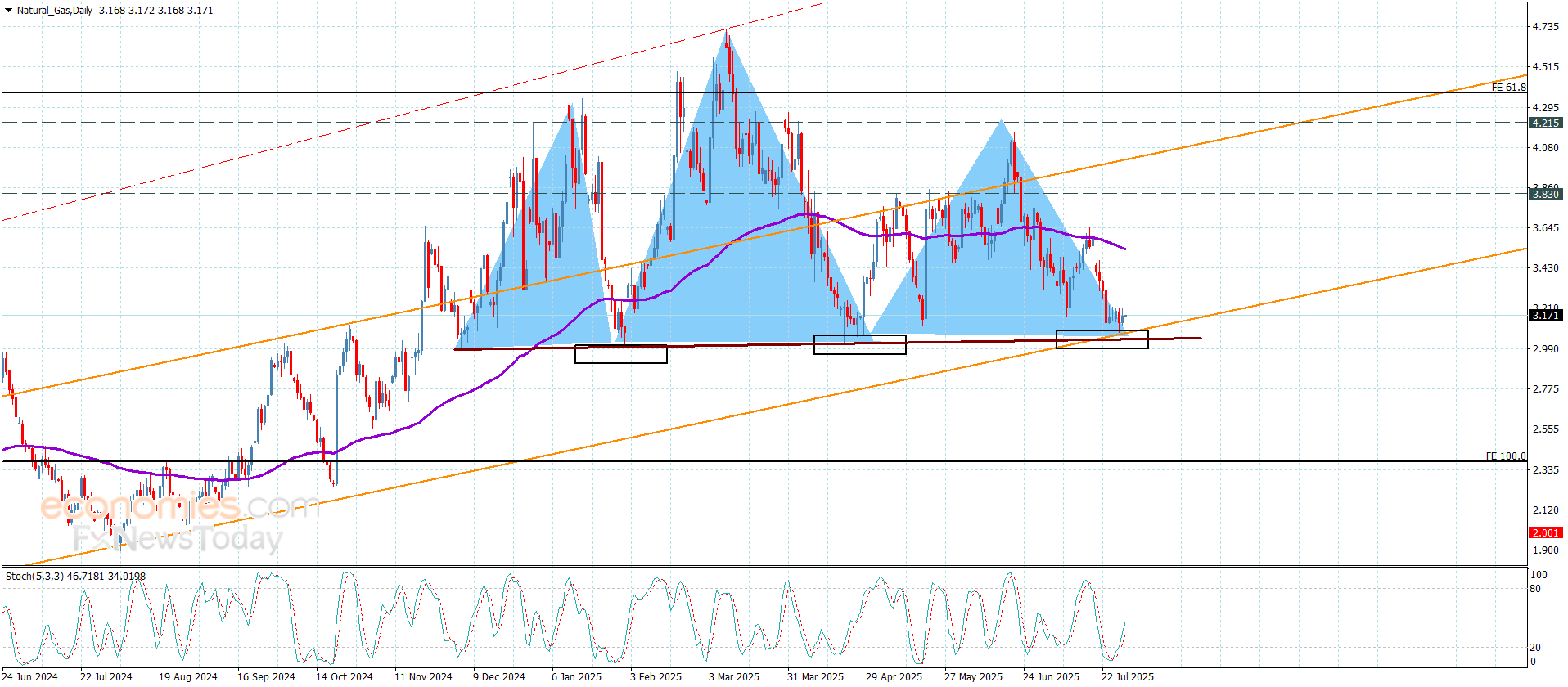
Natural gas prices provided a new positive close above $3.050 level, forming the neckline of the head and shoulders pattern that appears in the above image, taking advantage of stochastic exit from the oversold level and providing positive momentum again.
The price success to settle above $3.050 will decrease the risk of moving to a new bearish station, providing chances to begin recording some of the gains by its rally to $3.320 and $3.450, while breaking the neckline and holding below it will force it to suffer big losses by reaching $2.710 initially.
The expected trading range for today is between $3.10 and 3.320
Trend forecast: Bullish by the stability of $3.050
Important DisclaimersThe content provided on the website includes general news and publications, our personal analysis and opinions, and contents provided by third parties, which are intended for educational and research purposes only. It does not constitute, and should not be read as, any recommendation or advice to take any action whatsoever, including to make any investment or buy any product. When making any financial decision, you should perform your own due diligence checks, apply your own discretion and consult your competent advisors. The content of the website is not personally directed to you, and we does not take into account your financial situation or needs.The information contained in this website is not necessarily provided in real-time nor is it necessarily accurate. Prices provided herein may be provided by market makers and not by exchanges.Any trading or other financial decision you make shall be at your full responsibility, and you must not rely on any information provided through the website. FX Empire does not provide any warranty regarding any of the information contained in the website, and shall bear no responsibility for any trading losses you might incur as a result of using any information contained in the website.The website may include advertisements and other promotional contents, and FX Empire may receive compensation from third parties in connection with the content. FX Empire does not endorse any third party or recommends using any third party’s services, and does not assume responsibility for your use of any such third party’s website or services.FX Empire and its employees, officers, subsidiaries and associates, are not liable nor shall they be held liable for any loss or damage resulting from your use of the website or reliance on the information provided on this website.Risk DisclaimersThis website includes information about cryptocurrencies, contracts for difference (CFDs) and other financial instruments, and about brokers, exchanges and other entities trading in such instruments. Both cryptocurrencies and CFDs are complex instruments and come with a high risk of losing money. You should carefully consider whether you understand how these instruments work and whether you can afford to take the high risk of losing your money.FX Empire encourages you to perform your own research before making any investment decision, and to avoid investing in any financial instrument which you do not fully understand how it works and what are the risks involved.
The 9th OPEC International Seminar was held in Vienna a week ago, wherein participants discussed energy security, investment, climate change, and energy poverty, with a particular emphasis on balancing these competing priorities. According to commodity analysts at Standard Chartered, the summit titled “Charting Pathways Together: The Future of Global Energy” featured significantly greater engagement from international oil companies and consuming country governments, with discussions converging on a more inclusive shared agenda rather than non-intersecting approaches seen in previous years. However, StanChart reported there was a clear mismatch between what energy producers vs. market analysts think about spare production capacity. Unlike Wall Street analysts, who frequently talk about spare capacity of 5-6 million barrels per day (mb/d), speakers from several sectors of the industry noted thatspare capacity is both limited and very geographically concentrated.
StanChart believes this erroneous assumption about spare capacity has been a big drag on oil prices, and the implications for the whole forward curve of oil prices could be potentially profound once traders realize that roughly two-thirds of the capacity they thought was available on demand does not actually exist. This makes the analysts bullish about the general shape of their forecast 2026 price trajectory (Figure 32), i.e., a set of significant upward shifts as opposed to the flat trajectory seen in the market curve and in analyst consensus. In other words, oil prices could have as much as $15/barrel upside from current levels.
Source: Standard Chartered Research
StanChart is not the only oil bull here. Goldman Sachs recently hiked its oil price forecast for H2 2025, saying the market is increasingly shifting its focus from recession fears to potential supply disruptions, low spare capacity, lower oil inventories especially among OECD countries and production constraints by Russia. GS has increased its Brent forecast by $5/bbl to $66/bbl, and by $6 for WTI crude to $63/bbl, slightly lower than current levels of $68.34/bbl and 66.24/bbl for Brent and WTI crude, respectively. However, the Wall Street bank has maintained its 2026 price forecast at $56/bbl for Brent and $52 for WTI, due to “an offset between a boost from higher long-dated prices and a hit from a wider 1.7M bbl/day surplus.’’ Previously, GS had forecast a 1.5M bbl/day surplus for the coming year. Further, Goldman sees a stronger oil price rebound beyond 2026 due to reduced spare capacity.
Bullish On Gas Prices
EU natural gas inventories have climbed at faster-than-average clip in recent times. According to Gas Infrastructure Europe (GIE) data, Europe’s gas inventories stood at 73.10 billion cubic metres (bcm) on 13 July, good for a 2.31 bcm w/w increase. Still, the injection rate is not enough to completely fill the continent’s gas stores, with the current clip on track to take inventories to about 97.9 bcm, or 84.3% of storage capacity, at the end of the injection season.
Europe’s gas demand remains fairly lacklustre despite extremely high temperatures across much of the continent in recent weeks. According to estimates by StanChart, EU gas
demand for the first 14 days of July averaged 583 million cubic meters/day, nearly 3% lower from a year ago but a 10% improvement from the June lows.
However, StanChart is bullish on natural gas prices, saying the market is likely underestimating the likelihood of more Russian gas being taken off the markets.
Back in April, U.S. senators Lindsey Graham (Republican) and Richard Blumenthal (Democrat), introduced ‘Sanctioning Russia Act of 2025’, with the legislation enjoying broad bipartisan support (85 co-sponsors in the Senate out of 100 senators). In a joint statement on 14 July, the two senators noted that President Trump’s decision to implement 100% secondary tariffs on countries that buy Russian oil and gas if a peace agreement is not reached within 50 days but pledged that they will continue to work on “bipartisan Russia sanctions legislation that would implement up to 500 percent tariffs on countries that buy Russian oil and gas”. StanChart has predicted that the Trump administration is unlikely to take actions that risk driving oil prices higher; however, Russian gas remains in the crosshairs, with U.S. LNG likely to see a surge in demand if Russian gas exports are curtailed.
StanChart estimates that the EU’s net imports of Russian pipeline gas averaged 79.8 million cubic metres per day (mcm/d) in the first 14 days of July, with all non-transit flows into the EU coming into Bulgaria through the Turkstream pipeline, with Hungary and Slovakia also receiving Turkstream gas. There was also a flow of about 65 mcm/d of Russian LNG in the first half of July, with Russia providing 18.6% of the EU’s net imports. StanChart has predicted that we could see a strong rally in natural gas prices if Washington slaps Moscow with fresh gas sanctions.
By Alex Kimani for Oilprice.com
More Top Reads From Oilprice.com:
The breakdown of the trendline was confirmed by Monday’s closing price below the line. Then, on Tuesday, gold found resistance at the trendline with the day’s high of $3,334. That showed prior support of the trendline as resistance. The low for the day at $3,308 was almost an exact retest of support at the interim swing low of $3,310. Although that low failed briefly on Monday, as a low for the day of $3,302 hit intraday, the quick recovery shows support being retained around the interim swing low.
A rally above Tuesday’s high of $3,334 will show strength and the potential for a bullish reversal. But a rally above Monday’s high of $3,345 provides clearer confirmation as a three-day high will have been reached and two moving averages reclaimed. It is interesting to note that the 20-Day and 50-Day moving averages are the closest to each other since the last bullish crossover in January. This shows strong potential resistance and the likelihood that volatility is close to expanding rapidly.
The breakdown of the pennant points to possible continuation to the downside. A drop below Tuesday’s low of $3,308 will indicate weakness that will confirm a decline below $3,302. That would put gold in sight of a test of support around the higher swing low of $3,247 (C). The weekly chart supports a bearish scenario, although it is within the context of a consolidation pennant formation and therefore may be less reliable. Last week completed a bearish shooting star candlestick pattern and it triggered this week below $3,325.
For a look at all of today’s economic events, check out our economic calendar.
After touching its lowest level since mid-May near 1.3300 on Tuesday, GBP/USD stages a correction and trades above 1.3350 in the European session on Wednesday. High-tier macroeconomic data releases from the US and the Federal Reserve’s monetary policy announcements could trigger the next big action in the pair.
The table below shows the percentage change of British Pound (GBP) against listed major currencies this week. British Pound was the weakest against the US Dollar.
| USD | EUR | GBP | JPY | CAD | AUD | NZD | CHF | |
|---|---|---|---|---|---|---|---|---|
| USD | 1.86% | 0.45% | 0.30% | 0.58% | 1.23% | 1.08% | 1.07% | |
| EUR | -1.86% | -1.40% | -1.51% | -1.27% | -0.61% | -0.76% | -0.78% | |
| GBP | -0.45% | 1.40% | -0.28% | 0.14% | 0.80% | 0.65% | 0.62% | |
| JPY | -0.30% | 1.51% | 0.28% | 0.28% | 0.88% | 0.76% | 0.92% | |
| CAD | -0.58% | 1.27% | -0.14% | -0.28% | 0.62% | 0.51% | 0.48% | |
| AUD | -1.23% | 0.61% | -0.80% | -0.88% | -0.62% | -0.15% | -0.18% | |
| NZD | -1.08% | 0.76% | -0.65% | -0.76% | -0.51% | 0.15% | -0.03% | |
| CHF | -1.07% | 0.78% | -0.62% | -0.92% | -0.48% | 0.18% | 0.03% |
The heat map shows percentage changes of major currencies against each other. The base currency is picked from the left column, while the quote currency is picked from the top row. For example, if you pick the British Pound from the left column and move along the horizontal line to the US Dollar, the percentage change displayed in the box will represent GBP (base)/USD (quote).
Mixed macroeconomic data releases from the US limited the US Dollar’s gains on Tuesday and helped GBP/USD hold its ground. Additionally, investors seem to be stepping aside before committing to additional USD longs. JOLTS Job Openings declined to 7.43 million in June from 7.77 in May, falling short of the market expectation of 7.55, while the Conference Board’s Consumer Confidence Index improved to 97.2 in July from 95.2 in June.
The US economic calendar will offer ADP Employment Change data for July and the first estimate of the second-quarter Gross Domestic Product (GDP) growth on Wednesday. Markets expect private sector payrolls to rise by 78,000 following the 33,000 decline reported in June. A significant positive surprise, with a reading above 100,000, could boost the USD with the immediate reaction.
The US’ GDP is forecast to rebound and grew at an annual rate of 2.4% following the 0.5% contraction recorded in the first quarter. A reading near the market consensus, if combined with an upbeat ADP print, could help the USD gather strength heading into the Fed event. Conversely, GBP/USD could keep its footing if these data miss analysts’ estimates.
Later in the day, the Fed is widely anticipated to leave the policy rate unchanged at the range of 4.25%-4.5%. Earlier in the month, Governors Christopher Waller and Michelle Bowman both voiced their support for a 25 basis points rate cut in July. Hence, it wouldn’t be a big surprise if they were to vote in favor of a reduction in the policy rate. However, if the policy statement shows that there were other policymakers who voted for a rate cut, the USD could come under selling pressure in the late American session.
On the other hand, GBP/USD could turn south if Fed Chairman Jerome Powell avoids signalling a rate cut in September and repeats the need for patience, citing the uncertainty surrounding the inflation outlook despite the recently-announced trade deals with Japan and the EU. According to the CME FedWatch Tool, markets are currently pricing in about a 63% probability of a rate cut at the next meeting in September.
The Relative Strength Index (RSI) indicator on the 4-hour chart stays below 40 and GBP/USD is yet to make a 4-hour close above the 20-period Simple Moving Average (SMA), highlighting a lack of buyer interest.
On the downside, 1.3330 (static level) aligns as an interim support level before 1.3300 (Fibonacci 78.6% retracement of the latest uptrend) and 1.3250 (static level). Looking north, resistance levels could be spotted at 1.3400 (Fibonacci 61.8% retracement), 1.3470 (Fibonacci 50% retracement, 100-period SMA) and 1.3500 (round level, static level).
The Pound Sterling (GBP) is the oldest currency in the world (886 AD) and the official currency of the United Kingdom. It is the fourth most traded unit for foreign exchange (FX) in the world, accounting for 12% of all transactions, averaging $630 billion a day, according to 2022 data.
Its key trading pairs are GBP/USD, also known as ‘Cable’, which accounts for 11% of FX, GBP/JPY, or the ‘Dragon’ as it is known by traders (3%), and EUR/GBP (2%). The Pound Sterling is issued by the Bank of England (BoE).
The single most important factor influencing the value of the Pound Sterling is monetary policy decided by the Bank of England. The BoE bases its decisions on whether it has achieved its primary goal of “price stability” – a steady inflation rate of around 2%. Its primary tool for achieving this is the adjustment of interest rates.
When inflation is too high, the BoE will try to rein it in by raising interest rates, making it more expensive for people and businesses to access credit. This is generally positive for GBP, as higher interest rates make the UK a more attractive place for global investors to park their money.
When inflation falls too low it is a sign economic growth is slowing. In this scenario, the BoE will consider lowering interest rates to cheapen credit so businesses will borrow more to invest in growth-generating projects.
Data releases gauge the health of the economy and can impact the value of the Pound Sterling. Indicators such as GDP, Manufacturing and Services PMIs, and employment can all influence the direction of the GBP.
A strong economy is good for Sterling. Not only does it attract more foreign investment but it may encourage the BoE to put up interest rates, which will directly strengthen GBP. Otherwise, if economic data is weak, the Pound Sterling is likely to fall.
Another significant data release for the Pound Sterling is the Trade Balance. This indicator measures the difference between what a country earns from its exports and what it spends on imports over a given period.
If a country produces highly sought-after exports, its currency will benefit purely from the extra demand created from foreign buyers seeking to purchase these goods. Therefore, a positive net Trade Balance strengthens a currency and vice versa for a negative balance.
Important DisclaimersThe content provided on the website includes general news and publications, our personal analysis and opinions, and contents provided by third parties, which are intended for educational and research purposes only. It does not constitute, and should not be read as, any recommendation or advice to take any action whatsoever, including to make any investment or buy any product. When making any financial decision, you should perform your own due diligence checks, apply your own discretion and consult your competent advisors. The content of the website is not personally directed to you, and we does not take into account your financial situation or needs.The information contained in this website is not necessarily provided in real-time nor is it necessarily accurate. Prices provided herein may be provided by market makers and not by exchanges.Any trading or other financial decision you make shall be at your full responsibility, and you must not rely on any information provided through the website. FX Empire does not provide any warranty regarding any of the information contained in the website, and shall bear no responsibility for any trading losses you might incur as a result of using any information contained in the website.The website may include advertisements and other promotional contents, and FX Empire may receive compensation from third parties in connection with the content. FX Empire does not endorse any third party or recommends using any third party’s services, and does not assume responsibility for your use of any such third party’s website or services.FX Empire and its employees, officers, subsidiaries and associates, are not liable nor shall they be held liable for any loss or damage resulting from your use of the website or reliance on the information provided on this website.Risk DisclaimersThis website includes information about cryptocurrencies, contracts for difference (CFDs) and other financial instruments, and about brokers, exchanges and other entities trading in such instruments. Both cryptocurrencies and CFDs are complex instruments and come with a high risk of losing money. You should carefully consider whether you understand how these instruments work and whether you can afford to take the high risk of losing your money.FX Empire encourages you to perform your own research before making any investment decision, and to avoid investing in any financial instrument which you do not fully understand how it works and what are the risks involved.
Technical Analysis
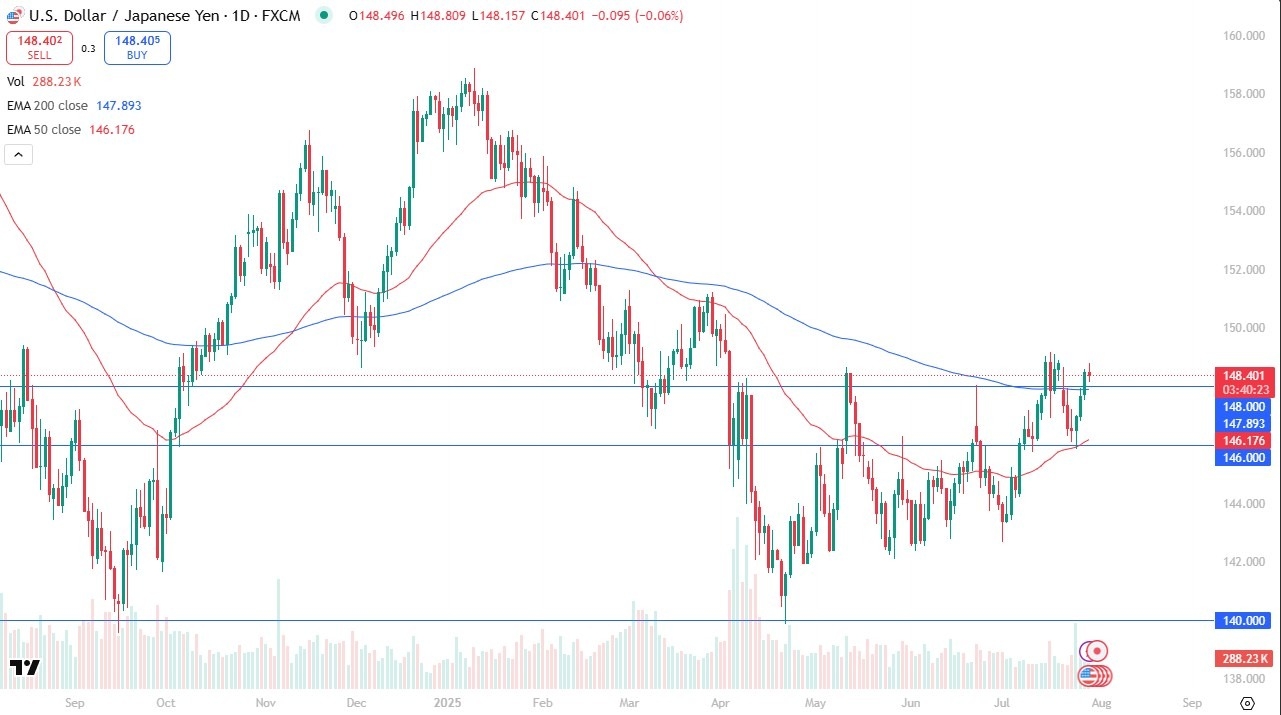
Ultimately, I think this is a market that is trying to build up enough pressure to break to the upside, but I also recognize that it is a market that faces quite a few headwinds. Wednesday will be extraordinarily noisy, right along with Thursday, as we have the Federal Reserve announcement on Wednesday, followed by the Bank of Japan sometime early on Thursday. In other words, this will be a very volatile pair over the next couple of days, so you have to be cautious. However, over the longer term, unless something changes quite drastically, I just don’t see why I would want to short this market as long as we are above the ¥146 level.
Keep in mind that the 50 Day EMA is sitting right around the ¥146 level, so I think that adds even more credence to that idea of a floor being put in the market. Anything below could open up a significant drop lower, perhaps sending the US dollar plunging quite drastically. This will almost certainly have something to do with the Bank of Japan itself, so I’d be paying close attention to that happening if it were to occur after the Bank of Japan meeting.

On a move above the ¥149 level, then I think the US dollar goes looking to the ¥151 level, which is an area that was a swing homemade previously. All things being equal, this is a market that I think you need to be very cautious with, but I also recognize that we are setting up for a bigger move sooner or later, so with that being the case, the market is likely to continue to be volatile, but I do think that we get a longer-term move in the next couple of sessions.
Want to trade our USD/JPY forex analysis and predictions? Here’s a list of forex brokers in Japan to check out.
Christopher Lewis has been trading Forex and has over 20 years experience in financial markets. Chris has been a regular contributor to Daily Forex since the early days of the site. He writes about Forex for several online publications, including FX Empire, Investing.com, and his own site, aptly named The Trader Guy. Chris favours technical analysis methods to identify his trades and likes to trade equity indices and commodities as well as Forex. He favours a longer-term trading style, and his trades often last for days or weeks.
Natural gas prices provided a new positive close above $3.050 level, forming the neckline of the head and shoulders pattern that appears in the above image, taking advantage of stochastic exit from the oversold level and providing positive momentum again.
The price success to settle above $3.050 will decrease the risk of moving to a new bearish station, providing chances to begin recording some of the gains by its rally to $3.320 and $3.450, while breaking the neckline and holding below it will force it to suffer big losses by reaching $2.710 initially.
The expected trading range for today is between $3.10 and 3.320
Trend forecast: Bullish by the stability of $3.050
It’s not necessarily expected that we will get that reprieve right away, but the September meeting is still a bit of an open question for most traders. And I think it’s important to get an idea as to what the tone of the statement is coming out of the Federal Reserve and Jerome Powell. If it sounds like he’s nowhere near cutting rates, then that could send the US dollar much higher overall.
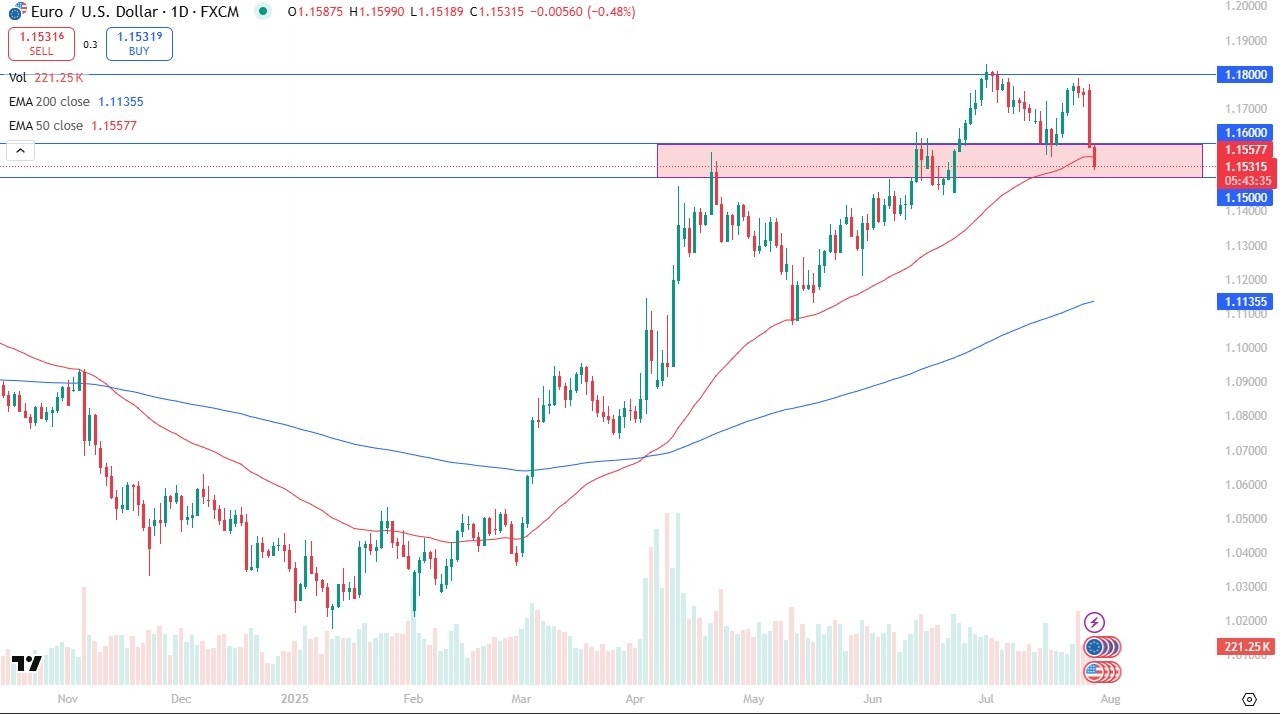
Ultimately, I think you have to look at this as a market that is right on the verge of trying to make a bigger decision. And if that’s going to be the case, I want to be there, but it’s probably going to be a situation where you are looking at this on how it closes on Wednesday to truly make that decision.
If we close above the 1.16 level, then it’s likely that this market goes looking to the 1.18 level again. If we close below the 1.15 level, then I believe the Euro drops down to the 200 day EMA. We are right on the precipice of a bigger move.
Ready to trade our Forex daily analysis and predictions? Here are the best trading platform for beginners to choose from.
Christopher Lewis has been trading Forex and has over 20 years experience in financial markets. Chris has been a regular contributor to Daily Forex since the early days of the site. He writes about Forex for several online publications, including FX Empire, Investing.com, and his own site, aptly named The Trader Guy. Chris favours technical analysis methods to identify his trades and likes to trade equity indices and commodities as well as Forex. He favours a longer-term trading style, and his trades often last for days or weeks.