The main category of Forex News.
You can use the search box below to find what you need.
[wd_asp id=1]
The main category of Forex News.
You can use the search box below to find what you need.
[wd_asp id=1]
Gold price (XAU/USD) trades almost 0.7% lower around $3,360 during the European trading session on Thursday. The precious metal faces a sharp selling pressure as global trade worries have eased amid hopes that the United States (US) and the European Union (EU) will close a trade agreement before the August 1 tariff deadline.
On Wednesday, a report from Financial Times (FT) showed that EU officials have signaled green signal to a trade pact with the US to avert a damaging trade war. Market experts believe the US-Japan deal confirmed on Tuesday increased fears among EU officials that they could their automobile export market share in the US economy, as Washington has slashed tariffs on cars from Tokyo to 15%.
The minutes of the US-Japan deal showed that the baseline and automobile levy on imports from Tokyo to Washington will be 15%. The US charges 25% import duty on all foreign cars, which is separate from the baseline tariff rate.
Easing global trade tensions have diminished demand for safe-haven assets, such as Gold.
Meanwhile, a slight recovery move in the US Dollar (US) seen during the day has also weighed on the Gold price. Technically, a higher US Dollar makes the Gold price an expensive bet for investors.
The US Dollar Index (DXY), which tracks the Greenback’s value against six major currencies, rebounds to near 97.40 after posting a fresh over two-week low near 97.00 earlier in the day.
Going forward, the major trigger for the Gold price will be the Federal Reserve’s (Fed) monetary policy meeting, which is scheduled for next week.
Gold price faces selling pressure after failing to break the Symmetrical Triangle formation on the upside – a move that often leads to volatility expansion. The upward-sloping trendline of the above-mentioned chart pattern is placed from the May 15 low of $3,120.83, while its downward-sloping border is plotted from the April 22 high around $3,500
The 20-day Exponential Moving Average (EMA) still acts as a key support area for the Gold price around $3,355.
The 14-day Relative Strength Index (RSI) falls inside the 40.00-60.00 range, suggesting selling pressure at higher levels.
The Gold price would fall towards the round-level support of $3,200 and the May 15 low at $3,121, if it breaks below the May 29 low of $3,245.
Looking up, the Gold price will enter in an unchartered territory if it breaks above the psychological level of $3,500 decisively. Potential resistances would be $3,550 and $3,600.
Gold has played a key role in human’s history as it has been widely used as a store of value and medium of exchange. Currently, apart from its shine and usage for jewelry, the precious metal is widely seen as a safe-haven asset, meaning that it is considered a good investment during turbulent times. Gold is also widely seen as a hedge against inflation and against depreciating currencies as it doesn’t rely on any specific issuer or government.
Central banks are the biggest Gold holders. In their aim to support their currencies in turbulent times, central banks tend to diversify their reserves and buy Gold to improve the perceived strength of the economy and the currency. High Gold reserves can be a source of trust for a country’s solvency. Central banks added 1,136 tonnes of Gold worth around $70 billion to their reserves in 2022, according to data from the World Gold Council. This is the highest yearly purchase since records began. Central banks from emerging economies such as China, India and Turkey are quickly increasing their Gold reserves.
Gold has an inverse correlation with the US Dollar and US Treasuries, which are both major reserve and safe-haven assets. When the Dollar depreciates, Gold tends to rise, enabling investors and central banks to diversify their assets in turbulent times. Gold is also inversely correlated with risk assets. A rally in the stock market tends to weaken Gold price, while sell-offs in riskier markets tend to favor the precious metal.
The price can move due to a wide range of factors. Geopolitical instability or fears of a deep recession can quickly make Gold price escalate due to its safe-haven status. As a yield-less asset, Gold tends to rise with lower interest rates, while higher cost of money usually weighs down on the yellow metal. Still, most moves depend on how the US Dollar (USD) behaves as the asset is priced in dollars (XAU/USD). A strong Dollar tends to keep the price of Gold controlled, whereas a weaker Dollar is likely to push Gold prices up.

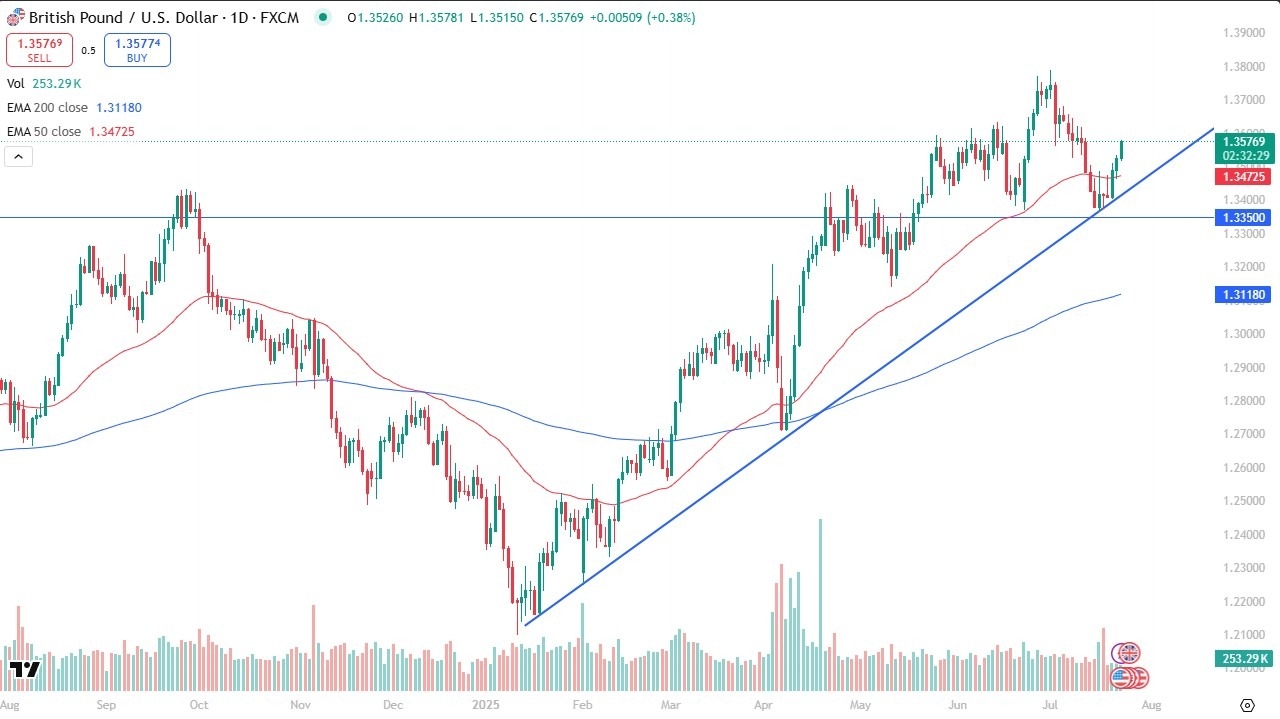
The technical analysis for this market is very bullish as long as we can stay above the 1.3350 level, but I would be concerned if we were to break down below there. At that point, we could come into the 200 Day EMA, near the 1.3118 level. All things being equal, the British pound has been a strong performer against the US dollar for some time, even when we were falling, because quite frankly “the British pound was less bad than the others.” In other words, the British pound has been relatively stronger than most of his contemporaries against the greenback, so that should translate in both directions unless something specific comes out London that we need to be worried about.
If we were to pull back in reach toward the 200 Day EMA, anything underneath there would be a very negative turn of events, and we would probably see the US dollar strengthen against almost everything around the world. The British pound may fall slower than other currencies, but if the British Pound finds itself under that much pressure, it’s likely that other currencies like the Canadian dollar, Japanese yen, euro, etc. will all be struggling against the US dollar. All things being equal though, this looks like a market that’s much more likely to go higher than lower
Ready to trade the Forex GBP/USD analysis and predictions? Here are the best forex trading platforms UK to choose from.
Christopher Lewis has been trading Forex and has over 20 years experience in financial markets. Chris has been a regular contributor to Daily Forex since the early days of the site. He writes about Forex for several online publications, including FX Empire, Investing.com, and his own site, aptly named The Trader Guy. Chris favours technical analysis methods to identify his trades and likes to trade equity indices and commodities as well as Forex. He favours a longer-term trading style, and his trades often last for days or weeks.
The light sweet crude oil market has shown itself to be bullish as we continue to hang around the $65 level. The $65 level also is backed up by the 50-day EMA, and it is the area that we previously had seen a lot of resistance. We had a massive move higher after the Israel airstrikes in Iran, but once the peace was signed and agreed to, oil markets collapsed. What I find interesting, though, is that we are hanging around this same area of previous resistance, and it seems like the market is getting comfortable. We have a lot of wicks to the upside. So, if we can break above the highest one, which is basically $66.50, then I think oil goes higher, probably more of a grind.
Brent looks very much the same, although we have the 50 day EMA above and the $68 level offering resistance. So, in this case, I’d like to see Brent break above $69. If we can do that, then the 200 day EMA gets targeted at $71.20. Short-term pullbacks are possible and quite frankly, we could just continue to stumble here. But I think we’ve got a situation where seasonality favors higher prices. And I do think that the market is trying to do everything it can to build up confidence to go to the upside. Because of this, I’m not really looking to short the market, but I think really at this point in time, we’re more or less in a wait and see type of situation after that wild move. I think most participants are a bit exhausted.
USD/JPY bearish scenario plays out as price rejects the 148.029 key resistance level, confirming a distribution.
Dollar weakness confirmed by DXY breakdown, amplifying the bearish momentum across USD/JPY as safe-haven yen flows accelerate.
Technical bias remains bearish below 145.75, unless the Fair Value Gap is reclaimed with targets toward 149.80 or further downside toward 142.70.
USD/JPY opened the week with a clear upside bias, trading above key Fair Value Gaps and appearing poised for a continuation move toward 150.00 and 151.00. The structure favored a bullish move following a retracement sweep and reclaim of the FVG near 148.056–148.277, as mentioned in the previous forecast: Nasdaq and S&P 500 hit all-time highs, XRP leads crypto breakout, Gold eyes $3,400
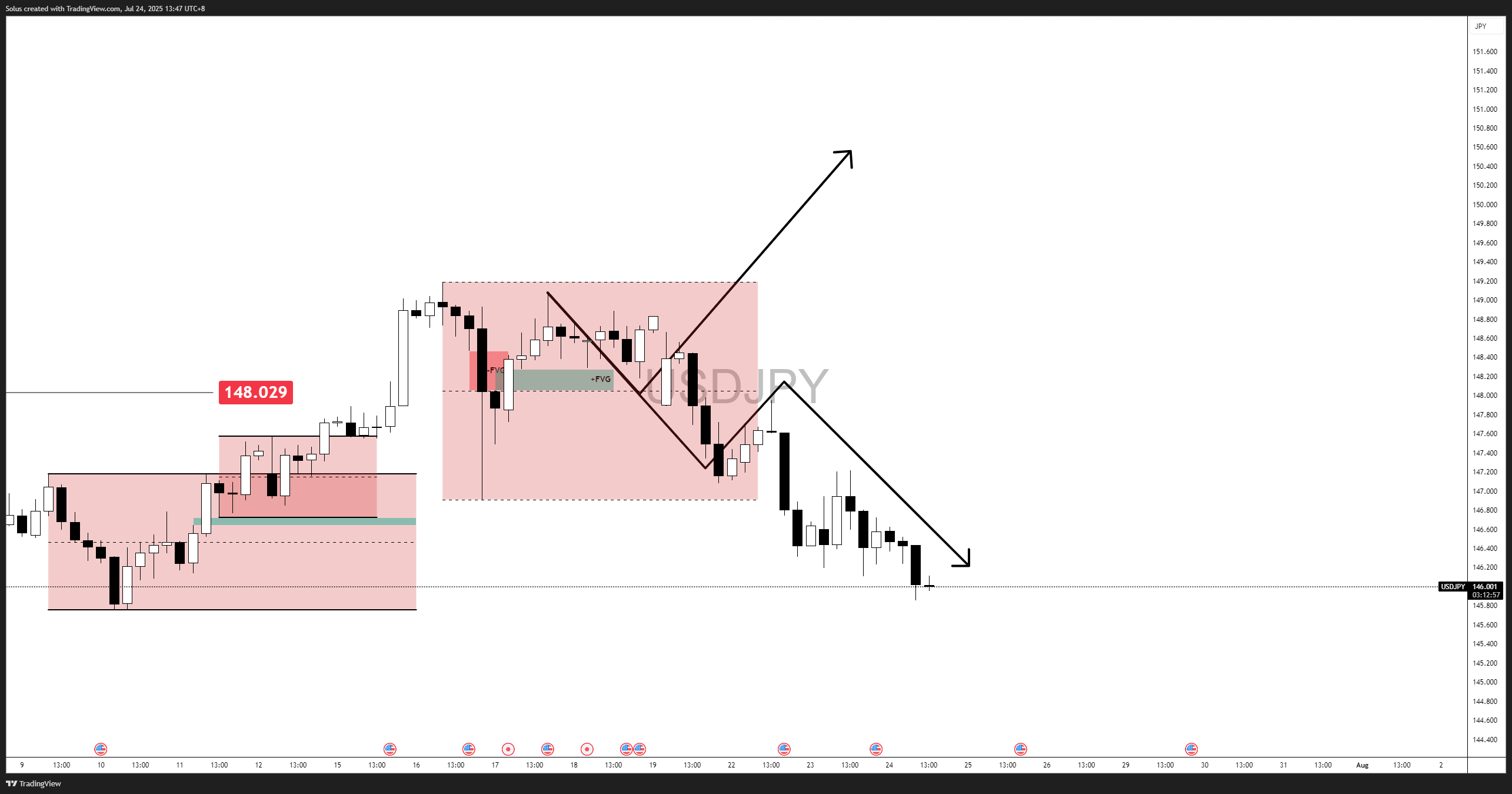
However, the market instead validated the alternate bearish scenario, reversing precisely from the 148.029 resistance level. This marked a distribution phase, not an accumulation to the upside, and the price has since fallen decisively.
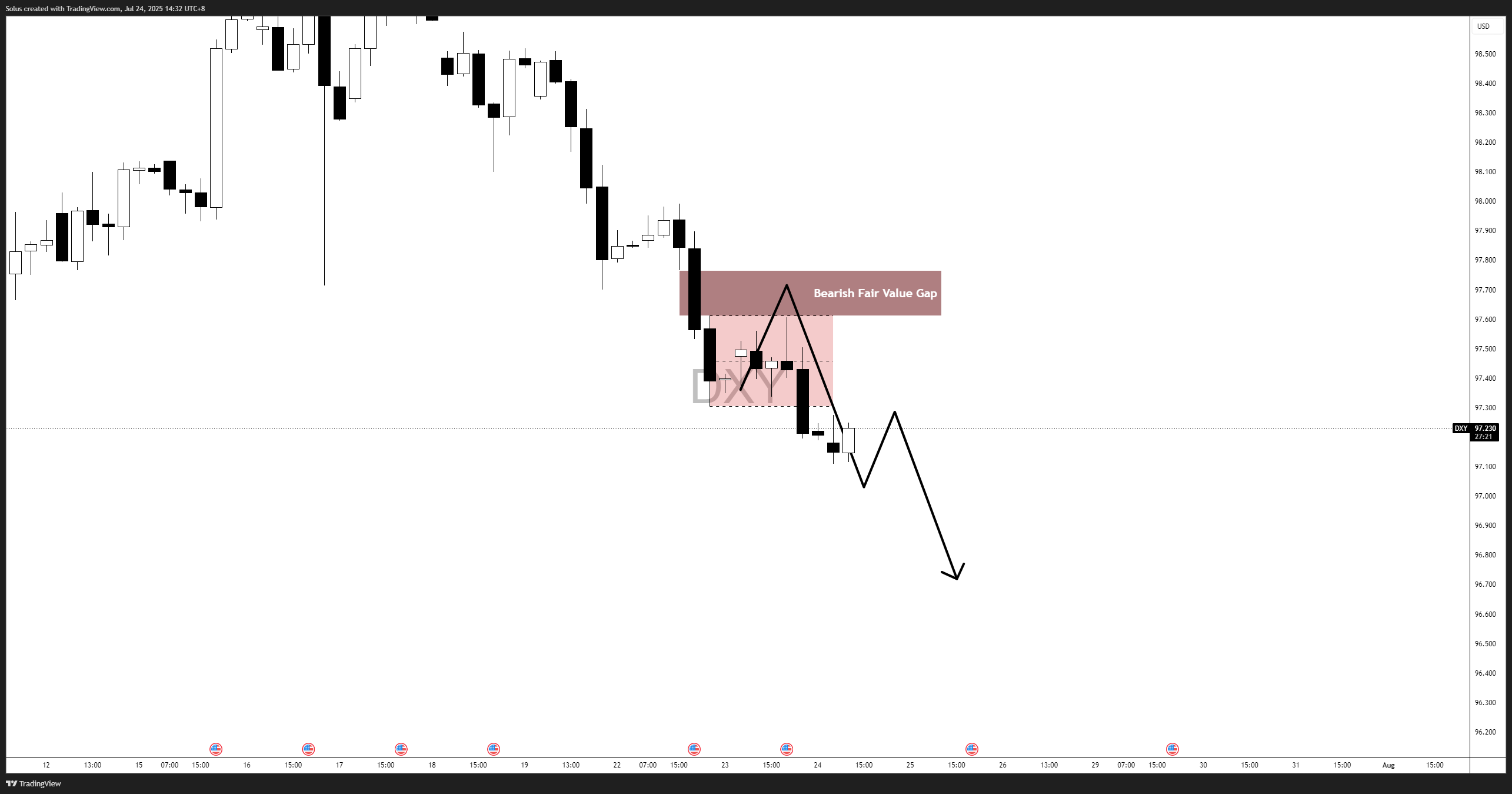
As shown in the recent Dollar price action, the DXY has decisively broken down from a key Bearish Fair Value Gap, currently trading below 97.30. This marks a significant structural shift that reinforces the broader USD weakness narrative, which is now dragging USD/JPY lower as the yen regains dominance.
This price action confirms that the entire USD complex is under pressure, not just a reaction to isolated JPY strength. The rejection from the 98 level and the subsequent lower high formation has invalidated any near-term bullish correction, signaling a continuation of the downtrend.
The 148.029 level acted as a magnet for liquidity, drawing in breakout traders only to reverse sharply. This zone coincided with:
A 4H Fair Value Gap
An internal liquidity pocket used to trap late buyers
Smart Money selling interest that engineered a false breakout, then broke structure aggressively to the downside
A new U.S.–Japan tariff agreement reduced tensions and opened the door for JPY strength, as markets priced in a stronger Japanese export outlook.
Investors also shifted into the yen amid domestic political volatility, with the ruling coalition losing control of the upper house. Though not extreme, it reinforced uncertainty, supporting JPY flows.
The DXY rejected 99.00 and dropped below 98.00, erasing USD strength.
With US indices hitting all-time highs, investors began rotating into safe-haven currencies as a hedge—pushing down USD/JPY.
USD/JPY is currently trading around 146 level, navigating a key Bearish Fair Value Gap. The pair has retraced toward a support cluster between 145.75 and 146.00.
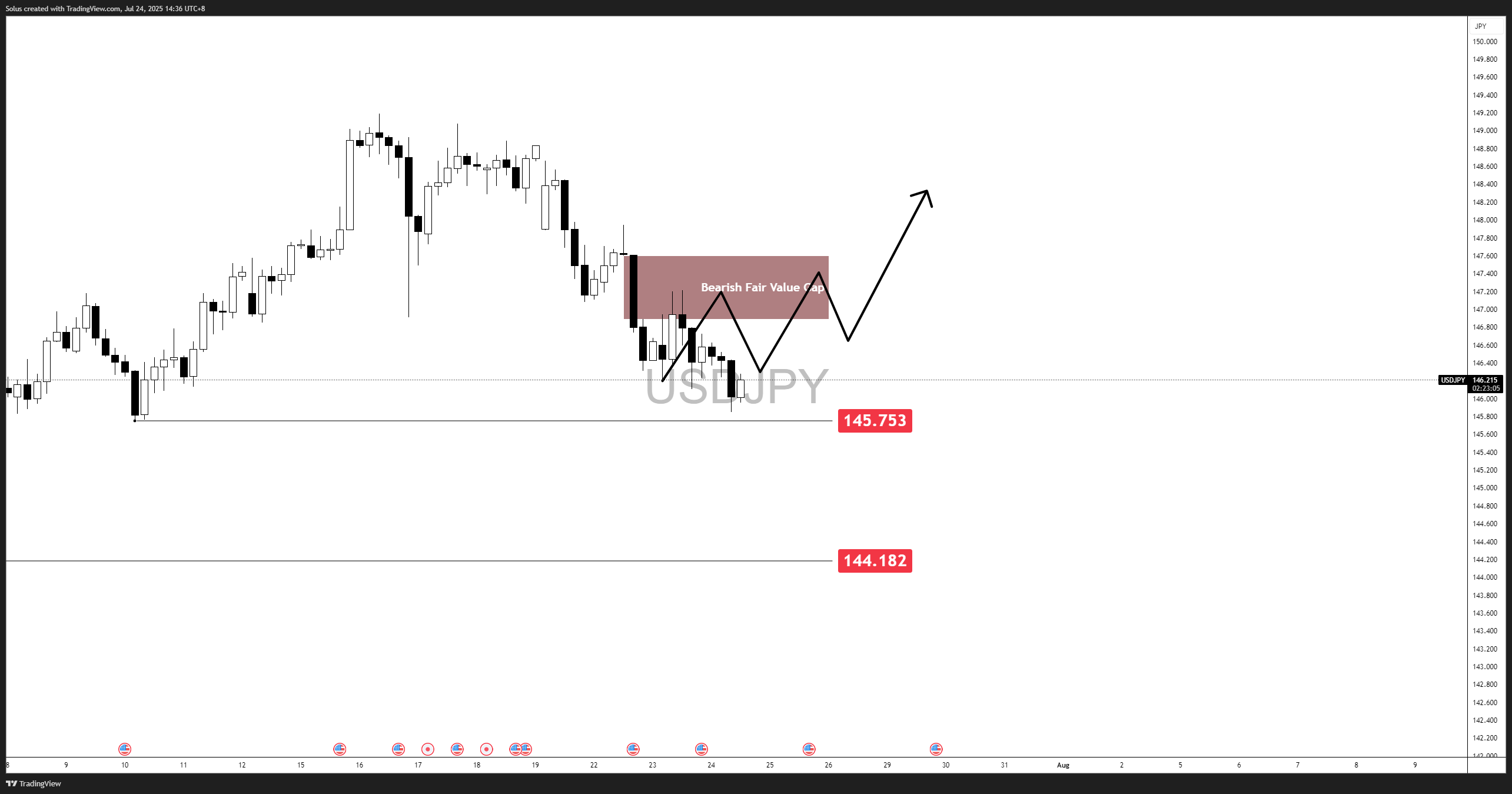
If USD/JPY validates and reacts at the 145.75 support, USD/JPY could be forming a short-term bottom. A retracement into the Bearish FVG may turn into a reclaim, indicating strength and potential reversal back toward previous distribution zones.
This would continue to go bullish if:
Upside Targets:
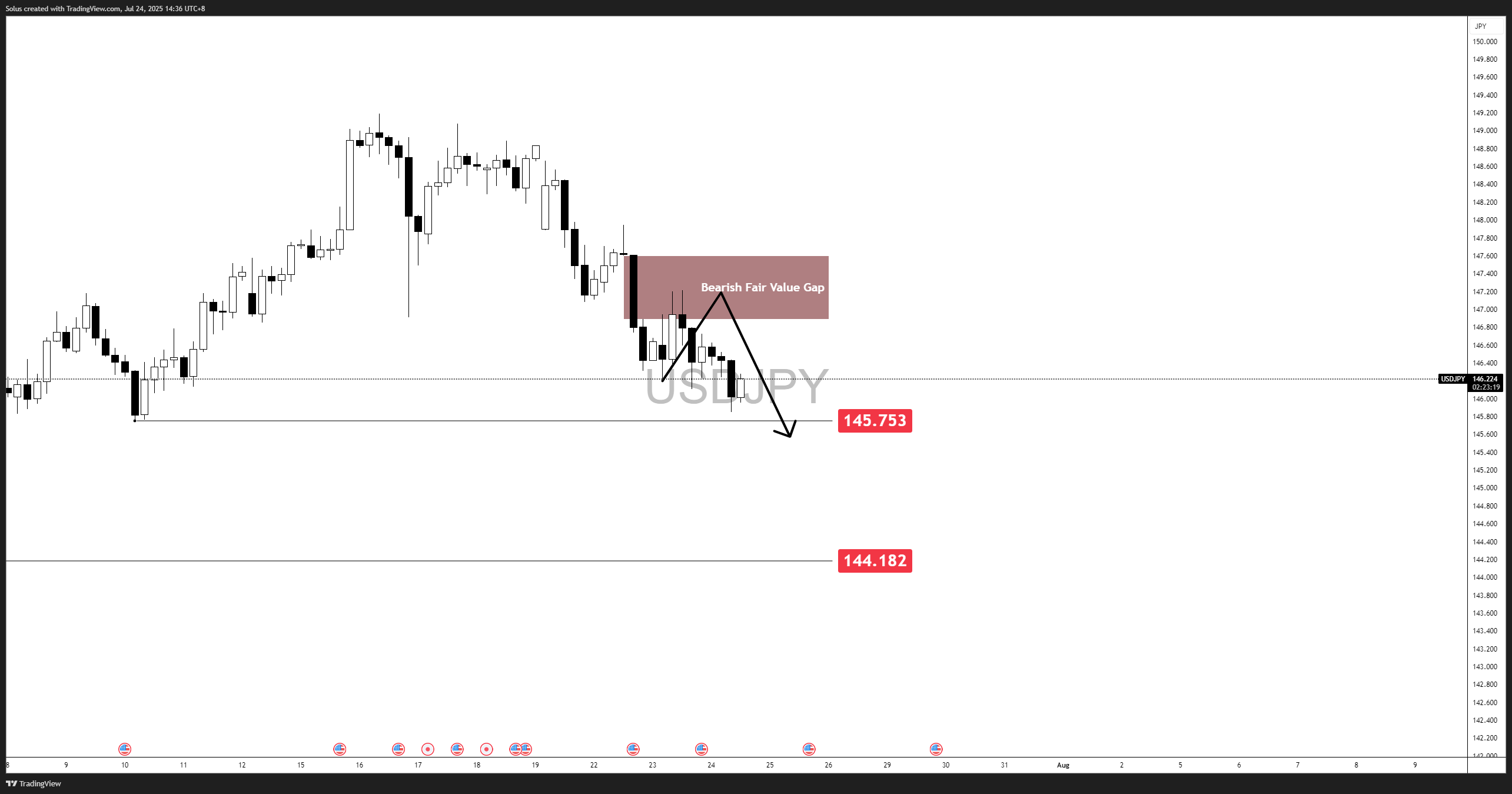
If price gets rejected from the FVG and fails to hold above 145.75, it would confirm the continuation of the broader bearish structure. This aligns with current DXY weakness and JPY strength driven by macro sentiment.
This would continue to go bearish if:
Price is rejected from 146.90–147.60 FVG zone
A clear breakdown below 145.75 occurs with a momentum candle
DXY continues sliding toward 96.70 or lower
Downside Targets:
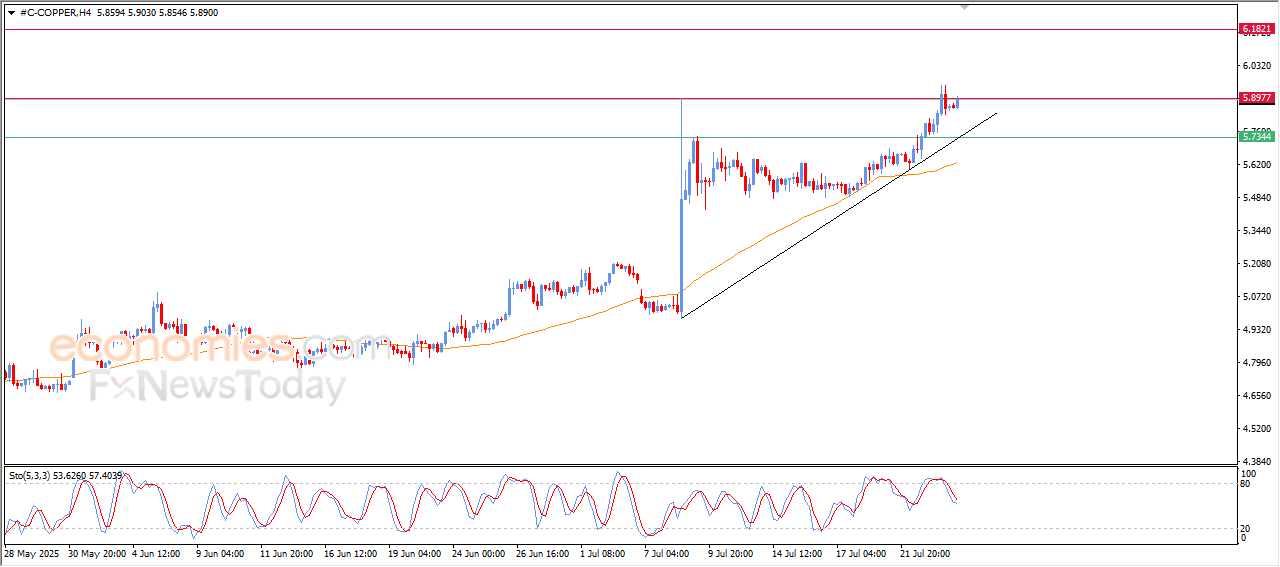
Copper price soars high in its last intraday trading, to reach the critical resistance at $5.89, which represents our yesterday’s target amid the dominance of the main bullish trend on the short-term basis and its trading alongside a supportive minor bias line for the trend, taking advantage of the dynamic support that is represented by its trading above EMA50, this rise came after the success in offloading its overbought condition on the (RSI), opening the way for achieving more gains.
Therefore, our expectations suggest a rise in (copper) price in its upcoming intraday trading, especially when breaching the mentioned resistance at $5.89, to target the next resistance level at $6.1820.
The expected trading range for today is between $5.7344 and $6.0500
Trend forecast: Bullish
High-accuracy trading signals delivered directly to your Telegram. Subscribe to specialized packages tailored for the world’s most important markets – all powered by BestTradingSignal.com .
The longer the subscription, the greater the savings and the more value you get.
Weekly performance report available here: Trading Signal Results – Week of July 14–18, 2025
The EUR/USD forecast indicates that the euro remains steady ahead of the European Central Bank meeting. Meanwhile, business activity data from major Eurozone economies aligned mainly with expectations. Market participants are also closely watching the progress in trade talks between the US and the European Union.
–Are you interested in learning more about ETF brokers? Check our detailed guide-
On Thursday, the European Central Bank will hold its policy meeting. Market participants expect the central bank to maintain its current interest rate policy. The ECB’s monetary easing campaign has had a positive impact on the economy and inflation. Therefore, policymakers are under no pressure to cut interest rates. Still, traders are pricing one more rate cut this year, likely in December.
Meanwhile, the outcome of business activity data from France and Germany was largely expected. Germany’s services sector continued growing, supporting the case for a pause in rate cuts.
Elsewhere, reports have shown that the European Union is nearing a trade deal with the US. The deal would impose a 15% reciprocal tariff on goods from the Eurozone. It would be half of the 30% Trump had promised. Therefore, it would allow the economy to continue its recovery.
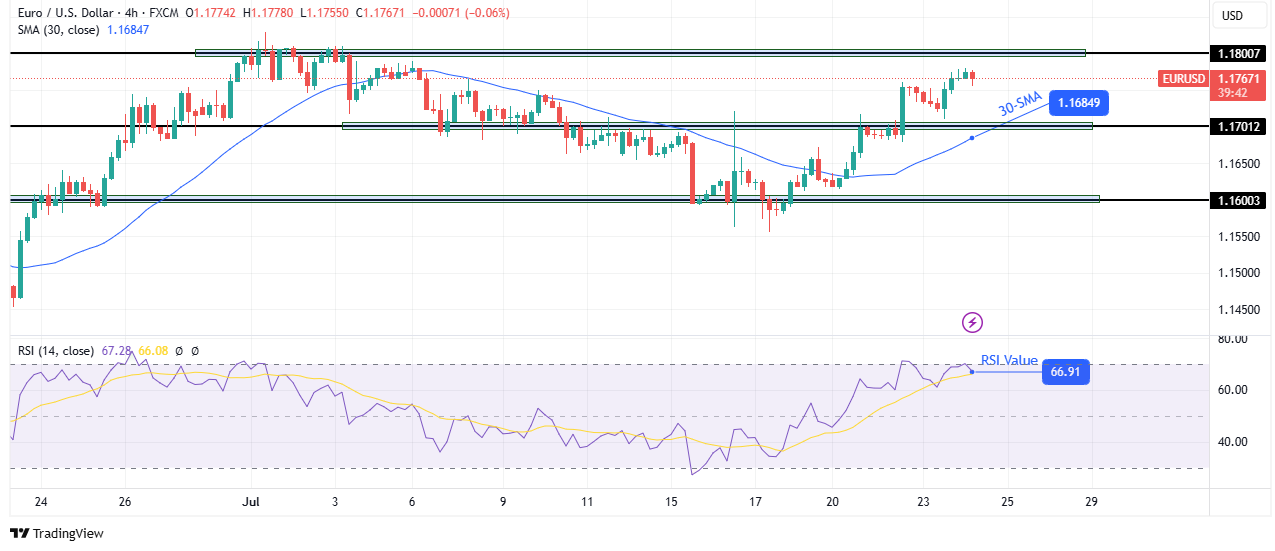
On the technical side, the EUR/USD price trades above the 30-SMA, indicating bulls are in the lead. At the same time, the RSI trades near the overbought region, showing solid bullish momentum. The price recently broke above the 1.1701 key resistance, which solidified the bullish bias. Bulls are now eyeing the next hurdle at the 1.1800 level.
–Are you interested in learning more about Canadian forex brokers? Check our detailed guide-
Initially, EUR/USD was in a downtrend, trading below the 30-SMA, with the RSI under 50. However, this changed when the price reached the 1.1600 key support level. Bulls emerged with solid momentum, and the downtrend failed to continue lower. Instead, the price broke above the SMA, indicating a shift in sentiment.
Given the solid bullish bias, the price may soon reach the 1.1800 resistance level. A break above will strengthen the bullish bias. However, the price might pull back to retest the SMA before climbing higher.
Looking to trade forex now? Invest at eToro!
68% of retail investor accounts lose money when trading CFDs with this provider. You should consider whether you can afford to take the high risk of losing your money.
Global markets witnessed steady growth in Copper Sulphate Prices, with notable surges in the USA, China, and South Africa. Our latest Copper Sulphate Price Trend Report offers in-depth analysis, forecast insights, historical trends, and an updated price chart to support smarter procurement decisions. Stay ahead with accurate data and market direction.
The Copper Sulphate Price Trend Report for Q2 2025 reflects dynamic pricing shifts across major global regions, influenced by industrial activity, agricultural demand, and market logistics. This report covers a deep dive into Copper Sulphate Prices, analyzing trends, historical data, and forecasting upcoming movements with a clear view of the Copper Sulphate price chart, index movements, and market forces.
Copper Sulphate Price Trend Analysis
During the second quarter of 2025, Copper Sulphate Prices exhibited moderate increases in key global markets. The USA saw prices reach US$ 2516/MT, while China recorded US$ 2400/MT, showing steady domestic consumption. Belgium and Canada followed similar upward trajectories, indicating strong European and North American demand recovery.
This trend aligns with rising industrial usage and stable agricultural applications, especially in fertilizers and fungicides.
Get Real-Time Price Analysis: https://www.imarcgroup.com/copper-sulphate-pricing-report/requestsample
Copper Sulphate Price Forecast 2025
The Copper Sulphate future price is expected to remain firm in the short term due to persistent demand and limited inventory buildup. With increasing consumption from the agriculture and electronics sectors, the price of Copper Sulphate may continue on a gradual upward trend throughout the latter half of 2025.
However, macroeconomic uncertainties and trade route fluctuations could impact the forecast in select regions. Stakeholders are advised to monitor inventory levels and input costs closely.
Copper Sulphate Price Chart & Index
The Copper Sulphate price index in Q2 2025 reveals moderate yet consistent growth compared to Q1. The Copper Sulphate price chart reflects this increase across regions, notably in North America and South Africa, where industrial rebound and logistics optimization supported the trend.
The global average also rose slightly, indicating broader market strength. Users can access region-specific pricing and historical indices through our full pricing platform.
Copper Sulphate Price Historical Analysis Data
A comparative analysis of the Copper Sulphate price history from 2024 to 2025 reveals a steady recovery in prices after a subdued demand in late 2023. In 2024, prices fluctuated amid input volatility, while in 2025, the market showed stabilization and growth.
This consistency highlights the resilience of Copper Sulphate across industrial applications, especially in mining, printing, and agriculture.
Copper Sulphate Price Comparison : Q1 vs Q2 2025
Across Q1 and Q2 2025, Copper Sulphate Prices in key regions recorded incremental increases. The USA, China, Belgium, and South Africa all experienced percentage gains in pricing due to stronger demand and slightly tightened supply chains. This upward shift is expected to continue if seasonal demand persists in Q3.
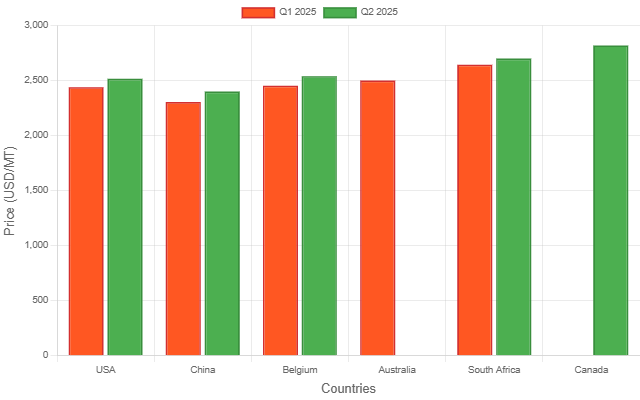
Price Trends and Regional Variations
North America: The Copper Sulphate Prices in the USA and Canada rose due to higher agricultural usage and a resurgence in chemical production.
Asia Pacific: China witnessed a moderate increase driven by localized manufacturing growth and post-holiday agricultural activity.
Global: Europe and Africa, particularly Belgium and South Africa, saw significant price action due to export orders and seasonal demand spikes.
Factors Influencing Copper Sulphate Prices
Specific Future Trends and Outlooks
Near Term: Slight upward momentum expected due to seasonal planting and steady industrial activity.
Long Term: By early 2026, prices may stabilize with increased global supply unless disrupted by major geopolitical or energy factors.
Historical Trends
Recent Copper Sulphate Price Trends and Market Activity
In Q2 2025, global Copper Sulphate Prices rose consistently across all key markets. This was attributed to improved logistics, resumed mining operations, and bulk procurement by fertilizer manufacturers. Additionally, new environmental regulations in some countries have led to changes in sourcing patterns, further shaping pricing.
List of Major Copper Sulphate Suppliers
These companies serve as primary suppliers across various continents, catering to both agricultural and industrial segments.
News & Recent Development
Browse Here More Other Related Reports:
· Phosphoric Acid Price Trend Report
· Acetic Acid Price Trend Report
· Ammonium Perchlorate Price Trend Report
· Boric Acid Price Trend Report
About Us:
IMARC Group is a global management consulting firm that provides a comprehensive suite of services to support market entry and expansion efforts. The company offers detailed market assessments, feasibility studies, regulatory approvals and licensing support, and pricing analysis, including spot pricing and regional price trends. Its expertise spans demand-supply analysis alongside regional insights covering Asia-Pacific, Europe, North America, Latin America, and the Middle East and Africa. IMARC also specializes in competitive landscape evaluations, profiling key market players, and conducting research into market drivers, restraints, and opportunities. IMARC’s data-driven approach helps businesses navigate complex markets with precision and confidence.
Contact us:
IMARC Group
134 N 4th St. Brooklyn, NY 11249, USA
Email: sales@imarcgroup.com
Tel No: (D) +91 120 433 0800
United States: +1-631-791-1145
Copper price soars high in its last intraday trading, to reach the critical resistance at $5.89, which represents our yesterday’s target amid the dominance of the main bullish trend on the short-term basis and its trading alongside a supportive minor bias line for the trend, taking advantage of the dynamic support that is represented by its trading above EMA50, this rise came after the success in offloading its overbought condition on the (RSI), opening the way for achieving more gains.
Therefore, our expectations suggest a rise in (copper) price in its upcoming intraday trading, especially when breaching the mentioned resistance at $5.89, to target the next resistance level at $6.1820.
The expected trading range for today is between $5.7344 and $6.0500
Trend forecast: Bullish
High-accuracy trading signals delivered directly to your Telegram. Subscribe to specialized packages tailored for the world’s most important markets – all powered by BestTradingSignal.com .
The longer the subscription, the greater the savings and the more value you get.
Weekly performance report available here: Trading Signal Results – Week of July 14–18, 2025
Silver price (XAG/USD) extends its losses for the second successive session, trading around $39.10 per troy ounce during the Asian hours on Thursday. The price of Silver struggles due to weakened safe-haven demand, driven by the optimism over further trade deals between the US and key partners.
The Financial Times reported that the European Union (EU) and the United States (US) are closing in on a deal that would impose 15% tariffs on EU goods imported into the US. Additionally, US President Donald Trump announced on Tuesday a major tariff deal with Japan, which includes a 15% tariff on Japanese exports.
However, some caution remained amid ongoing threats of 15% to 50% tariffs on countries such as South Korea and India, which are still negotiating deals. Traders also await clarity on talks with China, with Treasury Secretary Bessent scheduled to meet Chinese officials in the week ahead. On the monetary policy front, markets are focused on next week’s Federal Reserve meeting, where rates are expected to be kept on hold, with potential cuts anticipated in October.
However, the safe-haven demand for Silver could also be dampened due to easing concerns over the Federal Reserve’s (Fed) independence. US Treasury Secretary Scott Bessent said late Thursday that a nominee for the next Federal Reserve Chair is likely to be announced in December or January. Bessent emphasized that there is “no rush” to select a successor to current Fed Chair Jerome Powell.
Silver is a precious metal highly traded among investors. It has been historically used as a store of value and a medium of exchange. Although less popular than Gold, traders may turn to Silver to diversify their investment portfolio, for its intrinsic value or as a potential hedge during high-inflation periods. Investors can buy physical Silver, in coins or in bars, or trade it through vehicles such as Exchange Traded Funds, which track its price on international markets.
Silver prices can move due to a wide range of factors. Geopolitical instability or fears of a deep recession can make Silver price escalate due to its safe-haven status, although to a lesser extent than Gold’s. As a yieldless asset, Silver tends to rise with lower interest rates. Its moves also depend on how the US Dollar (USD) behaves as the asset is priced in dollars (XAG/USD). A strong Dollar tends to keep the price of Silver at bay, whereas a weaker Dollar is likely to propel prices up. Other factors such as investment demand, mining supply – Silver is much more abundant than Gold – and recycling rates can also affect prices.
Silver is widely used in industry, particularly in sectors such as electronics or solar energy, as it has one of the highest electric conductivity of all metals – more than Copper and Gold. A surge in demand can increase prices, while a decline tends to lower them. Dynamics in the US, Chinese and Indian economies can also contribute to price swings: for the US and particularly China, their big industrial sectors use Silver in various processes; in India, consumers’ demand for the precious metal for jewellery also plays a key role in setting prices.
Silver prices tend to follow Gold’s moves. When Gold prices rise, Silver typically follows suit, as their status as safe-haven assets is similar. The Gold/Silver ratio, which shows the number of ounces of Silver needed to equal the value of one ounce of Gold, may help to determine the relative valuation between both metals. Some investors may consider a high ratio as an indicator that Silver is undervalued, or Gold is overvalued. On the contrary, a low ratio might suggest that Gold is undervalued relative to Silver.
July 23, 2025 – Written by David Woodsmith
STORY LINK Pound-to-Euro Forecast: GBP Tipped to FALL to 1.1365 says UK Bank
After failing to make headway on Monday, the Pound Sterling to Euro exchange rate (GBP/EUR) has retreated to around 1.1520 on Tuesday.
The latest UK government borrowing requirement has increased concerns over tax hikes in the Autumn as well as unsettling the bond market which has hampered the Pound in global markets.
Equity markets, however, have held firm which has provided some Sterling relief and helped avoid a larger sell-off.
Rabobank is uneasy over UK fundamentals and has a 6-month GBP/EUR forecast of 1.1365.
ING notes that the Pound has not been able to take advantage of more favourable yield spreads which indicates that markets are putting a higher risk premium on the UK currency.
The bank added; “That GBP risk premium is partly because of the euro’s idiosyncratic strength (due to its appeal as a reserve currency) but may also embed some UK budget concerns. Those were fuelled further this morning as the UK unveiled larger borrowing for June than expected by the UK fiscal watchdog.”
The UK government borrowing requirement surged to £20.7bn for June from £14.1bn the previous year. This was above consensus forecasts of £17.4bn and the second-highest June deficit on record.
The deficit was also above the 17.1bn OBR forecast for the month.
For the first three months of fiscal 2025/26, the deficit widened to £57.8bn from £50.3bn the previous year which is close to the OBR target for the first quarter of the year.
Looking at induvial components, debt interest payments more than doubled to £16.4bn from £8.0bn the previous year.
There was an increase in receipts with a big increase in NIC contributions to £17.4bn from £14.3bn, but this was offset by a strong increase in overall spending.
ONS acting chief economist Richard Heys commented; “The rising costs of providing public services and a large rise this month in the interest payable on index-linked gilts pushed up overall spending more than the increases in income from taxes and National Insurance contributions, causing borrowing to rise in June.”
Gilts lost ground after the data with the 10-year yield increasing to 4.63%.
The yield, or interest rate, on 10-year UK bonds has risen by two basis points (0.02 percentage points) to 4.634%.

Longer-dated, 30-year, bond yields have risen by almost three basis points to 5.47% and only 13 basis points below 27-year highs seen in April.
Higher yields will put further upward pressure on debt servicing, increasing the risk of a vicious cycle for the Pound.
The data triggered fresh market fears surrounding the budget outlook and policy implications.
According to Capital Economics UK economist Alex Kerr; “the government’s u-turns on spending cuts and potential upward revisions to the OBR’s borrowing forecasts means the Chancellor will probably need to raise £15-25bn at the Autumn Budget to maintain the £9.9bn of headroom against her fiscal mandate.”
He added; “And given that she is struggling to stick to existing spending plans and we doubt the gilt market will tolerate significant increases in borrowing, she will probably have to raise taxes instead.”
Goldman Sachs added; “We think a rising fiscal risk premium is the main driver of the recent outperformance of EUR/GBP.”
International Money Transfer? Ask our resident FX expert a money transfer question or try John’s new, free, no-obligation personal service! ,where he helps every step of the way,
ensuring you get the best exchange rates on your currency requirements.
TAGS: Pound Euro Forecasts