The main category of Forex News.
You can use the search box below to find what you need.
[wd_asp id=1]
The main category of Forex News.
You can use the search box below to find what you need.
[wd_asp id=1]
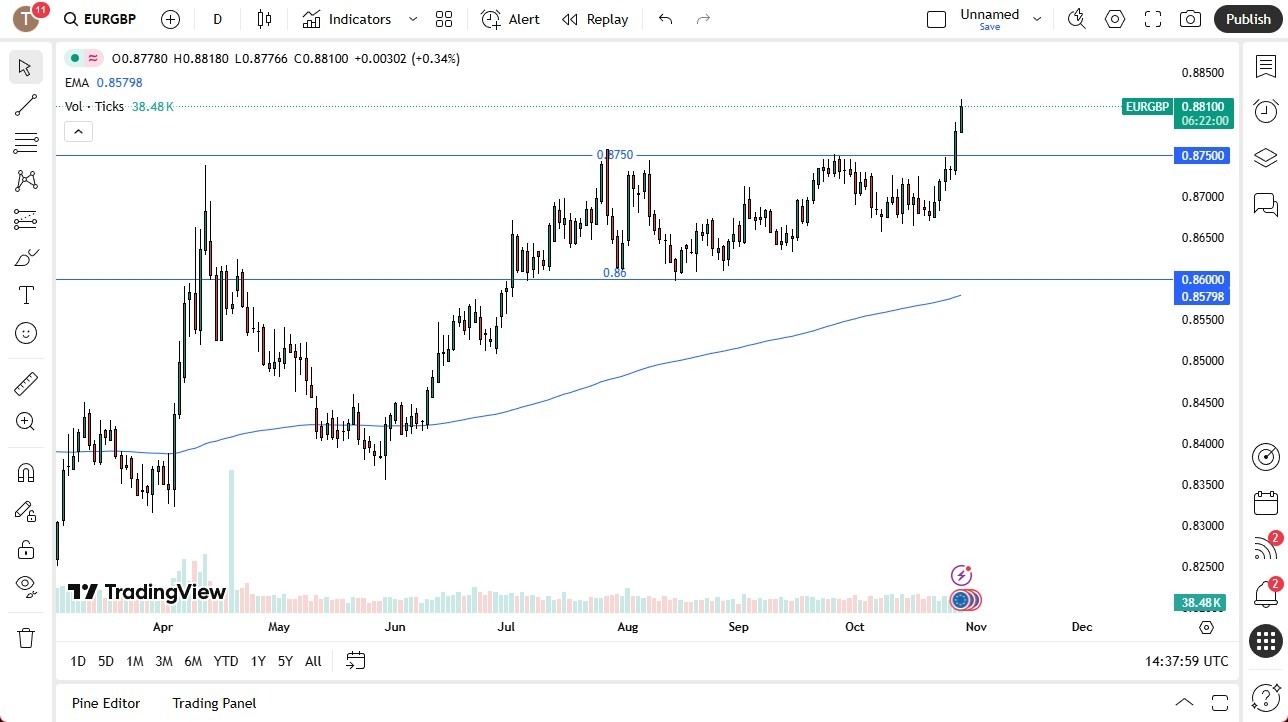
The euro continued to rally against the British pound during the trading session on Wednesday as markets awaited the European Central Bank interest rate decision on Thursday. It is worth noting that the pair broke above a major resistance barrier at 0.8750, a region that had acted as a ceiling in this market for a long time. Having previously consolidated within a 150-pip range, the so-called measured move suggests a potential advance toward the 0.89 level, an area that makes sense historically.

Over the longer term, the 0.89 level has proven significant on multiple occasions, creating a favorable technical setup. That said, the ECB decision could introduce volatility into the market, though any such movement should be short-lived unless the central bank delivers a genuine surprise. What stands out is that the British pound itself has been relatively weak in recent weeks, and this pair’s movement may reflect sterling’s softness more than any particular demand for the euro.
A pullback could present a buying opportunity, with 0.8750 expected to serve as a short-term floor. A dip toward that level would likely offer an attractive entry, though the market could simply continue higher. There appears to be little reason to short this pair unless the ECB delivers an unexpected shock, which seems unlikely at present. The euro has been in an uptrend since at least June, and even when viewed from a broader perspective—with some sharp corrections along the way—the prevailing trend remains higher. Accordingly, the 0.89 level appears to be a realistic target for the near term.
Ready to trade our daily GBP/USD Forex forecast? Here’s some of the best forex broker UK reviews to check out.
Christopher Lewis has been trading Forex and has over 20 years experience in financial markets. Chris has been a regular contributor to Daily Forex since the early days of the site. He writes about Forex for several online publications, including FX Empire, Investing.com, and his own site, aptly named The Trader Guy. Chris favours technical analysis methods to identify his trades and likes to trade equity indices and commodities as well as Forex. He favours a longer-term trading style, and his trades often last for days or weeks.
Markets are nervous of UK fiscal woes: While the public finances of many developed nations are currently somewhat dubious at best, this is particularly true for the United Kingdom, with a multibillion-pound hole that needs to be addressed by the upcoming budget in November.
While developments concerning the budget continue to do the media rounds, which will inevitably only increase as November 26th approaches, Rachel Reeves is stuck between a rock and a hard place, between honoring campaign pledges not to raise taxes on working people and VAT while simultaneously needing to find an estimated £30bn to balance spending with tax income.
To make matters worse, and coming at an inopportune time for the Chancellor of the Exchequer, an assessment to be released on Friday by the Office for Budget Responsibility (OBR) is expected to substantially downgrade UK productivity forecasts, resulting in a further estimate of £20 billion in shortfall.
Not to mention: government borrowing also exceeded estimates in the first half of 2025 by £7.2bn as per last week’s OBR commentary.
Tying this back to GBP/USD, however, is remarkably simple: the fiscal health of the UK economy appears to be worsening, and investors are collectively demanding a higher level of risk premium to hold sterling-denominated assets.
This fundamental downgrade in sterling’s rating when compared to other stores of wealth is what has led, in no small part, to recent GBP/USD downside.
EUR/USD lost more than 0.4% on Wednesday and snapped a five-day winning streak. The pair holds steady and trades slightly above 1.1600 in the European morning on Thursday as investors await the European Central Bank’s (ECB) monetary policy announcements.
The table below shows the percentage change of Euro (EUR) against listed major currencies this week. Euro was the weakest against the Australian Dollar.
| USD | EUR | GBP | JPY | CAD | AUD | NZD | CHF | |
|---|---|---|---|---|---|---|---|---|
| USD | 0.21% | 1.02% | 0.48% | -0.46% | -0.56% | 0.14% | 0.36% | |
| EUR | -0.21% | 0.82% | 0.36% | -0.66% | -0.70% | -0.07% | 0.15% | |
| GBP | -1.02% | -0.82% | -0.61% | -1.48% | -1.50% | -0.89% | -0.71% | |
| JPY | -0.48% | -0.36% | 0.61% | -1.04% | -1.12% | -0.46% | -0.23% | |
| CAD | 0.46% | 0.66% | 1.48% | 1.04% | -0.14% | 0.60% | 0.78% | |
| AUD | 0.56% | 0.70% | 1.50% | 1.12% | 0.14% | 0.62% | 0.80% | |
| NZD | -0.14% | 0.07% | 0.89% | 0.46% | -0.60% | -0.62% | 0.18% | |
| CHF | -0.36% | -0.15% | 0.71% | 0.23% | -0.78% | -0.80% | -0.18% |
The heat map shows percentage changes of major currencies against each other. The base currency is picked from the left column, while the quote currency is picked from the top row. For example, if you pick the Euro from the left column and move along the horizontal line to the US Dollar, the percentage change displayed in the box will represent EUR (base)/USD (quote).
The Federal Reserve (Fed) announced late Wednesday that it lowered the policy rate by 25 basis points (bps) to the range of 3.75%-4%. This decision came in line with the market expectation.
In the post-meeting press conference, Fed Chair Jerome Powell noted that another rate cut in December is “far from assured” and explained that the outlook for employment and inflation has not changed much since the September meeting. Powell further reiterated that they need to manage the risk of more persistent inflation.
Following these comments, the CME Group FedWatch Tool’s probability of a 25 bps rate cut in December declined to 70% from about 90%. In turn, the US Dollar (USD) gathered strength and caused EUR/USD to close the day deep in the red.
The ECB is widely anticipated to leave key rates unchanged on Thursday. Ahead of the ECB policy announcements, preliminary Gross Domestic Product (GDP) growth data for the Eurozone will be featured in the European economic calendar. Markets expect the Eurozone economy to expand at a quarterly pace of 0.1% in Q3. A negative print could revive expectations for an ECB rate cut in December and weigh on the Euro with the immediate reaction.
Investors will also pay close attention to comments from ECB President Christine Lagarde. In case Lagarde adopts an optimistic tone about the economic outlook and emphasizes upside risks to inflation, the Euro could stay resilient against its rivals and open the door to a recovery in EUR/USD. Conversely, EUR/USD could start stretching lower if Lagarde acknowledges heightened uncertainty on the economic outlook.
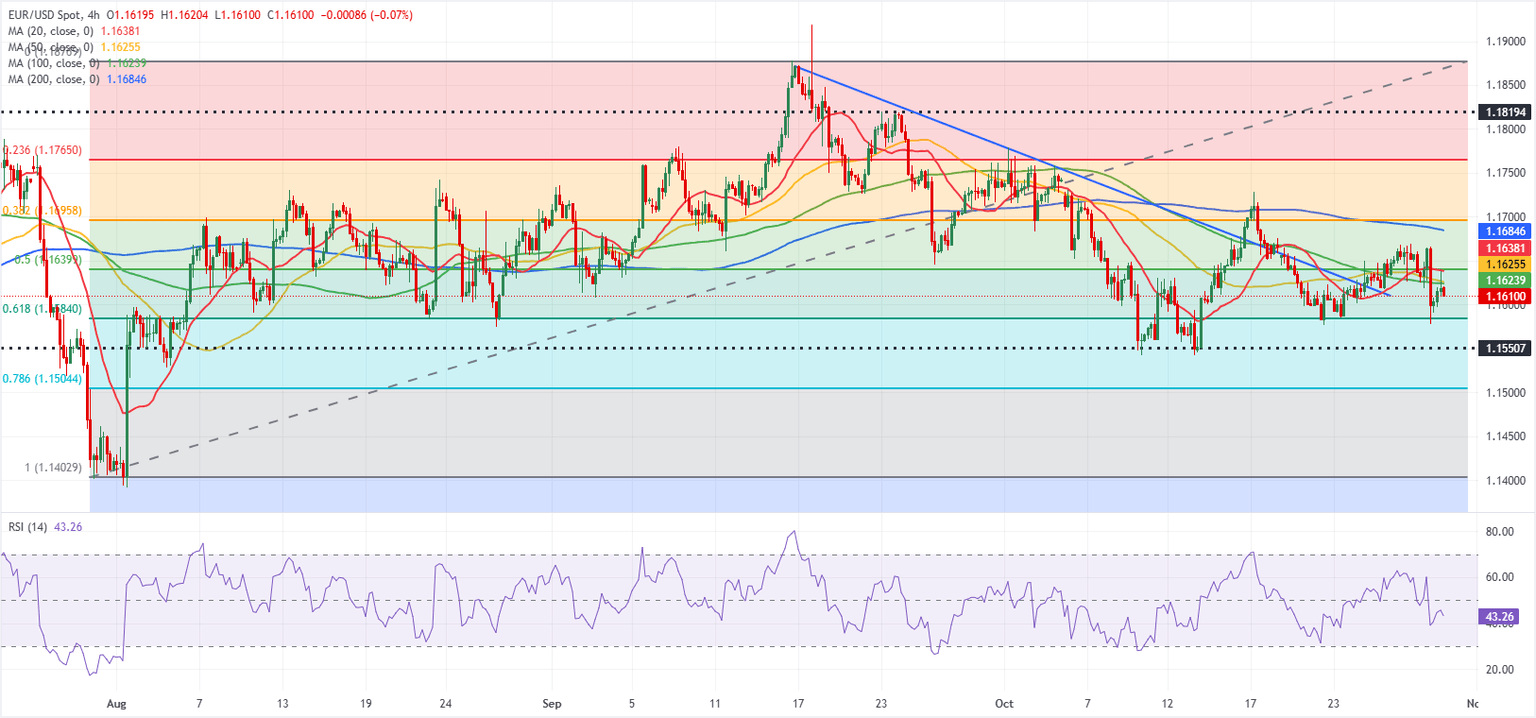
EUR/USD closed below the 100-day and the 20-day Simple Moving Averages (SMAs) on Wednesday and the Relative Strength Index (RSI) indicator on the 4-hour chart dropped toward 40, reflecting a bearish tilt in the short-term technical outlook.
Looking south, the first support level could be spotted at 1.1580 (Fibonacci 61.8% retracement of the latest uptrend) before 1.1550 (static level) and 1.1500 (Fibonacci 78.6% retracement). On the upside, the 20-day SMA aligns as an interim resistance level at 1.1630 ahead of 1.1670 (100-day SMA), 1.1690-1.1700 (200-period SMA, Fibonacci 38.2% retracement).
The Euro is the currency for the 20 European Union countries that belong to the Eurozone. It is the second most heavily traded currency in the world behind the US Dollar. In 2022, it accounted for 31% of all foreign exchange transactions, with an average daily turnover of over $2.2 trillion a day.
EUR/USD is the most heavily traded currency pair in the world, accounting for an estimated 30% off all transactions, followed by EUR/JPY (4%), EUR/GBP (3%) and EUR/AUD (2%).
The European Central Bank (ECB) in Frankfurt, Germany, is the reserve bank for the Eurozone. The ECB sets interest rates and manages monetary policy.
The ECB’s primary mandate is to maintain price stability, which means either controlling inflation or stimulating growth. Its primary tool is the raising or lowering of interest rates. Relatively high interest rates – or the expectation of higher rates – will usually benefit the Euro and vice versa.
The ECB Governing Council makes monetary policy decisions at meetings held eight times a year. Decisions are made by heads of the Eurozone national banks and six permanent members, including the President of the ECB, Christine Lagarde.
Eurozone inflation data, measured by the Harmonized Index of Consumer Prices (HICP), is an important econometric for the Euro. If inflation rises more than expected, especially if above the ECB’s 2% target, it obliges the ECB to raise interest rates to bring it back under control.
Relatively high interest rates compared to its counterparts will usually benefit the Euro, as it makes the region more attractive as a place for global investors to park their money.
Data releases gauge the health of the economy and can impact on the Euro. Indicators such as GDP, Manufacturing and Services PMIs, employment, and consumer sentiment surveys can all influence the direction of the single currency.
A strong economy is good for the Euro. Not only does it attract more foreign investment but it may encourage the ECB to put up interest rates, which will directly strengthen the Euro. Otherwise, if economic data is weak, the Euro is likely to fall.
Economic data for the four largest economies in the euro area (Germany, France, Italy and Spain) are especially significant, as they account for 75% of the Eurozone’s economy.
Another significant data release for the Euro is the Trade Balance. This indicator measures the difference between what a country earns from its exports and what it spends on imports over a given period.
If a country produces highly sought after exports then its currency will gain in value purely from the extra demand created from foreign buyers seeking to purchase these goods. Therefore, a positive net Trade Balance strengthens a currency and vice versa for a negative balance.
(This story was corrected on October 30 at 08:55 GMT to say that the Federal Reserve cut the policy rate by 25 bps to 3.75%-4%, not 4%-4.25%.)
Natural gas price surrendered to stochastic negativity, threatening the stability of the extra support at $3.830, suffering intraday losses by hitting $3.770 level, then attempts to settle above this support to confirm the dominance of the previously suggested bullish bias.
We recommend waiting for providing new bullish close for the upcoming four hours’ time frame above the current support, which reinforces the chances of forming several bullish waves, to target $4.050 level, reaching the barrier near $4.210, while facing new bearish pressures will confirm activating the bearish corrective track, which forces it to suffer more losses by targeting $3.690 and $3.550 level.
The expected trading range for today is between $3.800 and $4.050
Trend forecast: Bullish
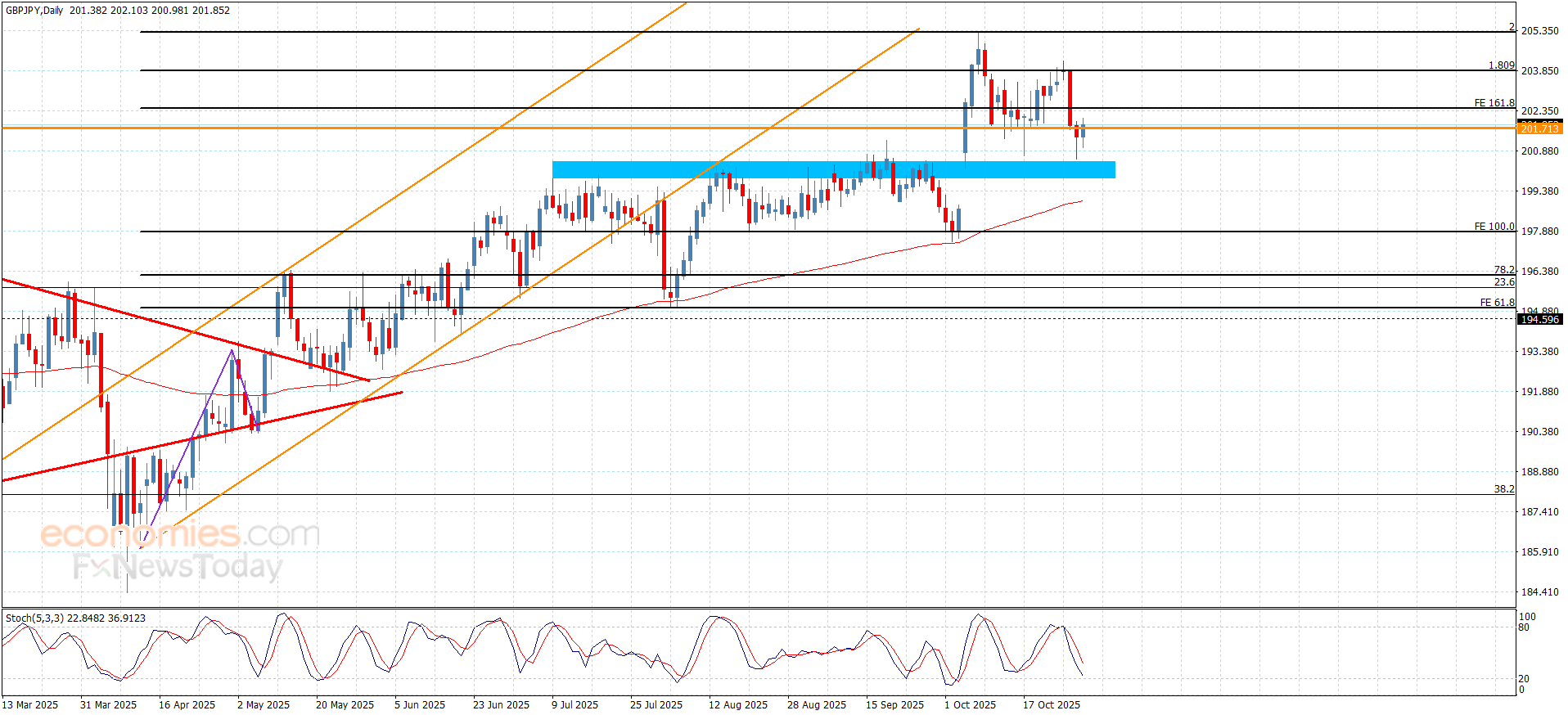
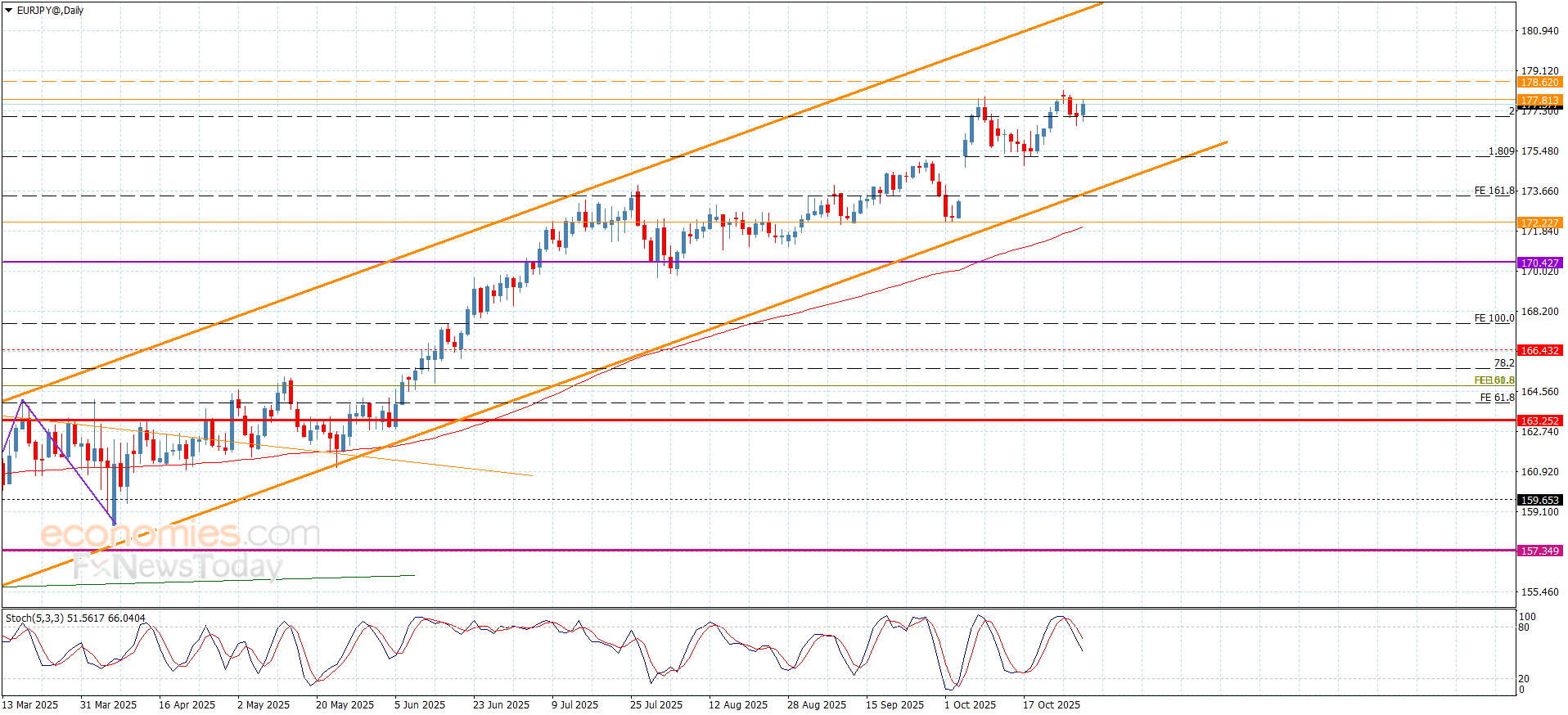
The GBPJPY pair approached the target near 200.45 in yesterday’s trading, which forms an important support level to push it to form bullish rebound by hitting 202.10 level, to indicate regaining the bullish trend.
The price needs a new bullish momentum that allows it to provide new bullish close above 201.70 level, reinforcing the chances of targeting positive stations that are located near 202.55 and 203.25, while declining and holding below 200.45 will force it to suffer extra losses, to expect targeting 199.20 level initially.
The expected trading range for today is between 200.80 and 202.55
Trend forecast: Bullish by the stability of 200.45
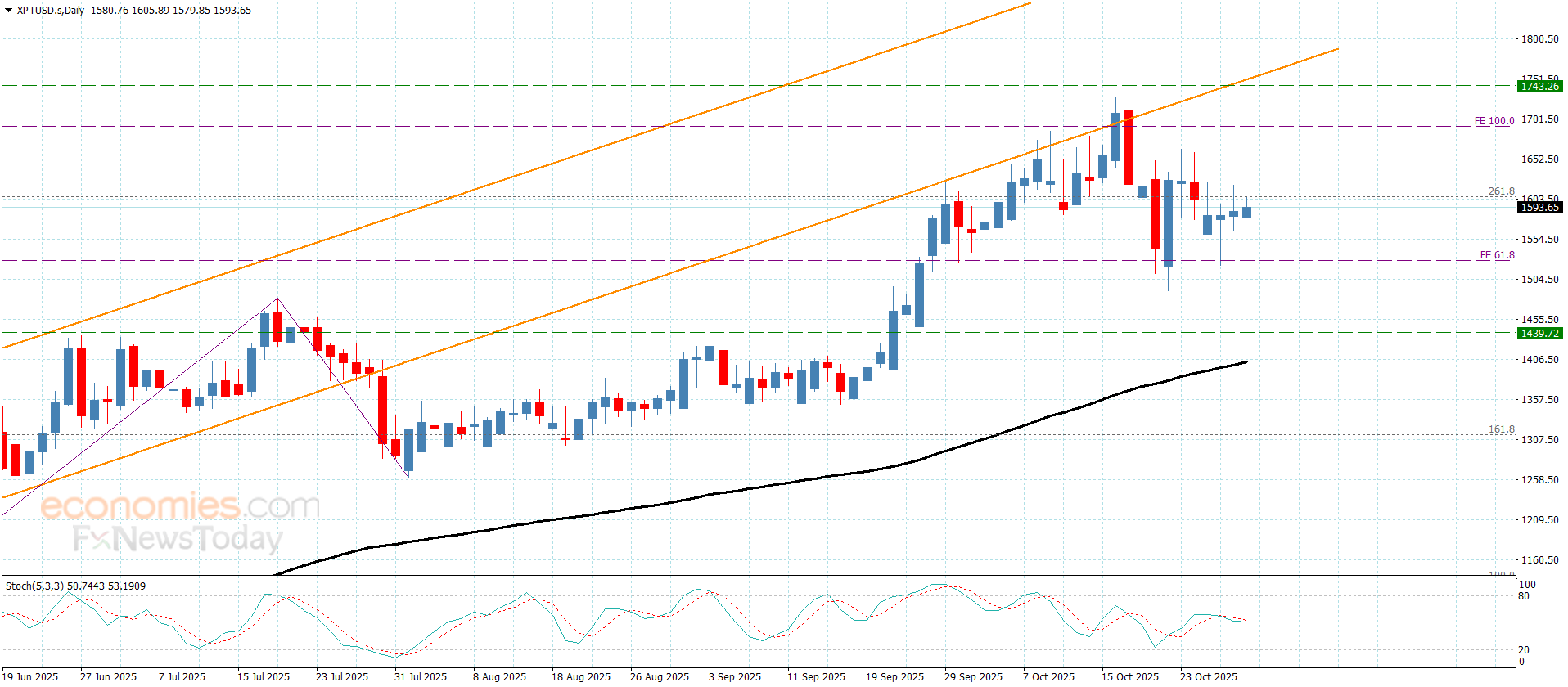
Platinum price didn’t move anything in yesterday’s trading, due to the repeated confinement between the extra support at $1525.00, while $1605.00 level keeps forming a barrier against the attempts of activating the previously suggested bullish trend.
Providing more of the sideways trading until breaching the current barrier and holding above it, to confirm its readiness to record some gains by its rally towards $1665.00 and $1695.00, while breaking the support and holding below it will force the price to suffer new losses towards $1470.00 reaching the next support near $1440.00.
The expected trading range for today is between $1530.00 and $1605.00
Trend forecast: Sideways
The GBPJPY pair approached the target near 200.45 in yesterday’s trading, which forms an important support level to push it to form bullish rebound by hitting 202.10 level, to indicate regaining the bullish trend.
The price needs a new bullish momentum that allows it to provide new bullish close above 201.70 level, reinforcing the chances of targeting positive stations that are located near 202.55 and 203.25, while declining and holding below 200.45 will force it to suffer extra losses, to expect targeting 199.20 level initially.
The expected trading range for today is between 200.80 and 202.55
Trend forecast: Bullish by the stability of 200.45
Gold is once again attempting a bounce above $3,900 as buyers try their luck for the third consecutive day in Asian trading this Thursday.
Gold remains confined within a familiar range, despite the critical US Federal Reserve (Fed) monetary policy decision-induced volatility seen on Wednesday.
The bright metal briefly regained the $4,000 barrier after the Fed delivered on the expected 25 basis points (bps) interest rate cut.
However, the upswing was quickly reversed as the US Dollar (USD) staged an impressive comeback following Fed Chair Jerome Powell’s commentary during the press conference.
Powell noted that policymakers are likely to become more cautious if it deprives them of further job and inflation reports, per Reuters.
His words tempered bets for another rate cut by the Fed next month, with markets now pricing in a 67.8% probability that the Fed will hold rates at the December 10 meeting, compared with a 9.1% chance seen pre-Fed announcements, the CME Group’s FedWatch tool shows.
Early Thursday, Gold buyers have come up for some air after four consecutive days of losses, eagerly awaiting the outcome of the highly anticipated meeting between US President Donald Trump and his Chinese counterpart Xi Jinping in South Korea, that is now underway.
The recent US-China trade talks have signalled a potential deal is in the offing at this meeting, especially after a preliminary consensus on topics including export controls, fentanyl and shipping levies was reached by both sides during their two-day talks in Malaysia.
Failure to reach a trade agreement by the top leaders could send risk sentiment into a tailspin, reviving the safe-haven demand for Gold. On the contrary, if both sides boast about progress toward a trade deal or stike one, Gold could be hammered as risk flows will take over.
In case an outright trade deal is not reached, the specifics of the meetings and details of any progress made would be closely scrutinized by markets.
On Wednesday, President Trump said that he expects to reduce US tariffs on Chinese goods in exchange for Beijing’s commitment to curb exports of fentanyl precursor chemicals.
Another catalyst that could drive Gold moves is the Bank of Japan (BoJ) policy announcements. Any surprises from the BoJ could trigger a sharp volatility in the USD/JPY pair, which could have a significant impact on the USD and the USD-denominated Gold.
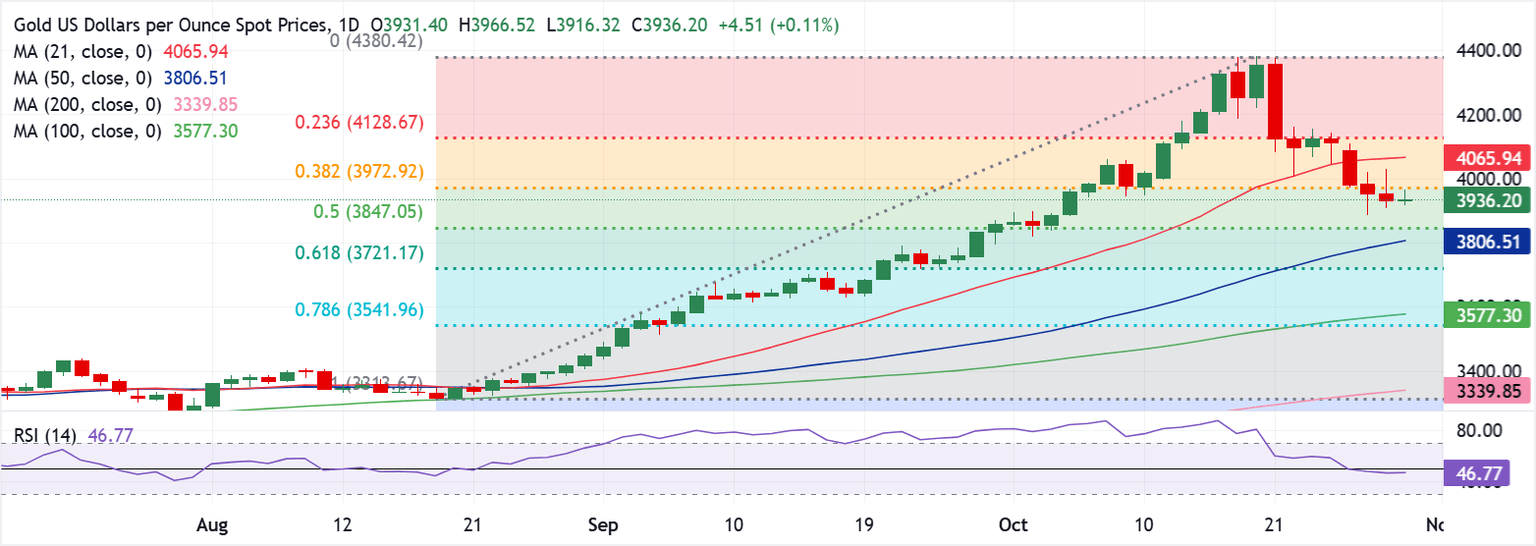
In the daily chart, XAU/USD is currently trading at around $3,938. A bullish 21 SMA advances above the longer ones, in line with the dominant bullish momentum; the 21 SMA stands at $4,066 and, being above spot, caps the immediate topside. Furthermore, the 50 SMA is also bullish, advancing below the shorter one; the 50 SMA stands at $3,807. Below spot, the 50 SMA at $3,807, the 100 SMA at $3,577 and the 200 SMA at $3,340 offer successive support levels, while the 21 SMA at $4,066 acts as resistance. The Relative Strength Index (14) has eased to 47, slipping below its neutral 50 mid-line after prior readings in extreme overbought territory; the latest uptick from 46 reduces bearish traction and favors consolidation as the broader moving-average structure remains positive.
Measuring the rally between $3,314 and $4,380, the 38.2% retracement stands at $3,973. With price currently beneath $3,973, initial resistance is located at $3,973, followed by $4,066 (21 SMA) and the 23.6% retracement at $4,129; a clearance of these levels would reassert the bullish sequence toward the top at $4,380. On the downside, support levels are $3,847 (50% retracement) ahead of $3,721 (61.8%), then $3,542 (78.6%) and $3,314 (100% of the measured upswing). As long as price holds above the rising 50 and 100 SMAs, pullbacks are likely to remain shallow, while a daily close back above $3,973 would be a near-term signal that buyers are regaining traction.
(This content was partially created with the help of an AI tool)
Generally speaking, a trade war is an economic conflict between two or more countries due to extreme protectionism on one end. It implies the creation of trade barriers, such as tariffs, which result in counter-barriers, escalating import costs, and hence the cost of living.
An economic conflict between the United States (US) and China began early in 2018, when President Donald Trump set trade barriers on China, claiming unfair commercial practices and intellectual property theft from the Asian giant. China took retaliatory action, imposing tariffs on multiple US goods, such as automobiles and soybeans. Tensions escalated until the two countries signed the US-China Phase One trade deal in January 2020. The agreement required structural reforms and other changes to China’s economic and trade regime and pretended to restore stability and trust between the two nations. However, the Coronavirus pandemic took the focus out of the conflict. Yet, it is worth mentioning that President Joe Biden, who took office after Trump, kept tariffs in place and even added some additional levies.
The return of Donald Trump to the White House as the 47th US President has sparked a fresh wave of tensions between the two countries. During the 2024 election campaign, Trump pledged to impose 60% tariffs on China once he returned to office, which he did on January 20, 2025. With Trump back, the US-China trade war is meant to resume where it was left, with tit-for-tat policies affecting the global economic landscape amid disruptions in global supply chains, resulting in a reduction in spending, particularly investment, and directly feeding into the Consumer Price Index inflation.
The Pound to US Dollar (GBP/USD) exchange rate extended losses on Wednesday after the Federal Reserve delivered a widely expected 25bps rate cut, while UK fiscal concerns continued to weigh on Sterling sentiment.
DAILY RECAP:
The Pound (GBP) remained under pressure on Wednesday, extending its recent slide as concerns mounted ahead of next month’s Autumn Budget.
Investors continued to digest reports suggesting the Office for Budget Responsibility (OBR) is preparing a downgrade to the UK’s productivity outlook, potentially opening up a £20 billion fiscal shortfall.
Such a revision is expected to force Chancellor Rachel Reeves into announcing a mix of tax hikes and spending restraint, fuelling fears that tighter fiscal policy could undermine the fragile UK recovery.
While Reeves has argued the government can balance fiscal discipline with growth, markets remain sceptical — keeping Sterling on the defensive.
Meanwhile, the US Dollar (USD) initially traded mixed before stabilising after the Federal Reserve announced a widely expected 25bps rate cut, lowering the fed funds range to 3.75–4.00%.
Chair Jerome Powell struck a balanced tone, noting that while inflation progress allows some room to ease, further rate reductions are “far from assured.”

The comments dampened expectations of aggressive near-term cuts, offering modest support to the Greenback even as Treasury yields edged lower.
Looking ahead, the Pound to US Dollar exchange rate will likely hinge on post-Fed market reaction and evolving sentiment around the UK budget.
If investors continue to interpret Powell’s remarks as cautious rather than dovish, the Dollar could retain its recent gains.
However, any follow-through risk rally or weaker US data could prompt renewed Dollar selling later in the week.
For the Pound, the domestic backdrop remains clouded by uncertainty over fiscal tightening. Without fresh data to shift attention, Sterling may struggle to find a floor until clearer signals emerge from the Treasury or OBR.
A key resistance level is June’s interim swing high at $4.15, aligned with the 161.8% ABCD target. Clearing this point would trigger a trend reversal, confirming improving underlying demand within the prior downswing’s structure. Near-term support is today’s $3.75 low, with resistance at the $3.86 high. The gap’s size and follow-through suggest buyers are stepping in with conviction.
Dynamic support centers on the 200-day moving average and a long-term uptrend line. The 200-day line is converging with the uptrend line, soon forming a tighter price area to reinforce support during any weakness. Holding above this confluence keeps the bullish outlook intact and supports the case for higher prices.
The advance from August’s swing low gained clear continuation today. The previous downtrend is broken, and the long-term uptrend line has been recaptured, putting the large rising bull channel from 2024’s low back in play. Pullbacks should now attract buyers, using lower prices to establish support and fuel the next leg higher.
Today’s $3.75-$3.86 range will set the tone—holding support targets $3.93-$3.95, while a break risks retesting the 200-day eventually. The gap and breakout favor bulls, with $4.15 as the critical reversal trigger. New contract data will refine future analysis, but the channel structure and trendline reclaim point to sustained upside if support holds firm. Watch today’s close for confirmation of momentum.
For a look at all of today’s economic events, check out our economic calendar.