The main category of Forex News.
You can use the search box below to find what you need.
[wd_asp id=1]
The main category of Forex News.
You can use the search box below to find what you need.
[wd_asp id=1]
Silver price (XAG/USD) extends its gains for the second successive session, trading around $48.00 per troy ounce during the European hours on Monday. The price of the grey metal declines due to weakened safe-haven demand, driven by the progress in the United States (US)-China trade negotiations. Silver prices also decline as profit-taking emerges amid concerns of overvaluation following the metal’s surge to record highs.
The risk-on sentiment improves after reports that top negotiators from the US and China have reached a consensus on major disputes and paved the way for Presidents Donald Trump and Xi Jinping to meet on Thursday to finalize a trade deal. Officials in Malaysia announced after two days of talks that both sides had agreed on key issues, including export controls, fentanyl, and shipping levies.
Moreover, US Treasury Secretary Scott Bessent told CBS News that President Trump’s threat to impose 100% tariffs on Chinese goods “is effectively off the table.” Bessent added that China has agreed to make “substantial” soybean purchases and to postpone its rare-earth export controls “for a year while they re-examine it.”
The downside of the non-interest-bearing Silver could be restrained as softer recent US inflation data for September support the likelihood of a rate cut by the US Federal Reserve (Fed) this week. The CME FedWatch Tool indicates that markets are now pricing in nearly a 97% chance of a Fed rate cut in October and a 96% possibility of another reduction in December. It is worth noting that returns on interest-bearing assets decline when interest rates fall. This makes non-yielding assets such as Silver more appealing, since investors aren’t missing out on as much interest income by holding them.
Silver is a precious metal highly traded among investors. It has been historically used as a store of value and a medium of exchange. Although less popular than Gold, traders may turn to Silver to diversify their investment portfolio, for its intrinsic value or as a potential hedge during high-inflation periods. Investors can buy physical Silver, in coins or in bars, or trade it through vehicles such as Exchange Traded Funds, which track its price on international markets.
Silver prices can move due to a wide range of factors. Geopolitical instability or fears of a deep recession can make Silver price escalate due to its safe-haven status, although to a lesser extent than Gold’s. As a yieldless asset, Silver tends to rise with lower interest rates. Its moves also depend on how the US Dollar (USD) behaves as the asset is priced in dollars (XAG/USD). A strong Dollar tends to keep the price of Silver at bay, whereas a weaker Dollar is likely to propel prices up. Other factors such as investment demand, mining supply – Silver is much more abundant than Gold – and recycling rates can also affect prices.
Silver is widely used in industry, particularly in sectors such as electronics or solar energy, as it has one of the highest electric conductivity of all metals – more than Copper and Gold. A surge in demand can increase prices, while a decline tends to lower them. Dynamics in the US, Chinese and Indian economies can also contribute to price swings: for the US and particularly China, their big industrial sectors use Silver in various processes; in India, consumers’ demand for the precious metal for jewellery also plays a key role in setting prices.
Silver prices tend to follow Gold’s moves. When Gold prices rise, Silver typically follows suit, as their status as safe-haven assets is similar. The Gold/Silver ratio, which shows the number of ounces of Silver needed to equal the value of one ounce of Gold, may help to determine the relative valuation between both metals. Some investors may consider a high ratio as an indicator that Silver is undervalued, or Gold is overvalued. On the contrary, a low ratio might suggest that Gold is undervalued relative to Silver.

Image © Adobe Images
“We retain a negative view on the U.S. dollar, despite recent stabilisation,” says Kiran Kowshik, Global FX Strategist at Lombard Odier.
The Swiss bank says the U.S. dollar has stabilised higher since mid-September, reflecting a voting pattern at the September Fed meeting where some members preferred a more cautious approach to cuts.
Globally, ex-USD weakness was also apparent due to the uncertain political news flow from France and Japan.
Looking aheada, Lombard Odier says dollar-specific drivers are to resume dominance of pairs like EUR/USD and GBP/USD.

Pound Sterling Live consistently delivers stronger rates than major UK banks.
In July, you could have saved up to $1,515 on a £50,000 transfer thanks to our competitive pricing.
i – Based on average GBP/USD rates observed in July.
“While markets already price in the Fed funds rate eventually falling to 3%, the sequencing matters: the Fed is cutting rates just as several other major central banks (including in Europe and Switzerland) have ended their easing cycles,” says Kowshik.
“This type of sequencing was seen in the 1980s and 1990s and resulted in USD depreciation as the Fed eased (see chart 2). We maintain a 12-month EURUSD forecast of 1.22.”
Regarding the pound vs. dollar, a GBP/USD recovery is anticipated by the Swiss bank.
“Combined with renewed weakness in the USD, GBP/USD could see a more significant move higher heading into December if the UK Budget does not surprise market expectations. Our 12-month GBP/USD forecast stands at 1.37,” says Kowshik.
He adds that the pre-budget anxieties that have pressed down on sterling over recent months are not unusual and the currency tends to recover after budget events.
“Historically, sterling tends to weaken heading into the Budget but sees relief thereafter,” says Kowshik.
The $4,079 area gains strength as resistance from the nearby top rising channel line and falling 10-day average. The 10-day is converging with the 20-day after touching the channel line today. Once below the 20-day, it becomes key short-term resistance. Monday’s $4,109 high and last Friday’s $4,144 high cap the zone.
Gold fell below the 20-day average on Monday, closing under it for the first time since August 22’s reclaim. No swing back to test it as resistance has occurred yet. Yesterday’s attempt met quick pushback. A more substantial advance into the zone could precede further bearish pullback or consolidation.
The next lower target is the 50% retracement at $3,846 and 50-day average at $3,808, rising. The 50% level is bolstered by a prior three-day sideways move that acted as resistance, now potential support. Convergence of the 50-day and 50% retracement may hint at timing — watch when they align.
The close near $4,027 is key — above it targets $4,079, below risks $3,918. The 20-day and channel line cap rebounds, but a test there could set up deeper pullback to $3,846. Monitor 50-day convergence for support clues — today’s strength favors buyers short-term if resistance holds.
For a look at all of today’s economic events, check out our economic calendar.
Today’s economic indicators signaled a potential pickup in economic momentum and rising national inflation, supporting a more hawkish BoJ rate path. Given these dynamics, USD/JPY maintains a bearish bias despite Powell downplaying the odds of a December rate cut. However, traders should closely monitor comments from Prime Minister Sanae Takaichi, an advocate for ultra-loose monetary policy.
While Japanese data may fuel speculation about a BoJ rate hike, the continued US government shutdown will likely delay key economic reports. In the absence of September’s Personal Income and Outlays Report, traders should closely monitor Fed speeches.
FOMC members Lorie Logan and Beth Hammack, along with Fed Reserve Bank of Atlanta President Raphael Bostic, are due to deliver speeches later in the Friday session. Economists consider the three regional bank presidents relatively hawkish, suggesting they may argue against a December rate cut.
Calls to delay a December Fed rate cut would reinforce Powell’s stance and may sustain US dollar strength. While short-term dollar strength could lift USD/JPY toward 154.45, the broader outlook remains bearish amid BoJ policy normalization.
According to the CME FedWatch Tool, the chances of a 25-basis-point cut in December fell from 91.1% on October 23 to 66.6% on October 29. This sharp repricing followed Powell’s press conference.
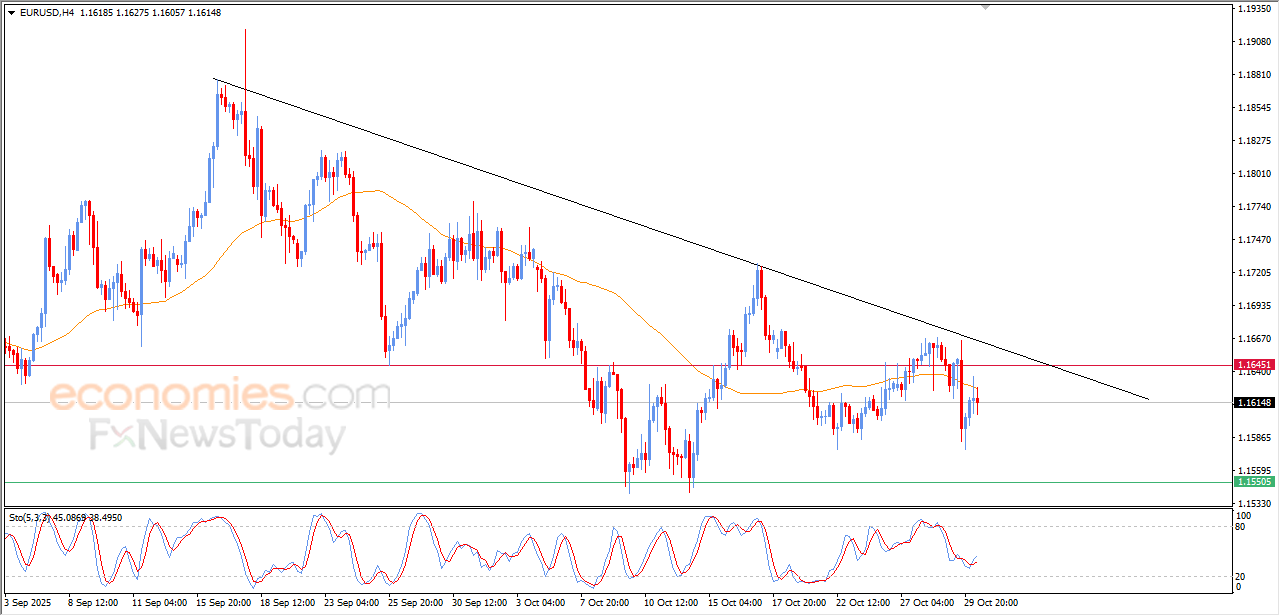
The bears quickly returned to the EUR/USD currency pair across trusted trading company platforms, breaking below the 1.1600 level again. This followed the Federal Reserve’s quarter-point interest rate cut. However, the Dow Jones and S&P 500 indices declined after Fed Chairman Jerome Powell stated that there is still a heated discussion about whether to follow up today’s rate cut with another. Powell added, “A further rate cut at the December meeting is not a foregone conclusion, quite the opposite. Monetary policy is not on a preset course.”

In this regard, the Federal Reserve’s decision on US interest rates has sparked opposition from both sides, with one side calling for further rate cuts and the other advocating for keeping rates higher. President Trump, who has repeatedly called for faster U.S. interest rate cuts, again criticized Powell ahead of Wednesday’s decision, saying the administration would be “very happy” to see his term end.
Trump spoke from South Korea, where both sides said they were close to finalizing a trade deal—marking progress after months of thorny talks over a $350 billion investment pledged by Seoul to the US. In this context, the US President is scheduled to meet with Chinese leader Xi Jinping in South Korea tomorrow, and investors hope this meeting will pave the way for NVIDIA to regain access to the Chinese market.
Meanwhile, across stock trading company platforms, NVIDIA’s stock jumped, making it the first company to reach a market capitalization of $5 trillion. Booming sales of the company’s flagship AI chip were crucial to this surge.
Overall, Fed Chairman Jerome Powell’s comments about the December rate-setting meeting—which will be held in six weeks—went far beyond the usual disavowal that Fed decisions are not on a preset course. Instead, his comments revealed a broader discomfort among at least some of his colleagues with the unrealistic investor expectation that a December rate cut is guaranteed. Powell said: “It may be time for some Committee members to step back a little and see if there are actually downside risks to the labor market.” Powell added that this week’s meeting revealed a “growing chorus” of policymakers who are asking: “Maybe we need to wait a while.”
In the past, Powell has tried to deflect questions about upcoming policy decisions by refocusing attention on the policy actions at that particular meeting.
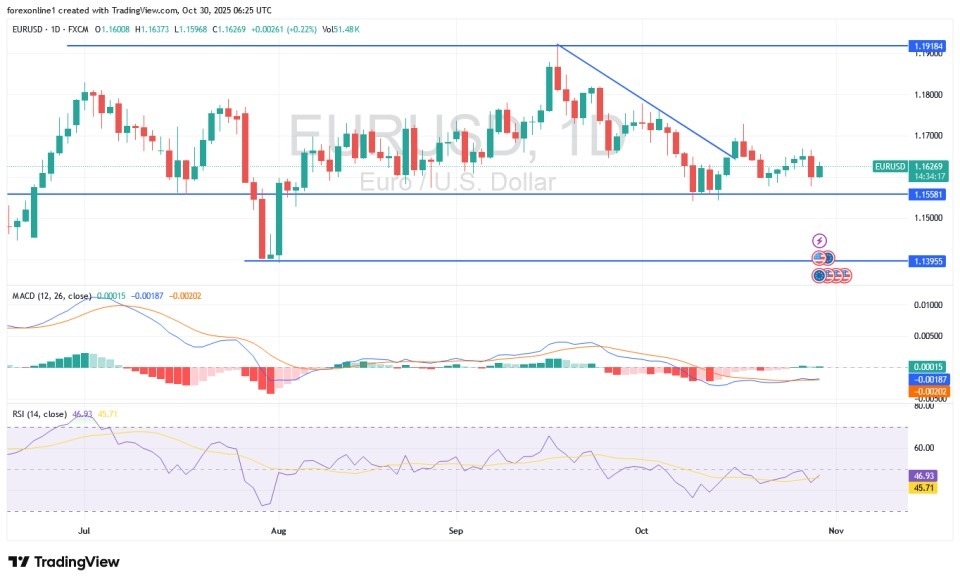
Based on the daily chart trading, the EUR/USD bears have gained momentum to push the currency prices lower. This is confirmed by the 14-day Relative Strength Index (RSI) being stable around a reading of 47, below the neutral line, and having more time to head toward stronger downward levels before reaching oversold territory. In the same performance, the MACD indicator is steadily leaning downwards. The bears’ focus is directed towards the support levels of 1.1590 and 1.1480 first.
The current downward bias for EUR/USD is anticipating important events, led by the announcement of the European Central Bank’s (ECB) monetary policy decisions at 16:15 Cairo time, followed by statements from ECB Governor Lagarde half an hour after the bank’s decision is announced. Before that, the German economic growth reading will be announced at 12:00 PM Cairo time, and the Eurozone economic growth reading will be announced at 1:00 PM Cairo time. On the US side, no important data releases are expected today.
Conversely, as we mentioned before, the success of the EUR/USD bull scenario remains contingent on a return to the 1.1800 resistance level. Otherwise, the downward trend will continue until further notice.
We still advise selling the EUR/USD pair on any strong upward retracement, but never take unnecessary risks.
Ready to trade our daily Forex analysis? We’ve made this forex brokers list for you to check out.
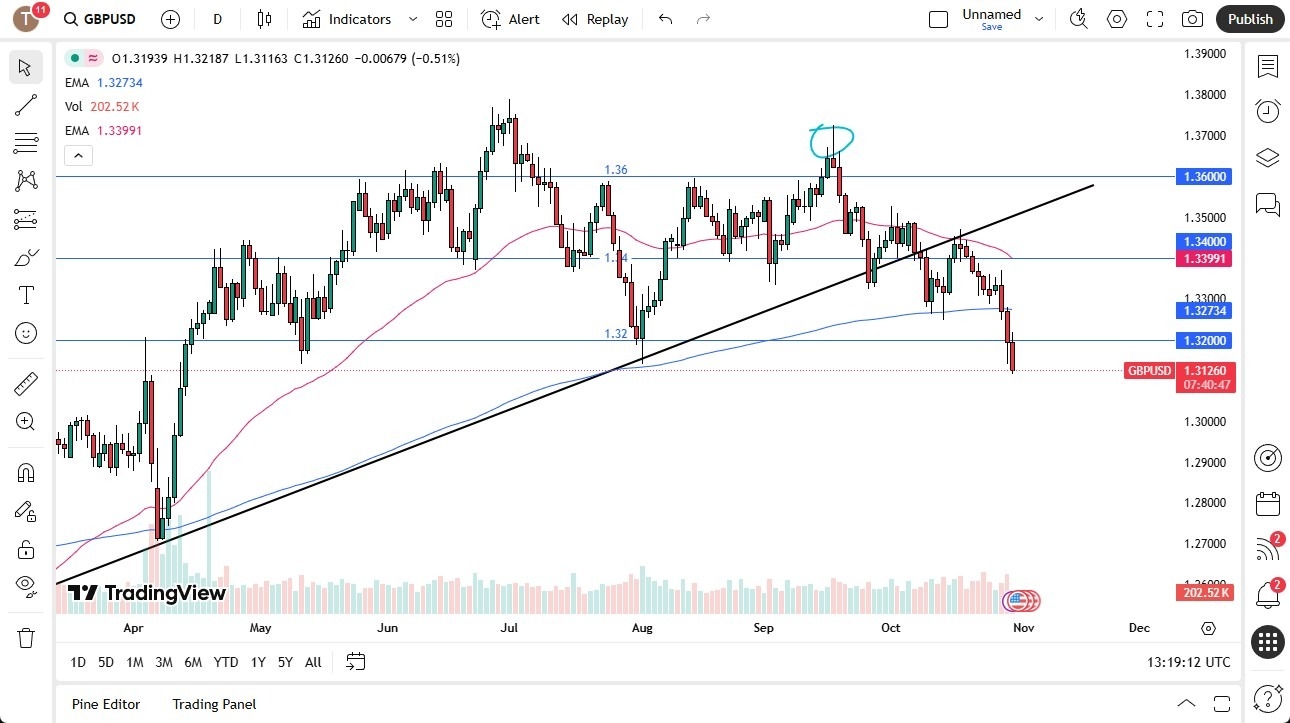
The British Pound initially tried to rally during the trading session on Thursday but has found the area above the 1.32 level to be a bit too much, and we have just fallen off again. I’ll bring to light that we’ve had two FOMC meetings since the peak, and we have done nothing but fall since then, with the occasional short-term bounce.
The US dollar is strengthening against almost everything, and it’s worth noting that the bond market yields really aren’t moving either. In other words, I do think that the US dollar has entered a bullish phase, and it is worth noting that we have broken a major support level during the trading session. If we break down below 1.31, then the market really could drop possibly as low as 1.2750 before it’s all said and done.
Until recently, the British Pound was one of the better performers against the US dollar, but clearly, people are expecting the Bank of England to have to cut rates and loosen monetary policy, and the British Pound has been punished as a result. Short-term rallies at this point, I believe, end up being selling opportunities, with the 1.32 level offering resistance and, of course, the 200-day EMA offering resistance at the 1.3273 level.
Breaking down below there during the previous session was a very serious shot across the bow, and the fact that we are continuing that overall downward pressure really drives home the idea that the US dollar is accelerating to the upside. As far as buying is concerned, at minimum, you would need to see a move back above the 200-day EMA, perhaps even a move above the 50-day EMA, which is hanging around the 1.34 level—an area that’s been important more than once as well. We broke a major uptrend line, and it looks like the US dollar is strengthening against almost everything. Therefore, shorting this pair makes perfect sense.
Ready to trade our daily Forex GBP/USD analysis? We’ve made this UK forex brokers list for you to check out.
Christopher Lewis has been trading Forex and has over 20 years experience in financial markets. Chris has been a regular contributor to Daily Forex since the early days of the site. He writes about Forex for several online publications, including FX Empire, Investing.com, and his own site, aptly named The Trader Guy. Chris favours technical analysis methods to identify his trades and likes to trade equity indices and commodities as well as Forex. He favours a longer-term trading style, and his trades often last for days or weeks.
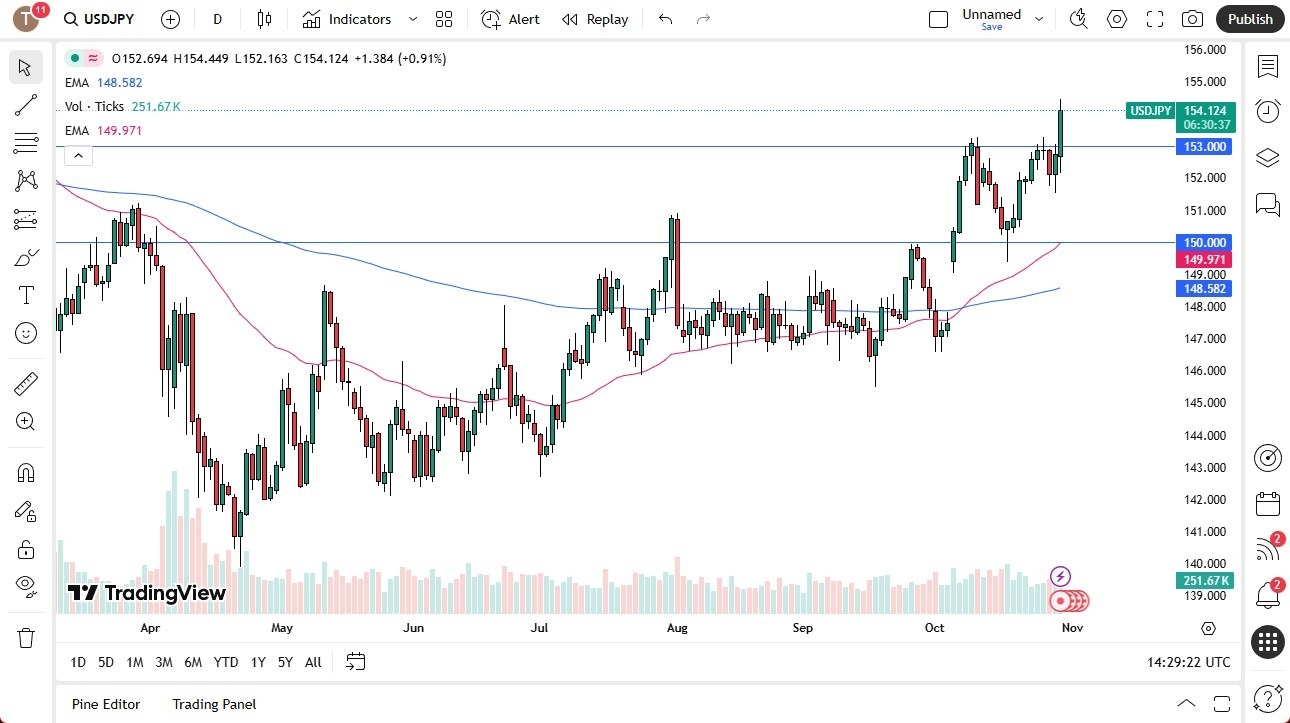
Keep in mind that recently we have seen a lot of momentum in the US dollar against multiple currencies, but the Japanese yen is a little bit special in the sense that we have recently had an election in Japan. The Japanese election ushers in a new government of doves, and it is thought that the Bank of Japan will continue to keep a very loose monetary policy, so it does make a certain amount of sense that the Japanese yen gets hammered by other currencies.
Contrast that with the FOMC meeting that we had on Wednesday, where Jerome Powell stated in the press conference that a December rate cut wasn’t necessarily a given. This has driven the US dollar higher against most things, including the Japanese yen, so it all lines up as a central bank outlook differential. Furthermore, we have an interest rate differential between the two currencies because, despite the fact that the Federal Reserve did in fact cut, the reality is that the bond market sat still.
Therefore, the interest rate differentials are even ignoring the Fed at this point. All things being equal, this is a reasonably sized candlestick. It’s explosive, it’s strong, but at the same time, it’s reasonable. It’s not out of control and impulsive. And I think this shows that short-term pullbacks are more likely than not will be bought into in this pair, and I believe that a certain amount of market memory comes into the picture at the 153 yen level as potential support.
In fact, I don’t even have a scenario at this point where I’m willing to short this pair. I think we have so much more upside. The 155 yen level could be targeted pretty quickly. And then after that, you could be looking at a move to 158 yen.
Want to trade our USD/JPY forex analysis and predictions? Here’s a list of forex brokers in Japan to check out.
Christopher Lewis has been trading Forex and has over 20 years experience in financial markets. Chris has been a regular contributor to Daily Forex since the early days of the site. He writes about Forex for several online publications, including FX Empire, Investing.com, and his own site, aptly named The Trader Guy. Chris favours technical analysis methods to identify his trades and likes to trade equity indices and commodities as well as Forex. He favours a longer-term trading style, and his trades often last for days or weeks.
The advance decisively broke through a potential resistance zone from $3.92 to $3.93, consisting of a 127.2% rising ABCD pattern target and 88.6% Fibonacci retracement. This clearance removes a significant hurdle and puts natural gas in position to challenge prior resistance at the June swing high. Exceeding this level would trigger a bullish signal, breaking a swing high from the downtrend structure and confirming a shift in momentum.
Key near-term support is today’s $3.79 low. The $3.92-$3.93 range, now former resistance, can also be monitored for signs of flipping to support. Since there was minimal pushback at that zone, a confirmed bull breakout could solidify it as a new floor. Wednesday’s $3.75 low provides another short-term support level if tested, offering buyers a chance to defend.
Natural gas is showing clear signs of resuming the long-term bull trend that began from 2024’s low. The long-term uptrend line was recently recovered, along with a downtrend line. Prices now trade above the 200-day average after remaining below it since early August, reinforcing underlying demand and structural improvement.
Clearing the 127.2% ABCD target opens the 161.8% extended Fibonacci target at $4.21 — the higher potential target for the current advance from August’s low. This would require surpassing the June swing high. A strong weekly close would further solidify the bullish posture, though a pullback remains possible before reaching $4.21.
The $3.79 close is critical — above it targets the June high, below risks $3.75. The 200-day average marks maximum downside if support fails. Today’s strength favors continuation — watch the June high for reversal confirmation. Pullbacks may offer entry opportunities if trendlines and the 200-day hold firm.
For a look at all of today’s economic events, check out our economic calendar.
Spot Gold managed to recover some ground on Thursday, trading around the $4,000 mark at the time of writing. The advance was limited, however, by broad demand for the US Dollar (USD). Following the Federal Reserve (Fed) hawkish interest rate cut on Wednesday, the Bank of Japan (BoJ) decided to leave rates unchanged as widely anticipated. However, BoJ Governor Kazuo Ueda delivered some dovish remarks that sent the Japanese Yen sharply lower, while providing additional impetus to the USD.
The Greenback also benefited from headlines indicating that the United States (US) and China reached a trade deal, de-escalating recent tensions. US President Donald Trump met Chinese leader Xi Jinping and agreed on rolling back some of their recent punitive actions. Trump announced it would immediately reduce fentanyl-related tariffs to 10%, and that China will resume buying soybean and agricultural products. Trump also mentioned they reached an agreement on chips and rate earths, although without much detail.
Other than that, the European Central Bank (ECB) also announced its monetary policy decision, leaving interest rates unchanged, as widely anticipated. President Christine Lagarde repeated that the central bank is in a good place and showed no urge to modify the monetary policy.
Finally, it is worth remembering that the US government remains on pause, amid the lack of funding. The US Senate seems in no rush to agree on a bill, which is costing the well-being of thousands of federal employees.
In the 4-hour chart, XAU/USD is currently trading at around $4,002, holding on to solid intraday gains. A bearish 20 SMA slides south at $3,973, sitting just above the 200 SMA, and both are below the current level, providing support. The 100 SMA at $4,109 is marginally easing and acts as immediate resistance. At the same time, the Momentum indicator stands just above its 100 line, suggesting the bearish impulse is losing traction. As for the RSI, it remains flat around 49, reflecting the absence of directional strength despite the intraday bounce. A decisive clearance of the 100 SMA resistance at $4,109 would unlock additional upside, whereas failure to top that level keeps risks skewed toward a pullback to the 20 SMA support at $3,973 ahead of $3,956.
In the daily chart, a bullish 20 SMA rallies above the longer ones, suggesting buyers still hold the broader grip; the 20 SMA stands at $4,080 and now acts as immediate resistance. The 100 SMA is also bullish, advancing to $3,578, while the 200 SMA rises to $3,340, both of which underpin the long-term bullish bias. Finally, the Momentum indicator has managed to bounce from its recent lows, but remains within negative levels, while the RSI indicator has recovered to 51edging back toward neutrality; the uptick hints at tentative buying interest.
(This content was partially created with the help of an AI tool)
Natural gas price surrendered to stochastic negativity, threatening the stability of the extra support at $3.830, suffering intraday losses by hitting $3.770 level, then attempts to settle above this support to confirm the dominance of the previously suggested bullish bias.
We recommend waiting for providing new bullish close for the upcoming four hours’ time frame above the current support, which reinforces the chances of forming several bullish waves, to target $4.050 level, reaching the barrier near $4.210, while facing new bearish pressures will confirm activating the bearish corrective track, which forces it to suffer more losses by targeting $3.690 and $3.550 level.
The expected trading range for today is between $3.800 and $4.050
Trend forecast: Bullish