The main category of Forex News.
You can use the search box below to find what you need.
[wd_asp id=1]
The main category of Forex News.
You can use the search box below to find what you need.
[wd_asp id=1]
The Gold price (XAU/USD) extends its upside to around $3,365 during the early Asian session on Monday. The precious metal edges higher as traders rushed toward the traditional safe-haven assets after US President Donald Trump widened the global trade war with a fresh wave of tariffs.
On Saturday, Trump said that the United States (US) will impose a 30% tariff on goods from the European Union (EU) and Mexico that will take effect on August 1. Trump also announced a 35% duty on Canadian imports and proposed a blanket tariff rate of 15%-20% on other trading partners last week, along with a 50% tariff on copper imports. Concerns over the impact of Trump’s latest tariffs boost the yellow metal as investors seek shelter from trade tensions.
Additionally, the persistent geopolitical tensions in the Middle East might contribute to the Gold’s upside. Reuters reported that at least eight Palestinians were killed and more than a dozen were wounded while collecting water in central Gaza on Sunday. The Israeli military said the missile had been intended to hit an Islamic Jihad militant in the area but that a malfunction had caused it to fall “dozens of metres from the target”. Steve Witkoff, Trump’s Middle East envoy, stated on Sunday that he was “hopeful” about the Gaza ceasefire discussions that were taking place in Qatar.
On the other hand, the cautious stance of the US Federal Reserve (Fed) might cap the upside for the precious metal. The US central bank is widely anticipated to hold interest rates steady as it waits to see the impact of tariffs on price pressures. Chicago Fed President Austan Goolsbee said that fresh tariffs unveiled by Trump have further muddied the inflation outlook, making it more difficult for him to support the rate cuts that the President has pressed for.
Gold has played a key role in human’s history as it has been widely used as a store of value and medium of exchange. Currently, apart from its shine and usage for jewelry, the precious metal is widely seen as a safe-haven asset, meaning that it is considered a good investment during turbulent times. Gold is also widely seen as a hedge against inflation and against depreciating currencies as it doesn’t rely on any specific issuer or government.
Central banks are the biggest Gold holders. In their aim to support their currencies in turbulent times, central banks tend to diversify their reserves and buy Gold to improve the perceived strength of the economy and the currency. High Gold reserves can be a source of trust for a country’s solvency. Central banks added 1,136 tonnes of Gold worth around $70 billion to their reserves in 2022, according to data from the World Gold Council. This is the highest yearly purchase since records began. Central banks from emerging economies such as China, India and Turkey are quickly increasing their Gold reserves.
Gold has an inverse correlation with the US Dollar and US Treasuries, which are both major reserve and safe-haven assets. When the Dollar depreciates, Gold tends to rise, enabling investors and central banks to diversify their assets in turbulent times. Gold is also inversely correlated with risk assets. A rally in the stock market tends to weaken Gold price, while sell-offs in riskier markets tend to favor the precious metal.
The price can move due to a wide range of factors. Geopolitical instability or fears of a deep recession can quickly make Gold price escalate due to its safe-haven status. As a yield-less asset, Gold tends to rise with lower interest rates, while higher cost of money usually weighs down on the yellow metal. Still, most moves depend on how the US Dollar (USD) behaves as the asset is priced in dollars (XAU/USD). A strong Dollar tends to keep the price of Gold controlled, whereas a weaker Dollar is likely to push Gold prices up.
I wrote on 6th July that the best trades for the week would be:
The overall loss of 0.47% equals a loss of 0.09% per asset.
The news last week was dominated by continuing speculation as to the amounts of President Trump’s new tariffs which would be imposed on various countries, after the hard deadline was pushed back to August. President Trump announced the following last week on tariffs:
These measures likely gave a boost to the US Dollar, which had an uncharacteristic strong week last week, and hit the Brazilian Real. However, overall, these items were unable to stop the two major US equity indices, the broad S&P 500 Index and the tech-focused NASDAQ 100 Index, from reaching new record highs, albeit on slowing momentum.
Other market drivers last week related to certain high-impact data releases:
Over the weekend, President Trump decreed that Mexico and the European Union will face 30% tariffs on their exports to the USA, effective 1st August. This will likely see stock markets open lower this week, and will probably boost the Dollar while sinking the Euro and the Mexican Peso.

The coming week has a relatively light program of high-impact data releases, but the CPI (inflation) releases will be important, especially the US data, which has become established as a central driver of the USD and therefore the entire Forex market.
This week’s important data points, in order of likely importance, are:
For the month of July 2025, I forecasted that the EUR/USD currency pair will increase in value. The performance of this forecast so far is:

July 2025 Monthly Forecast Performance to Date
As there was an unusually large upwards price movement in the AUD/JPY Forex currency cross last week, I forecast that it will fall in value over the coming week.
The Australian Dollar was the strongest major currency last week, while the Japanese Yen was the weakest. Volatility increased strongly last week, with 41% of the most important Forex currency pairs and crosses changing in value by more than 1%. Next week’s volatility is likely to remain the same or possibly increase.
You can trade these forecasts in a real or demo Forex brokerage account.

Last week, the US Dollar Index printed a strong up candlestick which engulfed the real body of the previous week’s candlestick and closed near the top of its weekly range. These are bullish signs, but there are two bearish signs which are probably stronger:
Markets are still expecting the Fed to make three more rate cuts this year, despite the Fed’s slightly hawkish recent rhetoric, and this is likely to send the Dollar to new long-term low prices once the tariff talk dies away and reaches a natural conclusion.

The NASDAQ 100 Index barely changed last week, despite briefly trading at a new all-time high price. The weekly candlestick was a small indecisive doji, which tends to signify indecision, while the small range is also bearish as it signifies declining momentum.
Although there are good arguments for trend traders to remain long here, I think we are seeing signs of a bearish retracement which is about to happen, probably linked to new tariffs President Trump has just announced will be imposed on the European Union and Mexico – there are likely to be more over this coming week, too.
I do not like trading US stock indices short, but a long trade could be possible here if we get a daily close above the current record high at 22,945.

The S&P 500 Index performed very similarly to the NASDAQ 100 Index last week. Everything I wrote above about that tech index also applies here to the S&P 500 Index. The only point I must add is that this broader Index will likely be harder hit by new tariffs than the NASDAQ 100 Index. However, if the Index goes on to make another record New York close high, I will enter a new long trade.

The EUR/USD currency pair printed a down candlestick last week which looks very like the US Dollar Index weekly candlestick.
There is a long-term bullish trend in this currency pair, which has historically trended very reliably.
However, the US just announced over the weekend that it will be imposing a new 30% tariff on all imports from the European Union, and this is likely to send prices lower over the coming week, at least over the first part of the week.
I would not want to enter a new trade except in the unlikely event that we see a daily (New York) close above $1.1806.

The AUD/JPY currency cross printed a strongly bullish candlestick with unusually large range and real body. This cross was the top performer in the Forex market last week, with the Aussie getting a boost from rising stock markets and from the Reserve Bank of Australia passing on a widely expected rate cut last week. The Japanese Yen is weak as markets still don’t see the Bank of Japan as ready to begin a serious course of rate hikes.
As the price looks somewhat over extended, and in honour of “buy the rumour, sell the fact” following the RBA’s passing on a rate cut, I think we are most likely to see the price fall here over the coming week, so a short trade with a small position size could be useful.
Another bearish factor is that the price ended the week sitting right on a resistance level which it was unable to break.

The USD/MXN currency pair printed a small rising candlestick but with a large upper wick. It is truly more of a bearish than bullish candlestick. The fact that the low of the week’s range was basically confluent with the key support level shown in the price chart below at $15.5776 suggests that all we have seen here is a little temporary support, which will soon break down to a new 10-month low price.
Over the weekend, President Trump announced that a new 30% tariff will apply to all imports from Mexico into the USA. This is bound to send the Mexican Peso lower and help bring the US Dollar higher. Therefore, I think a short trade here could be a good idea.
I will wait for a daily (New York) close below $15.5776 before entering a new short trade here.

Silver in US Dollar terms was holding up better than Gold, and despite making a bearish retracement the price remained within touching distance of the high. This kept my faith in the long-term bullish trend and allowed me to hold on to my long position in Silver.
My fair was rewarded at the end of last week when the price made a very strong bullish breakout, reaching as high as $38.50 per ounce, which was the highest price seen in over 13 years, so we really do have the price flying in blue sky right now.
Another bullish sign was that the price ended the week close to the high at $38.50. The price chart below shows this trend is extremely well established and has run since the start of 2023.

Palladium is one of the rarer precious metals. It has been rising on high volatility but exponentially, and along with Silver it rose very strongly last Friday to break to a new long-term high price.
Palladium futures are expensive for most retail investors, and the metal is not offered by many CFD brokers. However, an affordable physical ETF is available as PALL, and I will be looking to enter a trend trade long here when the market opens on Monday.

Copper had seen a broadly rising price for some time which qualified as a bullish trend, but it was President Trump’s declaration last week that all imports of Copper into the USA would be subject to a 50% tariff that send the price shooting into the stratosphere. These high prices in Copper have never been seen before – they are all-time highs, which is rare to see in a commodity.
The remaining question is how much more momentum can this news bring us on the long side. The tariff will boost the price, but by how much more?
As a trend trader, I already entered a long position here. Friday saw a bearish retracement, so a careful course of action might be entering a new long trade following a new all-time high New York closing price above $5.6855.

I see the best trades this week as:
Ready to trade our weekly Forex forecast? Check out our list of the top 10 Forex brokers in the world.
Silver (XAG/USD) trades with a positive bias for the second straight day and tests the top end of a multi-week-old range during the Asian session on Friday. The white metal currently trades around the $37.20 region, up 0.40% for the day.
From a technical perspective, the daily Relative Strength Index (RSI, 14) remains above 50, while the Moving Average Convergence Divergence (MACD) histogram and the signal line are yet to confirm bullish bias. This makes it prudent to wait for some follow-through buying beyond the $37.30-$37.35 region, or the highest since February 2012 touched last month, before placing fresh bullish bets around the XAG/USD.
The subsequent move up would increase the likelihood of additional gains towards the $38.00 round figure. The next relevant hurdle is pegged near the $38.35-$38.40 region, above which the XAG/USD could extend the momentum towards reclaiming the $39.00 mark for the first time since September 2011.
On the flip side, any corrective pullback below the $37.00 round figure could be seen as a buying opportunity and remain limited near the $36.50-$36.45 area. Some follow-through selling could drag the XAG/USD back closer to the $36.00 mark, which, if broken decisively, should pave the way for a slide towards the $35.50-$35.40 horizontal zone, representing the lower boundary of the short-term trading range.
A convincing break below the latter might then shift the near-term bias back in favor of bearish traders. The XAG/USD might then accelerate the fall towards the $35.00 psychological mark en route to $34.75 intermediate support before eventually dropping to the $34.45 region.
Silver is a precious metal highly traded among investors. It has been historically used as a store of value and a medium of exchange. Although less popular than Gold, traders may turn to Silver to diversify their investment portfolio, for its intrinsic value or as a potential hedge during high-inflation periods. Investors can buy physical Silver, in coins or in bars, or trade it through vehicles such as Exchange Traded Funds, which track its price on international markets.
Silver prices can move due to a wide range of factors. Geopolitical instability or fears of a deep recession can make Silver price escalate due to its safe-haven status, although to a lesser extent than Gold’s. As a yieldless asset, Silver tends to rise with lower interest rates. Its moves also depend on how the US Dollar (USD) behaves as the asset is priced in dollars (XAG/USD). A strong Dollar tends to keep the price of Silver at bay, whereas a weaker Dollar is likely to propel prices up. Other factors such as investment demand, mining supply – Silver is much more abundant than Gold – and recycling rates can also affect prices.
Silver is widely used in industry, particularly in sectors such as electronics or solar energy, as it has one of the highest electric conductivity of all metals – more than Copper and Gold. A surge in demand can increase prices, while a decline tends to lower them. Dynamics in the US, Chinese and Indian economies can also contribute to price swings: for the US and particularly China, their big industrial sectors use Silver in various processes; in India, consumers’ demand for the precious metal for jewellery also plays a key role in setting prices.
Silver prices tend to follow Gold’s moves. When Gold prices rise, Silver typically follows suit, as their status as safe-haven assets is similar. The Gold/Silver ratio, which shows the number of ounces of Silver needed to equal the value of one ounce of Gold, may help to determine the relative valuation between both metals. Some investors may consider a high ratio as an indicator that Silver is undervalued, or Gold is overvalued. On the contrary, a low ratio might suggest that Gold is undervalued relative to Silver.
The US dollar is trying to carve a local bottom following a dismal end to June. Meanwhile, gold is struggling at its 2025 trend line, which could spell trouble for the metal.
Check out today’s Weekly Forex Forecast for the latest on the DXY, EURUSD, GBPUSD, USDCHF, and XAUUSD.
The DXY is rebounding today following the release of impressive US employment numbers. Thursday’s non-farm payroll report exceeded expectations, and the unemployment rate dropped from 4.3% to 4.1%.
Technically speaking, Thursday’s rally in the US dollar was not a surprise. Pairs like USDCHF were showing bullish formations on Wednesday, and EURUSD was testing channel resistance from May.
However, the DXY has a significant challenge ahead. The June candle closed below 97.70, making it a substantial confluence of resistance in July.
Additionally, dollar bulls need to reclaim areas like 97.00 and 97.40, which it tested on Thursday. But the much bigger test for the DXY is 97.70, which is the bottom of the ascending channel from 2011.
July will be interesting for the DXY. On the one hand, the US dollar remains in its 2025 downtrend and trades below key areas like 97.70. On the other hand, a break below an area as significant as 97.70 is precisely what it would take to carve out a bottom.
That doesn’t mean it will happen, but I’m not going to rule it out. Regardless of what we get, the chart will have the final say.
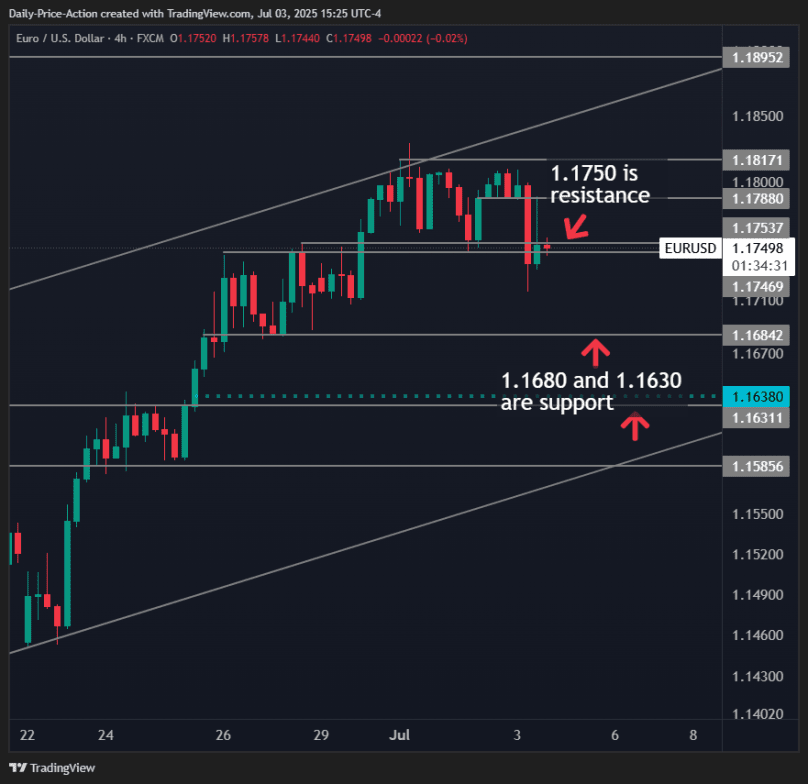
The EURUSD is pulling back today after the US employment report beat expectations. In the last video, I discussed the potential for a pullback from the euro in early July.
The pair was testing the top of its May channel earlier this week, and the DXY was carving a rounded bottom. So far, we haven’t seen much of a pullback from EURUSD, given how the US dollar gets walked back at each sign of strength.
Currently, EURUSD is finding resistance at 1.1788. The pair also closed a recent 4-hour candle below 1.1745; however, time will tell if this is a meaningful development or not.
My comments about where the euro might trend earlier this week are unchanged. Bulls will be eyeing levels like 1.1685, but especially areas like 1.1630 if we get it.
That could align with the DXY testing the 97.70 region. If so, it will mark a significant test for the forex market in July.
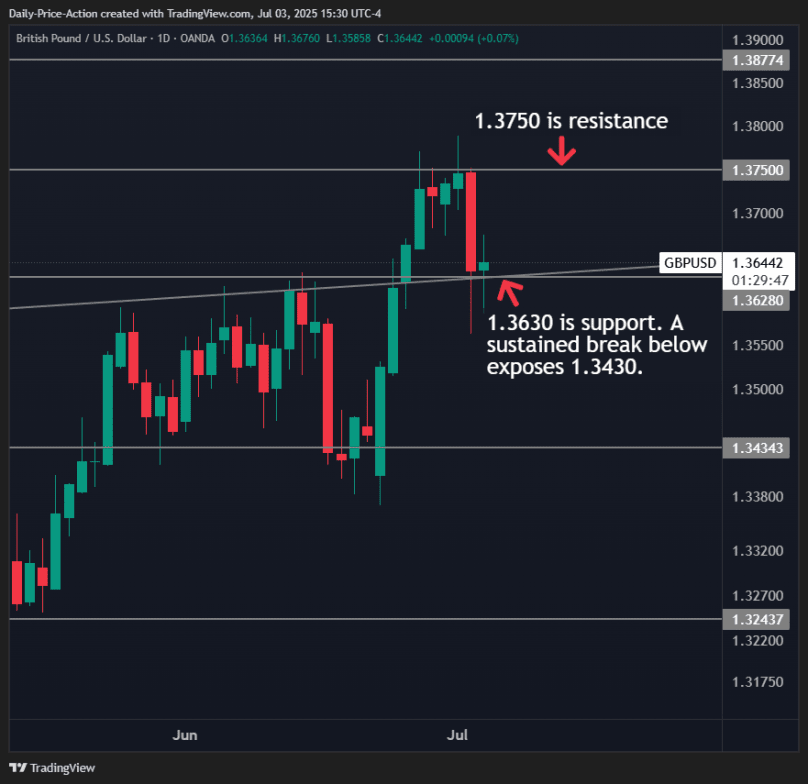
The GBPUSD is testing a highly significant area this week at 1.3630. The pair bounced from here on Thursday, but it quickly faded following the strong US jobs numbers.
However, buyers are doing their best to defend 1.3630 on the high time frames. GBPUSD remains above it for now on both the daily and weekly charts.
If the DXY can reclaim levels like 97.10, it could push GBPUSD below the key level. If so, 1.3430 could be next for the pound.
That said, as long as GBPUSD trades above 1.3630, the level remains key support.
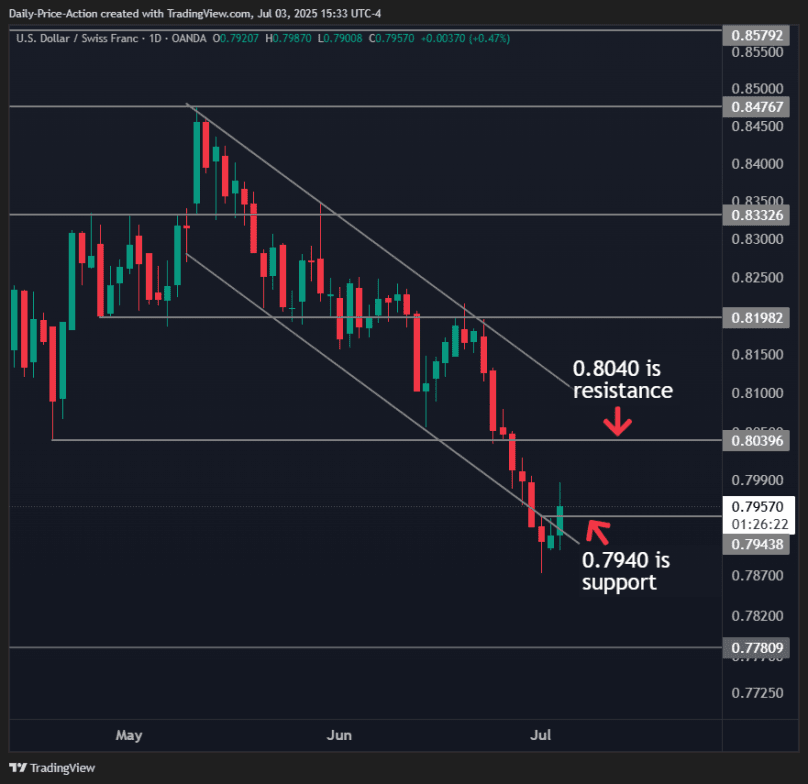
USDCHF is the pair that was showing bullish signs before Thursday’s NFP. The pair had reclaimed the bottom of its May channel on an hourly basis before the jobs numbers were released.
Of course, attempting a trade ahead of non-farm payroll is always ill-advised. Even if you get the direction right, the volatility and slippage can cause premature stopouts.
Thursday’s bullish reclaim of channel support could trigger a retest of 0.8040. That would be a significant moment for USDCHF, given how it’s the recent range lows, and June also closed below the level.
0.7940 is key support for USDCHF, with resistance at 0.8040. What occurs at 0.8040 could determine the next few weeks for USDCHF.
Keep the DXY and its 97.70 level on your radar as you trade the major currency pairs.
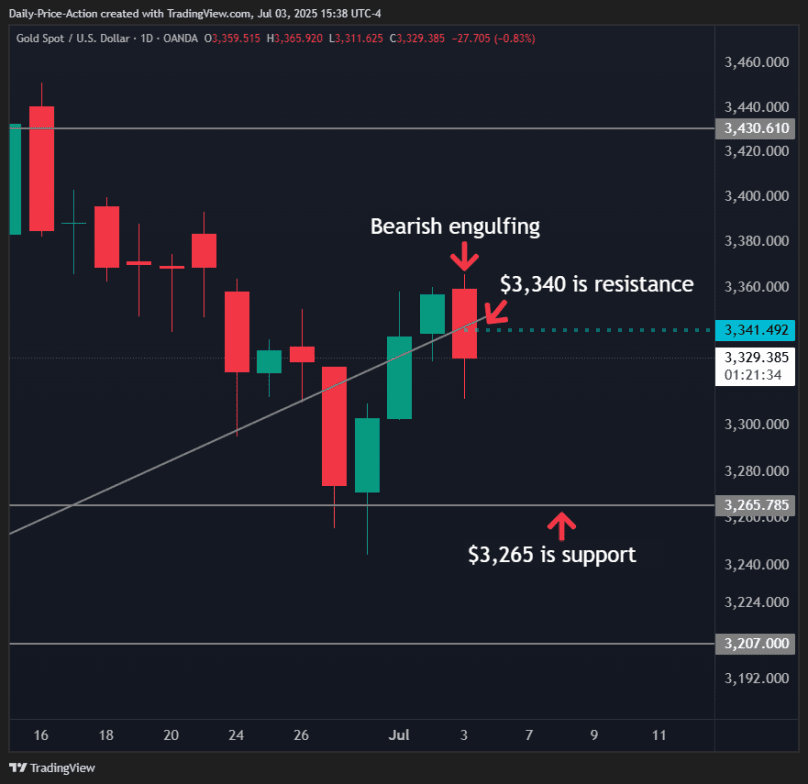
Gold is an interesting chart because you have a battle between two high time frames. On one hand, XAUUSD closed below its 2025 trend line at the end of June. On the other hand, gold reclaimed it on the daily time frame last week.
However, we’re seeing sellers step in following the robust US jobs numbers. This is simply gold making good on the weekly breakdown in June.
A weekly break always carries more weight than a daily break. There’s more volume in a weekly candle, and volume equals conviction when trading technical breaks.
As long as gold is below $3,340 on a weekly closing basis, I’ll be eyeing lower levels. First is key support at $3,265, followed by $3,207.
Thursday’s selloff left a buy-side single print at $3,341. That could serve as resistance if XAUUSD holds below the $3,340 region into Thursday’s close.
July 13, 2025 – Written by Tim Boyer
STORY LINK Euro to Dollar Forecast: EURUSD Looks “Overbought and Overvalued”
The Euro to Dollar exchange rate (EUR/USD) recovered from lows at 1.1665 on Friday, but was held just below the 1.1700 level as narrow ranges prevailed.
The dollar held firm in global markets while there were no major Euro developments.
Credit Agricole commented; “EUR/USD continues to look overbought and overvalued (according to our fair value and FX positioning models) could make it vulnerable to further correction lower in the near term.”
ING expects narrow ranges may continue to prevail for now; “while near-term risks look more balanced, if anything slightly skewed to the downside, the lack of fresh data suggests the pair may remain anchored around 1.17 for now.”
UoB commented; “Although there is still no significant increase in momentum, only a breach of 1.1755 (‘strong resistance level previously at 1.1780) would indicate that the current downward risk has faded.”
It added; “Until then, if EUR were to close below 1.1660, it could potentially trigger a move to 1.1625.”
Scotiabank added; “We continue to highlight the importance of medium-term support at the 50 day MA (1.1466). We see the near-term range bound between 1.1650 support and 1.1750 resistance.”
Overnight, President Trump announced that he would impose 35% tariffs on Canadian exports to the US from August 1st.
Equities have moved lower, but the dollar has been resilient.
Scotiabank commented; “Investors may consider these threats to be largely negotiating tactics at this point.”
Commerzbank FX analyst Volkmar Baur outlined two potential scenarios. The first is that tariff announcements and trade deals trickle out.
An alternative scenario is that markets assume that Trump will back off and are then shocked when big tariff increases go into effect.
According to Baur “It makes a difference for the market. If the latter is the case, there could be considerable volatility on 1 August if Trump does not back down this time and the tariffs actually come into force. In the former case, we would probably have to wait for a significant deterioration in fundamental data before the market reacts.
He added; “I would expect a weaker US dollar in both situations. However, while things could move quite quickly at the beginning of August if there is no taco, the salami argument would suggest a gradual devaluation as soon as the fundamentals deteriorate.”

MUFG also pointed to the importance of US fundamentals; “With the US economy showing resilience and the labour market still holding up, we may start to see the dollar benefitting again from yields. Our G10 FX regression models indicate scope for the US dollar to recover further. Our EUR/USD model implies a 8% over-valuation that when we back test indicates a 65% probability of a retracement lower over a 4-week period.”
RBC differentiates between the near term and longer-term trend; “In the short term, there are factors that could limit immediate USD weakness, even within the broader theme of depreciation remaining intact.”
HSBC commented on the medium-term outlook; “for EUR-USD to sustain its rally beyond our 1.20 target, we think it needs four EUR-centric factors to work in its favour. These are an acceleration in private sector credit, positive and rising real wage growth, a recovery in the inventory cycle, and policy intervention by the ECB and EU.”
It added; “For now, these elements may not be sufficiently compelling to push the EUR higher from lofty levels.”
International Money Transfer? Ask our resident FX expert a money transfer question or try John’s new, free, no-obligation personal service! ,where he helps every step of the way,
ensuring you get the best exchange rates on your currency requirements.
The GBP/USD weekly forecast indicates weaker growth in the UK, which has pushed up BoE rate cut expectations.
The GBP/USD pair had a bearish week as the dollar gained with US Treasury yields. Meanwhile, the pound dropped after downbeat UK GDP figures.
–Are you interested in learning more about Forex robots? Check our detailed guide-
Treasury yields soared after Trump announced higher tariffs on several countries, including Canada, Brazil, and Japan. If these tariffs take effect, they will hike import prices and drive inflation higher. This would force the Fed to maintain high borrowing costs.
Elsewhere, data on Friday revealed that the UK economy contracted by 0.1% compared to the forecast of a 0.1% expansion. The report increased pressure on the Bank of England to cut interest rates.
Next week, the US will release crucial inflation and retail sales figures. Meanwhile, the UK will release inflation and employment numbers. The US inflation figures will show whether Trump’s tariffs have increased price pressures. If so, the Fed might remain cautious about rate cuts. However, if inflation is softer than expected, it will solidify rate cut expectations.
On the other hand, the UK inflation numbers will shape the outlook for Bank of England rate cuts. Traders will also watch to see the state of the UK labor market.
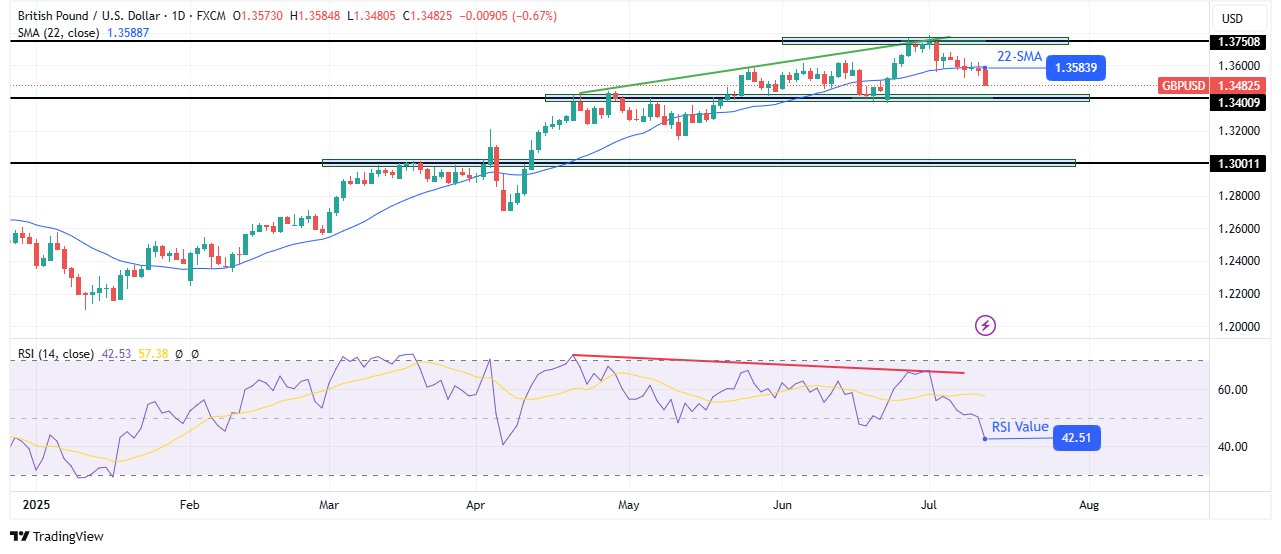
On the technical side, the GBP/USD price has broken below the 22-SMA after showing weakness in the rally. The break indicates a bearish shift in sentiment. At the same time, the RSI has crossed below 50, showing that bearish momentum is stronger.
–Are you interested in learning more about XRP price prediction? Check our detailed guide-
Previously, the price was trading in a solid bullish rally, making higher highs and lows. However, the price started puncturing the SMA, a sign that bears were gradually getting stronger. At the same time, while the price made higher highs, the RSI made lower ones. This resulted in a bearish divergence, signalling weaker momentum.
Consequently, bears made a strong break below the SMA. However, to confirm a new trend, the price must maintain its position below the 22-SMA. Additionally, it must start making lower highs and lows. That means breaking below the 1.3400 support.
Looking to trade forex now? Invest at eToro!
68% of retail investor accounts lose money when trading CFDs with this provider. You should consider whether you can afford to take the high risk of losing your money.
The GBP/JPY cross trades in positive territory for the third consecutive day near 197.95 during the early European session on Monday. The Japanese Yen (JPY) weakens against the Pound Sterling (GBP) as the Bank of Japan’s (BoJ) preference to move cautiously in normalizing still-easy monetary policy forces traders to push back their bets about the likely timing of the next interest rate hike to Q1 2026.
Technically, GBP/JPY keeps the bullish vibe on the daily chart, with the price holding above the key 100-day Exponential Moving Average (EMA). The path of least resistance is to the upside, as the 14-day Relative Strength Index (RSI) stands above the midline near 64.50. This suggests bullish momentum in the near term.
The first upside target to watch for the cross is seen at 198.81, the high of July 25, 2024. Extended gains could see a rally to the 200 psychological level. Further north, the next hurdle is located at 203.62, the high of July 22, 2024.
On the other hand, the initial support level for GBP/JPY emerges at 194.34, the low of June 18. A breach of this level could expose the key contention level in the 193.30-193.20 zone, representing the 100-day EMA and the lower limit of the Bollinger Band. The additional downside filter to watch is 191.90, the low of May 22.
The Japanese Yen (JPY) is one of the world’s most traded currencies. Its value is broadly determined by the performance of the Japanese economy, but more specifically by the Bank of Japan’s policy, the differential between Japanese and US bond yields, or risk sentiment among traders, among other factors.
One of the Bank of Japan’s mandates is currency control, so its moves are key for the Yen. The BoJ has directly intervened in currency markets sometimes, generally to lower the value of the Yen, although it refrains from doing it often due to political concerns of its main trading partners. The BoJ ultra-loose monetary policy between 2013 and 2024 caused the Yen to depreciate against its main currency peers due to an increasing policy divergence between the Bank of Japan and other main central banks. More recently, the gradually unwinding of this ultra-loose policy has given some support to the Yen.
Over the last decade, the BoJ’s stance of sticking to ultra-loose monetary policy has led to a widening policy divergence with other central banks, particularly with the US Federal Reserve. This supported a widening of the differential between the 10-year US and Japanese bonds, which favored the US Dollar against the Japanese Yen. The BoJ decision in 2024 to gradually abandon the ultra-loose policy, coupled with interest-rate cuts in other major central banks, is narrowing this differential.
The Japanese Yen is often seen as a safe-haven investment. This means that in times of market stress, investors are more likely to put their money in the Japanese currency due to its supposed reliability and stability. Turbulent times are likely to strengthen the Yen’s value against other currencies seen as more risky to invest in.
Friday’s advance further confirms a bullish reversal following a test of support near the lower uptrend line that marks the bottom of a developing bull pennant pattern. This puts gold on track to continue to strengthen towards a test of resistance near the top boundary line of the pennant, at a minimum. A breakout above that line provides an initial breakout signal, but a rise above the lower swing high at $3,451 should be more convincing. If a breakout of the pennant triggers, an initial new high target is around 3,578, derived from a rising ABCD pattern begun from the mid-May swing low. Then there is a 127.2% extended target measured from the April downswing at $3,603.
Since the apex of the pennant triangle is getting closer, an upside breakout should occur within the next couple of weeks, or a pattern failure. A failure of the bull pennant would occur on a drop through the bottom boundary of the pattern rather than the top. The fact that silver broke out today to a new trend high with enthusiasm is supportive of an eventual upside pennant breakout in gold.
Next, the behavior of gold around potential support around the 20-Day or 50-Day lines, should provide clues. If the bullish scenario is retained, support should be seen above today’s low of $3,322, which currently matches the 50-Day line. However, gold remains in a consolidation pattern and therefore choppy price action could continue until there is a decisive breakout.
For a look at all of today’s economic events, check out our economic calendar.
The above analysis includes the lower price zone that may show the maximum potential decline for the current bearish correction. What it illustrates is that a 31.5% drop in the price of natural gas is not unusual during a correction, as it was exceeded twice this year. However, be aware that the full downswing from the March trend high was greater than a 31.5% decline. Whether the potential target zone is reached or not, what it shows is that there is further downside potential for the current correction. This makes lower targets that are above the 78.6% Fibonacci level more likely to be reached before a new bottom is established.
On Friday, natural gas rallied to a three-day high of $3.42 before encountering resistance around the 200-Day MA, now at $3.43. Subsequently, sellers took charge and drove the price down to a low for the day at $3.92. At the time of this writing, downward pressure remains as trading continues in the lower half of the day’s trading range. A rejection of price at the 200-Day MA resistance puts natural gas in a position to continue to fall towards the next lower target zone for the downtrend, at $2.97 to $2.95.
Nonetheless, a decisive rally above the week’s high of $3.47 could turn sentiment from bearish to bullish. It would signal a potential one-week bullish reversal. Following a daily close above that high to confirm the breakout, natural gas would be heading up into potential resistance at $3.53, followed by $3.57.
For a look at all of today’s economic events, check out our economic calendar.
The GBPJPY pair began forming bullish wave achieving 199.45 level, but the contradiction of the main indicators and forming an extra barrier might reduce the chances of resuming the bullish attack in the current period.
The stability of the price below the extra barrier, we will begin preferring the bearish correctional trading, which might target 198.20 level reaching 61.8%Fibonacci correction level near 197.45, forming an important support against the upcoming trading, while its success to breach the barrier and holding above it will increase the chances for achieving extra gains that might begin at 200.35 reaching 201.55.
The expected trading range for today is between 198.20 and 199.45
Trend forecast: Bearish