The main category of Forex News.
You can use the search box below to find what you need.
[wd_asp id=1]
The main category of Forex News.
You can use the search box below to find what you need.
[wd_asp id=1]
One way to think about the current rally is in relationship to the sharp decline that followed the April lower swing high due to similar volatility. The total decline, from high to low, was $17.25, while the current advance when measured from the higher swing low (C) from May 1, was $17.03. Once there is similarity to a prior swing there is the potential for resistance, in this case. Moreover, notice how resistance was seen recently at a top rising parallel trend line. The line parallels the uptrend line that starts from the higher swing low in May and shows symmetry within a rising trend channel.
Today’s high provided a third daily test of the line and resistance was seen once again. Once symmetry in the rising channel is confirmed, there is the potential for a pullback or bearish reversal. A decline below Thursday’s low of $74.02 will trigger the bearish shooting star candle and a one-day bearish reversal off identified resistance.
Key support is the 200-Day MA, now at $69.02, while a minimum decline is anticipated to the 38.2% Fibonacci retracement at $70.65. Watch the 200-Day line along with a 50% retracement level at $68.64. Another area to watch for early support is around an AVWAP level at $72.24. It is potentially significant since it is anchored long-term, starting at the April 2024 swing high day.
For a look at all of today’s economic events, check out our economic calendar.
Gold price advanced throughout the first half of the day, but retreated in the American session, towards the current $3,310 a troy ounce area. The XAU/USD advanced on broad US Dollar (USD) weakness, a consequence of the latest United States (US) President Donald Trump round of letters.
Trump announced another series of levies through Truth Social on Wednesday, including a fresh 50% tariff on all copper imports starting August 1, while threatened Brazil with a 50% tax, accusing the country of unfair trade practices and of conducting a “which hunt” against former President Jair Bolsonaro.
The mood, however, changed after Wall Street’s opening, with US indexes rallying and weighing on the safe-haven metal. The USD in the meantime, trades mixed across the FX board, firmer against high-yielding rivals, yet falling vs commodity-linked ones.
Meanwhile, hawkish Federal Reserve (Fed) headlines add to Gold weakness. Following the release of the Federal Open Market Committee (FOMC) meeting Minutes on Wednesday, showing policymakers are in no rush to cut rates, came comments from St. Louis Fed President Alberto Musalem. Musalem noted that the economy is in a good place, but highlighted the risks from tariffs. He noted he expect the effects of tariffs to show on upcoming June data, adding a clearer picture could be seen in the summer.
Finally, JP Morgan CEO, Jamie Dimon, said he would price in a 40%-50% chance of higher US interest rates, adding he believes markets are underestimating the risk of higher US rates.
The daily chart shows that the XAU/USD pair struggles around its daily opening, while still trading between Fibonacci levels. The pair is currently below the 38.2% retracement of the June slide at around $3,325, failing on an early attempt to run beyond the level. The next Fibonacci support, comes at 3,295.50. Other than that, the pair keeps developing below a mildly bearish 20 Simple Moving Average (SMA), currently at around $3,350, while technical indicators remain lifeless just below their midlines.
The near-term picture hints at lower lows ahead. In the 4-hour chart, XAU/USD is piercing a directionless 20 SMA, while the upside remains contained by a bearish 100 SMA in the $3,330 region. Finally, technical indicators gain downward traction within negative levels, reflecting the ongoing slide rather than anticipating another leg lower.
Support levels: 3,295.50 3,287.40 3,274.50
Resistance levels: 3,325.00 3,350.00 3,373.40
Generally speaking, a trade war is an economic conflict between two or more countries due to extreme protectionism on one end. It implies the creation of trade barriers, such as tariffs, which result in counter-barriers, escalating import costs, and hence the cost of living.
An economic conflict between the United States (US) and China began early in 2018, when President Donald Trump set trade barriers on China, claiming unfair commercial practices and intellectual property theft from the Asian giant. China took retaliatory action, imposing tariffs on multiple US goods, such as automobiles and soybeans. Tensions escalated until the two countries signed the US-China Phase One trade deal in January 2020. The agreement required structural reforms and other changes to China’s economic and trade regime and pretended to restore stability and trust between the two nations. However, the Coronavirus pandemic took the focus out of the conflict. Yet, it is worth mentioning that President Joe Biden, who took office after Trump, kept tariffs in place and even added some additional levies.
The return of Donald Trump to the White House as the 47th US President has sparked a fresh wave of tensions between the two countries. During the 2024 election campaign, Trump pledged to impose 60% tariffs on China once he returned to office, which he did on January 20, 2025. With Trump back, the US-China trade war is meant to resume where it was left, with tit-for-tat policies affecting the global economic landscape amid disruptions in global supply chains, resulting in a reduction in spending, particularly investment, and directly feeding into the Consumer Price Index inflation.
July 10, 2025 – Written by David Woodsmith
STORY LINK GBP/USD Price Forecast: Pares Gains as US Jobless Claims Bolster Dollar
The Pound US Dollar exchange rate was trapped in a narrow range despite Thursday’s upbeat market mood.
At the time of writing, GBP/USD was trading at approximately 1.35654, showing losses of 0.24%.
Before the US jobless claims data release, the US Dollar (USD) had faced headwinds on Thursday, weakening against a number of its major peers as multiple factors weighed on the currency.
Improved market sentiment following President Donald Trump’s latest tariff announcements saw investors pivot away from the safe-haven ‘Greenback’. This risk-on mood limited USD demand through much of the European session.
Adding further pressure, the Federal Reserve’s latest meeting minutes, published on Wednesday evening, signalled a more dovish tone.
Several policymakers indicated a willingness to consider cutting interest rates in July, depending on how upcoming data unfolds.
This shift in Fed rhetoric dragged on the Dollar, with traders increasingly pricing in potential policy easing.
Looking ahead, the US’s latest initial jobless claims could add to the pressure. Any uptick in filings may reinforce expectations of a rate cut and further undermine USD appeal.
The Pound (GBP) traded sideways on Thursday, lacking the momentum to stage any significant moves amid a continued dearth of UK economic data.
As markets maintained a broadly optimistic tone, Sterling slipped against higher-risk currencies that tend to outperform in buoyant conditions.
At the same time, the Pound’s increasing sensitivity to risk allowed it to hold firm against its safe-haven rivals like the US Dollar.
With no fresh UK data to offer direction, GBP remained stuck within a narrow trading range, drifting in line with broader market sentiment throughout the session.
Looking ahead to Friday’s European session, the spotlight will fall on the UK’s latest GDP figures for May, which are expected to show a modest rebound.
Forecasts point to a rise in monthly growth from -0.3% to 0.1%.

If the data confirms an economic recovery, it could lend the Pound some support, potentially allowing GBP/USD to edge higher and end the week on a stronger note.
Meanwhile, the US Dollar looks set to remain at the mercy of broader market sentiment, with no notable US data due for release on Friday.
If investor confidence fades heading into the weekend, safe-haven demand could offer the ‘Greenback’ a lift.
International Money Transfer? Ask our resident FX expert a money transfer question or try John’s new, free, no-obligation personal service! ,where he helps every step of the way,
ensuring you get the best exchange rates on your currency requirements.
TAGS: Pound Dollar Forecasts
Following Wednesday’s indecisive action, GBP/USD stays relatively quiet in the European session on Thursday and continues to fluctuate at around 1.3600. Pound Sterling could have a hard time attracting buyers unless the risk mood improves in a noticeable way.
The table below shows the percentage change of British Pound (GBP) against listed major currencies this week. British Pound was the weakest against the Australian Dollar.
| USD | EUR | GBP | JPY | CAD | AUD | NZD | CHF | |
|---|---|---|---|---|---|---|---|---|
| USD | 0.47% | 0.42% | 1.37% | 0.58% | -0.08% | 0.61% | 0.14% | |
| EUR | -0.47% | -0.04% | 0.65% | 0.08% | -0.49% | 0.15% | -0.34% | |
| GBP | -0.42% | 0.04% | 0.68% | 0.15% | -0.44% | 0.20% | -0.42% | |
| JPY | -1.37% | -0.65% | -0.68% | -0.55% | -1.22% | -0.52% | -1.16% | |
| CAD | -0.58% | -0.08% | -0.15% | 0.55% | -0.63% | 0.06% | -0.57% | |
| AUD | 0.08% | 0.49% | 0.44% | 1.22% | 0.63% | 0.74% | 0.02% | |
| NZD | -0.61% | -0.15% | -0.20% | 0.52% | -0.06% | -0.74% | -0.62% | |
| CHF | -0.14% | 0.34% | 0.42% | 1.16% | 0.57% | -0.02% | 0.62% |
The heat map shows percentage changes of major currencies against each other. The base currency is picked from the left column, while the quote currency is picked from the top row. For example, if you pick the British Pound from the left column and move along the horizontal line to the US Dollar, the percentage change displayed in the box will represent GBP (base)/USD (quote).
US President Donald Trump reiterated his threat of imposing an additional 10% tariff on any country that aligns with the BRICS group on Wednesday. Trump also shared a new set of tariff letters, unveiling rates on imports from some minor trading partners, such as Libya, Algeria and Philippines.
Investors remain cautious and stay away from risk-sensitive assets as they struggle to assess the US economic and inflation outlook, given the lack of clarity on the US’ trade relations with major trading partners. After Wall Street’s main indexes registered moderate gains midweek, US stock index futures stay in negative territory on Thursday. A bearish action in major equity indexes in the US could allow the US Dollar (USD) to benefit from safe-haven flows and weigh on GBP/USD.
The US economic calendar will feature the weekly Initial Jobless Claims data, which is forecast to show that there were 235,000 first-time applications for unemployment benefits in the week ending July 5. The market reaction to this data is likely to be straightforward and remain short-lived. A noticeable decline could help the USD hold its ground, while a significant increase could hurt the currency.
The Relative Strength Index (RSI) indicator on the 4-hour chart stays below 50 after recovering from below-40 earlier in the week, suggesting that the bearish bias remains intact in the short term but lacks momentum.
The 100-period Simple Moving Average (SMA) on the 4-hour chart stays as a pivot level at 1.3600. In case GBP/USD stays below this level and confirms it as resistance, 1.3570 (200-period SMA) could be seen as the next support level before 1.3540 (lower limit of the ascending channel, Fibonacci 38.2% retracement of the latest uptrend) and 1.3500 (static level, round level).
Looking north, resistance levels could be seen at 1.3630 (Fibonacci 23.6% retracement), 1.3650 (50-period SMA) and 1.3700 (mid-point of the ascending channel).
The Pound Sterling (GBP) is the oldest currency in the world (886 AD) and the official currency of the United Kingdom. It is the fourth most traded unit for foreign exchange (FX) in the world, accounting for 12% of all transactions, averaging $630 billion a day, according to 2022 data.
Its key trading pairs are GBP/USD, also known as ‘Cable’, which accounts for 11% of FX, GBP/JPY, or the ‘Dragon’ as it is known by traders (3%), and EUR/GBP (2%). The Pound Sterling is issued by the Bank of England (BoE).
The single most important factor influencing the value of the Pound Sterling is monetary policy decided by the Bank of England. The BoE bases its decisions on whether it has achieved its primary goal of “price stability” – a steady inflation rate of around 2%. Its primary tool for achieving this is the adjustment of interest rates.
When inflation is too high, the BoE will try to rein it in by raising interest rates, making it more expensive for people and businesses to access credit. This is generally positive for GBP, as higher interest rates make the UK a more attractive place for global investors to park their money.
When inflation falls too low it is a sign economic growth is slowing. In this scenario, the BoE will consider lowering interest rates to cheapen credit so businesses will borrow more to invest in growth-generating projects.
Data releases gauge the health of the economy and can impact the value of the Pound Sterling. Indicators such as GDP, Manufacturing and Services PMIs, and employment can all influence the direction of the GBP.
A strong economy is good for Sterling. Not only does it attract more foreign investment but it may encourage the BoE to put up interest rates, which will directly strengthen GBP. Otherwise, if economic data is weak, the Pound Sterling is likely to fall.
Another significant data release for the Pound Sterling is the Trade Balance. This indicator measures the difference between what a country earns from its exports and what it spends on imports over a given period.
If a country produces highly sought-after exports, its currency will benefit purely from the extra demand created from foreign buyers seeking to purchase these goods. Therefore, a positive net Trade Balance strengthens a currency and vice versa for a negative balance.
European storage levels are also supportive for supply confidence, with stocks at 61% capacity compared to a five-year seasonal average of 70%.
Lower-48 dry gas production remains strong at 105.3 Bcf/day (+3.6% y/y), while demand fell to 77.5 Bcf/day (-8.6% y/y), highlighting the near-term oversupply environment.
LNG net flows to U.S. export terminals stand at 15.0 Bcf/day (+0.9% w/w), maintaining steady export demand but insufficient to fully offset domestic oversupply.
Meanwhile, the Edison Electric Institute reported a +1% y/y increase in U.S. electricity output last week, reflecting a positive driver for baseline natural gas demand from utilities, although not enough to overshadow the cooler weather risk.
The near-term outlook remains bearish for natural gas, with the combination of cooler weather forecasts, strong production, and above-average storage builds outweighing steady export and power demand.
A move below $3.149 would reinforce downside momentum toward $2.885, while resistance near $3.574 and the $3.794–$3.800 zone will likely cap rallies unless weather models turn materially hotter.
Traders should remain cautious, with a bearish bias favored into the EIA data release and early next week’s trade.
More Information in our Economic Calendar.
The Australian dollar has rallied during the trading session here on Thursday in the early hours. But really, at this point in time, we have the same problem. It’s the 0.6550 area offering a ton of resistance. Ultimately, I think this is a scenario where traders continue to see a lot of back and forth choppy behavior and I don’t see why that would change anytime soon. After all, we’ve been grinding higher, and grinding is probably the best word here for the market in what it’s been doing over the last couple of months. I believe you have a scenario where eventually we may try to break above the 0.66 level, but I’m not in a rush to get into this pair, mainly due to the fact that it just hasn’t been very dynamic.
It’s just been a grind back and forth. You basically have a slight tilt in a channel, but no momentum whatsoever. So quite frankly, there’s easier ways to short the US dollar. If we were to turn around and break down below the 50 day EMA, then that would be, for me at least, the same as breaking below a trend line and it could send the US dollar stronger against the Australian dollar making this pair drop towards the 200 day EMA possibly even lower.
For a look at all of today’s economic events, check out our economic calendar.
The EURJPY pair didn’t settle above the bullish channel’s resistance at 171.85, due to its neediness to the positive momentum, which forces it to form a temporary rebound by targeting 171.20 level, then begin forming sideways trading attempting to gather the required positive momentum.
To recommend waiting for confirming breaching the current resistance, to reinforce the chances for forming a new bullish attack, to target the positive stations near 172.85 and 173.45, while the breach failure might force it to form a new correctional rebound, to suffer some losses by reaching 170.45 and 169.65.
The expected trading range for today is between 171.20 and 172.85
Trend forecast: Bullish
The GBPJPY pair reached 199.85 level in its last bullish rally, which forced it to form a bearish correctional rebound, to fluctuate below 66.8%Fibonacci correction level, affected by stochastic exit from the overbought level, forcing it to delay the positivity temporarily currently.
The main stability within the bullish channel’s levels in the above image makes us wait to gather the positive momentum, to expect the trading confinement between the current trading at 198.00 level, forming extra support while forming bullish waves might assist reaching 199.45 and 200.35.
The expected trading range for today is between 198.30 and 199.45
Trend forecast: Fluctuated within the bullish track
The EURJPY pair didn’t settle above the bullish channel’s resistance at 171.85, due to its neediness to the positive momentum, which forces it to form a temporary rebound by targeting 171.20 level, then begin forming sideways trading attempting to gather the required positive momentum.
To recommend waiting for confirming breaching the current resistance, to reinforce the chances for forming a new bullish attack, to target the positive stations near 172.85 and 173.45, while the breach failure might force it to form a new correctional rebound, to suffer some losses by reaching 170.45 and 169.65.
The expected trading range for today is between 171.20 and 172.85
Trend forecast: Bullish

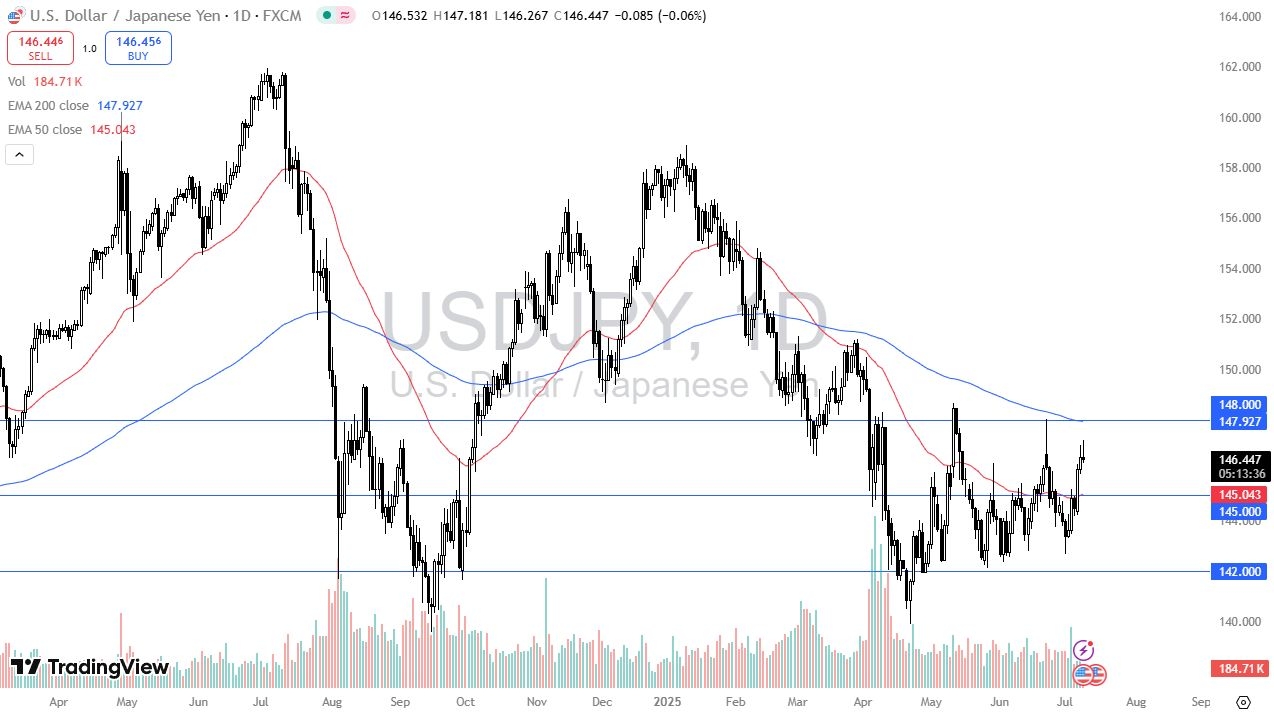
I believe that the interest rate differential will eventually propel the US dollar higher against Japanese yen, especially considering the fact that the Japanese bond market is a bit of a disaster at the moment. The Bank of Japan may have to step in and start buying bonds, which is essentially the same thing as quantitative easing, so that could really play havoc on the Japanese yen. That being said, they have not done it yet, so there is a little bit of hesitation and there are a lot of questions asked of whether or not they would actually do it. Or, you also have to keep in mind that we are in a downtrend to get this is area, and typically speaking, consolidation leads to continuation. However, the fundamentals don’t necessarily scream that we should be selling off.
When we do pull back, I’ll be looking for buying opportunities underneath current levels, such as the ¥145 region, followed by the ¥142 region. Ultimately, I think it’s only a matter of time before we see value hunters coming back into the market, but if we were to break above the ¥148 level, then we snap through the 200 Day EMA, which of course would be very bullish to say the least. If that were to happen, then I would anticipate that we have a longer-term “buy-and-hold” type of market. Ultimately, I think we do see a lot of volatility, but I’ll be looking to buy the dip here as we should continue to go back and forth in this range in the short term, before finally breaking out and making a bigger move.
Want to trade our USD/JPY forex analysis and predictions? Here’s a list of forex brokers in Japan to check out.
Christopher Lewis has been trading Forex and has over 20 years experience in financial markets. Chris has been a regular contributor to Daily Forex since the early days of the site. He writes about Forex for several online publications, including FX Empire, Investing.com, and his own site, aptly named The Trader Guy. Chris favours technical analysis methods to identify his trades and likes to trade equity indices and commodities as well as Forex. He favours a longer-term trading style, and his trades often last for days or weeks.