The main category of Forex News.
You can use the search box below to find what you need.
[wd_asp id=1]
The main category of Forex News.
You can use the search box below to find what you need.
[wd_asp id=1]
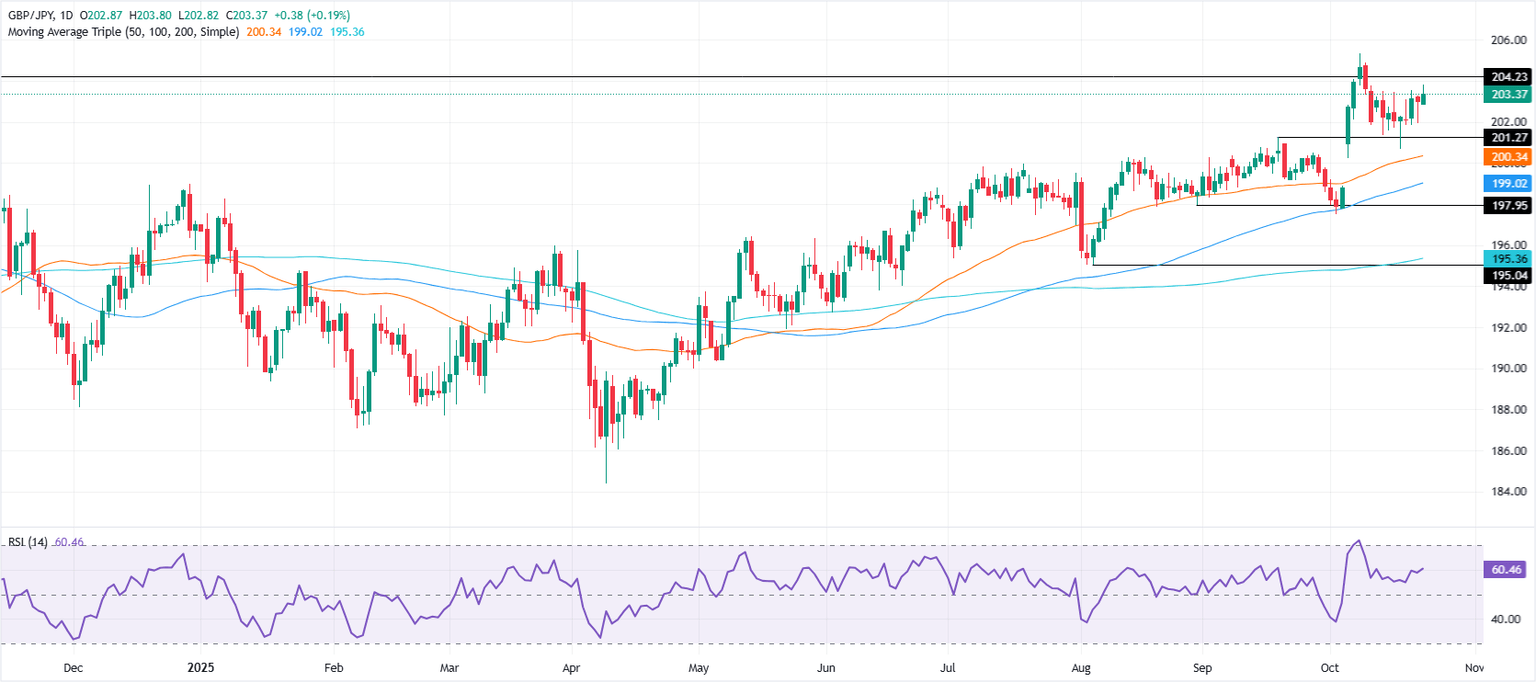
The GBP/JPY extended its gains on Thursday, ending up 0.19% at around 203.30, up so far in the week close to 0.55%. At the time of writing, as Friday’s Asian session begins, the cross-pair trades at 203.36 virtually unchanged.
From a technical standpoint, the GBP/JPY remains subdued after dropping to a nine-day low of 200.68, in October 17. Nevertheless, the pair has recovered some ground, and it seems poised to test higher prices.
The Relative Strength Index (RSI) shows that buyers are gathering momentum as the RSI is bullish.
With that said, the first resistance would be 203.50. If surpassed the next stop would be 204.00, followed by October 8 yearly high of 205.32. Conversely, if GBP/JPS tumbles below 203.00, the first support would be the 202.00 mark, followed by the 20-day Simple Moving Average (SMA) at 201.87.
The table below shows the percentage change of British Pound (GBP) against listed major currencies this week. British Pound was the strongest against the Japanese Yen.
| USD | EUR | GBP | JPY | CAD | AUD | NZD | CHF | |
|---|---|---|---|---|---|---|---|---|
| USD | 0.42% | 0.78% | 1.36% | -0.22% | -0.36% | -0.30% | 0.40% | |
| EUR | -0.42% | 0.36% | 1.03% | -0.64% | -0.68% | -0.79% | -0.01% | |
| GBP | -0.78% | -0.36% | 0.43% | -1.00% | -1.04% | -1.15% | -0.39% | |
| JPY | -1.36% | -1.03% | -0.43% | -1.62% | -1.74% | -1.73% | -1.05% | |
| CAD | 0.22% | 0.64% | 1.00% | 1.62% | -0.10% | -0.15% | 0.63% | |
| AUD | 0.36% | 0.68% | 1.04% | 1.74% | 0.10% | -0.11% | 0.66% | |
| NZD | 0.30% | 0.79% | 1.15% | 1.73% | 0.15% | 0.11% | 0.77% | |
| CHF | -0.40% | 0.00% | 0.39% | 1.05% | -0.63% | -0.66% | -0.77% |
The heat map shows percentage changes of major currencies against each other. The base currency is picked from the left column, while the quote currency is picked from the top row. For example, if you pick the British Pound from the left column and move along the horizontal line to the US Dollar, the percentage change displayed in the box will represent GBP (base)/USD (quote).
The 20-day average emerged as key support after Tuesday’s sharp drop breached the 10-day line. Since late August, gold has leaned on the 10-day average for dynamic support, but the top rising channel line, tested at $4,066 today, now joins the 20-day as a critical floor. Holding here keeps the bullish structure intact.
The pullback remains mild, and Wednesday’s hammer at the 20-day line hints at a potential reversal. A breakout above $4,161—Wednesday’s high—would trigger the hammer, likely reclaim the 10-day average and target Tuesday’s wide $4,080-$4,375 range. Such a move signals shifting momentum, with recent highs back in play.
With one session left, the weekly chart shows limited damage—a higher weekly low and slightly higher high suggest resilience. Tuesday’s aggressive selloff, however, implies consolidation within its $4,080-$4,375 range may precede a clear advance. The 20-day support test flags a possible bottom, but time may be needed to solidify gains.
Gold’s pause at $4,039 support sets up either sideways consolidation or a bounce-and-reverse. A close above $4,161 fuels bullish hopes toward $4,375, while sub-$4,039 risks deeper tests. The weekly pattern leans slightly bullish if $4,066 holds. Watch today’s close—breakout signals strength, but Tuesday’s range could cap near-term moves.
For a look at all of today’s economic events, check out our economic calendar.
“I believe that now is a prime opportunity to raise the policy interest rate. The once deeply entrenched norm has waned in Japan, that the price stability target has been almost achieved.”
Notably, the BoJ must weigh the benefits of a weaker yen boosting exports and the negative effects of higher import costs on households.
On Wednesday, October 22, former BoJ board member Eiji Maeda hinted at a December or January rate hike, stating:
“Moving too slowly in policy normalization would hurt people’s livelihoods by weakening the yen and accelerating inflation.”
As the dust settles from the inflation report, traders will now turn their attention to flash private sector PMI numbers.
The market focus will likely be on the Services PMI, given that the sector contributes over 70% to Japan’s GDP. Economists forecast the S&P Global Services PMI to drop from 53.3 in September to 53.0 in October.
A sharper drop in the headline PMI could signal a loss of economic momentum, potentially tempering bets on a BoJ rate hike. A more dovish BoJ policy stance may weigh on the Japanese yen. Conversely, a higher PMI reading could boost expectations of a BoJ rate hike.
However, traders should also consider input and output prices and the employment sub-components. Softer wage growth, weaker output prices, and job cuts would support a delay to monetary policy tightening. On the other hand, higher wages, stronger output prices, and rising jobs would suggest a more hawkish rate path.
Across the Pacific, US S&P Global Services PMI and Michigan Consumer Sentiment Index numbers will fill an economic data void as the US government shutdown enters day 24.
Economists forecast the Services PMI to fall from 54.2 in September to 53.5 in October.
A sharper drop toward the 50 neutral level would signal a marked loss of economic momentum, given that services contribute around 80% to US GDP. Additionally, traders should consider the employment and prices sub-components. Lower prices, job cuts, and slower services sector activity would support a more dovish Fed rate path, pushing USD/JPY toward 150.
Conversely, a pickup in services sector activity, higher prices, and rising employment could temper bets on multiple Fed rate cuts. A less dovish Fed rate path may send USD/JPY toward the August high of 153.274.
While the services sector data will be key, the Michigan Consumer Sentiment Index could also move the dial. According to preliminary data, the Michigan Consumer Sentiment Index slipped from 55.1 in September to 55.0 in October.
A downward revision could signal a pullback in consumer spending, dampening demand-driven inflation. A softer inflation outlook would support multiple Fed rate cuts and a USD/JPY fall toward 150. On the other hand, a higher reading could challenge bets on multiple Fed rate cuts, sending the pair toward 153.274. While the consumer sentiment figures will draw interest, the Services PMI will have more impact on the USD/JPY pair.
Market scenarios for USD/JPY will hinge on central bank rhetoric and trade headlines.
– Written by
Tim Boyer
STORY LINK GBP/USD Price Forecast: Pound Sterling Holds Near 1.33 on Safe-Haven Demand
The Pound to US Dollar exchange rate (GBP/USD) was little changed on Thursday, as renewed US-China trade tensions lifted demand for the safe-haven Dollar while dovish Bank of England (BoE) expectations weighed on Sterling.
At the time of writing, GBP/USD was trading at 1.3329, down 0.15% on the day.
The US Dollar (USD) held firm throughout Thursday’s European session, finding support as risk sentiment soured amid reports of renewed trade strains between Washington and Beijing.
According to sources, the Trump administration is weighing new restrictions on software and technology exports to China — a move that reignited investor caution and encouraged a shift into safer assets.
Despite a quiet US data calendar, the ‘Greenback’ advanced against risk-sensitive currencies, underpinned by the day’s risk-off tone and speculation that the Federal Reserve may proceed cautiously with future rate cuts.
The Pound (GBP), meanwhile, struggled to regain momentum after Wednesday’s weaker-than-expected inflation data continued to drag on sentiment.
The softer September CPI reading has led investors to bring forward expectations for BoE rate cuts, with some now predicting a potential move as early as December.
Get better rates and lower fees on your next international money transfer.
Compare TorFX with top UK banks in seconds and see how much you could save.
As a result, Sterling traded in a narrow range on Thursday, with market participants largely unwilling to rebuild long GBP positions ahead of key UK data due on Friday.
Friday brings a busy data slate for both sides of the pair that could inject fresh volatility into GBP/USD.
In the UK, retail sales for September are forecast to fall by -0.2%, pointing to subdued household spending and adding to evidence of a cooling economy.
However, a modest uptick in the UK’s preliminary services PMI could provide partial relief, signalling that the broader economy retains some resilience despite weakening demand.
Across the Atlantic, attention turns to the latest US inflation figures, with headline CPI expected to rise from 2.9% to 3.1%, while core inflation is seen holding steady.
Stronger-than-forecast readings could bolster the Dollar by tempering expectations for near-term Fed rate cuts, while a softer outcome may trigger renewed USD selling pressure into the weekend.

International Money Transfer? Ask our resident FX expert a money transfer question or try John’s new, free, no-obligation personal service! ,where he helps every step of the way,
ensuring you get the best exchange rates on your currency requirements.
TAGS: Pound Dollar Forecasts
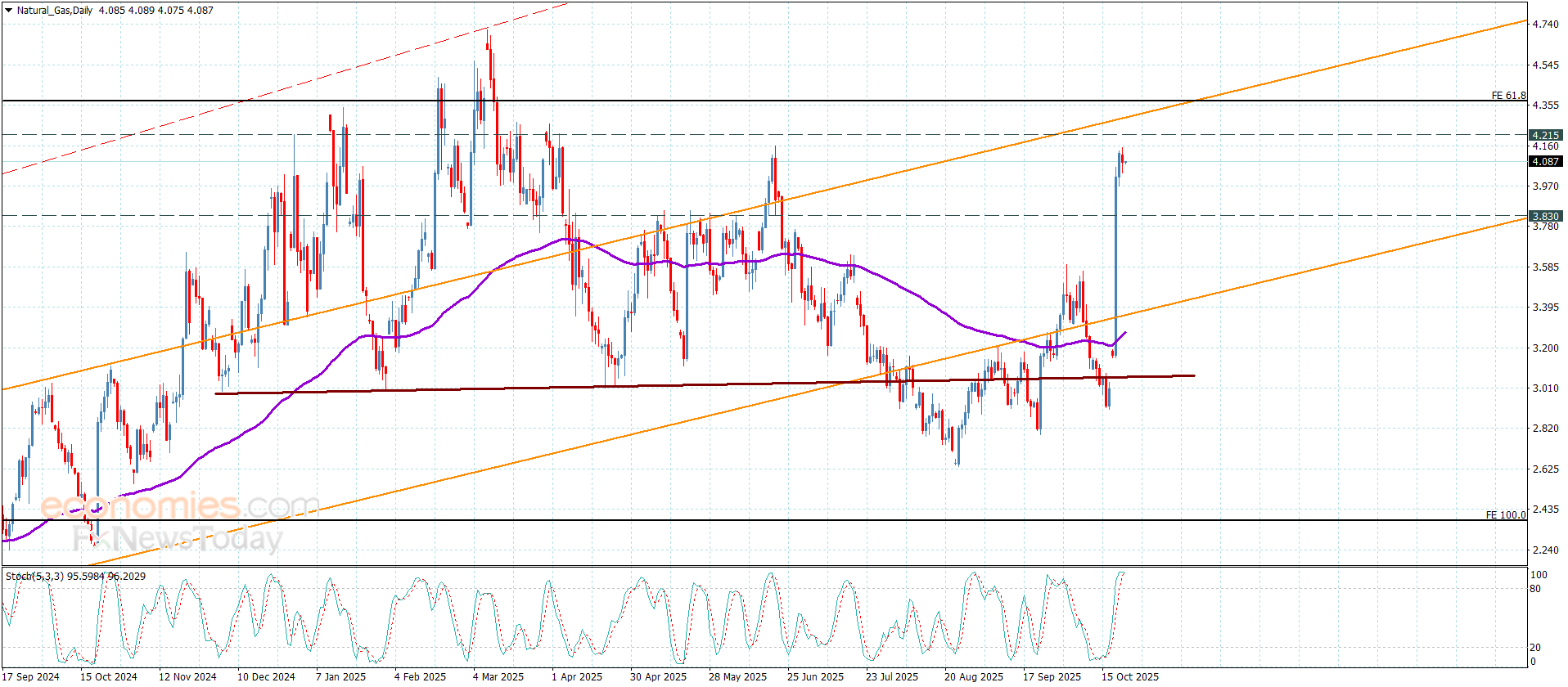
A $3.55-$3.59 resistance range, defined by weekly highs in three of the past four weeks, includes the 61.8% Fibonacci retracement at $3.55 and the nearby 200-day moving average at $3.46. While no breakout above $3.59 has occurred, recent strength suggests improving demand, hinting at a potential push through if momentum rebuilds after this pullback.
Despite resistance, the rising near-term uptrend shows promise for a $3.59 breakout, establishing a higher swing high and confirming continuation. An initial target at $3.71 aligns with a rising ABCD pattern, matching prior upswing magnitude, and may test the 25% extended top rising channel line. The rally from August’s $2.89 low mirrors earlier sharp advances. Strength was shown by a reclaim of the channel centerline, 20-day average, long-term uptrend line, and downtrend line, with three days partially above the 200-day average signaling vigor, though unsustainable so far.
A break below today’s $3.31 low would breach the downtrend line, a minor bearish signal targeting the 20-day average at $3.27, currently rising. This level becomes critical to gauge if buyers can defend the uptrend’s structure or if deeper weakness emerges.
The $3.39 close decides the day—below it confirms pullback momentum toward $3.27, above it keeps breakout hopes alive. The $3.55-$3.59 zone remains the hurdle for bulls aiming at $3.71. Watch today’s action: strength preserves the uptrend, but a downtrend line break signals caution until support firms up.
For a look at all of today’s economic events, check out our economic calendar.
On the chart, we have the day that is circled, representing the FOMC interest rate decision and press conference. The US dollar has done pretty much nothing but strengthen since then, although again, the British pound has put up a bigger fight against it than many others.
The euro is slightly stronger against the British pound during the trading session on Thursday, but at this point in time, we continue to move sideways, right around the 50-day EMA. The 50-day EMA sits in the middle of a larger consolidation area, with the 0.86 level on the bottom and the 0.8750 level on the top representing your support and resistance areas. Ultimately, this shows the neutrality between these two currencies as of late.
So that’s why they’re moving in tandem against the US dollar, or at least it helps you determine that one is not particularly stronger than the other. Ultimately, though, when I look at this chart, once we break out of this range, we should have a fairly decent move on our hands. Range-bound traders right now continue to bounce around about a 40 pip range.
For a look at all of today’s economic events, check out our economic calendar.
Platinum price ended the bearish corrective attack by targeting $1490.00 level, to form strong bullish rebound by its rally towards $1633.00, attempting to reduce the effect of the intraday bearish pressure on the current period.
We couldn’t confirm activating the positive track until providing new positive close above$1605.00 to ease the mission of targeting some positive stations that are located near $1665.00 and $1695.00, while the decline below $1605.00 will force the price to form new bearish waves, attempting to reach $1525.00.
The expected trading range for today is between $1570.00 and $1665.00
Trend forecast: Fluctuated within the bullish track.
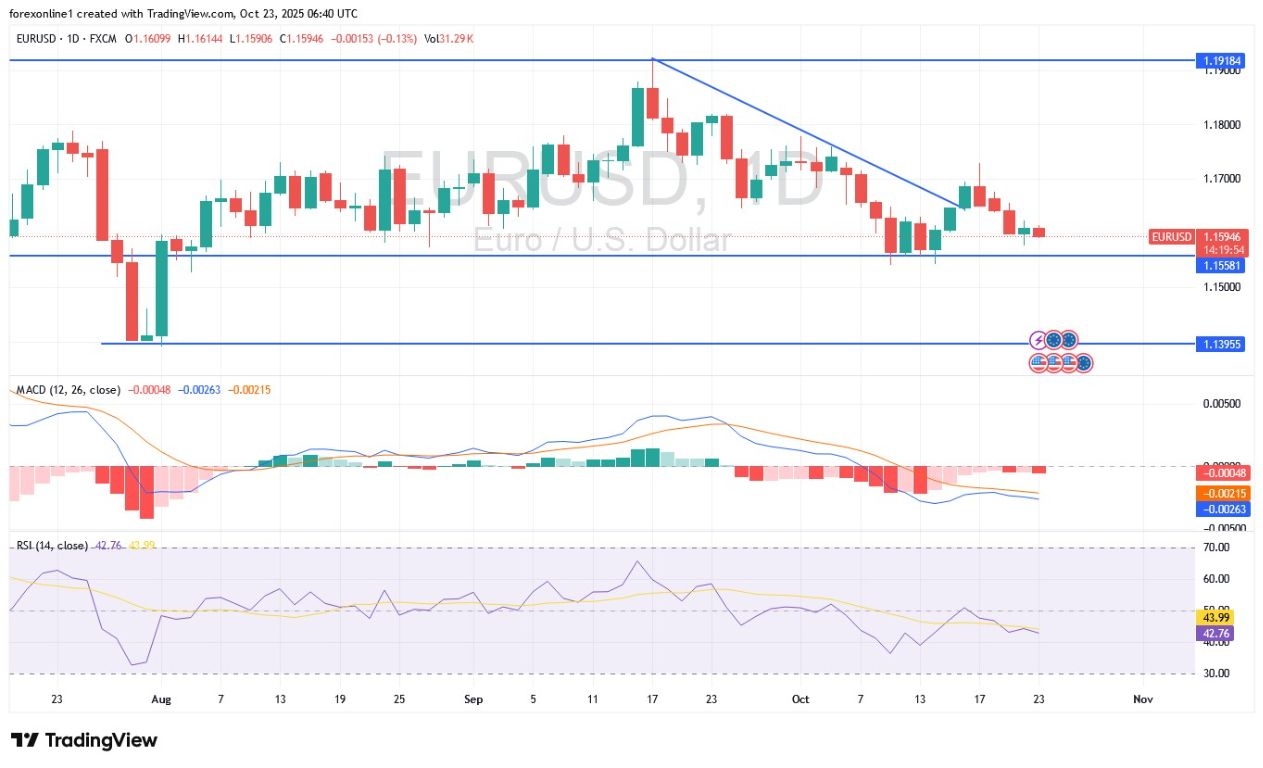
As anticipated, the bearish bias for EUR/USD has strengthened, moving towards and below the 1.1600 support level. During yesterday’s trading session, the most famous currency pair in the Forex market saw losses extend to the 1.1576 support level, near its lowest point in a week, before stabilizing around the 1.1610 level at the time of writing this analysis. Overall, the EUR/USD bias may remain bearish as traders now look to US inflation data for clues on whether the Federal Reserve will implement another interest rate cut next week.

The consolidation of the 14-day Relative Strength Index (RSI) around a reading of 43, below the neutral line, confirms the bearish shift for the EUR/USD pair across reliable trading platforms. Despite the losses, the pair still has more room for stronger declines before reaching oversold territory. This could happen if the bears succeed in pushing towards the support levels of 1.1540, 1.1470, and 1.1400, respectively.
As we mentioned before, the EUR/USD pair’s upward trend, based on the daily chart, will continue to be contingent on a move towards the 1.1800 resistance level again.
Wait for the reaction to the US inflation figures to anticipate the most appropriate EUR/USD trades, whether to buy or sell.
According to Forex market trading, the EUR/USD exchange rate failed to breach the 1.1700 area at the start of this week’s trading and quickly inclined to move towards and below the 1.1600 support as the US Dollar achieved net gains in currency markets. Although the 10-year US Treasury yield remained below 4.00%, the US Dollar still managed to post net gains while the Yen recorded sharp losses.
Regarding the future of currency prices, UoB Bank does not expect a breakout; while a calmer fundamental tone suggests a potential drop in the Euro price today, any decline is likely to be part of a lower range between 1.1625 and 1.1660. However, according to ING Bank, there is room for further short-term decline; “EUR/USD remains almost entirely driven by US credit/equity sentiment. Accordingly, further stability could lead to EUR/USD trading reaching the 1.160 support. Levels below that will be difficult to justify unless Friday’s US CPI comes in higher than expected.”
Overall, US interest rate expectations will be a key market influencer.
At this stage, traders are pricing in a near-100% chance of a US rate cut at next week’s meeting, and the Federal Reserve has not expressed any objection. In this regard, Rabobank commented, “The FOMC remains likely to make another cut in October, even if the committee’s vision is limited. In the absence of convincing evidence to go beyond October or to make a larger cut in October, the FOMC is operating automatically.”
Generally, financial markets also estimate a probability exceeding 95% for an additional 25 basis point US interest rate cut in December. Before that, with the government shutdown, US markets continue to operate with a scarcity of data, which increases the risk of misjudging subsequent meetings.
Ready to trade our EUR/USD daily forecast? Here’s a list of some of the top forex brokers in Europe to check out.
Bitcoin (BTCUSD) prices settled with cautious gains during their last intraday trading, after the stability of the key support of $107,400, gaining bullish momentum that helped it to achieve these gains and surpass the resistance of its EMA50, however the main bearish trend remains the dominant on the trading, especially with its trading alongside supportive trendline, besides the relative strength indicators reaching sever overbought levels compared to the price move, indicating the beginning of forming negative divergence, which intensified the negative pressure on the price.
Get high-accuracy trading signals delivered directly to your Telegram. Subscribe to specialized packages tailored for the world’s top markets:
Full VIP signals performance report for 13-17, October 2025:
View Full Performance Report Telegram (https://t.me/besttradingsignalstocksbot?start=p88d632b0-66dd-11f0-a948-13815052d5ae)
The British Pound is has reverted to Wednesday’s pullback and trades at the upper range of the 203.00s, as news that the new Japanese government should be preparing a large stimulus program is hammering the Yen on Thursday.
Reuters has reported, citing a government document, that Prime Minister Takaichi’s cabinet would be planning a USD 90 billion stimulus package to support households against the impact of increasing prices. This stimulus would come less than a year after a similar one introduced in 2024 and is expected to add pressure on the already strained public finances.
The technical picture shows the bulls in control and trying to confirm above the resistance area between the top of an ascending wedge pattern and the October 10 high, at the 203.75 area. The 4-hour RSI remains well above the 50 level, and the MACD is about to perform a bullish cross, which reinforces the positive outlook.
A successful break of that resistance area would shift the focus to the October 9 high, at 204.85, ahead of the year-to-date high, at 205.33.
To the downside, trendline support is at the 202.80 area, ahead of the October 21 and 22 lows, in the area of 201.90. Further down, the key 202.790 support (October 17 low) emerges as the next plausible target.
The table below shows the percentage change of Japanese Yen (JPY) against listed major currencies today. Japanese Yen was the strongest against the Swiss Franc.
| USD | EUR | GBP | JPY | CAD | AUD | NZD | CHF | |
|---|---|---|---|---|---|---|---|---|
| USD | 0.17% | 0.12% | 0.52% | -0.01% | -0.26% | -0.07% | 0.28% | |
| EUR | -0.17% | -0.05% | 0.32% | -0.17% | -0.42% | -0.24% | 0.12% | |
| GBP | -0.12% | 0.05% | 0.37% | -0.11% | -0.37% | -0.19% | 0.17% | |
| JPY | -0.52% | -0.32% | -0.37% | -0.51% | -0.74% | -0.58% | -0.21% | |
| CAD | 0.00% | 0.17% | 0.11% | 0.51% | -0.24% | -0.06% | 0.29% | |
| AUD | 0.26% | 0.42% | 0.37% | 0.74% | 0.24% | 0.18% | 0.54% | |
| NZD | 0.07% | 0.24% | 0.19% | 0.58% | 0.06% | -0.18% | 0.36% | |
| CHF | -0.28% | -0.12% | -0.17% | 0.21% | -0.29% | -0.54% | -0.36% |
The heat map shows percentage changes of major currencies against each other. The base currency is picked from the left column, while the quote currency is picked from the top row. For example, if you pick the Japanese Yen from the left column and move along the horizontal line to the US Dollar, the percentage change displayed in the box will represent JPY (base)/USD (quote).